
Judge, 1903-10-10 · page 5 of 16
Judge — October 10, 1903 — page 5: what you’re looking at
What you’re looking at
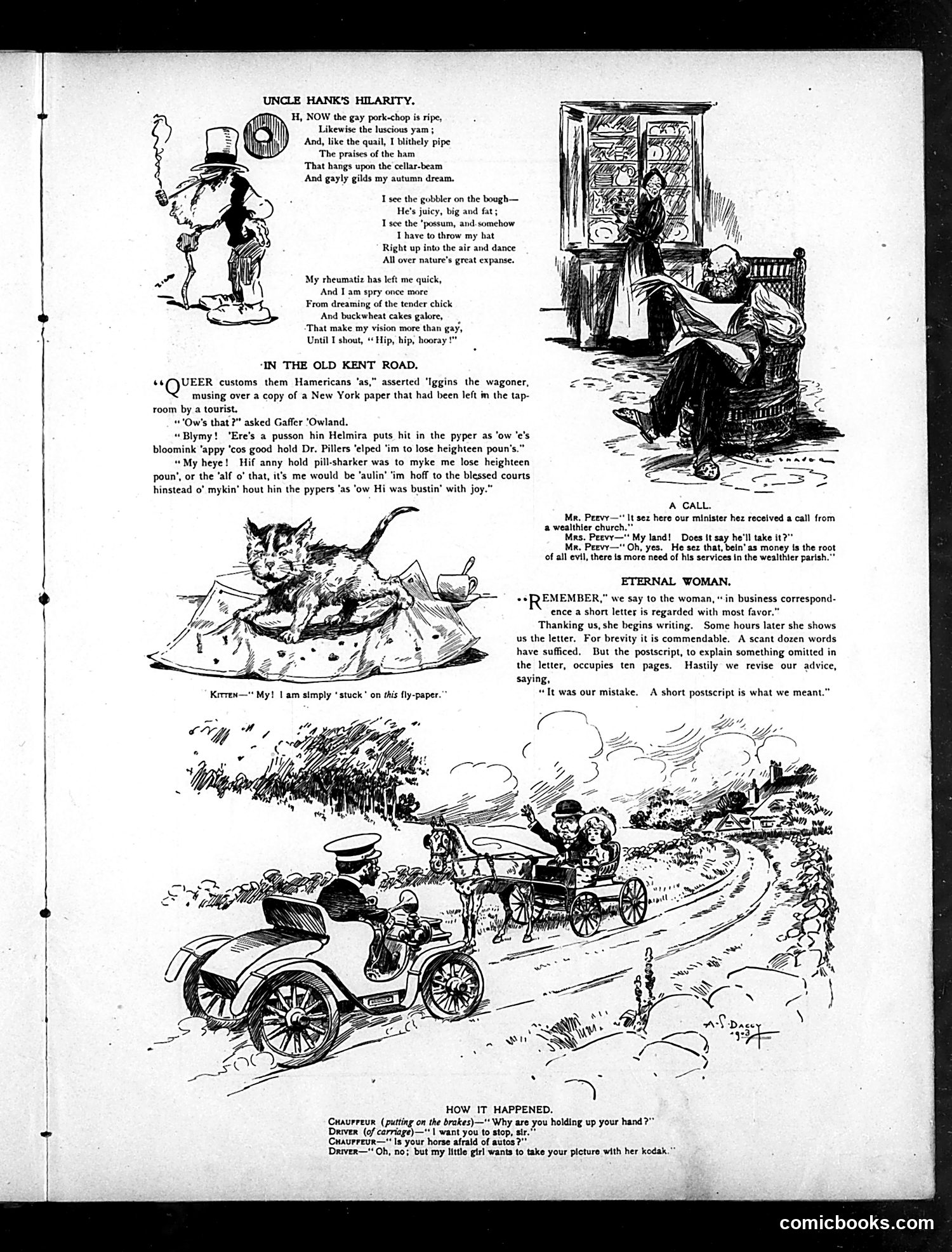
This page contains three separate humorous pieces typical of early 20th-century American satire: **"Uncle Hank's Hilarity"** presents rustic nostalgia—a country figure celebrating autumn harvest foods (pork, yams, ham, turkey, possum) with such enthusiasm that his rheumatism vanishes. The humor lies in the exaggerated sentimentality and dialect. **"In the Old Kent Road"** mocks American health culture through British working-class characters expressing bewilderment that an American would publicly celebrate weight loss or consult a doctor. The satire critiques American enthusiasm for medical self-improvement as peculiar. **"A Call"** jokes about ministerial hypocrisy: a pastor accepts a lucrative position at a wealthier church while claiming poverty's spiritual necessity—the irony being his stated principle contradicts his actions. **"How It Happened"** satirizes the new automobile era and kodak photography craze, suggesting even children now document life mechanically rather than simply experiencing it. The page reflects early 1900s American anxieties about modernity, changing values, and class distinction.
📄 Transcribed text from this page (OCR, searchable)
Machine-transcribed from the original scan — historical spelling and the odd misread are preserved.
UNCLE HANK’S HILARITY. H, NOW the gay pork-chop is ripe, Likewise the luscious yam ; And, like the quail, I blithely pipe The praises of the ham That hangs upon the cellar-beam And gayly gilds my autumn dream. I sce the gobbler on the bough— He's juicy, big and fat ; I sce the ‘possum, and.somehow Thave to throw my hat Right up into the air and dance All over nature's great expanse. My rheumatiz has left me quick, And I'am spry once more From dreaming of the tender chick And buckwheat cakes galore, ‘That make my vision more than g: Until I shout, “Hip, hip, hooray ‘IN THE OLD KENT ROAD. S6C)UEER customs them Hamericans ‘as,” asserted ‘Iggins the wagoner, musing over a copy of a New York paper that had been left im the tap- room by a tourist. “'Ow's that ?” asked Gaffer ‘Owland. “Blymy! ‘Ere’s a pusson hin Helmira puts hit in the pyper as ‘ow ‘e's bloomink ‘appy ‘cos good hold Dr. Pillers ‘elped ‘im to lose heighten poun's.”” “My heye! Hif anny hold pill-sharker was to myke me lose heighteen poun’, or the ‘alf o’ that, it's me would be ‘aulin’ ‘im hoff to the blessed courts hinstead o' mykin’ hout hin the pypers ‘as ‘ow Hi was bustin’ with joy.” A CALL. Mr. Peevy—*' It sez here our minister hez received a call from ‘a wealthier church.” Rs. Peevy—" My land! Does it say he'll take it?” Mr. Peevy—"* Oh, yes. He sez that, bein’ as money {s the root of all evil, there is more need of his services in the wealthier parish." ETERNAL WOMAN. ++ REMEMBER,” we say to the woman, “in business correspond- ence a short letter is regarded with most favor.” Thanking us, she begins writing. Some hours later she shows us the letter. For brevity it is commendable. A scant dozen words have sufficed. But the postscript, to explain something omitted in the letter, occupies ten pages. Hastily we revise our advice, saying, “It was our mistake. A short postscript is what we meant.” HOW IT HAPPENED. Cuaurreur (putting on the brakes)—"* Why are you holding up your hand?” Driver (of carriage)—'*| want you to stop, sir.” Cxaurreur—"* ls your horse afraid of autos?" Daiver—' Oh, no; but my little girl wants to take your picture with her kodak.” comicbooks.com