
A complete issue · 16 pages · 1903
Judge — September 26, 1903
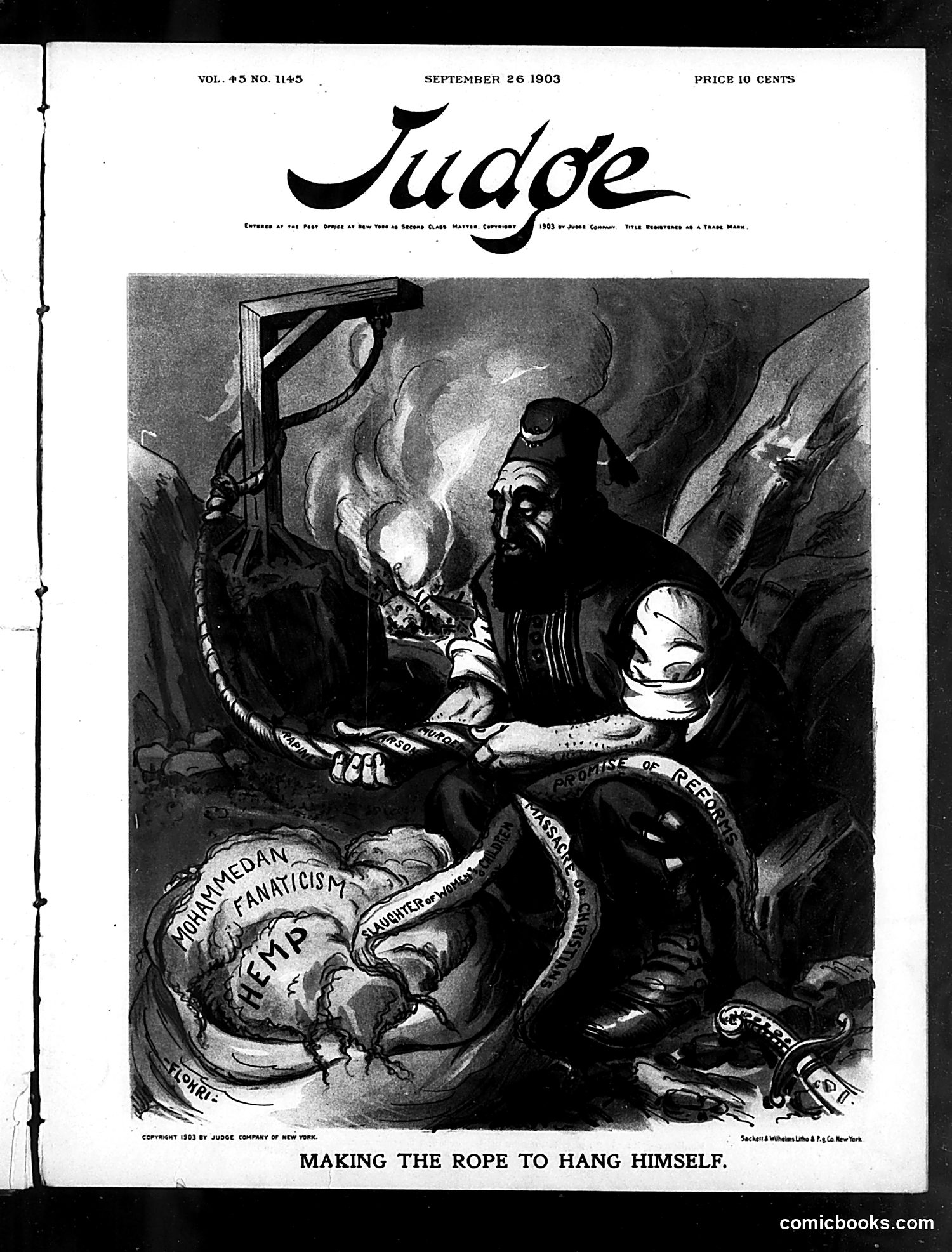
This September 1903 *Judge* cartoon satirizes what appears to be a political figure (likely a politician or public official) being manipulated by symbolic forces. The demon-like figure represents malevolent influences—possibly corruption or poor judgment—while the wrapped figure labeled with terms like "fanaticism," "hemp," and references to "rest" suggests self-destructive behavior. The title "Making the Rope to Hang Himself" is a metaphorical warning: the subject is creating the means of his own downfall through foolish or stubborn decisions. The demonic imagery and hellish setting underscore the moral condemnation. The specific political context remains unclear without additional historical documentation, but the cartoon warns against allowing oneself to be guided by destructive impulses or ideologies that lead to personal ruin.
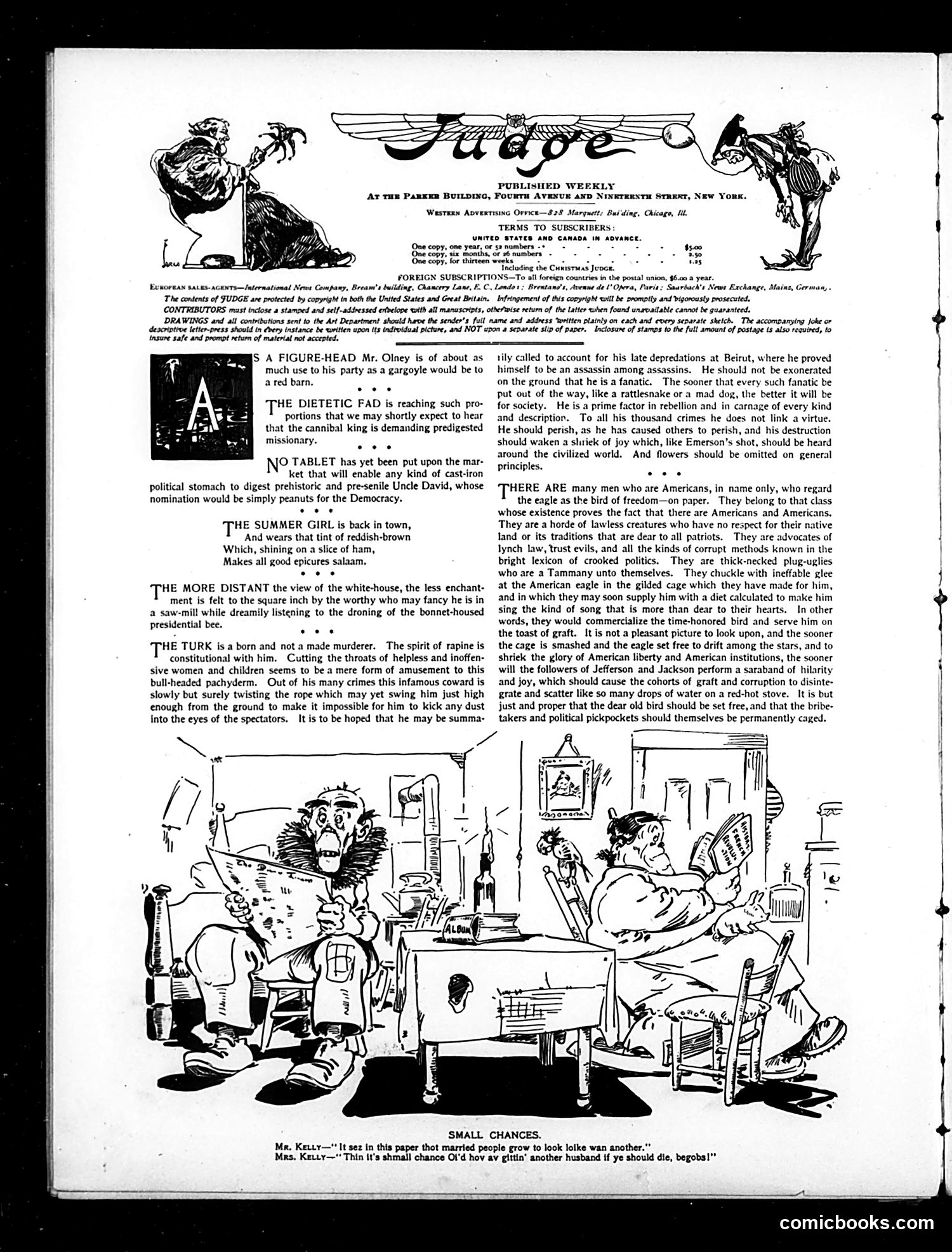
This page contains political commentary and satire typical of early 20th-century Judge magazine. The main text attacks several targets: a man named Olney (appears to be a political figure), the "dietetic fad" (dietary trends), and crucially, describes "Americans in name only" — men who claim patriotism while engaging in corruption, lynch mobs, and political graft. The lower cartoon titled "Small Chances" depicts a domestic scene where Mr. Kelly warns Mrs. Kelly that married couples grow to resemble each other, joking grimly about becoming like "another husband" — the humor depends on marital discord being common enough to joke about death as preferable. The illustrations satirize both political hypocrisy and era-specific social commentary, though specific figures and dates aren't clearly identified in the visible text.
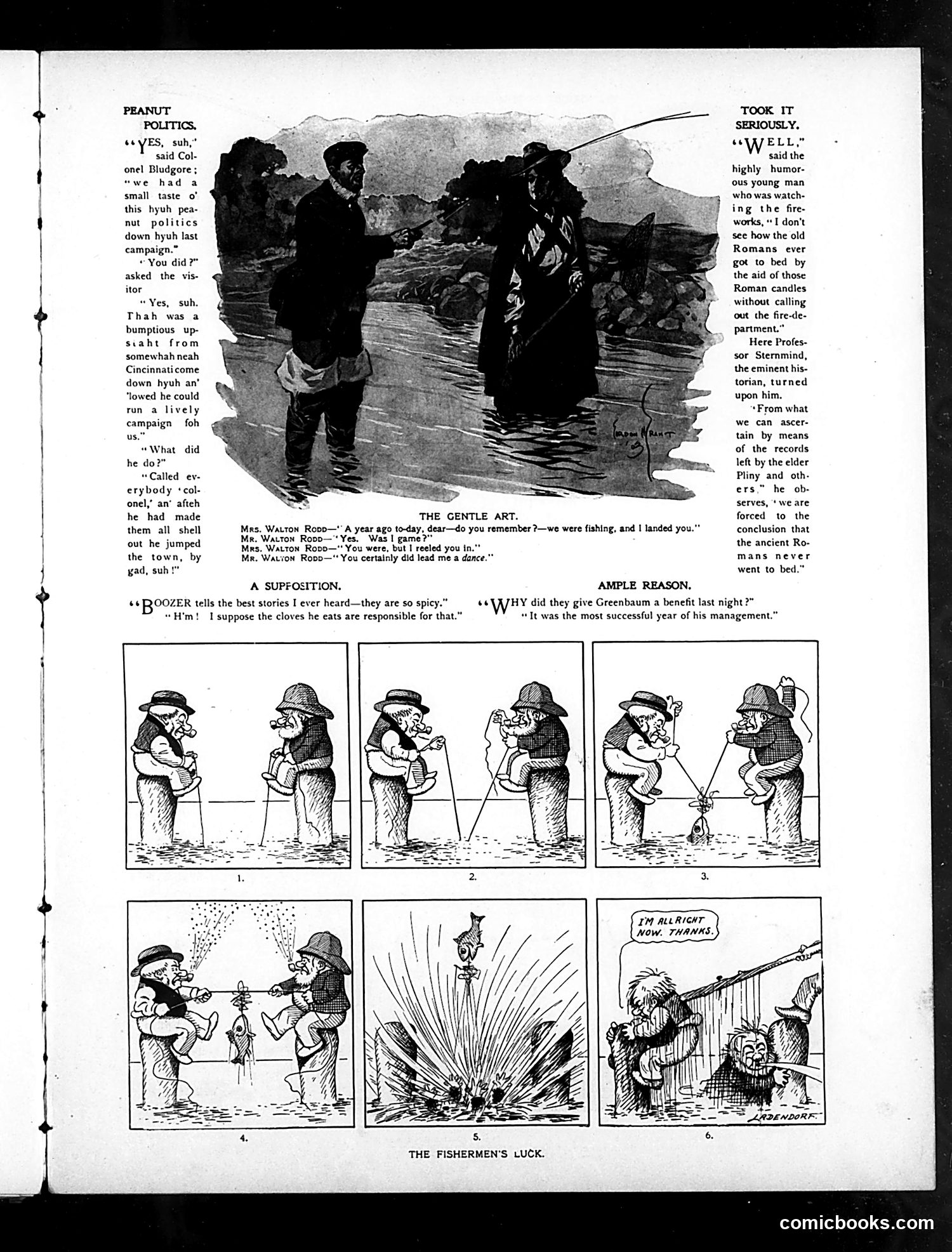
This page contains two separate pieces: **"Peanut Politics"** (top): A conversation between Colonel Bludgore and a visitor about Cincinnati politics. Bludgore describes running a "humorous" political campaign, joking that he "called everybody 'colonel'" and made promises he didn't keep. The satire mocks American political corruption and empty campaigning—specifically how politicians use informal charm and false titles to win votes while having no genuine policy platform. **"The Fisherman's Luck"** (bottom comic strip): A six-panel sequence showing two fishermen. Through increasingly comedic exchanges involving their fishing line, it culminates in an explosion (panel 5) and apparent injury (panel 6). The humor relies on physical comedy and the unexpected violent payoff to their interaction. Both pieces use satire to mock recognizable social behaviors—political dishonesty and fishing mishaps—for Judge's readers.
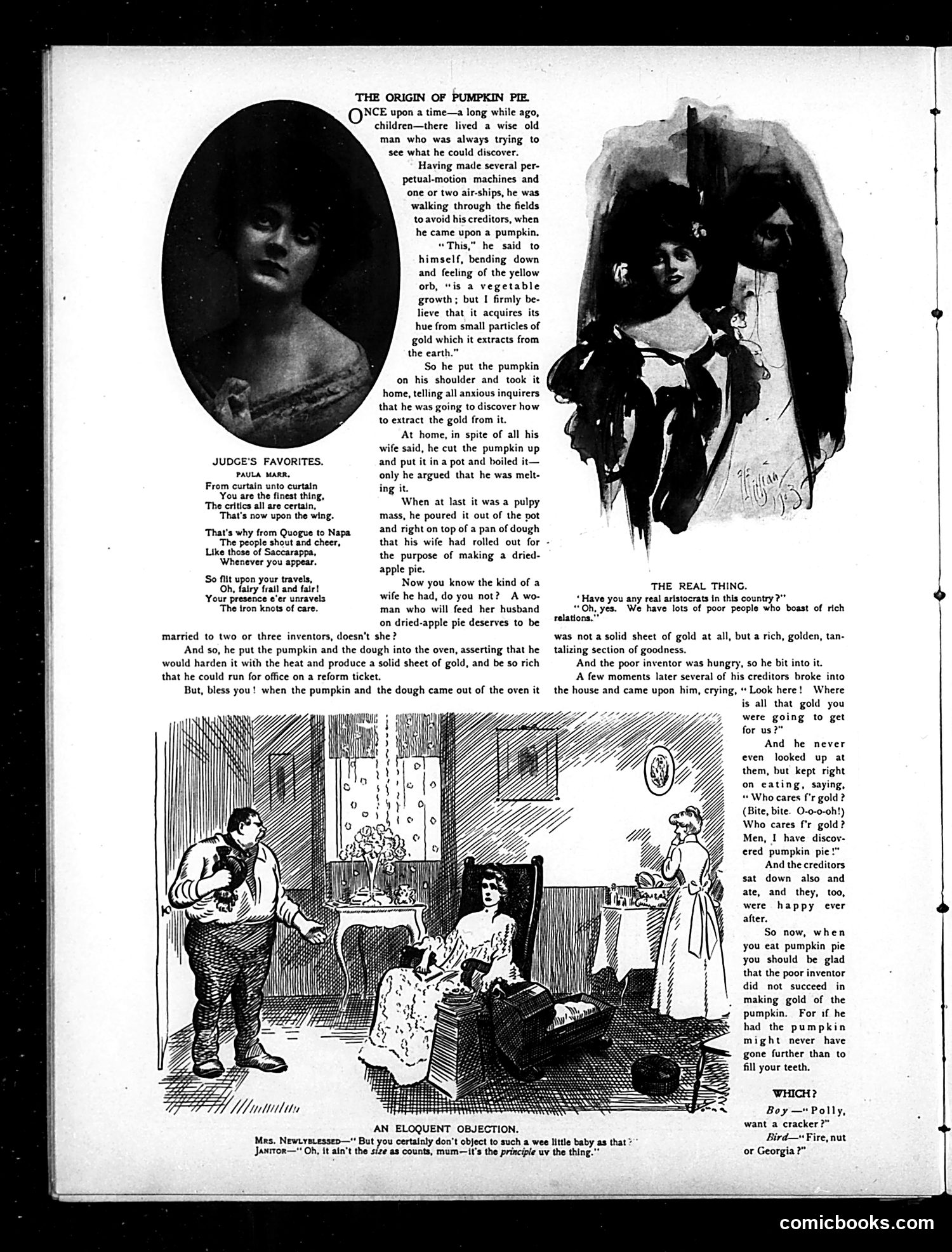
This page presents a humorous folk tale explaining pumpkin pie's invention. A poor inventor, seeking to extract gold from pumpkins (believing they contained particles of precious metal), boils one down. His skeptical wife, tired of his failed schemes, uses the resulting mush to make dried-apple pie instead. The satire targets two things: first, the gullibility of inventors pursuing absurd schemes; second, the irony that failure produces something genuinely valuable—pumpkin pie becomes beloved by his creditors, who cease their complaints once fed. The accompanying illustrations and verse ("Judge's Favorites") mock the pretensions of inventors while celebrating practical domestic resourcefulness. The joke ultimately celebrates pumpkin pie's worth despite (or because of) its humble, accidental origins.
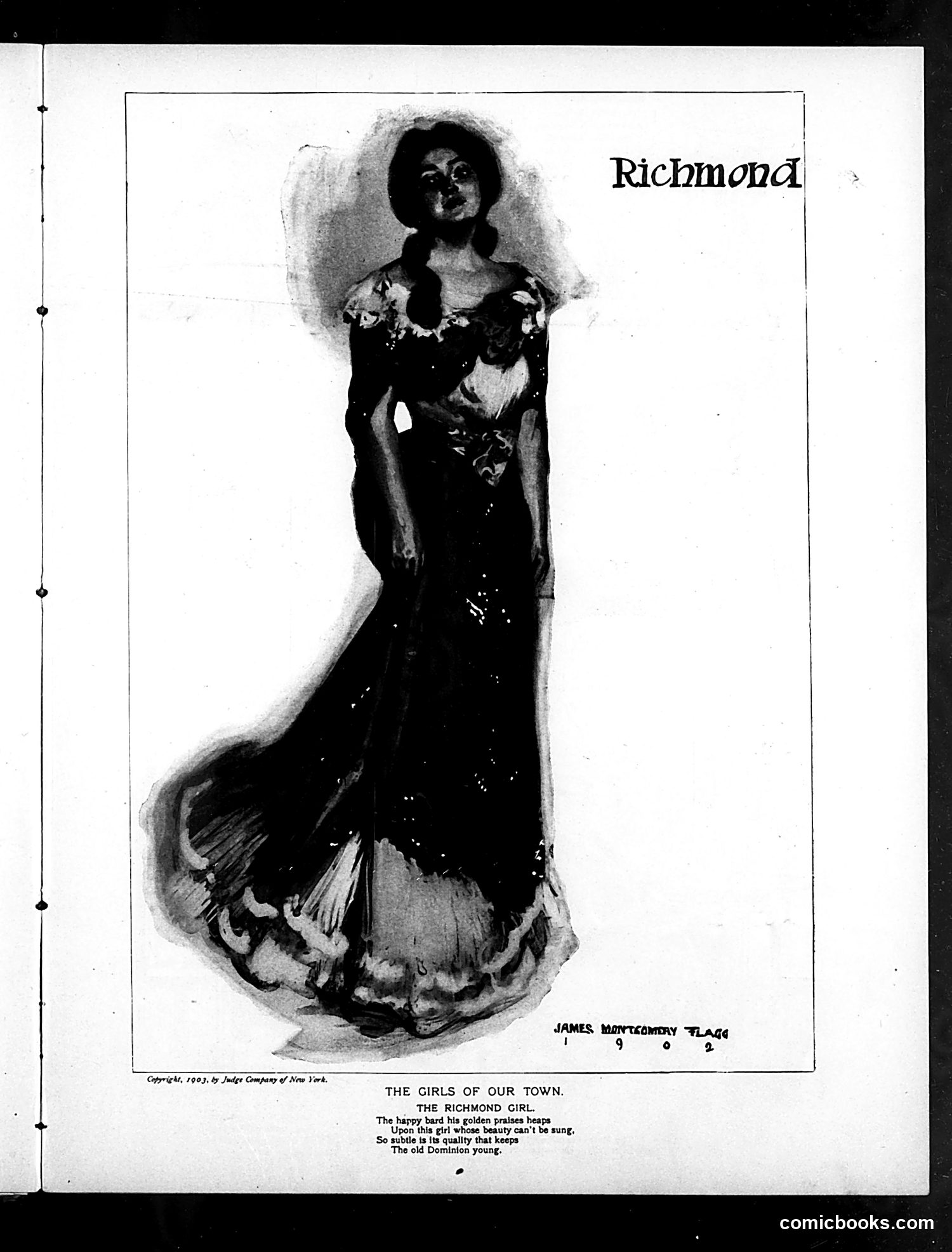
This illustration by James Montgomery Flagg depicts an idealized young woman representing Richmond, Virginia. The accompanying verse celebrates her ethereal beauty—described as so "subtle" it defies description—and credits her with keeping "the old Dominion young." "The old Dominion" is a historical nickname for Virginia, referencing its colonial significance. The satire appears gentle: Flagg's romanticized portrayal ironically suggests that Richmond's vitality depends on feminine beauty rather than economic or political substance. This fits *Judge* magazine's pattern of satirizing regional characteristics through personified "girls of our town," using exaggerated aesthetic idealization to humorously comment on regional identity and pride. The work exemplifies early-20th-century American satirical illustration blending flattery with subtle social commentary.
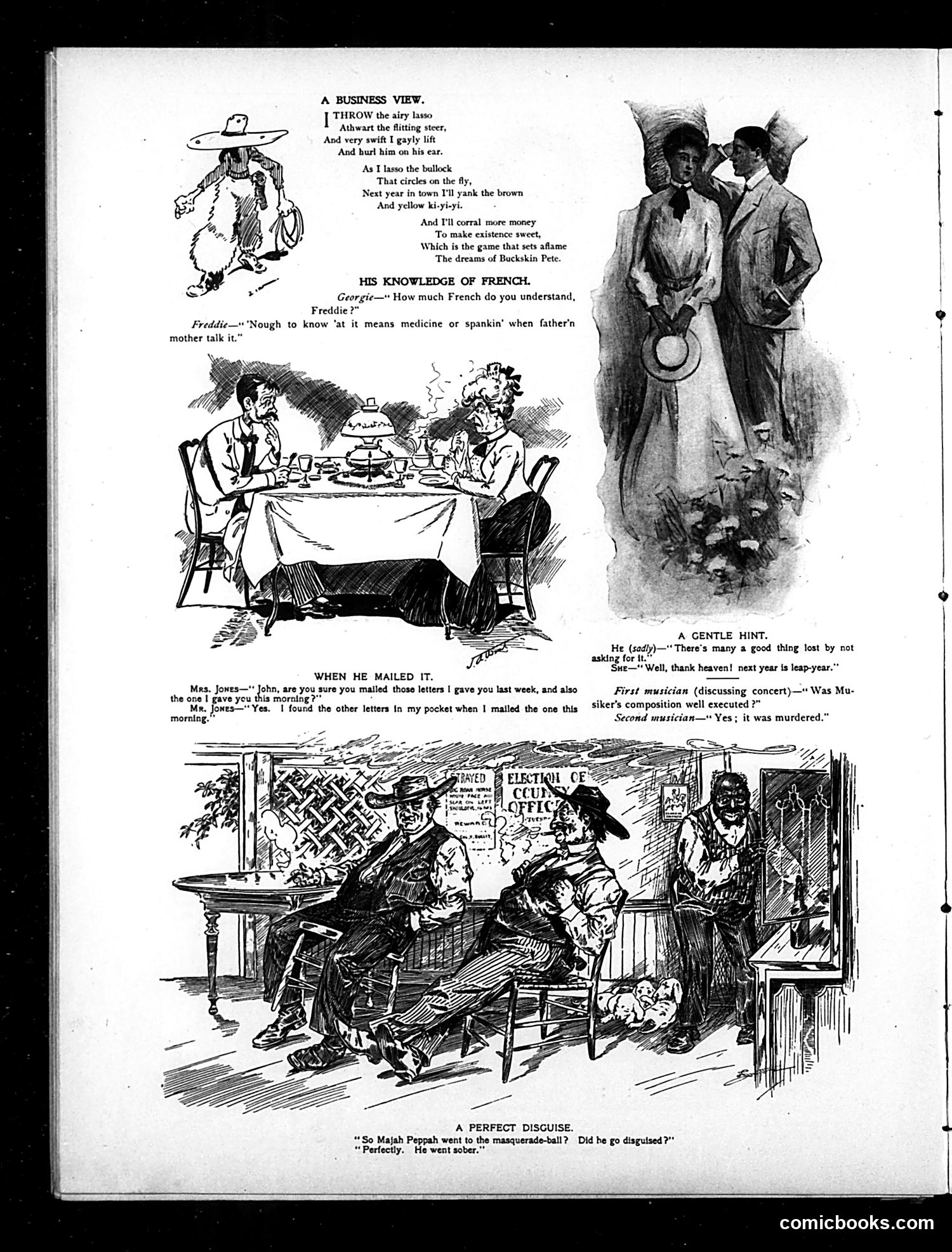
This page contains several brief humorous sketches typical of early American satirical magazines: **"A Business View"** mocks the romanticized "Wild West" entrepreneur—a cowboy ("Buckskin Pete") who speaks in flowery verse about lassoing cattle and dreams of making money, treating frontier commerce as romantic adventure rather than practical work. **"His Knowledge of French"** jokes about a child's misunderstanding: a boy thinks French must mean "medicine or spankin'" because he only hears it when his parents discuss discipline or health matters in hushed tones. **"A Gentle Hint"** plays on leap-year tradition (when women could propose to men). A sad man mentions lost opportunities, and the woman cheerfully notes next year allows *her* to ask—suggesting she'll pursue him. **"When He Mailed It"** depicts marital absent-mindedness: a husband found unmailed letters in his pocket *after* mailing another one. **"A Perfect Disguise"** uses ironic social commentary: a Southern gentleman ("Majah Peppah") at a masquerade was "disguised" by being *sober*—implying he's typically drunk.
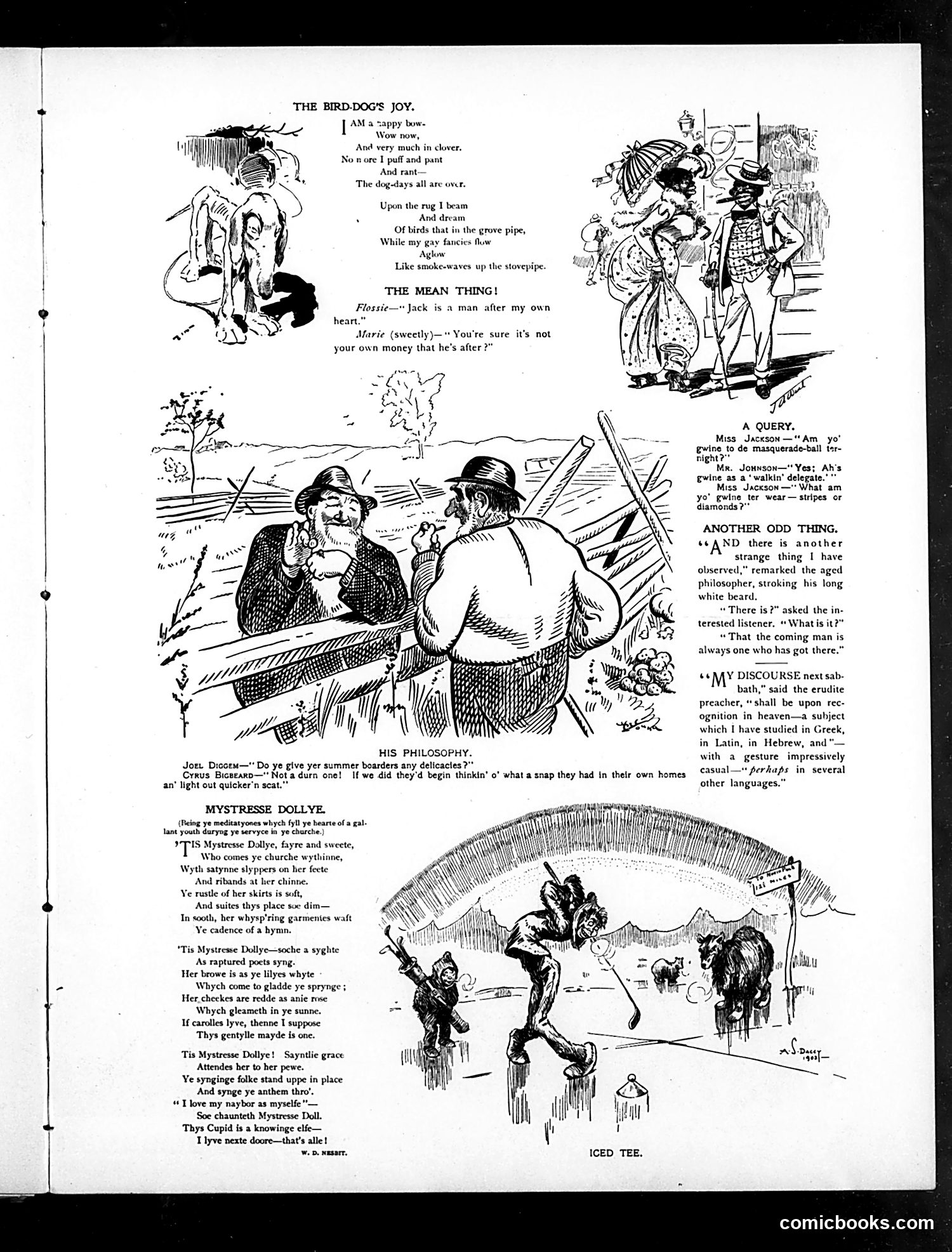
This page contains several satirical comics and verses typical of Judge magazine's humor: **"The Bird-Dog's Joy"** celebrates a dog's relief as summer ends and cooler weather arrives—simple domestic humor with no political content. **"The Mean Thing"** jokes about a woman (Flossie) praising a suitor, only for her friend Marie to suggest he's after money, not love—social satire about matrimonial fortune-hunting. **"A Query"** uses dialect humor (appears to be African American vernacular) where a man says he'll attend a masquerade as a "walkin' delegate" (likely a labor organizer), prompting a woman to ask if he'll wear "stripes or diamonds"—possibly implying prison garb or wealth. **"His Philosophy"** shows a hotel owner admitting he gives summer boarders no delicacies to prevent them from expecting such treatment at home. **"Mystresse Dollye"** is archaic verse romanticizing a churchgoing woman, ending with a punchline: a neighbor boy (Cupid) lives next door—deflating the flowery sentiment with practical reality. The page emphasizes social observation humor over political satire.
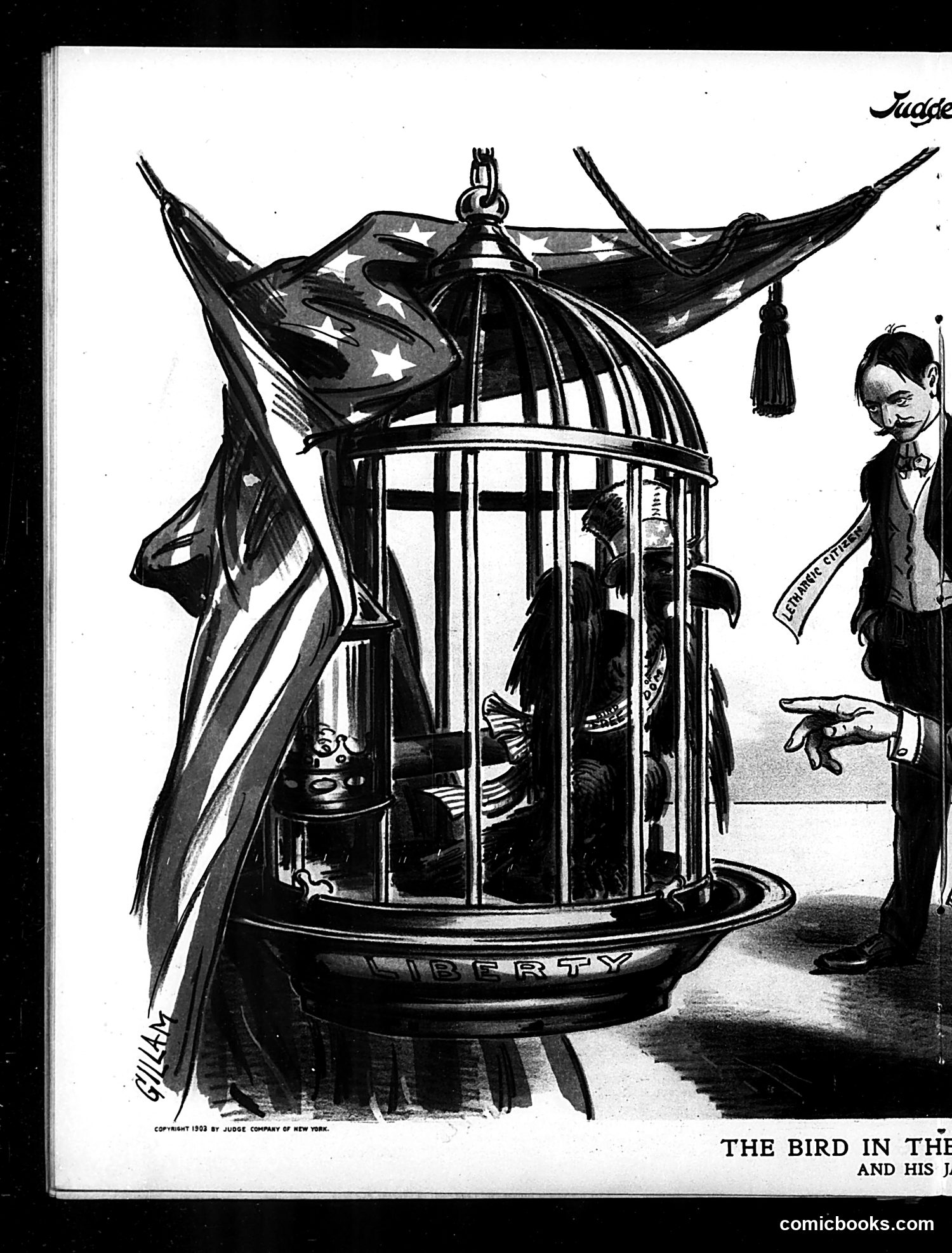
This political cartoon depicts **"The Bird in the Cage"** — a metaphorical illustration of American liberty under constraint. The birdcage represents imprisonment or restriction of freedom, while the American flags above suggest patriotic ideals in tension with that confinement. The well-dressed figure on the right appears to be a political or governmental authority figure, gesturing toward the caged bird. The "Democratic Principles" banner visible suggests this critiques restrictions on democratic freedoms or civil liberties. The specific political context is unclear from the visible text alone, but Judge magazine typically used such imagery to satirize government overreach, wartime restrictions, or political suppression of constitutional rights during early-to-mid 20th century America. The cartoon's title and the figure's identity would clarify the precise historical reference.
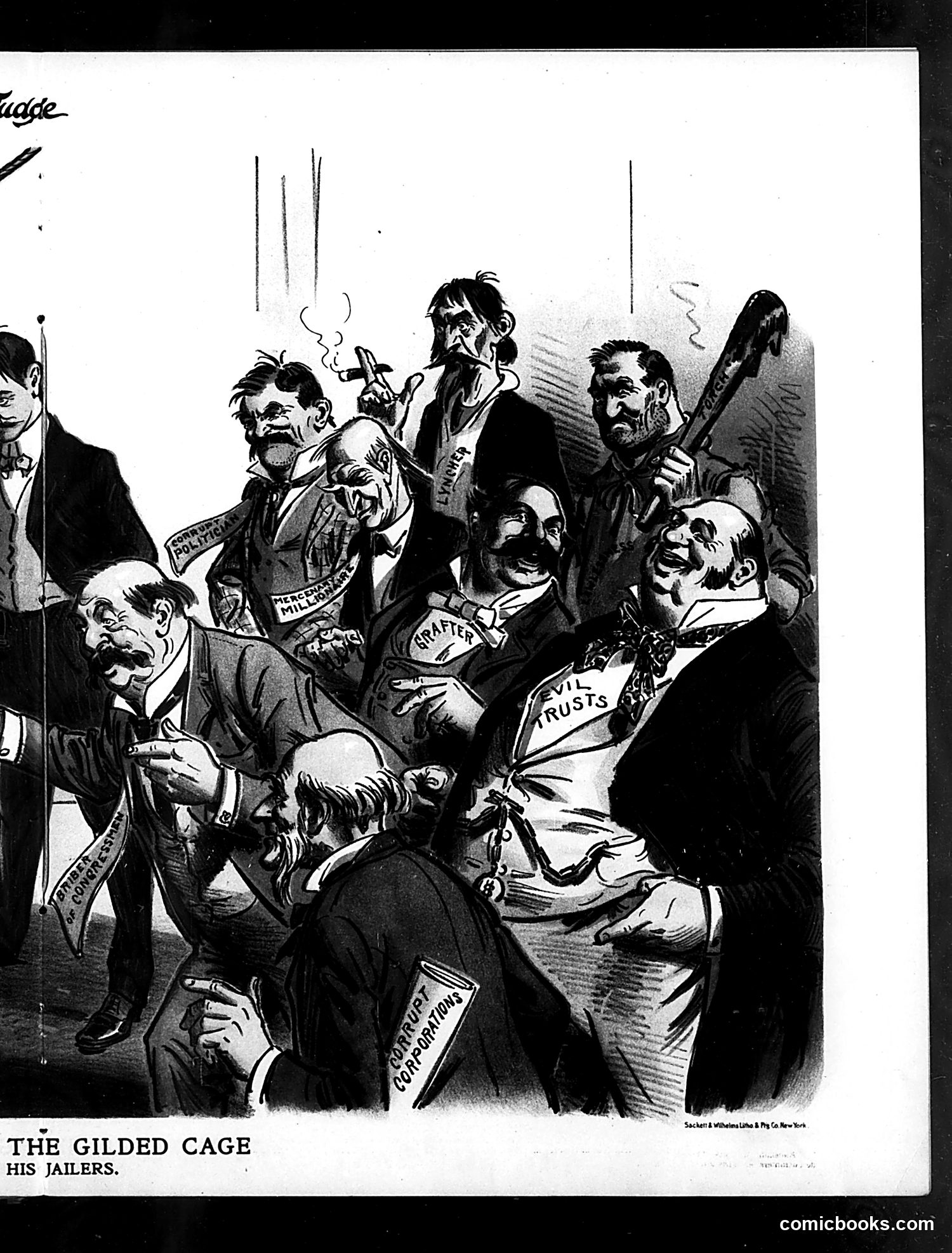
This political cartoon depicts wealthy industrialists and businessmen as jailers guarding a figure trapped in a cage labeled "corruption" and "trusts." The men wear labels identifying them as representatives of monopolistic enterprises and corrupt dealings ("Drafts," "Evil Trusts"). The satire critiques the Gilded Age practice of wealthy elites controlling the political and economic system through corruption and trust-building—essentially imprisoning the common citizen or honest government within their schemes. The "gilded cage" metaphor suggests that while the trap appears luxurious on the surface, it remains an oppressive confinement controlled by powerful business interests. This reflects Progressive Era anxieties (likely late 1800s-early 1900s) about monopolies, political corruption, and economic inequality.
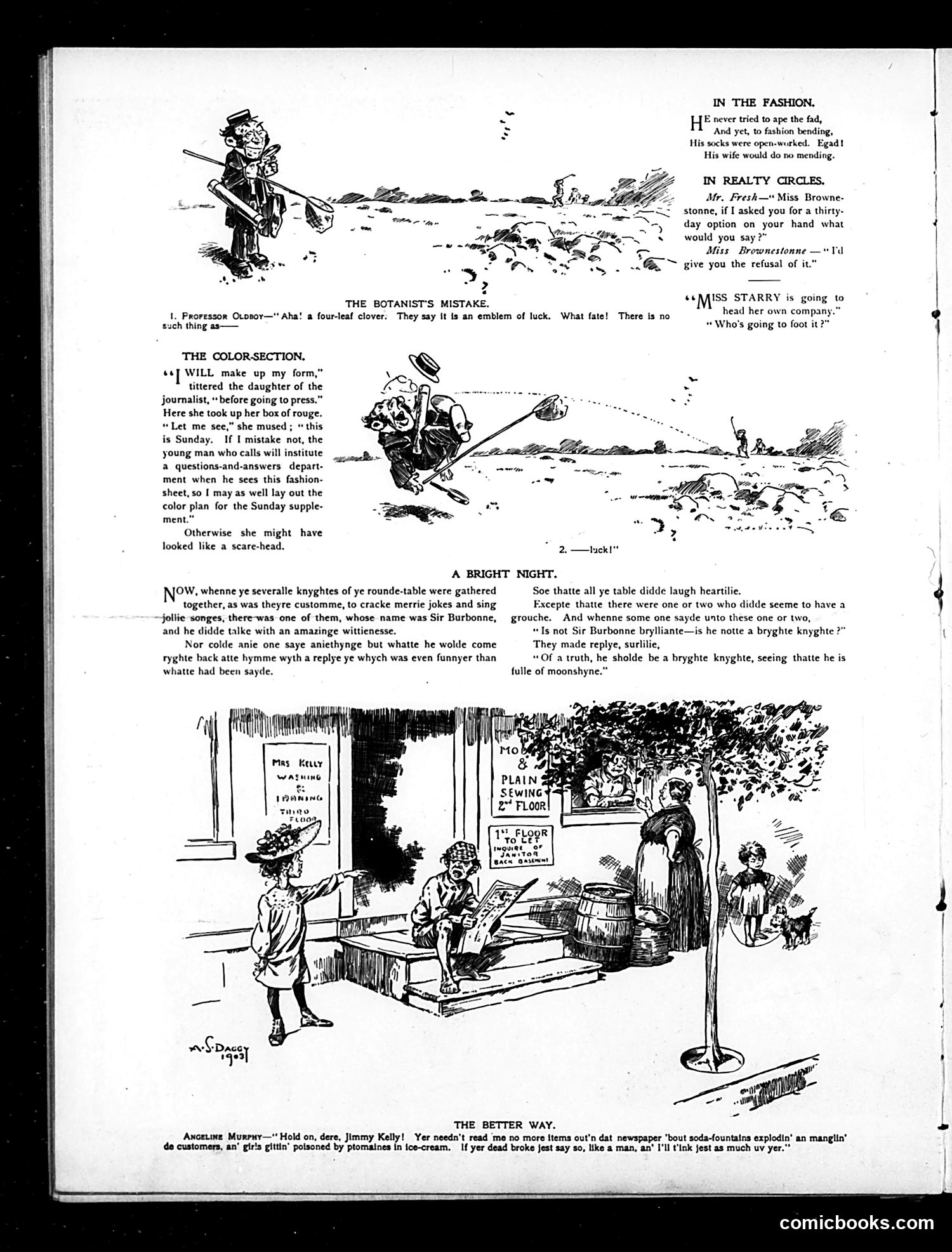
This page contains several unrelated satirical cartoons and humorous sketches typical of early Judge magazine: **"In the Fashion"**: Mocks a husband whose socks have holes (fashionably "open-worked"), yet his wife refuses to mend them—satire on both fashion pretension and marital dynamics. **"In Realty Circles"**: A real estate agent proposes a "thirty-day option" on a woman's hand (marriage proposal), using commercial language. She refuses, offering only "the refusal of it"—satirizing the commercialization of romance and marriage as business transactions. **"The Botanist's Mistake"**: A professor misidentifies a four-leaf clover, claiming luck doesn't exist—ironic given the clover's legendary fortune-bringing properties. **"The Color-Section"**: A journalist's daughter applies rouge before layout, anticipating her suitor will ask questions about the fashion section, necessitating makeup. Satire on both vanity and journalism. **"A Bright Night"** and **"The Better Way"**: Additional comic sketches with less clear political/social commentary—appear to be general humor about conversation and relationships. The page reflects early 20th-century satirical interests: fashion, romance, marriage, journalism practices, and gender dynamics.
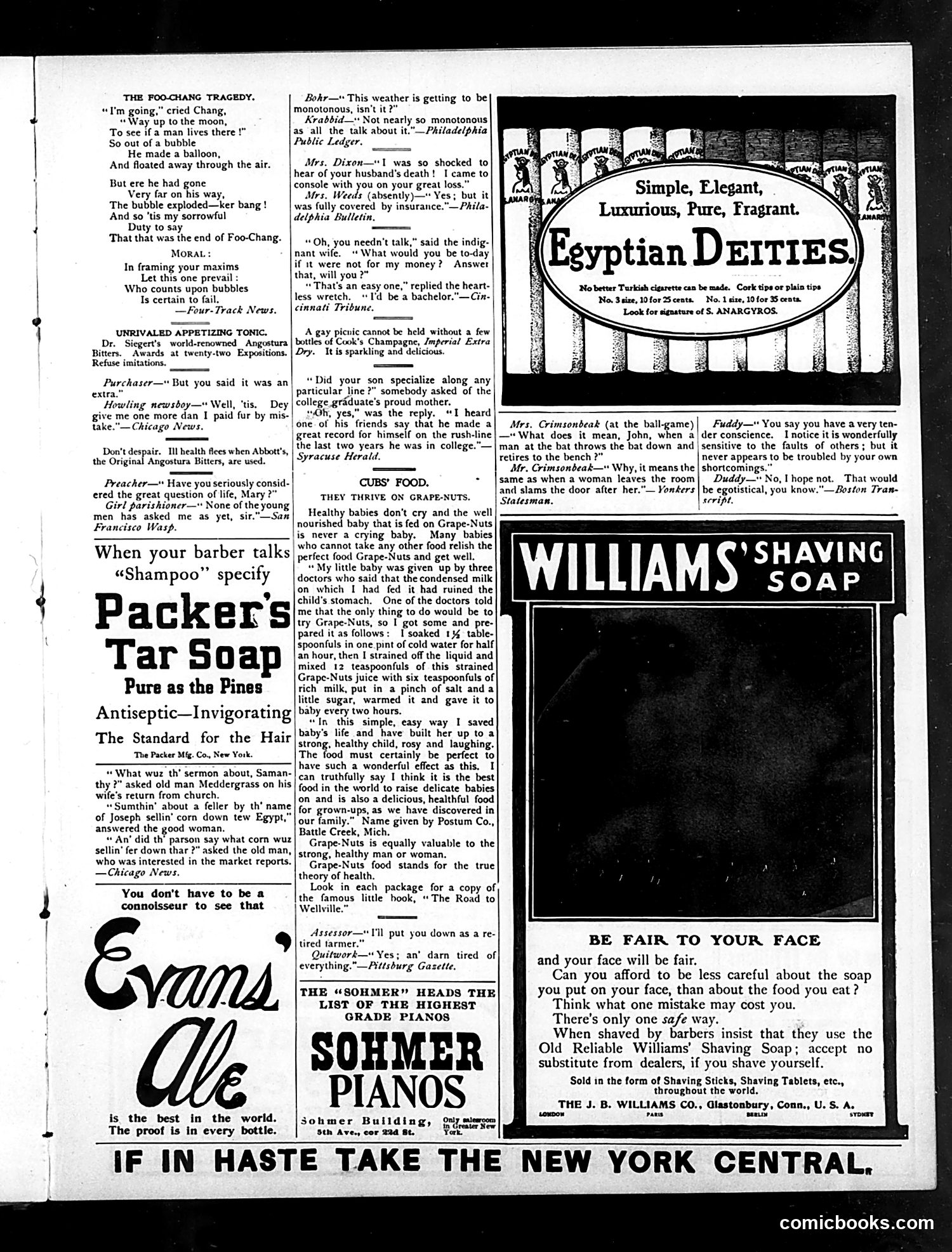
This page is primarily **advertising and humor snippets** rather than political satire. The content includes: **Poetry/Humor pieces:** "The Foo-Chang Tragedy" is a cautionary fable about a man named Chang who builds a bubble-balloon to reach the moon; it explodes mid-flight. The moral warns against trusting in unstable schemes. **Comic anecdotes:** Brief jokes about church sermons (a man misunderstanding Joseph selling "corn" in Egypt as a commodity transaction), marriage humor (a wife's money-dependent husband admitting he'd be a bachelor without her), and misunderstandings about college athletic "records." **Advertisements:** The page is dominated by product ads—Packer's Tar Soap, Egyptian Deities cigarettes, Williams' Shaving Soap, Evans Oil, and Sohmer Pianos—interspersed with testimonials (notably a lengthy one about Grape-Nuts cereal curing a baby's digestive problems). **Context:** This reflects early 1900s American magazine format, where satirical publications mixed light humor with revenue-generating advertisements. The jokes target everyday situations rather than specific political figures or events.
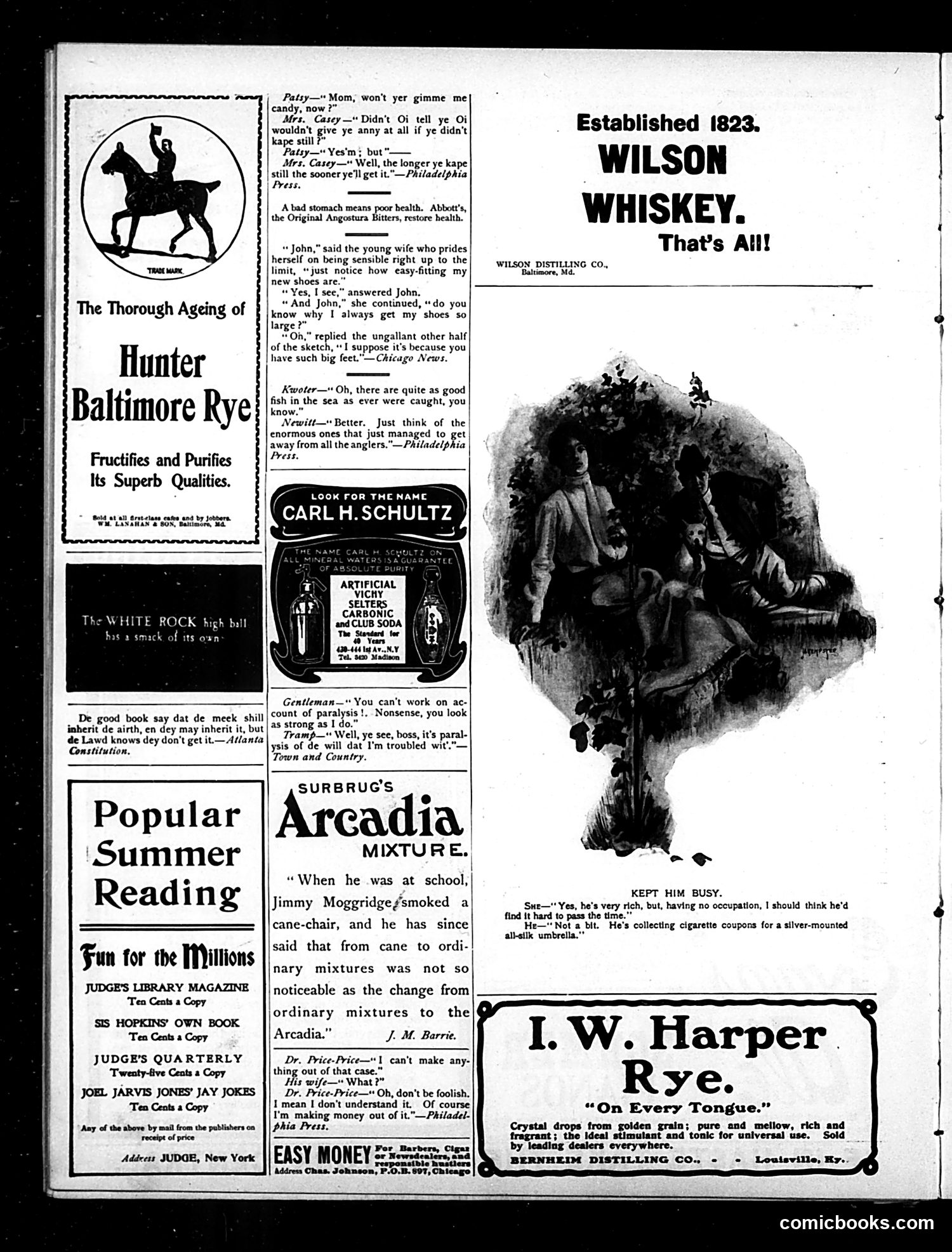
This page is primarily **advertising with scattered humor**—typical of Judge magazine's format. The main visual is a sketch of men in what appears to be a tavern or social setting, accompanying a joke about a wealthy idle man collecting cigarette coupons for luxury goods, satirizing pointless upper-class pastimes. The text consists mainly of **short jokes** using ethnic/dialect humor (Irish characters "Mrs. Casey" and "Patsy," African American dialect in the "meek shall inherit" quote)—common in early 1900s American humor. These joke snippets poke fun at domestic disputes, fishing exaggerations, and feigned illnesses. The **bulk of the page is liquor and patent medicine advertising**: Hunter Baltimore Rye, Wilson Whiskey, I.W. Harper Rye, White Rock mixers, and Abbott's Bitters (marketed as health restorative). This reflects the era before Prohibition when such products advertised openly in humor magazines. The page offers no coherent political or social commentary—it's a commercial product designed to entertain while selling alcohol and patent medicines to readers.
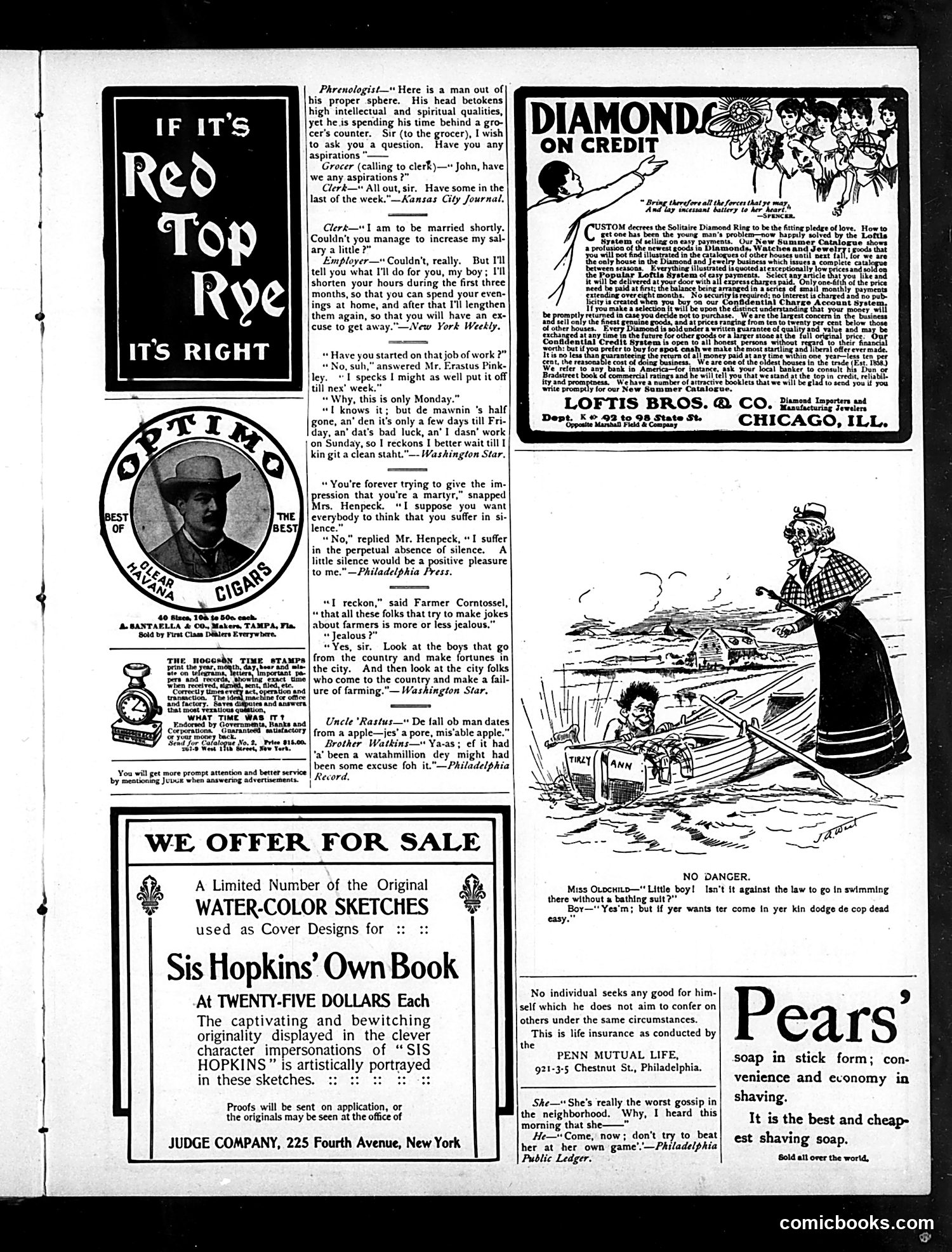
This page from Judge magazine contains multiple satirical vignettes typical of early 20th-century American humor: **Main Cartoons:** - A phrenologist (pseudo-scientist who read skulls) discovers a grocer with superior intellect—satire on mismatched employment and aspirations. - An employer offers shortened hours to an engaged clerk—dark humor about workaholics trapped by circumstance. - A Southern Black worker delays starting Monday's job through superstition—perpetuating racist stereotypes common in period magazines. - A henpecked husband insists he suffers in "perpetual absence of silence"—domestic comedy about nagging wives. - Farmer Corntossel suggests city people making farming jokes are jealous of successful rural-to-urban migrants. **Advertisements** dominate: Loftis Bros. diamonds on credit, Pears soap, Optimo cigars, and reproductions of Sis Hopkins illustrations. The humor relies on class anxieties, racial caricature, marital discord tropes, and rural-urban tensions characteristic of Judge's satirical approach.
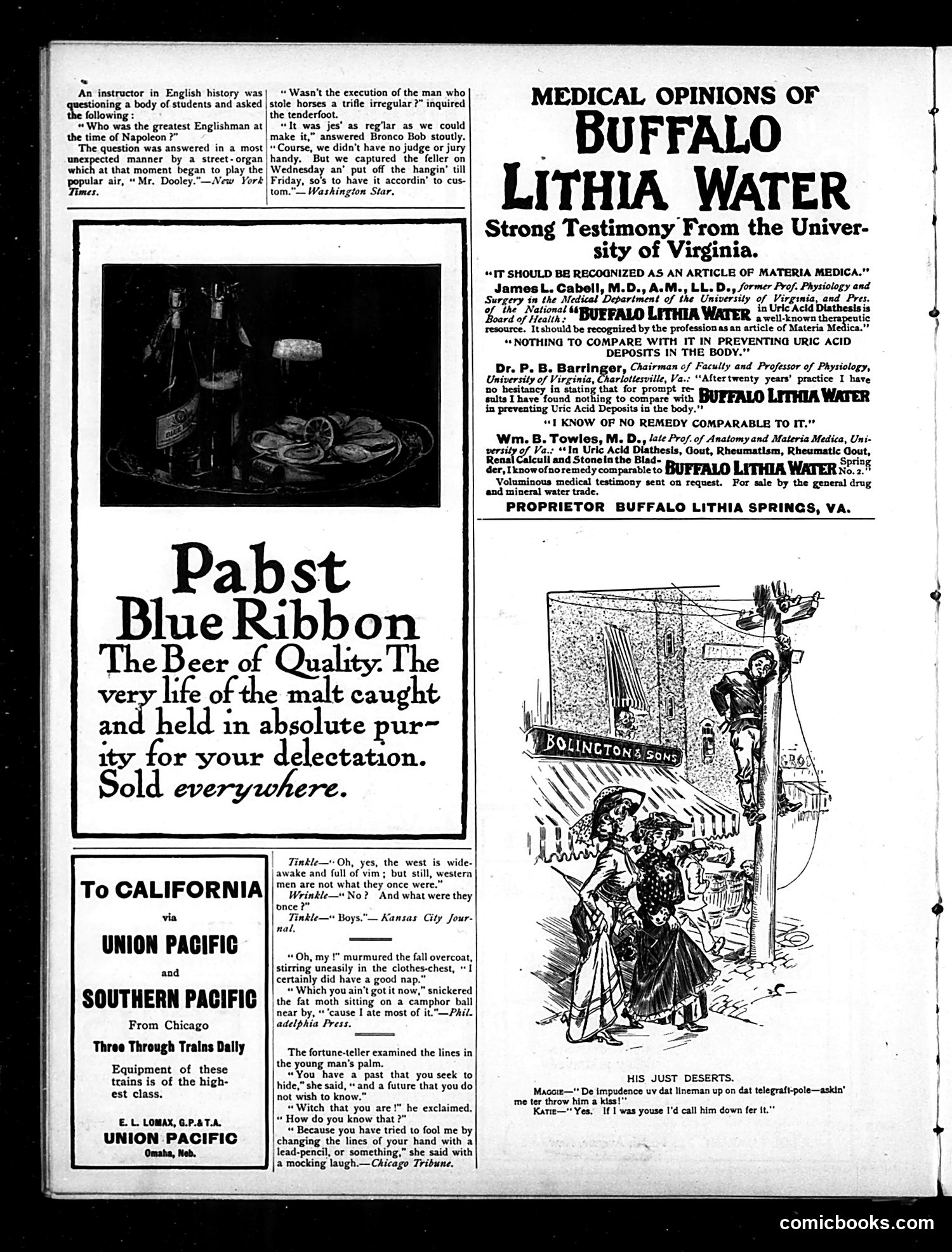
This page combines humor pieces with period advertising. The main content includes: **Top Left Cartoon**: A street organ playing "Mr. Dooley" (a popular Irish-American character) unexpectedly answers a history teacher's question about Napoleon's era—a joke about absurd coincidence and the ubiquity of popular culture. **Western Humor Anecdote**: A tenderfoot questions outlaw "Bronco Bob" about an irregular horse-thief execution. Bob's response satirizes frontier "justice"—claiming their lynching was "regular" because they delayed it until Friday to observe proper form. This mocks the contradiction between lawlessness and pretended civility in the Wild West. **Minor Sketches**: Include jokes about overcoats, moths, and fortune-tellers—light filler content. **Advertisements**: Pabst Blue Ribbon beer, Union Pacific railroad, and Buffalo Lithia Water (claiming medical benefits for gout and uric acid) dominate the page—reflecting Judge's commercial base. The page is primarily **advertising-driven satirical content** typical of early 1900s magazines, mixing crude frontier stereotypes with genteel urban humor.
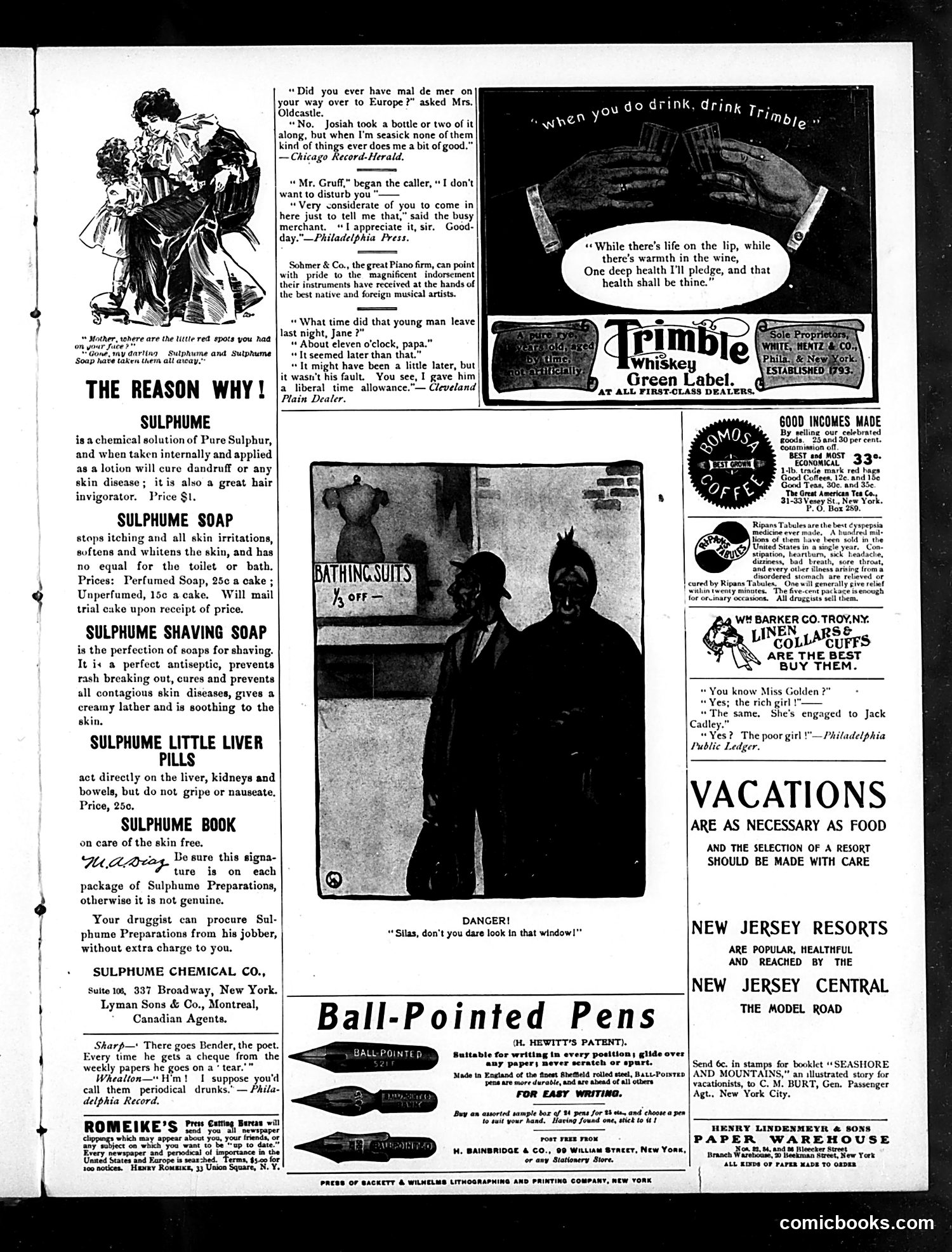
This page consists primarily of **advertisements and short humorous anecdotes** rather than political cartoons. The main illustrated content shows a domestic scene captioned "DANGER! 'Silas, don't you dare look in that window!'" — depicting a woman preventing a man from watching bathing suits on display, a joke about propriety and voyeurism. The page's humor comes from brief comic exchanges printed alongside product ads: - A joke about "mal de mer" (seasickness) where a wife claims Josiah's bottle didn't help - A merchant sarcastically thanking an interrupting caller for announcing he won't be a bother - A father-daughter dialogue about a young man's late departure from the house These appear to be reprinted jokes from newspapers (credited to *Chicago Record-Herald*, *Philadelphia Press*, *Cleveland Plain Dealer*), typical of Judge's format mixing satire with advertising. The overall tone mocks social conventions, parental anxiety, and commercial interactions of the era.
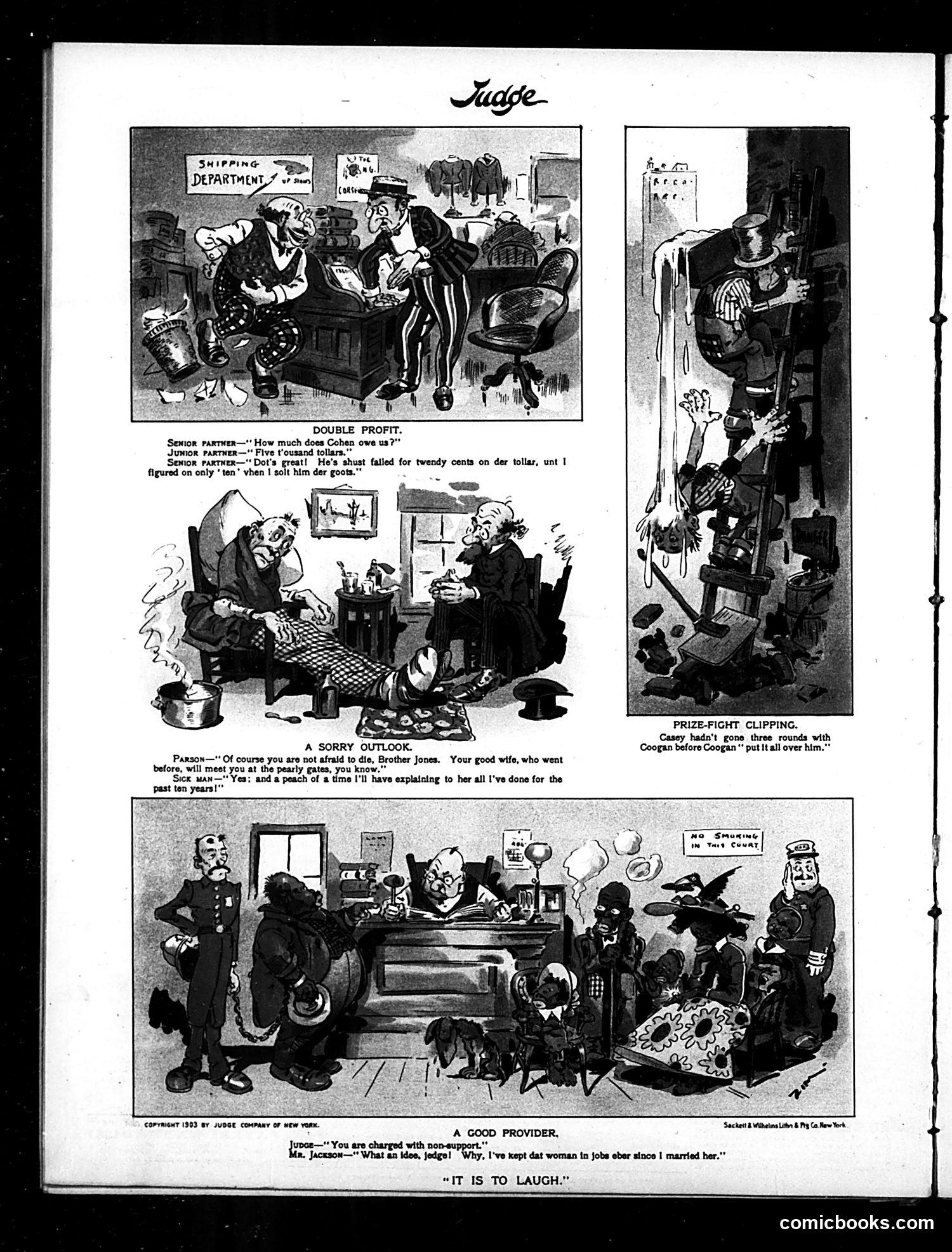
This page contains three separate satirical cartoons mocking contemporary social issues: **"Double Profit"** ridicules Jewish businessmen (depicted with exaggerated stereotypical features) exploiting bankruptcy laws—a debtor fails for twenty cents on the dollar, but the creditor had already underpriced his goods, profiting twice. **"Prize-Fight Clipping"** jokes about boxer Casey being thoroughly defeated by Coogan in the ring. **"A Good Provider"** satirizes a deadbeat husband in court. When charged with non-support, he claims he *has* supported his wife—by keeping her employed in jobs (implying she works while he doesn't). The caption "It Is to Laugh" signals the absurdity. The ethnic caricatures and "fractured English" dialogue reflect Judge's reliance on immigrant stereotypes for humor, which was standard 1903 satirical practice but reflects deeply offensive attitudes toward working-class immigrants and Jewish Americans.