
A complete issue · 21 pages · 1903
Judge — June 27, 1903
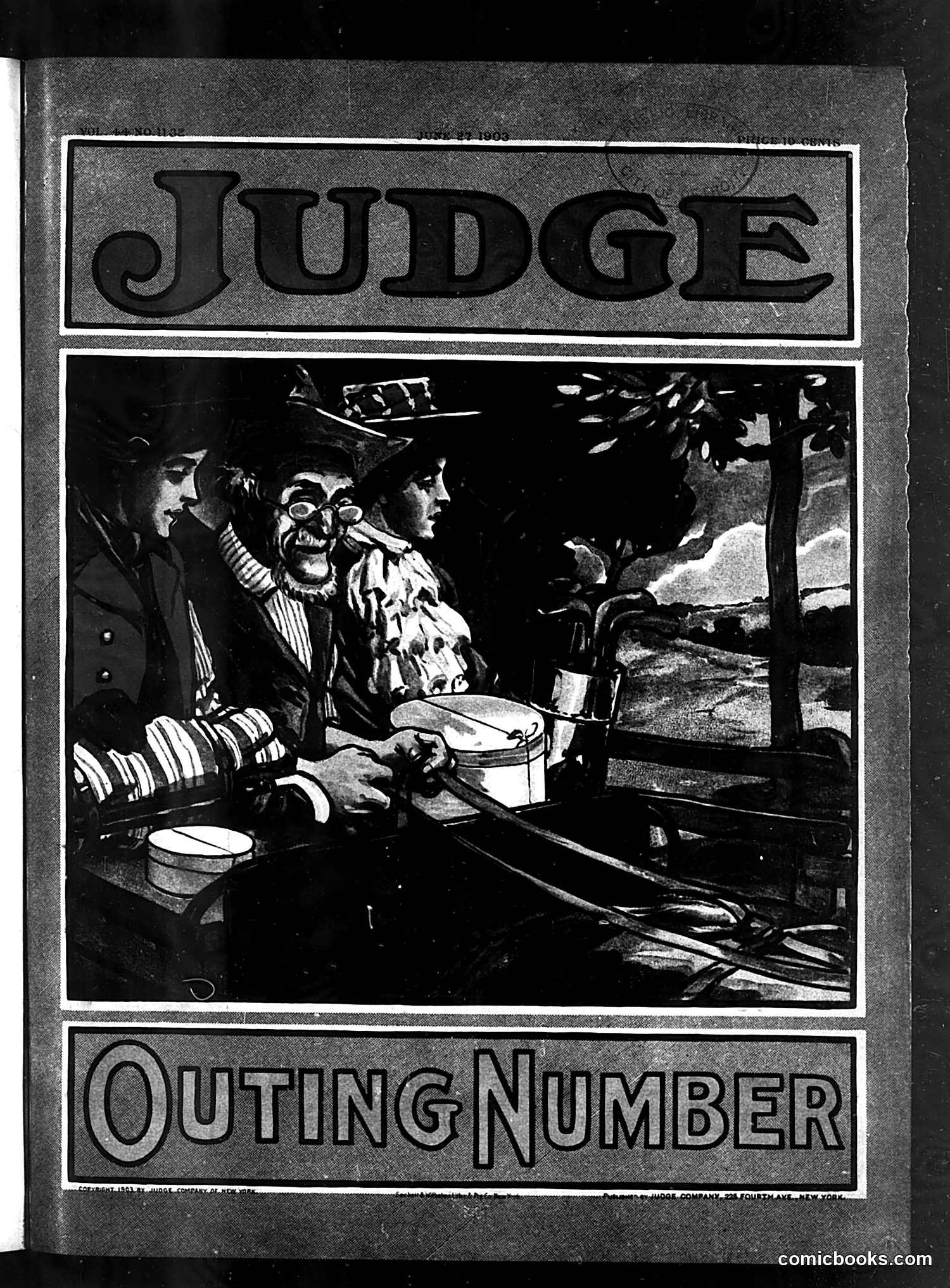
This appears to be a cover from *Judge* magazine's "Outing Number" issue. The central image depicts three figures in what appears to be a camping or outdoor cooking scene. The figure in the center has exaggerated, grotesque features—a caricatured face with prominent teeth—which was common in early 20th-century satirical imagery. Without clearer text identifying specific individuals or dated context visible in the image, I cannot definitively state who these figures represent or what particular political/social event is being satirized. The "Outing Number" designation suggests the issue may have focused on outdoor recreation or travel themes popular among the magazine's readership. The caricatured style indicates social commentary, but the specific target remains unclear from this reproduction.
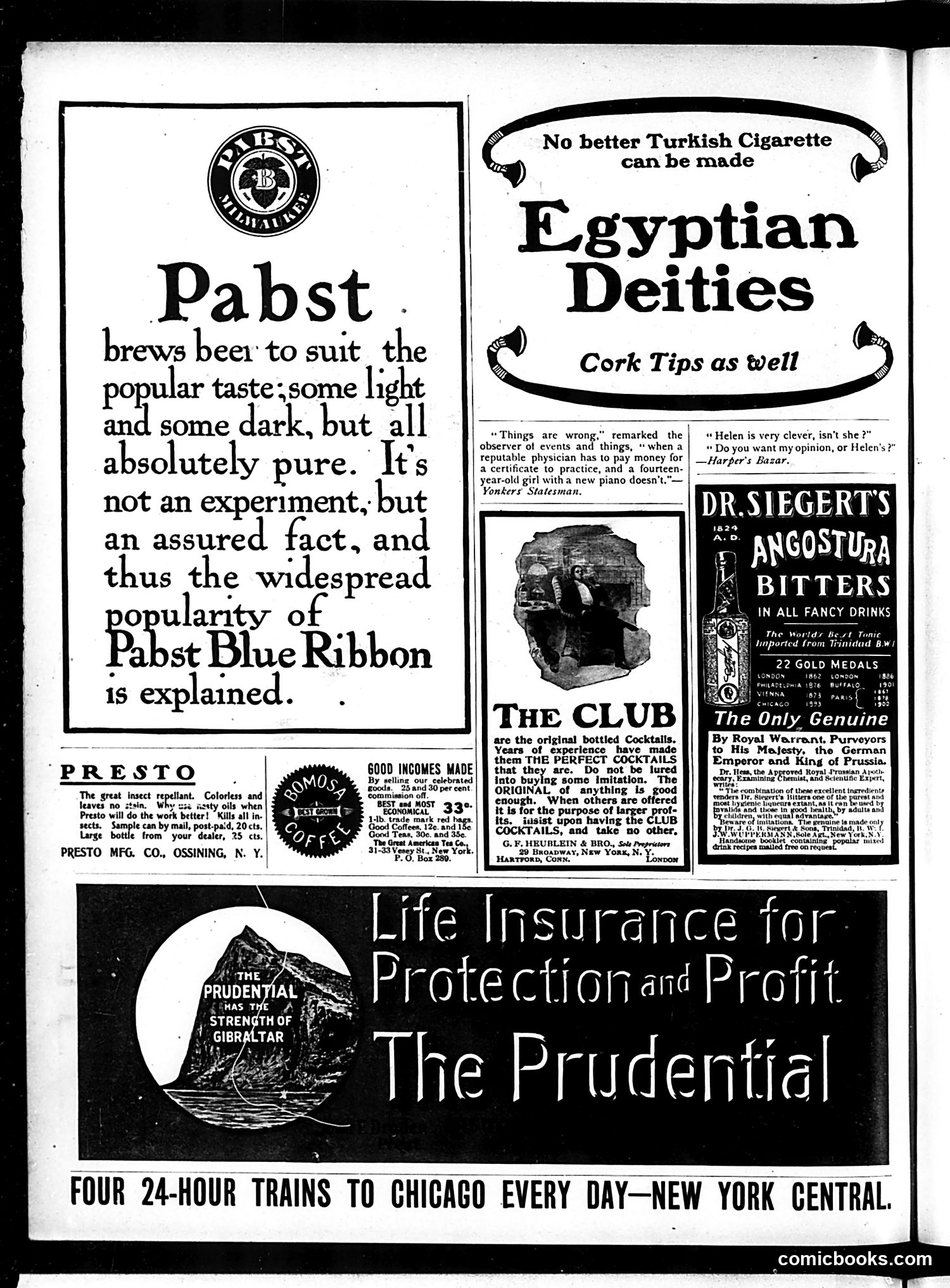
This page is primarily **advertising**, not political satire. It contains four distinct advertisements: 1. **Pabst Blue Ribbon beer** - emphasizing purity and popularity 2. **Egyptian Deities cigarettes** - claiming superiority as Turkish cigarettes, with cork tips 3. **Dr. Siegert's Angostura Bitters** - an imported medicinal product 4. **The Prudential Insurance Company** - promoting life insurance There's also a small ad for **Presto insect repellent** and a **Club Cocktails** advertisement featuring what appears to be an Egyptian artifact image. The page reflects early 20th-century consumer culture, with products marketed through appeals to quality, sophistication, and health. The Egyptian Deities branding and imagery were common in that era's marketing, though such appropriation would be considered problematic today. No political cartoons or satire are present on this page.
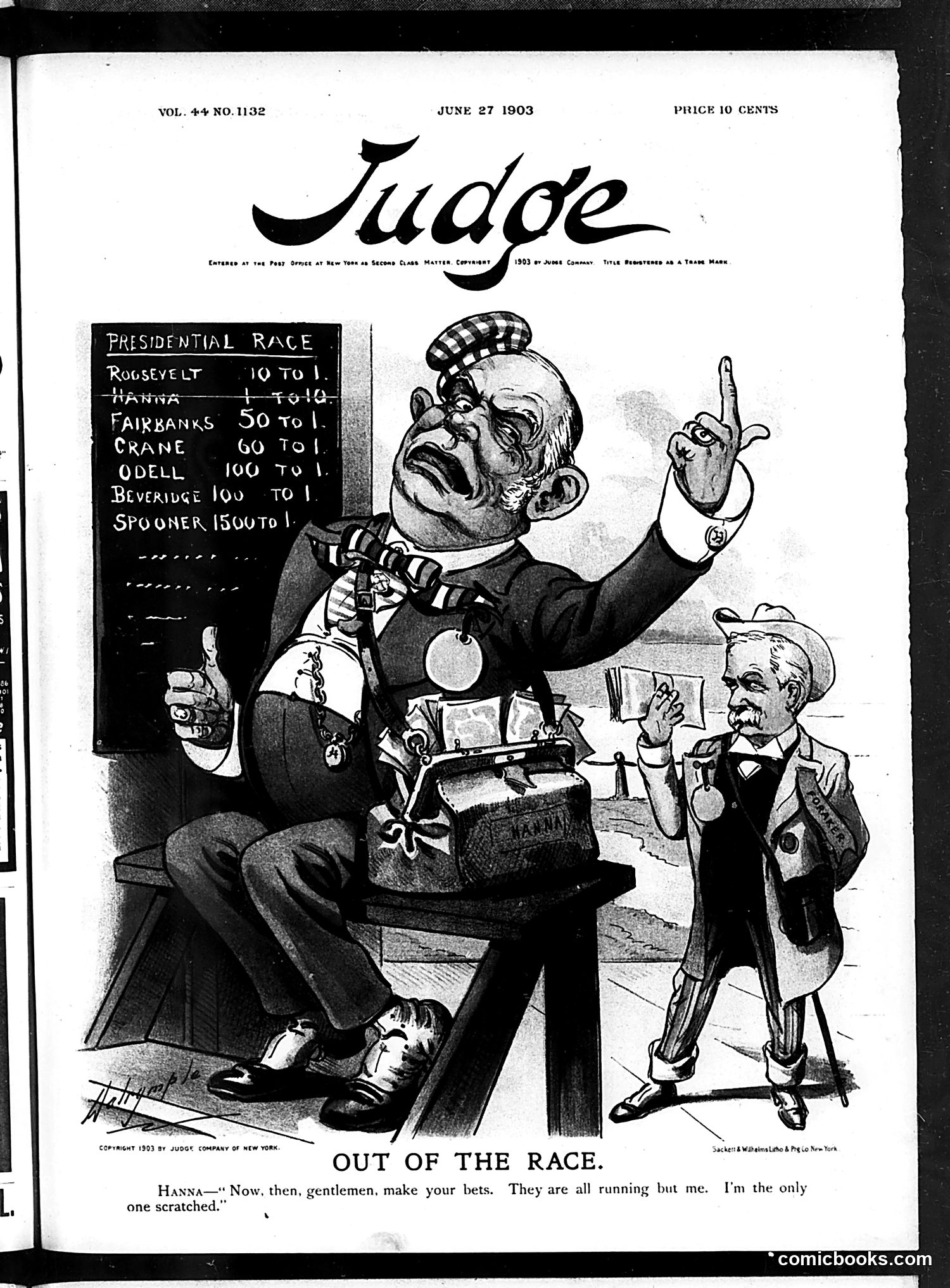
This political cartoon satirizes the 1904 Presidential race. The large caricatured figure labeled "Hanna" (likely Mark Hanna, Republican political boss) sits at a betting table showing odds for various candidates: Roosevelt, Fairbanks, Crane, Odell, Beveridge, and Spooner. Hanna announces he's "scratched"—withdrawn from the race—claiming all others are "running but me." The irony is that Hanna, though not a candidate himself, was a powerful kingmaker whose influence shaped Republican nominations. The cartoon mocks his diminished political power by 1903, depicting him as marginalized despite the betting odds he still controls. The smaller figure appears to be listening to his boast.
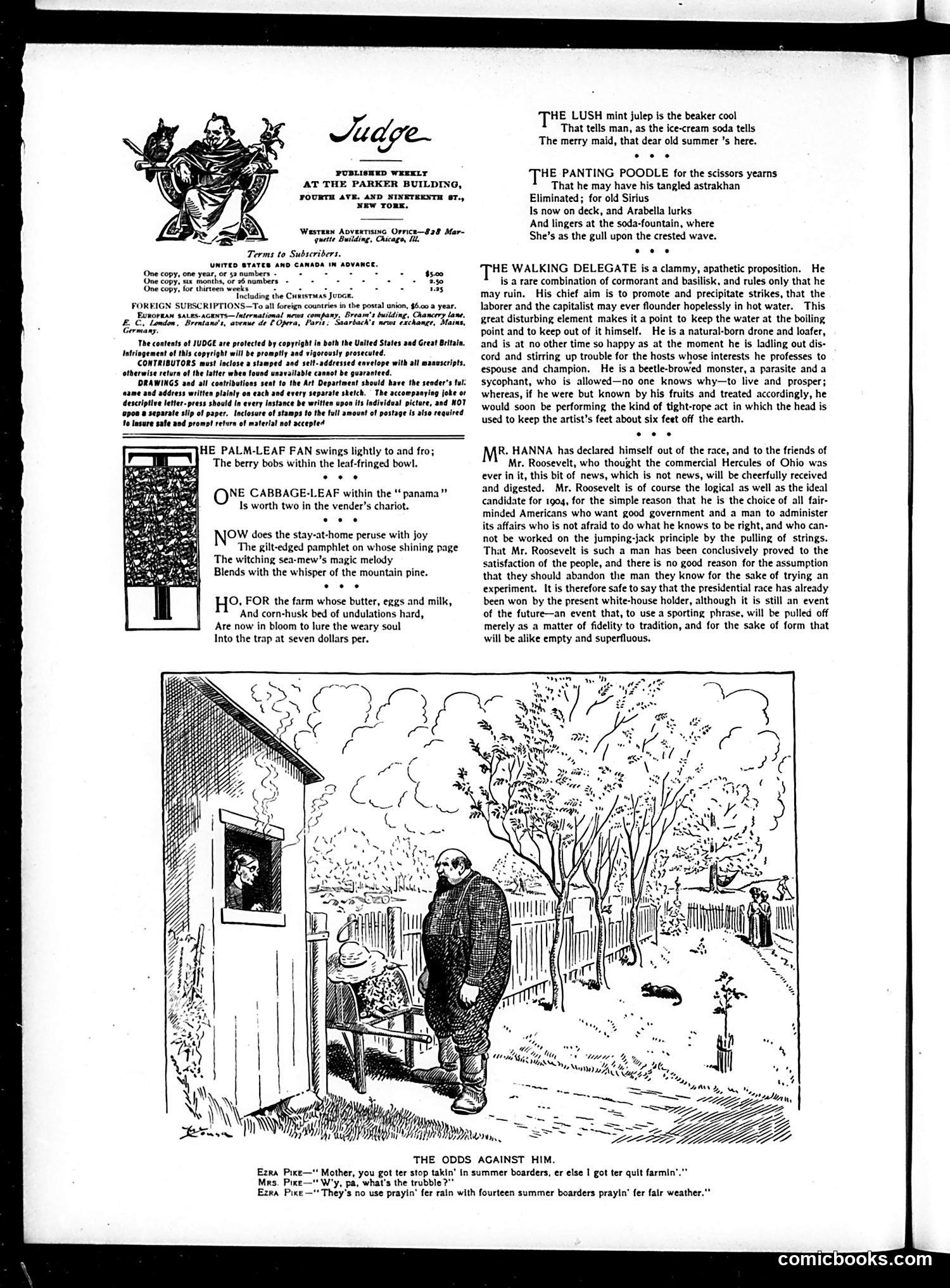
This page contains satirical verses and a cartoon titled "The Odds Against Him," depicting a conversation between Ezra Pike and his wife about summer boarders. The cartoon shows a heavyset man confronting a woman at a cottage doorway. The dialogue indicates Ezra Pike is frustrated that his wife takes in summer boarders for income, but complains about their presence. His wife responds that boarding guests is necessary and practical—they need the income. The satire targets rural working-class economics and domestic tensions: the husband resents the intrusion and labor of hosting paying guests, while the wife pragmatically accepts it as financial necessity. The cartoon illustrates the gender dynamics and economic pressures of early 20th-century rural American life, where seasonal boarding was common income supplementation for struggling farmers and their families.
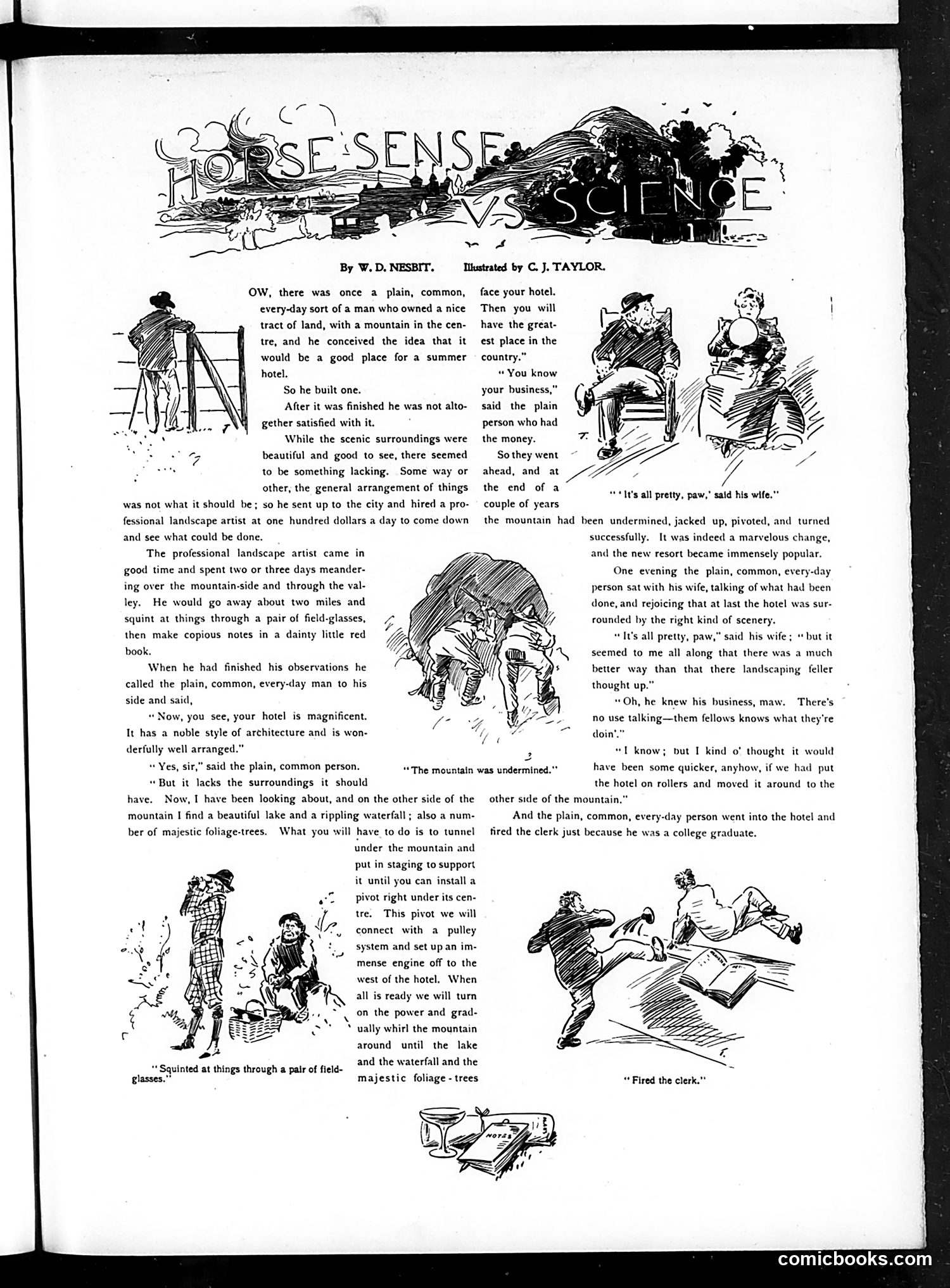
This story satirizes the pretentious overcomplication of "expert" professionals versus practical common sense. A wealthy but unsophisticated man hires an expensive landscape architect (at $100/day) to improve his mountain hotel. The architect proposes an absurdly elaborate solution: tunnel under the mountain, install a massive pivot system with pulleys and engines to literally rotate the entire mountain to face the scenic lake and waterfall toward the hotel. The scheme succeeds, but the man's wife points out the obvious alternative: simply move the *hotel* itself to the other side of the mountain—far simpler and quicker. The punchline—firing the college-educated clerk—reinforces the joke: the man rewards practicality over education. This reflects period anxiety about whether formal education and technical expertise actually solve problems better than traditional wisdom. The story mocks both excessive professional jargon and the contempt for educated professionals that sometimes accompanied it.
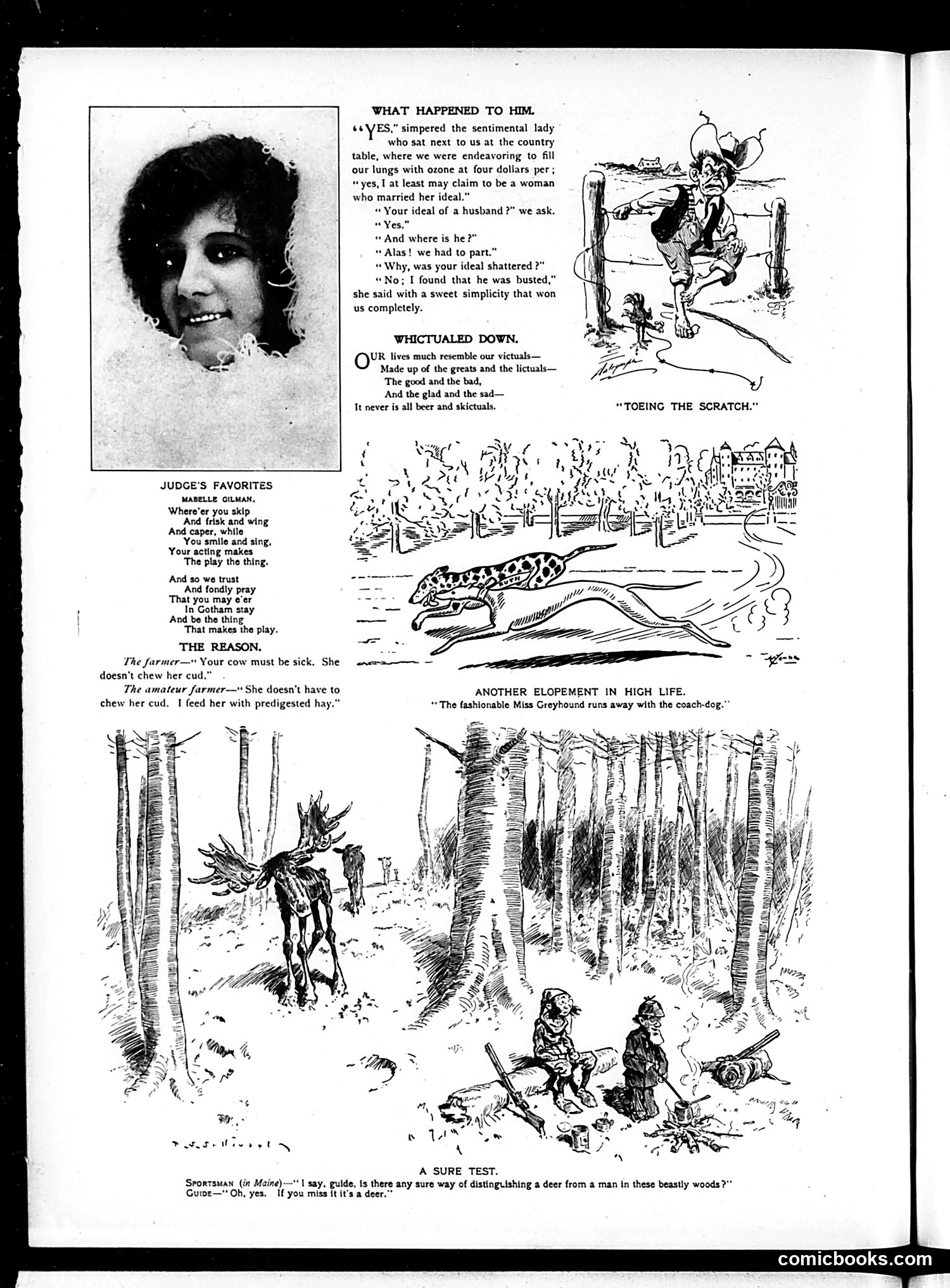
This page from the satirical magazine *Judge* contains several disconnected humorous pieces typical of early 20th-century American humor: **"What Happened to Him"**: A sentimental woman brags about marrying her ideal husband, but reveals he's disappeared because he "was busted"—a play on romantic idealism versus financial reality, mocking sentimental romanticism. **"Judge's Favorites"**: Praise for actress Mabelle Oilman (identity unclear), celebrating her stage performance in generic theatrical language. **"Another Elopement in High Life"**: A joke about a fashionable greyhound dog eloping with a coach-dog—absurdist humor treating animals as high-society figures, likely satirizing contemporary celebrity scandals. **"A Sure Test"**: A Maine hunting joke where a guide suggests the way to distinguish a deer from a man is whether you hit it—dark frontier humor about poor marksmanship. The page mixes romance satire, theatrical promotion, absurdist animal humor, and hunting jokes with no apparent unifying political theme.
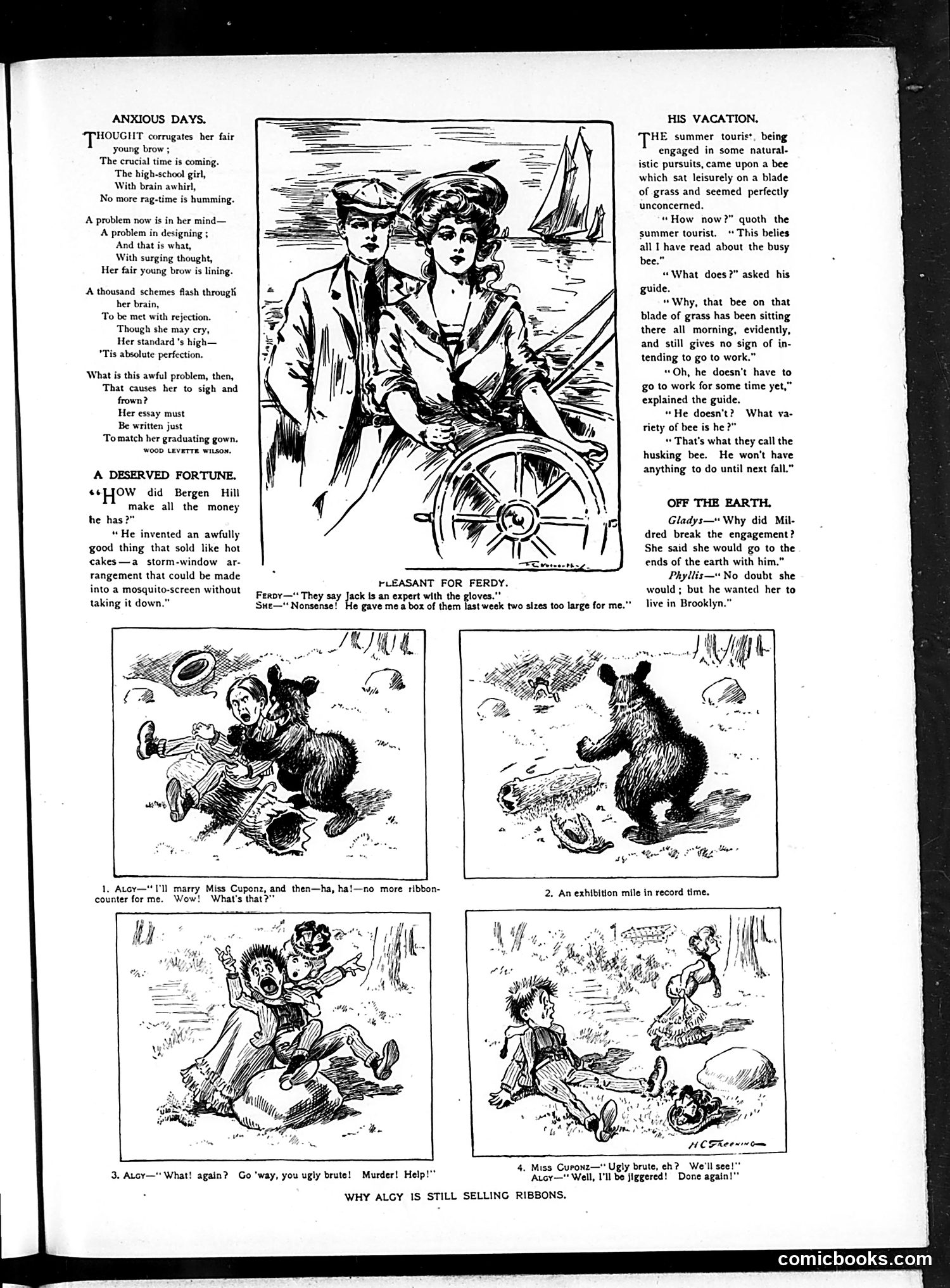
This page contains multiple humorous short pieces typical of early 20th-century satirical magazines: **"Anxious Days"** mocks a high-school girl's anxiety over matching her essay's quality to her graduation gown—satirizing the superficial concerns of privileged youth. **"A Deserved Fortune"** presents a straightforward success story about a practical inventor, offering gentle humor rather than satire. **"Pleasant for Ferdy"** jokes about a man's incompetence with boxing gloves, playing on the double meaning of "expert." **"His Vacation"** satirizes tourists' ignorance: the city visitor misunderstands "husking bee" (a communal farm work gathering) as a type of lazy bee, mocking outsiders' unfamiliarity with rural life. **"Off the Earth"** contrasts romantic idealism with practical geography—she'd travel anywhere, but he wants her in Brooklyn, poking fun at urban domesticity versus romantic adventure. **The "Algy" comic strip** depicts slapstick violence between a man and a bear over ribbons, relying on visual humor rather than social commentary.
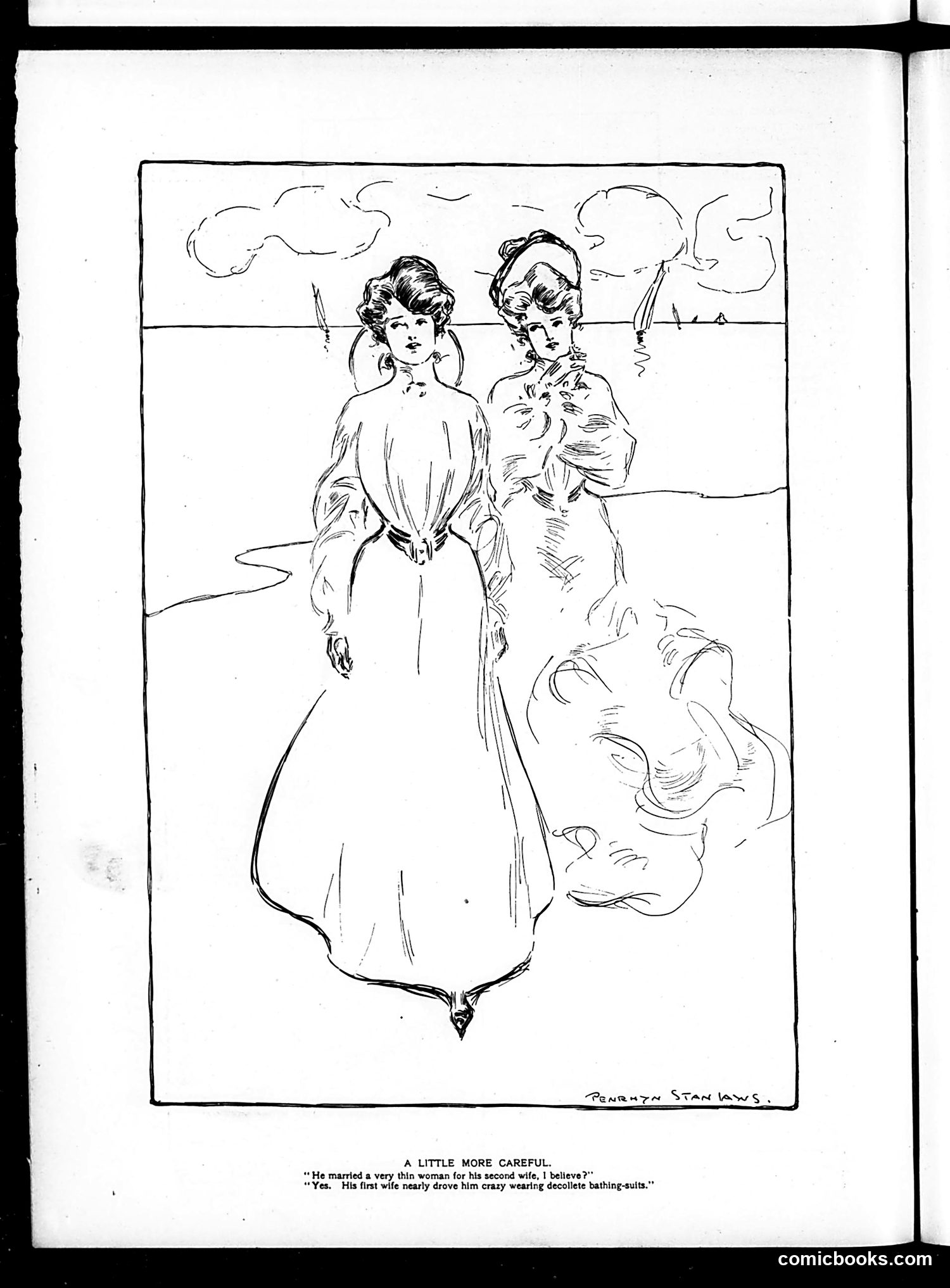
This is a single-panel cartoon satirizing marital anxiety and women's fashion choices. Two fashionably dressed women converse about a man's marriages: his first wife wore revealing ("decollete") bathing suits that distressed him, so his second wife is deliberately thin and modest. The joke targets the absurdity of men's controlling behavior regarding women's clothing and appearance. It mocks the notion that a man would marry a woman specifically because she's thin enough to look less provocative in swimwear—suggesting his neurotic need to manage his wife's appearance and how others perceive her. The cartoon likely reflects early-20th-century anxieties about changing women's fashion (shorter, more revealing swimwear was becoming normalized) and satirizes restrictive masculine attitudes toward female autonomy and dress.
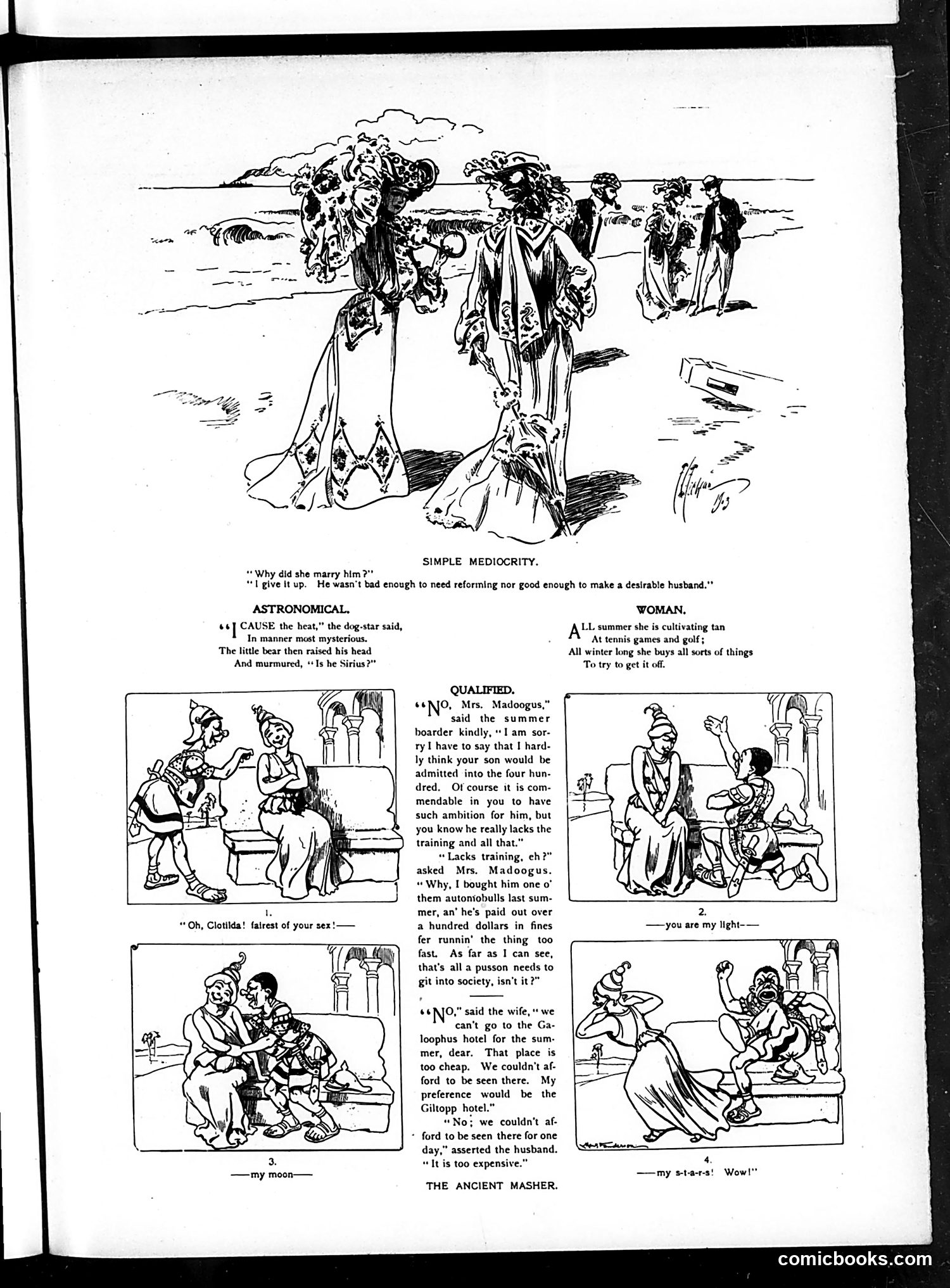
This page contains several short satirical pieces mocking early 20th-century American social pretensions and gender roles: **"Simple Mediocrity"** jokes about marrying someone mediocre—neither bad enough to "reform" nor good enough to be desirable. **"Astronomical"** is a pun: a dog-star asks about "heat"; a bear responds with "Sirius" (the Dog Star), playing on the scientific term. **"Woman"** ridicules women's contradictory beauty routines—spending summer tanning via tennis/golf, then winter buying products to remove it. **"Qualified"** satirizes newly-rich social climbers. A summer boarder snobs Mrs. Madoogus about her son lacking "four hundred" (elite society) credentials. She misunderstands "training" as driving a car (buying one resulted in $100+ in speeding fines), believing this qualifies one for high society—mocking both her ignorance and the arbitrary nature of class standards. **"The Ancient Masher"** (bottom strip) depicts an older man flirting with women, an old social type. The overall theme: American society's shallow materialism and confused values.
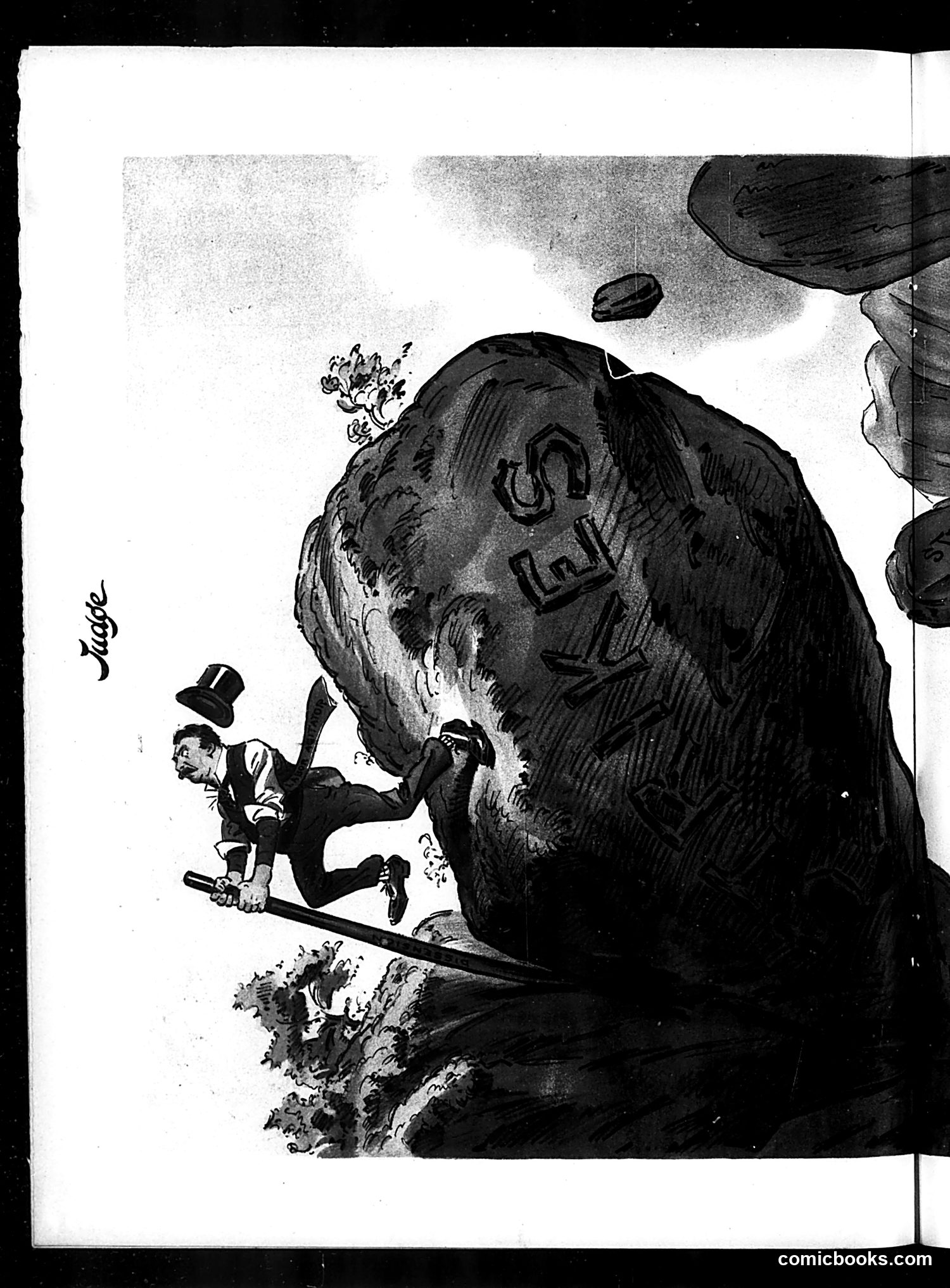
This appears to be a political cartoon from *Judge* magazine, signed "Judge" (the artist's signature visible on the left). The image shows a small man in formal attire (top hat and coat) wielding an axe or similar tool, attacking or chopping at a large skull or death's head figure. Explosive effects and debris surround the action. However, the OCR text provided is largely illegible—appearing to be mostly formatting characters or scanning errors with no readable words. Without clear text identifying the specific political context, figures, or event referenced, I cannot reliably explain what this cartoon satirizes or whom it depicts. To properly analyze this cartoon's meaning and historical context, a clearer OCR transcription or publication date would be essential. The visual metaphor suggests fighting death or disease, but the specific reference remains unclear.
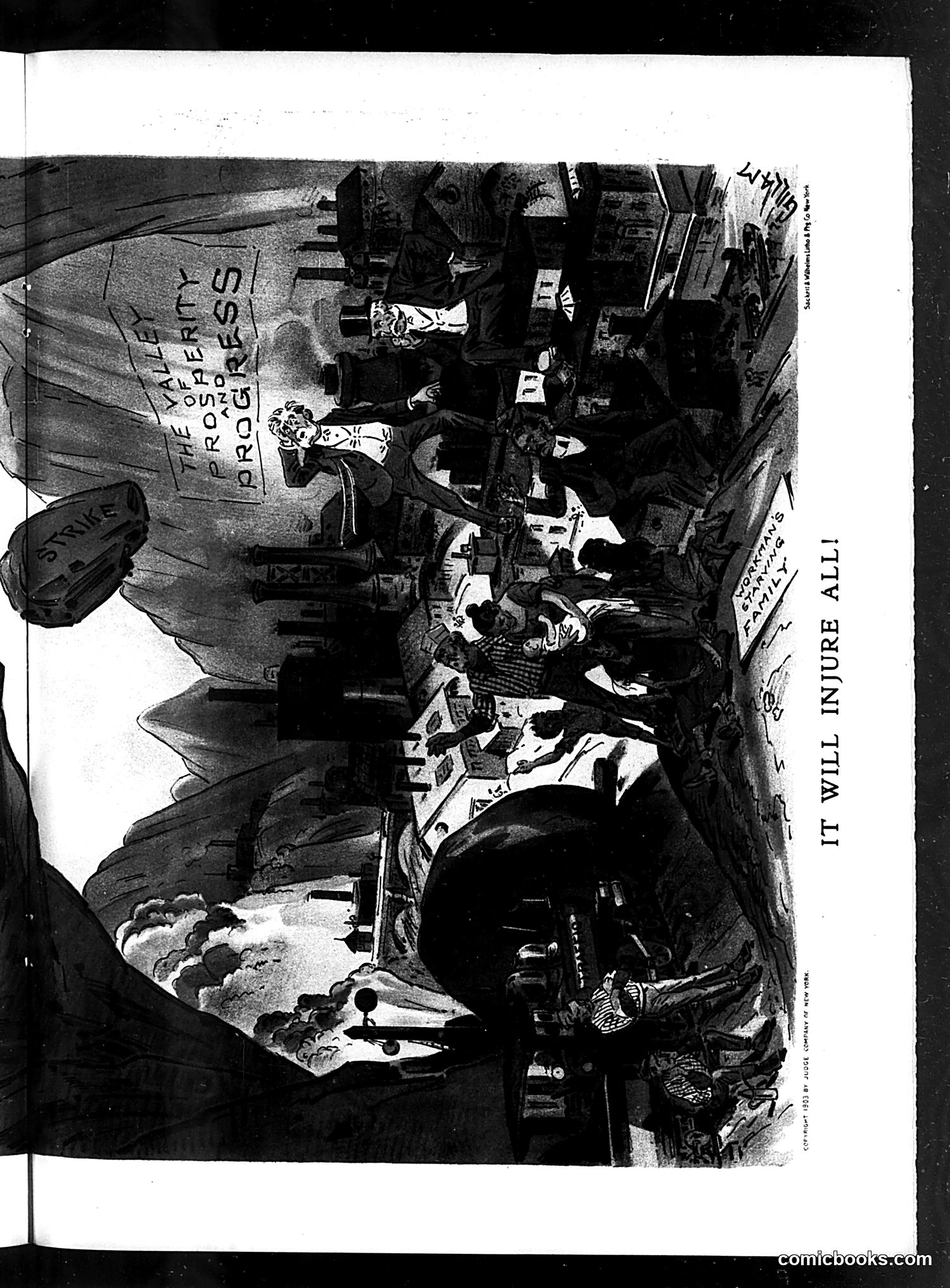
This appears to be a satirical cartoon from *Judge* magazine depicting a crowded, chaotic scene labeled "The Valley of the Prophets" with text referencing "It Will Injure All." The image shows multiple figures in what seems to be a satirical commentary on competing political or social predictions/prophecies. The cartoon likely critiques various competing predictions or warnings circulating in American discourse—possibly about economic, political, or social consequences of particular policies. The crowded composition and overlapping figures suggest multiple contradictory voices making alarming claims simultaneously. Without clearer text visibility or dating information, the specific political moment remains unclear, but the satire targets the proliferation of dire, competing predictions as inherently absurd or suspect.
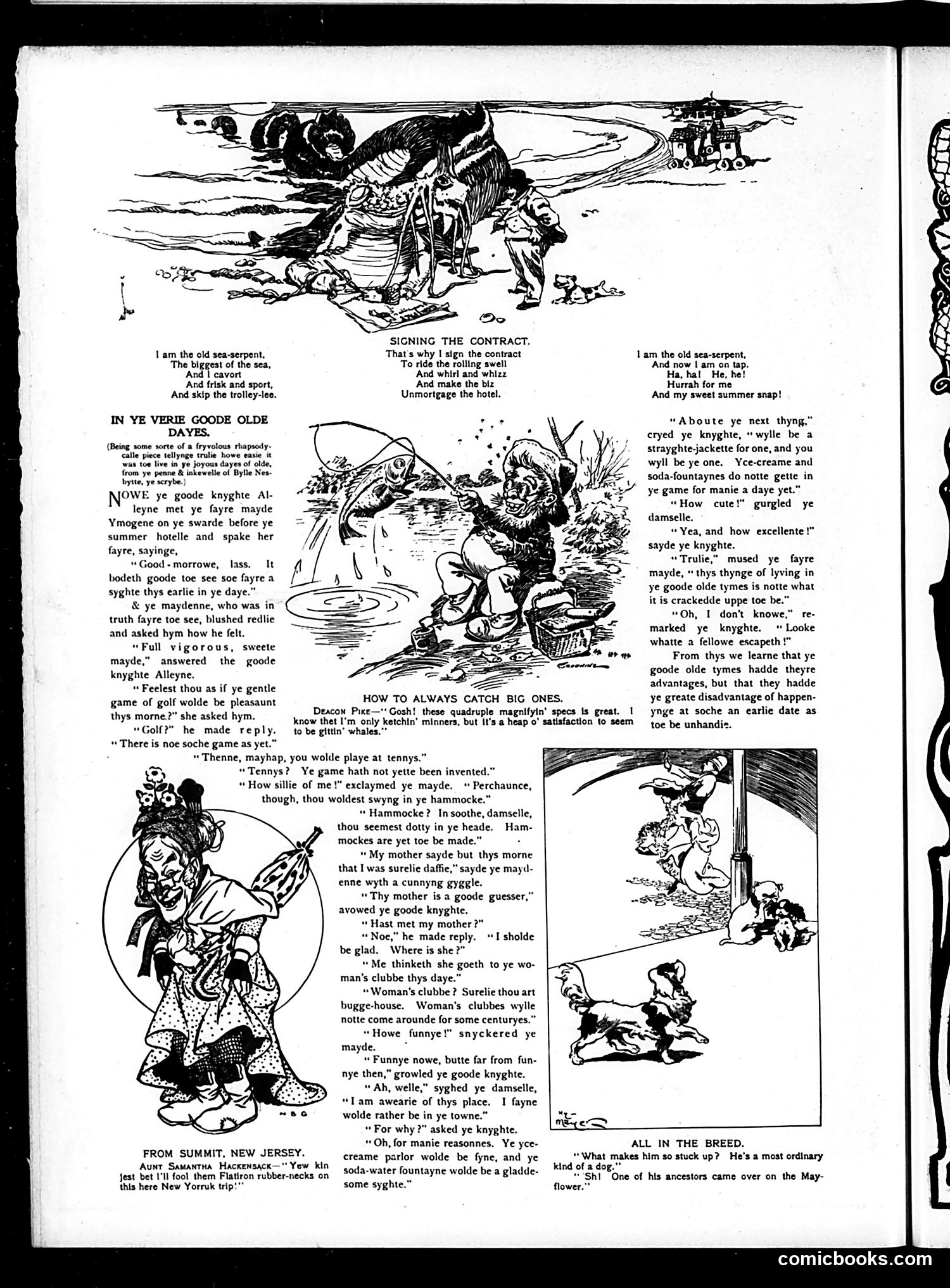
This page contains humorous pseudo-historical sketches mocking nostalgia for "ye olde days." The main piece, "In Ye Verie Goode Olde Dayes," uses deliberately archaic spelling to satirize the romanticization of the past. A knight and maiden discover that cherished modern conveniences—golf, tennis, hammocks, ice cream parlors, soda fountains, and women's clubs—didn't exist in actual medieval times. The joke critiques how people selectively remember history, imagining an idealized past while forgetting its genuine hardships and lacks. Other cartoons on the page offer unrelated humor: a sea-serpent boasting about commercial exploitation; a fisherman using magnifying glasses to see minnows as whales; and a dog descended from Mayflower passengers acting superior. These exemplify Judge's typical early-20th-century mix of wordplay, visual gags, and social observation.
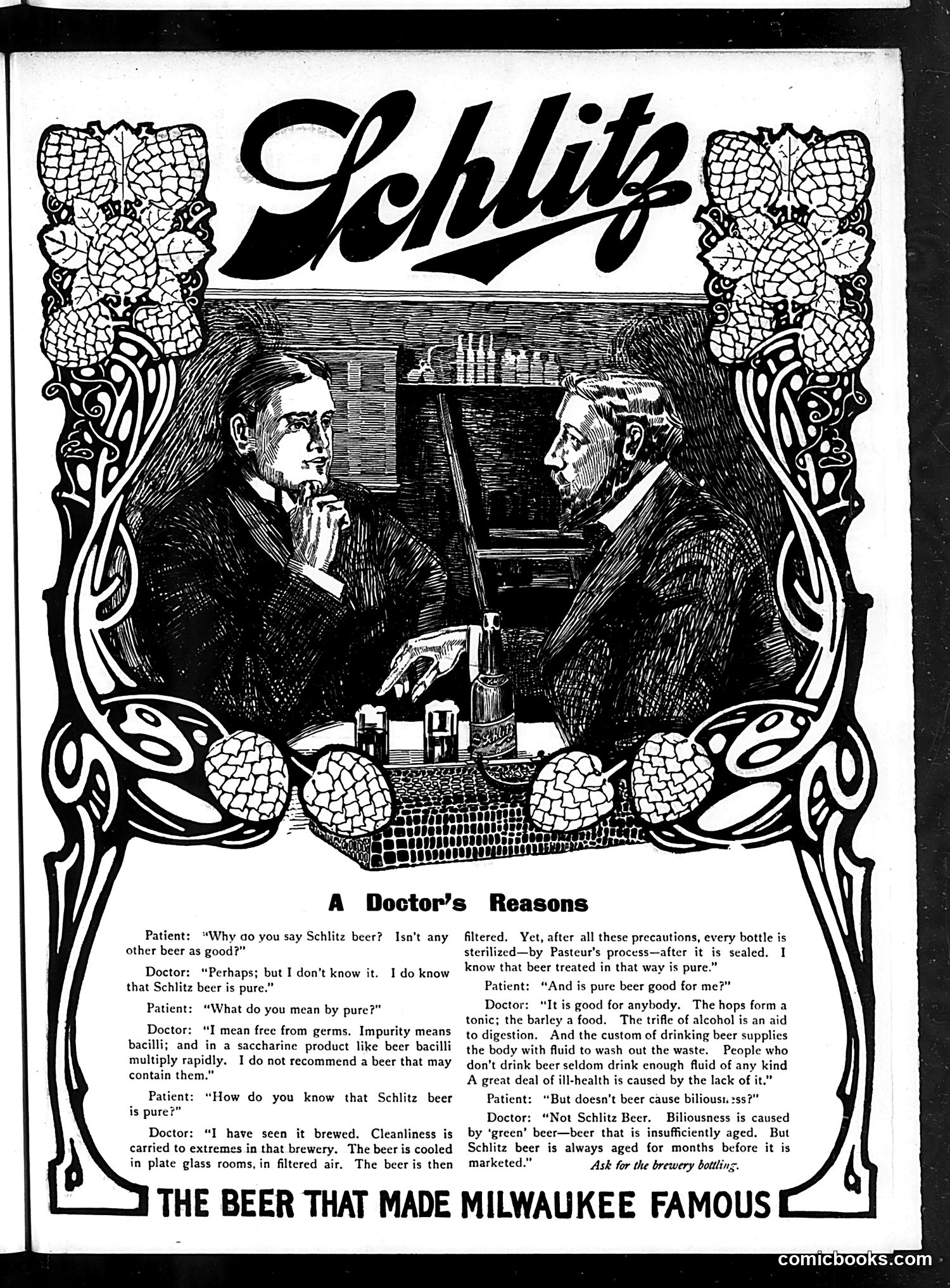
This is a **Schlitz beer advertisement** disguised as editorial content in Judge magazine. It depicts a doctor and patient in conversation, with the doctor endorsing Schlitz beer's purity and health benefits. The satire targets early-20th-century advertising trends: manufacturers leveraged scientific authority and germ-theory anxieties (post-Pasteur) to market products. By framing beer consumption as medically advisable—claiming hops provide tonics, alcohol aids digestion, and proper hydration prevents illness—Schlitz positioned their product as health-promoting rather than merely recreational. The ornate hop-vine borders reinforce the "natural" purity message. This reflects the era's broader tendency to invoke doctors' endorsements to lend credibility to commercial products, a practice now heavily regulated but common then. The page is fundamentally **advertising**, not satire—though modern readers might find the beer-as-medicine pitch itself darkly humorous.
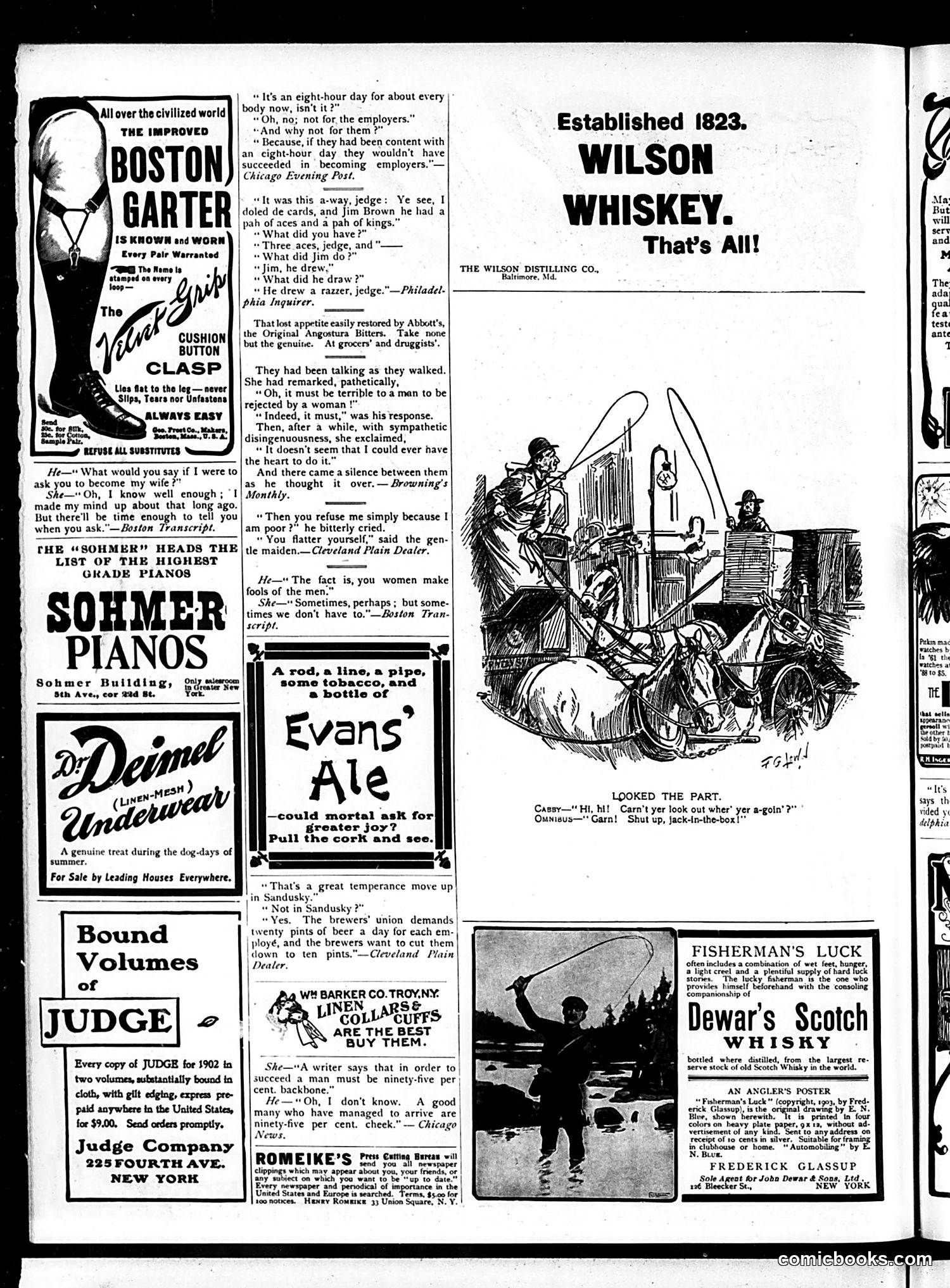
This page mixes advertisements with short humor items typical of Judge magazine's format. The main comic illustration (center-right) shows two figures on what appears to be a boat or dock—one addressing another as "jack-in-the-box," a derogatory reference to a small or irritating person, suggesting class-based mockery of a working-class figure. The humor pieces are brief editorial jokes on familiar themes: courtship, labor conditions, and gender relations. Notable is a jab at employers for working beyond eight-hour days (positioned as justification for their success), and a brewing industry joke about union demands for beer rations. The page is predominantly advertising: whiskey, ale, pianos, underwear, and other consumer goods fill the margins. These ads reflect 1902-era products and market positioning. The overall tone assumes an educated, middle-class readership comfortable with gentle mockery of labor disputes, courtship conventions, and working-class speech patterns rendered in dialect.
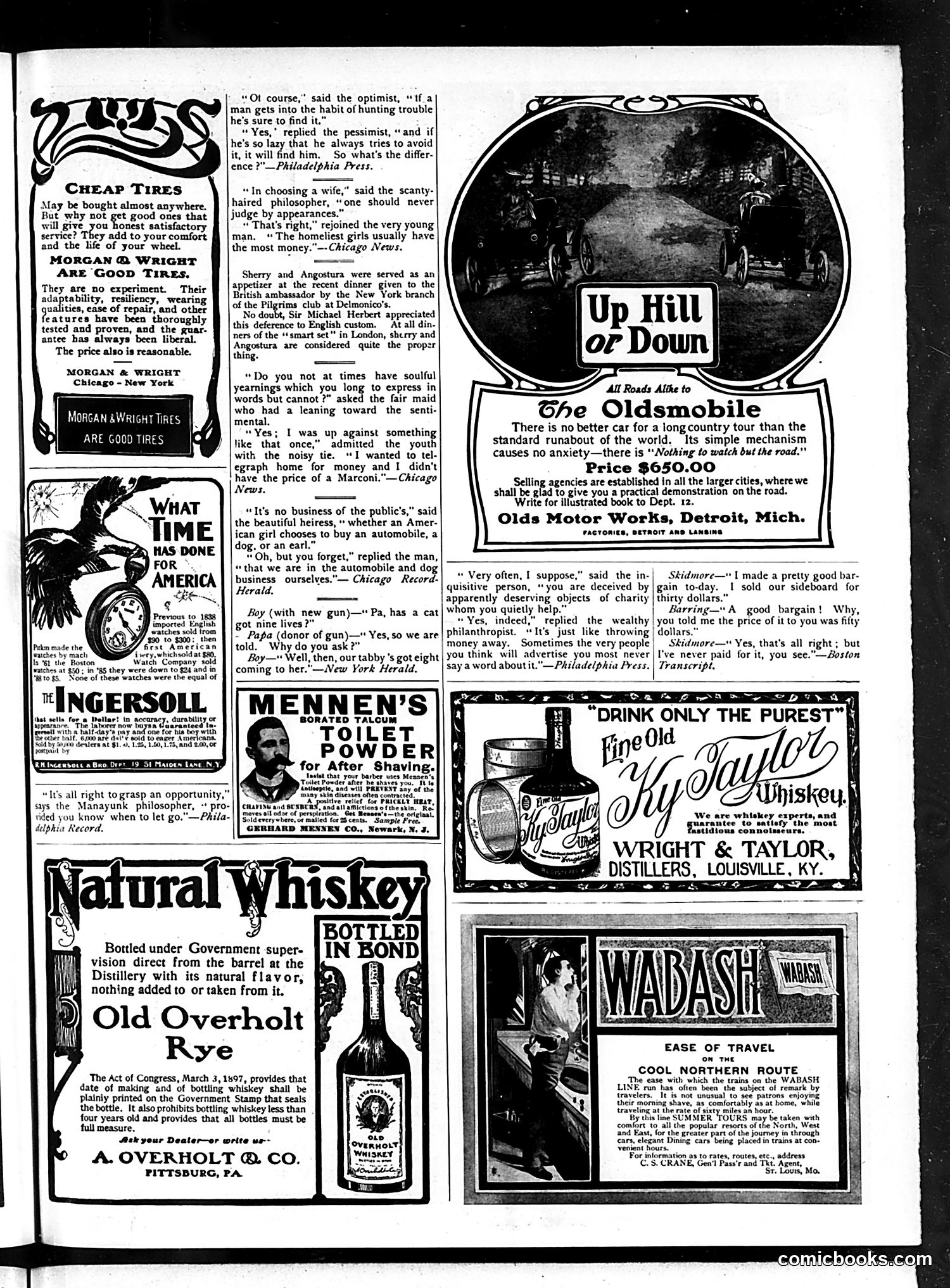
This is primarily an **advertising page** from Judge magazine, with minimal editorial content. The few short humor pieces are typical of the era's satirical style—brief, quotable quips on universal topics rather than specific political satire. The page showcases early 1900s commercial products: tire companies (Morgan & Wright), automobiles (Oldsmobile at $650), whiskeys (Old Overholt Rye, Old Sky Taylor), toiletries (Mennen's talcum powder), and travel services (Wabash railroad). The humor reflects period attitudes: a joke about a man too cheap to telegraph home (Marconi technology as luxury); another about a wealthy philanthropist deceived by charity cases; and a boy's logic puzzle about cat lives. One piece satirizes beautiful heiresses buying automobiles and earls—mocking both consumer culture and transatlantic marriages between American heiresses and European nobility, a genuine phenomenon of the Gilded Age. The content reveals more about *advertising and consumer culture* of the era than political commentary—Judge by this period had shifted toward commercial content rather than sharp satire.
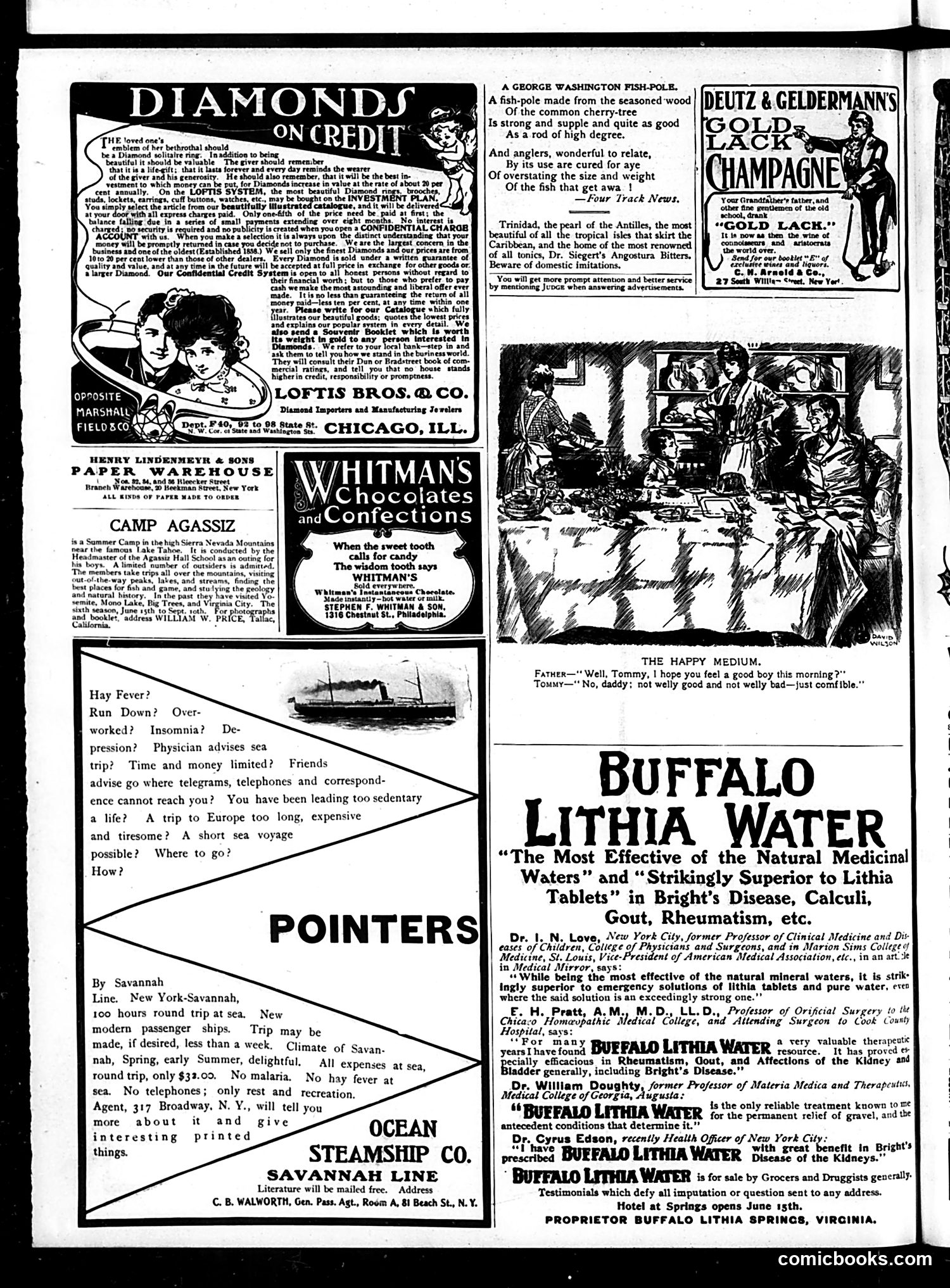
This page is primarily **advertising** with one modest cartoon. **The Cartoon ("The Happy Medium"):** A father asks his son Tommy if he feels "good" that morning. Tommy replies he feels neither particularly good nor bad—just "comfible" (comfortable). The joke plays on the child's malapropism and the idea of seeking a middle emotional state rather than genuine virtue—satirizing parental expectations and childhood honesty. **Main Advertisements Include:** - **Diamonds on Credit** (Loftis Bros.): Pitch for installment jewelry purchases with confidentiality - **Gold Lack Champagne**: Spirits advertisement - **Whitman's Chocolates**: Confections marketing - **Camp Agassiz**: Summer camp for boys in Nevada mountains - **Buffalo Lithia Water**: Medicinal water claiming cures for kidney/bladder diseases, citing medical authorities - **Ocean Steamship Co./Savannah Line**: Travel advertisements The page reflects early 1900s consumer culture with heavy medical-patent-remedy marketing typical of the era.
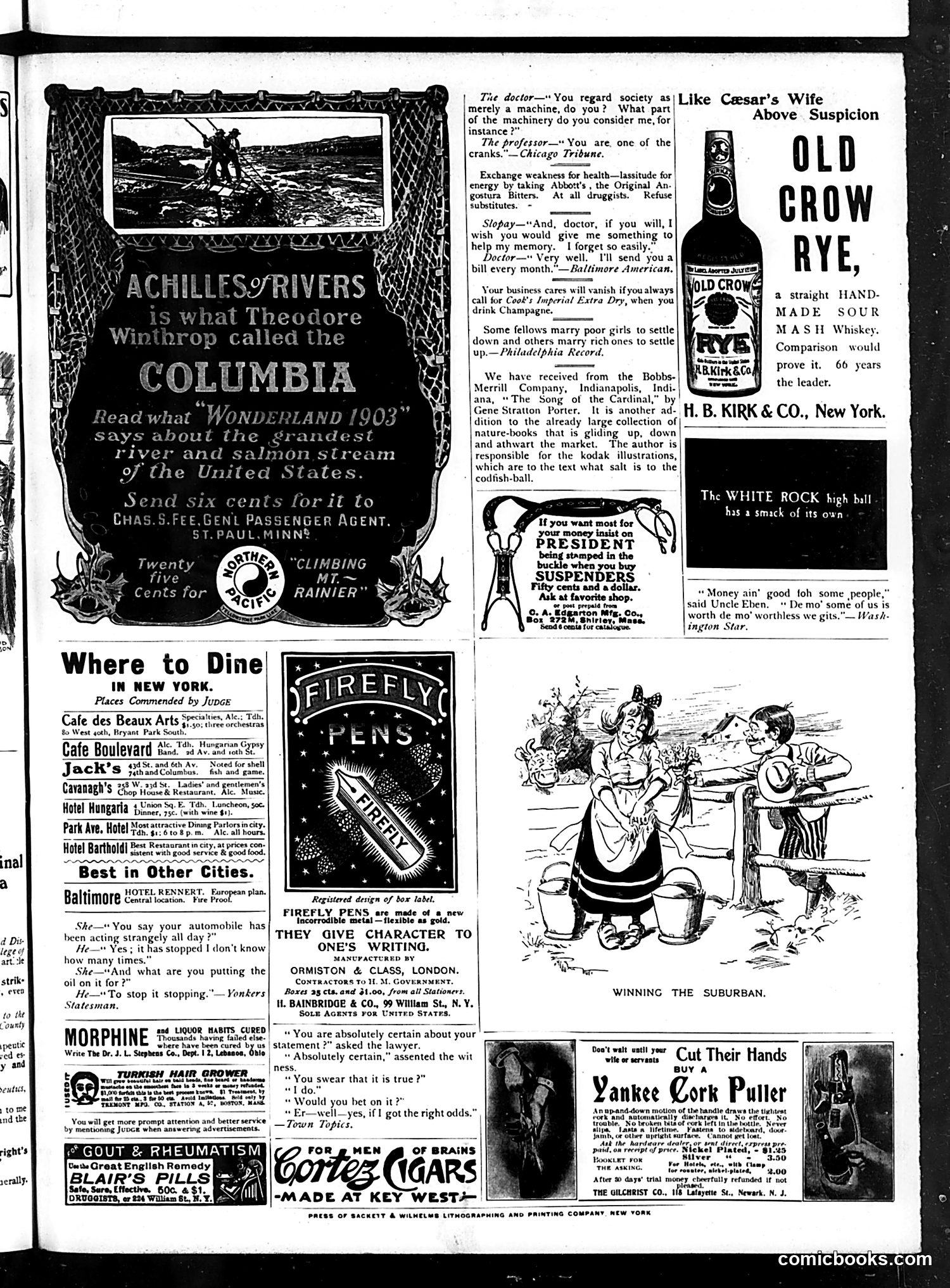
This page is primarily **advertisements and filler humor** rather than political cartoons. The dominant visual elements are product ads (Old Crow Rye whiskey, Firefly Pens, Yankee Cork Putter, morphine treatments) interspersed with brief jokes. The small comic illustration titled **"Winning the Suburban"** depicts a woman in Victorian dress beating a man with a stick near a fence—a domestic humor joke about marital conflict, a common Judge theme of the era. The text contains **short joke exchanges**: a professor calls a doctor a "crank" in society's machinery; a patient asks a doctor for memory help and receives a bill; a lawyer questions a witness about certainty. These are gentle, society-page humor typical of Judge's audience. The reference to **"Caesar's Wife"** (promoting Old Crow) alludes to the Roman saying that Caesar's wife must be "above suspicion"—a quality the ad humorously claims for the whiskey brand. Overall, this is a **commercial magazine page** showcasing the advertising-driven nature of early 1900s periodicals, with light social satire aimed at upper-middle-class readers.
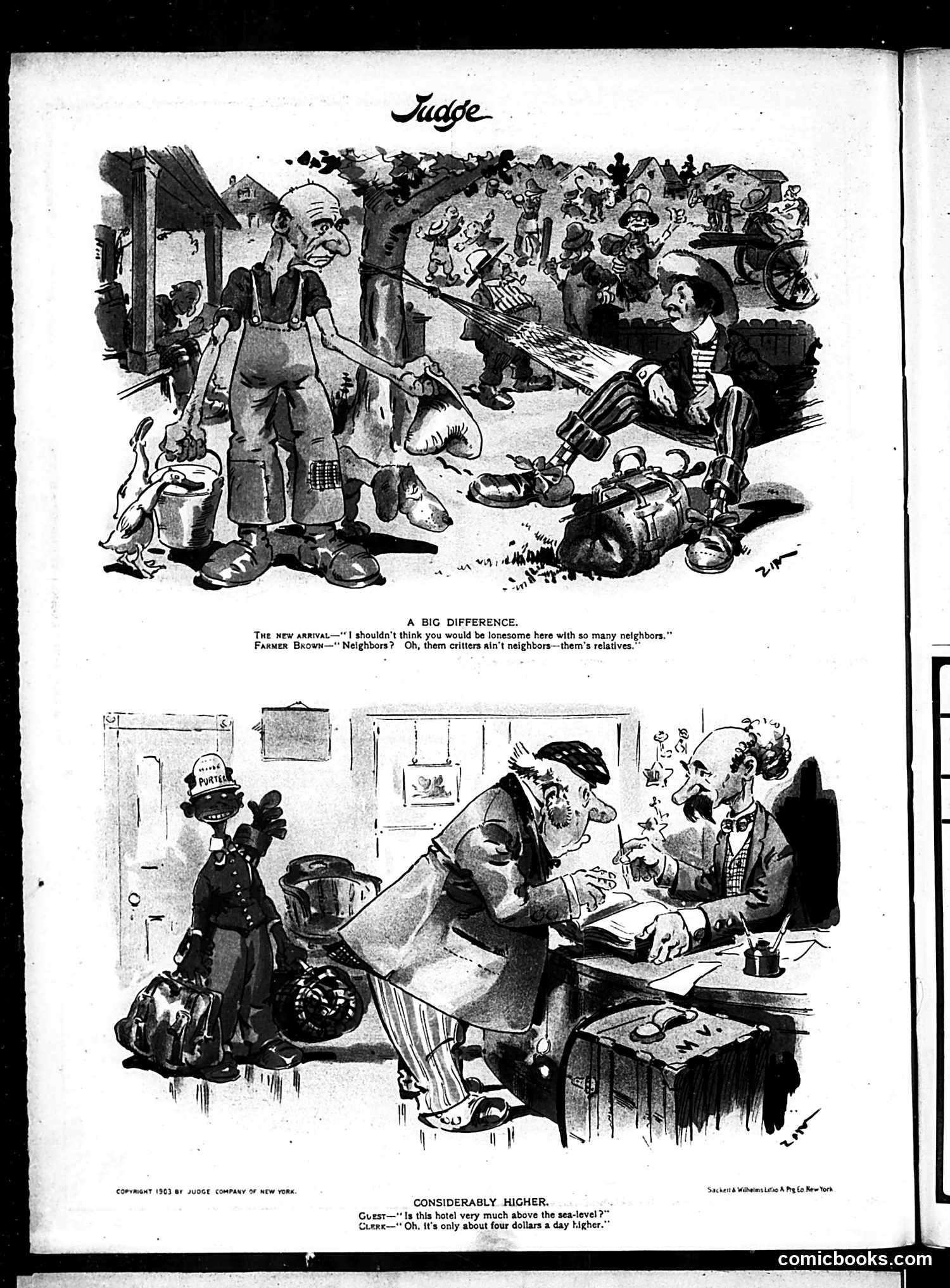
**Top Cartoon ("A Big Difference"):** A newly arrived farmer observes many people in a crowded rural setting and assumes they're neighbors. Farmer Brown corrects him—they're actually his *relatives*. This satirizes rural family size and suggests the countryside is overrun with the farmer's extended kin rather than being a community of distinct neighbors. It's a joke about large rural families and isolation. **Bottom Cartoon ("Considerably Higher"):** A hotel guest asks the clerk if the establishment is significantly elevated above sea level. The clerk punts on the geography question, instead making a pun: the hotel is "higher" in price—four dollars a day above standard rates. This is straightforward wordplay humor mocking inflated hotel pricing by exploiting the double meaning of "higher." Both cartoons use rural/working-class characters and simple, pun-based humor typical of Judge's style.
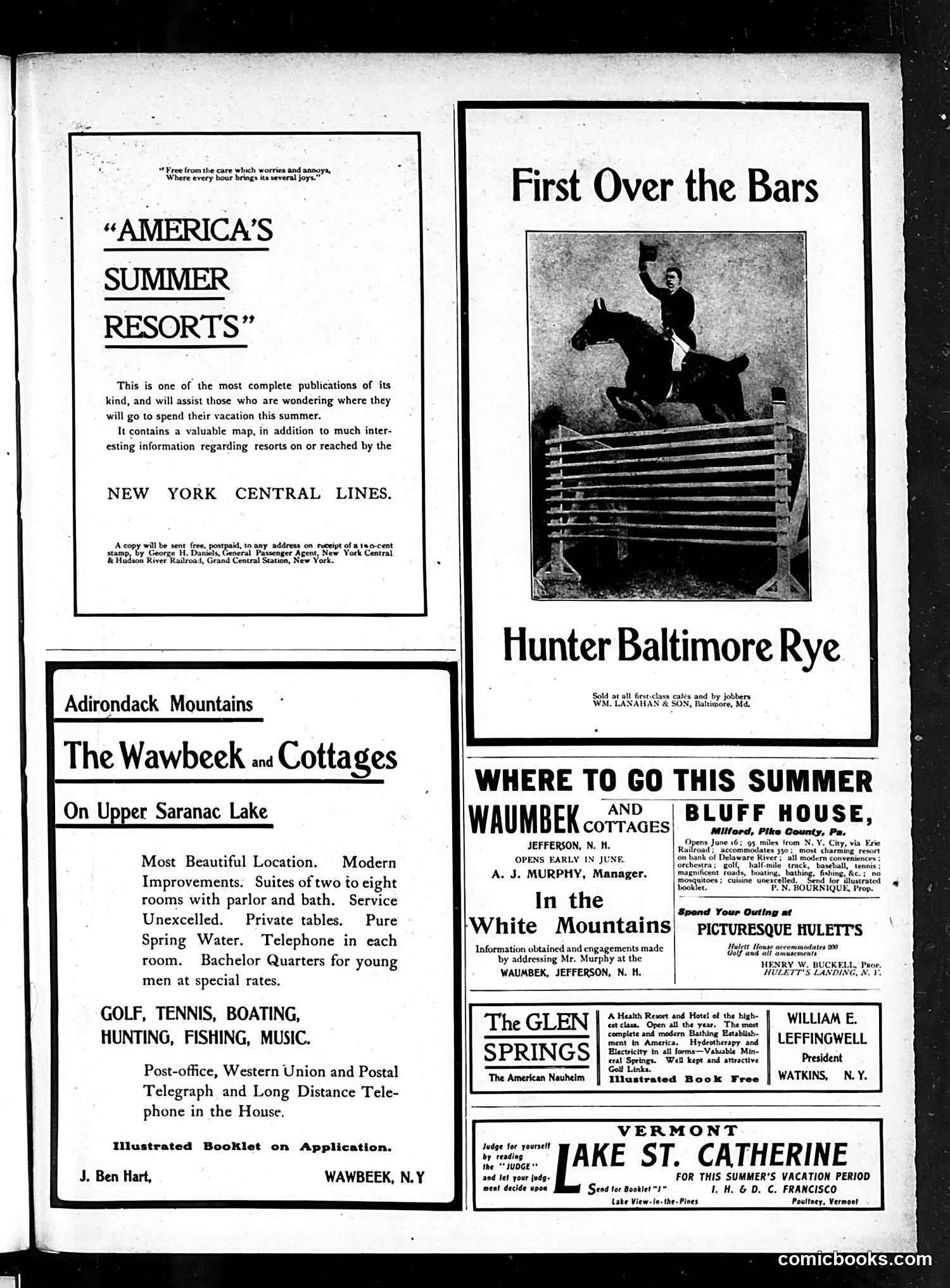
This page is **primarily advertising**, not satirical content. It features vacation resort advertisements for upscale American summer destinations, circa early 1900s. The single illustrated element—"First Over the Bars"—shows a horse and rider jumping a fence. This appears to be a sporting image advertising **Hunter Baltimore Rye whiskey**, not political satire. The image celebrates equestrian sport, likely appealing to the affluent leisure class targeted by these resort ads. The page's content reflects the era's leisure culture: wealthy urbanites could escape to Adirondack Mountains resorts, Vermont lakeside hotels, and Pennsylvania countryside estates. Amenities listed—golf, tennis, hunting, fishing, private telegraph service—indicate luxury accommodations for the well-to-do. No political figures or satirical commentary are evident. This is a commercial page showcasing how Judge magazine monetized its readership through targeted advertising to upper-class consumers seeking summer recreation.
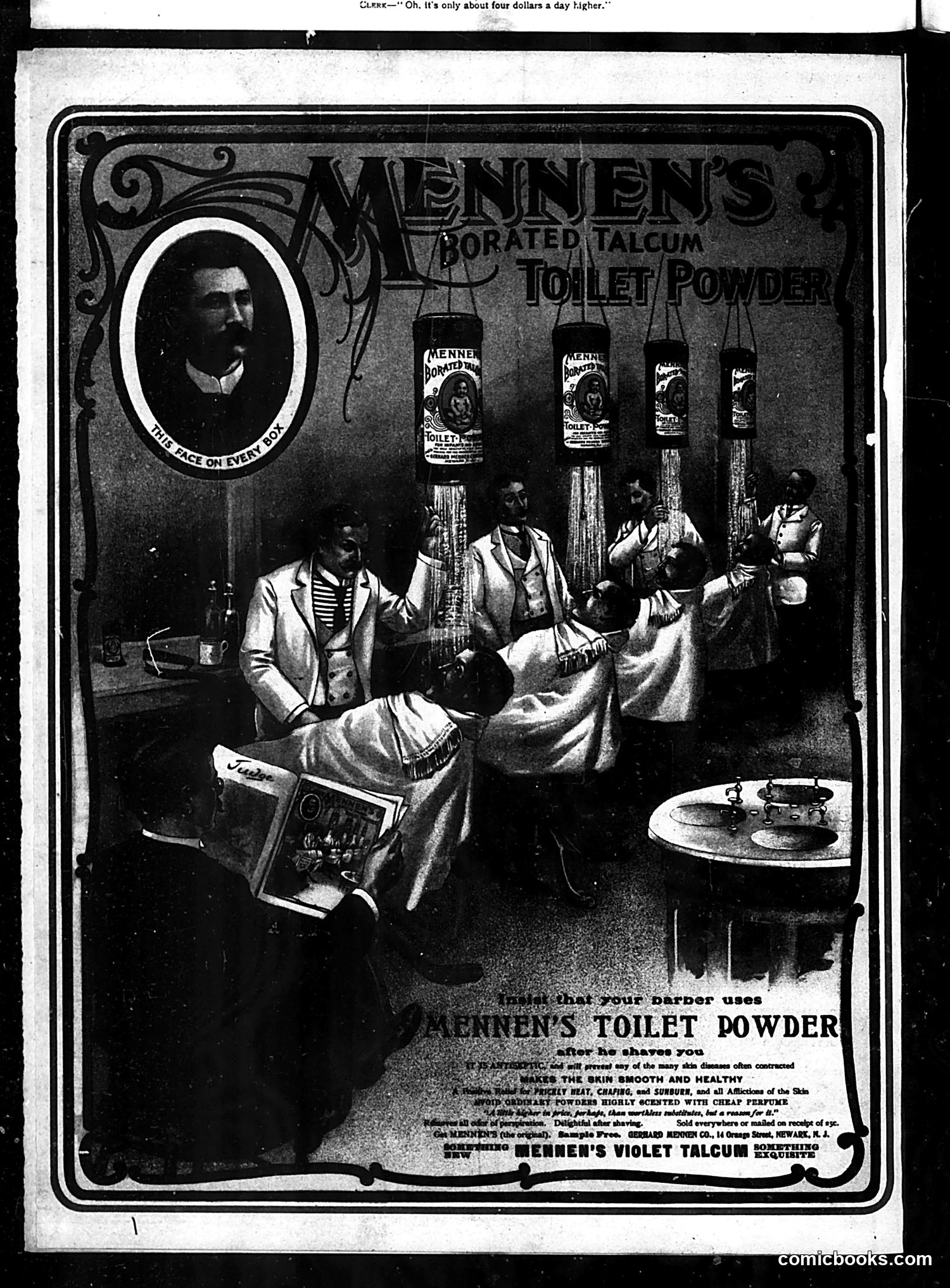
This is primarily a **full-page advertisement**, not political satire. It advertises Mennen's Borated Talcum Toilet Powder, a personal hygiene product. The ad depicts a barber shop scene where a barber applies the powder after shaving a customer, with other barbers and clients visible. A portrait of what appears to be the product's founder or endorser occupies the upper left. The marketing pitch emphasizes the powder's supposed medical benefits: preventing skin diseases, keeping skin "smooth and healthy," and treating chafing and sunburn. The text notes it's "highly scented with cheap perfume"—an unusual selling point that reveals period advertising's candor about cost-cutting. This reflects early-20th-century consumer culture when toilet powders were marketed with exaggerated health claims, and barber shops were social/commercial hubs where such products were prominently used and sold.

I can see this is a page from *Judge* magazine, but the image is extremely dark and heavily degraded, making it nearly impossible to discern the actual cartoon content, illustrations, or text details beyond the watermark "comicbooks.com" at the bottom right. The page appears to show some faint outlines of figures or illustrations on the left and right margins, but no legible text or clear imagery is visible in the center or throughout most of the page. Without being able to read the OCR text provided (which appears incomplete in your message) or see the cartoon clearly, I cannot reliably identify the political figures, social references, or satirical points intended. To provide accurate historical context, I would need either a clearer image or the complete OCR transcription.