
A complete issue · 16 pages · 1903
Judge — April 11, 1903
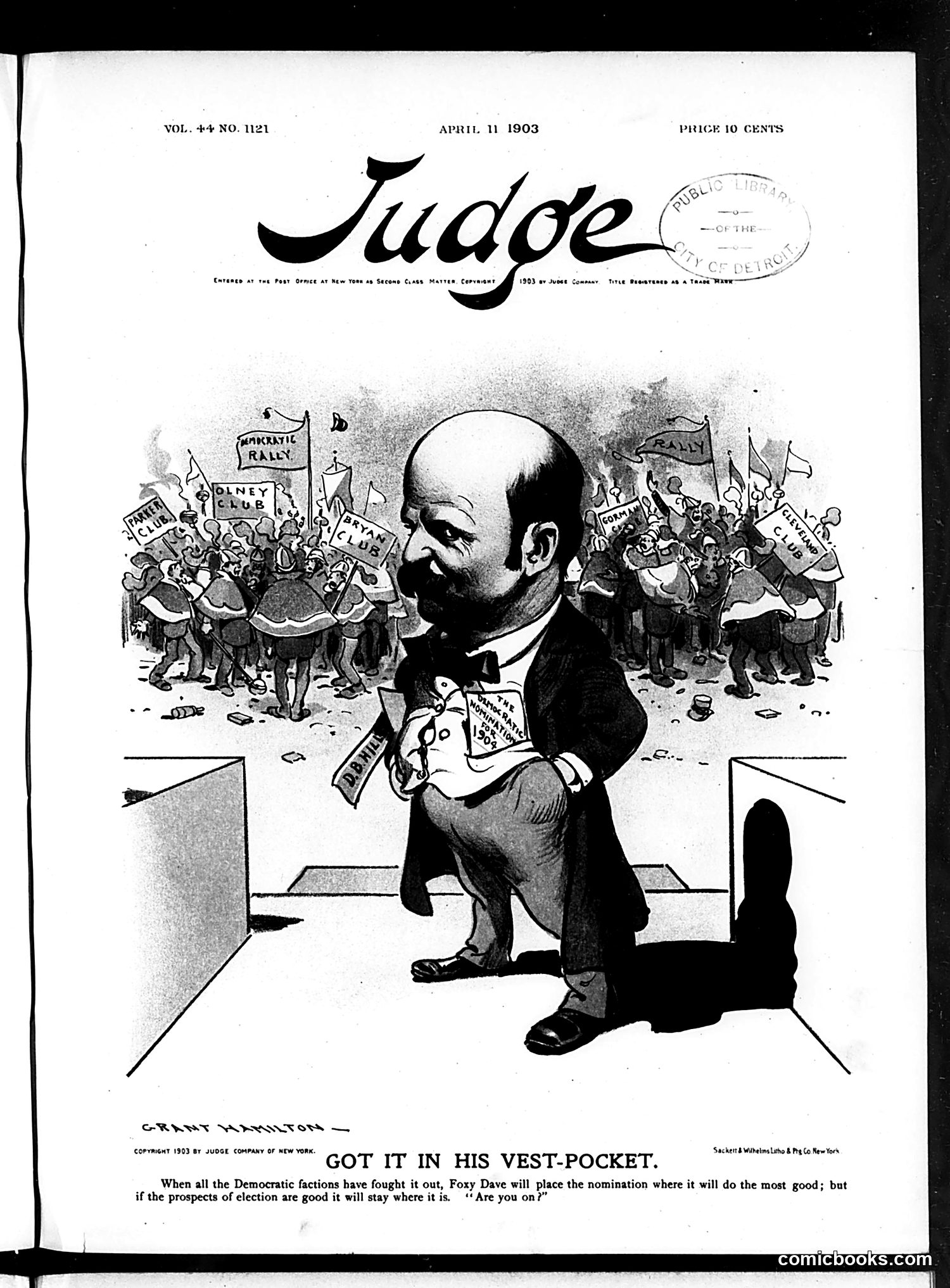
**Judge Magazine, April 11, 1903** This cartoon by Grant Hamilton satirizes Democratic presidential nomination politics. The caricatured figure in the foreground—identified as "Foxy Dave" in the caption—holds nomination papers while crowds with various party faction signs rally behind him. The caption explains that when Democratic factions finish fighting, "Foxy Dave will place the nomination where it will do the most good," asking "Are you on?" The satire suggests Dave (likely a Democratic political operative) controls the nomination process through backroom dealing—keeping it literally in his vest-pocket rather than letting it emerge from legitimate party competition. The cartoon mocks the era's perception of machine politics and smoke-filled-room decision-making, where powerful insiders determined nominations regardless of grassroots support.
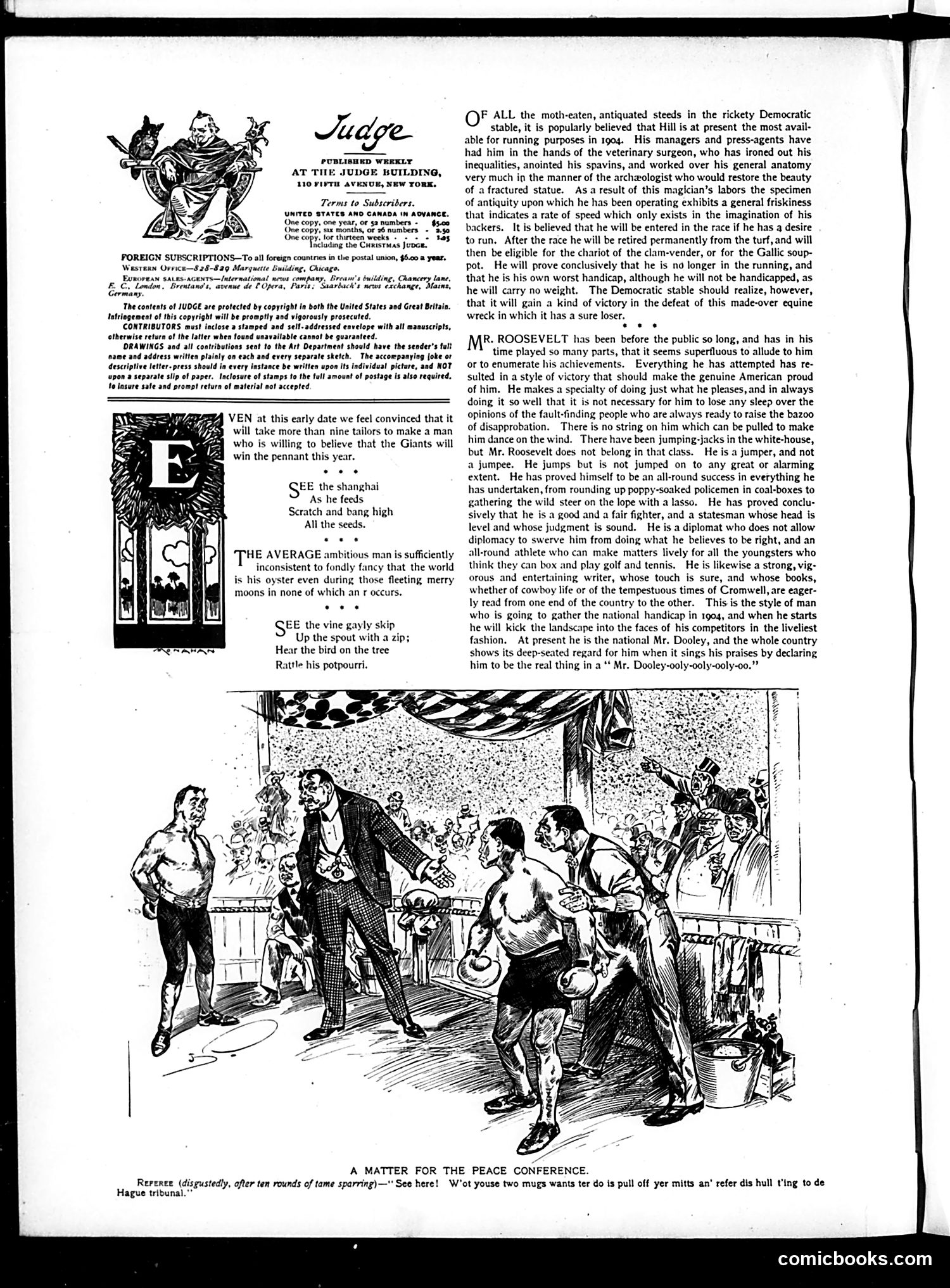
This Judge magazine page contains two satirical pieces about Theodore Roosevelt and American politics, likely from around 1904-1912 (based on references to upcoming races). The upper text mocks a moth-eaten Democratic racehorse supposedly belonging to a Democratic stable, suggesting it will lose badly—this appears to satirize Democratic electoral prospects. The lower cartoon, captioned "A Matter for the Peace Conference," depicts what appears to be a boxing or athletic dispute at what looks like an official gathering. The referee's dialogue ("See here! We'l youse two mugs wants ter do is pull off yer mitts an' refer dis hull t'ing to de Hague tribunal") satirizes international arbitration by suggesting even simple disputes are being deferred to formal peace conferences rather than being resolved directly—likely critiquing excessive legalism or diplomatic complexity.
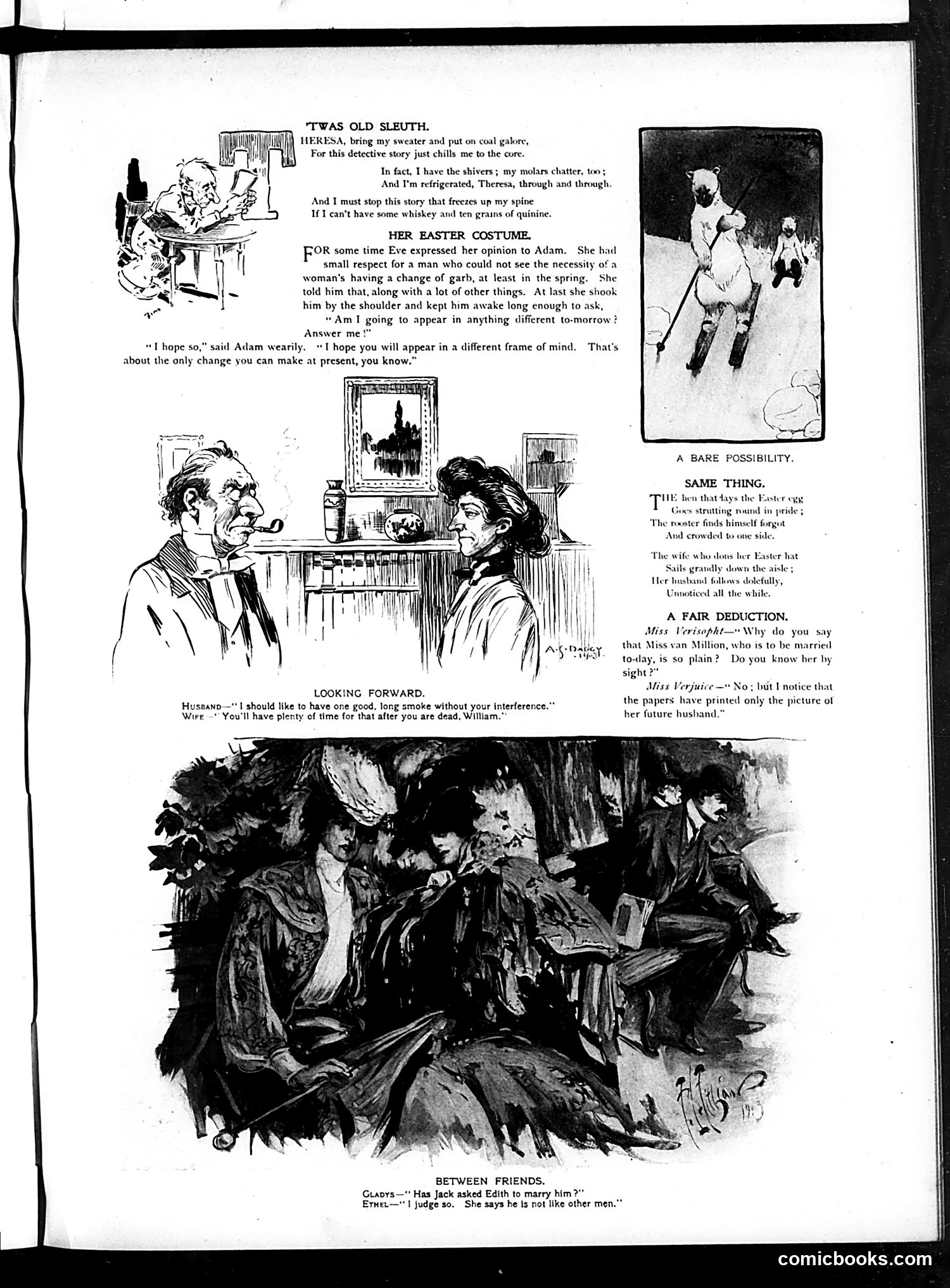
This page contains several humorous sketches with social commentary typical of early-20th-century American satire: **"'Twas Old Sleuth"** mocks a detective story enthusiast who demands his wife wear a different Easter outfit to avoid being recognized—suggesting absurdly melodramatic thinking. **"Her Easter Costume"** satirizes a husband's dismissive attitude toward his wife's desire for spring fashion changes, showing marital discord over trivial matters. **"Looking Forward"** depicts a husband wanting uninterrupted smoking time, with his wife's sharp retort about "plenty of time for that after you are dead, William"—dark humor about domestic conflict. **"A Fair Deduction"** jokes about newspaper reporting of a woman's appearance rather than personality. **"Between Friends"** shows women gossiping about a man's marriageability, commenting on gender dynamics and social judgment. The overall theme addresses marriage tensions, gender roles, and social pretensions of the era.
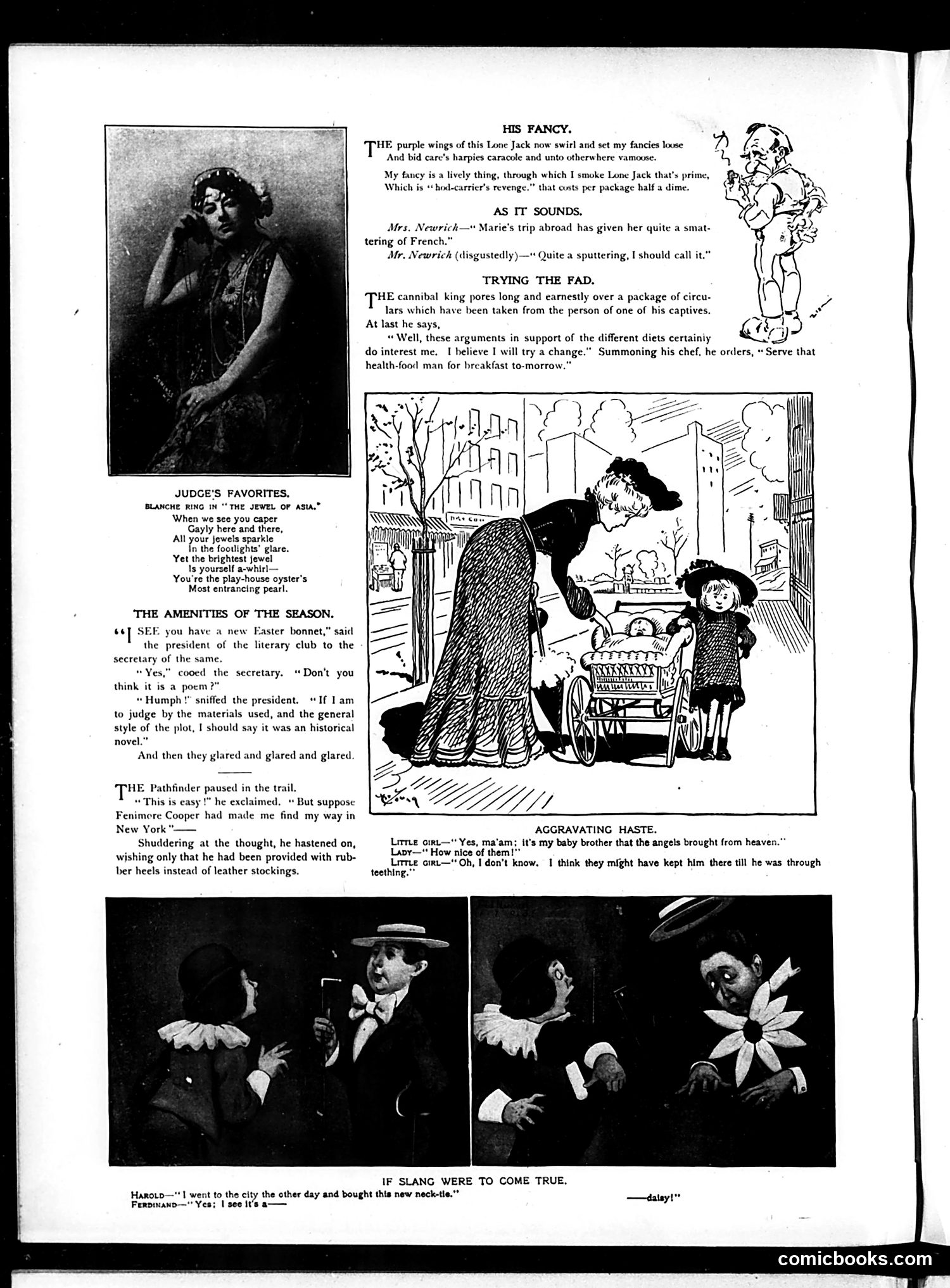
This page contains several unrelated satirical pieces typical of early-20th-century Judge magazine: **"His Fancy"** mocks romantic idealization, with text about a "Lone Jack" character and bohemian pretensions. **"Judge's Favorites"** celebrates actress Blanche Ring in "The Jewel of Asia," using flowery language typical of theatrical promotion satire. **"Aggravating Haste"** depicts a woman with a baby carriage, satirizing impatient motherhood—the child claims angels brought the infant, suggesting unwanted pregnancy or hasty family planning. **"If Slang Were to Come True"** shows two men with exaggerated gestures, apparently joking about slang expressions becoming literal reality—though the specific reference is unclear without fuller context. The page primarily targets middle-class social pretensions, theatrical culture, and domestic humor rather than explicit political commentary.
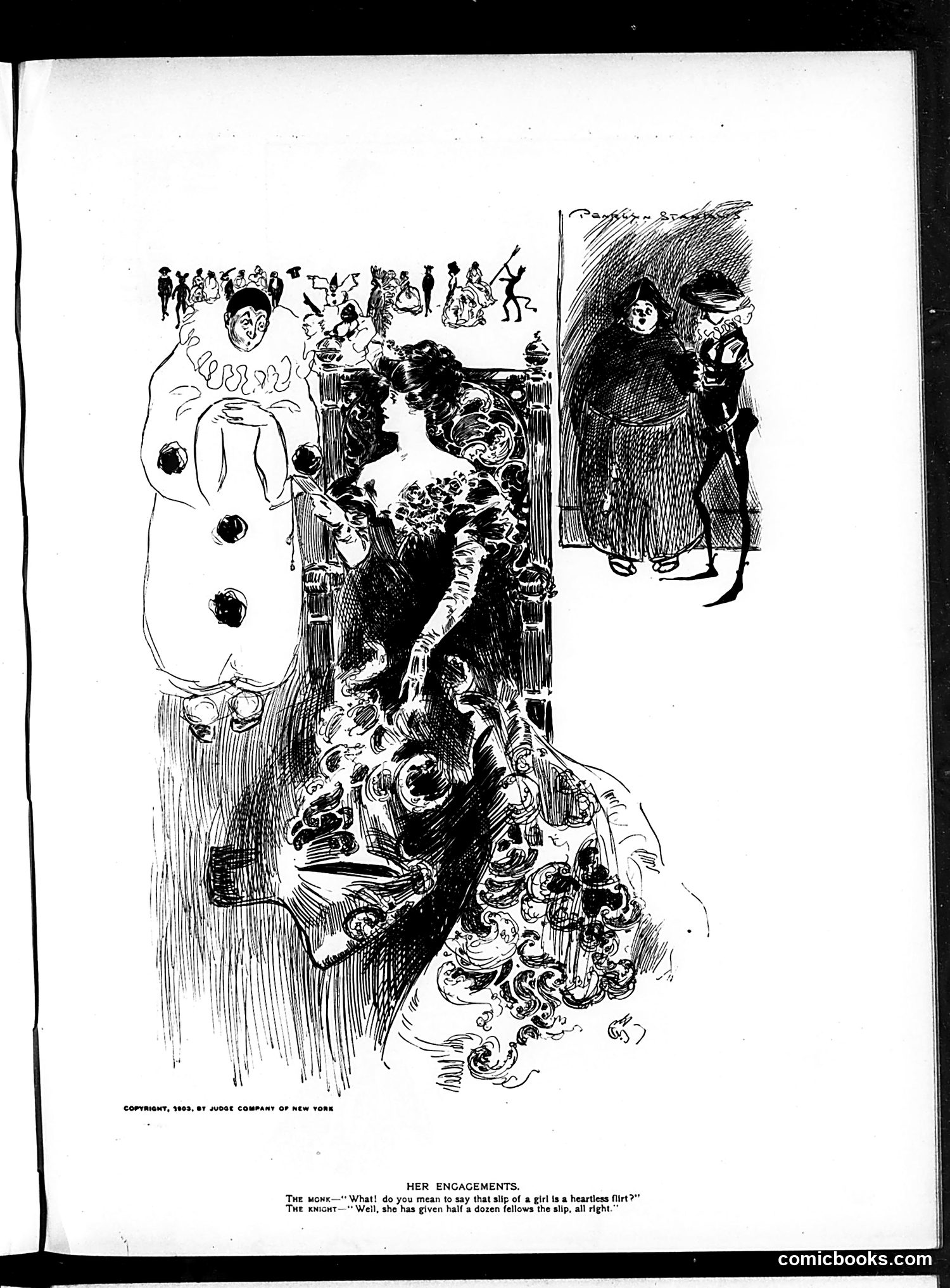
This cartoon satirizes women's social independence and romantic autonomy in the early 1900s. The dialogue between a Monk and Knight (medieval figures used for timeless commentary) mocks a young woman's behavior: when the Monk warns that a girl who "slips" from engagements lacks virtue ("heartless flirt"), the Knight defends her—she's simply broken off multiple betrothals, which he considers acceptable. The satire targets conservative anxiety about women's increasing freedom to reject marriage proposals. The medieval figures distance the commentary from contemporary scandal while making clear the generational divide: older morality viewed broken engagements as scandalous; modern attitudes treated them as a woman's prerogative. The cartoon ironically celebrates female agency while implicitly mocking both the Monk's outdated concern and the Knight's casual dismissal.
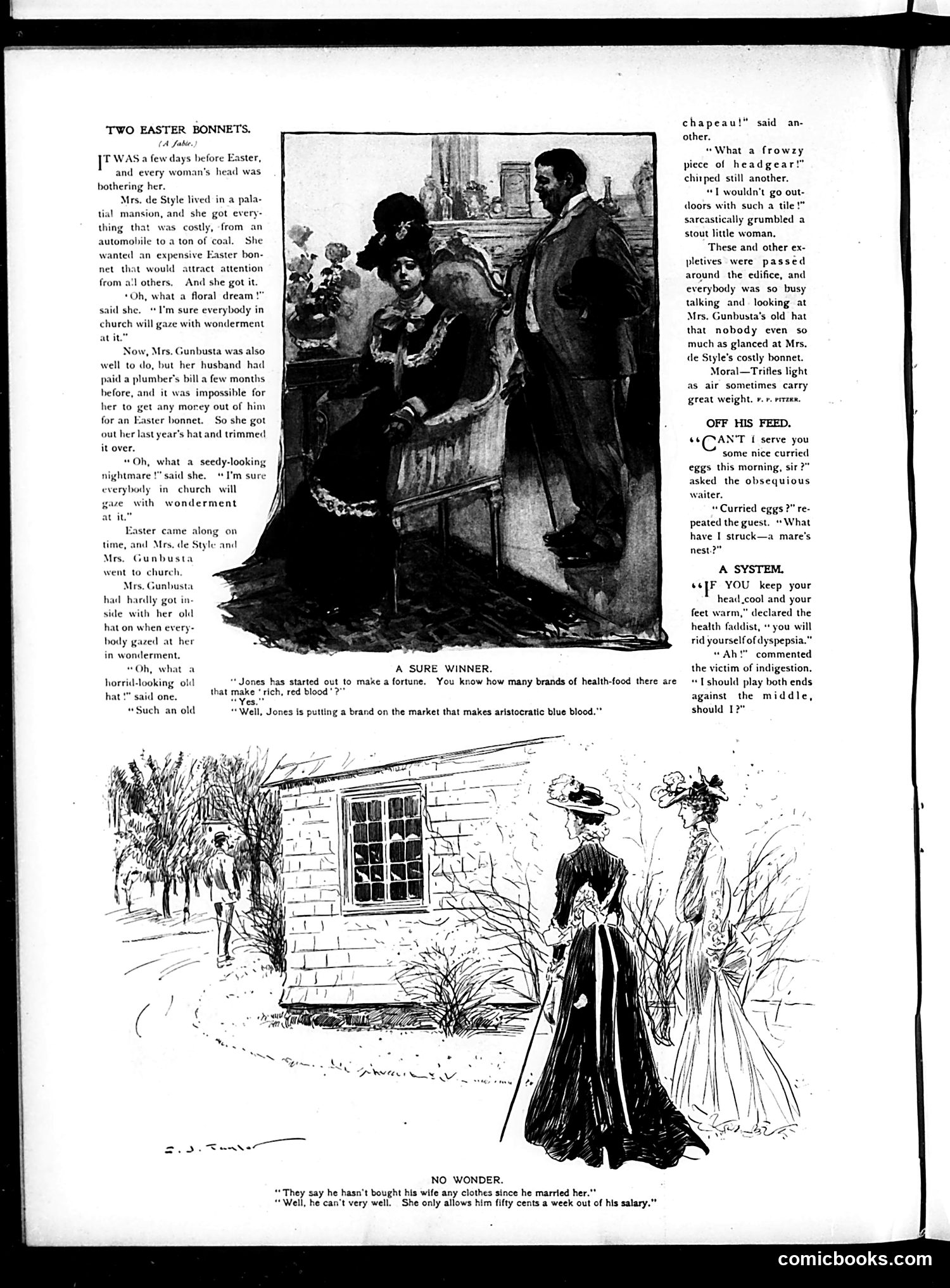
This page satirizes wealthy women's obsession with Easter bonnets as status symbols. Mrs. de Style, wealthy and vain, purchases an elaborate, expensive bonnet designed to attract admiration. Mrs. Gunbusta, equally well-to-do but unable to afford a new hat after her husband's plumbing bill, retrimmed her old bonnet. The joke: at church, everyone focuses on critiquing Mrs. Gunbusta's shabby hat—calling it "frowzy" and "horrid-looking"—while ignoring Mrs. de Style's costly creation entirely. The moral mocks society's shallow preoccupation with appearances: trivial matters ("trifles light as air") carry disproportionate social weight. The accompanying vignettes mock health fads and marital economics, common Judge targets. Overall, the page ridicules upper-middle-class conspicuous consumption and women's competitive vanity during the Edwardian era.
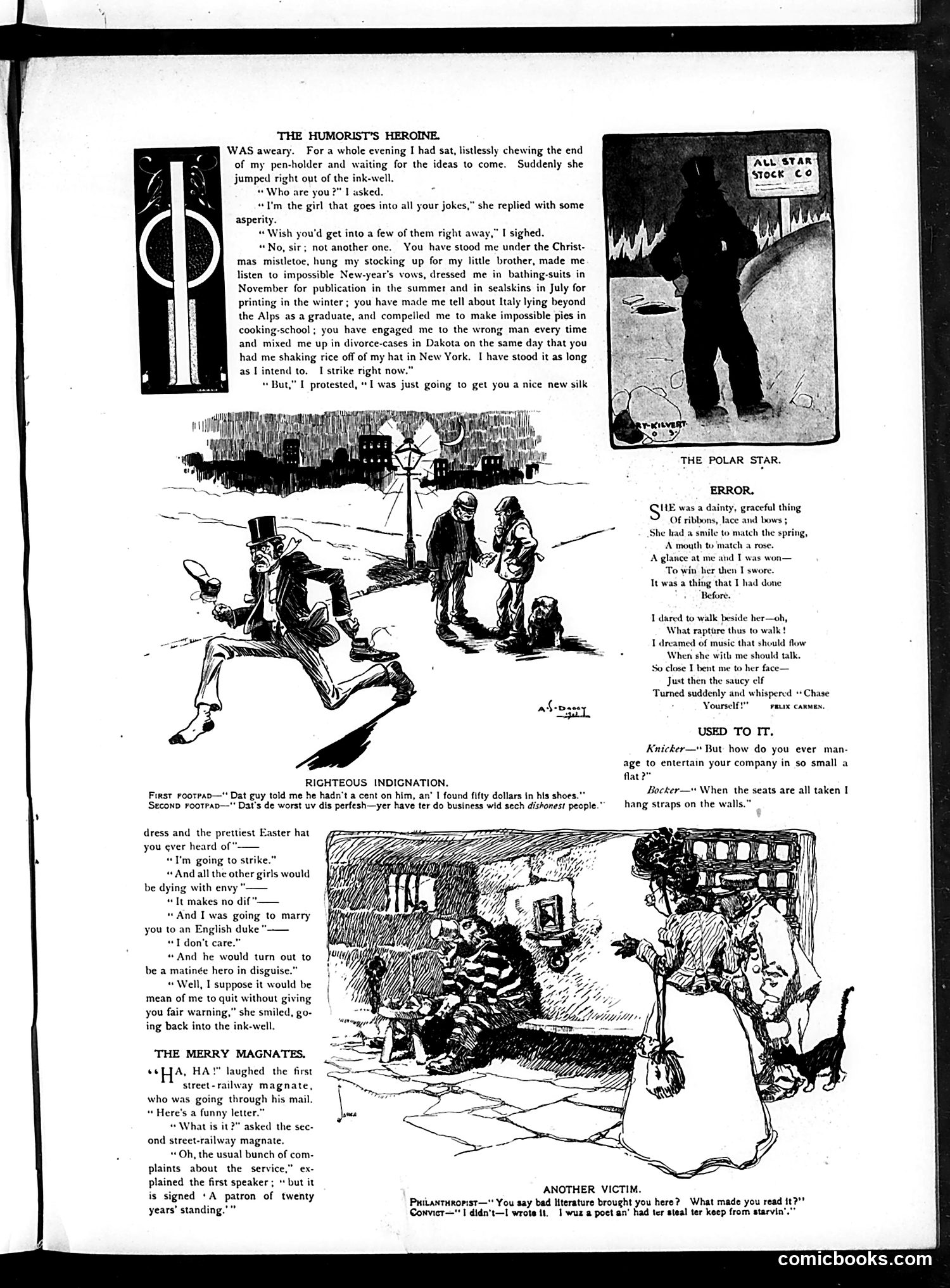
This page collects several satirical pieces mocking early 1900s social conventions and urban life: **"The Humorist's Heroine"** depicts a personified female character who "escapes" from a writer's inkwell to protest being endlessly recycled through hackneyed jokes—forced into Christmas scenes, impossible cooking tasks, and romantic entanglements. The satire targets predictable magazine humor formulas and the exhaustion of stock female character types. **"The Polar Star" and "Error"** are romantic poems mocking sentimental courtship narratives where women play games or suddenly reject pursuing men. **"Righteous Indignation"** shows two working-class men discussing dishonest business practices—one found $50 in a seemingly penniless man's shoe, illustrating corruption in low-wage labor. **"The Merry Magnates"** satirizes street-railway company executives dismissing customer complaints about poor service as routine grievances from long-suffering patrons. **"Another Victim"** darkly jokes that a convicted poet turned to theft because nobody would buy his poetry—commenting on poverty and the undervaluation of artists. The page satirizes predictable humor formulas, urban corruption, and social hypocrisy.
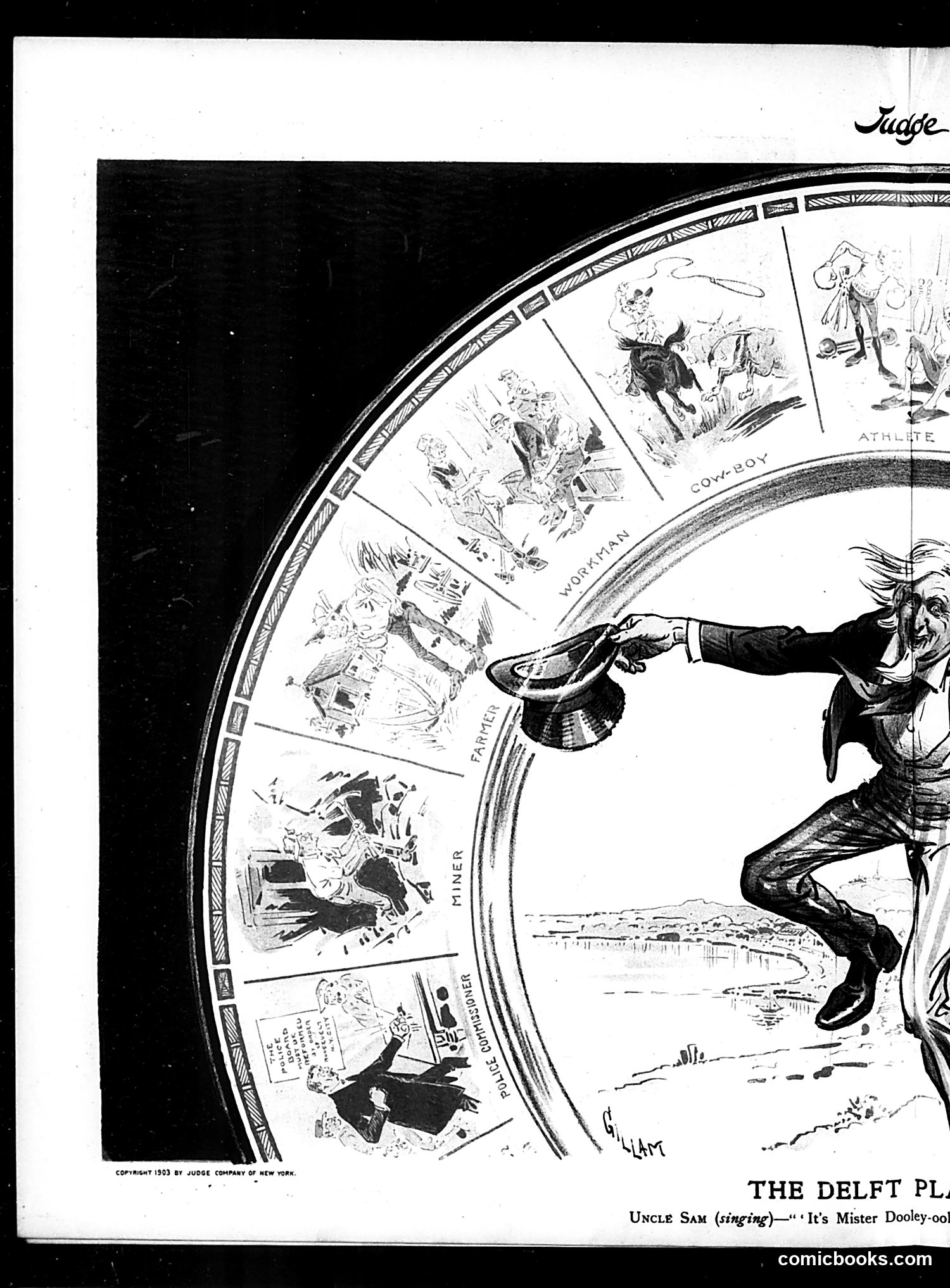
This Judge cartoon depicts Uncle Sam as a carnival barker or showman, spinning a large decorative plate (resembling Delft pottery) that displays various illustrated scenes. The plate appears to be a "wheel of fortune" or "spinning wheel" device. Uncle Sam references "Mister Dooley" — likely Mr. Dooley, a popular Irish-American comic character from the era known for satirical political commentary. The cartoon seems to be satirizing how Uncle Sam (the U.S. government) "spins" or manipulates public narratives, presenting different "scenes" or versions of events to the American public. The specific political message is unclear without seeing the complete text and all illustrated vignettes on the plate, but the general satire appears critical of governmental propaganda or selective presentation of information to citizens.
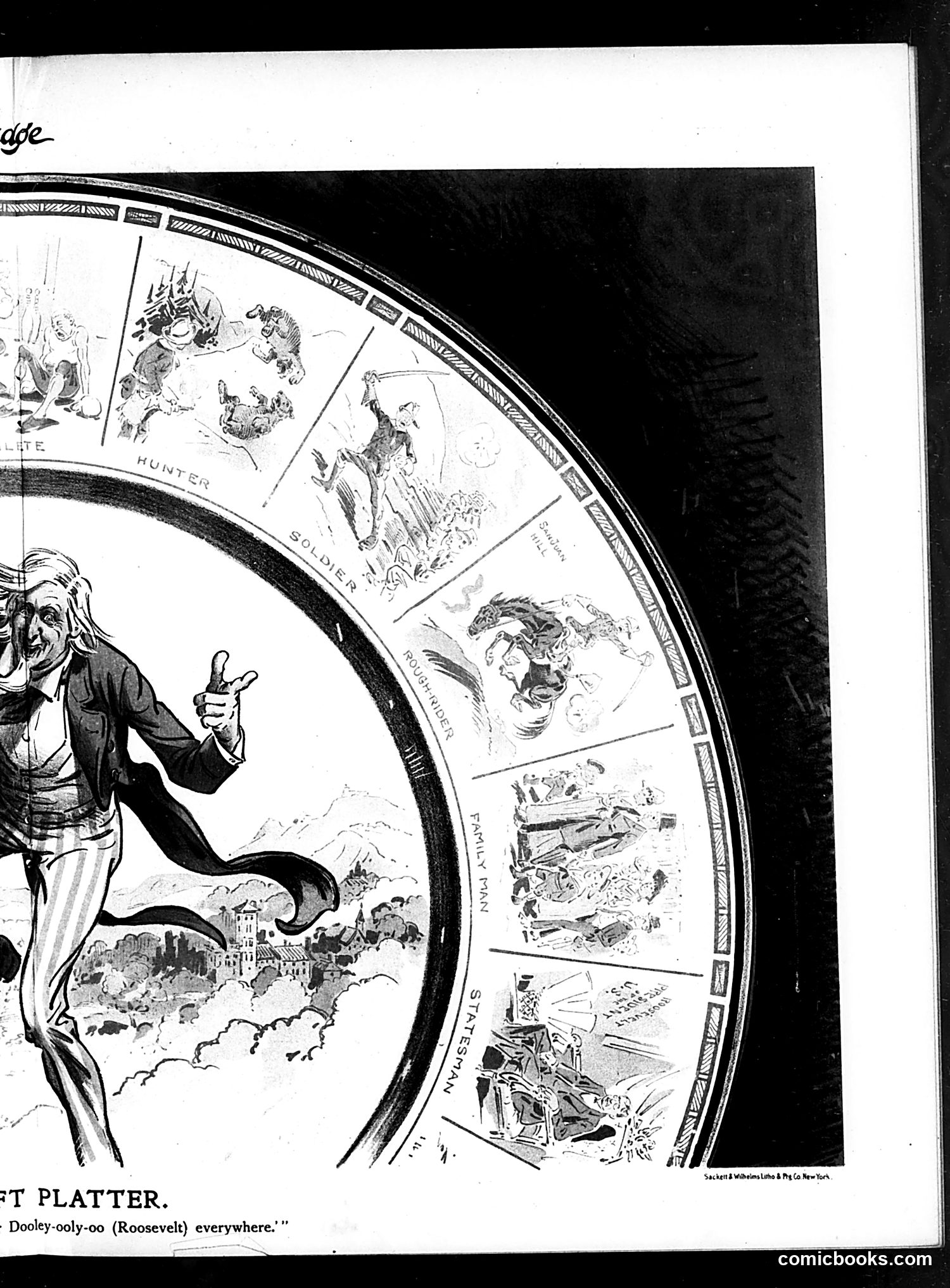
This appears to be a political cartoon from Judge magazine featuring a spinning wheel or "platter" divided into sections, each depicting different professions or roles (visible labels include "Hunter," "Soldier," "Street Man," and "Family Man"). A caricatured figure on the left, identified by the caption as "Roosevelt," spins this wheel while exclaiming "Dooley-ooly-oo (Roosevelt) everywhere." The satire likely mocks Theodore Roosevelt's omnipresence in American politics and media during his era, suggesting he was involved in or commenting on every aspect of American life and society. The rotating wheel suggests his influence touching all social classes and occupations. The cartoon critiques what the artist saw as Roosevelt's overreach or excessive public visibility.
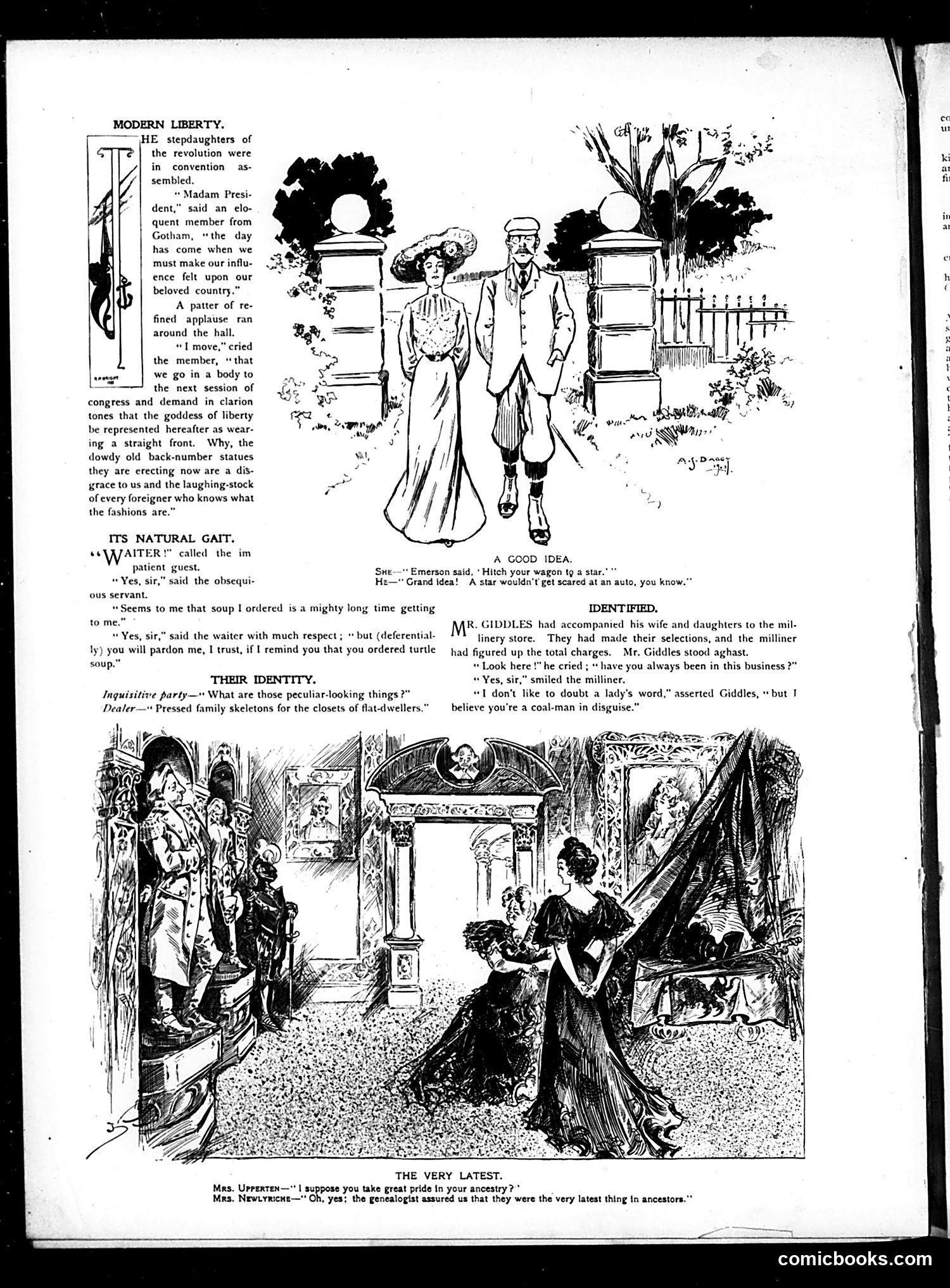
This page contains several unrelated satirical comic pieces typical of early 20th-century humor magazines: **"Modern Liberty"** mocks women's reform conventions, depicting female activists so focused on fashion that they propose the Statue of Liberty be redesigned to wear a "straight front" corset rather than address substantive political issues. The satire suggests these women's groups prioritize trivial matters over genuine social change. **"Its Natural Gait"** and other brief jokes use wordplay and situational humor: a waiter defends slow soup service by reminding the guest he ordered turtle soup (which moves slowly). **"Identified"** satirizes inflated millinery prices, with a husband questioning whether the milliner is actually a "coal-man in disguise"—implying she's making excessive profits. **"The Very Latest"** mocks social climbers obsessed with ancestry, joking that their genealogist calls ancestors "the very latest thing"—treating lineage as fashionable trend rather than historical fact. The humor targets pretension, materialism, and superficiality across gender and class lines, reflecting Judge's satirical mission.
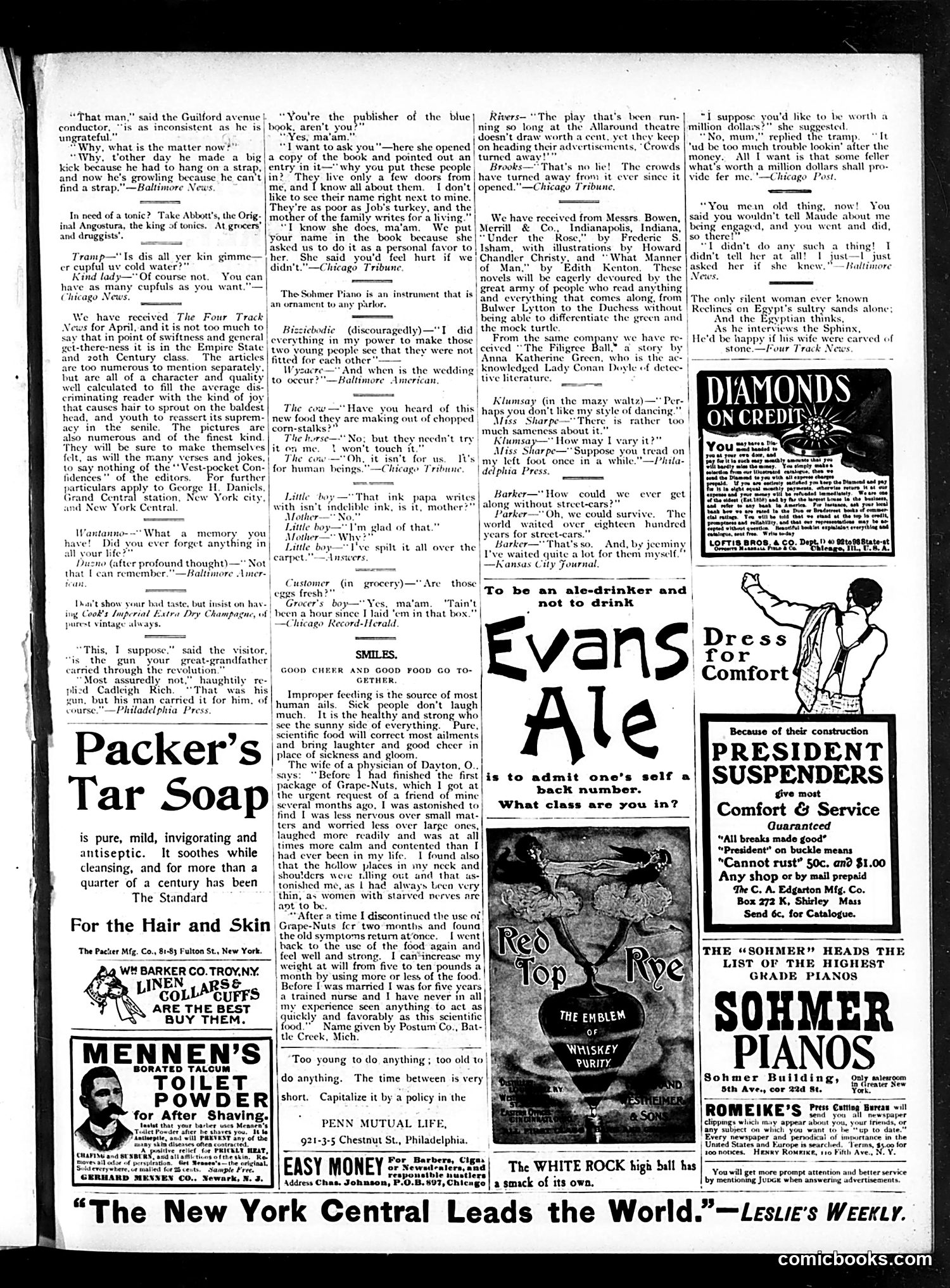
This page from Judge magazine is primarily a **collection of brief comic anecdotes and advertisements** rather than a single political cartoon. The humor reflects early 20th-century American life: **Notable Jokes:** - A conductor complains passengers demand straps, then complain when none exist—mocking inconsistent public behavior - A woman objects to poor neighbors' names appearing in a directory next to hers, despite their accomplishments - A man frustrated that his matchmaking efforts failed, timing the wedding announcement awkwardly **Context:** These vignettes satirize middle-class social anxieties (poverty proximity, social status), human contradiction, and romantic entanglements. The page is dominated by product advertisements (Packer's Tar Soap, Mennen's Powder, pianos, ale) typical of Judge's commercial model. The satire is genteel rather than political—humor for literate, prosperous readers concerned with manners and social propriety.
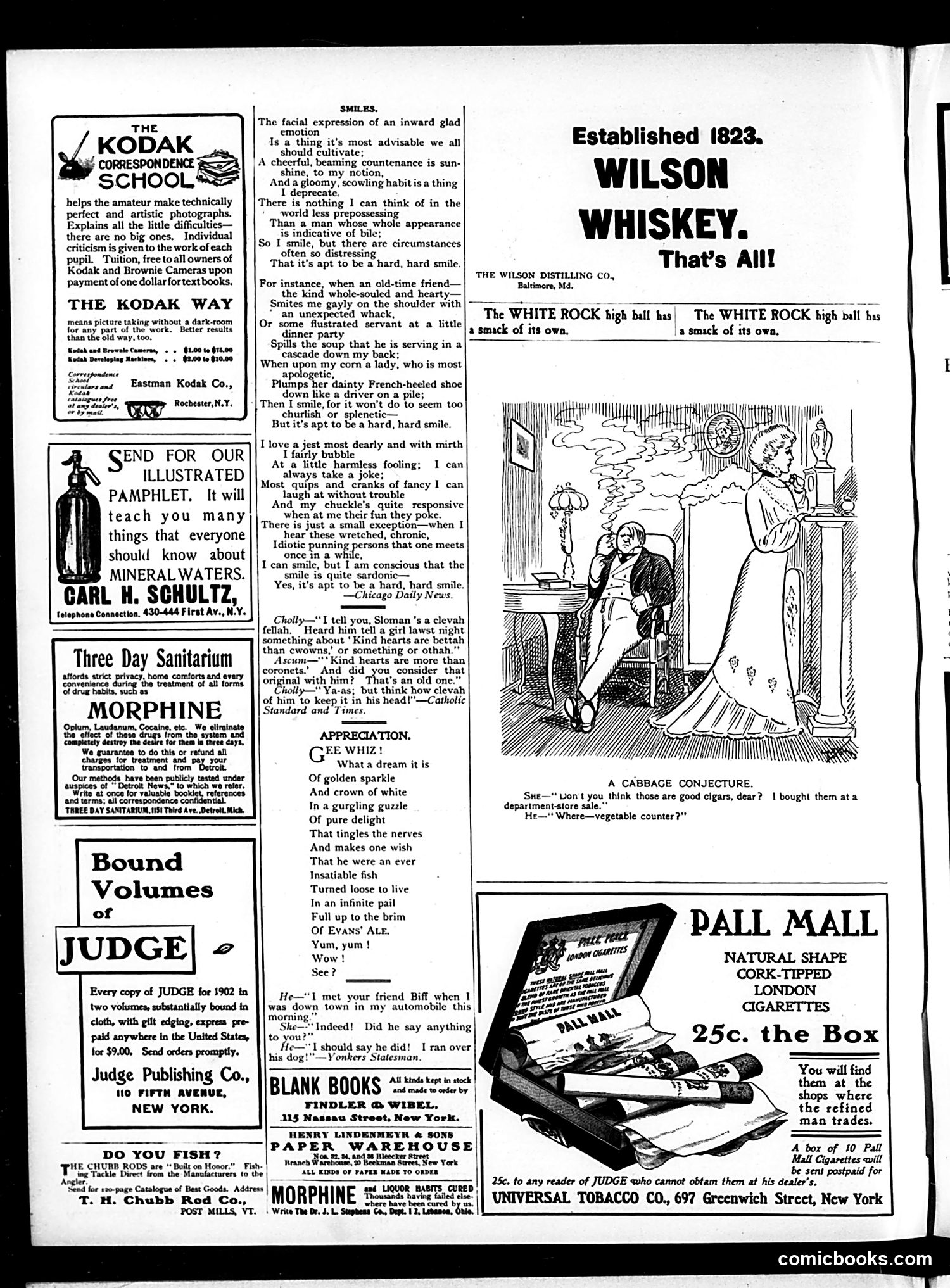
This page from Judge (circa 1902) is primarily **advertising**, with minimal editorial content. The advertisements reflect turn-of-the-century American consumer products and services: **Notable ads include:** - Kodak cameras (promoting amateur photography) - A "Three Day Sanitarium" offering morphine addiction treatment—reflecting the era's unregulated drug crisis and widespread opium/morphine dependence - Bound volumes of Judge magazine itself - Pall Mall cigarettes - Fishing equipment **The editorial cartoons are minimal.** One titled "Cabbage Conjecture" shows two men discussing vegetables, appearing to be mild social humor about produce vendors. **The text includes poems about smiling** and appreciative verses about ale ("Evans Ale"), typical of Judge's light satirical humor. The page primarily documents **what products and services were marketed to Judge's affluent readers**—notably the casual advertising of morphine treatment, which would shock modern readers and illustrates how differently drug addiction was understood and commercialized in the early 1900s.
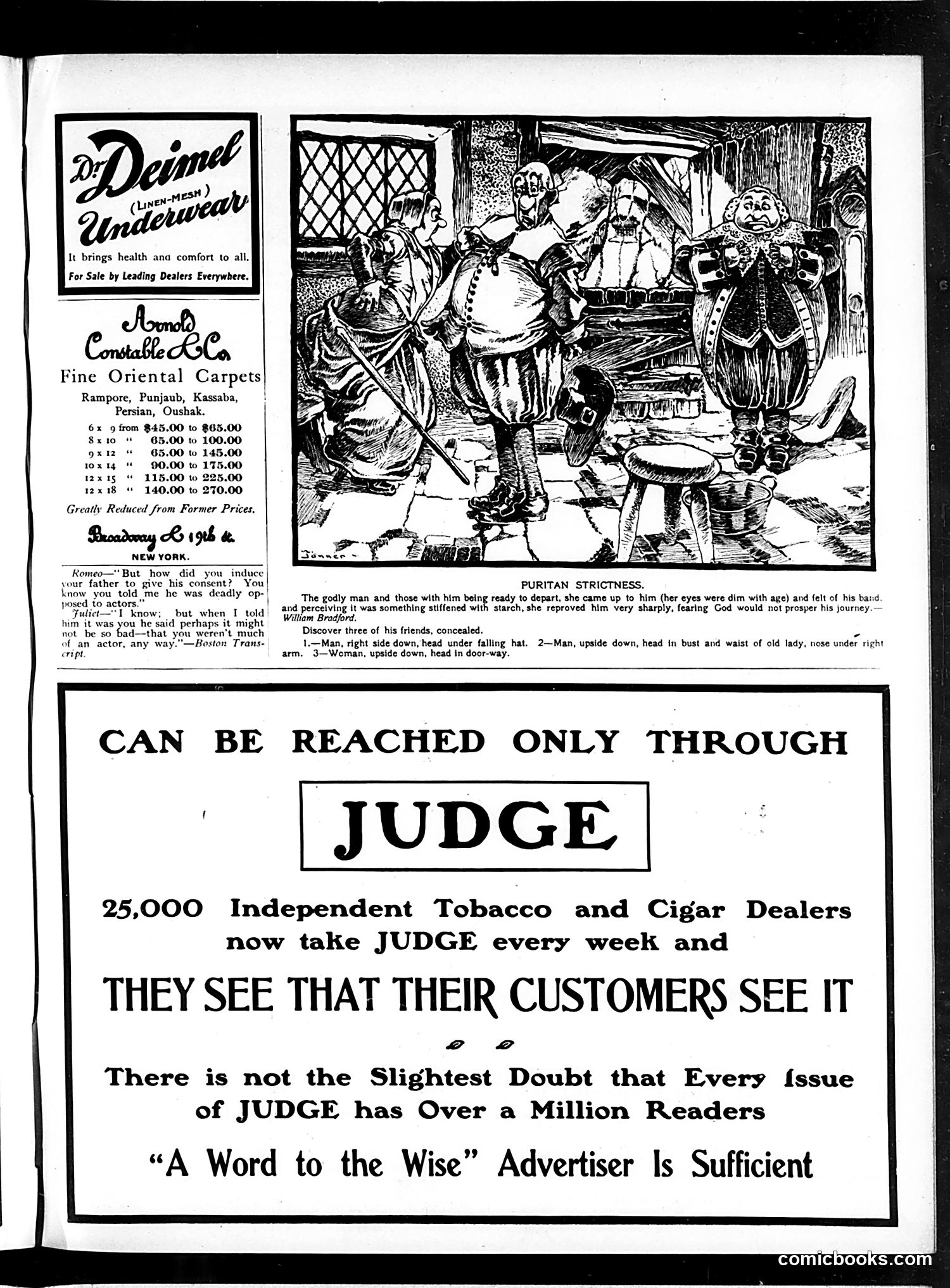
The main cartoon satirizes rigid Puritan morality through a historical scene. A godly man prepares for departure while an elderly Puritan woman inspects his clothing, sternly reproving him for wearing starch-stiffened fabric. She fears God will not favor his journey if he indulges in such vanity. The joke lies in three hidden men concealed in absurd positions around the scene—under a falling hat, inside the woman's dress, and in a doorway—suggesting that while Puritans obsessed over minor moral infractions like starched clothing, actual moral violations (represented by these concealed figures) went unnoticed. This mocks Puritan hypocrisy: strict judgment of trivial matters masked deeper failings. The historical William Bradford reference grounds this in actual Puritan history, making the satire more pointed about the disconnect between professed values and reality. The page is primarily advertising for carpets, underwear, and Judge magazine itself.
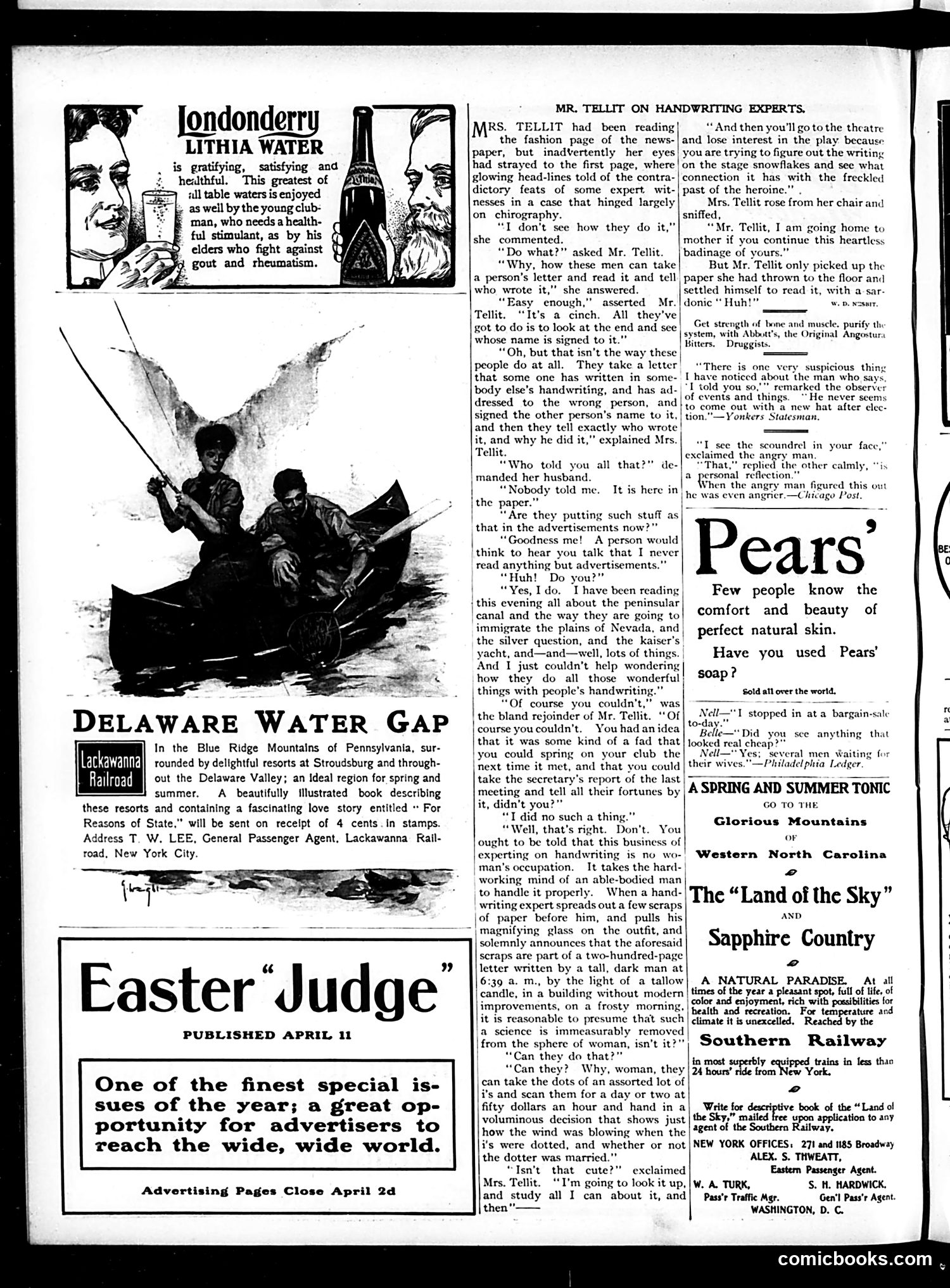
This page contains a humorous domestic dialogue between Mr. and Mrs. Tellit about handwriting experts. Mrs. Tellit has read newspaper accounts of expert witnesses using handwriting analysis to identify document forgers in legal cases. Mr. Tellit dismissively suggests the "trick" is simply reading the signature—entirely missing the point of forensic handwriting examination. Mrs. Tellit, exasperated by his deliberate obtuseness, threatens to leave. The satire targets masculine smugness and willful ignorance: Mr. Tellit represents the type of man who confidently reduces complex expertise to obvious triviality, then refuses to genuinely engage with his wife's attempts to explain. The joke's punch relies on readers recognizing that handwriting experts actually analyze letter formations, pressure, and habits—not just signatures—to authenticate documents in fraud cases, which were newsworthy during this period. The rest of the page contains period advertisements and unrelated content.
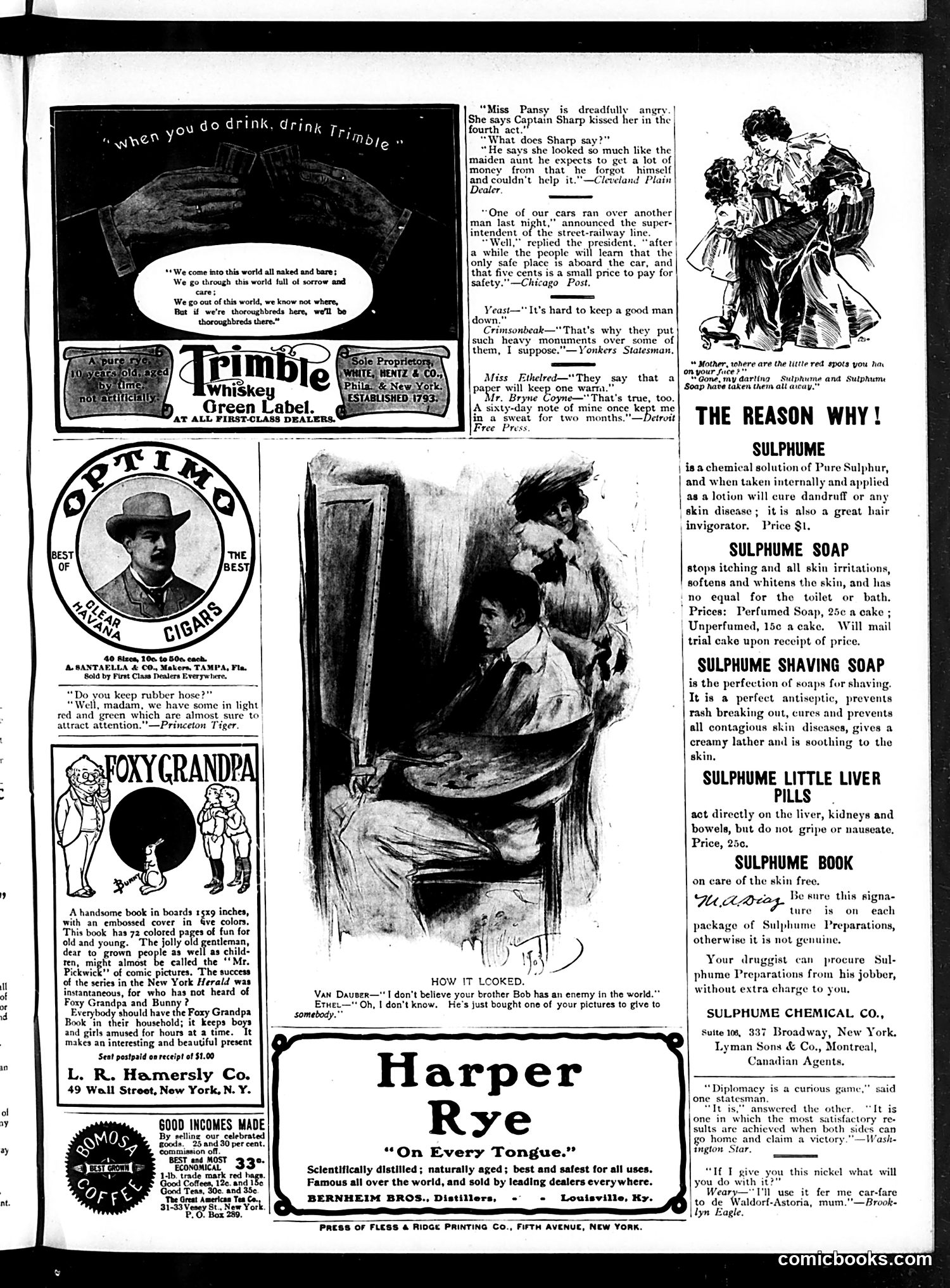
This page is **primarily advertisements** interspersed with brief satirical humor items typical of Judge magazine's format. The main content includes: **Advertisements**: Timbre Whiskey, Optimo Cigars, Foxy Grandpa comic book, Harper Rye whiskey, and Sulphume beauty/medicinal products dominate the page. **Satirical jokes** (brief, text-based): - A quip about a streetcar conductor callously suggesting accident victims should ride *inside* cars for safety - A joke about a romantic misunderstanding between "Miss Pansy" and "Captain Sharp" - Various one-liners about keeping "good men down" (tombstones) and romantic deception **The central illustration** titled "How It Looked" shows two figures viewing what appears to be an unflattering portrait, with a caption about someone purchasing an unwanted picture as a gift—typical period humor about bad art. This is a representative page of early 20th-century Judge: mixing product ads with light social comedy reflecting contemporary concerns about romance, transportation safety, and commercial culture.
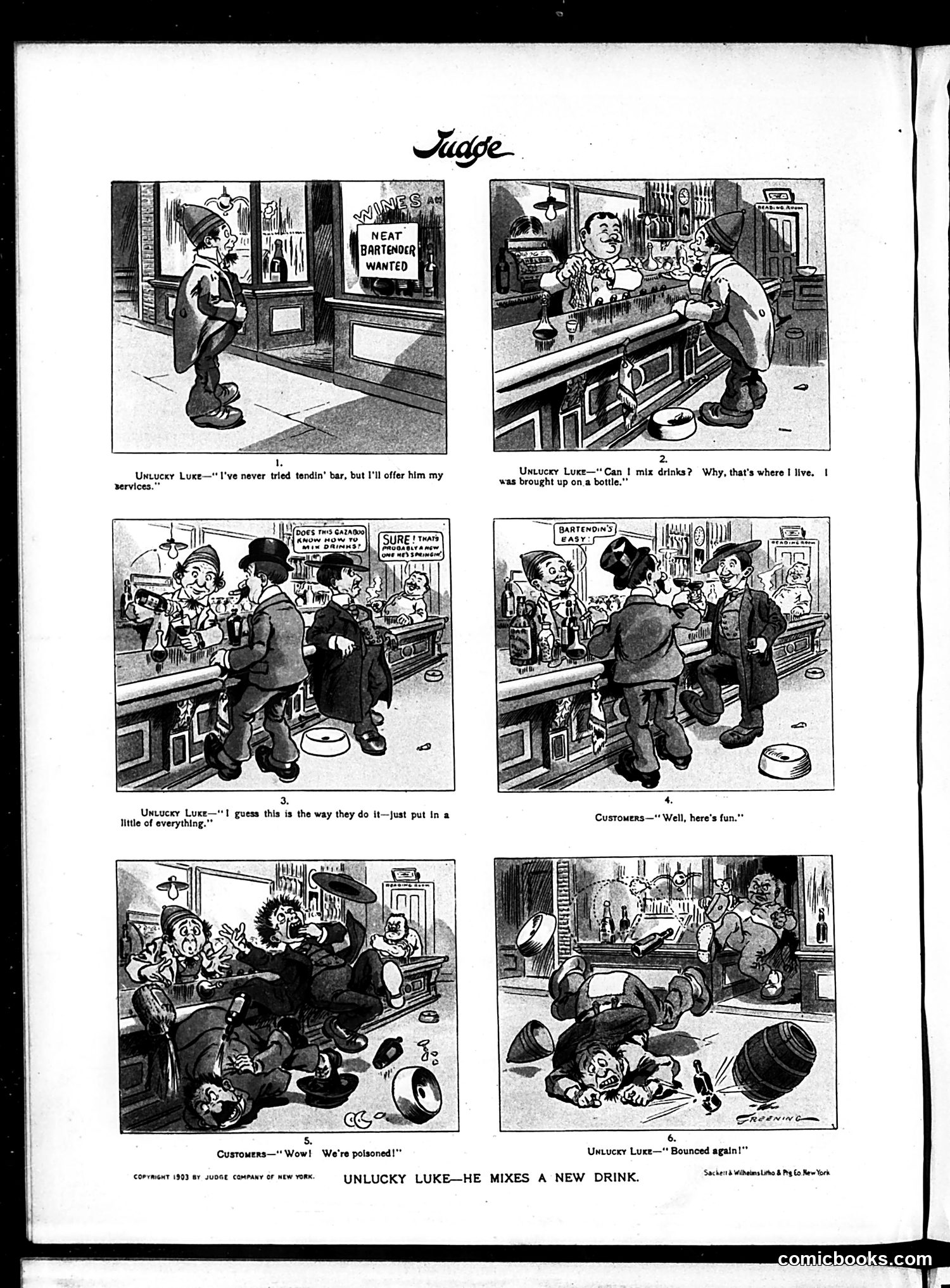
This comic strip satirizes a character named "Unlucky Luke," a hapless bartender who claims to have been "brought up on a bottle" (raised by alcohol). The joke follows his attempt to create a new drink by indiscriminately mixing "a little of everything" together. The humor derives from the predictable chaos: customers become violently poisoned, and Luke gets literally "bounced" (thrown out) from the bar as a result. The strip mocks both incompetent bartenders and the period's widespread experimentation with novelty cocktails—a growing trend in early 1900s urban saloon culture. The exaggerated, physical slapstick (characters flying through the air) and caricatured drunk appearance reflect typical Judge magazine comedy conventions of the era. The satire gently pokes fun at working-class bar culture and the dangers of untrained mixology.