
A complete issue · 16 pages · 1902
Judge — November 22, 1902
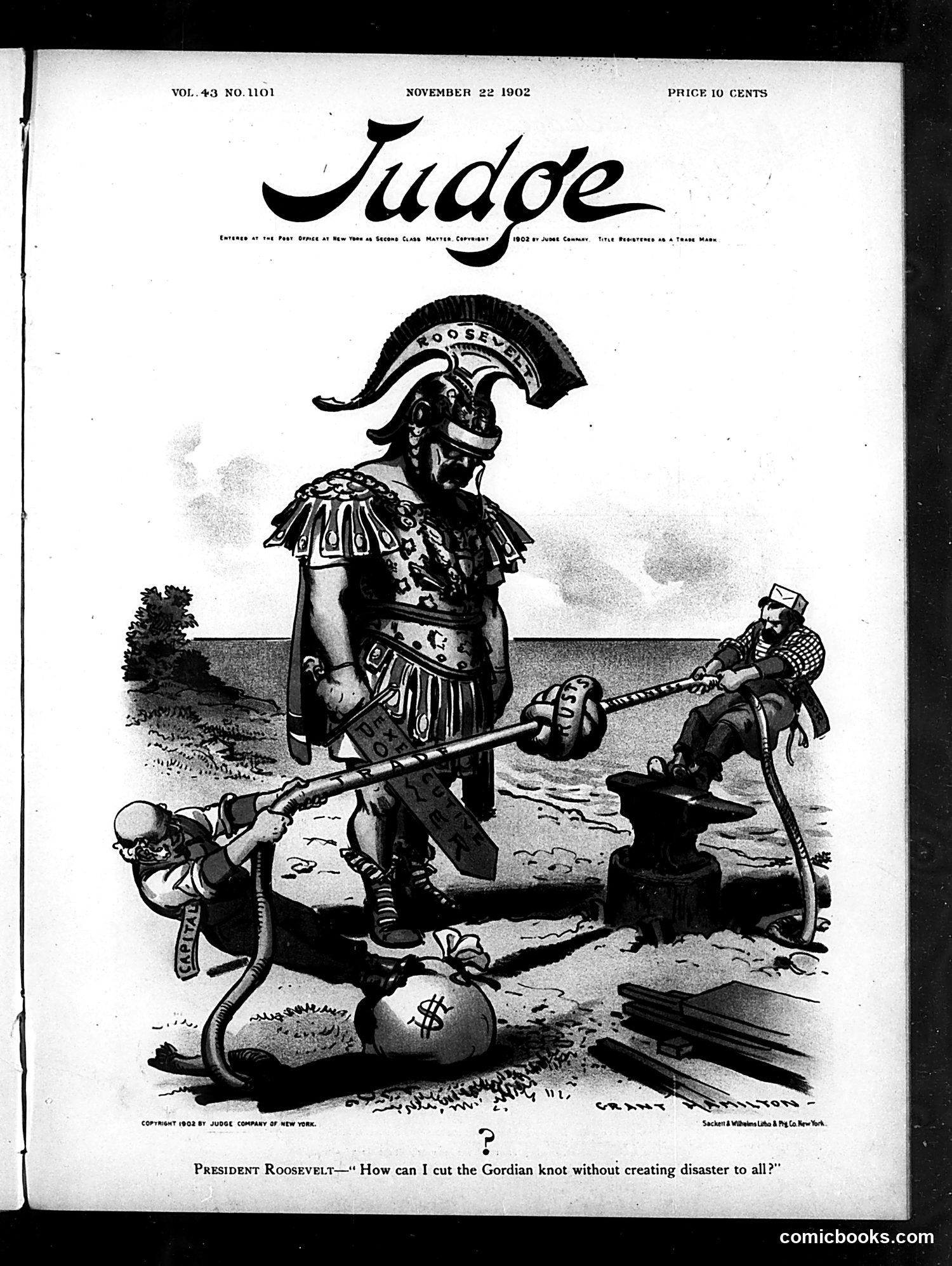
This satirical cartoon depicts President Theodore Roosevelt as a Roman military figure (labeled "Roosevelt") attempting to cut the "Gordian knot." In Greek legend, the Gordian knot was an impossibly tangled knot; Alexander the Great solved it by cutting through it with his sword rather than untying it. The smaller figures (appearing to represent political opponents or problems) are being manipulated by the rope. Roosevelt's caption—"How can I cut the Gordian knot without creating disaster to all?"—satirizes his bold, aggressive approach to governing. The cartoon suggests Roosevelt's forceful problem-solving methods, while effective, risk collateral damage. The imagery comments on the tension between decisive executive action and its potential consequences during his presidency.
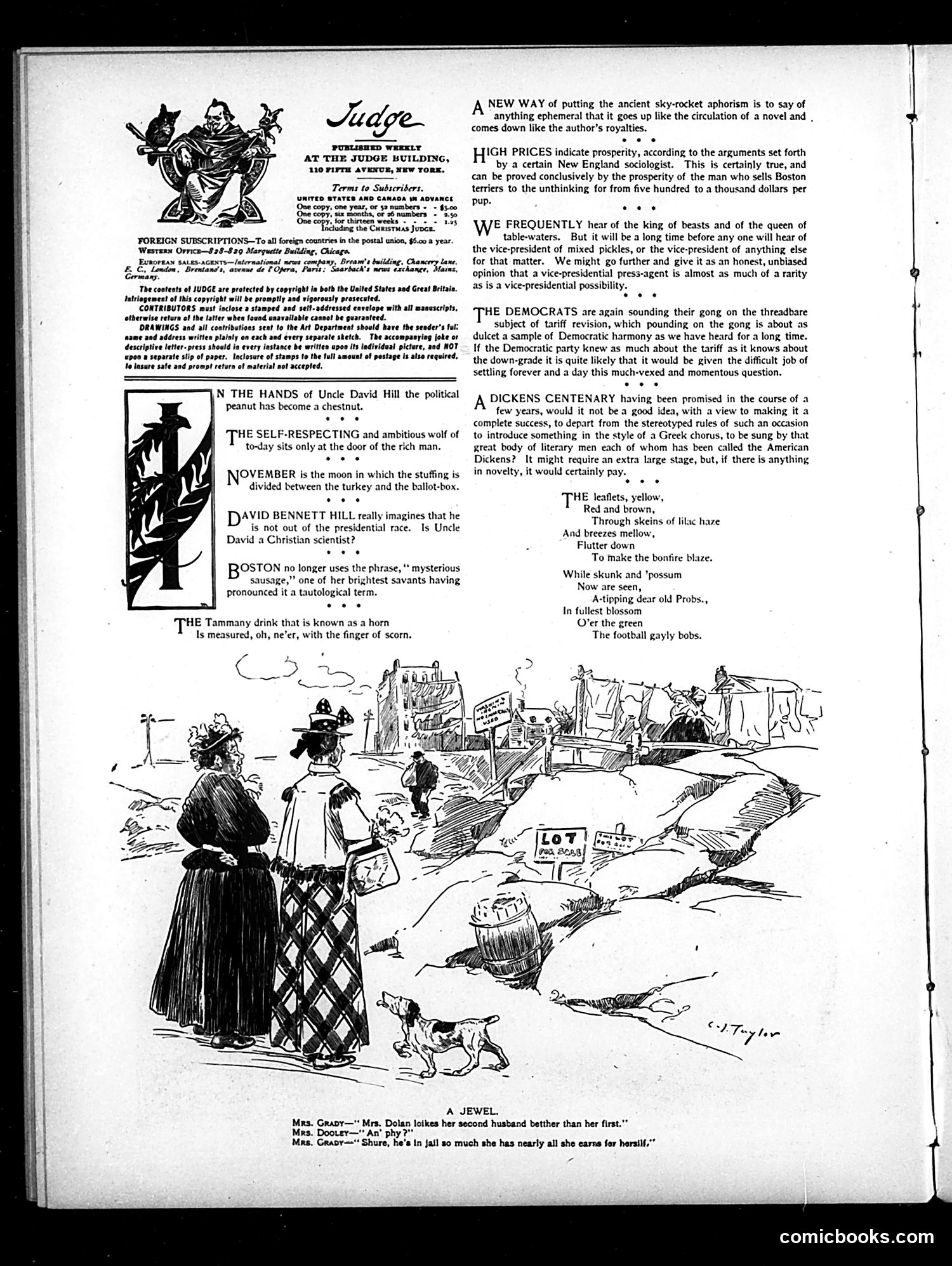
This page contains editorial commentary and a satirical cartoon titled "A Jewel." The main cartoon depicts two women viewing what appears to be a vacant lot or construction site with debris, commenting on Mrs. Delap's preference for her second husband over her first—apparently because the second one is "in jail so much she has nearly all the same for herself." The joke satirizes marriages where one spouse's imprisonment becomes convenient for the other's independence and financial control. The accompanying text discusses various political topics including David Bennett Hill, Democratic tariff debates, and Boston's "mysterious sausage" terminology. The page reflects late 19th-century American political satire and domestic humor typical of Judge magazine's satirical commentary on contemporary society and politics.
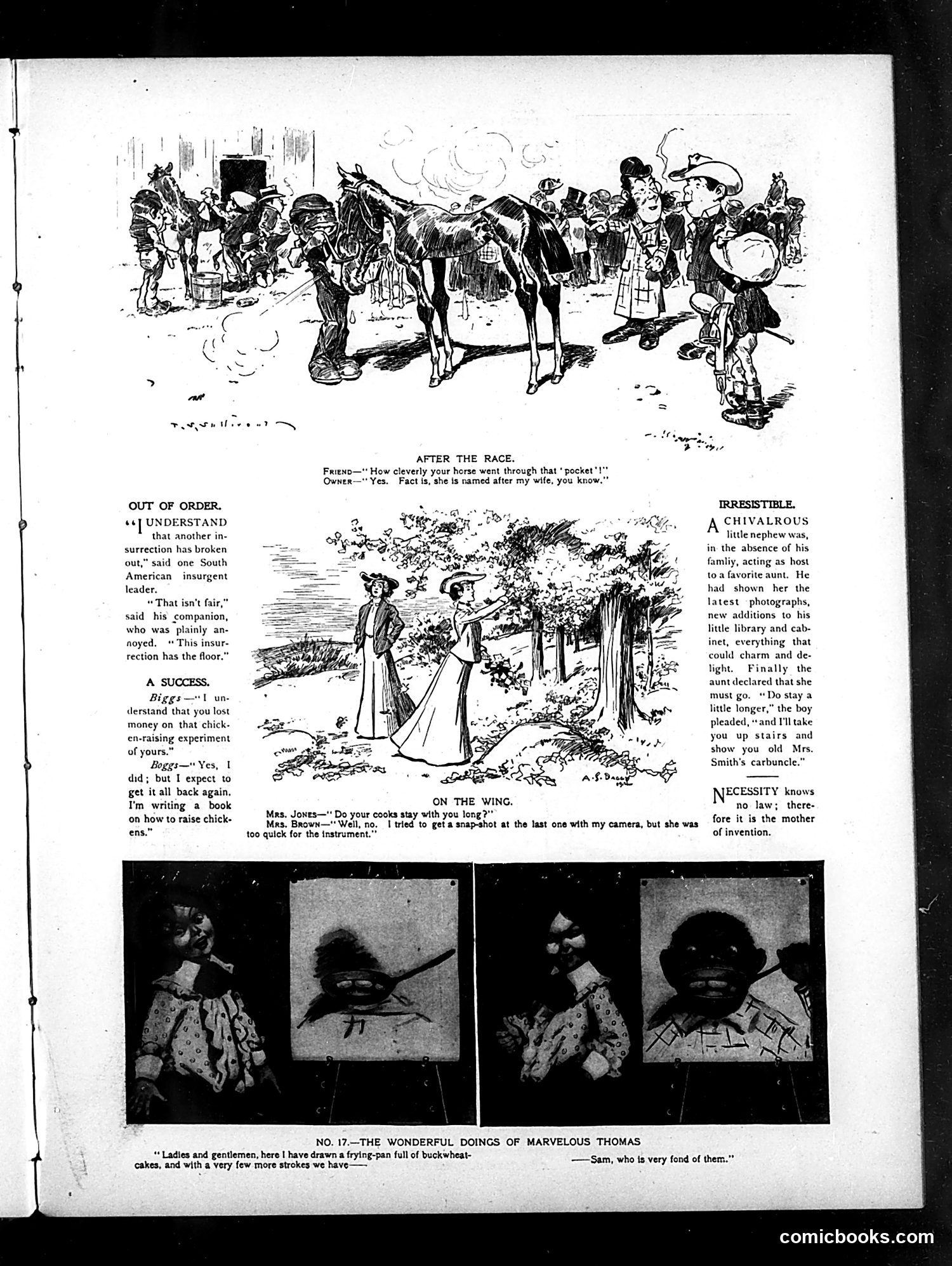
This page contains several standalone comic sketches and a photo series, rather than unified political commentary. **"After the Race"** depicts a horse race scene where two men discuss a horse named after the owner's wife—a joke about the animal's competitive "pocket" (speed). **"Out of Order," "A Success," and "On the Wing"** are brief dialogue-based gags about mundane subjects: insurance disputes, chicken-raising, and photography timing. **"Irresistible"** is a short narrative about a mischievous nephew visiting his aunt. **"The Wonderful Doings of Marvelous Thomas"** (bottom) appears to be a photo-based comedy series showing a character performing tricks with what seems to be a frying pan. These are primarily **domestic humor pieces** without clear political satire—typical of Judge's lighter entertainment content alongside more pointed social commentary.
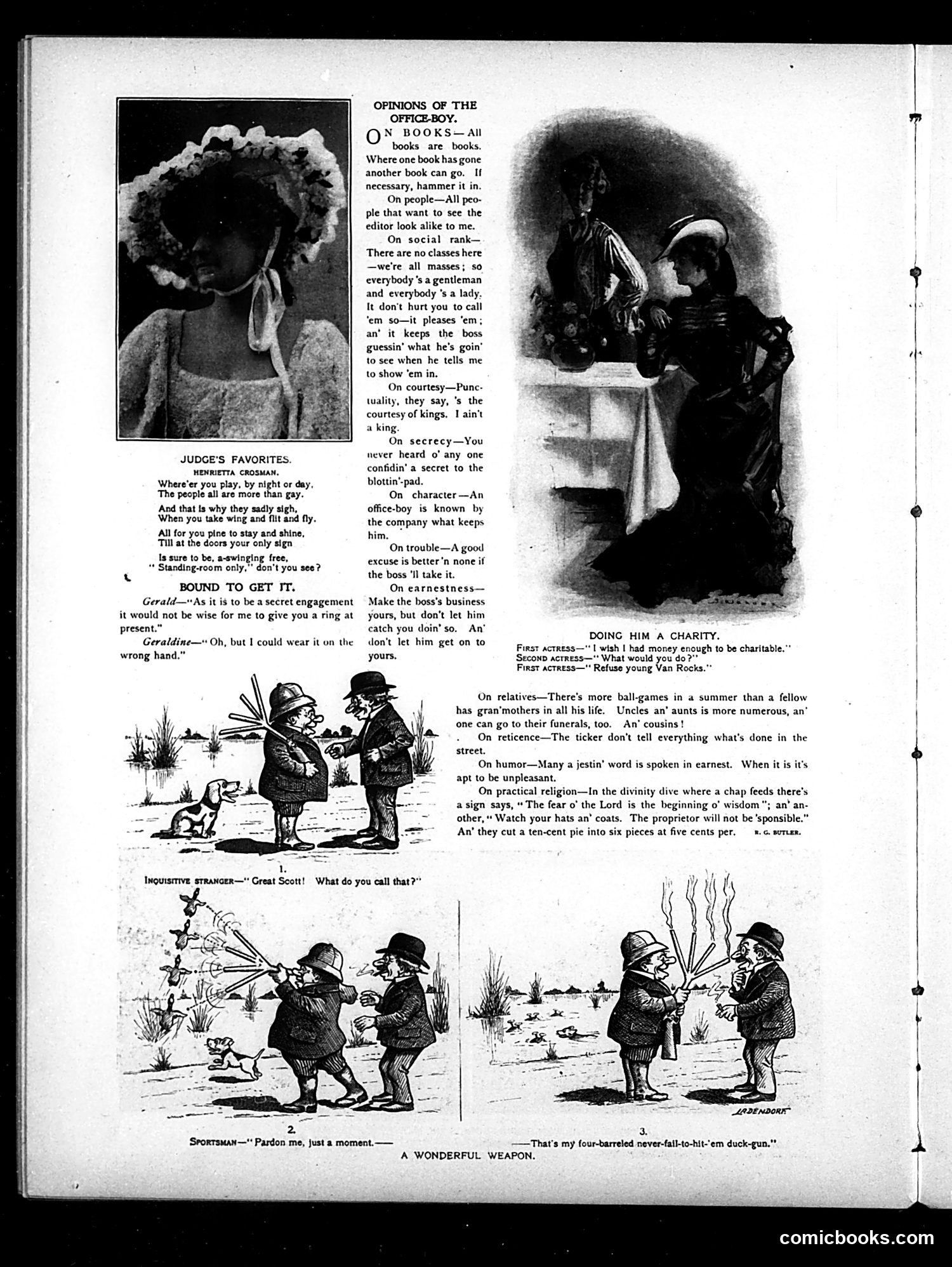
This page combines humor pieces with illustrated cartoons. The top section features "Opinions of the Office-Boy"—a recurring Judge column offering satirical observations on books, people, social rank, courtesy, and character. The commentary mocks pretension while promoting egalitarian values ("we're all masses"). The illustrated cartoons below depict working-class or rural characters in various scenarios. The bottom series titled "A Wonderful Weapon" shows two men discovering what appears to be a novel farming tool or device, with the punchline suggesting it's an unusual "never-fail-to-hit-'em duck-gun." The overall tone is lighthearted social satire typical of Judge's era, poking fun at class distinctions, misunderstandings between different social groups, and rural/urban contrasts—common themes in early 20th-century American humor magazines.
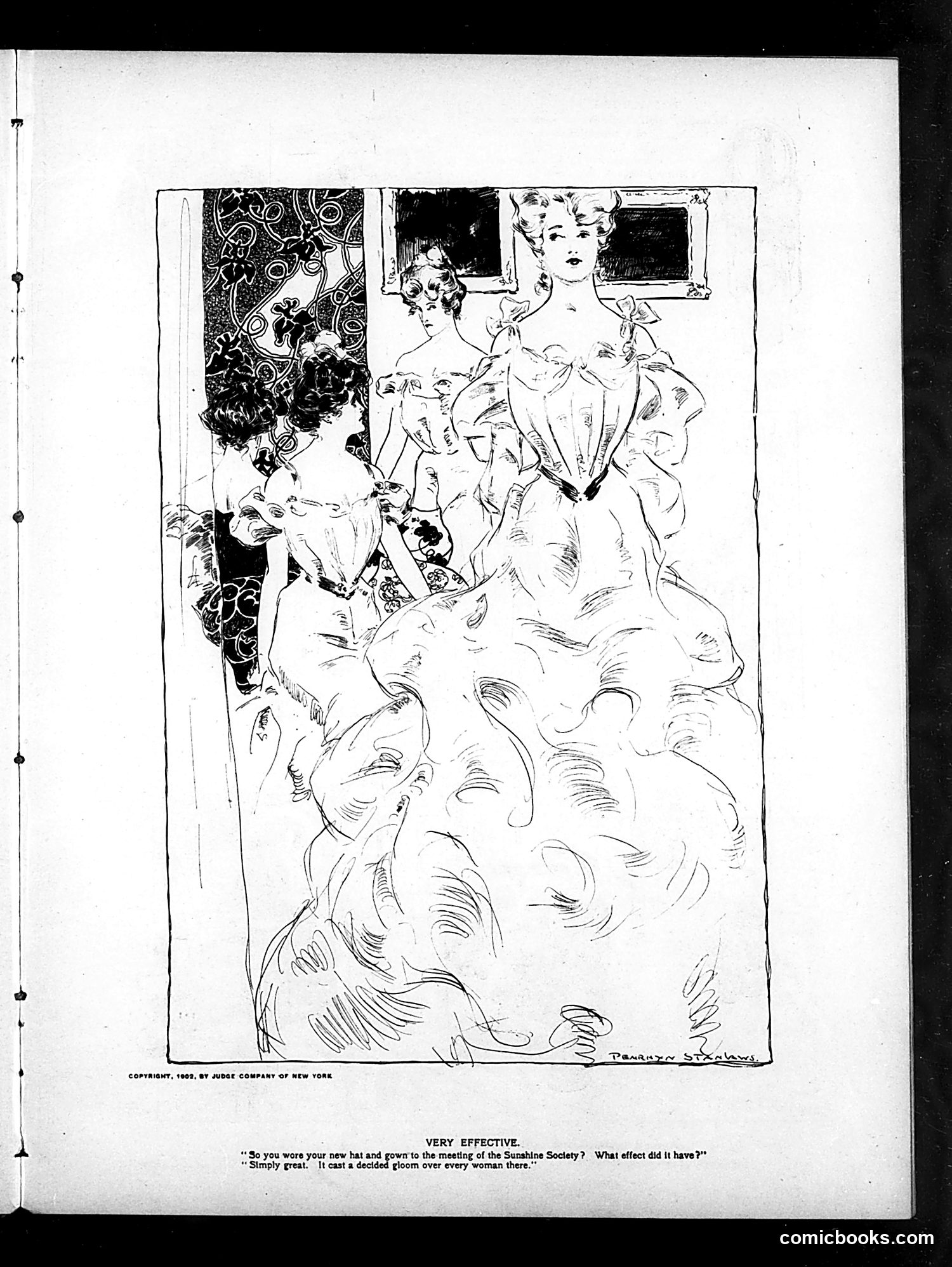
This is a visual gag about female fashion and social competitiveness. The cartoon shows elegantly dressed women at what appears to be a "Sunshine Society" meeting. The joke's premise: a woman wore an expensive new hat and gown expecting to impress, but instead the outfit was so stunning it made all the other women feel dowdy by comparison—thus casting a "gloom" over them. The satire targets two things: women's vanity and competitive social dynamics among affluent ladies' clubs. The pun on "gloom" (darkness/sadness vs. the Society's sunny name) adds the humor. The elaborate cross-hatched backgrounds and fashionable dress details emphasize the pretension being mocked. This reflects early 20th-century satirical commentary on upper-class women's society gatherings and fashion obsession.
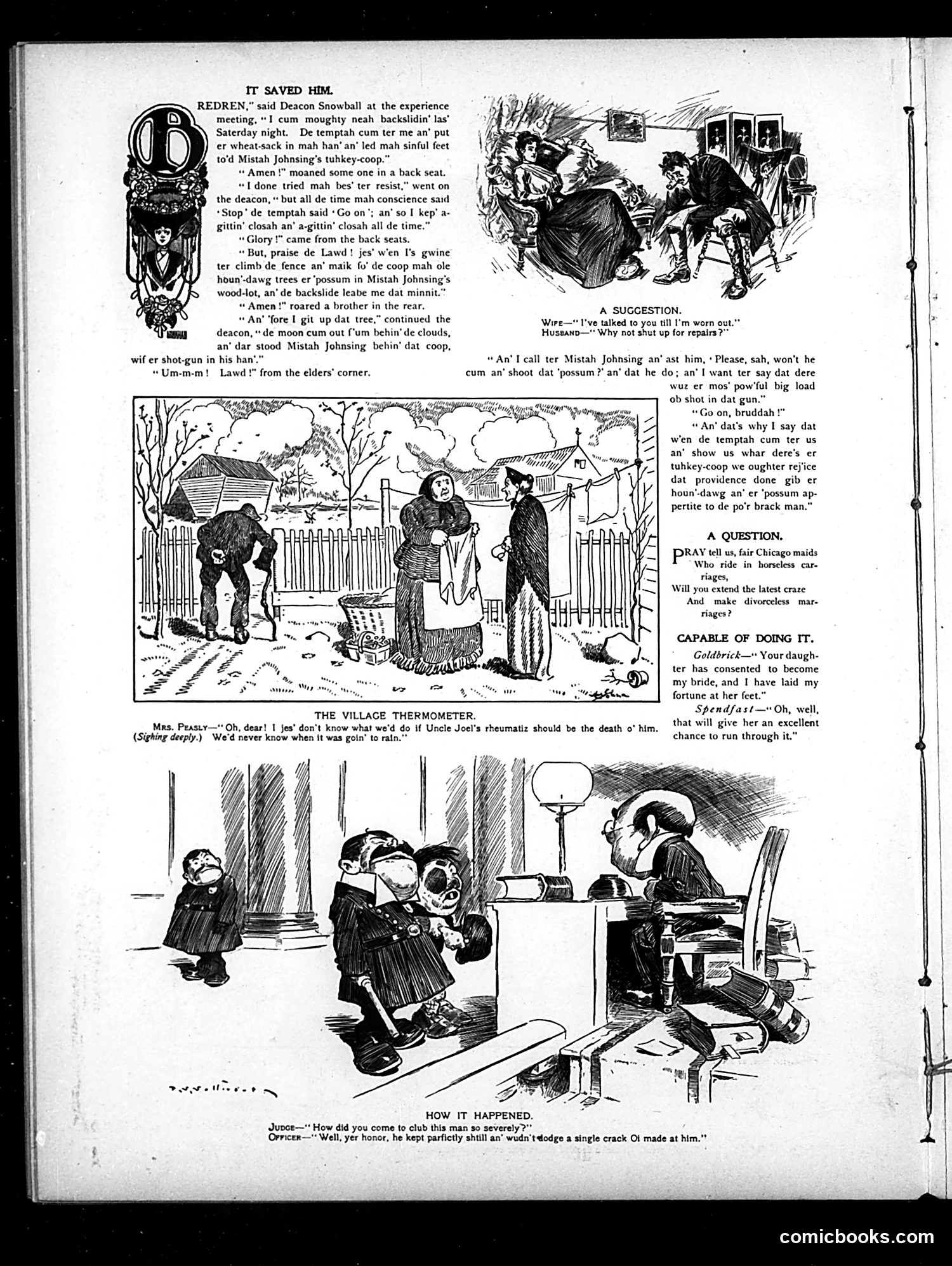
This page contains three distinct satirical pieces: **"It Saved Him"** uses racial dialect humor (common in early 20th-century American media) to mock both religious hypocrisy and African American speech patterns. A deacon describes nearly stealing from "Mistah Johnsing's turkey-coop" but claims divine intervention—a conveniently timed possum and the gun-wielding owner—saved him. The satire targets the deacon's self-serving interpretation of providence. **"A Question"** ridicules the emerging "horseless carriage" (automobile) trend and Chicago's rising divorce rate by sarcastically asking if women will now pursue "divorceless marriages" with the same enthusiasm. **"How It Happened"** is a dark joke about police brutality: an officer claims he beat a man "severely" because the victim "kept perfectly still" and didn't dodge his blows—satirizing either police incompetence or the absurdity of the justice system. The cartoons reflect period attitudes: casual racism, anxiety about modern technology and changing social mores, and cynicism about law enforcement.
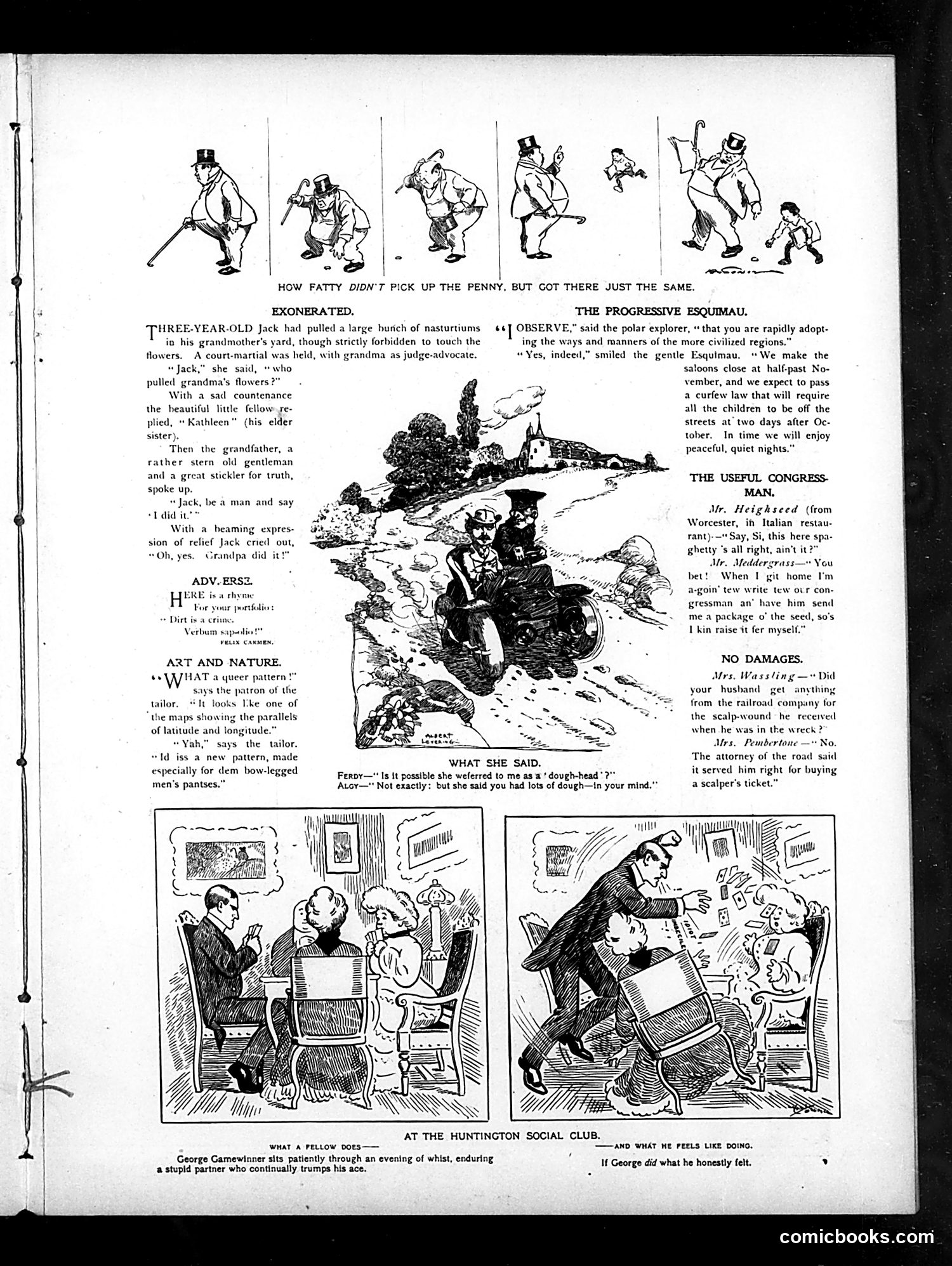
This page contains multiple satirical pieces typical of early 20th-century American humor: **Top strip**: "How Fatty Didn't Pick Up the Penny" appears to be a visual gag about someone (likely referencing a character named "Fatty," possibly from silent film comedy) attempting but failing at a simple task. **Text pieces satirize:** - **"Exonerated"**: A child's story mocking courtroom formality applied to minor domestic disputes - **"Art and Nature"**: A tailor's ethnic humor (bow-legged man's pants joke, apparent Yiddish dialect) - **"Progressive Esquimau"**: Satirizing "civilized" society's adoption of vice (saloons, curfews) as progress - **"Useful Congressman"**: Mocking working-class faith in politicians, suggesting a congressman might mail vegetable seeds **Bottom cartoons**: "At the Huntington Social Club" depicts a wealthy man enduring tedious whist (card game) with an incompetent partner—contrasting what he patiently does versus what he'd "honestly" like to do (violence, implied). The page reflects period stereotypes, class anxiety, and satirical distrust of institutions.
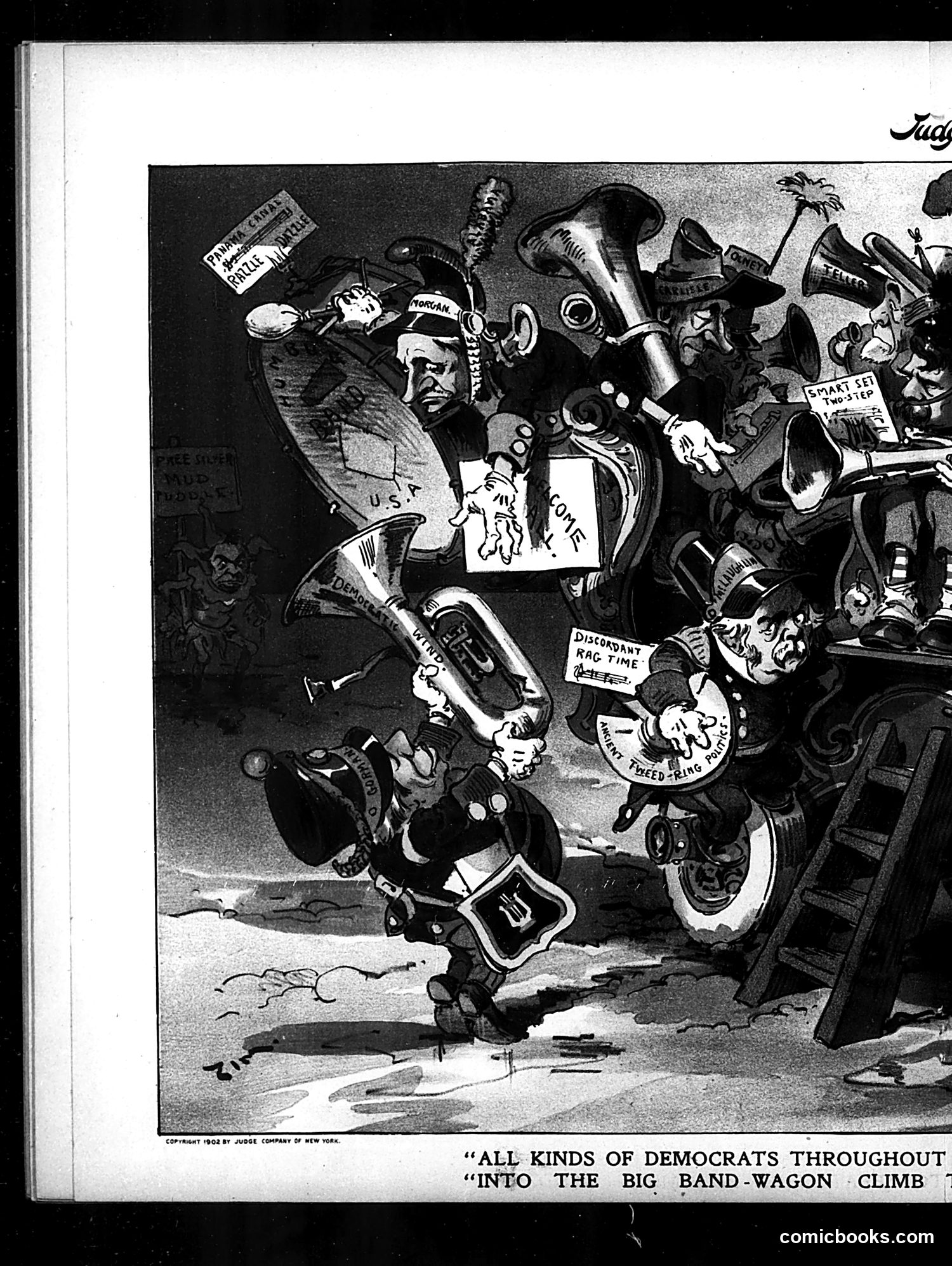
This Judge magazine cartoon satirizes the Democratic Party's attempt to unite diverse factions under one banner (the "big band-wagon"). The caricatured figures represent different Democratic constituencies or interest groups being herded together—a common metaphor in Gilded Age political cartooning. The exaggerated facial features and various grotesque character types suggest mockery of the party's attempts at coalition-building. Labels visible on signs reference specific policy positions or controversies, though individual figures are difficult to identify precisely without additional context. The overall message: Republicans (Judge's typical audience) ridicule Democrats as a chaotic, incompatible collection of special interests held together only by political expedience rather than principle. The carnival/circus atmosphere emphasizes the inherent disorder and absurdity the cartoonist associates with Democratic politics.
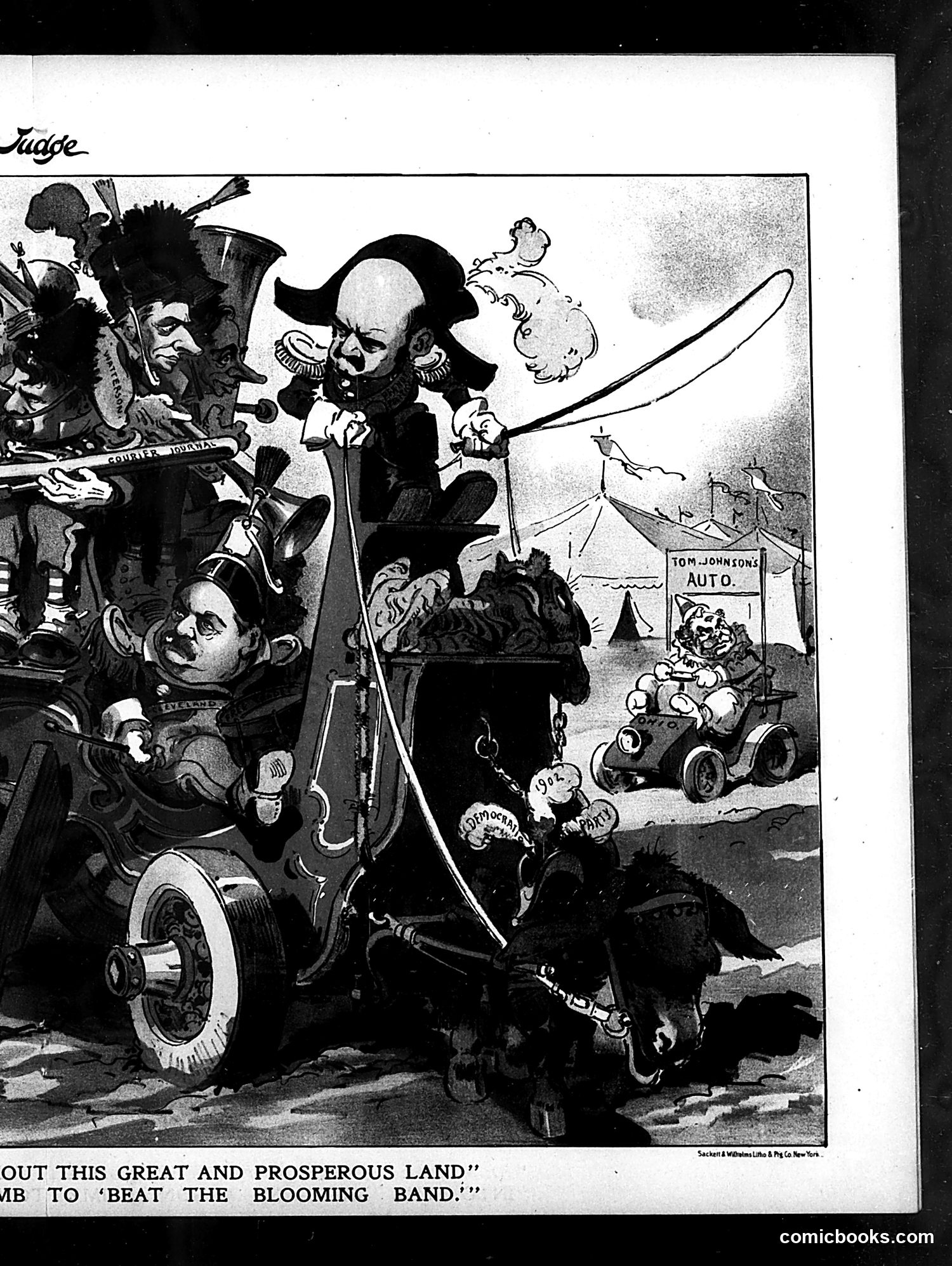
This Judge magazine cartoon satirizes military/political figures competing in what appears to be a chaotic race or competition. The central figure, a bald man in military dress with a curved sword, dominates the composition alongside other caricatured officials and military personnel in elaborate uniforms. The partial caption reads "...to 'beat the blooming band,'" suggesting a competitive struggle. The scene includes a "Tom Johnson's Auto" sign visible in the background, and various figures appear to be in absurd, exaggerated poses typical of Judge's satirical style. Without the complete caption and date, the specific political event or individuals being mocked remains unclear, though the cartoon likely critiques competition between government or military leaders during the early 20th century. The artist is credited as "Sackell & Wilhelms" at bottom.
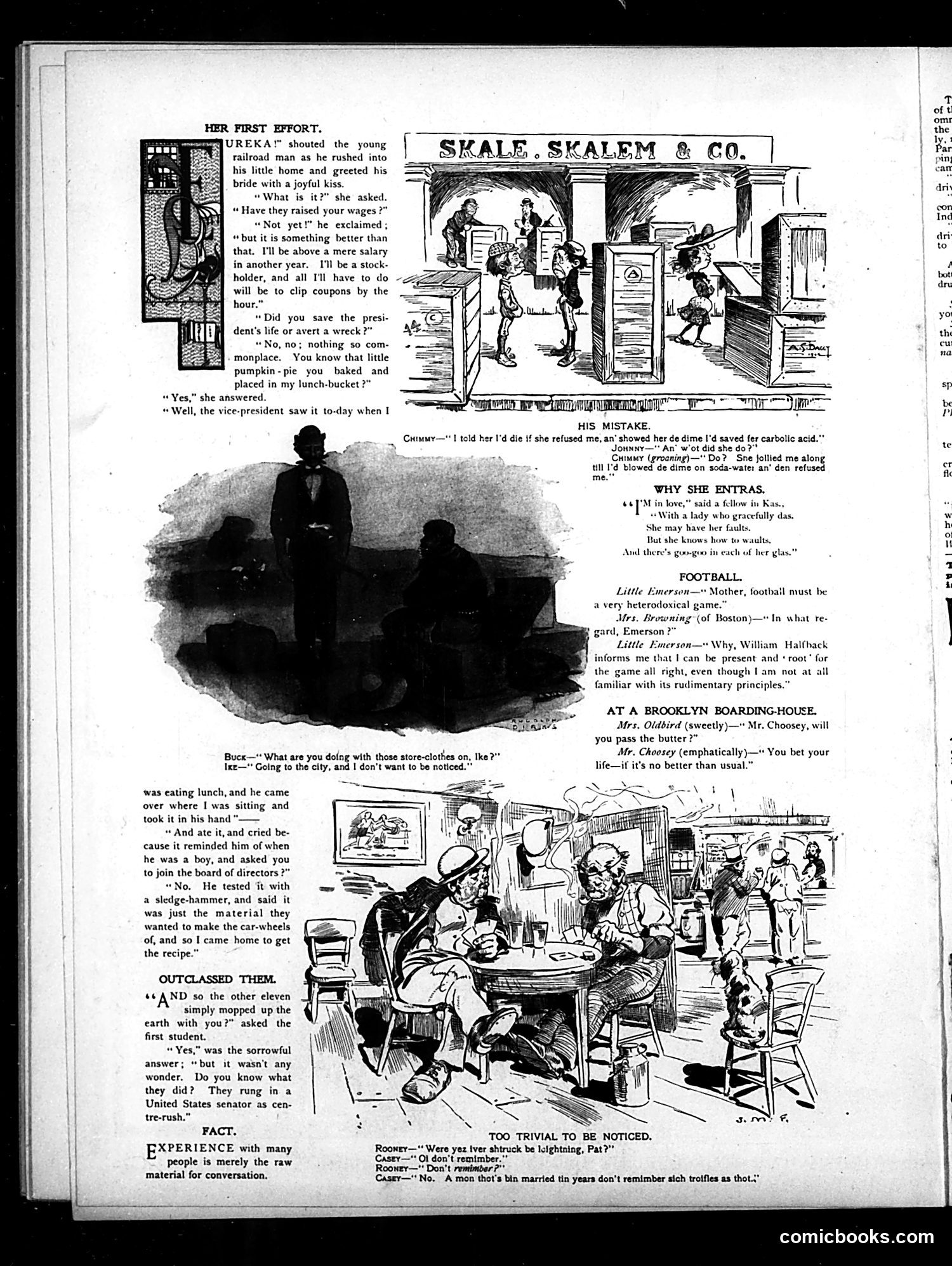
This Judge magazine page contains several satirical vignettes mocking American society circa early 1900s. **"Her First Effort"**: A railroad worker excitedly tells his wife he'll become wealthy—not through merit, but because a vice-president saw her homemade pumpkin pie in his lunch bucket and wants to make him a stockholder. The satire targets the absurdity of corporate nepotism and unearned advancement based on trivial personal connections rather than ability. **Other sketches** mock various social pretensions: a man overdressed for the city, boarding-house snobbishness, and a college football team that illegally recruited a U.S. senator as a player. The lower comic strips use exaggerated dialect humor (Irish and German accents) common to the era—typical of period satire but reflecting now-outdated ethnic stereotyping. Overall, the page satirizes gilded-age capitalism, social climbing, and the arbitrary nature of success in America, where connections matter more than competence.
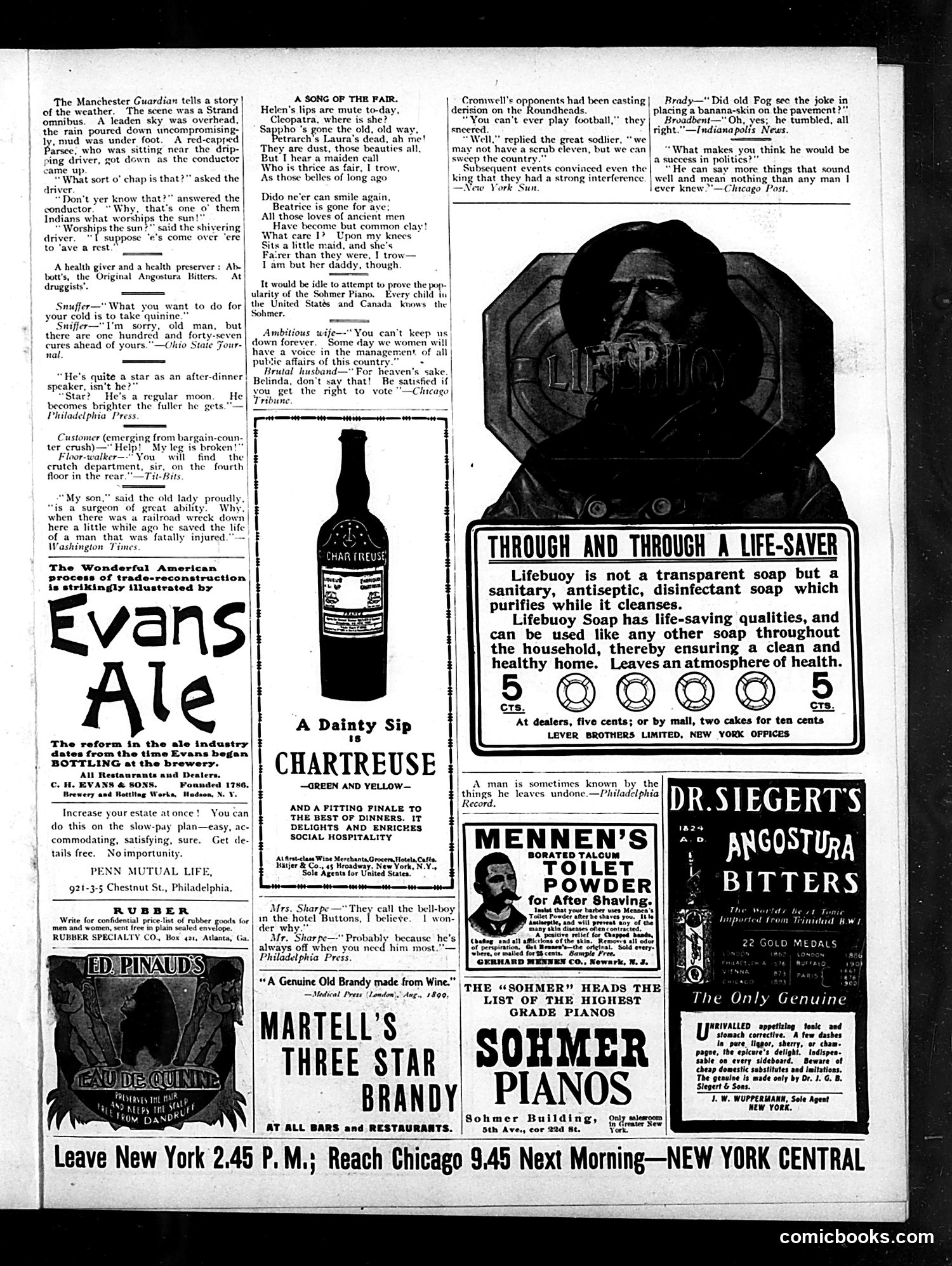
This page is primarily **advertisements and brief humor items**, not a political cartoon. The content includes: **Text-Based Humor:** - Short jokes about weather, cold remedies, and after-dinner speakers - A poem ("A Song of the Fair") romanticizing a modern maiden over classical beauties - Witty exchanges about politics, football, and social situations **Advertisements:** The page is dominated by product ads for: - Evans Ale (brewery) - Chartreuse liqueur - Lifebuoy soap - Martell brandy - Sohmer pianos - Mennen's toilet powder - Dr. Siegert's Angostura Bitters - Pinnaud's (toiletries) **Social Commentary:** The humor reflects early 20th-century concerns: women's suffrage ("Ambitious wife" wanting political voice), class distinctions, and modern urban life. The jokes are gentle satire rather than sharp political critique—typical of *Judge's* lighter content mixed with commercial interests. No specific political figures or events are identifiable on this page.
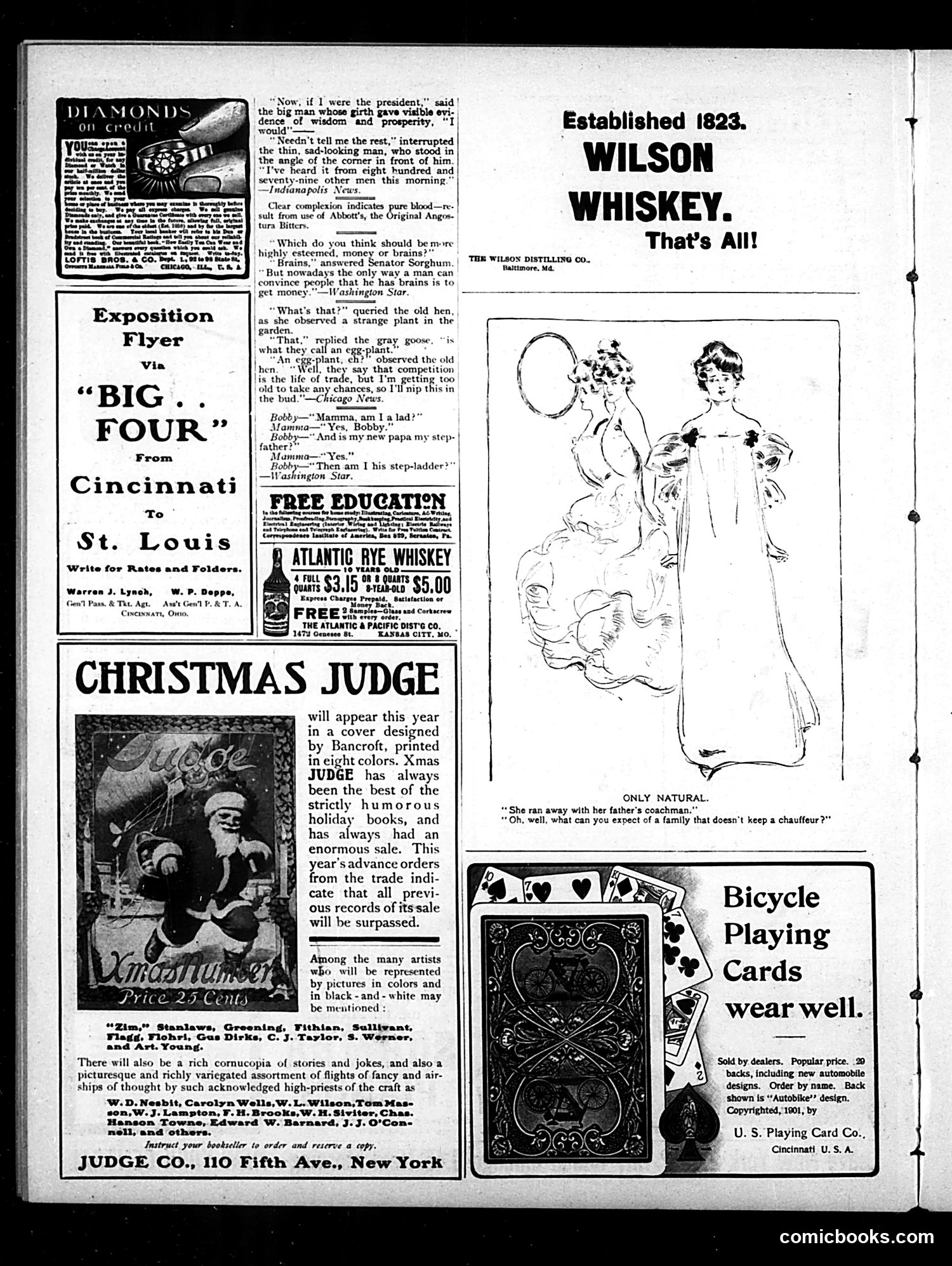
This page from Judge (circa 1901, based on copyright notice) is primarily **advertisements and brief humorous anecdotes** rather than political cartoons. The content includes: **Humor snippets:** Short jokes about everyday life—a fat man's repeated daydream of being president, a senator's observation that displaying brains requires money, competitive trading, and family dynamics. One joke references a "chauffeur," suggesting this targets upper-class readers familiar with newfangled automobiles. **Advertisements:** Whiskey, playing cards, diamonds, and transportation services dominate. The "Big Four" railroad flyer and Atlantic Rye Whiskey ads reflect turn-of-century commercial interests. **Christmas Judge promotion:** Announces the upcoming holiday issue, listing contributing artists and humorists. The page reflects **early 1900s American consumer culture and middle-to-upper-class concerns**—money, status symbols (chauffeurs), and leisurely entertainment. There's no overt political satire visible; the humor is gentle, domestic, and largely apolitical by modern standards.
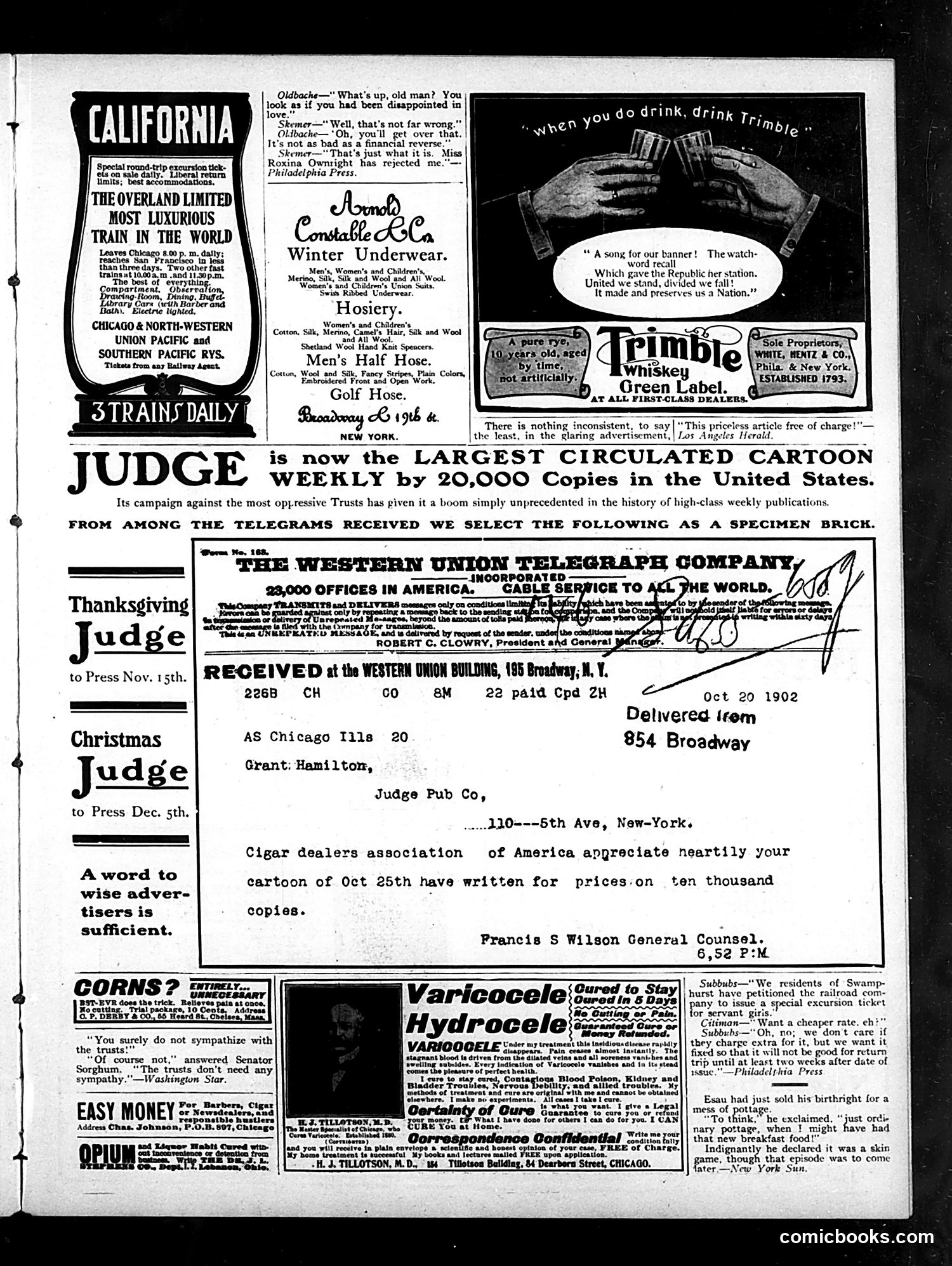
This page is primarily **advertisements and business notices** rather than editorial cartoons. The main content includes: **Upper section**: Small comic dialogues (Oldbacḧ and Skemer discussing disappointment in love; a patriotic song) alongside ads for winter underwear, hosiery, and train travel (The Overland Limited). **Central announcement**: Judge magazine celebrates becoming "the largest circulated cartoon weekly by 20,000 copies in the United States," attributing success to its anti-trust campaign. **Lower section**: A Western Union telegram (dated Oct 20, 1902) confirming receipt of Judge's Oct 25th cartoon, noting the Cigar Dealers Association of America requested 10,000 copies—suggesting Judge's political satire had commercial appeal beyond readers. **Bottom cartoons**: Brief jokes about corns/medical treatments and railroad excursion tickets. The page demonstrates Judge's influence in early 1900s American satire and advertising culture, though specific political figures or detailed satirical commentary are minimal here.
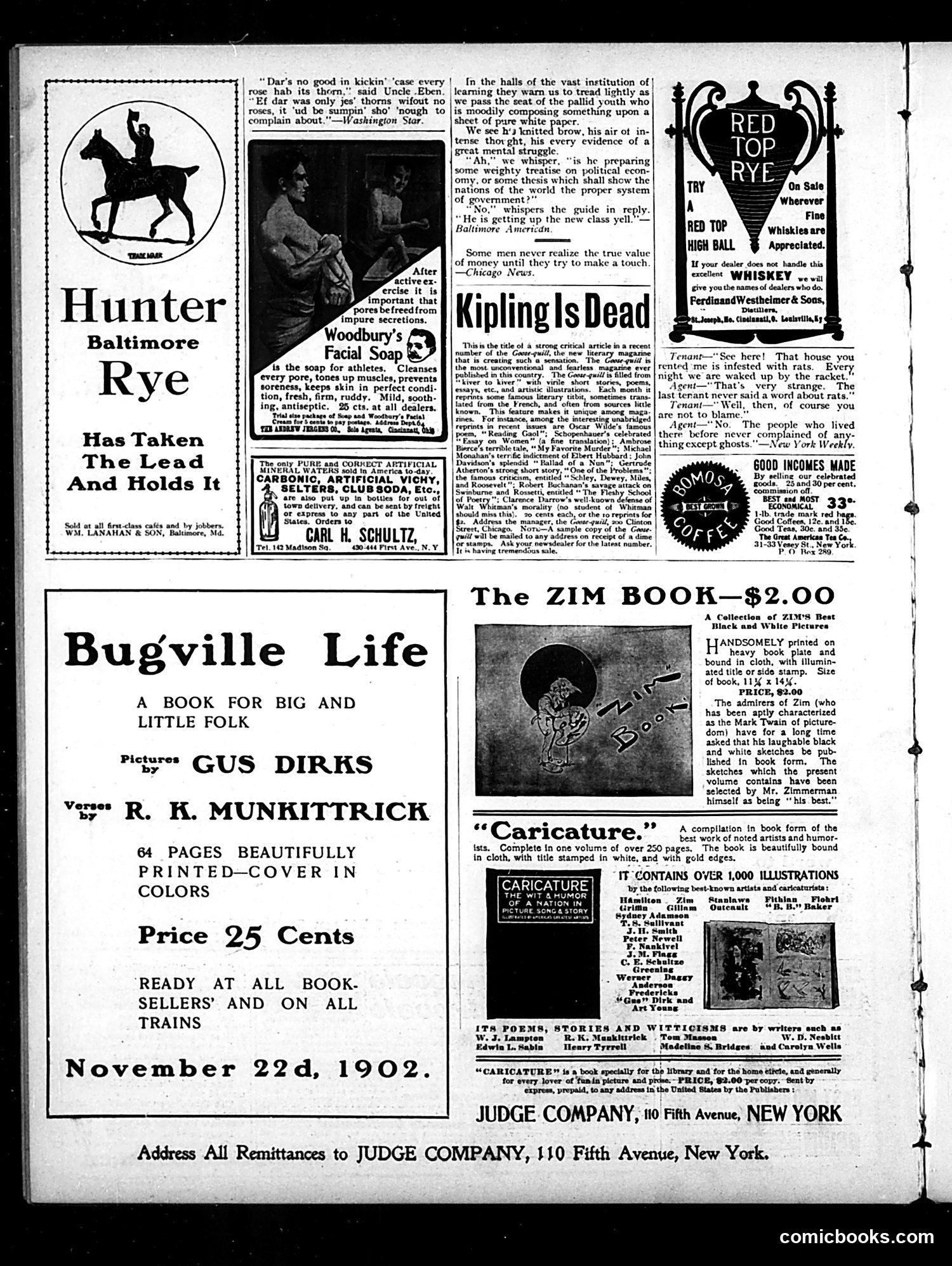
This page is primarily **advertising and book announcements** rather than political satire, though it includes minor humorous content. The page features: **Notable Content:** - A brief Uncle Eben dialect joke (common in 1902 publications) about roses having thorns—mild folk wisdom with no political edge - An article titled "Kipling Is Dead," which appears to be a literary critique of Rudyard Kipling's work in *The Cosmopolitan* magazine, not an obituary - Two short joke panels about college life and tenant complaints about rats—generic period humor - Multiple product advertisements (rye whiskey, soap, mineral water) and book promotions **Context for Modern Readers:** The page reflects early 1900s advertising conventions and the casual use of racial dialect humor typical of the era. The "Kipling Is Dead" article refers to critical assessment of his literary merit, not his actual death (Kipling died in 1936). The content is largely commercial rather than satirical commentary on contemporary politics or society.
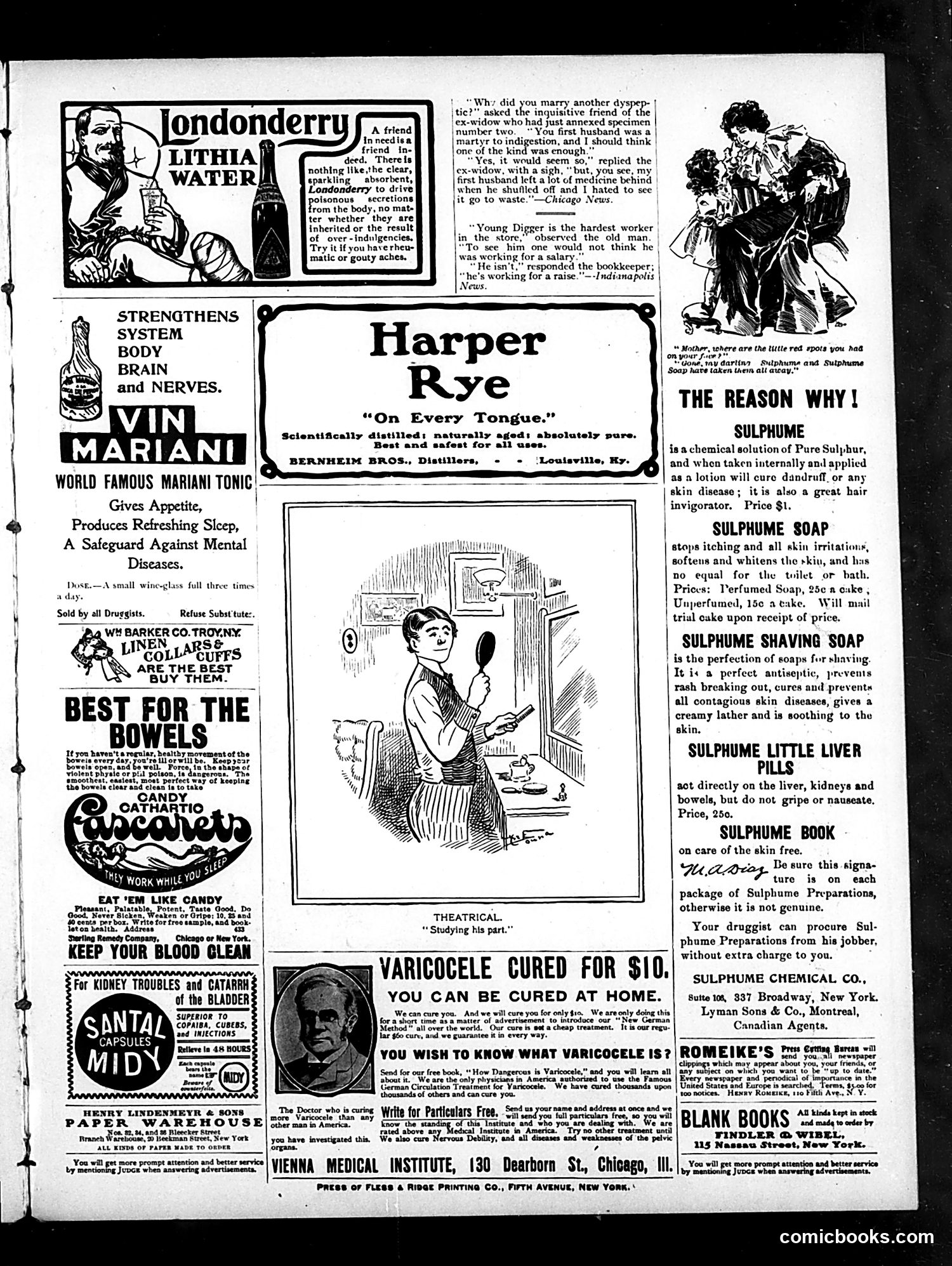
This page is primarily **advertising**, typical of early 20th-century American magazines. Most content consists of patent medicines and commercial products with exaggerated health claims. The few brief **jokes** include: - A widow marrying a second dyspeptic husband to use up leftover medicine from the first - An observation that a hardworking store employee "Young Digger" labors so hard he appears not to be working for wages but for personal advancement The **satirical cartoon** ("Studying his part") depicts a theatrical actor, humorously suggesting he's practicing his role in a bathroom mirror—poking fun at theatrical vanity or method acting. The **medical advertisements** are notable for modern readers as examples of fraudulent quackery: "Varicocele Cured for $10," "Santal Capsules" for nervous conditions, and various "miracle" products like Sulphume (a sulfur preparation). These reflect an era before FDA regulation when dubious remedies were openly marketed with unsubstantiated health claims. The page illustrates how mainstream publications once legitimized medical fraud.
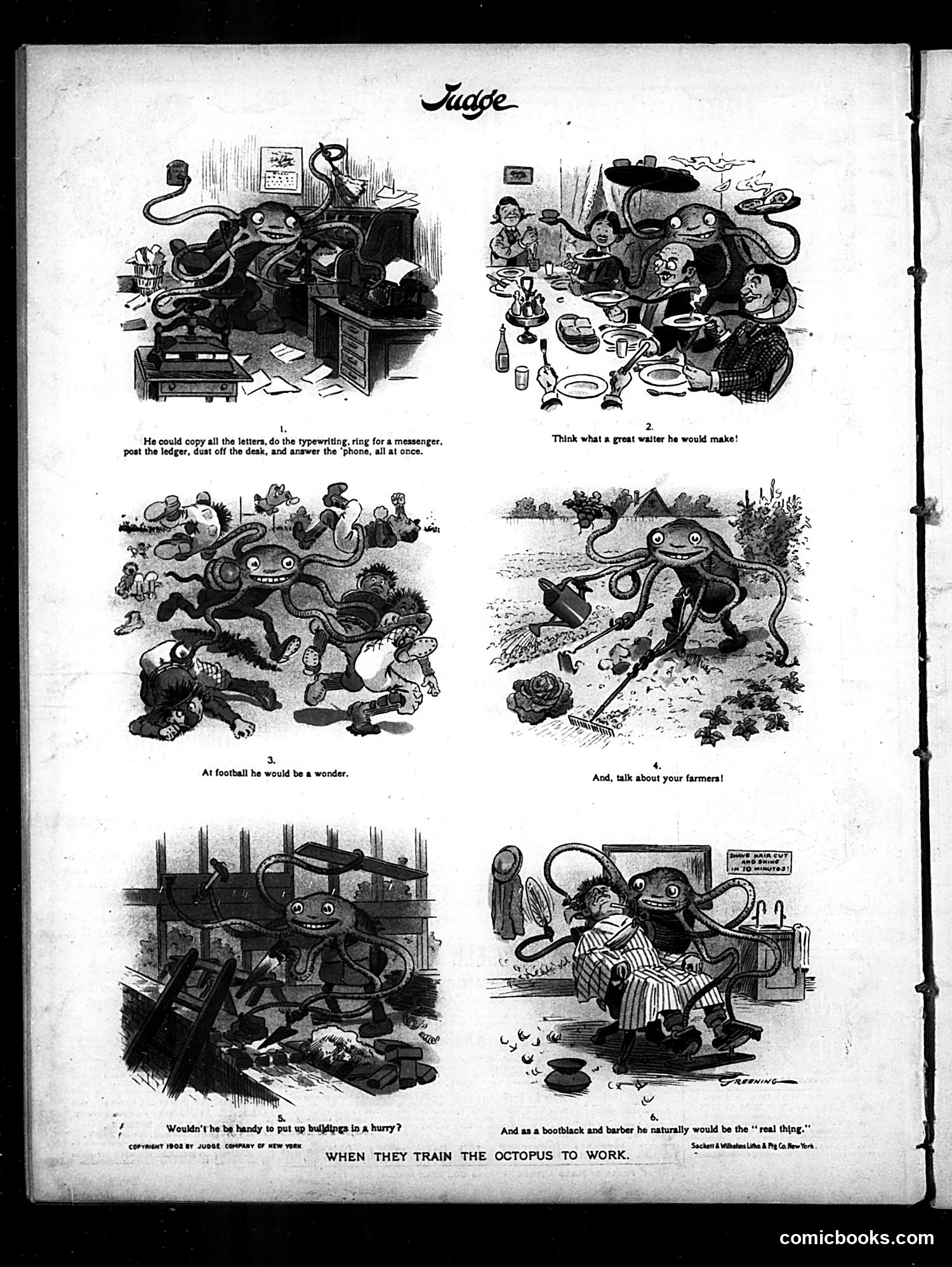
This 1902 Judge cartoon satirizes the ideal of the perfectly efficient worker through absurdist humor. An anthropomorphized octopus—chosen specifically for its multiple arms—is shown performing various jobs simultaneously: office work (typing, phone answering, filing), sports, farming, construction, and barbering. The satire targets both industrial-age work culture and perhaps labor anxieties of the period. By exaggerating what employers implicitly demanded (workers handling multiple tasks at once with superhuman efficiency), the cartoon mocks the unrealistic expectations placed on laborers. The octopus becomes a metaphor for the "ideal" worker—someone literally capable of doing everything simultaneously—thereby exposing how absurd such expectations truly are. The humor works through this impossible fantasy, suggesting contemporaries recognized the pressure workers faced to be infinitely versatile and productive.