
Judge, 1902-11-22 · page 10 of 16
Judge — November 22, 1902 — page 10: what you’re looking at
What you’re looking at
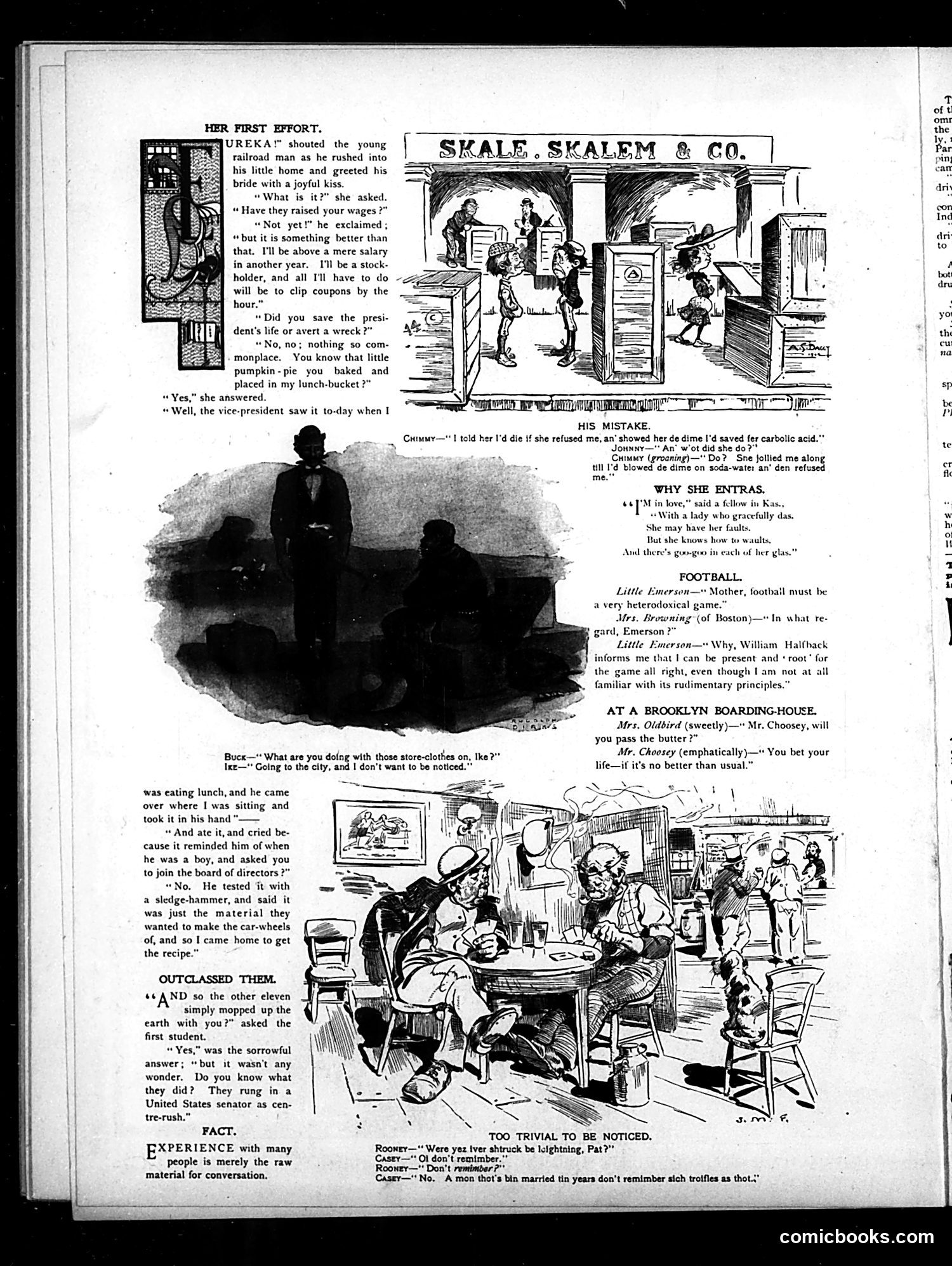
This Judge magazine page contains several satirical vignettes mocking American society circa early 1900s. **"Her First Effort"**: A railroad worker excitedly tells his wife he'll become wealthy—not through merit, but because a vice-president saw her homemade pumpkin pie in his lunch bucket and wants to make him a stockholder. The satire targets the absurdity of corporate nepotism and unearned advancement based on trivial personal connections rather than ability. **Other sketches** mock various social pretensions: a man overdressed for the city, boarding-house snobbishness, and a college football team that illegally recruited a U.S. senator as a player. The lower comic strips use exaggerated dialect humor (Irish and German accents) common to the era—typical of period satire but reflecting now-outdated ethnic stereotyping. Overall, the page satirizes gilded-age capitalism, social climbing, and the arbitrary nature of success in America, where connections matter more than competence.
📄 Transcribed text from this page (OCR, searchable)
Machine-transcribed from the original scan — historical spelling and the odd misread are preserved.
UREKA"" shouted the young railroad man as he rushed into his little home and greeted his bride with a joyful kiss. “What is it?” she asked. Have they raised your wages ?" Oe “Not yet!" he exclaimed ; . «but it is something better than dri that, I'll be above a mere salary to in another year. I'll be a stock- ! holder, and all I'll have to do te will be to clip coupons by the hour.” “Did you save the presi- dent's life or avert a wreck ?” “No, no; nothing so com- monplace. You know that little pumpkin-pie you baked and placed in my lunch-bucket 2” = = i “Yes,” she answered. = —— “Well, the vice-president saw it to-day when I i TATTLE P HIS MISTAKE. Cxinmy—' | told her I'd die if she refused me, an’ showed her de dime I'd saved fer carbolic acid."* my Jounny—"* An’ w'ot did she do?” te Crummy (groaning)—" Do? Sne jollied me along till 1d blowed de dime on soda-water an’ den refused st me.” fl WHY SHE ENTRAS. 66] 'M in love," said a fellow in Ka With a lady who gracefully das. w She may have her faults. h But she knows how to waults, i 1 FOOTBALL, H \ Little Emerson— Mother, football must be a very heterodoxical game.” rs. Browning (of Boston)—* In what re- s gard, Emerson Little Emerson—* Why, William Halfback nforms me that I can be present and * root’ for } the game all right, even though Iam not at all familiar with its rudimentary principles.” AT A BROOKLYN BOARDING-HOUSE. Mrs. Oldbird (sweetly) —"* Mr. Choosey, will you pass the butter ?” “What are you doing with those store-clothes on, Ike?" Mr. Choosey (emphatically}—" You bet your Going to the elty, and I don't want to be noticed."* life—if it's no better than usua was eating lunch, and he came over where I was sitting and took it in his hand "—— “ And ate it, and cried be- cause it reminded him of when he was a boy, and asked you to join the board of directors ?” “No. He tested it with a sledge-hammer, and said it was just the material they wanted to make the car-wheels of, and so I came home to get the recipe.” OUTCLASSED THEM. seAND so the other eleven simply mopped up the earth with you?” asked the first student. “Yes,” was the sorrowful answer; “but it wasn't any wonder. Do you know what | they did? They rung in a United States senator as cen- tre-rush,” PACTS TOO TRIVIAL TO BE NOTICED. EXPERIENCE with many * Were yes iver shtruck be lolghtning, Pat?” people is merely the raw AS cn don arma material for conversation. Caszy—"‘No. A mon thot’s bin married tin years don't remimber sich troifles as thot..’ comicbooks.com