
A complete issue · 16 pages · 1902
Judge — November 15, 1902
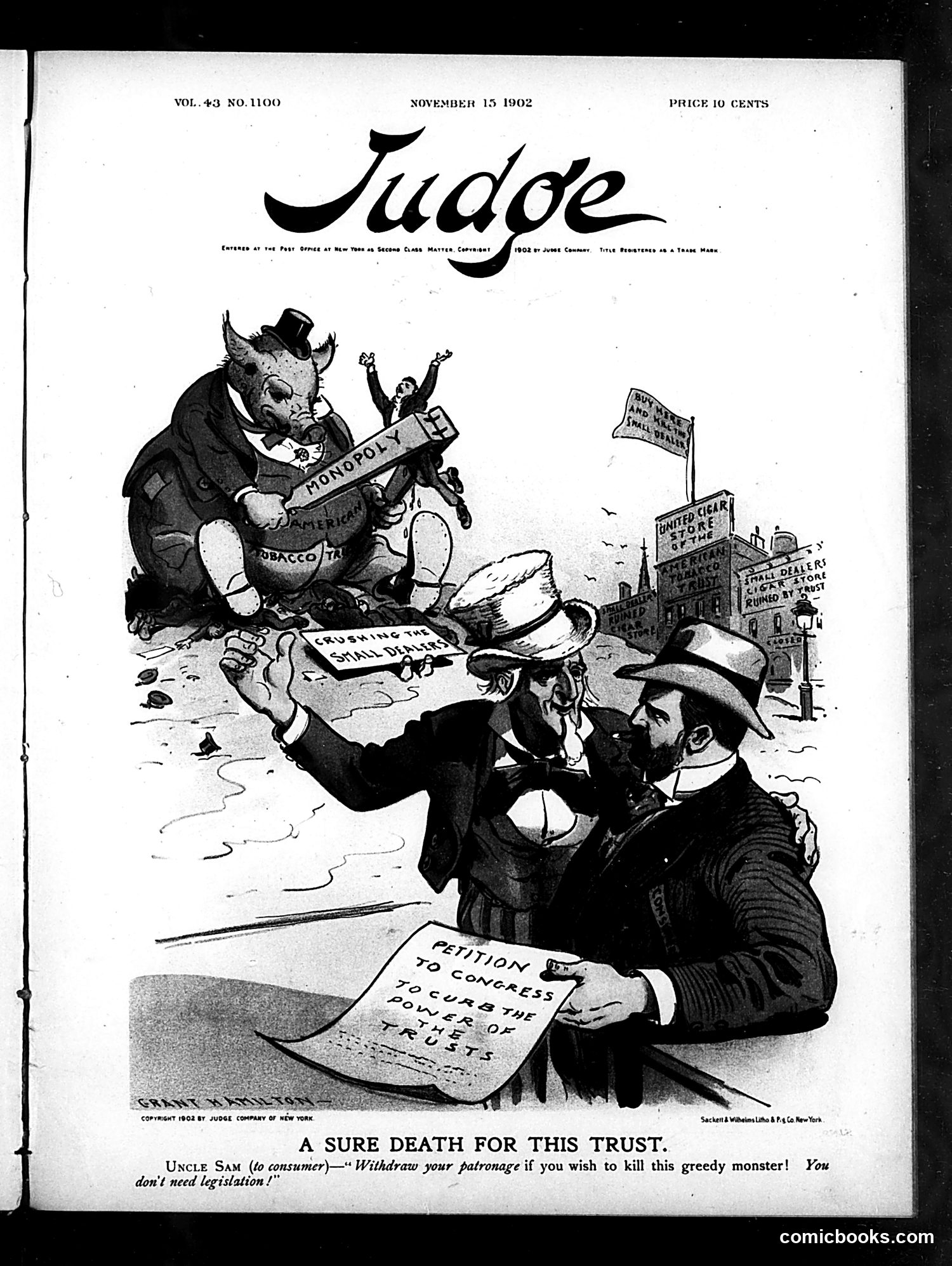
This November 1902 *Judge* cartoon addresses **corporate monopolies ("trusts")**, a major political issue of the Progressive Era. Uncle Sam (representing the U.S. government) advises consumers to withdraw patronage from a greedy corporate monster to kill it without legislation. The cartoon depicts a demon-like figure labeled "MONOPOLY" wearing a top hat, surrounded by small dealers being crushed. Signs reference **tobacco and cigar trusts**—specific industries notorious for monopolistic practices. The smaller businessmen and consumers below hold a petition to Congress, requesting government intervention. The satirical message: citizens possess economic power; by boycotting monopolies, they can force change without waiting for Congress to act. This reflects contemporary public frustration with concentrated corporate power and debate over whether legislation or consumer action should combat trusts.
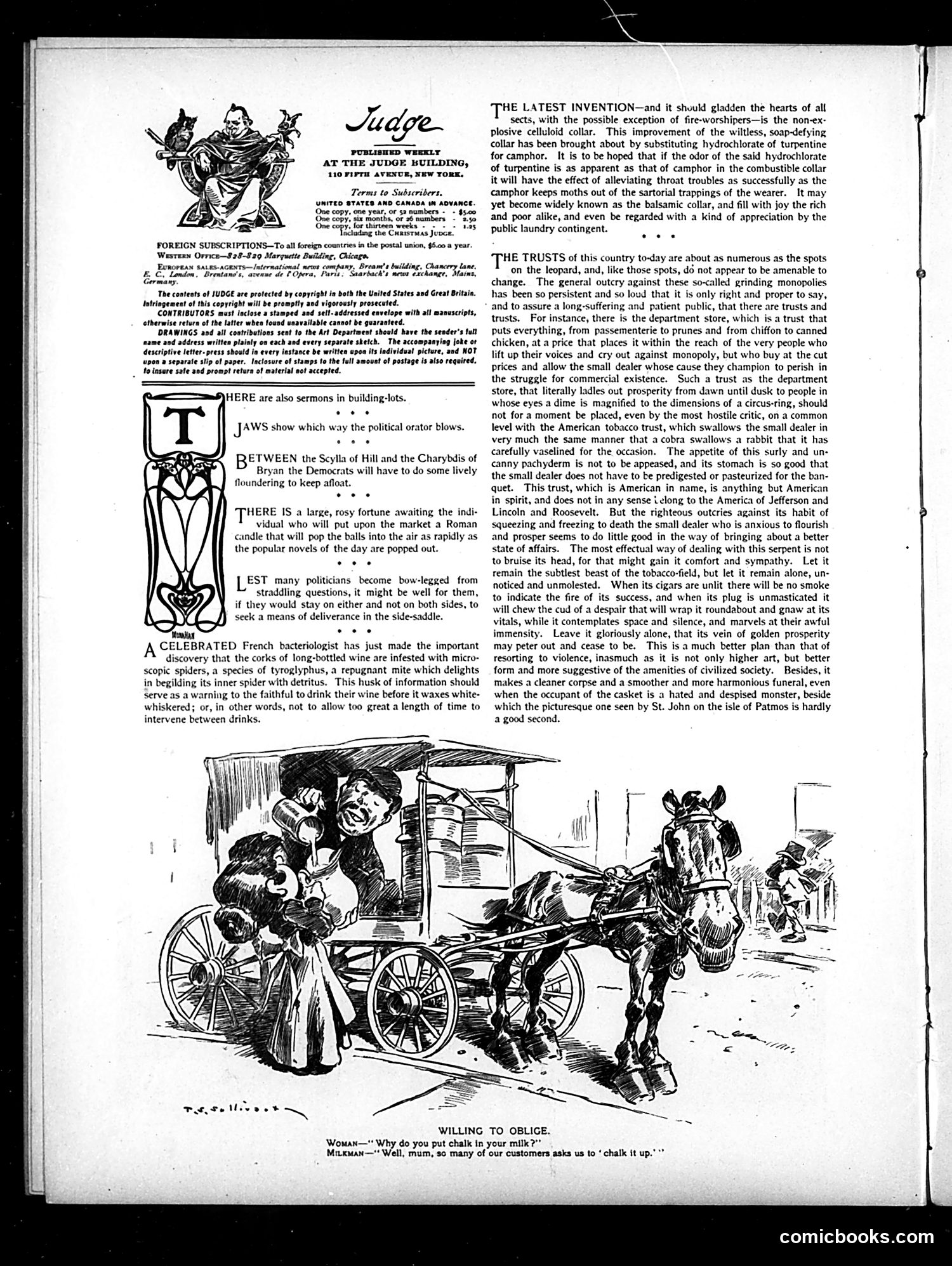
The main cartoon titled "Willing to Oblige" depicts a milkman responding to a customer's question about why he puts chalk in milk. His answer—that many customers ask him to "chalk it up"—is a visual pun playing on two meanings: literally adding chalk to milk (a known adulterant of the era), and the common phrase "chalk it up" meaning to record a debt. This satirizes the widespread practice of milk adulteration in early 20th-century America, a serious public health concern. The joke exposes how vendors rationalized fraudulent practices by claiming customer demand, while the accompanying editorial text discusses various monopolistic trusts exploiting consumers. The cartoon critiques both vendor dishonesty and systemic corruption in food distribution.
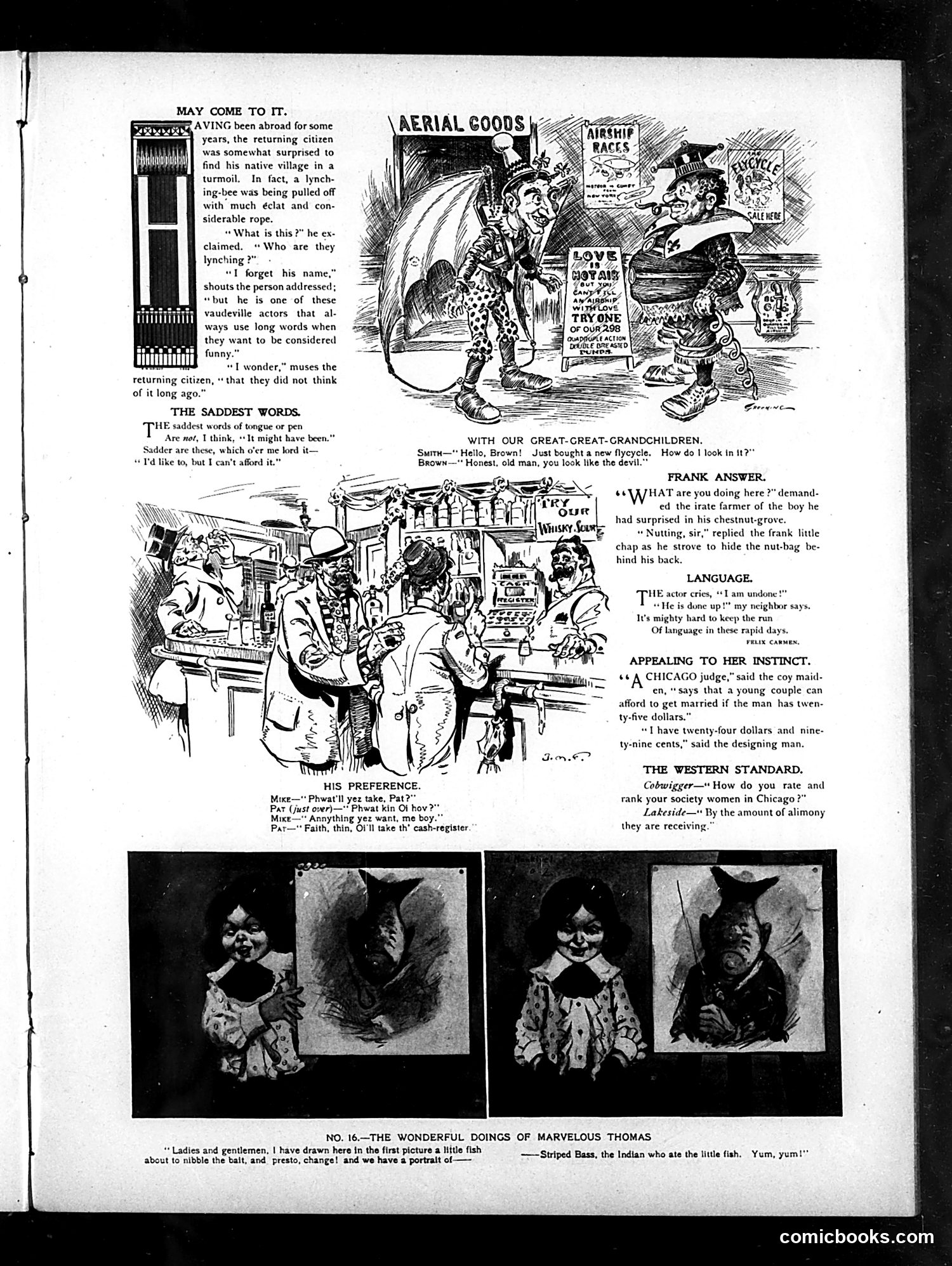
This page contains multiple satirical sketches and jokes typical of early 20th-century Judge magazine humor. **"May Come to It"** depicts surprise at a returning citizen's involvement in what appears to be a lynching incident—referencing contemporary racial violence. **"Aerial Goods" and "With Our Great-Great-Grandchildren"** show surreal visions of future inventions and descendants, common Judge topics exploring technological anxiety. **Other sketches** ("Frank Answer," "Language," "Appealing to Her Instinct," "The Western Standard," and "His Preference") present domestic humor—typical romantic/marital comedies poking fun at gender relations and courtship customs. The bottom section, "The Wonderful Doings of Marvelous Thomas," appears to be an illustrated narrative featuring what the caption identifies as "Striped Bass, the Indian who ate the little fish." Overall, this reflects Judge's mix of topical satire, domestic comedy, and absurdist fiction.
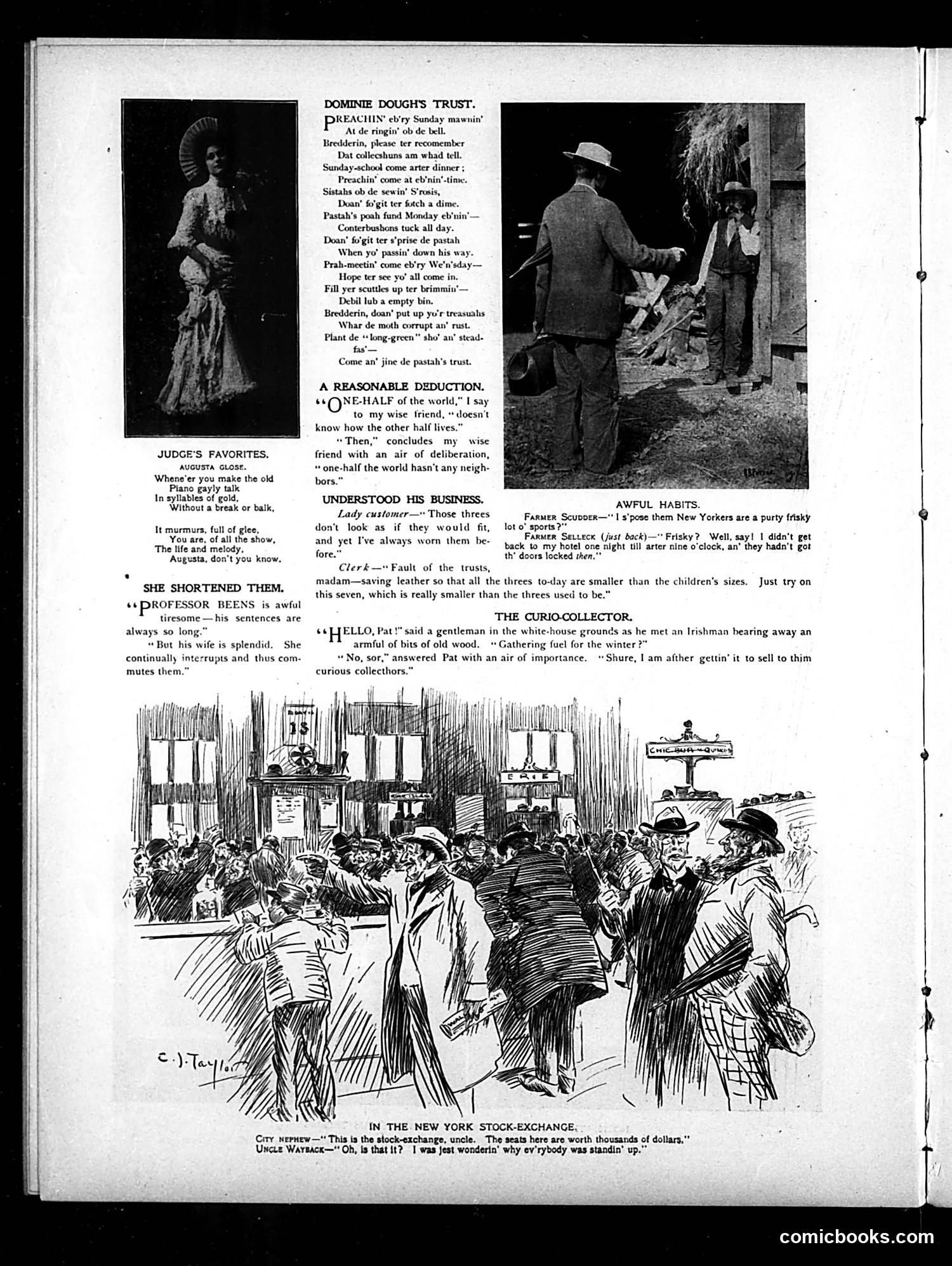
This page contains several humorous sketches and poems satirizing turn-of-the-century American life. **"Judge's Favorites"** features Augusta Gloss, a character known for witty remarks about high society. **"Dominie Dought's Trust"** is a dialect poem mocking rural speech patterns and religious hypocrisy. **"The Curio-Collector"** dialogue jokes about an Irishman selling scrap wood as antiques to wealthy collectors—satirizing both nouveau-riche gullibility and immigrant entrepreneurship. **"In the New York Stock-Exchange"** cartoon depicts the chaos of stock trading, with a caption mocking Wall Street's frenzy: the uncle's amazement that "stocks are worth thousands of dollars" reflects contemporary anxiety about speculative wealth. The page's humor targets class pretension, immigrant stereotypes, and financial speculation typical of Gilded Age satire.
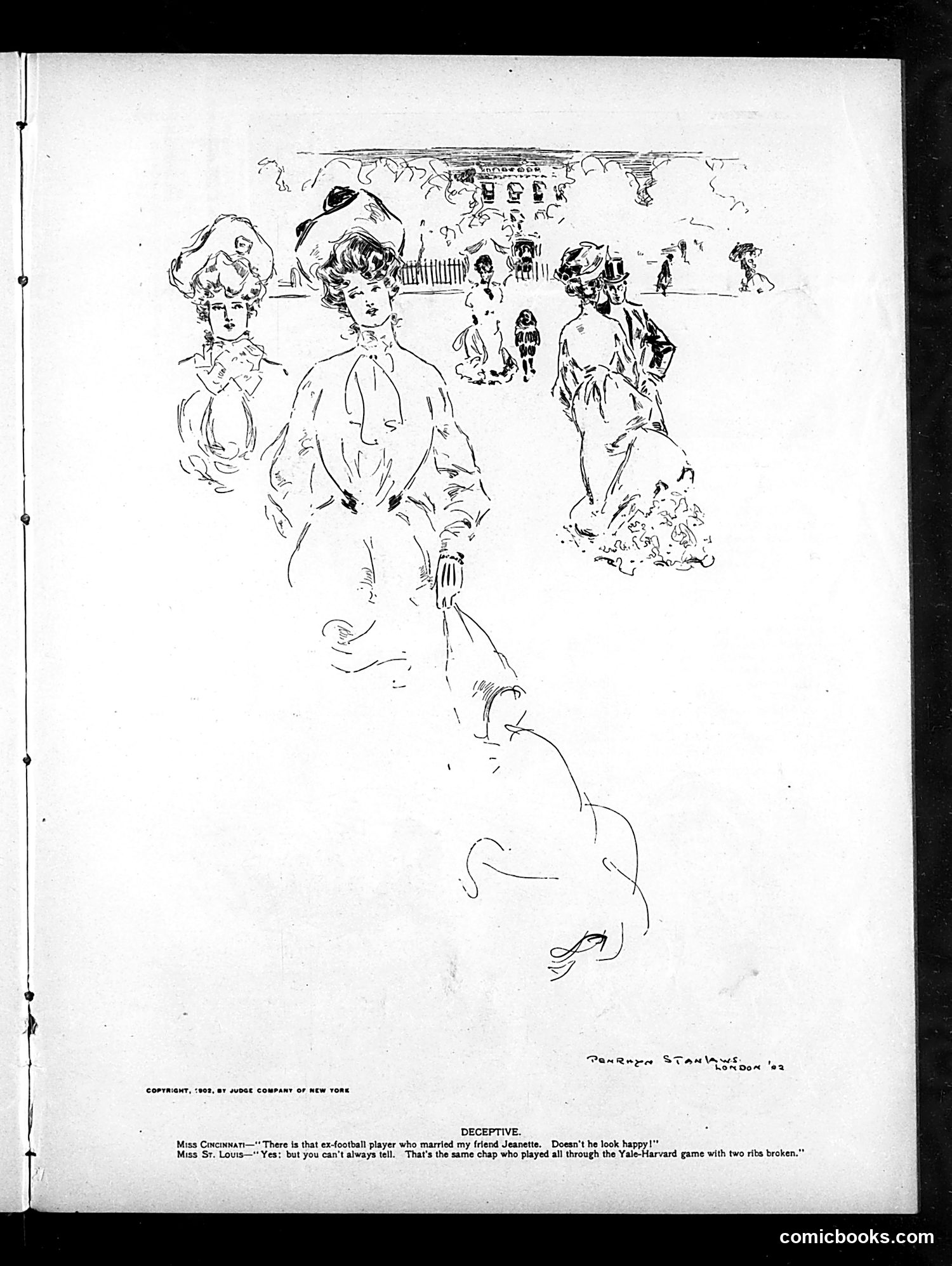
This is a social humor cartoon from *Judge* magazine featuring two women in conversation. The joke turns on deceptive appearances: Miss Cincinnati remarks that an ex-football player who married her friend Jeanette "doesn't look happy," while Miss St. Louis responds that appearances deceive—this same man played through an entire Yale-Harvard game with two broken ribs, implying his stoicism makes it impossible to judge his actual emotional state. The cartoon satirizes early 20th-century attitudes about masculine toughness and emotional restraint. The humor derives from the incongruity between a man's ability to endure athletic pain and his capacity (or inability) to show marital contentment. The elegant fashion illustration style is typical of *Judge*'s society-focused humor. The reference to the prestigious Yale-Harvard rivalry anchors the joke in recognizable American sporting culture.
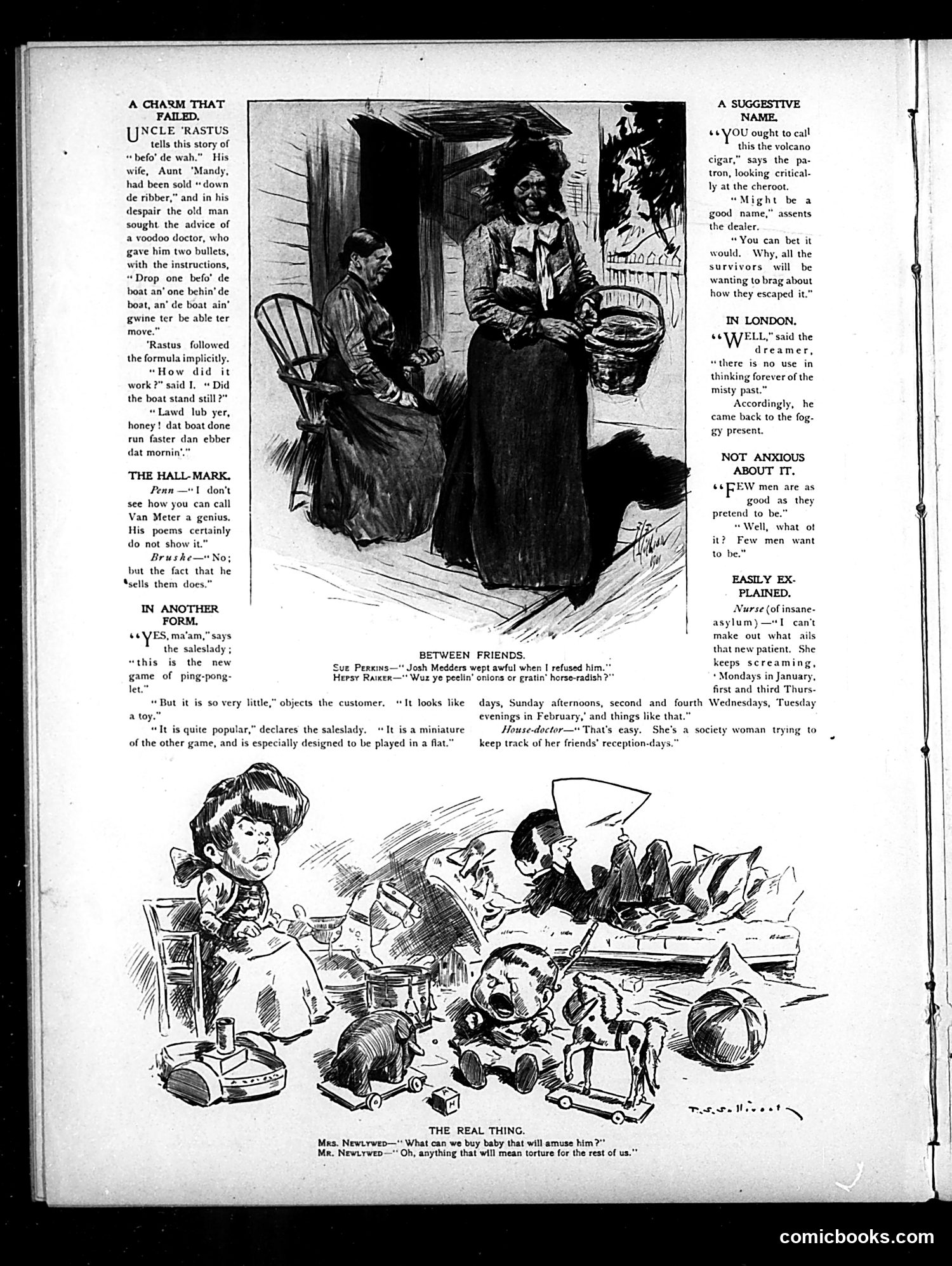
This page contains several satirical vignettes typical of early 20th-century American humor: **"A Charm That Failed"** uses a racist stereotype—an elderly Black man ("Uncle 'Rastus") recounting a pre-Civil War anecdote about a voodoo doctor's failed spell. The humor relies on minstrelsy traditions and dialect humor common to the era. **"The Hall-Mark"** satirizes artistic pretension: a poet's work is deemed worthless, yet he succeeds commercially—suggesting the market rewards mediocrity over merit. **"Between Friends"** and related snippets mock social absurdities: ping-pong enthusiasm, a saleslady overselling novelties, and a society woman so busy tracking social obligations she's gone mad tracking reception-days. **"The Real Thing"** presents parents debating baby gifts, with the father darkly joking that any toy means parental suffering. The page reflects Judge's satirical focus on social pretension, commercialism, and domestic life, while containing period-typical racial caricatures that modern readers should recognize as offensive.
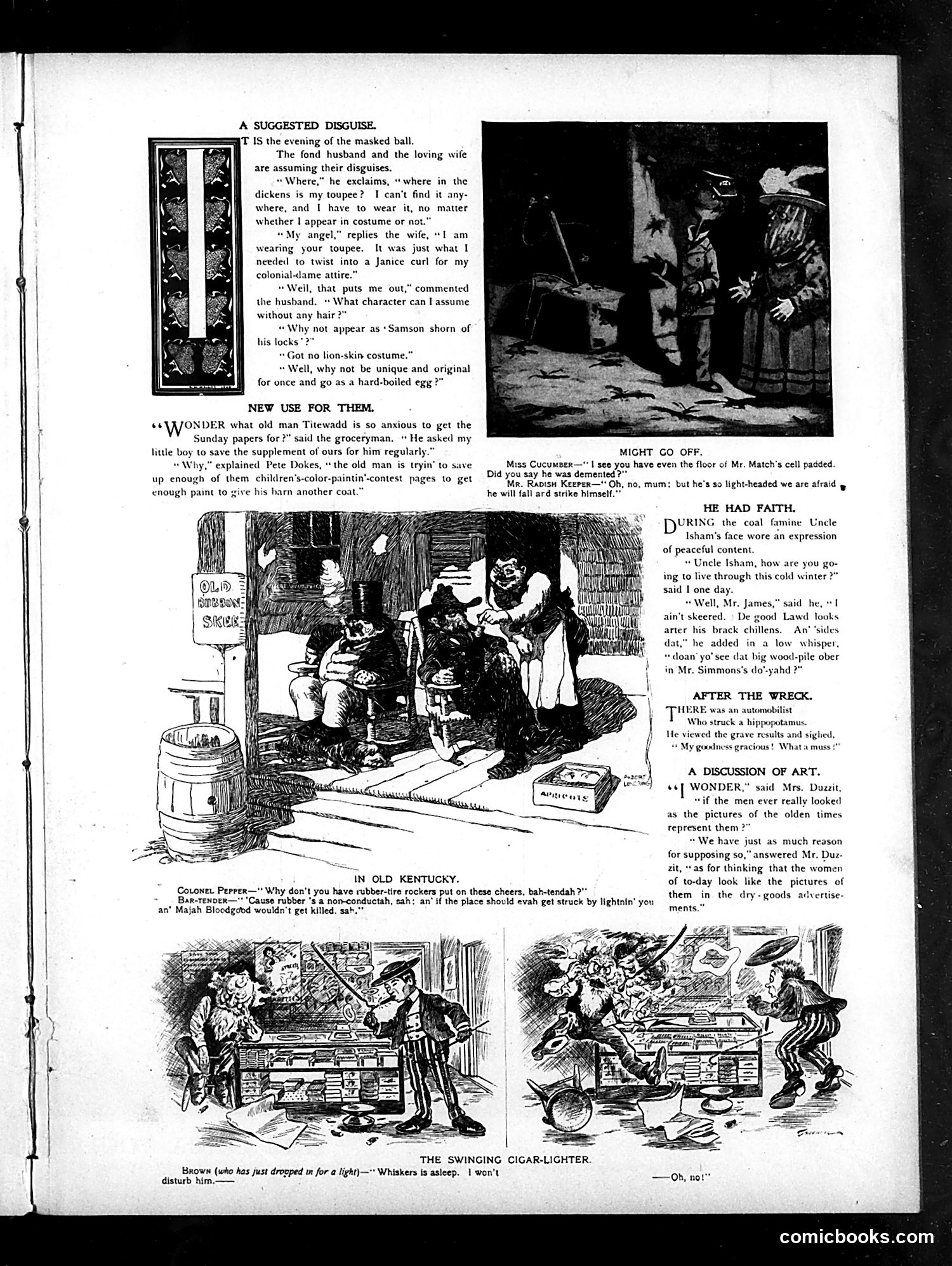
This page collects brief comic sketches typical of Judge magazine's humor. The main piece plays on marital comedy: a husband needs his toupee for a masked ball costume, but his wife has borrowed it for her colonial-themed outfit. When he asks what character he can assume without hair, she suggests either "Samson shorn of his locks" (biblical reference) or—as a punchline—a "hard-boiled egg," exploiting the visual absurdity of baldness. Other sketches include: an elderly miser collecting newspaper supplement coloring-contest pages to paint his barn cheaply; a racist caricature of "Uncle Isham" (African American) expressing faith during coal shortage while eyeing a neighbor's woodpile; and various domestic and period-detail humor involving Kentucky dialect, automobiles, and bar scenes. The humor relies on wordplay, visual puns, and social stereotypes typical of early 20th-century American satire—much would be considered offensive today.
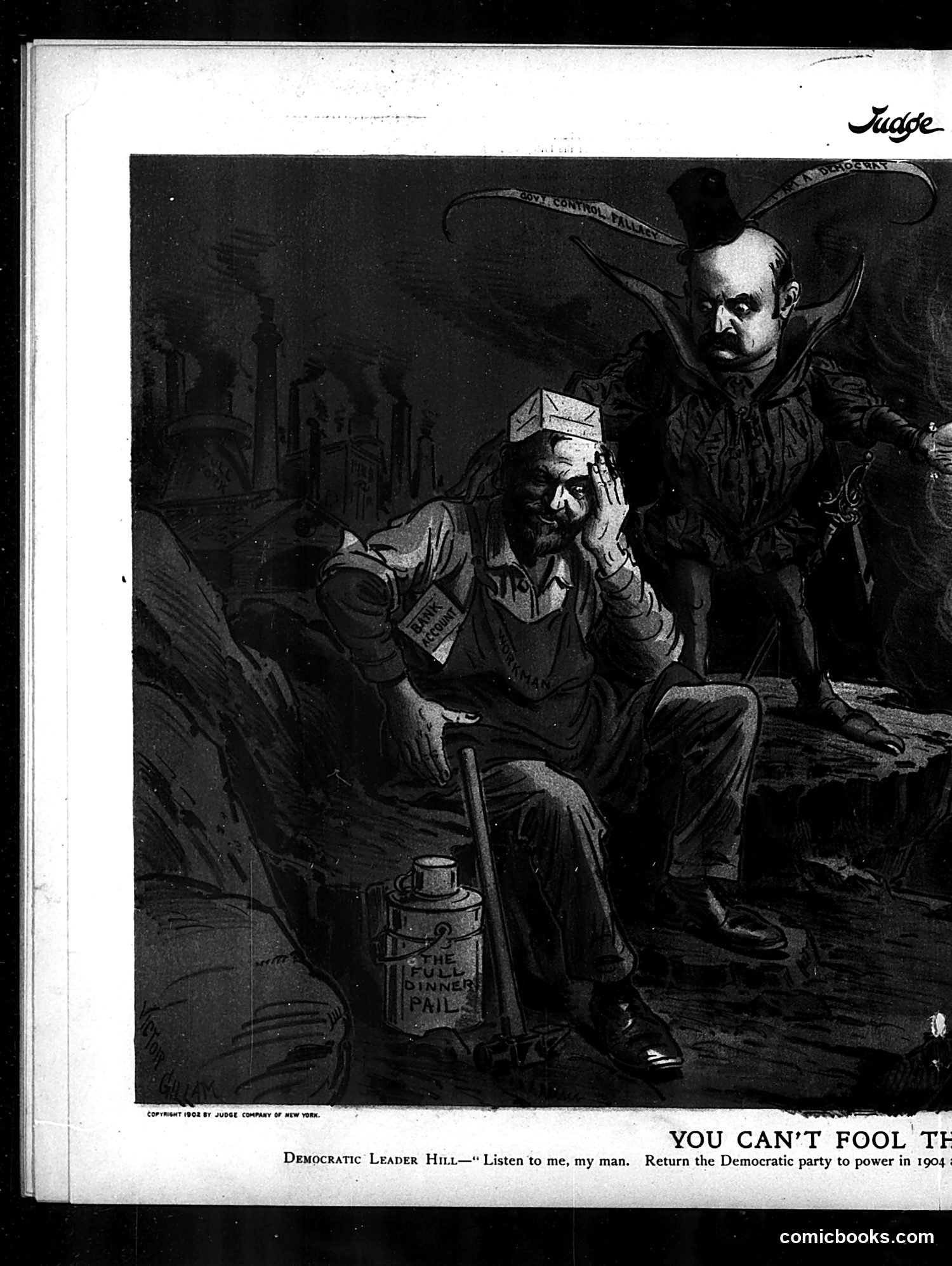
This 1902 *Judge* cartoon satirizes Democratic Party leadership during the Theodore Roosevelt presidency. A figure labeled "Democratic Leader Hill" (likely referring to David B. Hill, a prominent New York Democrat) attempts to persuade a working man—depicted as poor and hungry, sitting beside "The Full Dinner Pail"—to return the Democratic party to power in the 1904 election. The satire's point: the cartoon mocks the Democratic leader's hollow appeal to voters. The "dinner pail" references the Republican slogan promising prosperity under Republican rule. The working man's skeptical posture and Hill's unconvincing gesture suggest Democrats lack credible arguments to win back power from the popular Roosevelt administration. The title "You Can't Fool T[hem]" (cut off) emphasizes voters won't be deceived by empty political rhetoric.
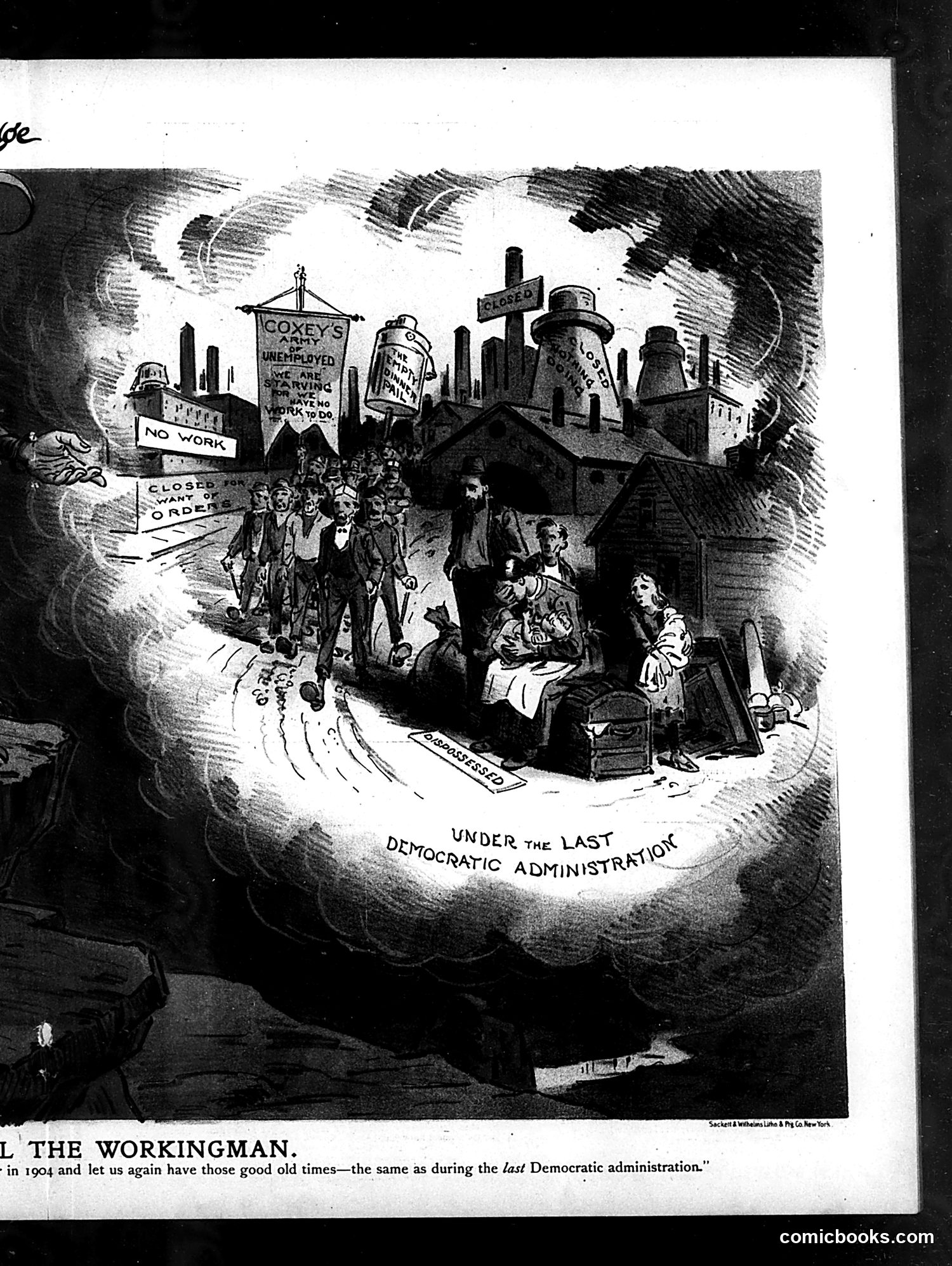
This is a political cartoon criticizing conditions under the most recent Democratic administration. The image depicts a graveyard scene with tombstones labeled "Coxey's Army," "No Work," and other hardship references, with impoverished workers and families gathered below. The caption sarcastically quotes a workingman asking to return to "the good old times" of the previous Democratic era. The satire attacks the opposing party (likely Republicans in power at the time of publication) by ironically suggesting the prior Democratic administration was worse—implying widespread unemployment, homelessness, and economic suffering. "Coxey's Army" references the 1894 march of unemployed workers, a symbol of economic crisis. The cartoon's point: voting Democratic again would mean returning to those desperate conditions, not improvement.
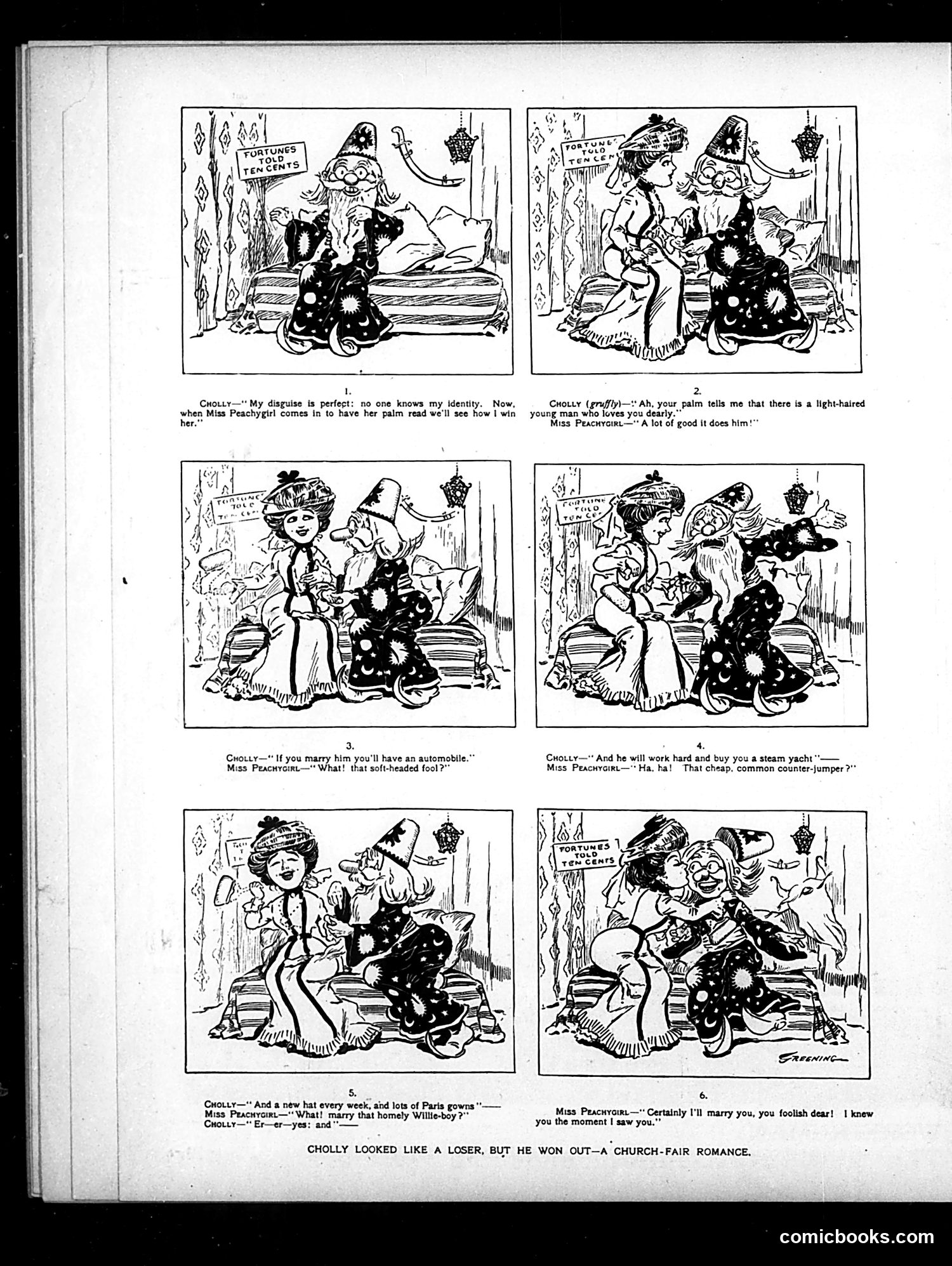
This six-panel comic satirizes fortune-telling and romantic deception. A character called "Cholly" disguises himself as a fortune teller to win over "Miss Peachygirl," who dismisses her actual suitor as a "soft-headed fool" and "common counter-jumper." The joke relies on class snobbery: Miss Peachygirl rejects the young man's genuine affection and modest prospects (no automobile, no steam yacht, no Paris gowns). But when the disguised Cholly promises lavish gifts, she remains unimpressed—until the final panel reveals she'll marry him anyway, having recognized him "the moment I saw you." The satire targets both superficial materialism and the pretense of romance. The subtitle suggests Cholly's humble appearance masked his actual worthiness, while mocking the notion that a "church-fair romance" (modest, wholesome) trumps mercenary calculations. The humor hinges on assumptions about gender, class, and courtship rituals of the era.
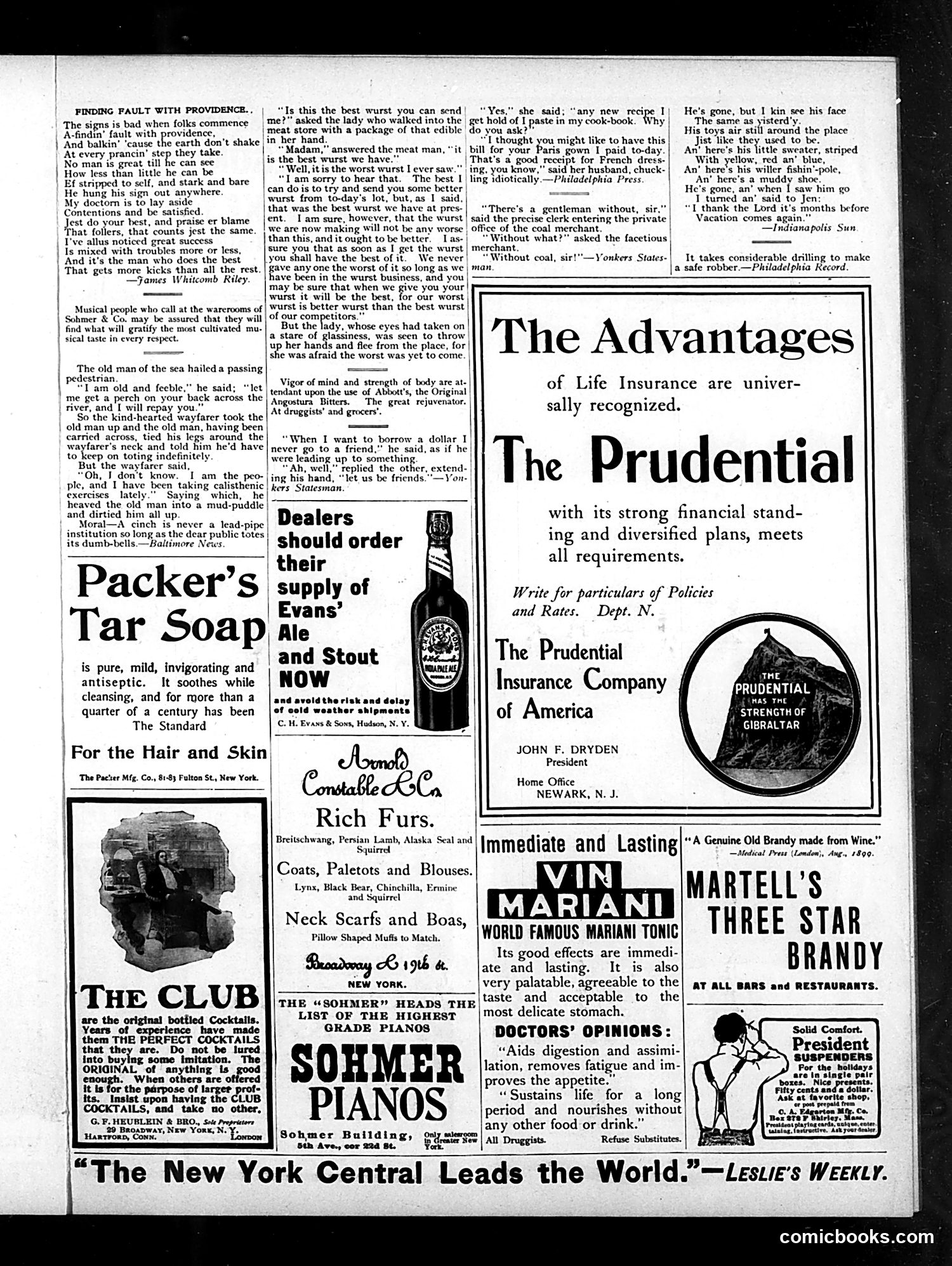
This page from *Judge* consists primarily of **humorous short stories and advertising** rather than political cartoons. The main content includes: **Satirical anecdotes:** - A dialogue about "wurst" (sausage) that plays on repetitive wordplay—a butcher defends his product's quality through circular logic - A story parodying Sinbad the Sailor, where "the People" (symbolic of common citizens) become exhausted supporting established institutions - Brief jokes about borrowing money, coal merchants, and safe-robbers **The satire's point:** These pieces mock bureaucratic pretension, commercial self-interest, and institutional parasitism. The "Sinbad" story particularly critiques how institutions exploit public goodwill indefinitely. **The advertisements** (Packer's Tar Soap, Sohmer Pianos, The Prudential Insurance, spirits) fill the remainder, reflecting early 20th-century marketing conventions. There are no identifiable political figures or specific dated events referenced on this visible page.
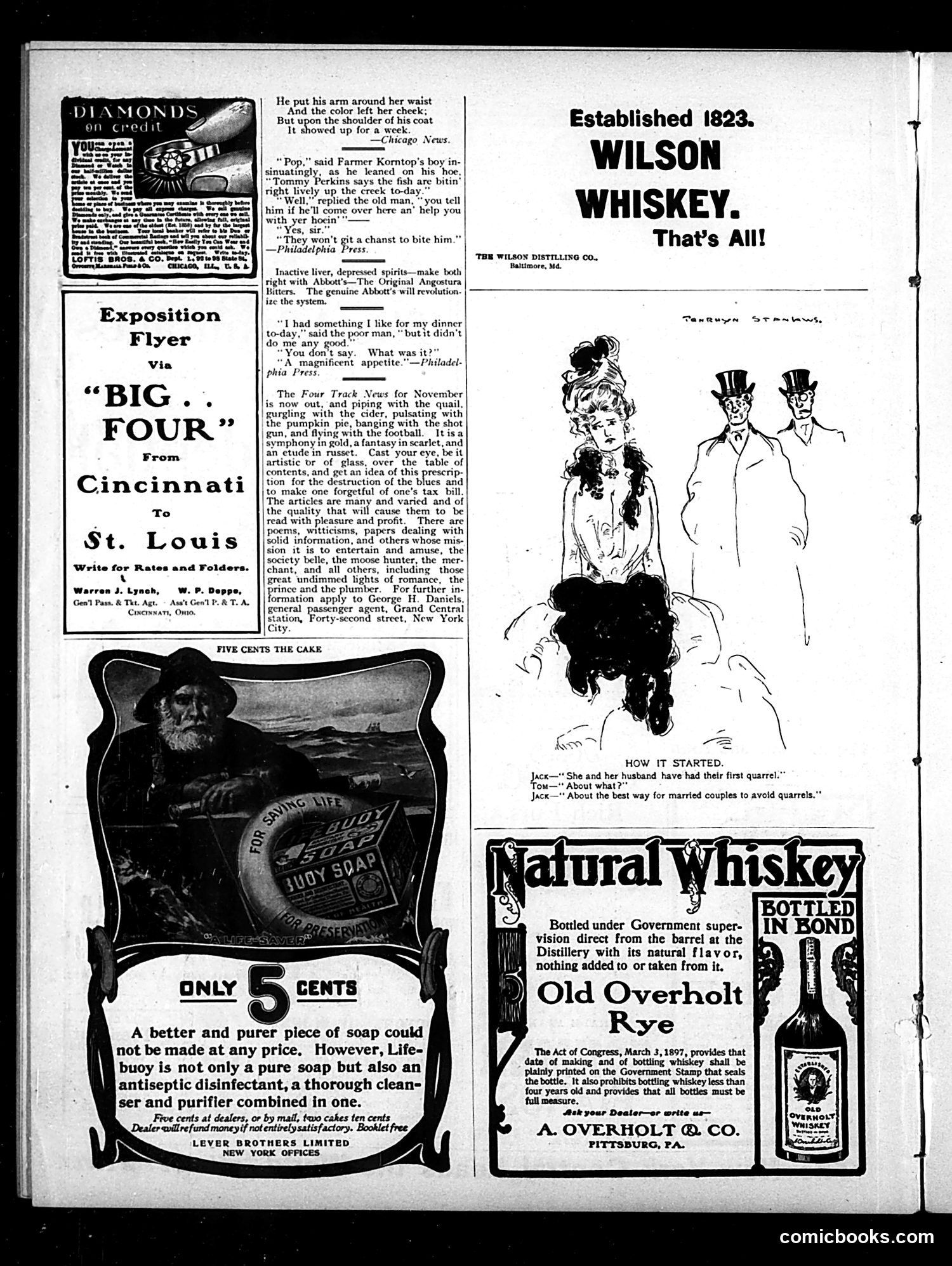
This page is primarily **advertising** with brief comic vignettes interspersed. The main content includes: **Comic Snippets:** Three short jokes about rural life and marriage—a farmer's boy avoiding fish-biting by helping with hoeing, a poor man's "magnificent appetite" as dinner, and a newlywed couple's first quarrel about *preventing* quarrels. **Advertisements:** The page features prominent ads for Wilson Whiskey (established 1823), Judy Soap (five cents), an Exposition Flyer for the "Big Four" railroad (Cincinnati to St. Louis), Abbott's Bitters for liver complaints, the Four Track News magazine, and Old Overholt Rye whiskey. **Historical Context:** The whiskey ads reference Government supervision and the 1897 Act of Congress regulating whiskey bottling—reflecting early 20th-century food/drug regulation. The bitters advertisement reflects era-typical patent medicine marketing. The page reflects Judge's mixed editorial-advertising model typical of early 1900s magazines, with lightweight humor supporting commercial content.
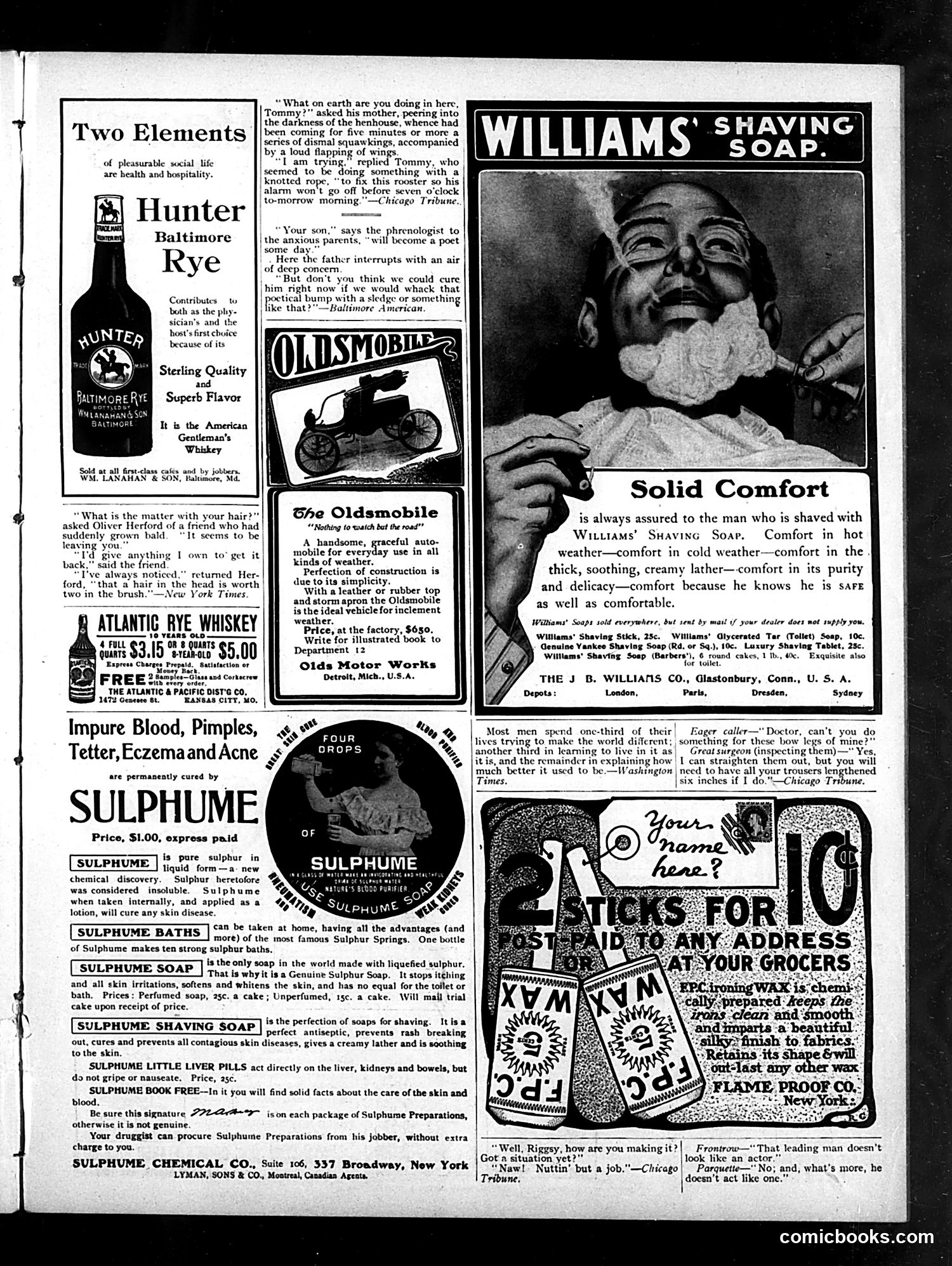
This page is primarily **advertisements** with interspersed short humorous anecdotes rather than political cartoons. The jokes are lightweight domestic humor: a boy trying to silence a rooster with a rope; a phrenologist suggesting a father could "cure" his son's poetic ambitions by hitting his head with a sledge; banter about baldness. These reflect early 1900s casual attitudes toward corporal punishment and pseudoscientific phrenology—now recognized as racist pseudoscience. The advertisements promote whiskey, automobiles, and notably "Sulphume," a patent medicine claiming to cure skin conditions. These were common in period magazines; many such "cures" contained questionable or harmful ingredients. The Williams Shaving Soap ad features a photograph of a man mid-shave with lather, emphasizing comfort and safety—typical early 20th-century advertising rhetoric about grooming products. **No significant political satire is present.** The page demonstrates Judge's mixed content model: satirical articles elsewhere, but here primarily commercial advertising revenue combined with light, family-friendly humor.
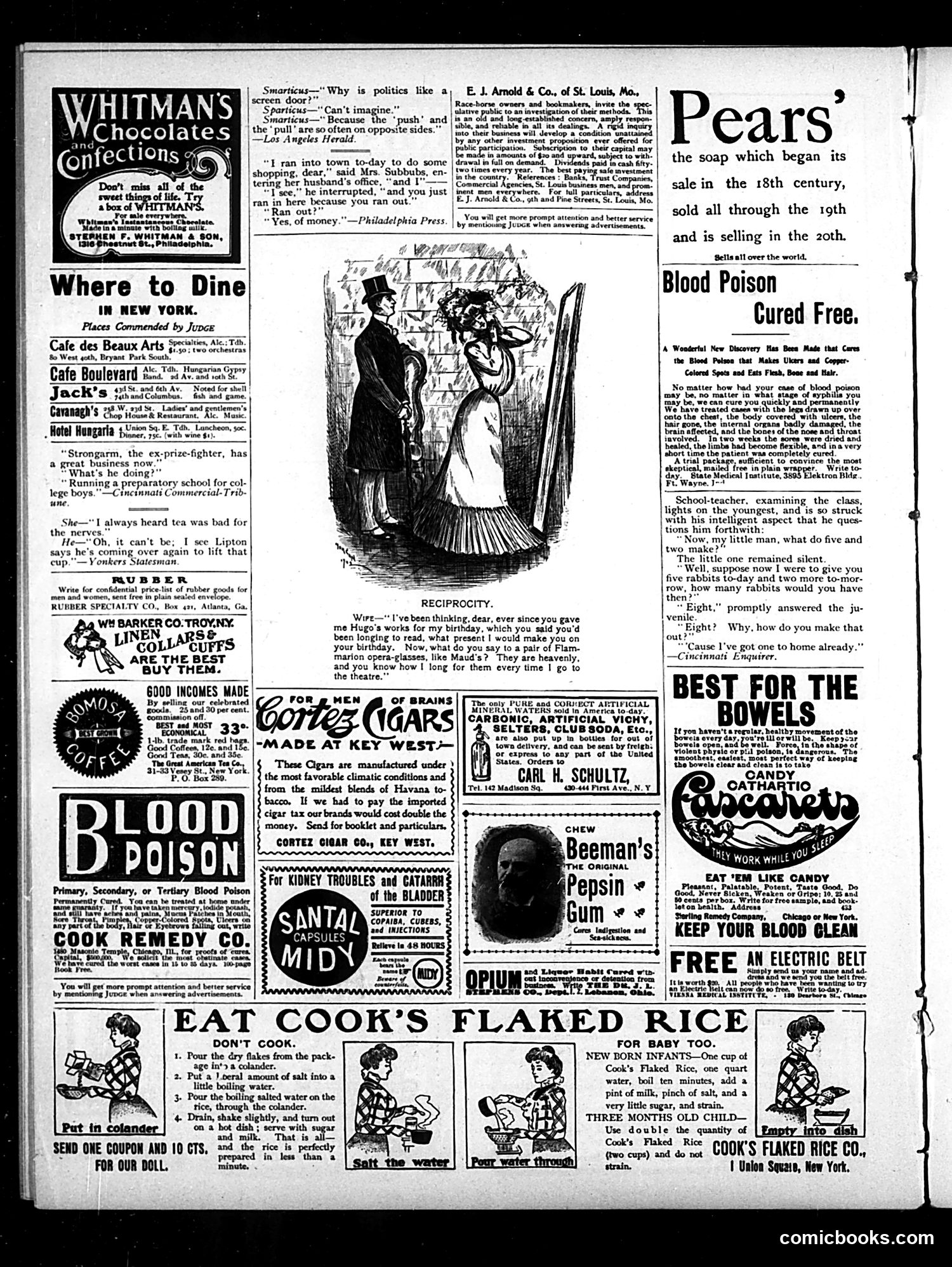
This page consists primarily of **advertisements and short jokes**, not political cartoons requiring historical analysis. The main illustrated content is "Reciprocity," a brief dialogue joke about a husband and wife exchanging book gifts. The husband gave his wife Hugo's works (presumably Victor Hugo), which he didn't want to read himself, and she now proposes giving him opera-glasses she covets—a humorous exchange where neither person actually wants what they're giving. The page is otherwise filled with period advertisements for products now recognized as dangerous or fraudulent: blood poison "cures," rubber goods, cigars, mineral water substitutes, and patent medicines. These reflect early 20th-century advertising standards before modern consumer protection regulations. The cartoons are minimal and generic—simple illustrations accompanying ads (men and women in period dress). There appear to be no identifiable political figures or satirical commentary on specific events visible on this page.
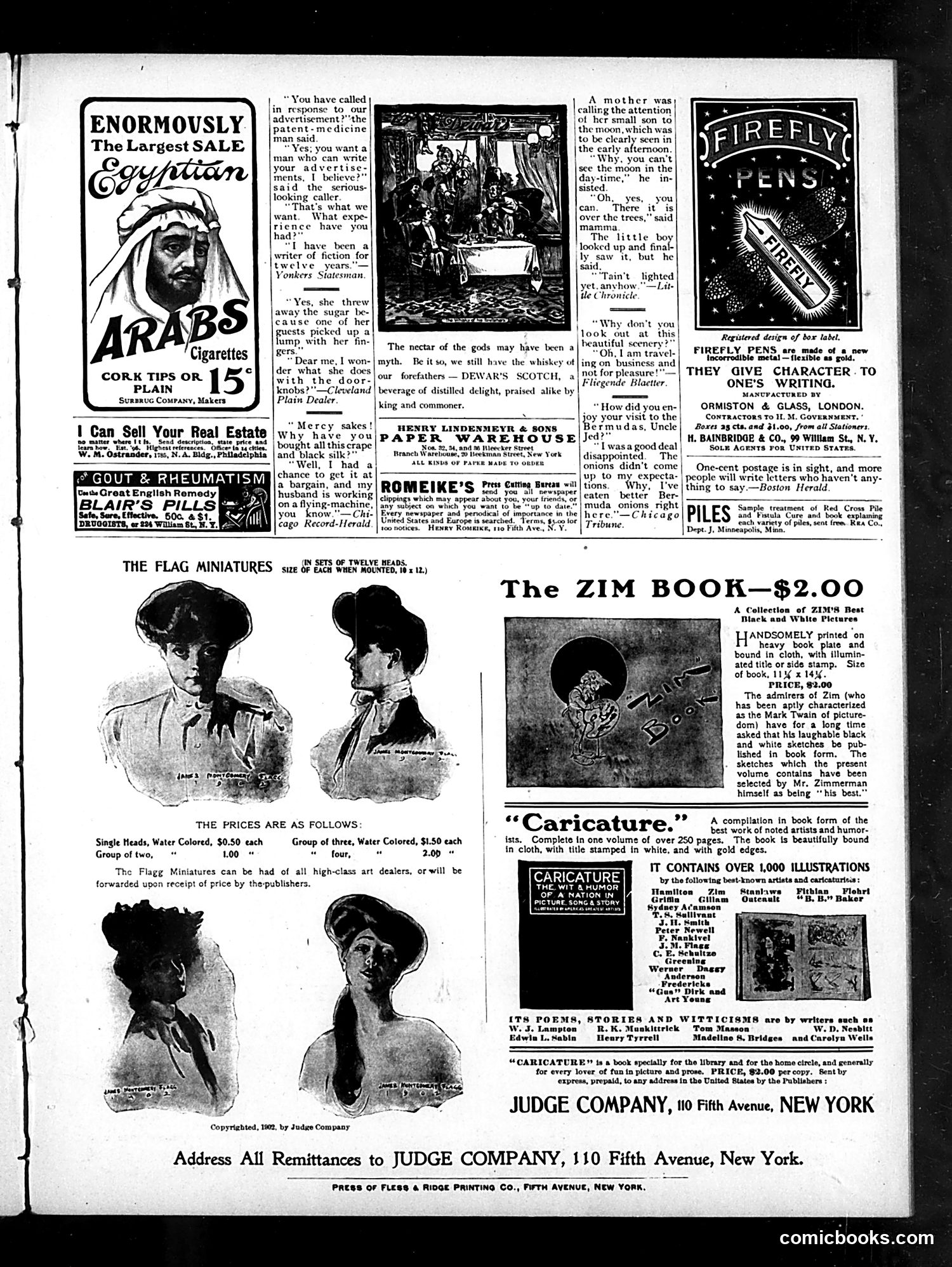
This page is primarily **advertising and product promotion** rather than political satire. The content includes: **Main advertisements:** - Arabs Cigarettes (cork-tipped, 15¢) - Firefly Pens - Real estate sales service - Blair's Pills (patent medicine for gout/rheumatism) - Romieke's press clipping service - The Zim Book ($2.00) — a collection of humorous black-and-white sketches - A Caricature compilation book **Comic vignettes:** The small dialogue snippets scattered throughout appear to be gentle humor about everyday situations—a mother confused about seeing the moon in daytime, someone purchasing excessive black cloth, complaints about onions at dinner—rather than political commentary. **Historical context:** This reflects early 1900s commercial culture: patent medicines, stenographic services, and illustrated humor books were popular products advertised in satirical magazines like Judge, which relied on advertising revenue alongside editorial content. The page contains **no identifiable political figures or social satire**—it's essentially a classified advertising section with filler humor.
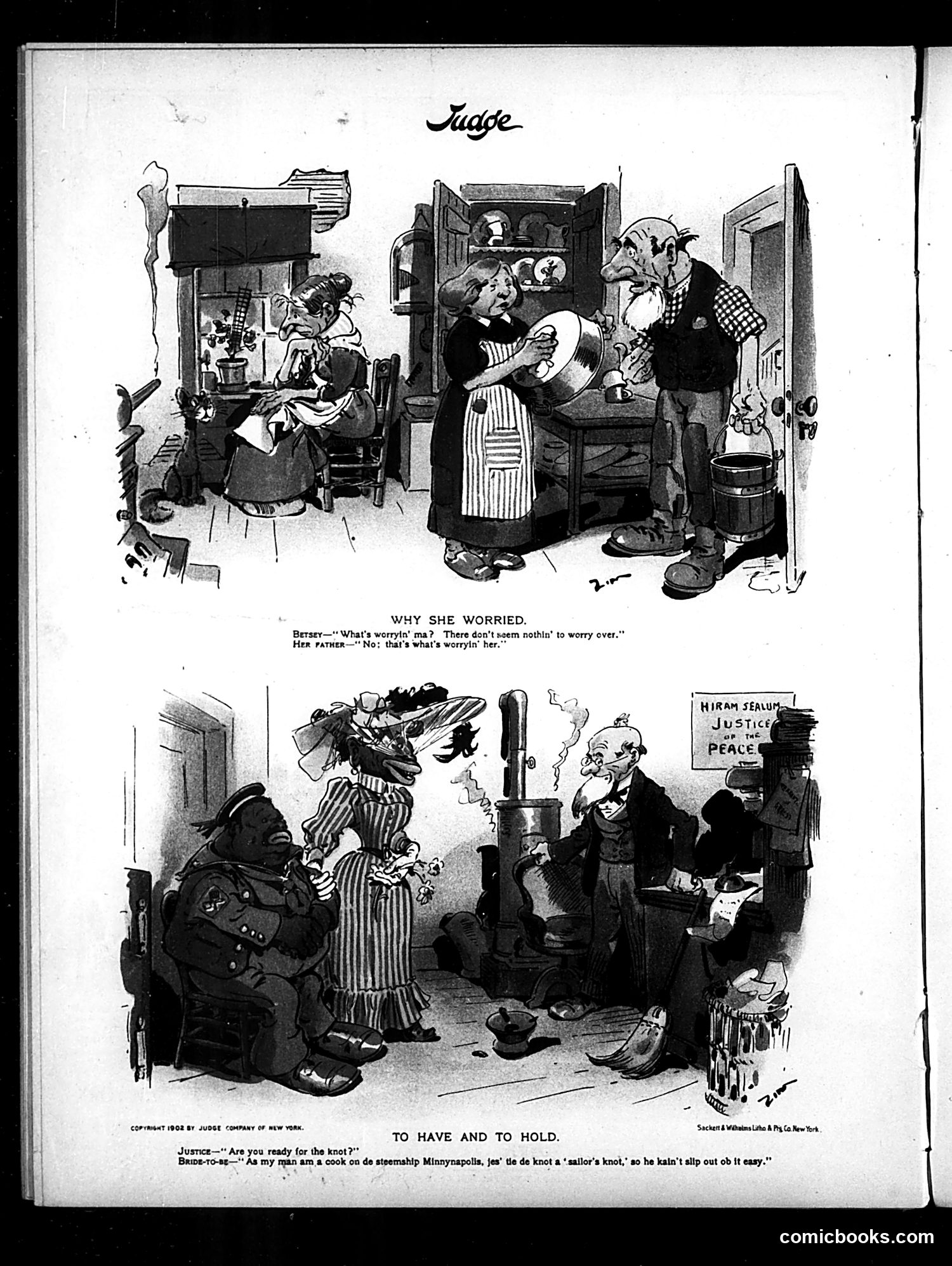
This page contains two satirical cartoons from Judge magazine, copyright 1902. **Top cartoon ("Why She Worried"):** A domestic scene where a bride is anxious despite having nothing apparently wrong. Her father reassures her there's nothing to worry about—which paradoxically worries *him*, suggesting he recognizes trouble in an ostensibly perfect marriage. The joke plays on pre-marital anxiety and the father's darker awareness of marital realities. **Bottom cartoon ("To Have and to Hold"):** A bride instructs a judge to tie her marriage knot as a "sailor's knot" so her husband—a cook on a steamship—cannot "slip out of it easy." The humor derives from the woman's distrust of her maritime worker husband and her crude solution: making the marriage literally inescapable. Both cartoons mock marriage anxieties and suggest skepticism about marital fidelity, particularly regarding working-class husbands. The stereotyped dialect and working-class characters were typical of Judge's period humor.