
A complete issue · 16 pages · 1902
Judge — August 2, 1902
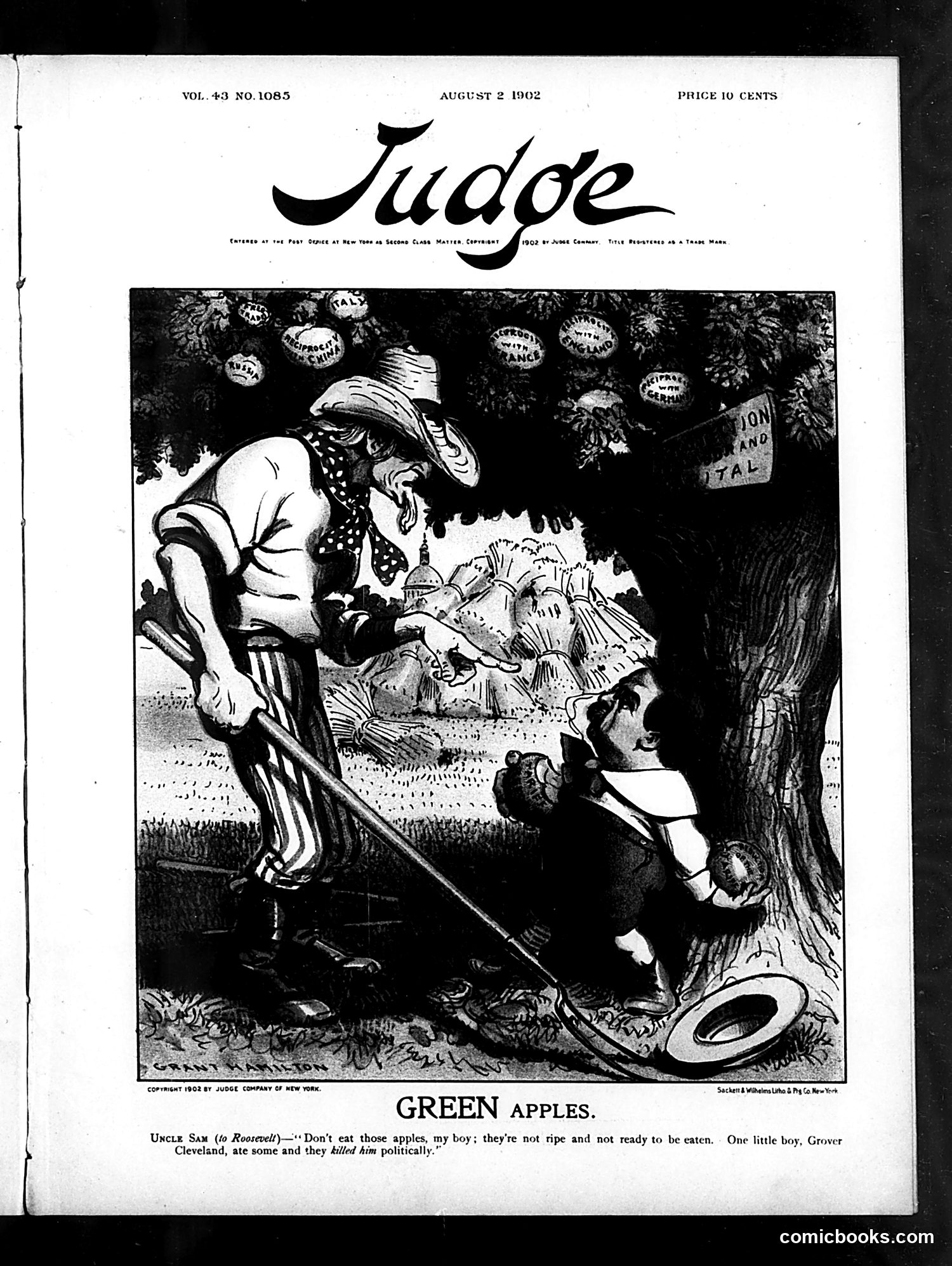
This August 2, 1902 Judge cartoon satirizes President Theodore Roosevelt's political influence through the metaphor of unripe fruit. Uncle Sam warns a boy (identified as Grover Cleveland in the caption) against eating green apples, cautioning they're "not ripe and not ready to be eaten." The caption notes that Cleveland ate some and they "killed him politically." The cartoon references Cleveland's presidency and subsequent political decline. Roosevelt, depicted as Uncle Sam, warns against premature political action or ambition—suggesting that attempting power before one is ready leads to political death, as happened to Cleveland. The hanging carnival balls above suggest the season of political ferment and opportunity.
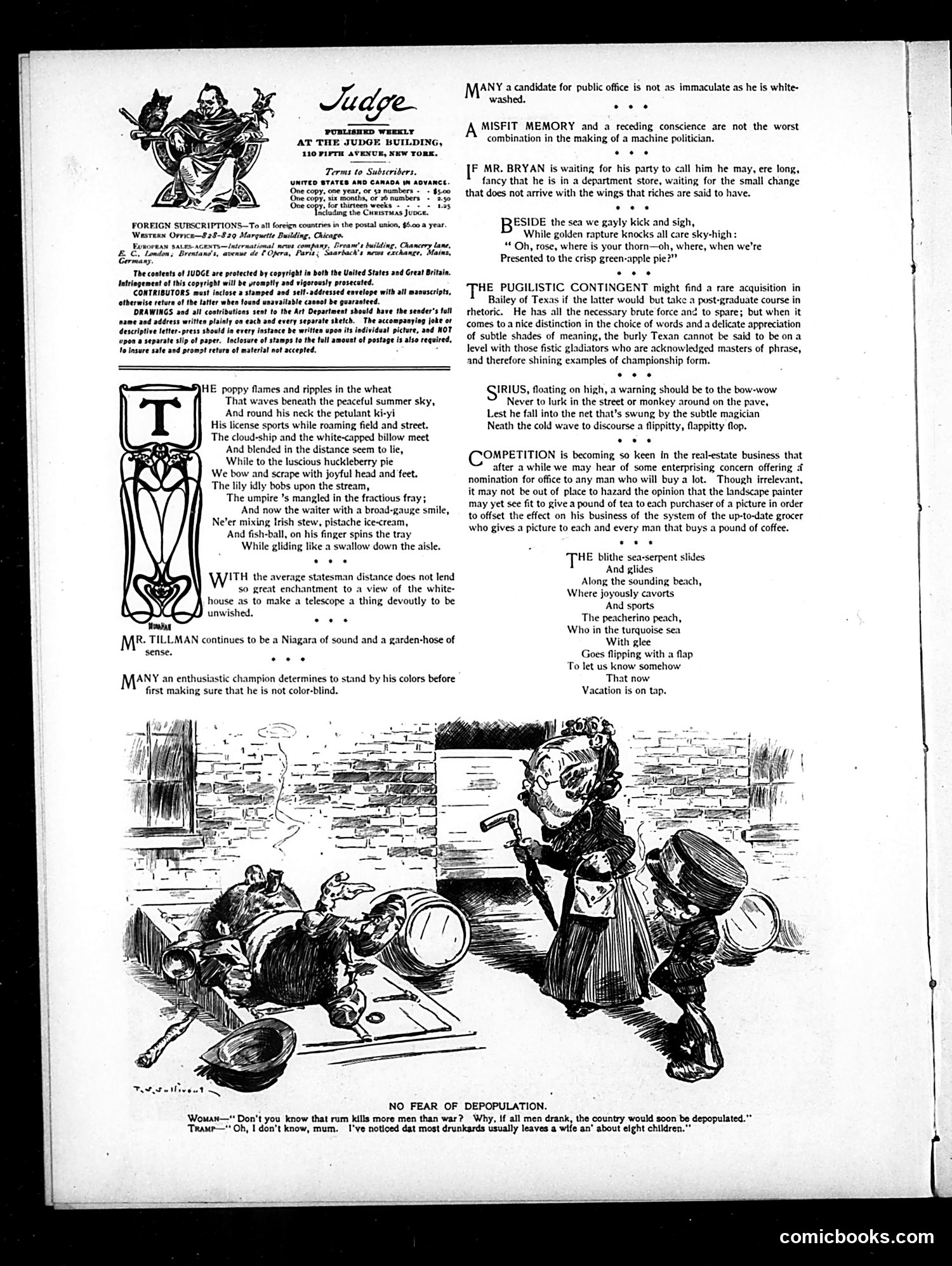
This cartoon satirizes concerns about population decline in America. The caption shows a vagrant ("Tramp") dismissing worries that drinking kills men, claiming "I've noticed dat most drunkards usually leaves a wife an' about eight children." The image depicts a disheveled drunk man surrounded by numerous children in rags, suggesting that even the poorest, most dissolute members of society reproduce prolifically. The satire targets two anxieties simultaneously: fears about national population and anxieties about the "unfit" reproducing at higher rates than educated classes—a eugenic concern popular in early-20th-century America. The joke's dark implication is that depopulation isn't a worry because even the most economically worthless people have large families, undermining concerns about America's demographic future.
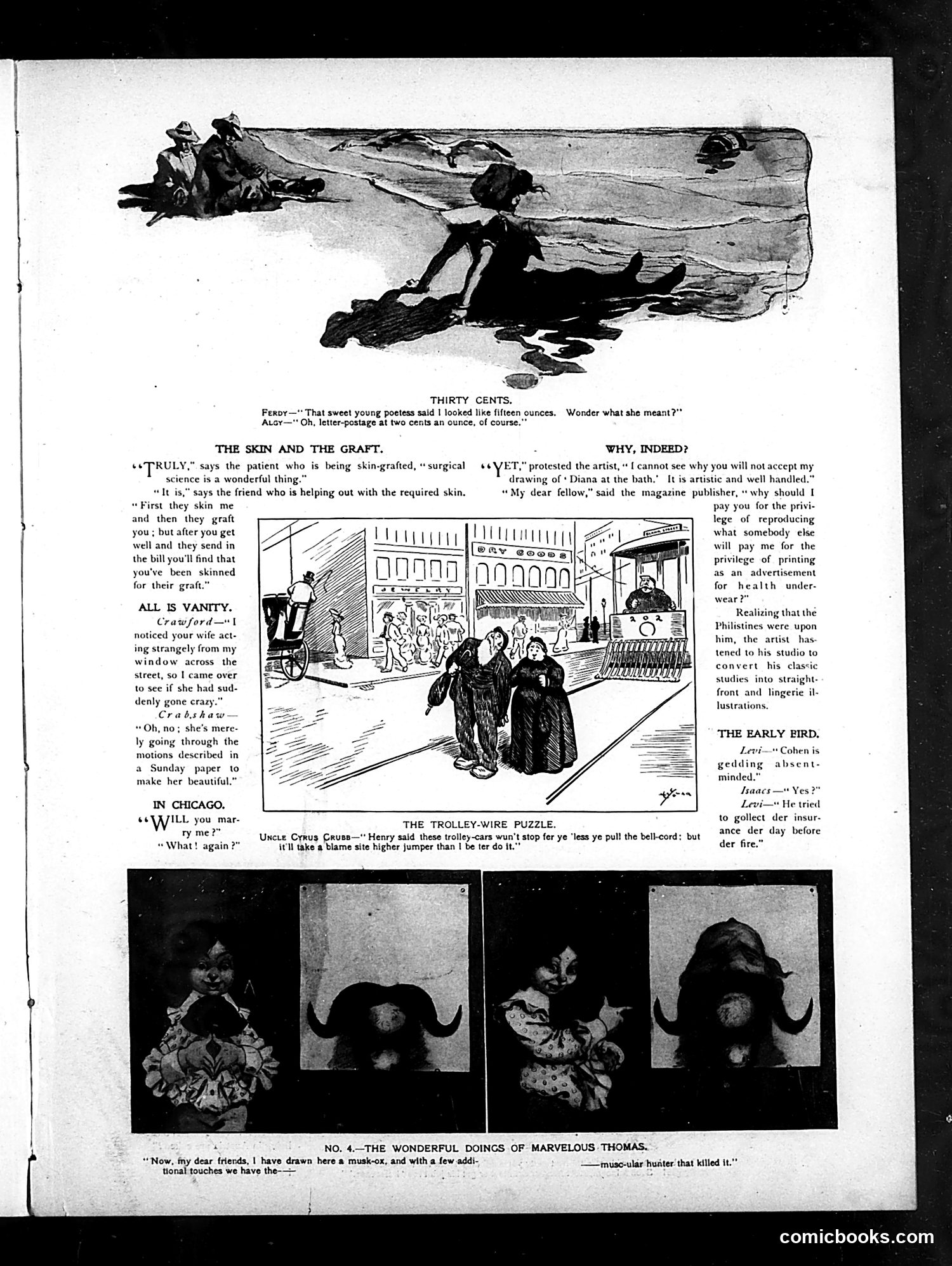
This page contains several unrelated satirical pieces and humorous content typical of Judge magazine's format: **"Thirty Cents"** and **"The Skin and the Graft"** are conversational jokes about medical procedures and postal rates. **"In Chicago"** appears to be a marriage proposal scenario. **"The Trolley-Wire Puzzle"** features Uncle Cyrus Chubb making a joke about trolley cars and jumping—likely referencing the then-new electric trolley systems that were transforming urban transport in the early 1900s. **"The Early Bird"** is a brief dialogue about insurance. **"The Wonderful Doings of Marvelous Thomas"** (bottom) shows a humorous sequence with a character and a hat/mask, with accompanying text about drawing a musket. The page reflects Judge's mix of social commentary, urban humor, and contemporary technology references aimed at middle-class American readers.
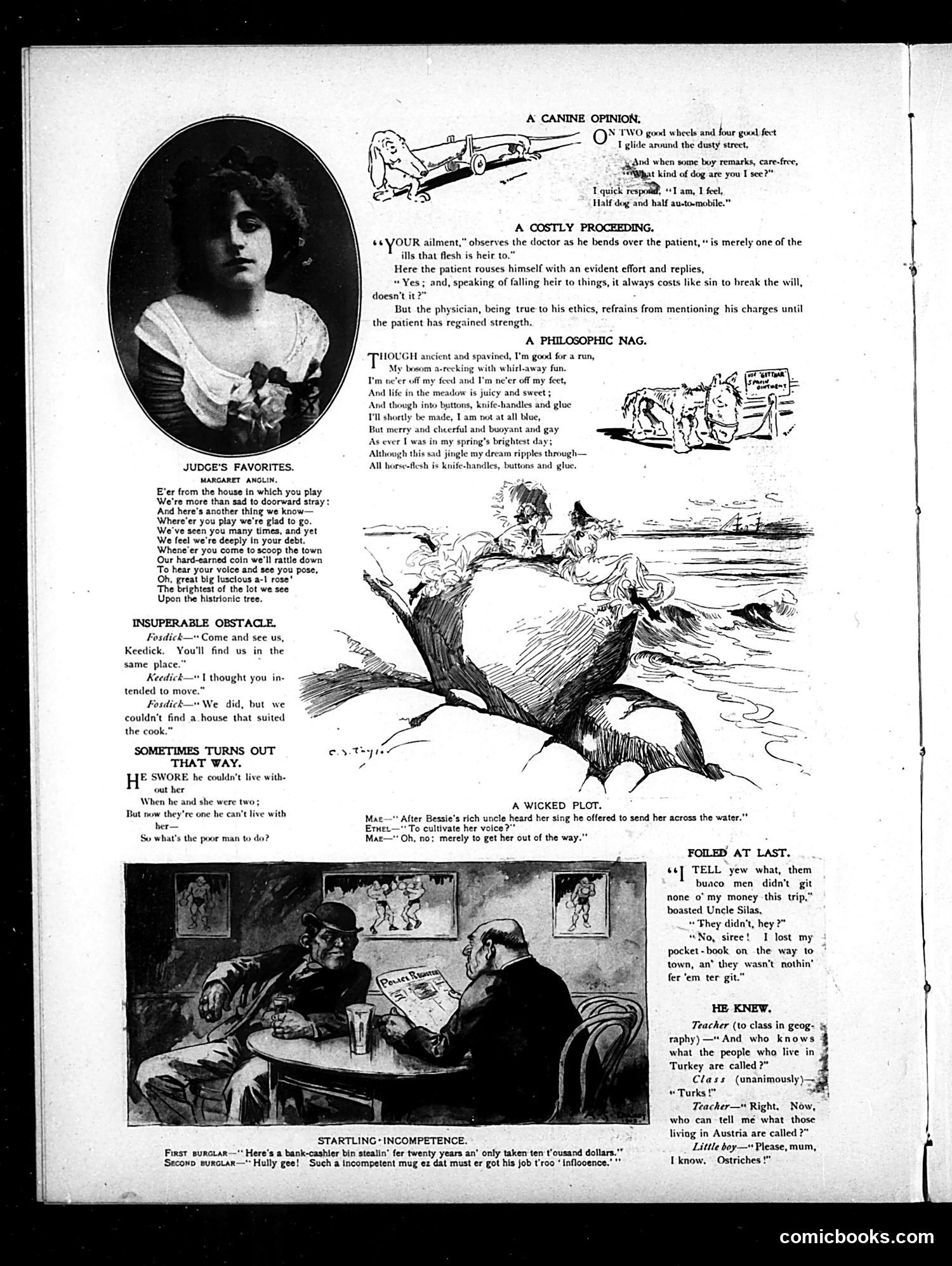
This page contains humorous sketches and poems rather than political cartoons. The content includes: **"A Canine Opinion"** — A dog's quip about being half-dog, half-automobile, satirizing early automobiles as common urban sights. **"A Philosophic Nag"** — A poem from a horse's perspective, lamenting lost pastoral life while surrounded by urban technology (fan, knife-handles, glue). **"A Wicked Plot"** — A domestic humor piece about a woman getting her uncle to send her across the water (travel), with her husband's suspicious interpretation. **"Startling Incompetence"** — A photograph-based sketch mocking a bank cashier's decades-long incompetence at his job. The overall tone is light satire on modern life, technology disrupting nature, and human folly—typical of Judge's genteel humor for educated readers.
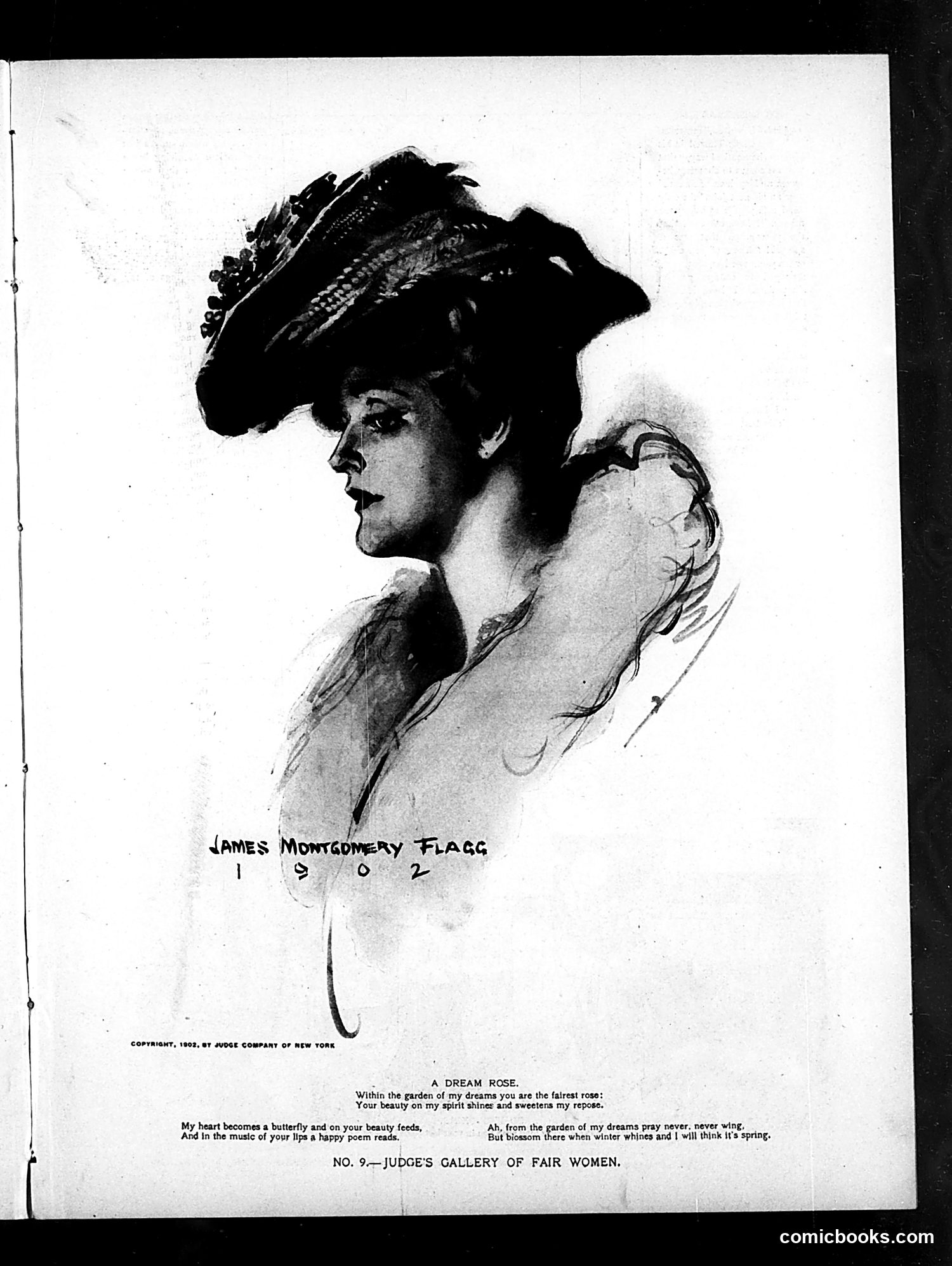
This is a portrait illustration by James Montgomery Flagg from Judge magazine's 1902 "Gallery of Fair Women" series. The image shows a woman in profile wearing an elaborate Edwardian-era hat, rendered in Flagg's characteristic sketch style. The accompanying poem, "A Dream Rose," is sentimental romantic verse comparing the subject to a rose in an idealized garden. This gallery series appears to celebrate fashionable women of the era, focusing on their aesthetic appeal and romanticized beauty rather than commentary or satire. The content reflects early-1900s popular culture's elevation of refined femininity and decorative aesthetics. This isn't satirical commentary but rather aspirational portraiture typical of Judge's lighter entertainment pages—essentially illustrated celebrity appreciation featuring prominent or fashionable women of the period.
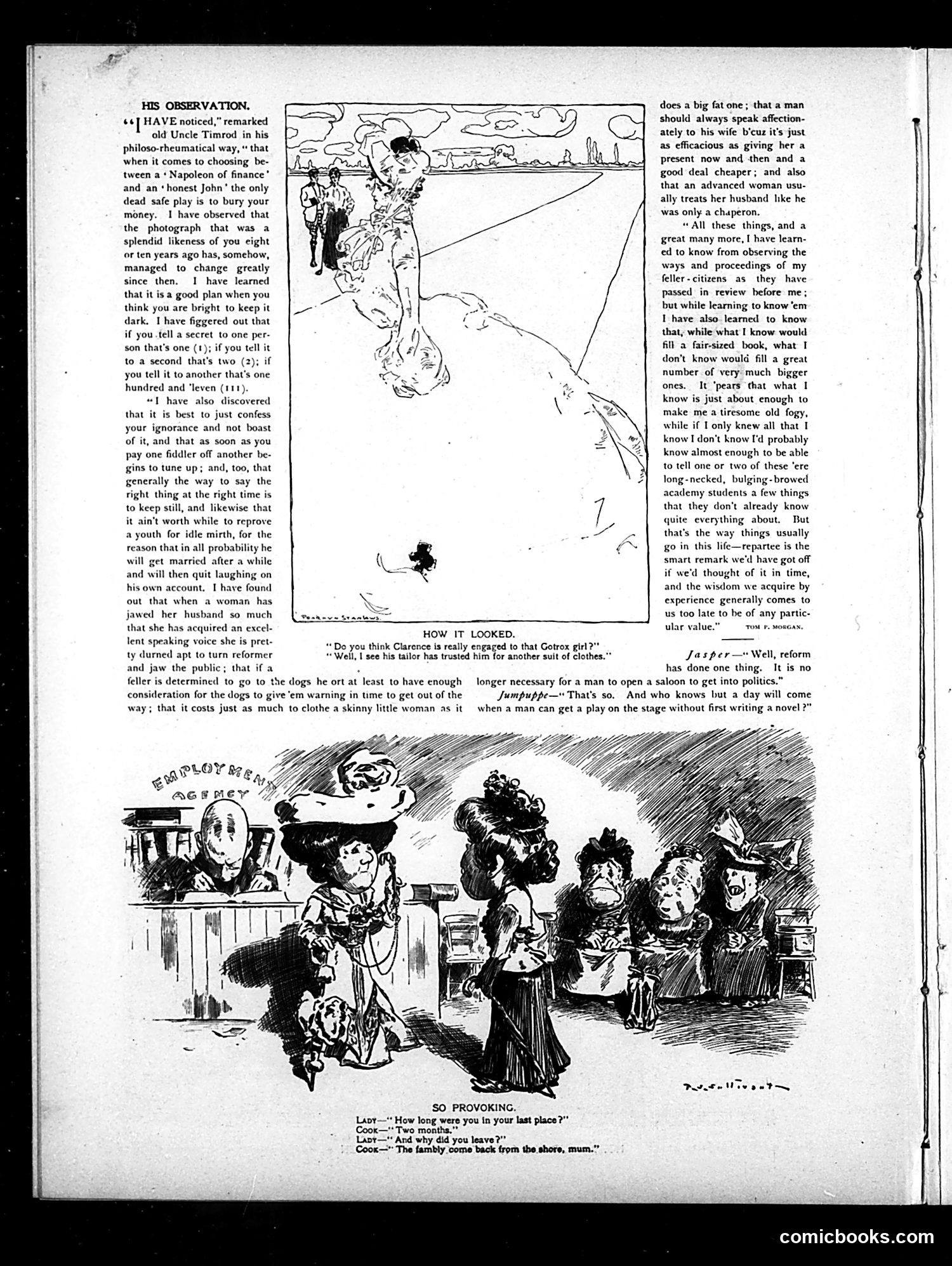
This page contains three distinct satirical pieces: **"His Observation"** features Uncle Timrod dispensing folksy wisdom about human nature—money, photography, gossip, marriage, and women reformers. The humor lies in his self-aware admission that his accumulated knowledge is simultaneously vast enough to make him tedious and limited enough to be nearly useless. It's gentle social commentary on the gap between perceived and actual wisdom. **"How It Looked"** is a brief joke about a man's engagement credibility being measured by whether his tailor will extend credit—satirizing economic standing as the true indicator of marriageability. **"So Provoking"** depicts a domestic servant being questioned by her new employer about previous employment. The humor: she left because "the family come back from the shore"—suggesting her primary motivation for employment is avoiding the family's presence entirely. The bottom text snippets mock reform movements and theatrical gatekeeping, suggesting reforms haven't substantially improved society or access to opportunity.
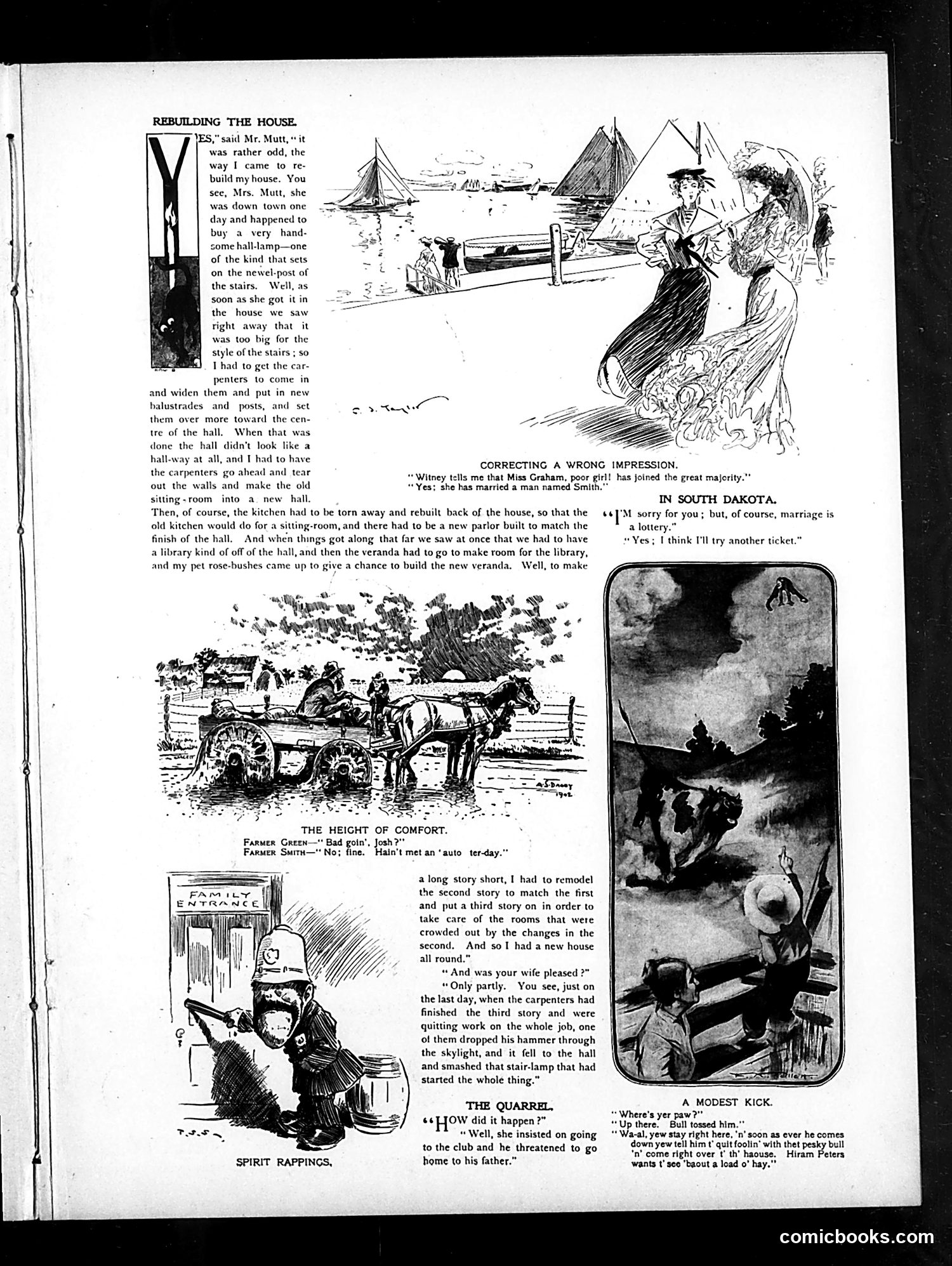
This page from Judge (an American satirical weekly) contains several humorous short pieces typical of the era's comedy writing: **"Rebuilding the House"** is the main feature—a shaggy-dog story about cascading home renovations. Mr. Mutt buys his wife a decorative hall lamp, but it's too large for the existing staircase, so he hires carpenters to widen the stairs. Each modification necessitates further work: the hall looks wrong, so walls come down; the kitchen relocates; a new parlor is needed; the veranda must go for a library. By the story's end, he's rebuilt an entire three-story house—only to have a worker's dropped hammer destroy the original lamp that started everything. The satire mocks the absurdity of home improvement projects spiraling into catastrophic expense. The surrounding vignettes ("Correcting a Wrong Impression," "The Quarrel," "Spirit Rappings," and rural farmer jokes) are separate, brief comedy sketches with contemporary social observations about marriage, marriage as misfortune, and rural life.
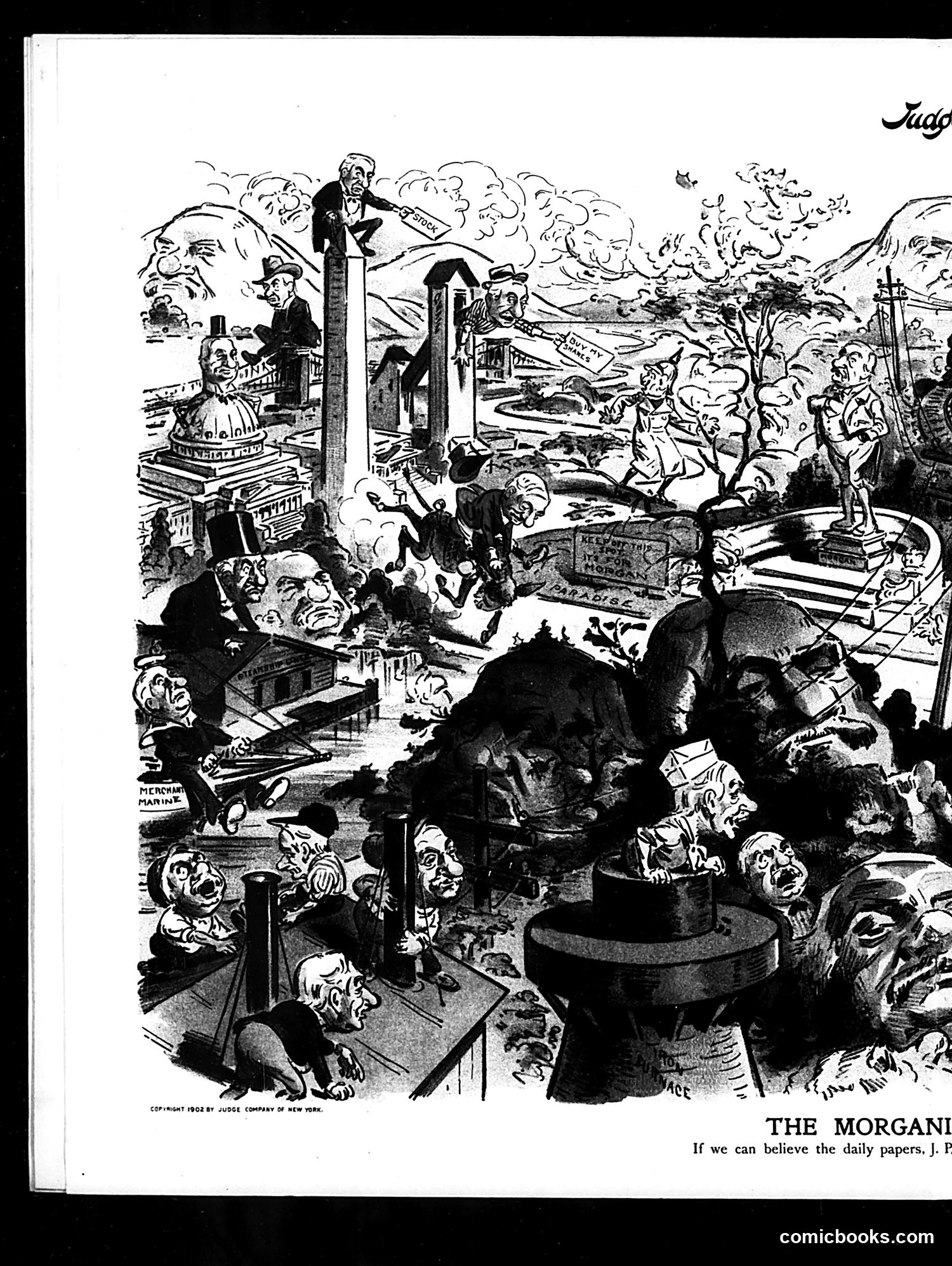
This 1902 Judge magazine cartoon satirizes J. P. Morgan, the powerful banker and financier. The incomplete caption ("If we can believe the daily papers, J. P.") suggests skepticism about newspaper reports regarding Morgan's activities. The elaborate composition depicts a chaotic scene with multiple caricatured figures and grotesque demons or devils, likely representing the financial manipulation, monopolistic practices, and corruption associated with Morgan's business empire. The architectural elements and crowds suggest industrial/financial power centers. The cartoon's satirical point appears critical of Morgan's influence over American commerce and politics. Judge magazine frequently attacked wealthy industrialists and monopolists during the Gilded Age and Progressive Era, viewing them as threats to democracy and fair competition.
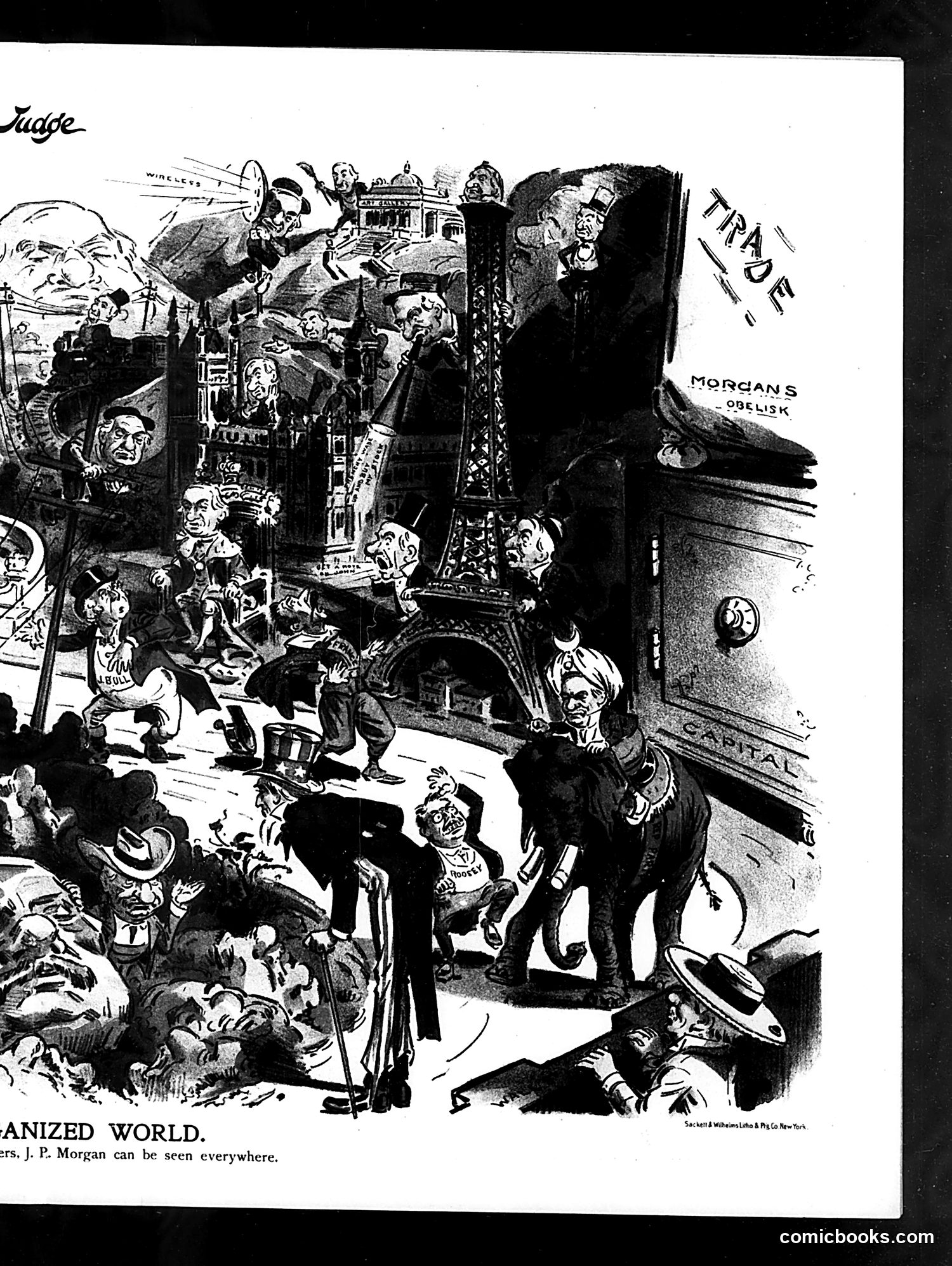
This is a satirical cartoon from *Judge* magazine depicting a chaotic Parisian street scene centered around the Eiffel Tower. The visible text references "J. P. Morgan can be seen everywhere," suggesting the cartoon critiques the pervasive financial influence of American banker J.P. Morgan in international affairs, particularly in France. The crowded composition shows numerous caricatured figures—likely representing politicians, financiers, and ordinary people—swarming around iconic French landmarks. The title fragment "ANIZED WORLD" (likely "ORGANIZED WORLD") suggests ironic commentary on global organization under capitalist/financial control. The satire appears to mock how Morgan's financial power reaches everywhere globally, presenting him as an omnipresent force shaping international commerce and politics during the Gilded Age.
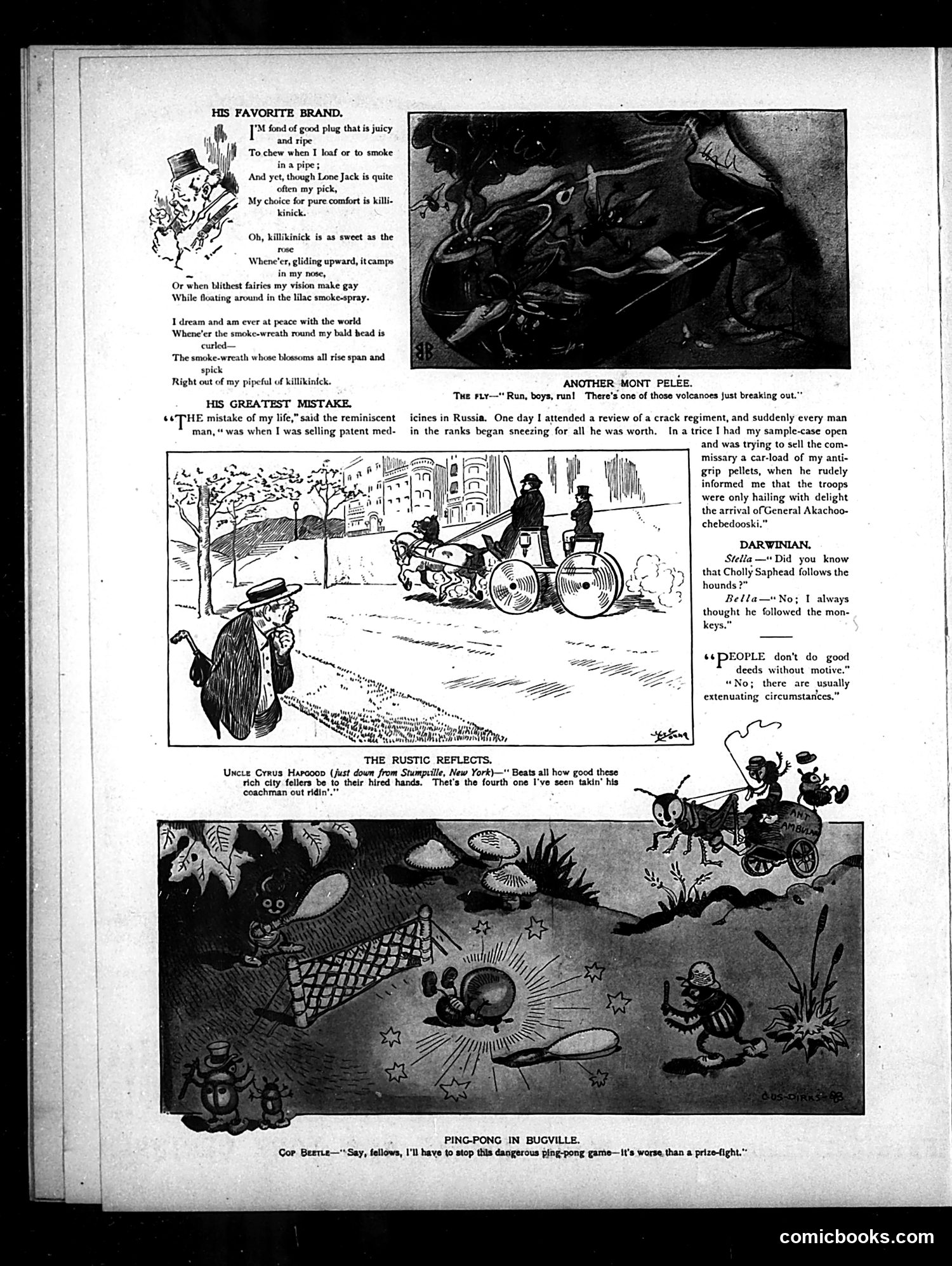
This Judge magazine page contains several satirical pieces: **"His Favorite Brand"** promotes "killikinick" tobacco through verse, depicting a satisfied smoker. This is advertising copy disguised as poetry—common in 19th-century magazines. **"Another Mont Pelée"** references the 1902 eruption of Mount Pelée in Martinique (a recent disaster), joking that a volcano is "breaking out" among insects or small creatures—punning on current events for humor. **"His Greatest Mistake"** satirizes patent-medicine salesmen (a common target of satirical magazines), showing one foolishly trying to sell "anti-grip pellets" to Russian troops who are actually just sneezing at a general's name ("Akachoo-chebedooski"—a pun). **"The Rustic Reflects"** jokes that wealthy city men treat their hired hands well because they're taking their coachmen out riding—suggesting the coachmen are actually romantic interests, not servants. **"Ping-Pong in Bugville"** depicts insects playing ping-pong, with a beetle calling to stop because it's dangerous—likely satirizing the fad status of ping-pong at the time.
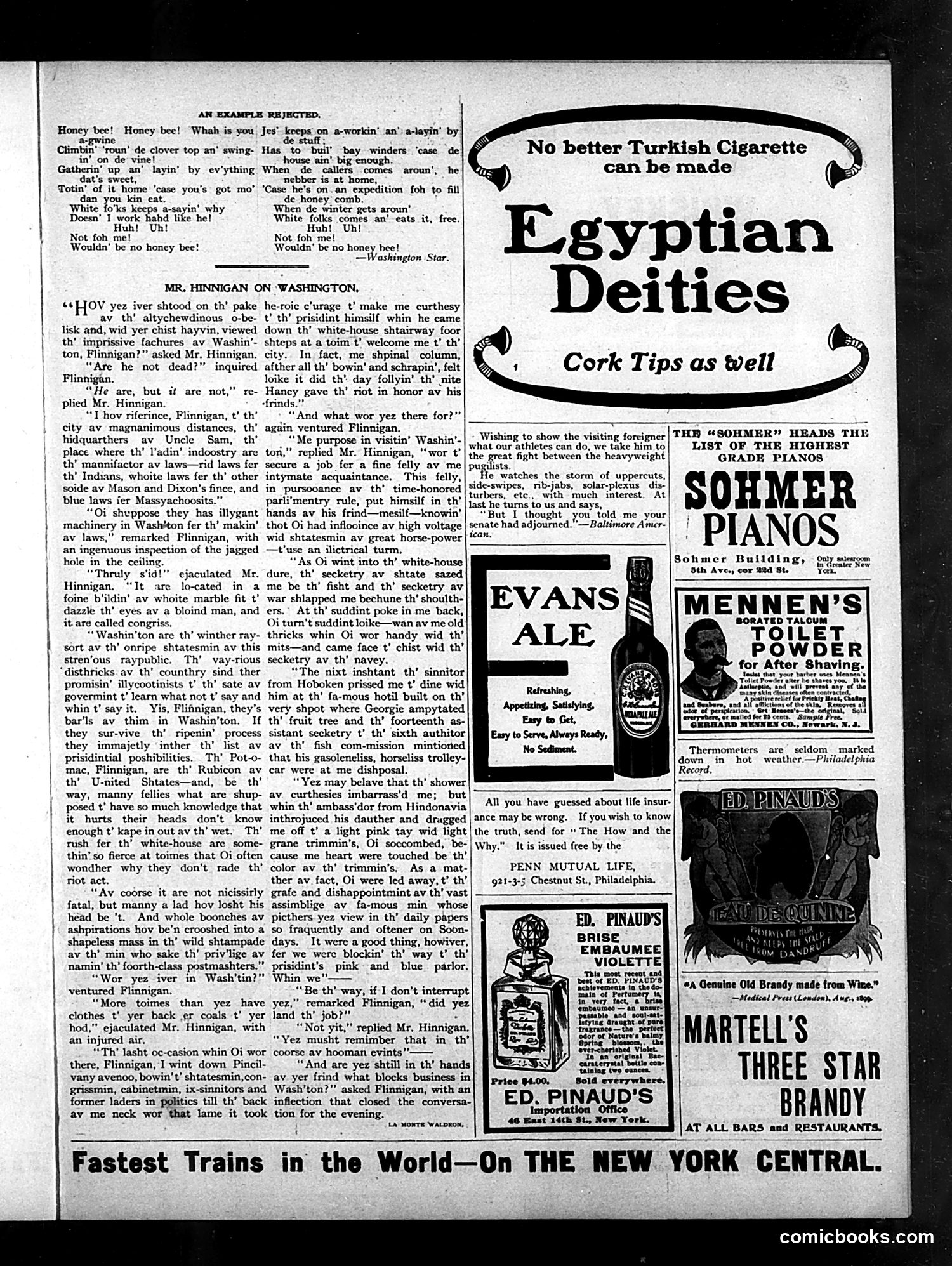
This page contains two distinct pieces of satire from Judge magazine: **"An Example Rejected"** (top): A dialect poem contrasting a hardworking honeybee with an African American laborer. The bee gathers honey and works continuously; the Black worker refuses similar labor, saying "Not foh me! Wouldn' be no honey bee!" The satire mocks the common white argument that Black people should emulate the work ethic of industrious creatures. It's racist propaganda dressed as humorous comparison. **"Mr. Hinnigan on Washington"** (main text): An Irish immigrant character (identifiable by dialect: "Oi," "th'," "foine") describes Washington D.C. to a friend. The satire targets political corruption—the capital is portrayed as a machine manufacturing laws, where ambitious politicians ("illycootinists") arrive as idealists and either become corrupted or fail. The competitive scramble for patronage positions is likened to a dangerous "stampade." This critiques Gilded Age spoils-system politics and careerism. Both pieces use exaggerated dialect for comedic effect while making social commentary on labor, ambition, and corruption.
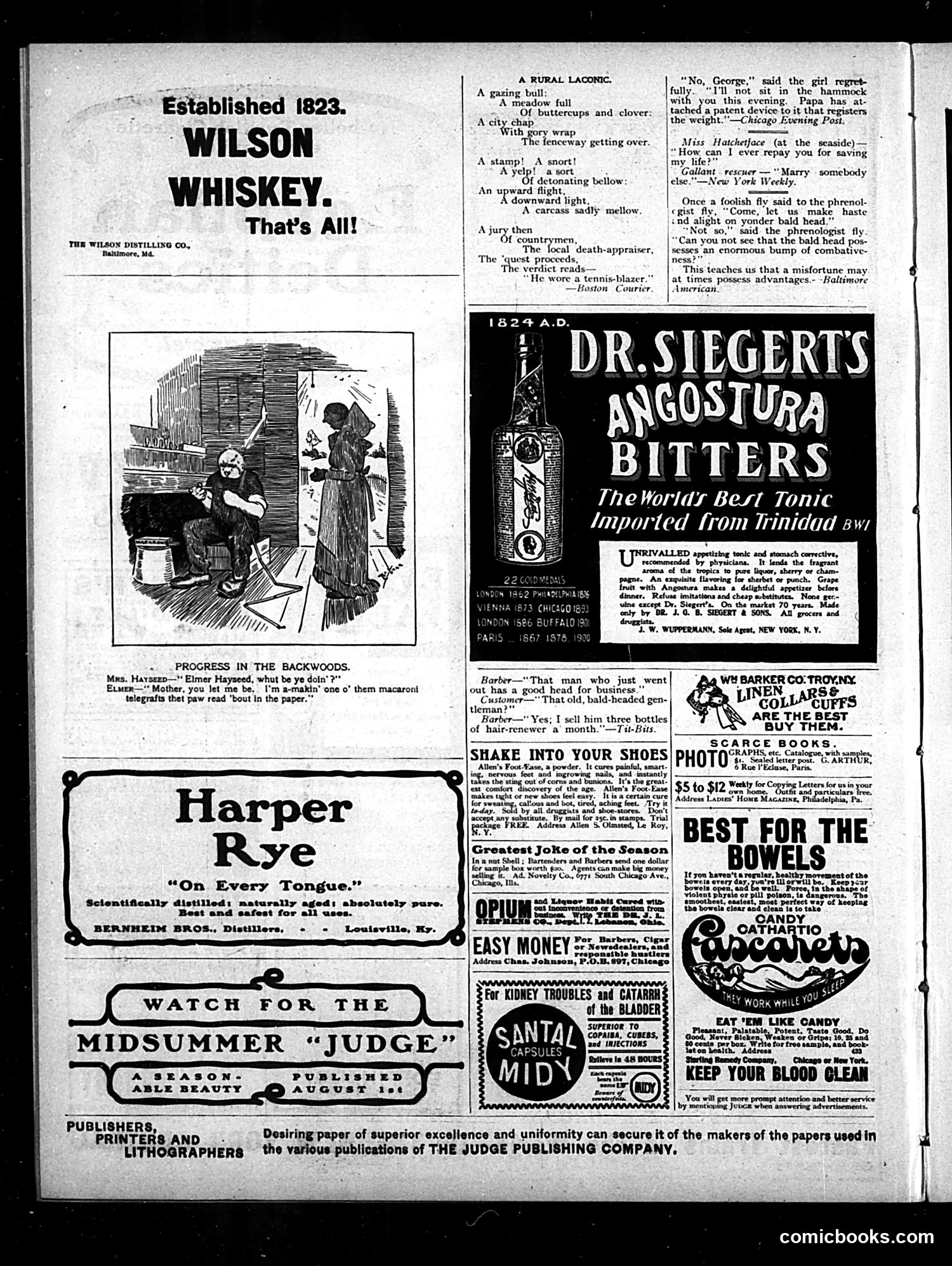
This is primarily an **advertising page** with minimal editorial content. The few satirical pieces are brief: **"Progress in the Backwoods"** depicts rural ignorance—a farmer attempts to make a "macaroni telegraph" after reading about the technology, showing the comedic gap between backwoods folk and modern innovation. **Short jokes** mock physical appearance and social types: a bald man's "bump of combativeness," a plain woman rejected for marriage, and predictable barber-shop banter about baldness. The page is dominated by **patent medicine and consumer product advertisements** typical of Judge's era—whiskey, bitters, foot powder, hair-renewal treatments, and bowel remedies. These ads reveal period anxieties about health, grooming, and modern life. The satirical content is negligible; this appears to be a commercial issue heavy on revenue-generating advertisements rather than editorial satire. The jokes themselves are gentle, relying on obvious physical humor rather than political or social commentary.
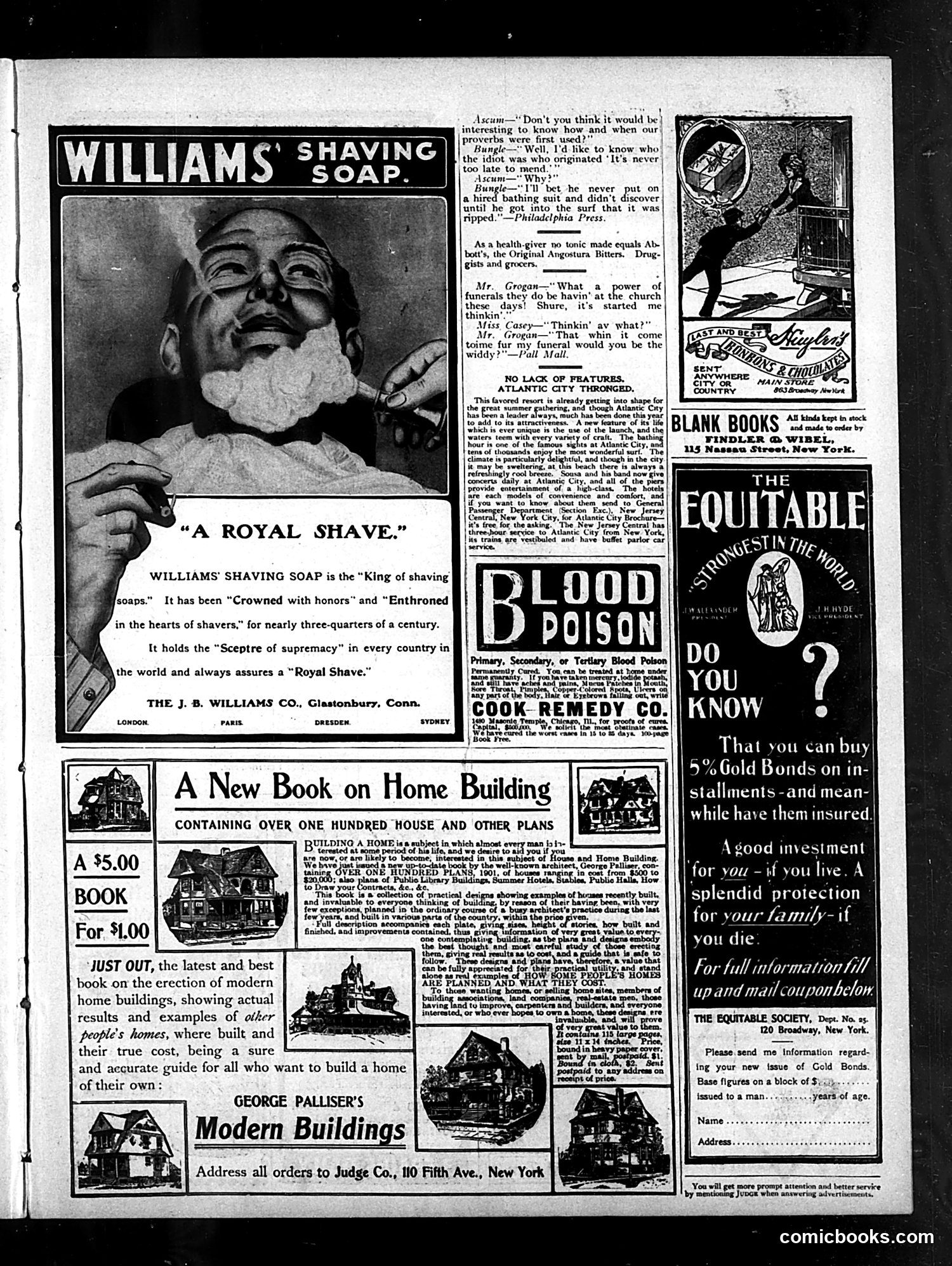
This page is primarily **advertising**, not political satire. It contains several distinct elements: **Main Features:** - A large Williams' Shaving Soap advertisement featuring a man enjoying "A Royal Shave," using mock-royal language ("Crowned with honors," "Sceptre of supremacy") - Three brief humorous anecdotes (Irish dialect joke about funerals, observations about proverbs and swimming suits) - A travel notice about Atlantic City's summer season amenities **Other Advertisements:** - Abbott's Angostura Bitters (health tonic) - Blood Poison Cook Remedy - Blank books supplier - Home building book by George Palliser - The Equitable Society insurance/bonds offering **Historical Context:** The page reflects early 20th-century consumer culture. The shaving soap ad uses grandiose language typical of period advertising. The Irish dialect humor represents common contemporary comedy tropes. Insurance bonds and home-building guides suggest prosperity and middle-class aspiration. This is essentially a **commercial publication page** rather than satirical content—Judge magazine's revenue came from advertising, so these pages were expected and necessary.
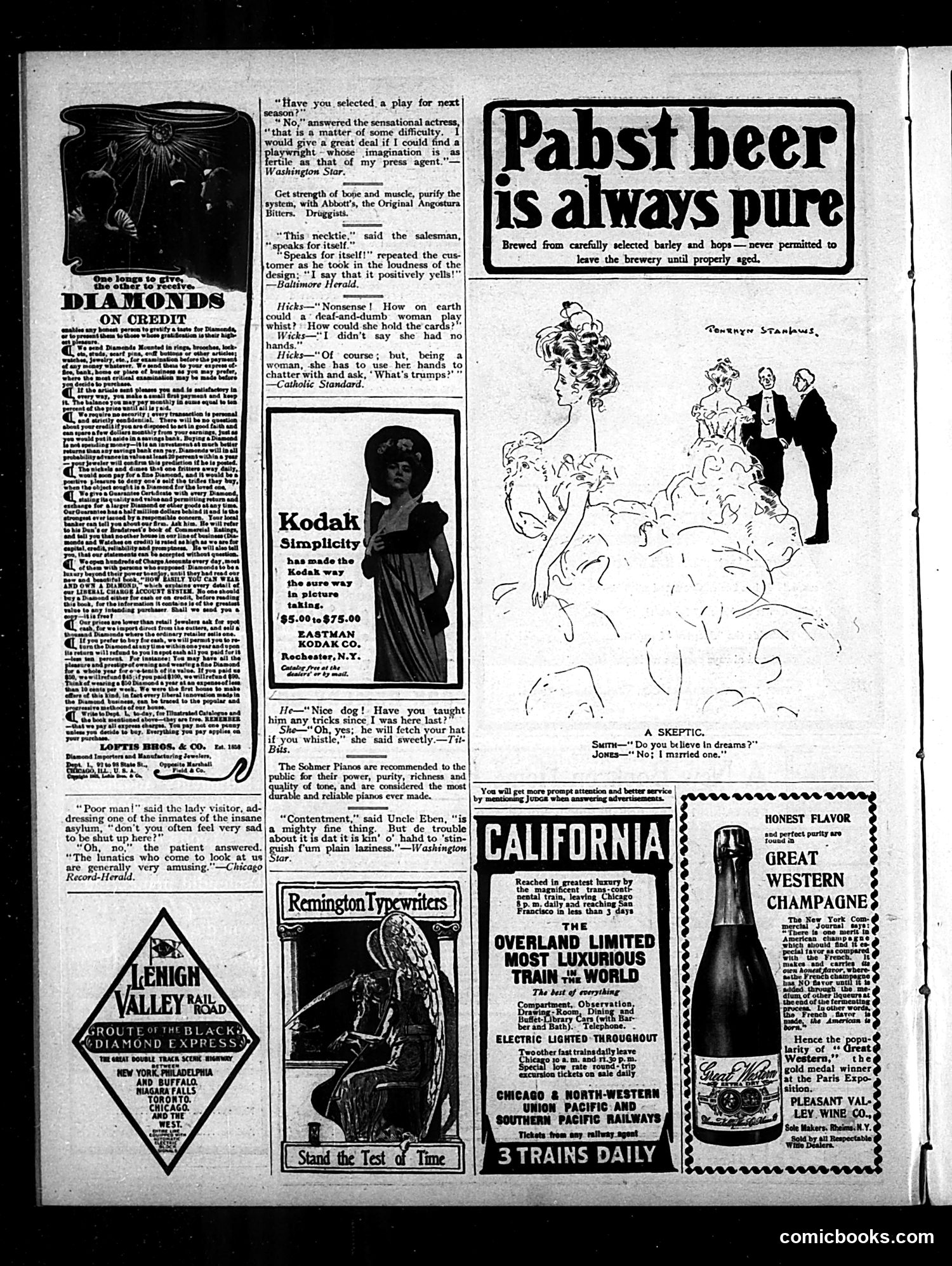
This page is primarily **advertisements interspersed with brief humor pieces** typical of Judge magazine's satirical format. The cartoon section features several short jokes rather than political satire: - **"Have you selected a play?"** mocks sensational actresses, suggesting their press agents have more imagination than playwrights. - **The necktie joke** plays on a loud design literally "speaking for itself" and "yelling." - **The whist-playing deaf-and-dumb woman joke** relies on period stereotypes, with the punchline being that she doesn't need to hear—just needs hands. - **Tennyson Stanlaws' cartoon** shows a couple where the husband married a woman he believed was just a dream (a skeptical marriage reference). The advertisements occupy most space: Pabst beer, Kodak cameras, Remington typewriters, Lehigh Valley Railroad, California's Overland Limited train, and Great Western Champagne. These reflect early 20th-century consumer products marketed to Judge's middle/upper-class readership. There is **no significant political content** on this particular page.
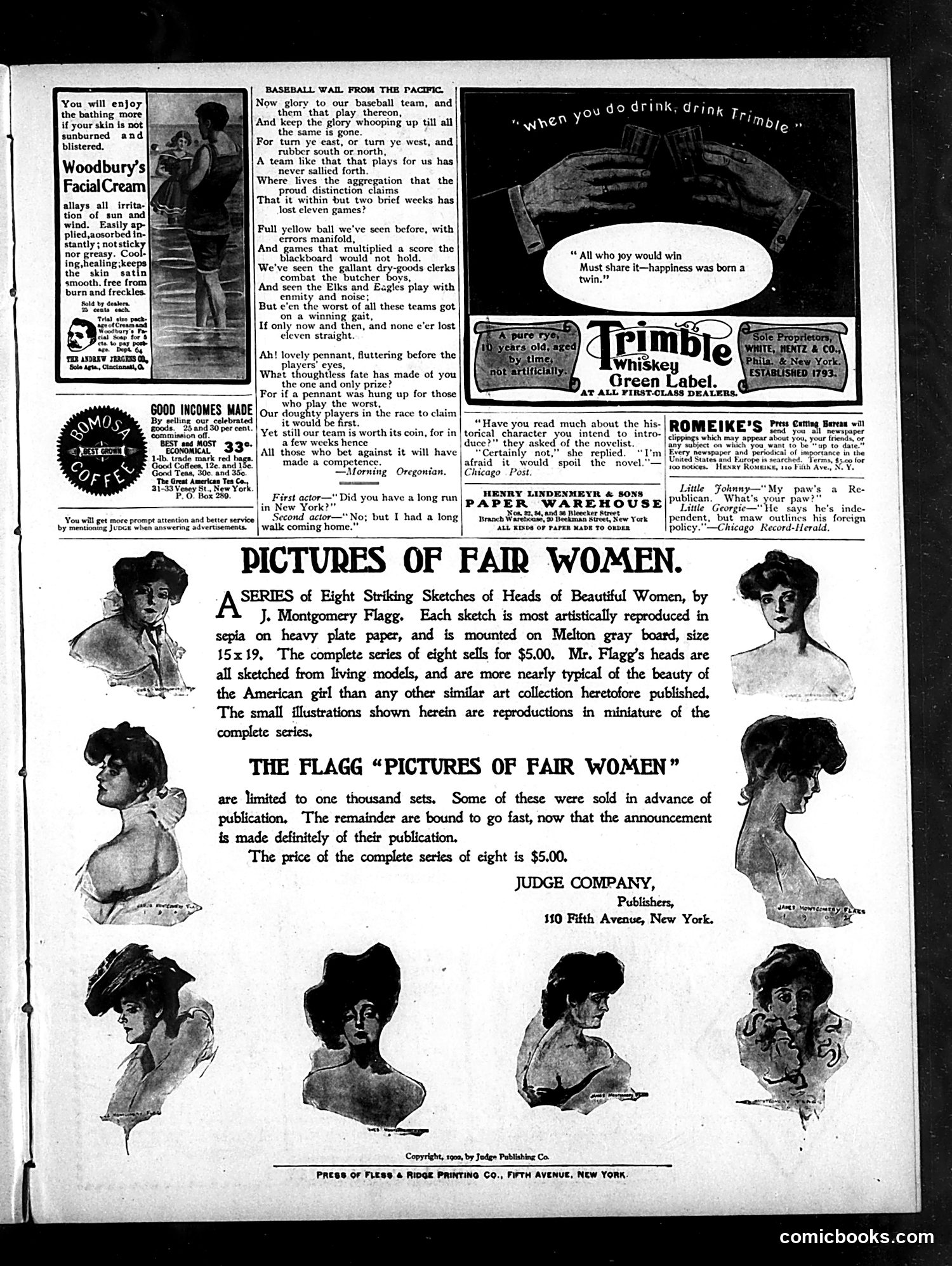
This page primarily features **advertisements and product promotions** rather than political satire. The main content is a lengthy poem titled "Baseball Wail from the Pacific," celebrating an unidentified West Coast baseball team that won eleven consecutive games. The poem uses grandiose language to praise the team's achievements, though the specific team isn't named in the visible text. The page also advertises several products typical of early 1900s commerce: - **Woodbury's Facial Cream** (skincare) - **Trimble Whiskey** (spirits) - **J. Montgomery Flagg's "Pictures of Fair Women"** (an art series of eight portrait sketches, limited to 1,000 sets, priced at $5.00) There are also brief comedic exchanges between theatrical actors and a novelist discussing historical accuracy, representing typical Judge humor of the period. The **Flagg artwork series** appears to be the page's main editorial feature—showcasing eight sketches of idealized female beauty, which was popular commercial art at the time. The page demonstrates Judge's function as both satirical magazine and advertising vehicle for consumer goods and art products.
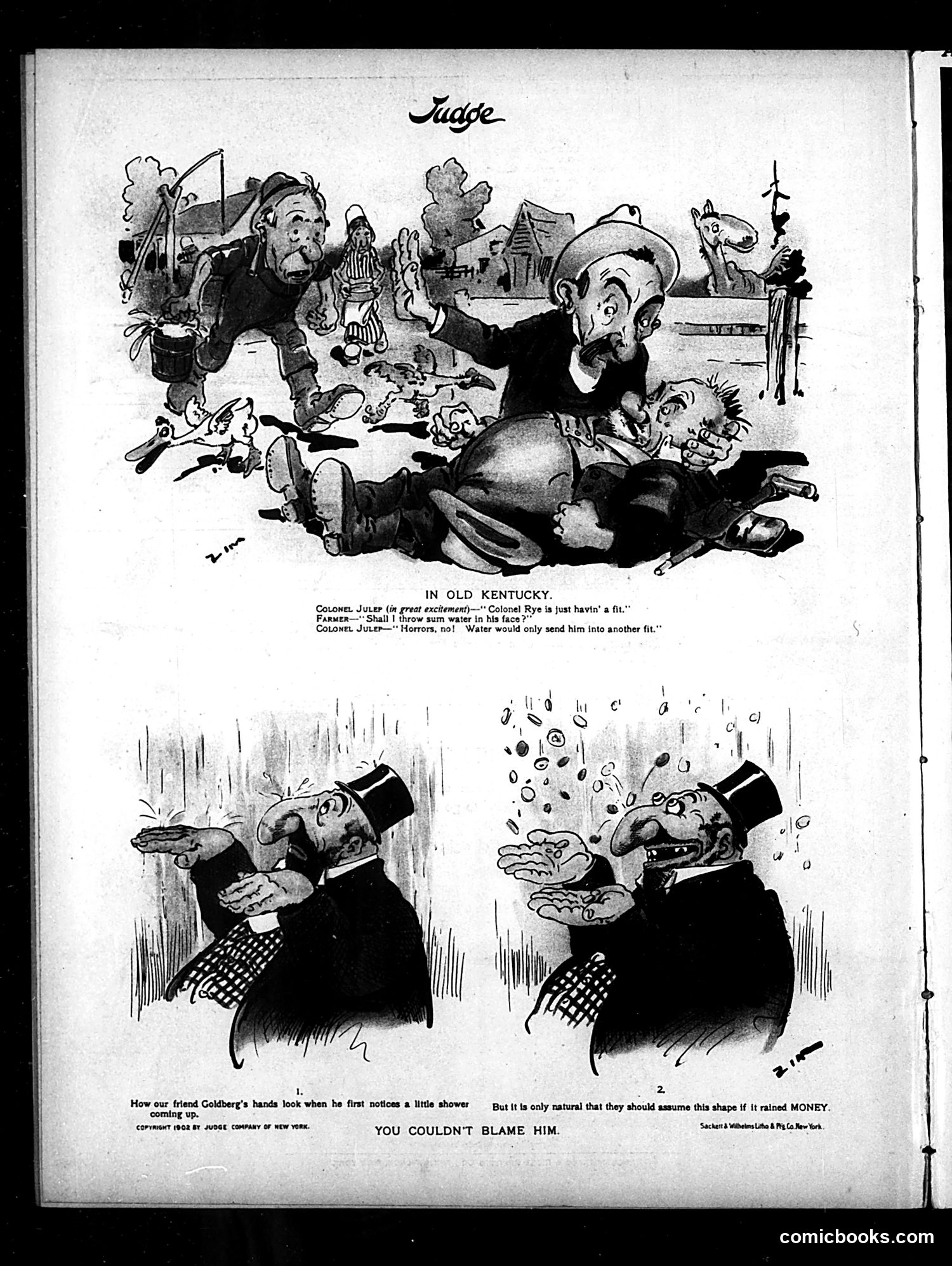
**Top cartoon ("In Old Kentucky"):** This depicts rural Southern characters in an excited state over "Colonel Rye" (whiskey). The humor relies on dialect comedy and the stereotype of backwoods Kentuckians obsessed with alcohol—a common satirical trope of the era. **Bottom cartoons ("You Couldn't Blame Him"):** These show a man named Goldberg with hands in dramatically different positions—first closed/normal, then spread wide open catching falling objects. The caption suggests that if it rained *money* instead of water, his reaction would naturally be to catch it greedily. This satirizes materialism and greed, suggesting that wealthy or acquisitive people (possibly a reference to a contemporary wealthy figure named Goldberg, though unclear which) can't help their money-grabbing nature. Both cartoons use exaggerated physical comedy and caricature typical of early 20th-century American satire.