
A complete issue · 17 pages · 1902
Judge — June 28, 1902
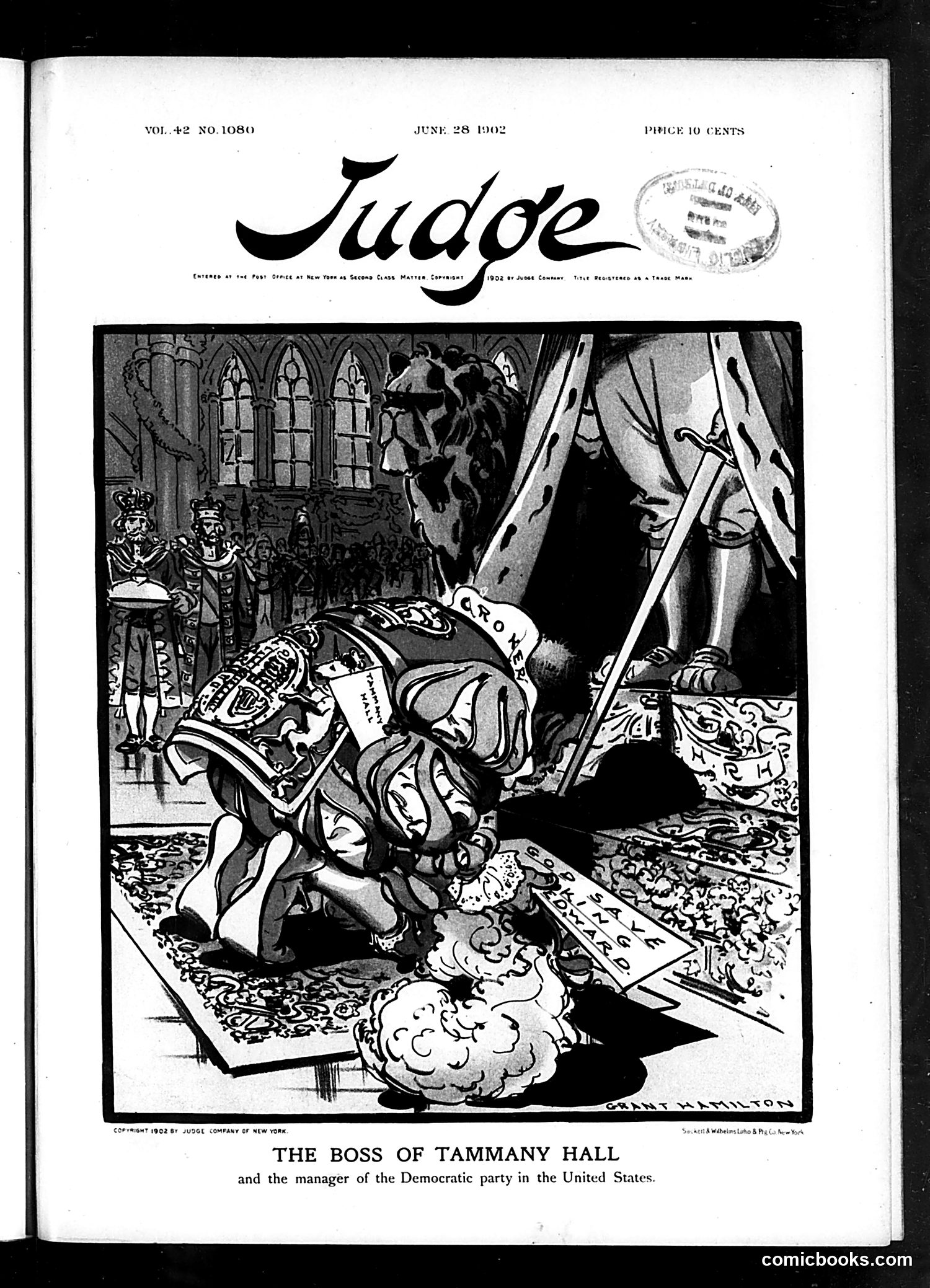
This political cartoon satirizes the Democratic Party's control by Tammany Hall, the powerful New York City political machine. The central figure appears to be a corrupt political boss manipulating the Democratic party like a puppet or marionette—note the strings visible in the illustration and the figure operating the "crown" symbol representing party leadership. The ornate interior setting suggests elite political power, while the chaotic scene depicts the boss literally controlling party machinery and direction. The satire criticizes how Tammany Hall functioned as an unelected shadow government, using patronage and corruption to dominate Democratic politics in America. The cartoon suggests voters had no real choice—the party was rigged by behind-the-scenes machine bosses rather than democratic processes.
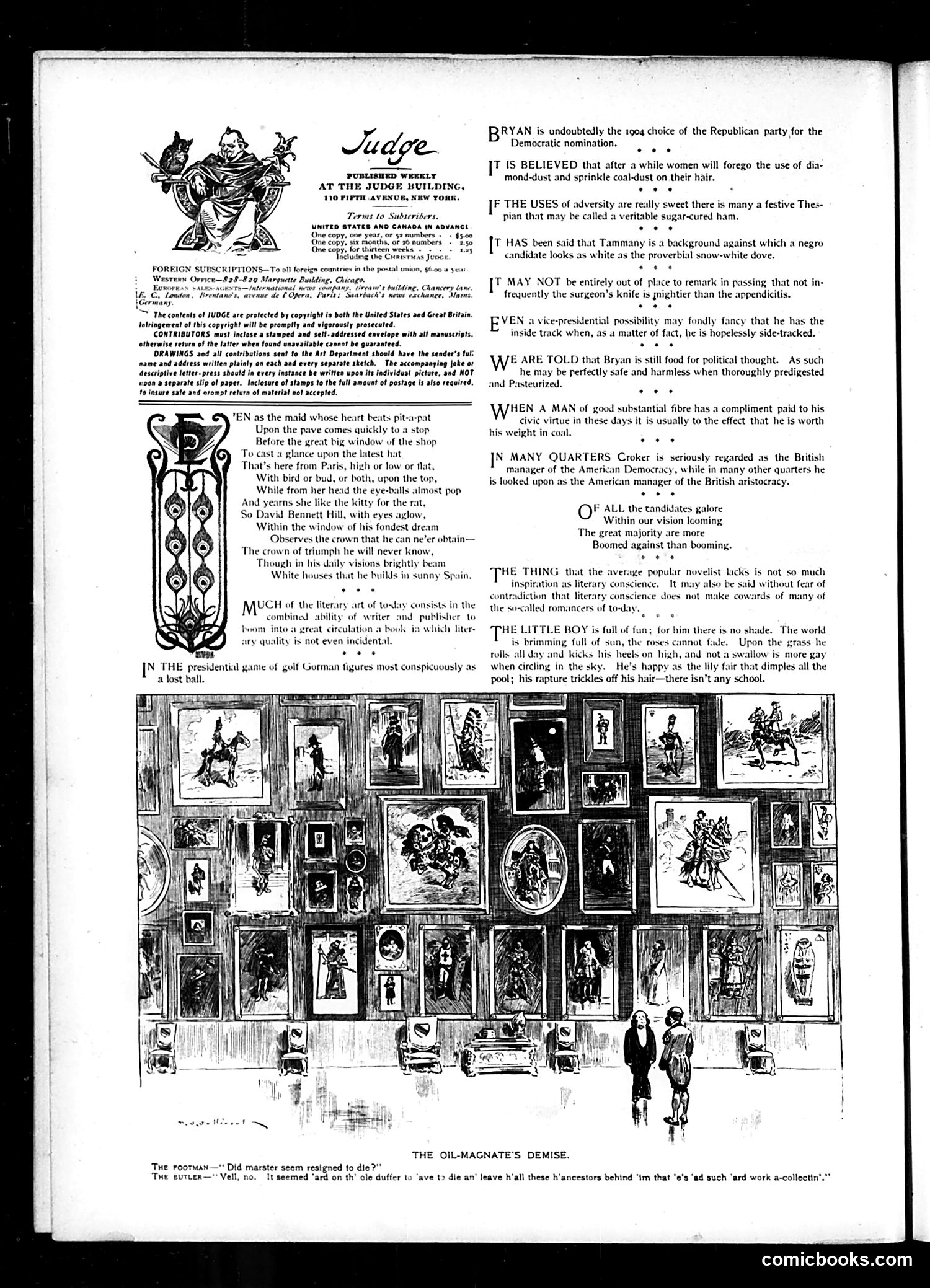
This page contains editorial commentary on the 1904 U.S. presidential election, endorsing William Jennings Bryan as the Democratic nominee. The text discusses Bryan's political viability despite concerns about his appearance and background. The main cartoon, "The Oil-Magnate's Demise," depicts an art gallery scene with two figures viewing paintings. The caption's dialogue suggests commentary on wealth and class—a butler and footman discuss whether a master "seemed resigned to die," with wordplay about "ancestors" and collecting. This appears to satirize wealthy industrialists (oil magnates) and their pretensions to culture through art collection, likely critiquing the nouveau riche class during America's Gilded Age. The poem and additional editorial snippets provide political commentary typical of Judge's satirical approach to contemporary figures and social issues.
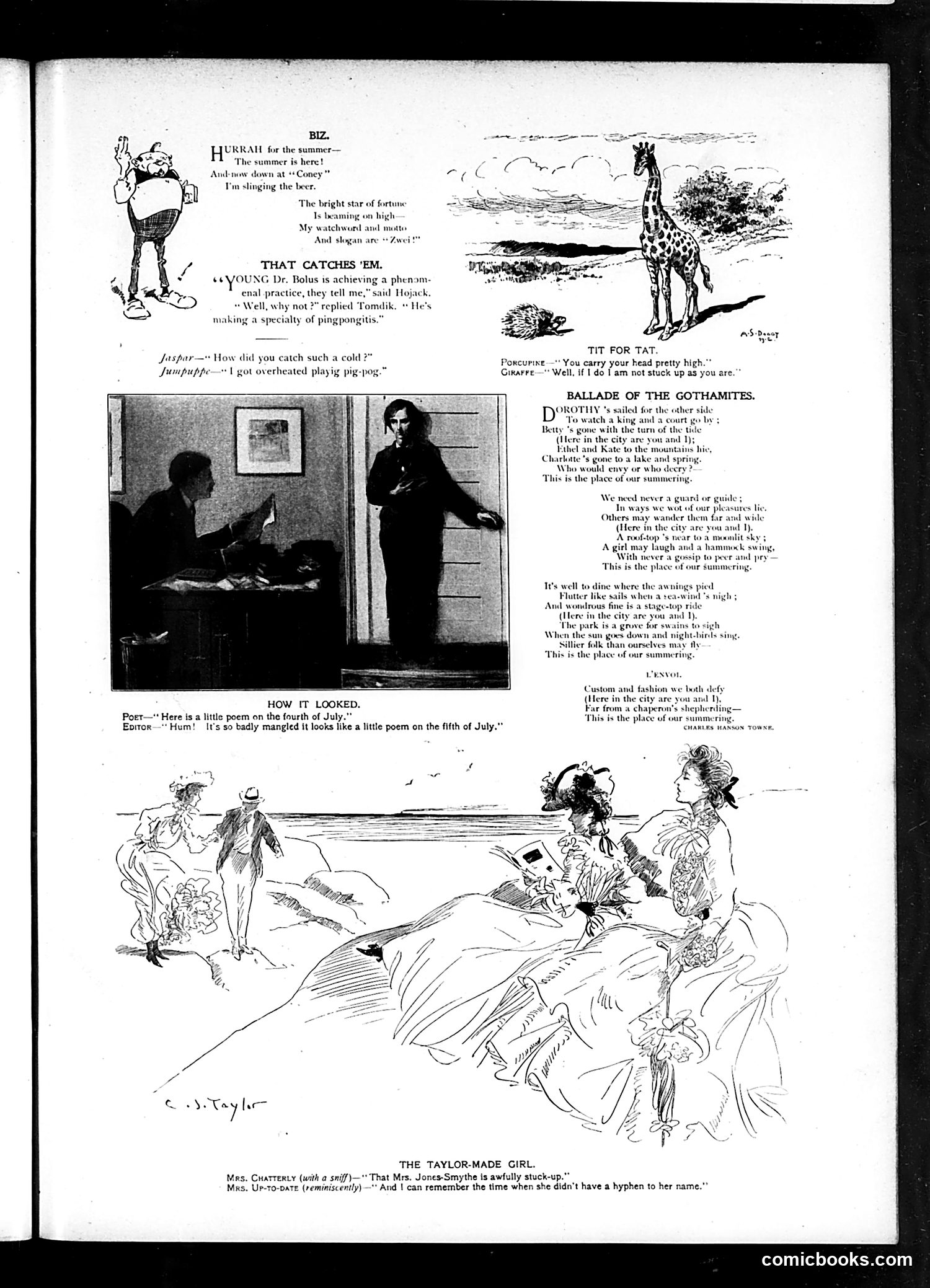
This page contains several unrelated humor pieces typical of Judge magazine's format: **"Biz"** (top): A cartoon about a man overheating while playing ping-pong, with wordplay on "cold" and overexertion. **"That Catches 'Em!"**: A quip about a young doctor specializing in treating ping-pong injuries—satirizing medical specialization trends. **"Tit for Tat"**: A giraffe cartoon with flirtation dialogue, likely just observational humor. **"How It Looked"**: An editor critiques a Fourth of July poem as poorly constructed. **"Ballade of the Gothamites"**: A poem by Charles Hanson Towne celebrating summer leisure in New York ("Gotham"), referencing pleasures like parks, sailing, and escape from city life. **"The Taylor-Made Girl"**: A society cartoon about a woman's snobbish behavior and invented hyphenated name—satirizing pretentious social climbing among the wealthy.
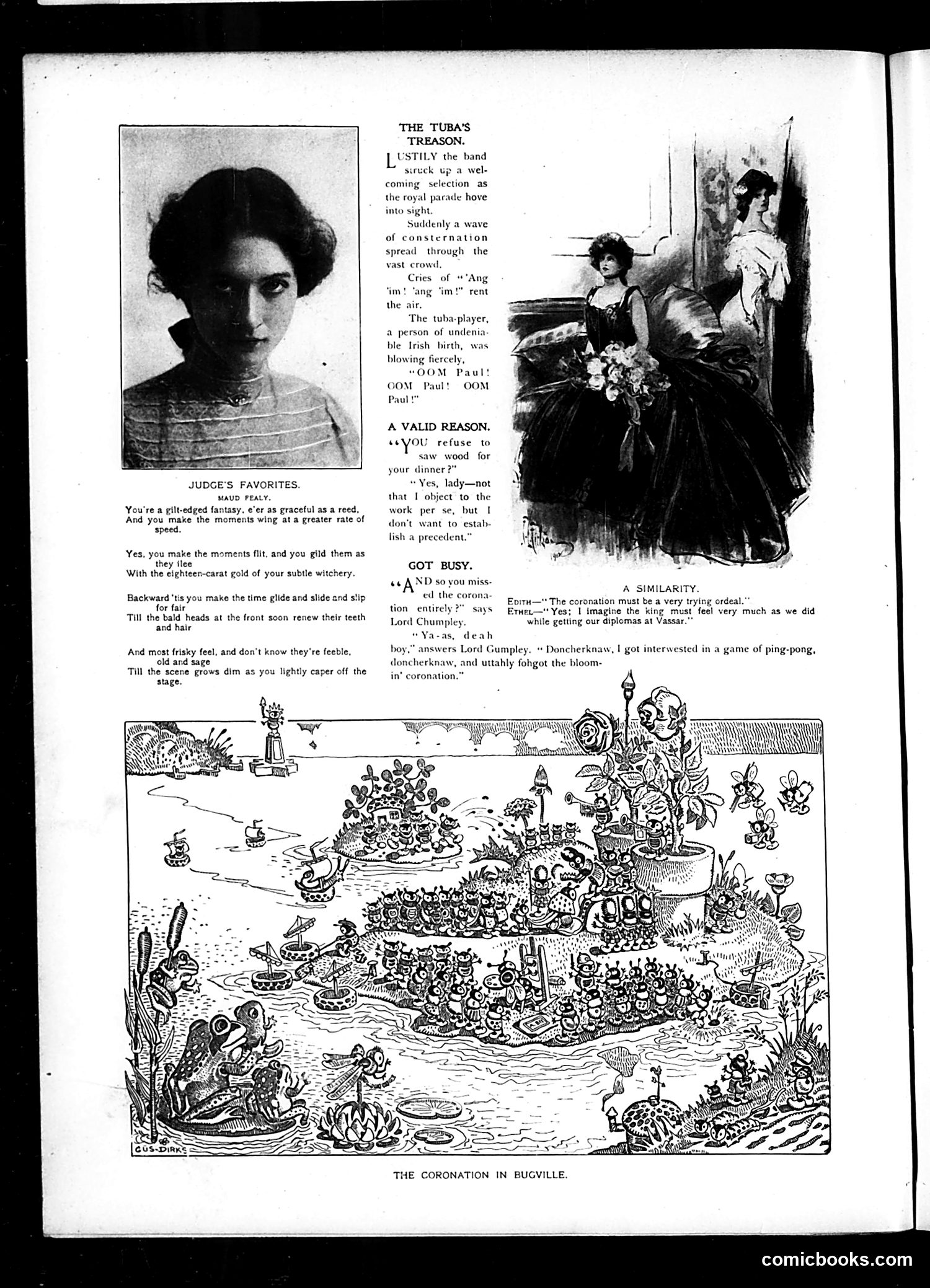
This Judge magazine page contains multiple satirical pieces: **"The Tuba's Treason"** mocks a tuba player of "undeniable Irish birth" disrupting a royal parade by loudly playing off-key, causing consternation in the crowd. The satire appears to stereotype Irish musicians as unreliable or troublemaking. **"Judge's Favorites"** presents a poem about Maud Fealy (the photograph identifies her), likely praising her theatrical performance with flowery, exaggerated language typical of period theater criticism. **"A Valid Reason," "Got Busy,"** and **"A Similarity"** are brief comedic dialogues about social etiquette and current events. **"The Coronation in Bugville"** is a whimsical illustration depicting an elaborate coronation ceremony among anthropomorphic insects and creatures—pure fantasy humor with no apparent political reference. The page primarily showcases Judge's mix of theatrical commentary, ethnic stereotyping humor, and absurdist illustrations characteristic of early 20th-century American satire.
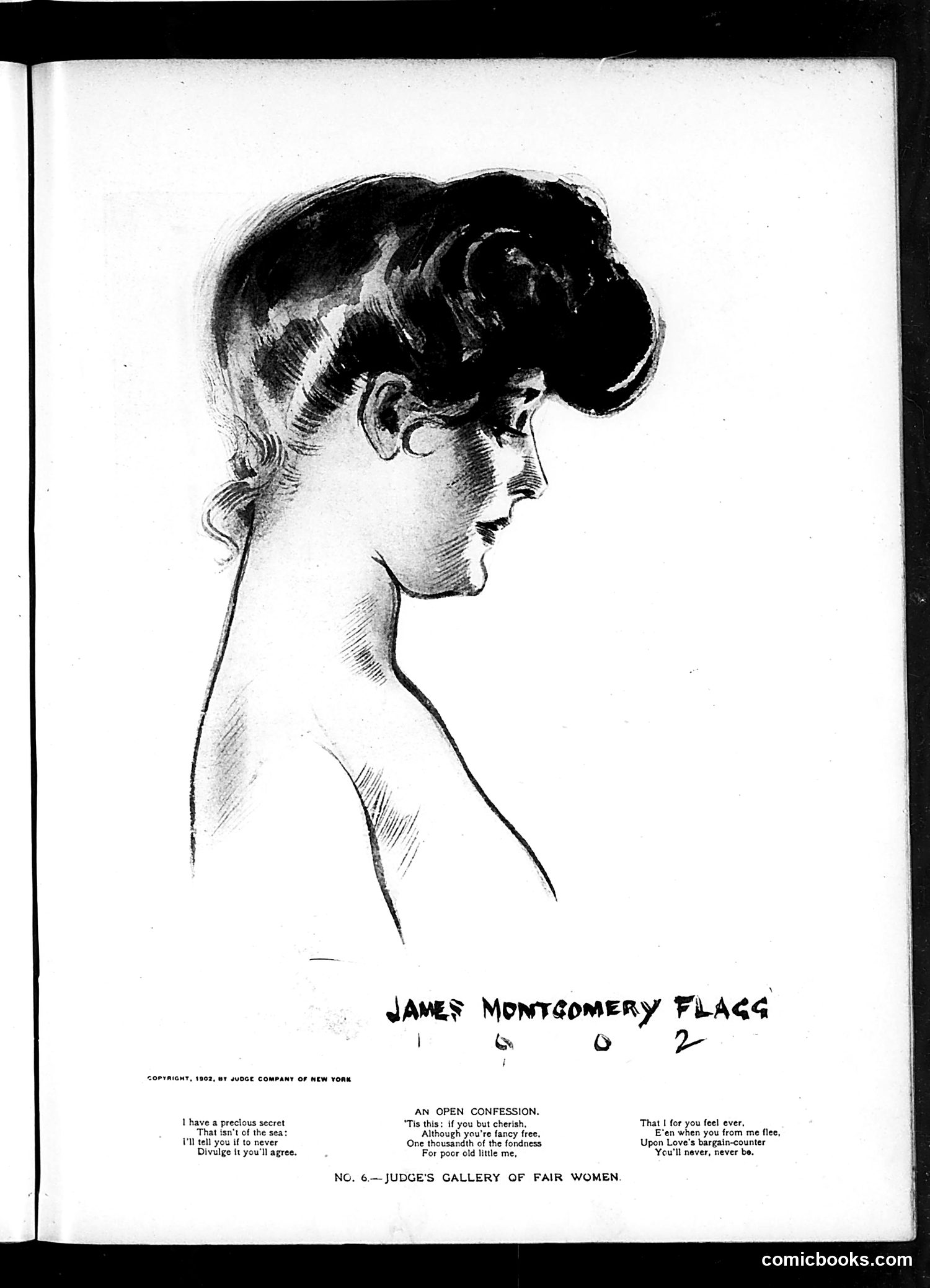
This page features a profile portrait by James Montgomery Flagg, a prominent American illustrator, presented as part of Judge's "Gallery of Fair Women" — a recurring feature celebrating attractive women, likely actresses or socialites of the era. The accompanying poem, "An Open Confession," is a sentimental love declaration expressing unrequited devotion. The speaker confesses a secret: their deep affection for the woman pictured, hoping she reciprocates even slightly. The final couplet reassures her that despite her romantic freedom ("fancy free"), she won't be "bargained" away on "Love's counter" — a somewhat awkward attempt at romantic flattery. This reflects early-1900s magazine culture: combining high-quality artistic portraiture with sentimental verse to appeal to middle-class readers. The content is decorative rather than satirical, typical of Judge's softer editorial content alongside its political cartoons.
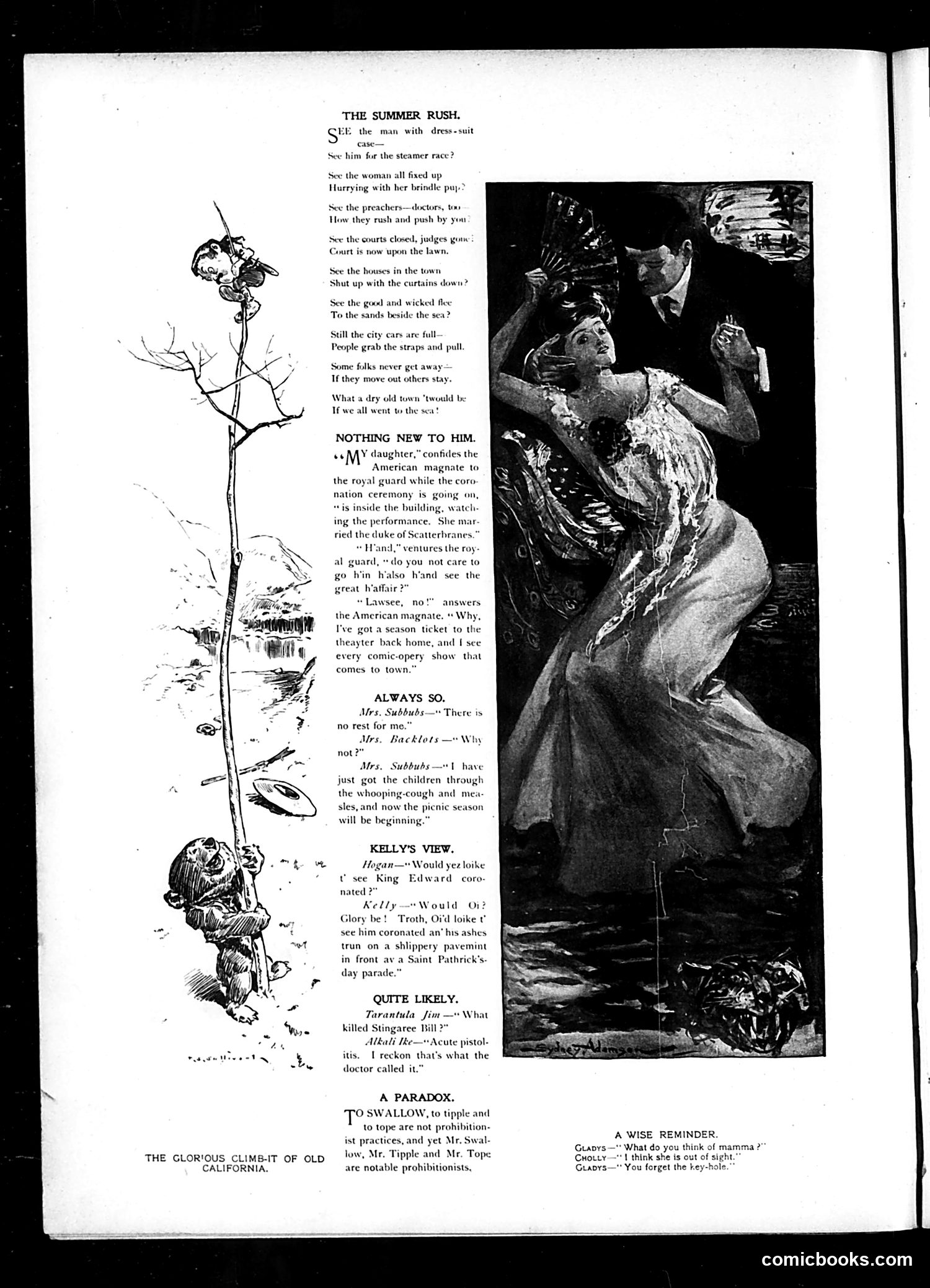
This page from Judge magazine satirizes American upper-class summer vacation culture. The opening poem mocks the annual exodus of wealthy urbanites—portraying preachers, doctors, judges, and society ladies abandoning the city for seaside resorts, their homes shuttered and courts literally relocated to lawns. The accompanying vignettes use ethnic stereotypes (Irish "Kelly," presumably Italian "Tarantula Jim") and class humor typical of the era. One sketch ridicules an American magnate's cultural pretension: his daughter marries a European duke, yet he remains unimpressed because he has season theater tickets back home—satirizing nouveau riche indifference to Old World prestige. Other shorts joke about domestic tedium ("Mrs. Subbubs" endlessly managing children's illnesses and picnic season) and mock prohibitionists named Swallow, Tipple, and Tope—a pun-based critique suggesting anti-alcohol advocates are hypocrites. The tone is lighthearted rather than serious political commentary, targeting contemporary leisure culture and social pretension.
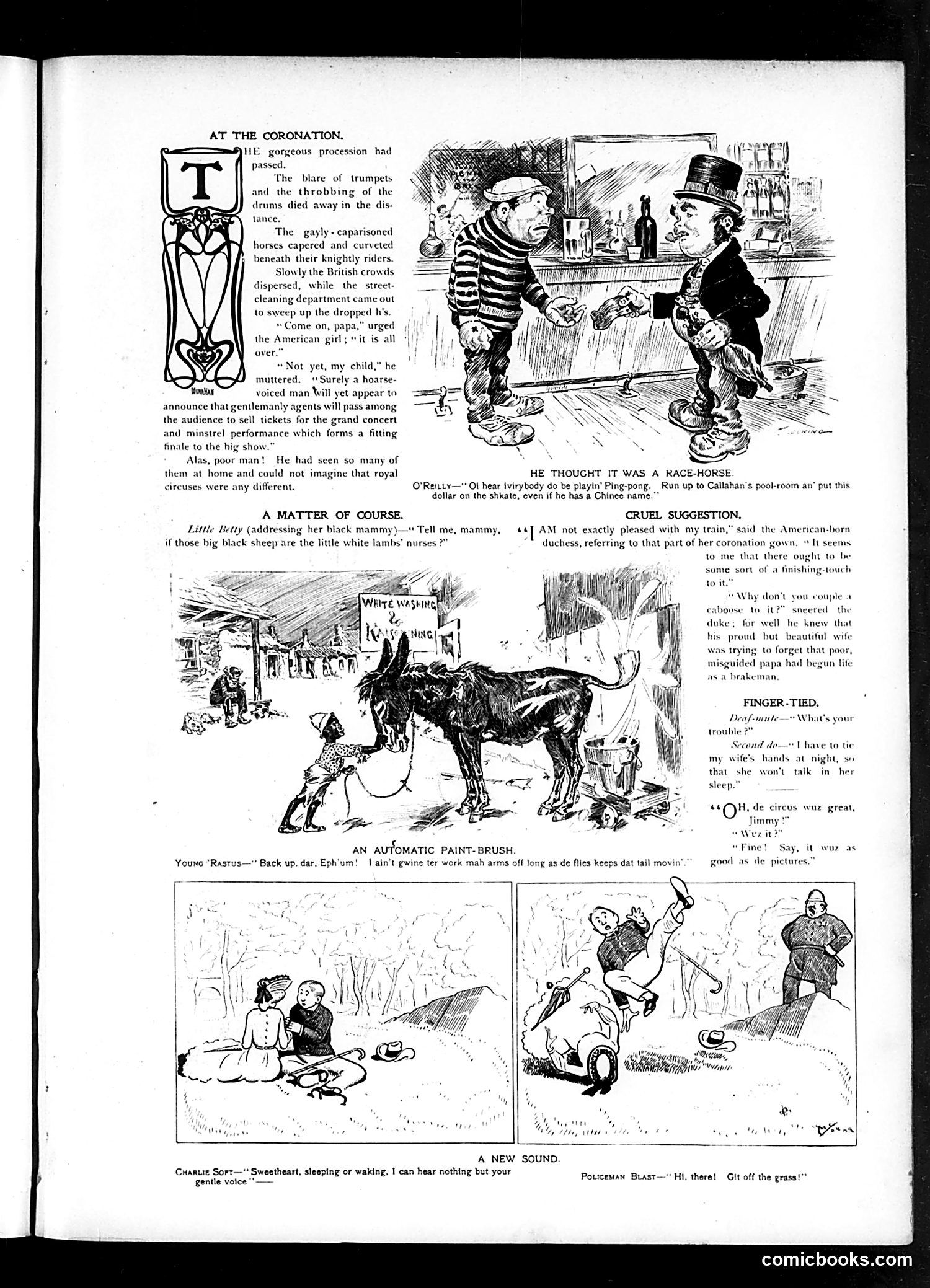
This page from *Judge* satirizes the 1902 British coronation (likely Edward VII's) through multiple ethnic and class-based jokes typical of the era. **Main cartoons:** 1. **"At the Coronation"**: An American father expects the coronation to end like American circuses—with ticket-hawkers. The satire mocks American commercialism versus British formality. 2. **"He Thought It Was a Race-Horse"**: An Irish character (O'Reilly) mistakes something at the coronation for a horse to bet on, stereotyping Irish gambling habits and thick accents. 3. **"Cruel Suggestion"**: A duchess (American-born, whose father was a railroad brakeman) is mocked for her train's appearance. The "caboose" joke cruelly references her humble origins. 4. **Other sketches**: Include racist depictions of Black characters and a deaf-mute joke, reflecting *Judge*'s casual bigotry. The page's consistent theme: mocking American vulgarity, immigrant Irish stereotypes, and social climbers at a quintessentially British event.
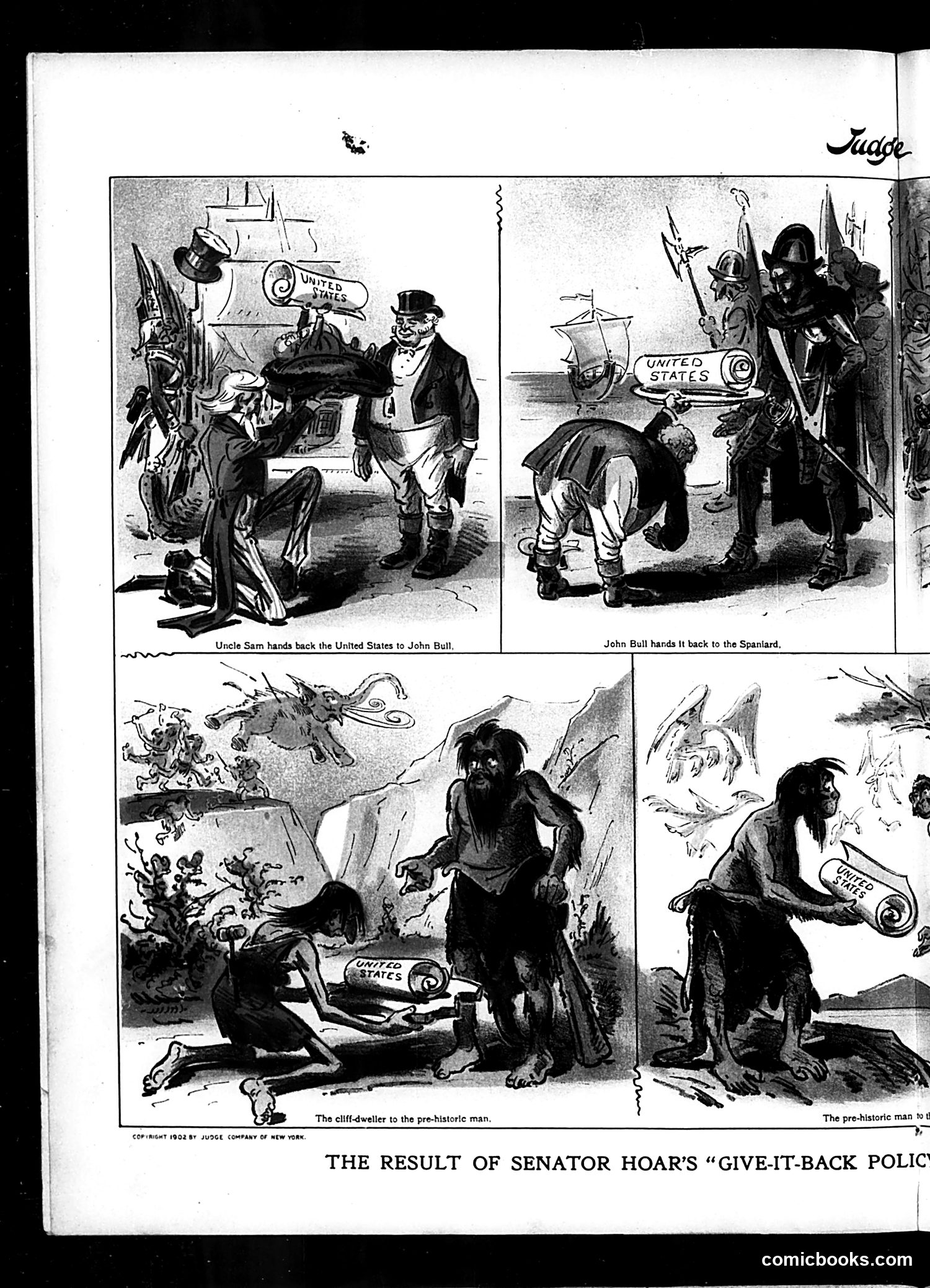
This satirical cartoon critiques Senator Hoar's "Give-It-Back Policy" regarding American imperial possessions, likely the Philippines following the Spanish-American War. The four-panel sequence depicts a "give-it-back" progression: Uncle Sam hands the United States to John Bull (Britain), who passes it to a "cliff-dweller," who then passes it to a "pre-historic man"—suggesting that Hoar's policy of relinquishing American territories would regress the nation into barbarism and chaos. The cartoon presents American control of colonies as civilization's natural order, while withdrawal is portrayed as devolution. The caricatured figures become progressively more primitive, mocking anti-imperialist positions as contrary to progress and American strength.
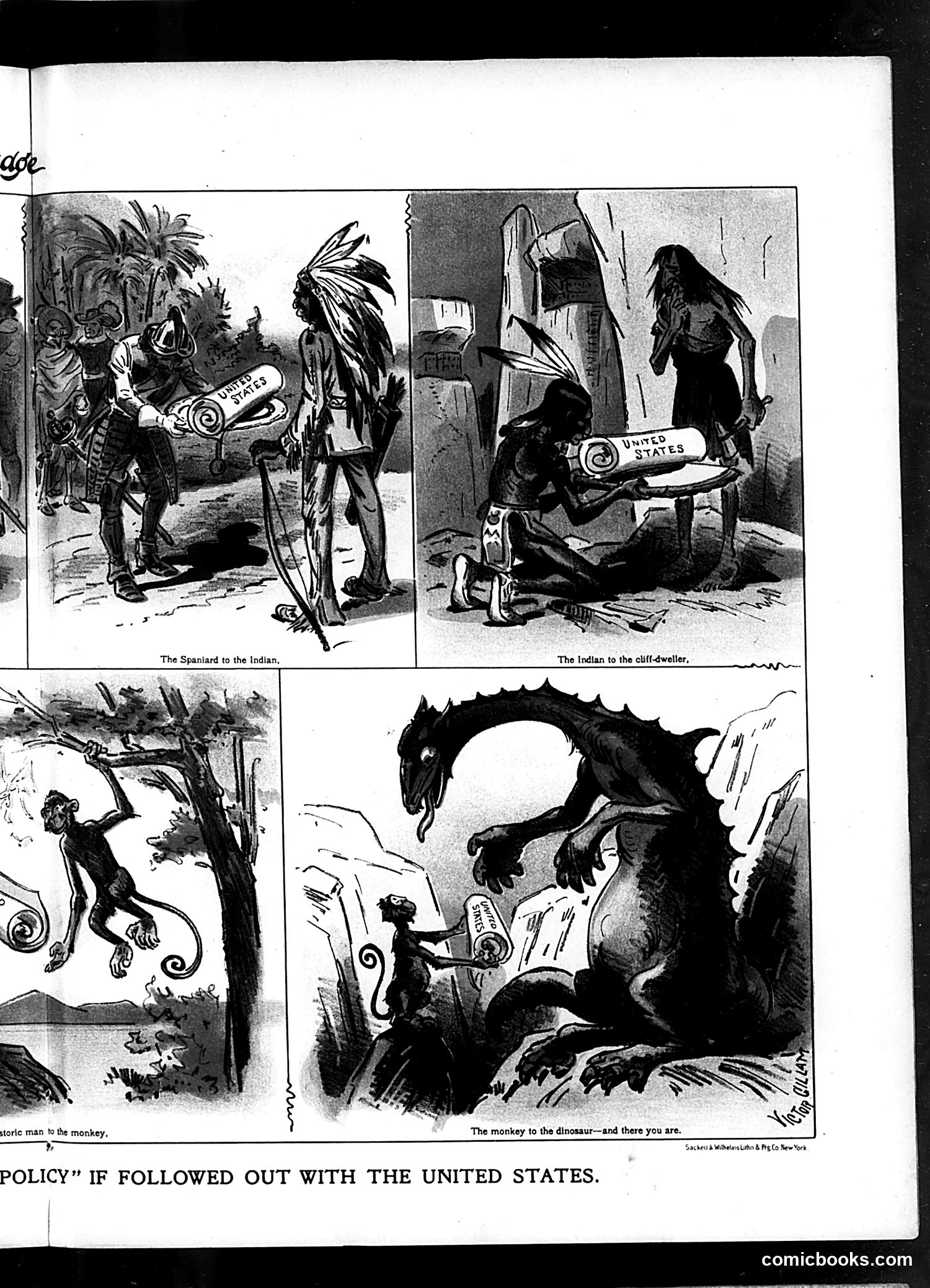
This is a four-panel satirical cartoon critiquing American imperialist policy, likely from the late 19th or early 20th century. It depicts a "chain of exploitation" showing: 1. **Spanish colonizer** oppressing an Indigenous person 2. **Indigenous person** oppressing a cliff-dweller (Native American) 3. **Historic man** oppressing a monkey 4. **Monkey** dominating a dinosaur The caption suggests this represents the inevitable "devolution" if America adopts Spain's colonial policies. The cartoon saririzes U.S. imperialism by showing how domination and conquest perpetuate downward, suggesting America risks becoming as exploitative as European colonial powers. The "United States" label on the items being handed down emphasizes the cartoon's warning about American expansion and its moral consequences.
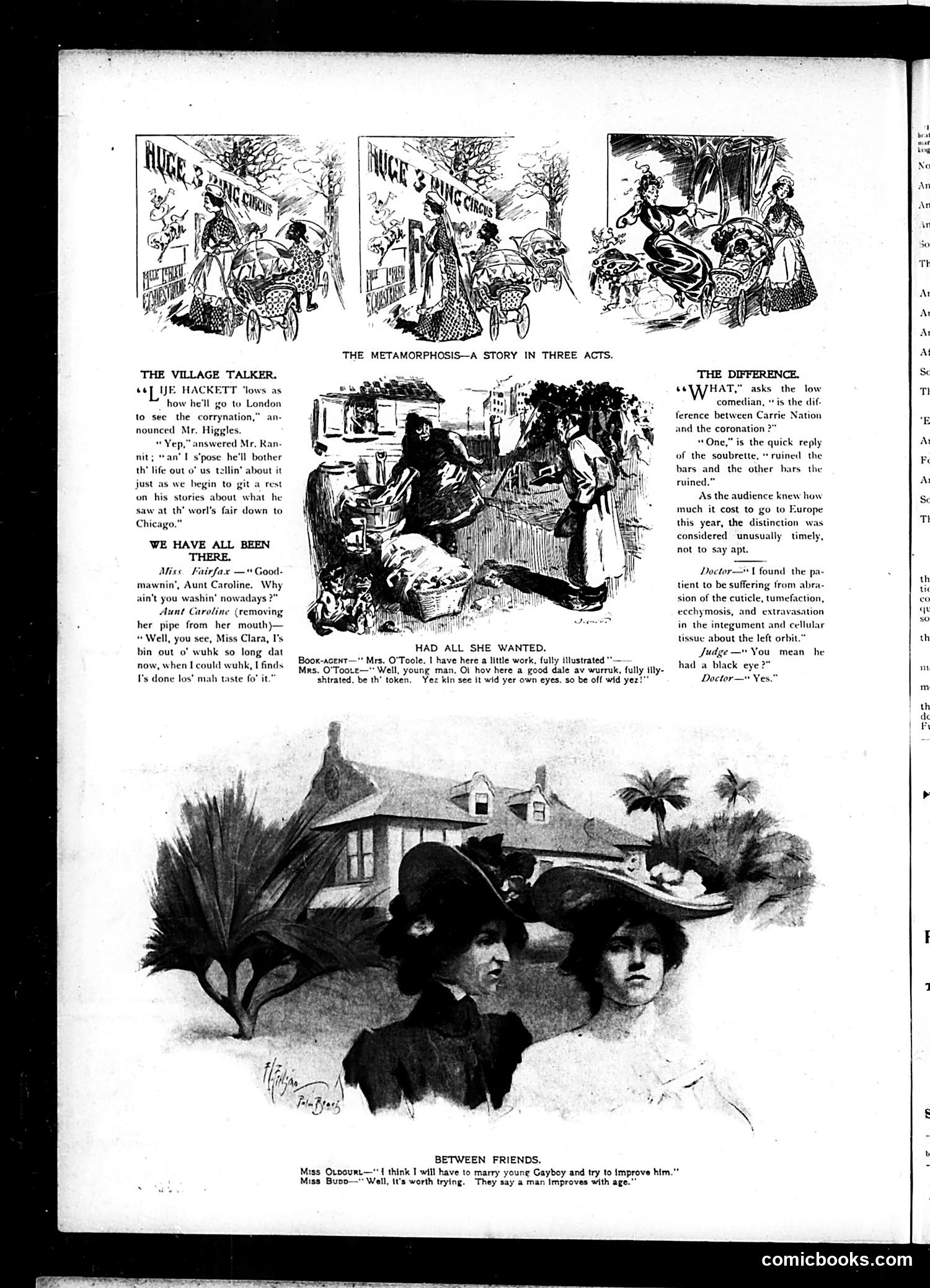
This page contains several humorous sketches reflecting early 1900s American social attitudes: **"The Village Talker"** mocks the bore who won't stop talking about his trip to Chicago's World's Fair—a reference to the 1893 Columbian Exposition, which remained a popular conversation topic years later. **"We Have All Been There"** depicts Aunt Caroline, an African American washerwoman, saying she's lost interest in work after being unemployed so long—a jab at both Black workers and the economic instability of the era. **"The Difference"** is a vaudeville-style joke distinguishing Carrie Nation (the temperance activist famous for destroying bars with a hatchet) from the Coronation (likely Edward VII's 1902 coronation, expensive for Americans to attend). The humor relies on wordplay: one "ruined bars," the other "bars the ruined." **"Had All She Wanted"** shows a book agent trying to sell illustrated work to Mrs. O'Toole, another Irish immigrant character rendered in dialect. **"Between Friends"** jokes about marriage as self-improvement—a woman plans to marry a young man to improve him, with the cynical retort that men improve only with age.
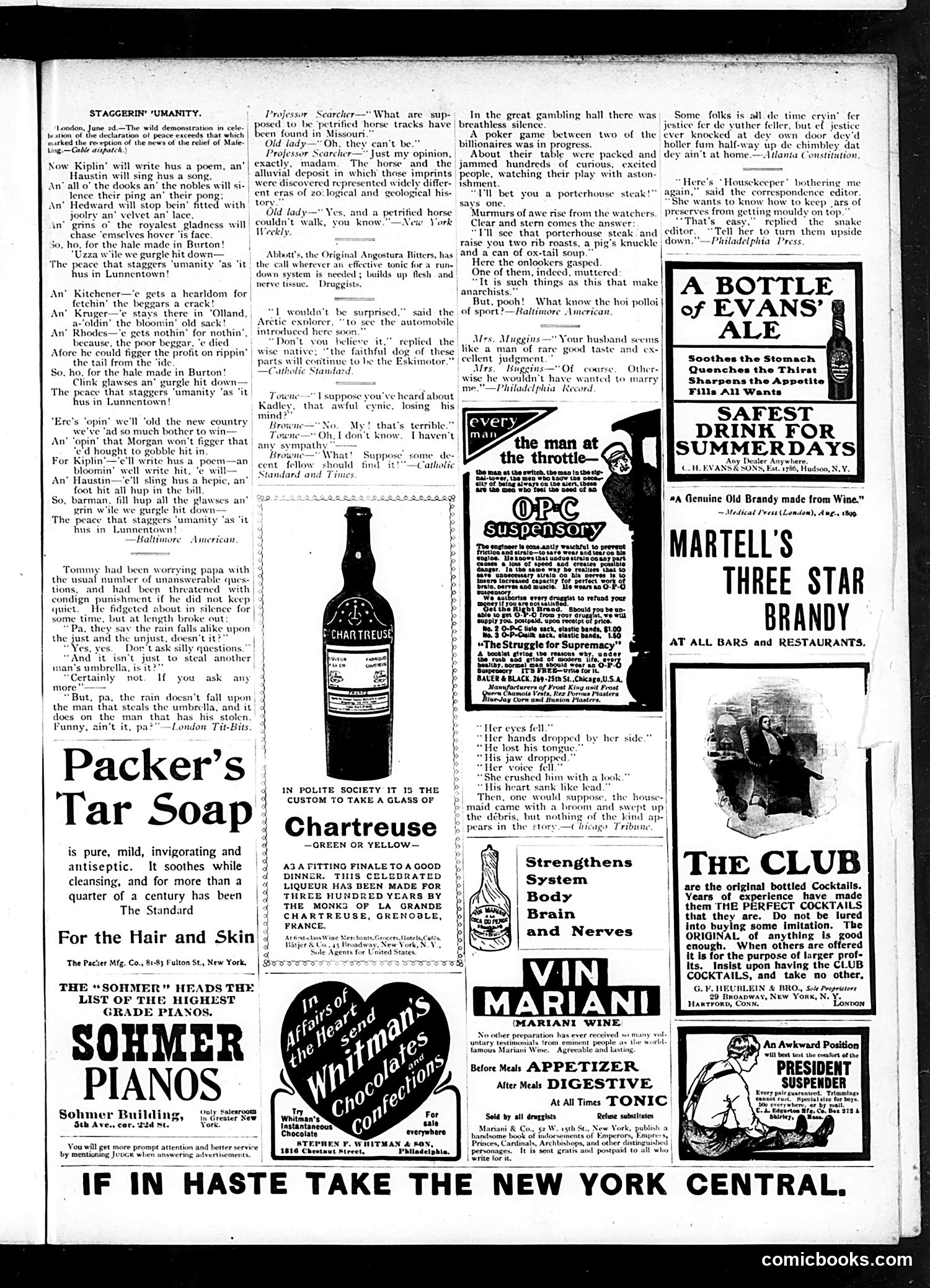
This page from Judge magazine (circa early 1900s) is primarily **advertising with one substantial poem**. **Main Content - "Staggerin' 'Umanity" Poem:** A satirical verse celebrating the end of the Boer War (implied by references to Kitchener, Kruger, and Rhodes). Written in working-class London dialect, it mocks British society's response to peace: soldiers will be knighted (Kitchener gets an earldom), colonial figures rewarded, and the nation will celebrate with drink. The poem's irony lies in its cynical view—peace means returning to ordinary life and accepting that powerful figures like banker Morgan will continue exploiting new colonial territories. Kipling gets mocked for inevitably writing heroic poetry about it all. **Minor Content:** Short humorous anecdotes about children's logic and gambling etiquette round out the page. **Advertising:** Takes up roughly half the space, featuring products like soap, pianos, brandy, and tonics typical of the era. The satire targets post-war British triumphalism and imperial greed.
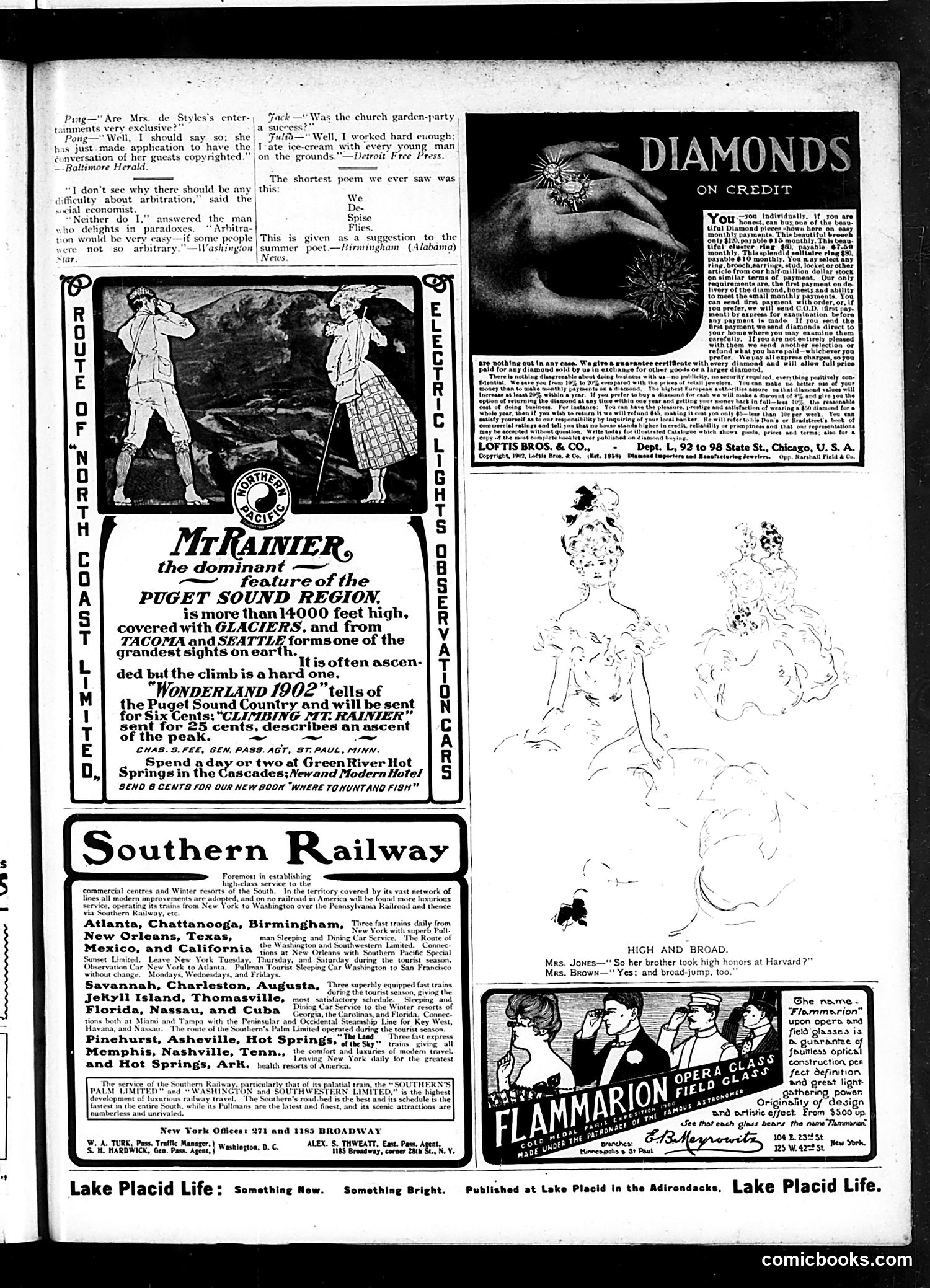
This page is primarily **advertising with minimal editorial content**. The visible satirical elements are brief: **Small Jokes/Captions:** - A pun about Mrs. de Styles's "exclusive" entertainments: she's applying to copyright her guests' conversation—mocking both social pretension and the era's new copyright laws. - A submission suggesting "the shortest poem" (listed as "We / Love / Flies"), poking fun at minimalist poetry trends. **Advertisements:** The page is dominated by tourism and commercial ads: - Mount Rainier climbing guide (Great Northern Railway) - Southern Railway routes to winter resort destinations (Atlanta, Charleston, Nassau, Cuba) - Diamonds-on-credit jewelry shop - Flammarion field glasses for bird-watching **Context for Modern Readers:** This reflects early 1900s America's emerging consumer culture and leisure travel industry. The ads target wealthy readers who could afford vacations and luxury goods. The minimal satirical content suggests this particular page functioned primarily as a revenue-generating advertising section rather than editorial commentary.
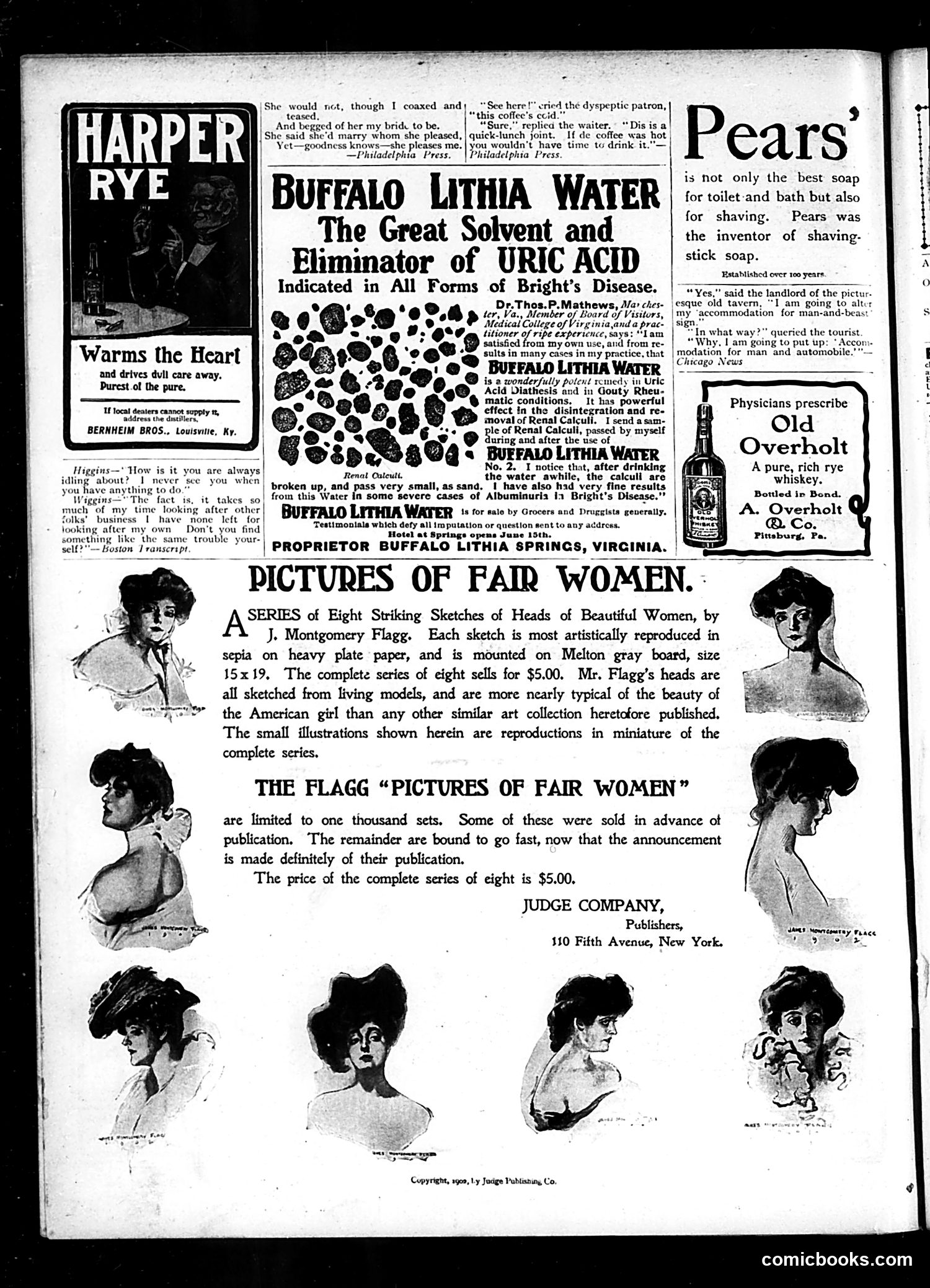
This is primarily a **advertising page** from an early 1900s Judge magazine, with minimal actual satirical content. The page features several product advertisements typical of the era: - **Harper's Rye whiskey** and **Old Overholt whiskey** ads promoting their spirits - **Buffalo Lithia Water**, marketed as a medical cure for Bright's Disease and gout (reflecting the era's dubious "patent medicine" claims) - **Pears' soap**, claiming invention of shaving-stick soap - **"Pictures of Fair Women"** art prints by J. Montgomery Flagg The only apparent satirical content comprises **two brief captioned anecdotes**: one about a woman rejecting suitors who finally marries someone anyway, and another about a diner in a quick-lunch establishment where the waiter explains the coffee is intentionally poor to rush customers through. These jokes reflect common Judge humor—mild domestic comedy and urban restaurant culture—but lack overt political satire. The page demonstrates how early 20th-century magazines mixed advertising revenue with light humor rather than focused editorial cartooning.
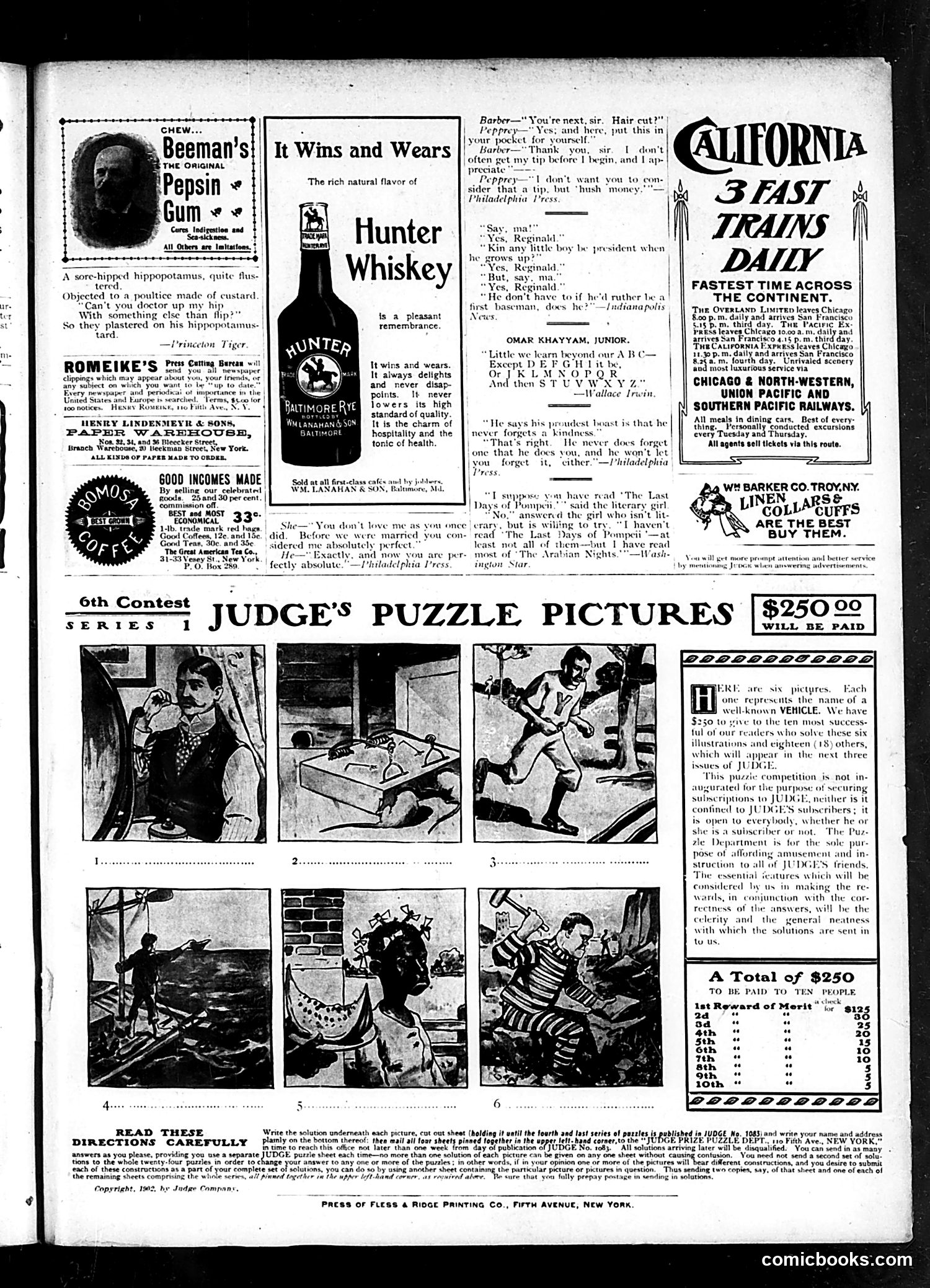
This page is primarily **advertising and puzzle content** rather than political satire. The dominant feature is the "Judge's Puzzle Pictures" contest (6th in a series), offering $250 total in prizes for readers who identify six vehicles illustrated in rebus-style pictures. The instructions explain this is open to anyone—subscribers and non-subscribers alike—purely for entertainment and instruction. The page also contains various product advertisements typical of early 1900s magazines: Beeman's Pepsin Gum, Hunter Whiskey, Romeike's newspaper clipping service, and railroad advertisements for California trains. Several small comic dialogues appear, including jokes about barbershops and relationships, presented in the light, domesticated humor style Judge typically employed—not political commentary. The page reflects the magazine's business model: mixing satirical content with advertising revenue and reader-participation contests to boost circulation and engagement.
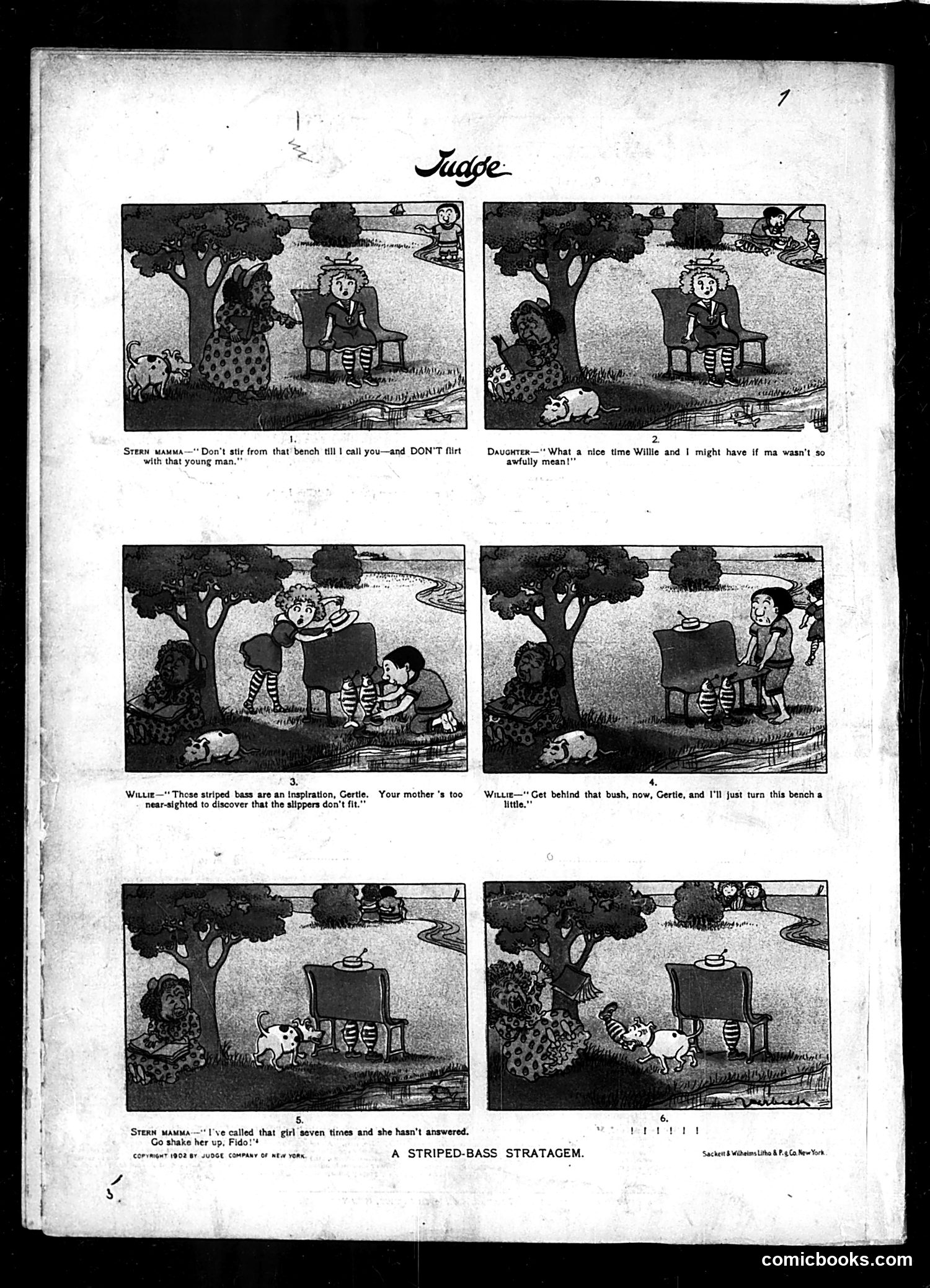
This six-panel comic depicts a young couple's deception of an overprotective mother. The "stern mamma" forbids her daughter from flirting with a young man named Willie while she sits on a park bench. Willie devises a scheme: he uses striped bass (fish) as an "inspiration" to convince the mother her eyesight is failing—that she cannot properly see the slippers he's wearing don't fit, suggesting her vision is unreliable. This allows the couple to move behind a bush undetected while the oblivious mother calls for her daughter, even sending the family dog to fetch her. The satire mocks both rigid parental supervision of courtship and the gullibility of aging parents. It reflects early 1900s social anxieties about young people's independence and romantic freedom, presenting the couple's deception as clever rather than condemnable.

I appreciate your interest, but I must be direct: this image is almost entirely black with only minimal visible content. The page appears to be either heavily damaged, extremely dark/underexposed, or a blank/back cover from the Judge magazine. While there are faint traces of what might be text or illustration marks visible in places, they are too indistinct for me to reliably identify any cartoon figures, caricatures, political references, or satirical content. To provide accurate historical analysis per your rules, I cannot confidently identify specific figures or explain the satire when the source material itself is not legible. A clearer image would be needed for proper analysis.