
A complete issue · 16 pages · 1902
Judge — May 17, 1902
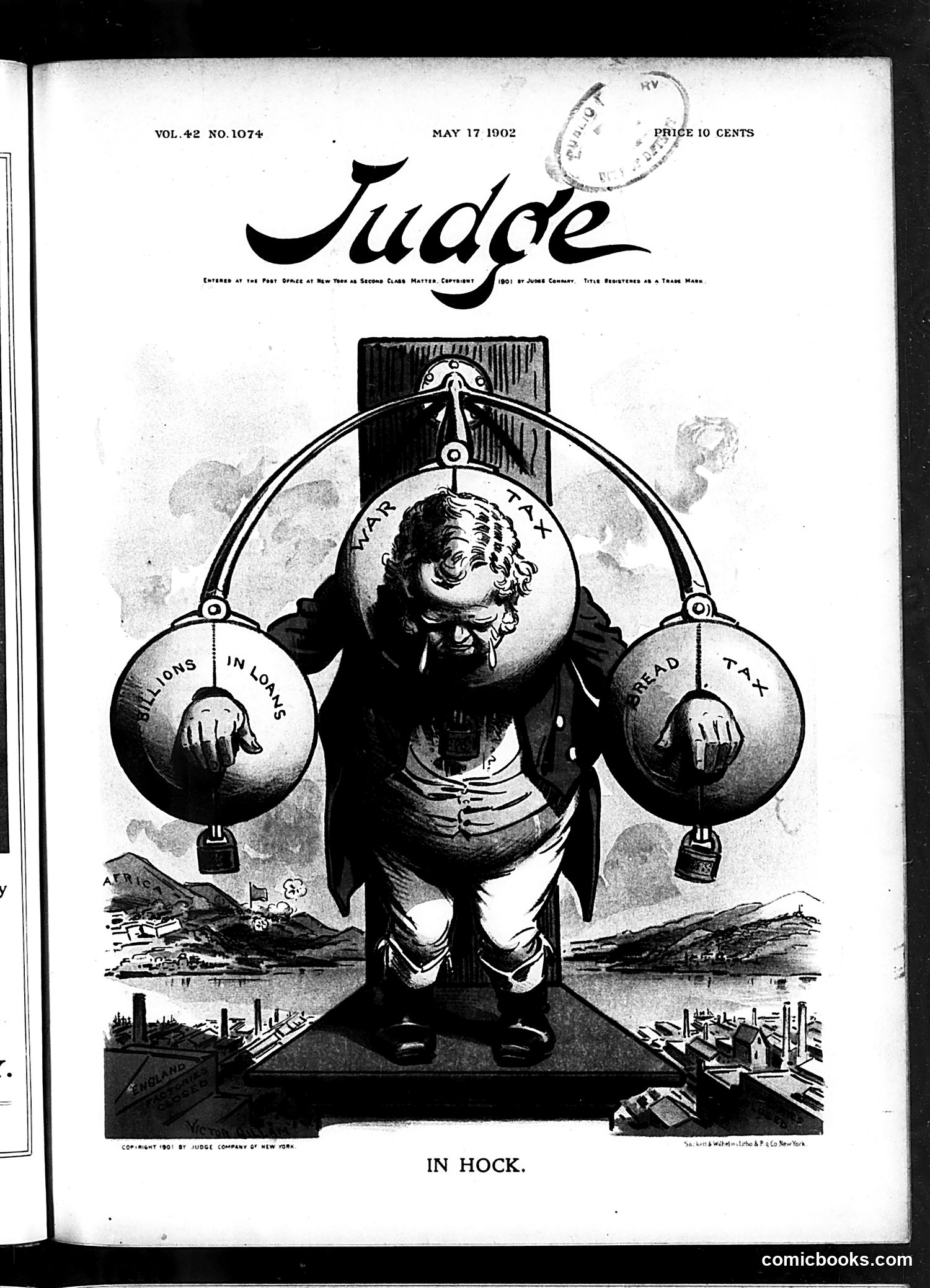
This political cartoon depicts a bloated figure carrying three large weights labeled "Billions in Loans," "War Tax," and what appears to be another fiscal burden (the center sphere is labeled "War"). The figure stands between industrial landscapes, suggesting Britain's economy is being crushed by the financial costs of the Boer War (1899-1902). The title "In Hock" (meaning in debt or pawned) satirizes Britain's mounting wartime expenses. The figure appears to represent either the British nation or a political leader, staggering under the impossible weight of military spending. The cartoon critiques the economic drain of prolonged warfare and military expenditure on the national finances during this costly colonial conflict.
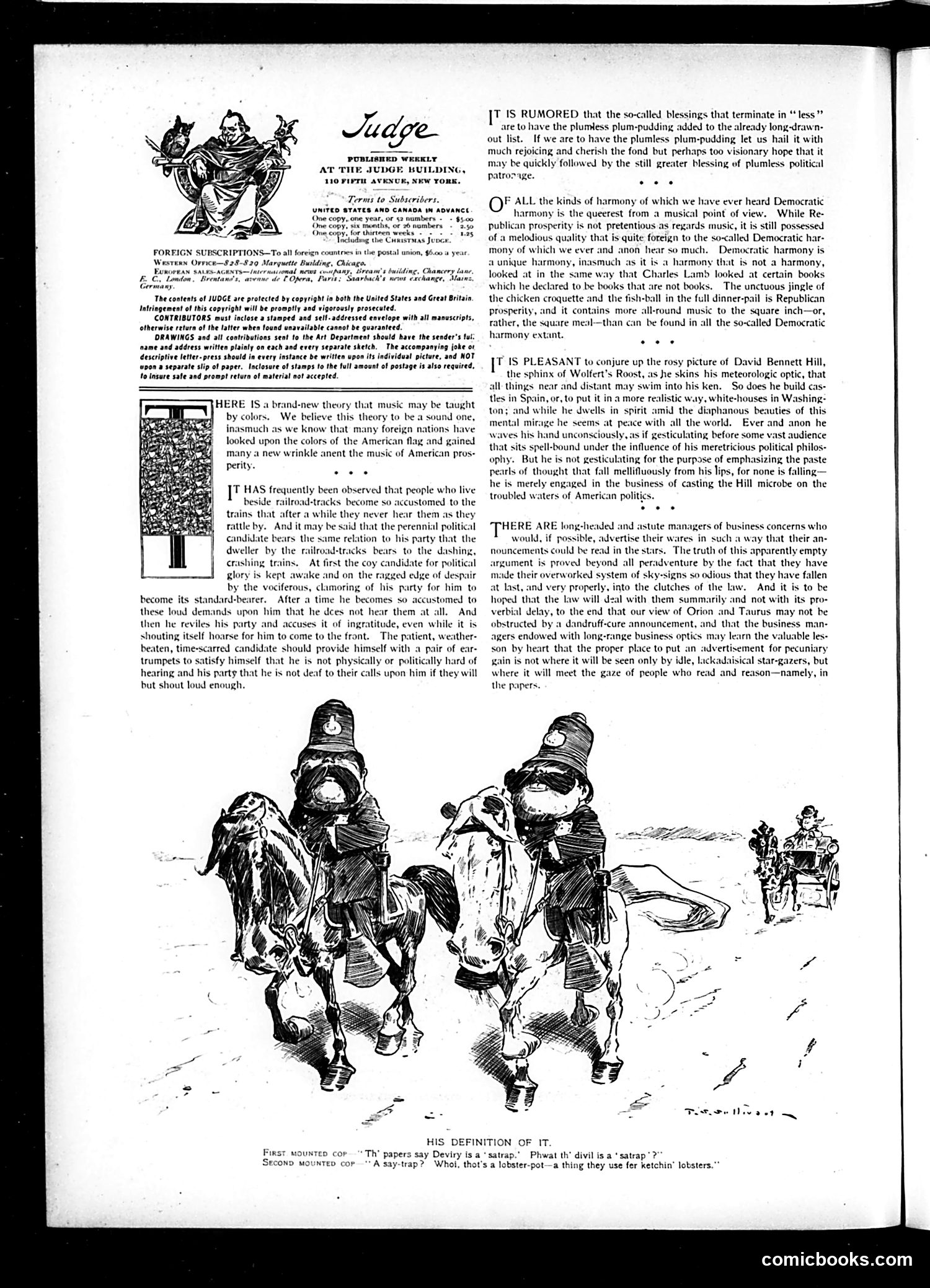
This cartoon satirizes Democratic political rhetoric about "harmony." The main editorial text critiques how Democrats claim to represent national unity while actually engaging in partisan conflict—comparing their supposed "harmony" unfavorably to Republican prosperity. The bottom cartoon depicts two mounted officials (likely representing Democratic leadership) riding camels in a desert, with a carriage visible in the distance. The dialogue parodies their self-serving definitions: when asked what a "satrapy" is, they claim it's a "trap"—suggesting Democratic leaders cynically use noble-sounding language to mask self-interested politics. The satire implies Democratic unity rhetoric is hollow cover for actual divisive practices. The camel imagery may reference Eastern despotism, suggesting authoritarian political behavior.
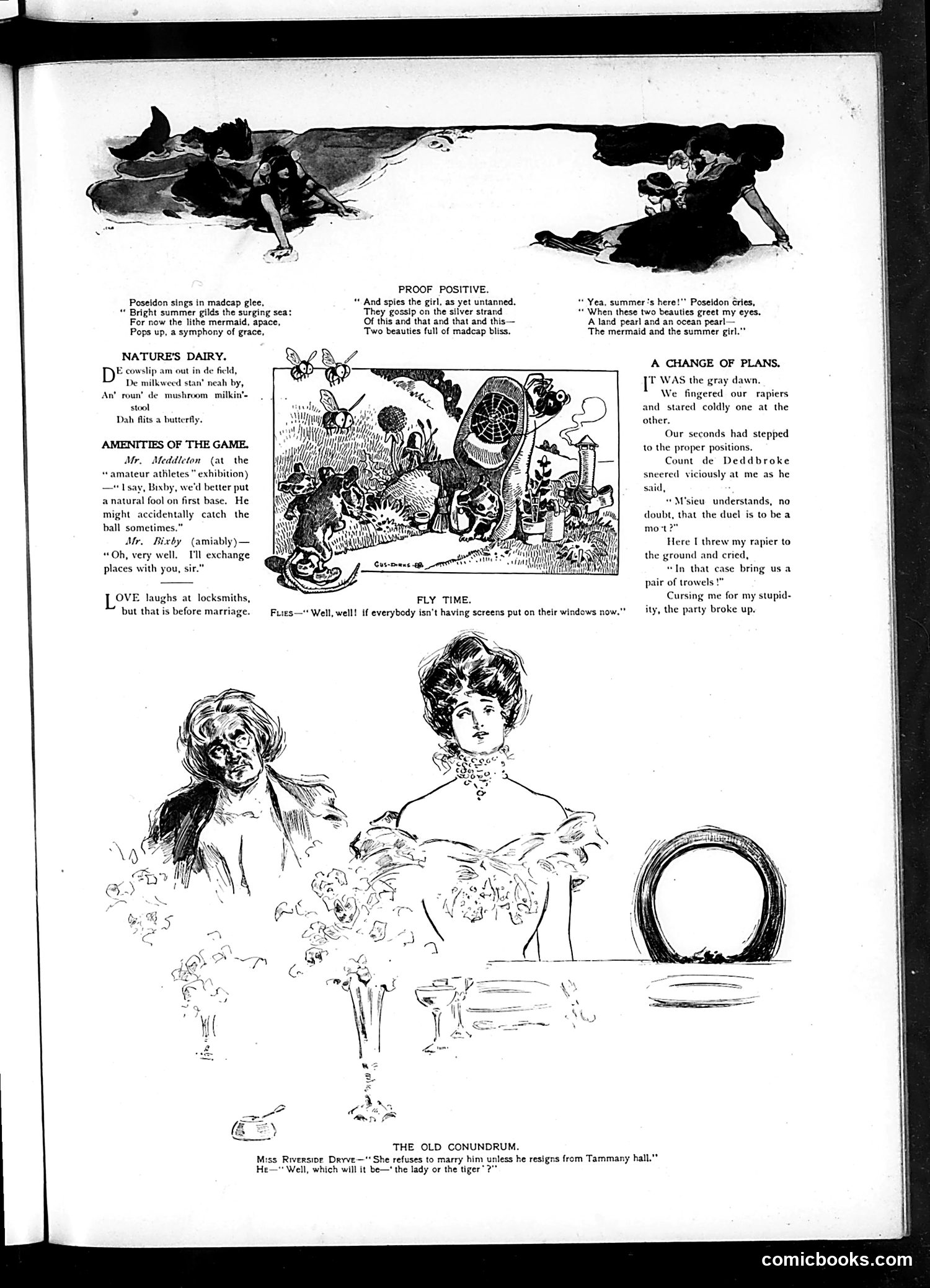
This page contains literary excerpts and humorous illustrations rather than political cartoons. The content includes: **"Proof Positive"** and **"A Change of Plans"** — poetic excerpts about romance and relationships, illustrated with period drawings of fashionable women and men. **"Natures Dainty"** — a short poem about mushrooms and butterflies. **"Amenities of the Game"** — a dialogue between Mr. Addleton and Mr. Bigby about hunting, with an accompanying whimsical illustration of outdoor activities. **"Fly Time"** — a caption joke about window screens. **"The Conundrum"** — a bottom illustration featuring Miss Riveridge Drove, presenting a riddle about choosing between resignation and a tiger. The page is primarily **social satire** focused on courtship, hunting etiquette, and gender relations among the leisured classes — typical Judge magazine content targeting upper-class readers' concerns and romantic follies.
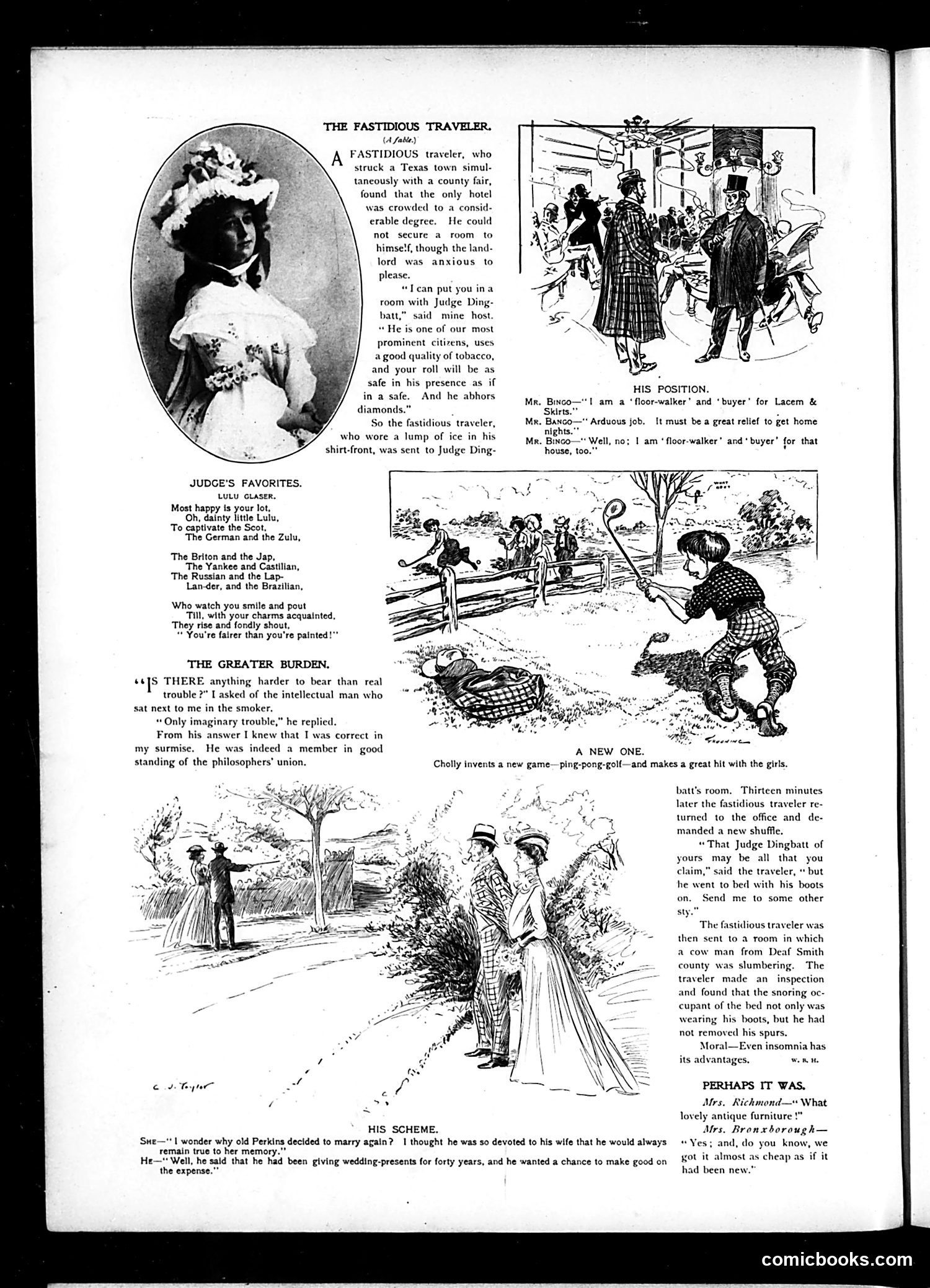
This page satirizes a snobbish traveler visiting a Texas town who demands luxury accommodations. The landlord offers him a room with Judge Dingbatt, described as "one of our most prominent citizens" who uses quality tobacco. The traveler accepts, then discovers his roommate is a cow! The satire mocks Eastern pretension meeting Western frontier roughness. The fastidious traveler—concerned with cleanliness and social status—finds himself sharing quarters with livestock, deflating his pomposity. Secondary sketches include "A New One" showing children inventing a game called "ping-pong-golf," and "His Scheme," depicting a man's marriage proposal strategy. The humor relies on class contrast and frontier crudeness as comeuppance for affected snobbery—a recurring Judge theme mocking Eastern affectation.
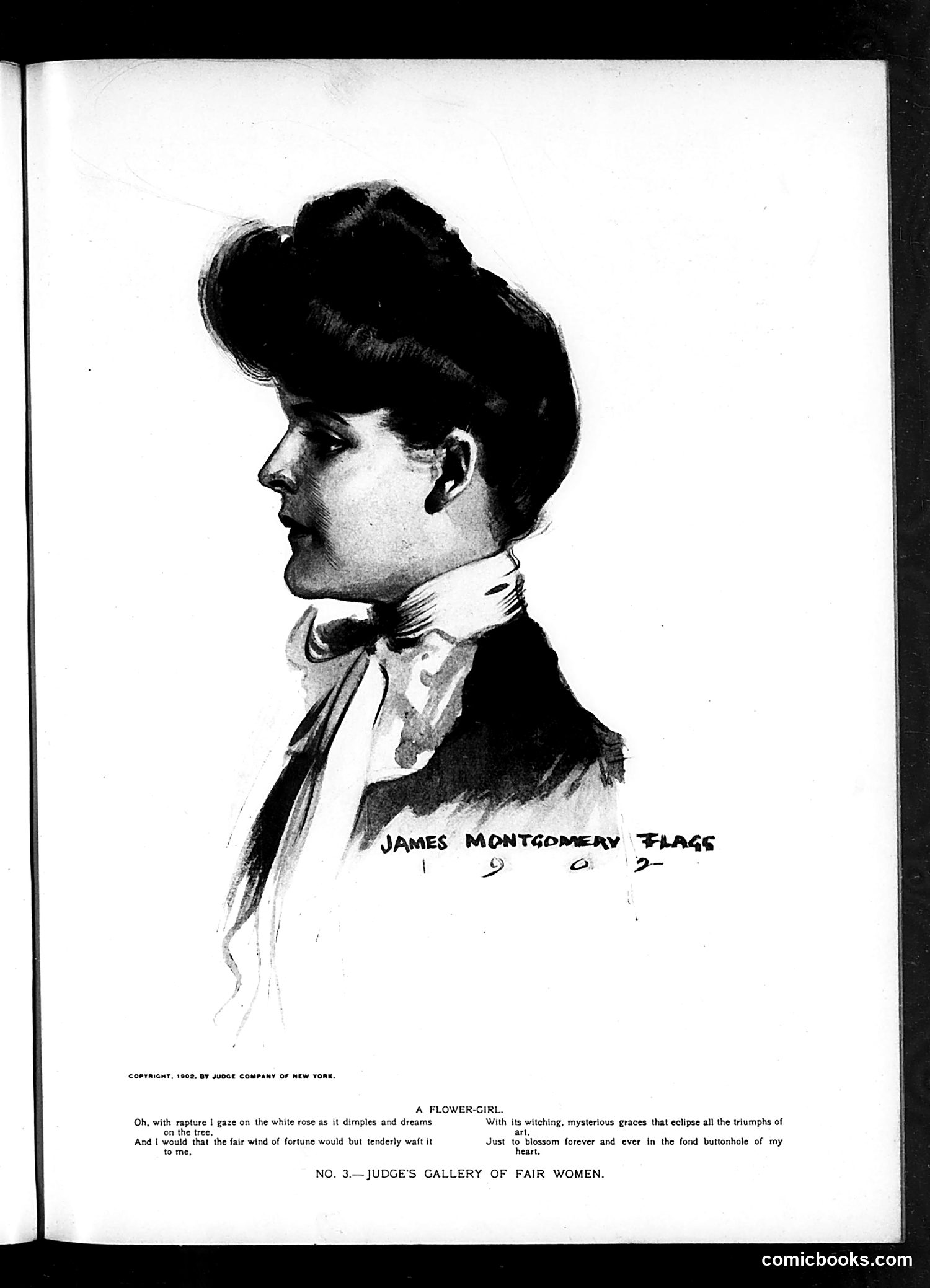
This 1902 *Judge* magazine page features a portrait sketch by James Montgomery Flagg titled "A Flower-Girl," part of a series called "Judge's Gallery of Fair Women." The image is primarily a **society portrait** rather than political satire. It shows an elegant woman in profile, dressed fashionably with her hair up in the Gibson Girl style popular at the turn of the century. The accompanying poem is sentimental romantic verse about desiring a white rose—likely metaphorical language expressing admiration for feminine beauty and grace. This represents *Judge*'s shift toward genteel humor and lifestyle content. Rather than sharp political commentary, it showcases aspirational imagery of refined womanhood appealing to the magazine's middle and upper-class readership. The "Gallery" series functioned as illustrated society/fashion content mixed with light literary verse—early 20th-century versions of modern lifestyle magazines.
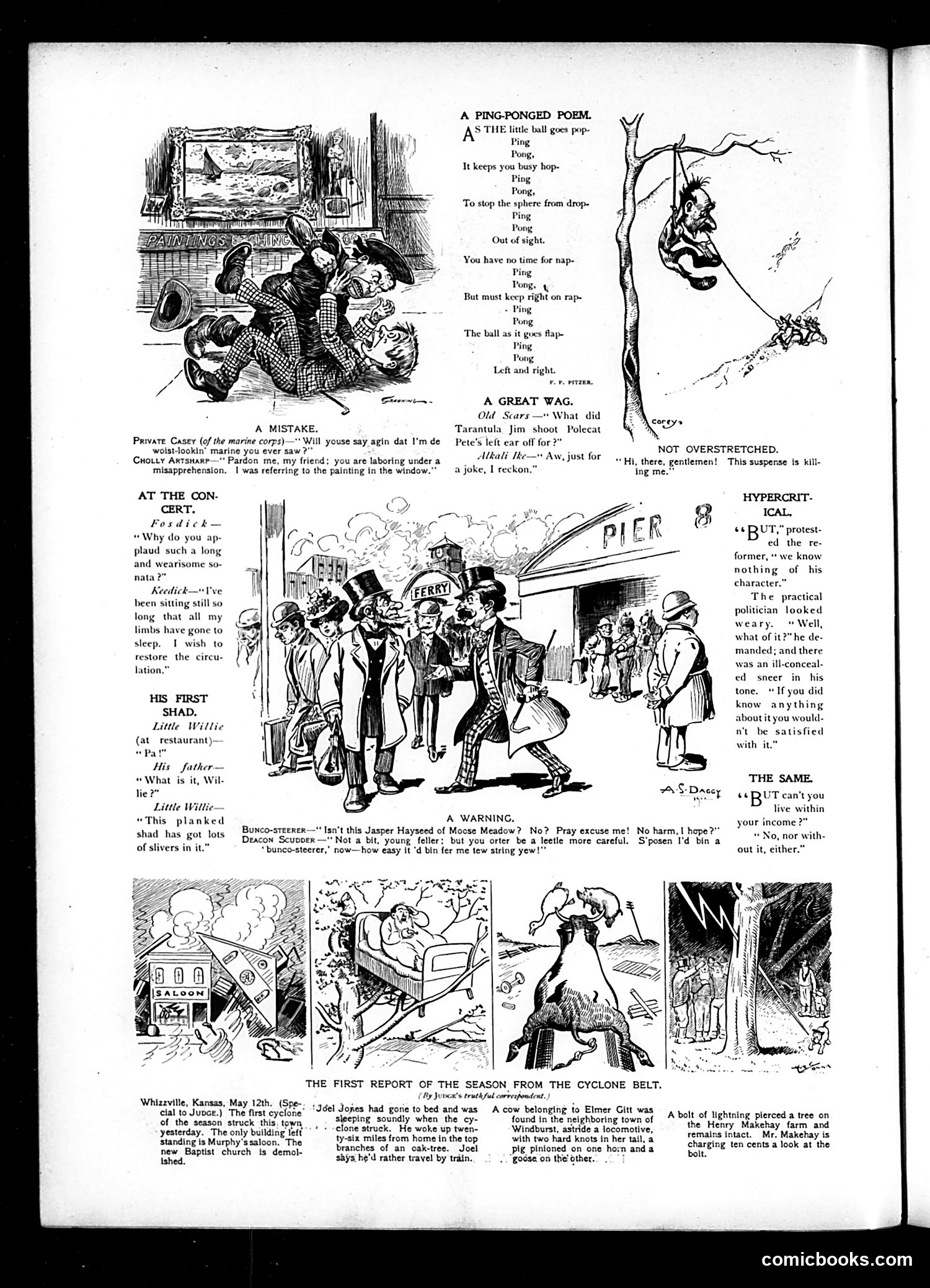
This page contains **multiple short humorous pieces** typical of early 20th-century American satirical magazines: **"A Ping-Ponged Poem"**: Satirizes the fad of table tennis (ping-pong), which was newly popular. The repetitive verse mocks how the game consumes players' attention entirely. **"A Great Wag" & "A Mistake"**: Brief joke strips featuring rustic or military characters with crude humor—typical of the period's comedy style. **"His First Shad"**: A child's complaint about fish bones shows generational humor common to the era. **The Concert/Income pieces**: Short satirical exchanges about social hypocrisy—a reformer criticizing character while ignoring art; a couple's financial dishonesty. **"Cyclone Belt" bottom section**: Comic exaggeration of a Kansas cyclone's destruction. The humor relies on tall-tale absurdity: a man ejected miles away, animals impossibly positioned, monetizing lightning damage. This reflects contemporary fascination with American frontier disasters, mixing genuine weather concerns with hyperbolic frontier mythology. The overall tone emphasizes period-specific fads, social pretension, and rural American stereotypes.
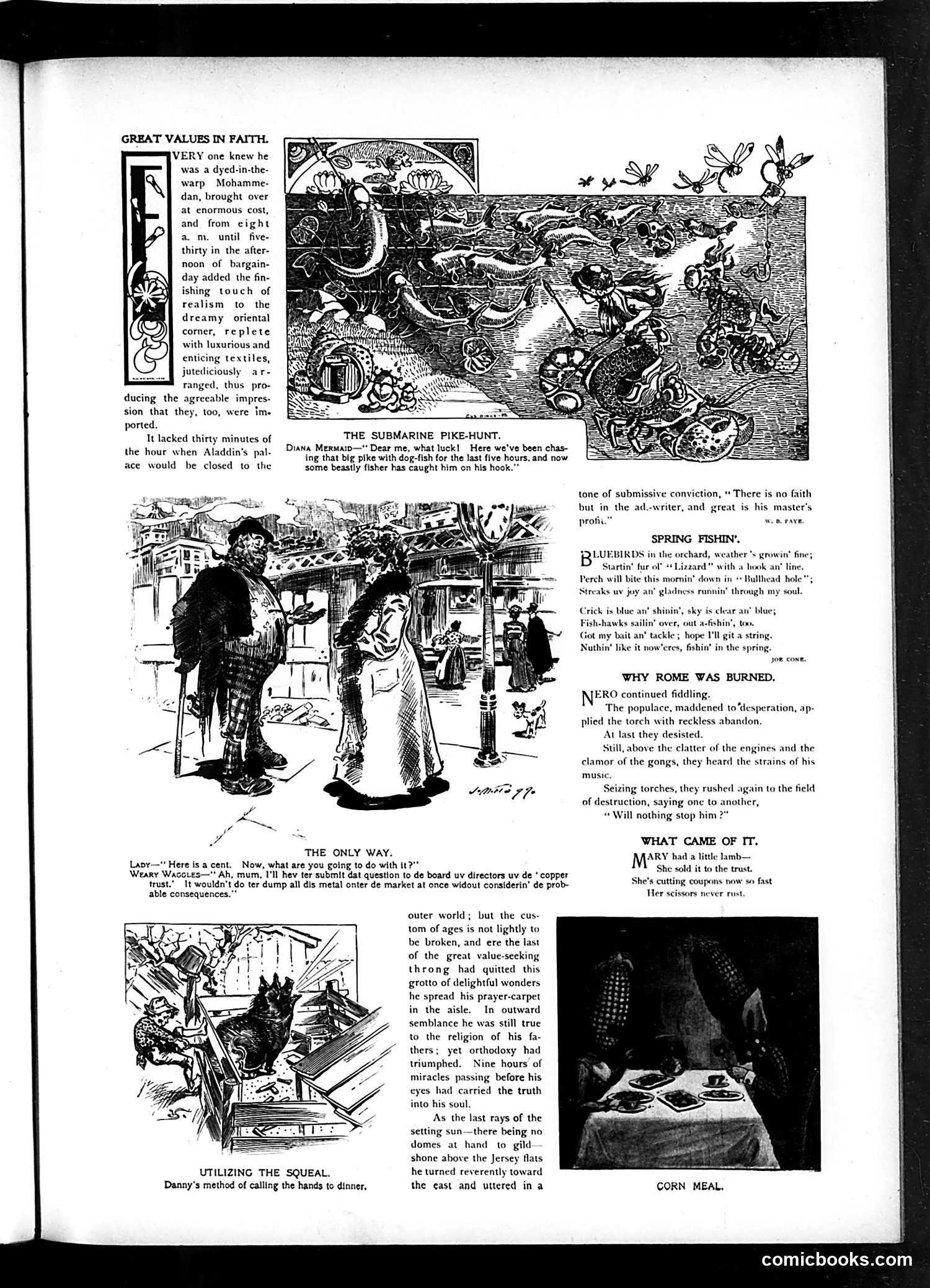
This page contains several satirical pieces targeting turn-of-the-century American society: **"Great Values in Faith"** mocks commercial advertising's use of exotic imagery. A department store hires a Muslim man as a living display prop for "Oriental" textiles during a sale, exploiting his genuine faith as mere decoration. The satire: retailers commodify authenticity for profit while reducing people to theatrical props. **"The Submarine Pike-Hunt"** is absurdist humor about mermaids complaining a fisherman caught their prey. **"Why Rome Was Burned"** reinterprets the Nero legend: the populace burns Rome not from madness, but because Nero's constant fiddling is unbearable—blaming leadership indifference for societal destruction. **"The Only Way"** criticizes monopoly trusts: a child's lamb is sold to a trust, which won't release it to market (controlling supply/prices), a critique of Gilded Age corporate consolidation. The page satirizes commercialism, monopolies, and the gap between appearance and reality in American capitalism.
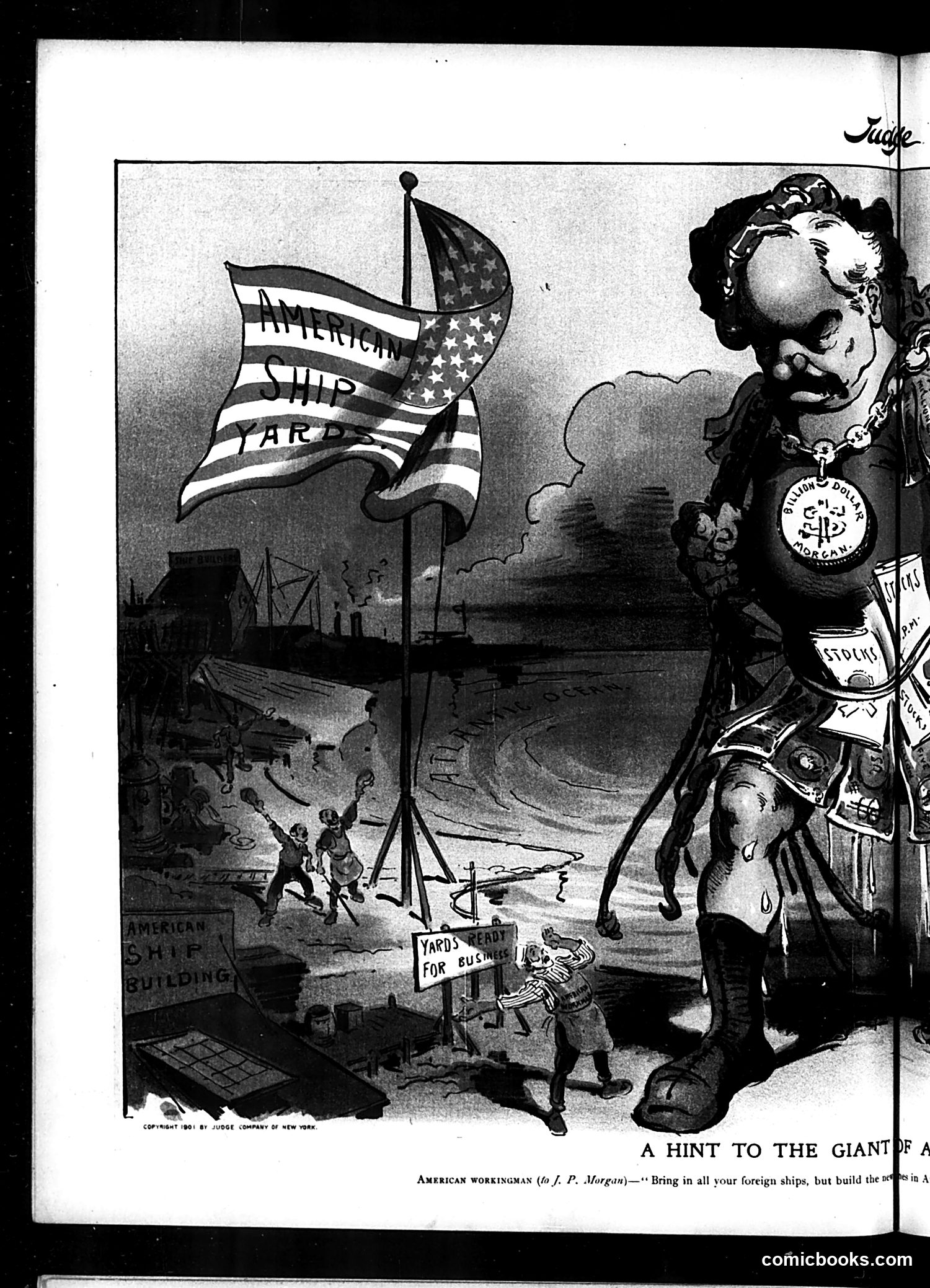
This Judge magazine cartoon satirizes J.P. Morgan, the powerful banker and industrialist. The "American Workingman" (depicted as a small figure) addresses Morgan (shown as a bloated giant on the right, wearing medals and fine clothing) with a sarcastic suggestion: bring foreign ships into American ports, but construct new vessels domestically. The satire targets Morgan's conflicting business interests—he profited from both importing foreign goods and domestic shipbuilding. The cartoon critiques how wealthy industrialists like Morgan leveraged their influence to benefit themselves while claiming to support American workers and industry. The American flag and shipyard setting emphasize the nationalist rhetoric masking selfish corporate interests. The workingman's small stature contrasts sharply with Morgan's enormous figure, highlighting the power imbalance between labor and capital.
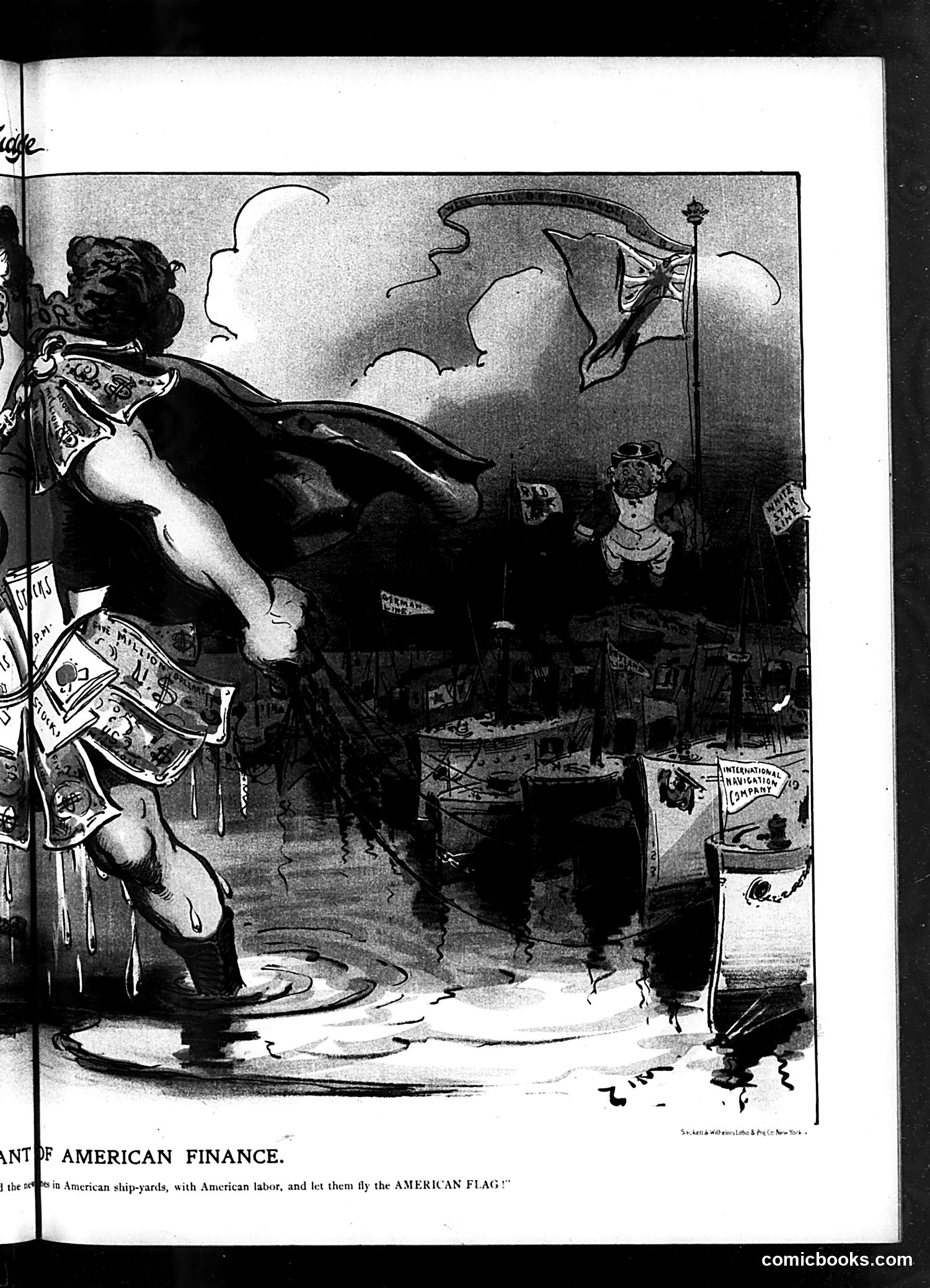
This political cartoon satirizes American industrial and financial power, depicting a large figure (appearing to represent American capitalism or a wealthy industrialist) striding across a landscape. The figure wears ornate clothing decorated with dollar signs and financial symbols, emphasizing wealth and greed. The caption reads: "Build the ships in American ship-yards, with American labor, and let them fly the AMERICAN FLAG!" This appears to be pro-American protectionist satire, likely from the early 20th century, advocating domestic manufacturing and labor. The cartoon mocks the "giant" of American finance as simultaneously powerful yet ridiculously oversized and greedy—critiquing either excessive corporate power or, conversely, celebrating American industrial might depending on *Judge* magazine's editorial stance at that moment.
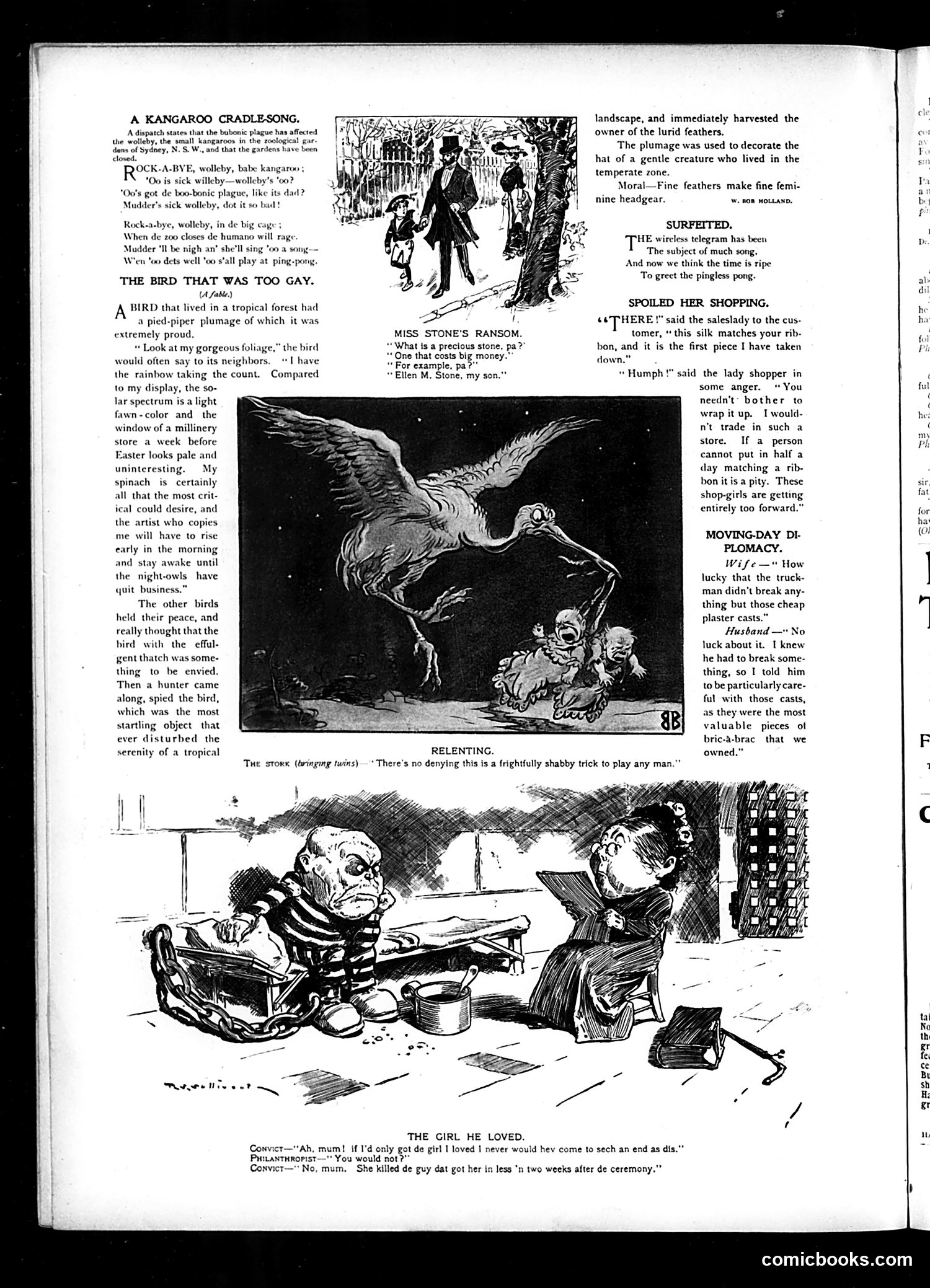
This page contains several satirical pieces typical of early 20th-century American humor: **"A Kangaroo Cradle Song"** mocks the reported bubonic plague affecting wallabies in Sydney's zoo using affected baby-talk dialect humor. **"The Bird That Was Too Gay"** is a moral fable: a vain tropical bird with brilliant plumage is hunted and killed, its feathers used to decorate a woman's hat. The satire targets female vanity and the fashion industry's cruel use of bird plumage for millinery decoration—a contemporary concern among naturalists and early conservationists. **"Miss Stone's Ransom"** references Ellen M. Stone, an American missionary kidnapped in Bulgaria in 1901-1902. The wordplay equates her (a "precious stone") with expensive gems, satirizing the high ransom demanded. The remaining short pieces contain mild domestic and shopping humor typical of the era, with no obvious political content. Overall, the page reflects early 1900s concerns: animal welfare, women's fashion excess, and international news events.
This page is primarily **advertising** with interspersed short humor items typical of Judge magazine's format. The humor pieces are mild, domestic jokes featuring Irish immigrant characters (Bridget and Pat), wives and husbands, and workplace scenarios—common subjects for early 20th-century American humor. They employ ethnic dialect humor and play on misunderstandings (a wife misunderstanding "inflammatory rheumatism" as "exclamatory rheumatism" because her husband "don't do nothing but holler"). The advertisements dominate the page, hawking products like Packer's Tar Soap, Evans' Ale, Crawford Shoes, and Sohmer Pianos—typical consumer goods of the era. The Prudential Insurance ad promotes life insurance as a "springtime" investment decision. An "I Want to Be a Newspaper Man" recruitment ad appears mid-page. There are no identifiable political cartoons or caricatures of public figures on this page. It's essentially a standard magazine interior mixing light domestic humor with commercial advertising.
This page is primarily **advertising**, not political satire. It contains brief humorous anecdotes at the top, then transitions to commercial advertisements. The small jokes reference everyday domestic and social situations: a woman's birthday candles, a gossipy neighbor's civic involvement, and a husband's boastfulness about starting as a bootblack. These are gentle, generic observations about American middle-class life—not topical satire. The bulk of the page showcases period advertisements: Chartreuse liqueur, a Chicago typewriter ($50), a water-powered fan ($4.50), Delaware rubber products, and regional travel promotions (Southern Railway to North Carolina). Two whiskey ads appear: Wilson Whiskey ("established 1823") and Red Top Rye. These reflect the era's open alcohol advertising, pre-Prohibition. The Southern Railway ad emphasizes Asheville and Hot Springs as health destinations with temperate climates—appealing to wealthy travelers seeking respite from urban heat and illness. Overall, this is a typical Judge page blending light humor with commercial content, not political commentary.
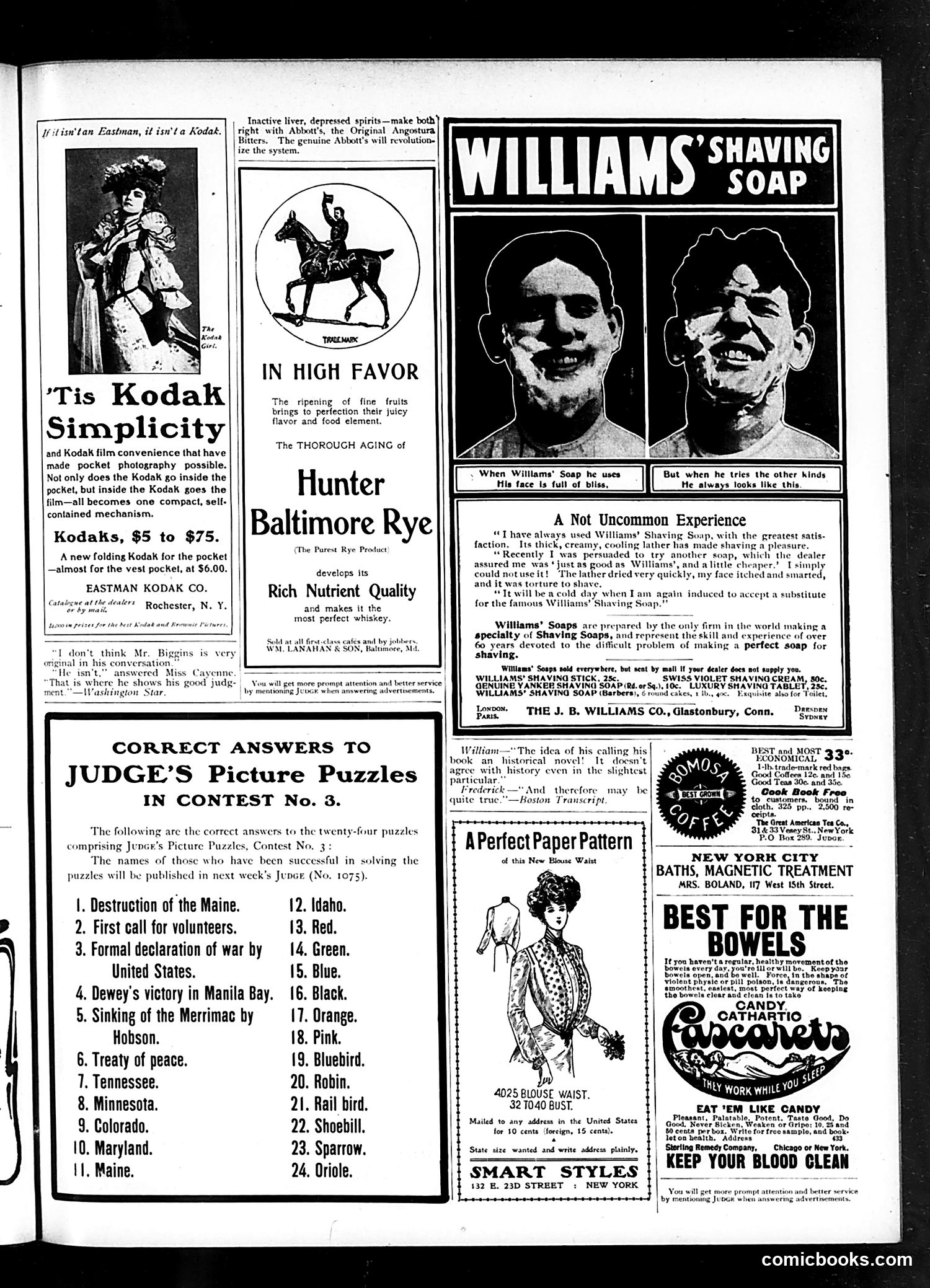
This page is primarily **advertising and contest answers**, not political satire. The dominant content includes: **Contest Section**: Answers to Judge's Picture Puzzles (Contest No. 3), listing 24 historical events, mostly from the **Spanish-American War** (1898)—destruction of the Maine, Dewey's victory in Manila Bay, Hobson's sinking of the Merrimac, treaty of peace. This reflects Judge's audience engagement through puzzles tied to recent national events. **Advertisements**: The page features product ads typical of the era—Kodak cameras, Hunter Baltimore Rye whiskey, Abbott's bitters, and Williams' Shaving Soap (with before/after face comparisons showing the superiority of their product). **Minor Humor**: One small anecdote mocks a writer's "historical novel" for contradicting actual history—light literary criticism rather than political commentary. The page reflects early 1900s magazine content: reader contests tied to patriotic events, nostalgic products, and commercial advertising dominating editorial space.
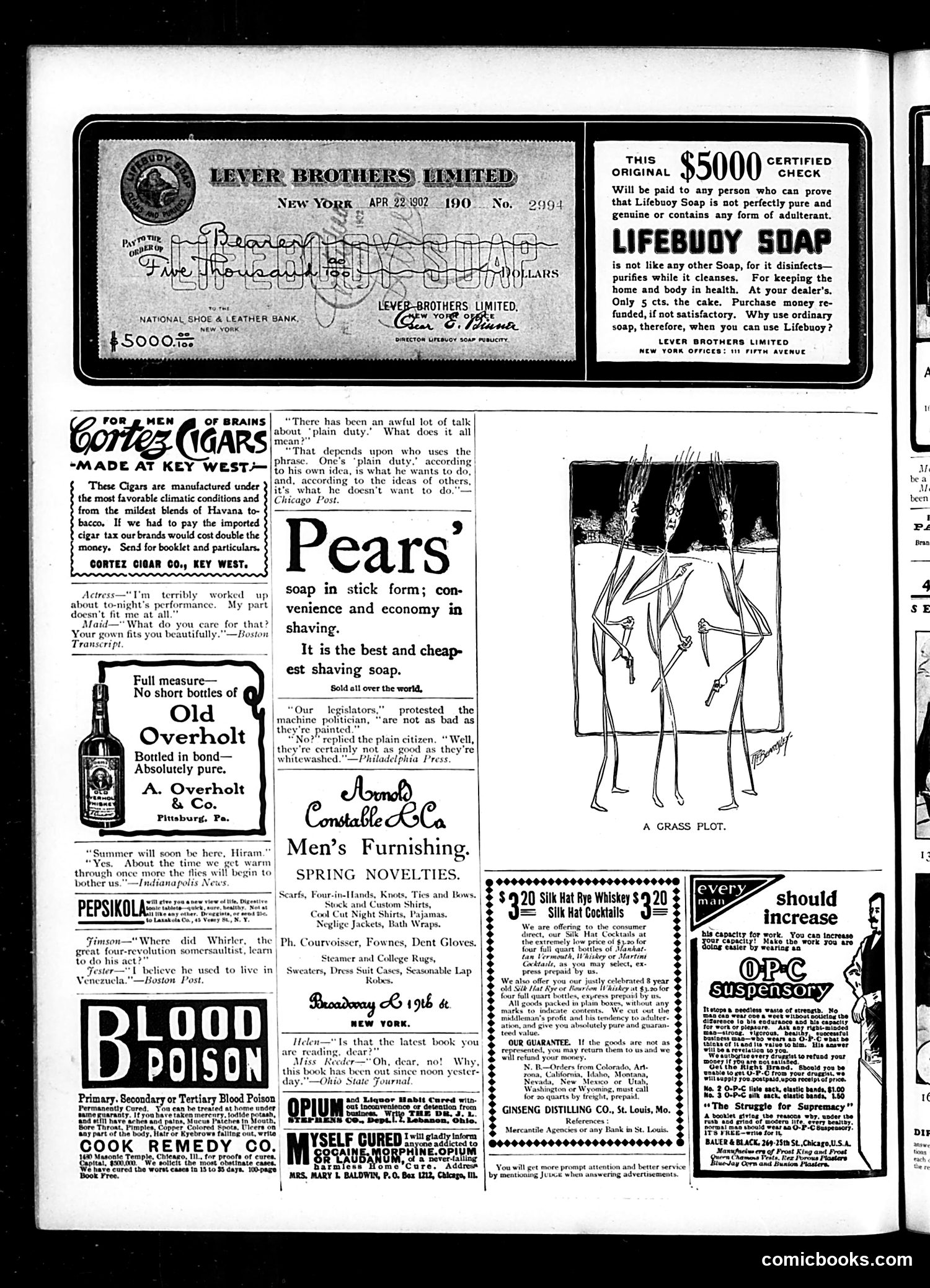
This is primarily an **advertising page** from Judge magazine (April 22, 1902), with minimal editorial content. The main notable item is a **check-based advertisement** from Lever Brothers promoting Lifebuoy Soap. It's a $5,000 "certified check" offering payment to anyone who can prove the soap contains adulterants—a marketing claim playing on contemporary consumer anxieties about product purity and food/product safety, which were significant concerns in the early 1900s before federal food and drug regulation. The page is otherwise filled with period advertisements for cigars, whiskey, patent medicines (including "Blood Poison" cures and opium treatments), men's furnishings, and other products. One small joke involves an actress whose costume doesn't fit—a minor theatrical humor item. The **U-P-C "suspensory"** advertisement is notable as period male medical/personal wear marketing. Overall, this page reflects early 20th-century consumer culture and the patent medicine era, with little political or social satire present.
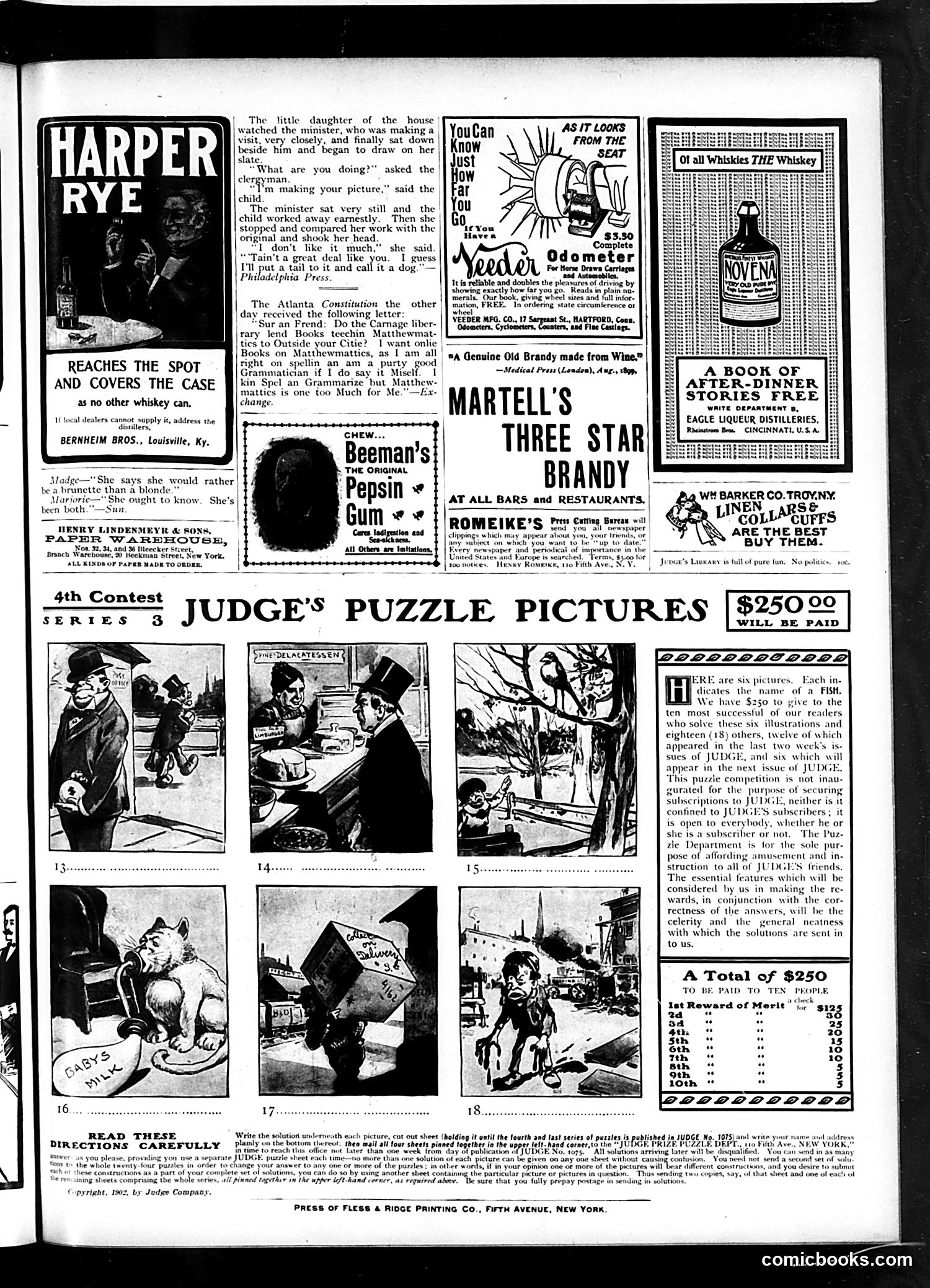
This page is primarily **advertising and a puzzle contest**, with minimal satirical content. The notable cartoon appears in the upper left: a **minister's visit** where a young girl draws his portrait but declares it unsatisfactory—threatening to "put a tail to it and call it a dog." The humor is gentle rather than political: it's a joke about the minister's unflattering appearance and childhood honesty, typical of era family humor. The rest of the page consists of **product advertisements** (Harper Rye whiskey, Beeman's Pepsin Gum, Needer Odometer, Martell's Brandy, etc.) and Judge's **"4th Contest Series 3: Judge's Puzzle Pictures,"** offering $250 total prize money to readers who can identify six illustrated fish pictures. There is **no apparent political satire** on this page. The content reflects Judge's dual function as both satirical magazine and vehicles for advertising and reader contests—a common revenue model for publications of this era.
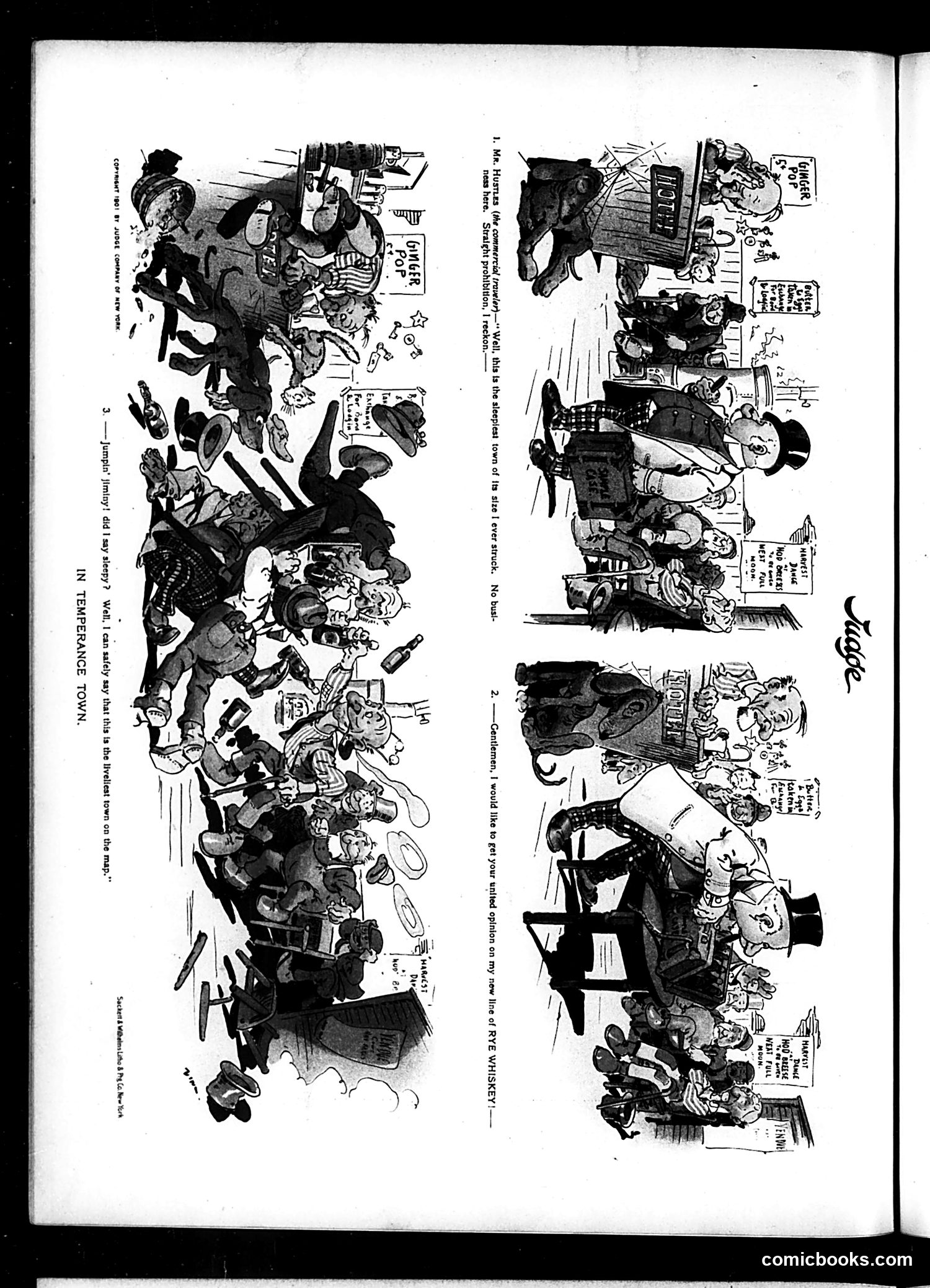
This two-panel Judge cartoon satirizes Prohibition's unexpected social consequences. **Panel 1:** A traveling salesman ("Mr. Hustles") arrives in a town and complains it's dead—"straight prohibition, I reckon"—assuming strict alcohol laws have killed all business and activity. **Panel 2:** He immediately retracts this assessment, calling it "the liveliest town on the map," after witnessing the chaotic reality: speakeasies, illegal drinking establishments, gambling, and general lawlessness thriving beneath the surface. **The Satire:** The cartoon mocks Prohibition's failure. Rather than creating orderly, sober communities, alcohol bans allegedly spawned underground vice operations more lively and visible than legitimate commerce. The "sleepy" town is ironically busier than ever—just criminally so. This reflects widespread public skepticism about Prohibition's actual effects during the 1920s.