
Judge, 1902-05-17 · page 2 of 16
Judge — May 17, 1902 — page 2: what you’re looking at
What you’re looking at
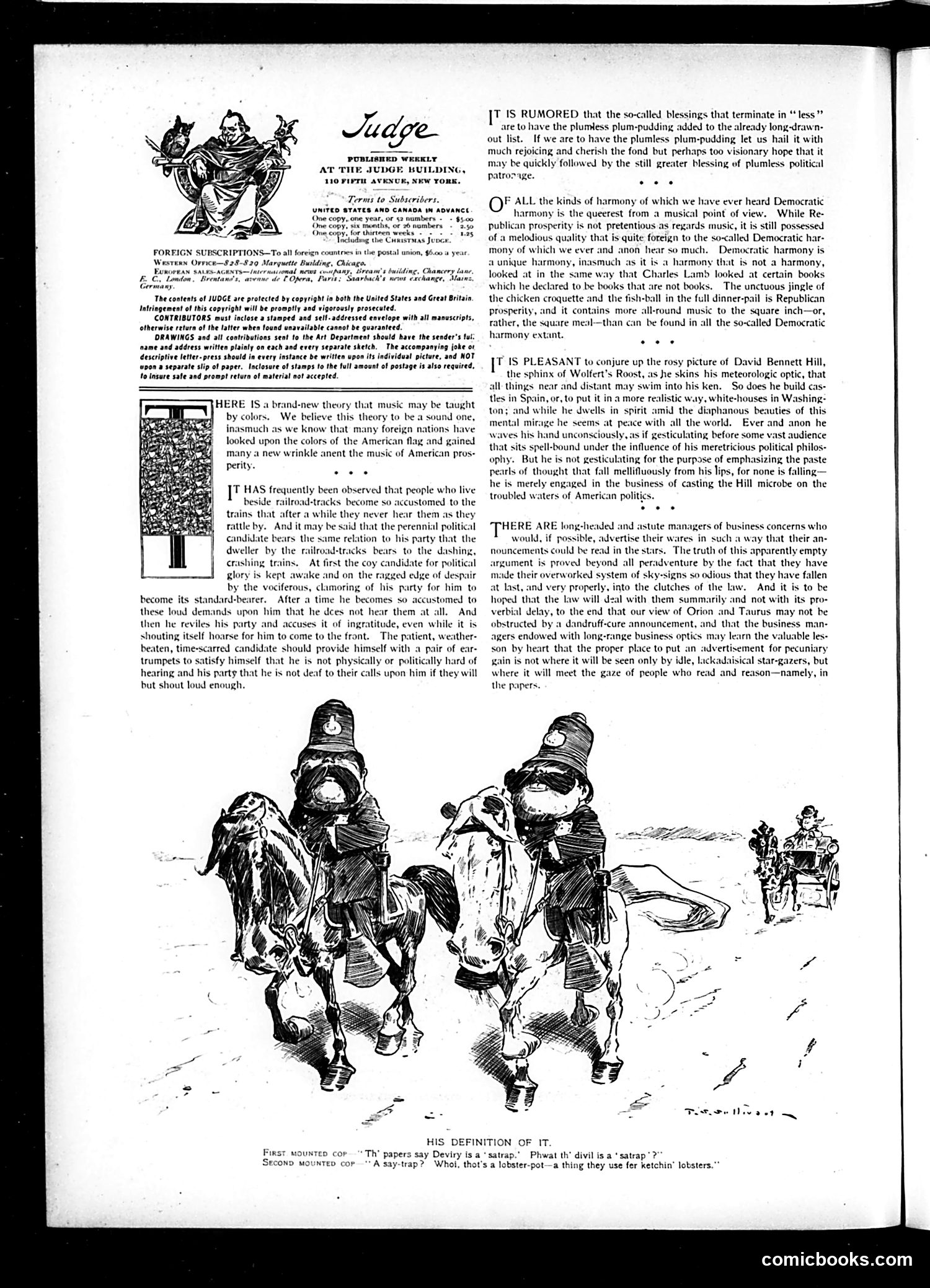
This cartoon satirizes Democratic political rhetoric about "harmony." The main editorial text critiques how Democrats claim to represent national unity while actually engaging in partisan conflict—comparing their supposed "harmony" unfavorably to Republican prosperity. The bottom cartoon depicts two mounted officials (likely representing Democratic leadership) riding camels in a desert, with a carriage visible in the distance. The dialogue parodies their self-serving definitions: when asked what a "satrapy" is, they claim it's a "trap"—suggesting Democratic leaders cynically use noble-sounding language to mask self-interested politics. The satire implies Democratic unity rhetoric is hollow cover for actual divisive practices. The camel imagery may reference Eastern despotism, suggesting authoritarian political behavior.
📄 Transcribed text from this page (OCR, searchable)
Machine-transcribed from the original scan — historical spelling and the odd misread are preserved.
AT THE JUDGE BUILDING, 110 PIVTH AVENUE, NkW YORK. Terms to Subscribers. UNITED STATES AND CANADA IN ADVANCE ,or ge numbers = #50 One copy, for urteen weeks ss > has Jachuding the Cusasaas Juoc FORFIGN SUBSCRIPTIONS—To all foreign countries in the post , Chicago. couupany, Dream's building, Chancery ls union, $6.00 otherwise return of the latter when found unavailable cannot be guaranteed. s seat fo the Art Department should have the sender's ful: d every separate sketch. The accompanying jake ot descriptive letter-press should in every instance be written upon its individual picture, and NOT upon a separate slip of paper. Iaclosure of stamps fo the fu of postage is also required, to insure safe and prompt return of material not accepted. HERE IS a brand-new theory that music may be taught by colors. We believe this theory to be a sound one, inasmuch as we know that many foreign nations have looked upon the colors of the American flag and gained many a new wrinkle anent the music of American pros- perity. ks Se & T HAS frequently been observed that people who live beside railroad-tracks become so accustomed to the trains that after a while they never hear them as they rattle by. And it may be said that the perennial political candidate bears the same relation to his party that the dweller by the railroad-tracks. be: crashing trains, At fi glory is kept awake and on the ragged edge of despair by the vociferous, clamoring of his party for him to become its standard-bearer. After a time he becomes so accustomed to these loud demands upon him that he dees not hear them at all then he reviles his party and accuses it of ingratitude, even wh shouting itself hoarse for him to come to the front. The patient, weather- beaten, time ted candidate should provide himself with air of trumpets to satisfy himself that he is not physically or politically hard of hearing and his party that he is not deaf to their calls upon him if they will but shout loud enough. [T'S RUMORED that the so-called blessings that terminate in “ less” are to have the plumless plum-pudding added to the already long-drawn- out list. If we are to have the plumless plum-pudding let us hail it with much rejoicing and cherish the fond but perhaps too visionary hope that it may be quickly followed by the still greater blessing of plumless political patromage. OF ALL the kinds of harmony of which we have ever heard Democratic harmony is the queerest from a musical point of view. While Re- publican prosperity is not pretentious as regards music, it is still possessed of a melodious quality that is quite foreign to the so-called Democratic ha mony of which we ever and anon hear so much. Democratic harmony is a unique harmony, inasmuch as it is a harmony that is not a harmony, looked at in the same way that Charles Lamb looked at certain books which he declared to be books that are not books. The unctuous jingle of the chicken croquette and the fish-ball in the full dinner-pail is Republican prosperity, and it contains more all-round music to the square inch—or, her, the square meal—than cin be found in all the so-called Democratic harmony extant. " IS PLEASANT to conjure up the rosy picture of David Bennett Hill, the sphinx of Wolfert’s Roost, as he skins his meteorologic optic, that all things near and distant may swim into his ken. So does he build tles in Spain, or, to put it ina more r white-houses in Washing: ton; and while he dwells in spirit amid the diaphanous beauties of this mental mirage he seems at peace with all the world. Ever and anon he waves his hand unconsciously, as if gesticulating before some vast audience that sits spell-bound under the influence of his meretricious political philos- ophy. But he is not gesticulating for the purpose of emphasizing the paste pearls of thought that fall mellifluously from his lips, for none is falling: he is merely engaged in the business of casting the Hill microbe on the troubled waters of American politics. HERE ARE long-headed and astute managers of business concerns who would, if possible, advertise their wares in such a way that their an- houncements could be read in the stars. The truth of this apparently empty argument is proved beyond all peradventure by the fact that they have made their overworked system of sky-signs so odious that they have fallen at last, and very properly, into the clutches of the law. And it is to be hoped that the law will deal with them summarily and not with its pro- verbial delay, to the end that our view of Orion and Taurus may not be obstructed by a dandruff-cure announcement, and that the business man- agers endowed with long-range business optics may learn the valuable les son by heart that the proper place to put an advertisement for pecuniary gain is not where it will be seen only by idle, lackadaisical star-gazers, but where it will meet the gaze of people who read and reason—namely, in the papers. HIS DEFINITION OF IT. First mounreo cor Second mounteo cor Th’ papers say Deviry is a“ satrap." Phwat th’ divil is a ‘ satrap *? “A say-trap? Whol, thot's a lobster-pot—a thing they use fer ketchin’ lobsters.”" comicbooks.com