
A complete issue · 16 pages · 1902
Judge — May 3, 1902
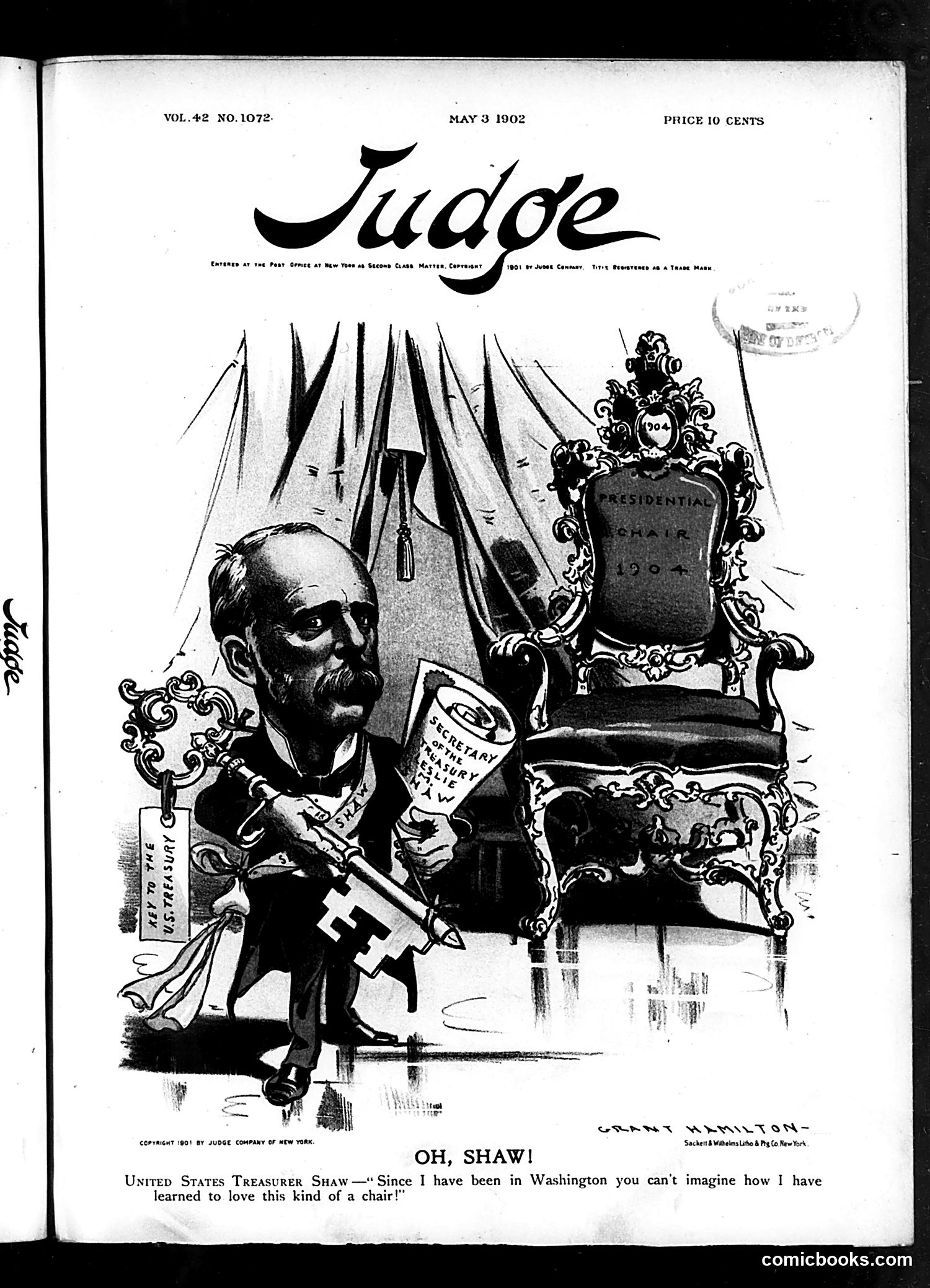
This political cartoon satirizes **United States Treasurer Leslie M. Shaw** (identifiable by the label and caricature). Shaw is depicted as a vain aristocrat seated in an ornate "Presidential Chair" labeled "1904," surrounded by symbols of office and authority including flags and decorative regalia. The satire mocks Shaw's apparent ambitions for the 1902 presidency, suggesting he has become enamored with the trappings of power and Washington's prestigious institutions since taking office. The quote—"Since I have been in Washington you can't imagine how I have learned to love this kind of chair!"—criticizes his newfound attachment to executive privilege and grandeur. The cartoon implies Shaw is becoming corrupted by position, prioritizing comfort and status over public service.
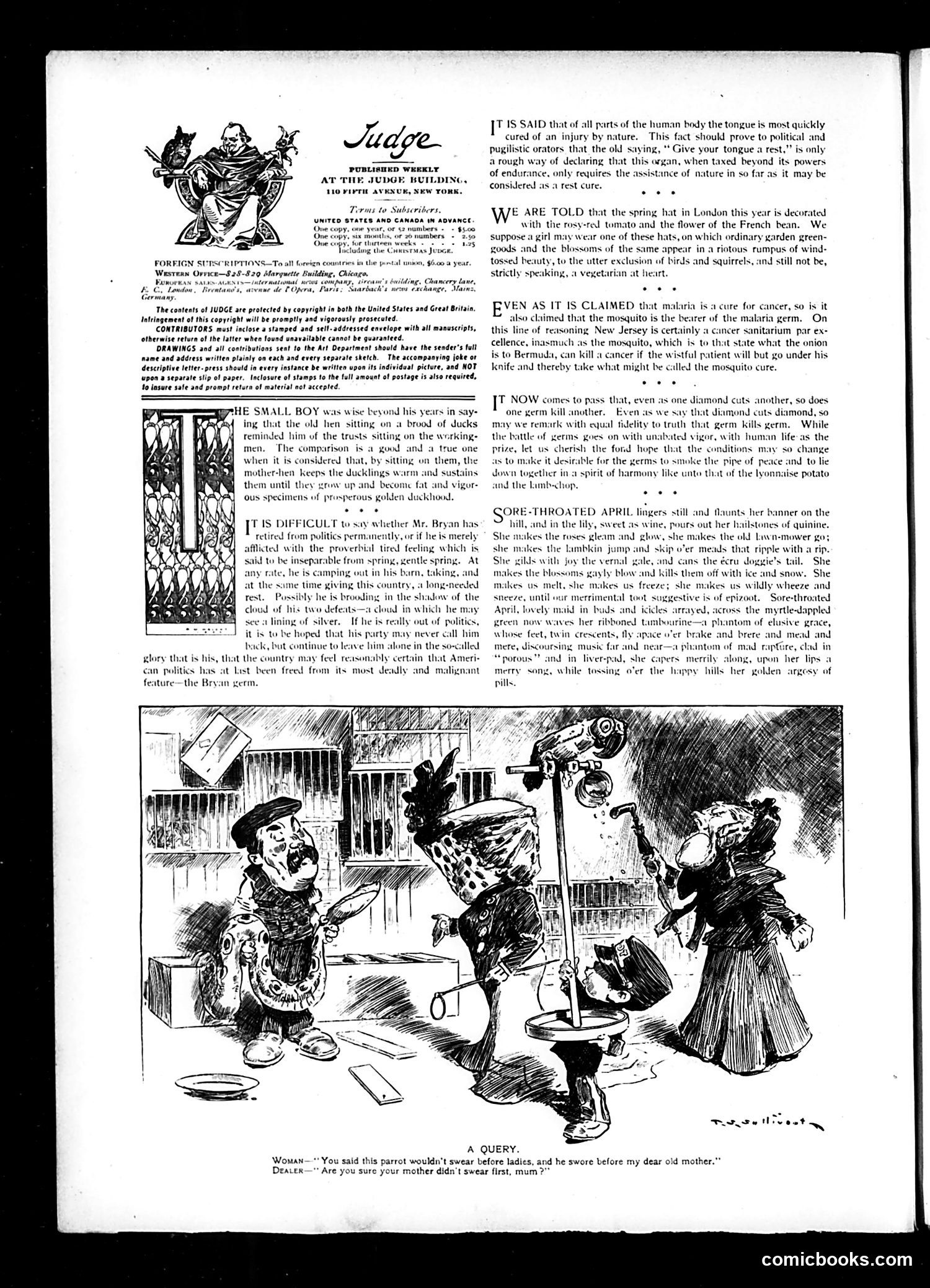
This page contains several satirical pieces typical of Judge magazine's social commentary. The main cartoon at bottom depicts a **parrot-selling transaction**. The humor relies on a double entendre: the woman claims the parrot "wouldn't swear before ladies" and swore before her mother, while the dealer questions whether the mother actually heard it first. The joke plays on the parrot's indiscriminate profanity and social propriety expectations of the era. The upper text discusses medical and scientific topics of the period—tongue injuries, London's spring decorations, mosquitoes as disease vectors, and diamond cutting. These represent Judge's characteristic blend of light commentary on contemporary health concerns and scientific developments, presented with humorous skepticism about claims made regarding these innovations. The overall tone is satirical commentary on modern life and human nature rather than direct political satire.
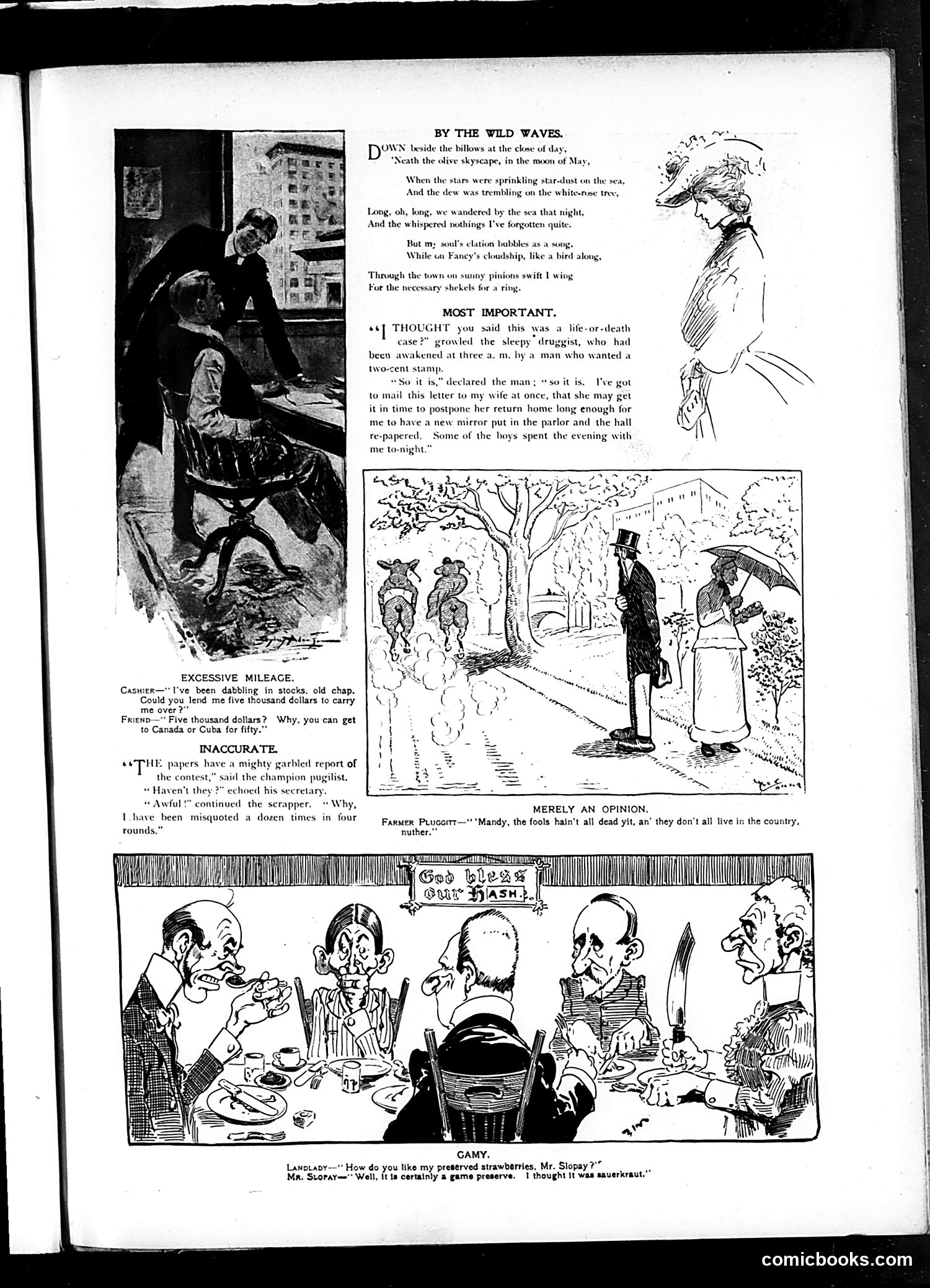
This page contains several humorous sketches typical of early-20th-century satirical journalism: **"By the Wild Waves"** (top): A poem about seaside wandering and romance, illustrated with period figures. **"Excessive Mileage"** (left): A dialogue where a cabbie demands payment for numerous trips, exploiting a passenger—satirizing overcharging taxi drivers. **"Most Important"** and **"Inaccurate"** (center): Brief comedic anecdotes about trivial domestic concerns (mirrors, newspaper misprints) treated as urgent—mocking petty preoccupations. **"Merely an Opinion"** (middle): Rural characters dismissing city sophistication—a common class-based joke. **"Gamy"** (bottom): A dinner scene where guests euphemistically discuss "game preserve" for spoiled meat—satirizing pretentious dining language masking poor quality. The overall theme: social pretension, class differences, and linguistic absurdity in everyday situations.
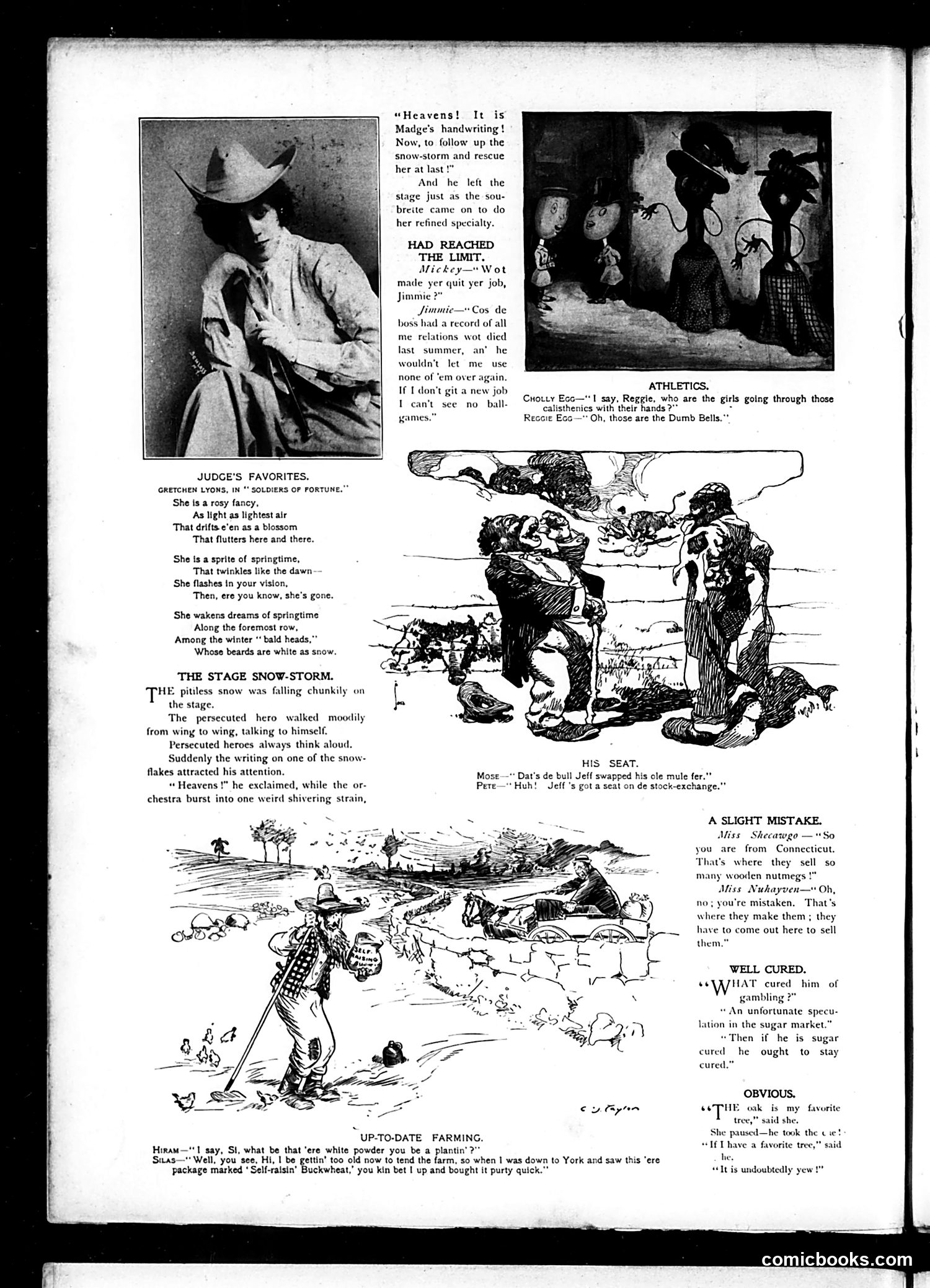
This page contains theatrical sketches and humorous vignettes rather than political commentary. The content includes: **"Judge's Favorites"** — A portrait section celebrating actress Gretchen Lyons, with poetic verses praising her beauty and stage presence. **"The Stage Snow-Storm"** — A theatrical scene where artificial snow falls on stage during a performance, causing the hero to react dramatically. **"Athletics"** and **"His Seat"** — Brief comedic dialogues about theater attendance and seating. **"Up-to-Date Farming"** — A cartoon satirizing modern agricultural practices, likely mocking newfangled farming methods or equipment. **"A Slight Mistake," "Well Cured," and "Obvious"** — Short joke vignettes with punchlines about regional differences and misunderstandings. The page appears primarily entertainment-focused rather than politically satirical.
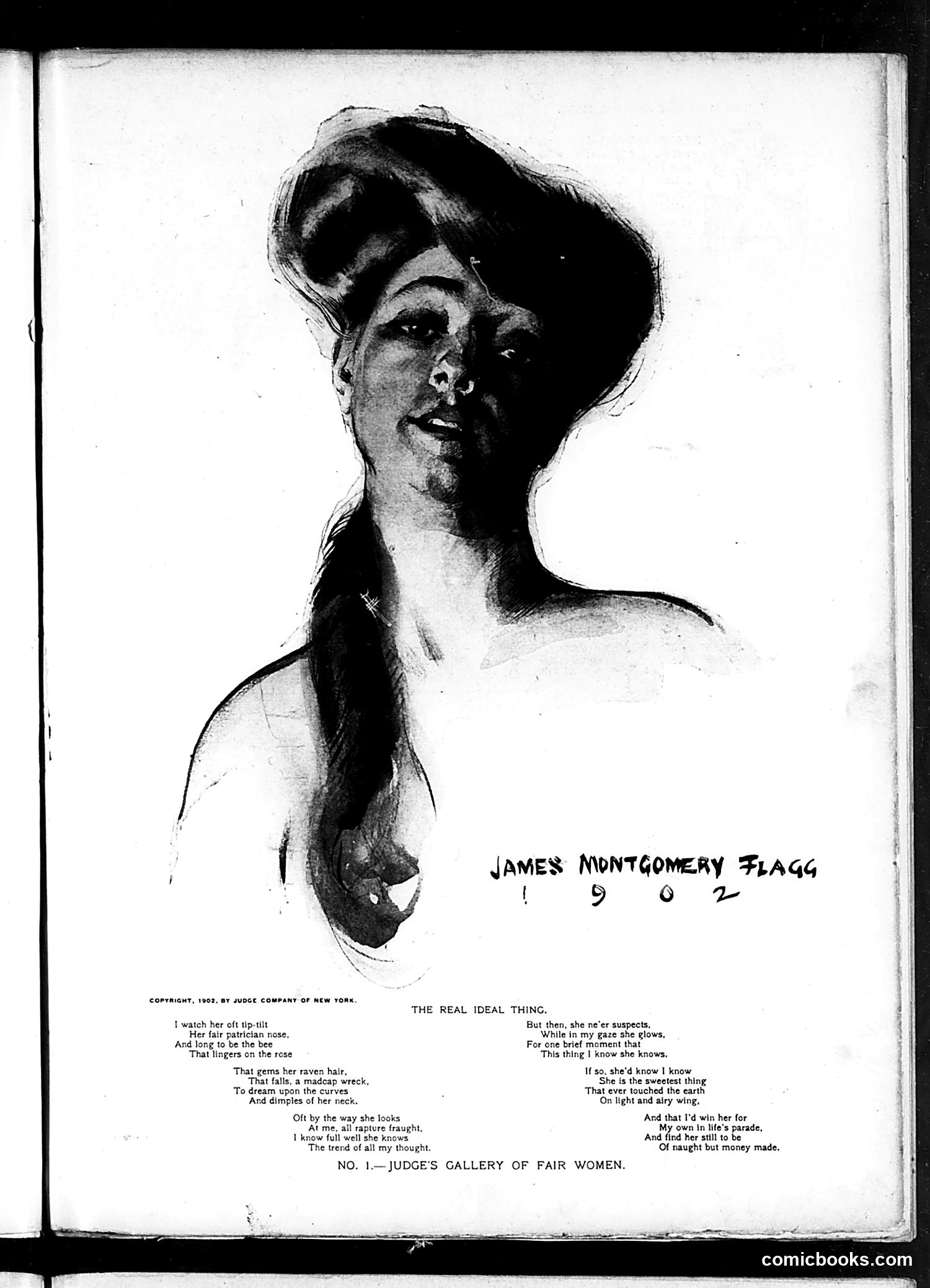
This 1902 Judge magazine page features a portrait sketch by renowned illustrator James Montgomery Flagg, titled "The Real Ideal Thing." It's the first in a "Gallery of Fair Women" series. The accompanying poem satirizes romantic idealization and self-deception in courtship. The male speaker romanticizes a woman's physical beauty (her nose, hair, neck) while convincing himself she reciprocates his feelings through subtle glances. However, the poem's final lines reveal bitter cynicism: he suspects she's ultimately interested only in money, not genuine affection. The satire targets both male delusion about female interest and the transactional nature of Gilded Age romance, where wealthy suitors pursued women who valued financial security over authentic connection. Flagg's elegant sketch contrasts with the poem's disenchanted message about the gap between romantic fantasy and mercenary reality.
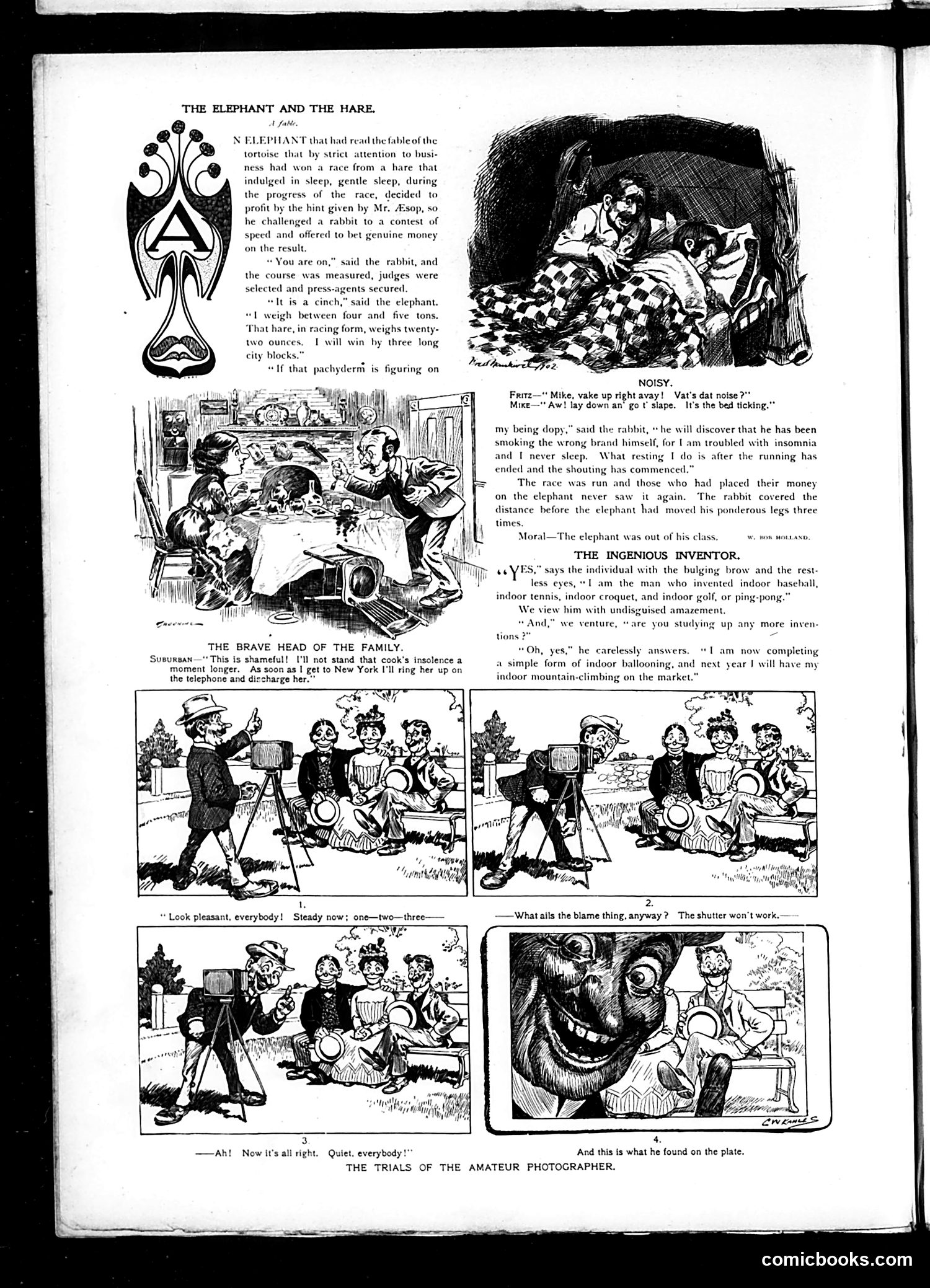
This page contains three separate satirical pieces from Judge magazine: **"The Elephant and the Hare"**: A modern retelling of Aesop's fable where an overconfident elephant challenges a rabbit to a race, certain of victory due to size. The rabbit, plagued by insomnia, wins easily. The moral: confidence without self-knowledge fails. This likely satirizes overblown American confidence or corporate hubris circa early 1900s. **"The Ingenious Inventor"**: Mocks an inventor claiming credit for "indoor" versions of outdoor activities (baseball, tennis, golf, croquet, mountain-climbing, ballooning). The satire targets either frivolous patent-seekers or the absurdity of commercializing artificial recreations. **"The Brave Head of the Family" and "The Trials of the Amateur Photographer"**: Comic strips depicting domestic mishaps—a husband struggling with photography equipment while his wife threatens to discharge the maid, and the humorous results when the camera finally works. The humor is lighthearted social observation rather than political commentary.
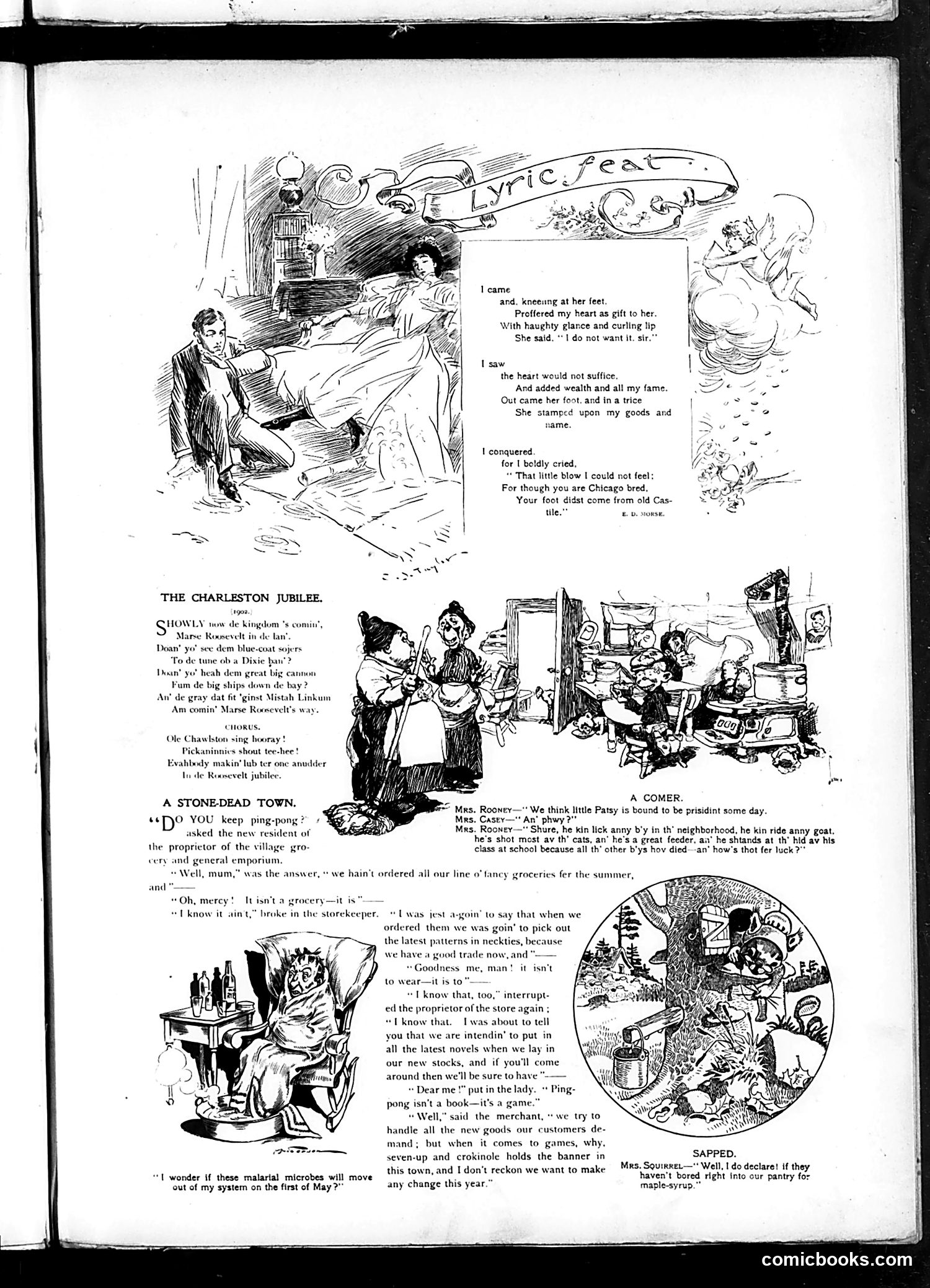
This page contains several satirical pieces typical of early 1900s humor: **"Lyric Seat"** (top): A romantic poem mocking courtship, where a suitor's declarations of love and wealth are rejected by a woman who literally stamps on his "goods and name"—until he appeals to her vanity by claiming her foot is Spanish rather than American. The joke satirizes both sentimental romance and shallow materialism. **"The Charleston Jubilee"**: A dialect piece in offensive stereotypes celebrating Theodore Roosevelt's presidency, using exaggerated African American vernacular. This reflects the casual racism of the era. **"A Stone-Dead Town"** and related sketches: Humorous exchanges about a small town's stagnant economy. A shopkeeper explains the town hasn't ordered fancy groceries or novelties because there's no demand—a commentary on economic depression in rural America and small-town decline. **"A Comer"** and **"Sapped"**: Short domestic humor pieces typical of the magazine's filler content. The overall tone reflects 1900s magazine satire: class commentary, ethnic stereotyping, and gentle mockery of provincial American life.
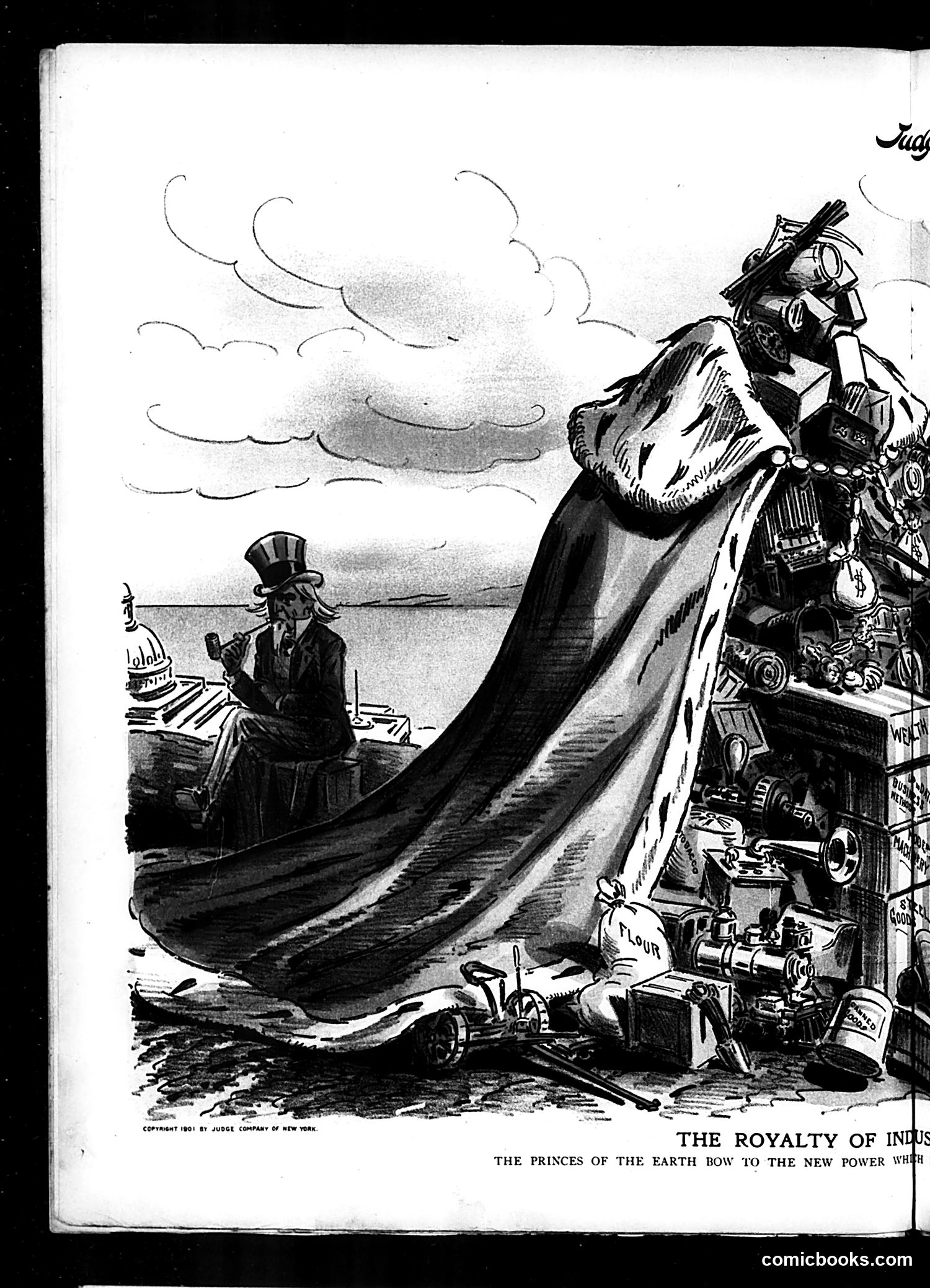
This 1891 *Judge* cartoon satirizes the rising power of industrial magnates over traditional aristocracy. The central figure—a dramatically caped industrial baron, laden with factory machinery and symbols of manufacturing wealth—towers over a small, formally-dressed gentleman in a top hat who bows deferentially. The caption declares that "princes of the earth bow to the new power"—industry itself. The scattered goods at bottom (marked "flour" and other commodities) represent industrial output. This reflects the Gilded Age anxiety about wealth concentration: self-made industrialists had become more powerful than old-money aristocrats or government officials. The cartoon criticizes this shift, suggesting that manufacturing moguls now command more respect and influence than traditional social hierarchies, a commentary on capitalism's transformative social impact during rapid American industrialization.
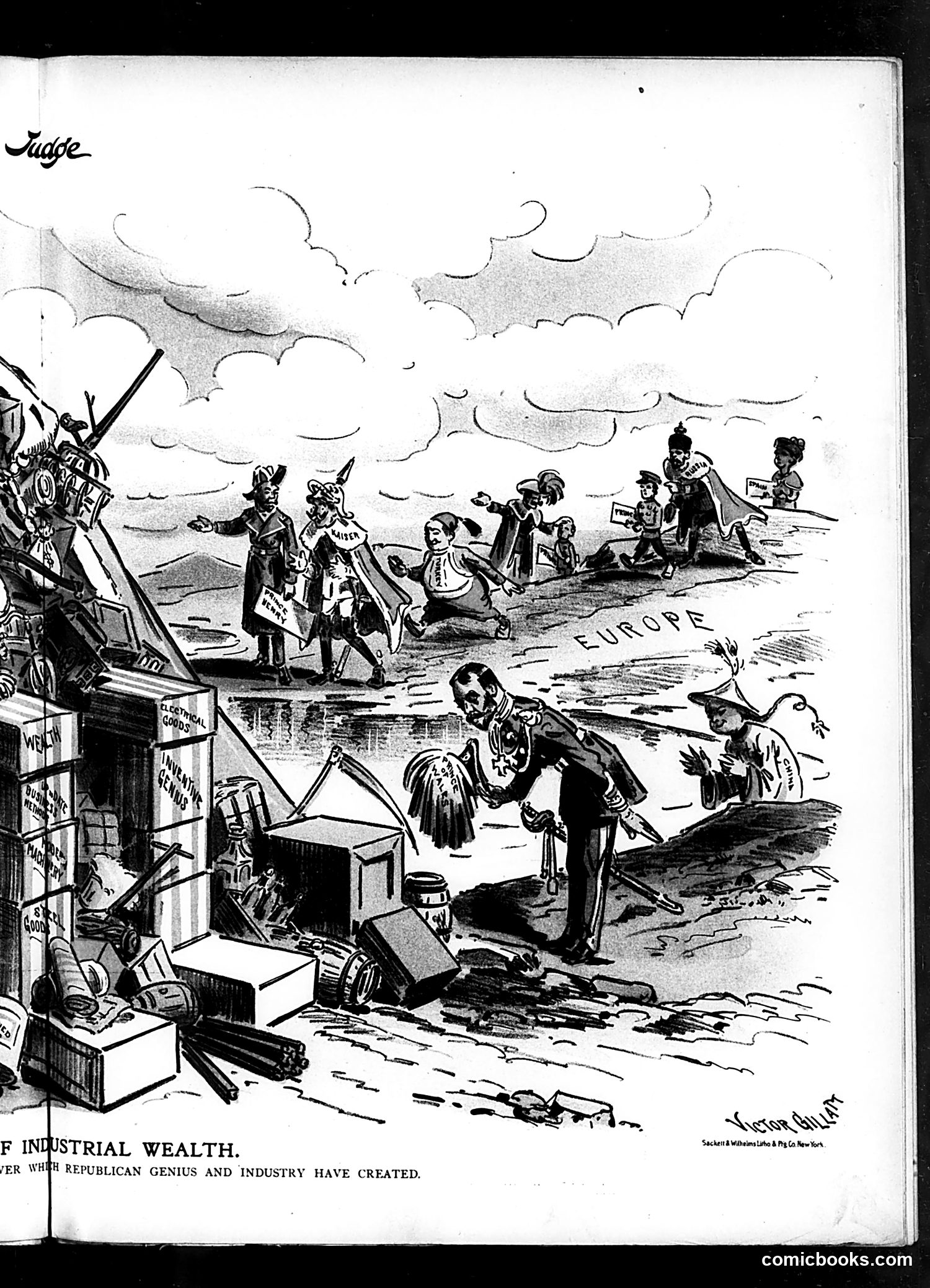
This Judge magazine cartoon satirizes Republican claims about industrial wealth creation. The left side shows an elaborate industrial structure labeled with various commercial interests, representing the wealth Republicans claimed to have built. However, the right side depicts European figures (identifiable by their military dress and imperial styling) approaching across labeled "EUROPE," appearing to claim or take possession of this American industrial wealth. The satire suggests that despite Republican boasts about creating industrial prosperity, foreign powers—likely representing imperial European nations—threaten to seize or exploit these American riches. This reflects late-19th or early-20th century anxieties about foreign economic competition and imperialism. The cartoon critiques Republican industrial policy as vulnerable to international exploitation, undermining their claims of successful wealth creation and national economic protection.
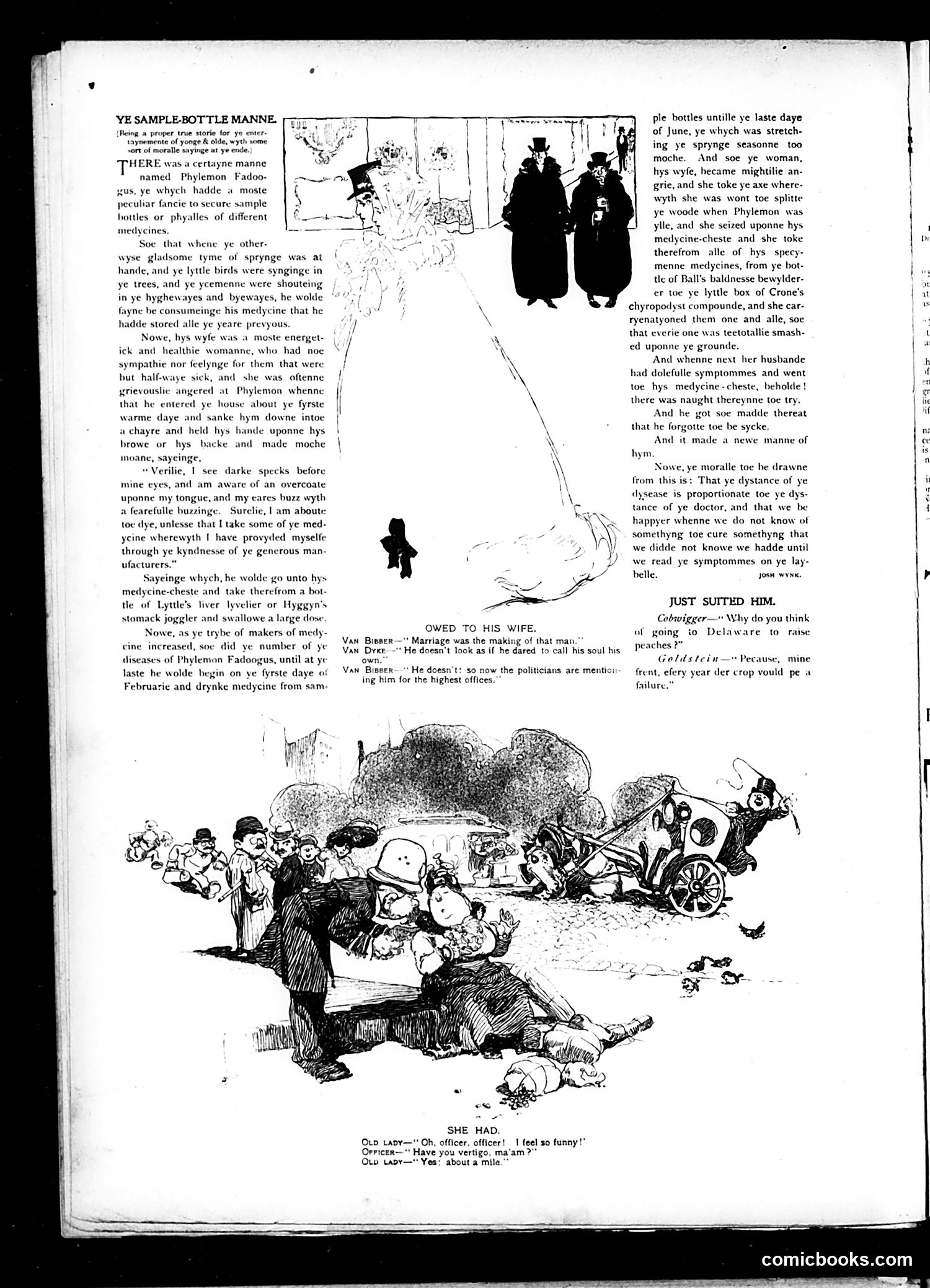
This page contains two satirical pieces from *Judge* magazine: **"Ye Sample-Bottle Manne"** is a mock-medieval tale mocking hypochondriacs who collect patent medicine samples. Phylemon Fadoogius obsessively drinks these throughout spring, claiming various ailments. His fed-up wife finally smashes his entire medicine collection, which paradoxically cures him—suggesting the medicines were placebos and his "diseases" imaginary. The satire targets both gullible consumers and the patent medicine industry's proliferation of bogus remedies. **"Just Suited Him"** (bottom) is a brief joke about a man planning to raise peaches in Delaware. His friend asks why, and he replies that his crop would fail there annually—implying Delaware's climate makes it unsuitable, so failure is guaranteed. The humor is dry: the man seems resigned to inevitable failure. The page reflects early 20th-century American skepticism toward unregulated patent medicines and their aggressive marketing to the worried well.
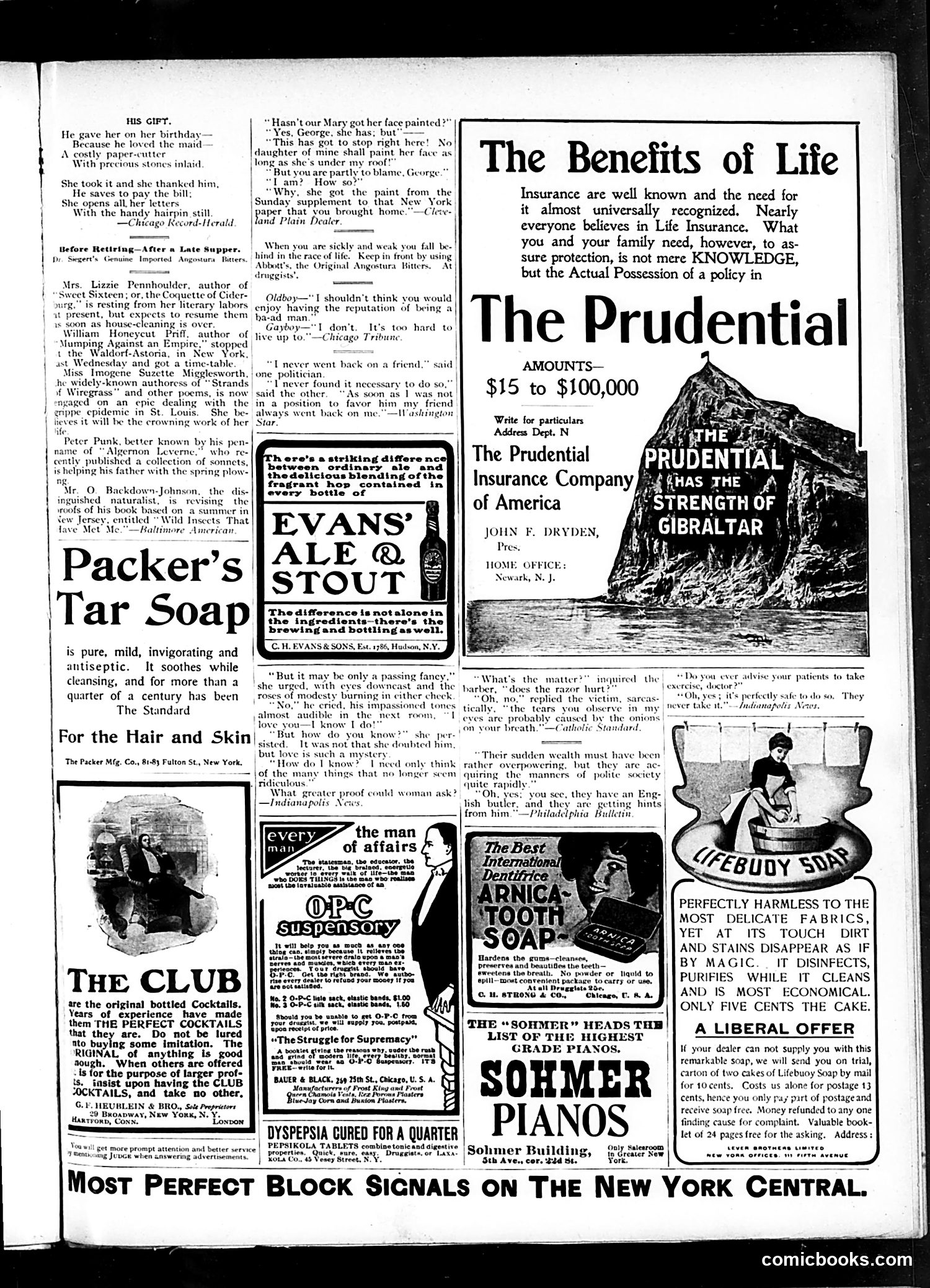
This page is primarily **advertising**, typical of Judge magazine's format. The notable content includes: **"His Gift" Cartoon (top left):** A brief satirical domestic sketch about a father angry that his daughter wants to wear face paint, declaring she won't "paint her face" under his roof. She secretly obtains cosmetics from a newspaper supplement, then opens "all her letters / With the handy hairpin still"—implying she's secretly corresponding. The joke mocks both paternal authority and the growing cosmetics/fashion industry targeting young women. **Literary Gossip Section:** Notices about minor authors and their works, presented mockingly—standard magazine filler poking fun at minor literary figures. **Advertisements:** The page is dominated by period product ads (Packer's Tar Soap, Evans' Ale & Stout, Prudential Insurance, OPC Suspensory, Lifebuoy Soap, Sohmer Pianos) with accompanying illustrations. **Bottom:** A fragment about "Most Perfect Block Signals on the New York Central" (railroad advertising). The page reflects early 1900s consumer culture, beauty standards, and concerns about youth independence.
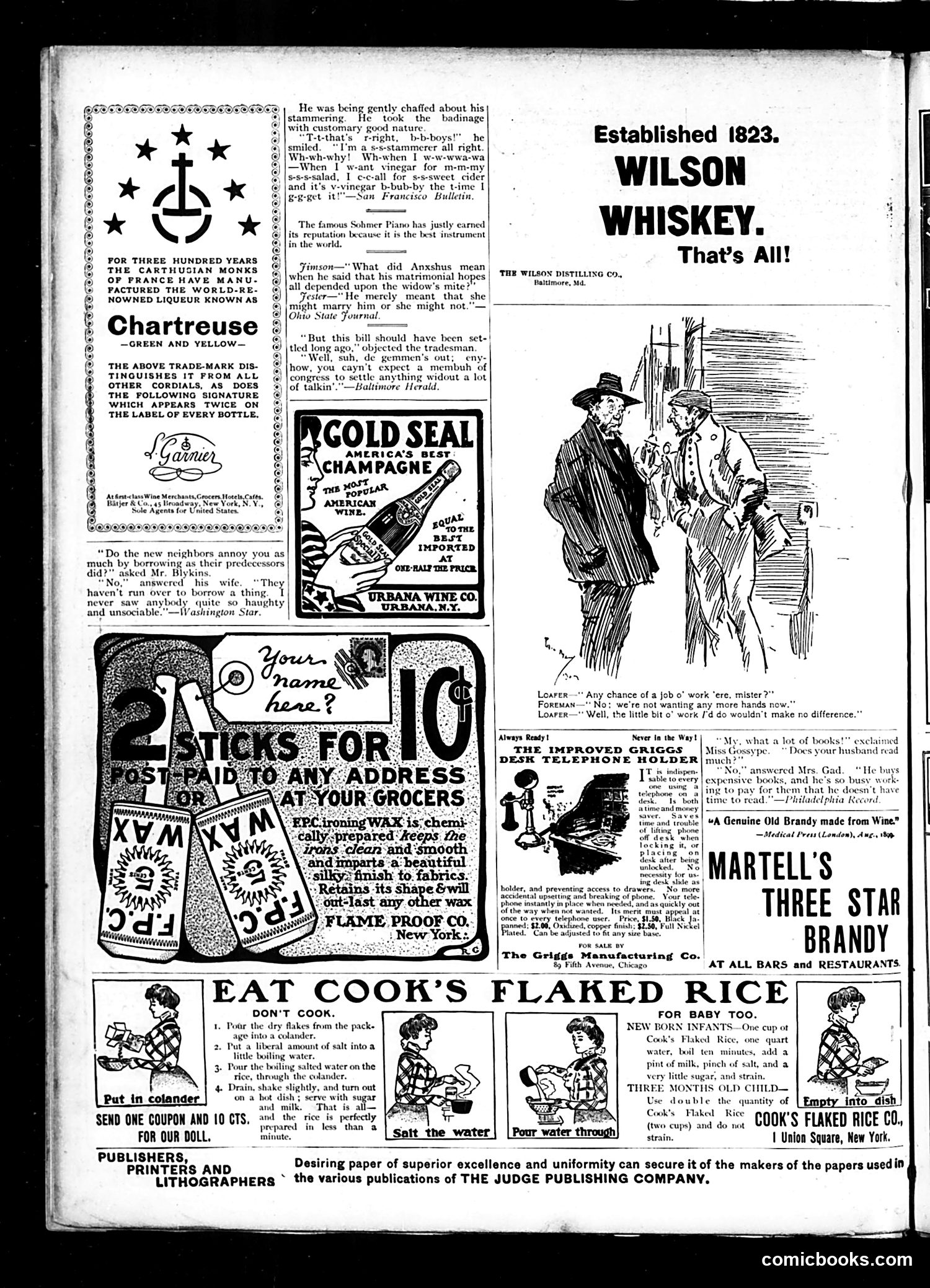
This page is primarily **advertising**, with several small humorous anecdotes and jokes interspersed. The main cartoons show: 1. **Top right**: A sketch of two working-class men (a "Loafer" and "Foreman") discussing job availability during what appears to be an economic downturn—the foreman says they're "not wanting any more hands now," suggesting labor surplus. 2. **Center**: Various short jokes about domestic life—stammering, marriage hopes, borrowing from neighbors, and husbands not reading books they buy—typical early-20th-century domestic humor. The **advertisements** dominate: Wilson Whiskey, Gold Seal Champagne, Chartreuse liqueur, a telephone holder, laundry wax, and Cook's Flaked Rice (marketed even for infants). These ads reflect consumer goods and brand-building typical of the 1910s-1920s era. The page lacks overt political satire; it's essentially a humor and advertising vehicle for *Judge*'s middle-class readership.
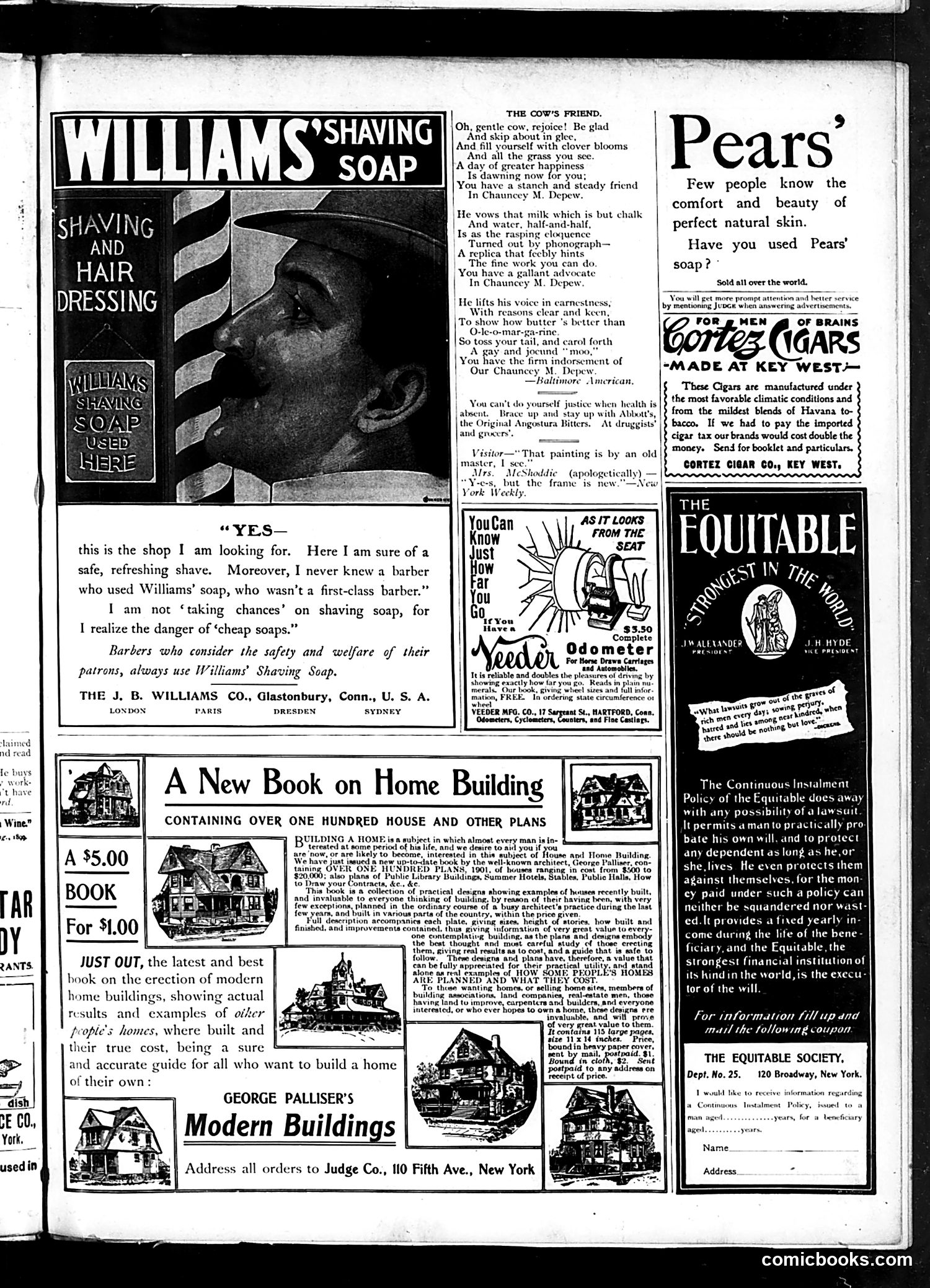
This page is primarily **advertising** with one political-social cartoon. ## The Cartoon: "The Cow's Friend" The cartoon satirizes **Chauncey M. Depew**, a prominent Republican politician and railroad executive, who apparently made public statements defending oleomargarine (cheap butter substitute) and milk quality. The poem mocks him as "the cow's friend" while actually championing products that undermine dairy farmers—he advocates for oleomargarine over real butter and defends milk quality claims that the cartoonist suggests are dubious. The satire targets **hypocrisy**: Depew claims to support farmers while endorsing products that compete with and potentially defraud consumers about dairy products. This reflects late-19th-century debates over food regulation and corporate influence on consumer goods. ## The Rest The page contains advertisements for **Williams' Shaving Soap**, **Pears' Soap**, **Cortes Cigars**, the **Equitable Life Insurance Society**, the **Veeder Odometer**, and a book on home building by architect George Palliser.
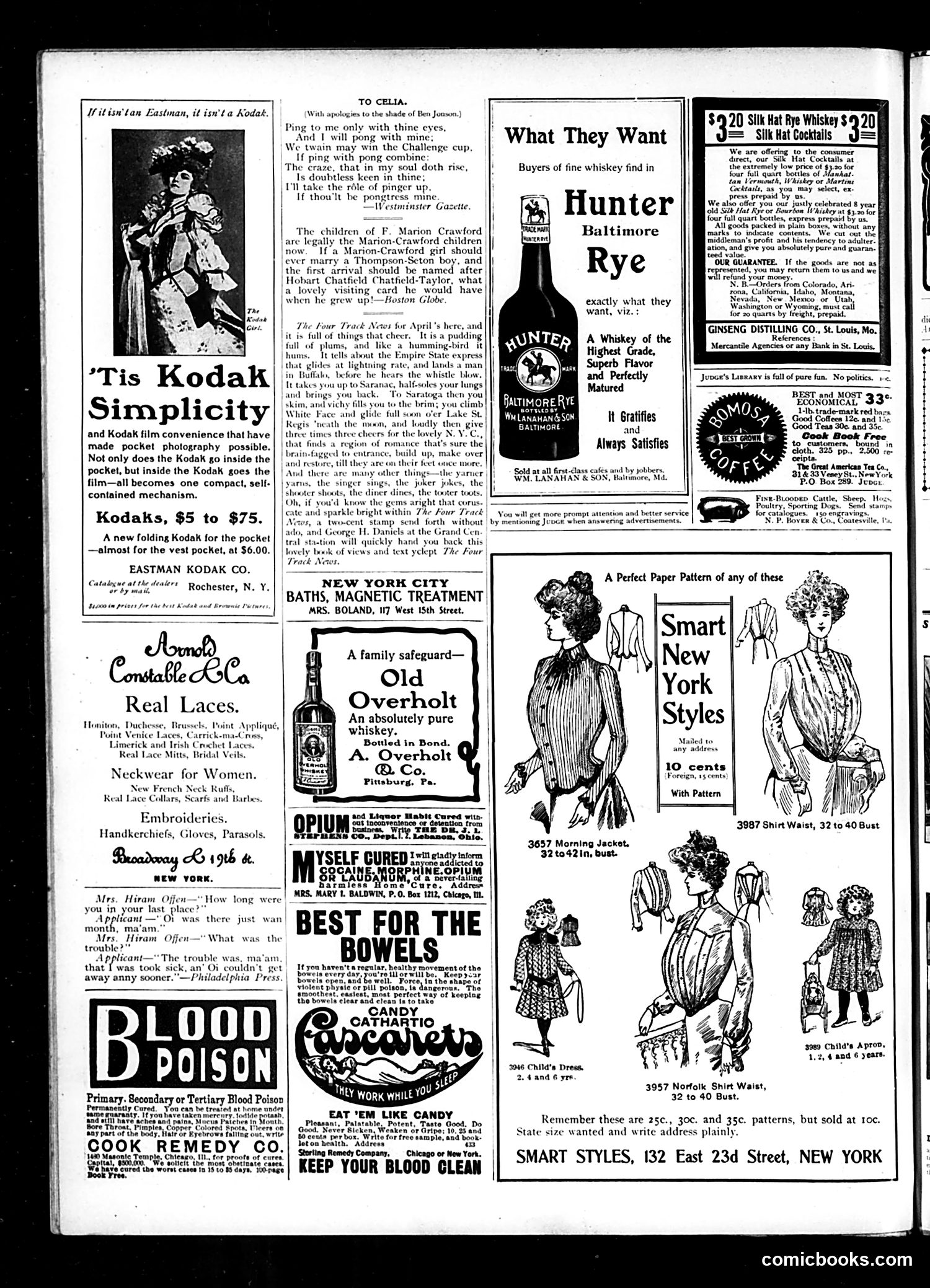
This is primarily an **advertising page** from Judge magazine, with minimal editorial content. The notable exception is a short satirical poem titled "To Celia" at the top. ## The Satire: The poem mocks the contemporary craze for **"ping-pong"** (table tennis), which was wildly popular in early 1900s America. It parodies Ben Jonson's famous love poem "To Celia" by replacing romantic sentiment with obsession over the game. The joke: people are so consumed by ping-pong that even courtship is reimagined through sporting competition—"Ping to me only with thine eyes, / And I will pong with mine." The poem satirizes how fads can overtake society's priorities. ## The Advertisements: The page is dominated by period ads for Kodak cameras, whiskeys (Hunter Baltimore Rye, Silk Hat Rye), laces, remedies (blood poison cure, opium treatment), and clothing patterns—typical products marketed to Judge's affluent readership. A Cascaret candy laxative ad also appears, reflecting common digestive remedy marketing of the era. The content reflects early 1900s consumer culture and health anxieties.
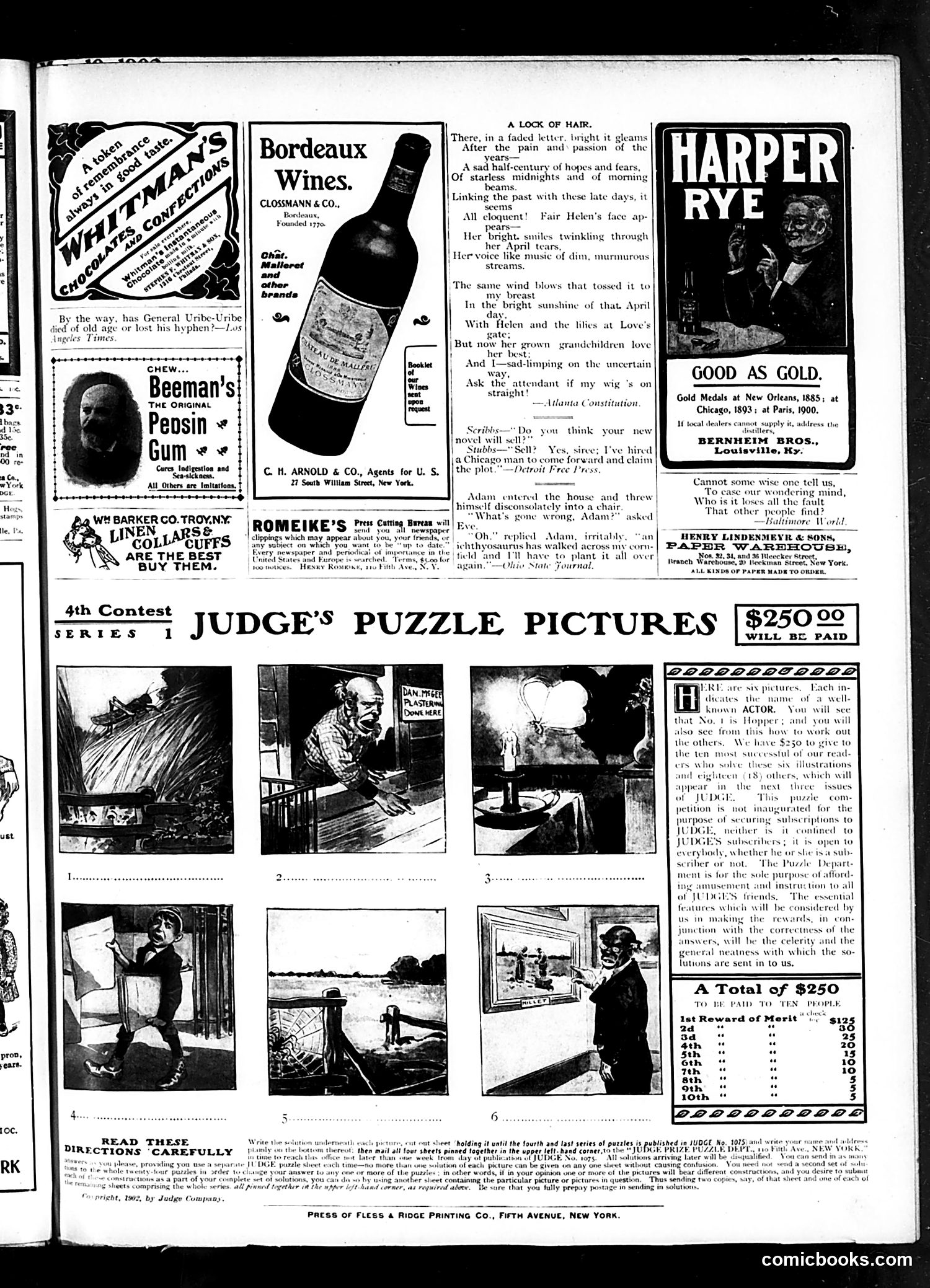
This page is primarily **advertising and contests**, not political satire. The main content is Judge's "4th Contest Series 1: Judge's Puzzle Pictures"—a visual puzzle where readers identify six photographs of well-known actors of the era, competing for $250 in prizes distributed among the top ten solvers. The instructions explain contestants should mail in their answers. The page also contains period advertisements (Beeman's Gum, Bordeaux Wines, Harper Rye, etc.) and several brief humorous items: a poem titled "A Lock of Hair" (sentimental); two short jokes about novel-writing and a farmer's complaint about someone crossing his cornfield; and a quip about losing one's wig. The only potentially political reference is a joke asking "has General Uribe-[something] lost his hyphen?"—suggesting a contemporary figure, likely Latin American, but the context is too fragmentary to identify clearly. Overall, this page reflects Judge's mix of advertising revenue, reader engagement contests, and light humor rather than sustained political commentary.
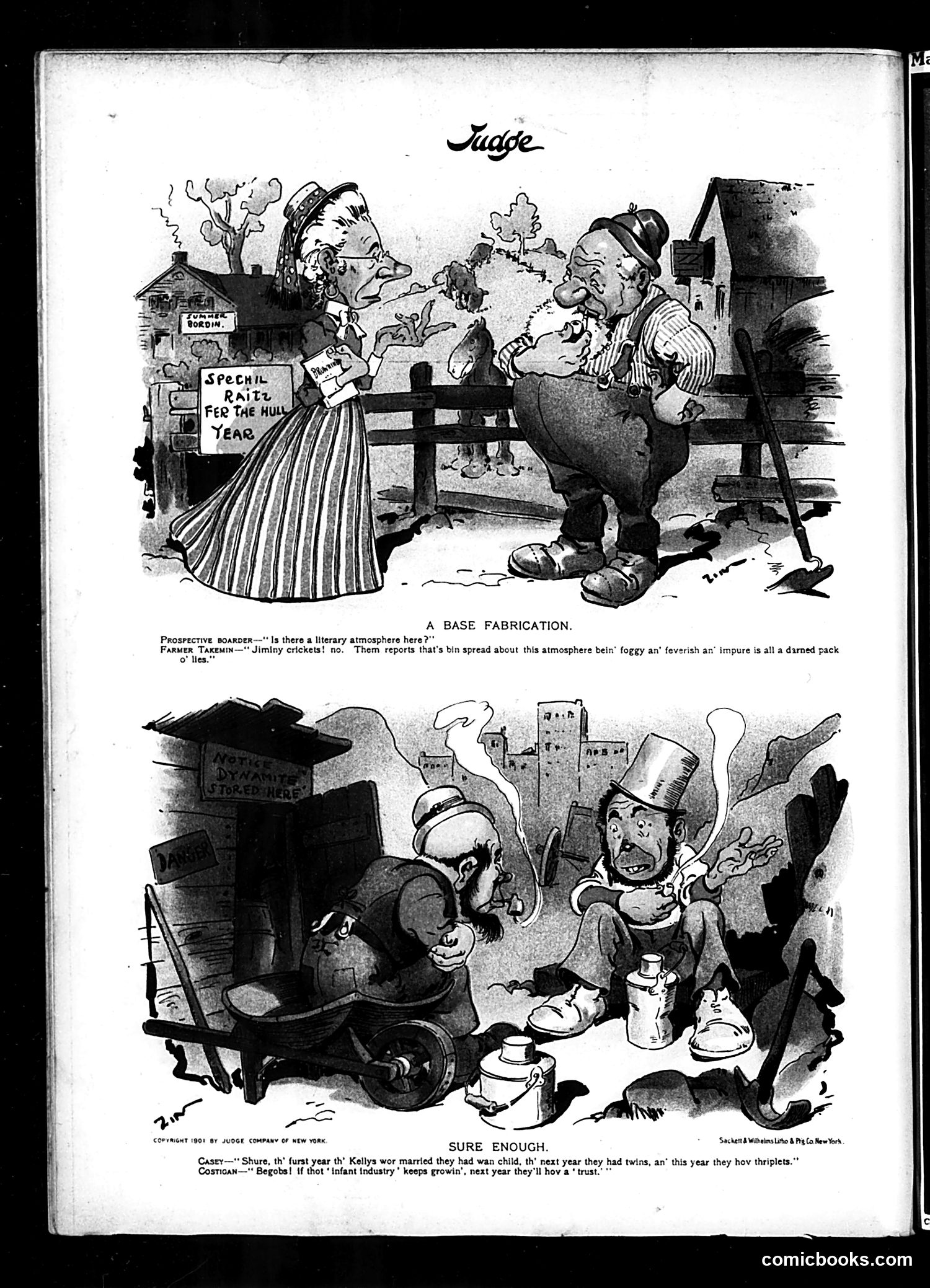
**Top Cartoon: "A Base Fabrication"** A prospective boarder asks a farmer about the literary atmosphere. The farmer (labeled "Farmer Taxenin") denies reports that the area has a "foggy and feverish" atmosphere—claims he calls "lies." This appears to mock rural resistance to outside criticism or regulation, possibly referencing agricultural or rural industry defensive posturing against urban/progressive scrutiny. **Bottom Cartoon: "Sure Enough"** Two Irish characters discuss the rapidly expanding Kelly family—one child yearly, then twins, then triplets. One quips that if the "infant industry" keeps growing, "next year they'll have a 'trust.'" This satirizes the rapid consolidation of American industries into monopolistic trusts during the Gilded Age, using family growth as metaphor for unchecked industrial expansion the government should regulate.