
A complete issue · 16 pages · 1902
Judge — April 19, 1902
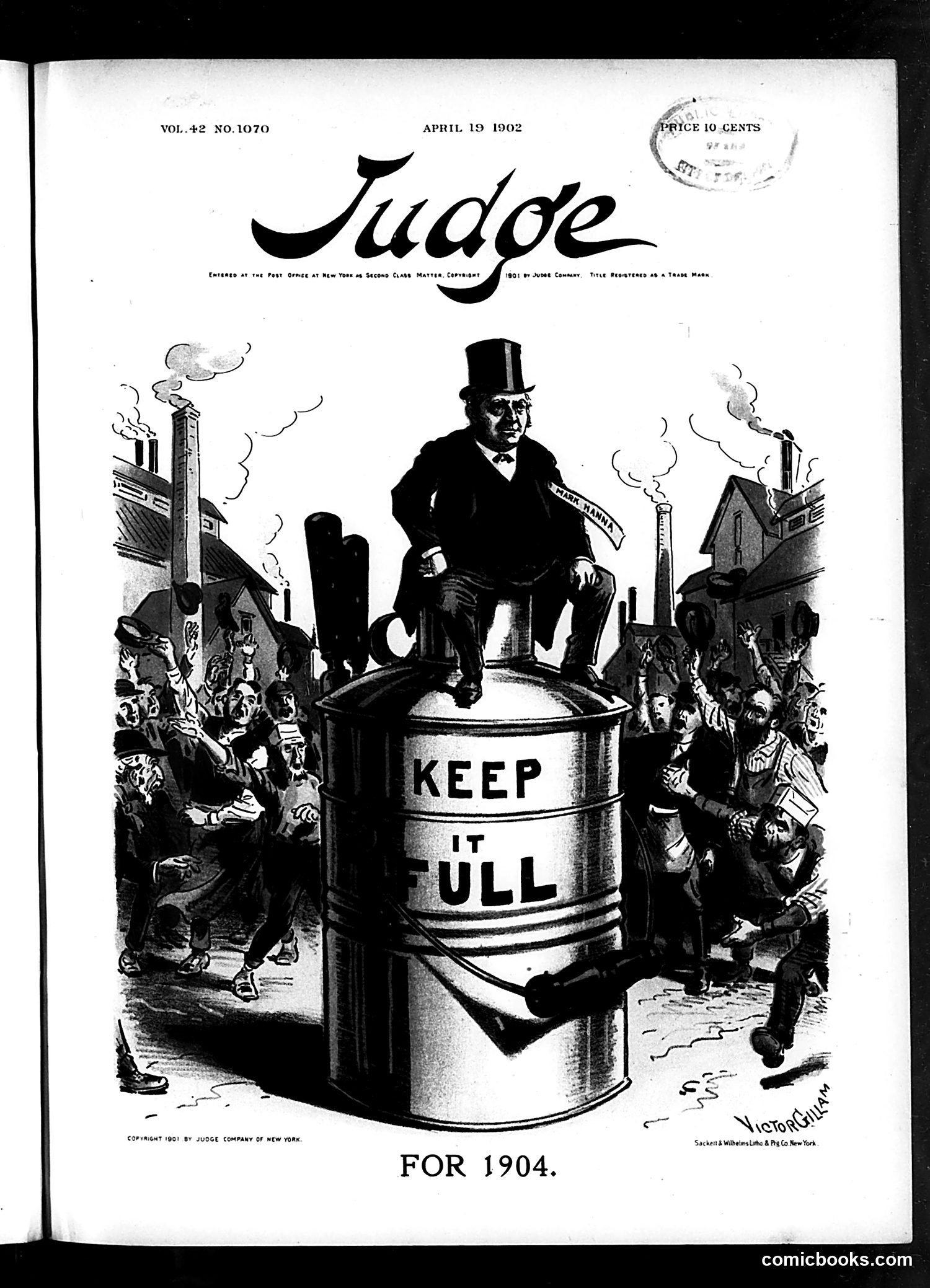
This Judge magazine cover from April 19, 1902 depicts a wealthy industrialist or political figure standing atop a large barrel labeled "KEEP IT FULL," surrounded by crowds of working-class people below. The figure wears a top hat and formal attire, while factory smokestacks billow in the background. The satire targets wealth accumulation and labor exploitation during the industrial era. The barrel likely represents corporate profits or resources that the elite figure maintains "full" while the masses surrounding him—appearing impoverished or desperate—remain beneath. The 1904 reference suggests this commentary applies to the upcoming presidential election. The cartoon critiques the widening gap between industrial magnates and ordinary workers during the Gilded Age.
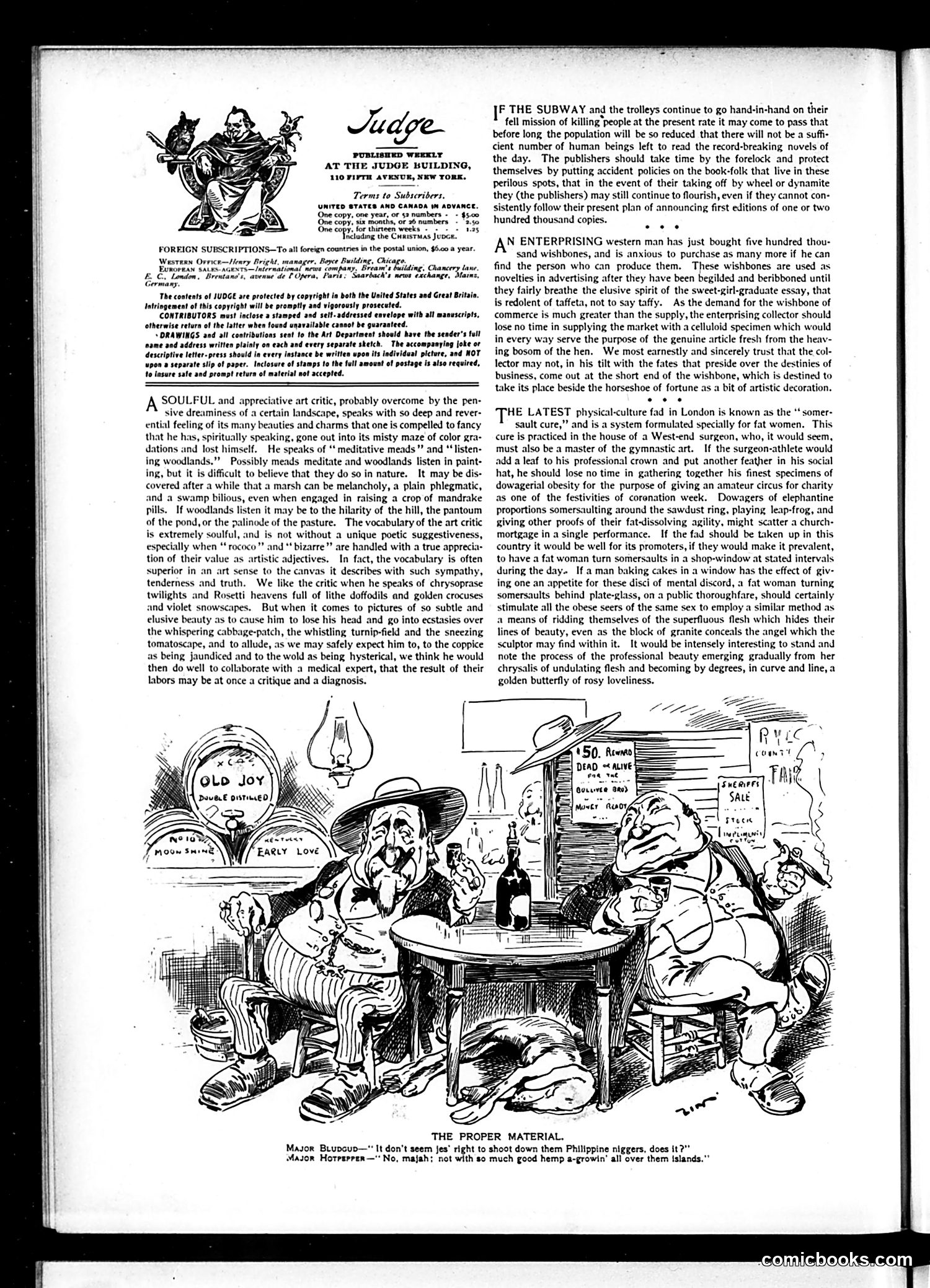
The cartoon depicts two caricatured men in a saloon labeled "Dead or Alive" engaged in conversation. Based on the caption, one figure is "Major Bludsoe" and the other "Major Hottentot," discussing shooting down "Philippine niggers." This appears to be **anti-imperialist satire** criticizing American military violence during the **Philippine-American War** (1899-1902). The exaggerated, crude caricatures and racist language reflect Judge magazine's apparent mockery of American military figures and colonial attitudes. The saloon setting suggests these are mercenaries or war profiteers. The satire likely critiques both the brutality of the conflict and the moral bankruptcy of those advocating for Philippine subjugation. The dehumanizing language in the caption is the *target* of the satire, not endorsed by it.
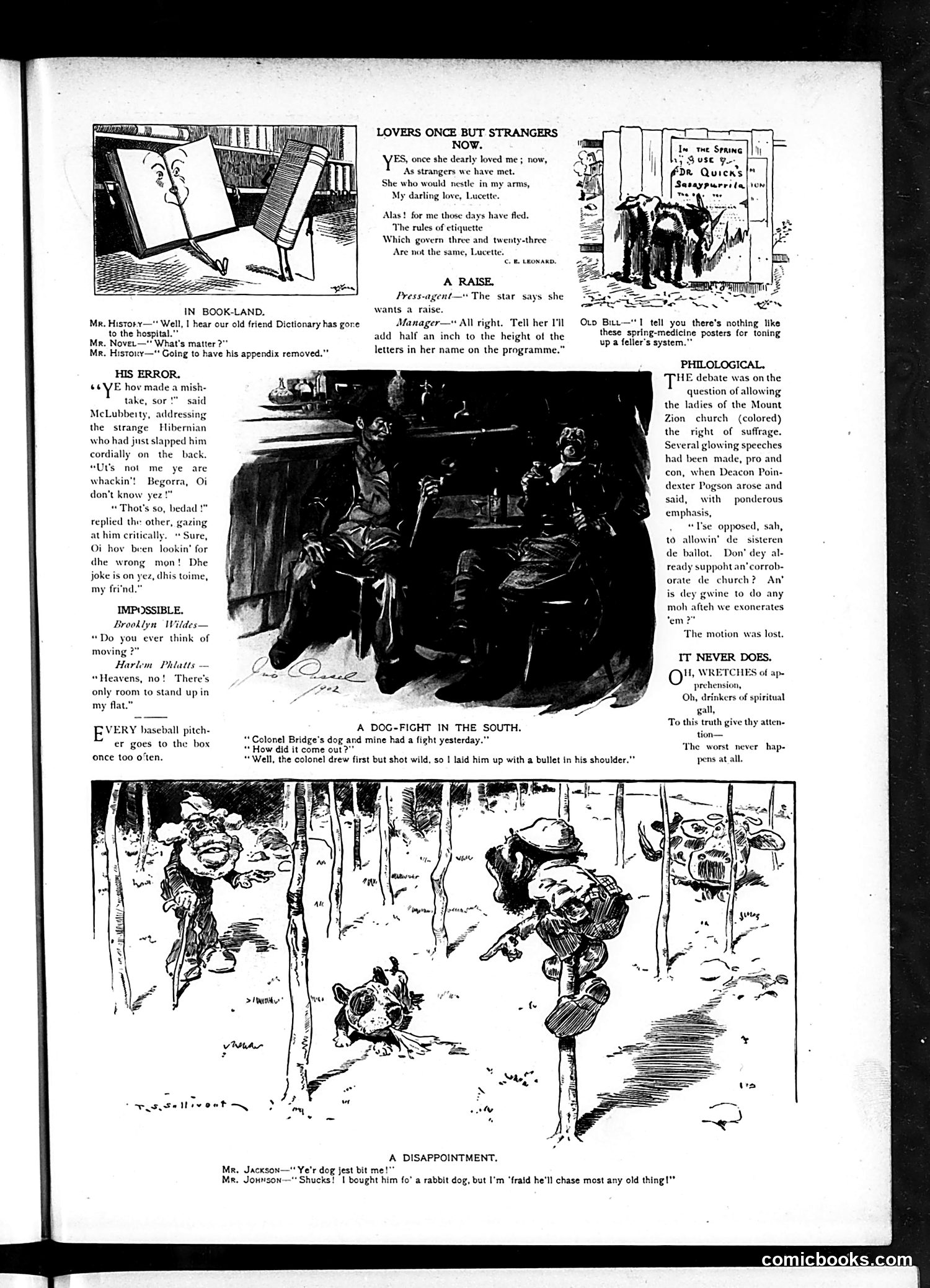
This page contains several short humorous pieces rather than political cartoons: **"Lovers Once But Strangers Now"** is a poem about former romantic partners who've become distant. **"In Book-Land"** mocks dictionary definitions with wordplay jokes about editors and authors. **"His Error"** depicts a Hibernian (Irish immigrant) character mishearing instructions, playing on stereotypical dialect humor common in the era. **"A Dog-Fight in the South"** shows a shooting incident where someone shot a dog, using regional dialect for comedic effect. **"A Disappointment"** features two men discussing a purchased rabbit-dog that chases "any old thing." The page emphasizes ethnic/immigrant humor and wordplay typical of early-20th-century American satire magazines, relying on stereotypes now considered offensive.
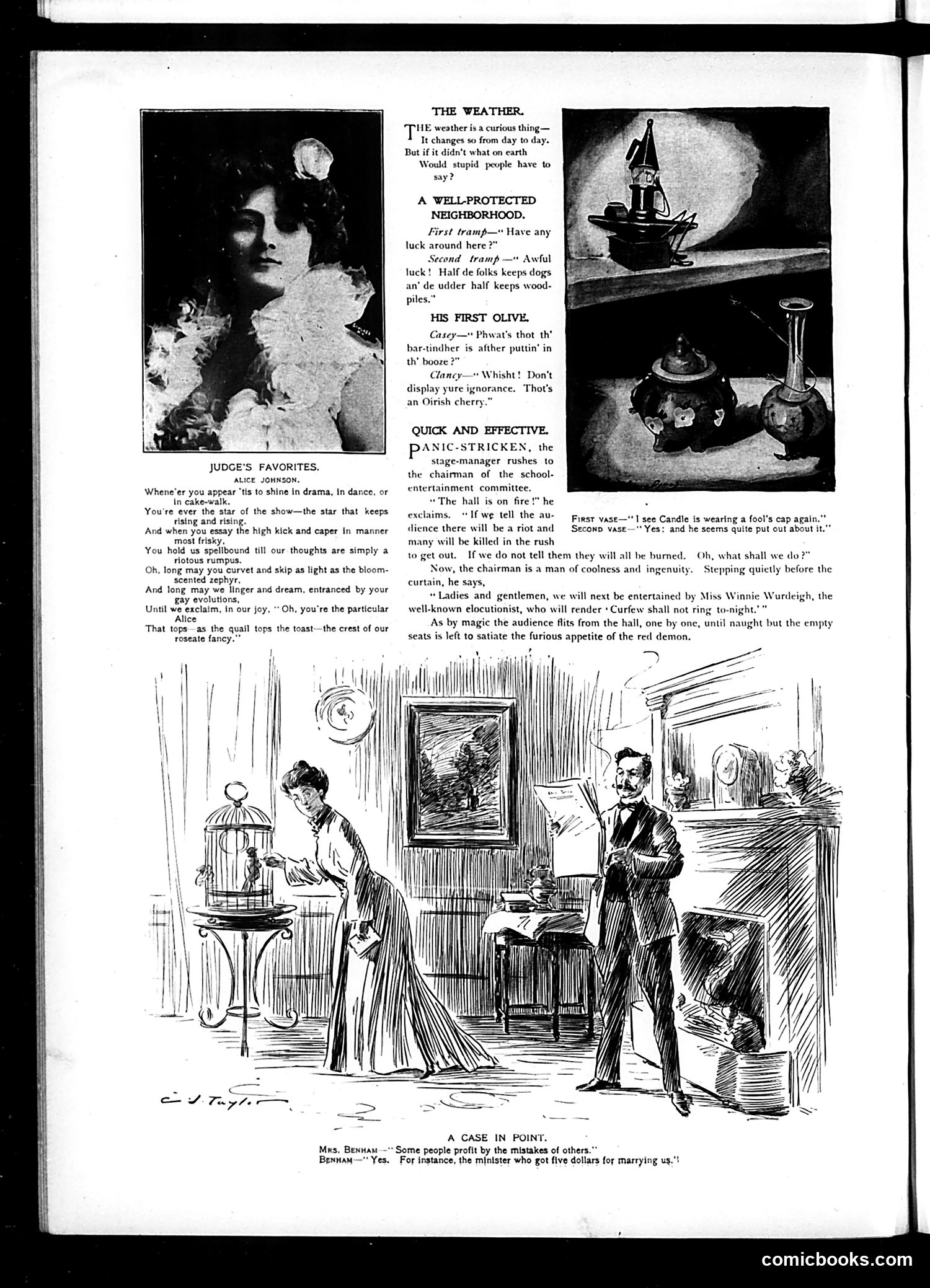
This page contains three distinct satirical pieces: **"Judge's Favorites"** features actress Alice Johnson with a laudatory poem celebrating her theatrical talents and beauty. **"A Well-Protected Neighborhood"** and **"His First Olive"** appear to be brief humorous dialogues mocking working-class speech patterns and social pretensions—typical of period humor that relied on ethnic or class-based dialect comedy. **"Quick and Effective"** satirizes school entertainment committees and stage-managers through a panic scenario about audience safety during a performance. **"A Case in Point"** is a domestic comedy sketch where a wife jokes that clergy profit from mistakes—specifically, ministers who marry couples. The illustrations are pen-and-ink drawings typical of early-20th-century Judge magazine's style. Overall, this page mixes theatrical commentary, class-based humor, and domestic satire common to the era.
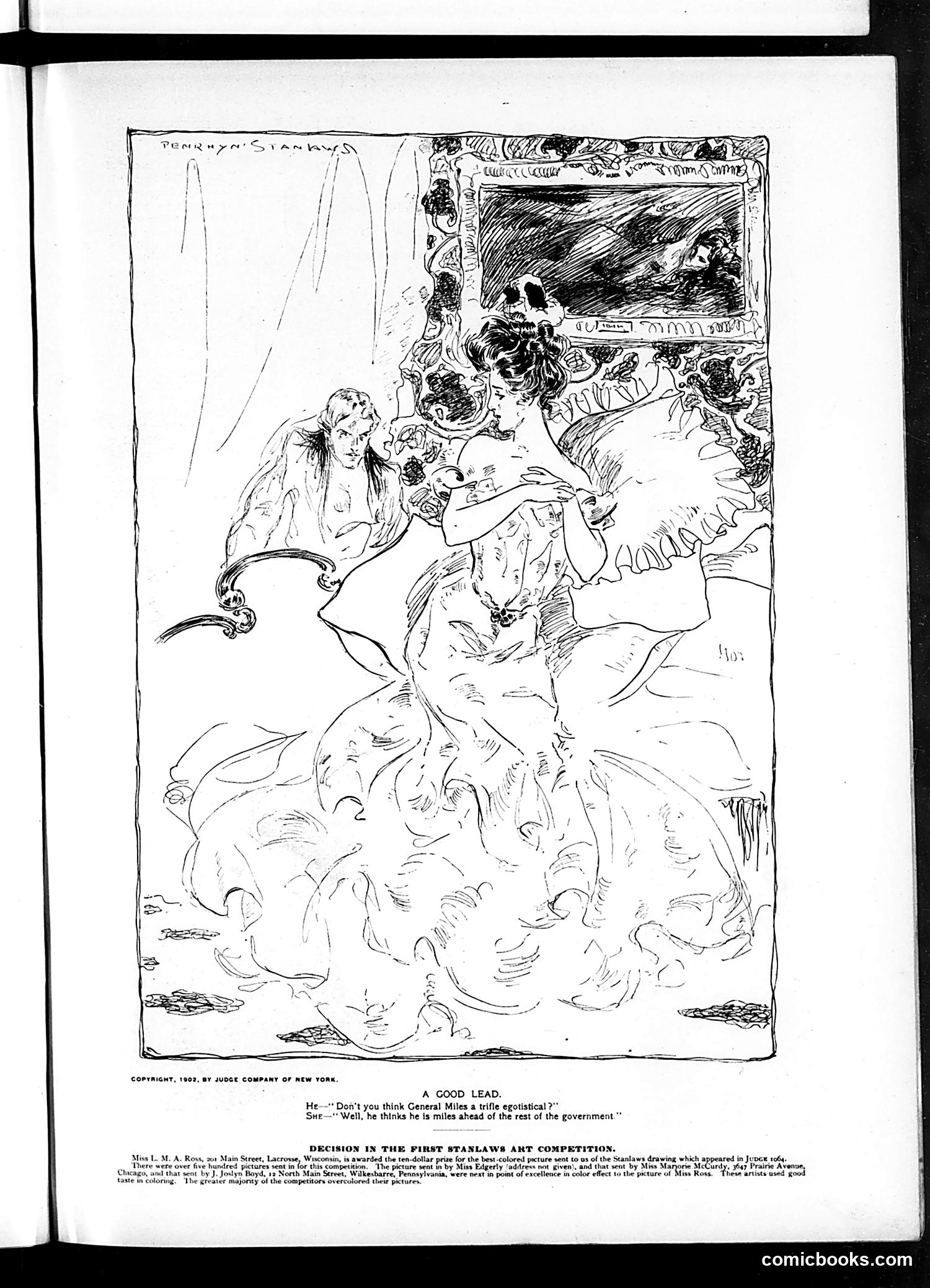
This cartoon satirizes **General Nelson Miles**, a prominent U.S. military figure, through a visual pun. The joke plays on his surname: when asked if Miles is "egotistical," the female character responds that he thinks he is "miles ahead of the rest of the government" — a double meaning suggesting both his arrogance and a literal distance/superiority complex. The large illustration depicts Miles as an inflated, bloated figure, emphasizing the satirical point about his outsized ego. The caricature style was typical of Judge's political commentary during the early 1900s. Below is a notice announcing results of a coloring competition for readers, indicating this was an interactive magazine that engaged its audience with contests and artwork submissions. **Context**: This reflects contemporary criticism of Miles's public persona and military prominence during the Spanish-American War era.
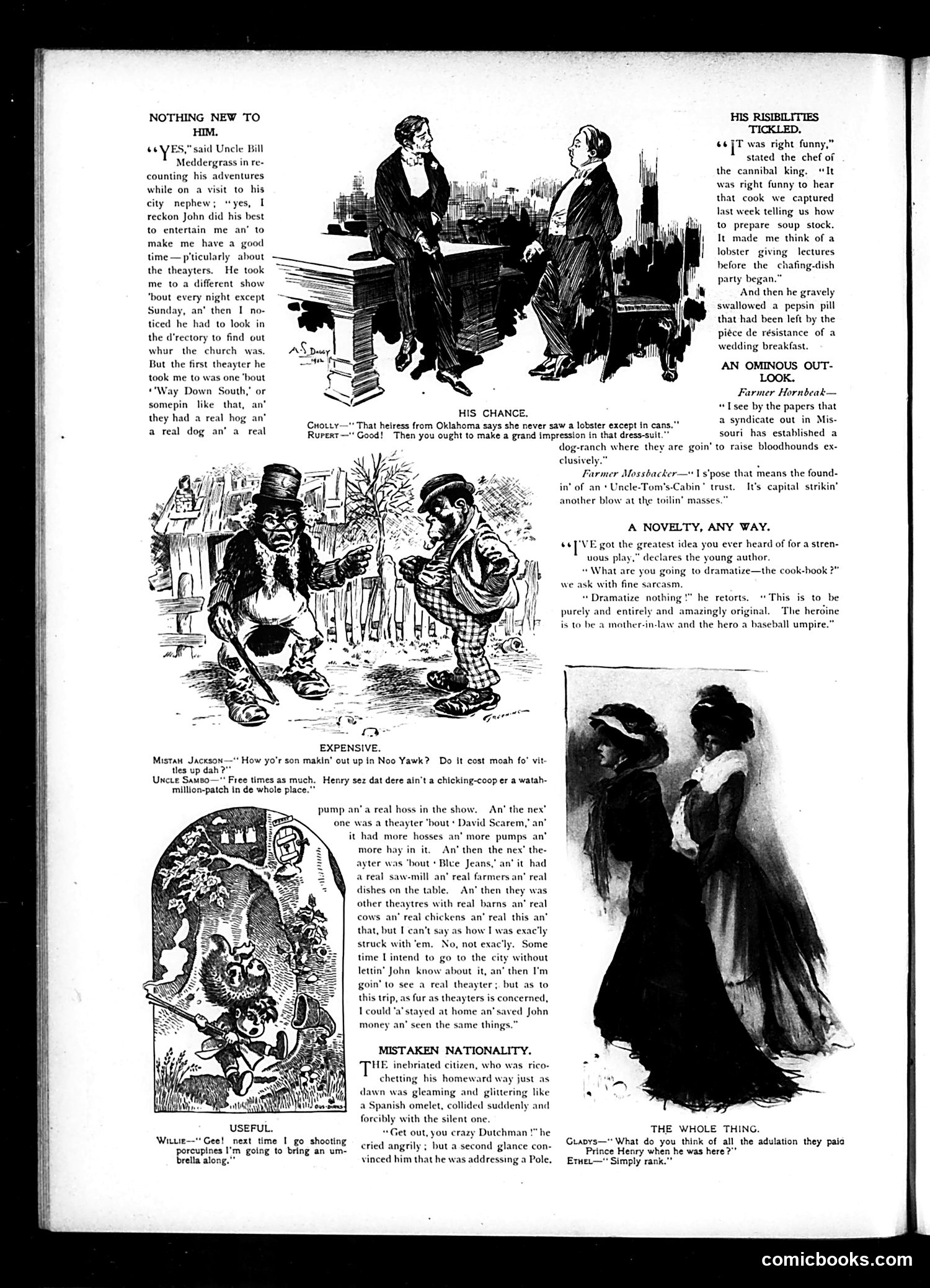
This page contains several unrelated satirical sketches typical of early 20th-century Judge magazine: **"Nothing New to Him"** mocks rural visitors to the city. Uncle Bill, a country farmer, describes attending various theatrical productions featuring increasingly elaborate "realistic" props (real horses, sawmills, farmers). The satire targets both the theater industry's obsession with spectacle over substance and the unsophisticated tastes of rural audiences who remain unimpressed regardless. **"His Chance"** jokes about an Oklahoma heiress unfamiliar with lobsters except in cans, suggesting she'd be comically out of place in high society—poking fun at wealthy but uncultured newcomers. **"Mistaken Nationality"** depicts a drunk colliding with someone, initially calling him "Dutchman" before realizing he's actually a Pole—a crude ethnic joke playing on stereotypes about immigrant groups. The remaining sketches satirize theatrical pretension, city expenses, and social climbing. The humor relies heavily on period-specific ethnic caricatures and rural/urban class divisions now considered offensive.
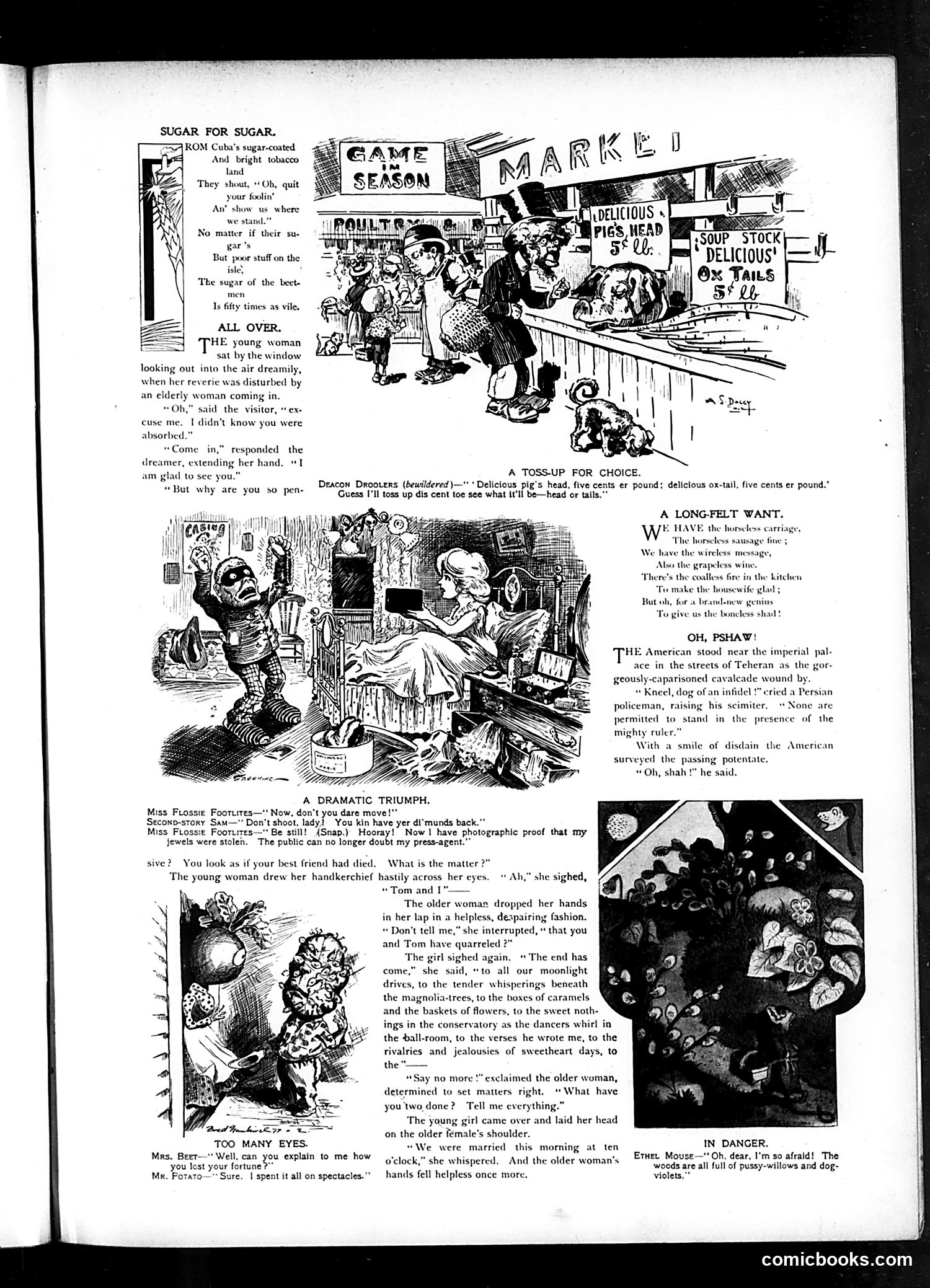
This page contains multiple satirical pieces typical of early 20th-century American humor: **"Sugar for Sugar"** mocks trade debates, likely referencing tariff disputes between Cuban and American sugar producers. The verse ridicules protectionist arguments, suggesting American beet sugar is inferior to Cuban sugar yet subsidized. **"All Over"** and **"Too Many Eyes"** are romantic/domestic humor pieces unrelated to politics—common filler in Judge. **"A Toss-Up for Choice"** satirizes market conditions, showing a street vendor indifferent about selling pig's head or ox-tail, suggesting economic uncertainty or abundance. **"Oh, Pshaw!"** mocks American arrogance abroad: an American refuses to kneel before a Persian ruler, displaying disrespect for foreign authority. This reflects contemporary American imperialist attitudes and cultural superiority complex. The various sketches showcase Judge's mix of political commentary and genteel domestic comedy aimed at middle-class readers. The cartoons emphasize American commercial competition and international swagger typical of the era.
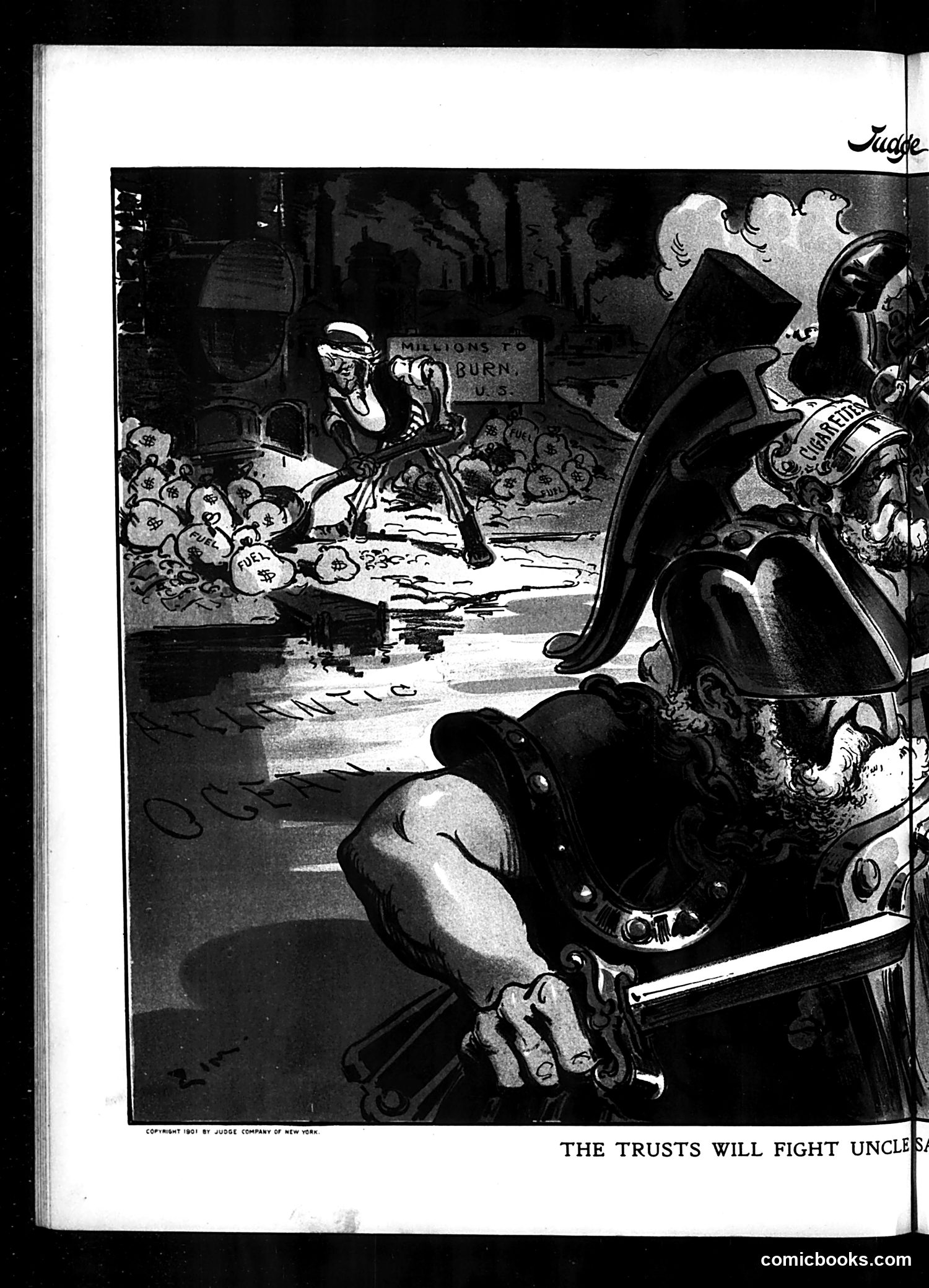
This is a political cartoon about **corporate trusts** (monopolistic business combinations) fighting back against regulation. The figure on the right appears to be **Uncle Sam**, depicted as a boxer or fighter preparing for confrontation. On the left, smaller figures surrounded by large spheres labeled with dollar signs represent the **trusts**—wealthy industrialists or corporations treating money as ammunition or weapons. The cartoon's message warns that powerful trusts will aggressively resist government efforts to control or break them up. The visual metaphor of combat emphasizes the intensity of this coming conflict. This reflects **early 20th-century American anxieties about monopoly power** and the struggle between federal regulation and big business interests. The caption "THE TRUSTS WILL FIGHT" frames this as a cautionary prediction about corporate resistance to antitrust legislation.
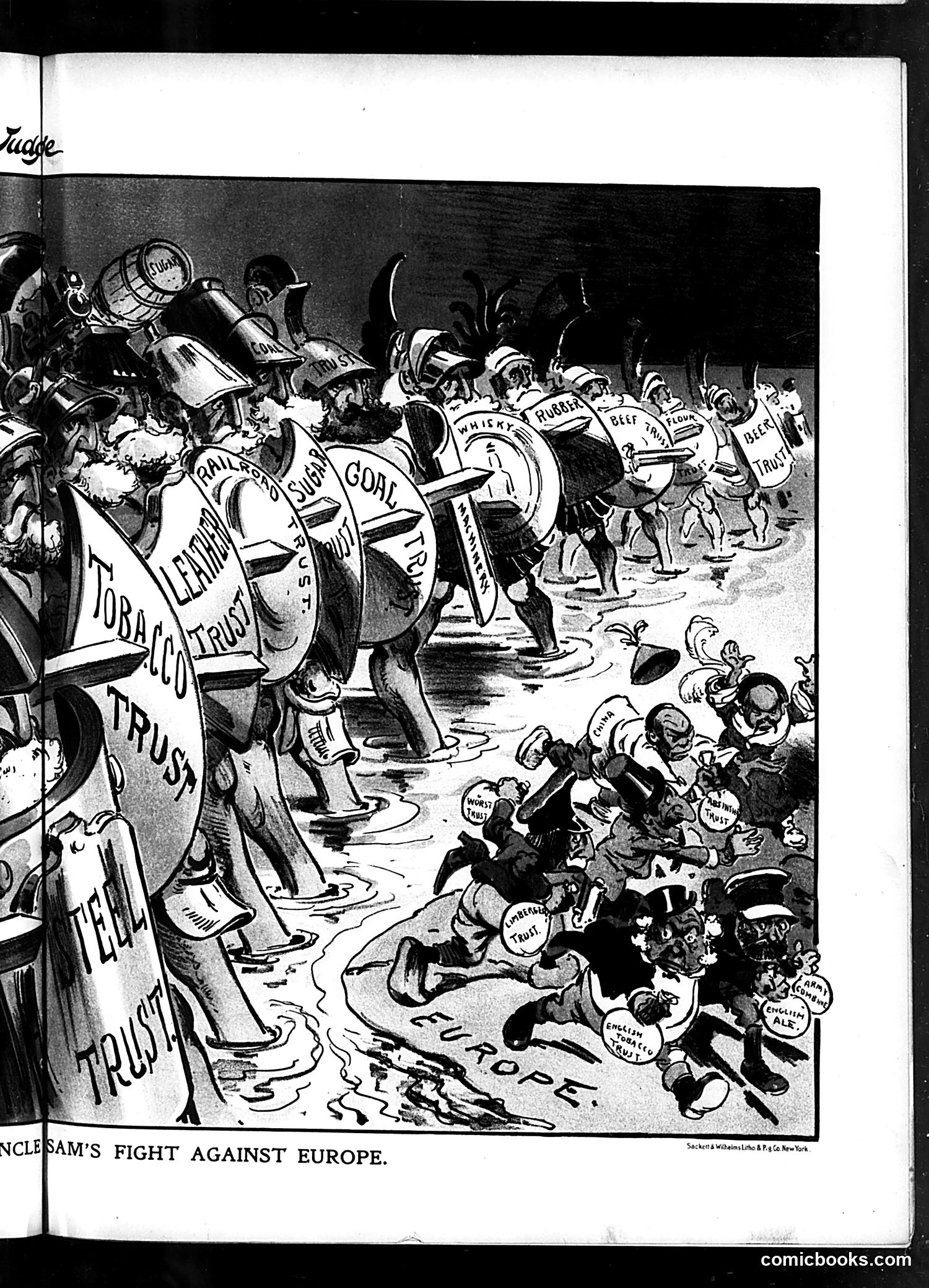
This political cartoon depicts Uncle Sam (the tall figure on the left, identifiable by his characteristic appearance) confronting a line of European powers represented as large, menacing figures carrying barrels labeled with various products and concepts: "Tobacco Trust," "Whiskey," "Rubber," "Beef Trust," and others. At the bottom right, smaller figures appear to represent competing American interests or domestic concerns, seemingly crushed or overwhelmed beneath the larger European forces. The satire criticizes what the cartoonist saw as unfair European economic dominance or competition against American business and interests. The "trusts" referenced suggest concerns about monopolistic practices affecting American commerce and workers during the Progressive Era.
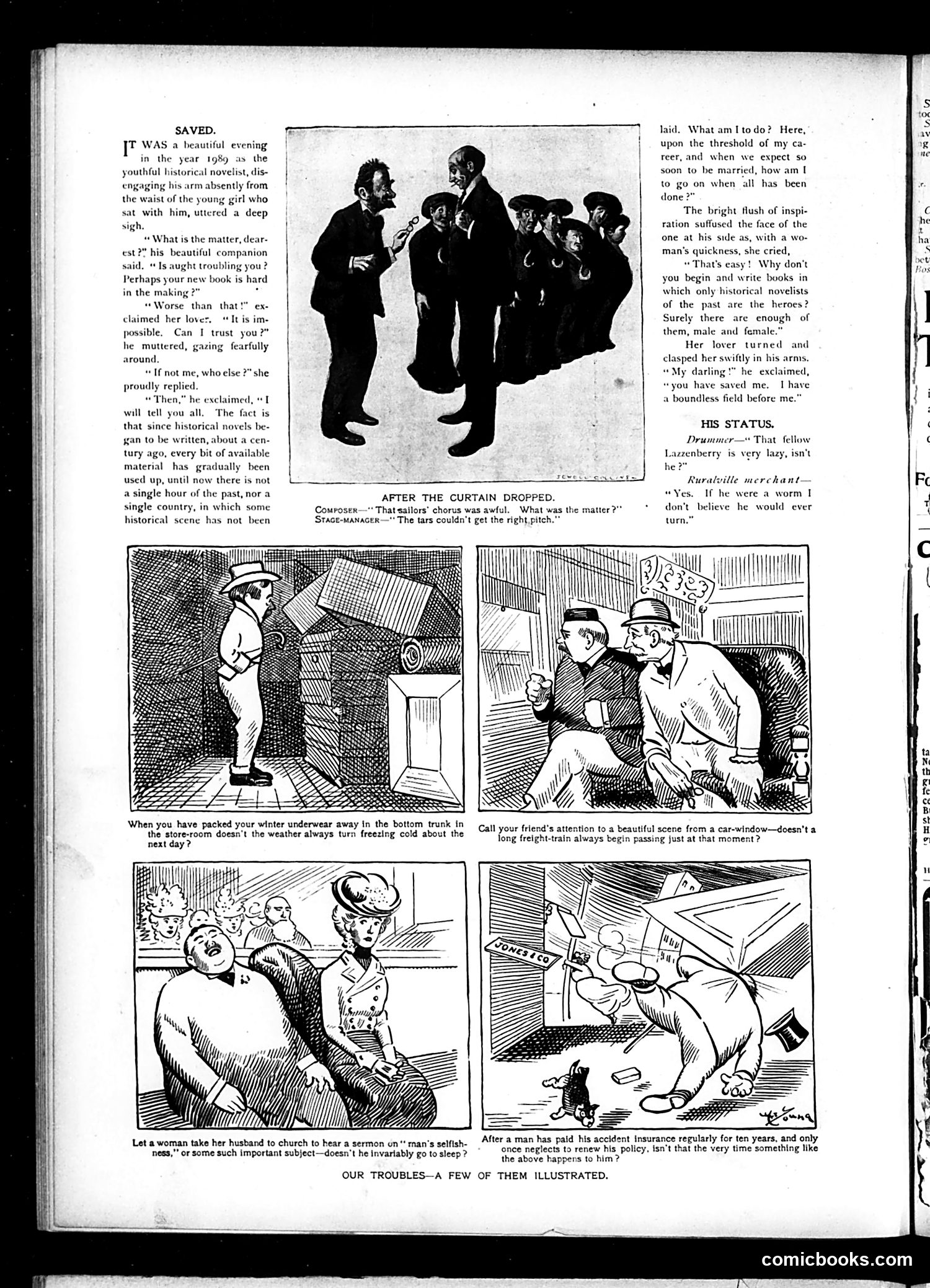
This page contains a romantic story and humor comics satirizing contemporary life around 1900. **The Main Story**: A young historical novelist in 1989 despairs that all historical material has been exhausted by writers. His girlfriend solves this by suggesting he write historical novels *about historical novelists themselves*—creating an infinite recursive loop of subject matter. **The Satire**: This mocks the exhaustion of Victorian literature and the anxiety among writers about originality. It's tongue-in-cheek commentary on how creative industries recycle themselves. **The Illustrated Humor Strips Below** ("Our Troubles—A Few of Them Illustrated"): These present domestic and social complaints in comic-panel form—unpredictable weather, inattentive husbands, insurance misfortune, etc. They're gentle satire of middle-class life's petty frustrations, using deadpan captions as punchlines. The overall tone is witty social commentary targeting educated readers familiar with literary debates.
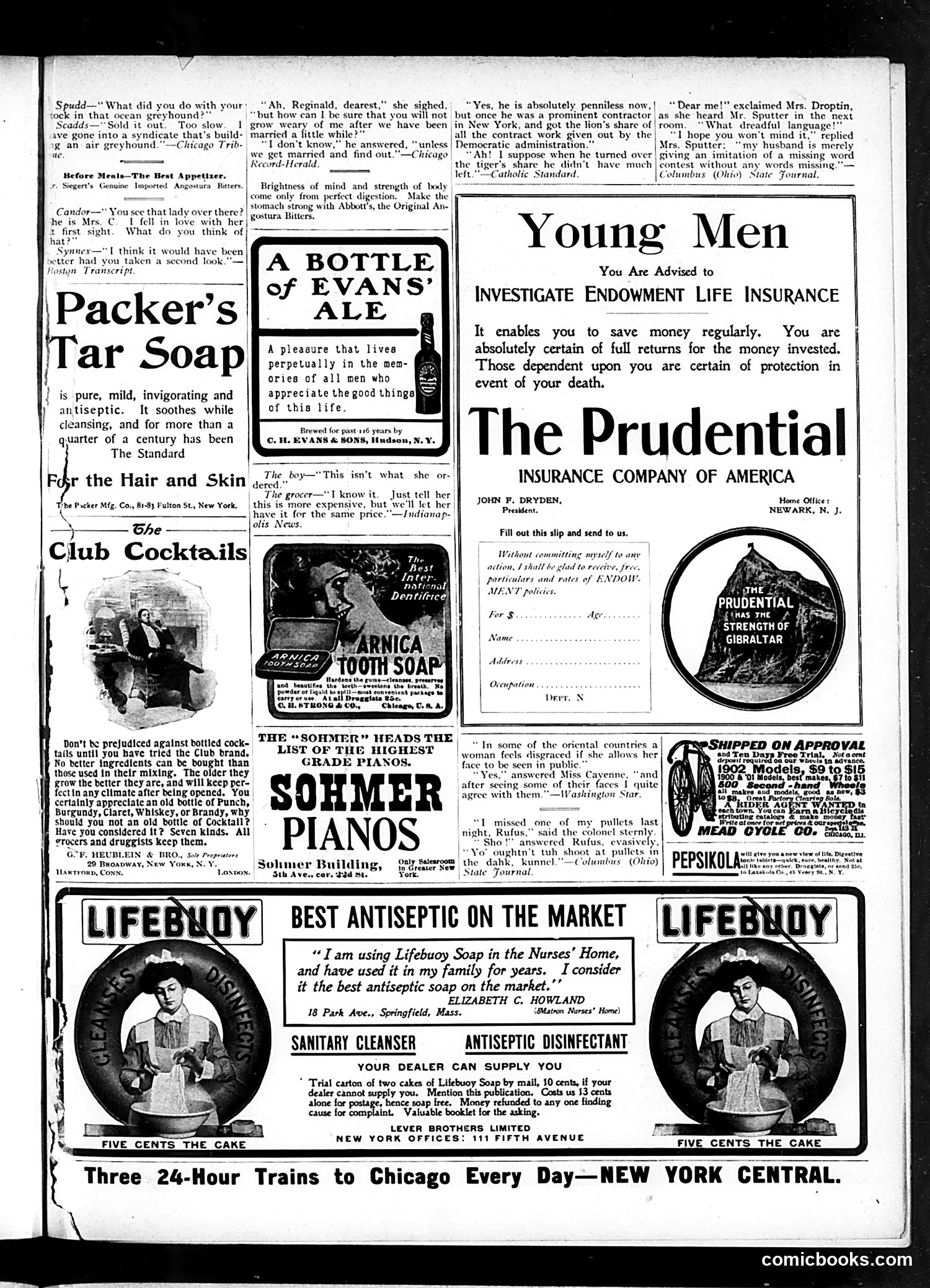
This page is primarily **advertisements and brief comic snippets** rather than political cartoons. The small jokes mock: - **Greyhound racing/investment**: A man brags he's investing in an "air greyhound" syndicate instead of slow racetrack dogs - **Marriage and finances**: A couple debates whether love survives after marriage; another joke reveals a contractor lost his fortune after the Democratic administration ended his lucrative contracts - **Social pretension**: Mrs. Droptin is scandalized by "dreadful language," while another joke mocks Oriental attitudes toward women's faces The remainder consists of **period product advertisements** (Packer's Tar Soap, Arnica Soap, Sohmer Pianos, Prudential Insurance, Lifebuoy Soap) and a testimonial from a Massachusetts nurse praising Lifebuoy as an antiseptic. The page reflects early 20th-century advertising conventions and light social humor—mostly commentary on courtship, class anxiety, and minor scandals rather than substantive political satire.
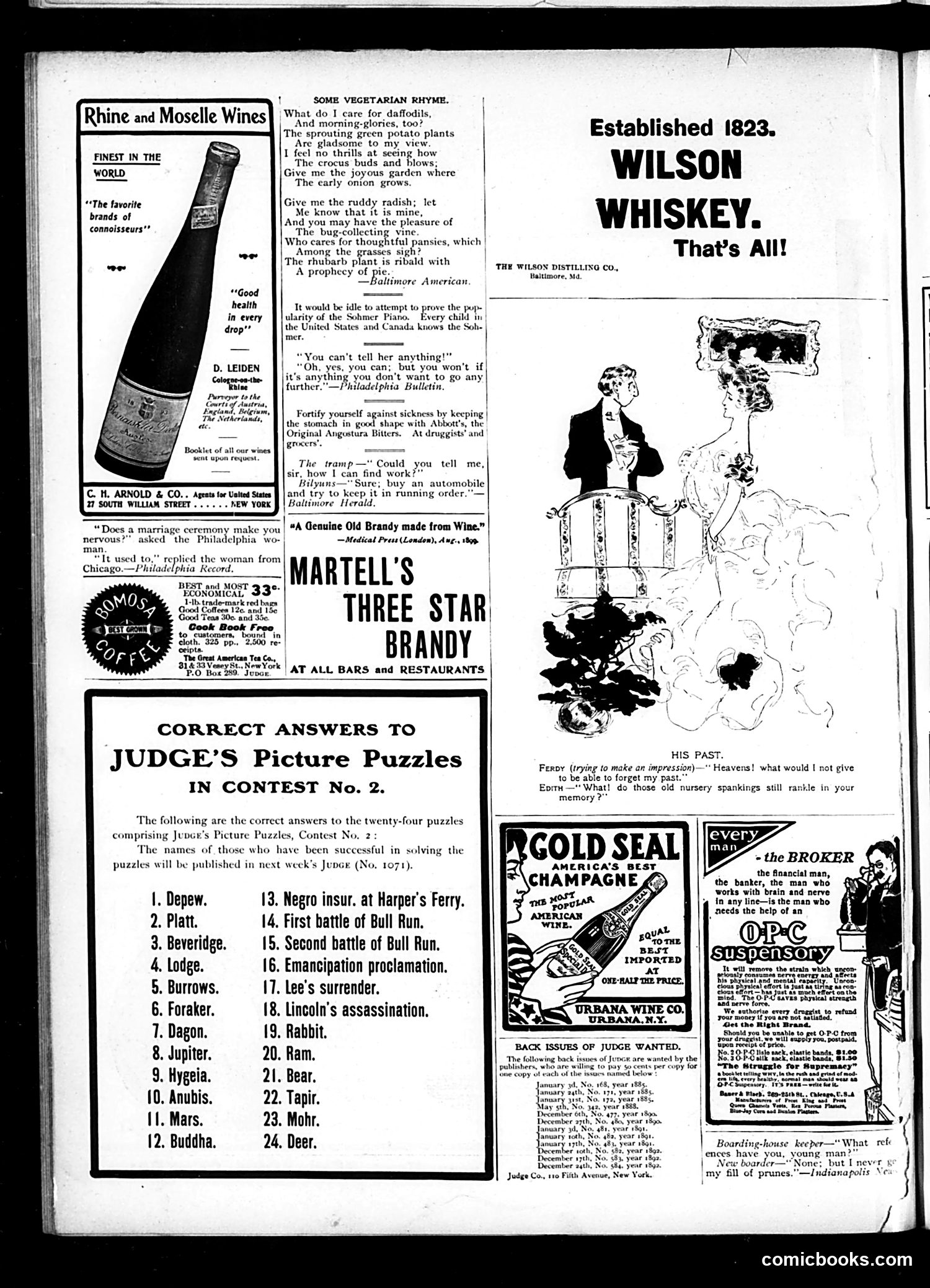
This page is primarily **advertising and contest content** rather than political satire. The main elements are: **Advertisements:** Prominent liquor ads (Rhine/Moselle wines, Wilson Whiskey, Martell Brandy, Gold Seal Champagne) dominate the layout—typical for Judge's era, before Prohibition. **The cartoon** (upper right) shows two figures labeled "Perry" and "Eoin" in a brief comedic exchange about forgetting one's past. Perry claims he'd give anything to forget his past; Eoin jokes that old nursery spanking memories still bother him. It's mild domestic humor with no political content. **Contest content:** The bulk of the page lists answers to a picture puzzle contest from a previous issue, naming figures like Depew, Lodge, and Beveridge (American politicians) and Civil War references. This appears to be puzzle solutions rather than original satire. **Overall:** This is a typical Judge interior page mixing paid advertising with light humor and reader contests—not a showcase for the magazine's satirical cartoons.
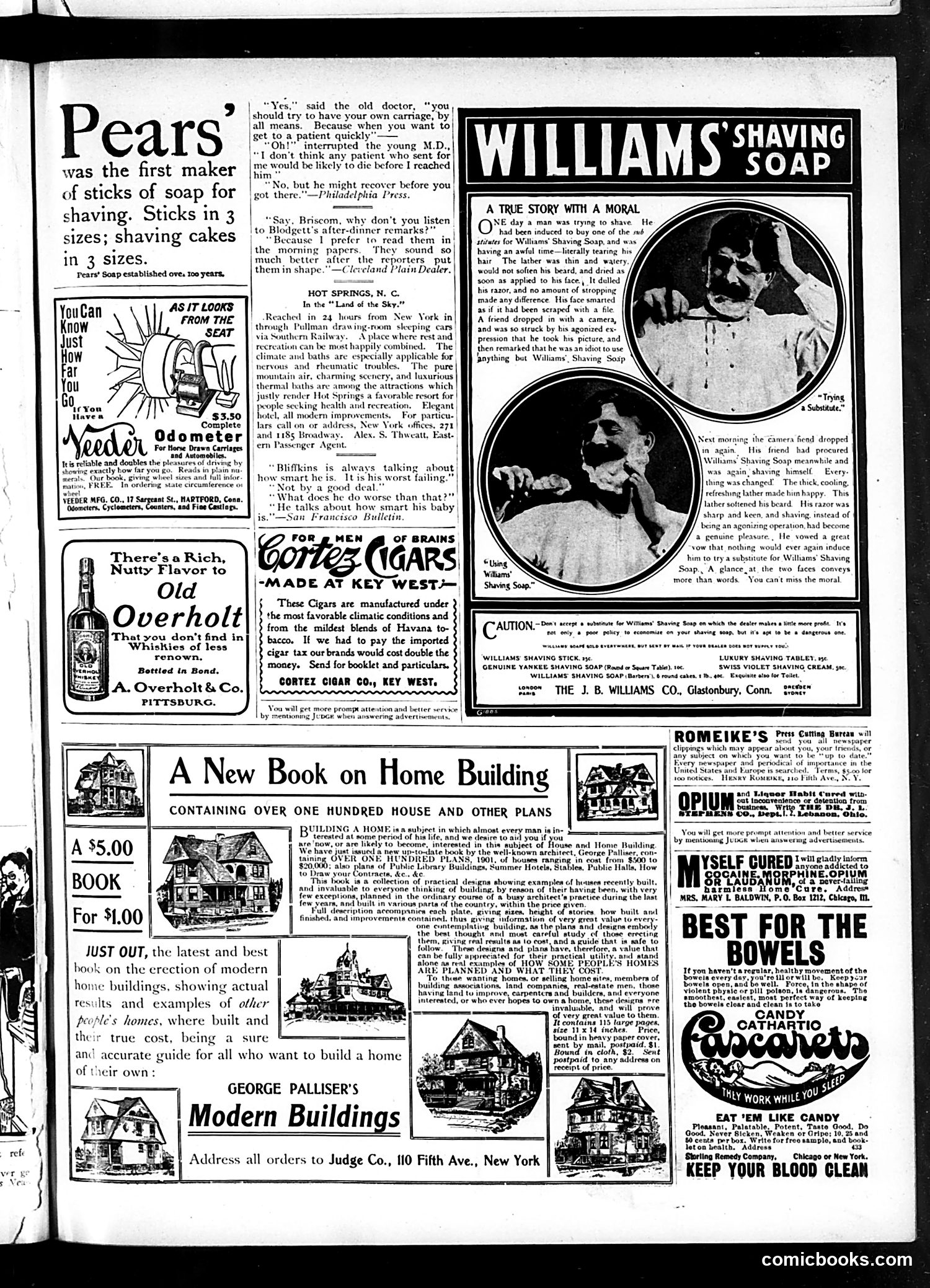
This page is primarily **advertising** rather than satirical content. The dominant feature is the Williams' Shaving Soap advertisement (top right), which presents a morality tale: a man suffering with an inferior soap substitute experiences agony while shaving, but finds redemption through Williams' brand, transforming his ordeal into "genuine pleasure." The small jokes scattered throughout are mild workplace humor unrelated to politics or satire. One involves a young doctor who naively believes patients will survive long enough for him to arrive; another concerns a man whose witticisms sound better when reporters polish them for print. The remaining content comprises standard period advertisements for home-building guides, cigars, whiskey, and patent medicines (including opium-based products, which were legal and commonly advertised then). **There is no political satire visible on this page.** It represents typical early 20th-century American magazine advertising and light humor, notable mainly for how freely it marketed products (like opium) now strictly regulated.
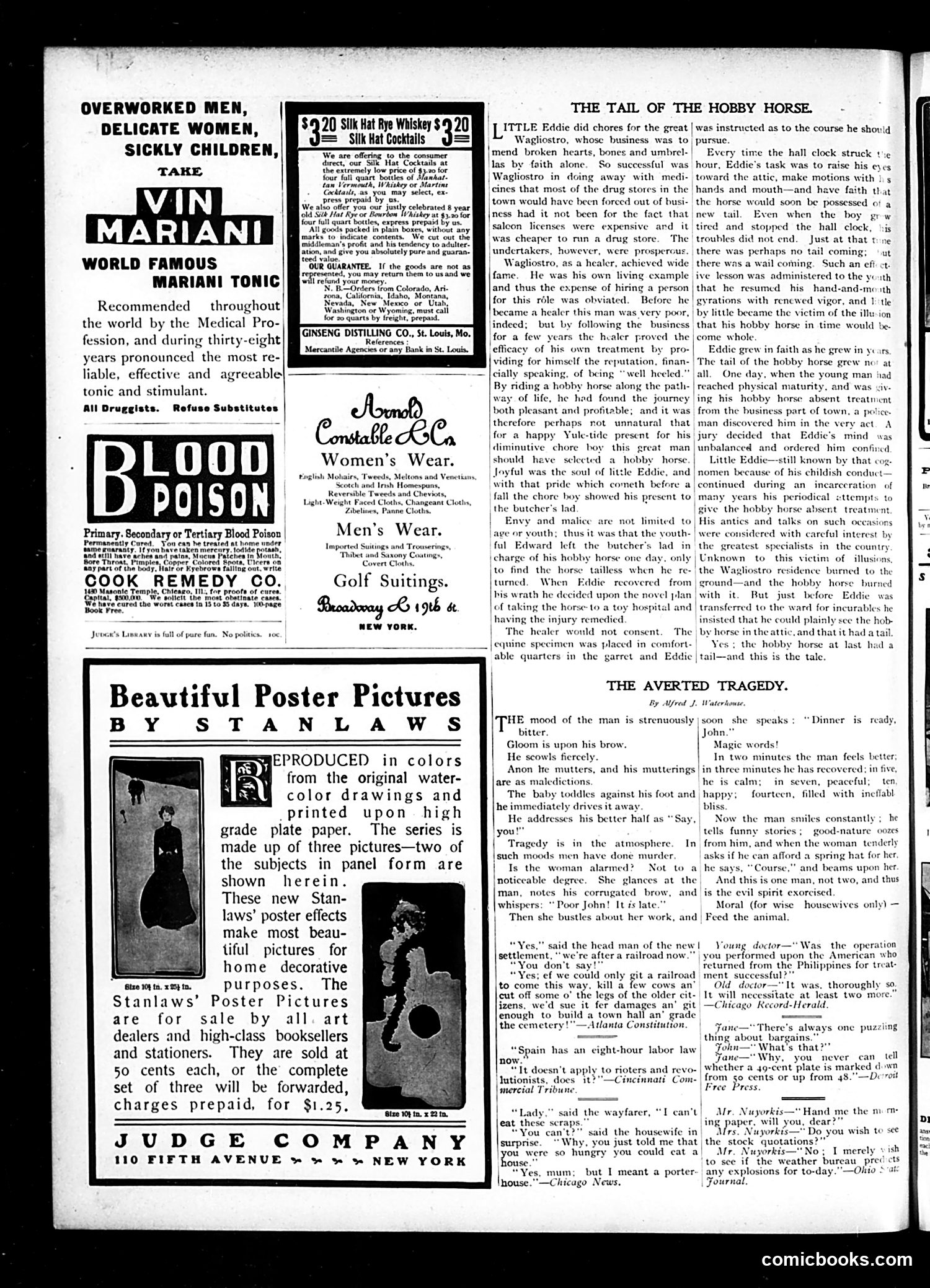
This is primarily a **satirical story** (not a cartoon) mocking faith healers and medical quackery popular in the early 1900s. **The Setup:** A character named Wagliostro claims to heal broken bones, hearts, and umbrellas through faith alone, not medicine. This is so successful that drug stores nearly close—except they survive by selling alcohol (saloon licenses are expensive, so running a drugstore is cheaper). **The Satire:** Wagliostro becomes wealthy and famous by being his own advertisement: he stays healthy, appearing to prove his methods work. The phrase "well heeled" (meaning wealthy) plays on his "hobby horse"—a figurative journey built on pretense and deception. **The Point:** The story ridicules both faith healers exploiting the gullible and the irony that drugstores survive by becoming alcohol vendors rather than genuine pharmacies. It's a critique of medical fraud and corruption in American healthcare circa 1910s. The page is otherwise filled with **patent medicine and alcohol advertisements**—products Judge's advertisers themselves peddle—adding ironic layers to the satire.
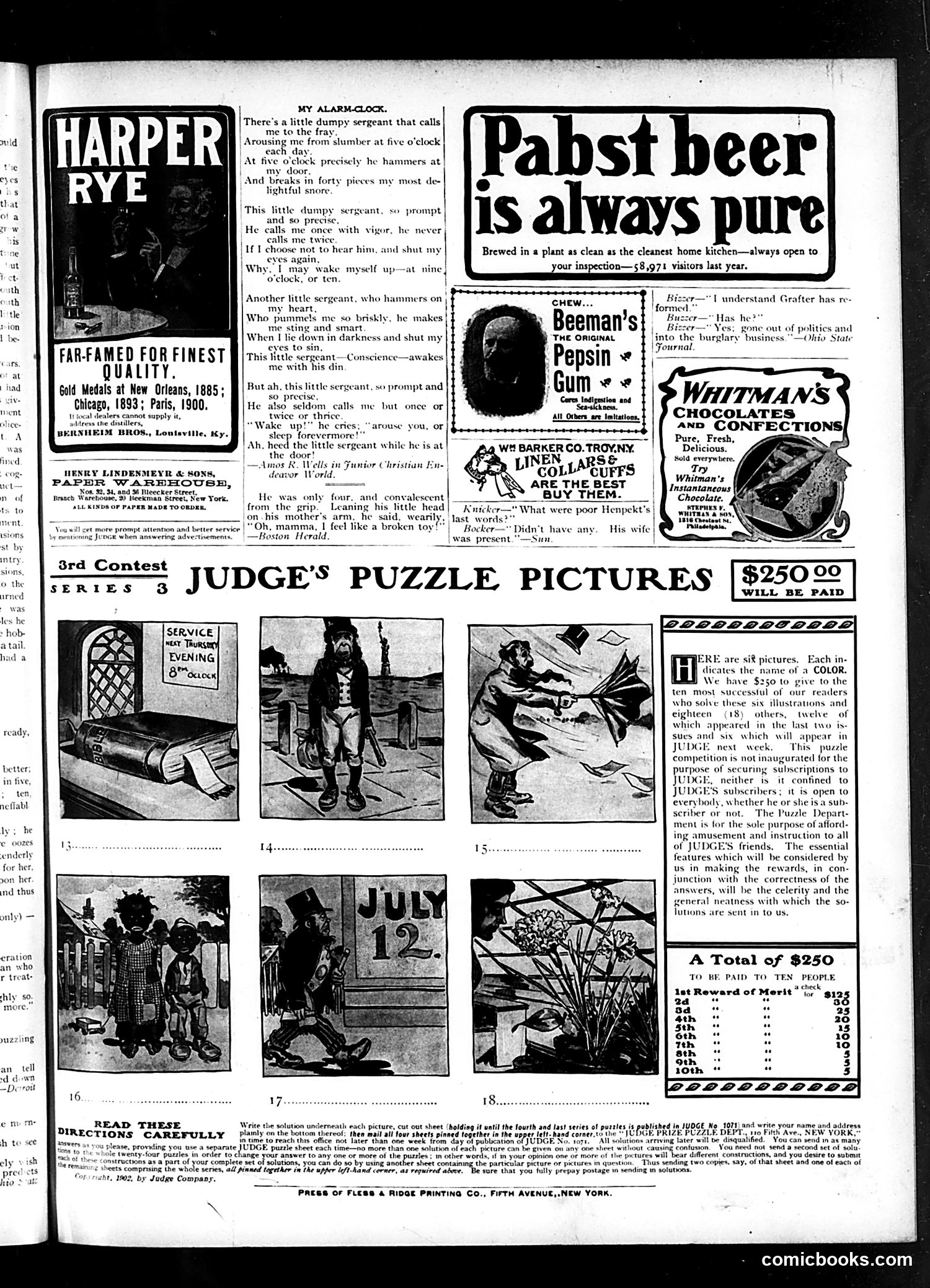
This page from *Judge* magazine presents a **puzzle competition** offering $250 in prizes to readers who solve six illustrated picture-riddles. The page is primarily an advertisement vehicle, not political satire. The visible content includes: - **"My Alarm-Clock"** poem (left): A sentimental piece personifying three "sergeants"—a literal alarm clock, conscience, and duty—that wake the narrator. It's lighthearted domestic verse, not satirical. - **Advertisements**: Including Harper Rye whiskey ("Far-Famed for Finest Quality"), Pabst beer ("Always Pure"), Beeman's Pepsin gum, and Whitman's Chocolates—typical of the era's *Judge* content. - **Six puzzle illustrations** (numbered 13-18): Black-and-white scenes depicting various scenarios readers must identify and name. The puzzles appear generic—a man in a barrel, figures in period dress, a calendar showing July 12th, etc. The instructions emphasize this competition is open to all readers, not just subscribers, and judges will consider "correctness of answers" along with "celerity and neatness" of submissions. This is fundamentally a **commercial entertainment page**, not political commentary.
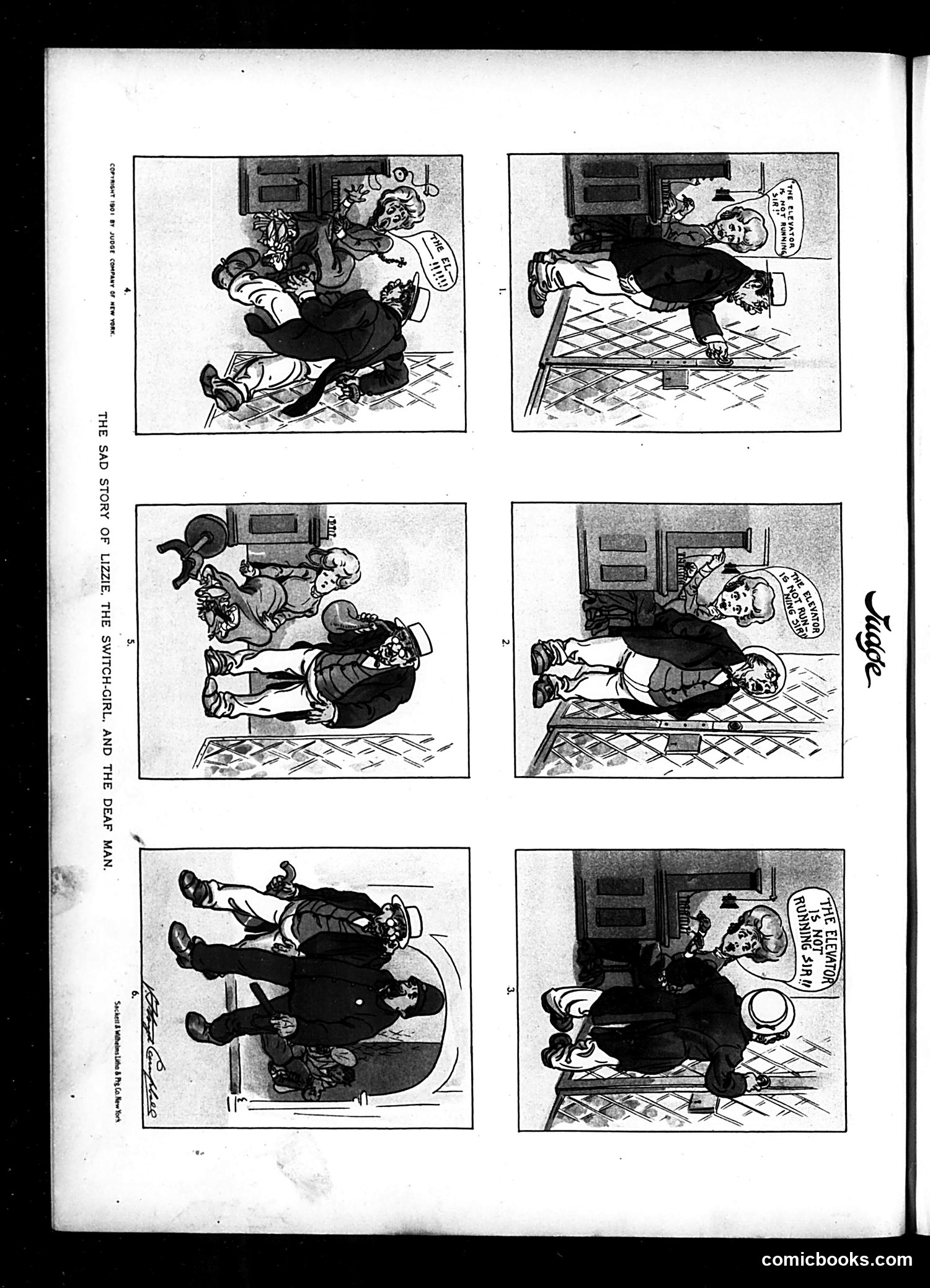
This is a six-panel satirical comic strip from Judge magazine (1901). The narrative follows a young woman named Lizzie through a morality tale depicting her descent, likely due to drug addiction ("dope"). Each panel shows her progressively deteriorating circumstances—beginning with what appears to be her working as a "switch-girl" (likely a railway worker or similar occupation) and ending in apparent destitution or ruin. The comic employs typical Progressive-era social commentary, using Lizzie's downfall as a cautionary narrative about vice, poverty, and moral corruption. The title's specific reference to "dope" indicates this addresses the period's growing concern about drug addiction and its social consequences, particularly among working-class women. The strip exemplifies Judge's use of serialized narratives for social criticism.