
A complete issue · 20 pages · 1902
Judge — April 5, 1902
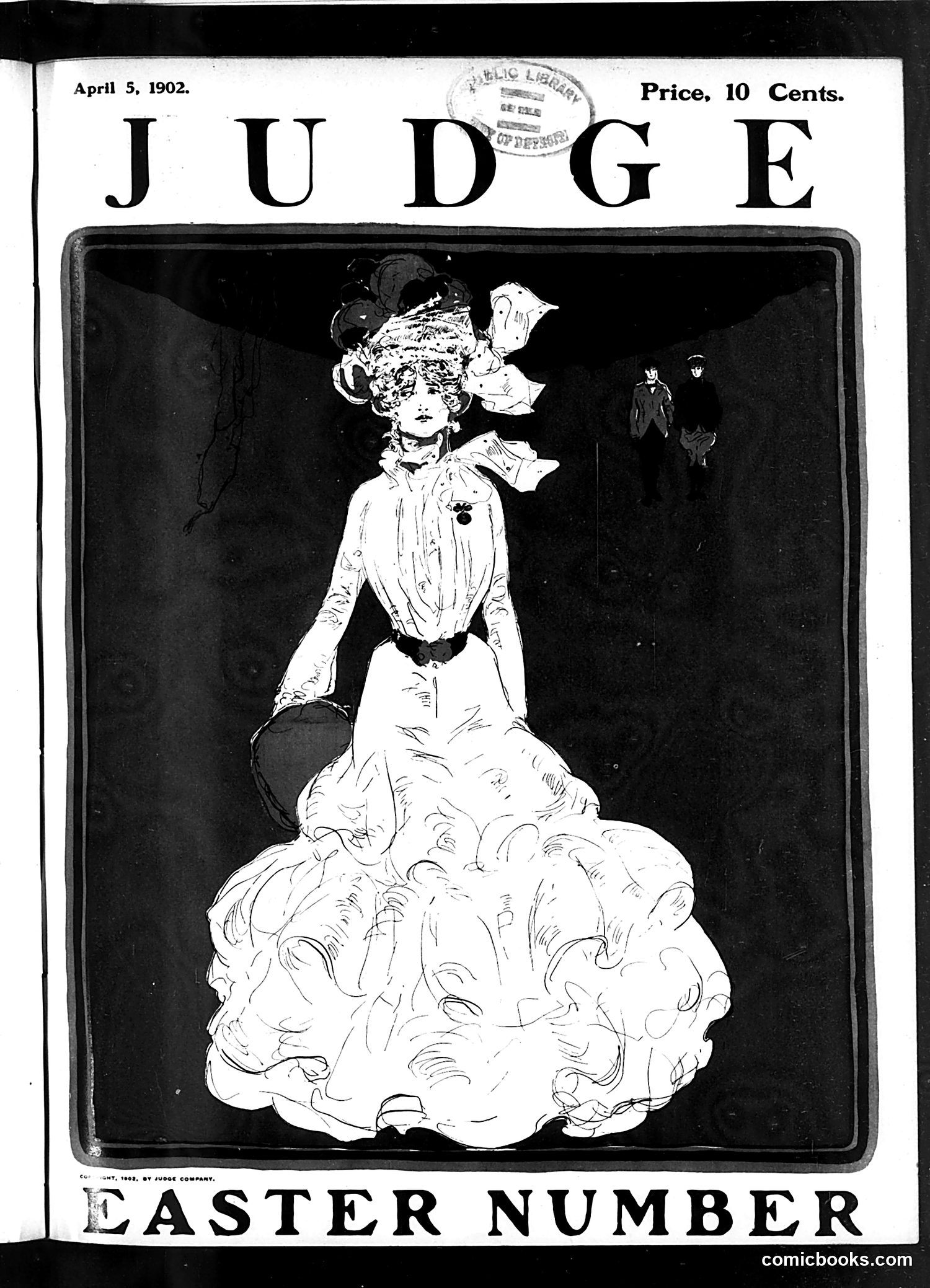
This is the Easter Number of **Judge**, a prominent American satirical weekly. The cover features an elegantly dressed woman in elaborate Edwardian fashion—a high Gibson Girl-style coiffure adorned with feathers and bows, a fitted white blouse, and a dramatically voluminous skirt. She holds a fan and displays the exaggerated silhouette typical of 1902 high fashion. The satire likely mocks the absurdity of upper-class women's Easter fashions, particularly the impractical proportions and excessive ornamentation. Small figures in the background appear to observe her, possibly commenting on the ridiculousness of such fashion displays. The cartoon critiques wealthy women's vanity and conspicuous consumption through the holiday season—a recurring theme in Judge's social satire.
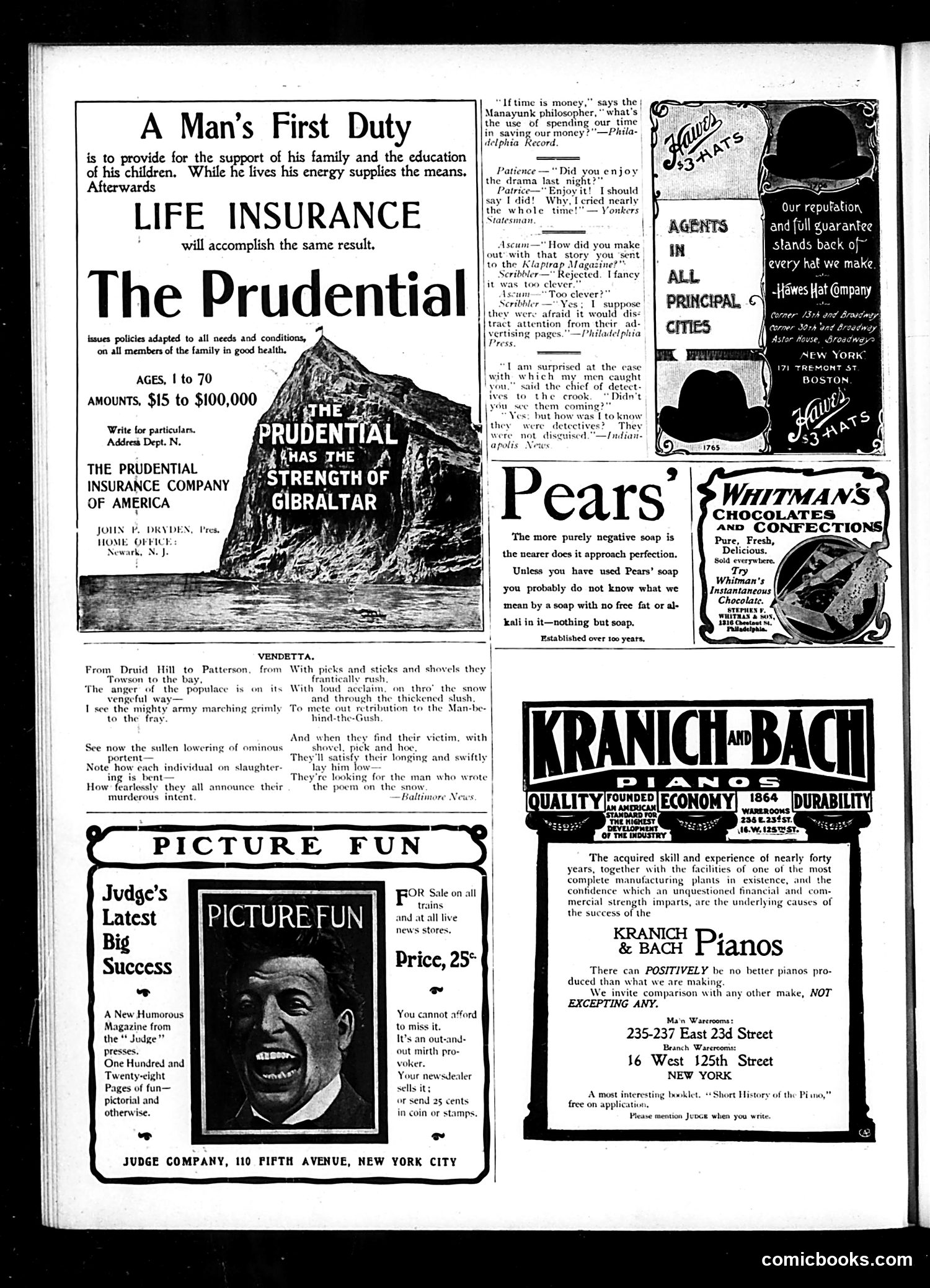
This page is primarily **advertising with one literary feature**, not political satire. The main content includes: - **Life Insurance ad** (Prudential) using Gibraltar's strength as metaphor - **Pears' Soap ad** emphasizing purity - **Kranich & Bach Pianos ad** highlighting quality and durability - **Judge's Picture Fun** — a humorous magazine promoting "Judge" publications, featuring what appears to be a comedic facial portrait - **Hisses Hat Company** and **Whitman's Chocolates** advertisements The "Picture Fun" section seems the only satirical element, advertising Judge magazine itself as a source of humor. The facial caricature appears designed to amuse rather than target a specific political figure. **Overall: This is a commercial page with light entertainment rather than political commentary.**
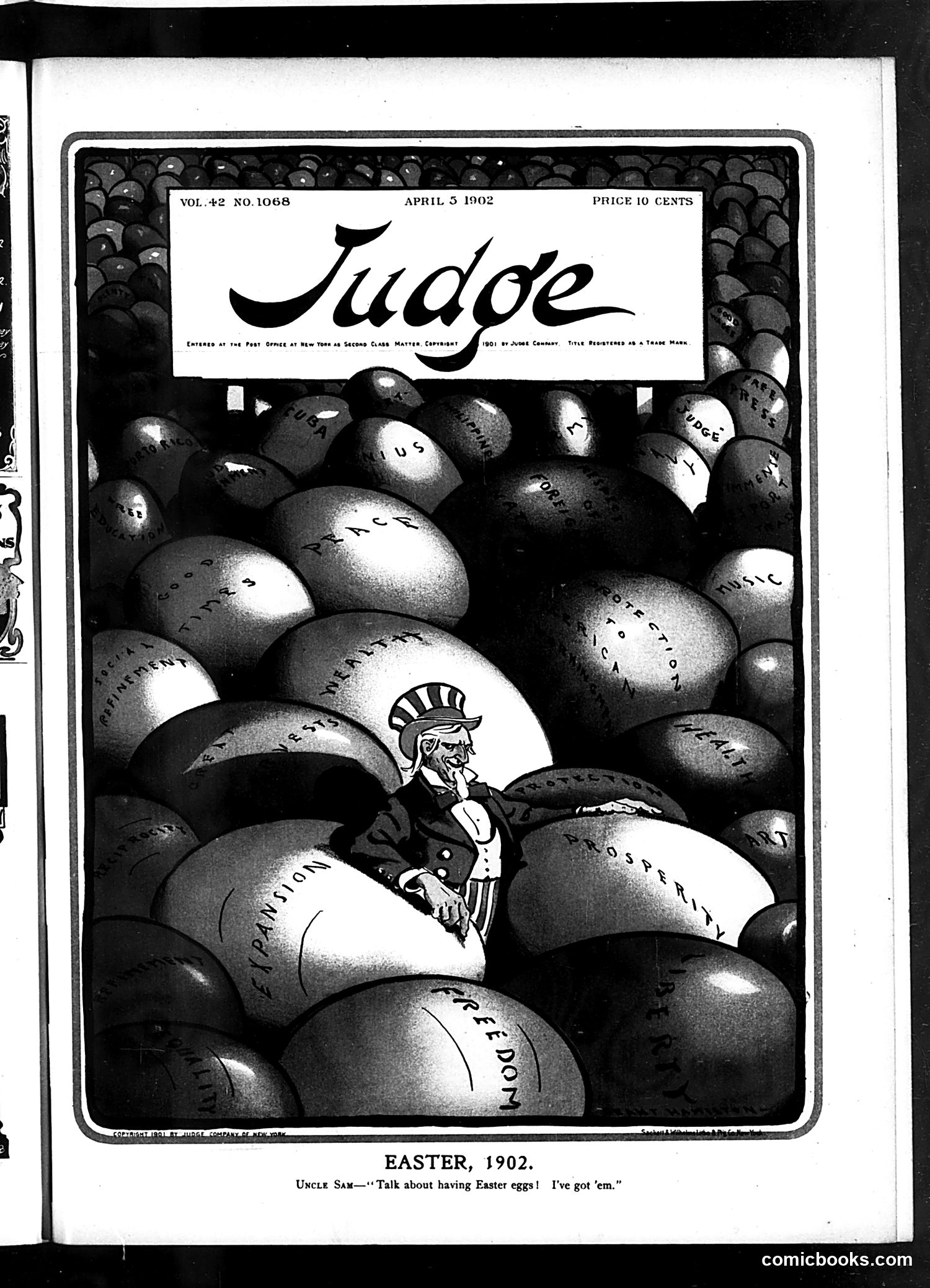
This satirical cover depicts Uncle Sam (identifiable by his characteristic top hat and facial hair) surrounded by enormous Easter eggs labeled with various nations and political entities. The joke's caption reads: "Talk about having Easter eggs! I've got 'em." The satire comments on American imperial expansion around 1902. Each egg represents a territory or possession the U.S. controlled or sought to control—likely including the Philippines, Cuba, Puerto Rico, and Hawaii, all acquired or claimed during the Spanish-American War (1898) and its aftermath. Uncle Sam boasts of his "eggs" (colonial possessions) as Easter trophies, satirizing American imperialism as an acquisitive venture. The image mocks American expansionist policies of the era while using the Easter holiday's egg symbolism for visual impact.
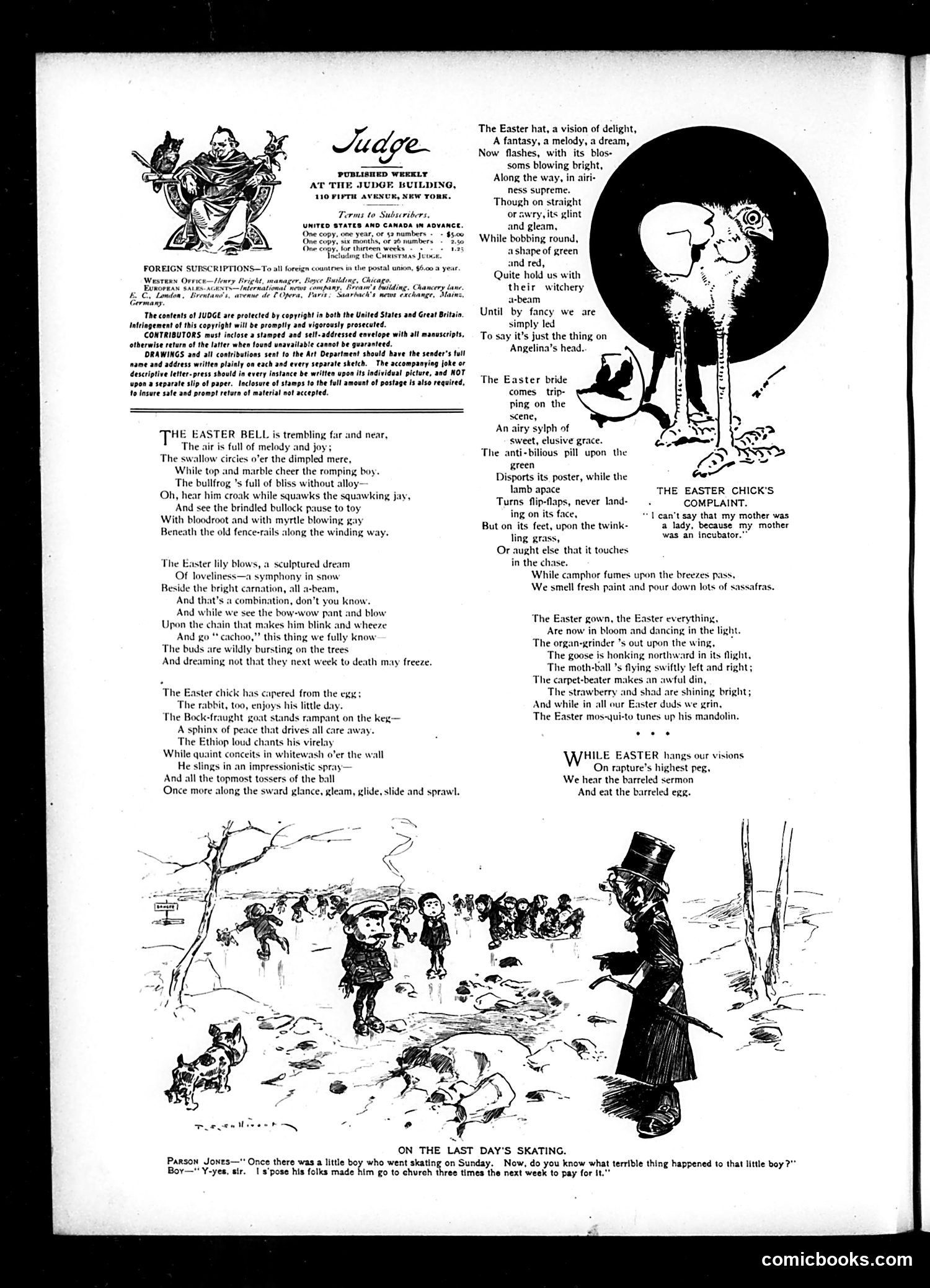
This page contains Easter-themed poetry and illustrations rather than political satire. The poems celebrate Easter imagery—Easter bells, lilies, chicks, and bonnets—with whimsical, descriptive verses. A notable illustration shows "THE EASTER CHICK'S LAMENT," where a chick expresses uncertainty about its parentage ("I can't say that my mother was a lady, because my mother was an incubator"). The bottom illustration, "ON THE LAST DAY'S SKATING," depicts a humorous scene with children skating. A caption includes dialogue between Parson Jones and a boy about a skating accident, using genteel humor typical of the era. These are lighthearted, non-political pieces celebrating spring holidays and childhood experiences, without apparent social or political commentary.
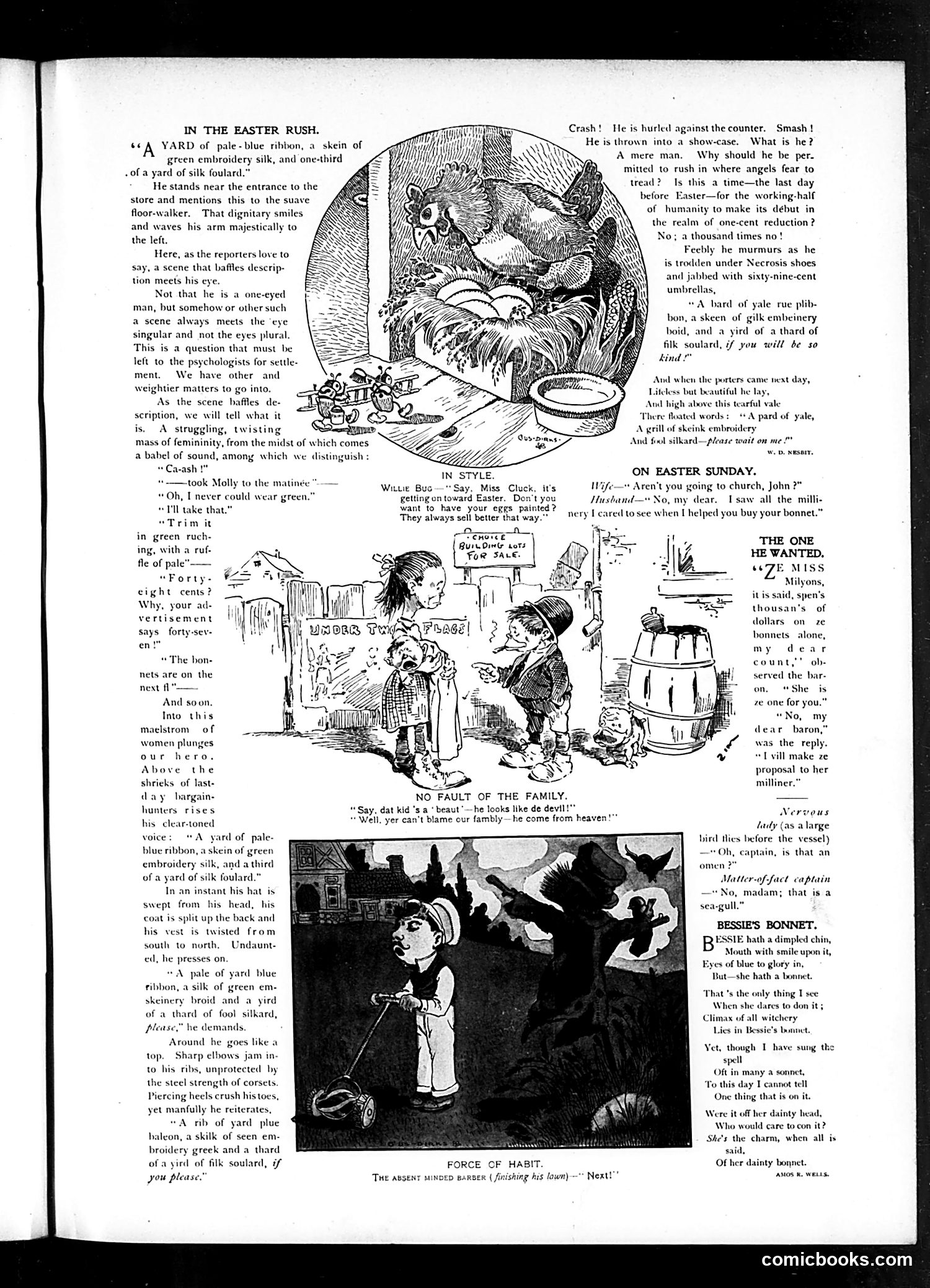
This page satirizes the chaos of Easter shopping, particularly the frenzied crowds of women buying Easter bonnets and trimmings—a major retail event in early 20th-century America. **Main Cartoon ("In the Easter Rush"):** A man enters a department store during the final pre-Easter shopping day to request ribbon and silk. He's immediately caught in a chaotic mass of female shoppers bargaining aggressively over prices. Women shout conflicting demands; he's physically mangled—hat knocked off, clothes torn—as he desperately repeats his request, his words becoming increasingly garbled from the trauma. The joke: a mere man foolishly ventures into women's sacred shopping territory on the worst possible day, suffering comic consequences. **Supporting Content:** Brief humorous vignettes about Easter bonnets, including a husband's relief at avoiding millinery shops and a poem celebrating a woman's bonnet. A small joke about a seagull plays on superstitious passengers mistaking it for an omen. **Social Context:** Reflects the importance of Easter bonnets in women's fashion and the perceived intensity of female consumerism—typical Judge satirical attitudes toward modern shopping culture and gender dynamics.
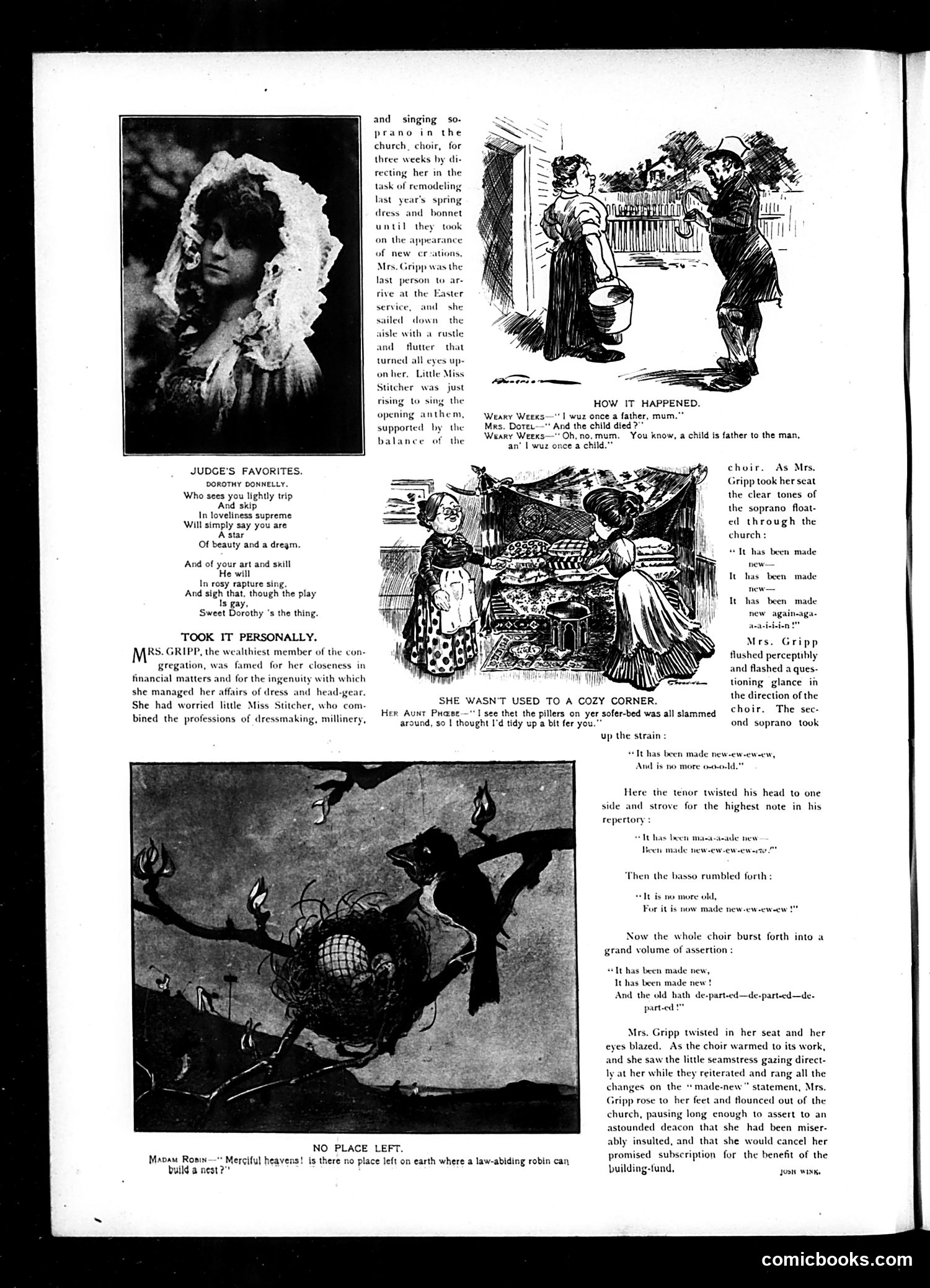
This page contains three separate satirical pieces from Judge magazine: **"Judge's Favorites"** celebrates actress Dorothy Donnelly with flattering verse—standard fan content. **"Took It Personally"** is the main satire: Mrs. Gripp, a wealthy but stingy church member, bullied seamstress Little Miss Stitcher for three weeks remodeling her Easter dress/bonnet. When Stitcher sings soprano in the Easter service, the choir repeatedly emphasizes the hymn line "It has been made new"—clearly directed at Gripp's reused/remodeled outfit. Gripp, recognizing the subtle mockery and Stitcher's direct gaze, takes offense and storms out, threatening to cancel her church donation. The joke mocks Gripp's vanity and miserliness while celebrating the working-class woman's clever, non-confrontational revenge. **"No Place Left"** (bottom) is an unrelated complaint about urban overcrowding—a robin can't find space to nest.
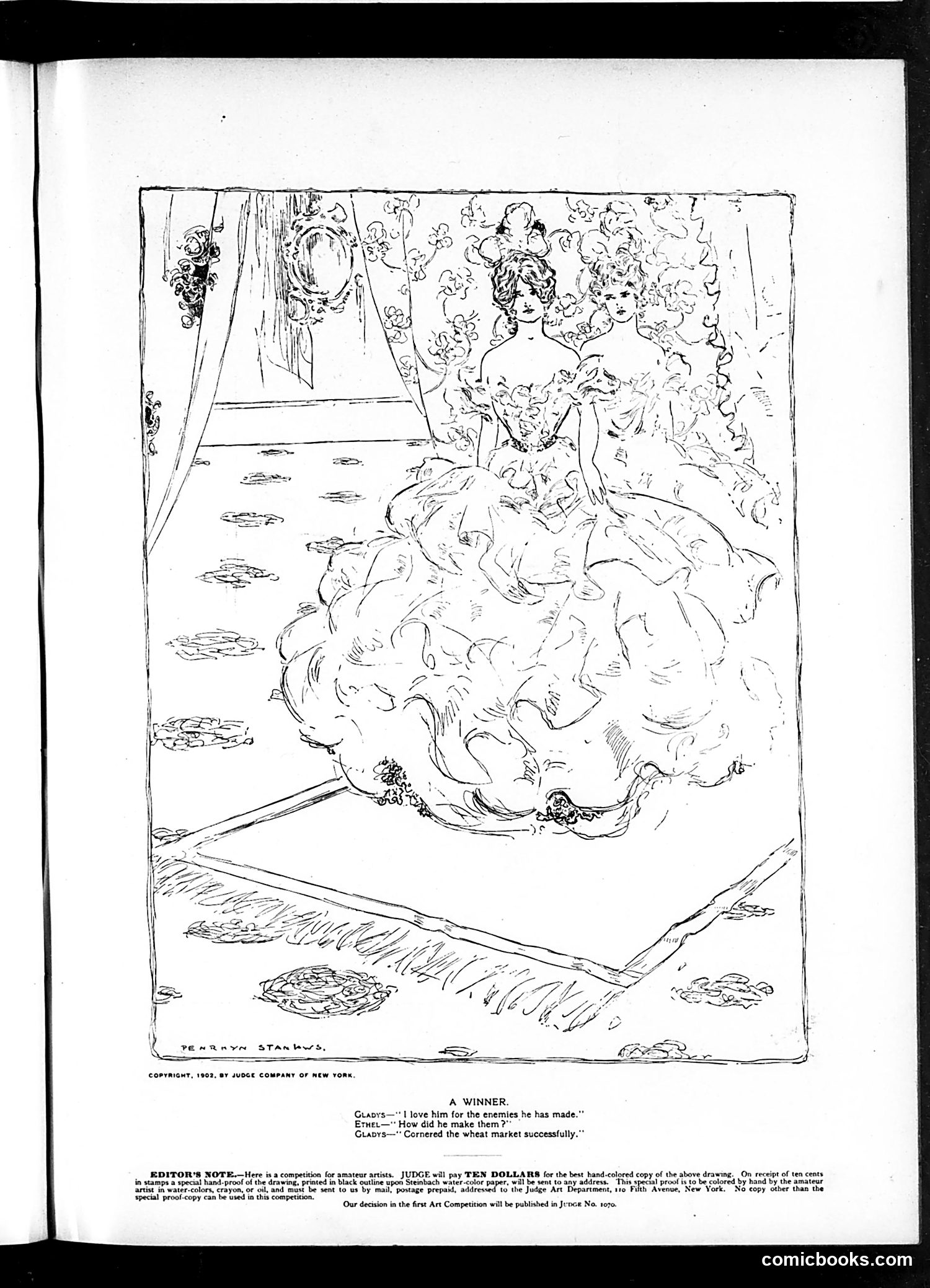
This 1902 *Judge* cartoon satirizes wheat market manipulation and monopolistic business practices. Two women—Gladys and Ethel—discuss a man Gladys admires. When asked how he made enemies, Gladys reveals he "cornered the wheat market successfully." The joke targets wealthy industrialists who controlled commodity markets by buying up supplies to artificially inflate prices, enriching themselves while harming ordinary consumers and farmers. The cartoon's title "A Winner" is ironic; Gladys celebrates this man's ruthlessness as a business achievement, but his "enemies" are the public he's exploited. This reflects Progressive Era concerns about trusts and monopolies. The elaborate dress and interior suggest wealthy society women discussing business titans approvingly, mocking how capitalist excess was socially celebrated despite its harmful effects. The page also advertises an art competition, offering ten dollars for hand-colored versions of this drawing.
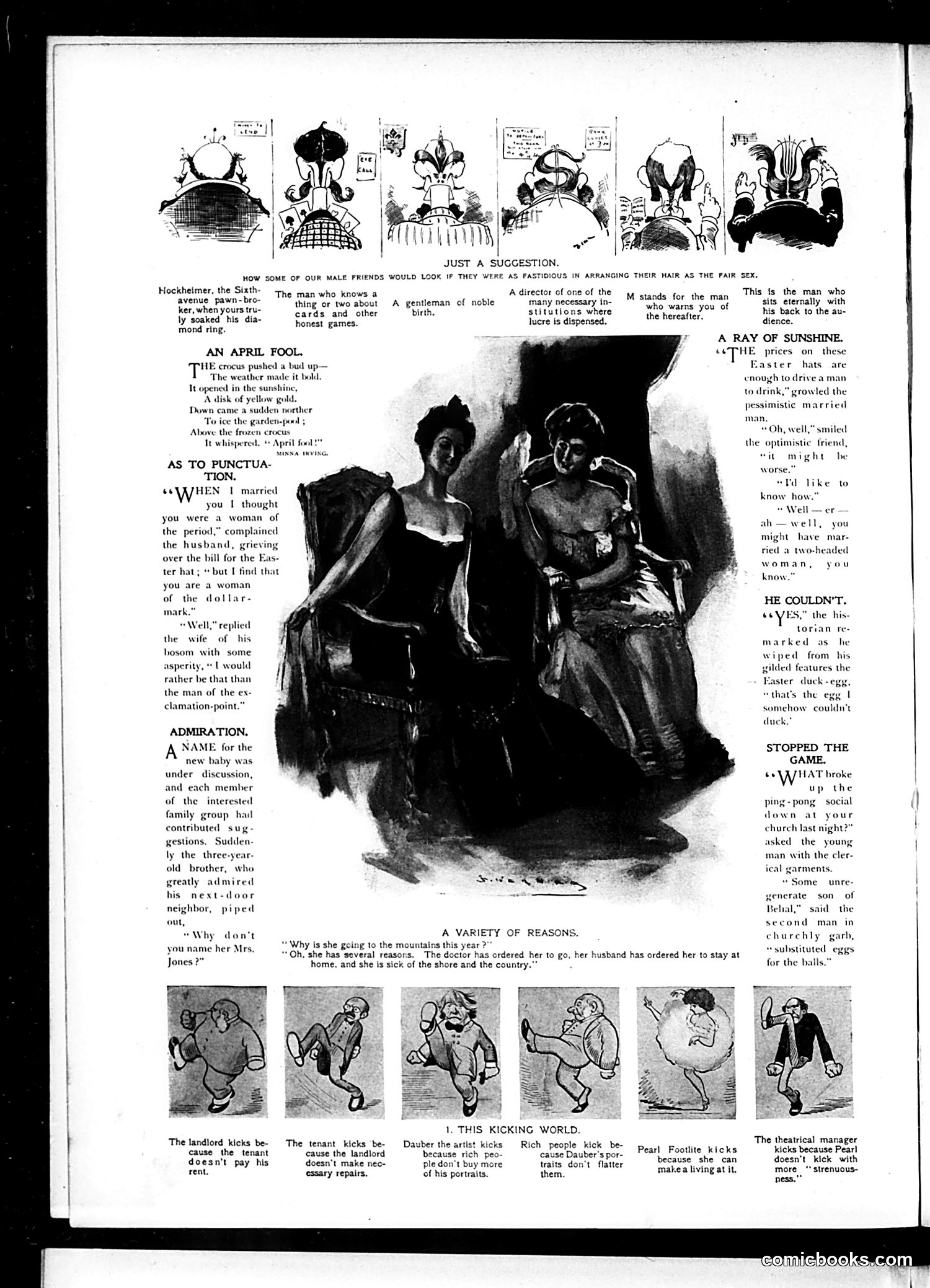
This page contains multiple satirical pieces typical of early 20th-century American humor: **"Just a Suggestion"** depicts six male caricatures with exaggerated, elaborate hairstyles styled "as the fair sex" would arrange theirs. The satire mocks men's vanity and grooming pretensions—suggesting that if men were as fussy about their appearance as women, they'd look ridiculous. **Other content** includes brief humorous stories ("An April Fool," "As to Punctuation," "Admiration") playing on domestic tensions and gender dynamics—common themes in Judge's social satire. **"This Kicking World"** presents six cartoon vignettes showing different social classes complaining: landlords versus tenants, artists versus wealthy patrons, theatrical managers versus performers. Each "kicks" against the other, satirizing class conflicts and economic grievances. The overall tone reflects early 1900s attitudes about gender roles, class relationships, and social propriety—with humor aimed at contemporary readers' recognition of these tensions.
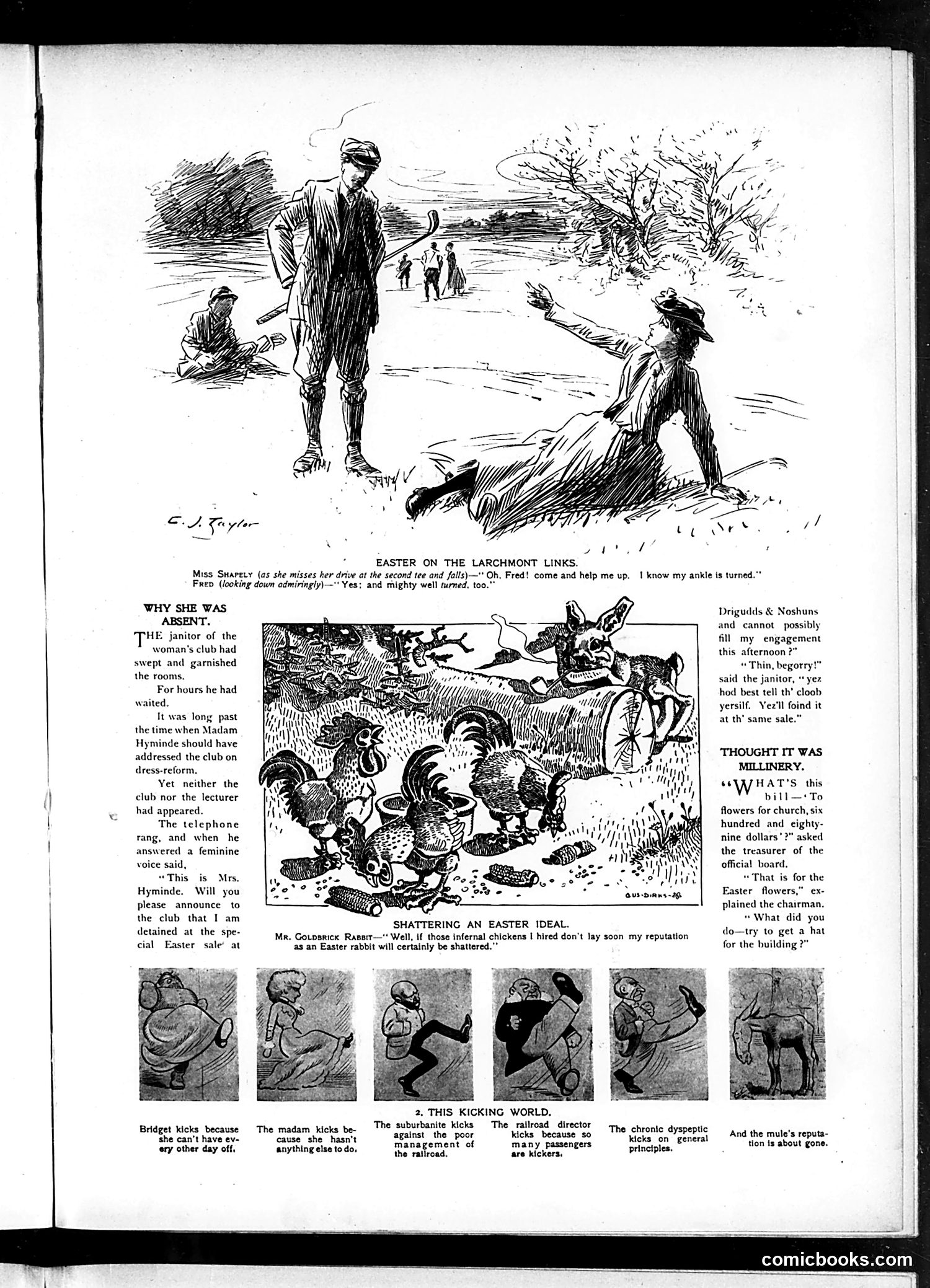
This page contains three interconnected satirical pieces mocking early-20th-century social pretensions and absurdities: **"Easter on the Larchmont Links"** depicts a woman golfer feigning injury to gain male attention—satirizing both the affectation of women in sports and flirtatiousness disguised as helplessness. **"Why She Was Absent"** ridicules a wealthy club woman who skips a dress-reform lecture to attend an Easter sale, spending $689 on church flowers. The satire targets the hypocrisy of reform-minded ladies and conspicuous consumption. **"Shattering an Easter Ideal"** mocks a man hired as an Easter rabbit whose chickens won't lay—undermining his commercial scheme and the commercialization of Easter itself. **"This Kicking World"** (six panel strip) catalogs social complaints: servants, employers, suburbanites, railroad directors, dyspeptics, and mules all perpetually dissatisfied. It's broad social commentary on universal discontent across class lines. The overall theme: American society's self-absorbed complaints and hollow pretenses, from wealth to labor.
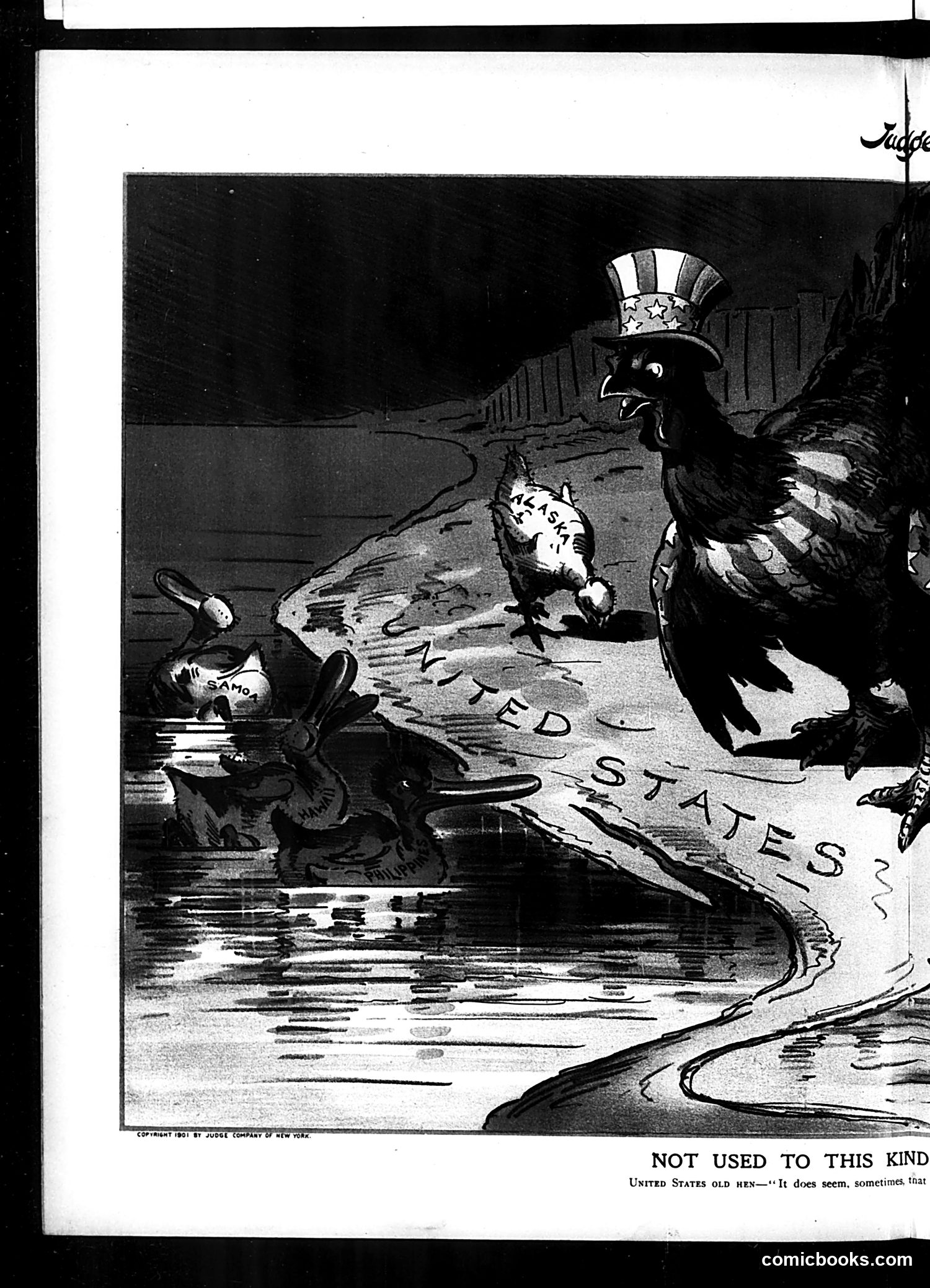
This Judge magazine cartoon satirizes American isolationism and military unpreparedness. A rooster wearing Uncle Sam's iconic top hat appears alarmed or unprepared, surrounded by what appear to be small animals (possibly representing other nations or military threats). Text visible on the ground reads "FEDERAL STATES" and references "USED TO THIS KIND," suggesting the cartoon critiques the U.S. ("United States old hen") as unaccustomed to military conflict or international entanglement. The rooster serves as a feminine symbol for America—domesticated, peacetime-oriented—contrasting with the aggressive posture expected of a nation potentially entering global conflict. The cartoon likely comments on debates over American military readiness or foreign policy during a period of international tension, though the specific historical moment is unclear from the visible text alone.
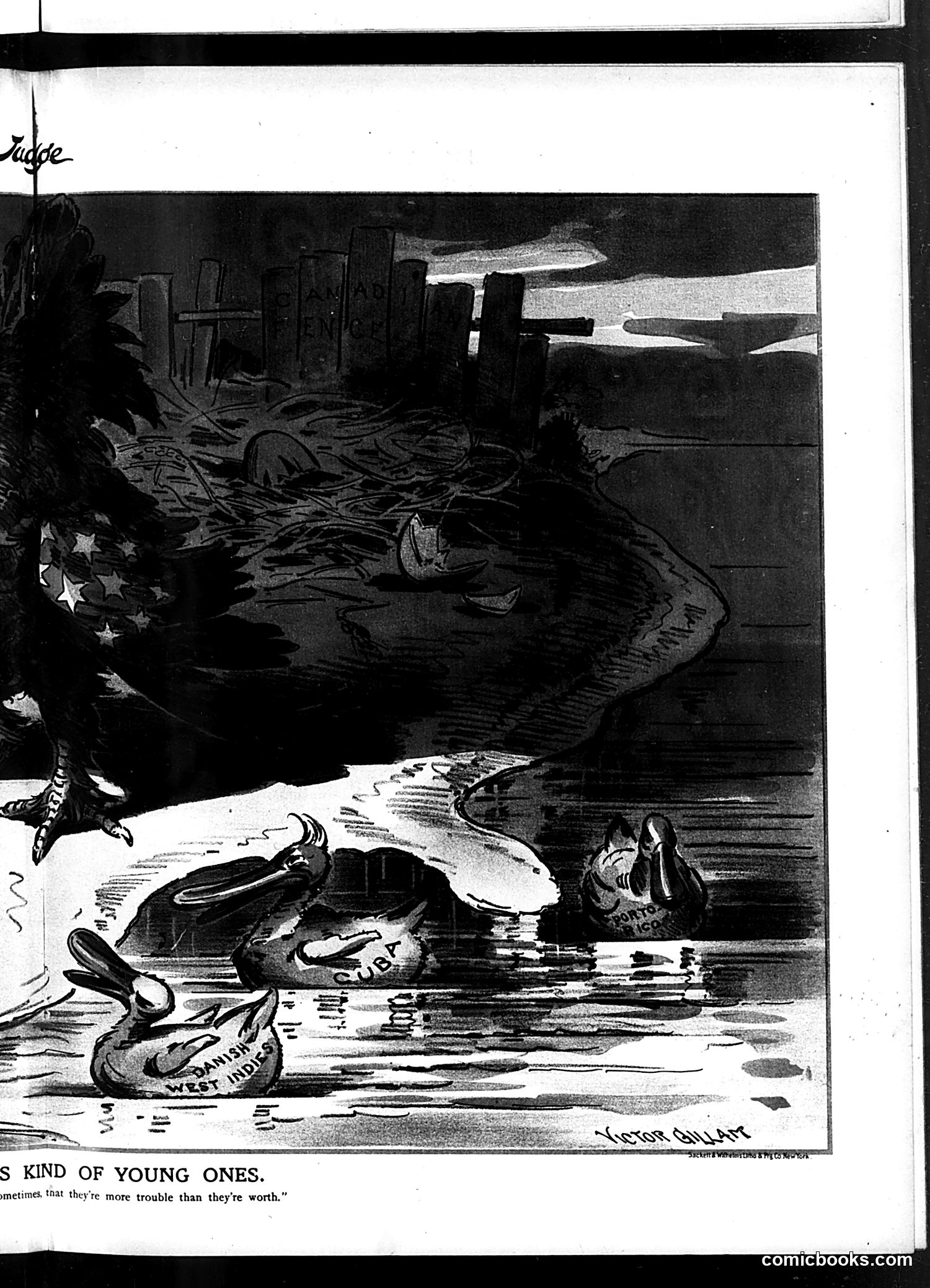
This political cartoon depicts aquatic creatures (appearing to be crocodiles or alligators) labeled "SPANISH" and "WET NURSES" drowning or struggling in water, while an American eagle with stars watches from above left. The cityscape in the background suggests an urban American setting. The satire appears to reference American intervention in Spanish colonial affairs, likely concerning Cuba or the Philippines during the Spanish-American War era. The "young ones" metaphor suggests colonial territories or dependencies. The caption's cynical observation—"sometimes that they're more trouble than they're worth"—critiques the burden and complications of imperial expansion, questioning whether acquiring these territories justifies the costs and difficulties involved. The cartoon expresses skepticism about American imperial ambitions.
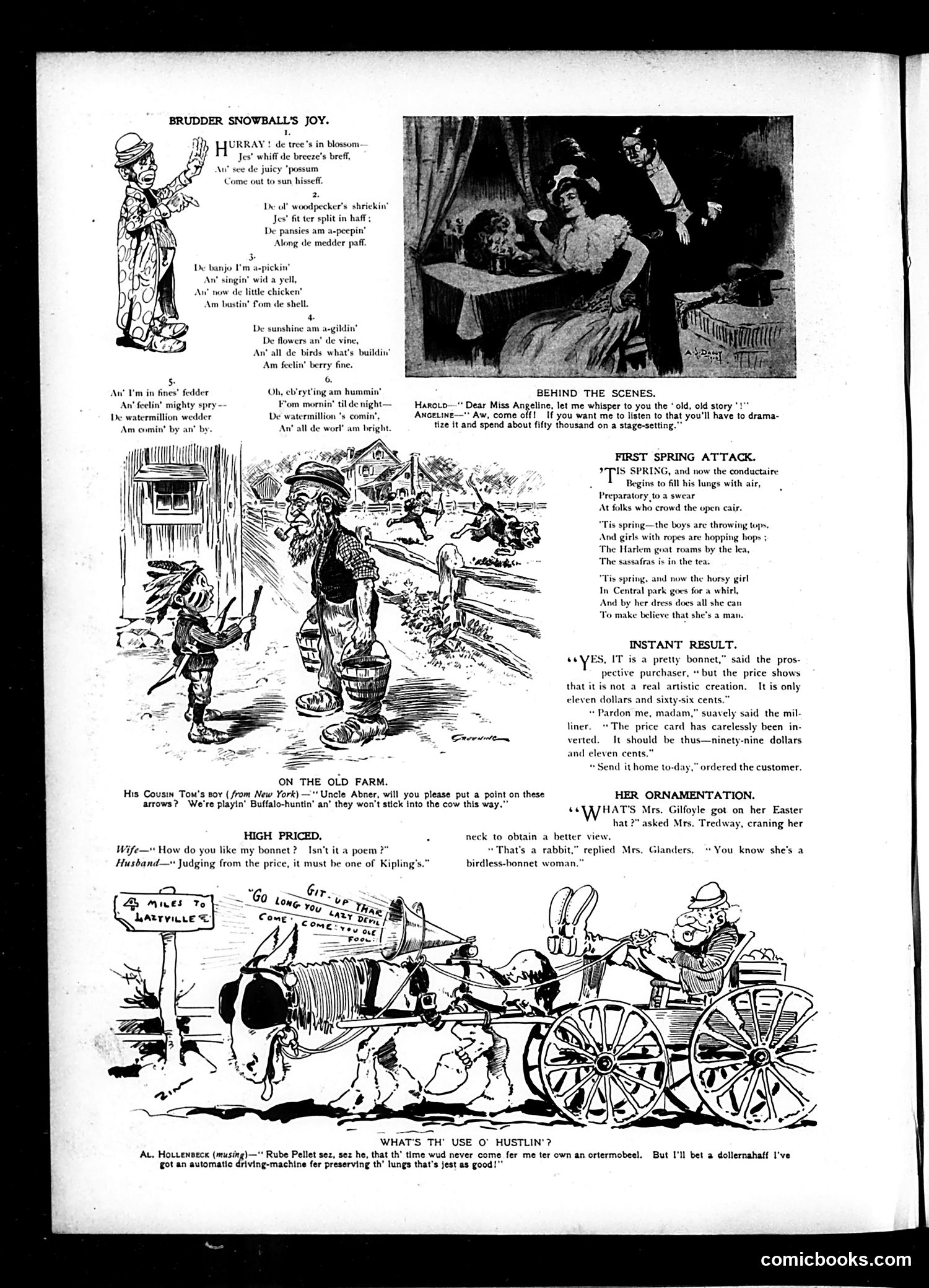
This page from Judge contains multiple unrelated humorous pieces typical of early 20th-century American satire: **"Brudder Snowball's Joy"** uses racist dialect humor (common to the era) featuring an African American character celebrating spring's arrival with exaggerated speech patterns. **"Behind the Scenes"** mocks theatrical pretension—a woman demands an expensive stage production to listen to romantic flattery, satirizing theater's inflated costs and artificiality. **"First Spring Attack"** humorously catalogs spring's annoyances: conductors' irritability, children's games, and women in Central Park affecting masculine dress to appear fashionable. **"High Priced"** jokes about hat pricing—a milliner reverses a price card to justify charging vastly more ($99.11 instead of $11.66), satirizing marketing deception and consumer gullibility. **"What's Th' Use O' Hustlin'?"** features rural dialect humor about a man who owns an "automatic driving-machine" (likely a prototype automobile) instead of achieving wealth traditionally—mocking both rural skepticism and mechanical innovation. The page reflects period attitudes, class commentary, and consumer culture satire.
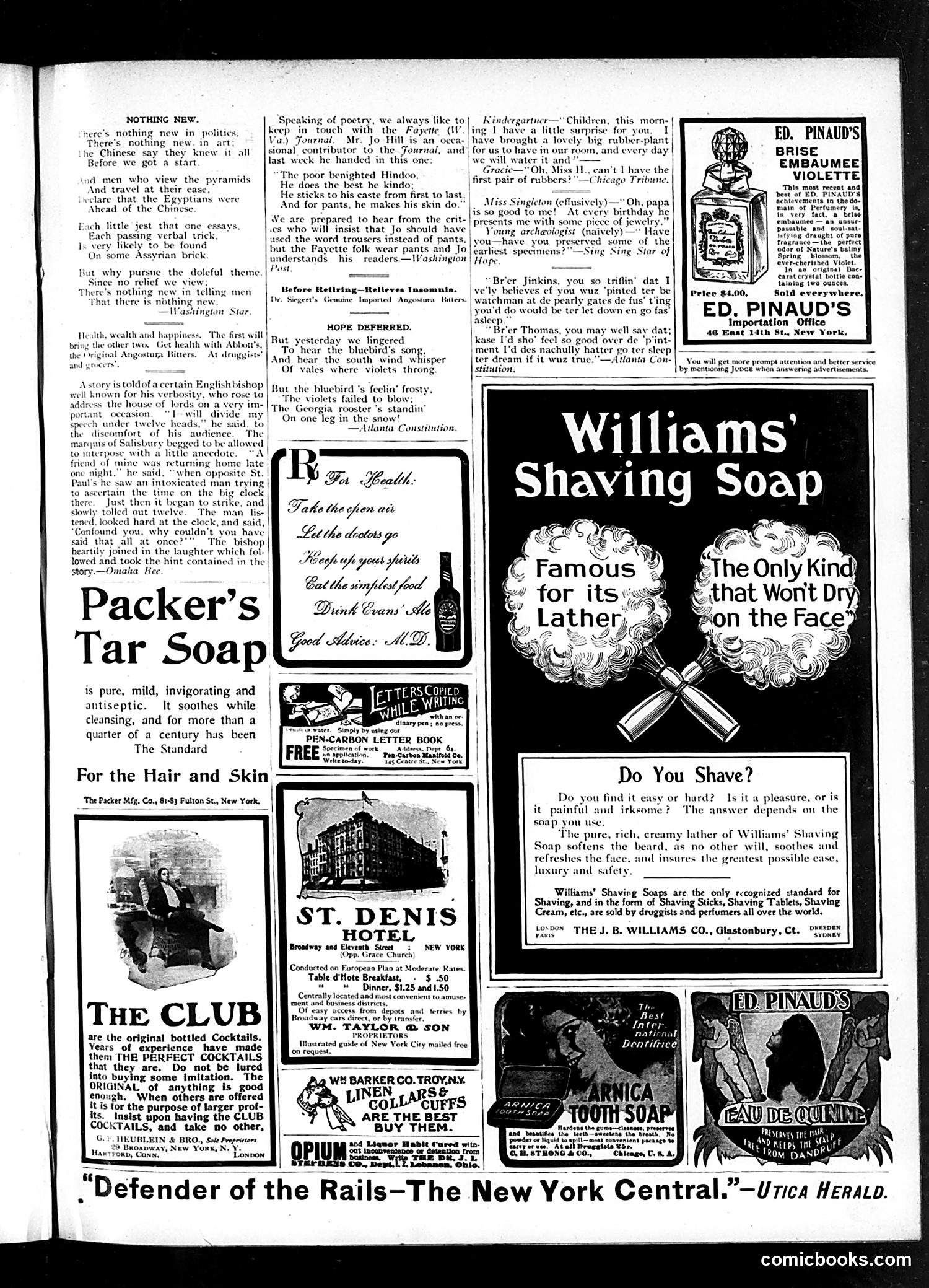
This page is predominantly **advertising**, not political satire. It contains various product advertisements typical of early 20th-century American magazines: Packer's Tar Soap, Williams' Shaving Soap, The Club Cocktails, St. Denis Hotel, and remedies for opium addiction and insomnia. The small editorial content includes **humorous anecdotes** rather than political cartoons: - A poem mocking a poor Hindi man's clothing practices - A story about an English bishop's verbose speech (interrupted by a clock striking twelve) - A joke about children and a rubber plant - A brief piece on poetry contributors The page's title, "NOTHING NEW," reflects its opening philosophical verse suggesting human concerns are timeless—echoing ancient Egyptian and Chinese wisdom. **No identifiable political figures or satirical commentary appear.** This is primarily a commercial publication page with light humor pieces designed to fill space between advertisements.
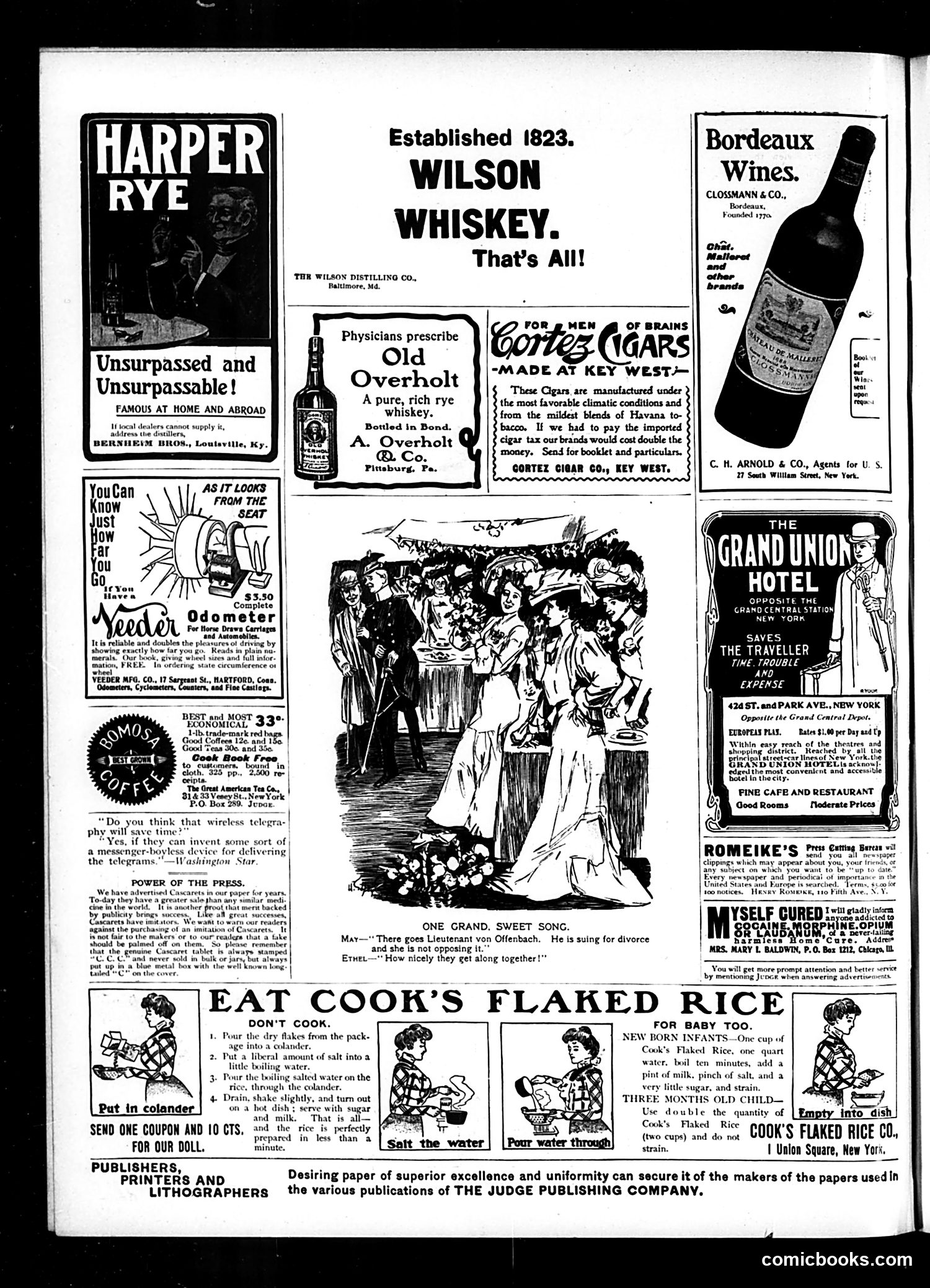
This is primarily an **advertising page** from Judge magazine, with one satirical cartoon. ## The Main Cartoon: "One Grand, Sweet Song" The cartoon depicts a couple at what appears to be a social gathering. The joke centers on a conversation about Lieutenant von Offenbach, who is divorcing his wife—yet she's not contesting it. The punchline relies on irony: despite the apparent marital discord (divorce proceedings), the couple "get along together" so nicely. This satirizes the absurdity of formal legal disputes between people who seem cordial, or possibly mocks the social pretense of civility masking underlying conflict. ## Advertisements The page is filled with period advertisements for whiskey, wine, cigars, rice, hotels, and other products—typical Judge magazine content. One ad includes a joke about wireless telegraphy potentially eliminating messenger boys, reflecting early-20th-century anxieties about technological disruption. The overall page reflects Judge's formula: mixing satirical humor with commercial revenue through advertising.
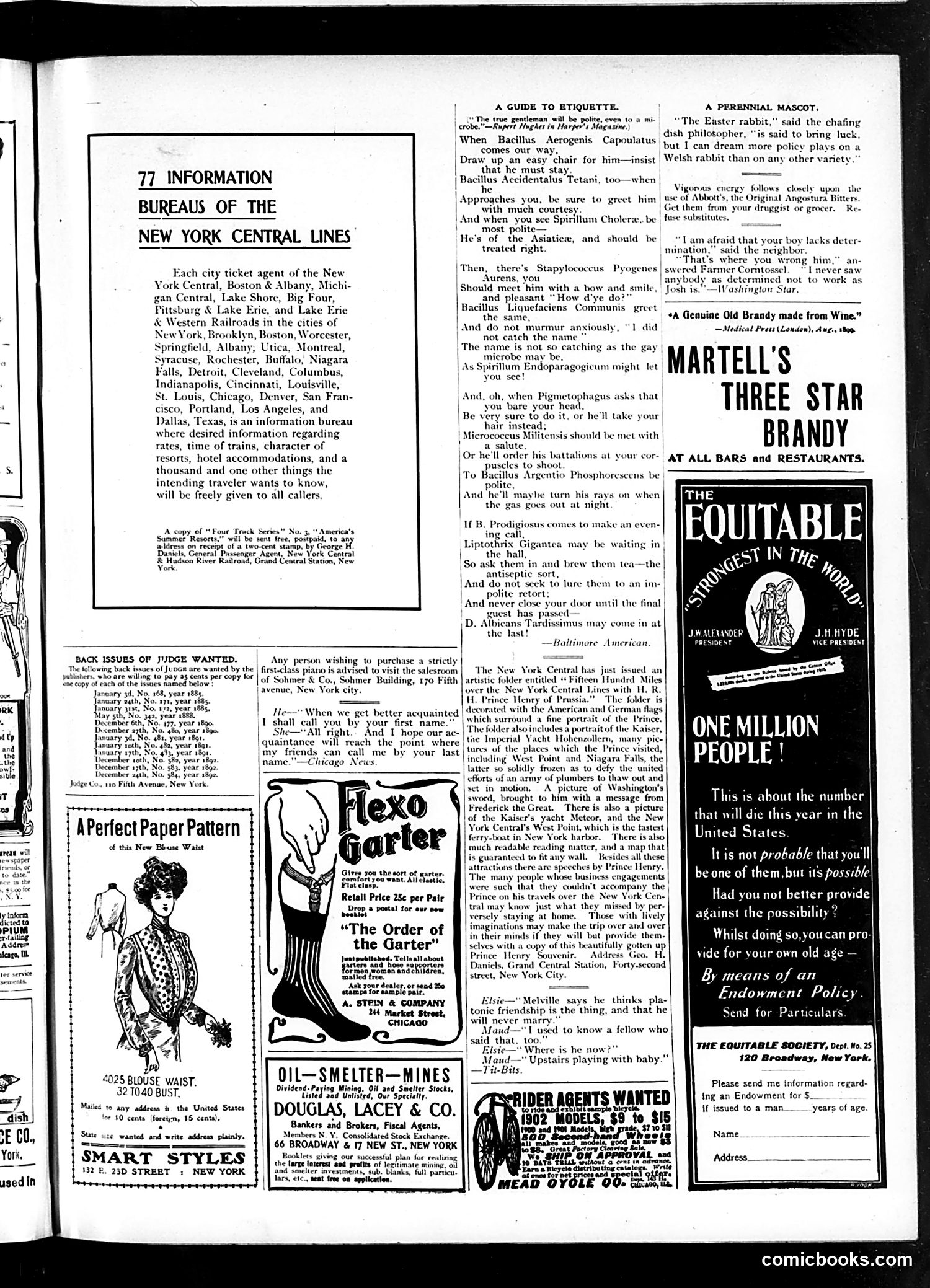
This page is primarily **advertising and administrative notices** rather than political satire. The small "Guide to Etiquette" column appears to be humorous filler—a mock-scientific piece listing fictional bacteria names (like "Bacillus Aerogenis Capoulatus") with absurd social instructions for greeting them politely. This is wordplay humor exploiting the era's fascination with newly-discovered microorganisms; the joke is treating invisible germs as visiting dignitaries requiring etiquette. The main content consists of: - Information about New York Central Railroad ticket bureaus - Various advertisements (Martell's Three Star Brandy, The Equitable Society insurance, Flexo Garter hosiery, etc.) - Notices for back issues of *Judge* magazine itself The "Easter rabbit" and "Welsh rabbit" references are brief commercial copy for beverages, not satire. There is no discernible political cartoon on this page—it's a typical turn-of-century magazine layout mixing editorial matter with paid advertising.
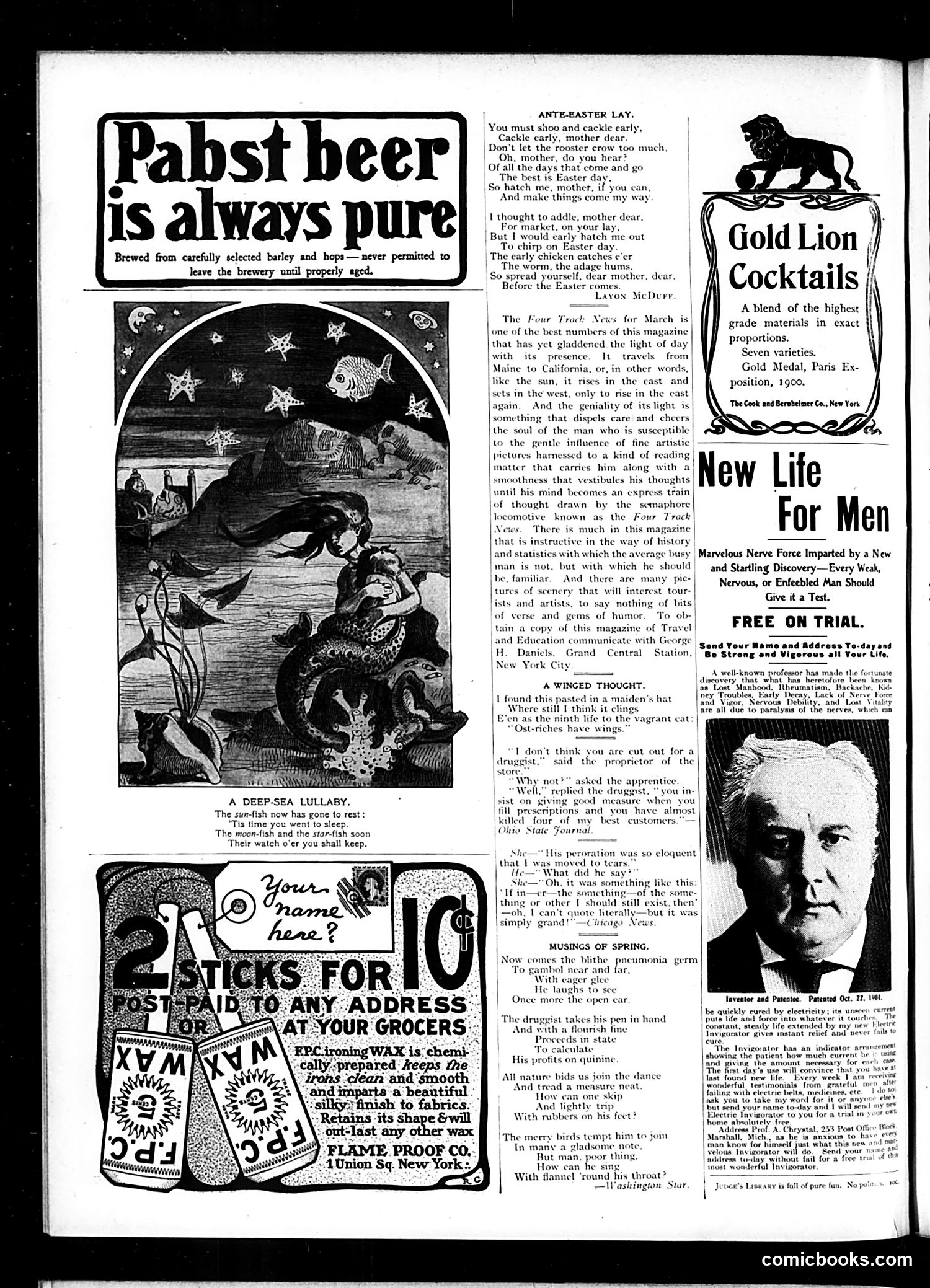
This is primarily an **advertising and literary page** from Judge magazine, with several humorous pieces and ads. The main content includes: **Poetry/Humor:** - "Ante-Easter Lay" — a playful poem from a hen's perspective about Easter preparation - "A Deep-Sea Lullaby" — whimsical verse about sea creatures - "A Winged Thought" and "Musings of Spring" — brief comic anecdotes about druggists, romance, and seasonal ailments **Satirical Elements:** The "Musings of Spring" poem gently mocks spring hypochondria—people rushing to treat pneumonia, buying quinine, and bundling up with flannel despite warm weather's arrival. **Advertisements:** Notable ads include Pabst Beer (emphasizing purity and aging), Gold Lion Cocktails, KWM Wax Polish, and a dubious patent medicine called "New Life For Men" promising to restore "nerve force" and "lost manhood"—typical of era quackery. The page reflects Judge's blend of light satire, family-friendly humor, and period advertising—no specific political cartoons appear here.
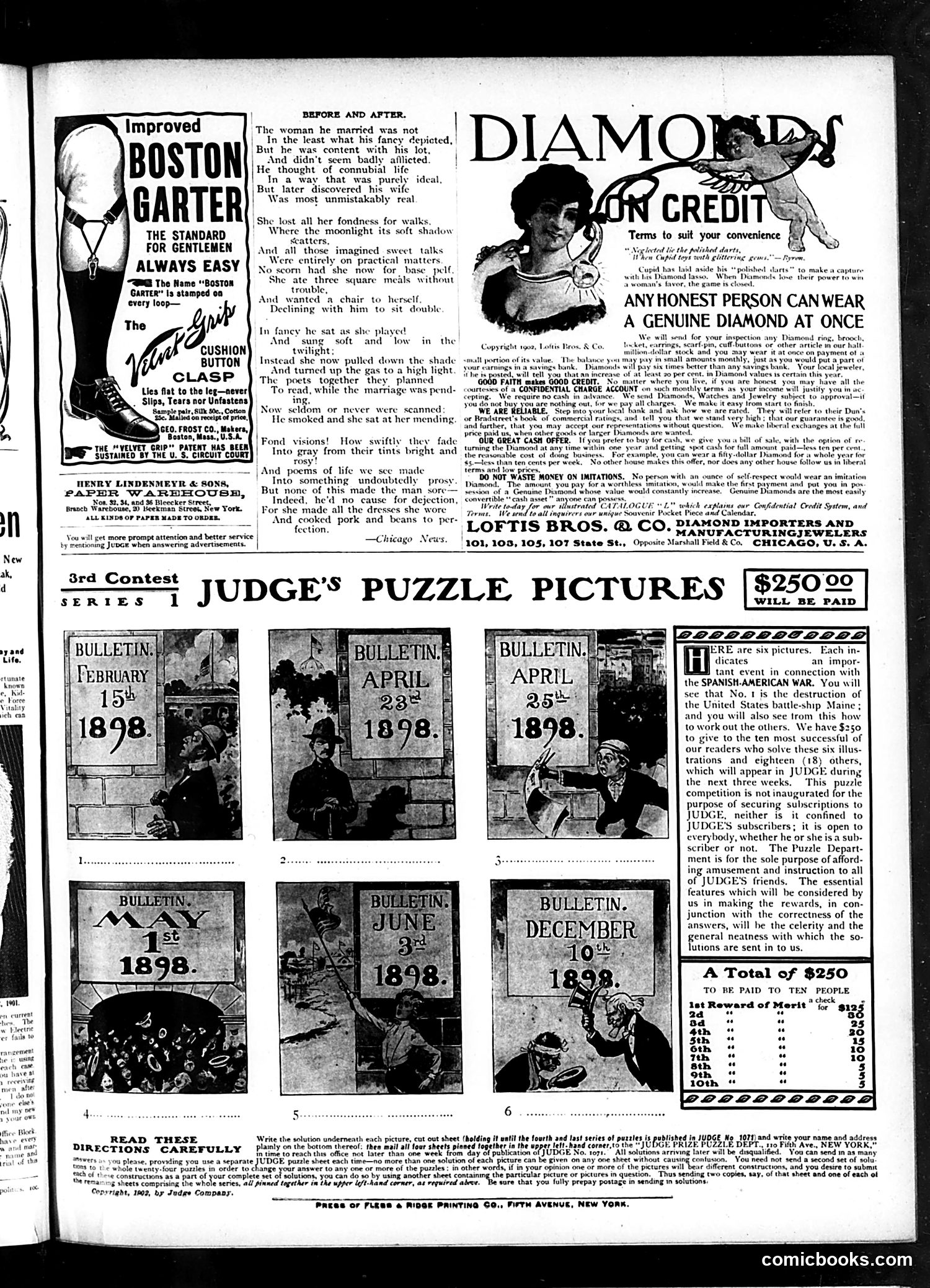
This page from Judge magazine (1898) contains mixed content: advertisements, a poem, and a puzzle contest. **"Before and After" Poem:** This satirical verse mocks romantic idealization versus marital reality. A man imagines his bride as poetic and devoted, but discovers she's practical—concerned with meals and comfort rather than moonlit walks and poetry. The joke reflects late-Victorian anxieties about women's actual versus idealized nature, suggesting wives prioritize domestic practicality over romantic sentiment. **Advertisements:** The page features product ads (Boston Garters, diamonds on credit) exploiting consumer desires and credit systems emerging in the 1890s. **Puzzle Contest:** Judge announces a $250 prize for solving six illustrated puzzles related to the Spanish-American War (1898), including one depicting the USS Maine's destruction—a recent, nationally traumatic event that sparked the war. The page reflects 1890s concerns: gender role disappointments, consumer capitalism, and patriotic engagement with current military conflict.
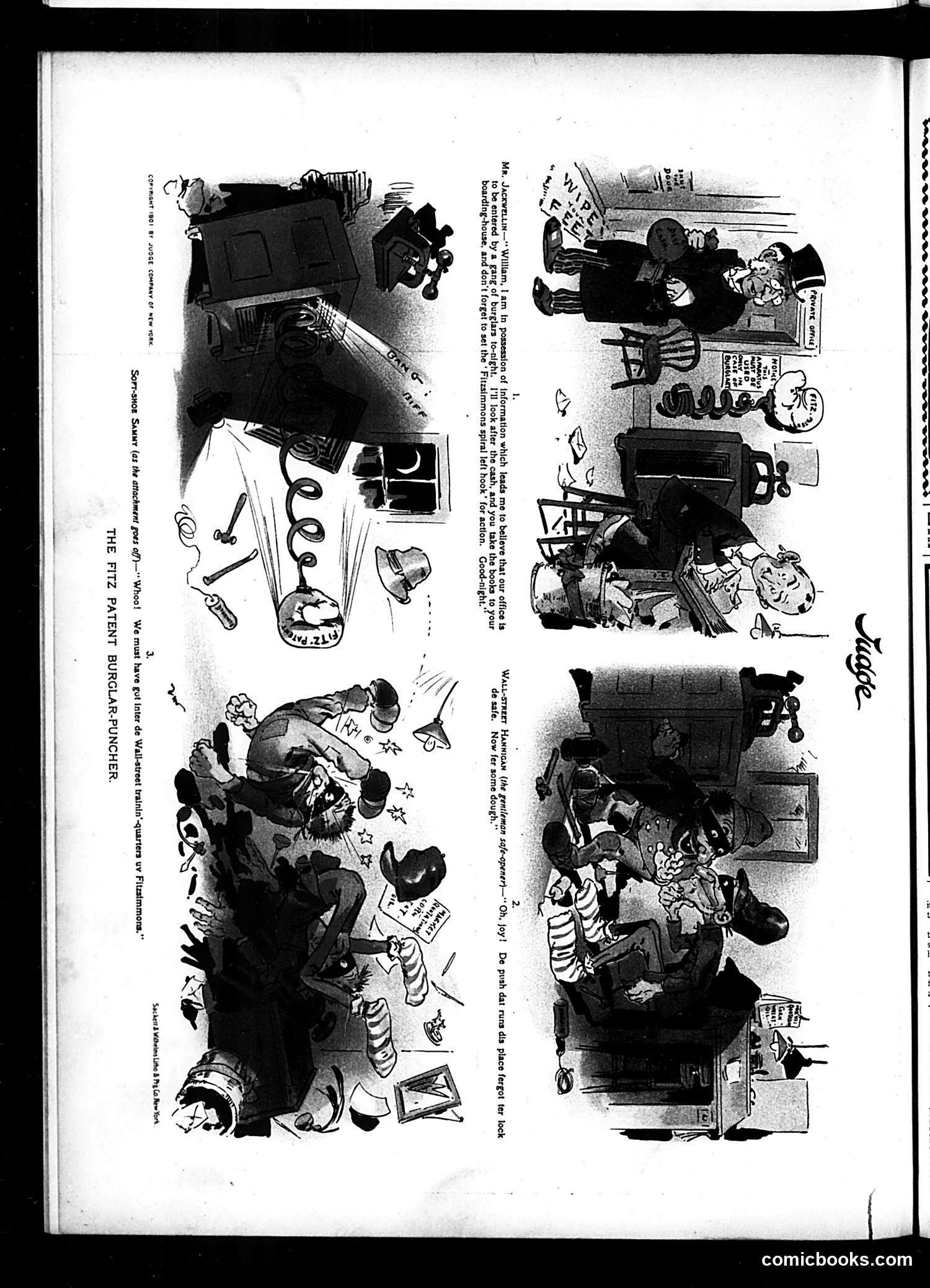
This Judge magazine cartoon satirizes boxer **Bob Fitzsimmons**, likely from the 1890s. The humor plays on Fitzsimmons' reputation as a powerful fighter by imagining his fighting techniques applied to a burglar-catching device. The cartoon depicts a safe-cracking scenario where a burglar ("Jack Wellin") attempts robbery but gets caught by an explosive or mechanical trap—the "Fitz Patent Burglar-Puncher." A character (possibly a security guard or safe owner) reacts with amazement, joking that the violent response resembles Fitzsimmons' famous boxing training quarters on Wall Street. The satire mocks both: (1) Fitzsimmons' extreme fighting ability, treating it as dangerously excessive, and (2) the era's fascination with mechanical security innovations. The joke conflates the boxer's knockout power with an over-engineered defensive device, suggesting Fitzsimmons-level force is overkill even for stopping criminals.
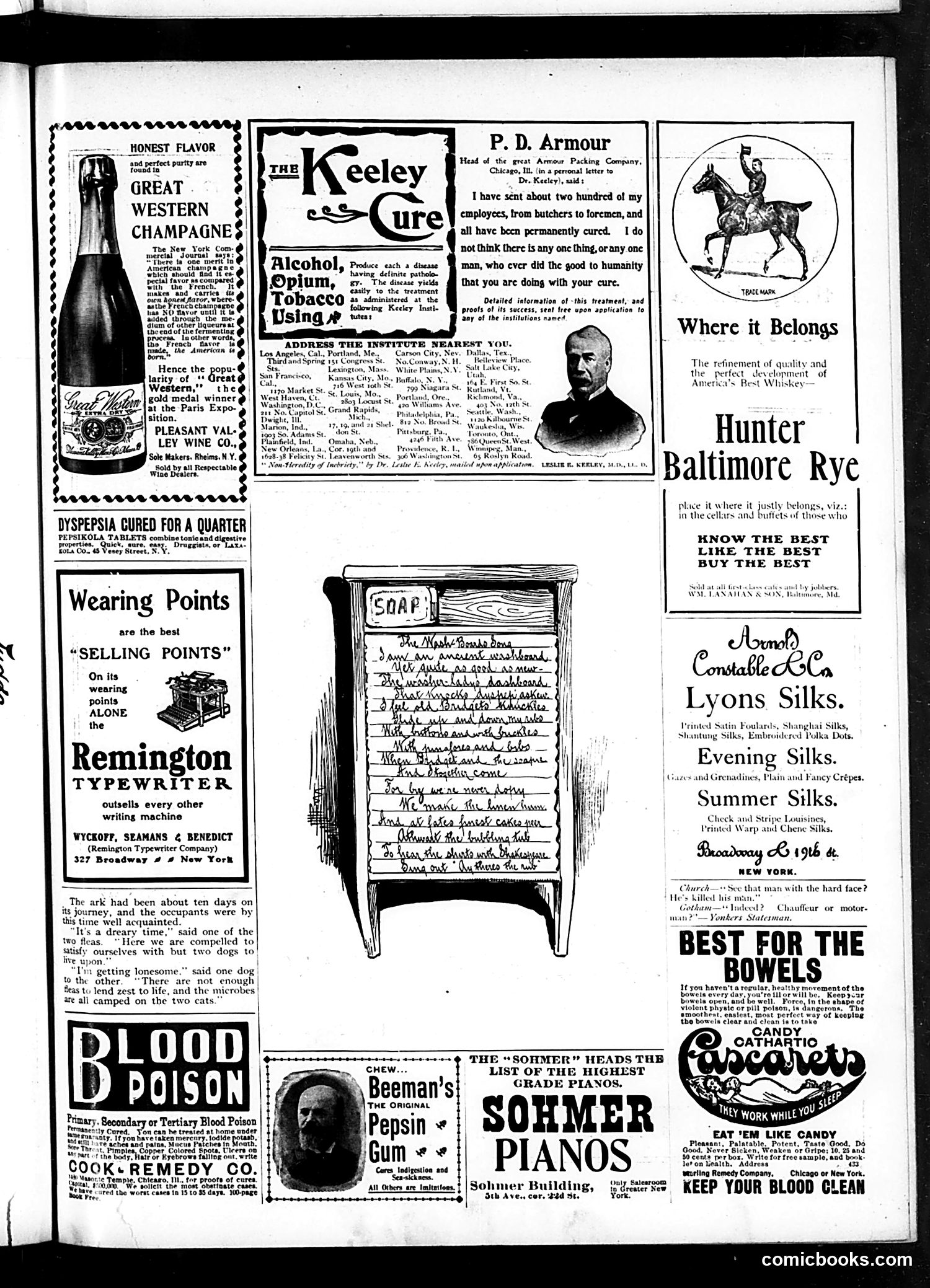
This is primarily an **advertising page** from an early 1900s satirical magazine, not a political cartoon. The page contains dozens of commercial advertisements with minimal satirical content. The notable exception is a brief **humorous anecdote** (lower left) about fleas on Noah's Ark complaining about overcrowding—a lighthearted joke with no political significance. The advertisements themselves reflect period attitudes worth noting: they hawk dubious medical "cures" (blood poison treatment, dyspepsia tablets, pepsin gum), reflecting an era before FDA regulation when fraudulent patent medicines saturated media. The ads invoke celebrity endorsements (P.D. Armour praising Keeley Institute treatments) and make extravagant health claims. The page demonstrates how Judge monetized its readership through advertising rather than relying solely on editorial content. The ads reveal contemporary consumer anxieties (digestive problems, venereal disease, constipation) and commercial opportunism exploiting them.
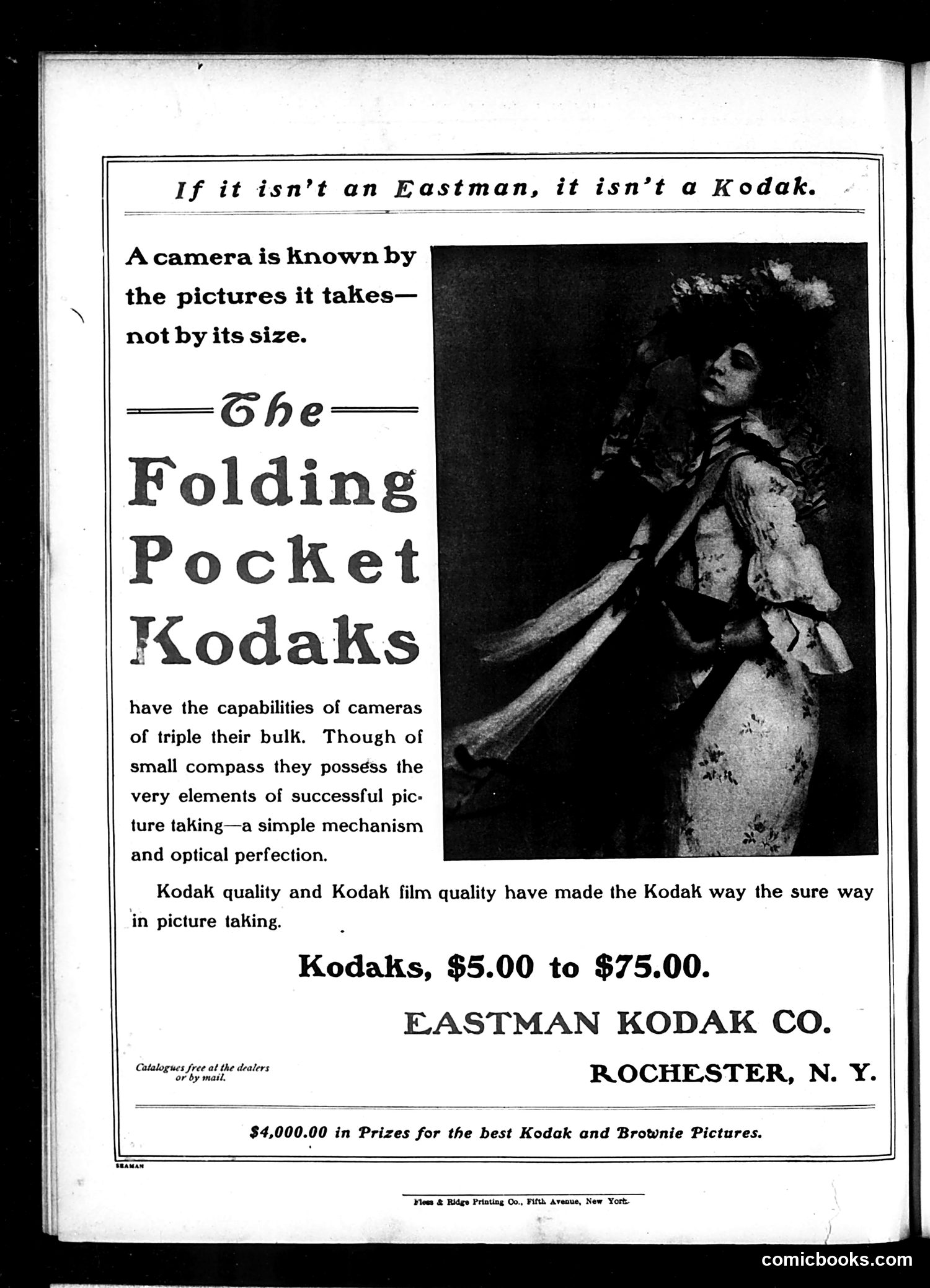
This is a **full-page advertisement**, not a cartoon or satirical content. It's a Kodak camera ad from *Judge* magazine promoting "Folding Pocket Kodaks." The ad emphasizes that camera quality depends on picture results, not physical size—a key selling point for compact, portable cameras. The accompanying photograph shows a woman with a folding Kodak camera held to her face, demonstrating the product's portability and ease of use. The advertisement positions Kodak as the superior choice through "Kodak quality and Kodak film quality," and advertises a $4,000 prize contest for "the best Kodak and Brownie Pictures" to encourage consumer participation and brand loyalty. This reflects the early 20th-century photography market, where Kodak dominated by making photography accessible to amateur consumers rather than professional photographers.