
A complete issue · 16 pages · 1902
Judge — March 15, 1902
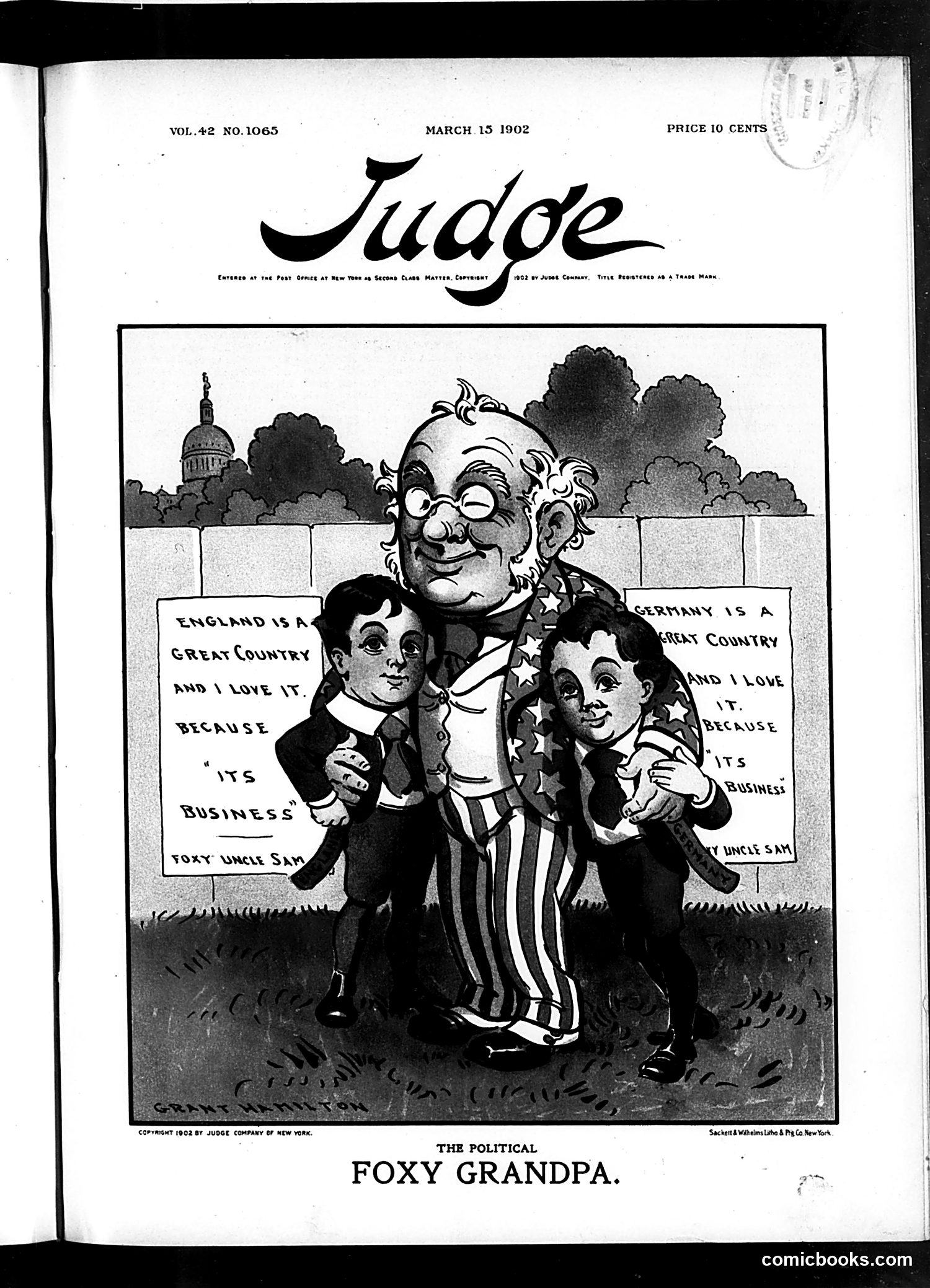
This 1902 *Judge* magazine cartoon satirizes political hypocrisy through the figure of "Uncle Sam" (center, in striped pants), depicted as a deceptive "foxy grandpa" figure manipulating two child-like personifications of nations. The signs read: "England is a great country and I love it, because it's business" (left) and "Germany is a great country and I love it, because it's business" (right). The satire targets American foreign policy as dishonest self-interest disguised as patriotic rhetoric. Uncle Sam cynically claims to love these nations for commercial reasons while playing both sides, portraying American diplomacy as cunning exploitation rather than genuine friendship. The "grandpa" metaphor suggests America is patronizingly manipulating younger nations for profit.
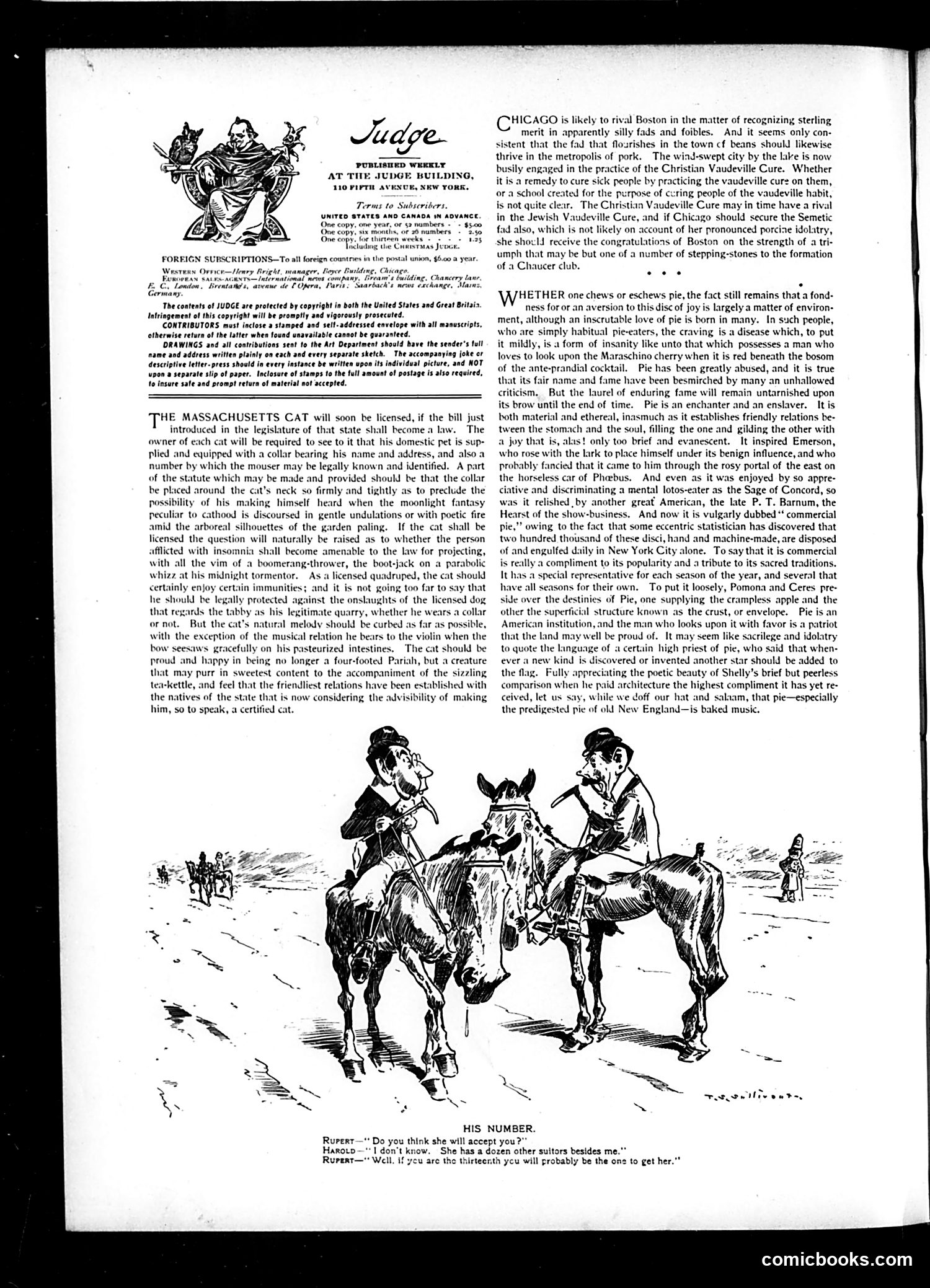
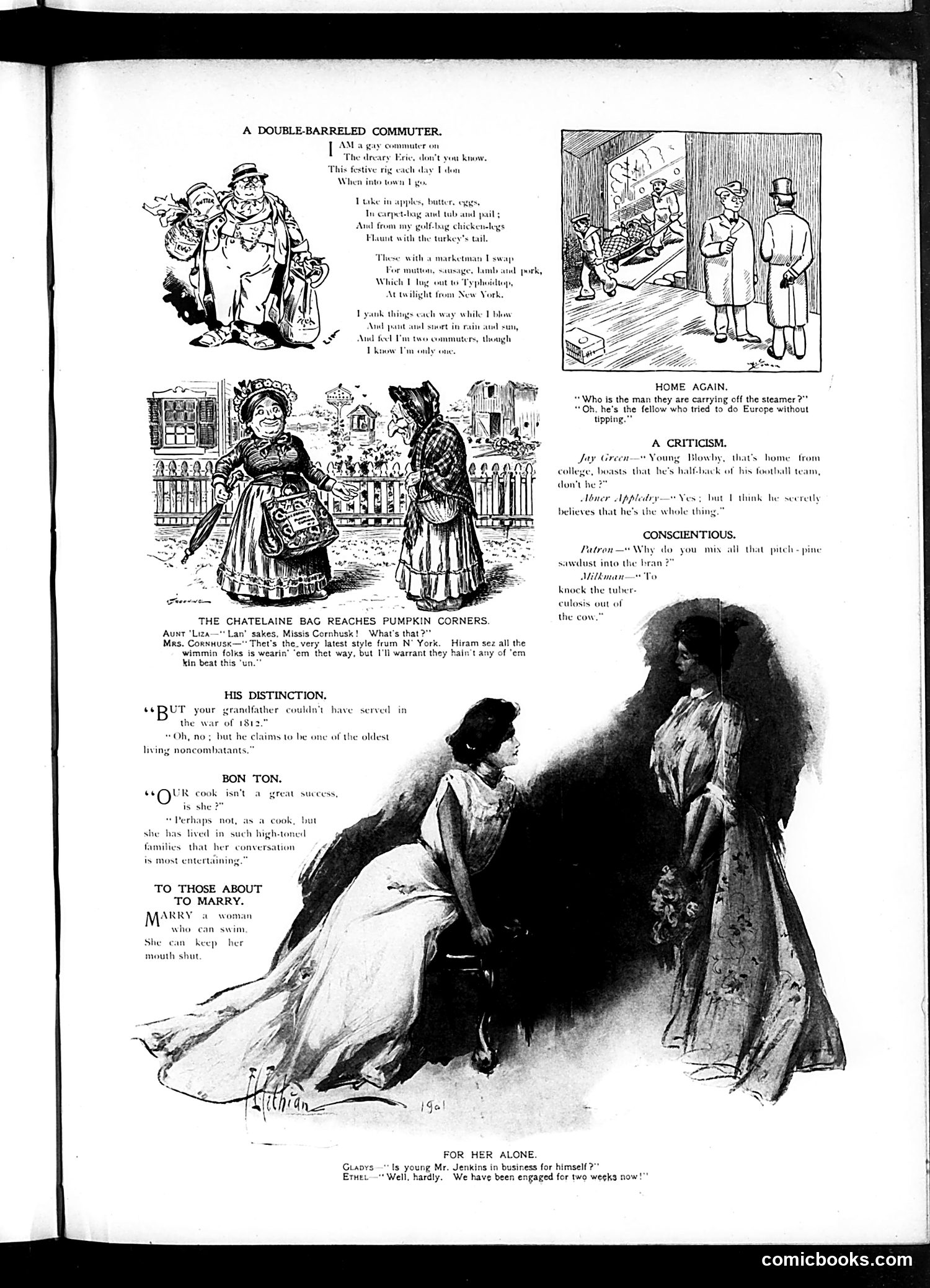
This page contains several brief satirical pieces and illustrations typical of Judge magazine's humor: **"A Double-Barreled Commuter"** mocks a man who brings excessive provisions from the countryside to the city, trading farm goods with urban workers—poking fun at commuter culture and rural-urban economic exchanges. **"The Chatelaine Bag Reaches Pumpkin Corners"** satirizes how fashionable accessories from New York reach small towns, with rural characters adopting urban styles. The remaining pieces—"His Distinction," "Bon Ton," "To Those About to Marry," and "For Her Alone"—are brief witty observations about social pretension, cooking, marriage, and courtship conventions of the era. The large illustration at bottom appears to depict a romantic or dramatic encounter. Overall, the page offers gentle social satire on class differences, fashion trends, and domestic life among turn-of-the-century Americans.
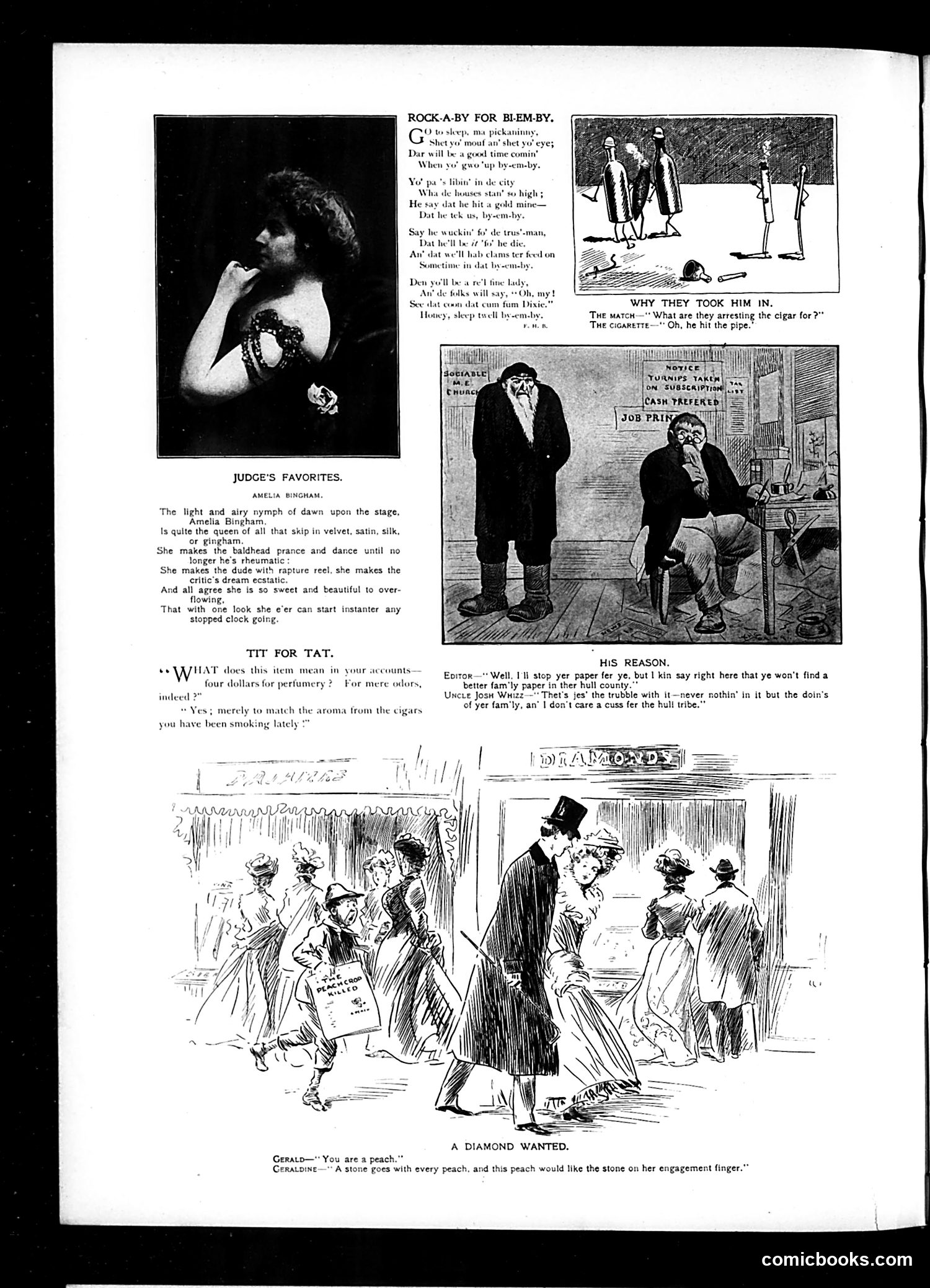
This page contains several entertainment-focused pieces rather than political satire: **"Judge's Favorites"** celebrates actress Amelia Bingham, describing her as a graceful performer with talent across dramatic and comedic roles. **"Rock-a-By for Blem-By"** appears to be humorous verse, possibly mocking or parodying someone's speech patterns or public persona (the "Blem-By" reference is unclear without additional context). **Three cartoon vignettes** depict everyday social humor: a beach scene with cigar-related jokes, an employment office scene about family reputation, and a drawing-room scene about acquiring a diamond engagement ring. These are light satirical observations about social conventions and courtship rituals of the era rather than political commentary. The humor relies on recognizing period attitudes toward class, family status, and gender relations.
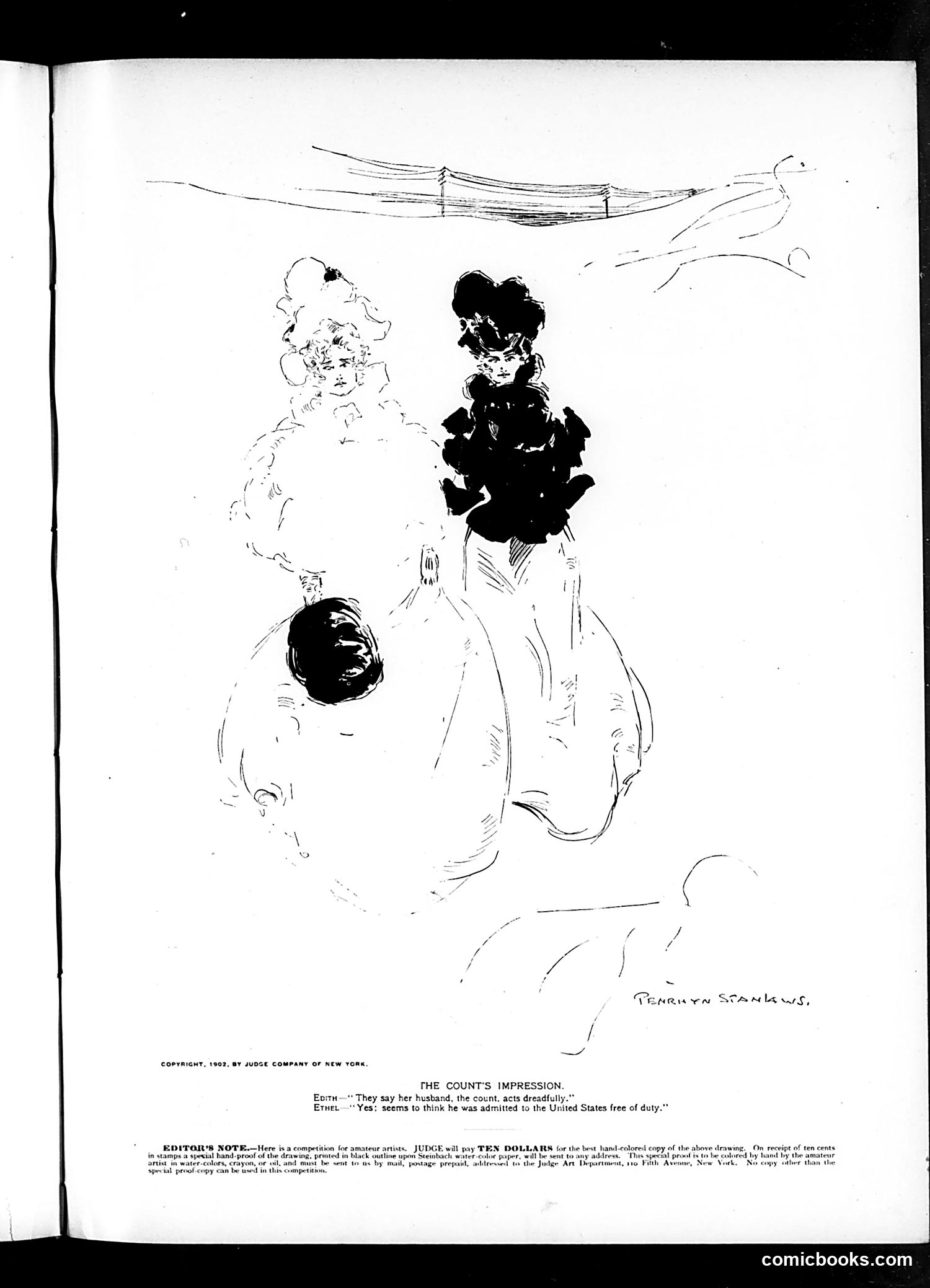
This cartoon satirizes European nobility visiting America. Two women discuss a count (a European aristocrat) whose behavior is deplorable. The joke turns on a tariff/customs pun: Ernest quips that the count "seems to think he was admitted to the United States free of duty"—playing on "duty" as both a moral obligation and a customs tax. The satire targets wealthy foreign aristocrats who believed they could enter America without adhering to American social standards or laws, as if they were exempt goods. It reflects early-1900s American anxiety about European elites thinking themselves above American rules, while also mocking the protective tariff debates of that era through wordplay. The artist is credited as Perriton Maxwell (or similar).
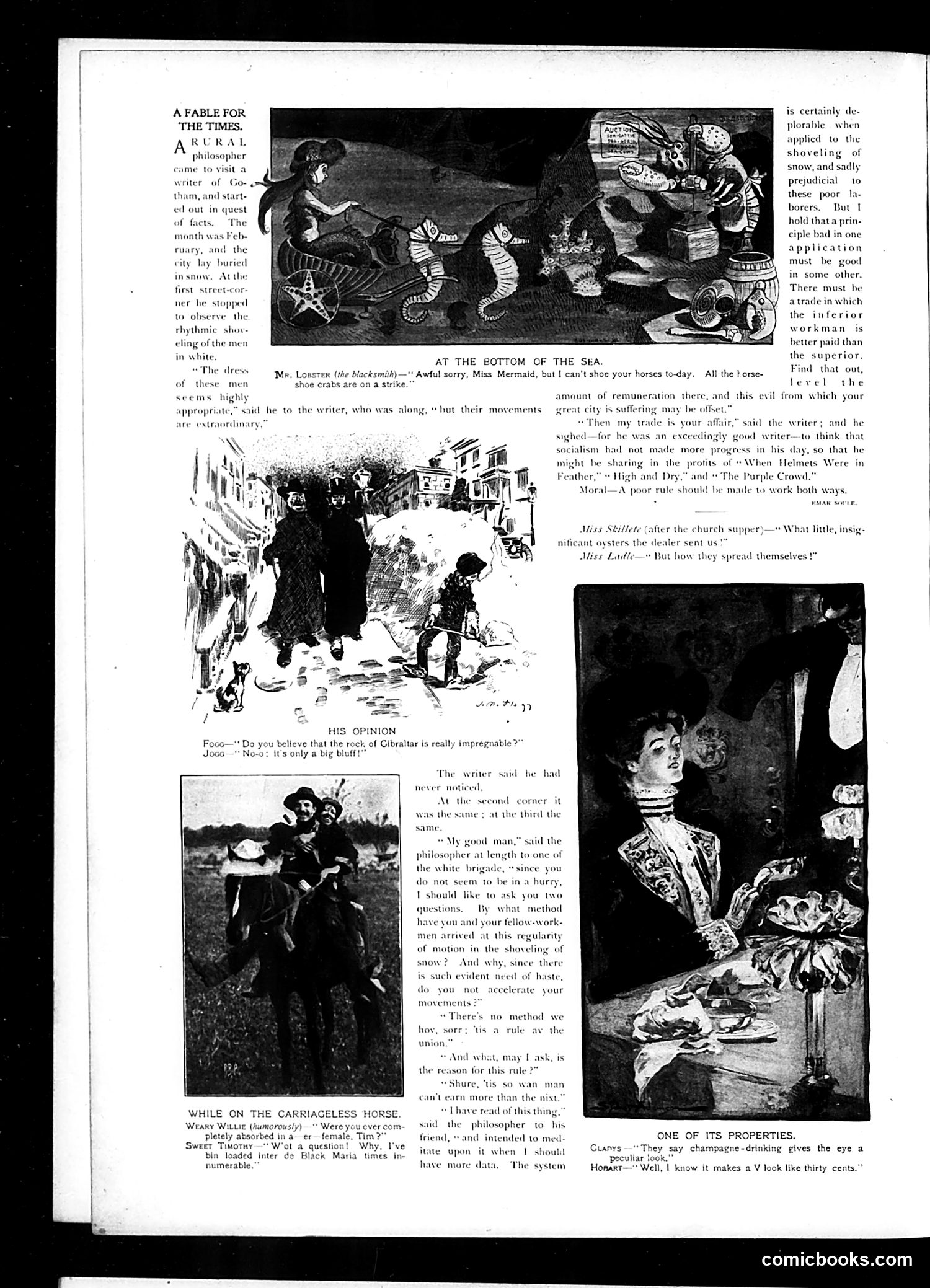
This page satirizes labor unions and their rigid work rules through a rural philosopher's encounter with urban snow-shovelers. The "fable" criticizes union regulations that enforce uniform work pace regardless of individual ability or urgency—workers maintain slow, methodical movements "by rule of the union" rather than working efficiently. The satire's point: union rules protect inferior workers by preventing faster colleagues from outpacing them, thus preventing wage differentiation based on merit. The philosopher concludes this represents socialism's failure to advance, as it prevents rewarding superior workers. The accompanying illustrations are humorous vignettes (mermaids needing horseshoes, oyster opinions, Gibraltar jokes) that serve as typical magazine filler. This reflects late-19th/early-20th-century American skepticism toward organized labor, portraying unions as bureaucratic obstacles to individual merit and productivity rather than protections for workers.
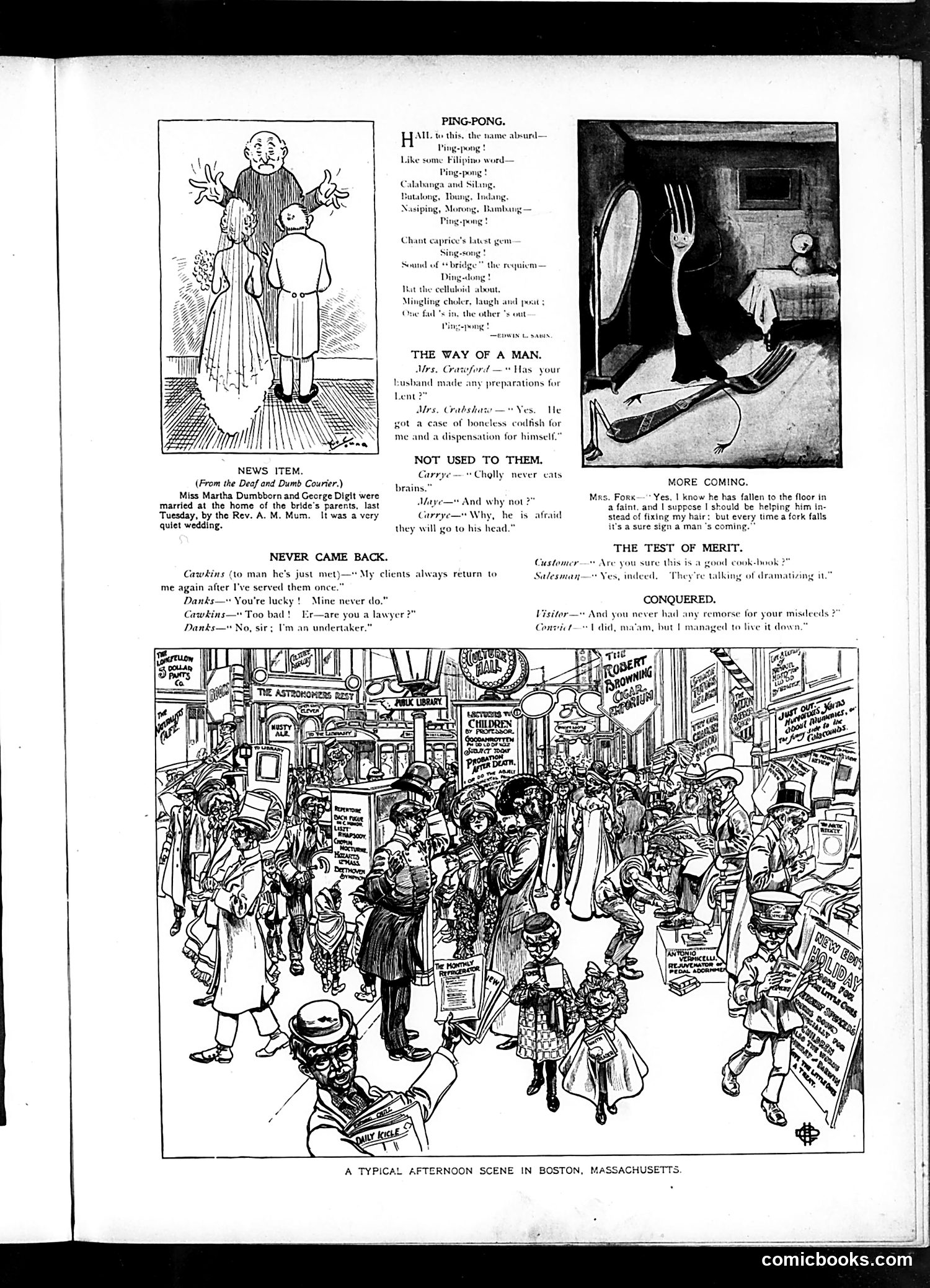
This page from the satirical magazine **Judge** contains multiple humor pieces typical of the era: **The main cartoon** (bottom, large) depicts "A Typical Afternoon Scene in Boston, Massachusetts"—a crowded street filled with pedestrians, shop signs, and commercial activity. The satire appears to mock urban congestion and commercialism in American cities. **The smaller jokes and vignettes** use wordplay and social commentary: - "Never Came Back" jokes about an undertaker whose clients don't return - "Ping-Pong" satirizes a passing fad (the game itself) - "The Way of a Man" mocks husbands' attitudes toward religious observance (Lent preparations) - "Not Used to Them" plays on fears about eating brains - Various sections mock courtship, cookbooks, and criminal rehabilitation The overall tone reflects turn-of-the-century American humor: relying on puns, domestic situations, and gentle mockery of contemporary trends and social behaviors. The page demonstrates Judge's format of mixing brief comedic scenarios with illustrated commentary.
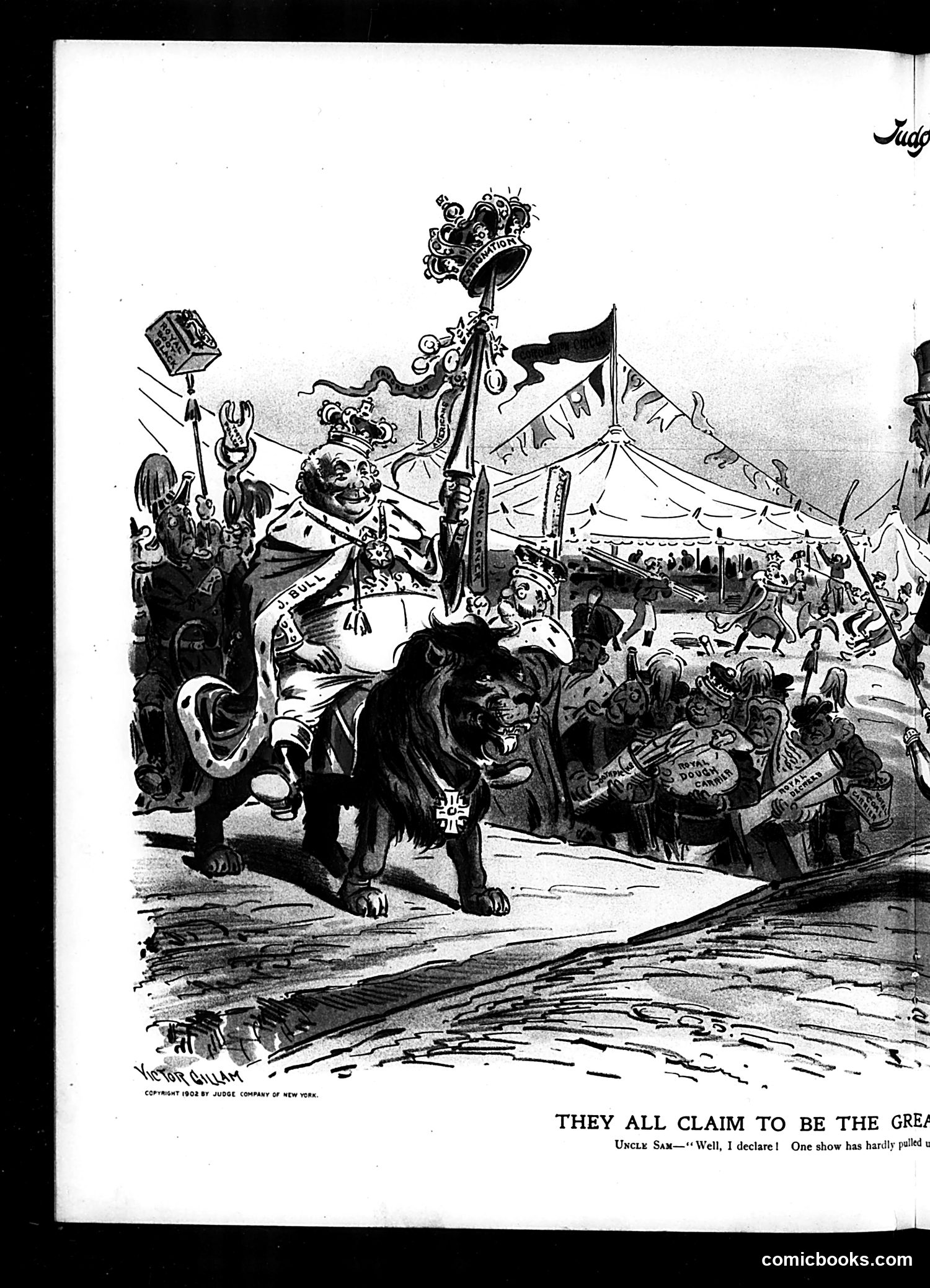
This 1902 Judge cartoon satirizes competing circus or theatrical shows all claiming superiority. "Uncle Sam" (the bearded figure in the top hat and starred vest) observes a chaotic circus scene with various performers and acts, expressing bewilderment at their competing boasts. The cartoon likely critiques American business rivalry or political factionalism of the era—multiple groups or companies each claiming to be "the greatest" despite offering dubious value. The circus setting suggests fraudulent showmanship or empty promises. The bear and various characters represent different contestants or performers, all vying for Uncle Sam's approval and patronage. The satirical point: American consumers/voters should be skeptical of grandiose claims when many competing interests make identical boasts.
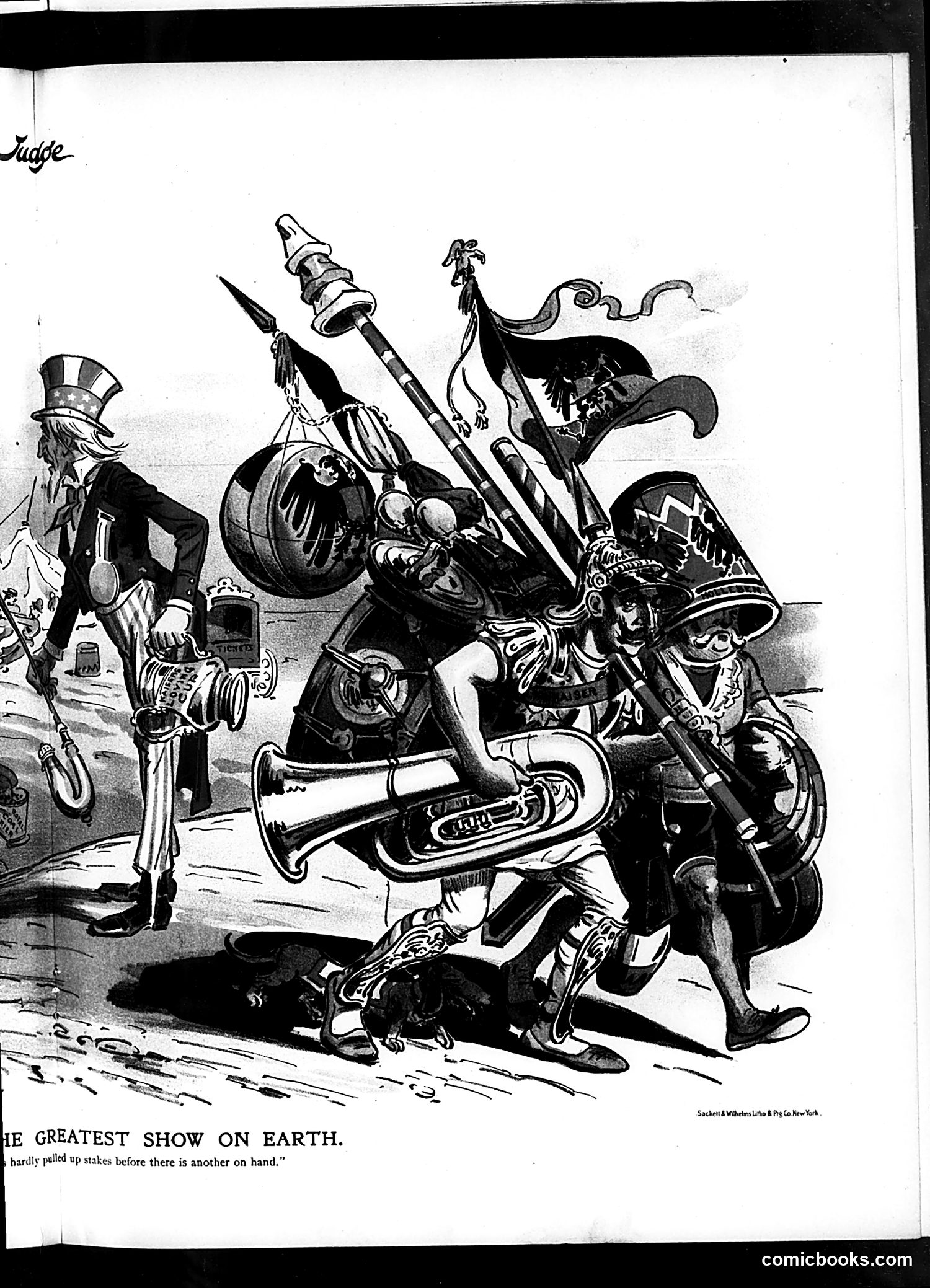
This Judge cartoon satirizes the constant parade of political campaigns and scandals. The title references P.T. Barnum's famous circus marketing slogan, comparing American politics to a spectacle. The image depicts elaborately costumed figures with military regalia, brass instruments, and theatrical props—characterizing political movements as carnival attractions rather than serious governance. The caption's incomplete phrase ("hardly pulled up stakes before there is another on hand") suggests the relentless cycle of political upheaval: one crisis or campaign barely concludes before another begins. The caricatured figures appear to represent political operatives or candidates, dressed in exaggerated finery. A small dog accompanies them, possibly symbolizing the public swept along by these spectacles. The satire critiques how American politics functions as entertainment-driven theater divorced from substantive issues.
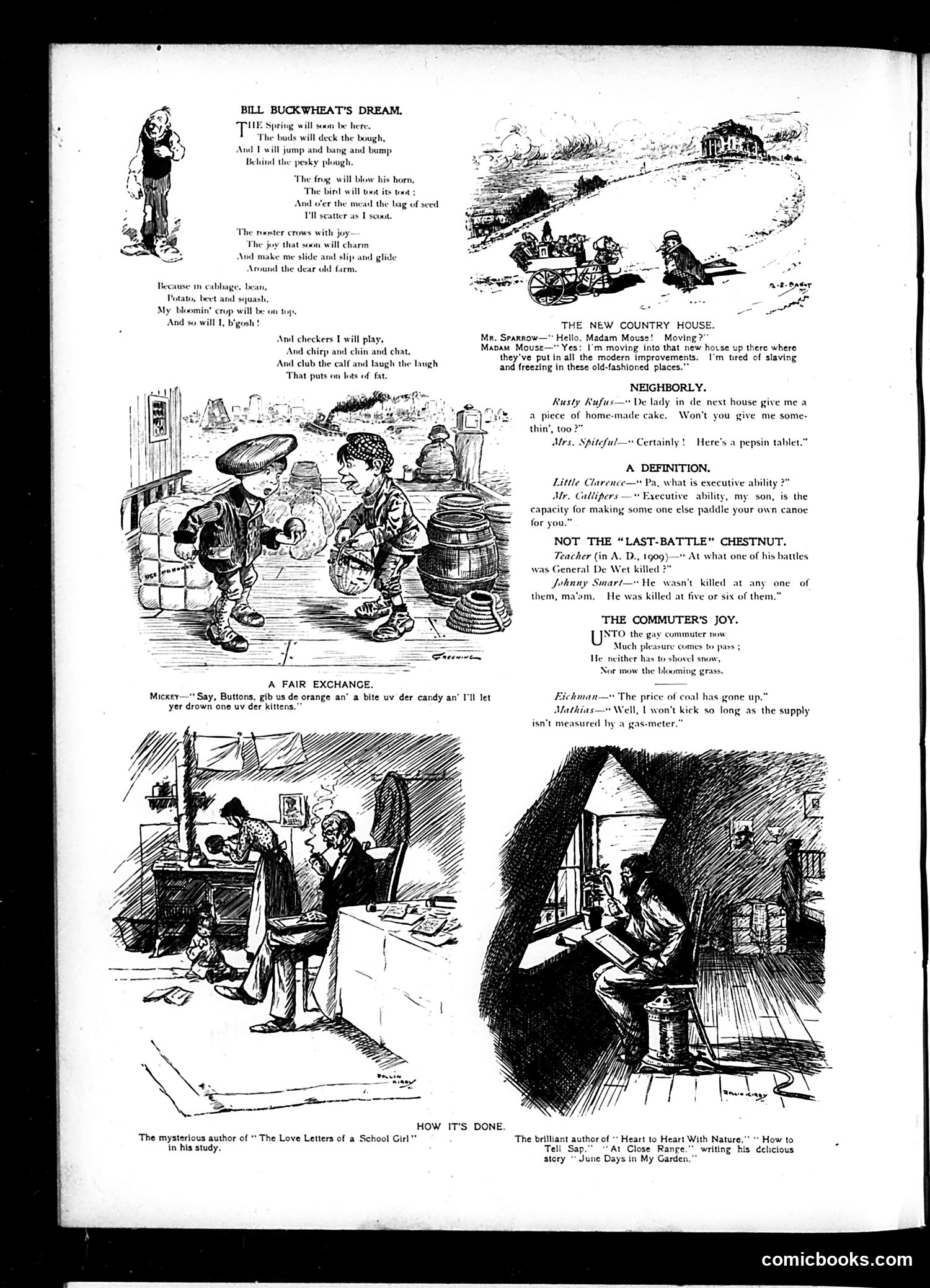
This page from *Judge* contains several satirical pieces targeting early 20th-century American life: **"Bill Buckwheat's Dream"** depicts a farm laborer's romantic fantasies about spring plowing and rural life—satire of idealized pastoral labor. **"A Fair Exchange"** shows street children negotiating: one offers to let another drown kittens in exchange for food. This darkly satirizes urban poverty and callous indifference to animal life among poor city youth. **"The New Country House"** mocks wealthy urbanites moving to countryside estates, with Mrs. Mouse complaining about "old-fashioned places" despite modern improvements—satirizing affectation and discontent among the affluent. **"A Definition"** ridicules "executive ability" as making others do your work—a swipe at business management practices. **"The Commuter's Joy"** satirizes suburban commuters who escape yard work while coal prices rise—skewering their selective privilege. The final two illustrations mock pretentious authors and their overwrought writing processes. The overall tone targets class pretension, urban poverty, and contemporary social hypocrisy.
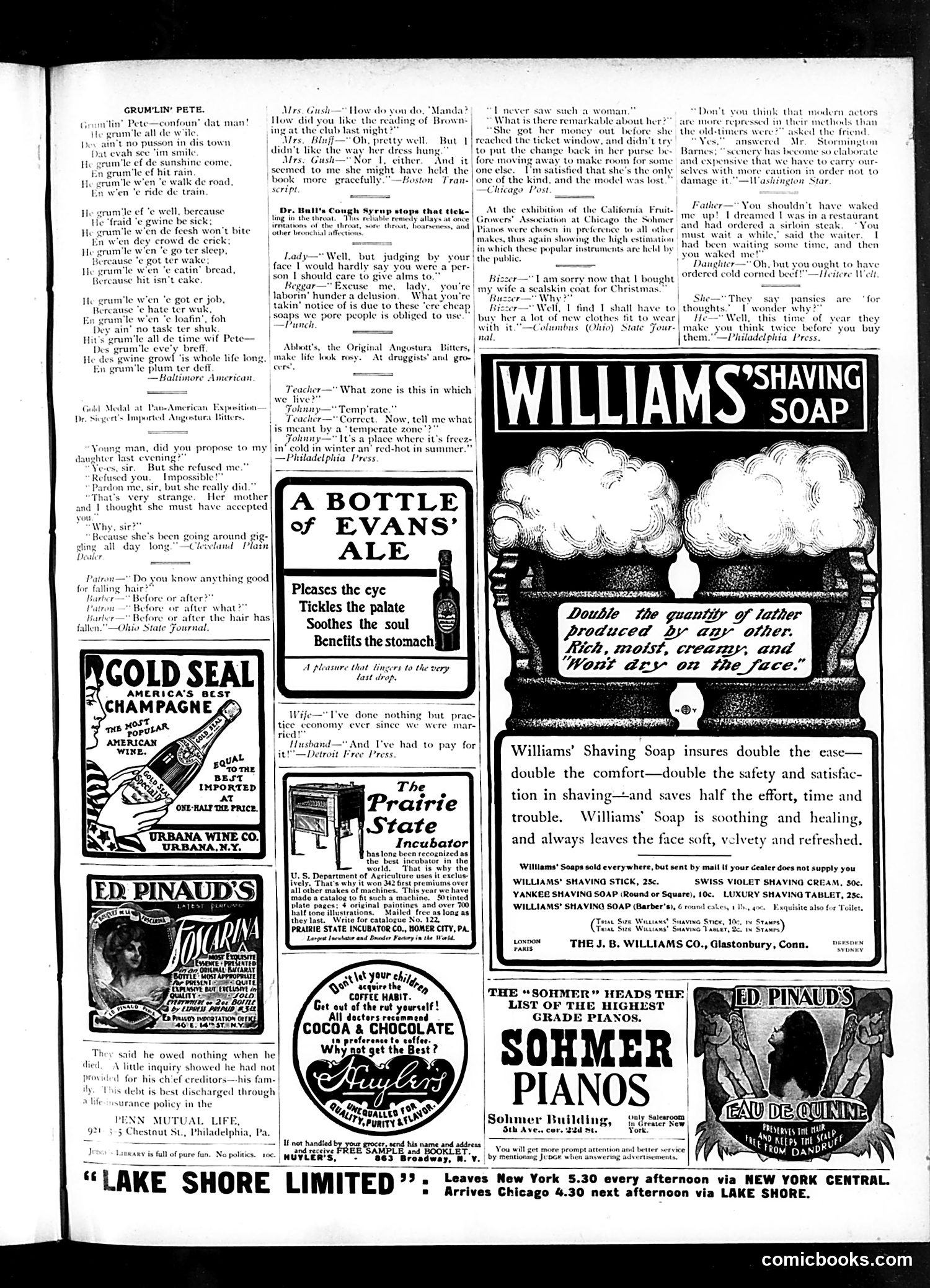
This page is primarily **advertising**, with several brief humorous dialogue snippets interspersed among product ads. The satirical content is minimal: **"Grum'lin' Pete"** is a dialect humor piece depicting an African American character who complains constantly about everything—rain, work, leisure, food. This reflects the **racist "comic dialect" humor** common in early 20th-century publications, presenting stereotyped speech patterns for entertainment. Other brief jokes include marital humor ("proposed to my daughter"), classroom humor (geography lesson), and domestic conflicts (wife's spending habits, interrupted dreams). The page is dominated by **period advertisements** for products like Williams' Shaving Soap, Evans' Ale, Prairie State Incubators, and piano sales—typical of Judge's revenue model. There is **no clear political satire** visible. The content represents entertainment standards of the era, including casual ethnic stereotyping that would be considered offensive today.
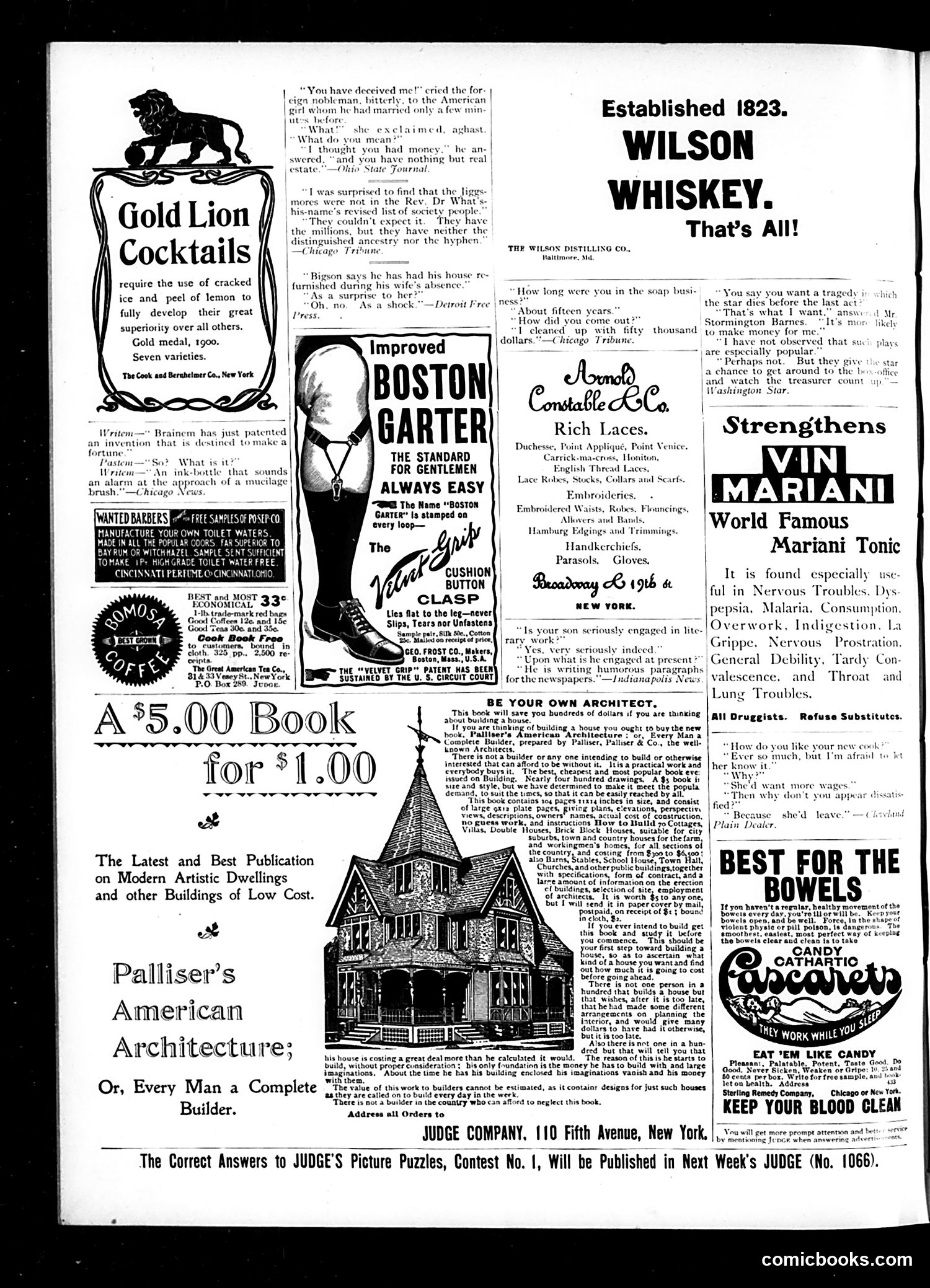
This page is primarily **advertising**, not political satire. It contains product advertisements typical of early 1900s publications, interspersed with brief humorous anecdotes rather than political cartoons. The visible jokes address everyday social situations: a foreign nobleman deceives a bride about his wealth; a man furnishes his house as a "shock" rather than surprise to his wife; a soap businessman's financial success. These are gentle domestic humor pieces, not political commentary. The advertisements promote items like Gold Lion Cocktails, Boston garters, Wilson whiskey, lace products, and Vin Mariani tonic (a patent medicine). There's also a $5 book offer for Palliser's American Architecture manual—a practical building guide marketed to homeowners. No identifiable political figures or events appear on this page. The content reflects period consumer culture and light social satire rather than political analysis or caricature.
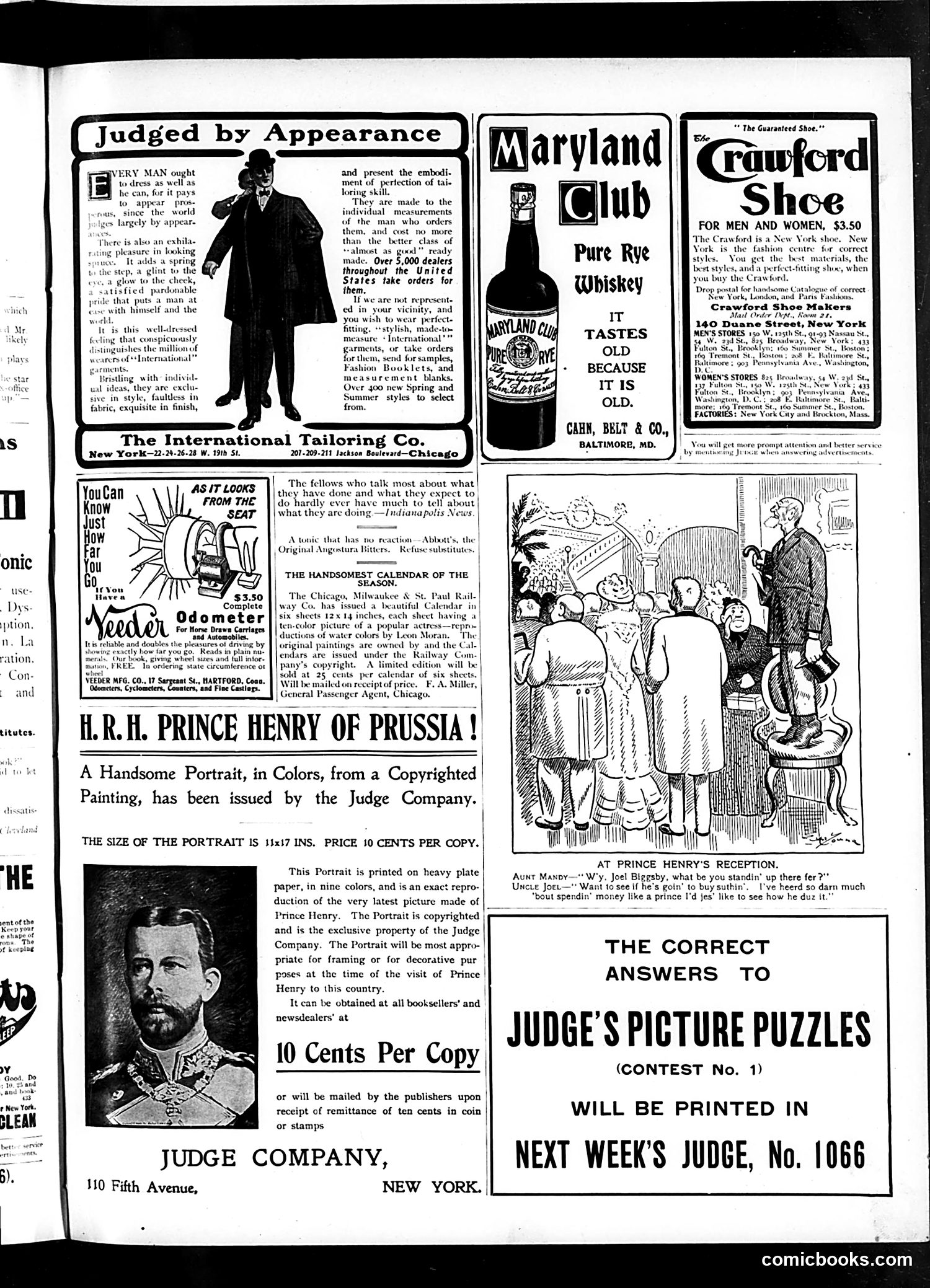
This is primarily an **advertising page** with one cartoon. The main content consists of product advertisements (tailoring, whiskey, shoes, odometers) interspersed with editorial material. The single cartoon depicts **Prince Henry of Prussia's visit to America**. The joke shows rural characters (Aunt Mandy and Uncle Joe) observing the Prince at a reception, hoping to witness his legendary extravagant spending. Uncle Joe wants to "see how he duz it"—implying Prussian royalty had a reputation for lavish expenditure that fascinated ordinary Americans. The accompanying advertisement announces a colored portrait of Prince Henry available for 10 cents, capitalizing on his contemporary visit to the United States. This suggests the portrait was issued to commemorate a significant diplomatic or social visit by Prussian royalty, likely from the early 1900s. The cartoon plays on the contrast between rural American curiosity and European royal wealth.
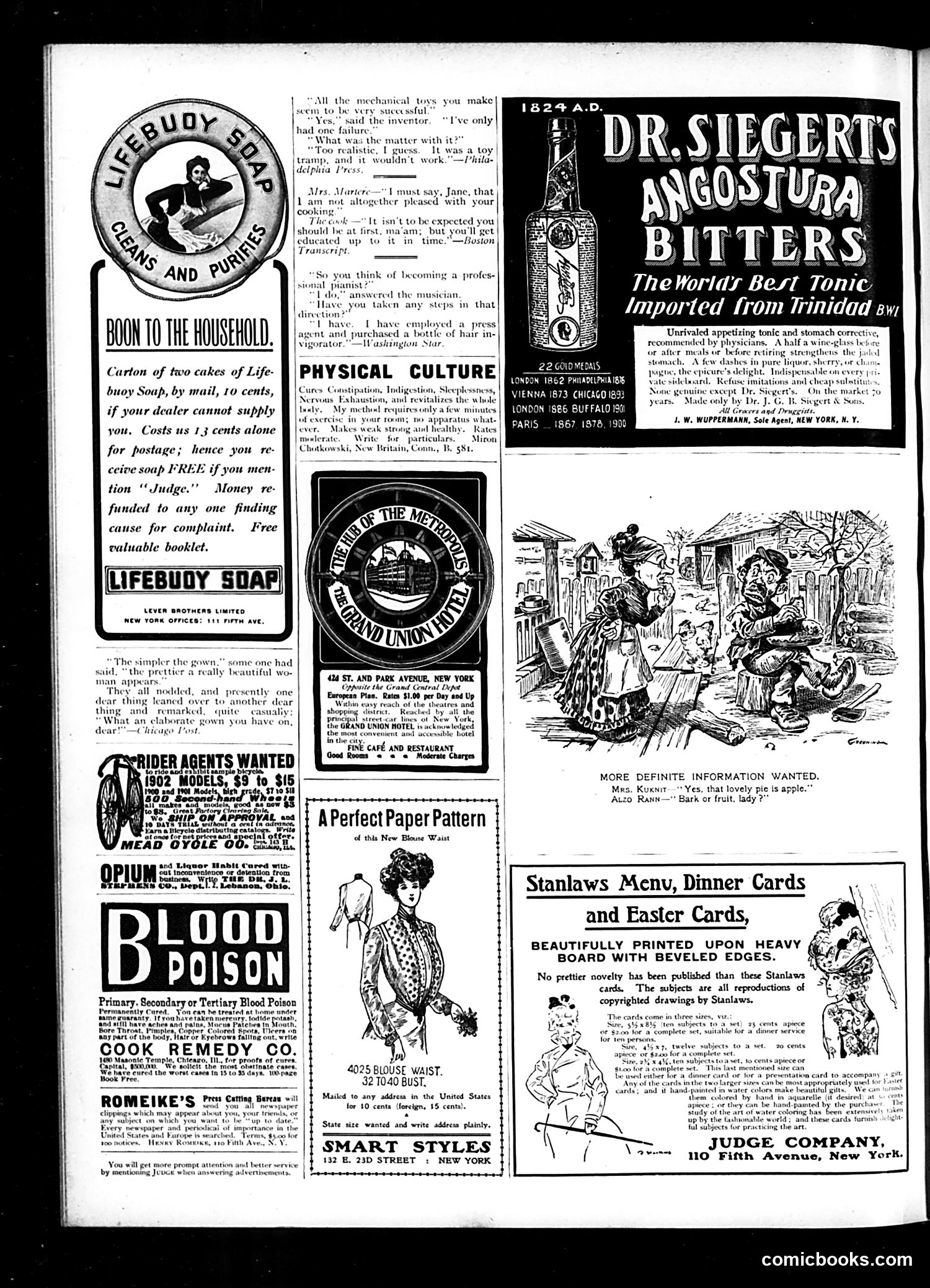
This page is primarily **advertising**, with several small satirical comic vignettes interspersed. The main cartoons are brief jokes about everyday life: 1. **"Physical Culture"** mocks a would-be opera singer who claims to have "employed a press agent and purchased a bottle of hair invigorator" as steps toward a professional music career—satirizing superficial self-promotion over genuine talent. 2. **"More Definite Information Wanted"** shows a domestic scene where one character asks another if a pie is "apple," and the other responds "Bark or fruit, lady?"—a joke about unclear or questionable food quality/ingredients. The advertisements reflect early 1900s products: Lifebuoy Soap, patent medicines ("Blood Poison" cures), bicycles, and paper patterns for clothing. These ads reveal period anxieties about health, appearance, and domestic skills. The overall tone is lighthearted social commentary on vanity, food, and consumer culture—typical of Judge magazine's satirical approach to middle-class American life.
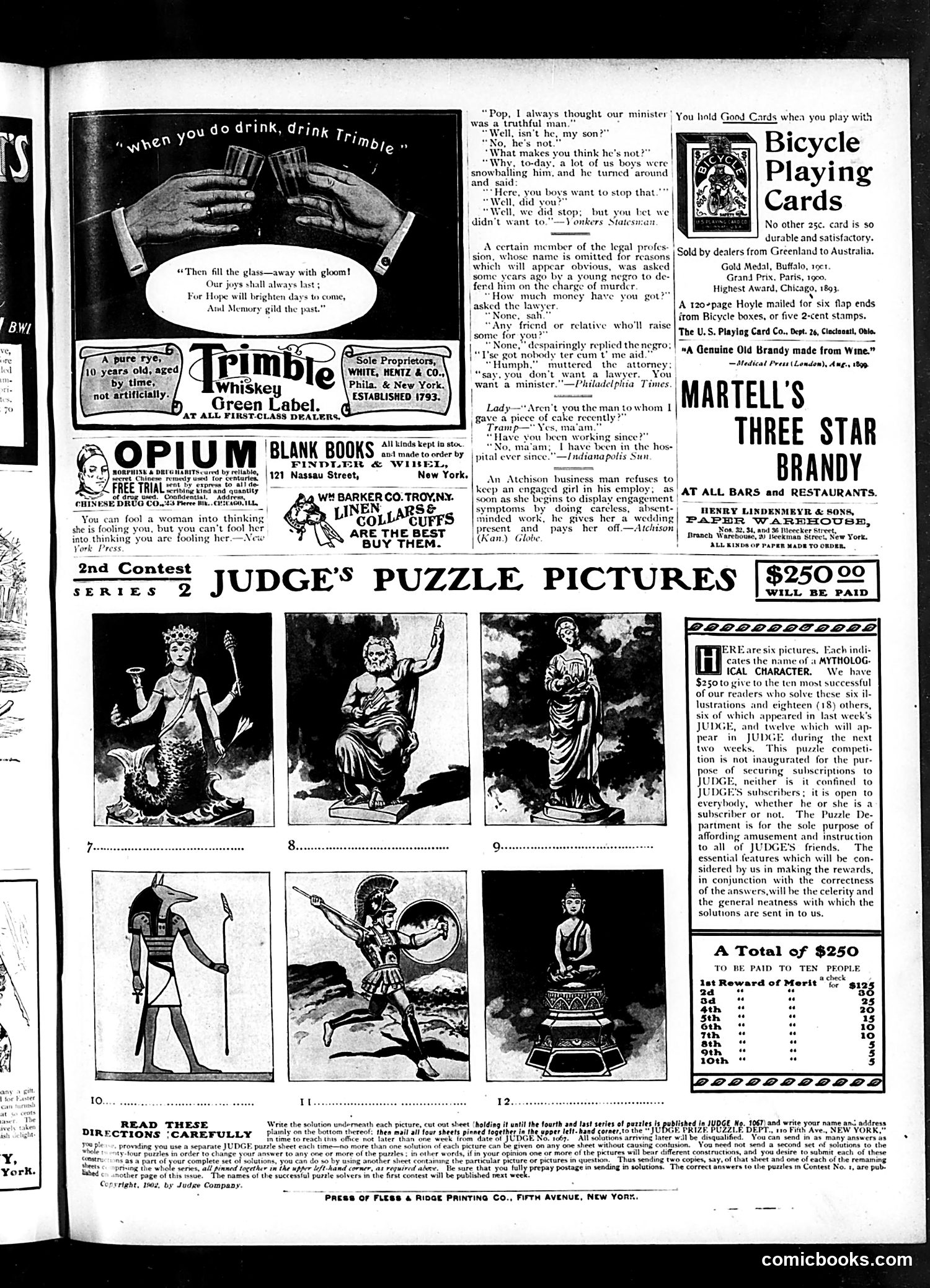
This page is primarily **advertising and contest content** rather than political satire. However, it includes several short comic anecdotes at the top: 1. **"Pop, I always thought our minister was a truthful man"** — A joke about a minister who told boys to stop snowballing him, then contradicted himself by asking them to stop anyway. The humor relies on the minister's hypocrisy about truthfulness. 2. **Lawyer and poor Black defendant** — A racial stereotype joke where a poor man cannot afford a lawyer because he has "nobody" to help raise money. The punchline mocks his poverty. 3. **Vagrant/tramp joke** — A beggar claims he's been in the hospital since receiving cake, implying laziness rather than genuine hardship. These brief jokes reflect period attitudes: clergy hypocrisy, racial stereotyping, and suspicion of the poor. The bulk of the page advertises Trimble Whiskey, Opium products, Bicycle Playing Cards, and Martell's Brandy, plus announces a mythological picture-puzzle contest offering $250 in prizes.
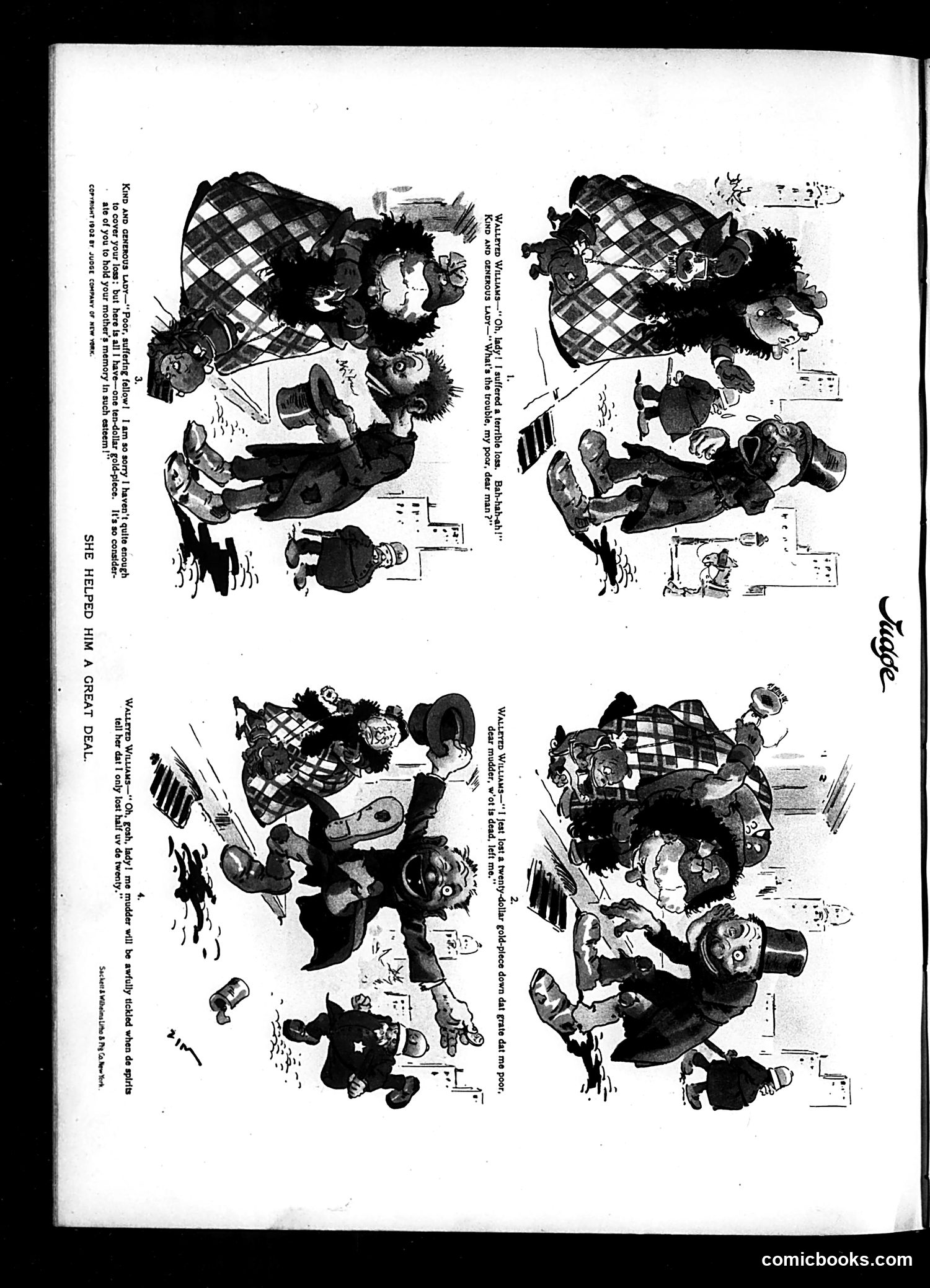
This four-panel comic depicts a con artist exploiting a wealthy, sympathetic woman's charity. "Watteren Williams" (a caricatured Irish immigrant, indicated by dialect spelling) approaches a "Kind and Generous Lady" claiming he lost his dead mother's precious twenty-dollar gold piece down a grate. The satire works on multiple levels: it mocks both the immigrant character's transparent dishonesty and the wealthy woman's naive gullibility. When she offers only ten dollars (half the claimed loss), Williams cynically decides to tell his mother's spirit he lost only half—pocketing the profit while maintaining his sob story's plausibility. The title's irony is sharp: the lady has "helped" him not through charity but by enabling his con. The piece reflects turn-of-the-century stereotypes about Irish immigrants as unreliable and scheming, while simultaneously satirizing upper-class sentimentality and susceptibility to manipulation.