
Judge, 1902-03-15 · page 6 of 16
Judge — March 15, 1902 — page 6: what you’re looking at
What you’re looking at
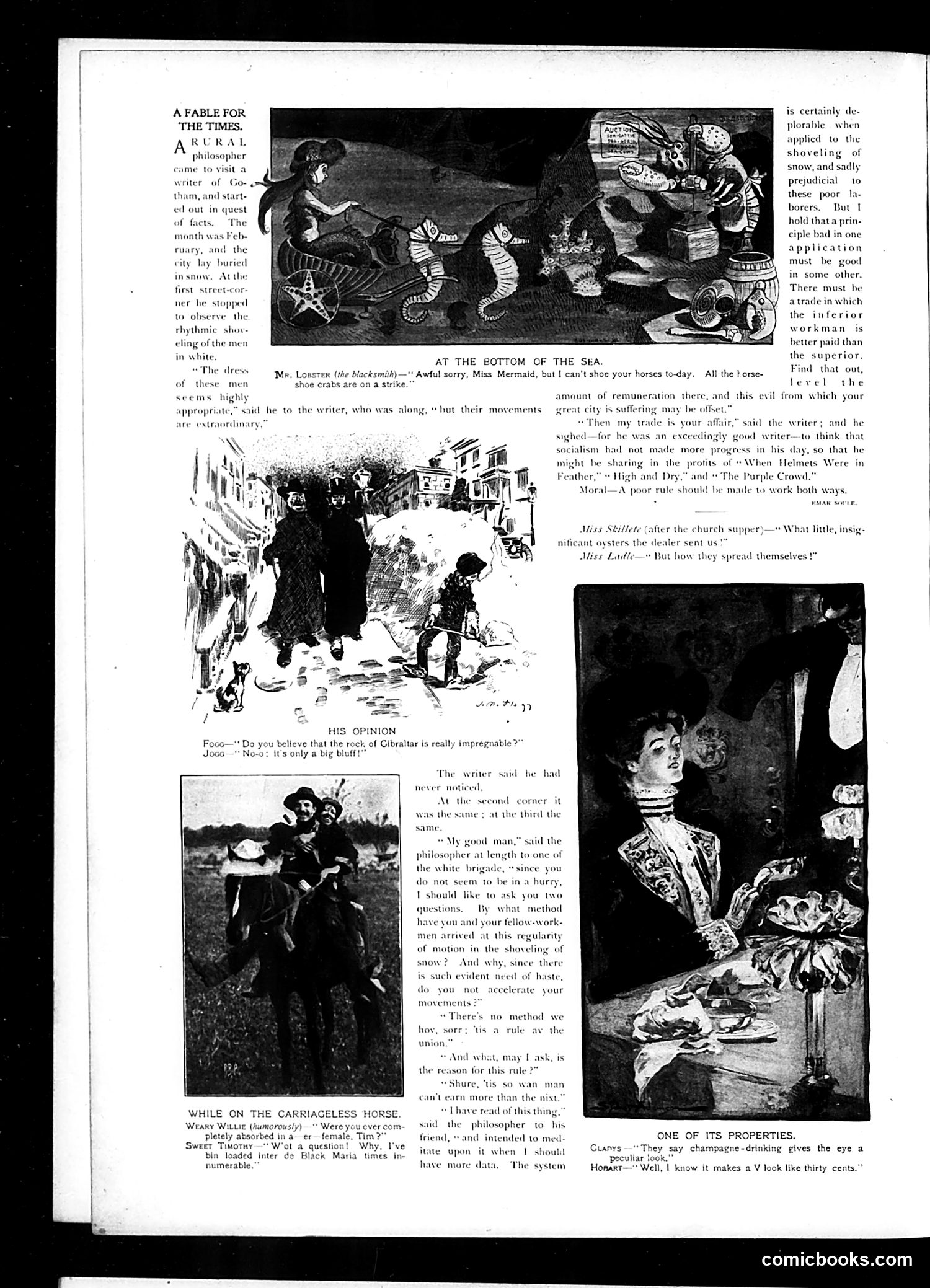
This page satirizes labor unions and their rigid work rules through a rural philosopher's encounter with urban snow-shovelers. The "fable" criticizes union regulations that enforce uniform work pace regardless of individual ability or urgency—workers maintain slow, methodical movements "by rule of the union" rather than working efficiently. The satire's point: union rules protect inferior workers by preventing faster colleagues from outpacing them, thus preventing wage differentiation based on merit. The philosopher concludes this represents socialism's failure to advance, as it prevents rewarding superior workers. The accompanying illustrations are humorous vignettes (mermaids needing horseshoes, oyster opinions, Gibraltar jokes) that serve as typical magazine filler. This reflects late-19th/early-20th-century American skepticism toward organized labor, portraying unions as bureaucratic obstacles to individual merit and productivity rather than protections for workers.
📄 Transcribed text from this page (OCR, searchable)
Machine-transcribed from the original scan — historical spelling and the odd misread are preserved.
is certai plorable | when A FABLE FOR ‘THE TIMES. RURAL philosopher applied to the shoveling of to visit a snow, and sadly cam prejudicial to these poor la- borers, But I hold thata prin- writer of Gow tham, and start- ed out in quest of facts. The ciple bad in one application must be month was Feb- ruary, and the city lay buried in snow, Atthe good in some other. There must be atrade in which the inferior workman is better paid than the superior. Find that out, level the first street-cor- ner he stopped to observe the rhythmic shov- cling of the men in white AT THE BOTTOM OF THE SEA. “The dress e blacksmith) —"* Awful sorry, Miss Mermaid, but I can’t shoe your horses to-day. All the Forse- of these men seems highly amount of remuneration there, and this evil from which your appropriate,” said he to the writer, who was along, “but their movements — great city is suffering may be off are extraordinary,” “Then my trade is your affair,” said the writer; and he sighed —for he was an exceedingly good writer—to think that socialism had not made more progress in his day, so that he ht he sharing in the profits of «When Helmets Were in ther,” “High and Dry,” and * The Purple Crowd.” Moral—A poor rule should be made to work both ways. | m Miss Skillete (after the church supper)— What little, insi oysters the dealer sent us!” Miss Ladle nit t how they spread themselves!" HIS OPINION ¥. of Gibraltar is really impregnable ?* Do you believe that the ro No-o: it's only a big bluff!” The writer said he had never noticed, At the second corer it was the same ; at the third the same. My good man,” said the philosopher at length to one of the white brigade, “since you do not seem to be ina hurry, I should like to ask you two questions, By what method have you and your fellow-work- men arrived at this reg larity of motion in the shovelin snow? And why, since there is such evident need of haste, do you not accelerate. your movements + “There's no method we hov, sorr; ‘tis a rule av the union.” And what, may I ask, is the reason for this rule ? + Shure, so wan man vt than the nist.” earn mor WHILE ON THE CARRIAGELESS HORSE. * Thave read of this thing,” Weary Wittie (humorously) “Were youcvercom- tid the philosopher to his | pletely absorbed in a~er—female, Tim?" friend, “and intended to med- ONE OF ITS PROPERTIES. Sines Tinpeyes Wot b. geeation | itate upon it when [shoul cise SY champagne -drinking, gives: the\ eye humerable,” have more data, The system Honakt—'' Well, | know it makes a V look like thirty cents.”” comicbooks.com