
A complete issue · 16 pages · 1902
Judge — February 22, 1902
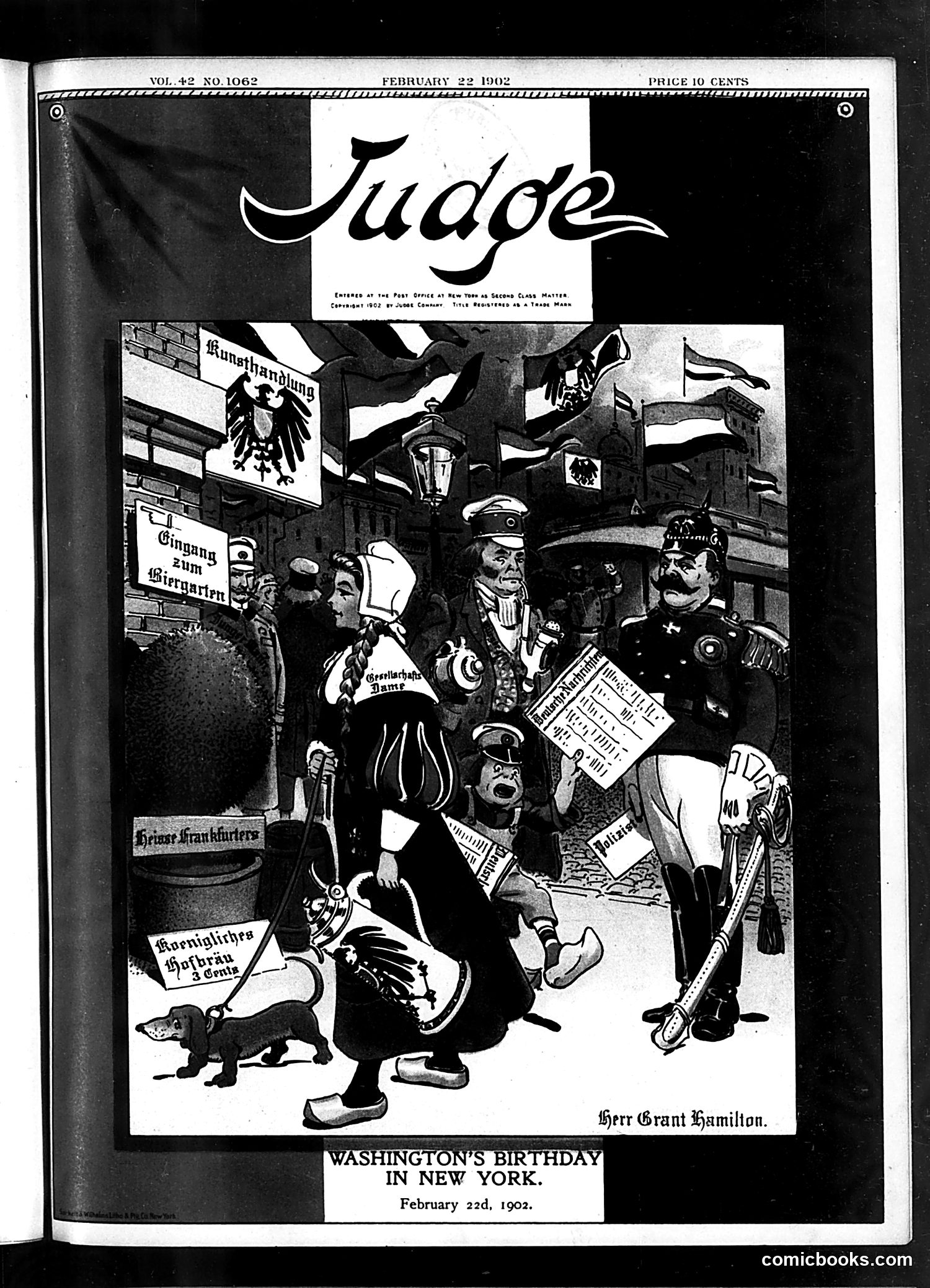
This satirical cartoon depicts German immigrants celebrating Washington's Birthday in New York City. The figures wear traditional German clothing and are surrounded by German beer hall signs ("Gingang zum Morgarten," "Frankfurter," "Moenglichss Hofbräu"). The satire appears to mock the disconnect between German-American communities and American patriotic traditions—they're ostensibly celebrating Washington's birthday but are primarily engaged with German cultural markers and beer consumption. The dachshund and German signage emphasize ethnic identity over civic assimilation. Artist Grant Hamilton uses this to satirize immigrant communities' perceived resistance to adopting American cultural values, a common prejudice in early 1900s American political commentary.
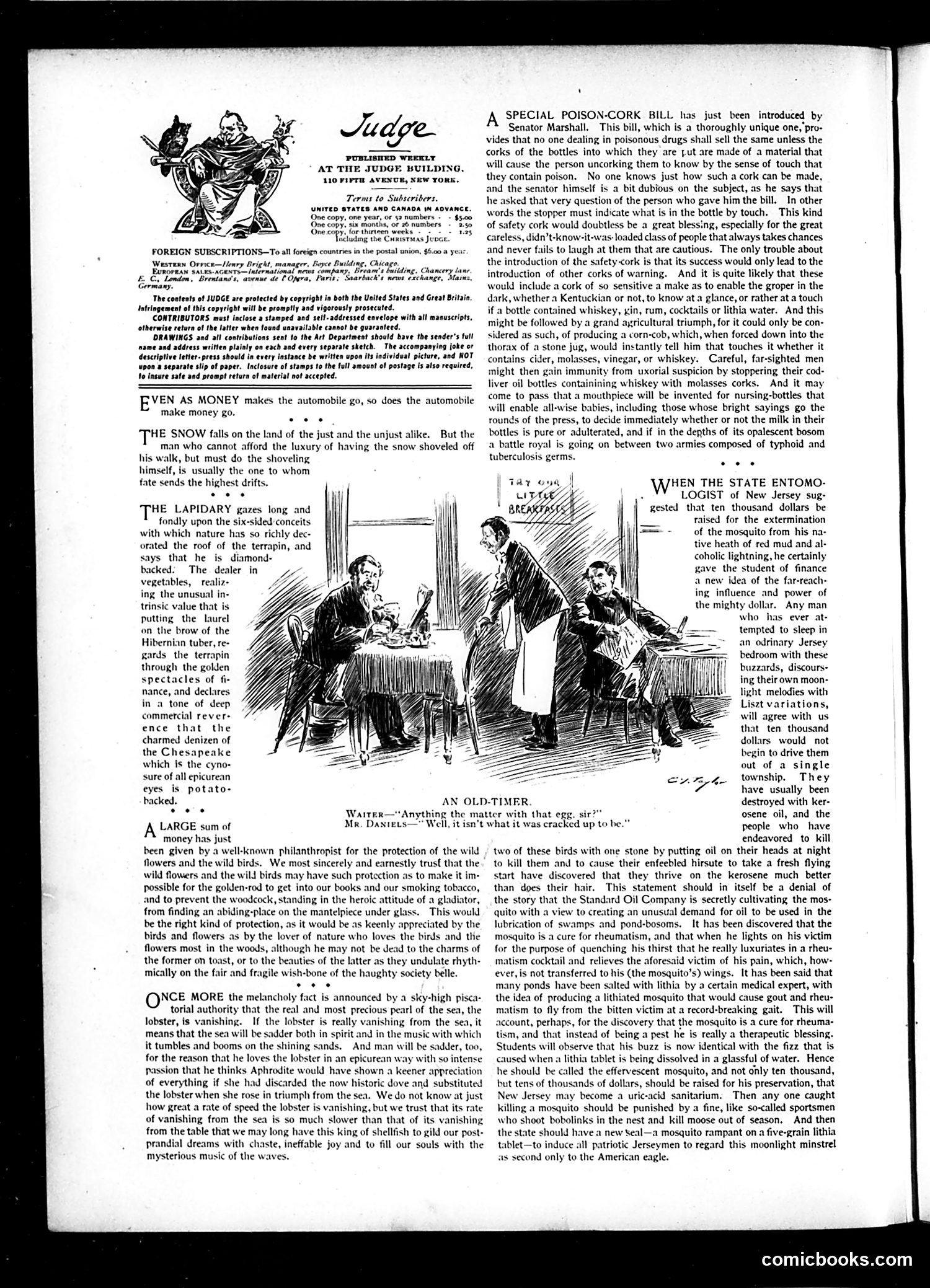
This cartoon depicts a waiter serving an egg dish to a diner, with the waiter asking "Anything the matter with that egg, sir?" and the diner responding "Well, it isn't what it was cracked up to be." The humor is a visual pun: the egg on the plate is literally cracked, making the diner's complaint—a common expression of disappointment—literally accurate. The cartoon plays on the double meaning of "cracked up to be" (disappointing versus physically damaged). The surrounding text discusses various topics including poison-cork bills, automobiles, snow removal, lapidary work, and state entomologists' mosquito control efforts. These appear to be unrelated satirical commentary on contemporary issues rather than directly connected to the egg cartoon's meaning.
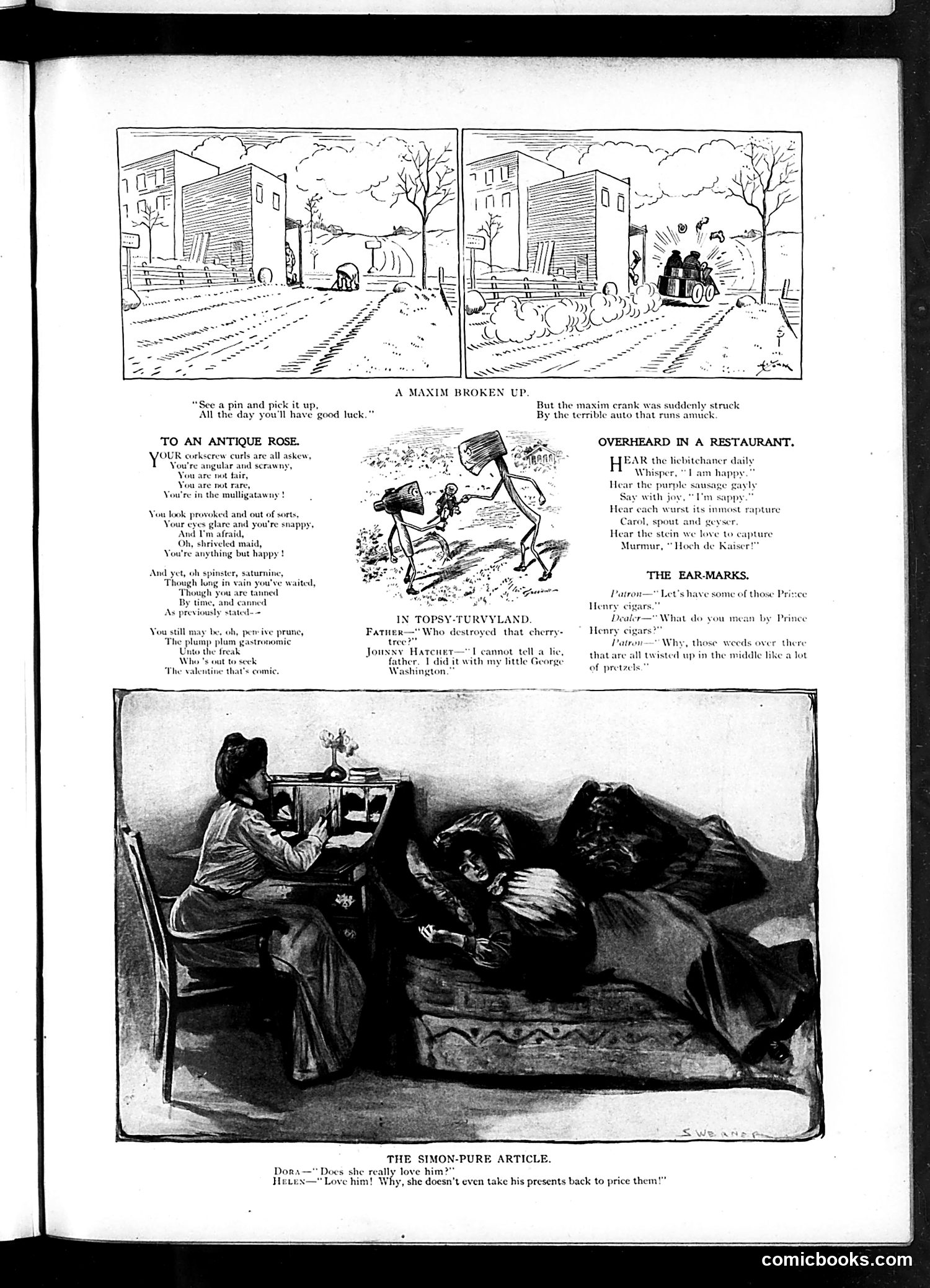
This page contains several unrelated humor pieces typical of Judge's satirical format: **"A Maxim Broken Up"** (top): A two-panel cartoon showing a farmer with a broken maxim crank, likely referencing the Maxim gun (an early automatic weapon). The joke appears to be a pun on "maxim" as both a saying and a mechanical device. **"To an Antique Rose"** and **"Overheard in a Restaurant"**: Humorous poems poking fun at various social types—gossipy women, pretentious diners discussing sausages and oysters. **"In Topsy-Turvyland"**: A whimsical cartoon with absurdist humor about destroying a cherry tree (possibly alluding to the Washington/cherry tree legend). **"The Simon-Pure Article"** (bottom): A sketch about romantic deception, where a woman doesn't even return a man's gifts—satirizing insincere romantic interest. The page is primarily light social satire rather than political commentary.
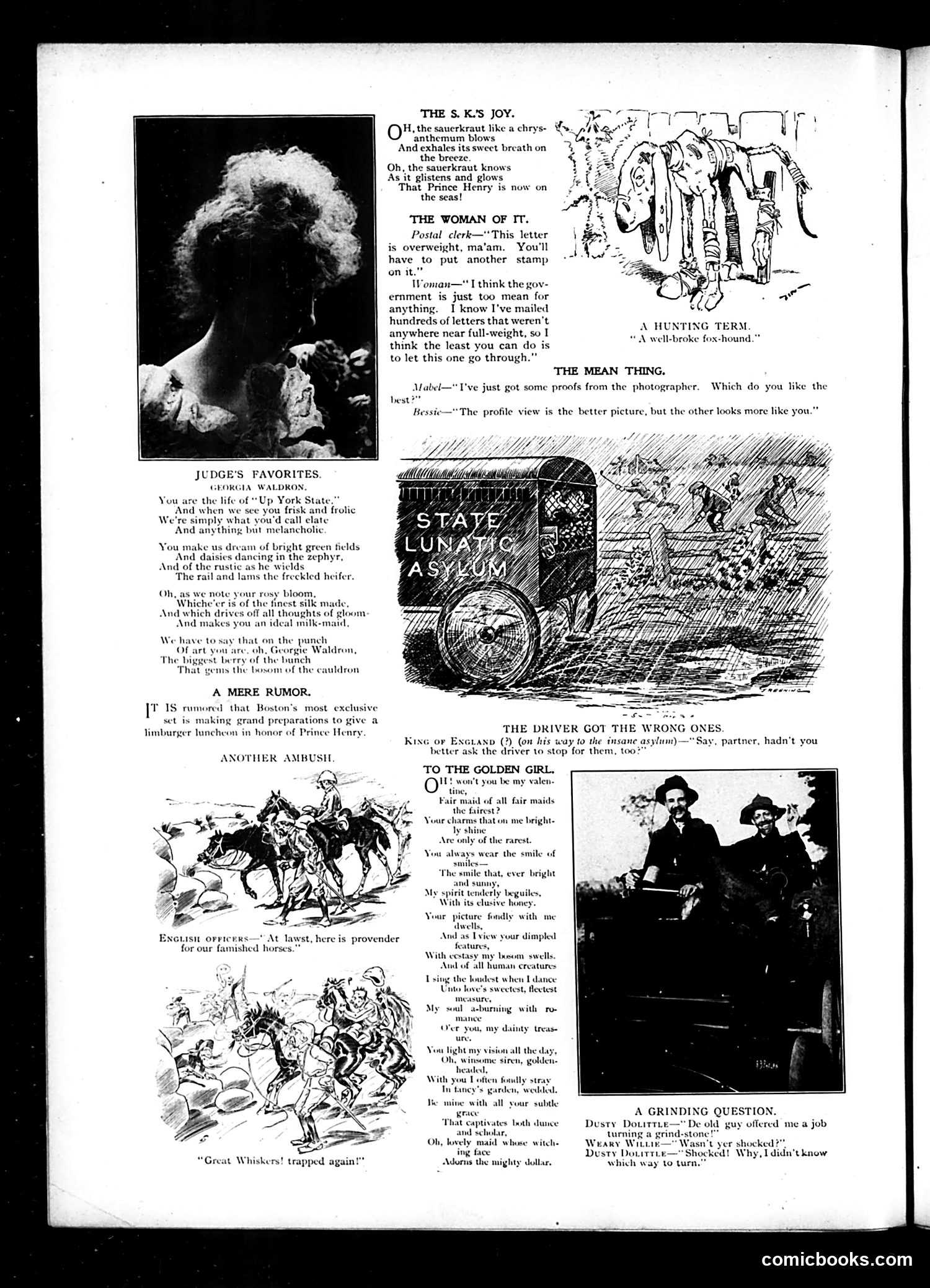
This page contains several humorous items rather than a focused political cartoon. **"Judge's Favorites"** praises Dorgia Waldron, likely a contemporary actress or socialite, using flowery romantic verse. **"The S.K.'s Joy"** appears to reference Prince Henry (unclear which historical figure), celebrating his return to sea with patriotic imagery. **"The Woman of It"** is a brief comedy sketch about a postal clerk and woman debating postage on an overweight letter—domestic humor with no political significance. **Other sketches** include "A Hunting Term," "The Mean Thing," and "A Grinding Question"—all short, light jokes about daily life. **"Another Ambush"** shows cavalry soldiers, likely satirizing military incompetence or confusion. The page prioritizes entertainment and social commentary over serious political satire, mixing verse, sketches, and illustrations typical of Judge's lighter content.
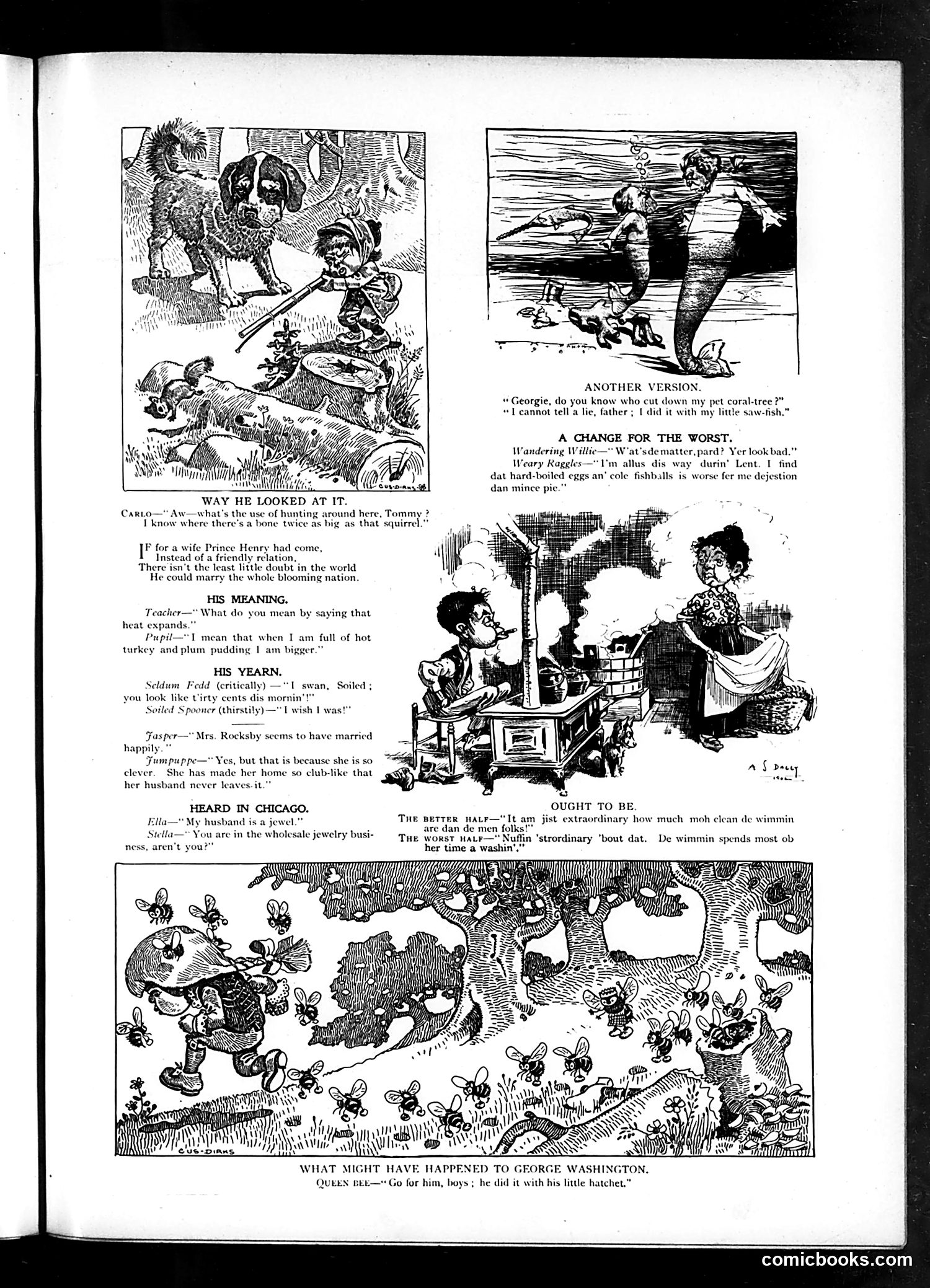
This page from Judge contains multiple brief humorous sketches typical of late-19th/early-20th century American comic journalism: **"Another Version"** parodies the George Washington cherry tree legend with a nonsensical twist—replacing the axe with a "saw-fish," absurdist humor. **"A Change for the Worst"** jokes about Lenten dietary restrictions making digestion difficult—referencing the Catholic practice of eating fish instead of meat during Lent. **"His Meaning"** features a schoolboy misinterpreting physics; **"His Yearn"** depicts vagrant characters' drinking desires. **"Heard in Chicago"** includes a woman's joke that her husband, claimed as a "jewel," actually works in wholesale jewelry—a play on words. **"Ought to Be"** satirizes gender stereotypes, suggesting women are cleaner than men because they spend time washing (implying men are naturally slovenly). **"What Might Have Happened to George Washington"** shows fairy-tale-like creatures attacking the historical figure with the hatchet, inverting the legend's moral lesson. The page exemplifies Judge's mix of social commentary, wordplay, and gentle domestic satire.
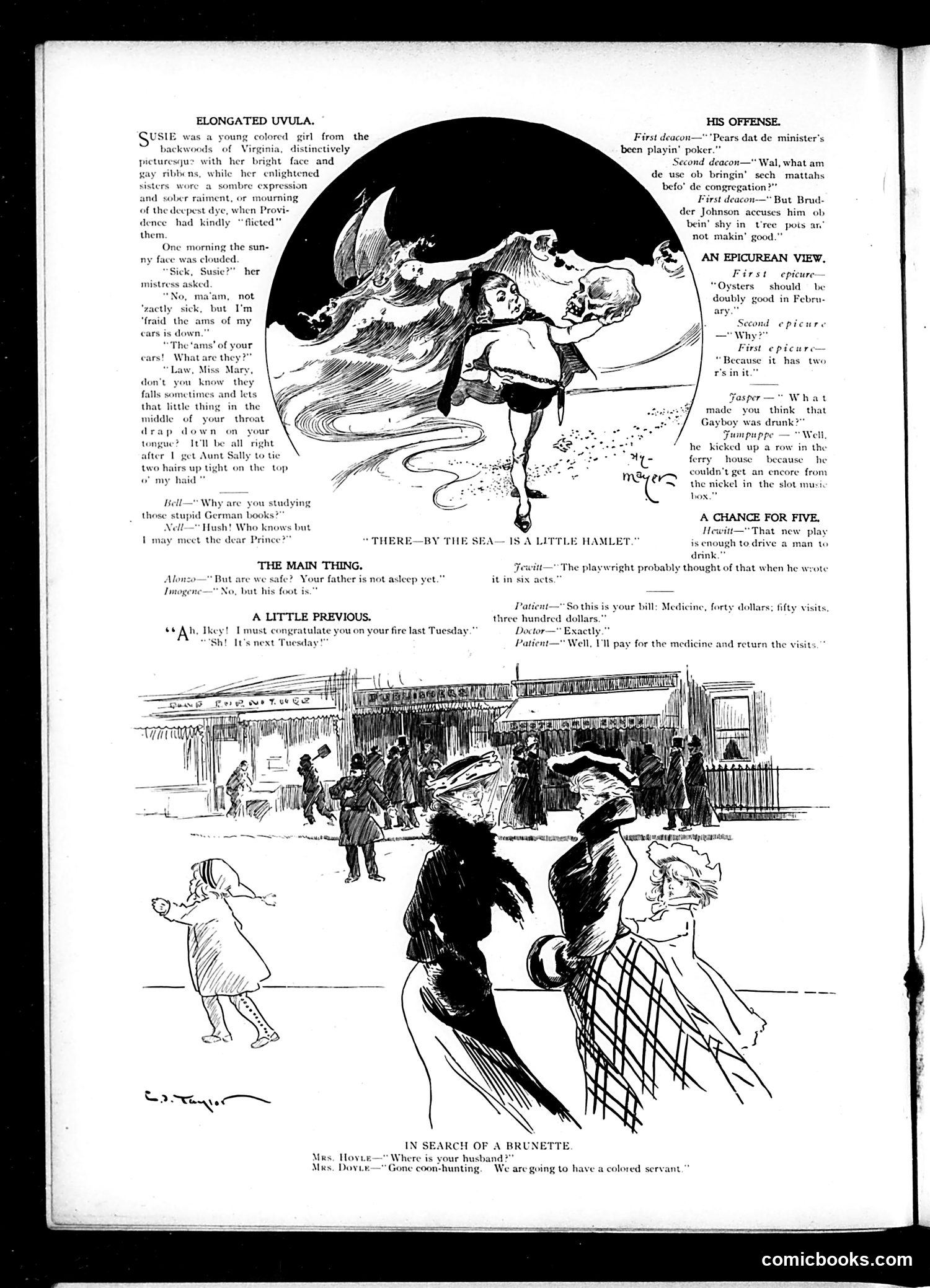
This *Judge* page contains multiple short satirical pieces typical of the magazine's format: **"Elongated Uvula"**: A dialect-heavy story about Susie, an enslaved or formerly enslaved Black girl from Virginia, who misunderstands medical terminology. The humor relies on minstrel-show caricature—exaggerated speech patterns and supposed ignorance. **Other brief jokes** include domestic scenes mocking various characters' foolishness (a man's father asleep while his girlfriend sneaks around; someone celebrating a fire before it happens). **"An Epicurean View"** and similar pieces are standard Victorian-era pub humor about drinking, infidelity, and everyday absurdities. **"In Search of a Brudanette"**: A brief racist joke about Black domestic servants, using offensive dialect spelling. The page reflects *Judge*'s reliance on racial caricature and minstrelsy conventions common to late-19th/early-20th-century American humor magazines. The "humor" depends on stereotyping and mockery of Black people and their speech patterns.
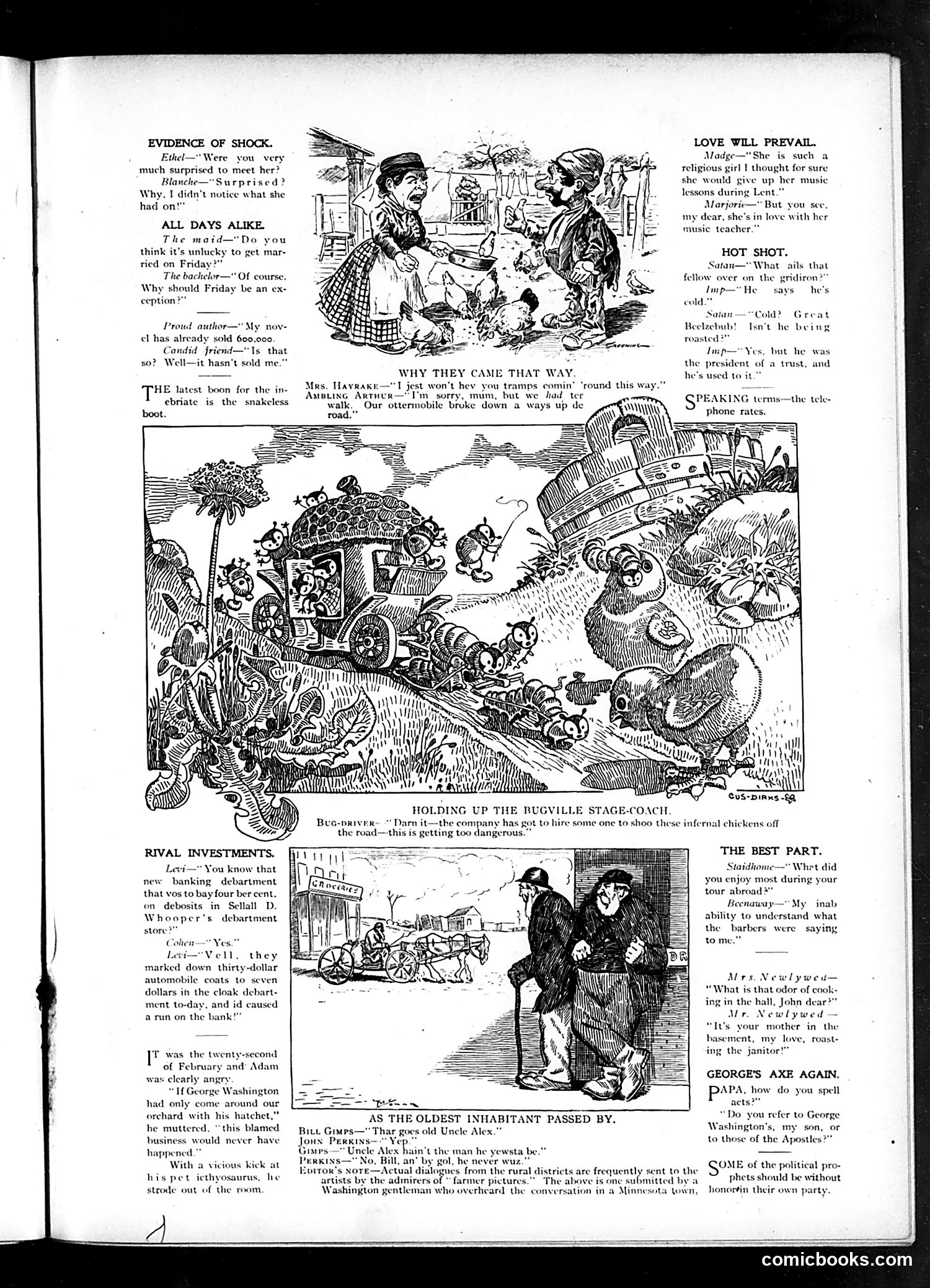
This page contains short humorous pieces typical of early 20th-century American satire. The cartoons mock everyday life and contemporary issues: **"Evidence of Shock"** jokes about female vanity—a woman is so absorbed in fashion that she doesn't notice meeting someone surprising. **"All Days Alike"** presents the bachelor's cynical view: every day is unlucky for marriage, not just Friday. **"Why They Came That Way"** depicts rural characters (likely Irish immigrants, suggested by dialect) explaining vagrant behavior to authorities. **"Hot Shot"** satirizes corporate corruption: a trust president is so accustomed to wrongdoing ("roasting") that even Hell seems familiar—a jab at Gilded Age business ethics. **"Rival Investments"** mocks consumerism: department store sales cause a bank run, suggesting frivolous spending over savings. **"George's Axe Again"** references Washington's cherry tree legend, making a cynical joke equating presidential acts with apostolic deeds—likely political commentary on contemporary leaders. The cartoons reflect Judge's satirical focus on American social hypocrisy, immigrant stereotypes, and economic foolishness.
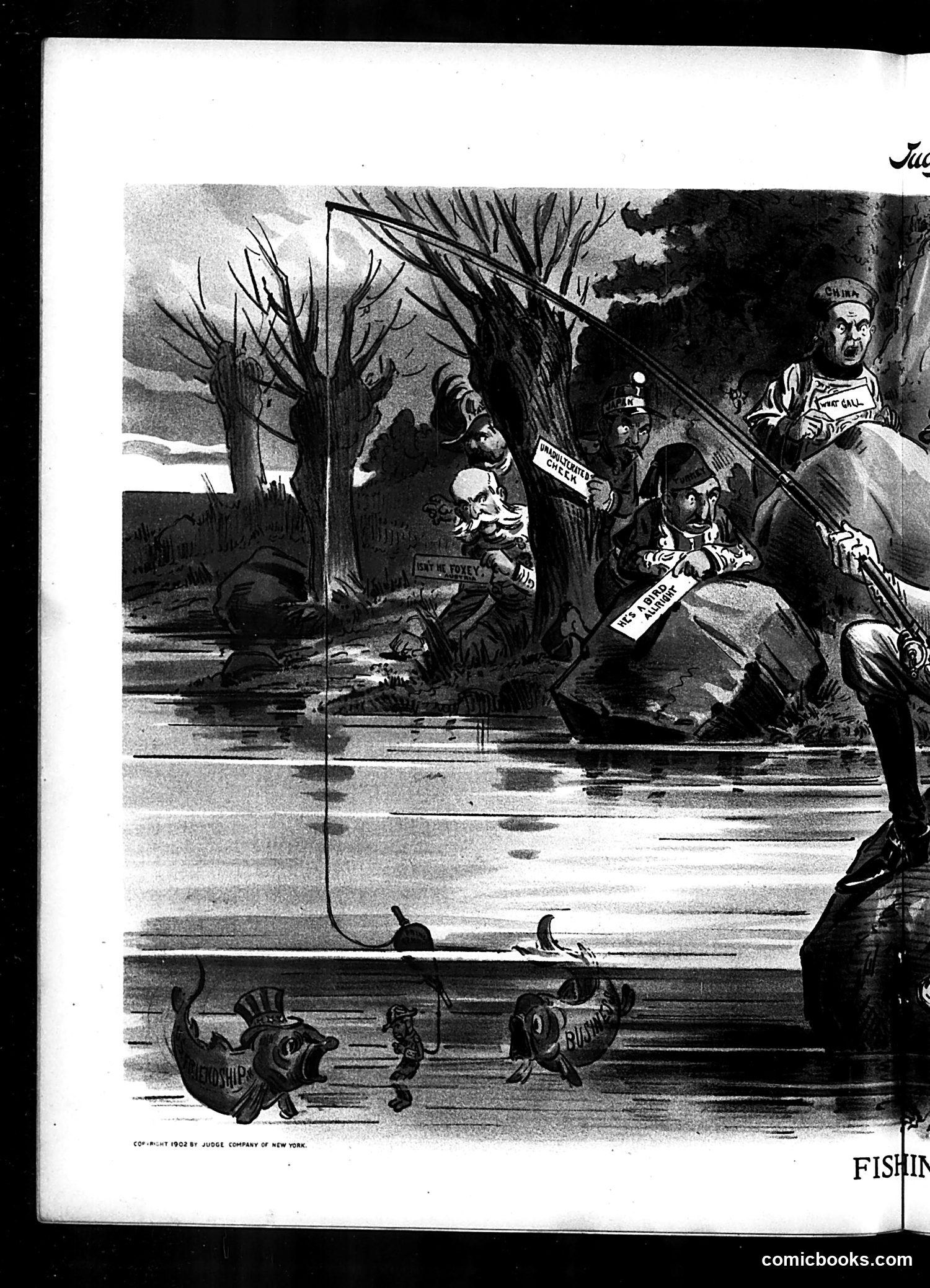
This satirical cartoon depicts several figures fishing in a body of water where fish labeled with what appear to be political or corporate entities are biting. The fishermen—wearing suits and hats suggesting political or business leaders—are positioned along the shore with bare, gnarled trees in a desolate landscape. The satire appears to comment on political corruption or backroom dealing ("fishing" for advantages). The figures' labels and the fish they're catching likely represent specific politicians, corporations, or scandals of the 1902 era, though the text is too unclear to definitively identify them. The overall message suggests powerful figures are opportunistically exploiting situations for personal gain—a common Judge magazine theme critiquing Gilded Age corruption and political machinations.
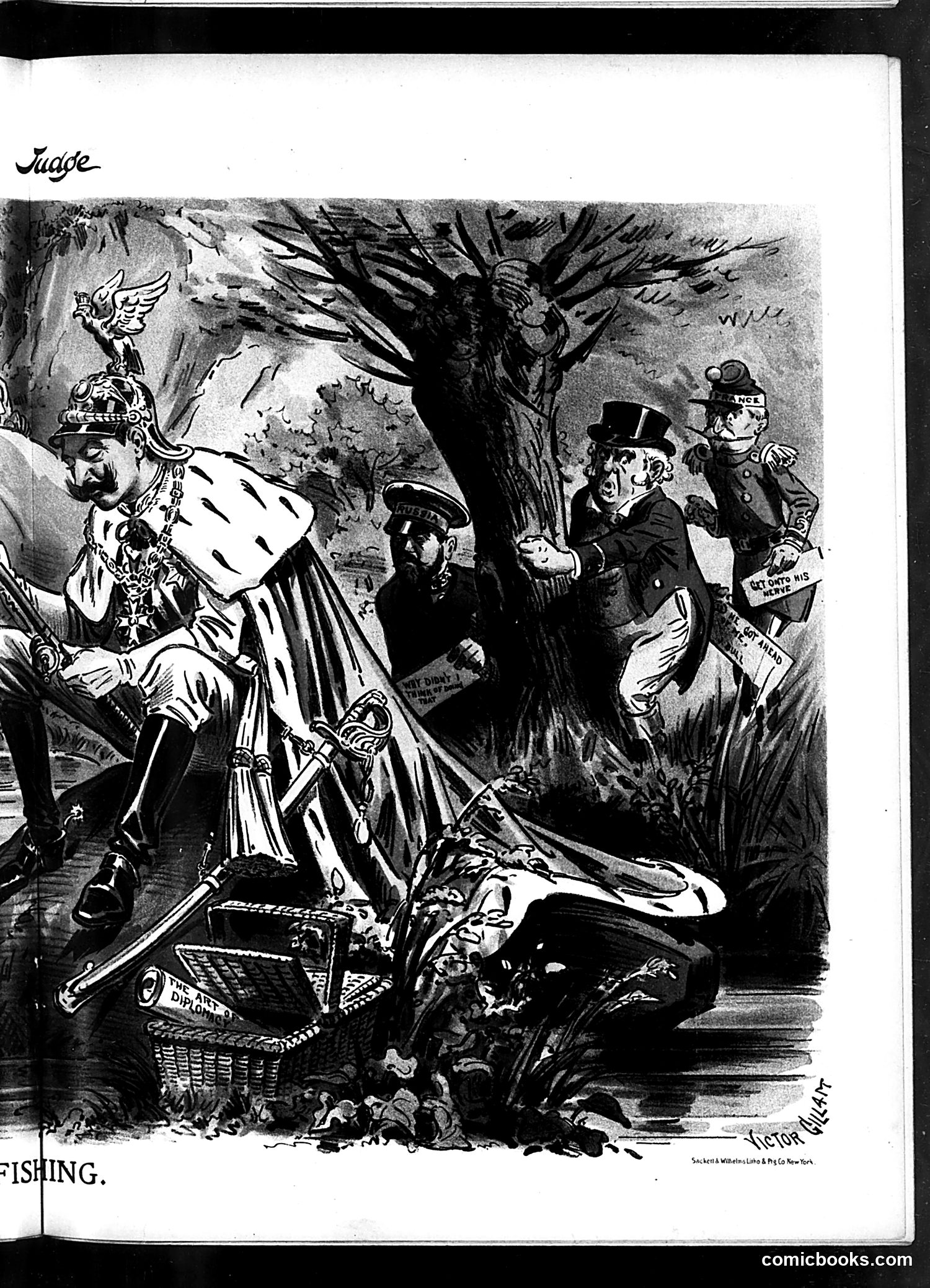
This political cartoon titled "Fishing" depicts a German Kaiser (left, in ornate military dress with spiked helmet) fishing in troubled waters. Several figures in formal dress and top hats appear to represent European powers or diplomats gathered around a gnarled tree, seemingly observing or reacting to the Kaiser's activities. The satire likely comments on German imperial ambitions and aggressive foreign policy during the pre-World War I or early WWI era. "Fishing" appears metaphorical—the Kaiser is "fishing" for territorial gains, alliances, or diplomatic advantage while other nations watch warily. The barren tree and overall dark tone suggest crisis or conflict in European affairs. The specific political moment remains unclear without a visible date.
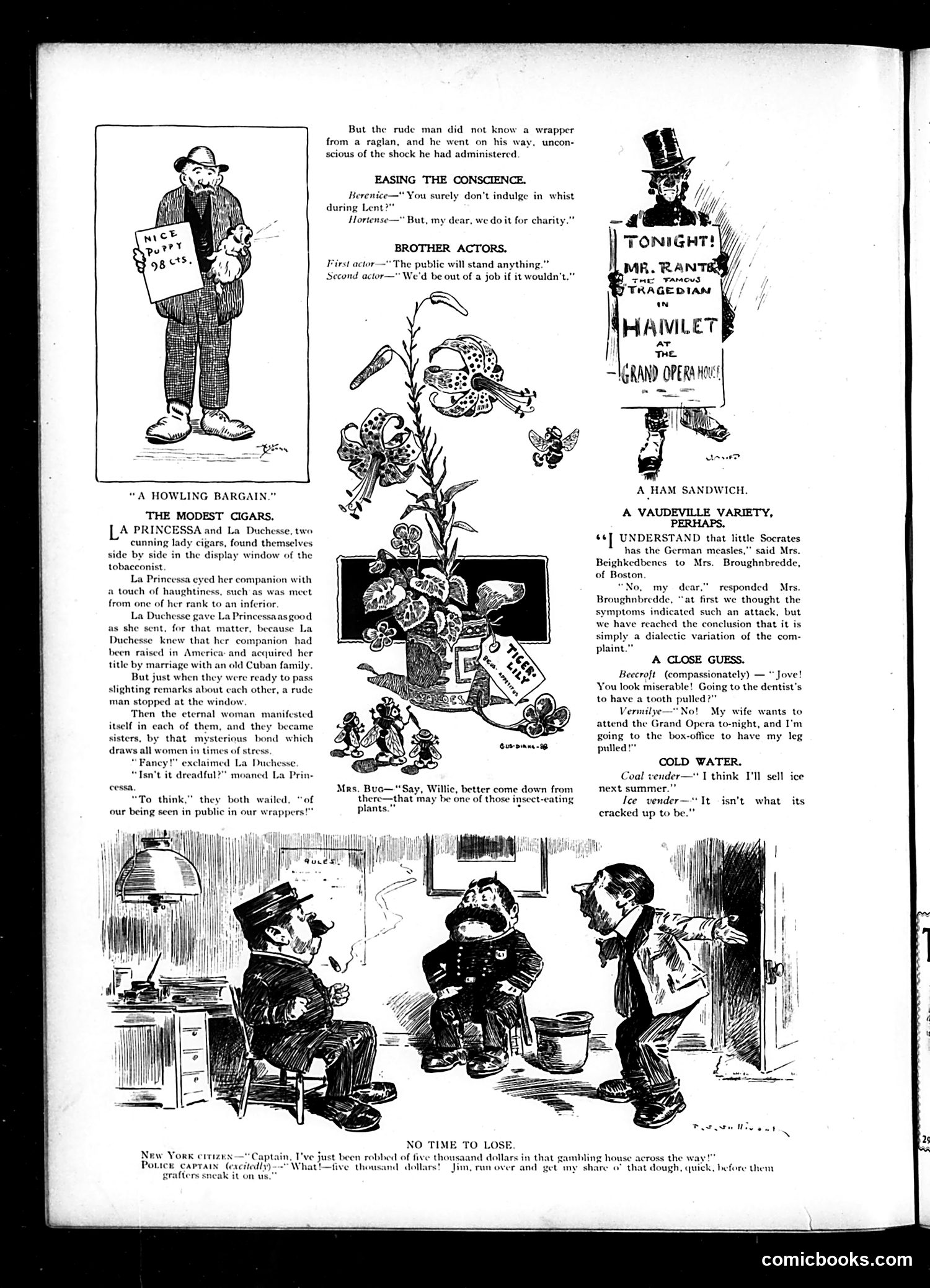
This page contains multiple unrelated humorous sketches typical of Judge magazine's format: **"A Howling Bargain"** mocks feminine vanity: two cigars with aristocratic pretensions (a "Princessa" and "La Duchesse") are mortified at being displayed in their plain wrappers, fearing public embarrassment. The joke: an uncultured man stops at the window, oblivious to their distress—he can't distinguish a wrapper from a raglan coat. The satire targets upper-class women's obsession with appearance and propriety. **"Brother Actors"** cynically jokes that audiences will tolerate anything in theater; if they wouldn't, actors would lose their jobs. **"Easing the Conscience"** satirizes moral hypocrisy: a woman indulges in card games during Lent (a religious fasting period) by claiming it's "for charity." Other brief jokes mock German measles misdiagnosis, dental visits, and working-class opportunism (a police captain wanting to exploit a robbery). The cartoons reflect early 20th-century concerns with class pretension, moral duplicity, and theatrical culture.
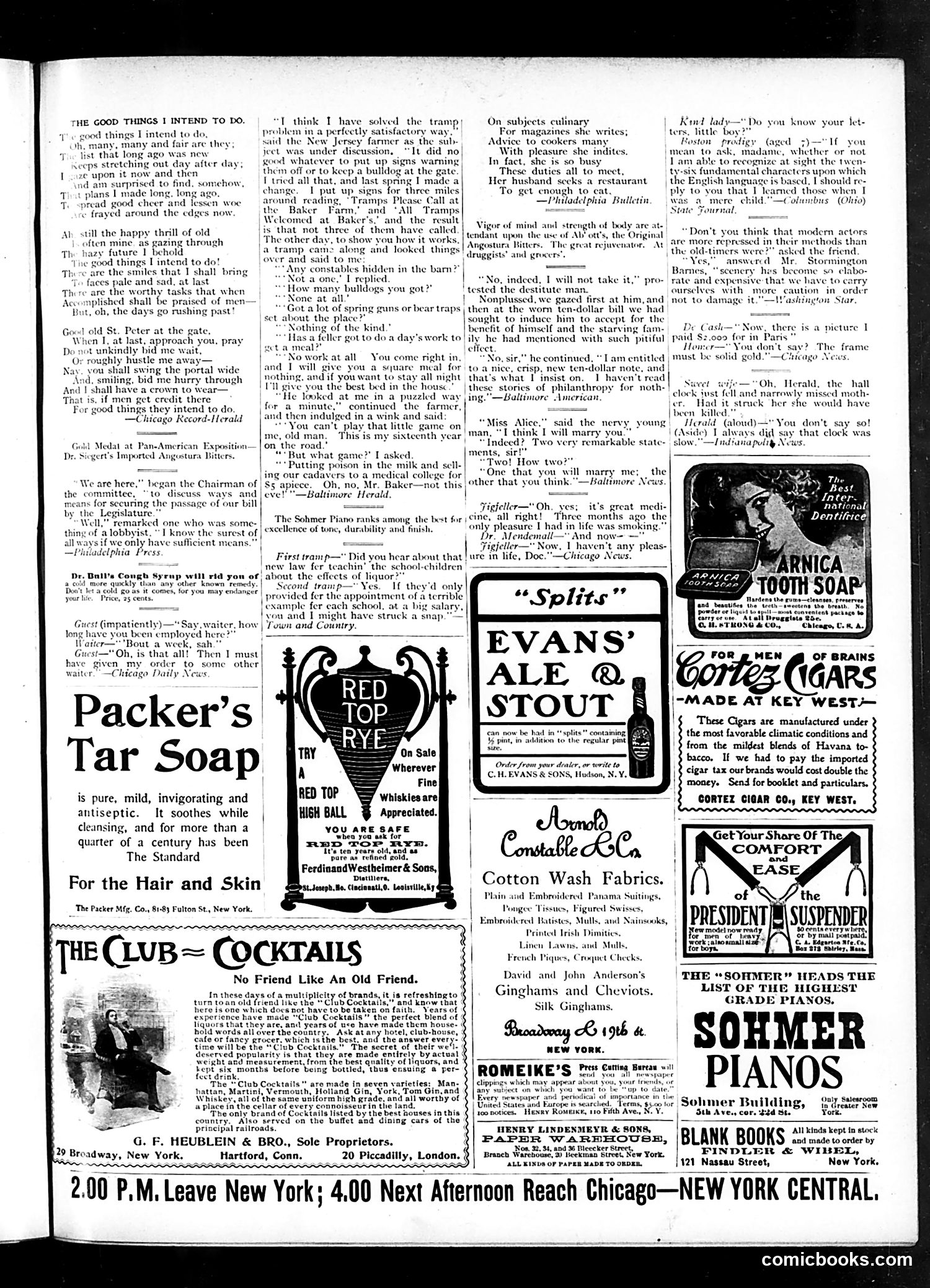
This page is primarily **advertising and humor columns** rather than political cartoons. The main content includes: **The Central Narrative Piece** ("The Good Things I Intend to Do"): A satirical dialogue between a New Jersey farmer and a tramp, mocking the gap between charitable intentions and actual behavior. The farmer boasts of his kindness but has actually installed signs, bulldogs, and traps to keep tramps away—revealing hypocrisy about Victorian-era charitable pretenses. **The Advertisements**: Period products (Packer's Tar Soap, Evans' Ale, Arnica Tooth Soap, Sohmer Pianos) that document early 1900s consumer culture. **Small Humor Items**: Brief jokes about modern actors being overly elaborate, and a sarcastic exchange about a poor man refusing a charity dollar bill, preferring a crisp new note—satirizing both poverty and the inadequacy of casual almsgiving. The page's humor consistently targets **middle-class hypocrisy** regarding charity and respectability during the Progressive Era.
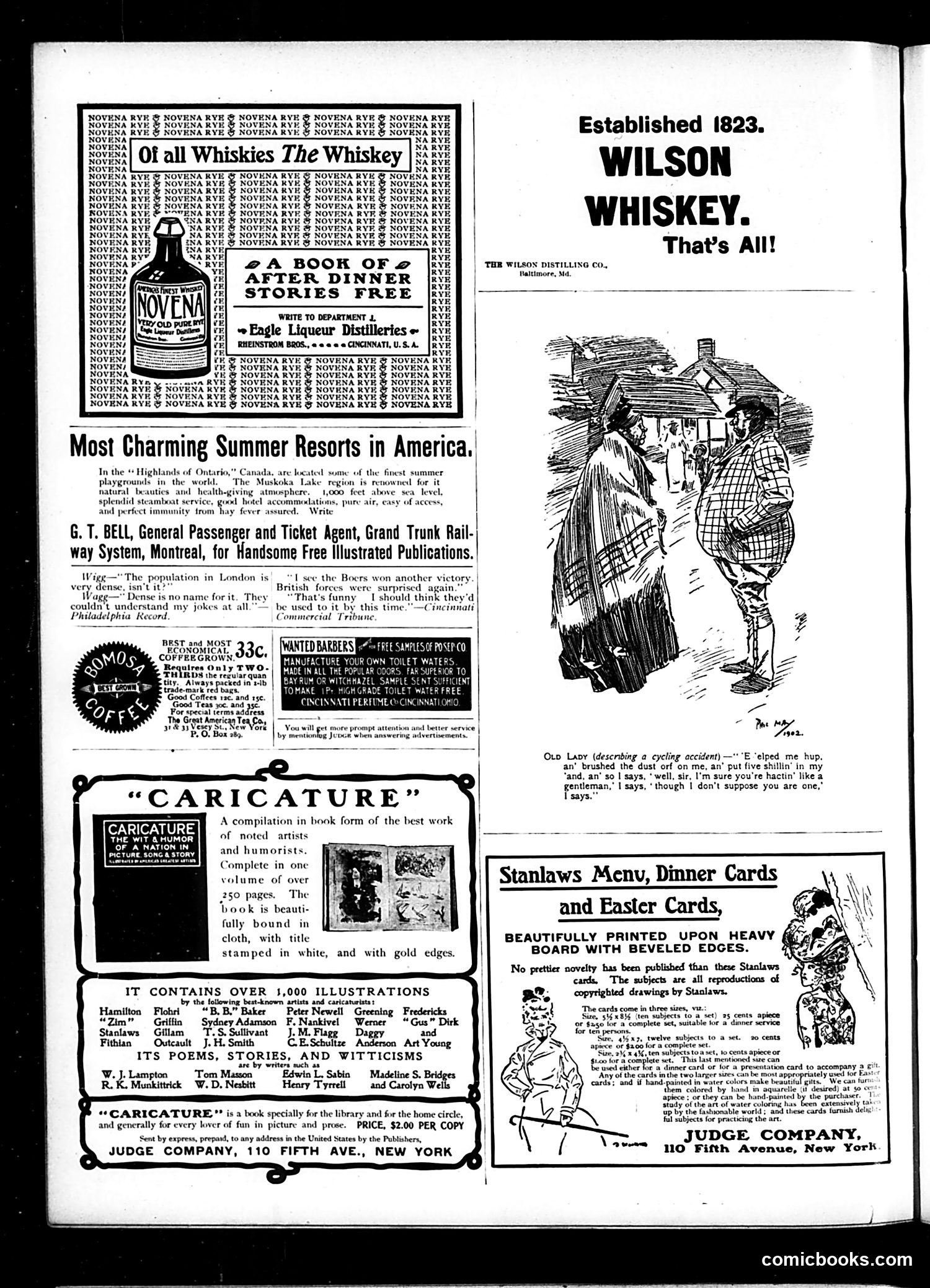
This is primarily an **advertising page** rather than editorial content. The main cartoon is a single captioned illustration labeled "Old Lady (descending a cycling accident)" depicting a genteel elderly woman and a well-dressed man, with her remarking that though he helped her after a bicycle accident and gave her money, she doubts he's actually a gentleman. The page is dominated by **product advertisements** for Wilson Whiskey (established 1823), Novena Rye liquor, Omosco Coffee, and other consumer goods typical of the era. There are also advertisements for a book called "Caricature: The Wit & Humor of a Nation," featuring hundreds of illustrations by noted cartoonists, and for Stanlaws greeting cards and dinner cards. **Context for modern readers:** This reflects early 1900s advertising practices where Judge magazine mixed editorial cartoons with commercial pitches. The humor is gentle social observation rather than political satire. The cycling accident reference reflects the bicycle craze of that era.
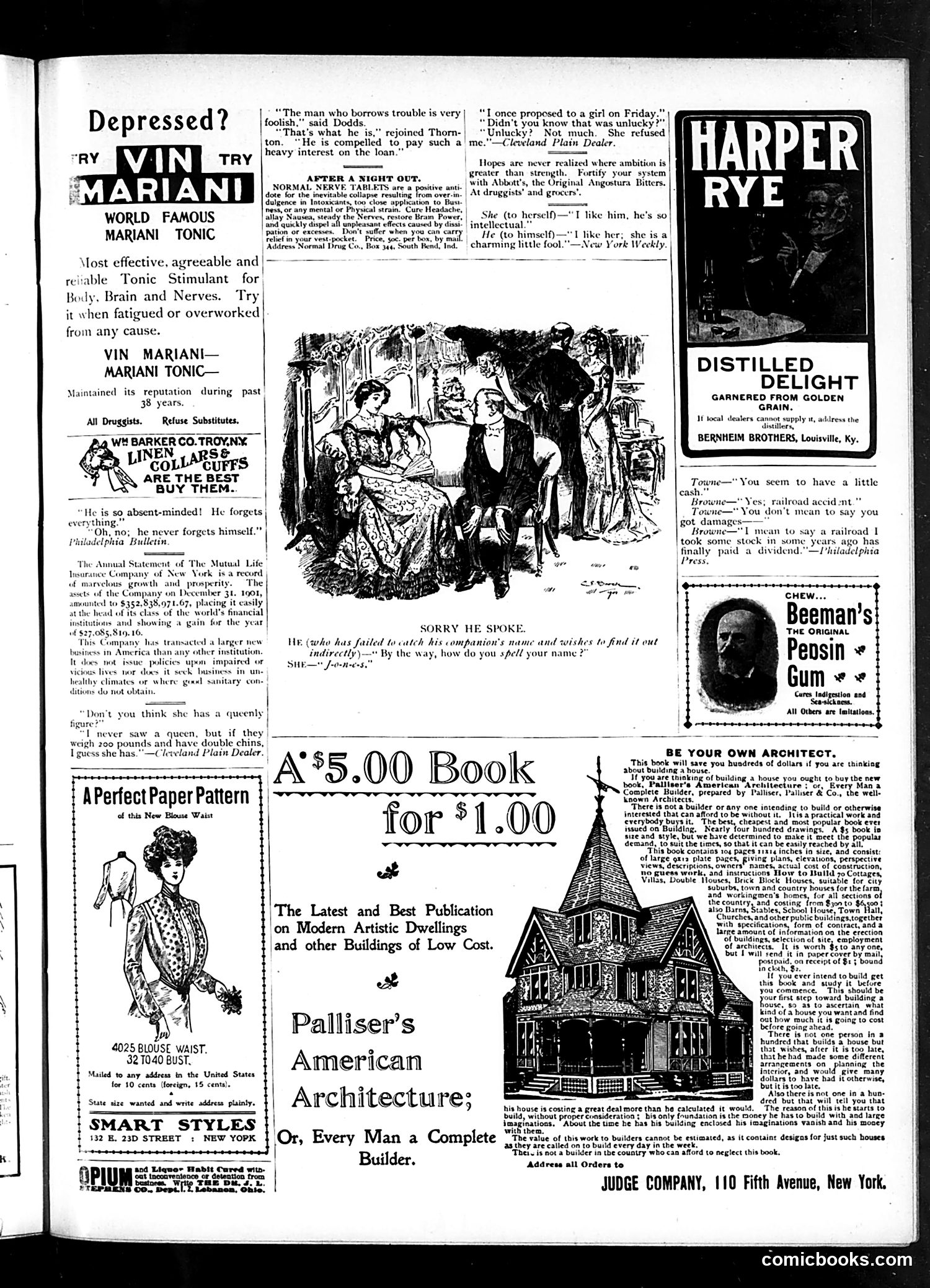
This page is primarily **advertising**—not a political cartoon. It's from Judge magazine and contains multiple product ads alongside brief humorous anecdotes. The cartoons are minimal: one illustration titled "SORRY HE SPOKE" shows a social situation where a man forgets someone's name and awkwardly asks how to spell it, only to learn (indirectly) the person's name through conversation. The humor is about social embarrassment. Other content includes: - Ads for Vin Mariani (a tonic wine claiming to cure depression/fatigue) - Patent medicine ads (opium/liquor addiction cures, "Normal Nerve Tablets") - A sewing pattern ad - An architecture book offer ($5.00 value for $1.00) - Harper's Rye whiskey ad - Short jokes about absent-mindedness, women's figures, and stock dividends The social commentary is light—mostly poking fun at everyday awkwardness rather than political satire. The ads reveal the era's unregulated patent medicine industry and assumption that readers might need alcohol-based "tonics" for fatigue.
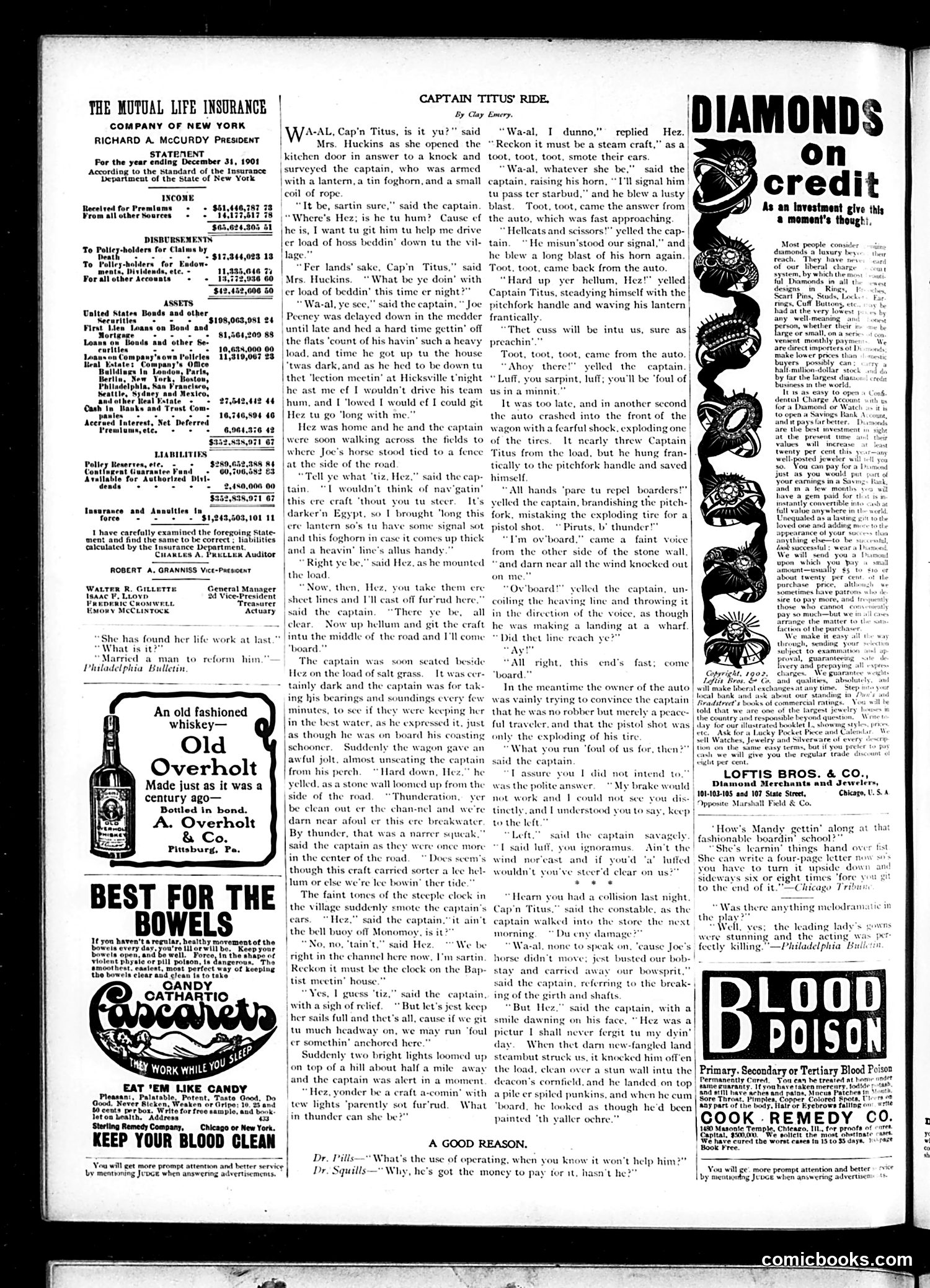
This is a comedic short story by Guy Lowell, not primarily political satire. The narrative humorously depicts Captain Titus attempting to transport a load of salt hay at night with his inexperienced helper Hez, treating the farm wagon as though navigating a coastal ship. The joke relies on the captain's elaborate nautical language and behaviors—using lanterns, foghorns, "soundings," and treating obstacles like stone walls as maritime hazards (channels, breakwaters)—applied absurdly to dry-land wagon driving. This genre of humor was popular in early 1900s magazines: rural characters employing specialized vocabulary incongruously. The surrounding advertisements (insurance, whiskey, patent medicines) suggest this is ordinary magazine filler content rather than editorial commentary. No specific political figures or events appear to be referenced—it's simply entertainment for contemporary readers.
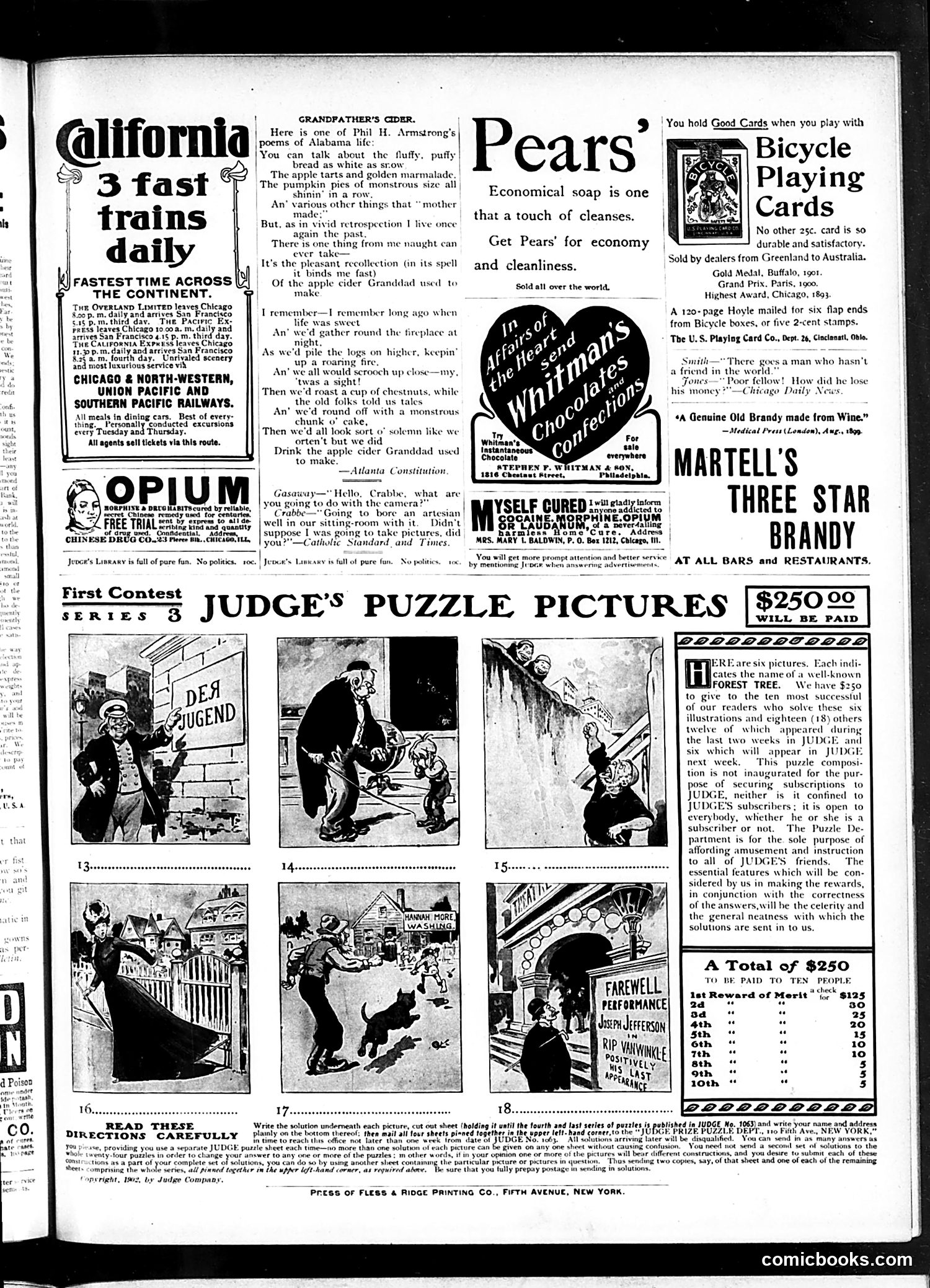
This page is primarily **advertising and entertainment content**, not political satire. The main feature is "Judge's Puzzle Pictures" — a contest offering $250 total in prizes. Readers must identify six illustrated forest trees (shown in cartoons numbered 13-18) and eighteen others published elsewhere. The instructions explain this is open to all readers, not just subscribers, purely for amusement. The page also includes: - A sentimental poem about "Grandfather's Cider" by Phil H. Armstrong - Railroad advertisements (Chicago & North-Western, Union Pacific, Southern Pacific) - Product ads (Opium drug treatment, Pears' soap, Bicycle Playing Cards, Martell's Brandy) - A brief joke about someone boring an artesian well in their sitting room **No political commentary or social satire is evident.** This appears to be a typical early-1900s magazine page mixing verse, advertisements, and reader-participation games.
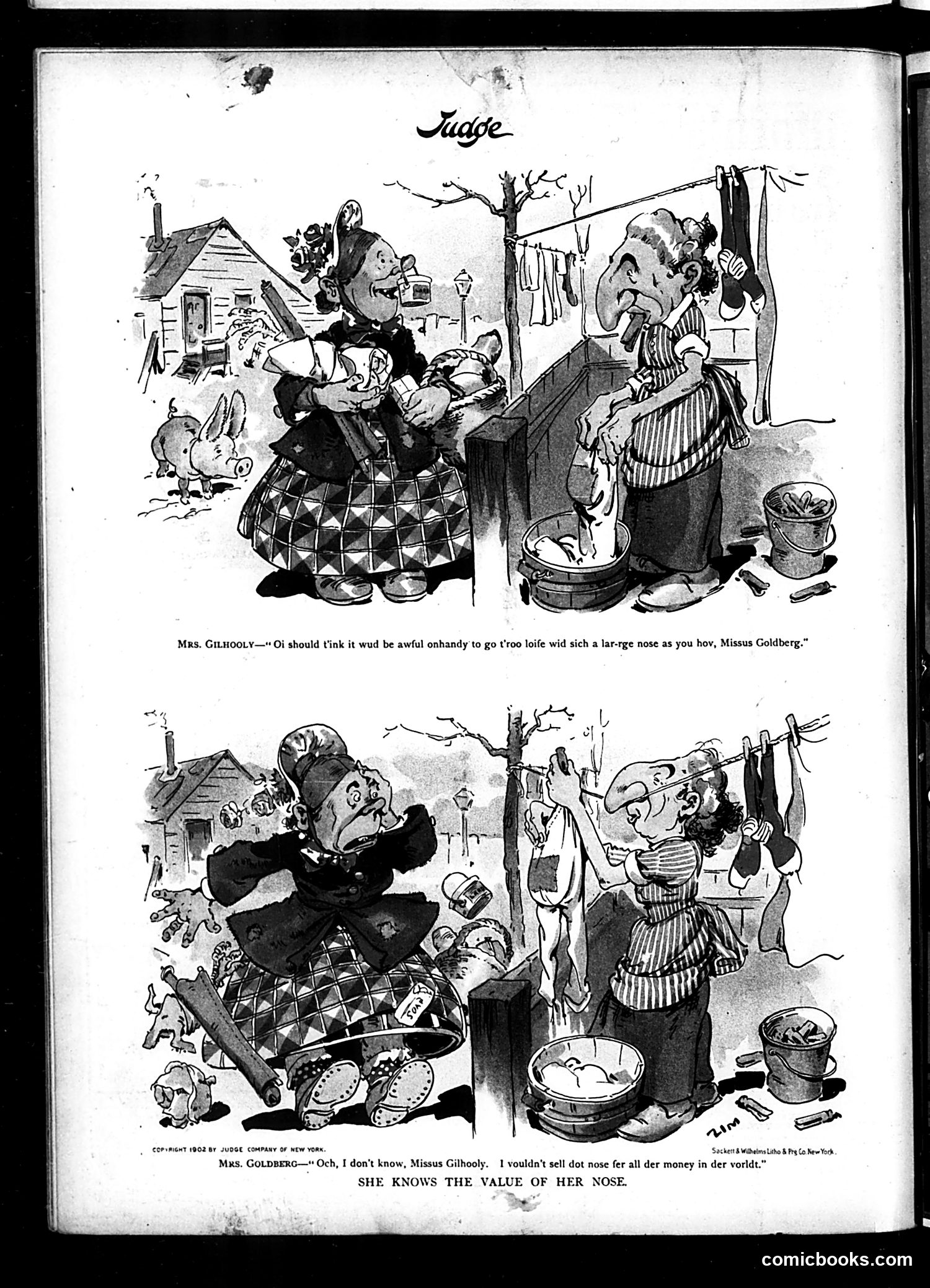
This two-panel cartoon mocks Jewish and Irish immigrant women through exaggerated caricature and stereotypical accents. "Mrs. Goldberg" (Jewish) and "Mrs. Gilhooly" (Irish) discuss the value of a woman's nose—the latter suggesting it's so large/prominent she'd be better off in "Froo loife" (free life) without it. The humor relies on antisemitic and anti-immigrant stereotyping common to early 20th-century American satirical magazines. The title "She Knows the Value of Her Nose" suggests Mrs. Goldberg ironically treasures her appearance despite its supposed unattractiveness by period standards. The cartoon reflects Judge magazine's frequent use of ethnic caricature for comedic effect, targeting marginalized immigrant communities for ridicule.