
A complete issue · 20 pages · 1902
Judge — January 4, 1902
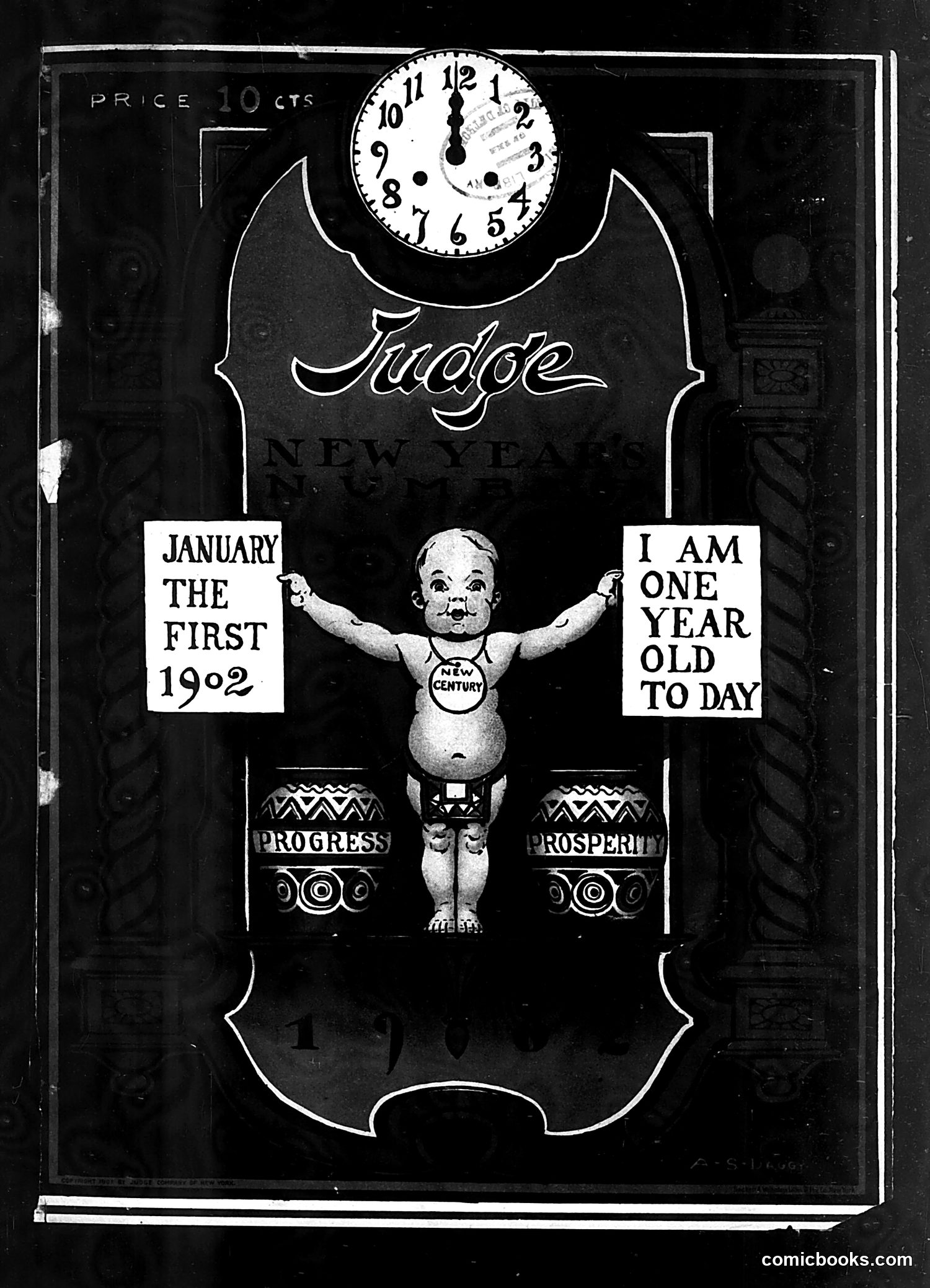
This New Year's Day cover celebrates the dawning of the 20th century. The baby labeled "NEW CENTURY" represents 1902, depicted as a strong infant "lifting" the concepts of "Progress" and "Prosperity" (shown as decorative urns). The clock shows midnight, marking the transition. Text boxes reference "January The First 1902" and "I Am One Year Old To Day," establishing that the new century has now reached its first birthday. The satire expresses optimistic confidence in American progress and economic prosperity during the early Progressive Era. The baby's strength symbolizes the nation's robust industrial and economic development entering the 20th century. This reflects contemporary American optimism about technological advancement and national expansion during Theodore Roosevelt's presidency.
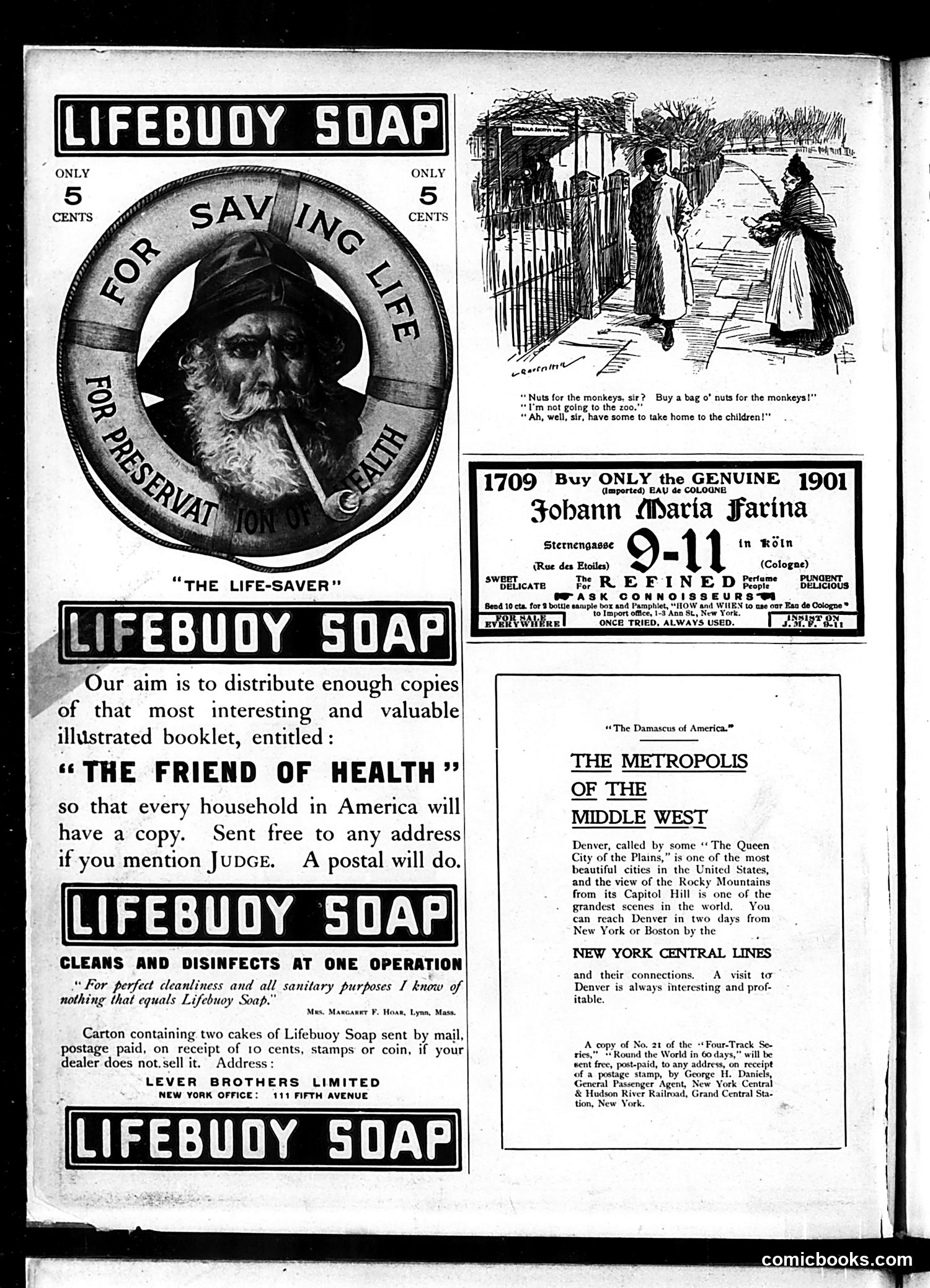
This page is primarily **advertising rather than satire or political commentary**. The left side contains multiple Lifebuoy Soap advertisements featuring "The Life-Saver" (an elderly bearded man), emphasizing the product's disinfectant properties. The copy references distributing health booklets titled "The Friend of Health" to American households. The right side includes an unrelated advertisement for Johann Maria Farina cologne (established 1709) and a travel promotion for Denver via the New York Central Lines, describing Denver as "The Metropolis of the Middle West" and "Queen City of the Plains." A small cartoon depicts two figures at a zoo discussing buying nuts for monkeys—likely a mild visual joke, but the caption is too small to clearly interpret the satire.
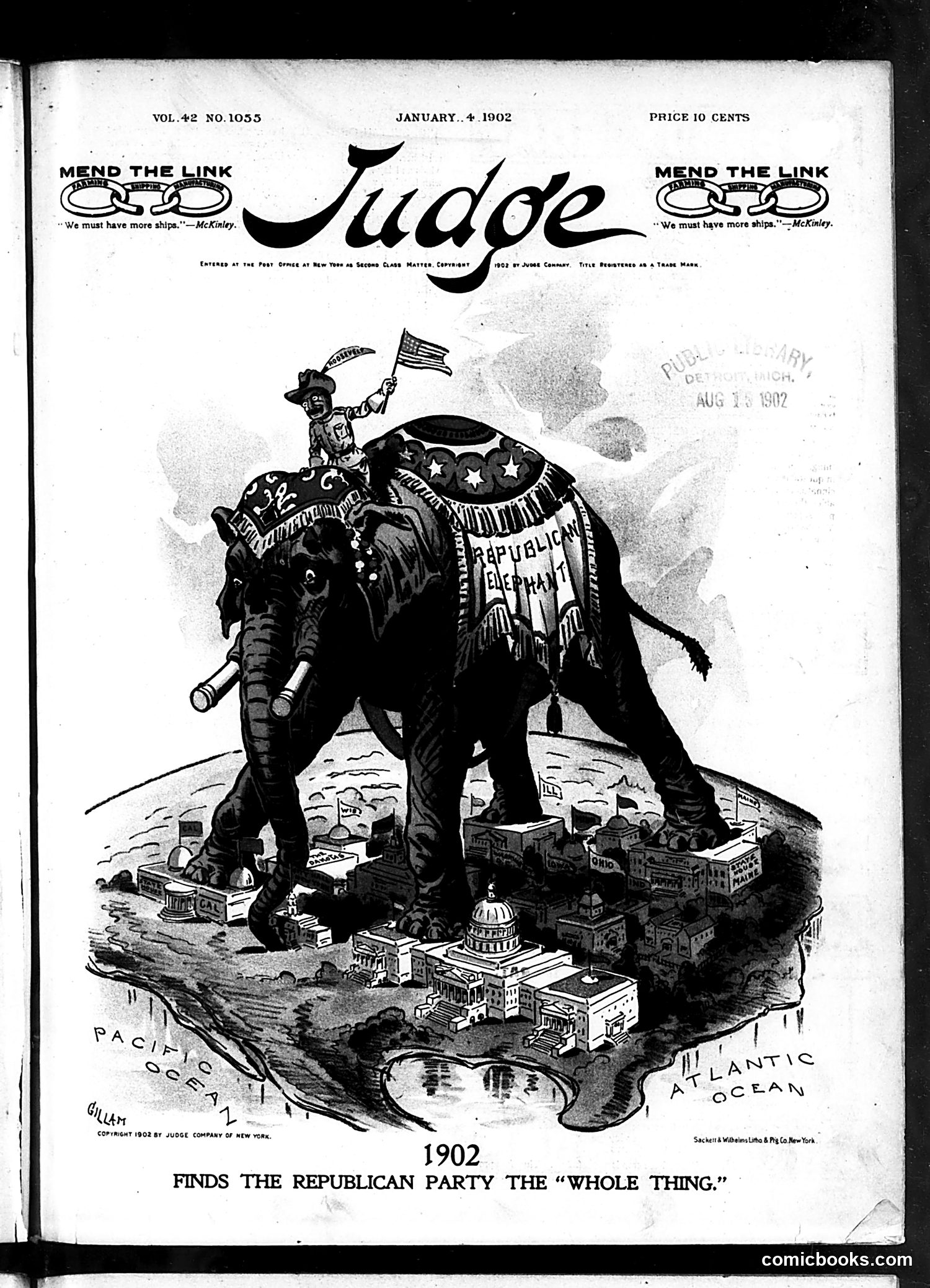
This editorial cartoon depicts an elephant (the Republican Party's symbol) standing astride American territory, spanning from the Pacific to Atlantic Oceans. The elephant wears a decorative blanket labeled "Republican Elephant" and carries American flags and military insignia. A figure (likely representing Republican leadership) sits atop, brandishing weapons. The caption states: "1902 FINDS THE REPUBLICAN PARTY THE 'WHOLE THING.'" The satire critiques Republican dominance and expansionism during Theodore Roosevelt's presidency. The elephant's massive stance over populated cities suggests the party's overwhelming political control. The military imagery references American imperial ambitions—particularly recent acquisitions like the Philippines and Puerto Rico following the 1898 Spanish-American War. The cartoon appears either celebratory or critical of this Republican hegemony, depending on Judge's editorial stance.
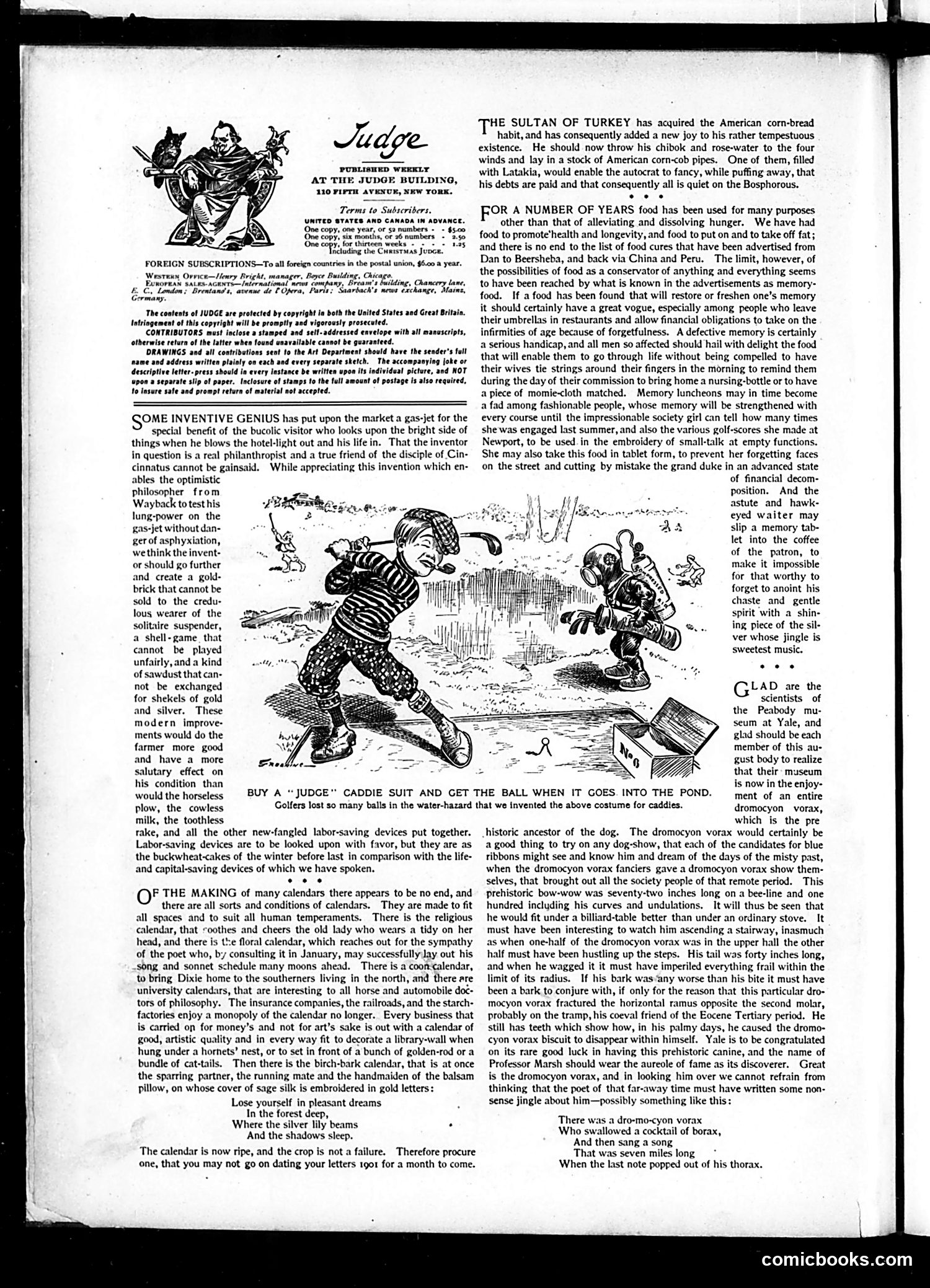
This page contains **multiple editorial pieces rather than a single unified cartoon**. The main illustrated content shows a child in a "Judge" caddie suit hitting a golf ball into a pond—a visual pun on the magazine's name and an advertisement for children's clothing. The text columns discuss various topics including food as medicine, calendar designs, and a humorous poem about a dromocyon vorax (an invented creature). **The political/social satire is minimal on this particular page.** Instead, Judge uses humor to promote consumer products (the caddie suit), discuss practical matters (calendar standardization), and entertain with whimsical verse. This reflects Judge's dual nature as both satirical publication and general-interest humor magazine with advertising.
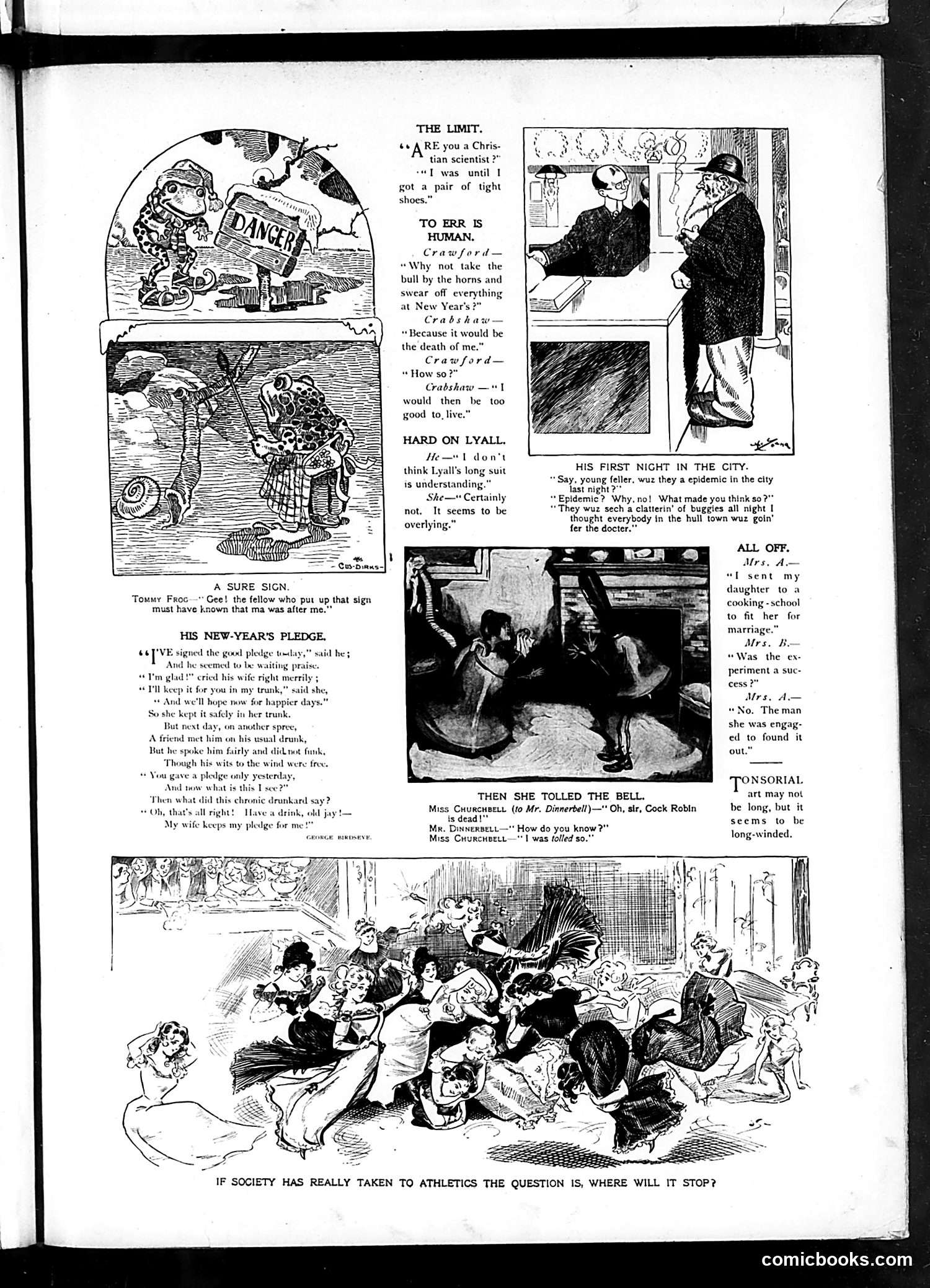
This page from *Judge* contains several satirical short jokes and cartoons typical of late 19th/early 20th-century humor: **"The Limit"** mocks Christian Scientists' denial of physical reality—a woman loses her faith upon experiencing tight shoes. **"To Err Is Human"** jokes about New Year's resolutions: a man won't swear off vices because being virtuous would make life unbearable. **"His First Night in the City"** satirizes rural innocence—a country visitor mistakes ordinary urban nighttime noise (buggies) for an epidemic. **"All Off"** ridicules domestic education: a woman's cooking-school training sabotages her engagement when her fiancé discovers her incompetence. **"His New-Year's Pledge"** ironically depicts a drunk who signs a temperance pledge only to violate it immediately; his wife keeps it as a joke. **The bottom cartoon** criticizes society women's sudden enthusiasm for athletics, sarcastically questioning where this trend toward female physical activity will end—implying concern about women abandoning traditional roles.
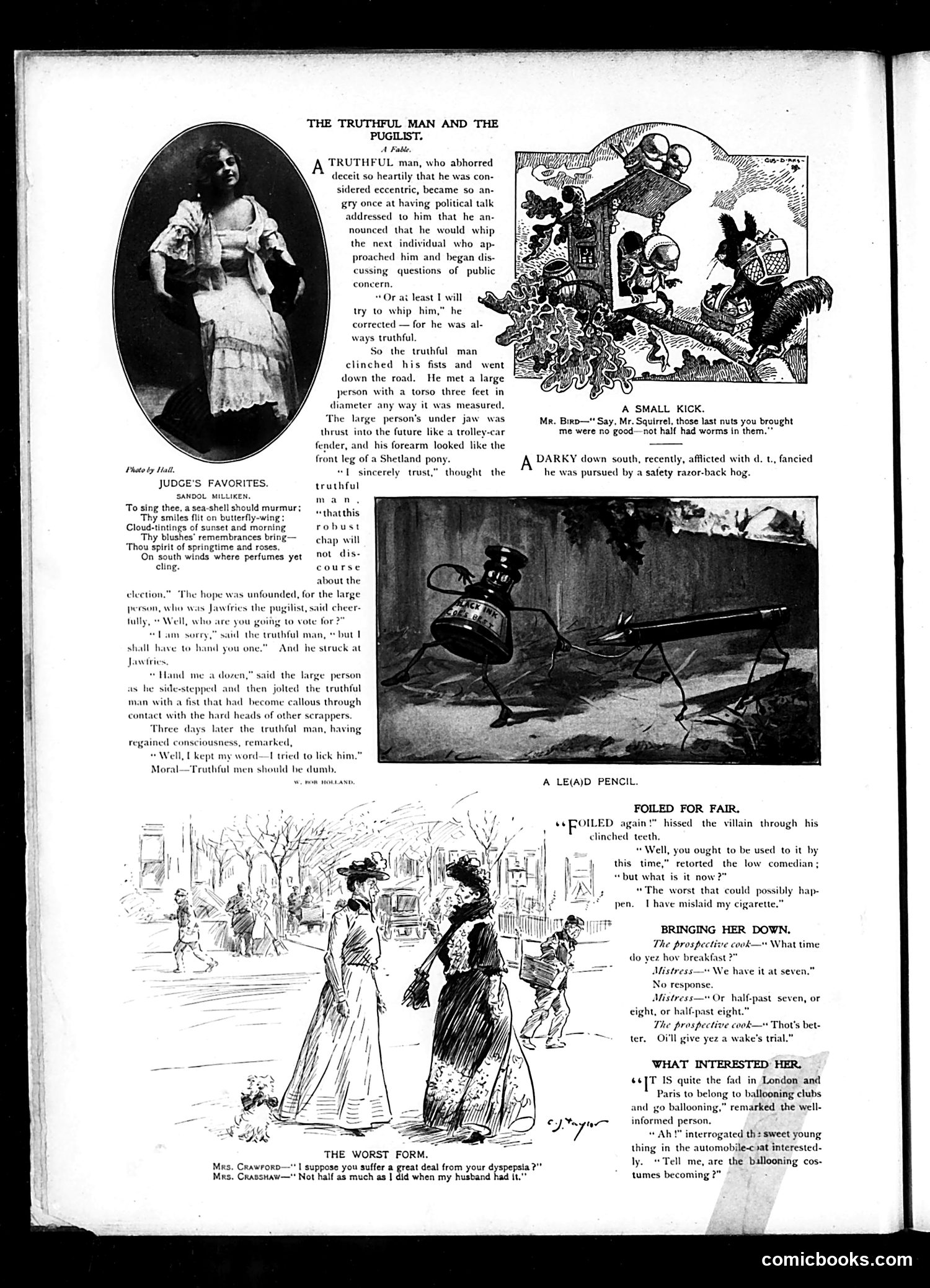
This page from *Judge* magazine contains several satirical pieces typical of early 20th-century American humor: **"The Truthful Man and the Pugilist"** (main story): A fable mocking extreme honesty. A man so devoted to truth-telling that he admits he'll *try* (not guarantee) to whip anyone discussing politics. He encounters "Jawtries the pugilist"—a professional boxer with a massive jaw and forearms. Despite his honesty and willingness, the truthful man gets thoroughly beaten. The moral: "Truthful men should be dumb." It satirizes both excessive candor and political discourse intrusiveness. The remaining pieces are brief joke cartoons with racial stereotypes ("Darky down south") and domestic humor common to the era—maids negotiating breakfast times, wives complaining about husbands' dyspepsia, and a young woman interested only in fashionable balloon-club costumes. The humor relies on period prejudices and social hierarchies now considered offensive.
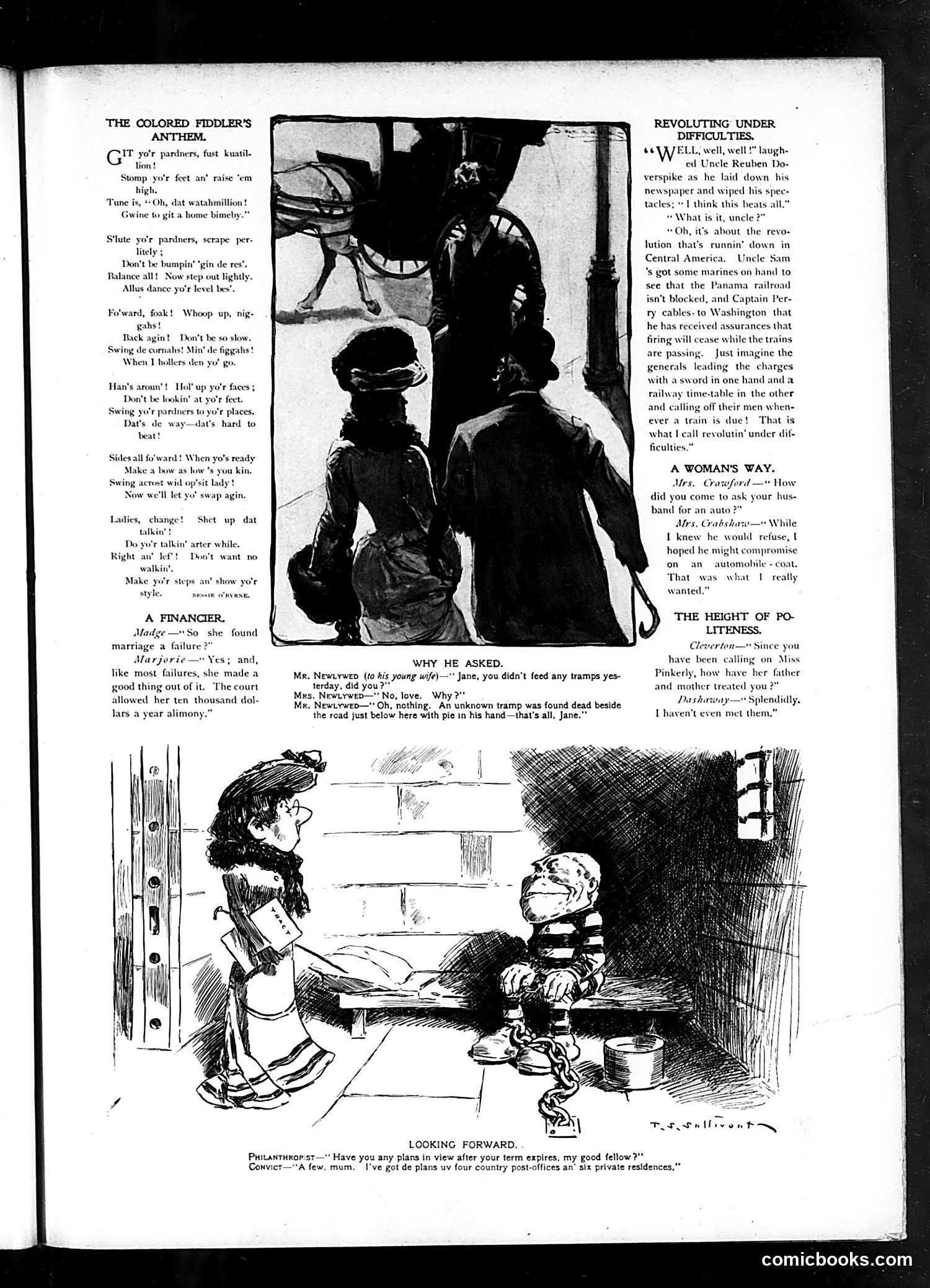
This Judge magazine page contains several satirical pieces: **"The Colored Fiddler's Anthem"**: A minstrel-style dialect poem mocking African American speech patterns—reflecting the racist entertainment conventions of the era. **"Revoluting Under Difficulties"**: Uncle Reuben satirizes U.S. military interventions in Central America, specifically the Panama situation. The joke ridicules the absurdity of conducting revolutions while protecting American railroad operations, imagining generals consulting timetables during combat. This references actual U.S. Marines protecting Panama Canal interests during early-1900s political instability. **Minor jokes**: "A Financier" mocks divorce settlements; "Why He Asked" is dark humor about a tramp's death; "A Woman's Way" satirizes female manipulation; "Looking Forward" jokes about convict post-prison plans; "The Height of Politeness" mocks social pretense. The page reflects Judge's satirical focus on American politics, manners, and foreign policy of the period, though its racial content is deeply offensive by modern standards.
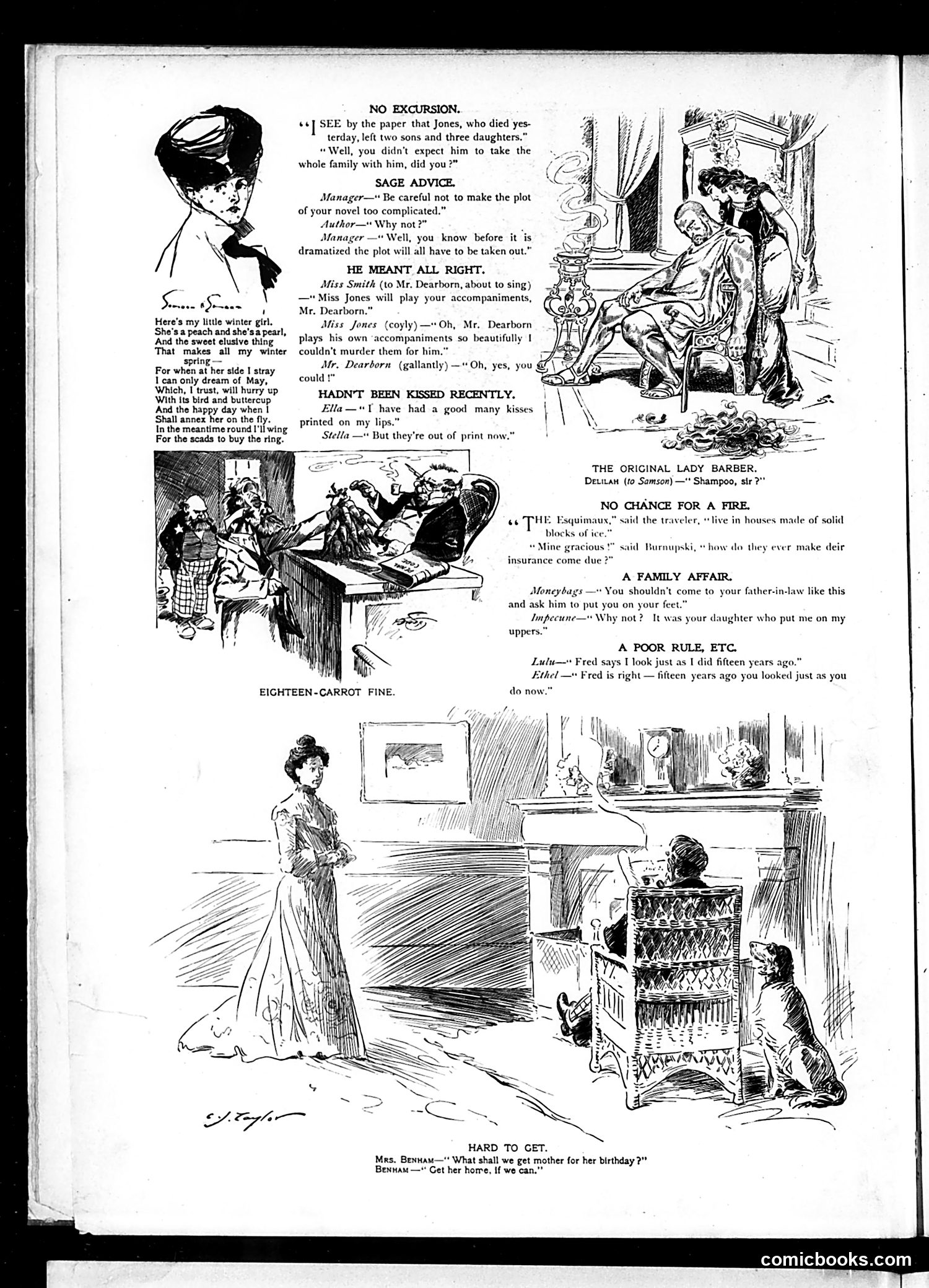
This page from *Judge* contains multiple short comic vignettes satirizing early 20th-century social conventions and professional life: **"No Excursion"** mocks the absurdity of inheritance expectations—a man assumes his deceased neighbor took his entire family with him. **"Sage Advice"** critiques the theater industry: authors are told not to complicate plots because dramatization will strip them out anyway, suggesting theatrical adaptation was crude or simplistic. **"He Meant All Right"** plays on double meanings: a woman's comment about a musician "murdering" his accompaniments is misinterpreted as flattery about his skill. **"Hadn't Been Kissed Recently"** uses the metaphor of "printed kisses" on lips becoming "out of print"—a dated romantic conceit. **"Original Lady Barber"** references the biblical Delilah cutting Samson's hair, suggesting female barbers were novelties. The remaining vignettes joke about insurance fraud, marital financial dependency, and aging wives. Overall, the page reflects period attitudes toward gender roles, professional standards, and class dynamics.
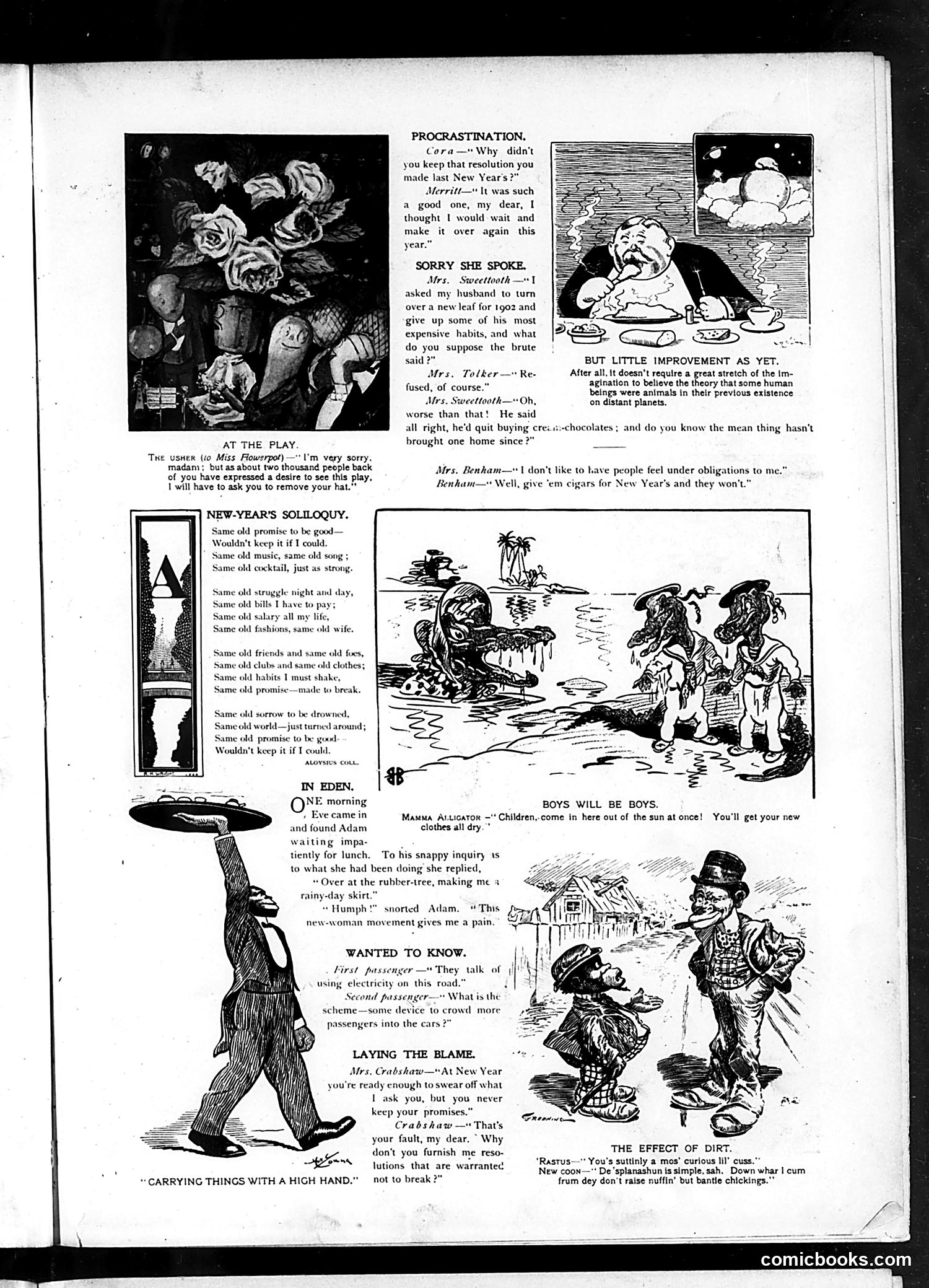
This page from *Judge* collects several New Year's-themed cartoons and jokes satirizing common human failings and domestic life around 1902. **Main Themes:** The "Procrastination" and "New-Year's Soliloquy" pieces mock the universal human tendency to make resolutions knowing they won't be kept. Characters admit they'll repeat the same promises annually without changing behavior. **Domestic Humor:** Several cartoons target marriage dynamics—wives nagging husbands about quitting expensive habits (chocolate-buying, cigars) while husbands make empty promises. "The Effect of Dirt" uses racial caricature (common for the era) in a joke about rural cleanliness standards. **Social Commentary:** "At the Play" satirizes overcrowded theaters. "Wanted to Know" mocks confusion about new technology (electricity). The evolutionary joke suggests humans retain animal instincts. **Overall Point:** The page consistently suggests human nature—procrastination, broken promises, marital conflict, and base instincts—remains unchanging despite modern progress and yearly resolutions to improve.
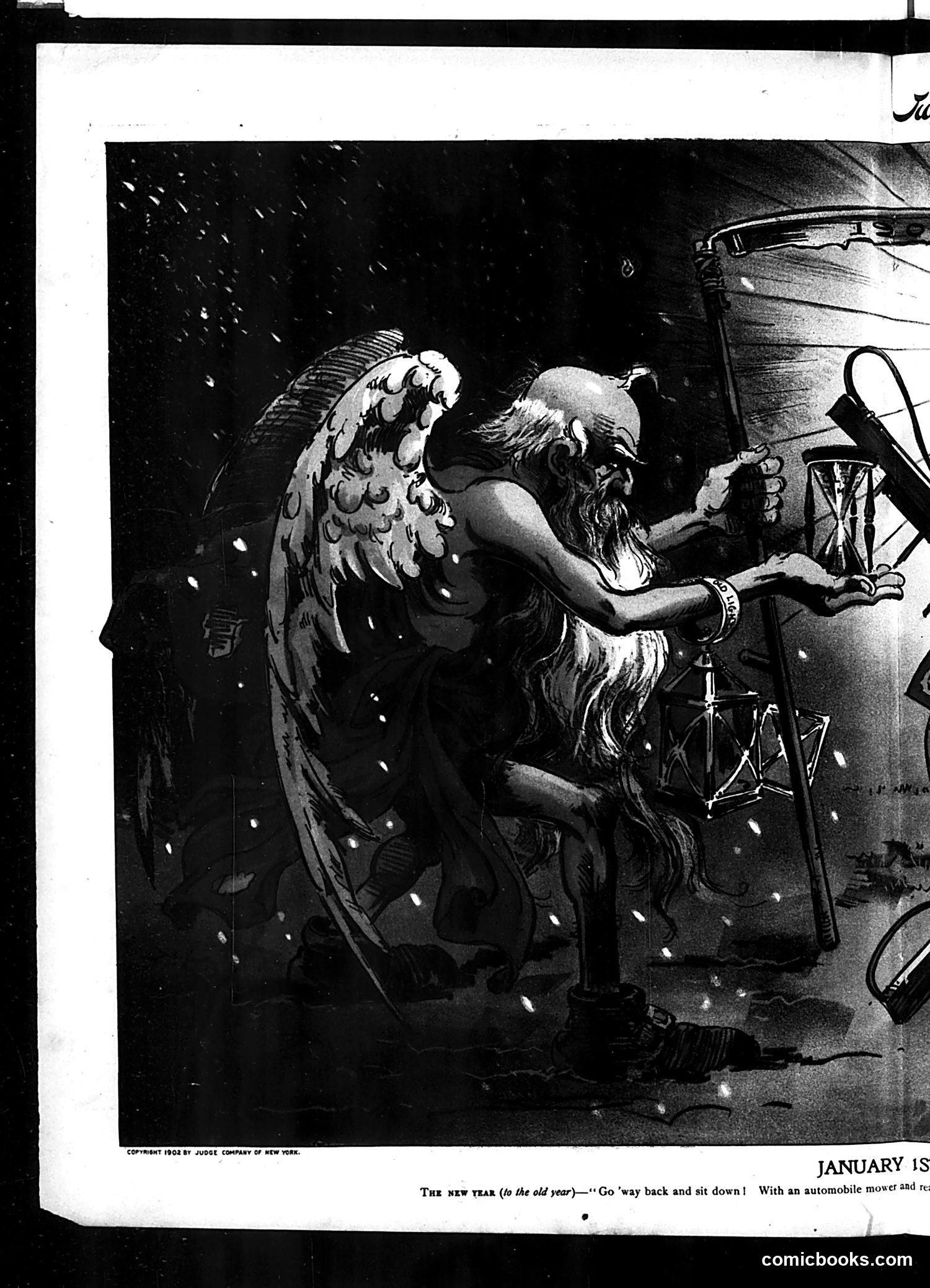
This New Year's satirical cartoon depicts an elderly, bearded figure (representing the outgoing "Old Year") being forcibly ejected by a younger, winged personification of the incoming "New Year." The Old Year is literally told to "Go 'way back and sit down!" The satire centers on **early 1900s technological progress**, specifically the "automobile mower" mentioned in the caption. The new year symbolizes modernity and innovation aggressively displacing tradition. The winged figure and celestial setting emphasize renewal. This reflects Judge's frequent commentary on rapid industrialization and mechanization transforming American life during the turn-of-the-century era. The cartoon mocks how eagerly society embraced new technology while dismissing the past—a common theme in Gilded Age satire.
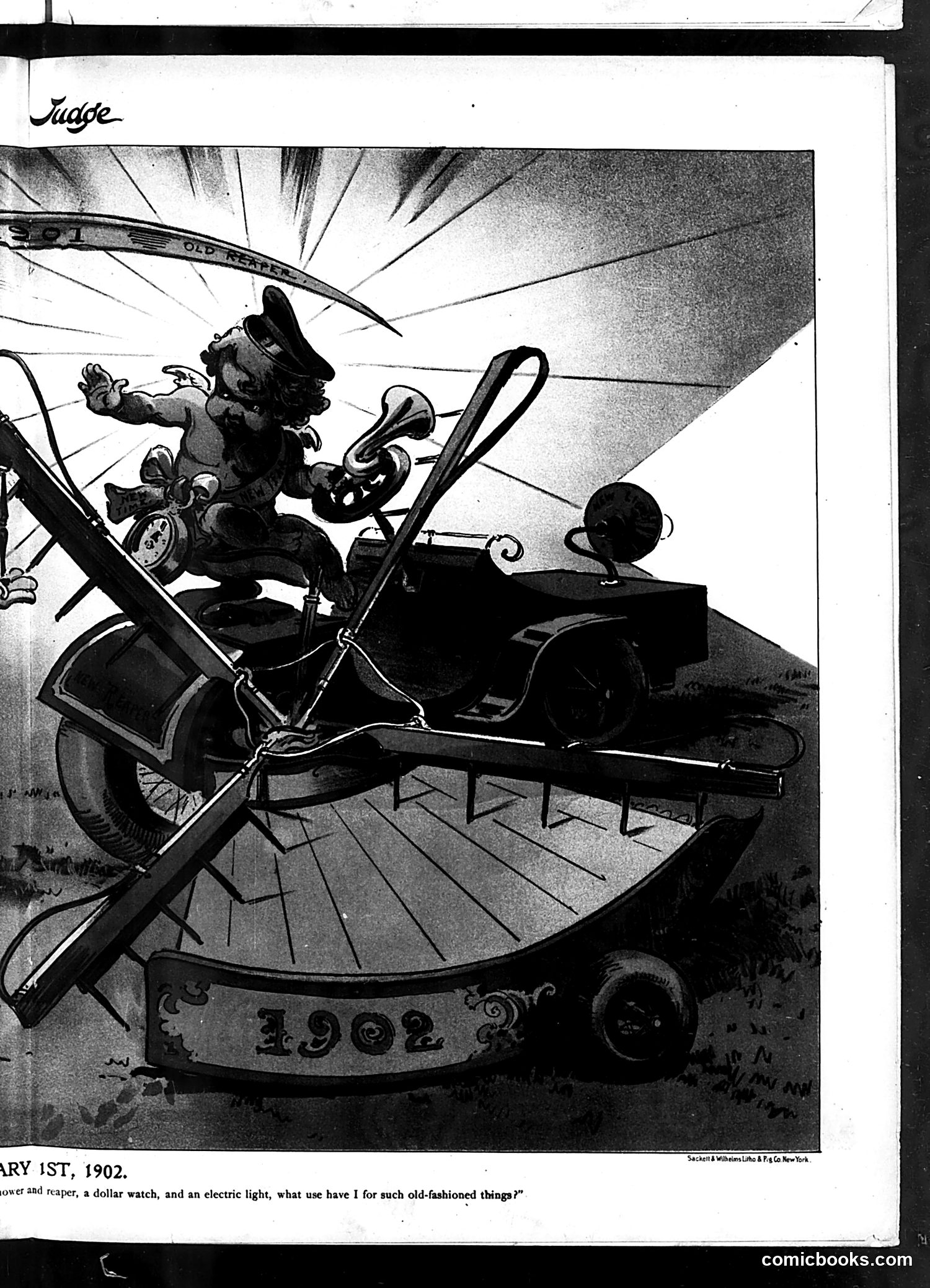
This Judge magazine cartoon satirizes the clash between modern technology and outdated traditions at the turn of the 20th century. A figure (appearing to be Father Time or a similar allegorical character) rides in an elaborate, ornate sleigh or carriage dated "1902," pulled by what looks like a mechanical or fantastical creature. The dramatic radiating lines suggest motion and energy. The caption's partial text references "a dollar watch, and an electric light"—items representing new industrial innovations. The joke critiques how old-fashioned customs and superstitions persist despite the era's technological advances. The figure seems bewildered by or dismissive of these modern conveniences, embodying the tension between Victorian tradition and the dawning modern age as Americans entered the 1900s.
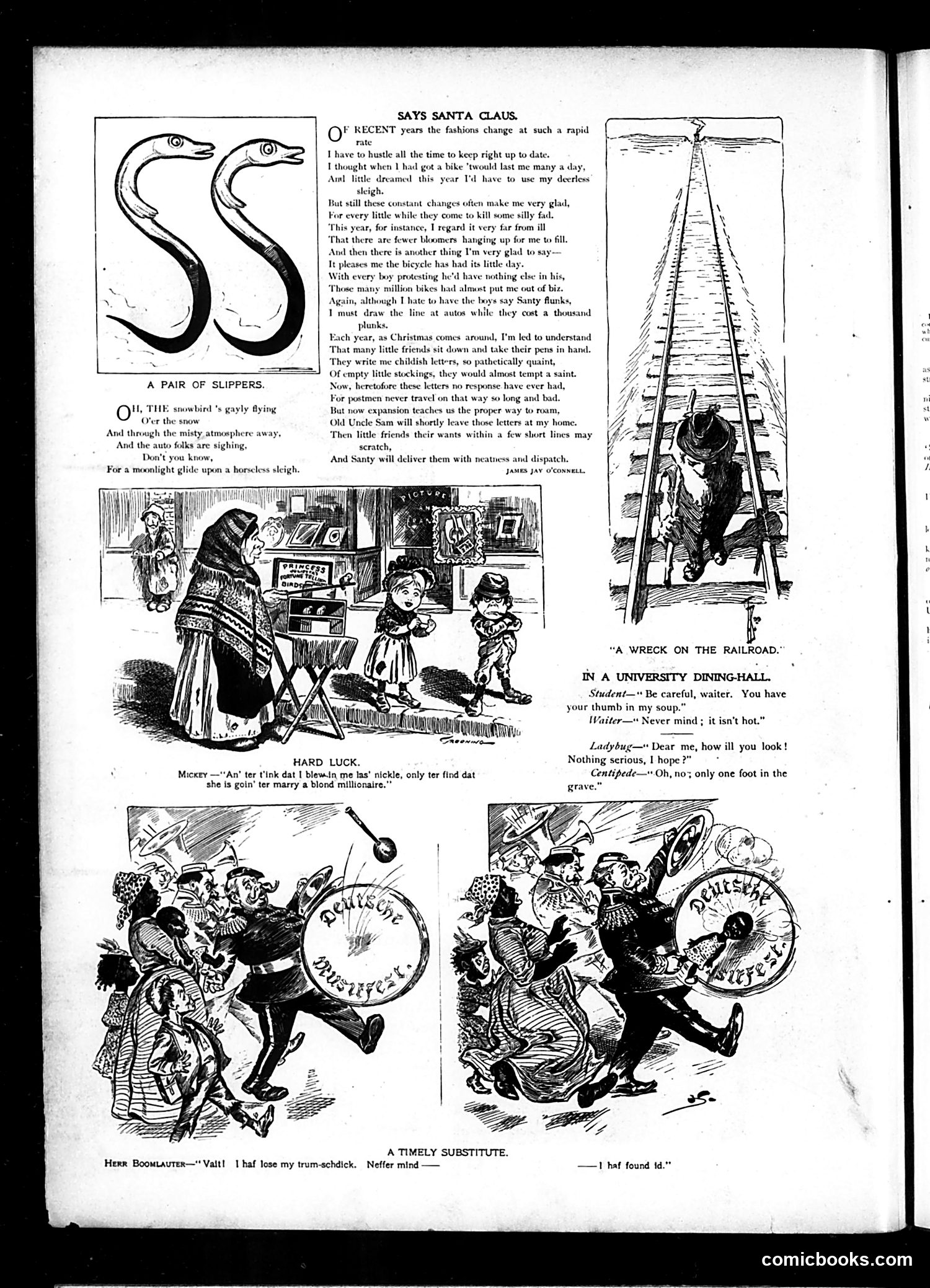
This page contains several unrelated humor pieces typical of Judge magazine's satirical format: **"Says Santa Claus"** (top): A poem where Santa complains about modern fashion changes making his gift-delivery job difficult—fewer bloomers mean fewer stockings to fill, and bicycles have reduced the need for his services. The satire targets the rapidly changing women's fashions and the social disruption caused by the bicycle craze of the 1890s. **Lower cartoons**: Separate joke illustrations with minimal captions about everyday mishaps—a "Hard Luck" scenario with a poor woman, "A Wreck on the Railroad," a university dining-hall incident, and "A Timely Substitute" showing orchestra musicians. The content reflects late-Victorian American humor: anxiety about female independence (bicycles, fashion), class commentary, and slapstick situations. No specific political figures are identifiable.
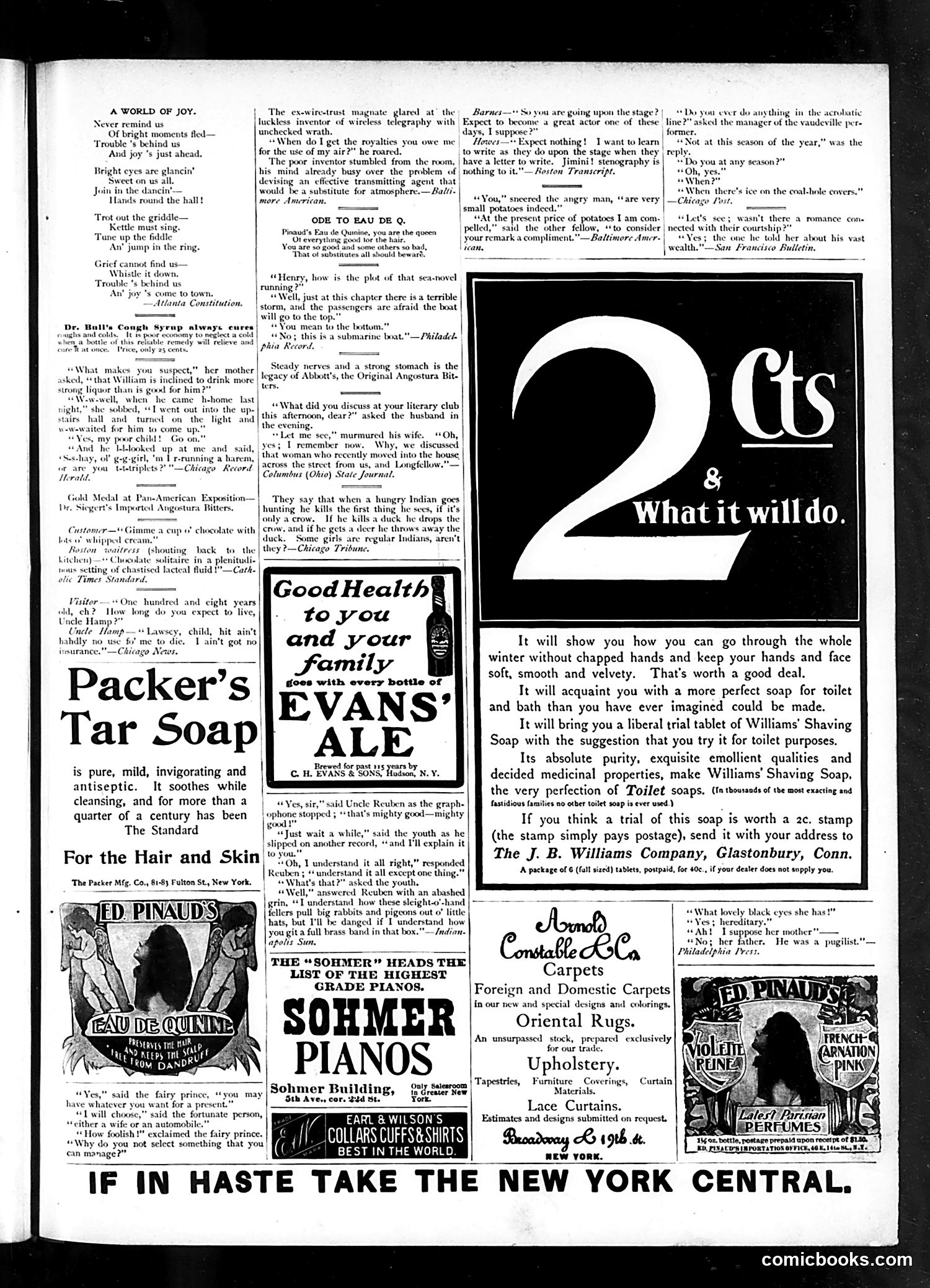
This page is **primarily advertisements** with brief satirical snippets interspersed—typical of Judge magazine's format. The main editorial content includes: 1. **"A World of Joy"** (top left): A cheerful poem about setting aside troubles—standard sentimental verse of the era. 2. **Wireless/Telephone Joke**: A magnate confronts an inventor over unpaid "royalties for the use of my air," satirizing early wireless telegraphy disputes and the emerging question of who owned broadcast frequencies. The inventor jests about needing a substitute for "atmosphere." 3. **Literary Club Joke**: A husband learns his wife's club discussed a neighbor instead of literature—mild satire on women's intellectual pretensions. 4. **Graphophone Joke**: A man amazed a "full brass band" fits in a phonograph cylinder—wonder at emerging recording technology. The page is dominated by **period advertisements** for soap, ale, pianos, and carpets. The content reflects 1900s-era concerns: wireless technology disputes, skepticism toward women's clubs, and fascination with new mechanical devices.
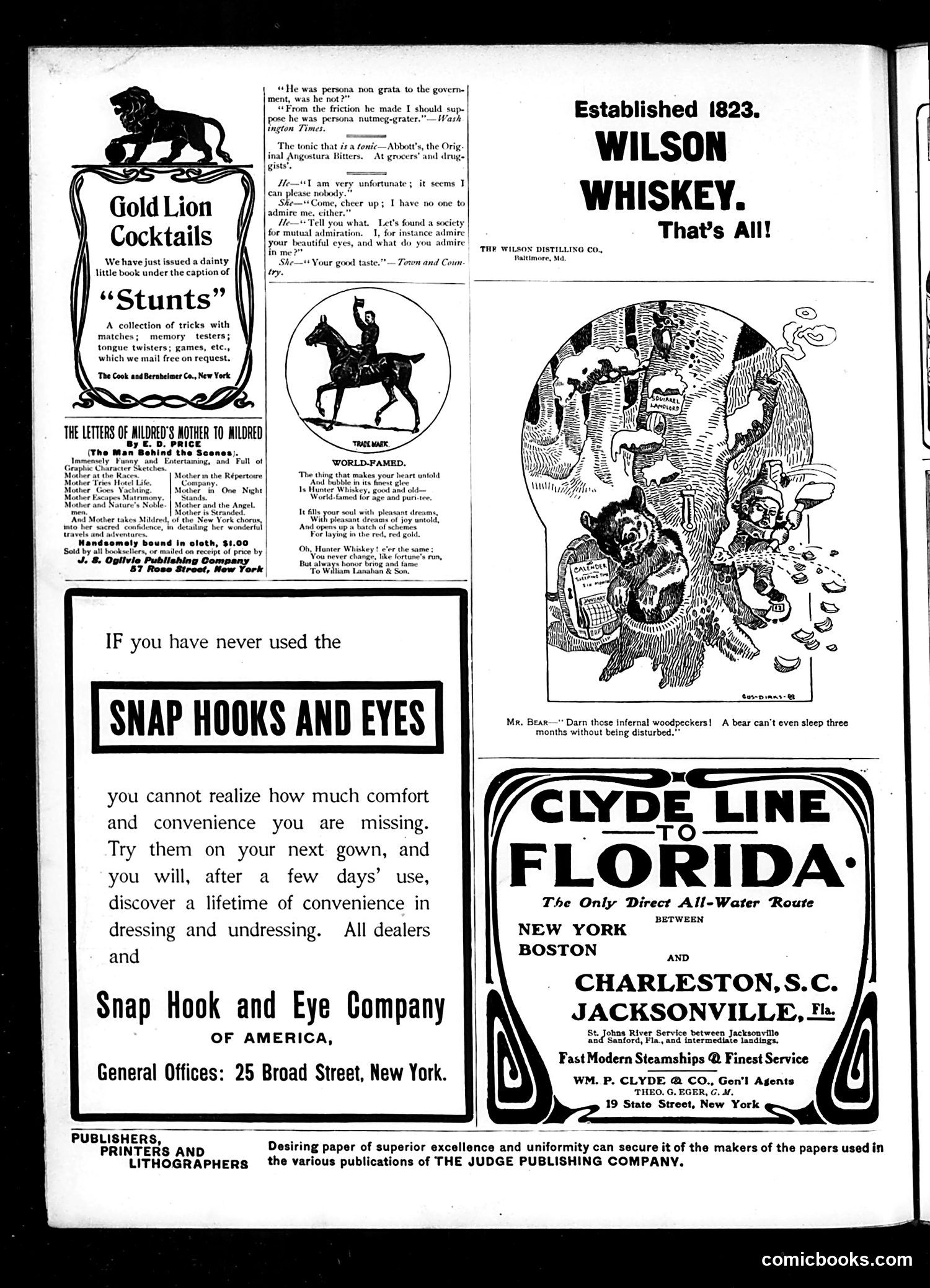
This page is primarily **advertisements** with one cartoon. The small cartoon shows a bear complaining about woodpeckers disturbing its hibernation—a simple visual gag about unwanted interruptions during winter sleep. The page features ads for various products: Wilson Whiskey (established 1823), Gold Lion Cocktails, a book of magic tricks called "Stunts," snap hooks and eyes for clothing, and the Clyde Line shipping service to Florida. There's also text about Angostura Bitters and a brief joke about someone being "persona non grata" to the government, making them as unpleasant as a "nutmeg-grater." The advertisements reflect early 20th-century consumer goods and services. No significant political or social satire is evident on this particular page—it's essentially a magazine back matter combining entertaining content with commercial promotions typical of period publications.
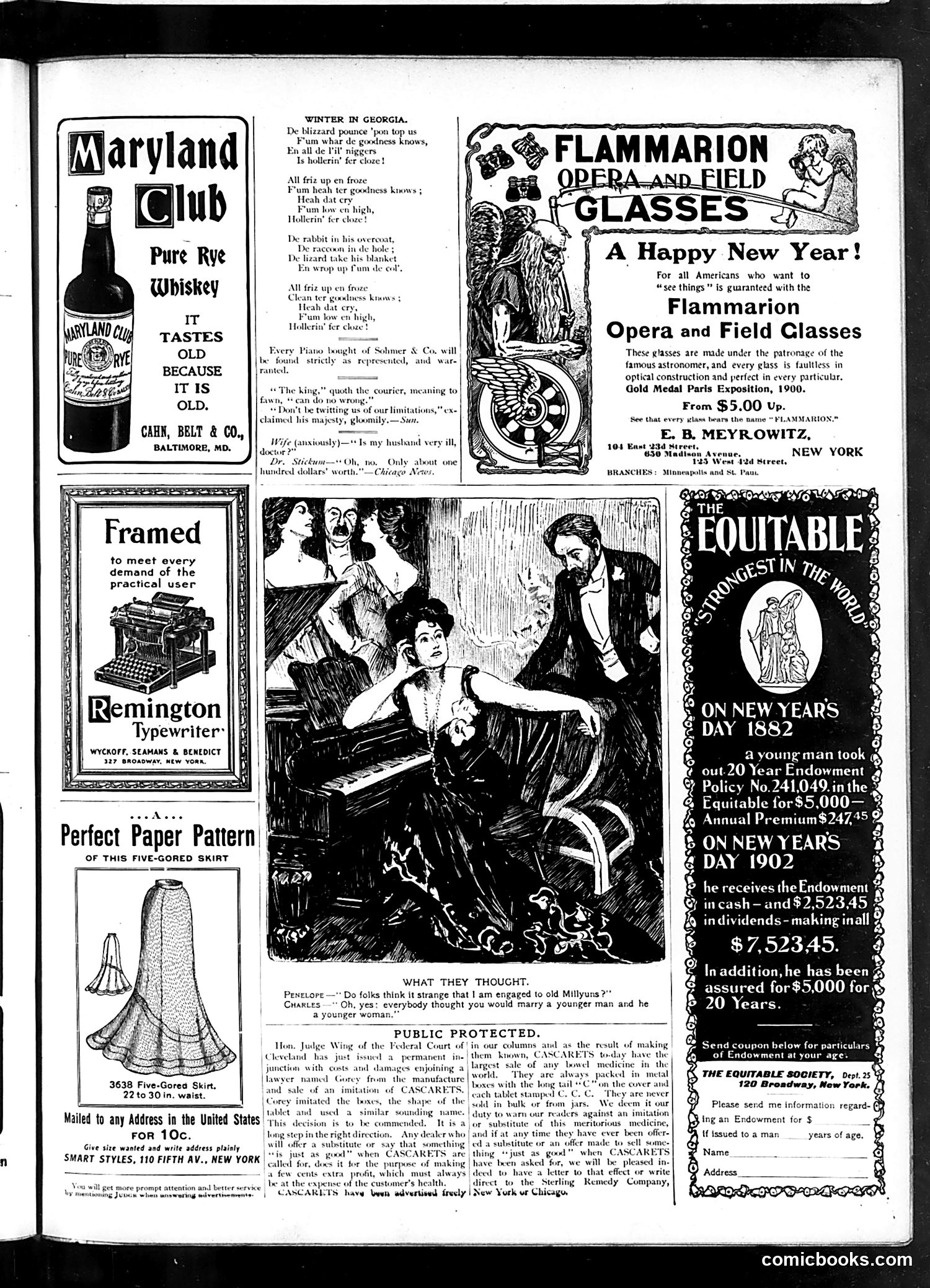
This page is primarily **advertising with one central cartoon**, typical of early 1900s magazines. ## The Main Cartoon ("What They Thought") The cartoon depicts a social satire about class and marriage. A man named Penelope announces his engagement to "old Millyuns" (a wealthy older man). The satirical point: everyone assumed Penelope would marry someone younger and wealthier, but instead chose an older rich man—and society finds this arrangement perfectly acceptable because money transcends age concerns. The joke exposes how wealth, not youth or romantic love, drives marriage decisions among the upper classes. ## Supporting Content A separate comic dialogue shows a wife asking if her husband is seriously ill; the doctor's "$100" response (likely about fees, text is unclear) suggests commentary on medical costs. The **"Winter in Georgia"** poem uses dialect humor, depicting animals bundling up against cold—a mild seasonal joke. ## Advertising The bulk of the page features period product ads: Maryland Club whiskey, Flammarion opera glasses, Remington typewriters, Equitable Life Insurance, and clothing patterns—standard commercial content for Judge's revenue.
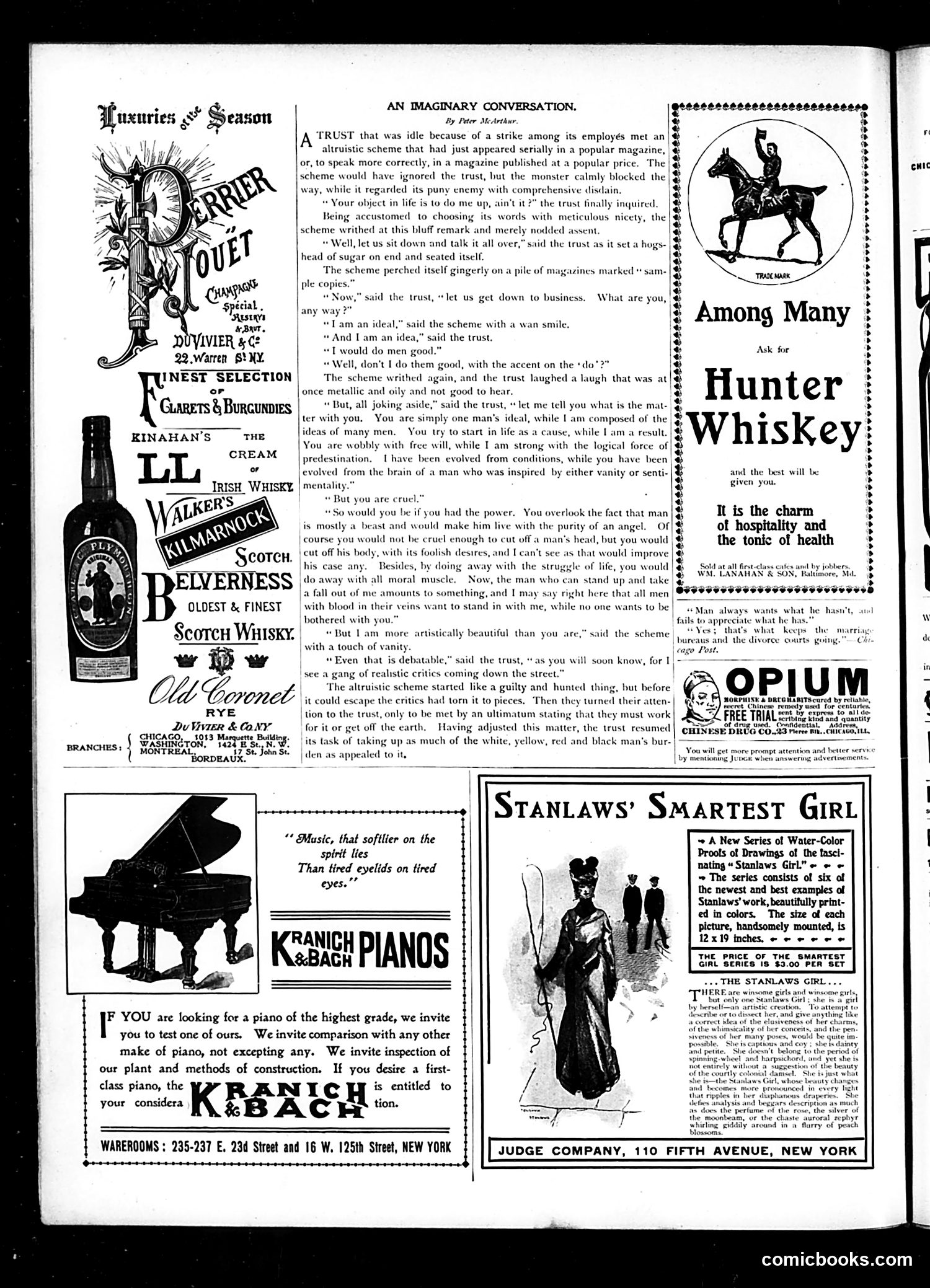
This satirical dialogue personifies a **Trust** (a large monopolistic corporation) confronting an **Altruistic Scheme** (likely a utopian reform proposal published in a popular magazine). The Trust argues its superiority through ruthless logic: it is "composed of the ideas of many men" and strengthened by "predestination," while the Scheme is merely one man's ideal, weakened by "free will." The Trust cynically claims it actually benefits workers by maintaining struggle and "moral muscle"—that removing hardship would harm them. The Scheme, appealing to beauty and idealism, cannot withstand the Trust's mockery. When "realistic critics" arrive, they destroy the Scheme utterly, then demand the Trust's workers simply accept conditions "or get off the earth." The satire targets both progressive reformers (naive and ineffectual) and capitalist monopolies (amoral and all-powerful). It suggests early-1900s labor disputes where reform movements proved powerless against entrenched corporate power.
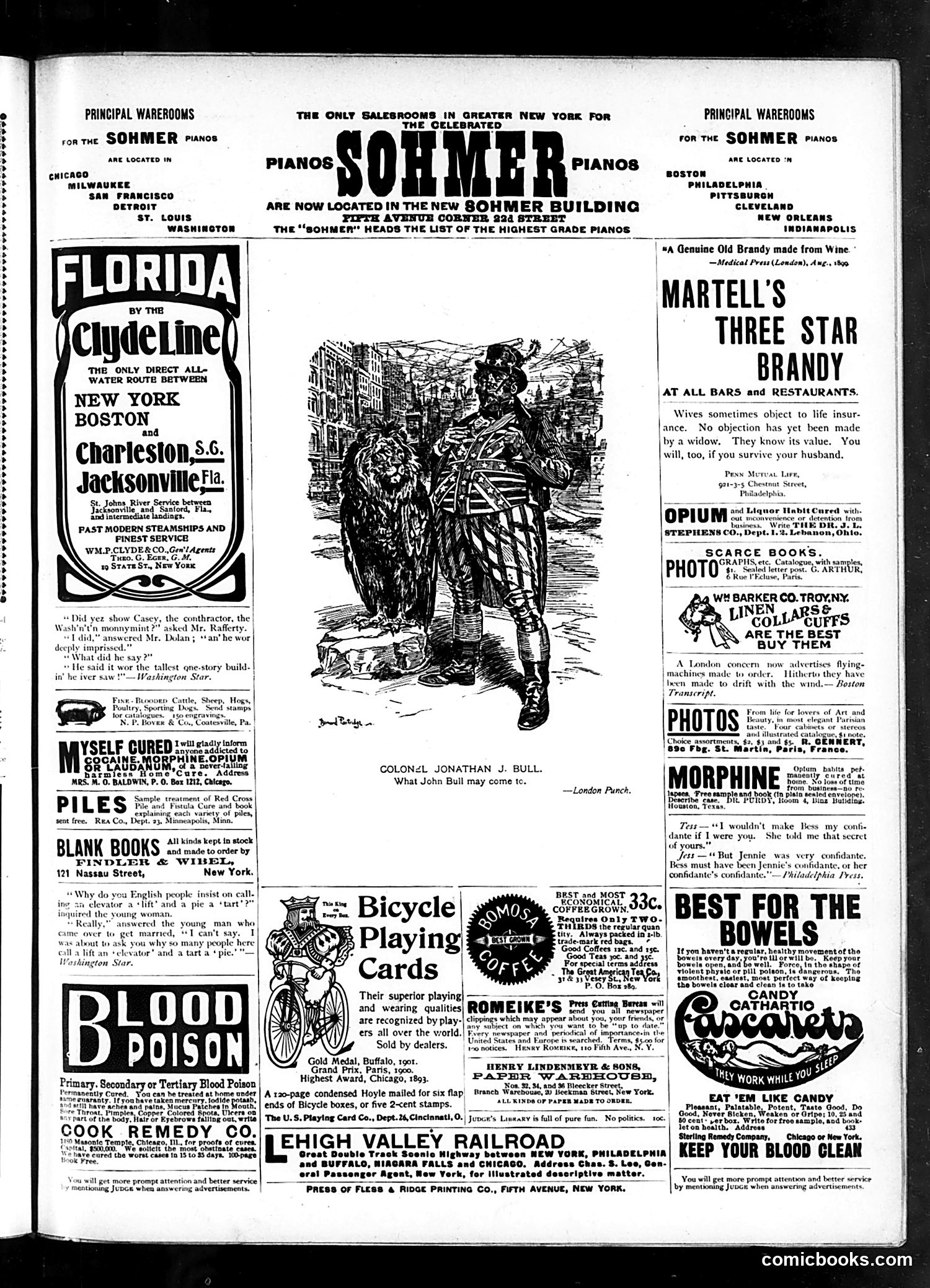
This is primarily an **advertising page** from an early 20th-century satirical magazine, not a political cartoon section. The central image—titled "Colonel Jonathan J. Bull: What John Bull May Come To" (credited to London Punch)—is the only substantial illustration. **The Image:** A skeletal, decrepit figure dressed in tattered clothing represents **John Bull**, the personification of Britain. The caption suggests this is a satire from the British Punch magazine, reprinted in Judge, mocking Britain's potential decline or weakening international standing. The exact historical reference is unclear without dating, but it likely refers to British anxieties during a period of imperial challenge. **Advertisements:** The page is dominated by ads for pianos, brandy, medicines (blood poison cures, morphine), coffee, and various patent remedies typical of the era—many making dubious health claims now recognized as quackery. The page reflects Judge's role as both satirical commentary and commercial enterprise, mixing social humor with medical/commercial advertising.
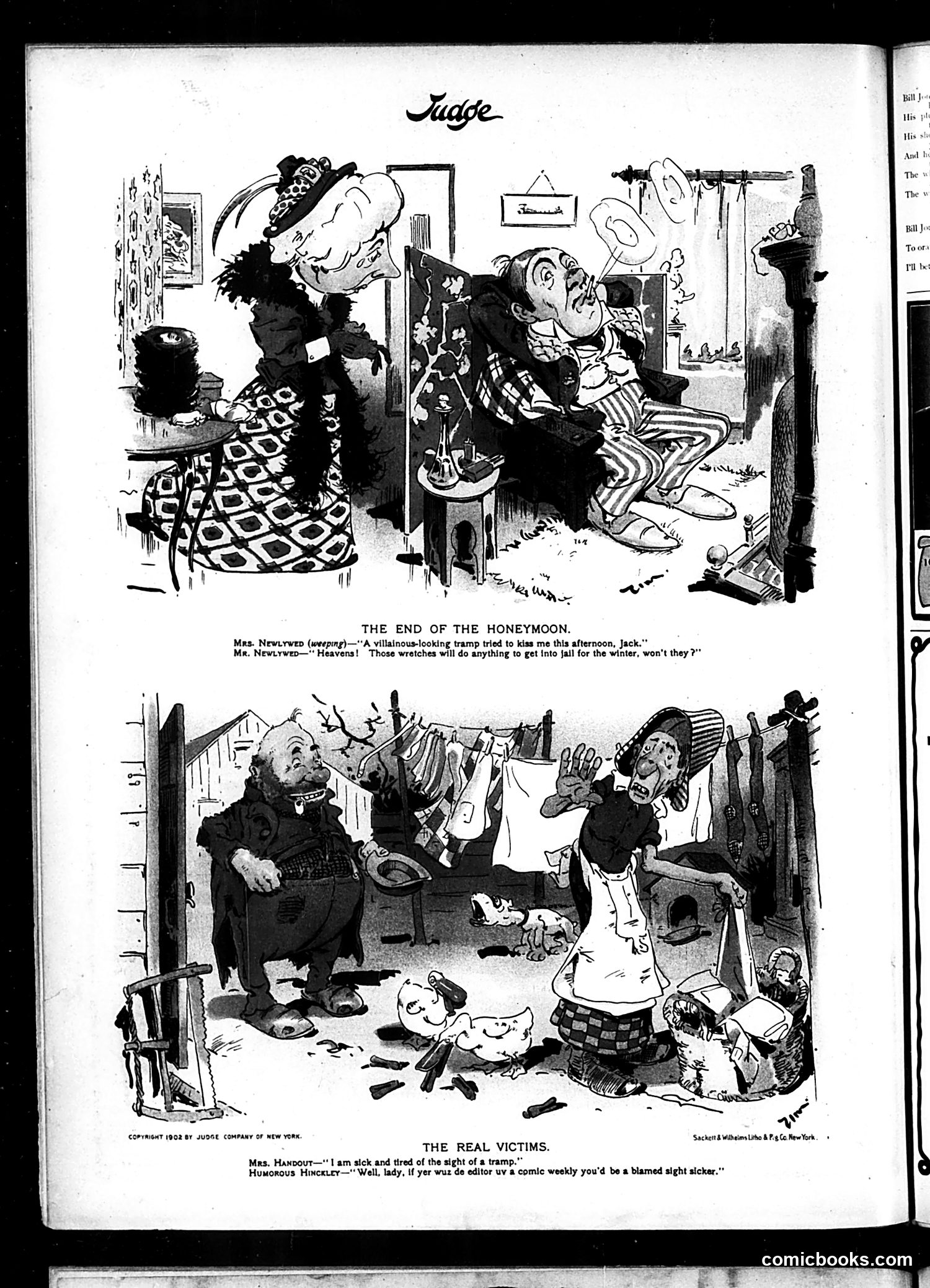
This page contains two satirical cartoons about vagrancy and homelessness in early 1900s America. **"The End of the Honeymoon"** mocks a newly married couple's naïveté. A woman reports a tramp attempted to kiss her; her husband dismissively assumes the vagrant was simply trying to get arrested for winter shelter—a common practice among homeless men seeking jail's warmth and food. The satire targets the couple's obliviousness to urban poverty. **"The Real Victims"** is meta-satire: it features "Humorous Hinckley" (likely a Judge contributor) complaining that editors of comic weeklies see tramps constantly—making them, not the homeless themselves, the real sufferers. The joke critiques how satirical magazines relentlessly mock the poor for entertainment. Together, these cartoons reveal Judge's somewhat contradictory stance: mocking both the ignorant wealthy and the homeless poor, while also self-aware about the publication's own exploitation of social misery for humor.
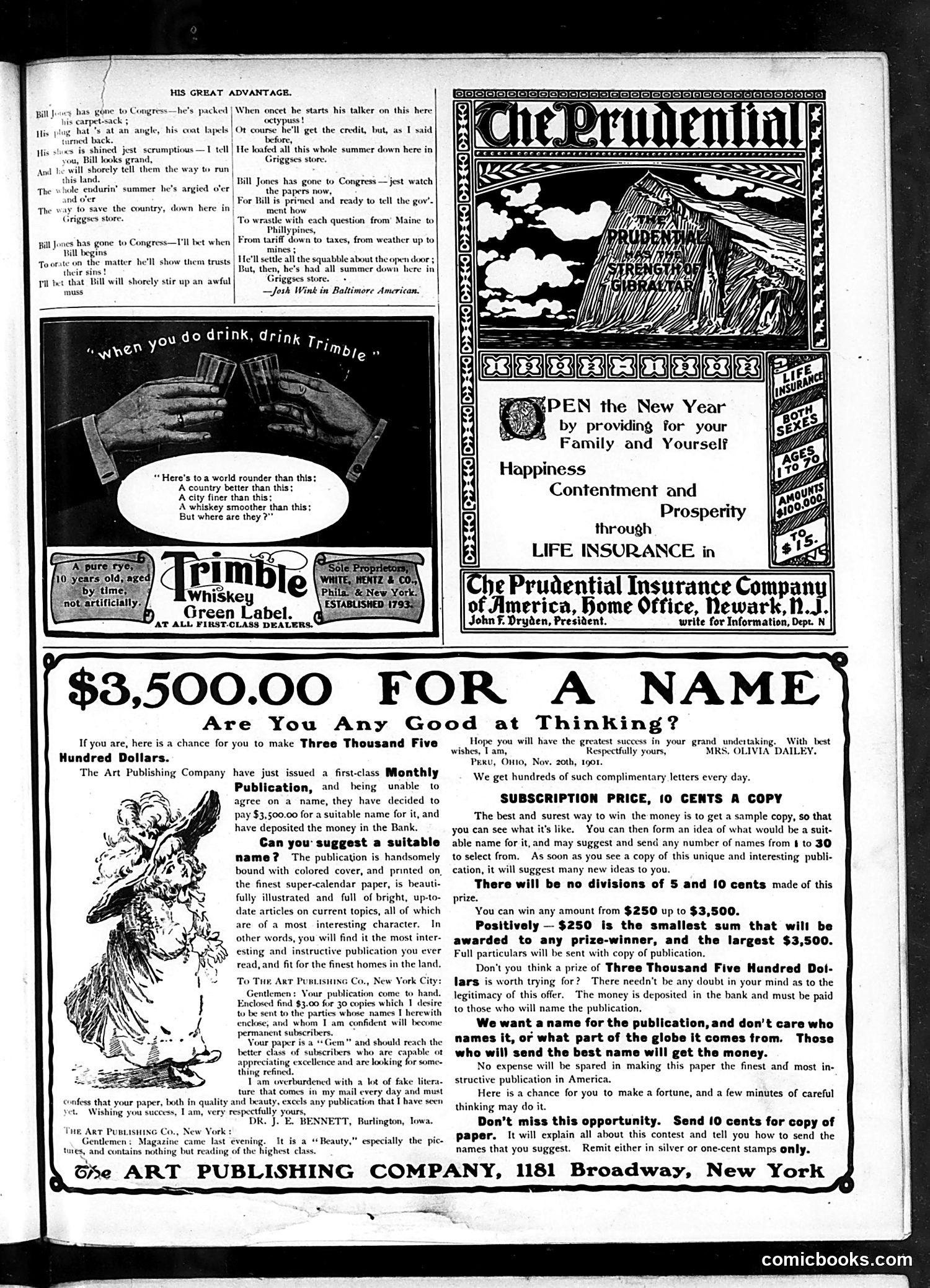
This Judge page combines satire with period advertising. The main cartoon mocks Bill Jones, a newly elected congressman from a rural area (likely Appalachia, based on dialect). The joke satirizes working-class politicians: Jones arrives in Washington with minimal sophistication ("carpet-sack," angled plug hat), having spent the summer loafing in a general store. Yet he's confidently prepared to pontificate on major national issues—tariffs, trusts, foreign policy ("the open door")—despite his obvious lack of expertise. The repeated refrain that he "loafed all this whole summer down here in Griggses store" undercuts his authority. The satire targets populist politicians who gained congressional seats through charisma rather than qualification, a common Progressive-era criticism. The accompanying Trimble Whiskey and Prudential Insurance ads are typical period magazine fillers. The large "Name That Publication" contest offering $3,500 represents early 20th-century magazine marketing schemes.
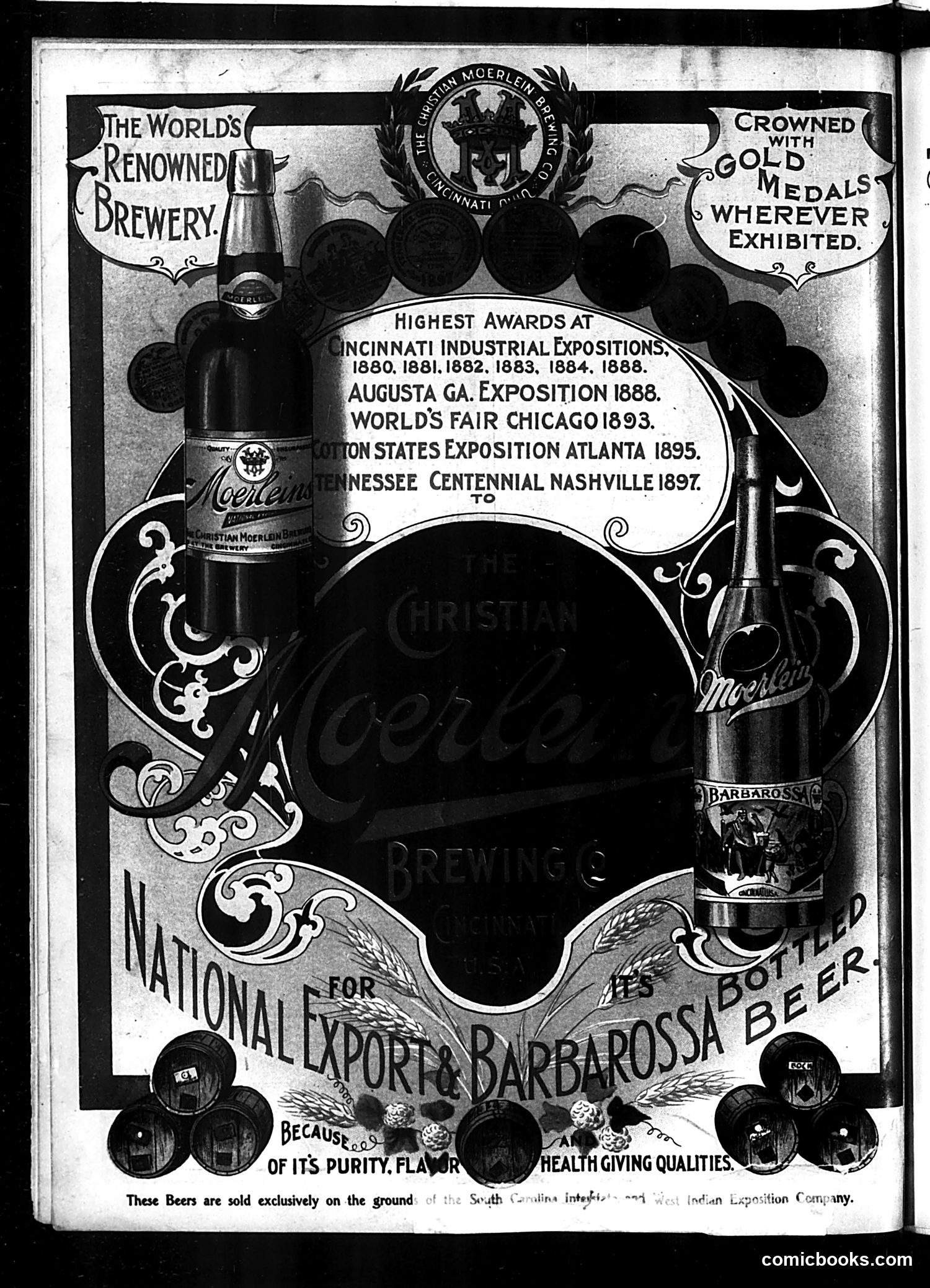
This is primarily **advertising, not satire**—a full-page promotion for Barbarossa Beer from the Christian Moerlein Brewing Company in Cincinnati. The ad emphasizes the brewery's prestige by listing major award wins at industrial expositions and the 1893 World's Fair Chicago. Decorative beer bottles frame ornate scrollwork, with medals displayed around the border. The key selling points highlighted are "purity, flavor, and health-giving qualities"—claims typical of late-19th-century beer marketing. The statement that these beers are "sold exclusively on the ground" of the South Carolina Inter-State and West Indian Exposition Company suggests this advertisement appeared during that specific exposition. For modern readers: this reflects an era when breweries promoted their products through competitive exhibition medals and health-related claims now recognized as dubious.