
A complete issue · 16 pages · 1901
Judge — December 21, 1901
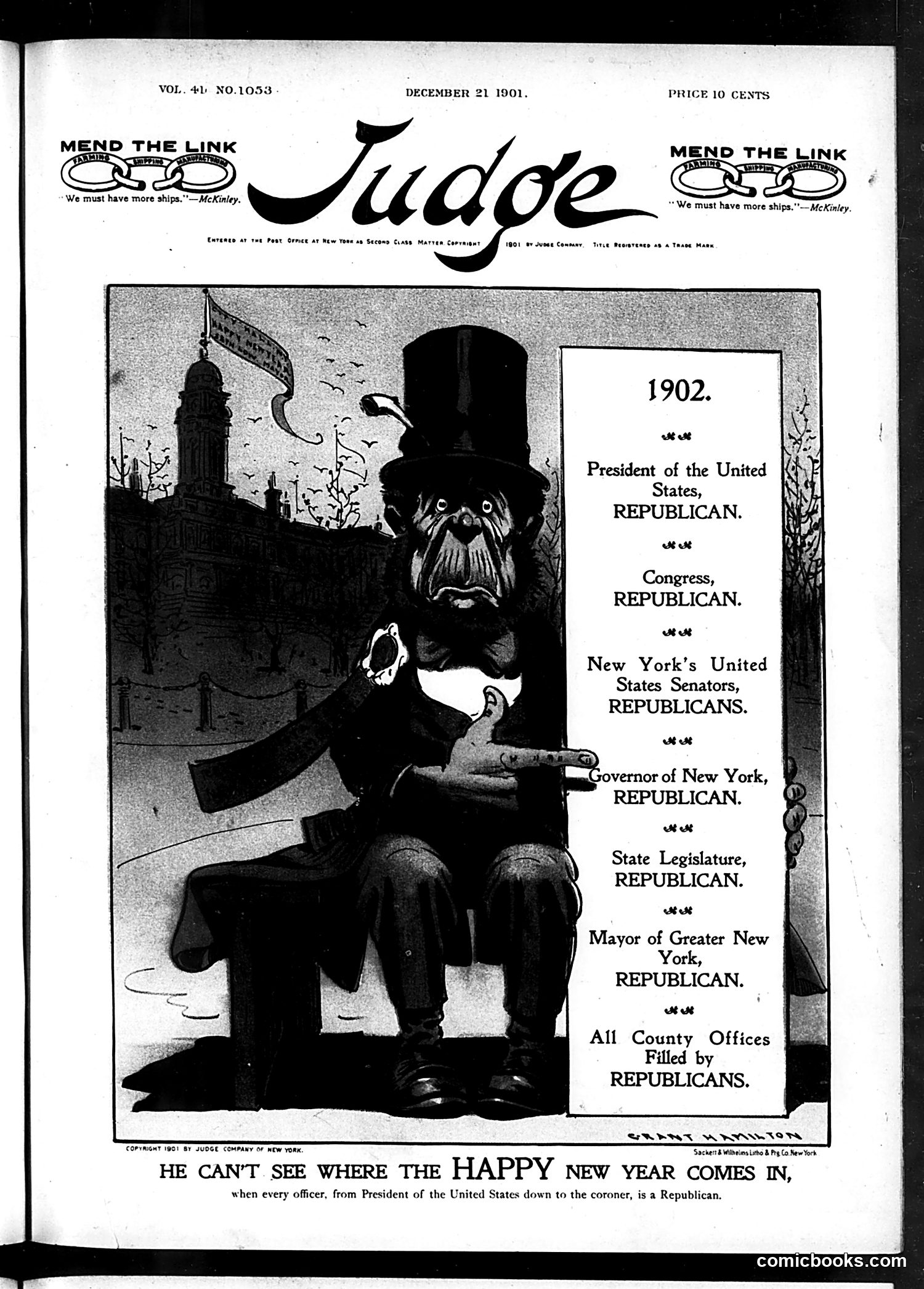
This political cartoon celebrates Republican electoral dominance in New York and nationally as 1902 approaches. The caricatured figure—appearing to be Uncle Sam or a Republican personification—sits blindfolded, holding a gun pointed at his own head. The caption reads: "HE CAN'T SEE WHERE THE HAPPY NEW YEAR COMES IN, when every officer, from President of the United States down to the coroner, is a Republican." The satire is darkly ironic: the cartoon mocks Republican success by suggesting their total control of government offices is so complete and one-sided that it's effectively self-destructive or absurd. The blindfold implies Republicans can't see potential dangers in having monopolistic political power. This reflects Democratic criticism of Republican hegemony during the McKinley era.
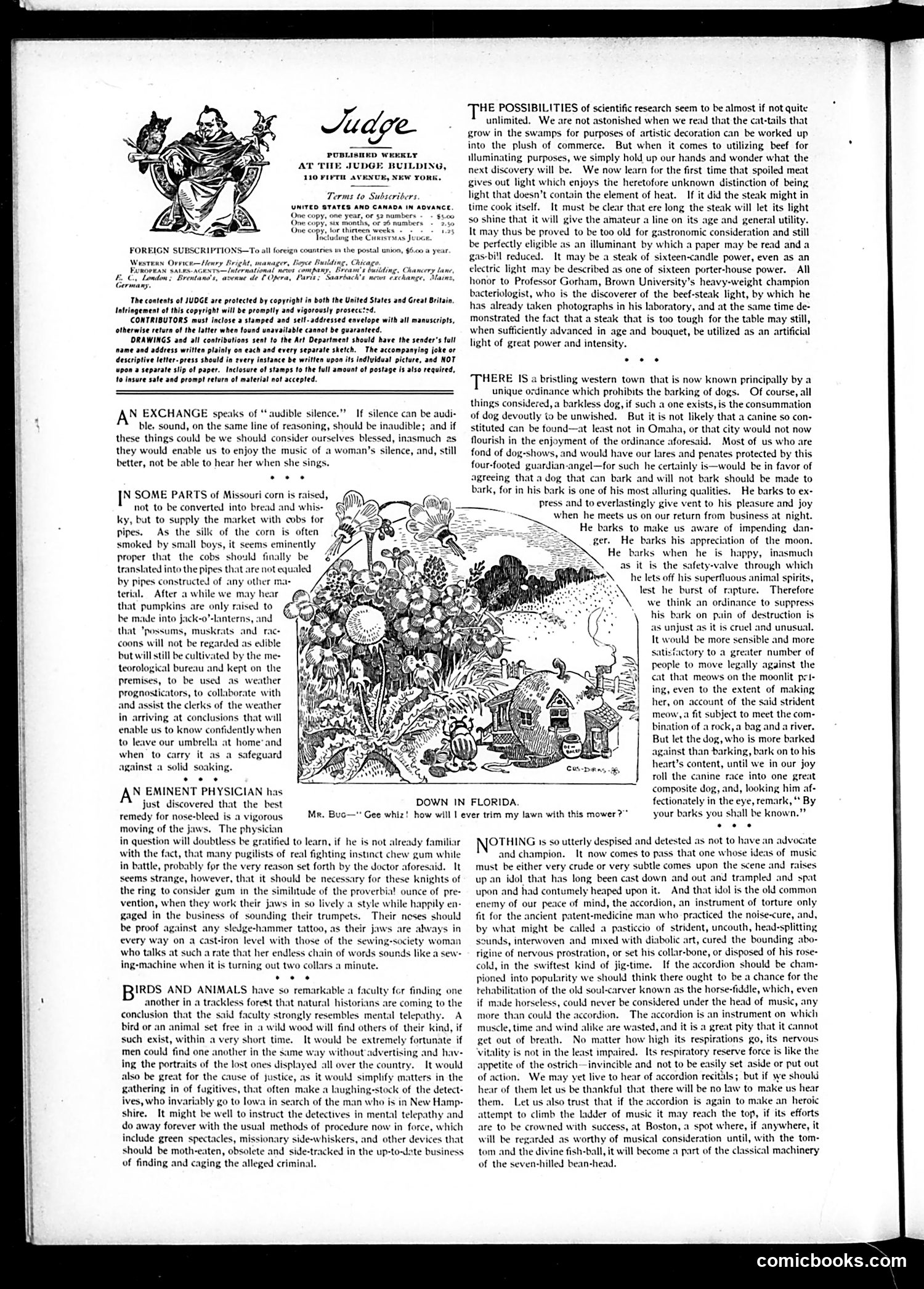
This cartoon depicts a homeowner (labeled "Mr. Bug") frustrated with lawn mowing, asking "Gee whiz! how will I ever trim my lawn with this mower?" The illustration shows an elaborate, whimsical contraption featuring various animals and mechanical devices arranged to cut grass. The satire targets Florida's notorious insect problem—particularly mosquitoes and other pests—by suggesting that managing a Florida lawn requires an absurdly complex, fantastical apparatus. The joke exploits the common complaint that Florida's climate and wildlife make basic lawn care nearly impossible. The cartoon humorously implies that conventional mowers are inadequate for Florida conditions, requiring instead this elaborate, impractical invention to deal with the state's pest-ridden landscape.
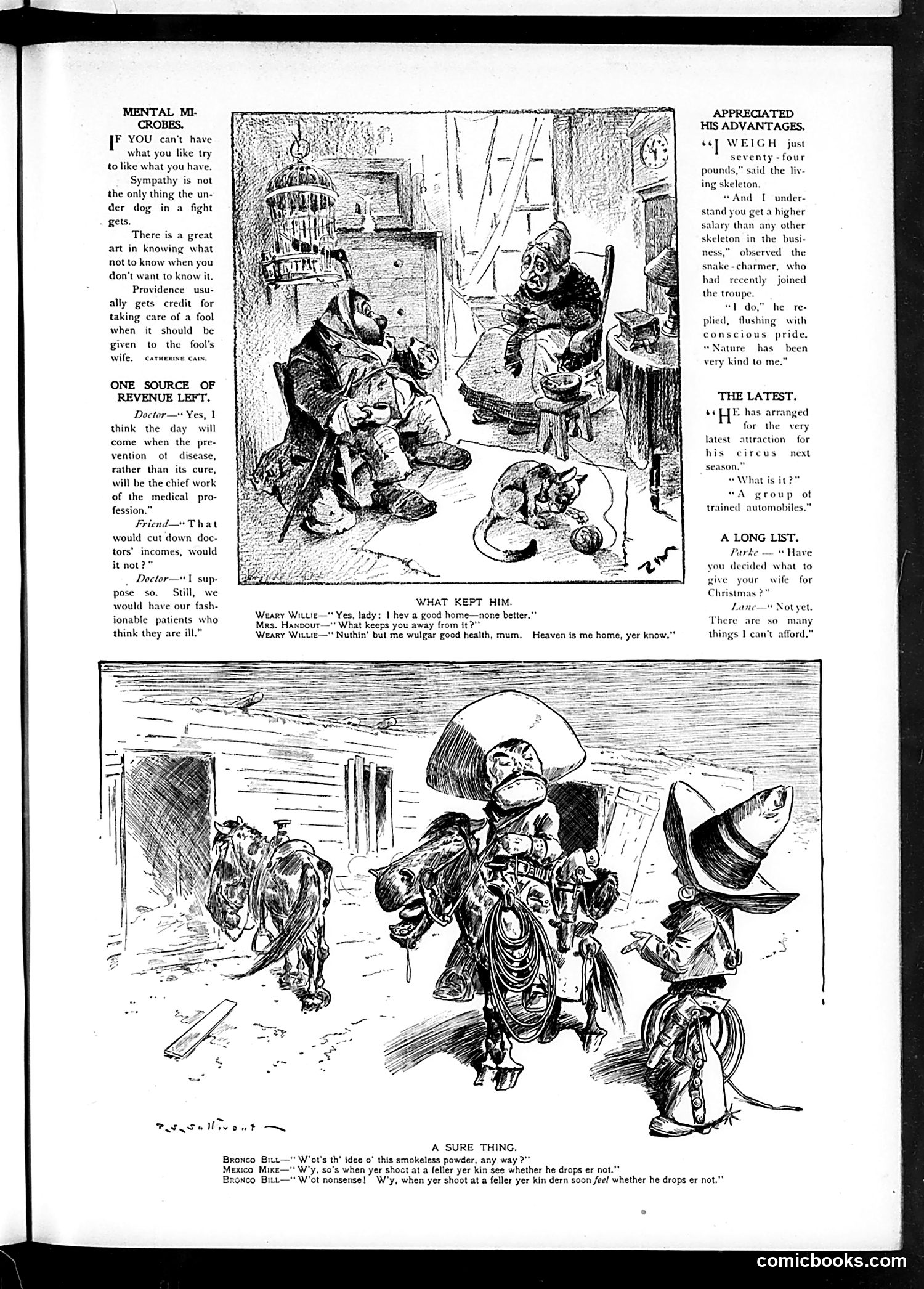
This page contains two satirical cartoons and accompanying text commentary. The upper cartoon, titled "What Kept Him," depicts circus performers and appears to mock someone's health claims. The caption references "Mrs. Hascourt" and "Weary Willie," suggesting commentary on a specific public figure's claims about maintaining vigor through some treatment or lifestyle choice. The lower cartoon, "A Sure Thing," shows men in cowboy attire with horses and firearms, likely satirizing the "Smokeless Powder" debate mentioned in the dialogue below. The text references "Bronco Bill" and discusses shooting accuracy and powder effectiveness—possibly critiquing claims about a new military or commercial powder technology popular at the time. Both cartoons employ exaggerated caricature typical of Judge's satirical style, though the specific individuals and events referenced are unclear without additional historical context.
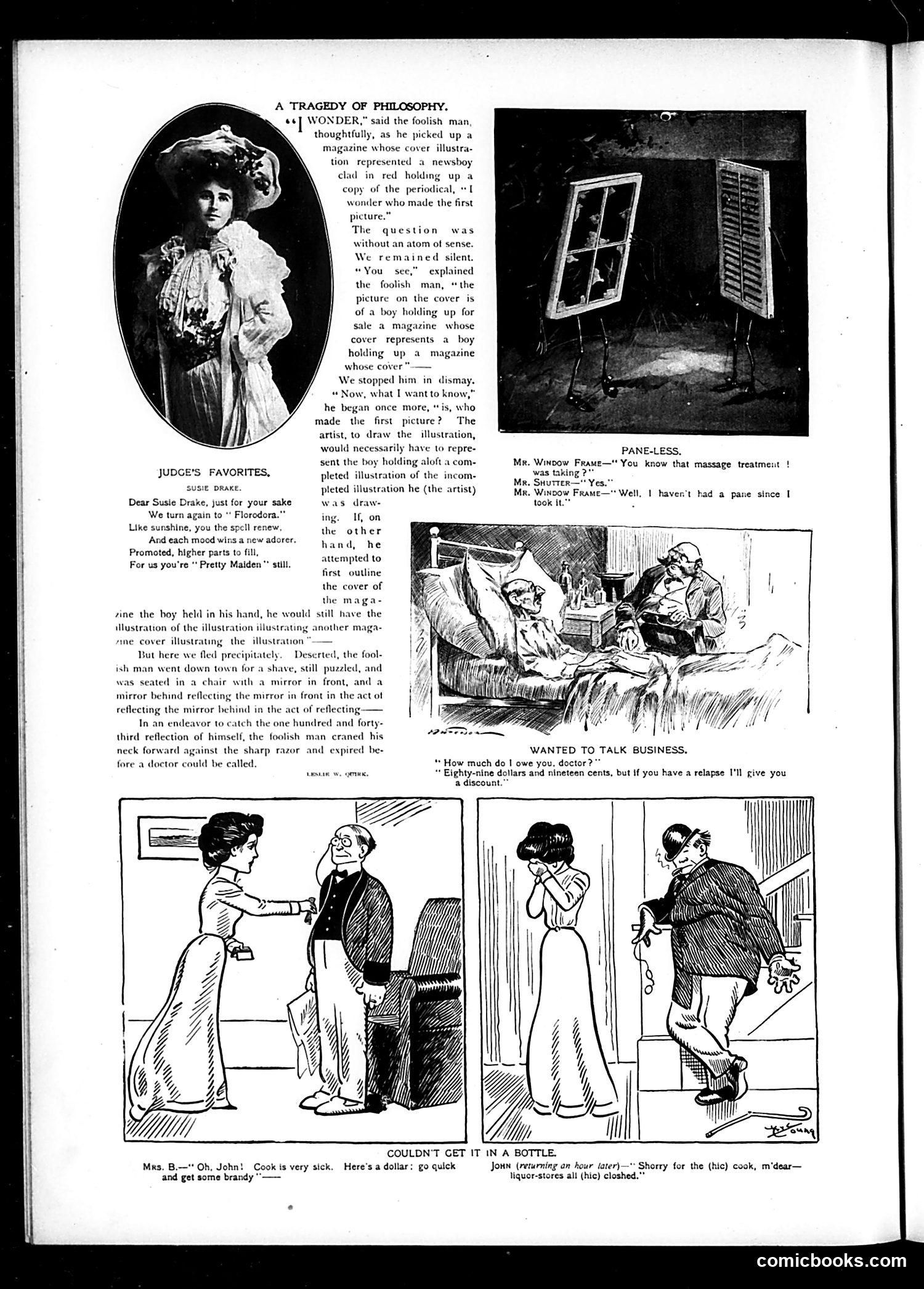
This page contains three distinct pieces of humor: **"A Tragedy of Philosophy"** mocks artistic pretension through an infinite-regress joke: a foolish man questions who drew the first magazine cover illustration (a boy holding a magazine). The artist must have drawn a boy holding a magazine with a cover showing a boy holding a magazine—endlessly. The satire critiques overthinking and philosophical absurdity. **"Judge's Favorites"** is poetry praising actress Susie Drake and the theatrical production "Florodora." **"Couldn't Get It in a Bottle"** and **"Wanted to Talk Business"** are brief comic strips about domestic situations—a sick cook and a doctor's fee negotiation—depicting everyday middle-class life and humor without specific political commentary.
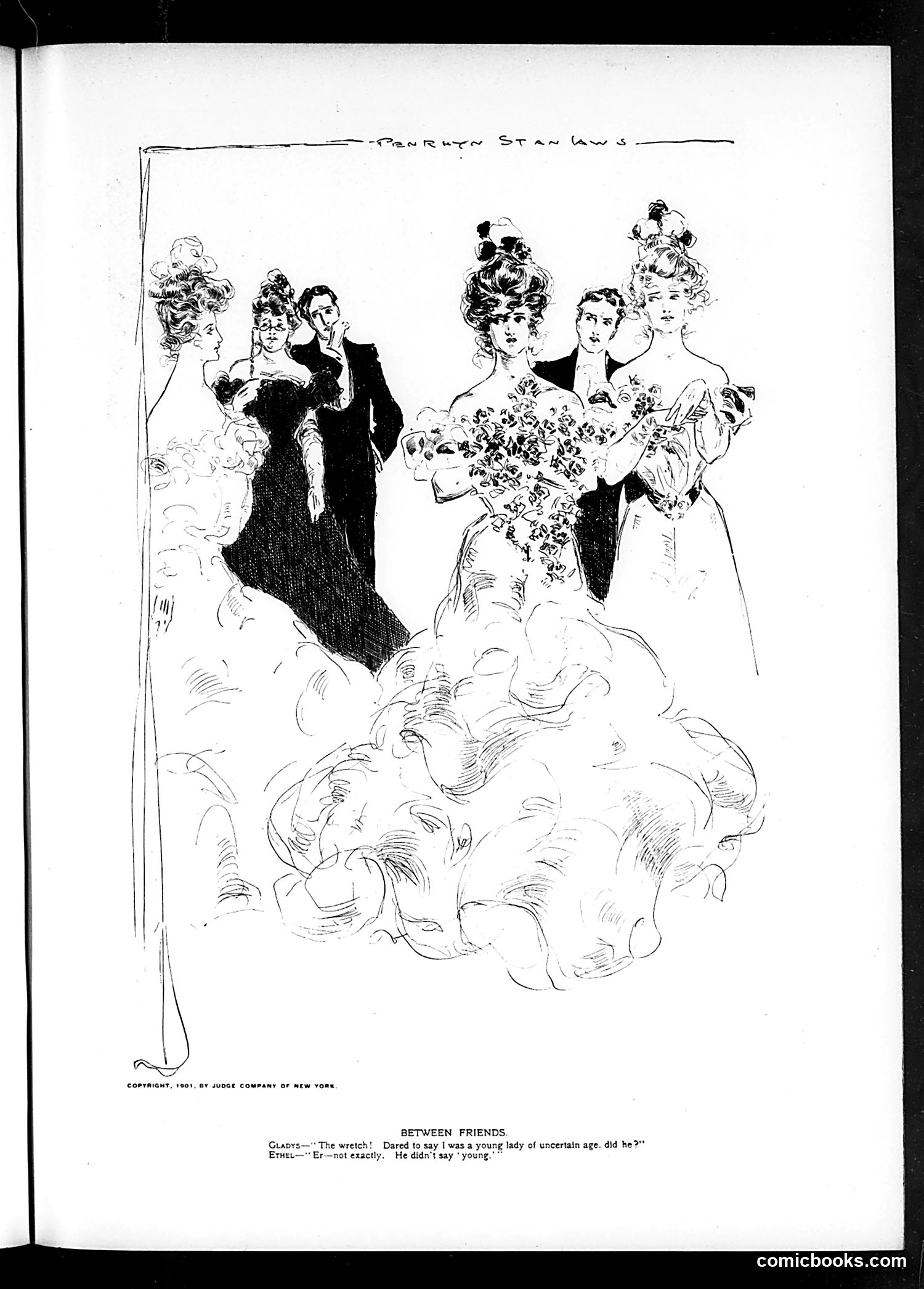
This is a conversational joke cartoon about vanity and aging. Two fashionable women discuss an insult: one (Gladys) complains that a man called her "a young lady of uncertain age." Her friend Ethel delivers the punchline—revealing the real offense wasn't the "uncertain age" part, but that he notably *omitted* calling her "young" at all, implying she's clearly middle-aged or older. The cartoon satirizes women's sensitivity about aging and appearance, a recurring theme in turn-of-the-century humor. The elaborate clothing and hairstyles shown emphasize the characters' concern with feminine presentation and youth. The joke relies on the audience understanding that being denied "young lady" status was a genuine social slight for women of this era.
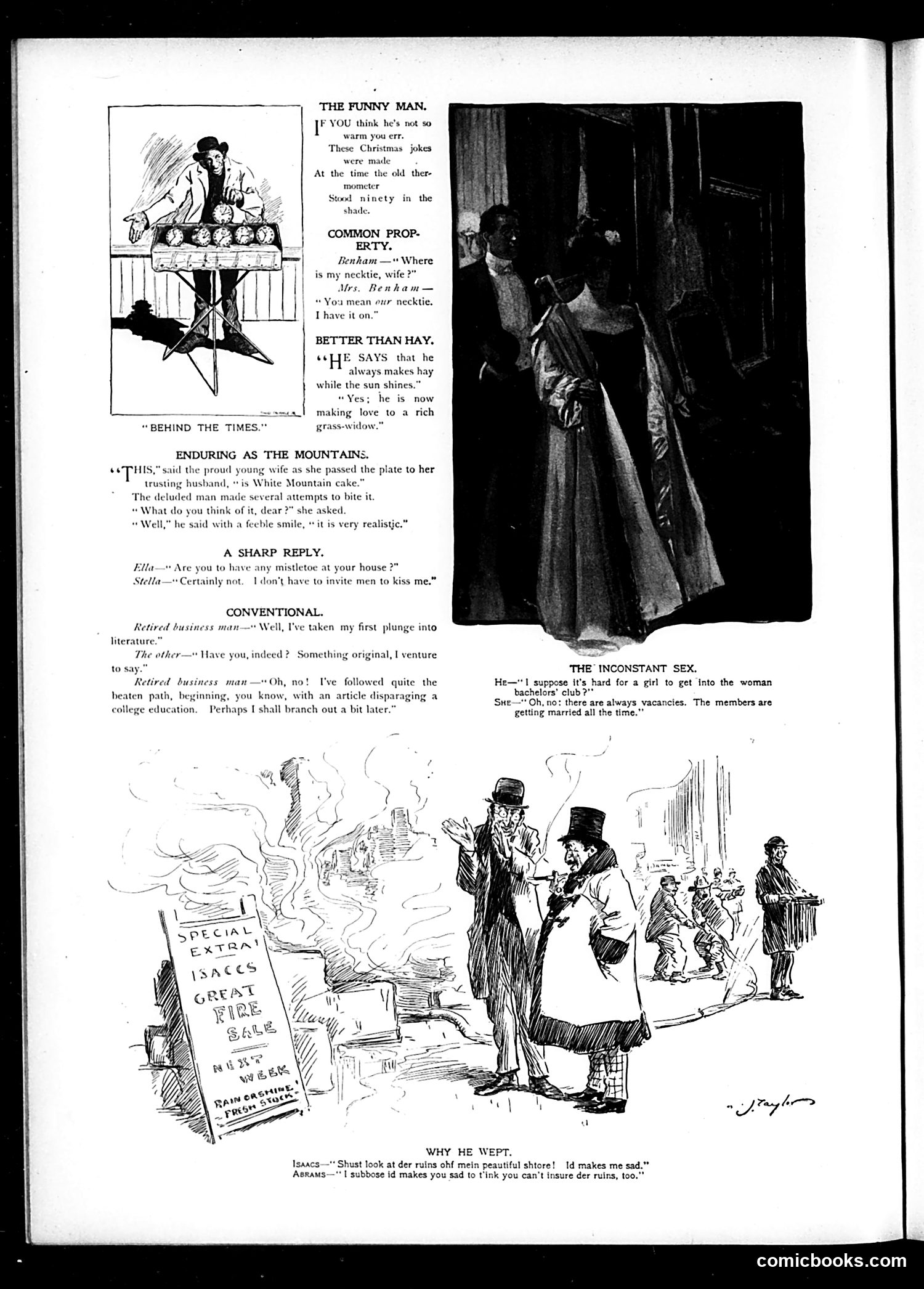
This page collects short jokes and comic sketches typical of early 20th-century American humor magazines. Key themes include: **Marriage & Gender Comedy**: Multiple jokes mock domestic life—wives claiming ownership of husbands' belongings ("our necktie"), women's inconsistency in relationships ("The Inconstant Sex"), and rigid gender roles. The "bachelors' club" joke satirizes women's tendency to marry. **Social Climbing**: Jokes target the newly wealthy (making love to a "grass-widow") and retired businessmen following conventional literary paths (disparaging college education). **Ethnic Stereotypes**: The bottom cartoon features exaggerated Yiddish-accented Jewish characters ("Isaacs" and "Abrams"), with one implying an insurance fraud setup after his store burns—reflecting period antisemitic tropes about Jewish dishonesty. **The Humor**: Generally relies on wordplay, marital tension, and social observation typical of era. The White Mountain cake joke plays on "realistic" (inedible) cooking. The overall tone reflects comfortable middle-class perspectives mocking outsiders and domestic partners.
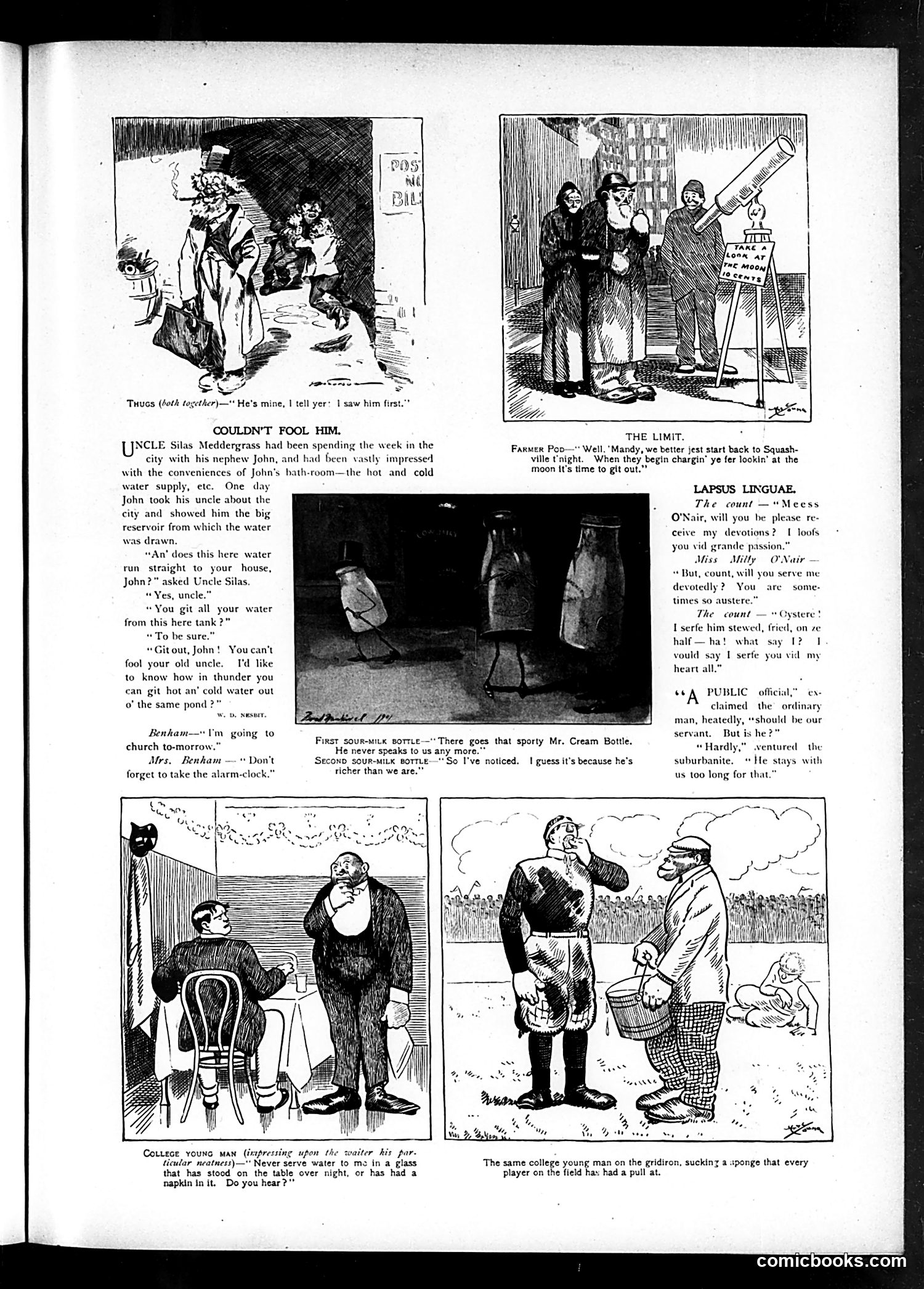
This page contains several short satirical pieces typical of early 20th-century American humor: **"Couldn't Fool Him"**: A rural uncle visiting the city is shown a reservoir and asks how one tank produces both hot and cold water—he suspects his nephew is lying. The joke satirizes rural simplicity and the disconnect between country folk and urban infrastructure. **"The Limit"**: Two farmers worry about rising charges at a resort, suggesting class anxiety about leisure costs becoming unaffordable. **"Lapsus Linguae"** ("Slip of the Tongue"): A foreign count's broken English creates double meanings in a romantic exchange—typical humor mocking both immigrant accents and courtship pretense. **Other sketches**: Include jokes about servants' behavior, public officials being unhelpful, and a college athlete drinking from a sponge during sports. The overall tone reflects turn-of-the-century American attitudes: gentle mockery of rural naiveté, immigrant English, class differences, and institutional inefficiency. The artwork uses clear line drawings typical of Judge's style.
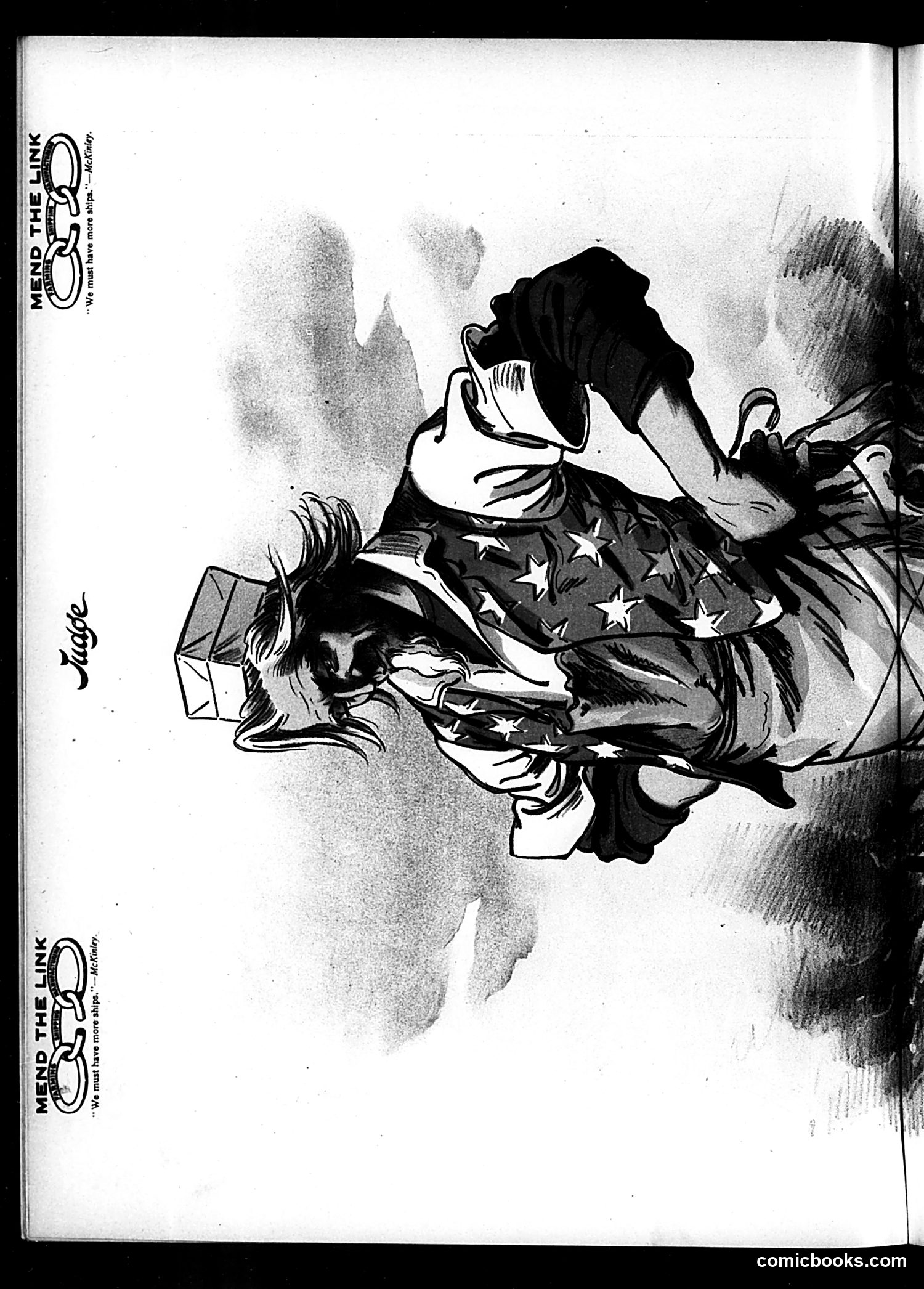
This appears to be a satirical cartoon from *Judge* magazine featuring an Uncle Sam figure (identifiable by the stars-and-stripes clothing and characteristic appearance) in a distressed or compromised position, surrounded by shadowy figures or influences. The OCR text is too corrupted to read reliably, making it difficult to identify the specific political issue or moment being lampooned. However, the imagery suggests commentary on American political corruption, foreign influence, or internal threats to the nation—common *Judge* themes during the late 19th/early 20th centuries. Without legible text or a visible date, I cannot confidently specify which political crisis, scandal, or international event this references. The cartoon's satirical point concerns threats to American sovereignty or integrity, but the precise target remains unclear from this image alone.
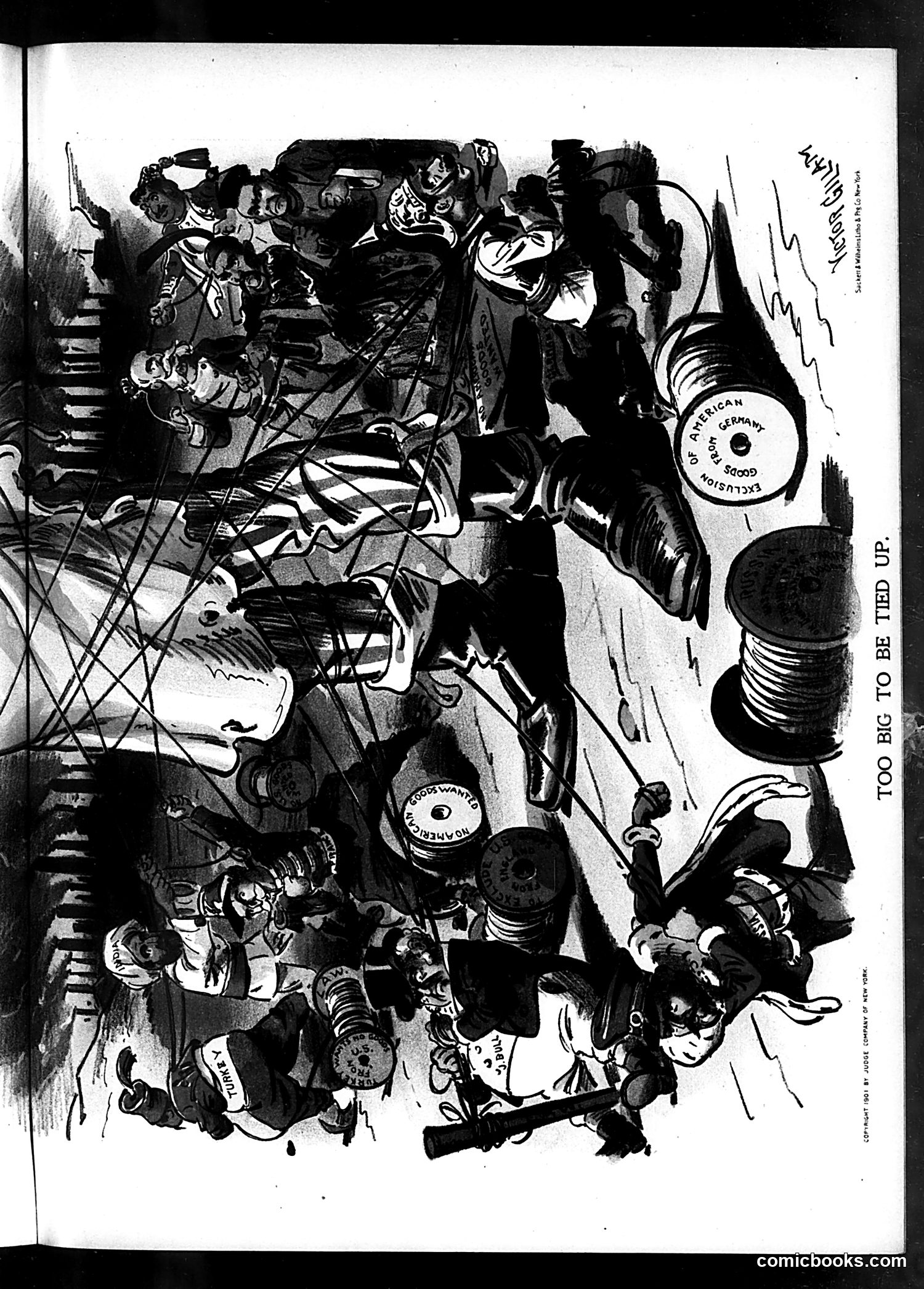
This page appears to be from an issue of *Judge* magazine, but the OCR text is largely unreadable—consisting mainly of formatting characters and website attribution. The political cartoon itself, viewed upside-down as presented, depicts a chaotic scene with multiple figures engaged in what appears to be a struggle or conflict. Various product cans and containers are visible (suggesting commercial/consumer goods), and the illustration style is characteristic of early-to-mid 20th century American satirical cartooning. The caption reads "TOO BIG TO BE TIED UP," which suggests commentary on monopolies, corporate power, or unwieldy institutions that are too large to control or regulate. **Without clearer text or date information, I cannot identify the specific political figures, events, or historical context this cartoon references.**
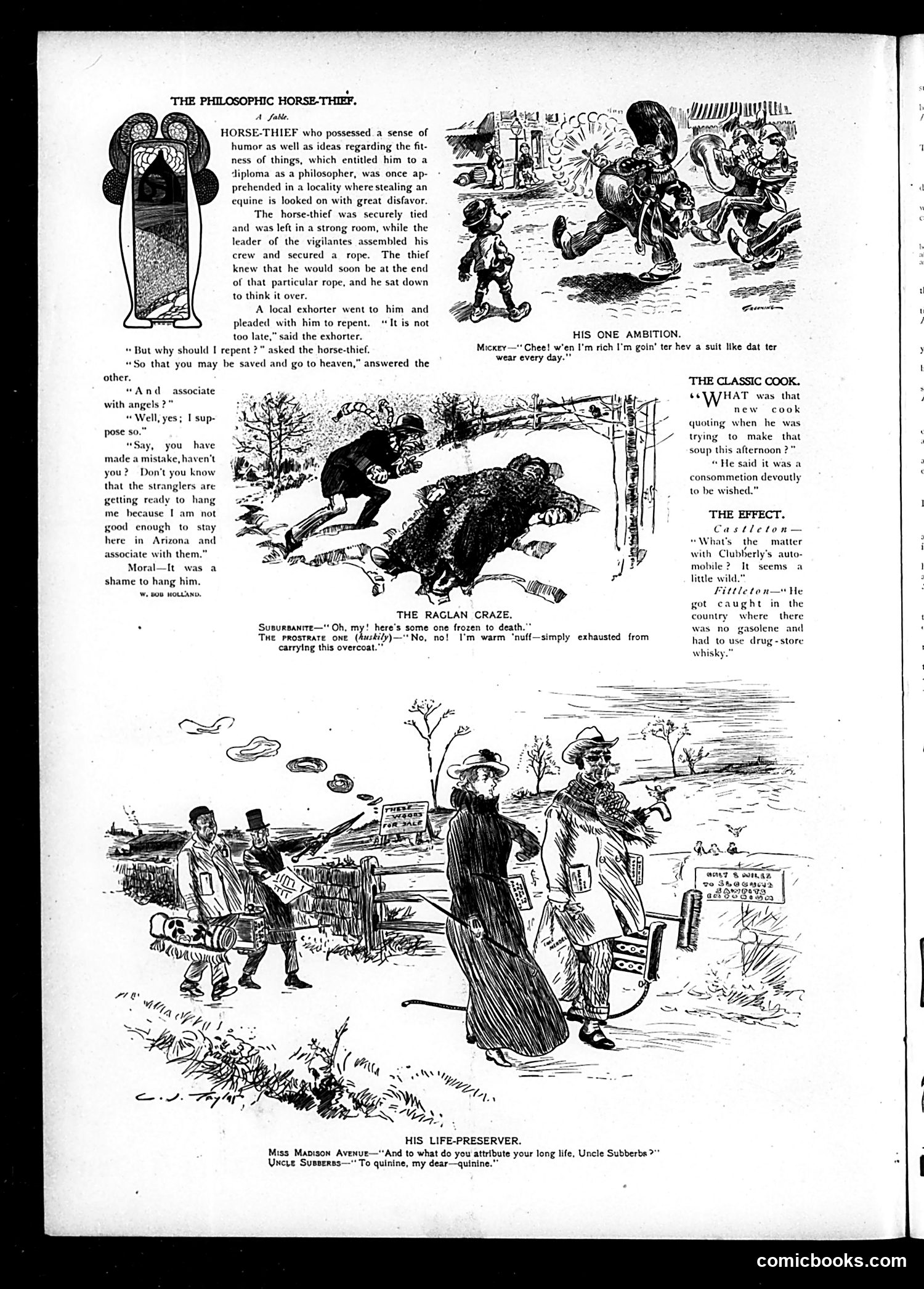
This page from *Judge* contains four brief humorous sketches: **"The Philosophic Horse-Thief"** mocks both vigilante justice and religious hypocrisy. A condemned horse thief facing lynching refuses a preacher's deathbed repentance plea, reasoning he's unfit to associate with angels anyway—just as he's unfit for Arizona society. The satire suggests the preacher's morality is as selective as the thief's. **"His One Ambition"** depicts a poor boy (Mickey) coveting a fancy suit, satirizing working-class aspiration and materialism. **"The Classic Cook"** jokes about a cook's malapropism, confusing "consommé" with "consumption" (tuberculosis). **"His Life-Preserver"** shows Uncle Subberbs attributing his longevity to quinine—likely satirizing patent medicine dependency among the elderly. The cartoons exemplify *Judge*'s formula: lightweight social satire targeting hypocrisy, class pretension, and contemporary absurdities. The tone is gentle mockery rather than sharp political critique.
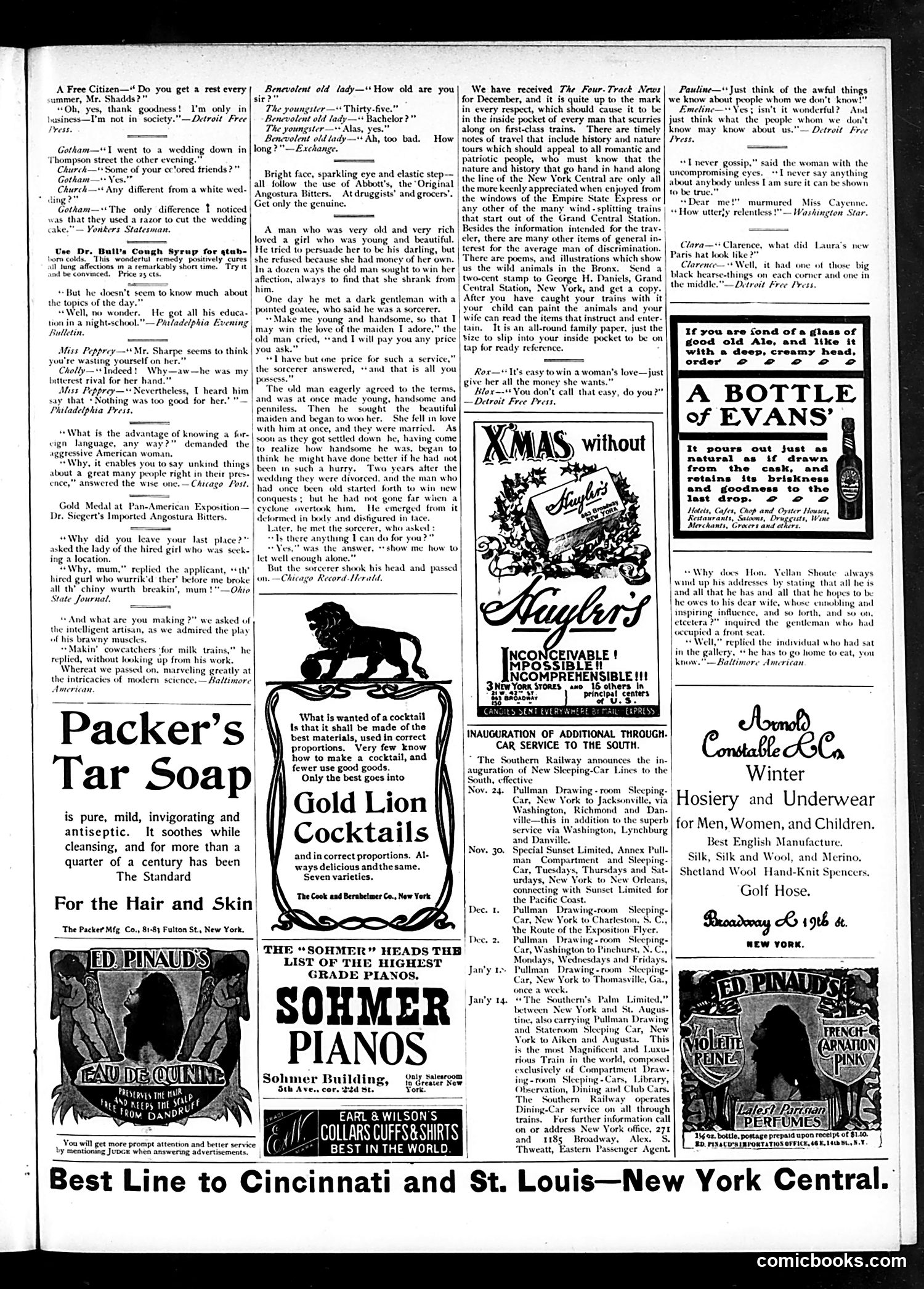
This is primarily an **advertising page** with scattered short humorous anecdotes typical of Judge magazine's format. The satirical jokes employ **racial stereotypes** common to early 20th-century American humor—now offensive. One anecdote jokes about a Black wedding, another mocks an immigrant domestic servant's speech patterns. These reflect period prejudices without deeper political commentary. The remaining humor addresses **class anxiety and gender dynamics**: jokes about night-school education, young women rejecting wealthy suitors for love, and a morality tale about a man who magically becomes young and handsome, only to learn that genuine character matters more than appearance. The page is dominated by **product advertisements** (Packer's Tar Soap, Sohmer Pianos, Dr. Bull's Cough Syrup) interspersed with these brief jokes—typical magazine layout of this era. No specific political figures or events are referenced. The content reflects popular anxieties about social mobility, courtship, and immigrant labor rather than electoral politics.
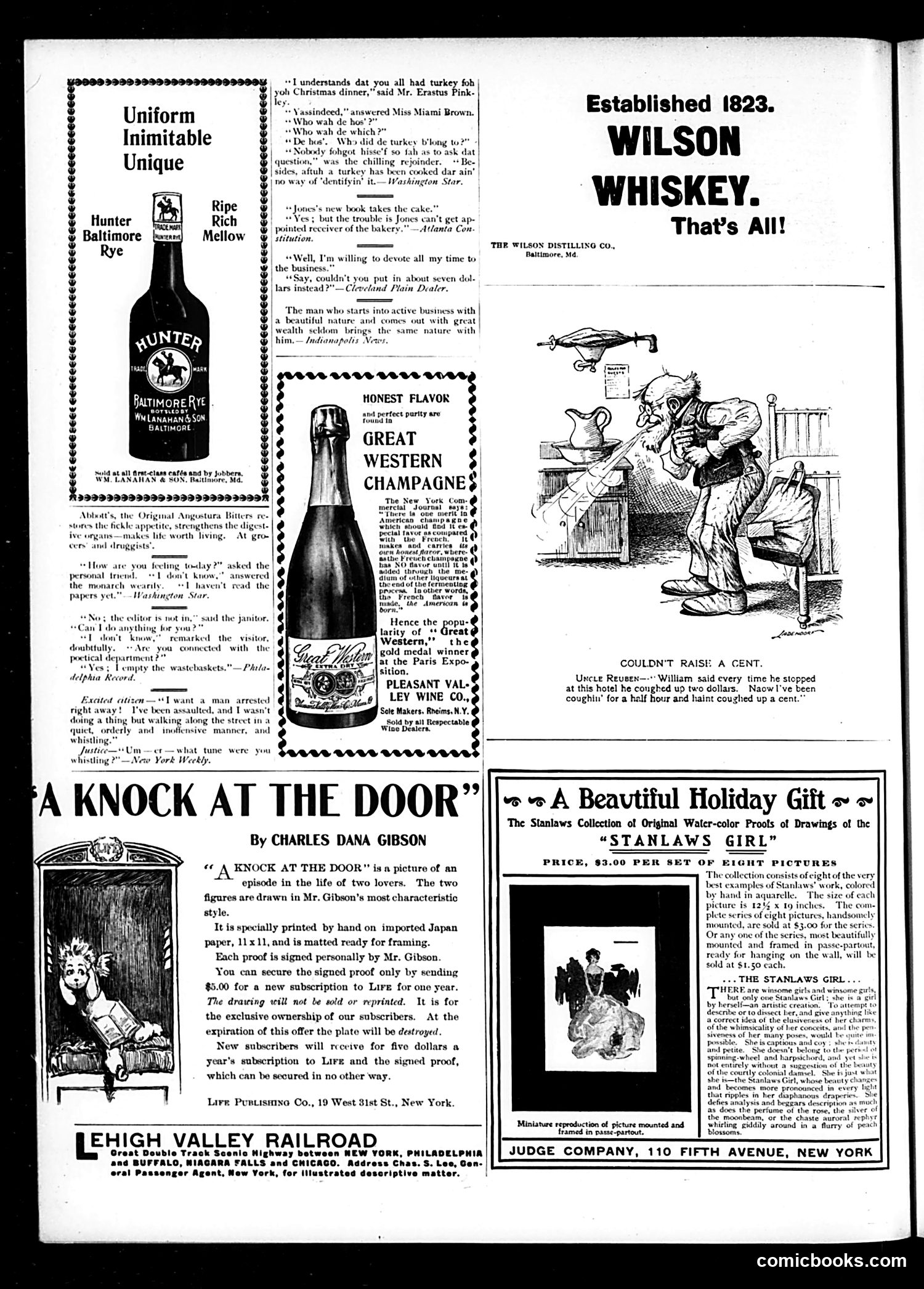
This page is primarily **advertising and light humor** rather than political satire. The content includes: **Main features:** - Multiple liquor advertisements (Wilson Whiskey, Hunter Baltimore Rye, Great Western Champagnes, Abbott's Bitters) - Charles Dana Gibson's "A Knock at the Door"—a romantic illustration available as a subscription bonus to *Life* magazine - The Stanlaws Girl collection advertisement **Humor content:** Brief jokes scattered throughout, including: - A dialogue about turkey at Christmas dinner (racial dialect humor typical of the era) - Office worker jokes about business and bakeries - Hotel guest humor about coughing up payment ("couldn't raise a cent") These are generic, non-political jokes common to humor magazines of this period. The page reflects early 20th-century advertising and entertainment conventions rather than social commentary. The Gibson illustration was a prominent feature—Gibson's "Gibson Girl" drawings were extremely popular at the time.
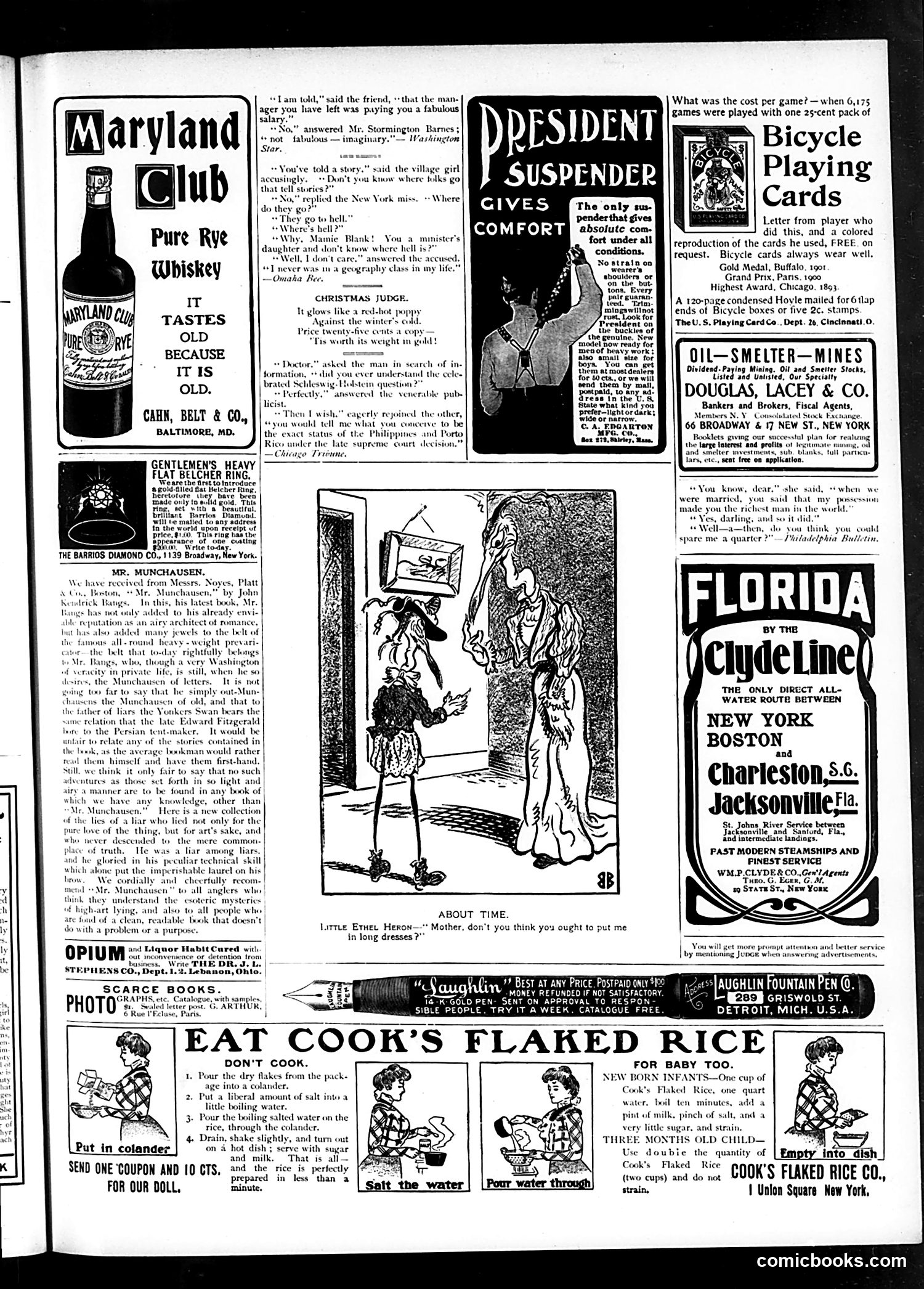
This page from *Judge* magazine is primarily **advertising and humor pieces** rather than political cartooning. The main cartoon ("About Time") shows a child asking her mother why she must wear long dresses—a gentle jab at restrictive Victorian fashion conventions that confined young girls. The text includes several humorous anecdotes mocking exaggeration and tall tales, including a commentary on author John Kendrick Bangs' book "Mr. Munchausen," comparing his fictional lying to the legendary Baron Munchausen. The jokes play on social awkwardness (a minister's daughter unfamiliar with hell) and romantic disappointment (a wife whose dowry made a man rich, now suggesting he return it). The bulk of the page consists of period advertisements for whiskey, jewelry, playing cards, steamship lines, and mining stocks—typical *Judge* revenue sources. There is **no substantial political satire** visible on this particular page.
This page is primarily **advertising copy** for Judge magazine's special Christmas issue, not a political cartoon. The text is a playful, hyperbolic promotion using elaborate metaphors to describe the publication's contents. **What it claims to contain:** - Christmas-themed jokes, poems, and stories - Illustrations of attractive women ("pretty girls") - Various comedic pieces appealing to different audiences (children, society people, gourmands, etc.) **The humor relies on:** - Absurdist exaggeration ("oyster feast stretching around a circus ring three deep") - Class-conscious references (terrapin for gourmets; "water-melon for the ever-frisky African" — this reflects period racial stereotypes) - Self-aggrandizing language about the magazine's quality and scope **The racial stereotype note:** The final phrase uses period vernacular suggesting racist attitudes common in early 20th-century American media, though this reflects the magazine's editorial culture rather than endorsement of specific politics. The advertisement's main purpose is simply to sell copies at 25 cents by promising comprehensive holiday entertainment.
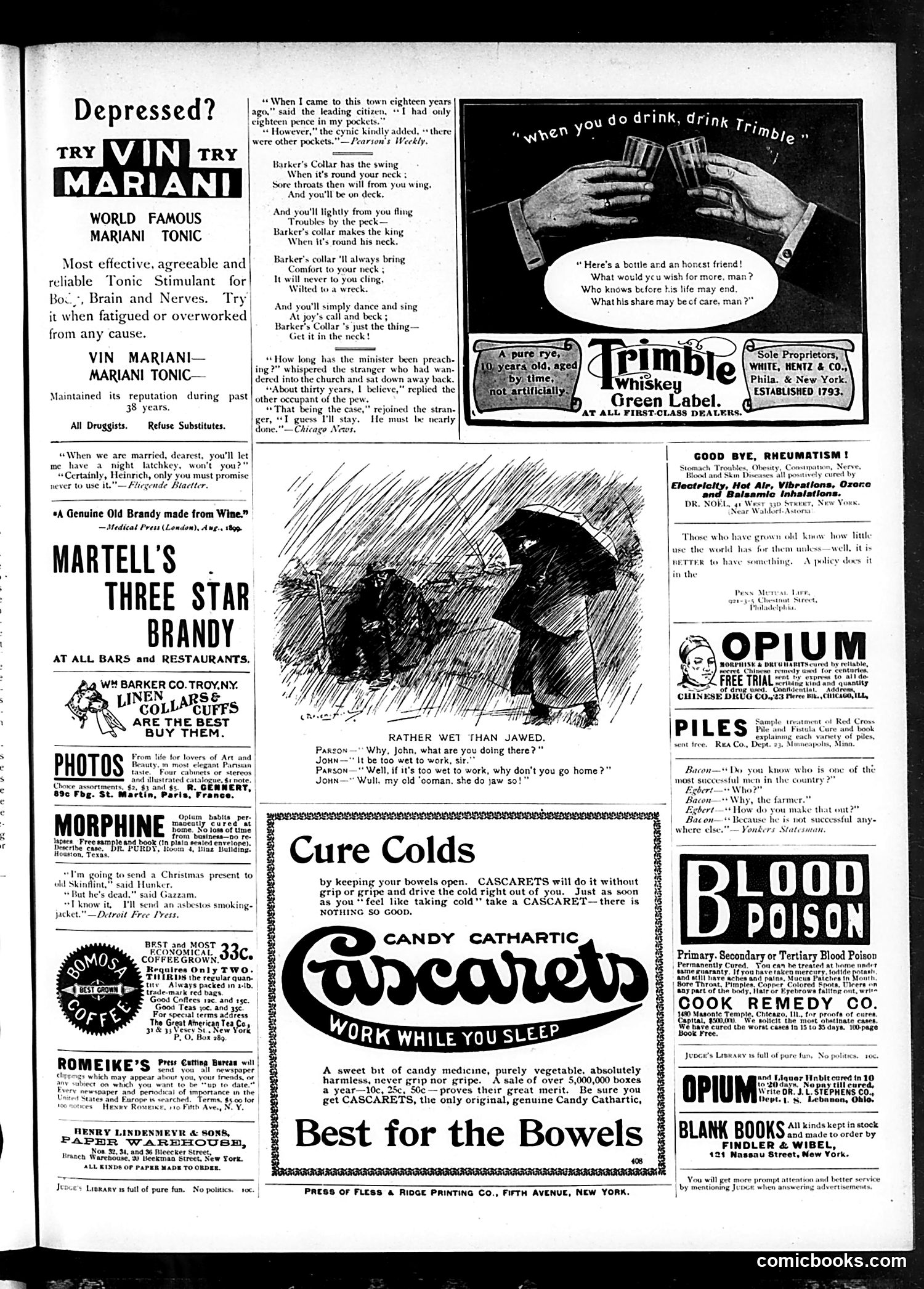
This page is primarily **advertisements** for patent medicines and consumer goods typical of early 20th-century magazines. However, the central cartoon titled "Rather Wet Than Jawed" offers social satire. The cartoon depicts a **working-class laborer (John)** avoiding work during rain, claiming it's "too wet." When a **parson (clergyman)** questions why he doesn't go home instead, John replies he won't because his wife "do jaw so"—meaning she nags constantly. The satire targets **domestic discord and nagging wives**: John prefers standing in the rain to enduring his wife's complaints. This reflects period attitudes portraying marriage as burdensome and wives as shrewish complainers—a common comedic theme in early-20th-century publications. The humor relies on the audience recognizing the stereotype of the henpecked husband and the "nagging wife" as relatable social commentary, treating domestic conflict as comedic material rather than serious concern.
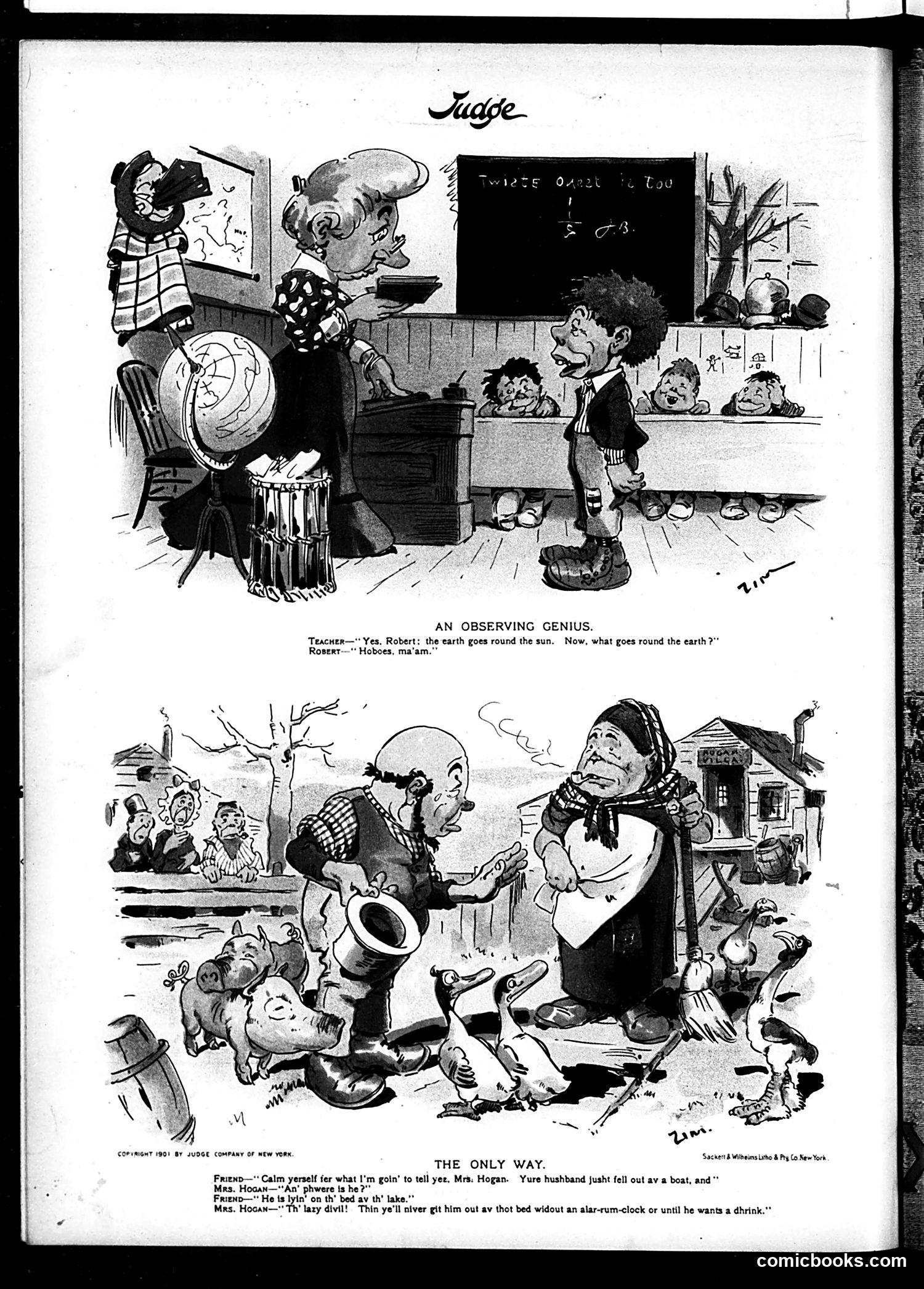
**"An Observing Genius"** mocks the gap between classroom instruction and street reality. A teacher asks where things orbit Earth; a boy answers "hoboes"—vagrants who traveled constantly. The joke relies on the era's widespread hobo culture: the child has observed actual human movement patterns more keenly than abstract astronomy. **"The Only Way"** plays on Irish-American stereotypes (evident from dialect spelling: "yee," "phwere," "dhrink"). A woman learns her husband fell in a lake but remains indifferent—he's presumably so lazy and drunk that only an alarm clock or thirst would motivate him to leave bed. The satire targets both working-class Irish immigrants and stereotypes about alcoholism and idleness prevalent in early-1900s American humor. Both cartoons reflect Judge's satirical approach to social observation and ethnic caricature typical of the period.