
Judge, 1901-12-21 · page 2 of 16
Judge — December 21, 1901 — page 2: what you’re looking at
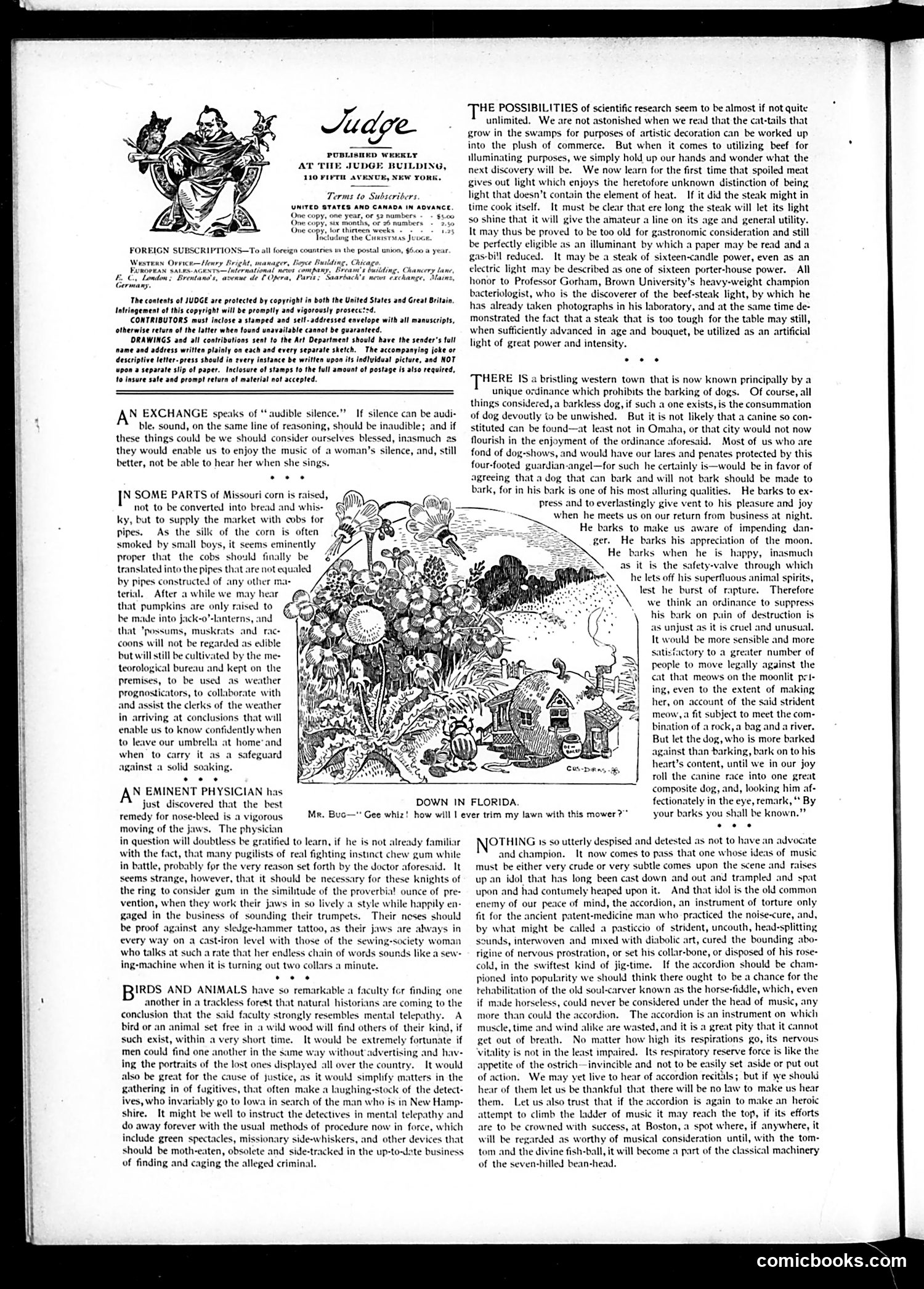
What you’re looking at
This cartoon depicts a homeowner (labeled "Mr. Bug") frustrated with lawn mowing, asking "Gee whiz! how will I ever trim my lawn with this mower?" The illustration shows an elaborate, whimsical contraption featuring various animals and mechanical devices arranged to cut grass. The satire targets Florida's notorious insect problem—particularly mosquitoes and other pests—by suggesting that managing a Florida lawn requires an absurdly complex, fantastical apparatus. The joke exploits the common complaint that Florida's climate and wildlife make basic lawn care nearly impossible. The cartoon humorously implies that conventional mowers are inadequate for Florida conditions, requiring instead this elaborate, impractical invention to deal with the state's pest-ridden landscape.
📄 Transcribed text from this page (OCR, searchable)
Machine-transcribed from the original scan — historical spelling and the odd misread are preserved.
PUBLISHED WEEKLY AT THE JUDGE BUILDING, 110 FIFTH AVENUE, NEW YORK. Terms to Subscribers. UNITED STATES AND CANADA IM ADVANCE. ‘One copy, one year, or s2 numbers = - $5.00 Om ix months, or 26 numbers < 2.40 Ove copy, lor thirteen, week == + 1.35 Joctuding the Ciistuas Juoce FOREIGN SUBSCRIPTIONS—To all foreign countries wv the postal union, $6.00 a year Chicago. AGENTS — later ‘ams building, Chane lane's, 3 2 Saarhach's news exchange, The contents of JUDGE are protected by coy both the United States and Great Infringement of this copyright will be promplly and vigorously prosecc:4. CONTRIBUTORS must inclose a stamped and self-addressed envelope with all manuscripts, otherwise retura of the latter when found unavailable cannot be guaranteed. DRAWINGS asd all contributions seat fo the Art Department should have the sender's full name and address written plainly on each and every separate sketch. The accompanying joke or descriptive letter. press should in tvery instance be written upon its indluidual picture, and NOT upon a separate slip of paper. Inclosure of stamps to the full amount of postage is also required, to insure sate and prompt return of material not accepted. N EXCHANGE speaks of “audible silence.” If silence can be audi- ble, sound, on the same line of reasoning, should be inaudible; and if these things could be we should consider ourselves blessed, inasmuch 2s they would enable us to enjoy the music of a woman’s silence, and, still better, not be able to hear her when she sings. N SOME PARTS of Missouri corn is raised, not to be converted into bread and whis- ky, but to supply the market with cobs for pipes. As the silk of the corn is often smoked by small boys, it seems eminently 7 proper that the cobs should finally be translated into the pipes that are not equaled by pipes constructed of any other ma terial. After a while we may hear that pumpkins are only raised to be made into jack-o’-lanterns, and that "possums, muskrats and rac- coons will not be regarded as edible but will still be cultivated by the me- teorological bureau and kept on the Premises, to be used as weather prognosticators, to collaborate with a sist the clerks of the weather iving at conclusions that will ble us to know confidently when to le. our umbrella at home* and when to carry it as a safeguard against a solid soaking. 'HE POSSIBILITIES of scientific research seem to be almost if not quite unlimited. We are not astonished when we read that the cat-tails that grow in the swamps for purposes of artistic decoration can be worked up into the plush of commerce. But when it comes to utilizing beef for illuminating purposes, we simply hold up our hands and wonder what the next discovery will be. We now learn for the first time that spoiled meat gives out light which enjoys the heretofore unknown distinction of being light that doesn’t contain the element of heat. If it did the steak might in time cook itself. It must be clear that ere long the steak will let its light so shine that it will give the amateur a line on its age and general utility. It may thus be proved to be too old for gastronomic consideration and still be perfectly eligible as an illuminant by which a paper may be read and a gas-bill reduced. It may be a steak of sixteen-candle power, even as an electric light may be described as one of sixteen porter-house power. All honor to Professor Gorham, Brown University’s heavy-weight champion bacteriologist, who is the discoverer of the beef-steak light, by which he has already taken photographs in his laboratory, and at the same time de- monstrated the fact that a steak that is too tough for the table may still, when sufficiently advanced in age and bouquet, be utilized as an artificial light of great power and intensity. THERE IS a bristling western town that is now known principally by a unique ordinance which prohibits the barking of dogs. Of course, all things considered, a barkless dog, if such a one exists, is the consummation of dog devoutly to be unwished. But it is not likely that a canine so con- stituted can be found—at least not in Omaha, or that city would not now flourish in the enjoyment of the ordinance aforesaid. Most of us who are fond of dog-shows, and would have our lares and penates protected by this four-footed guardian-angel—for such he certainly is—would be in favor of agreeing that a dog that can bark and will not bark should be made to bark, for in his bark is one of his most alluring qualiti He barks to ex- vhen he meets us on our return from business at night. He barks to make us aware of impending dan- He barks his appreciation of the moon. He barks when he is happy, inasmuch as it is the safety-valve through which he lets off his superfluous animal spirits, lest he burst of rapture. Therefore we think an ordinance to suppress. his bark on pain of destruction is as unjust as it is cruel and unusual. It would be more s le and more satisfactory to a greater number of people to move legally against the cat that meows on the moonlit pri- ing, even to the extent of making her, on account of the said strident meow, a fit subject to meet the com- bination of a rock, a bag and a river. But let the dog, who is more barked inst than barking, bark on to his ts content, until we in our joy roll the canine race into one great N EMINENT PHYSICIAN has just discovered that the best remedy for nose-bleed is a vigorous moving of the jaws. The physician in question will doubtless be gratified to learn, if he is not already familiar with the fact, that many pugilists of real fighting instinct chew gum while in battle, probably fpr the very reason set forth by the doctor aforesaid. It seems strange, however, that it should be necessary for these knights of the ring to consider gum in the similitude of the proverbia! ounce of pre- vention, when they work their jaws in so lively a style while happily en- gaged in the business of sounding their trumpets. Their neses should be proof against any sledge-hammer tattoo, as their jaws are abv: every way on a cast-iron level with those of the sewing-society woman who talks at such a rate that her endless chain of words sounds like a sew- ing-machine when it is turning out two collars a minute. IRDS AND ANIMALS have so remarkable a faculty fer finding one another in a trackless forest that natural historians are coming to the conclusion that the said faculty strongly resembles mental telepathy. A bird or an animal set free in a wild wood will find others of their kind, if such exist, within a very short time. It would be extremely fortunate if men could find one another in the same way without advertising and hav- ing the portraits of the lost ones displayed all over the country. It would also be great for the cause of justice, as it would simplify matters in the athering in of fugitives, that often make a laughing-stock of the detect- ives, who invariably go to lowa in search of the man who is in New Hamp- shire. It might be well to instruct the detectives in mental telepathy and do away forever with the usual methods of procedure now in force, which include green spectacles, missionary side-whis should be moth-eaten, obsolete and side-tracked in the up-to-date business of finding and caging the alleged criminal. DOWN IN FLORIDA. Mr. Buc—" Gee whiz! how will | ever trim my lawn with this mower?” composite dog, and, looking him af- fectionately in the eye, remark, * By your barks you shall be known.” IOTHING 1s so utterly despised and detested as not to have an advocate and champion. It now comes to pass that one whose ideas of mu must be either very crude or very subtle comes upon the scene and raises up an idol that has long been cast down and out and trampled and spat upon and had contumely heaped upon it. And that idol is the old common enemy of our peace of mind, the accordion, an instrument of torture only ancient patent-medicine man who practiced the noi: by what might be called a pasticcio of strident, uncouth, head-splitting sounds, interwoven and mixed with diabolic art, cured the bounding abo- rigine of nervous prostration, or set his collar-bone, or disposed of his rose- cold, in the swiftest kind of jig-time. If the accordion should be cham- pioned into popularity we should think there ought to be a chance for the tehabilitation of the old soul-carver known as the horse-fiddle, which, e' if made horseless, could never be considered under the head of mus more than could the accordion. The accordion is muscle, time and wind alike are wasted, and it great pity that it cannot get out of breath. No matter how high its respirations go, its nervous vitality is not in the least impaired. Its respiratory reserve force is like the appetite of the ostrich—invincible and not to be easily set aside or put out of action, We may yet live to hear of accordion recithls; but if we should hear of them let us be thankful that there will be no law to make us he: them. Let us also trust that if the is again to make an heroic attempt to climb the ladder of mus ich the top, if its efforts are to be crowned with success, at Boston, a spot where, if anywhere, it will be regarded as worthy of musical consideration until, with the tom- tom and the divine fish-ball, it will become a part of the classical machinery of the seven-hilled bean-head. any instrument on which comicbooks.com