
A complete issue · 16 pages · 1901
Judge — December 14, 1901
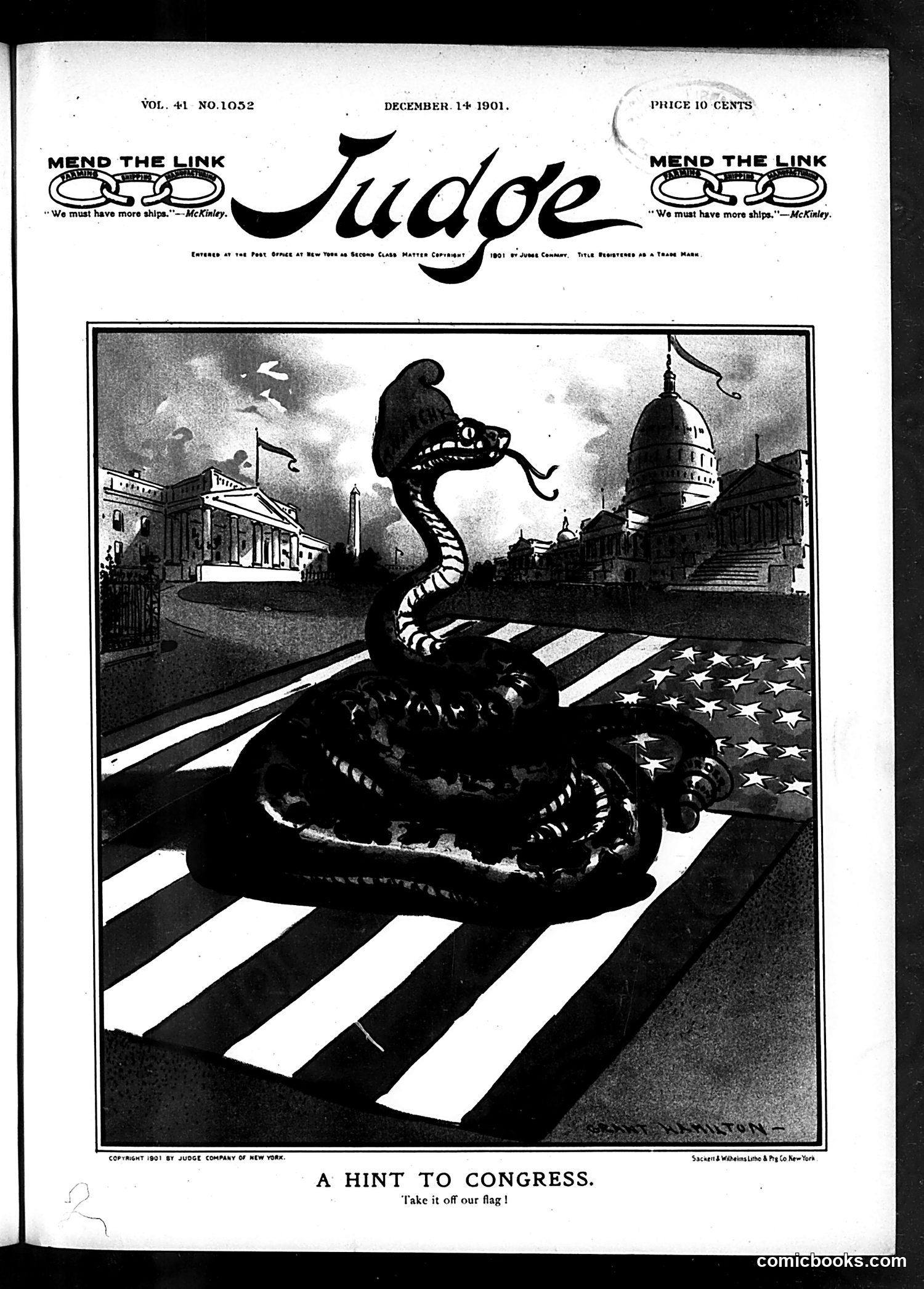
This political cartoon depicts a massive serpent coiled across Capitol grounds, directly beneath the American flag. The snake appears to represent a domestic political threat or crisis demanding Congressional attention. The caption "A Hint to Congress" and subtitle "Take it off our flag!" suggest the cartoonist is warning legislators that some serious problem is corrupting or endangering the nation's institutions and values. The serpent's placement on the American flag implies this threat is fundamental to national integrity. Without additional context from the 1901 period, the specific issue remains unclear—it could reference corruption, monopolies, labor unrest, or another contemporary crisis. The dramatic imagery emphasizes urgency, implying Congress must act decisively to remove this danger before it further compromises American democracy.
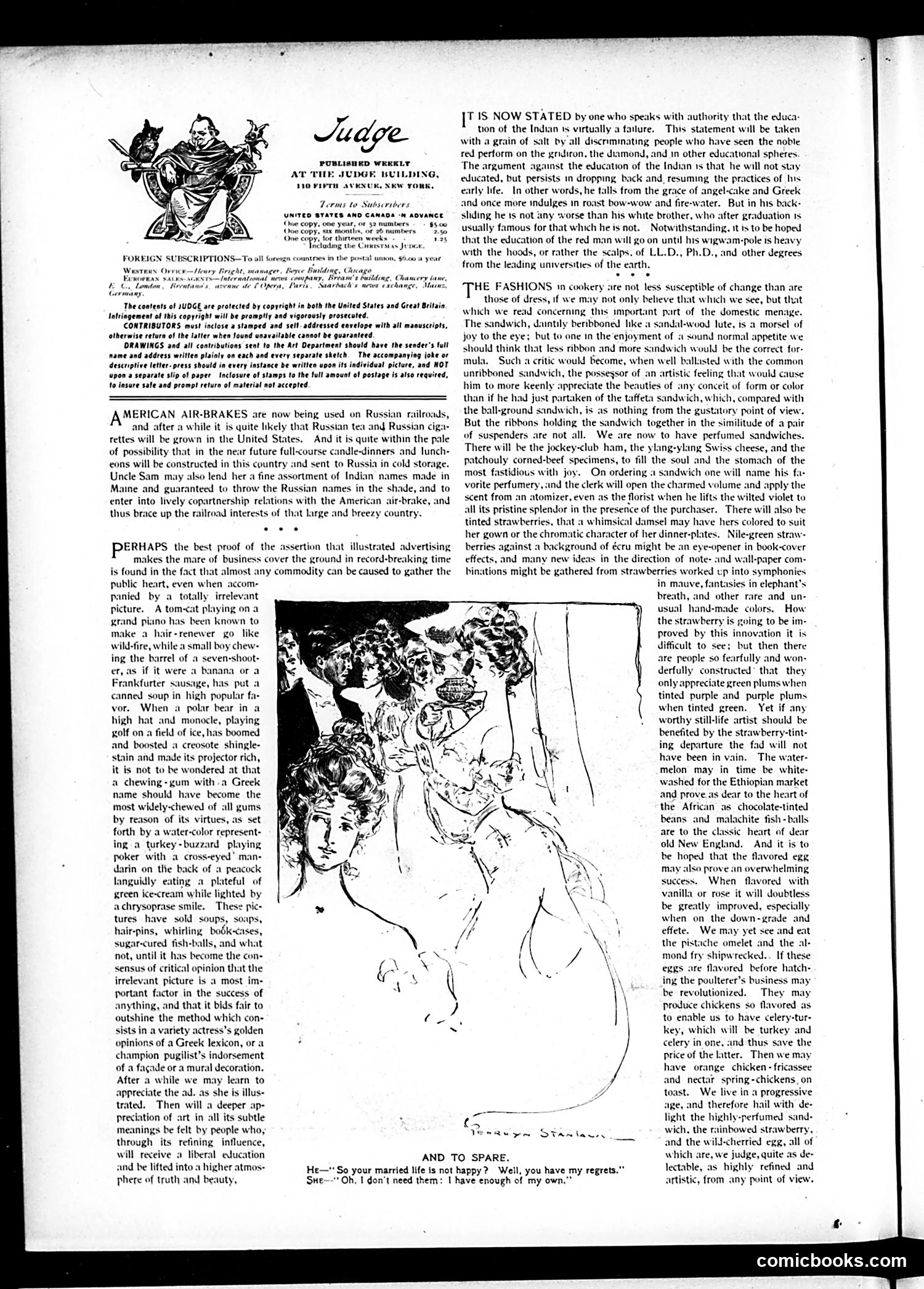
This page contains editorial commentary and a single cartoon titled "AND TO SPARE" (bottom right). The cartoon depicts a couple in conversation. The man says, "So your married life is not happy? Well, you have my regrets." The woman replies, "Oh, I don't need them: I have enough of my own." **The joke:** It's a play on the word "regrets"—he offers sympathy using the word in its emotional sense (regret/sorrow), but she interprets it literally as objects to possess, joking that she already has plenty of her own regrets from the marriage. The cartoon satirizes marital discord, a common Judge magazine theme. The woman's witty response suggests she's dissatisfied with her marriage and has accumulated numerous personal regrets—a dark humor commentary on unhappy domesticity. The page's editorial columns discuss Indian education, sandwich fashions, and advertising claims—typical Judge content mixing social commentary with satire.
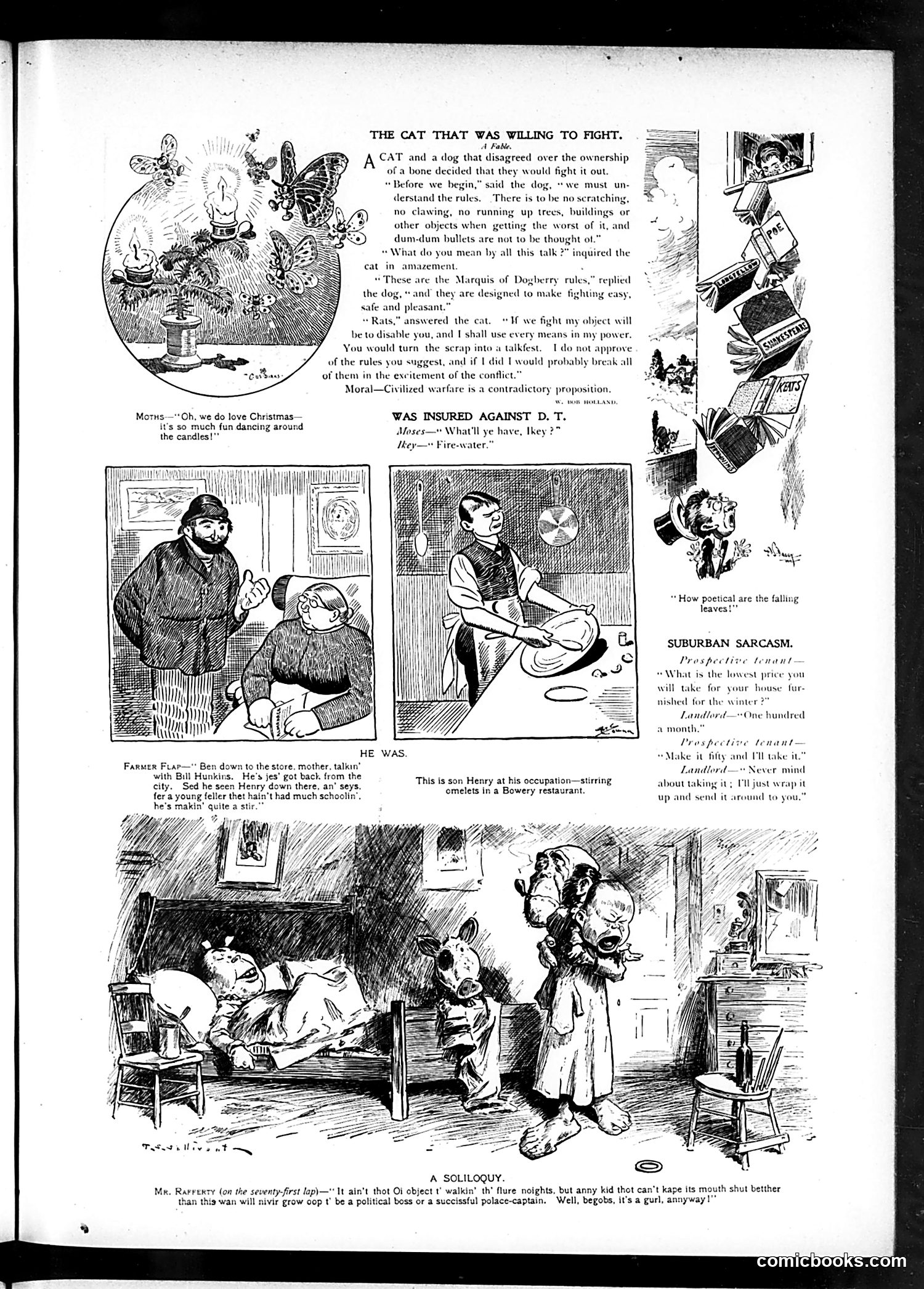
This page contains several satirical pieces typical of early 20th-century American humor: **"The Cat That Was Willing to Fight"** presents a debate between a cat and dog over fighting rules—the cat insists on "Queensberry rules" (fair boxing regulations) while the dog wants brutal combat. This appears to satirize civilized vs. uncivilized conflict resolution. **"Farmer Flap"** and **"He Was"** are brief comedic sketches about urban versus rural life and occupational mishaps. **"Suburban Sarcasm"** mocks a landlord-tenant conversation about winter heating costs. **"A Soliloquy"** features a character complaining that even kids won't listen to political arguments anymore—satirizing the irrelevance of serious political discourse to ordinary people. The cartoons employ caricature and wordplay typical of Judge's satirical style targeting social pretension and political pomposity.
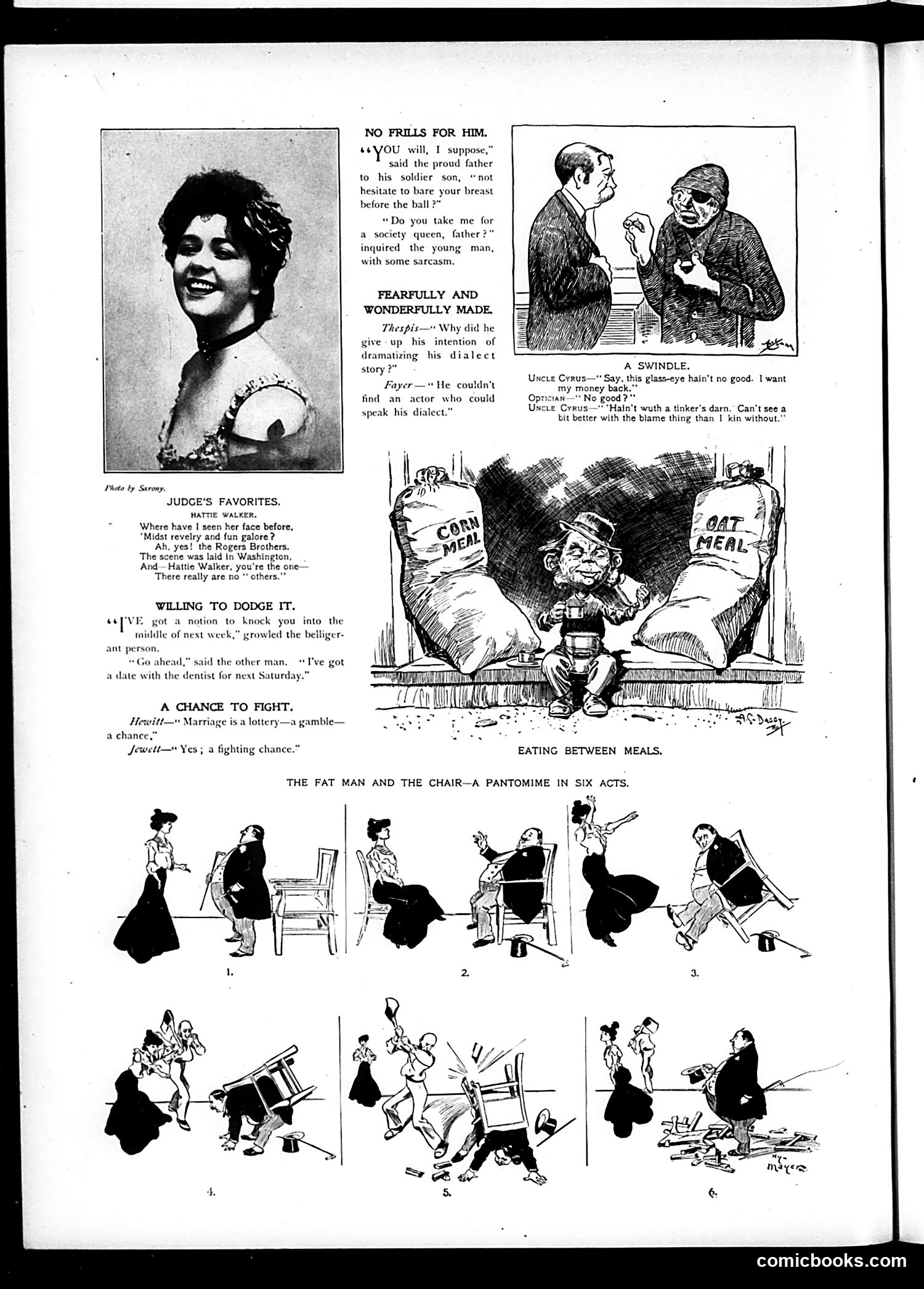
This page contains theatrical humor and social satire typical of early 20th-century Judge magazine. **Top sections** feature commentary on theatrical performers and romantic entanglements, including references to speaking dialect on stage and dating a dentist. **The cartoon "Eating Between Meals"** shows a caricatured thin man sandwiched between large sacks labeled "oat meal," satirizing either food rationing/scarcity or cheap diet subsistence—likely commentary on working-class poverty or wartime food conditions. **"The Fat Man and the Chair—A Pantomime in Six Acts"** depicts slapstick comedy where a large man repeatedly struggles with and breaks a chair through various violent interactions, a classic physical comedy routine mocking both obesity and furniture destruction. The overall tone reflects Judge's focus on domestic humor, theatrical gossip, and class-based comedy rather than explicit political satire.
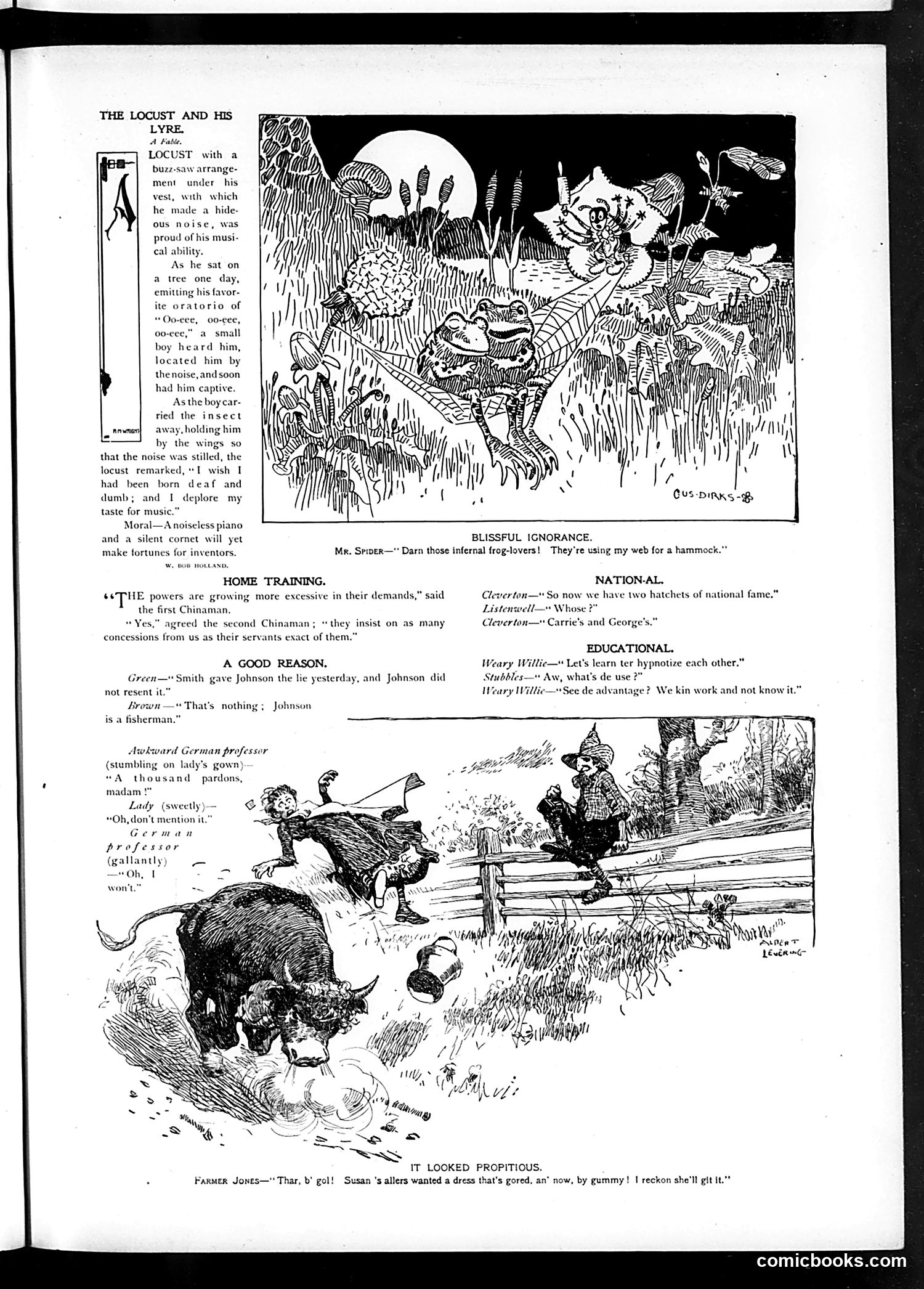
This page contains several short satirical pieces typical of Judge's humor: **"The Locust and His Lyre"** (fable): A locust proud of his loud buzzing "music" is captured by a boy. The moral mocks noisy musical instruments—suggesting silent pianos and cornets would make fortunes. This satirizes both pretentious artistic pride and the era's noise pollution complaints. **"Home Training"** and **"National"**: Brief dialogue jokes about Chinese laborers making "excessive demands" and competing "hatchets of national fame" (likely referencing the Carrie and George axes murders, notorious crimes of the period). **"Educational"**: Tramps discuss learning hypnosis to work without awareness—mocking both self-improvement schemes and labor exploitation. **"Awkward German Professor"**: Ethnic humor playing on German accents and affected formality. **"It Looked Propitious"**: Rural humor about a farmer whose wife gets her desired "gored" (triangular-panel) dress when his cow gores it—slapstick irony. The cartoons reflect Judge's typical mix of slapstick, class comedy, ethnic stereotypes, and social observation common to 1890s-era American satire.
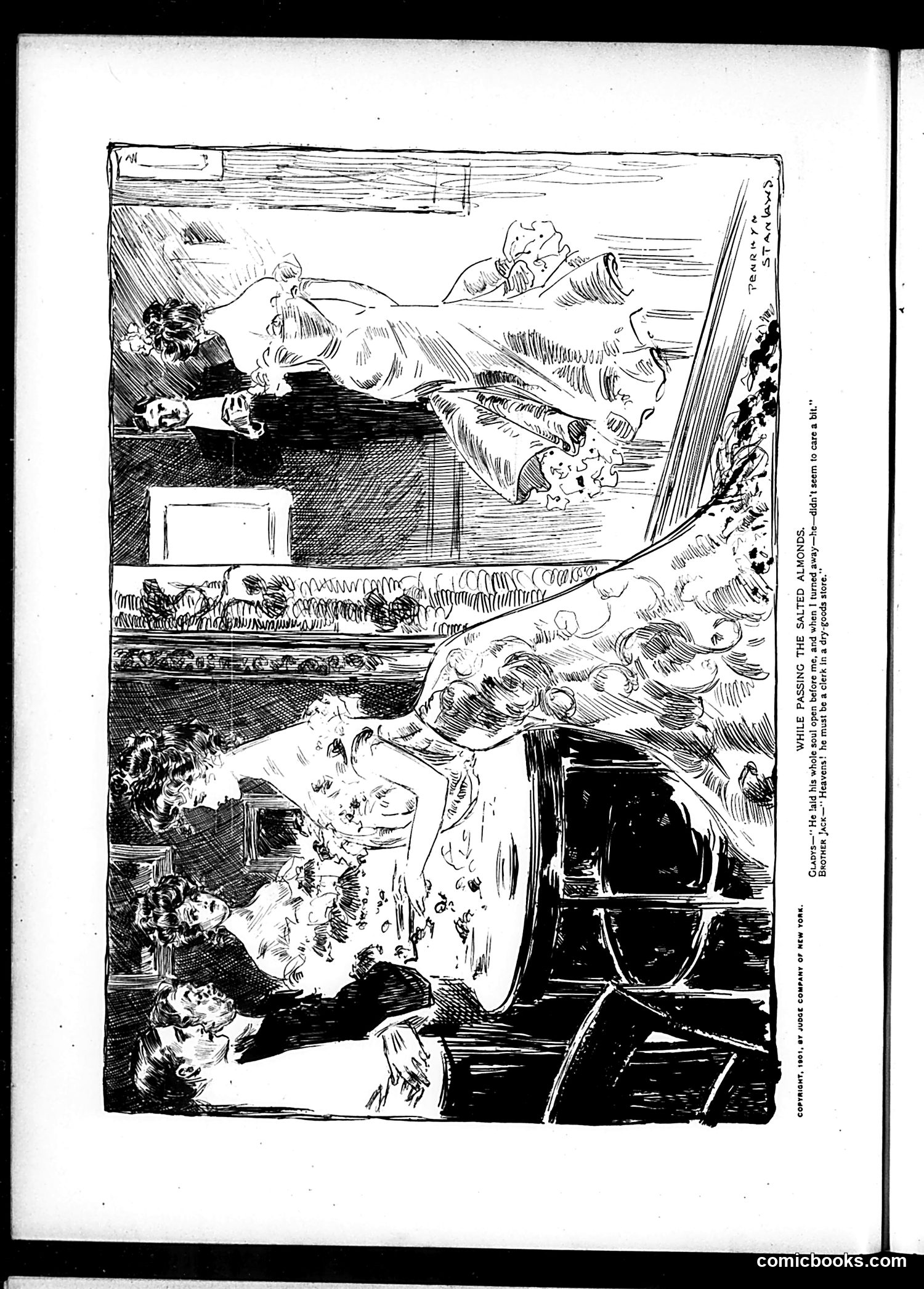
This is a satirical drawing depicting a social scene where a woman ("Gladys") confides to "Brother Jack" about a man's emotional indifference. The joke's punchline—that he "must be a clerk in a dry-goods store"—relies on early-20th-century stereotypes about retail workers. The humor targets the perceived emotional coldness and detachment of commercial clerks, suggesting they were so accustomed to superficial customer interactions that they couldn't engage authentically in personal relationships. This reflects period anxieties about how industrial capitalism and wage labor were supposedly degrading human connection and emotional capacity. The casual setting (suggested by "while passing the salted almonds") emphasizes the gossipy, intimate nature of the conversation, contrasting sharply with the caustic judgment being passed. The cartoon satirizes both the clerk's supposed emotional bankruptcy and the superficial social world where such judgments circulate.
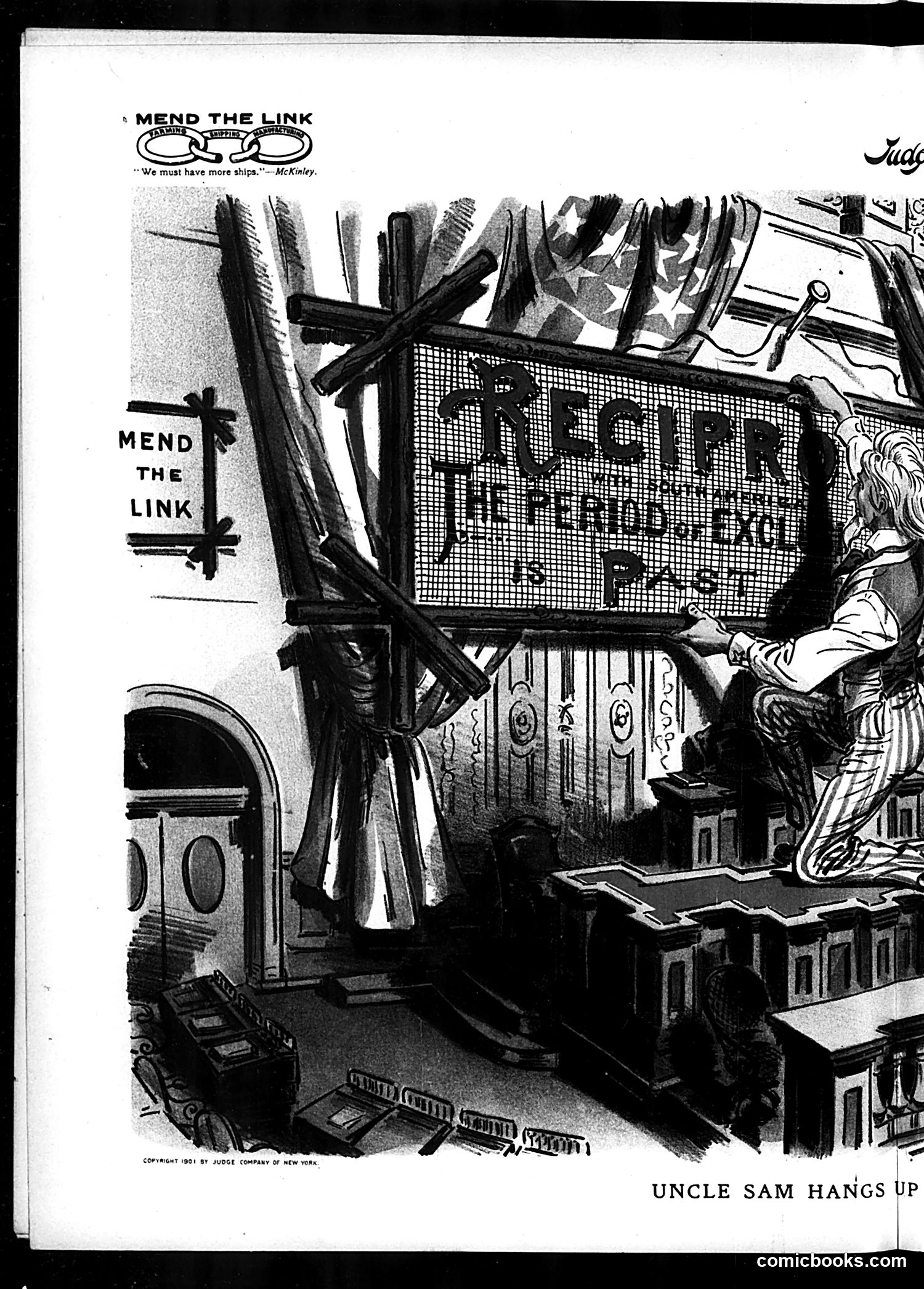
This Judge magazine page presents two linked satirical cartoons about naval preparedness under President McKinley (whose quote appears at top: "We must have more ships"). The main image depicts Uncle Sam literally hanging up clothes on a line—apparently the American flag and naval vessels—suggesting he's putting away or neglecting military readiness. The "broken link" reference criticizes the disconnect between McKinley's stated need for naval expansion and actual government action. The bottom caption, "Uncle Sam Hangs Up," reinforces the joke: the nation is figuratively "hanging up" or abandoning its maritime ambitions despite the president's rhetoric. The cartoon mocks the gap between political promises and practical implementation regarding American naval power during the McKinley administration's early period.
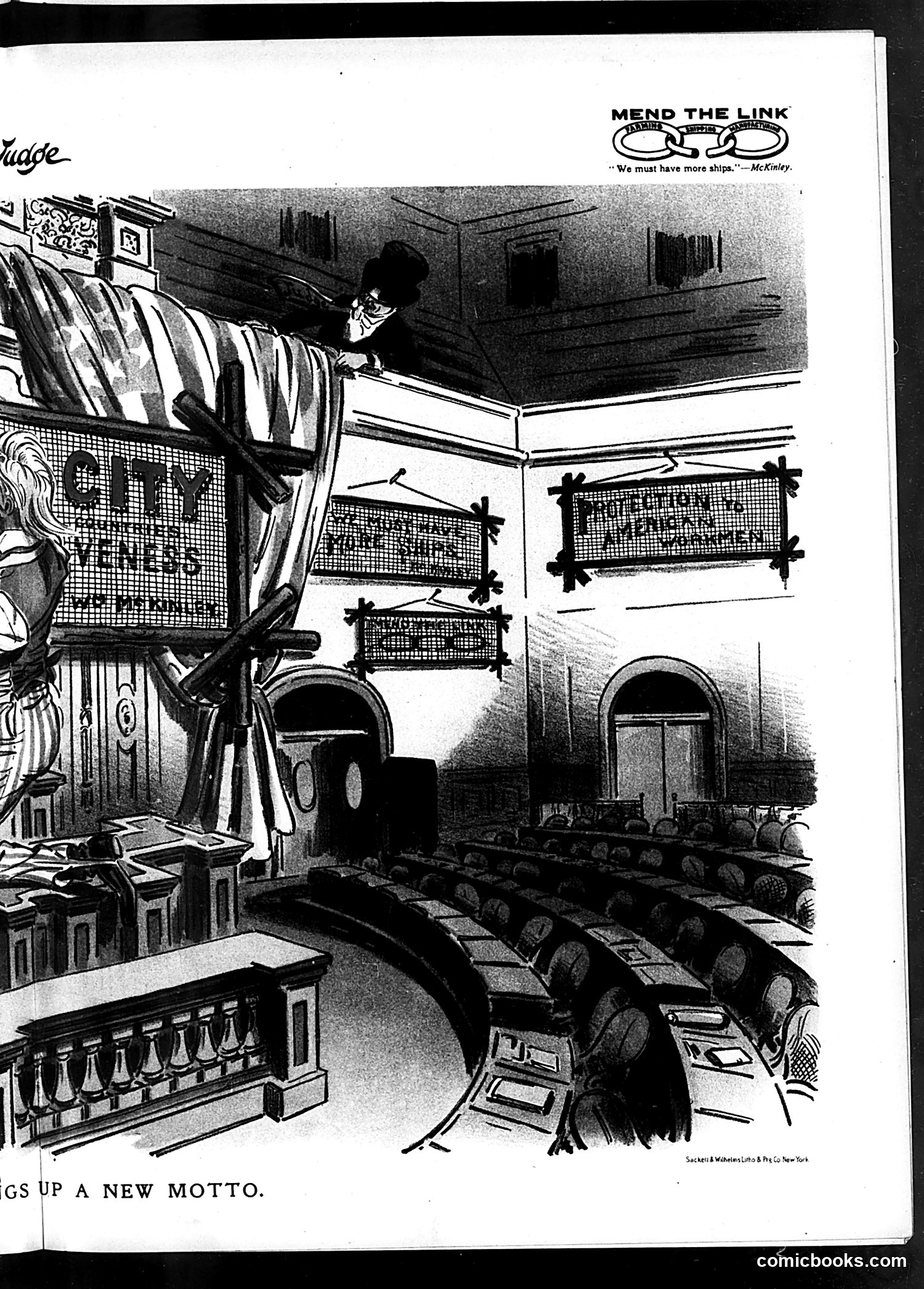
This political cartoon depicts a naval shipyard or dock scene. A figure stands atop what appears to be a large warship or vessel under construction, while below are multiple completed ships lined up in a harbor. The prominent masthead "MEND THE LINK" with chain imagery suggests naval/industrial strength. The partial text "GS UP A NEW MOTTO" (likely "RINGS UP A NEW MOTTO") references the McKinley quote visible in the header: "We must have more ships." The satire appears to critique American naval expansion policy during the McKinley administration (early 1900s). The cartoon illustrates the government's emphasis on building warships, possibly mocking either the aggressive militarization program or the difficulty/contradiction between stated intentions and actual naval production capacity. The architectural setting and industrial focus emphasize America's industrial/military-industrial complex during this imperialist period.
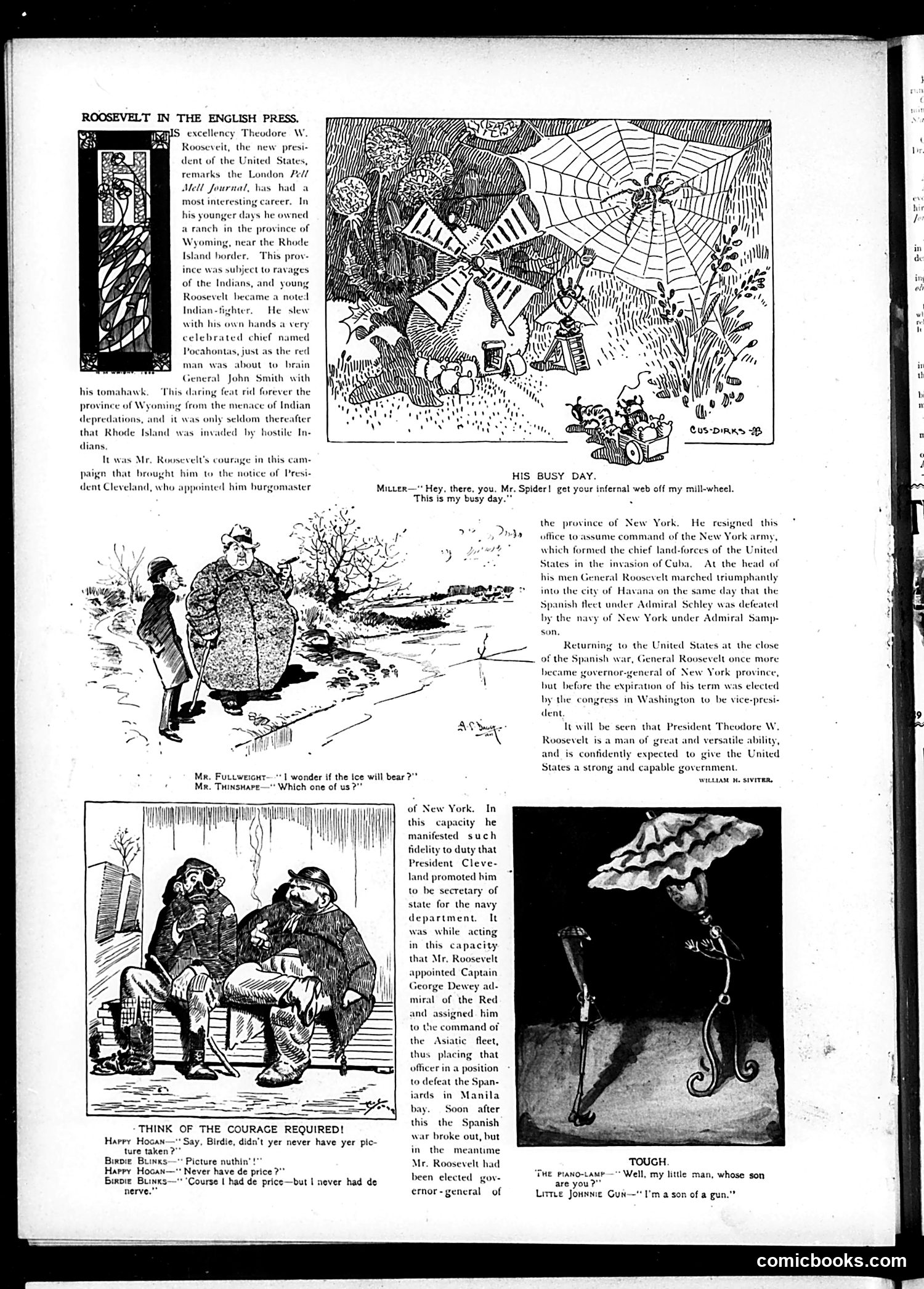
This page satirizes Theodore Roosevelt's public persona through deliberately absurd historical fabrications. The main article mockingly credits Roosevelt with impossible achievements: slaying "Pocahontas" (a woman, and historical figure), personally commanding forces in Cuba, and appointing Admiral Dewey—all exaggerated or falsified to ridicule American press coverage portraying him as a superhuman action hero. The cartoons reinforce this theme. "His Busy Day" shows Roosevelt frantically juggling multiple tasks (represented by the spider web on a mill-wheel), satirizing claims of his tireless energy. "Think of the Courage Required" and other vignettes mock the breathless admiration surrounding him. The English press quote framing the article suggests Judge is satirizing how American media, particularly after the Spanish-American War, inflated Roosevelt's war record and abilities into legend. The piece critiques both Roosevelt's manufactured public image and the credulous press promoting it.
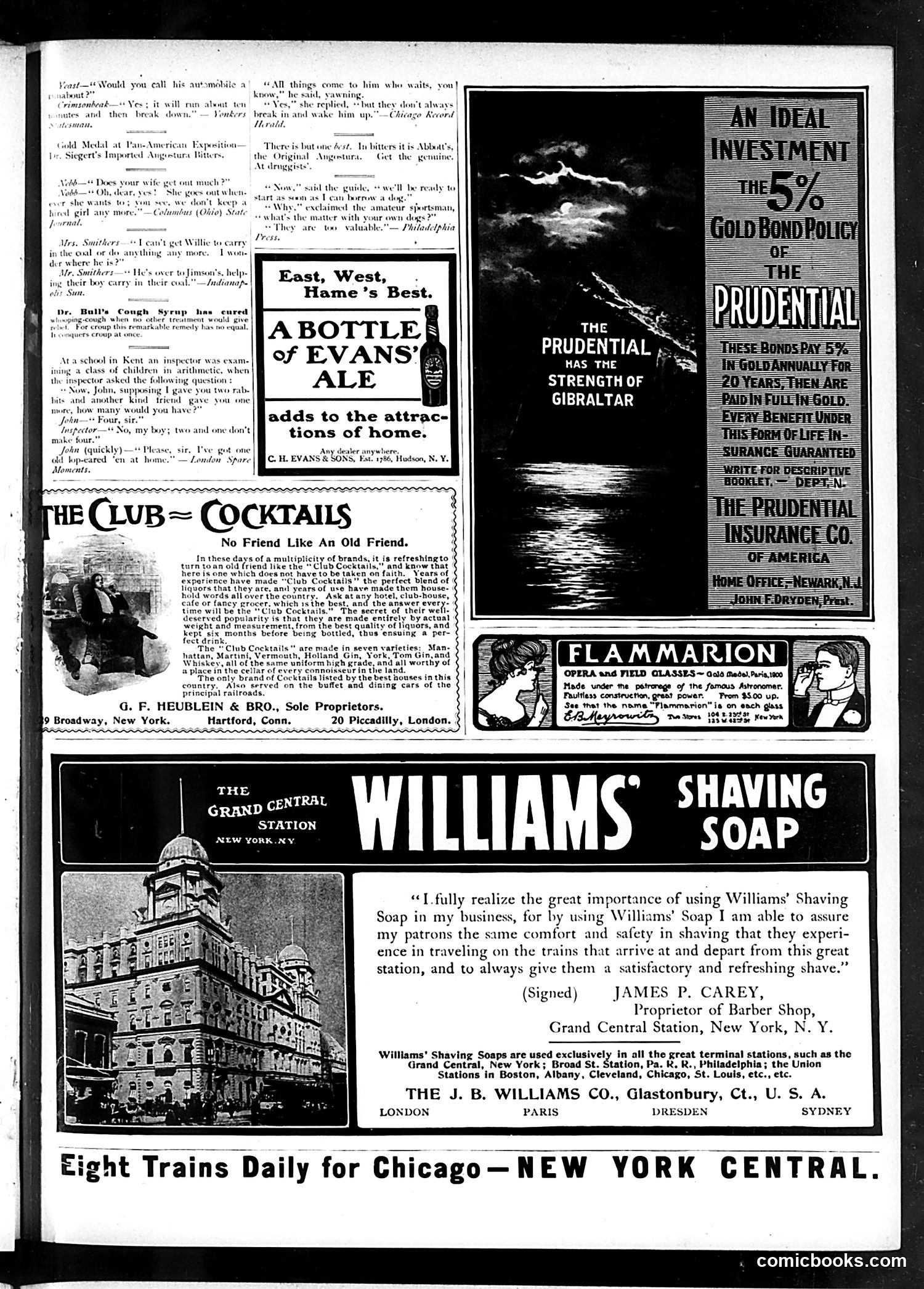
This page is primarily **advertising**, not satirical content. It contains several product advertisements interspersed with brief humorous jokes typical of early 1900s magazines. The visible jokes include: - A quip about an automobile that "will run about ten miles and then break down" - A school arithmetic problem where a child mentions "one old lop-eared hen at home" instead of calculating with rabbits - A domestic joke about a boy named Willie refusing chores The major advertisements are for: - **Evans' Ale** (beverage) - **Club Cocktails** (alcohol, seven varieties available) - **Prudential Insurance** (5% gold bonds) - **Flammarion Opera Glasses** - **Williams' Shaving Soap** (prominently featured with Grand Central Station imagery and a testimonial from a barber) - **New York Central Railroad** (eight daily trains to Chicago) The humor is gentle and domestic rather than political satire. The page reflects early 1900s consumer culture and advertising practices in American periodicals.
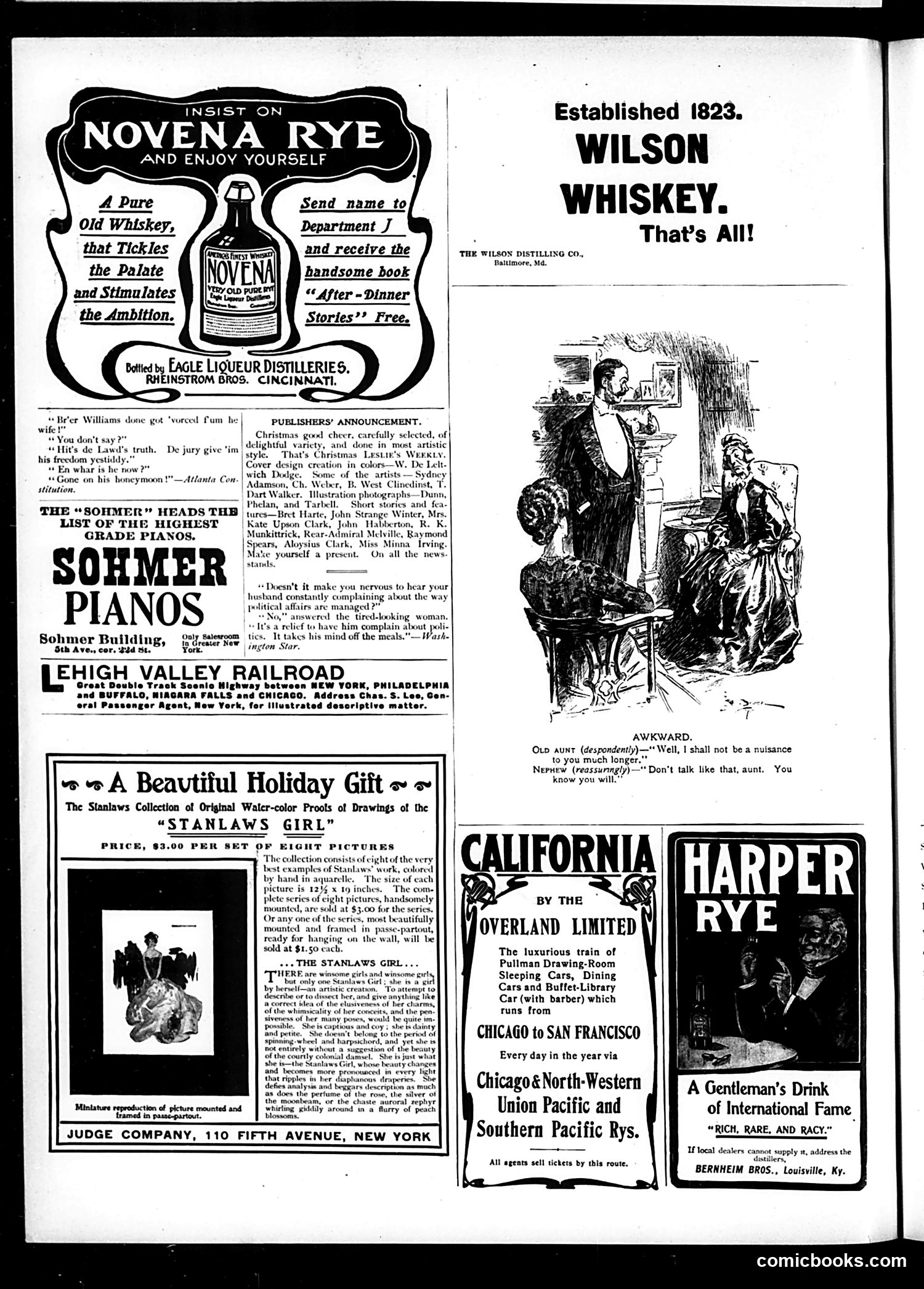
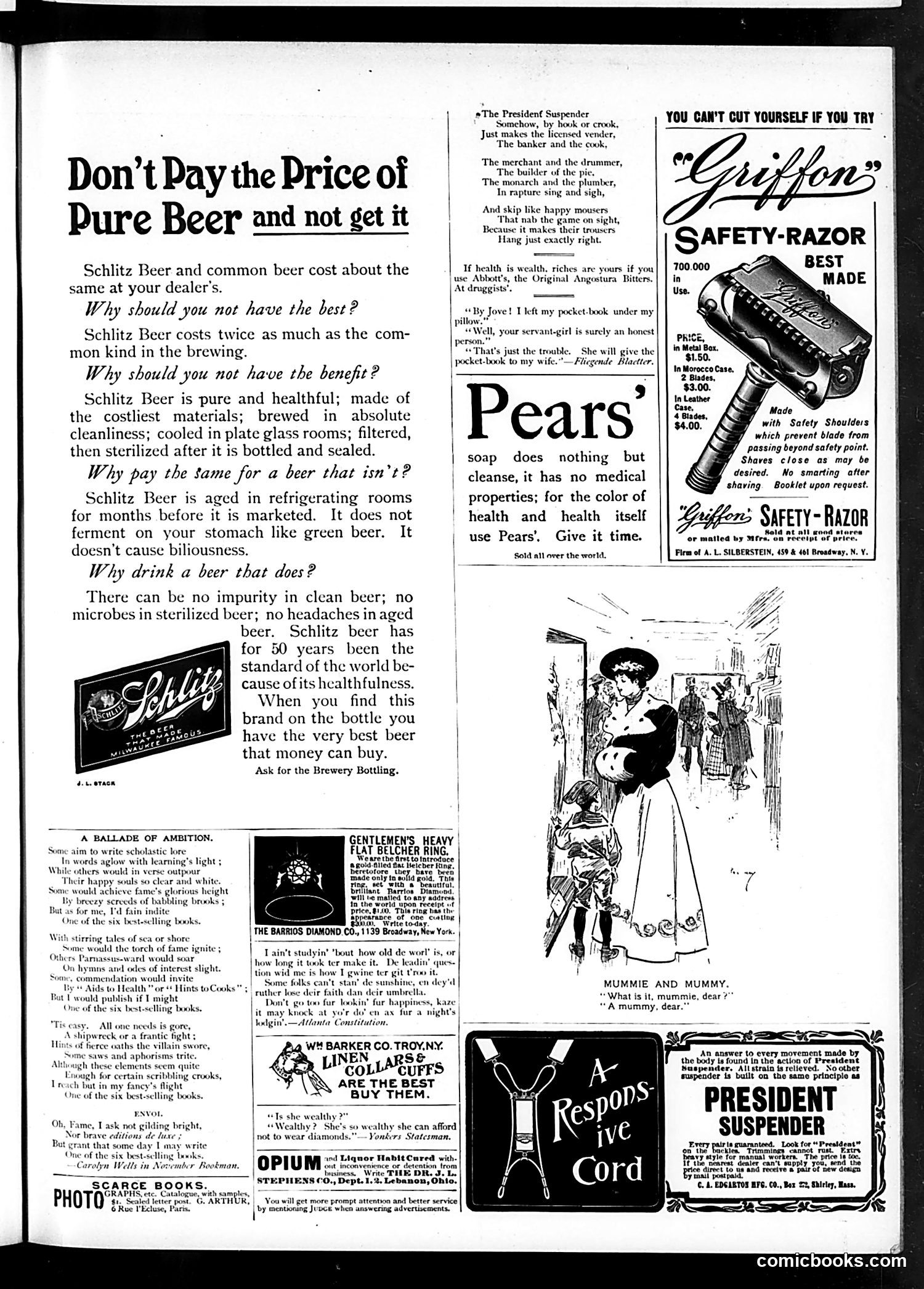
This page is primarily **advertising**, with one small cartoon labeled "MUMMIE AND MUMMY" visible mid-page. The "Mummie and Mummy" cartoon appears to be a visual pun or joke about the dual meaning of "mummy"—likely contrasting an Egyptian mummy (the preserved body) with "mummy" as British/colloquial for "mother." A child asks "What is it, mummie, dear?" and the mother responds "A mummy, dear," suggesting confusion or wordplay around the term. The dominant content is commercial advertising for various products (Schlitz Beer, Griffon Safety Razors, Pears' Soap, President Suspenders, and others), typical of Judge magazine's revenue model. The page also includes poetry sections like "A Ballade of Ambition" and humorous prose anecdotes. The cartoon itself is genteel, family-friendly humor rather than sharp political satire—characteristic of Judge's lighter content compared to its more pointed editorial cartoons elsewhere in the magazine.
This page is primarily **advertising**, not political satire. The central image dominates: a large photograph of a Knabe piano with decorative rope/cord framing, advertising the company's locations in New York, Baltimore, and Washington. The surrounding ads are typical period marketing—Red Top Rye whiskey, Beeman's Pepsin Gum, a theatrical production ("The Unwelcome Mrs. Hatch" at Manhattan Theatre), men's furnishings by Arnold Constable & Co., and a Vigoral beef drink by Armour & Company. The quote at top is from the Atlanta Constitution, lending prestige to the Red Top Rye advertisement. There is **no discernible political cartoon or satire** on this page. It's a commercial layout from Judge magazine, mixing product advertisements with a theater listing—standard practice for magazines of this era, which relied on advertising revenue.
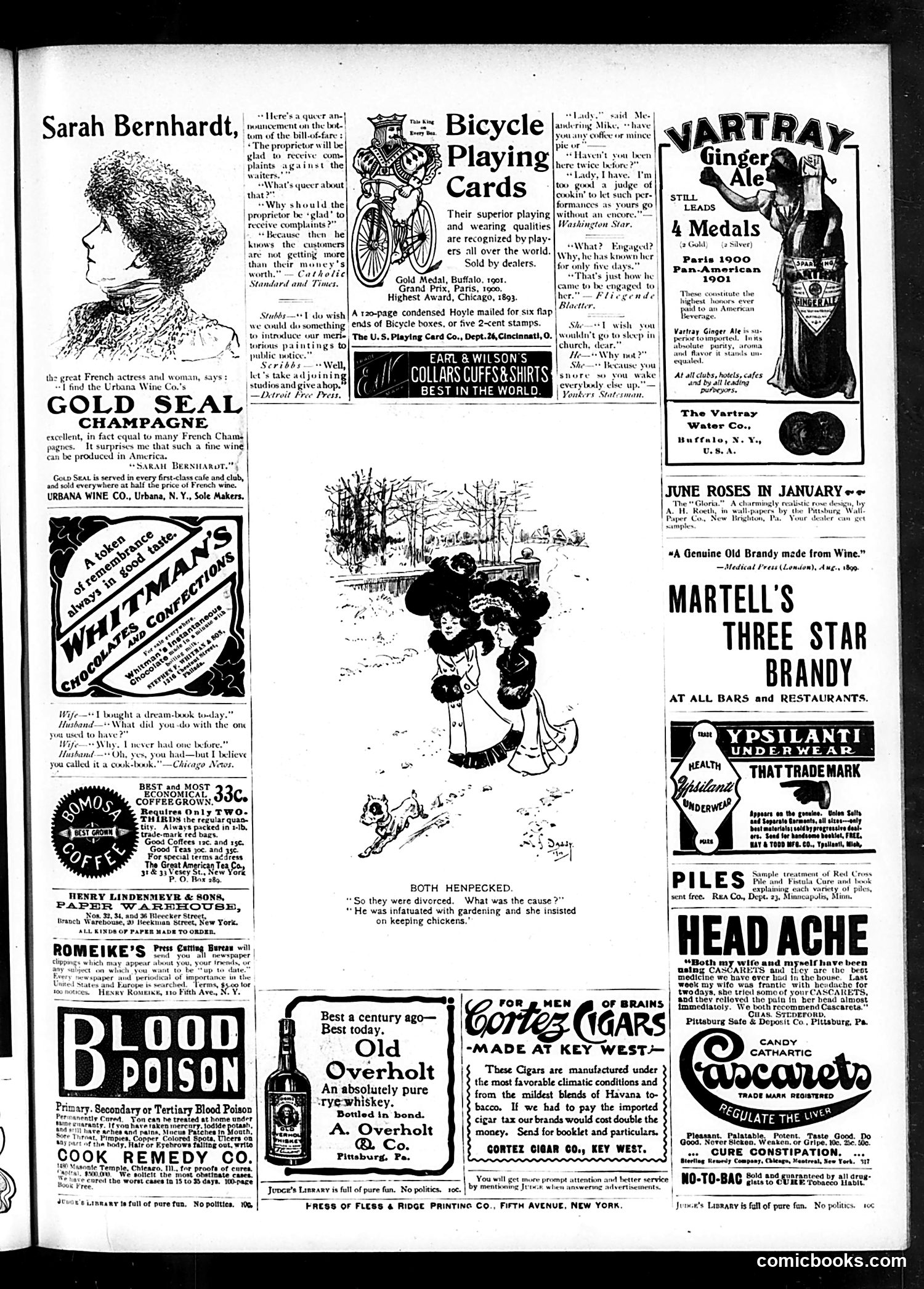
This page is primarily **advertising** but contains one small cartoon with a domestic joke. The cartoon titled "Both Henpecked" depicts two married couples discussing another couple's recent divorce. One wife asks what caused the split. The punchline: the husband was obsessed with gardening while the wife insisted on keeping chickens—implying they divorced over incompatible hobbies and household priorities. The "henpecked" reference is a double pun: it literally refers to the wife keeping chickens (hens), while "henpecked" was a common period term for men dominated by their wives. The humor relies on the idea that both spouses were equally stubborn and controlling ("both henpecked"), making their marriage untenable. The joke reflects early 1900s domestic comedy tropes about marital conflict over household management and personal interests, presented as lighthearted rather than serious commentary.
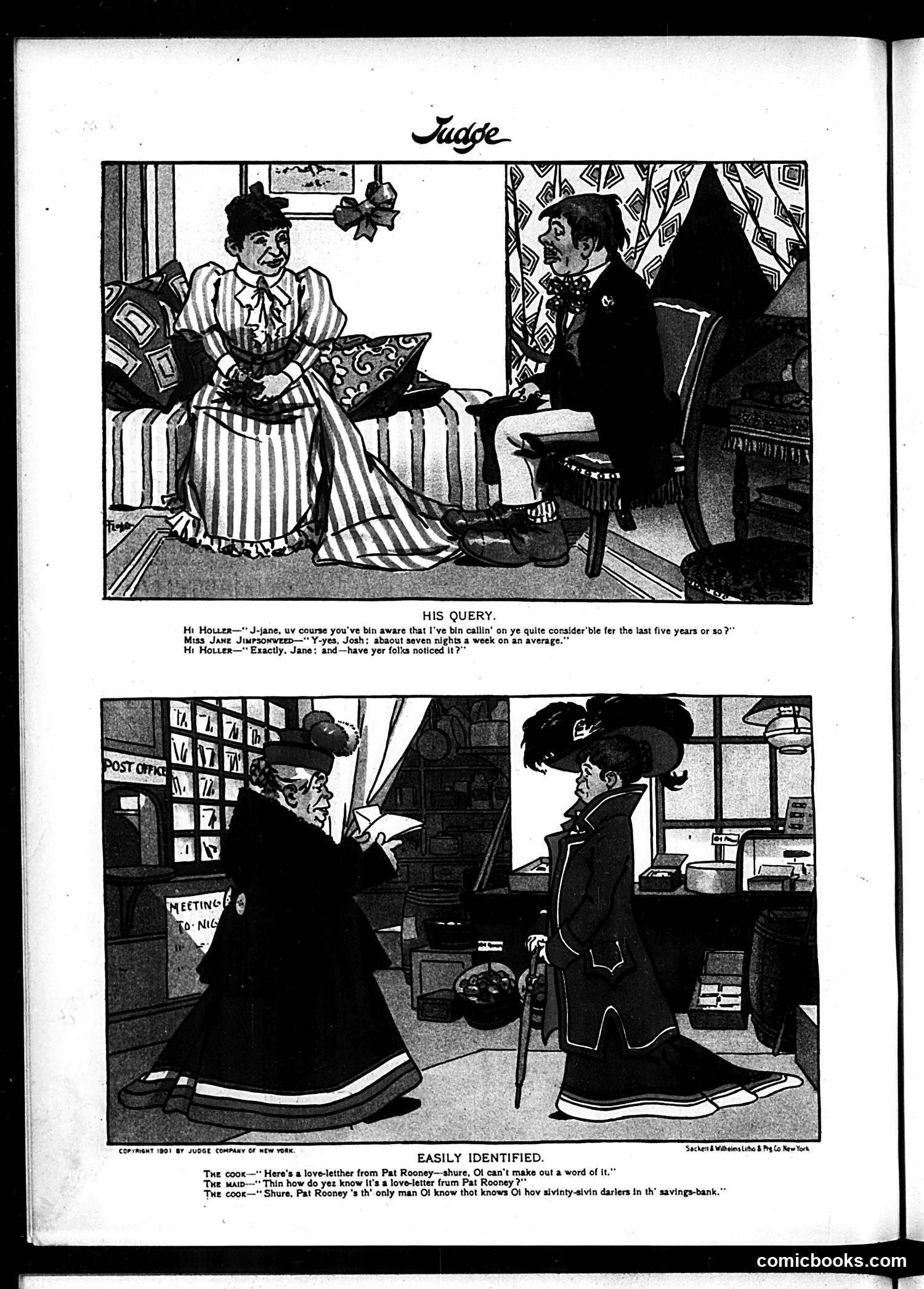
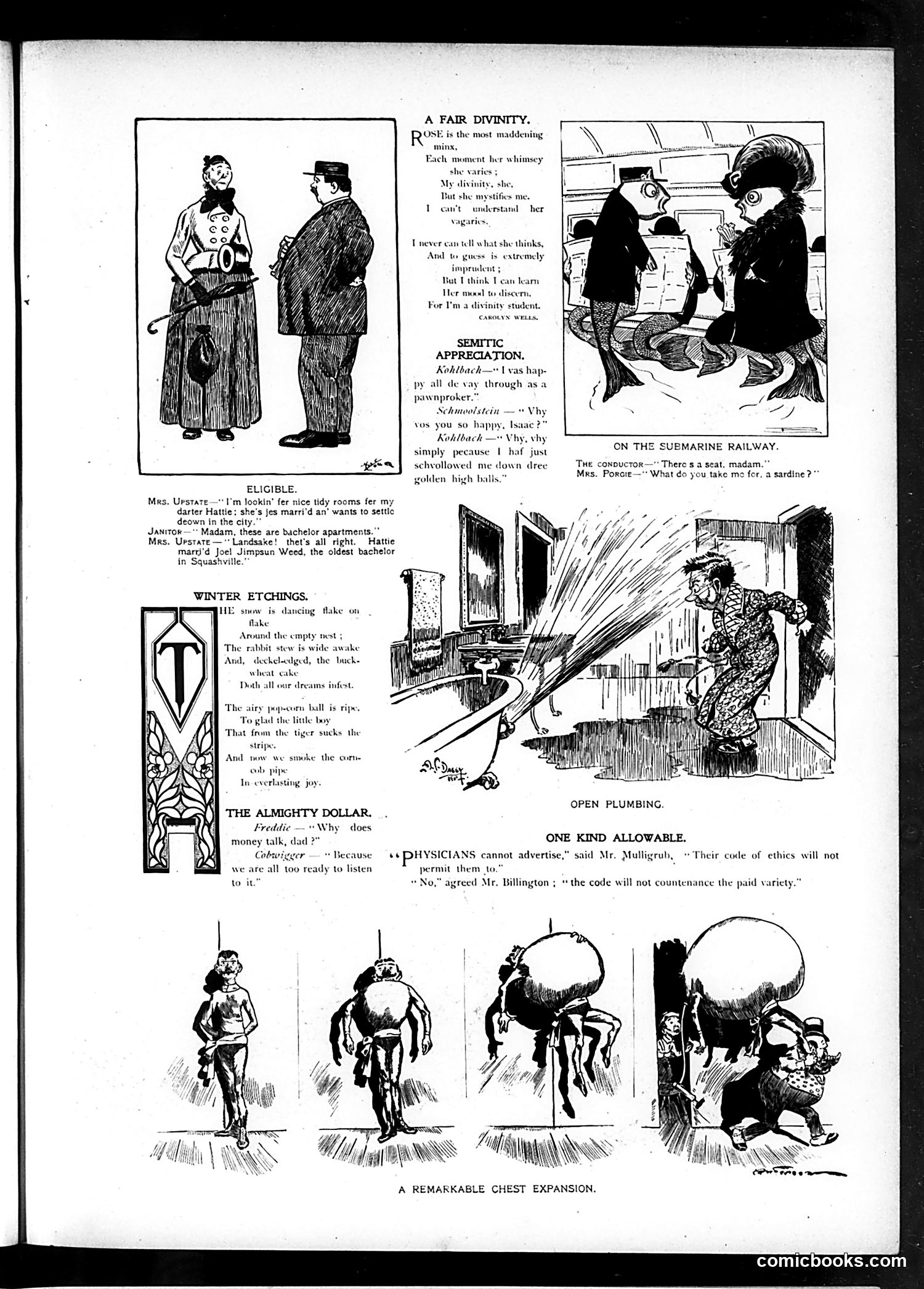
**"His Query"** (top): A young man (Josh) has been courting Miss Jane for five years, visiting seven nights weekly. He now asks if her parents have noticed—implying either marriage should happen or the courtship is becoming scandalous. The humor lies in the absurdity of such frequent, long-term unmarried visits being unacknowledged. **"Easily Identified"** (bottom): A cook receives a love letter from Pat Rooney but can't read it. When asked how she knows it's from Rooney, she explains he's the only man who knows she has seventy-seven dollars in her savings account—satirizing the stereotype of Irish immigrant suitors being primarily interested in women's money rather than romance. The heavy dialect ("shure," "Oi") reinforces ethnic caricature typical of 1901 Judge magazine.