
A complete issue · 16 pages · 1901
Judge — July 27, 1901
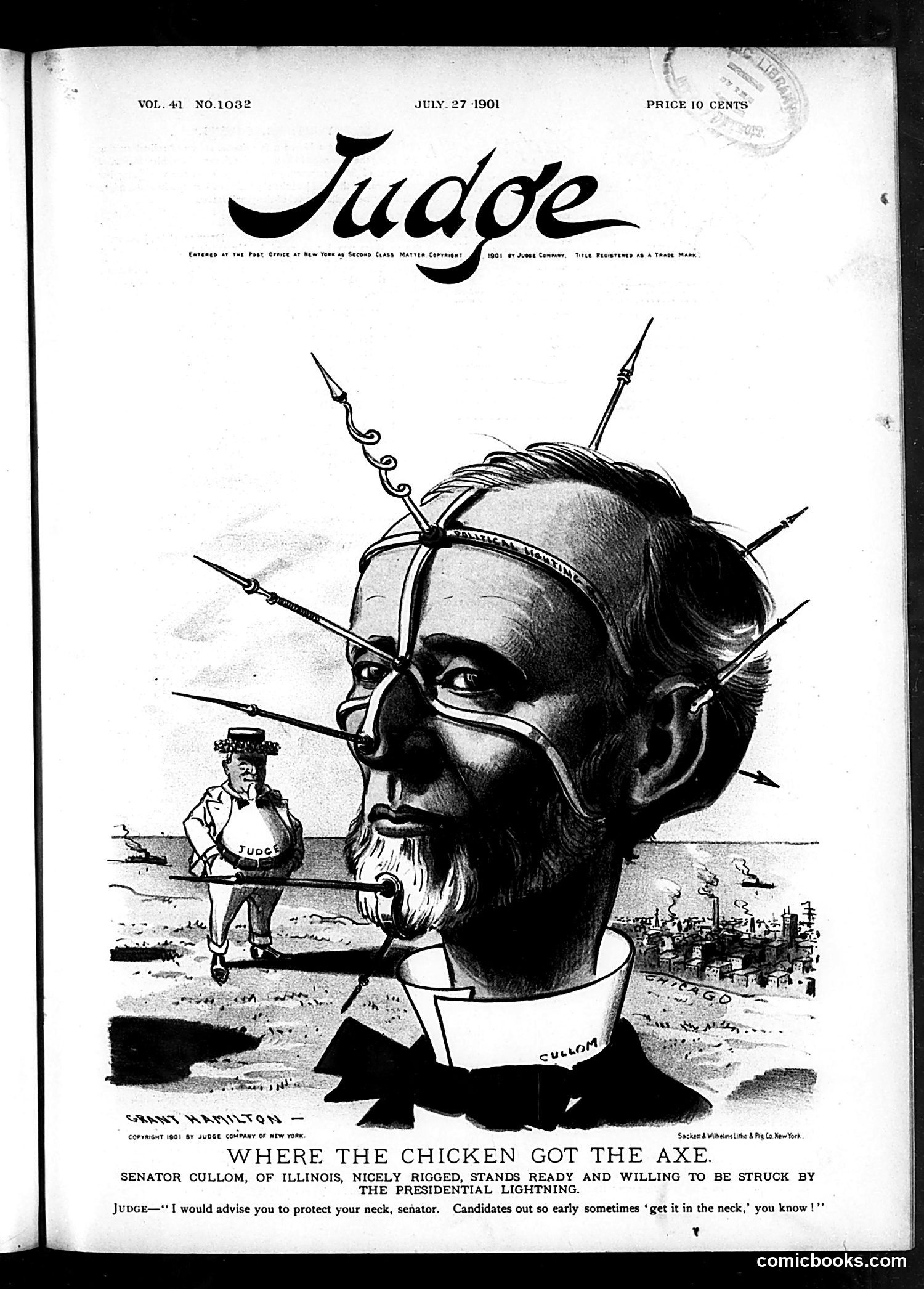
This Judge magazine cartoon (July 27, 1901) satirizes Senator Shelby Cullom of Illinois. The title references the phrase "get it in the neck"—meaning to be punished or defeated. The large caricatured head depicts Cullom as a grotesque figure pierced with spears and weapons, symbolizing political attacks. A small figure labeled "JUDGE" stands nearby, advising Cullom to "protect your neck" because presidential candidates "sometimes 'get it in the neck.'" The satire suggests Cullom faced political danger, possibly regarding presidential ambitions or factional conflict within the Republican Party. The "chicken" metaphor implies he was vulnerable or cowardly in the face of these threats. The background shows Chicago's skyline, grounding the critique in Illinois politics.
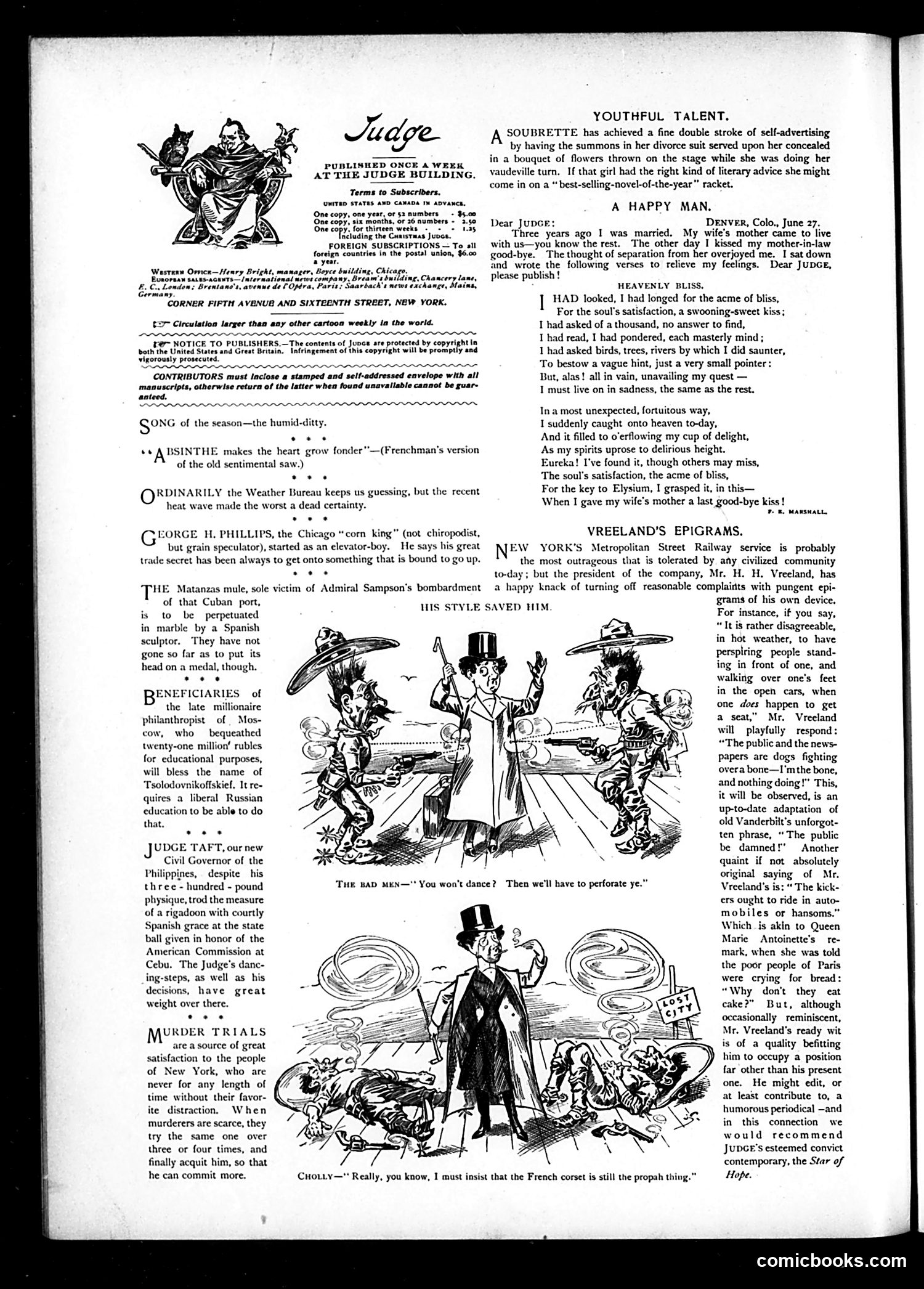
This page contains three distinct sections: **"Youthful Talent"** and **"A Happy Man"** are brief literary pieces unrelated to satire. **"Vreeland's Epigrams"** targets **H. H. Vreeland**, president of New York's Metropolitan Street Railway. The cartoons mock his dismissive response to passenger complaints about overcrowding on streetcars during hot weather. In the illustrated scenes, Vreeland responds to crowding complaints by suggesting passengers simply "won't dance" or adopt uncomfortable postures. The satire ridicules his tone-deaf, flippant replies to legitimate public grievances—he treats serious transit problems as jokes while people suffer in packed vehicles. The text notes Vreeland occasionally offers platitudes but fundamentally ignores worker welfare, making him a figure of contemporary corporate indifference to public service obligations.
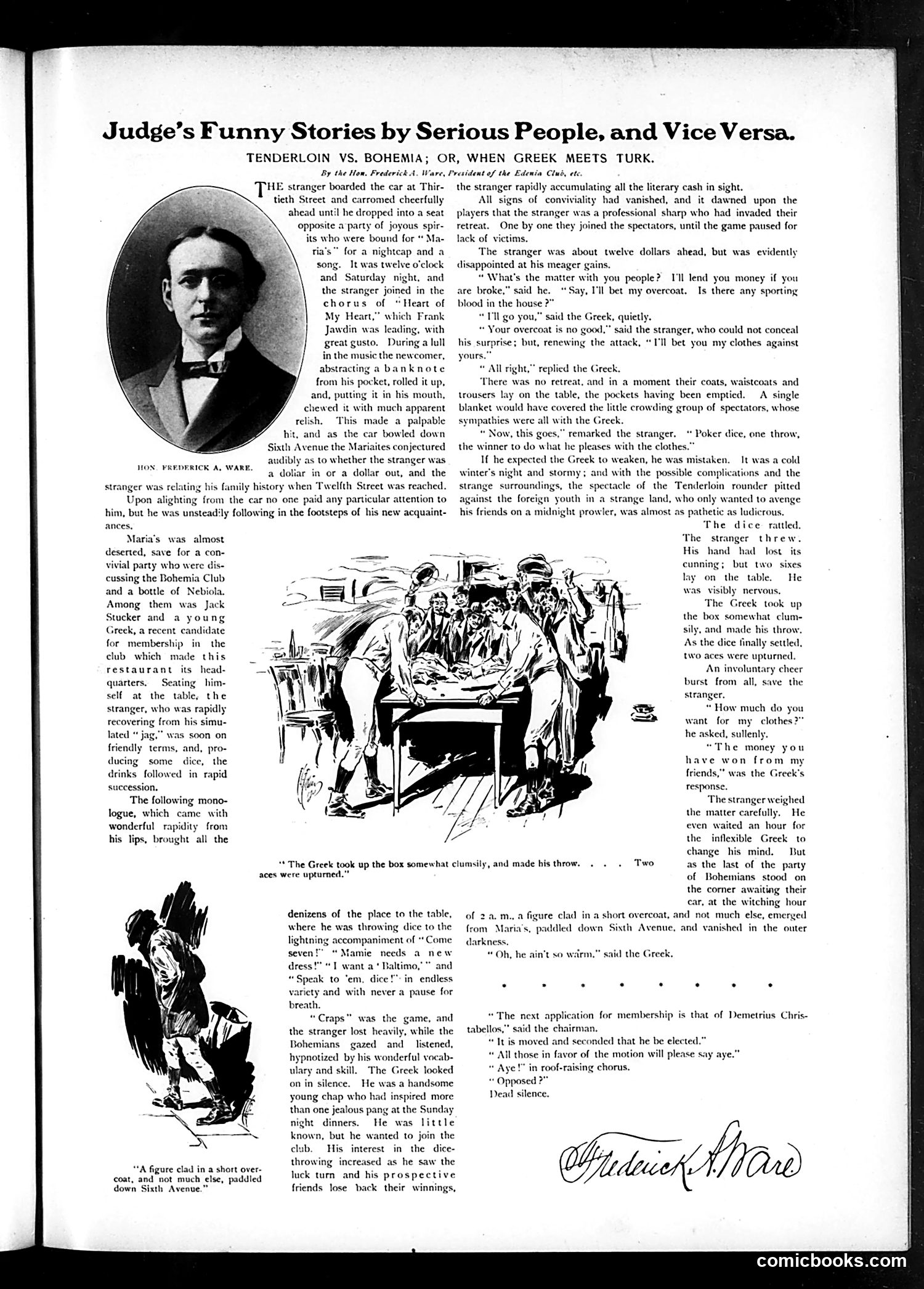
This is a humorous short story titled "Tenderloin vs. Bohemia; or, When Greek Meets Turk," by Hon. Frederick A. Wake. The narrative describes a dice game between a wealthy stranger and Greek gamblers in what appears to be 1890s New York's Tenderloin district (a vice-ridden neighborhood). The satire contrasts two social groups: the refined, upper-class "stranger" versus the street-smart Greek immigrants operating in the Tenderloin's gambling dens. The story plays on stereotypes—the "Greek" as cunning gambler, the well-dressed outsider as naïve prey. The dice game serves as a metaphor for class and ethnic conflict in urban America, with the wealthy man ultimately losing his clothes and dignity to street hustlers, despite his initial confidence and sophistication.
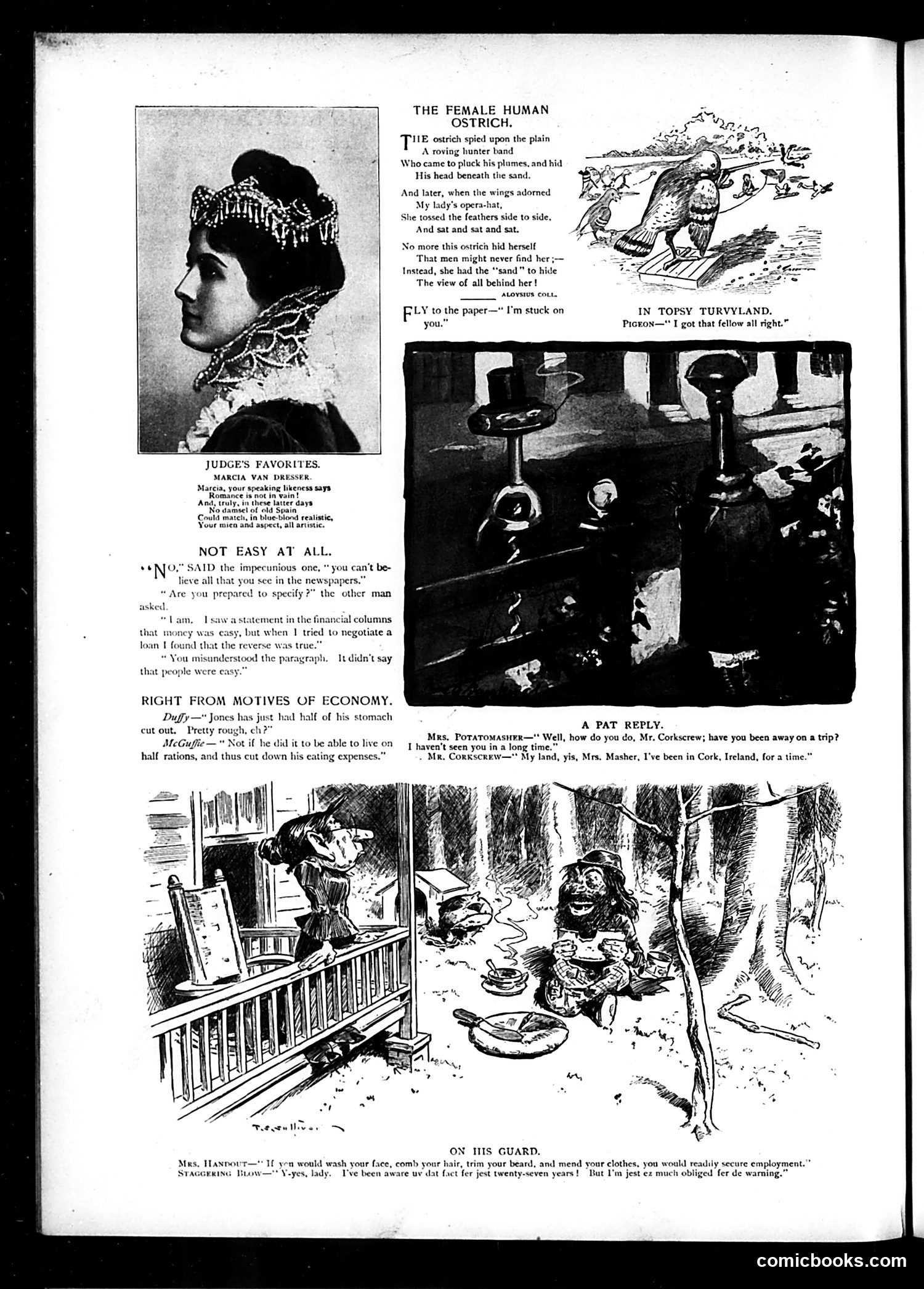
This page contains several satirical pieces targeting early 20th-century social issues: **"The Female Human Ostrich"** mocks women who hide social scandals—the ostrich metaphor suggests burying one's head to avoid embarrassment. The accompanying poem criticizes this avoidance strategy. **"In Topsy Turvyland"** appears to be a fantastical illustration, likely social commentary through absurdist imagery. **"Not Easy at All"** and **"Right From Motives of Economy"** are short satirical dialogues about financial hypocrisy and living frugally while maintaining appearances. **"On His Guard"** depicts a domestic scene with caricatured Irish servants, playing on period stereotypes about Irish immigrant workers and their supposed laziness or unreliability. The overall page reflects Judge's focus on class, gender, and ethnic stereotypes common to Edwardian-era American satire.
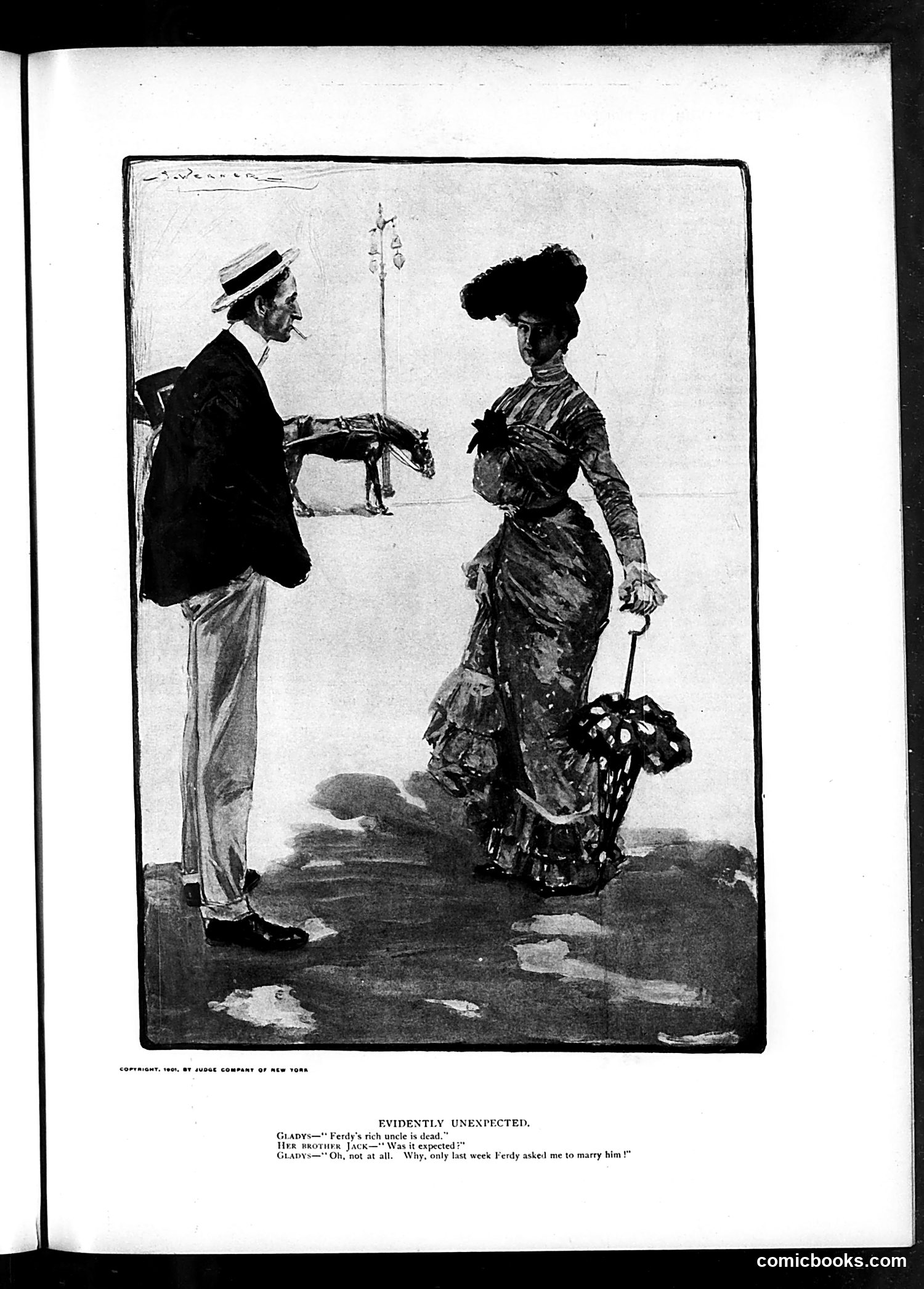
This 1901 Judge cartoon satirizes fortune-hunting in courtship. A wealthy woman named Gladys reports that her friend Ferdy's rich uncle has died unexpectedly. When asked if the death was anticipated, Gladys notes it definitely was not—because Ferdy had just proposed to her the previous week, implying his proposal was motivated by inheritance prospects rather than genuine affection. The joke targets the social practice of men pursuing wealthy women or women with wealthy relatives for financial gain. By timing Ferdy's proposal just before his uncle's death, the cartoon suggests his romantic interest was purely mercenary. The satire critiques both male opportunism and the shallow marriage market among the wealthy classes.
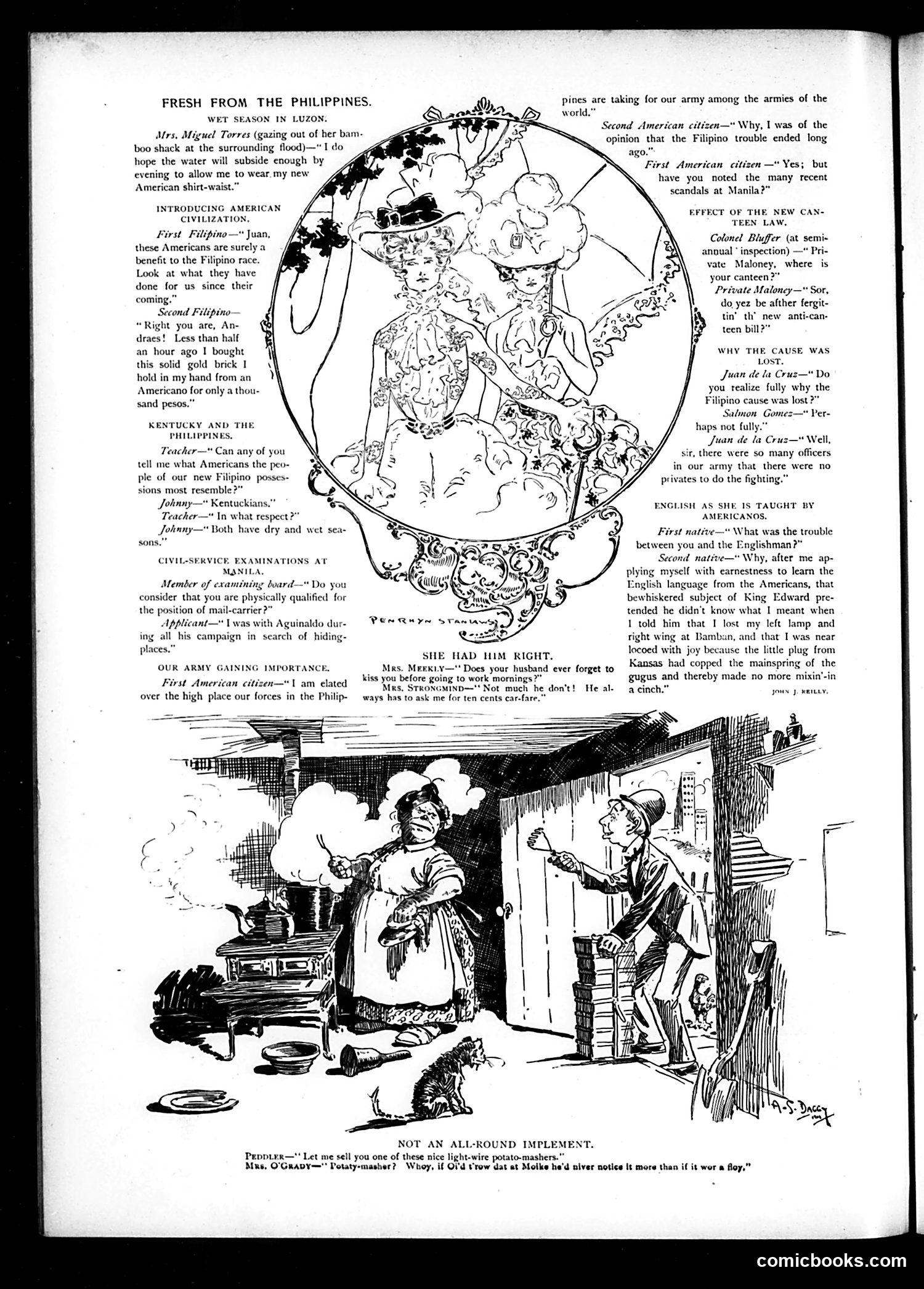
This Judge magazine page satirizes American involvement in the Philippine-American War (1899-1902) and colonial administration. The cartoons mock: **Colonial exploitation**: Filipinos are depicted as naive, being swindled by Americans (the "gold brick" scam). The title "Introducing American Civilization" is ironic—Americans bring not progress but corruption. **Military inefficiency**: Jokes about civil-service exams, officers outnumbering enlisted men, and scandals at Manila criticize American military management in the Philippines. **Language barrier humor**: Filipinos learning English from Americans creates absurd misunderstandings—mixing military slang with broken English for comic effect. **Wet season flooding**: Opens the piece, establishing the harsh conditions of colonial life in Luzon. The satire targets American imperialist claims about "civilizing" the Philippines, suggesting instead that Americans are merely profiteering scoundrels. The overall tone is cynical about U.S. colonial mission legitimacy.
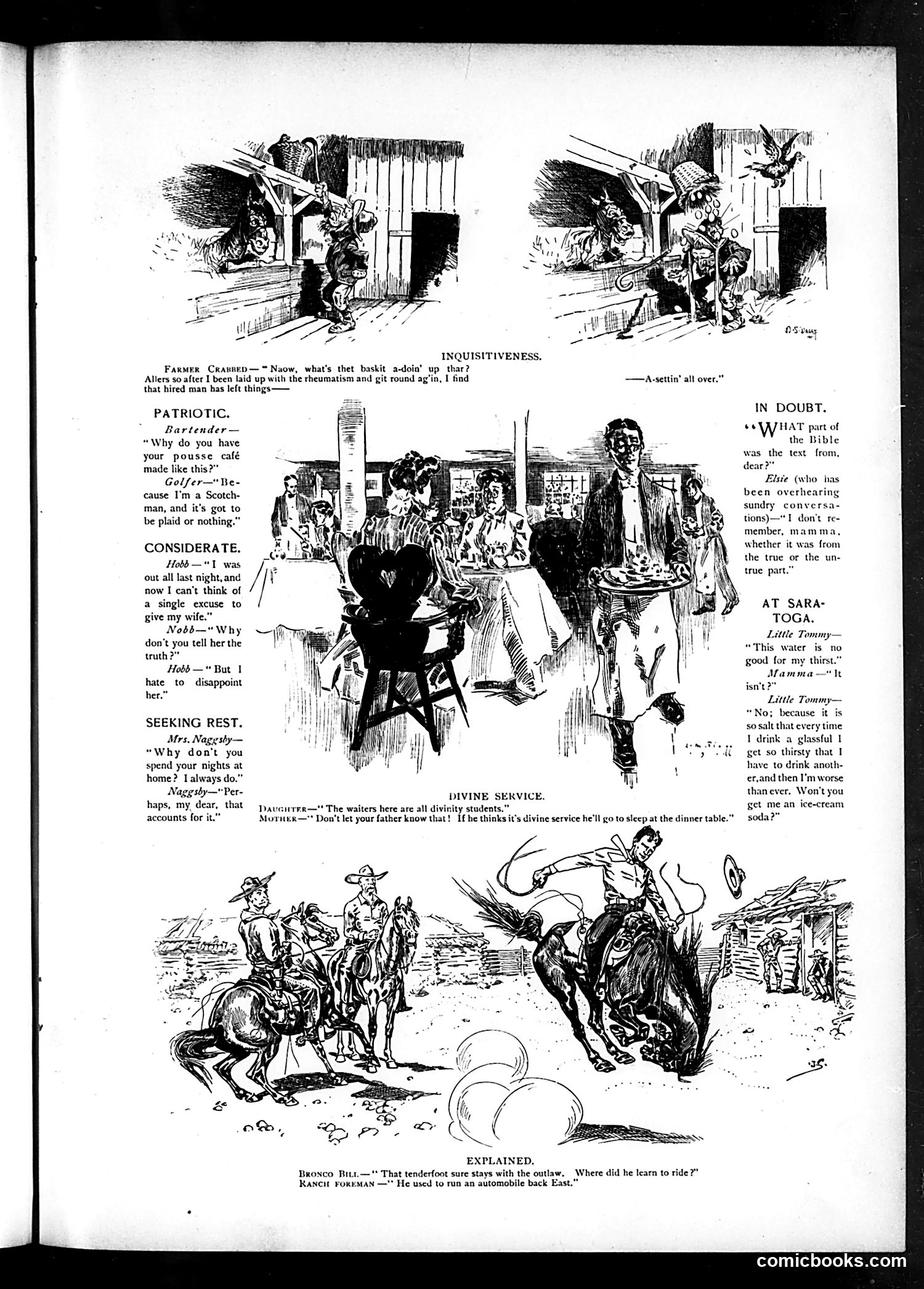
This page collects brief humorous vignettes mocking various social types and situations circa early 1900s: **"Inquisitiveness"** jokes about a farmer finding his hired man's basket left behind—implying the worker abandoned his post. **"Patriotic"** satirizes Scottish frugality: a golfer demands his pousse café (layered drink) be "plaid or nothing," conflating Scottish tartans with thrift. **"Considerate"** and **"Seeking Rest"** are domestic humor—husbands making excuses to avoid wives. **"Divine Service"** mocks working-class aspiration: waiters claiming to be divinity students, with the joke that the father wouldn't notice them sleeping if he believed the premise. **"In Doubt"** jokes about biblical literacy among women. **"At Saratoga"** features a child's logic about salt water causing excessive thirst. **"Explained"** satirizes Eastern urbanites: an "automobile back East" has apparently prepared someone for wild-west horseback riding, inverting expectations about rural versus urban skills. The humor targets class pretension, regional stereotypes, and marital discord typical of *Judge's* satirical approach.
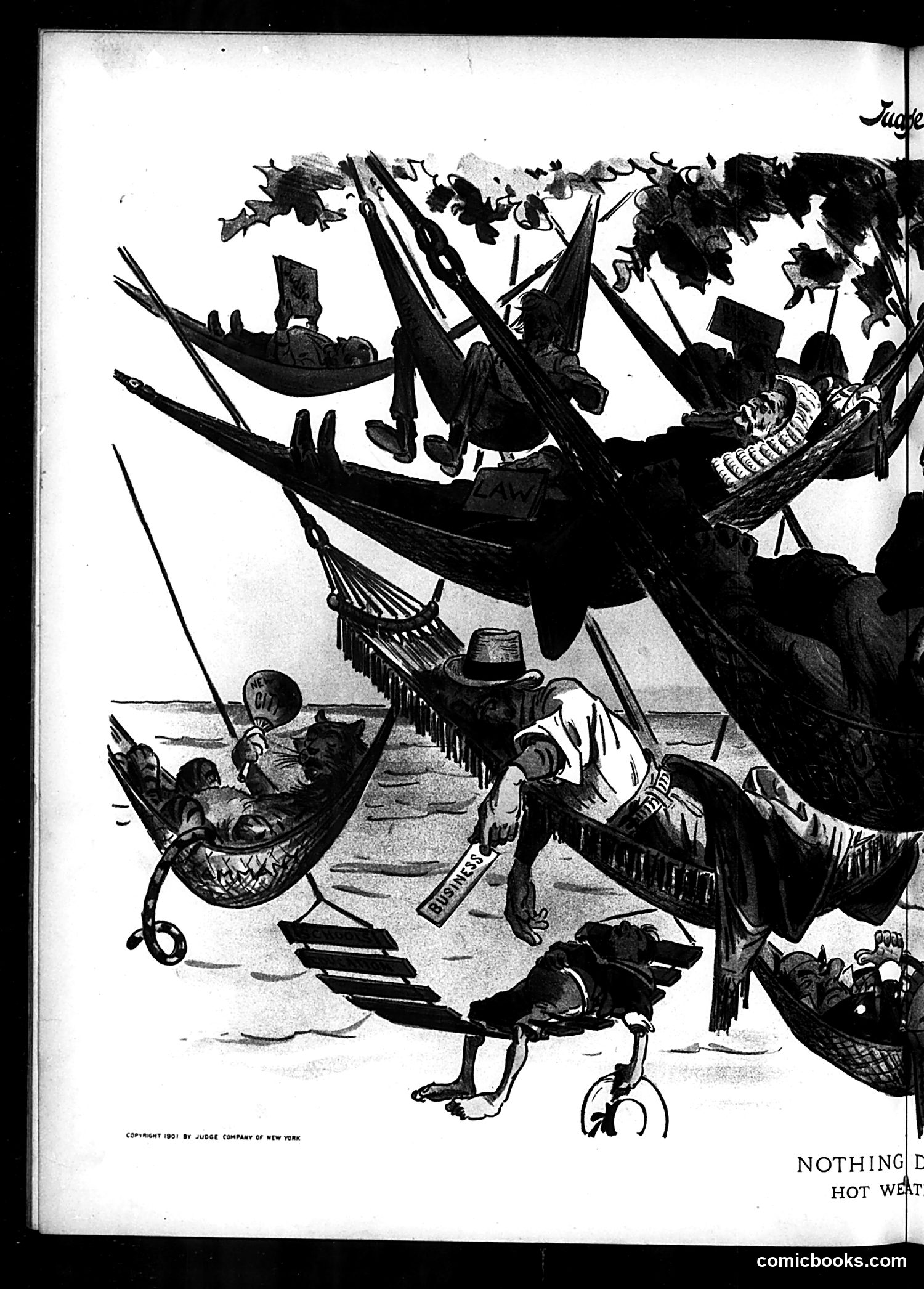
This 1901 Judge magazine cartoon depicts gondoliers (Venetian boatmen) in a stylized scene. The figures appear to represent political or social commentary through caricature, though the specific identities are unclear from the image alone. The scene shows multiple figures in hammocks or suspended positions among gondolas, with exaggerated facial features typical of Judge's satirical style. The composition suggests leisure or idleness contrasted with labor. Without clearer text identifying the figures or the specific political context referenced, I cannot definitively explain which contemporary events or politicians this targets. The visible partial text "NOTHING" and "HOT WEA[THER]" suggests the theme may relate to weather, leisure, or inactivity during summer months—a common Judge satirical subject.
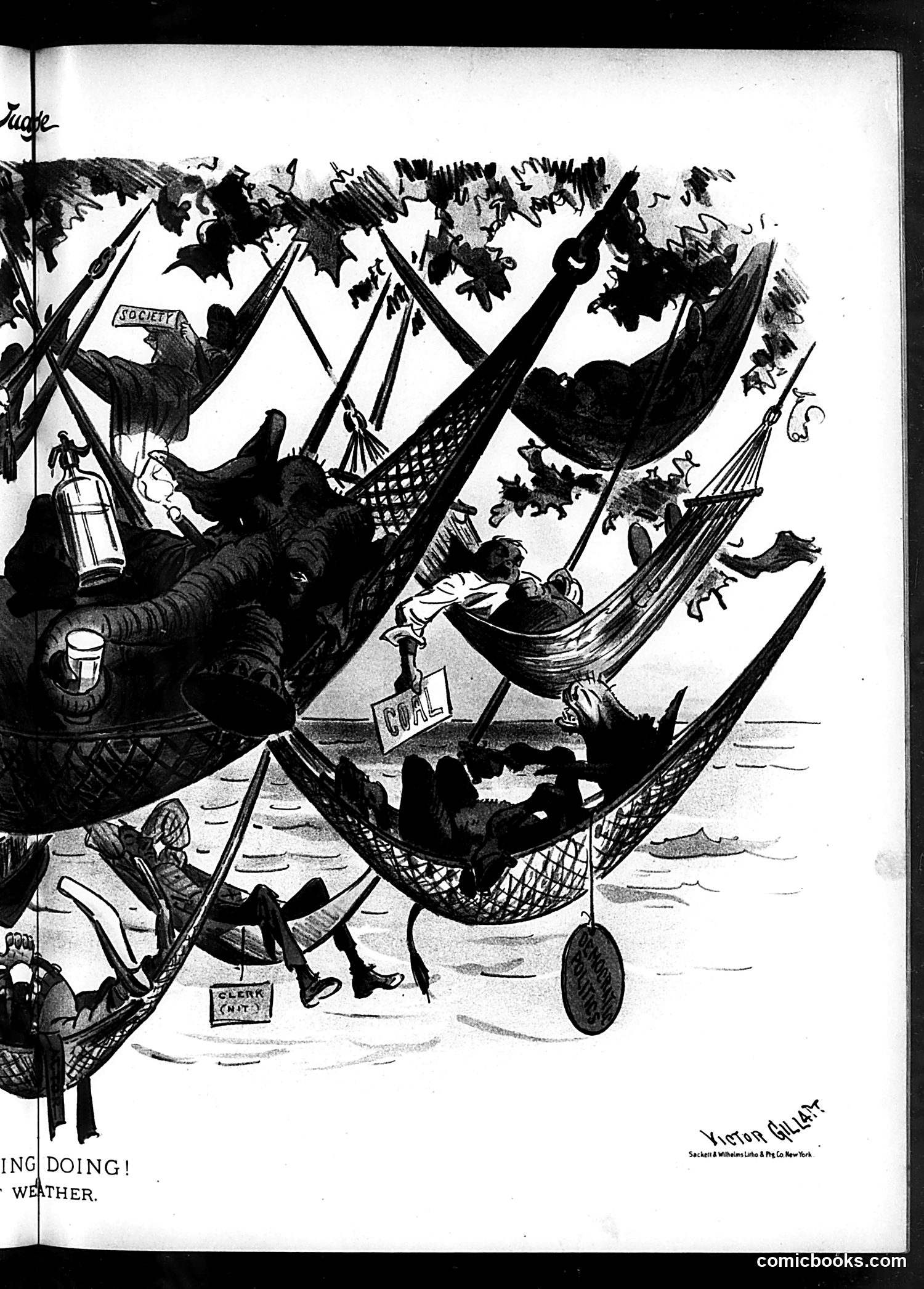
This cartoon by Victor Gillam depicts figures lounging in hammocks strung between ships or vessels, appearing idle and carefree. Visible labels include "SOCIETY," "GOAL," and "CLERK HAT," suggesting commentary on different social classes. The scene portrays leisure and relaxation while what appears to be work or duty (suggested by the ships and water setting) continues around them. The satire likely critiques social idleness or complacency—possibly targeting the wealthy ("Society") or bureaucratic classes ("Clerk") for avoiding responsibility while others labor. The contrast between the comfortable loungers and the active maritime setting implies a commentary on class privilege or shirking of civic/professional duties during a period when work and productivity were culturally emphasized. Without the full page context or date, the specific historical reference remains unclear.
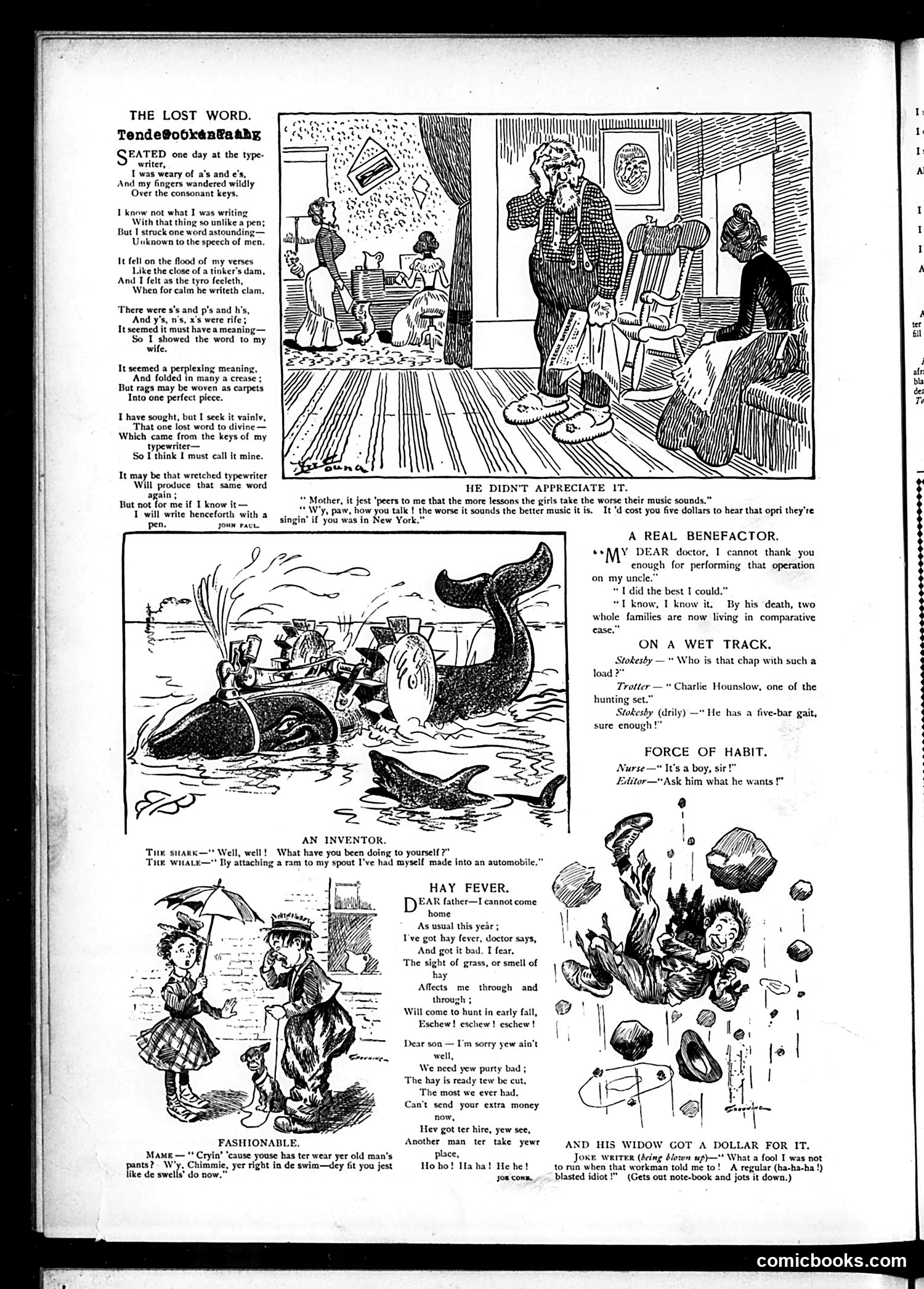
This page contains several short humorous sketches typical of *Judge* magazine's satirical content: **"The Lost Word"** is a whimsical poem about a typist who accidentally strikes an incomprehensible word on their typewriter, unable to reproduce or explain it—poking fun at the mechanical unpredictability of early typewriters. The other sketches mock everyday absurdities: a father praising his daughter's worse musical performances as "better music," a doctor praised for an operation that benefited the patient's family by his death, a hunter with an awkward gait, a new father asking what his newborn son "wants," and a young man claiming he converted his horse into an automobile. The "Hay Fever" and "Fashionable" pieces use dialect humor common to the era—rural/working-class speech patterns—while "And His Widow Got a Dollar" jokes darkly about a workman's fatal accident being financially worthwhile. These are light, pun-driven satirical vignettes typical of early-20th-century American humor magazines.
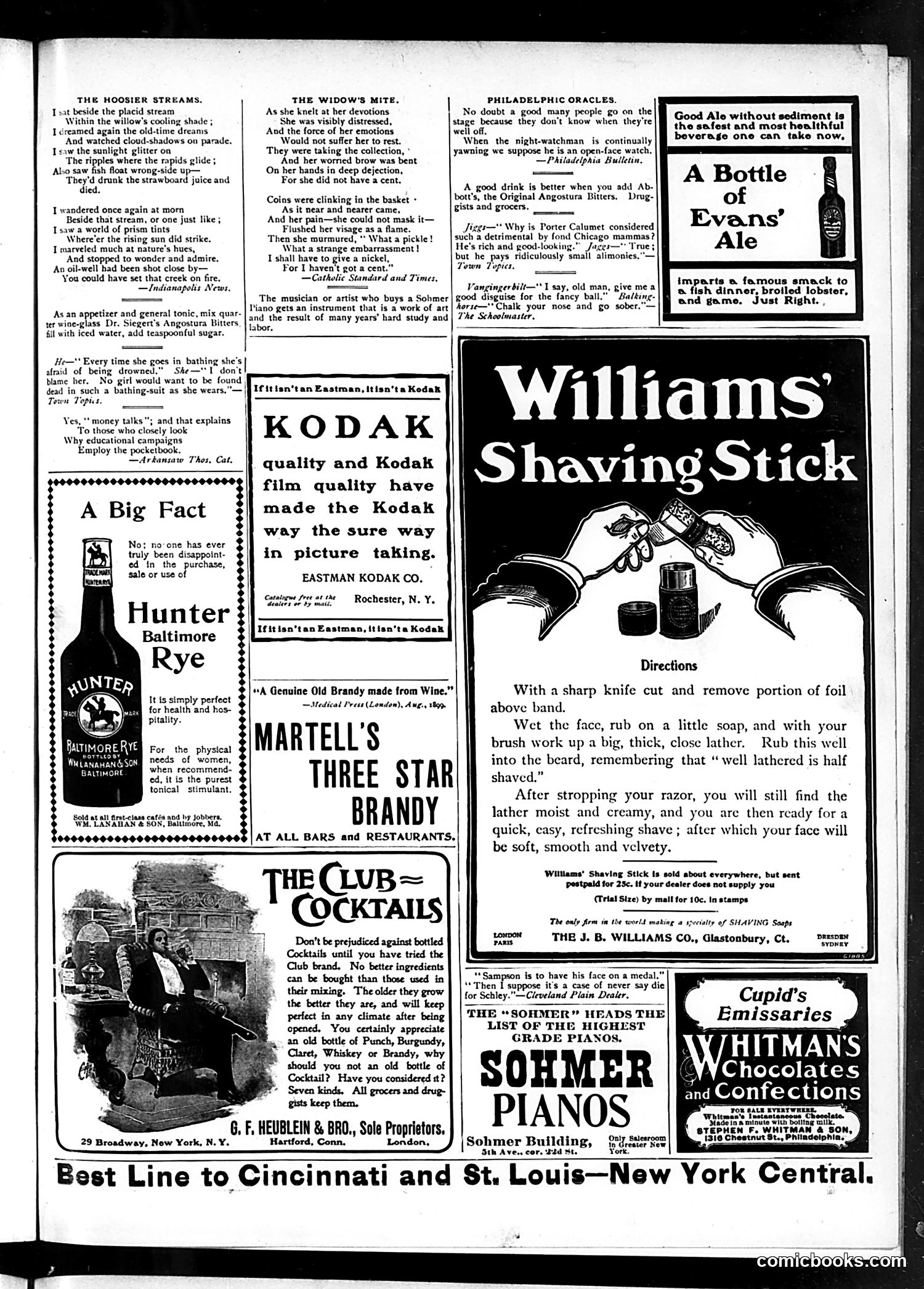
This page is primarily **advertising** mixed with short humorous newspaper items (jokes and brief poems). The poems in the left column—"The Hoosier Streams," "The Widow's Mite," and "Philadelphic Oracles"—are lighthearted satirical observations. "The Widow's Mite" jokes about a poor woman embarrassed when the church collection plate reaches her; "The Hoosier Streams" includes a dark joke about oil pollution killing fish. These reflect early-20th-century social concerns: poverty, industrial pollution, and religious hypocrisy. The scattered jokes reference contemporary figures and scandals (references to "Porter Calumet" and Vanderbilt suggest wealthy society gossip). The bulk of the page is **product advertisements**: Hunter Rye whiskey, Kodak cameras, Martell brandy, Sohmer pianos, Williams' Shaving Stick, and various beverages. These ads target middle-to-upper-class male readers. There is **no single political cartoon** here—rather, this is a typical Judge magazine layout mixing satirical verse, social humor, and paid advertising.
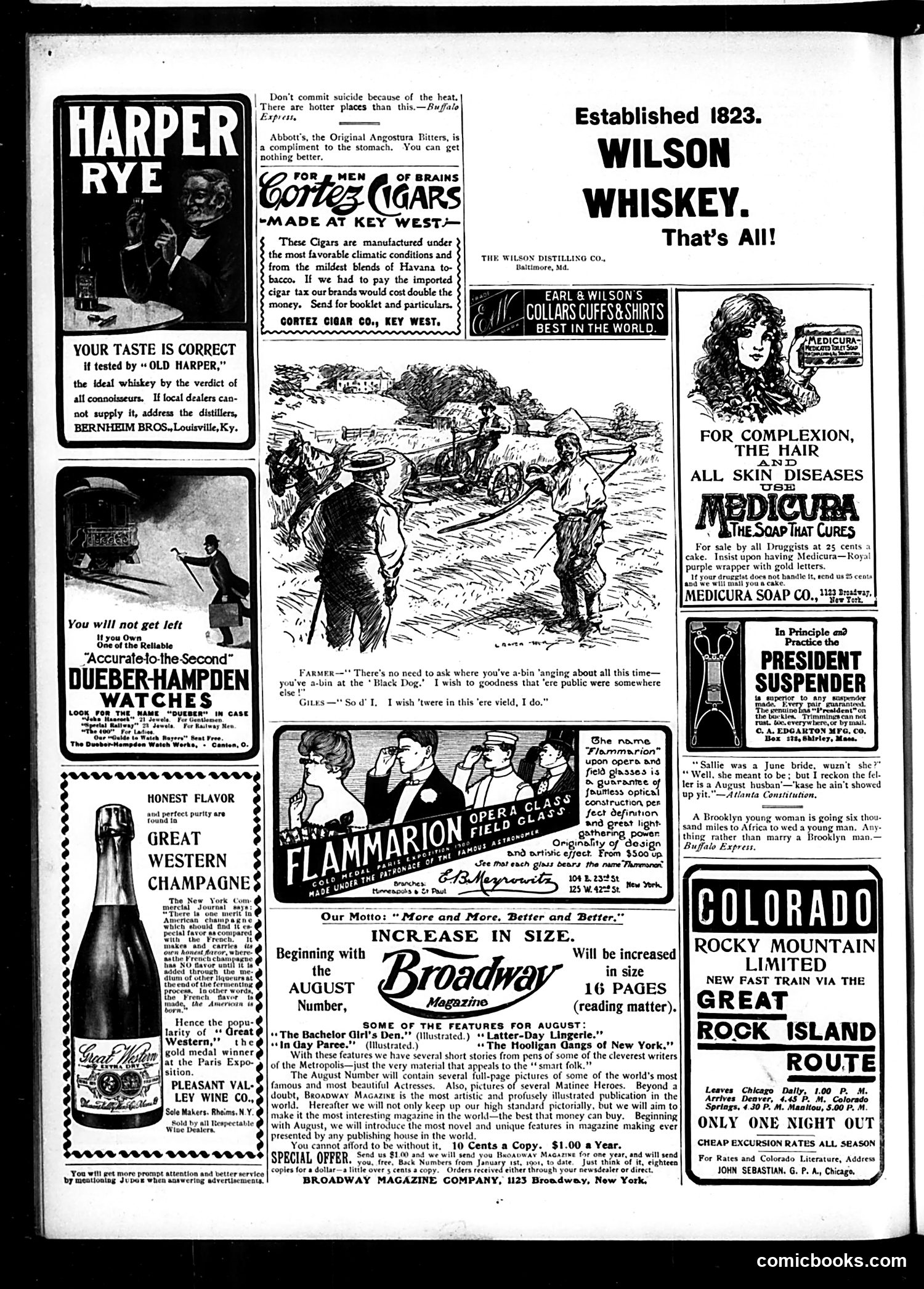
This is primarily an **advertising page** from Judge magazine, with one small cartoon at the bottom center. ## The Cartoon The single cartoon depicts two rural laborers ("Farmer" and "Giles") discussing their complaint about the public visiting a nearby field—likely during harvest time. The joke is simple working-class grumbling: Farmer wishes the bothersome public would go elsewhere; Giles darkly agrees he wishes they'd disappear entirely. It's gentle rural satire about trespassing and privacy, with no deeper political meaning. ## The Advertisements The page is dominated by period product ads: whiskey (Harper Rye, Wilson Whiskey), cigars, watches, soap, champagne, suspenders, and other goods typical of early 1900s publications. There's also promotional copy for **Broadway Magazine's** August expansion to 16 pages, and a train advertisement for the Great Rock Island Route. No significant political commentary or social satire is present on this page—it's essentially a commercial vehicle with a light rural joke.
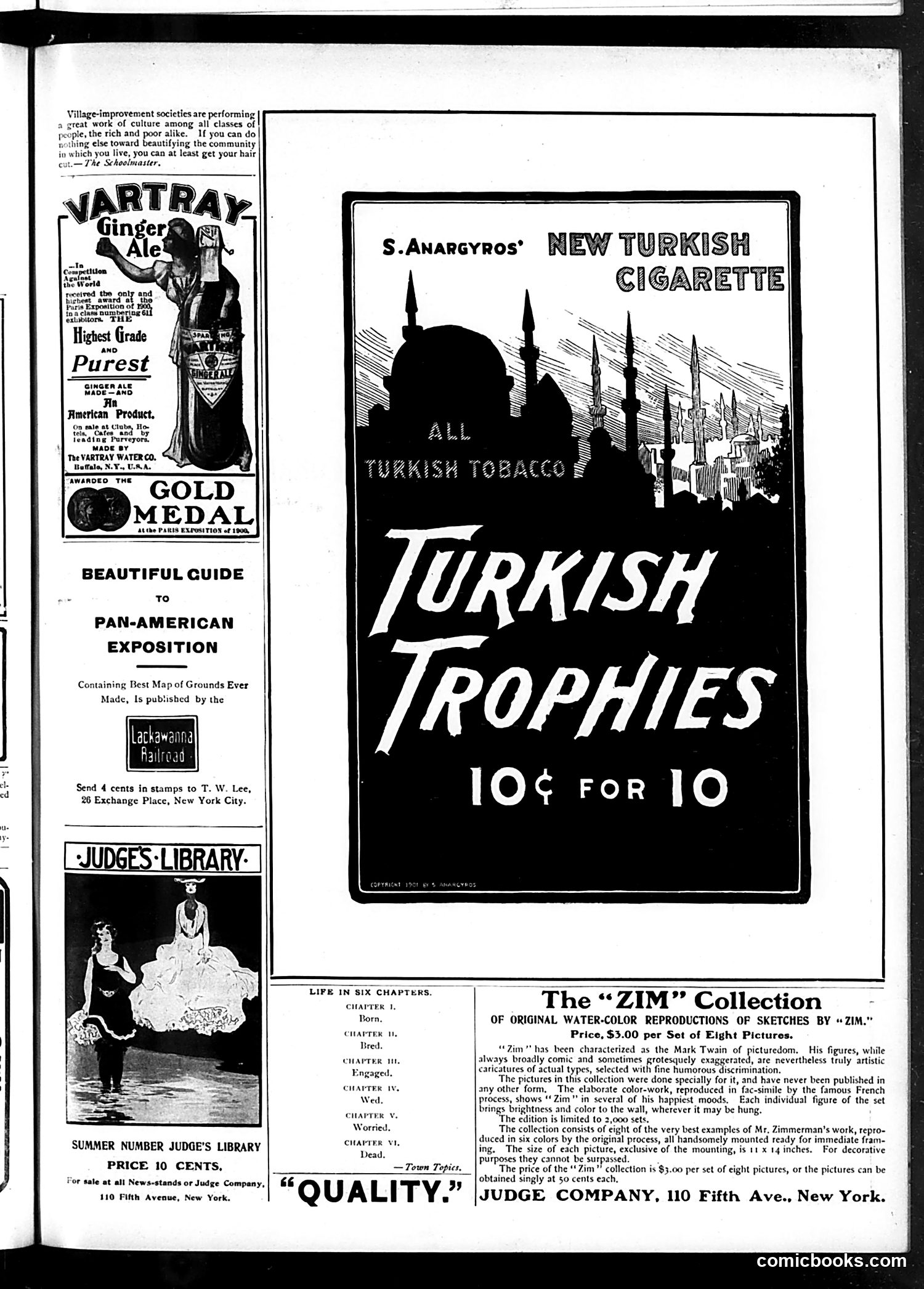
This page is primarily **advertising and promotional content** rather than satirical cartoons. The main elements include: 1. **Vartray Ginger Ale ad** (left): A commercial for an American beverage that won a gold medal at the 1900 Pan-American Exposition. 2. **Turkish Cigarette ad** (center): S. Anargyros brand cigarettes marketed as "All Turkish Tobacco," priced at 10¢ for 10. Features a silhouetted Turkish cityscape with minarets—playing on contemporary American fascination with "exotic" Ottoman imagery. 3. **Guide to Pan-American Exposition**: A railroad company promoting a travel guide to a major 1901 world's fair. 4. **Judge's Library ads**: Promoting the magazine's book collections at 10¢. 5. **"Zim" Collection**: Art reproductions by cartoonist Zimmerman, marketed as comedic caricatures. The only quasi-satirical content is a brief quote about village improvement societies and haircuts, suggesting modest self-improvement. Otherwise, this is a typical magazine advertisements page showcasing period consumer goods and entertainment options.
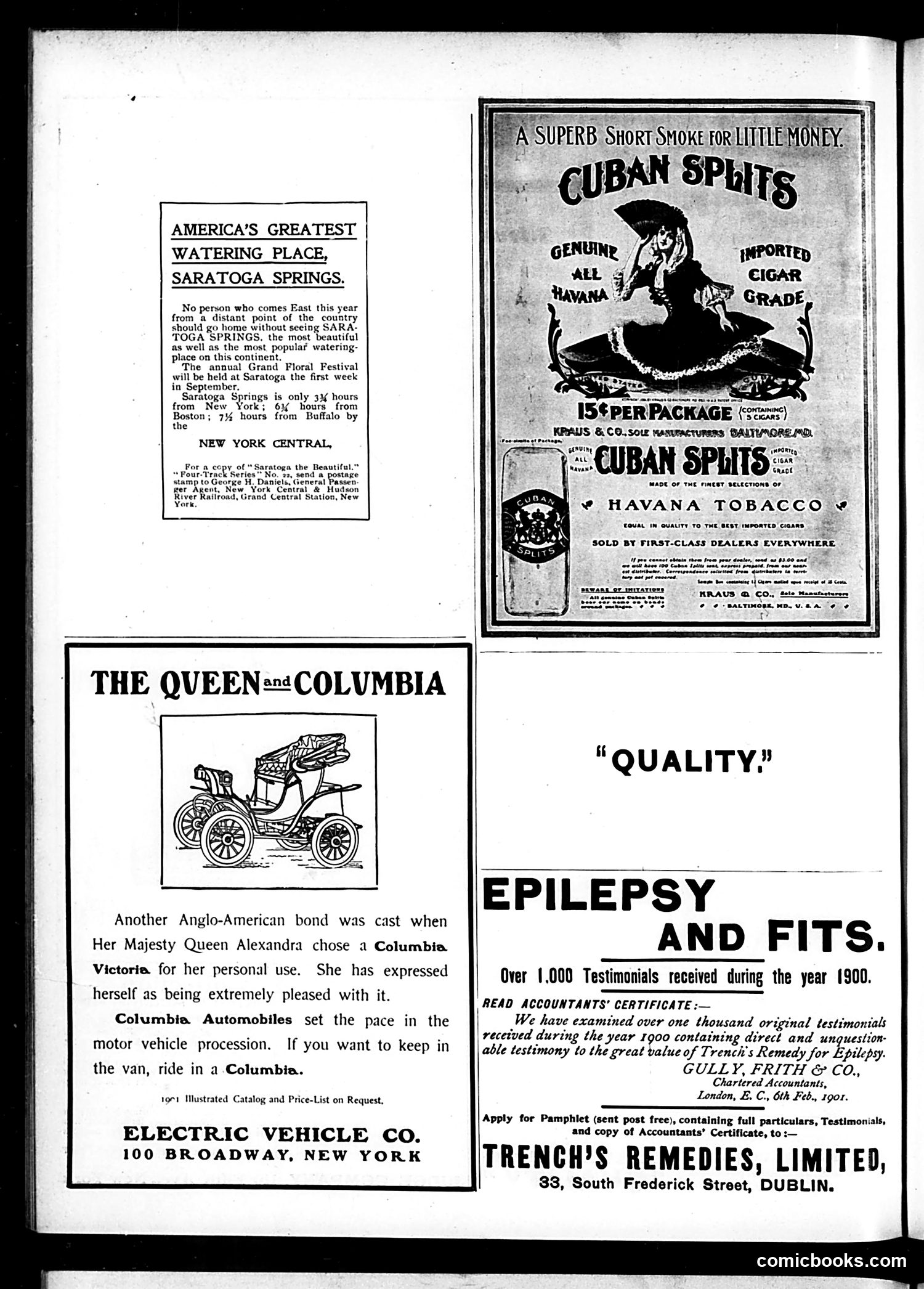
This page is primarily **advertisements** rather than editorial content or satire. It contains four distinct ads: 1. **Saratoga Springs tourism ad** - promoting the upstate New York resort as "America's Greatest Watering Place," accessible via New York Central Railroad. 2. **Cuban Splits cigars** - marketing cheap cigars (15¢ per package) as "genuine Havana" tobacco, appealing to budget-conscious smokers. 3. **Columbia Automobiles** - featuring an anecdote that Queen Alexandra (wife of King Edward VII) chose a Columbia Victoria for personal use, leveraging royal endorsement to suggest the automobiles "set the pace." 4. **Trench's Remedies** - a patent medicine claiming to treat epilepsy and fits, citing over 1,000 testimonials and an accountant's verification (a common advertising tactic of the era). The ads reflect early 1900s consumer culture: leisure travel, affordable luxuries, new automotive technology, and unregulated medicinal claims. No cartoon or satire is present on this page.
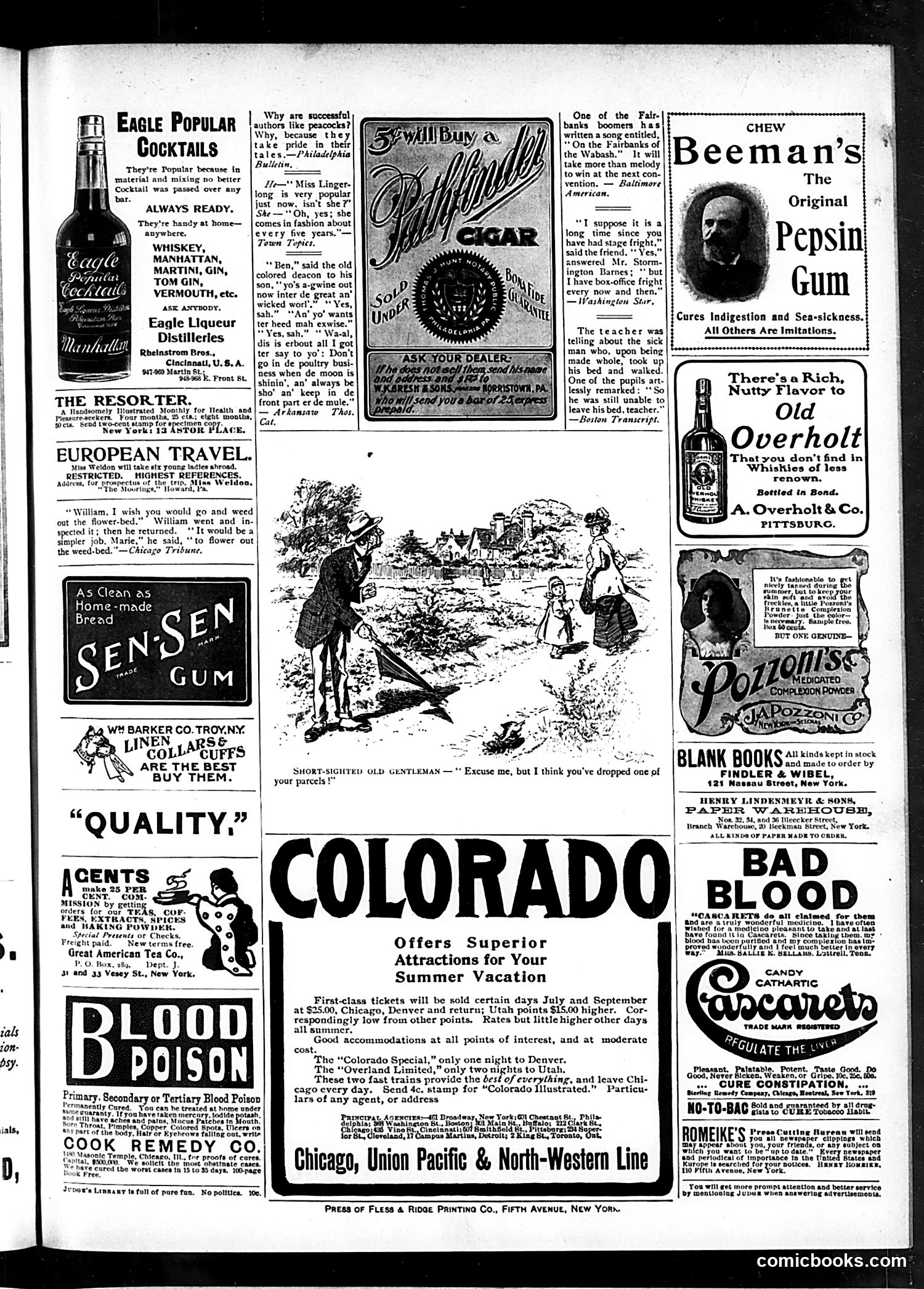
This page from *Judge* magazine is primarily **advertising**, not political satire. The layout consists of commercial ads for period products (Eagle Popular Cocktails, Beeman's Pepsin Gum, linens, patent medicines) interspersed with brief humorous anecdotes and wordplay. The central cartoon depicts a **short-sighted elderly gentleman** who mistakes a person's leg for a dropped parcel—a visual pun playing on his poor eyesight. The joke is straightforward physical comedy about misperception. The surrounding text contains light social humor (references to fashionable Miss Linger-Long, a Fairbanks political boom song, and a deacon's folk wisdom about mule-handling). None carries sharp political critique. The large Colorado travel advertisement dominates the lower portion, promoting summer vacation packages via Chicago, Union Pacific & North-Western Line—reflecting the page's primary commercial purpose rather than satirical intent.
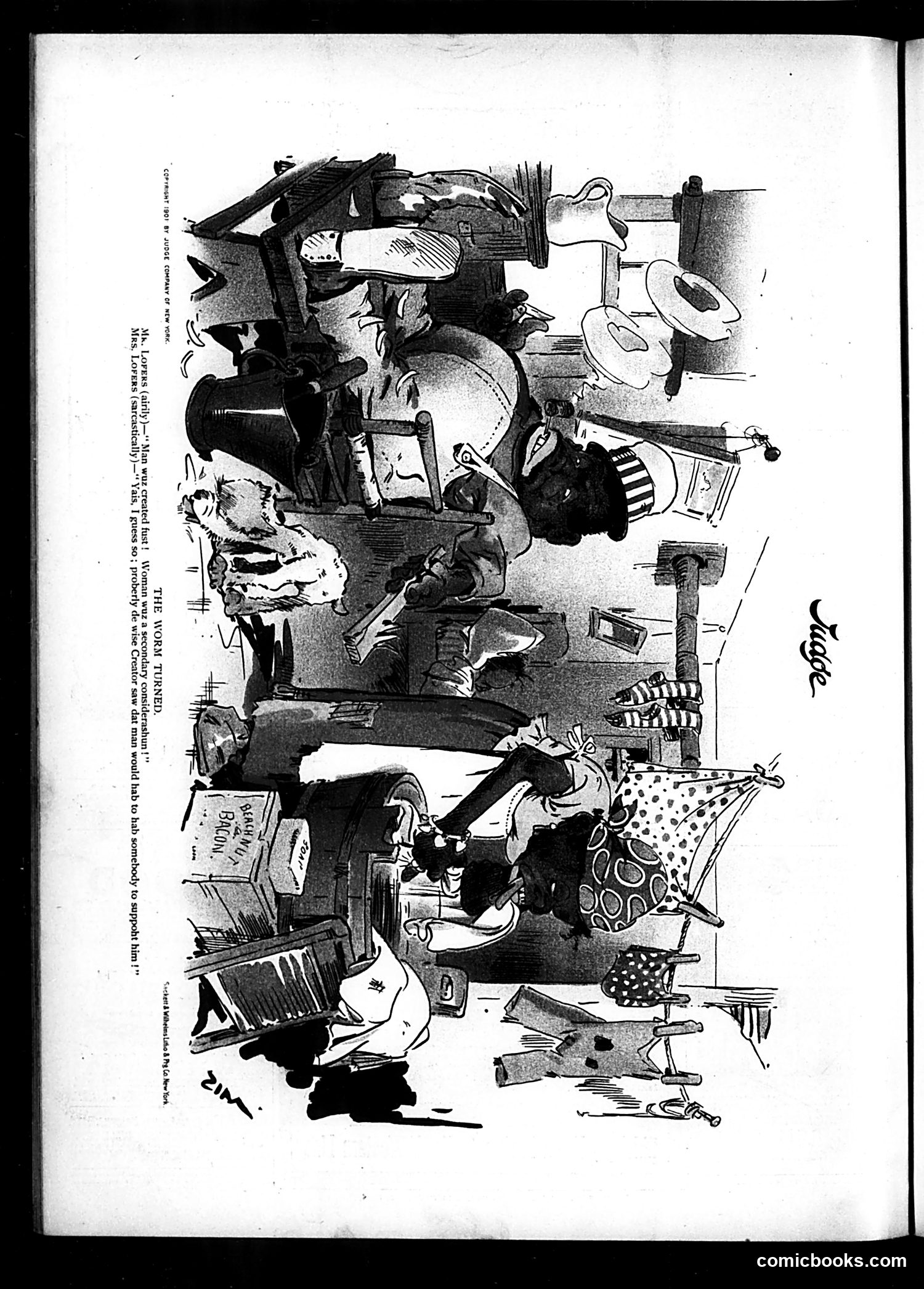
This is a satirical cartoon titled "The Worm Turned," depicting a debate about women's roles and equality. The dialogue—rendered in stereotypical dialect—shows two figures arguing about whether women are "secondary" to men or exist primarily to "support" men. The satire mocks anti-feminist arguments of the era by exaggerating the absurdity of men's claims to superiority. The "worm turned" title suggests women are pushing back against traditional subordination. The condescending tone and dialect caricature suggest Judge is ridiculing these defensive male perspectives as outdated and foolish. This reflects late 19th/early 20th-century women's suffrage debates, when women increasingly challenged their legal and social subordination. The cartoon appears to support women's equality by portraying anti-feminist arguments as laughably backwards.