
A complete issue · 16 pages · 1901
Judge — June 22, 1901
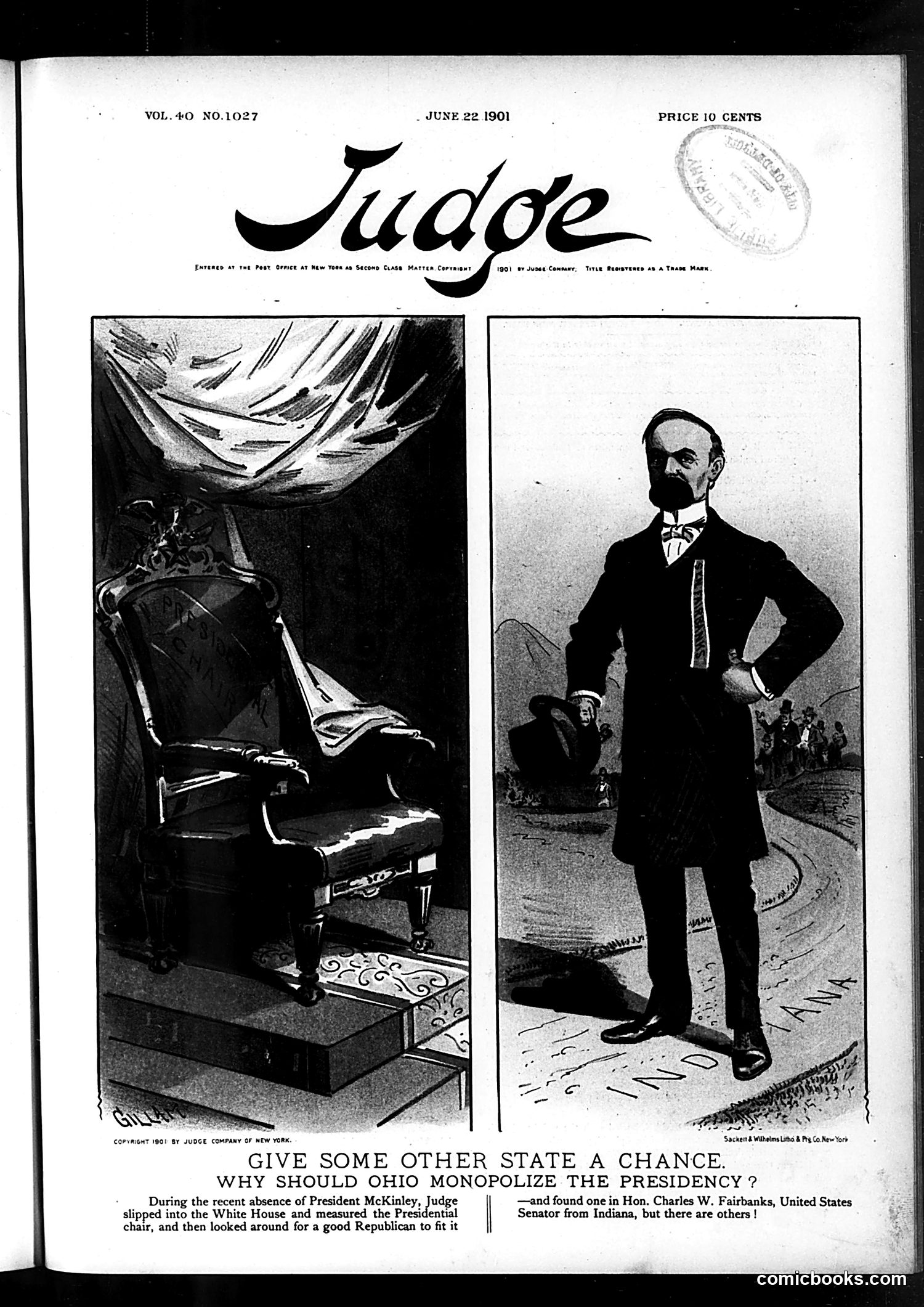
This *Judge* magazine cover from June 22, 1901, satirizes Ohio's dominance in American presidential politics. The headline questions "Why should Ohio monopolize the Presidency?" **The Visual Joke:** The left panel shows an ornate presidential chair positioned on a platform—suggesting Ohio has claimed or "owns" the office. The right panel depicts a well-dressed man (likely representing Ohio or an Ohio politician) standing possessively beside it. **Historical Context:** By 1901, multiple recent U.S. presidents had Ohio connections, including William McKinley (then current president, born in Ohio). The satire criticizes this regional monopoly on executive power, arguing other states deserve equal opportunity to produce presidents. The cartoon reflects 19th-century concerns about balanced regional representation in national politics.
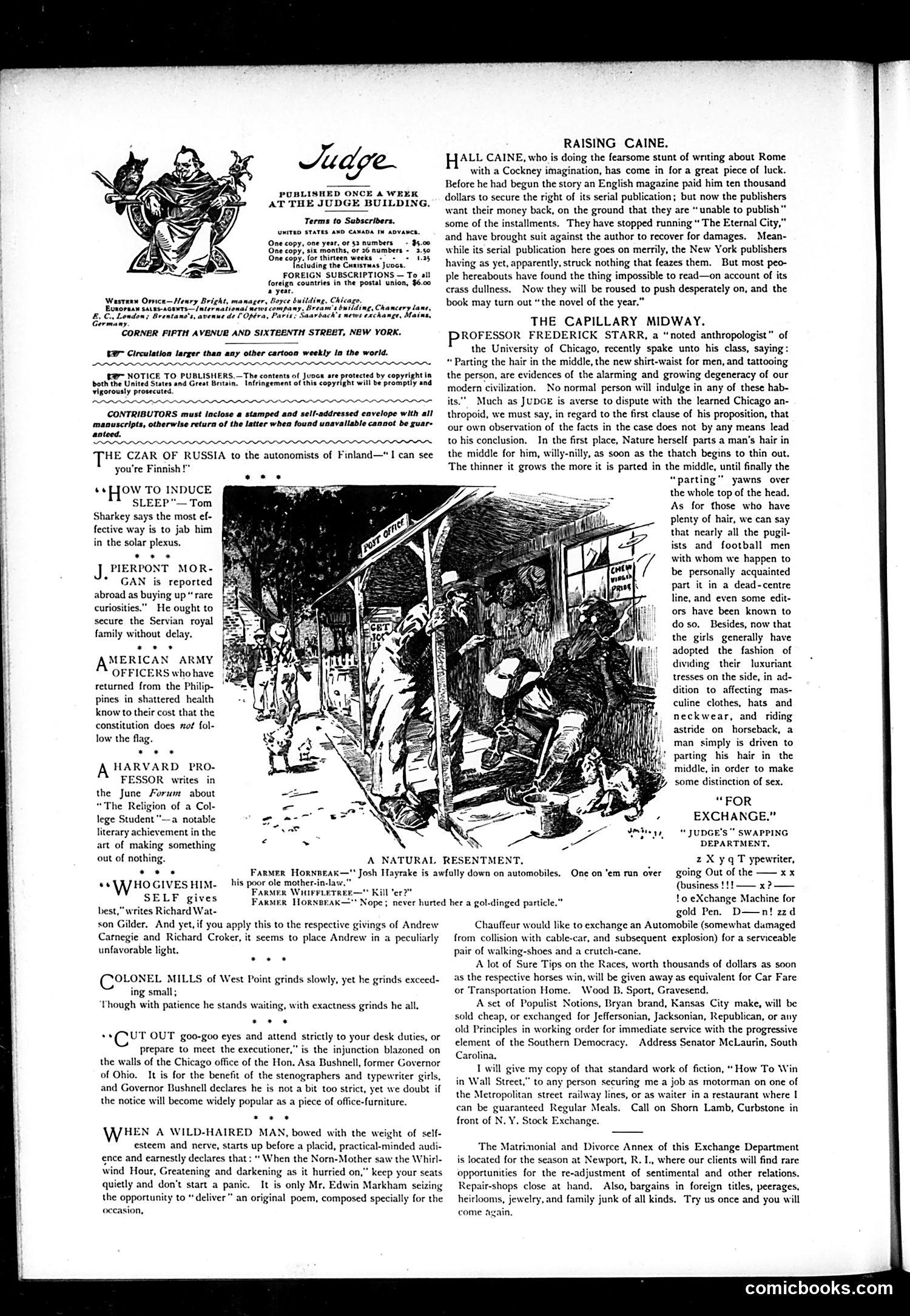
This cartoon depicts a farmer confronting an automobile driver after the car has hit the farmer's dog. The caption reads: "Farmer Hornbeam—'Josh Hayroke is awfully down on automobiles. One on 'em run over his prize dog last night.'" The punchline response is: "Farmer Hornbeam—'Nope; never hurted her a gold-digged particle.'" **The satire**: This mocks rural resentment toward automobiles in the early automotive era. The joke plays on the farmer's unexpected indifference—the dog wasn't valuable (not a "gold-digger"), so he bears no grudge. It reflects contemporary tensions between rural and urban/modern lifestyles, with farmers stereotypically portrayed as curmudgeonly about new technology, yet ultimately pragmatic rather than principled in their opposition.
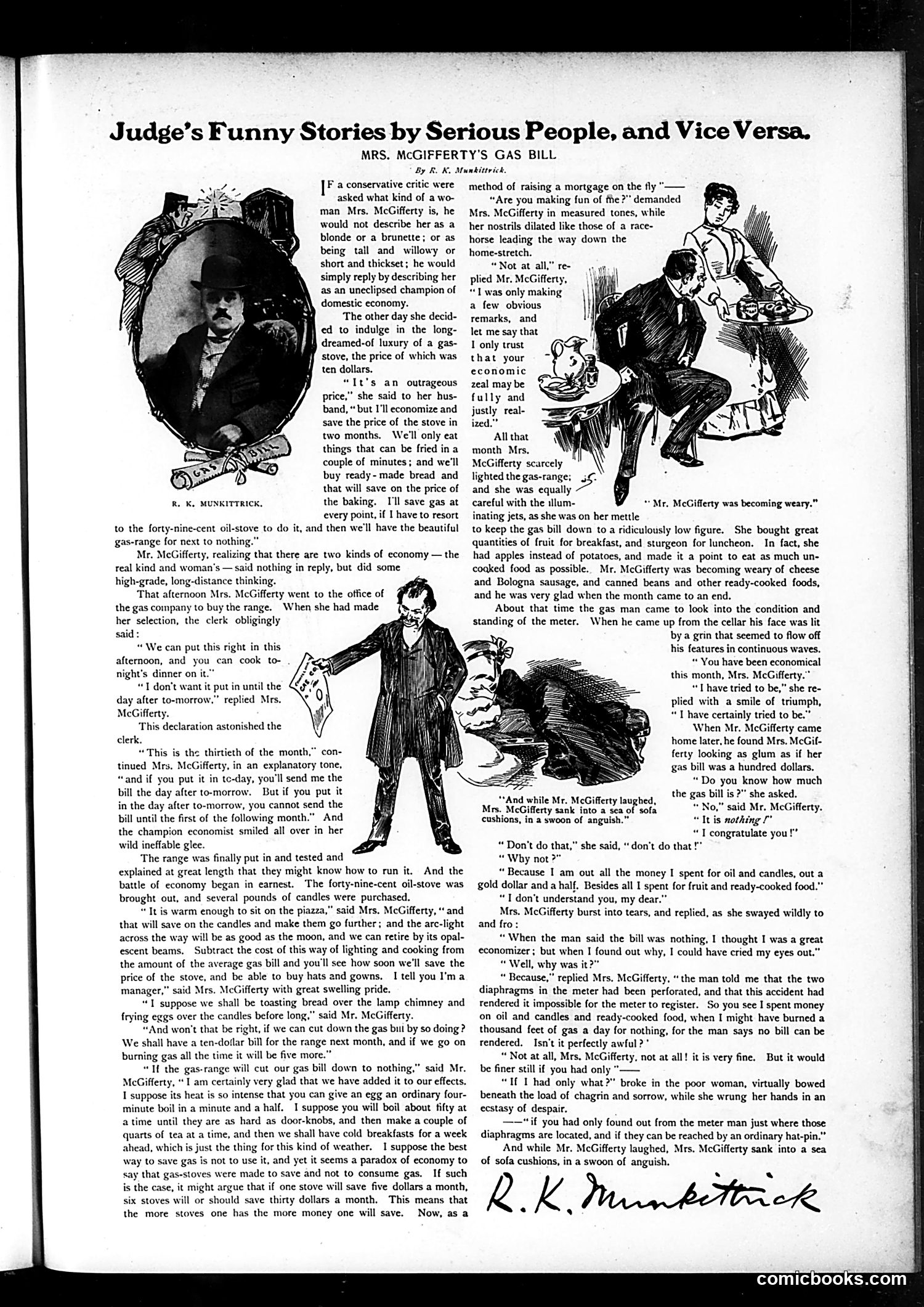
This satirical story by R.K. Munnitrick mocks the tension between thrift and domestic comfort in early 20th-century households. Mrs. McGifferty attempts to economize by minimizing gas stove use, while her husband grows increasingly weary of the results: cold food, uncooked meals, and general household discomfort. The satire targets both spouses—Mrs. McGifferty's misguided penny-pinching and Mr. McGifferty's passive acceptance of deprivation. The climax reveals the paradox: when the gas bill arrives at a hundred dollars (ostensibly from all her oil and candles as substitutes), the economics backfire completely. The cartoon illustrates domestic financial debates common to the period, poking fun at household budget conflicts and the law of unintended consequences.
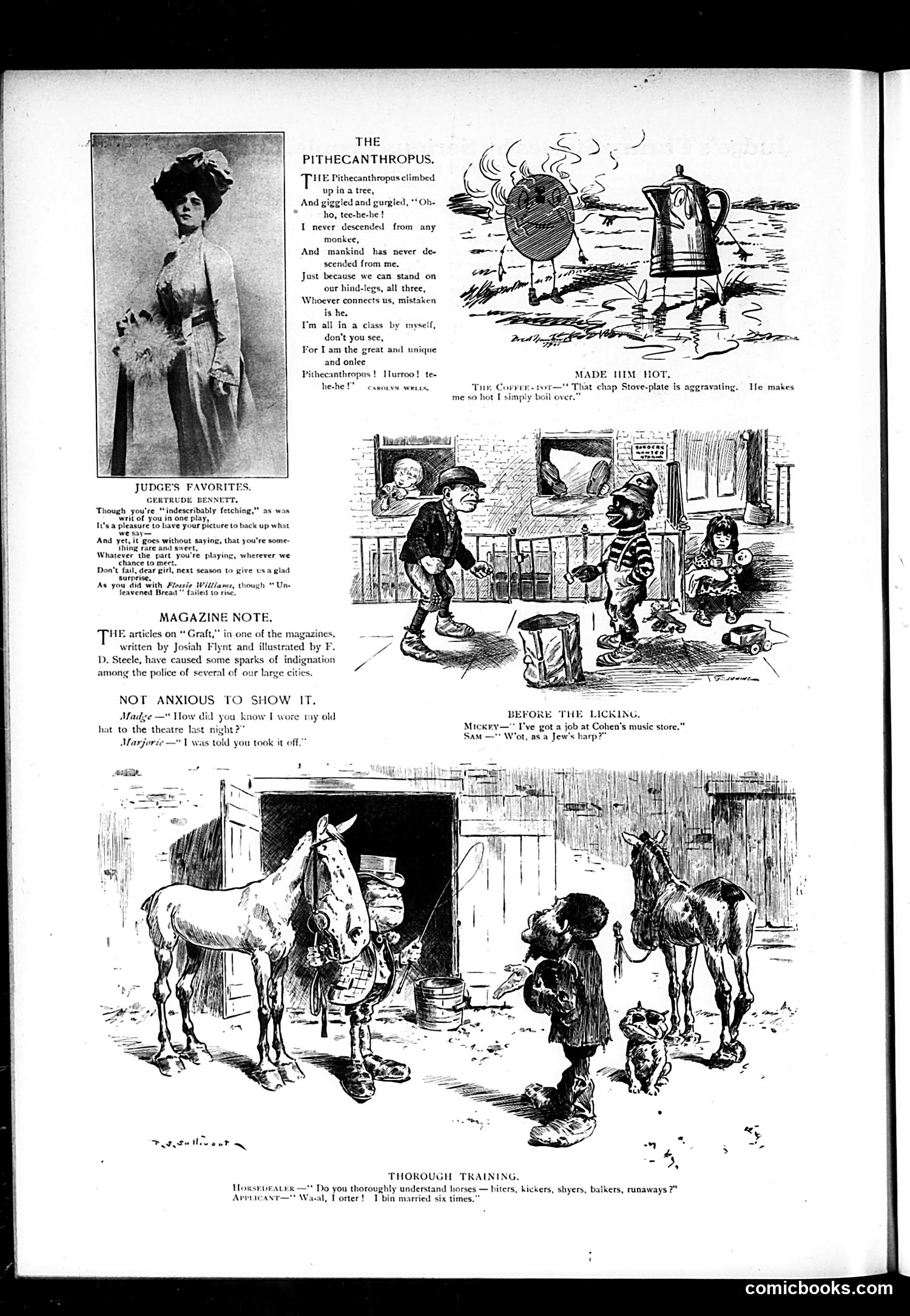
This page contains several unrelated satirical pieces typical of Judge magazine's format: **"The Pithecanthropus"** mocks a woman's vanity, comparing her claims of uniqueness to the extinct "ape-man" - a joke about both evolutionary science and female pretension. **"Made Him Hot"** satirizes a man boiling coffee excessively on a stove. **"Judge's Favorites"** and other brief comic pieces offer social commentary through short humorous observations. **"Thorough Training"** depicts a horsewoman instructing on equestrian terminology - likely satirizing overly pedantic instruction or pretentious upper-class horsemanship culture. The magazine combines poetry, single-panel cartoons, and short comedic dialogues. Without specific historical context for references like "Josiah Flynn" or "Cohen's music store," the exact targets remain unclear, though the overall tone targets vanity, pretension, and social affectation common to Gilded Age satire.
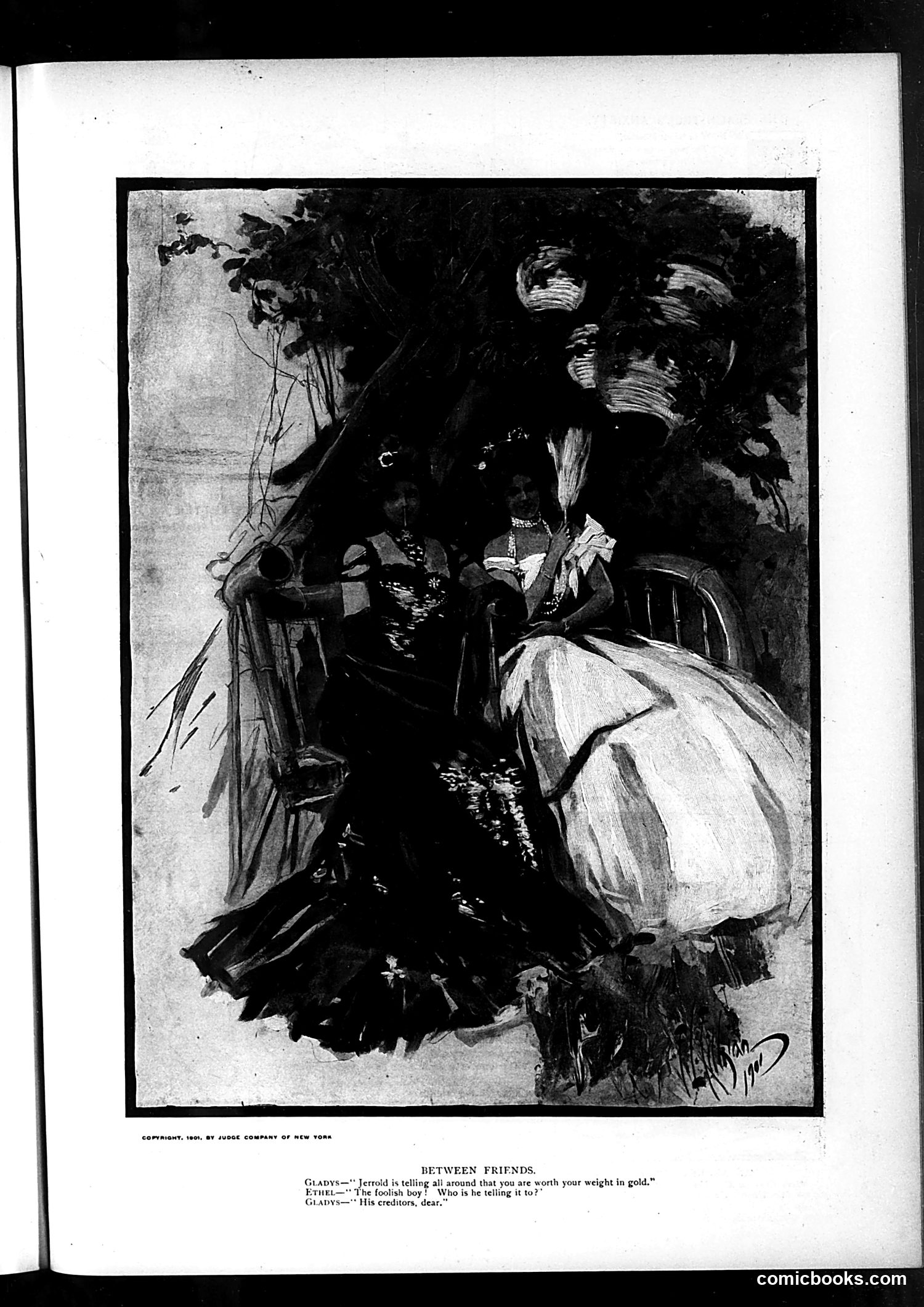
This 1901 Judge cartoon satirizes a young man named Jerrold who apparently has financial troubles. The joke plays on the phrase "worth your weight in gold"—normally high praise. However, the punchline reveals Jerrold is telling his *creditors* he's worth his weight in gold, suggesting he's trying to convince people he owes money to that he's financially reliable or valuable enough to repay them. The humor lies in the absurdity and desperation of using flattery on one's creditors rather than actually paying debts. The two women discussing this ("Between Friends") treat it as foolish behavior—attempting charm instead of demonstrating actual financial solvency. It's a commentary on financial irresponsibility and the gap between appearances and reality.
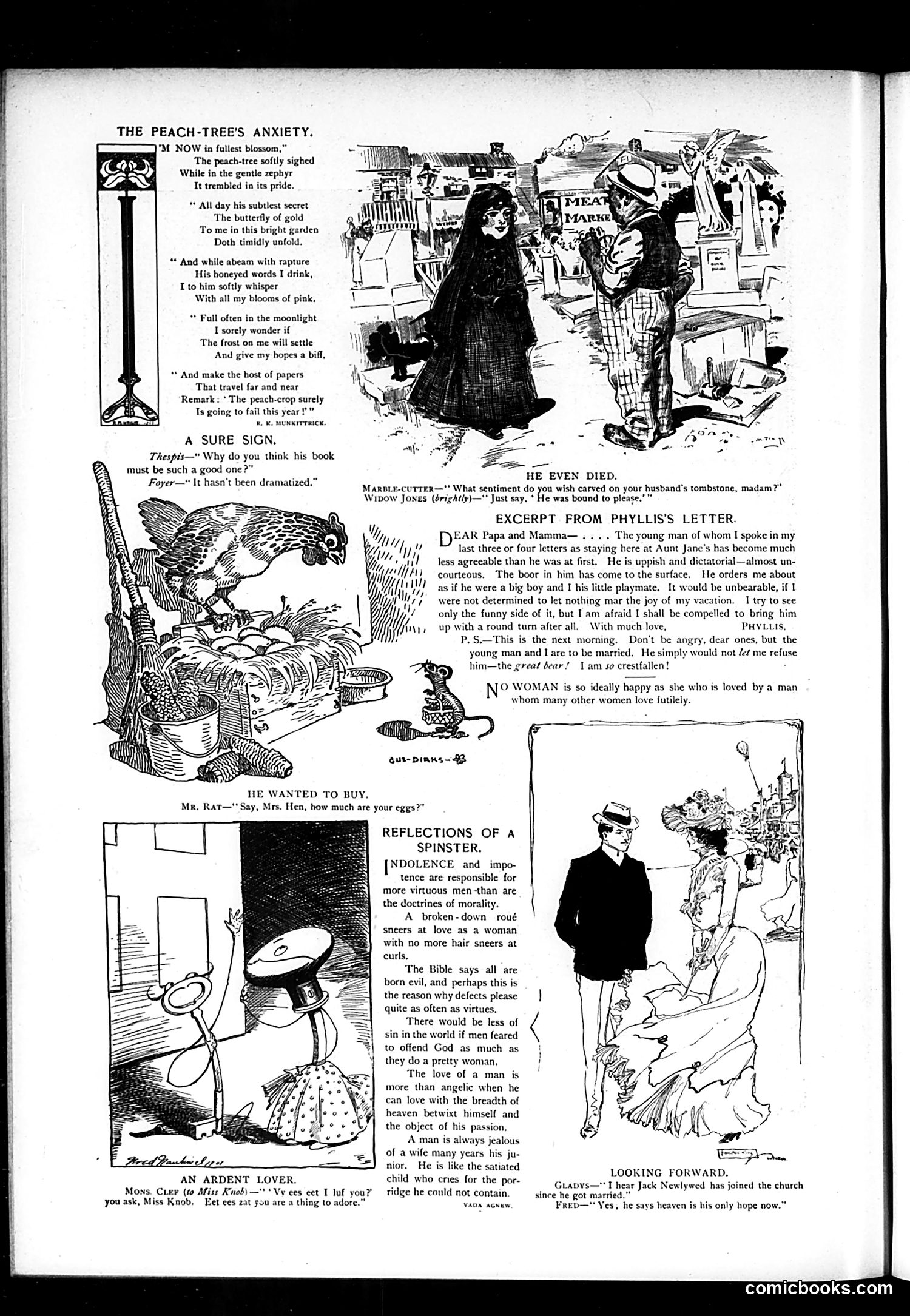
This page contains multiple satirical vignettes typical of early 20th-century American humor: **"The Peach-Tree's Anxiety"** is romantic poetry personifying a peach tree worried frost will destroy its blossoms—a metaphor for feminine anxieties about lost beauty and marriageability. **"A Sure Sign"** jokes that an undramatized book must be good (implying theater adaptations typically ruin literary works). **"He Even Died"** features a widow wanting her husband's tombstone to say "He was bound to please"—dark humor about marital obligation rather than love. **"Reflections of a Spinster"** offers cynical aphorisms about morality, desire, and jealousy—typical "spinster wisdom" humor mocking unmarried women's supposed bitterness. **"Ardent Lover"** and **"Looking Forward"** present brief comedic exchanges: a Frenchman's exaggerated compliments and a joke about a newly married man joining church as his "only hope." The overall tone reflects period attitudes: anxiety about female beauty fading, cynicism about marriage, and ethnic stereotyping (the French lover's accent).
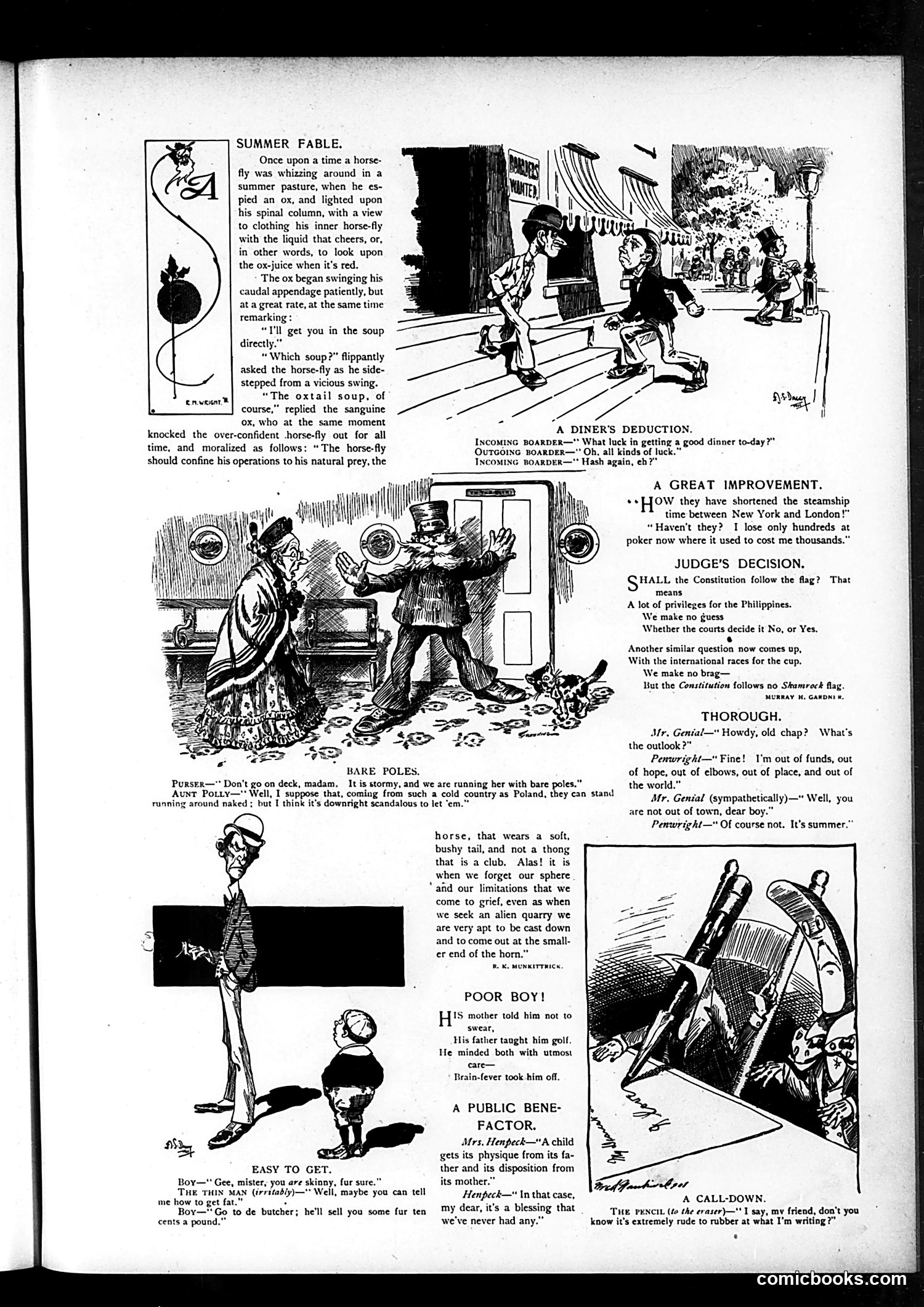
This page contains multiple brief satirical pieces typical of Judge's format: **"Summer Fable"** presents an Aesop's-style moral: a horsefly attempts to drink an ox's blood but is fatally swatted. The lesson warns against pursuing prey outside one's natural sphere—satirizing those who overreach their station. **"Judge's Decision"** references the contemporary "Constitution follows the flag" debate regarding U.S. imperial governance in the Philippines (early 1900s). Judge cleverly sidesteps the political question while making a joking prediction about the America's Cup yacht race, suggesting American dominance. **Other brief jokes** include wordplay about steamer travel, a commentary on social climbing ("Bare Poles"), and domestic humor about inheritance and childhood discipline. The cartoons are light, illustrative humor rather than sharp political commentary. The page reflects Judge's typical blend of social observation, mild satire about class and manners, and topical references accessible to contemporary readers but requiring historical context today.
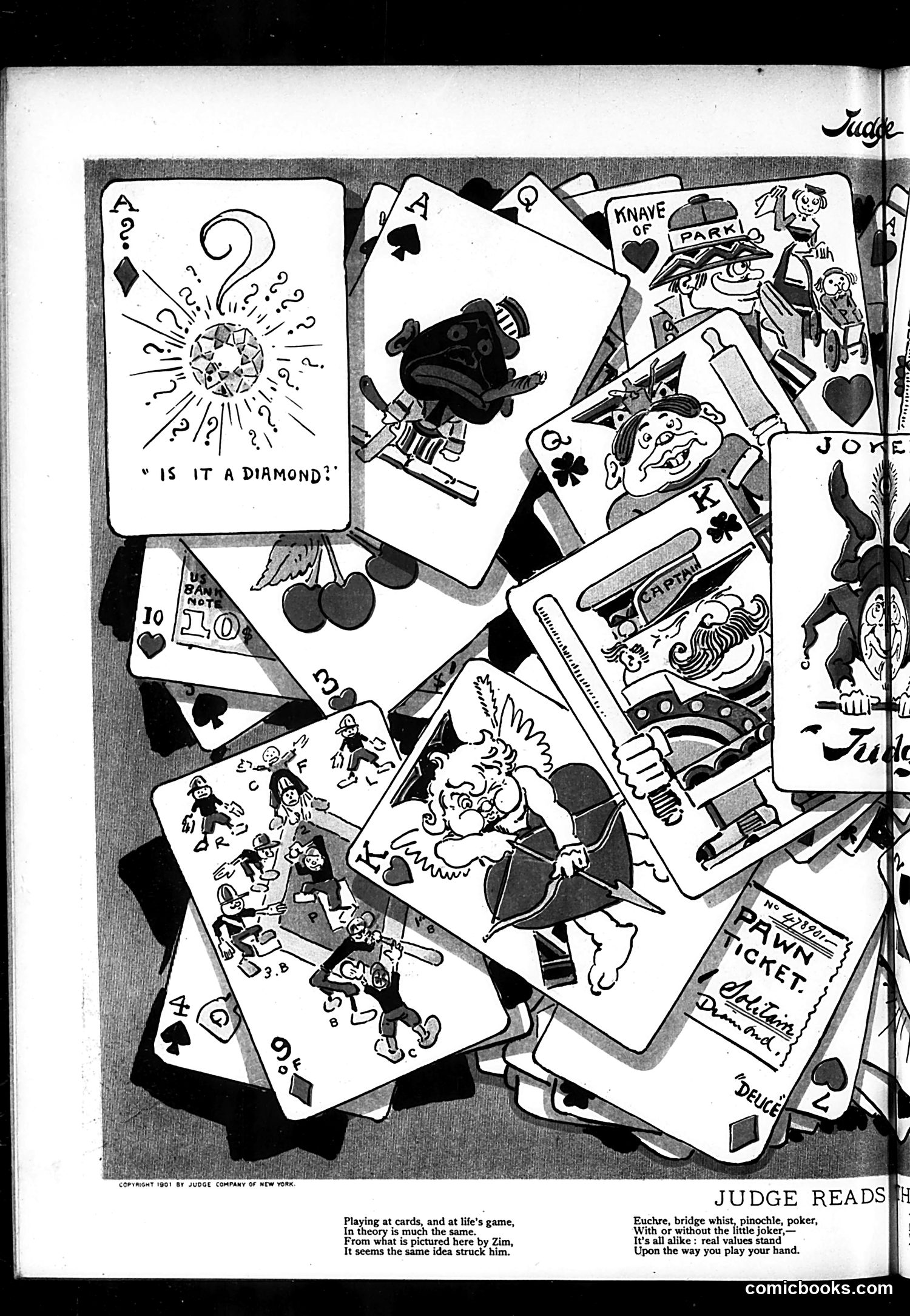
This Judge magazine page uses playing cards and card games as a metaphor for life itself. The central cartoon by artist Zim shows scattered cards with various illustrations—some depicting chaotic scenes, some showing fortune-seekers or gamblers. The accompanying verses compare card games (euchre, bridge whist, pinochle, poker) to life's broader contests, suggesting they operate by identical principles. The message is moralistic: regardless of the game or circumstances, "real values stand / Upon the way you play your hand"—meaning one's character and choices matter more than luck or circumstances. The "Is it a diamond?" question (referencing the card suit) appears to question whether success or fortune is genuine value or mere illusion. This reflects early-20th-century American anxiety about wealth, luck, and merit during a period of rapid social change and economic flux.
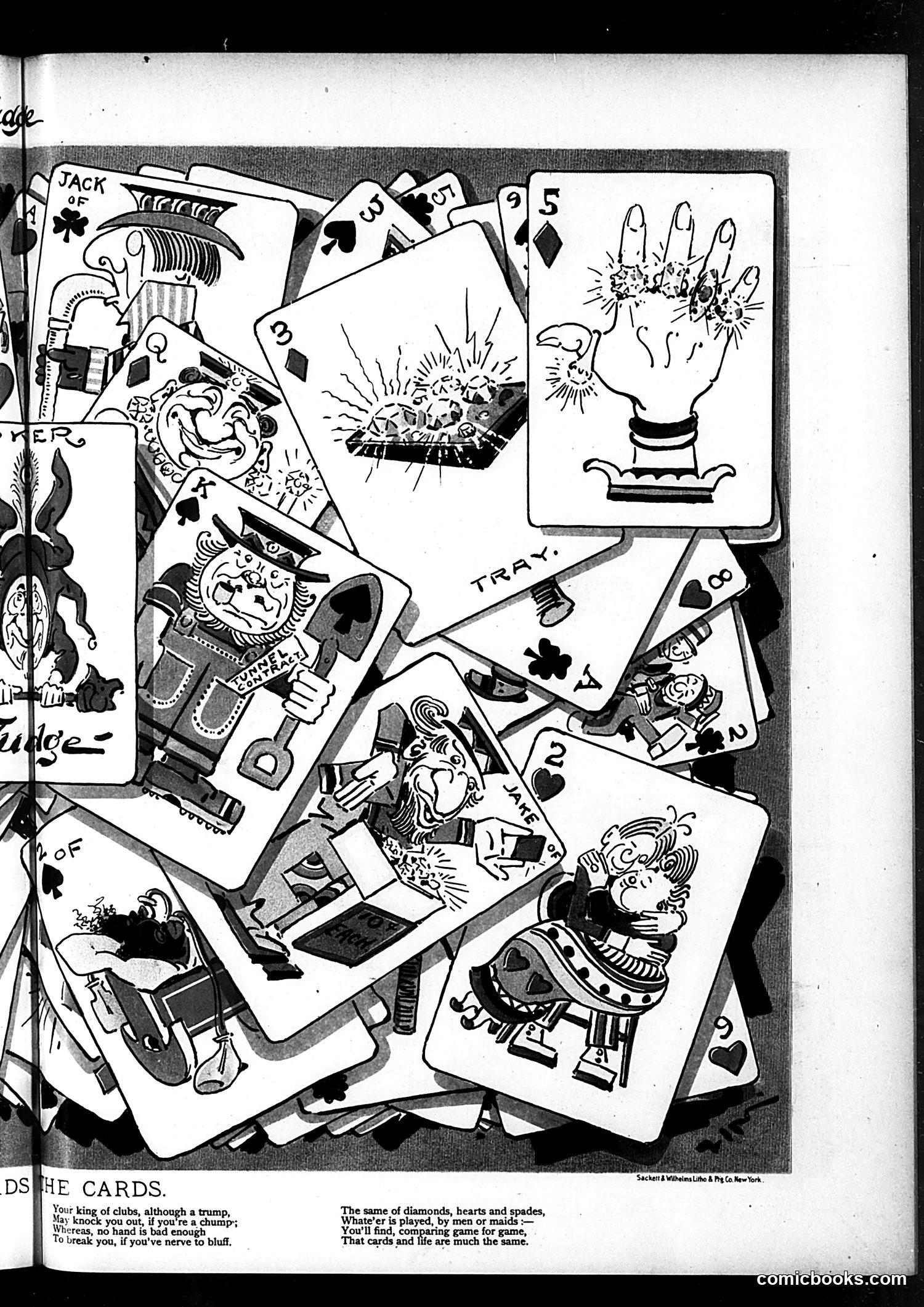
This is not a political cartoon but rather a satirical **social commentary** using playing cards as metaphor. The illustration shows various face cards (kings, queens, jacks) with exaggerated, grotesque features engaged in card-playing activities, with one card depicting an exploding hand. The accompanying verse compares card games to life itself: just as cards determine outcomes in games regardless of skill, so too does fate govern human affairs. The "king of clubs" can "knock you out if you're a chump," while other suits apply equally to "men or maids." The satire suggests life's unpredictability and the limited control individuals have over their fortunes—a timeless philosophical observation dressed in Victorian-era humor. The grotesque character depictions likely mock human pretension and vanity, suggesting we're all merely players in an uncertain game.
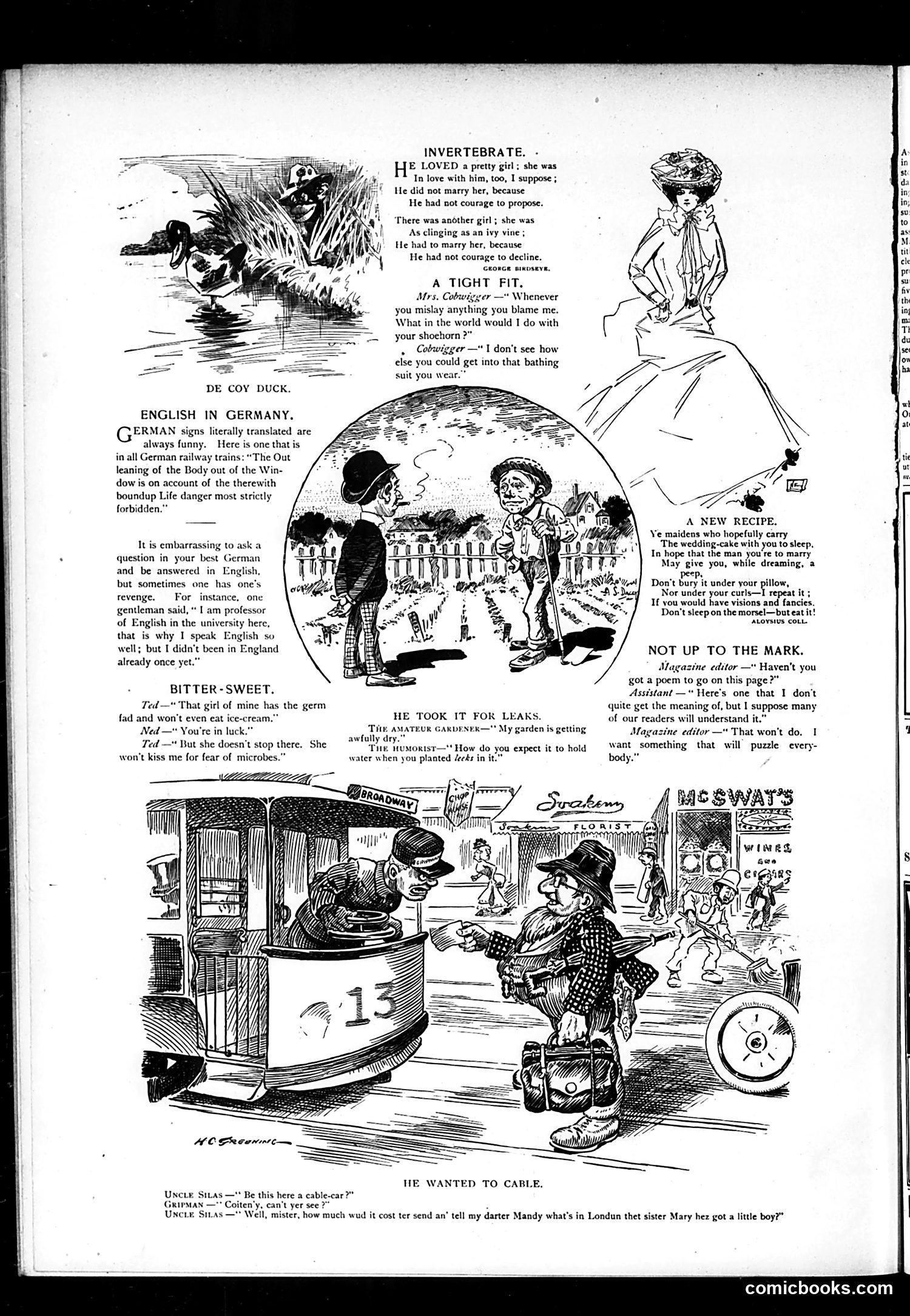
This page collects brief comedic sketches and poems satirizing various social situations: **"English in Germany"** mocks Germans' awkward English and railway signs with comically literal translations, while noting the irony of a self-proclaimed English professor who speaks grammatically broken English. **Other sketches** play on domestic misunderstandings (a man blaming his wife for a missing shoehorn; a gardener planting seeds in dry soil expecting water retention) and romantic timidity (a man too cowardly to propose or decline marriage). **"Not Up to the Mark"** satirizes magazine editors' preference for deliberately obscure poetry over clear writing—reversing readers' presumed expectations that editors want accessible content. The cartoons employ period stereotypes (Germans, rural/working-class figures) and rely on puns and linguistic confusion typical of Edwardian humor. The tone is lighthearted rather than cutting, focusing on everyday social embarrassments rather than political commentary.
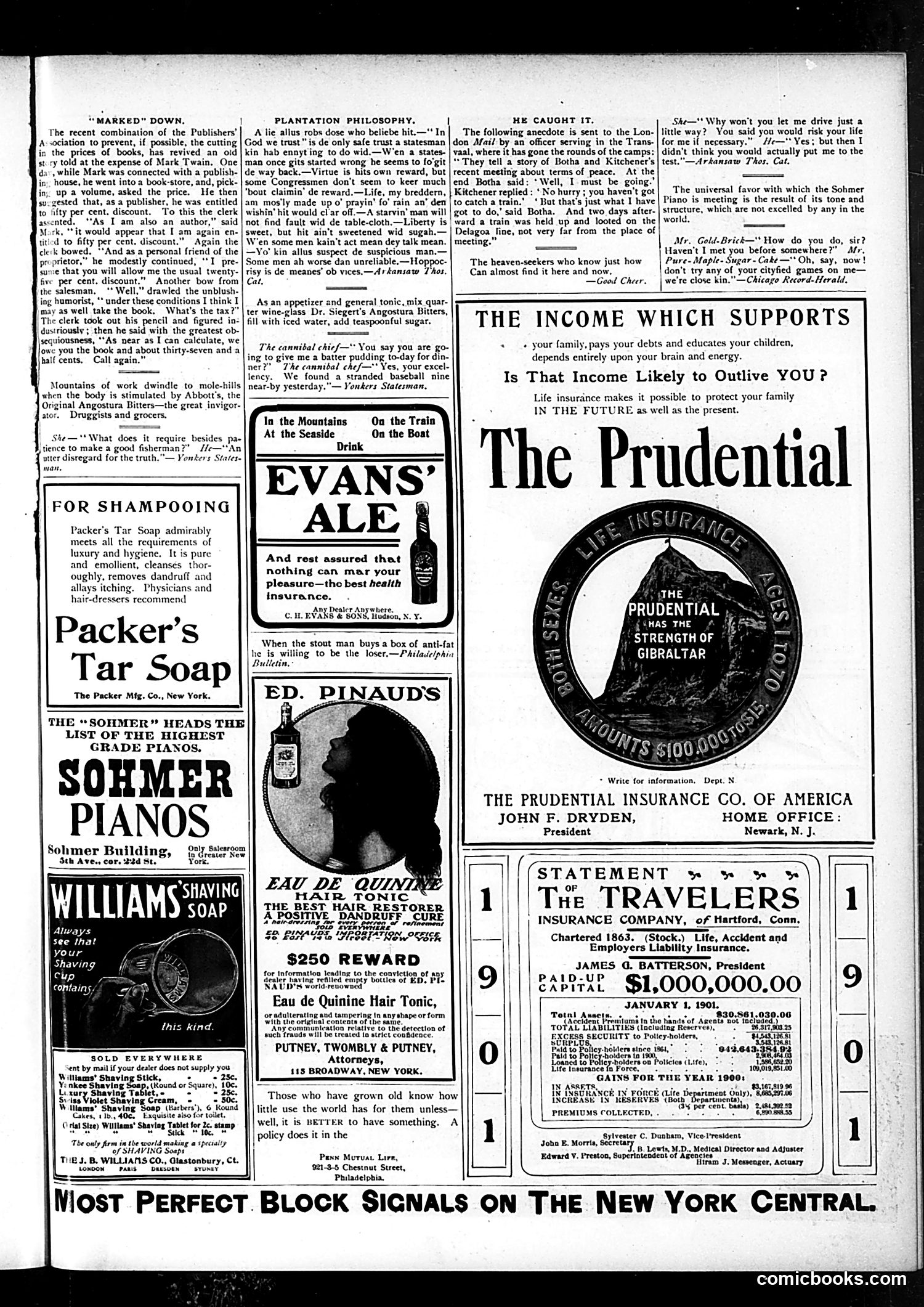
This page from Judge magazine (an American satirical publication) contains primarily **advertising and humorous anecdotes** rather than political cartoons. The main content includes: **Humorous stories:** - A Mark Twain anecdote about book discounts—satirizing publishers' pricing practices - "Plantation Philosophy"—dialect humor attributed to enslaved or rural Black speakers offering moral observations - "He Caught It"—a domestic humor piece about marital trust - Anecdotes about the Boer War (Botha and Kitchener), baseball, and cannibalism jokes **Advertisements** dominate the layout: Packer's Tar Soap, Evans' Ale, Sohmer Pianos, Williams' Shaving Soap, and notably **The Prudential Insurance Company**, which features prominently with its Gibraltar logo. The satire is **light and domestic** rather than political—targeting publishers' business practices, marital dynamics, and commercial absurdities. The "Plantation Philosophy" reflects period racism through dialect humor. The page reflects early-1900s American magazine conventions mixing advertisements with brief comic pieces and anecdotes.
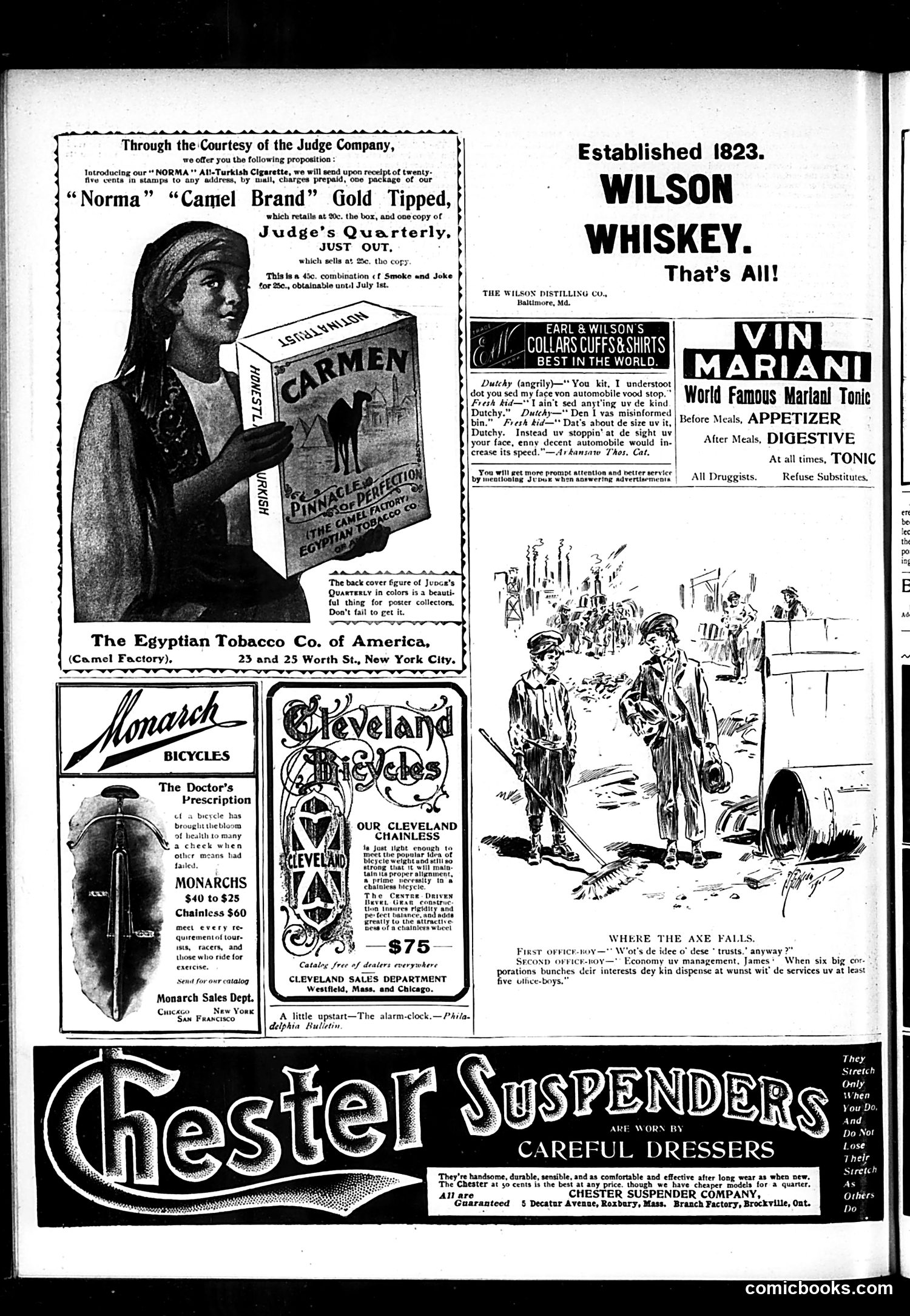
This page is primarily **advertising** for various products (whiskey, cigarettes, bicycles, shirts, suspenders) typical of early 20th-century magazines. The one cartoon of satirical interest is titled "WHERE THE AXE FALLS," depicting two office boys discussing corporate trusts. The joke reflects **Progressive Era anxieties** about large corporations consolidating power. When six competing corporations merge into trusts, they can eliminate redundant positions—specifically, the five office boys become unnecessary, leaving only one employed. The satire critiques how **monopolistic business practices harm workers**, a common theme during the trust-busting era. The "axe falls" metaphorically on working-class employment as efficiency (cost-cutting) becomes the stated justification. The cartoon uses working-class dialect ("utlive-boys") to make the victims of consolidation sympathetic, while presenting the business rationale ("Economy uv management") as coldly calculating.
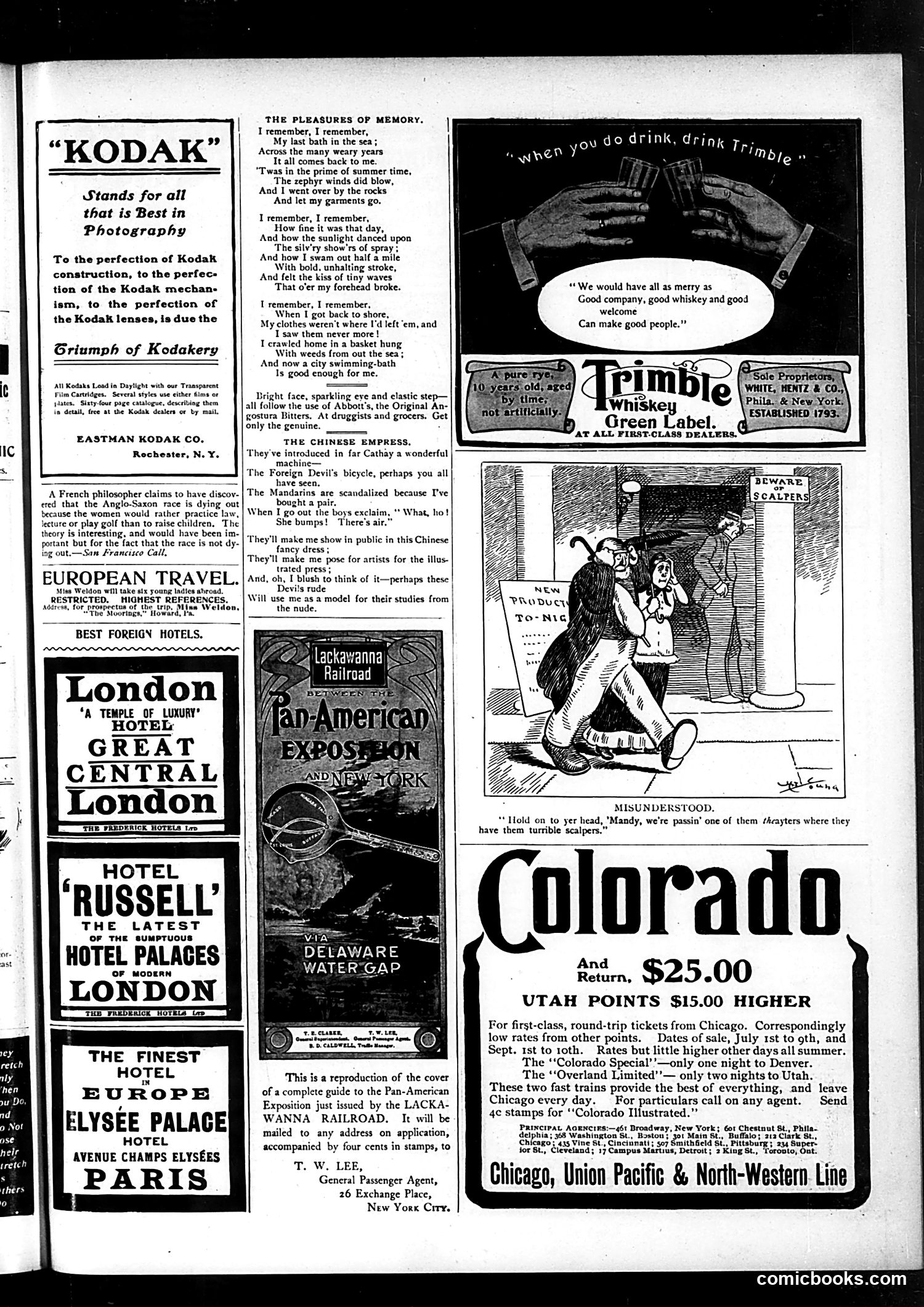
This page is primarily **advertising**, with two satirical cartoons interspersed. **"Misunderstood" cartoon**: A Black man and woman in a carriage misinterpret the word "theater" as "scalper," reflecting period-racist humor based on supposed dialect and misunderstanding. The satire targets the couple's speech patterns rather than commenting on actual social issues. **"The Chinese Empress" poem**: Satirizes a Chinese woman who has adopted Western technology (a bicycle), presented as scandalous. The humor relies on Orientalist stereotypes—depicting Chinese culture as backward and shocked by Western innovations. The reference to "Foreign Devils" and her fears of being displayed or used as an artist's model plays on racist anxieties about cultural collision and female modesty. Both cartoons use ethnic/racial caricature as their primary comedic device, typical of early-20th-century Judge magazine's approach to satire. The remaining content consists of travel advertisements and Kodak photography promotions.
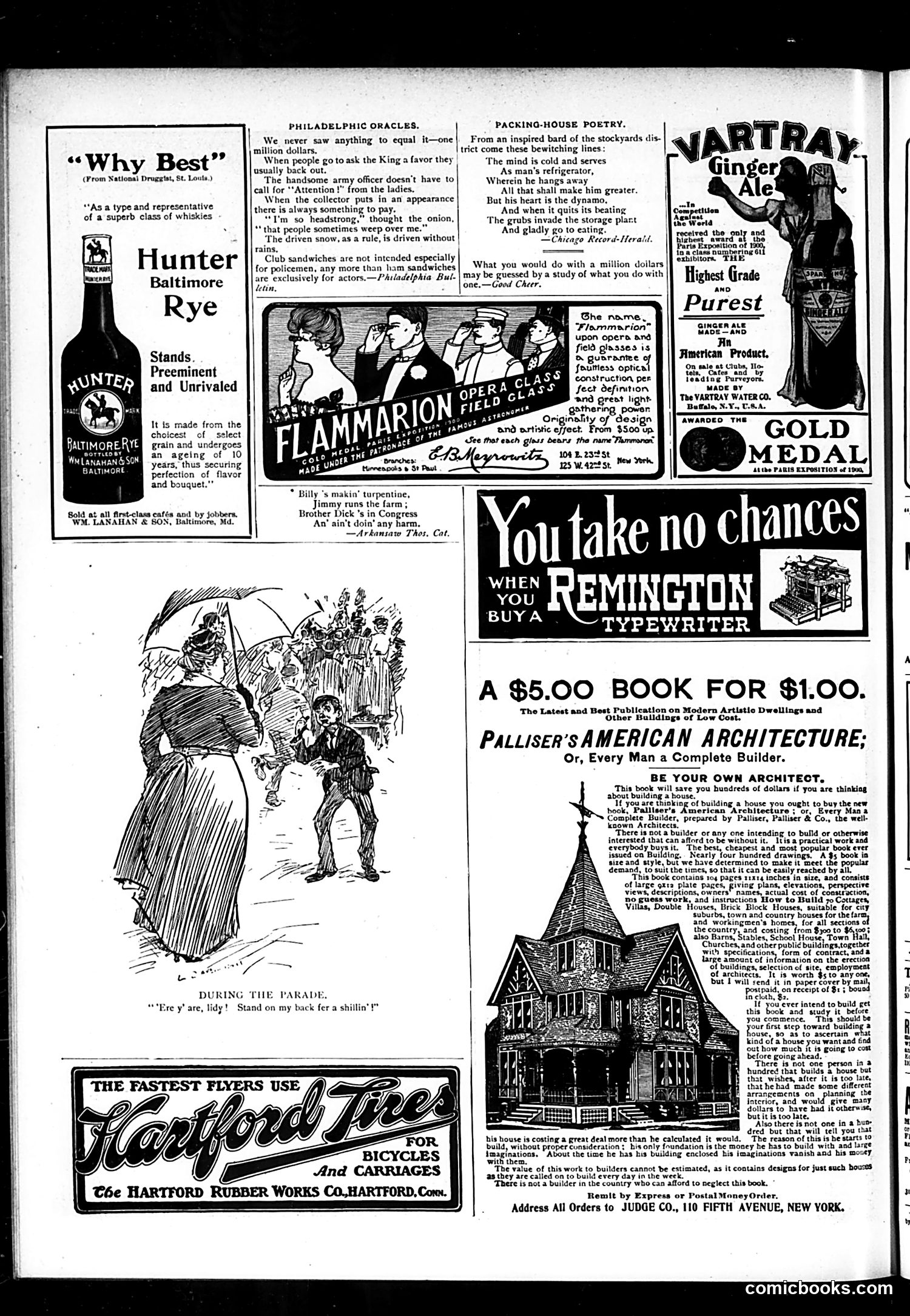
This page is primarily **advertising and reprinted humor**, not original political satire. The content includes: **Main cartoon**: "During the Parade" shows a woman asking an Irish immigrant (identifiable by dialect) to stand on his back for a shilling during a public parade—a class-based joke about working-class availability and poverty. **Humor sections**: Reprinted jokes from other publications about American life—banking, military officers, weather, food processing—offering light social commentary rather than political satire. **Advertisements**: Hunter Baltimore Rye whiskey, Flammarion opera glasses, Remington typewriters, Hartford tires, and a prominent book offer for Palliser's architecture guide. The page reflects early 20th-century Judge content: genteel humor about everyday American social situations, immigrant stereotypes (Irish dialect), and marketing to middle-class readers. No specific political figures or events are targeted—the satire is mild and observational rather than partisan.
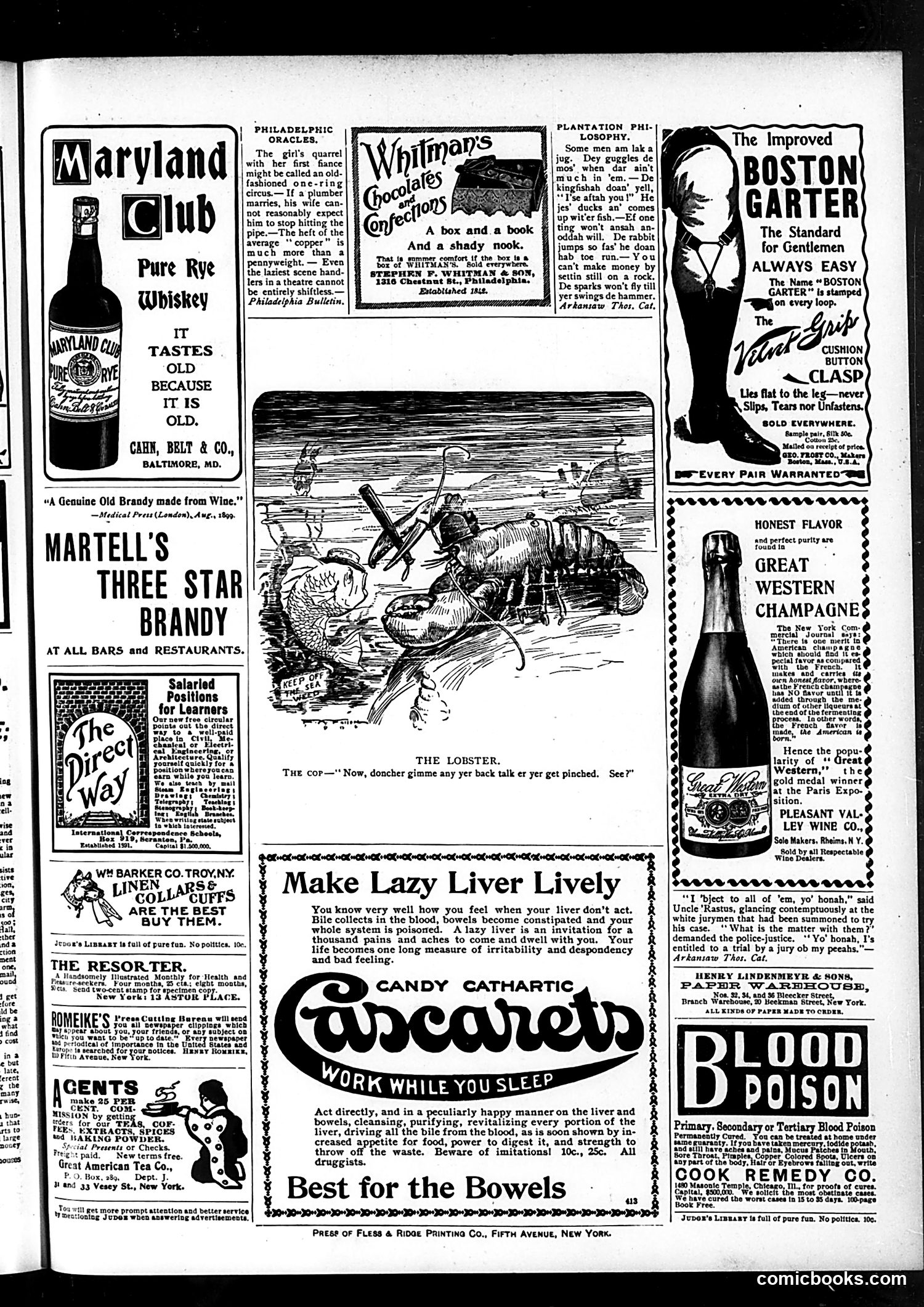
This is primarily an advertising page from Judge magazine, with one central cartoon. **The main cartoon**, titled "The Lobster," shows a cow (labeled "The Cow") being confronted by an angry character who warns: "Now, doncher gimme any yer back talk er yer get pinched." The humor appears to play on the figure's working-class dialect and aggressive demeanor—likely a comedic commentary on urban toughness or street-level authority figures of the period. **The surrounding content** is entirely commercial advertisements for patent medicines (Cascaret laxatives, blood poison remedies), spirits (whiskey, brandy, champagne), and consumer goods (garters, cuffs, stationery). The ads employ period medical claims typical of the era—tonics for "lazy liver," digestive complaints, and venereal disease cures. **Context for modern readers**: These advertisements reveal common health anxieties and remedies of the early 1900s, many now recognized as quack medicines. The casual, offensive racial dialect in one ad reflects the casual racism of that era's entertainment.
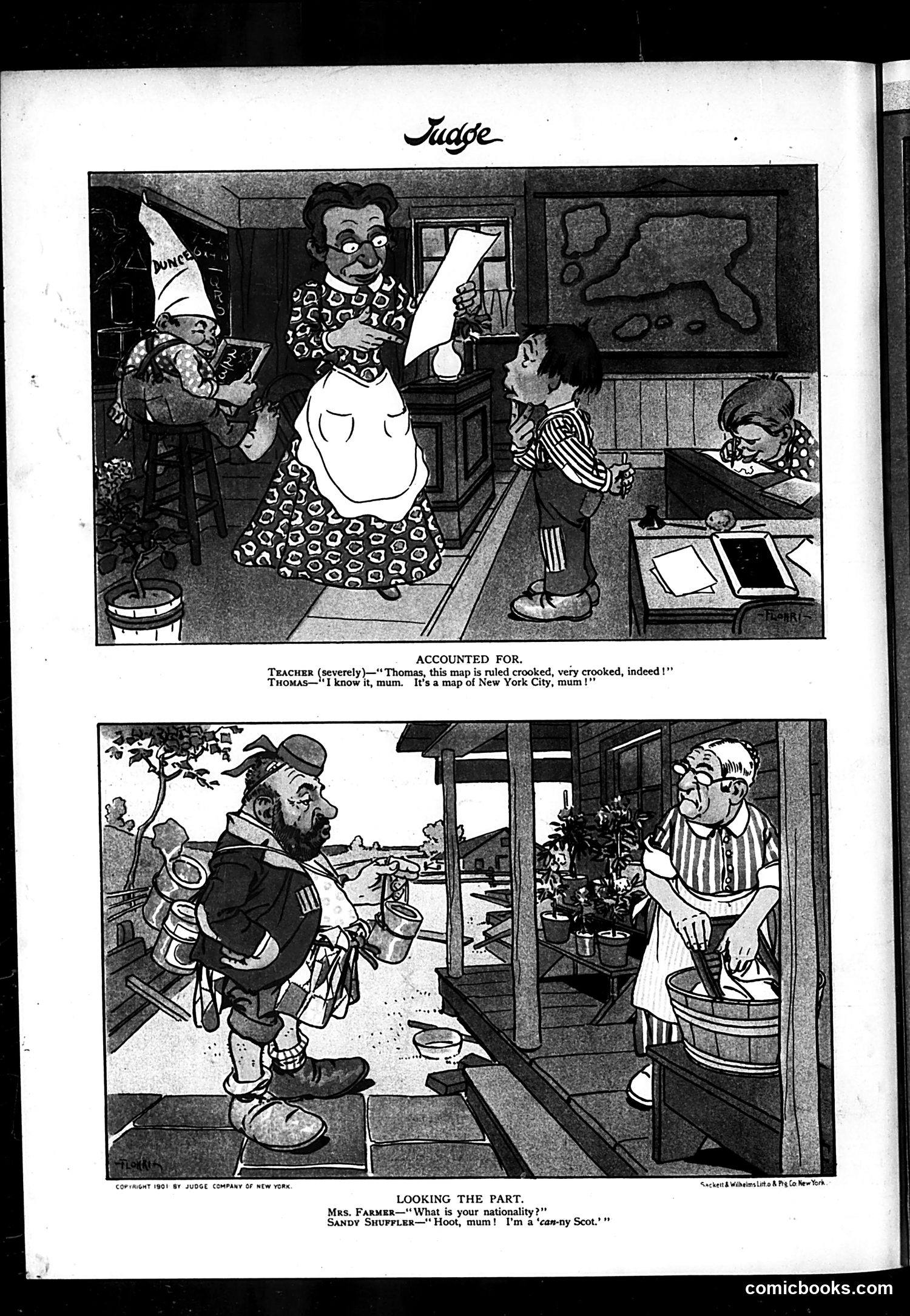
**Top cartoon ("Accounted For"):** A teacher scolds a student named Thomas for drawing a crooked map, which Thomas explains is intentionally accurate—it's a map of New York City. The joke satirizes NYC's famously irregular street grid and geography, which deviate from the orderly rectangular patterns found in most American cities. **Bottom cartoon ("Looking the Part"):** A woman asks an Irish or Scottish laborer about his nationality. He responds "I'm a canny Scot," playing on ethnic stereotypes about Scottish frugality and thriftiness (the word "canny" meaning shrewd with money). The humor relies on period stereotyping of immigrant nationalities and their supposed character traits. Both cartoons reflect early 20th-century American humor based on geography and ethnic stereotypes.