
Judge, 1901-06-22 · page 3 of 16
Judge — June 22, 1901 — page 3: what you’re looking at
What you’re looking at
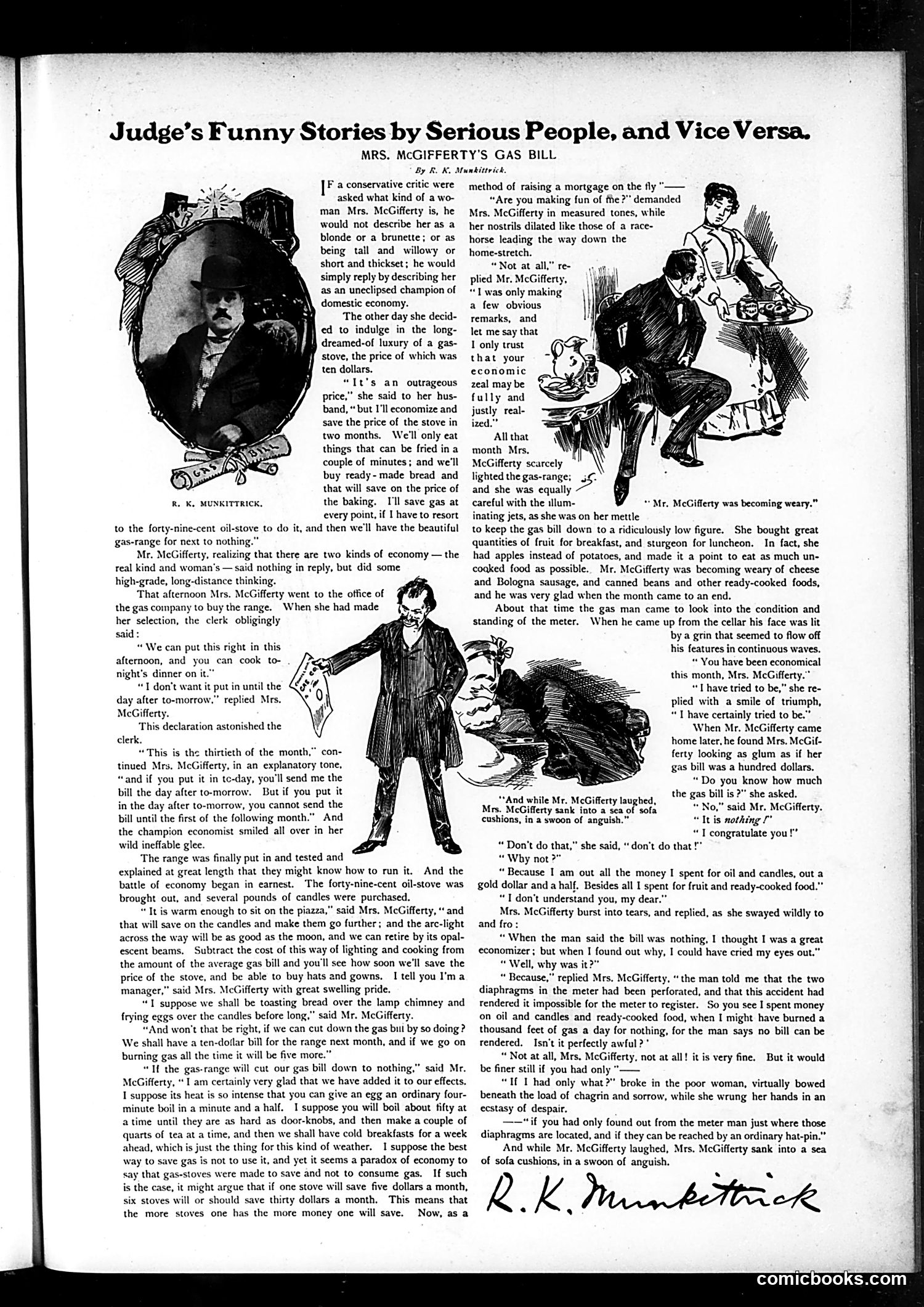
This satirical story by R.K. Munnitrick mocks the tension between thrift and domestic comfort in early 20th-century households. Mrs. McGifferty attempts to economize by minimizing gas stove use, while her husband grows increasingly weary of the results: cold food, uncooked meals, and general household discomfort. The satire targets both spouses—Mrs. McGifferty's misguided penny-pinching and Mr. McGifferty's passive acceptance of deprivation. The climax reveals the paradox: when the gas bill arrives at a hundred dollars (ostensibly from all her oil and candles as substitutes), the economics backfire completely. The cartoon illustrates domestic financial debates common to the period, poking fun at household budget conflicts and the law of unintended consequences.
📄 Transcribed text from this page (OCR, searchable)
Machine-transcribed from the original scan — historical spelling and the odd misread are preserved.
! Judge’s Funny Stories by Serious People, and Vice Versa. MRS. MCGIFFERTY'S GAS BILL. By RK, Munkittrick. F a conservative critic were asked what kind of a wo- man Mrs. McGifferty is, he would not describe her as a blonde or a brunette; or as being tall and willowy or short and thickset; he would simply reply by describing her ‘as an uneclipsed champion of domestic economy. The other day she decid- ed to indulge in the long- dreamed-of luxury of a gas- stove, the price of which was ten dollars. “It's an outrageous price,” she said to her hus- band, “ but I'll economize and save the price of the stove in two months. We'll only eat things that can be fried ina couple of minutes; and we'll buy ready-made bread and that will save on the price of the baking. I'll save gas at every point, if I have to resort to the forty-nine-cent oil-stove to do it, and then we'll have the beautiful gas-range for next to nothing.” Mr. McGifferty, realizing that there are two kinds of economy — the real kind and woman's — said nothing in reply, but did some high-grade, long-distance thinking. That afternoon Mrs. McGifferty went to the office of the gas company to buy the range. When she had made her selection, the clerk obligingly said : “We can put this right in this afternoon, and you can cook to night's dinner on it.” “T don’t want it put in until the day after to-morrow.” replied Mrs. McGifferty. This declaration astonished the clerk. “This is the thirtieth of the month,” con- tinued Mrs, McGifferty, in an explanatory tone, “and if you put it in to-day, you'll send me the bill the day after to-morrow. But if you put it in the day after to-morrow, you cannot send the bill until the first of the following month.” And the champion economist smiled all over in her wild ineffable glee. ‘The range was finally put in and tested and explained at great length that they might know how to run it. And the battle of economy began in earnest. The forty-nine-cent oil-stove was brought out, and several pounds of candles were purchased. “It is warm enough to sit on the piazza,” said Mrs. McGifferty, “and that will save on the candles and make them go further ; and the arc-light across the way will be as good as the moon, and we can retire by its opal- escent beams. Subtract the cost of this way of lighting and cooking from the amount of the average gas bill and you'll see how soon we'll save the price of the stove, and be able to buy hats and gowns. I tell you I'ma manager,” said Mrs. McGifferty with great swelling pride. “'T suppose we shall be toasting bread over the lamp chimney and frying eggs over the candles before long,” said Mr. McGifferty. “And won't that be right, if we can cut down the gas biti by so doing? We shall have a ten-doflar bill for the range next month, and if we go on burning gas all the time it will be five more.” “If the gas-range will cut our gas bill down to nothing,” said Mr. McGifferty, “I am certainly very glad that we have added it to our effects. I suppose its heat is so intense that you can give an egg an ordinary four- minute boil in a minute and a half. I suppose you will boil about fifty at atime until they are as hard as door-knobs, and then make a couple of quarts of tea at a time, and then we shall have cold breakfasts for a week ahead, which is just the thing for this kind of weather. I suppose the best way to save gas is not to use it, and yet it seems a paradox of economy to say that gas-stoves were made to save and not to consume gas. If such is the case, it might argue that if one stove will save five dollars a month, six stoves will or should save thirty dollars a month, This means that the more stoves one has the more money one will save. R. K, MUNKITTRICK, Now, as a method of raising a mortgage on the fly "—— “Are you making fun of the?” demanded Mrs. McGifferty in measured tones, while her nostrils dilated like those of a race- horse leading the way down the home-stretch. “Not at all,” re- plied Mr. McGifferty, “1 was only making a few obvious remarks, and let me say that I only trust that your economic zeal may be fully and justly real- ized.” All that month Mrs. McGifferty scarcely lighted the gas-range; and she was equally careful with the illum- inating jets, as she was on her mettle to keep the gas bill down to a ridiculously low figure. She bought great quantities of fruit for breakfast, and sturgeon for luncheon. In fact, she had apples instead of potatoes, and made it a point to eat as much un- coaked food as possible. Mr. McGifferty was becoming weary of cheese and Bologna sausage, and canned beans and other ready-cooked foods, and he was very glad when the month came to an end. About that time the gas man came to look into the condition and standing of the meter. When he came up from the cellar his face was lit by a grin that seemed to flow off his features in continuous waves. “ You have been economical this month, Mrs. McGifferty.” “Thave tried to be,” she re- plied with a smile of triumph, “T have certainly tried to be.” When Mr. McGifferty came home later, he found Mrs. McGif- ferty looking as glum as if her gas bill was a hundred dollars. “Do you know how much the gas bill is ?" she asked. “No,” said Mr. McGifferty. “In is nothing f° “ T congratulate you! “ Don't do that,” she said, “don't do that!" “Why not >” “ Because I am out all the money I spent for oil and candles, out a gold dollar and a half. Besides all I spent for fruit and ready-cooked food.”” “I don’t understand you, my dear.” Mrs. McGifferty burst into tears, and replied, as she swayed wildly to and fro: “When the man said the bill was nothing, I thought I was a great economizer ; but when I found out why, I could have cried my eyes out.” “ Well, why was it?” “ Because,” replied Mrs. McGifferty, “the man told me that the two diaphragms in the meter had been perforated, and that this accident had rendered it impossible for the meter to register. So you see I spent money on oil and candles and ready-cooked food, when I might have burned a thousand feet of gas a day for nothing, for the man says no bill can be rendered. Isn't it perfectly awful ?* “ Not at all, Mrs, McGifferty, not at all! it is very fine. But it would be finer still if you had only "—— “If I had only what broke in the poor woman, virtually bowed beneath the load of chagrin and sorrow, while she wrung her hands in an ecstasy of despair. ——“‘if you had only found out from the meter man just where those diaphragms are located, and if they can be reached by an ordinary hat-pin.” And while Mr. McGifferty laughed, Mrs. McGifferty sank into a sea of sofa cushions, in a swoon of anguish. RK MrAbhWack if oo * Mr. McGifferty was becoming weary.” “And while Mr. McGifferty laughed, Mrs. McGifferty sank into a sea of sofa cushions, in a swoon of anguish.” comicbooks.com