
A complete issue · 16 pages · 1901
Judge — May 18, 1901
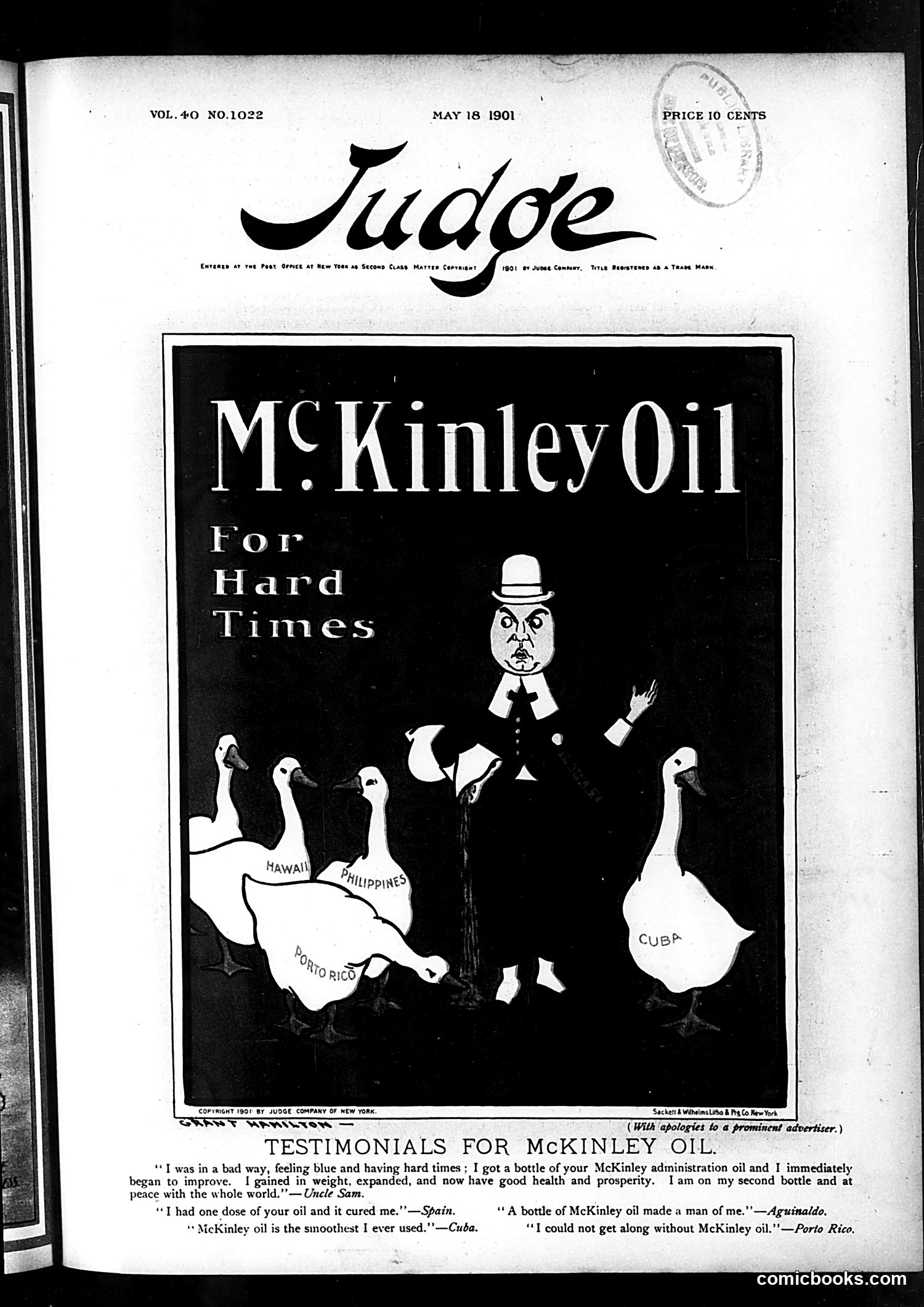
This 1901 *Judge* page satirizes President William McKinley's foreign policy through a fake medicine ad. The central figure—a man in formal dress representing McKinley—stands surrounded by geese labeled with U.S. territories: Hawaii, Philippines, Puerto Rico, and Cuba. The geese appear to symbolize these lands as resources being exploited or "milked" for profit. The advertisement mockingly presents "McKinley Oil" as a cure-all remedy with testimonials from the labeled territories, each claiming the oil improved their situation. The satire critiques American imperial expansion following the Spanish-American War (1898), suggesting McKinley's policies benefited America while claiming to help these newly-acquired possessions. The goose imagery implies the territories are being treated as commodities to be plundered.
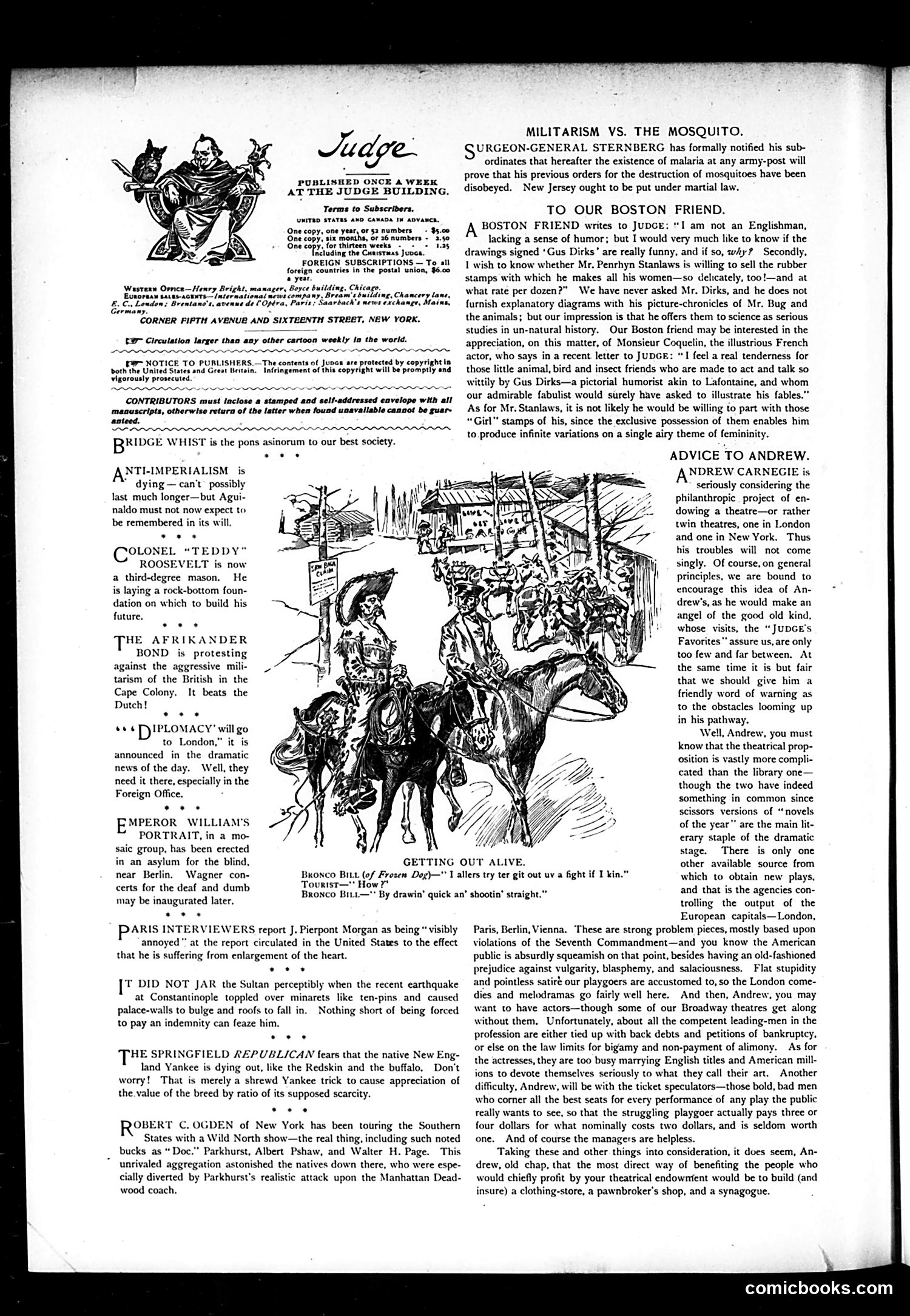
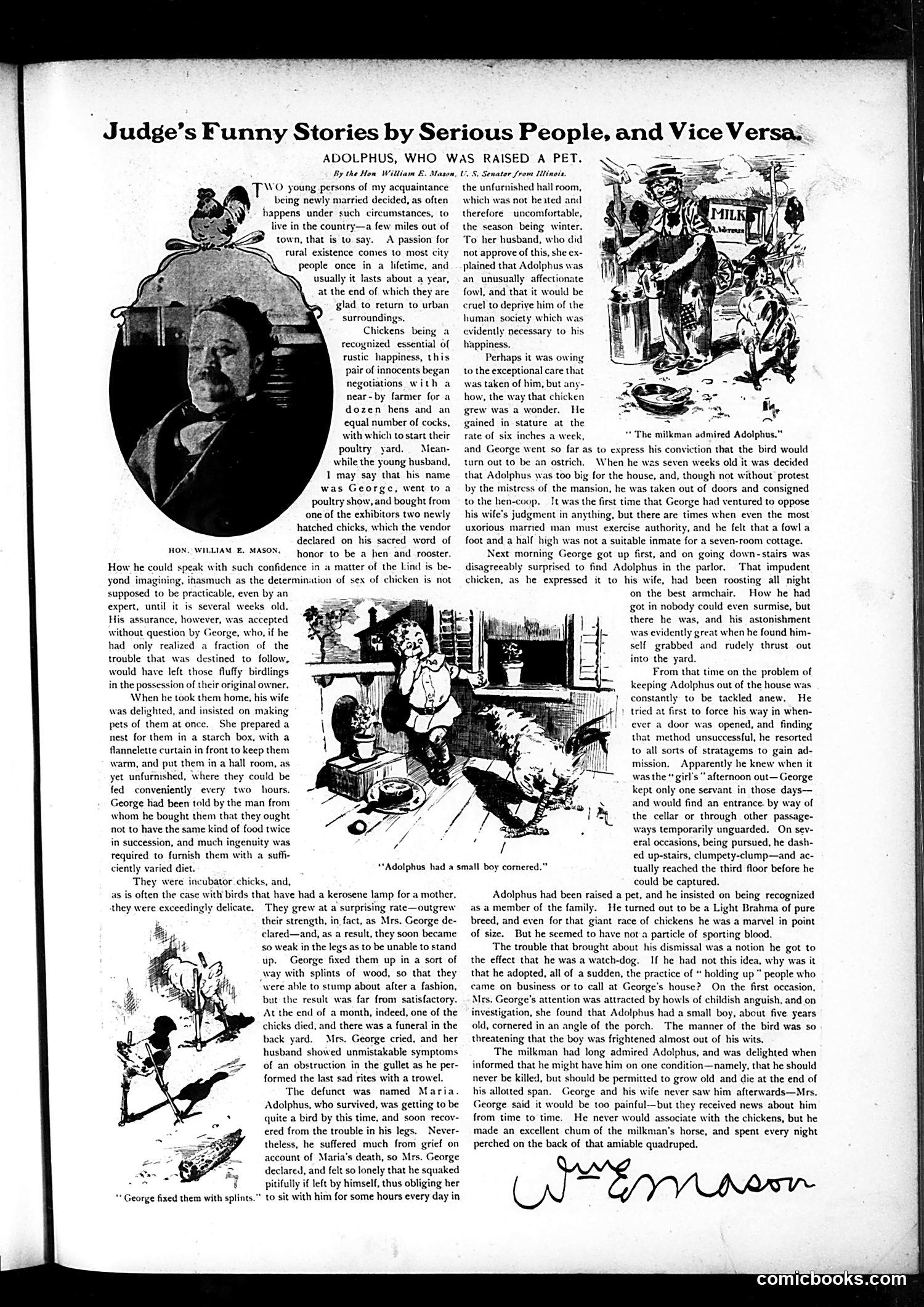
This humorous story by Hon. William E. Mason (U.S. Senator from Illinois) satirizes urban pretension and failed rural living. The narrative centers on George and his wife, city dwellers who purchase a rooster named Adolphus to start a poultry yard. The rooster, pampered and oversized (six inches per week), becomes unsuitable for their small cottage. Adolphus grows so large he terrorizes the household—escaping confinement, attacking inhabitants, and generally dominating the domestic space. The satire targets romanticized notions of rural life among inexperienced urbanites. The couple's inability to manage even a single bird mocks their pretensions toward self-sufficiency. Adolphus represents how poorly-conceived ventures fail when undertaken without practical knowledge or proper preparation.
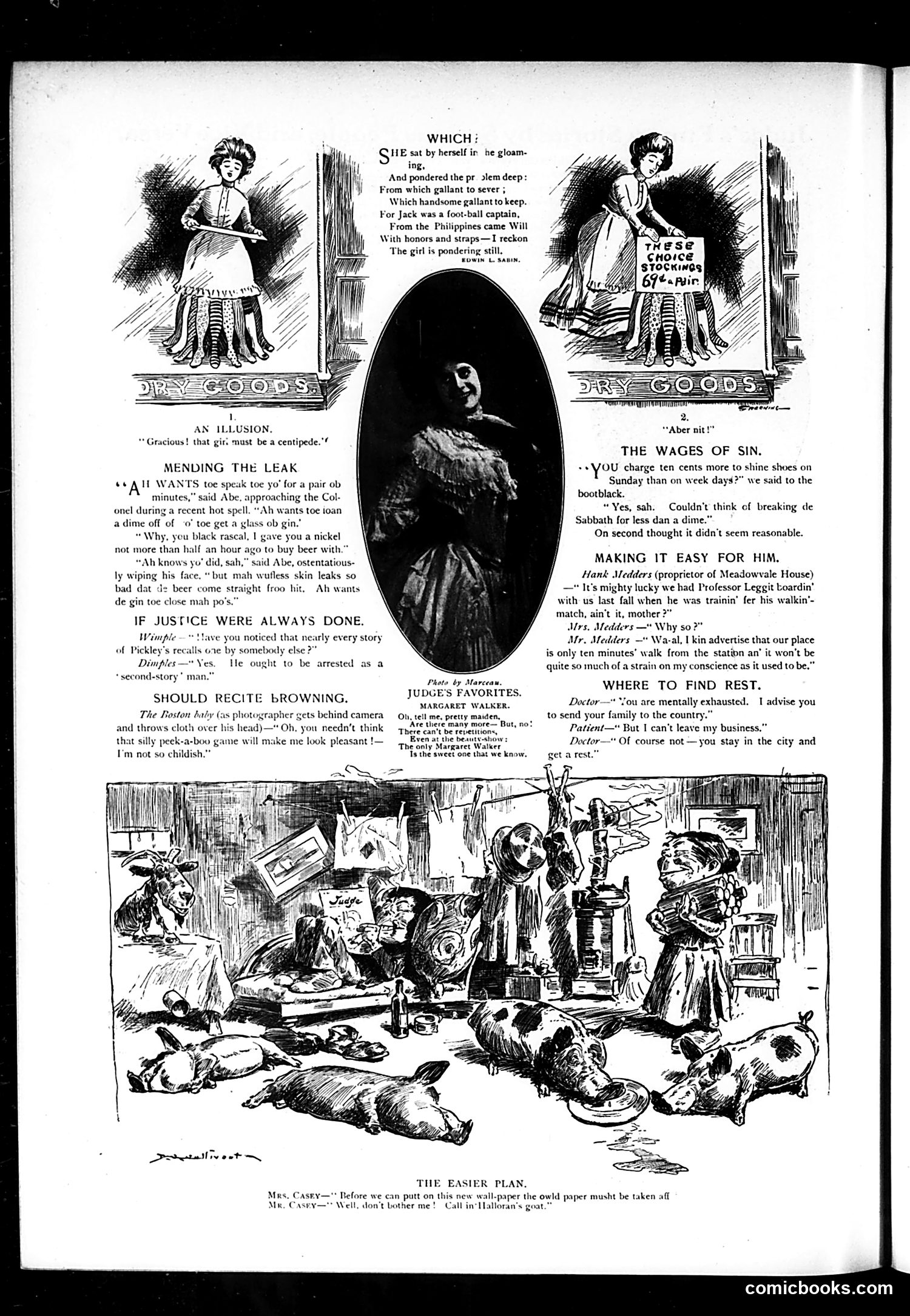
This page contains several satirical pieces from an early-20th-century American magazine: **"Which" and "Dry Goods"**: Two illustrated panels comparing women's choices, likely satirizing consumerism and female decision-making about clothing or goods. **"An Illusion" and "Mending the Leak"**: Short comedic sketches about everyday domestic situations—one involving a cab driver and gin, another about patching worn clothing. **"Judge's Favorites"**: A portrait labeled "Margaret Walker" appears to reference a contemporary public figure, though her specific notoriety is unclear. **"The Easier Plan"**: A chaotic illustration shows multiple figures in what appears to be a messy domestic scene, with the caption joking about wallpaper and a "goat"—satirizing household management or marital disagreements. The overall tone reflects Judge's typical humor: domestic follies, gender stereotypes, and working-class situations rendered as comedy.
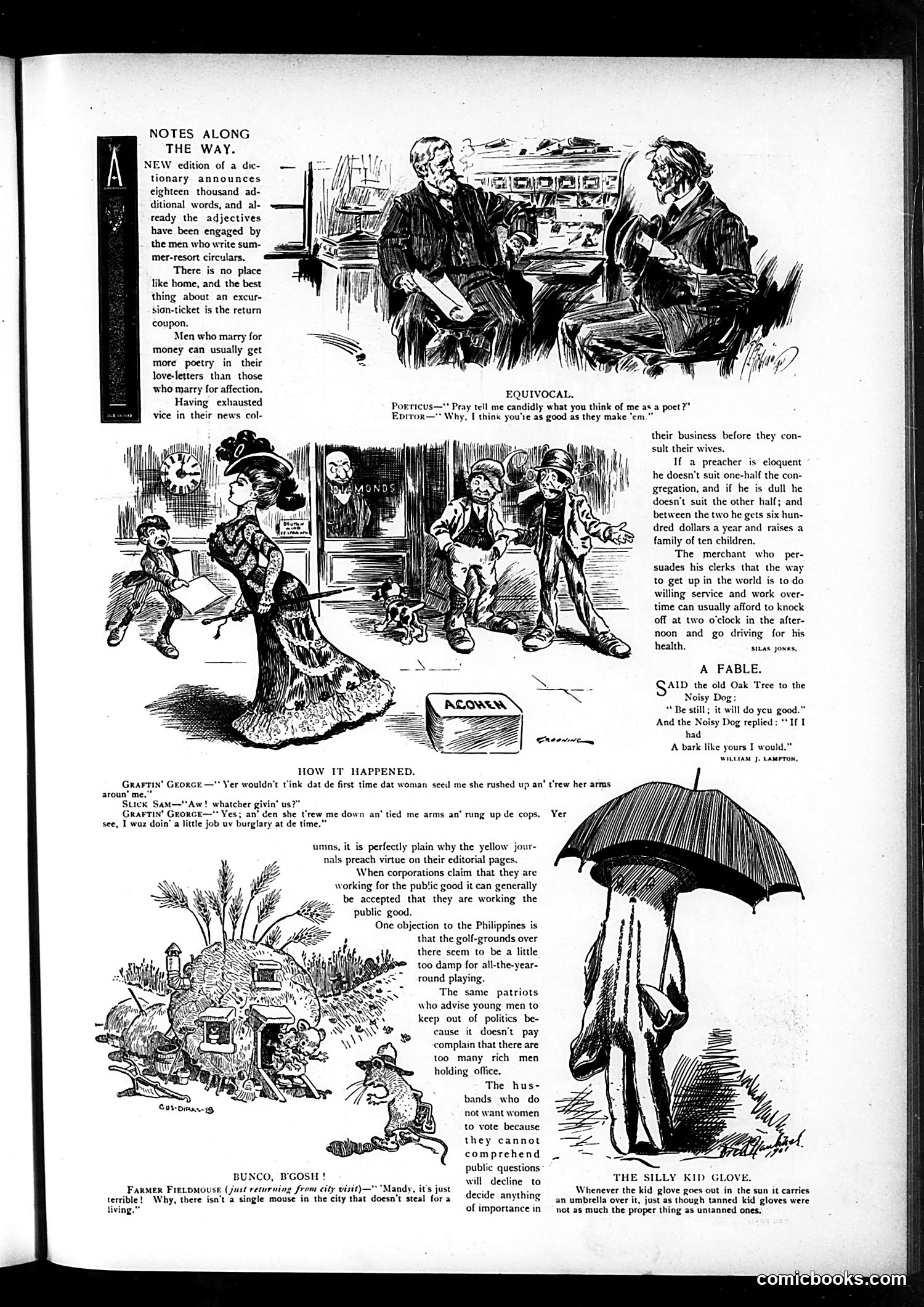
This page contains satirical commentary on American social and political life, typical of Judge magazine's editorial voice. The main pieces include: **"Notes Along the Way"**: Brief observations mocking summer resort advertising hyperbole, the cynicism of marrying for money, and clergy caught between incompatible congregation expectations. **"Equivocal"**: A poet asks an editor's opinion; the editor's backhanded compliment ("as good as they make 'em") satirizes insincere literary criticism. **"How It Happened"** and **"Bunco, B'Gosh!"**: Dialect humor featuring working-class characters, common in period humor but reflecting dated ethnic stereotyping. **"The Silly Kid Glove"**: Mocks the pretentiousness of protecting expensive tanned kid gloves from sun damage—frivolous upper-class vanity. The page's recurring theme: hypocrisy in American institutions (clergy, marriage, business, journalism) and class-based social absurdities. The cartoons use exaggeration and irony to critique both corporate self-interest and arbitrary social conventions.
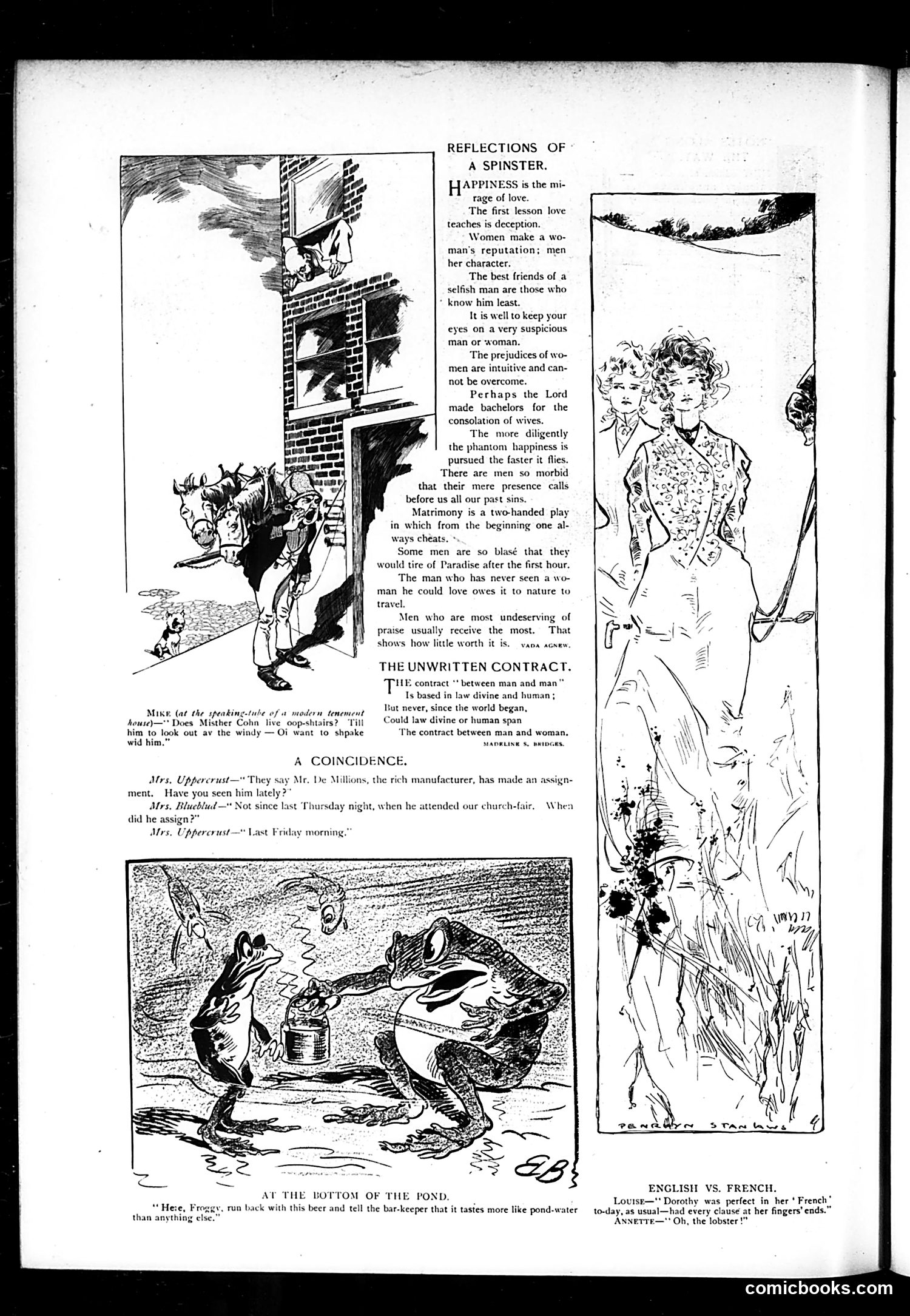
This page contains satirical observations on romance and marriage by a single woman ("A Spinster"), presented as cynical wisdom. Key points mock romantic ideals—love teaches deception, happiness is a mirage, marriage involves mutual cheating—reflecting early 20th-century skepticism about matrimonial bliss. The cartoons offer social humor: "A Coincidence" plays on a wealthy manufacturer's financial "assignment" (bankruptcy) occurring suspiciously after a church fundraiser. "At the Bottom of the Pond" depicts frogs discussing beer quality—likely a xenophobic joke about immigrants or foreign workers. The "English vs. French" segment mocks a woman's superficial "French" knowledge, reduced to reciting grammar rules. "The Unwritten Contract" suggests legal marriage protections exist for man-to-man dealings but not man-to-woman relationships, hinting at women's limited legal status. Overall, the page reflects period attitudes toward gender relations, immigration, and social class hierarchies.
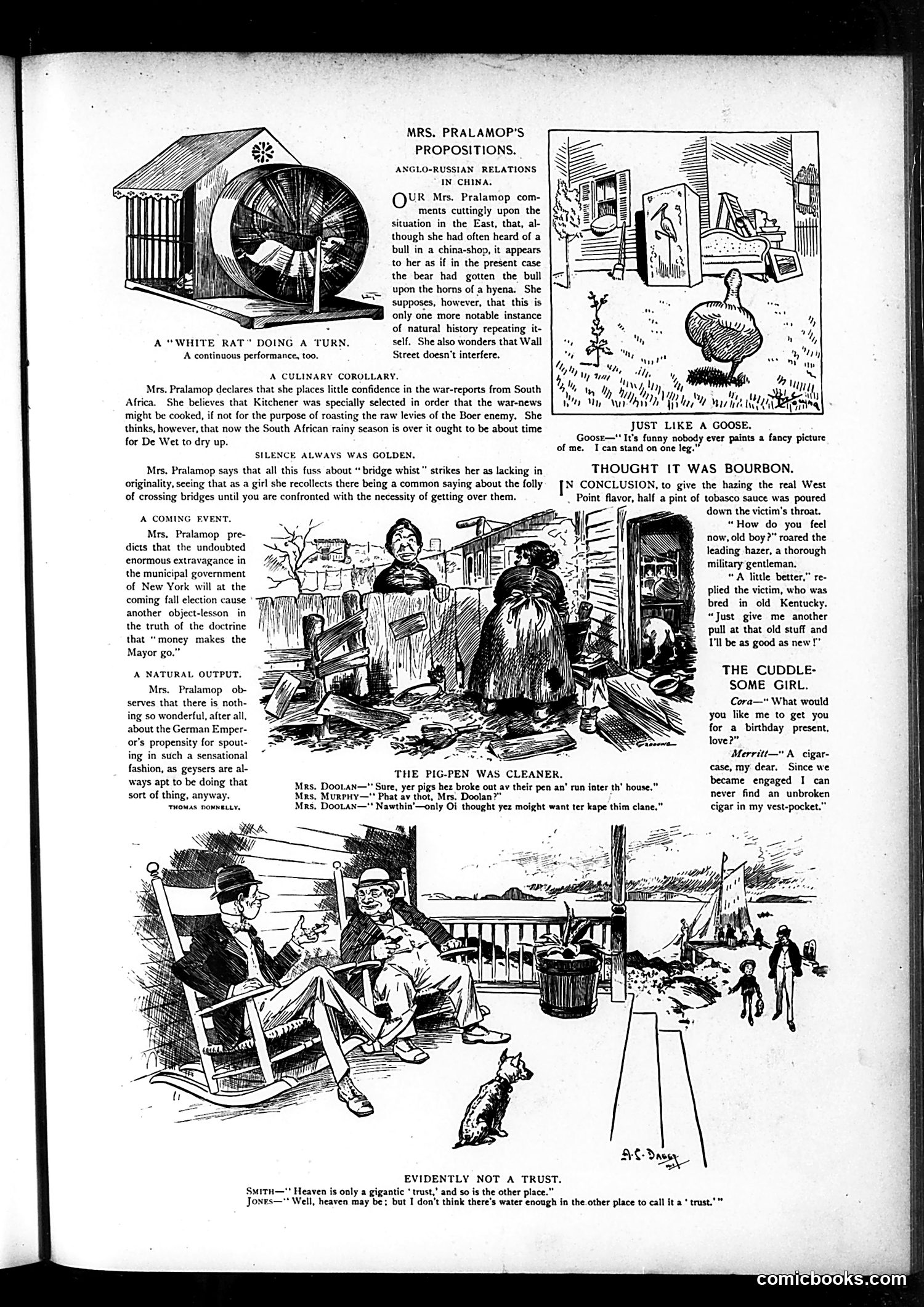
This page features Mrs. Pralamop, a recurring Judge character who offers absurdist social commentary. The main item mocks Anglo-Russian imperial conflicts in China using confused animal metaphors (a bear with a bull on a hyena's horns), satirizing public confusion about foreign policy. Other brief satirical pieces target contemporary issues: the Boer War's casualty reports ("cooked" by military selection); New York City municipal corruption; and German Emperor Wilhelm II's theatrical public behavior. The page also includes humorous short jokes and domestic scenes—a hazing incident with bourbon, a girl seeking unbroken cigars as gifts. These represent typical Judge content: light social satire mixing political commentary with absurdist humor and everyday comedy. The cartoons lack identifying labels for specific figures beyond character types, suggesting broad satirical commentary on institutions rather than individuals.
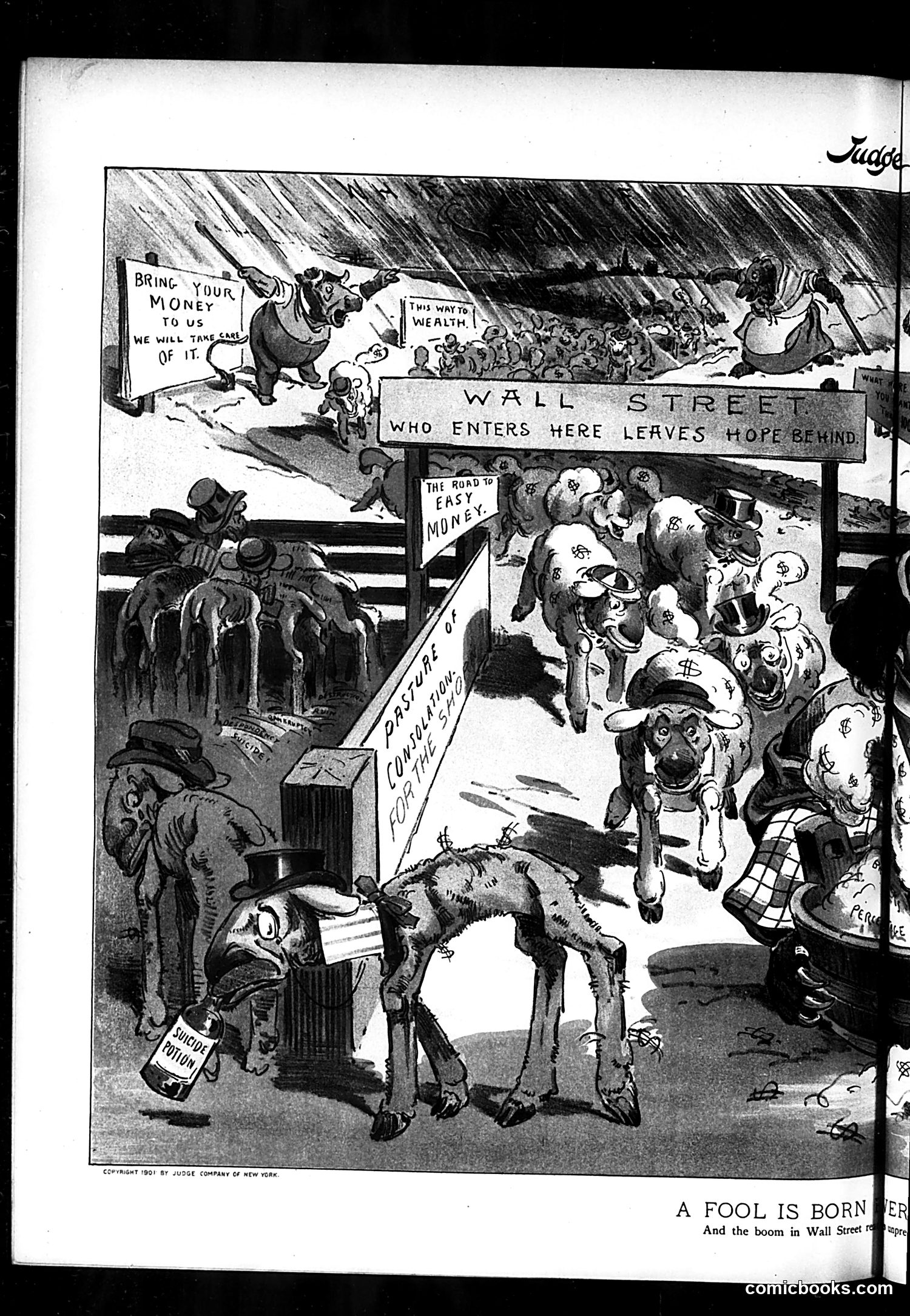
This is a satirical cartoon criticizing Wall Street speculation and financial fraud. The central image depicts anthropomorphized animals (donkeys, pigs, and other creatures) wearing dollar signs and top hats, representing greedy investors or speculators. They're crowding toward "Wall Street" with signs reading "Bring your money to us—we will take care of it" and "This way to wealth." The gate bears the Dante-inspired inscription "Who enters here leaves hope behind," mocking the false promises of easy riches. A skeletal figure and emaciated donkey labeled "Short Seller" appear to be victims of the scheme. The title "A Fool is Born...And the boom in Wall Street" suggests the cartoon critiques both the gullible investors and the financial manipulation endemic to the era—likely referencing the speculative excesses and market volatility of the early 20th century before major financial regulation.
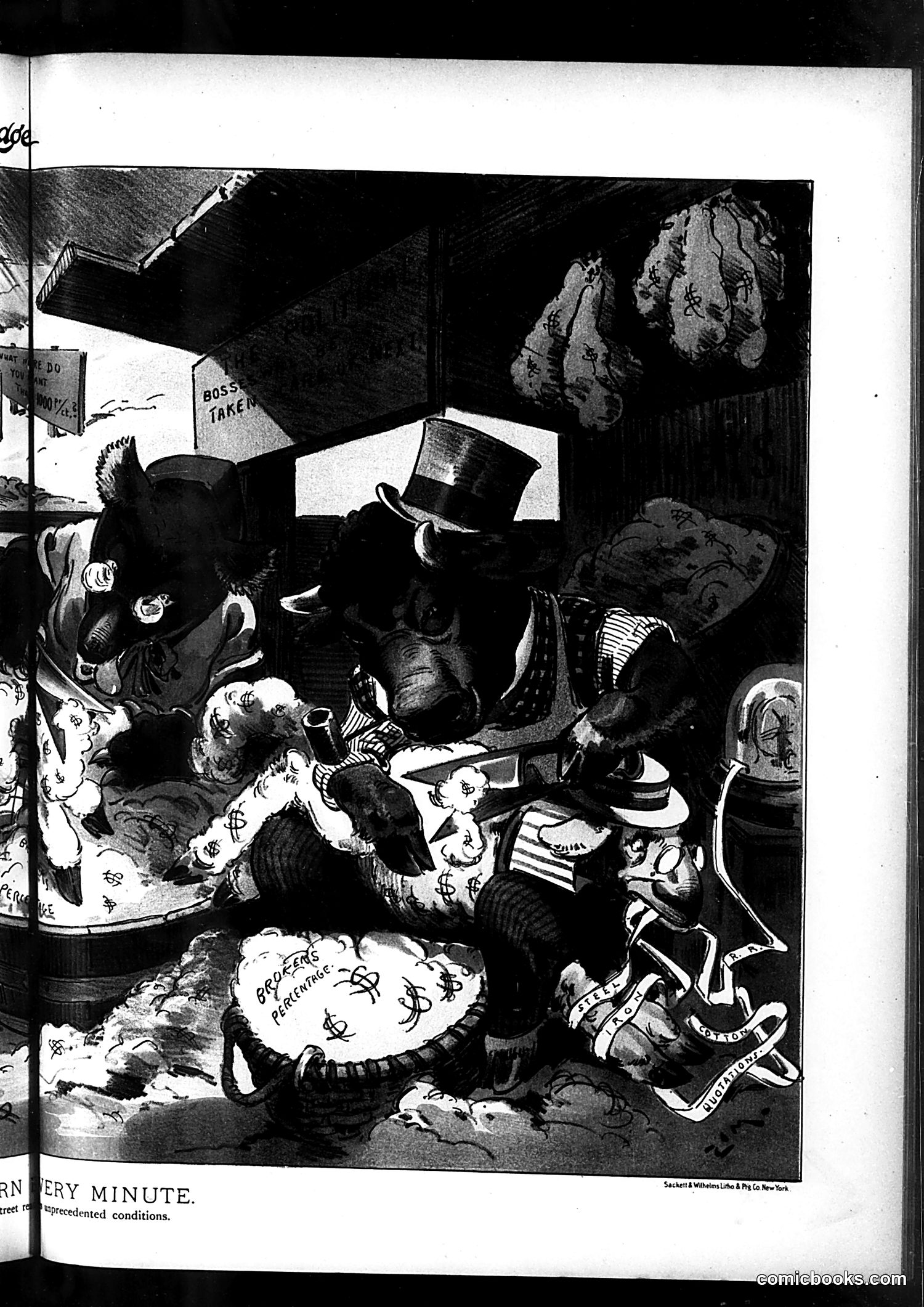
This appears to be a satirical cartoon from Judge magazine critiquing corruption or malfeasance. The central figure wears a top hat and appears to be a corrupt official or politician surrounded by caricatured figures with exaggerated features. Visible text includes references to "BOSS," "TURKEY," and dollar signs ($), suggesting themes of bribery, graft, and financial corruption. The scene depicts what looks like an illicit transaction or backroom dealing—a common subject in Gilded Age political satire. The caricatures and their positioning suggest the artist is mocking various parties involved in corrupt schemes, possibly including immigrants or ethnic stereotypes (common in period satire). Without clearer text or visible dates, the specific scandal or individuals remain unclear, but the general message critiques political corruption and malfeasance.
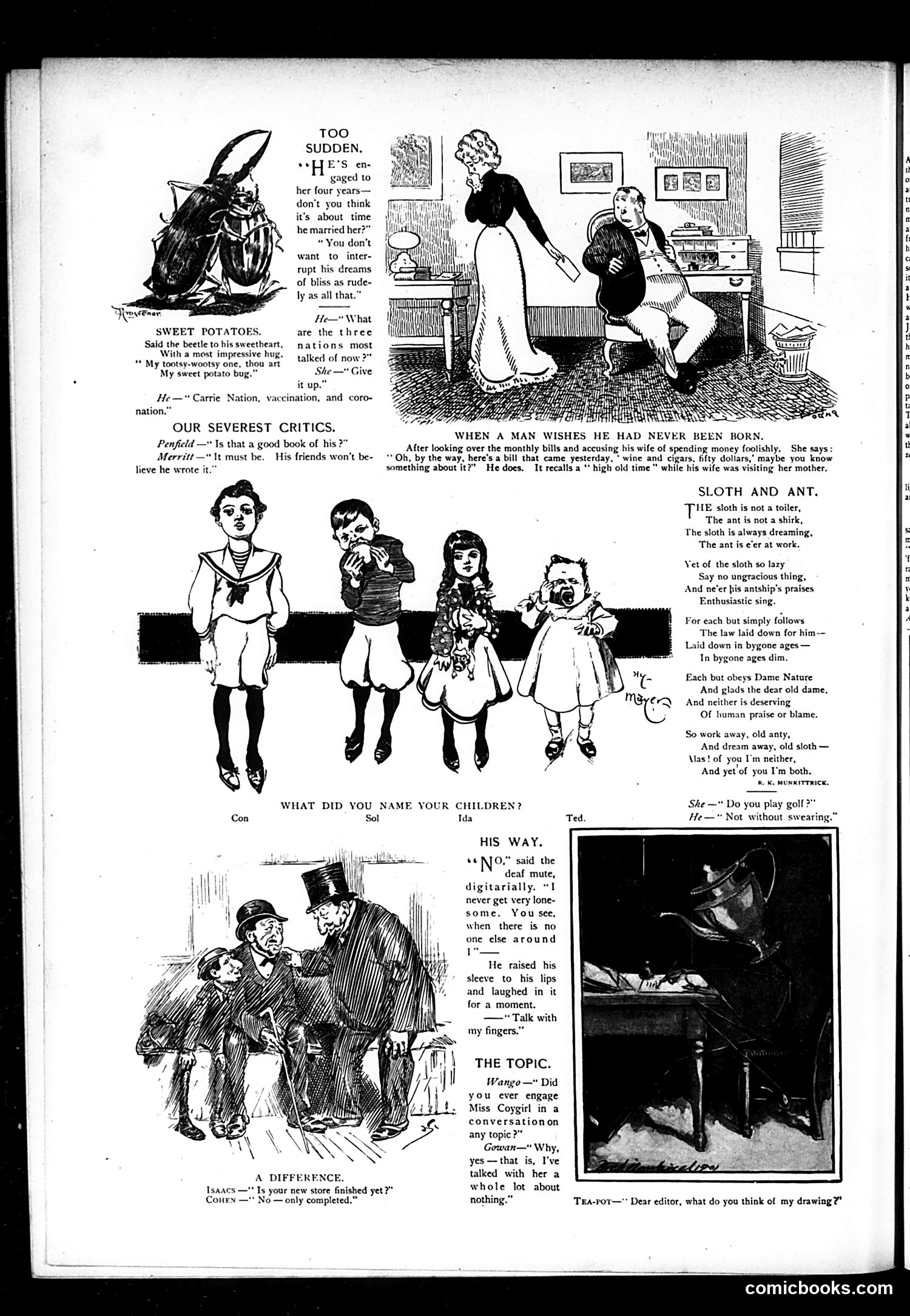
This page contains several unrelated humorous sketches typical of Judge magazine's format: **"Sweet Potatoes"** plays on the term "sweet potato bug" as a pet name, with a beetle proposing three "nations" to his sweetheart: Carrie Nation (the famous temperance activist), vaccination, and coronation—likely satirizing contemporary concerns. **"When a Man Wishes He Had Ne'er Been Born"** mocks domestic hypocrisy: a husband criticizes his wife's spending while conveniently forgetting his own $50 wine and cigar expenses—commentary on masculine double standards regarding household finances. **"Our Severest Critics"** suggests friends won't believe a man actually wrote his own book, implying either his incompetence or society's skepticism of amateur authors. **"Sloth and Ant"** is a Munktrick poem contrasting these creatures' natures philosophically, suggesting both follow natural law and deserve neither praise nor blame. The remaining sketches ("What Did You Name Your Children," "His Way," "The Topic") are brief jokes about naming, deafness communication, and conversational topics. The page represents typical early-20th-century American satirical humor.
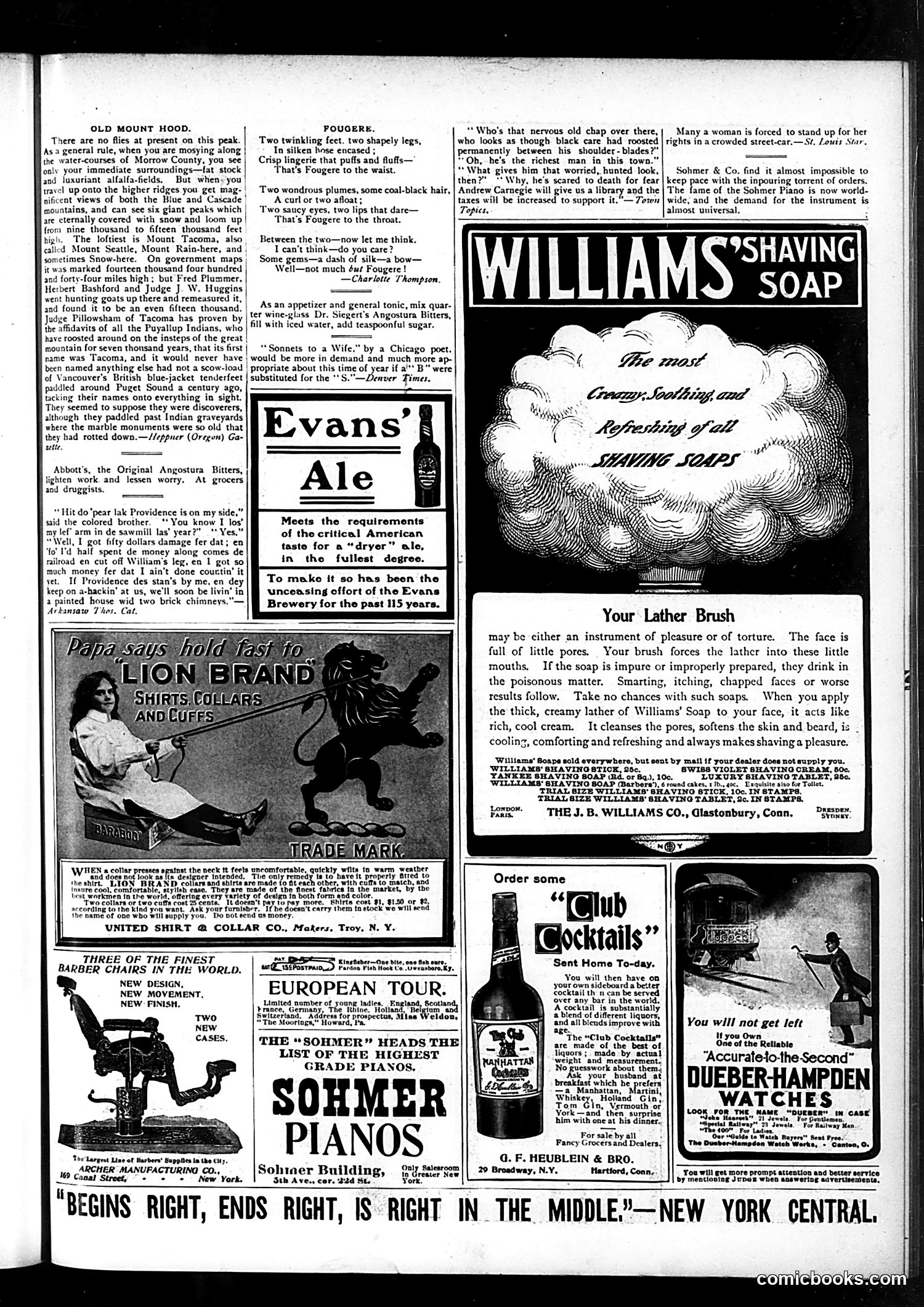
This page is primarily **advertising**, not political satire. It contains multiple product advertisements interspersed with brief humorous pieces typical of Judge magazine's format. The notable content includes: **"Old Mount Hood"** — A travelogue piece about Pacific Northwest geography, discussing Mount Tacoma/Rainier's height and history, with mild satire about British explorers' tendency to rename indigenous landmarks. **"Pougere"** — A playful poem describing a woman's appearance from feet to throat, advertising what appears to be a fragrance or fashion product. **A dialect joke** about a Black man receiving injury compensation, employing the racist humor common to period publications. **Product ads** for Evans' Ale, Lion Brand shirt collars, Sohmer pianos, Williams' Shaving Soap, Club Cocktails, and Dueber-Hampden watches dominate the page. The page reflects early 20th-century advertising aesthetics and the casual racism of the era, but contains no significant political cartooning or satire requiring historical context beyond period attitudes.
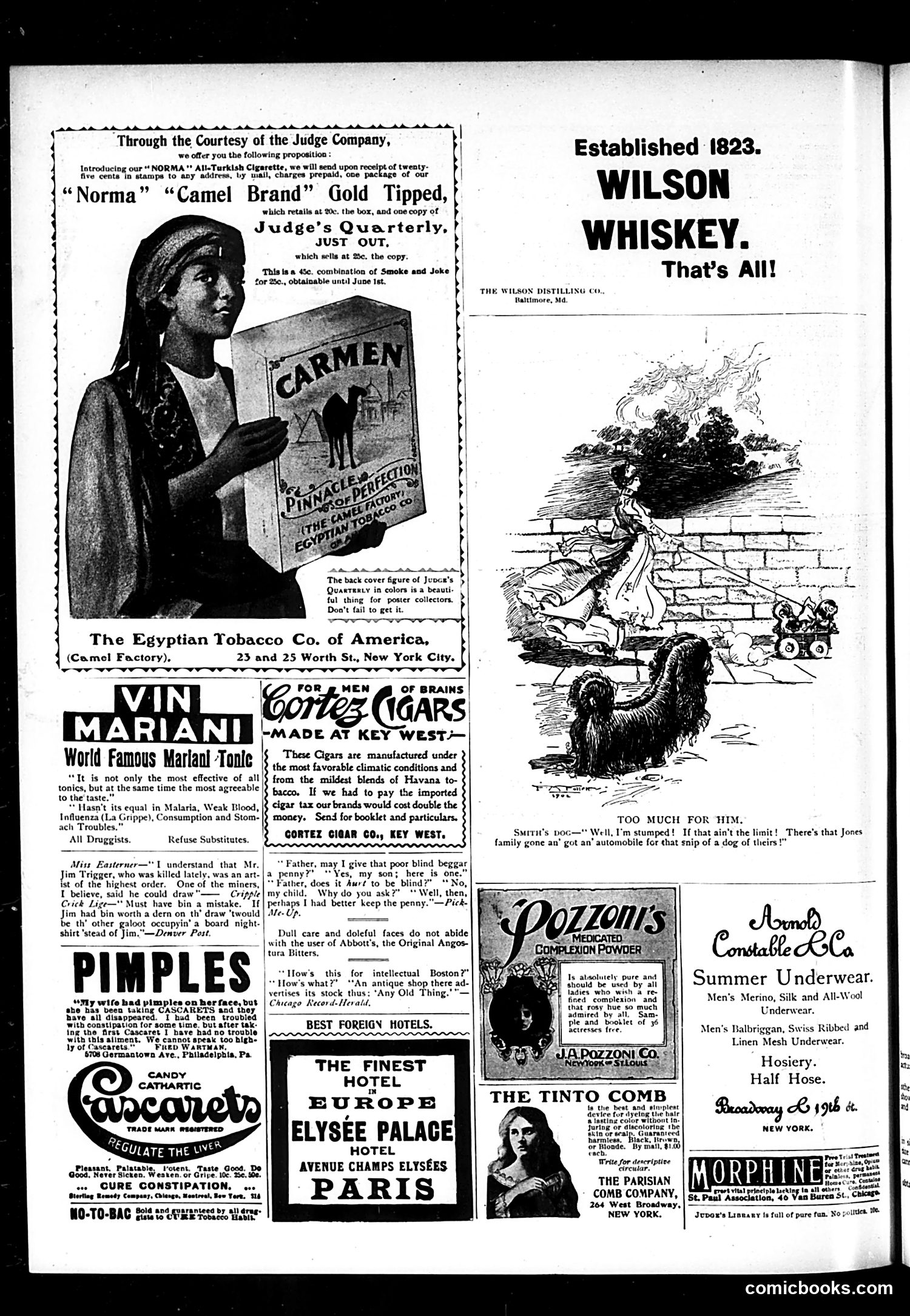
This is primarily an **advertising page** from Judge magazine, typical of early 20th-century publications. The page contains mostly commercial advertisements with two small embedded jokes. ## The Cartoons/Jokes: **"Too Much for Him"** (center-right): A domestic scene where a man expresses shock that his neighbor Jones bought an automobile for his small dog. The joke plays on class anxiety and conspicuous consumption—the absurdity of wealthy people spending extravagantly on pets was apparently humorous to the era's middle-class readers. **Father-and-son dialogue** (lower left): A brief exchange where a boy asks if he can give a penny to a blind beggar, then asks if blindness hurts. The punchline (cut off) likely involves the boy's selfish reasoning. ## Context: The page reflects **Edwardian-era consumer culture**: cigarettes, tonics, hair dyes, and automobiles as status symbols. References to remedies for "Consumption" and "La Gripe" (influenza) suggest pre-modern medicine marketing. The overall tone is genteel domestic humor aimed at aspiring middle-class readers.
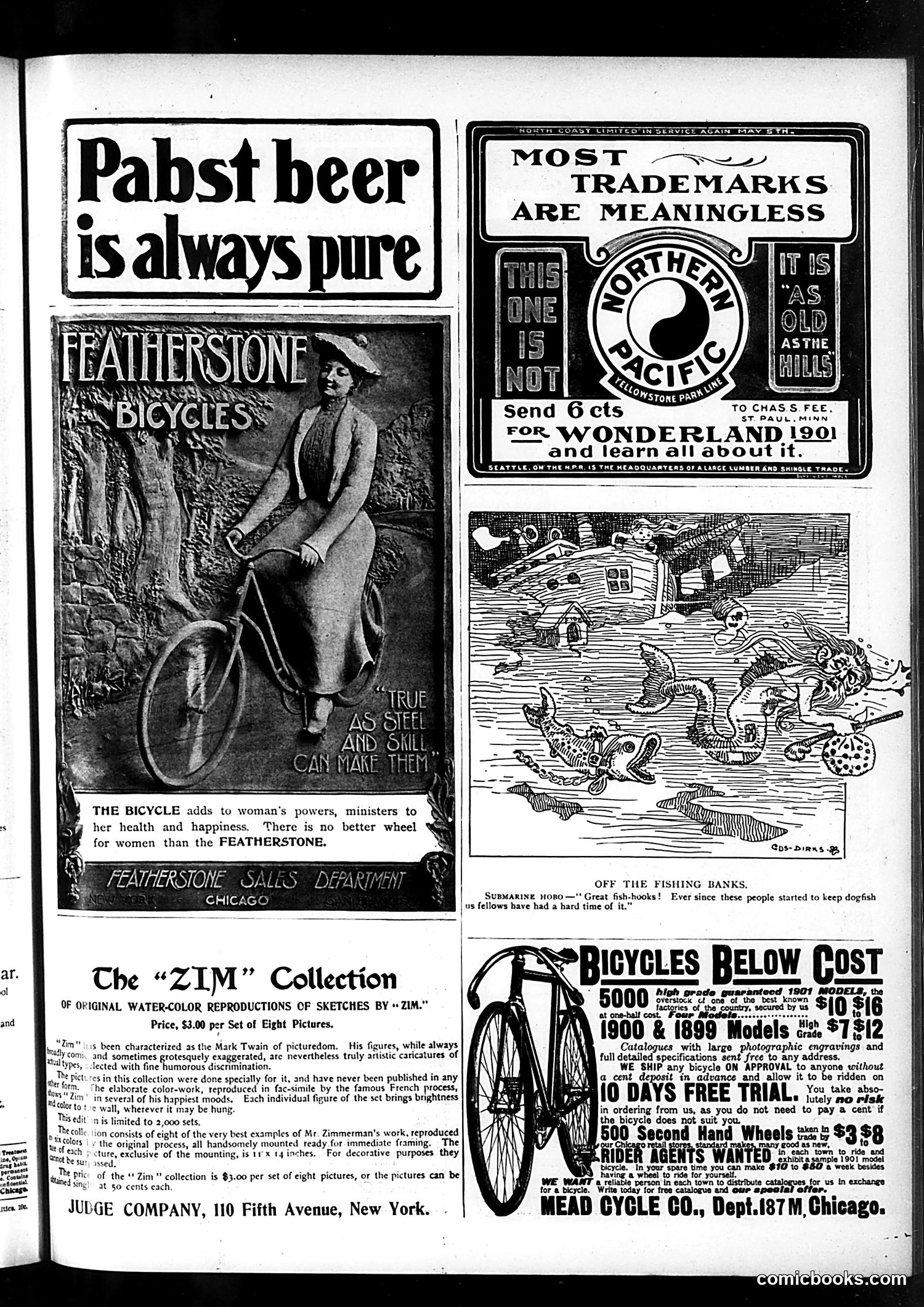
This page is primarily **advertising and product promotion** rather than political satire. It contains: 1. **Featherstone Bicycles ad** - Appeals to women by claiming bicycles enhance "woman's powers" and health, reflecting early 1900s Progressive Era enthusiasm for female independence through cycling. 2. **"Zim" Collection** - Advertises affordable art prints ($3.00 per set) by cartoonist Zimmerman, compared to Mark Twain. Targets middle-class consumers seeking home decoration. 3. **Northern Pacific Trademark** - A small promotional piece claiming trademarks are "meaningless" (unclear satirical intent). 4. **Submarine humor cartoon** - Shows fish complaining about humans keeping dogfish as pets, disrupting fishing. Light observational comedy. 5. **Mead Cycle Co. ad** - Aggressive bicycle sales pitch offering 10-day free trials and cheap second-hand wheels ($3-$8), targeting working-class buyers. The page exemplifies Judge's dual nature: satirical magazine mixed with revenue-generating advertisements. Most content serves commercial rather than political purposes.
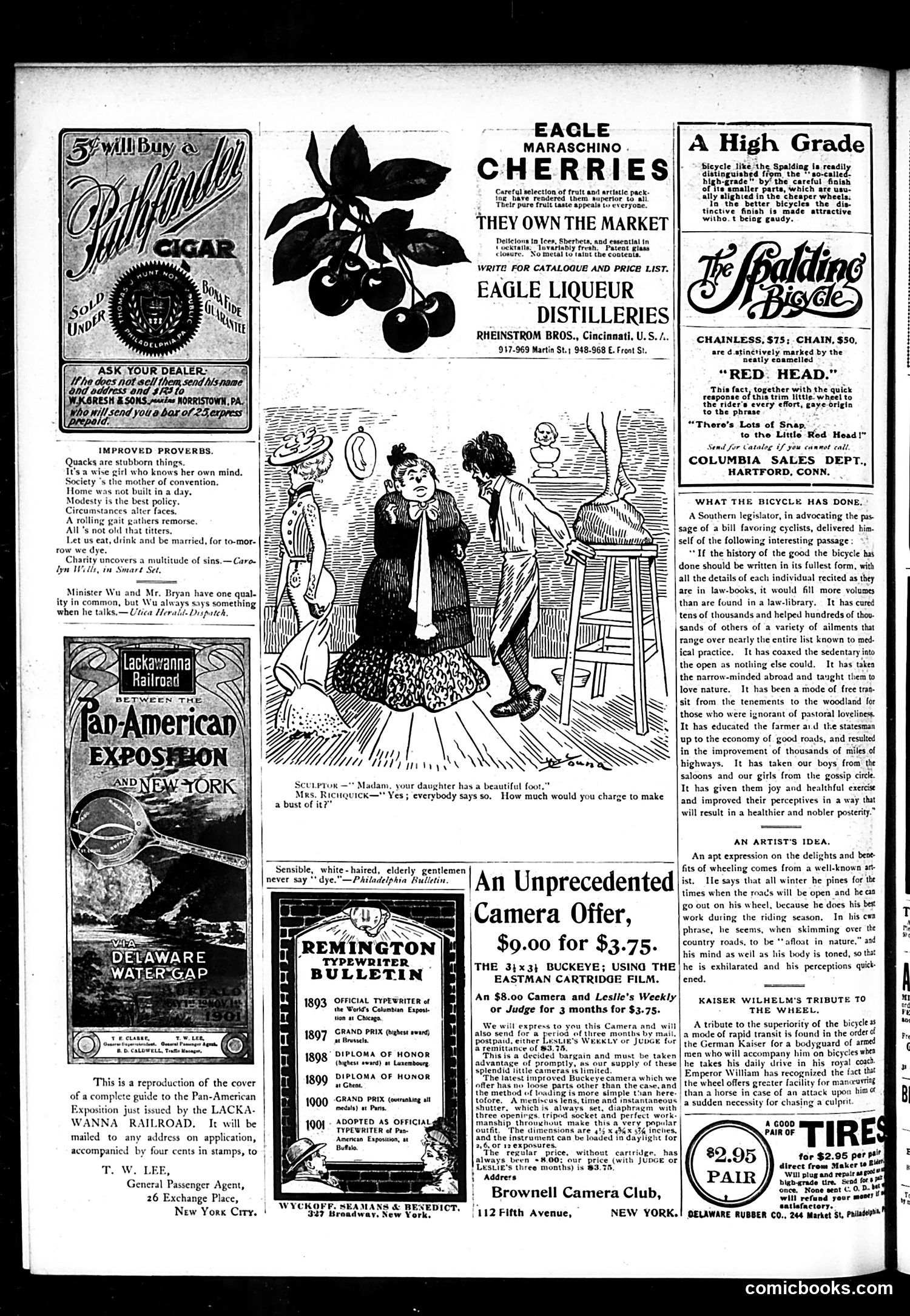
This page is primarily **advertisements and filler content** rather than political satire. The main cartoon depicts a domestic scene where a woman displays her foot to guests while her husband (labeled "Mr. Richinwick") sits uncomfortably. The joke, supported by the caption, mocks vanity and social pretension: the wife wants to charge money for people to see her "beautiful foot," suggesting absurd pride in minor attributes. The "Improved Proverbs" section offers mild social satire by twisting familiar sayings into humorous observations about human nature—nothing specific to 1900s politics. The remaining content consists of product advertisements (bicycles, cameras, typewriters, liqueurs) and promotional material for the Pan-American Exposition. There are no identifiable political figures or current events referenced. The page represents typical Judge magazine filler between more substantive satirical pieces.
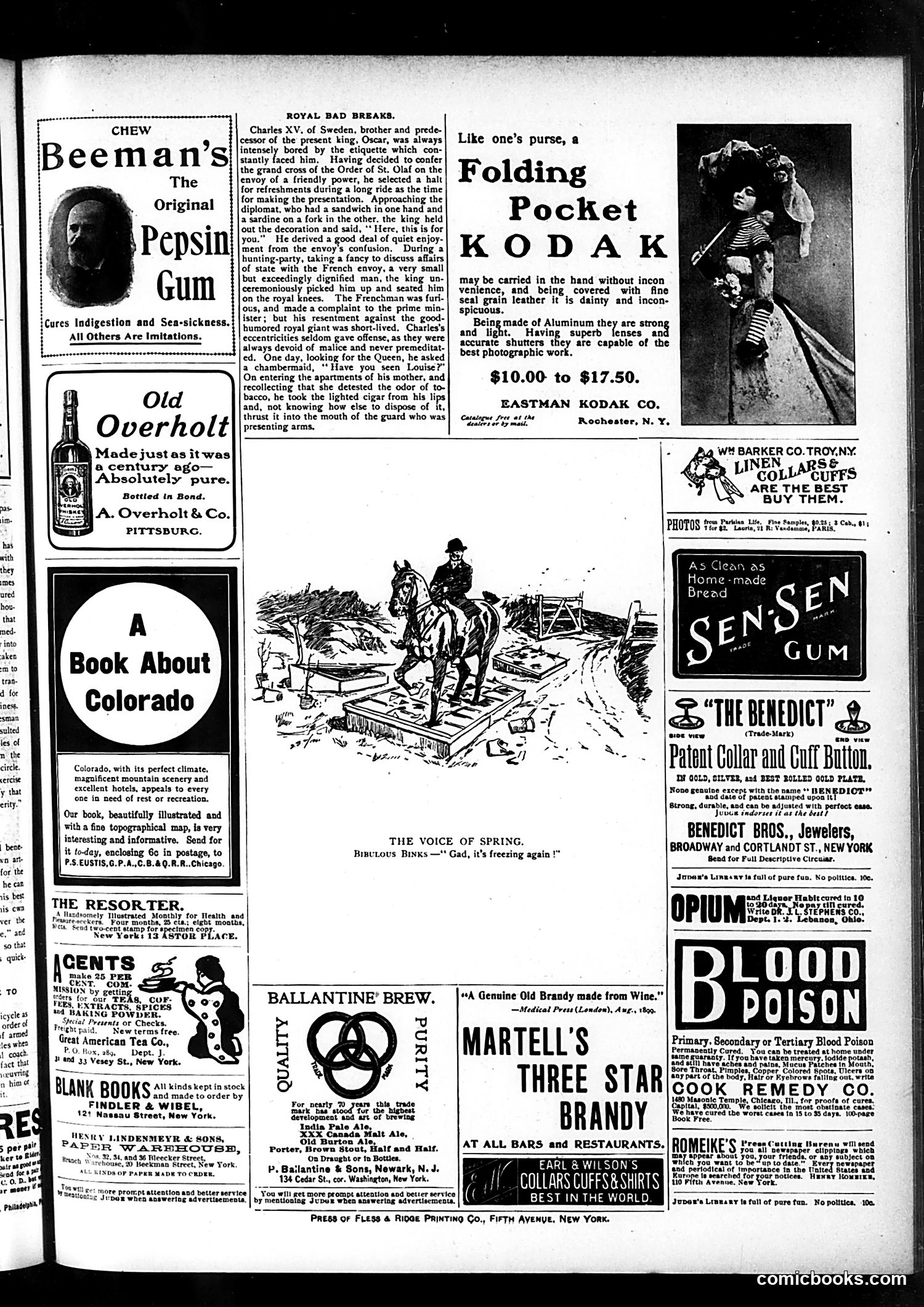
This page is primarily **advertising with one featured article**, not a political cartoon. The main text, "Royal Bad Breaks," recounts anecdotes about **King Charles XV of Sweden**, illustrating his deliberate disregard for court etiquette. The stories depict Charles as intentionally flouting formal ceremony—presenting a decoration while the diplomat ate a sandwich, seating a dignified French envoy on his lap uninvited, and thrusting a lit cigar into a guard's mouth. The piece frames these as harmless eccentricities from a "good-humored royal giant" whose behavior, though shocking, caused no lasting offense due to his lack of malice. For modern readers, this reflects **19th-century attitudes toward aristocratic privilege**: a king's rule-breaking is portrayed as charming rather than disrespectful, and subordinates' indignation is expected to dissolve quickly. The humor derives from the clash between formal protocol and royal whimsy—a dynamic largely obsolete in contemporary society. The remainder of the page consists of period advertisements for products like Kodak cameras, whiskey, brandy, and collars.
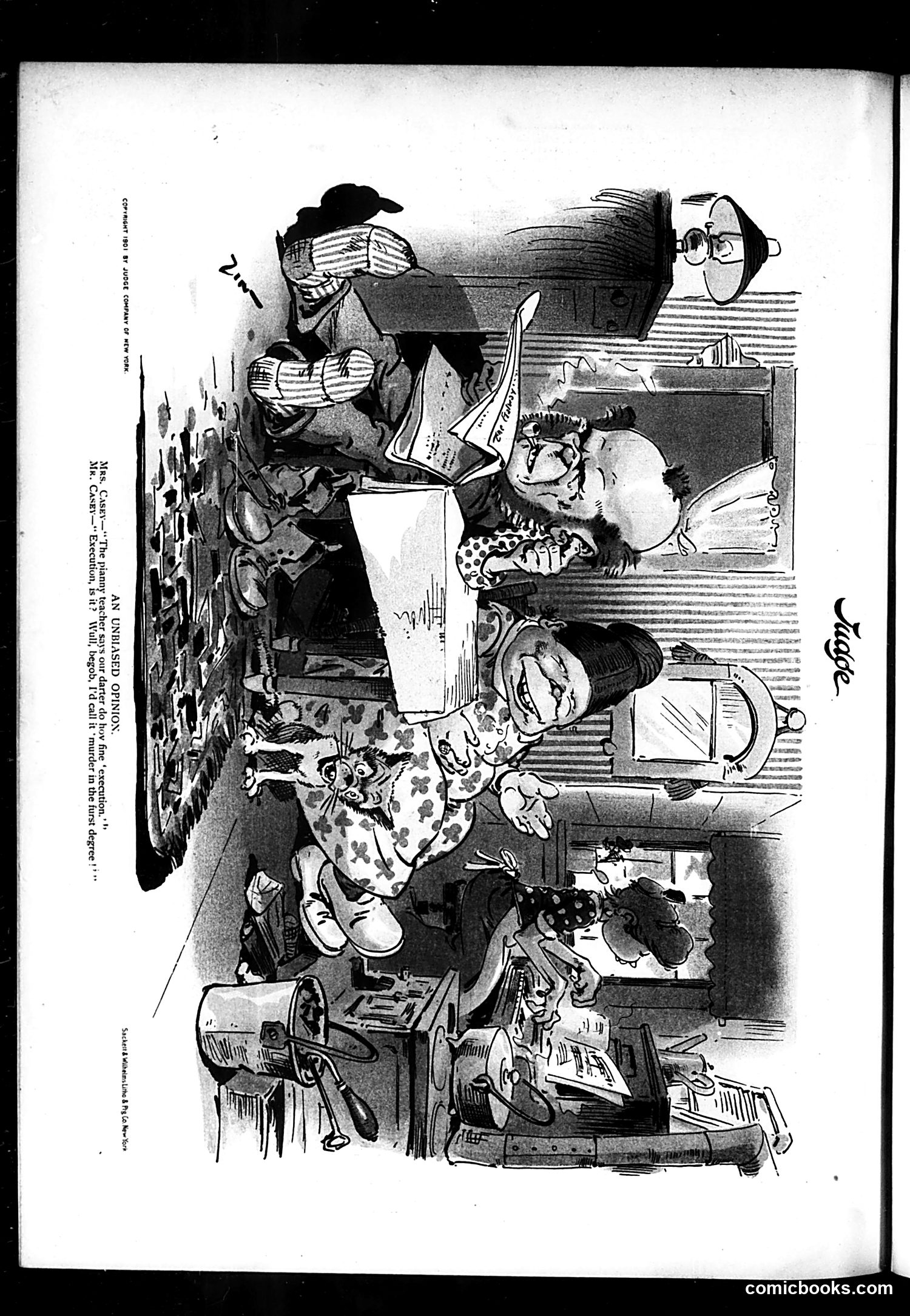
I cannot reliably interpret this cartoon with confidence. The OCR text is severely corrupted and unreadable, making it impossible to identify the publication date, specific figures, or satirical targets. While the image shows what appears to be a chaotic interior scene with multiple caricatured figures and exaggerated expressions typical of Judge magazine's style, I cannot determine who these figures represent or what political or social commentary is intended without legible text or clear visual identifying markers. To provide accurate historical context as requested, I would need either a clearer image or a properly OCR'd caption.