
Judge, 1901-05-18 · page 3 of 16
Judge — May 18, 1901 — page 3: what you’re looking at
What you’re looking at
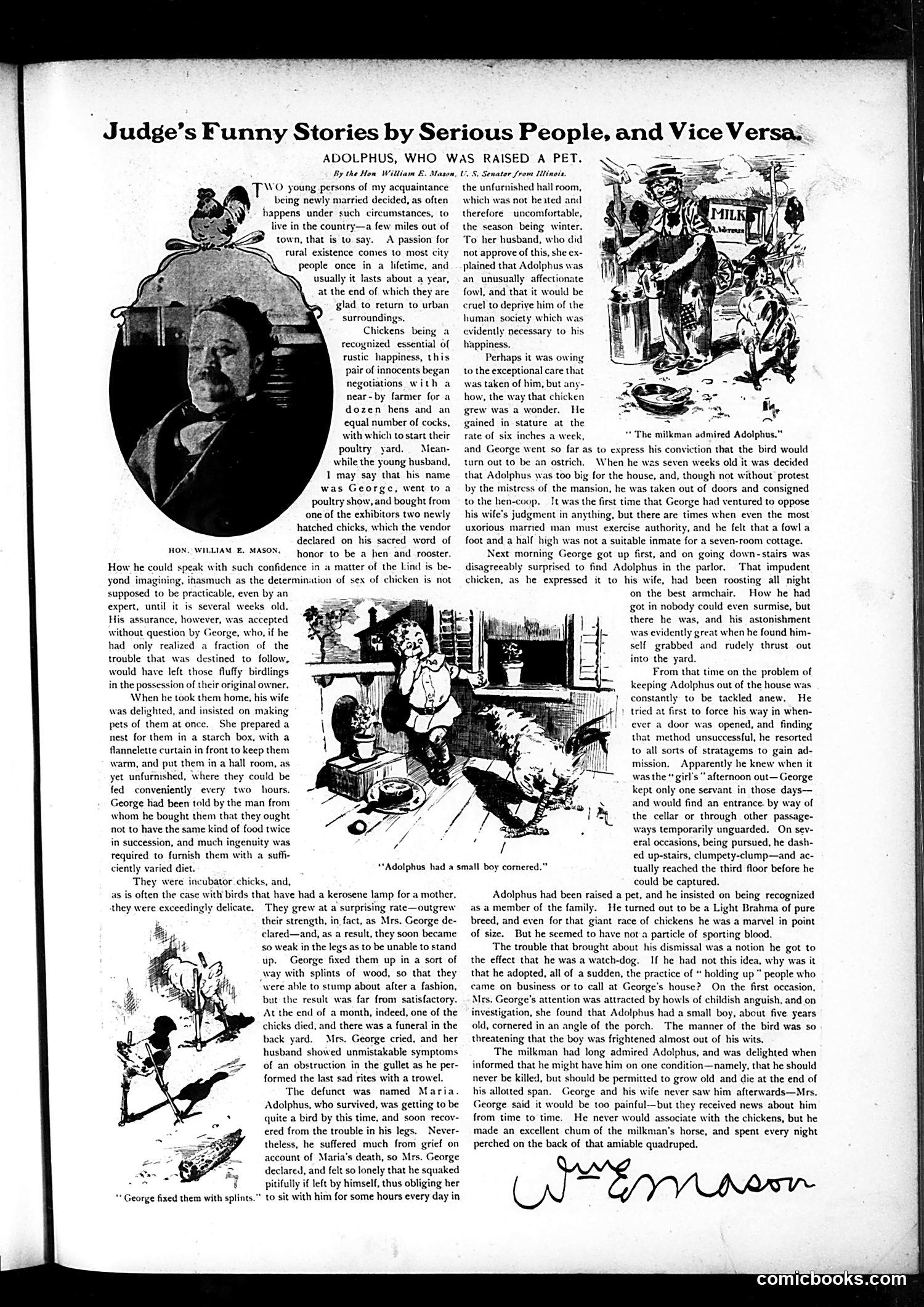
This humorous story by Hon. William E. Mason (U.S. Senator from Illinois) satirizes urban pretension and failed rural living. The narrative centers on George and his wife, city dwellers who purchase a rooster named Adolphus to start a poultry yard. The rooster, pampered and oversized (six inches per week), becomes unsuitable for their small cottage. Adolphus grows so large he terrorizes the household—escaping confinement, attacking inhabitants, and generally dominating the domestic space. The satire targets romanticized notions of rural life among inexperienced urbanites. The couple's inability to manage even a single bird mocks their pretensions toward self-sufficiency. Adolphus represents how poorly-conceived ventures fail when undertaken without practical knowledge or proper preparation.
📄 Transcribed text from this page (OCR, searchable)
Machine-transcribed from the original scan — historical spelling and the odd misread are preserved.
By the Hon William E WO young persons of my acquaintance being newly married decided, as often happens under such circumstances, to ag live in the country—a few miles out of town, that is to say, A passion for tural existence comes to most city people once in a lifetime, and usually it lasts about a year, at the end of which they are glad to return to urban surroundings. Chickens being a recognized essential of rustic happiness, this pair of innocents began negotiations with a near-by farmer for a dozen hens and an equal number of cocks, with which to start their poultry yard. Mean- while the young husband, 1 may say that his name was George, went toa poultry show, and bought from one of the exhibitors two newly hatched chicks, which the vendor declared on his sacred word of honor to be a hen and rooster. How he could speak with such confidence in a matter of the Lind is be- yond imagining, inasmuch as the determination of sex of chi supposed to be practicable, even by an expert, until it is several weeks old. His assurance, however, was accepted without question by George, who, if he had only realized a fraction of the trouble that was destined to follow, would have left those fluffy birdlings in the possession of their original owner, When he took them home, his wife was delighted, and insisted on making pets of them at once. She prepared a nest for them in a starch box, with a flannelette curtain in front to keep them warm, and put them in a hall room, as yet unfurnished, where they could be fed conveniently every two hours. George had been told by the man from whom he bought them that they ought not to have the same kind of food twice in succession, and much ingenuity was required to furnish them with a suffi- ciently varied diet. They were incubator chicks, and, is often the case with birds that have had a kerosene they were exceedingly delicate, HON. WILLIAM BE, MASON, ken is not mp for a mother, They grew at a surprising rate—outgrew: their strength, in fact, as Mrs. George de- clared—and, as a result, they soon became so weak in the legs as to be unable to stand up. George fixed them up in a sort of way with splints of wood, so that they “were able to stump about after a fashion, but the result was far from satisfactory. At the end of a month, indeed, one of the chicks died, and there was a funeral in the back yard. Mrs. George cried, and her husband showed unmistakable symptoms of an obstruction in the gullet as he per- formed the last sad rites with a trowel. The defunct was named Maria. Adolphus, who survived, was getting to be quite a bird by this time, and soon recov ered from the trouble in his legs. Never- theless, he suffered much from grief on account of Maria's death, so Mrs. George declared, and felt so lonely that he squaked pitifully if left by himself, thus obliging her * to sit with him for some hours every day in Seorge fixed them with splints. Judge’s Funny Stories by Serious People, and Vice Versa;. ADOLPHUS, WHO WAS RAISED A PET. See iF Mason, U.S. Senator from Ilinois, “*Adolphus had a small boy cornered.” the unfurnished hail room, which was not heated and therefore uncomfortable, the season being winter. To her husband, who did not approve of this, she ex- y a plained that Adolphus was is, an unusually affectionate fowl, and that it would be cruel to deprive him of the human society which was evidently necessary to his happiness. Perhaps it was owing to the exceptional care that was taken of him, but a how, the way that chi grew was a wonder. He gained in stature at the rate of six inches a week, “The milkman admired Adolphus.” and George went so far as to express his conviction that the bird would turn out to be an ostrich. When he was seven weeks old it was decided that Adolphus was too big for the house, and, though not without protest by the mistress of the mansion, he was taken out of doors and consigned to the hen-coop. It was the first time that George had ventured to oppose his wife's judgment in anything, but there are times when even the most uxorious married man must exercise authority, and he felt that a fowl a foot and a half high was not a suitable inmate for a seven-room cottage. Next morning George got up first, and on going down-stairs was disagreeably surprised to find Adolphus in the parlor. ‘That impudent chicken, as he expressed it to his wife, had been roosting all night on the best armchair. How he had got in nobody could even surmise, but there he was, and his astonishment was evidently great when he found him- self grabbed and rudely thrust out into the yard. From that time on the problem of keeping Adolphus out of the house was constantly to be tackled anew. He | tried at first to force his way in when- | ever a door was opened, and finding that method unsuccessful, he resorted to all sorts of stratagems to gain ad- mission, Apparently he knew when it was the “ girl's" afternoon out— George kept only one servant in those days— and would find an entrance. by way of the cellar or through other passage- ways temporarily unguarded. On sev- eral occasions, being pursued, he dash- ed up-stairs, clumpety-clump—and ac- tually reached the third floor before he could be captured. Adolphus had been raised a pet, and he insisted on being recognized 3 a member of the family. He turned out to be a Light Brahma of pure breed, and even for that giant race of chickens he was a marvel in point of size, But he seemed to have not a particle of sporting blood. The trouble that brought about his dismissal was a notion he got to the effect that he was a watch-dog. If he had not this idea, why was it that he adopted, all of a sudden, the practice of “ holding up " people who came on business or to call at George's house? On the first occasion, Mrs. George's attention was attracted by howls of childish anguish, and on investigation, she found that Adolphus had a small boy, about five years old, cornered in an angle of the porch. The manner of the bird was so threatening that the boy was frightened almost out of his wits. The milkman had long admired Adolphus, and was delighted when informed that he might have him on one condition—namely, that he should never be killed, but should be permitted to grow old and die at the end of his allotted span. George and his wife never saw him afterwards—Mrs. corge said it would be too painful—but they received news about him from time to time. He never would associate with the chickens, but he made an excellent chum of the milkman’s horse, and spent every night perched on the back of that amiable quadruped. ny-