
A complete issue · 11 pages · 1901
Judge — May 4, 1901
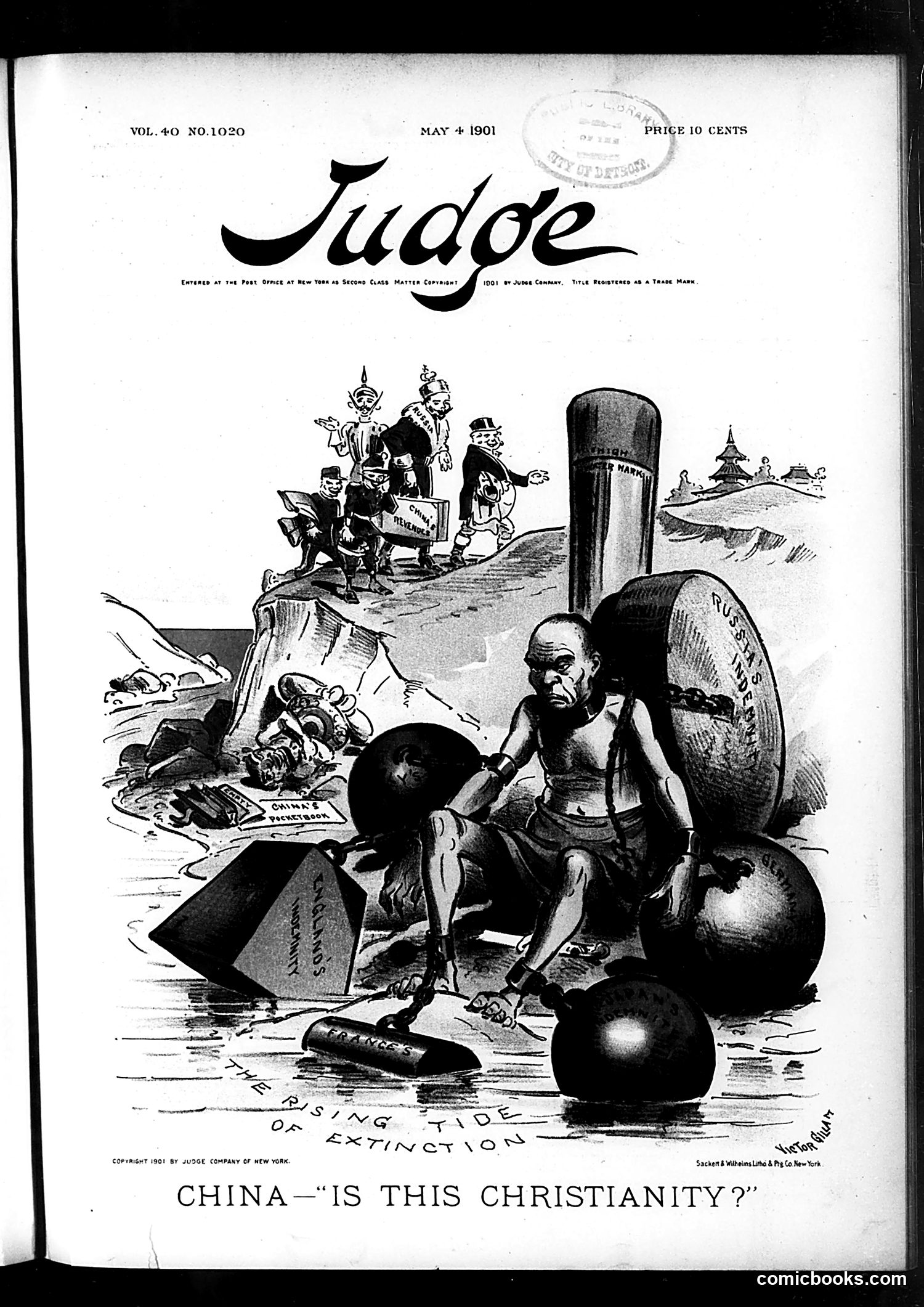
This May 1901 *Judge* cartoon satirizes Western imperial powers' violence in China during the Boxer Rebellion aftermath. The central figure—a brutish, caricatured man labeled "Rising Tide of Extinction"—represents Western aggression. He's surrounded by implements of destruction and war, while refined diplomats observe from the background, seemingly indifferent to the carnage. The title's rhetorical question mocks Western powers' claims to bring Christian civilization to China while engaging in brutal military conquest and exploitation. The cartoon criticizes the hypocrisy of nations justifying imperial intervention through religious and moral rhetoric while committing atrocities. The chaotic scene of destruction contrasts sharply with the composed diplomats, exposing the disconnect between stated principles and actual conduct.
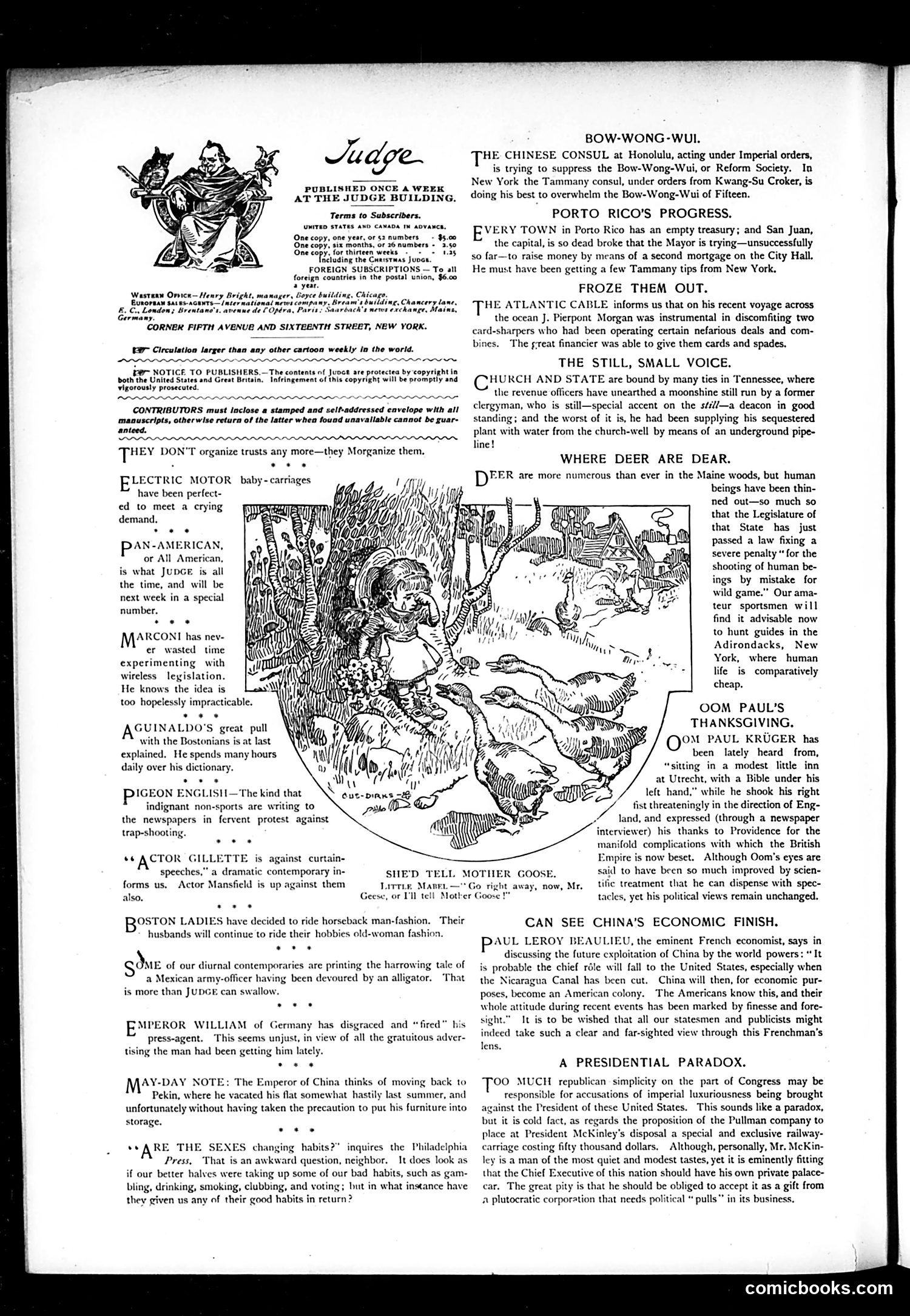
The main cartoon depicts a hunter encountering deer in a forest landscape. The accompanying article "WHERE DEER ARE DEAR" discusses Maine's deer overpopulation problem and notes the state legislature has passed severe penalties for hunting violations—treating the killing of deer as seriously as poaching game. The satire appears to criticize this perceived overprotection of deer as absurd or misdirected governmental priority. The image of the startled hunter suggests the irony of facing legal consequences while attempting legitimate outdoor activity. Additional brief satirical items on the page mock various contemporary subjects: trusts, electric motor baby-carriages, wireless legislation, and political figures. The overall tone suggests Judge magazine's skepticism toward regulatory overreach and progressive legislation of the era.
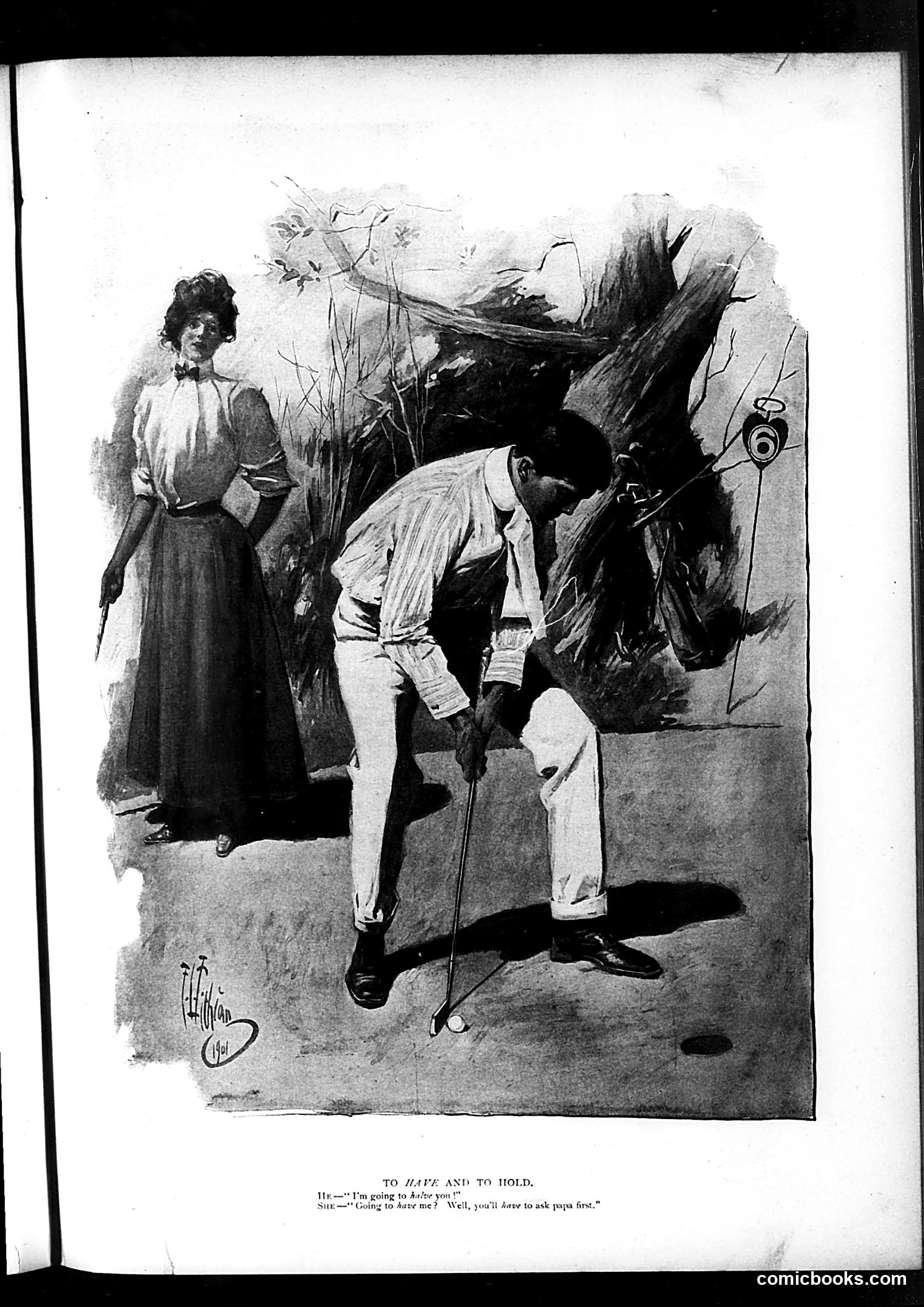
This cartoon depicts a romantic/marital scenario typical of Judge magazine's social humor. A woman stands watching a man bent over, preparing to hit a golf ball near some reeds and a tree stump. The dialogue reads: **He:** "I'm going to birdie you!" **She:** "Going to save me? Well, you'll have to ask papa first." The humor relies on a double entendre: "birdie" (a golf term meaning one stroke under par) sounds like a term of endearment, while her response treats his statement as a marriage proposal—requiring parental permission, reflecting early 20th-century courtship conventions. The cartoon satirizes both the formality of marriage customs and the way sporting language can be playfully misinterpreted in romantic contexts.
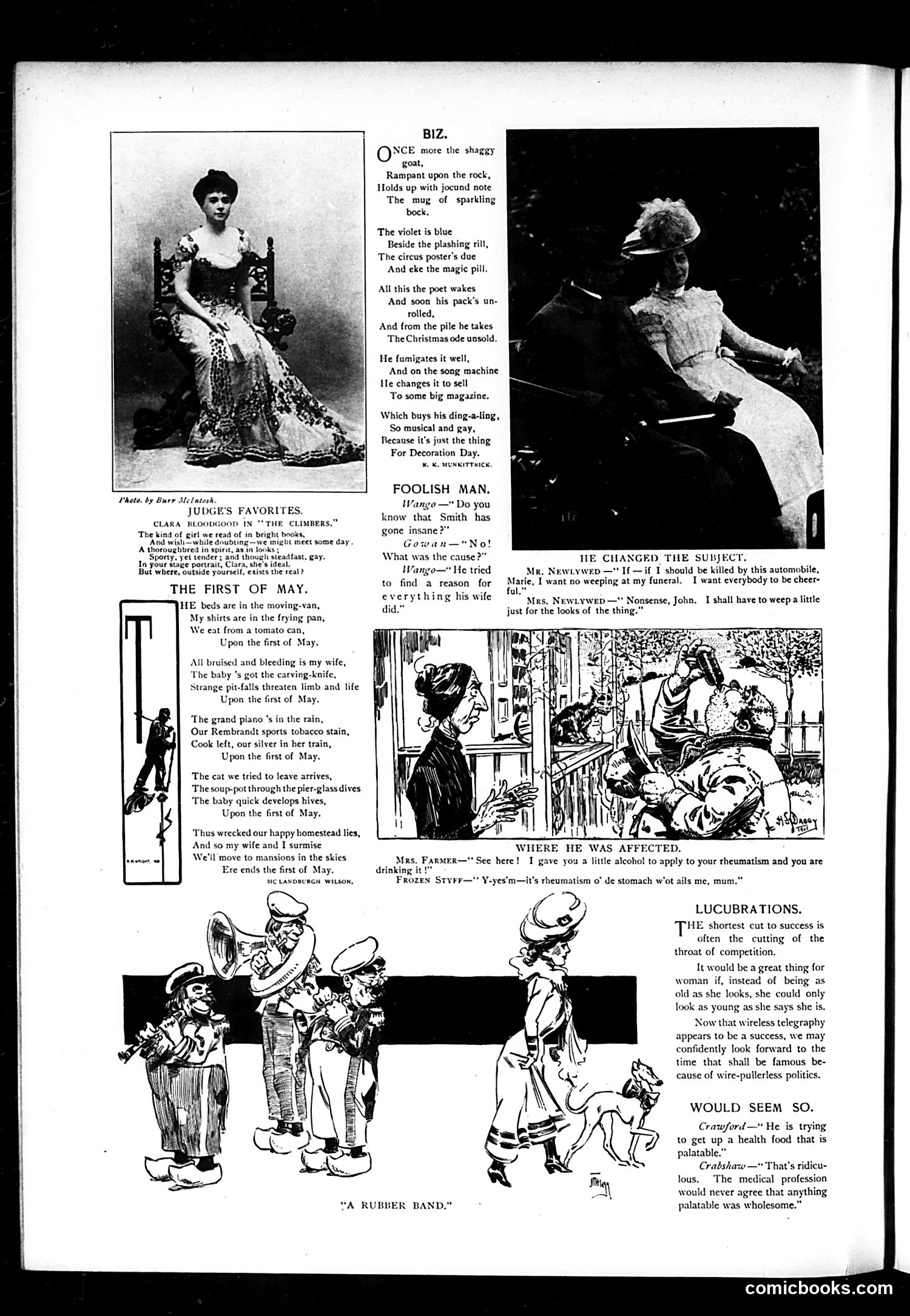
This page contains several distinct pieces of satirical content: **"Judge's Favorites"** features a woman in "The Climbers," a theatrical production, with a poem mocking her pretensions. **"The First of May"** is a poem satirizing moving day in New York, depicting the chaos and hardship of relocating—a common urban experience then. **"He Changed the Subject"** shows a domestic dialogue where a wife threatens automobile-related death if her husband won't listen to her concerns, satirizing marital dynamics. **"Where He Was Affected"** mocks a man claiming rheumatism while actually being a "frozen stiff" drunkard, exposing false excuses for intoxication. **"A Rubber Band"** is a cartoon showing what appears to be military or authority figures, though its specific reference is unclear. **"Lucubrations"** discusses wireless telegraphy's success and makes a medical joke about "palatable" health foods. The page reflects turn-of-century American social humor around domesticity, urban life, and contemporary technology.
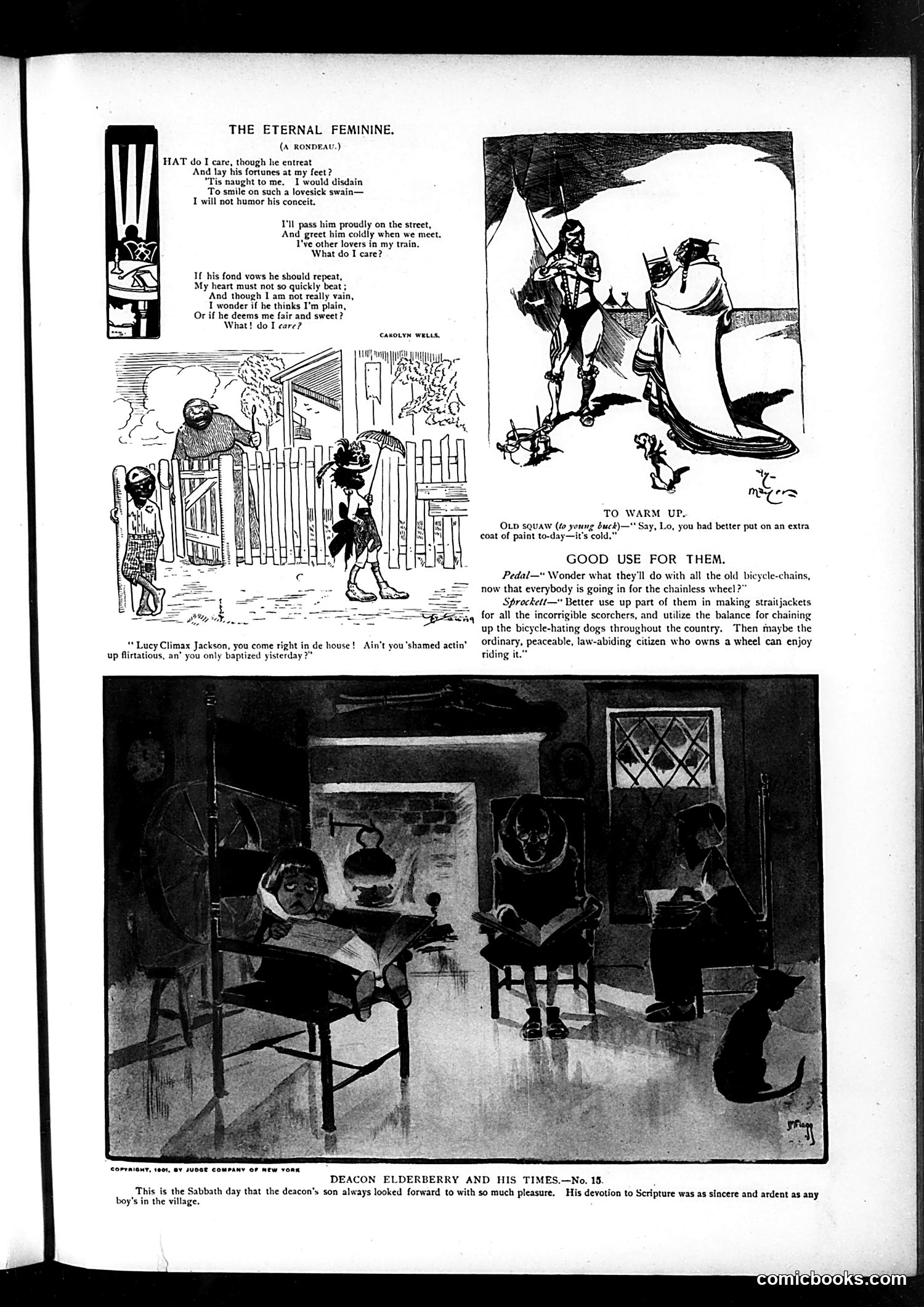
This Judge magazine page contains multiple satirical pieces reflecting early 1900s attitudes: **"The Eternal Feminine" (top)**: A poem mocking women's romantic game-playing—the speaker claims indifference to suitors while clearly caring deeply, exposing what the author sees as feminine hypocrisy and vanity. **"Lucy Climax Jackson" cartoon**: Satirizes African Americans, depicting a recently baptized girl flirting. The dialect and name are period racist stereotypes. **"To Warm Up"**: A brief joke about Native Americans ("Lo"), using the stereotypical diminutive term and mocking their appearance. **"Good Use for Them"**: Commentary on the bicycle craze—suggesting old bicycle chains could make straitjackets for reckless riders ("scorchers") or restrain dogs that hate bicycles. **"Deacon Elderberry" (bottom)**: Appears to be part of a serialized story about hypocrisy, contrasting the deacon's son's supposed scriptural devotion with unspecified dubious behavior. The page reflects Judge's blend of social satire alongside casual racial stereotyping common to the era.
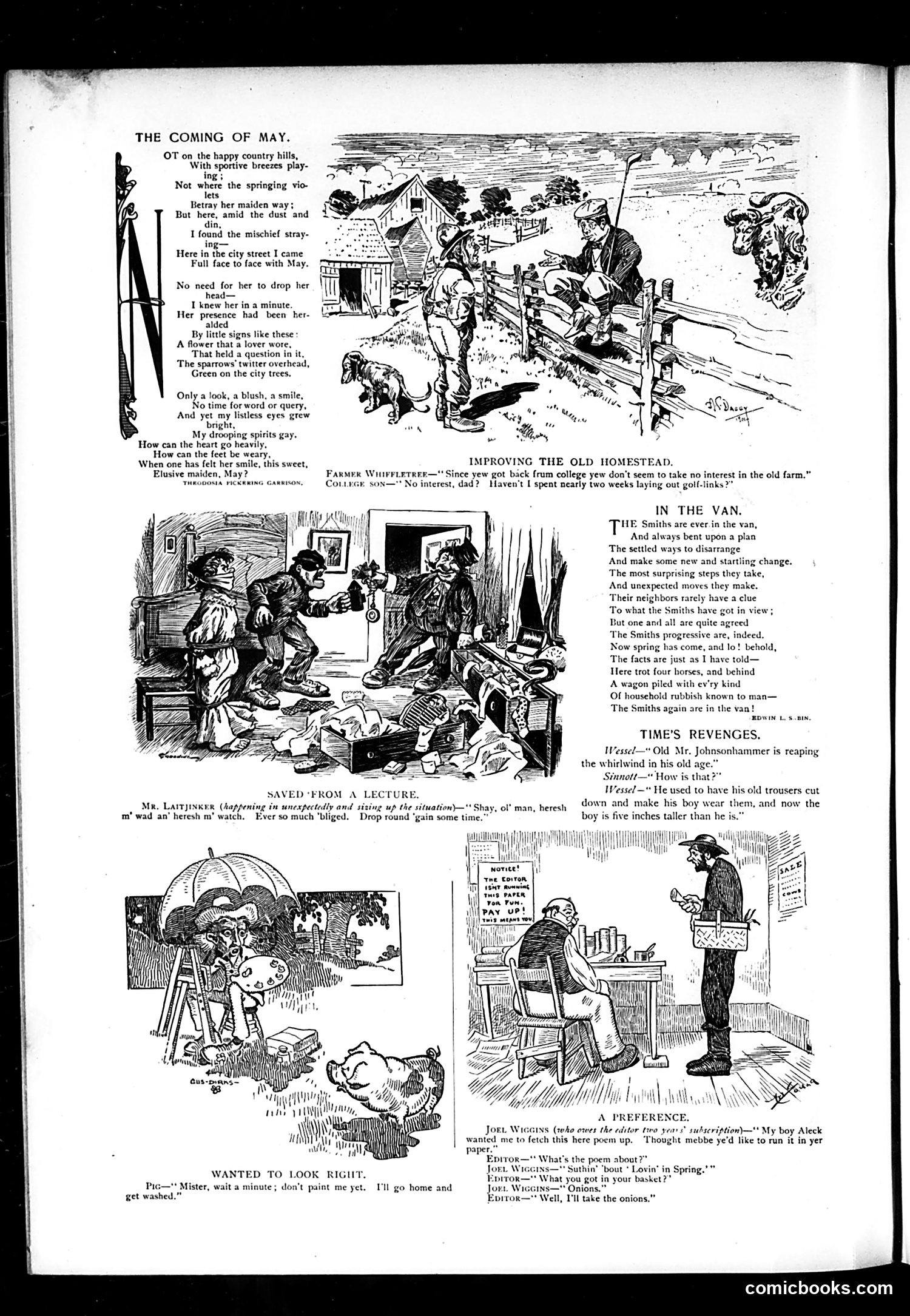
This page from the satirical magazine *Judge* contains several humorous vignettes reflecting turn-of-the-century American social attitudes: **"The Coming of May"** is a sentimental poem about encountering spring in the city—conventional romantic verse. **"Improving the Old Homestead"** mocks college-educated young men returning to farms. The joke: a boy home from college claims he's "improving" his father's farm by laying out golf links rather than doing actual agricultural work. This satirizes the perceived uselessness of higher education and the disconnect between educated youth and practical rural labor. **"Time's Revenges"** presents ironic comeuppance: a miserly father who forced his son to wear hand-me-down trousers is now humiliated when the grown boy towers five inches taller, rendering those old trousers comical. Social satire about stinginess. **"In the Van"** ridicules the Smith family as perpetually starting trendy disruptions. The punchline: their latest "progressive" move is simply hauling away household junk in a wagon—mocking status-seekers who adopt changes without substance. The remaining items are minor humorous sketches about everyday situations.
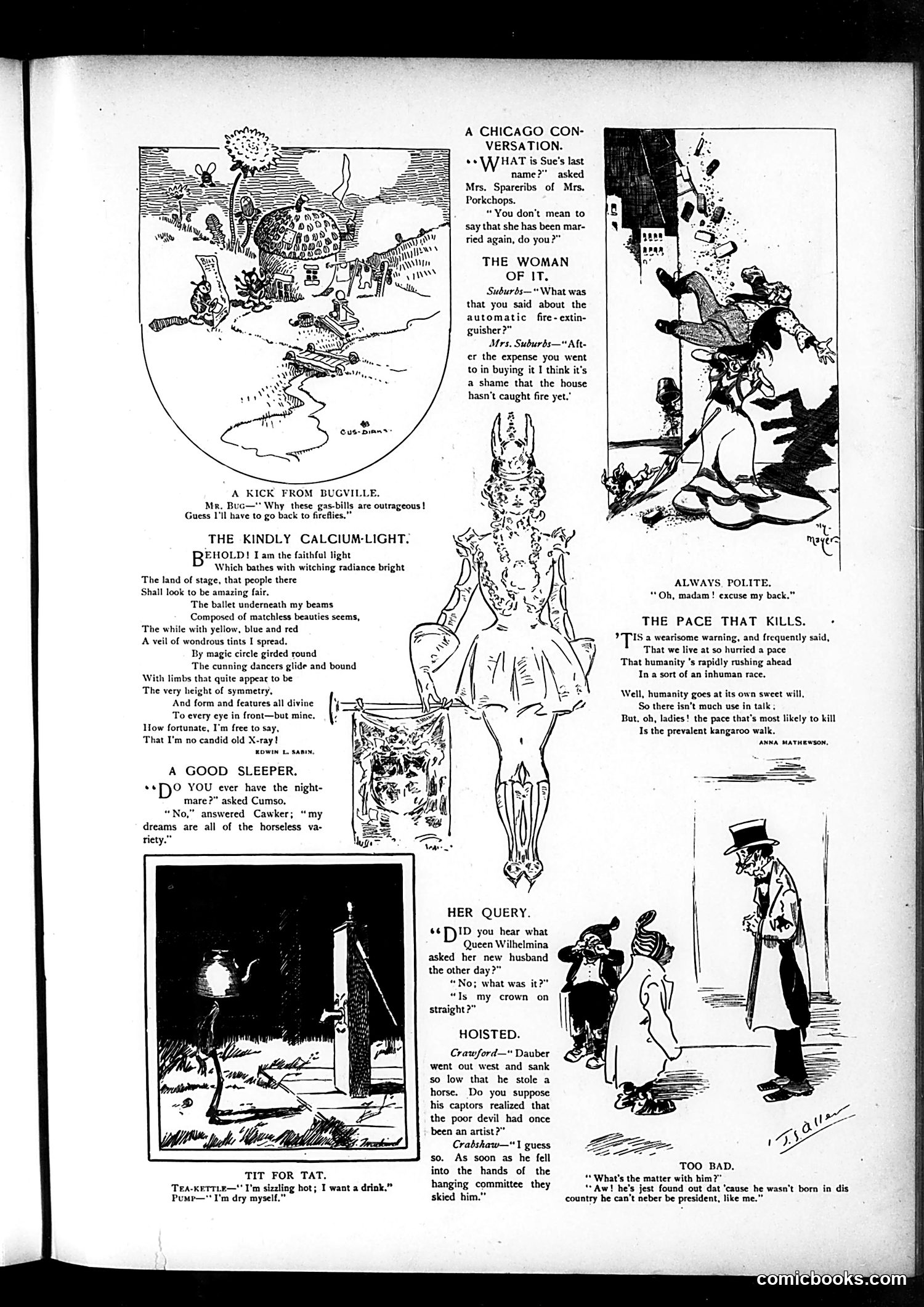
This page contains several brief satirical pieces typical of early 1900s humor: **"A Chicago Conversation"** mocks suburban pretension—a woman complains their expensive fire extinguisher is useless because their house hasn't burned down. **"A Kick from Bugville"** satirizes rising gas utility bills, with a man joking he'll return to using fireflies for light. **"The Kindly Calcium-Light"** is a theatrical joke: stage lighting makes performers appear beautiful, but the light itself can't see how unattractive they actually are under its glow. **"Her Query"** references Queen Wilhelmina of the Netherlands, making a shallow joke about her asking if her crown sits straight—stereotyping royalty as vain. **"Too Bad"** appears to mock immigrant or naturalization concerns, with someone disappointed they can't become president due to birthplace, contrasting with another character's assumption of automatic presidential eligibility. The cartoons collectively represent Judge's satirical approach: social commentary on American materialism, technology, vanity, and immigration attitudes.
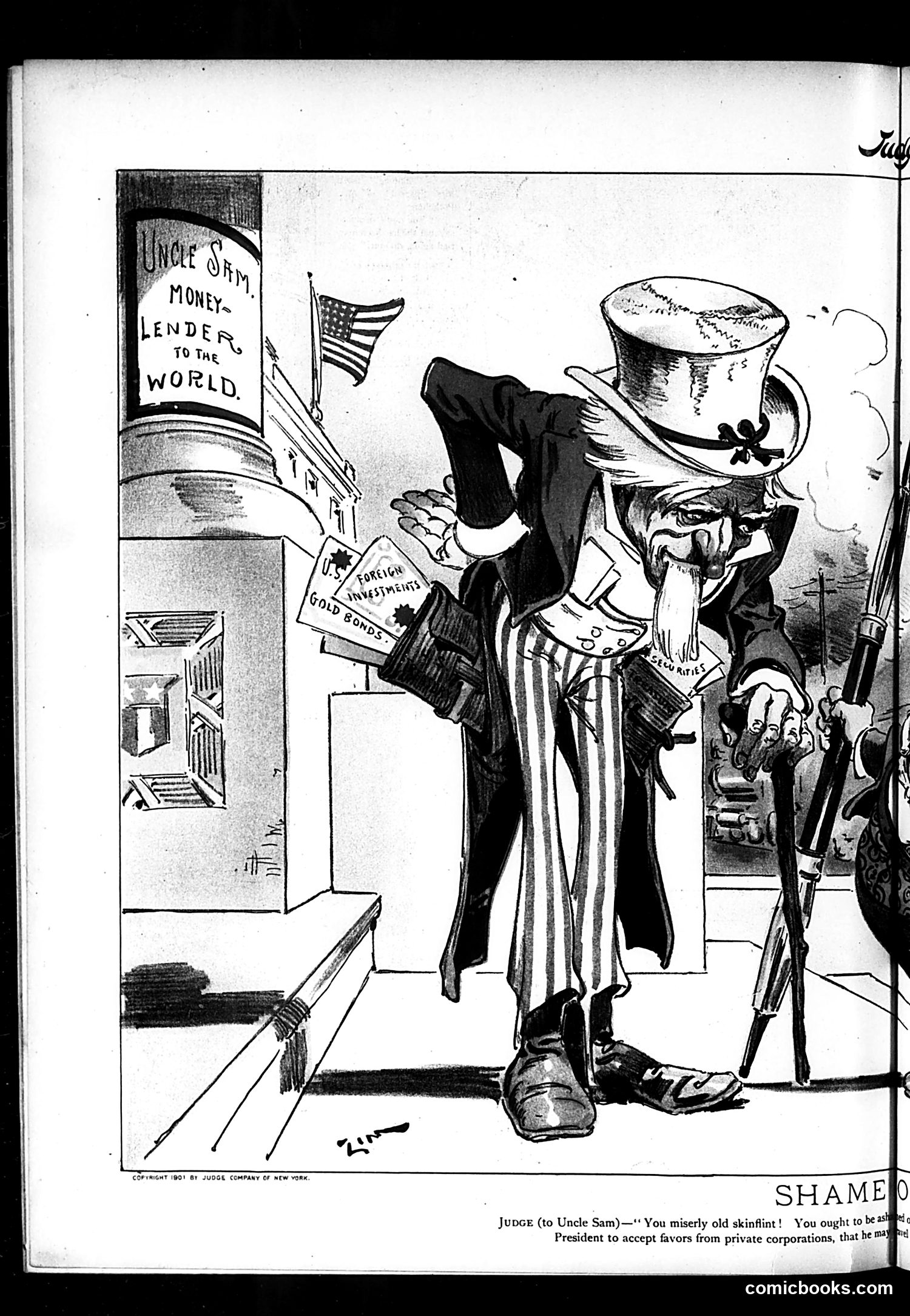
This Judge magazine cartoon satirizes Uncle Sam (representing the U.S. government) for accepting financial favors from private corporations. A judge figure criticizes "Uncle Sam" as a "miserly old skinflint," suggesting the government is corrupt or compromised by corporate influence. The visual elements include Uncle Sam's iconic top hat and striped pants, a building labeled "Uncle Sam, Money Lender to the World," and documents showing "Foreign Investments" and "Gold Bonds." The satire criticizes American financial entanglement with private corporate interests, particularly regarding overseas investments and lending practices. The cartoon appears to mock U.S. foreign policy and corporate influence on government—a common Progressive Era concern about corporate power corrupting democratic institutions and foreign relations.
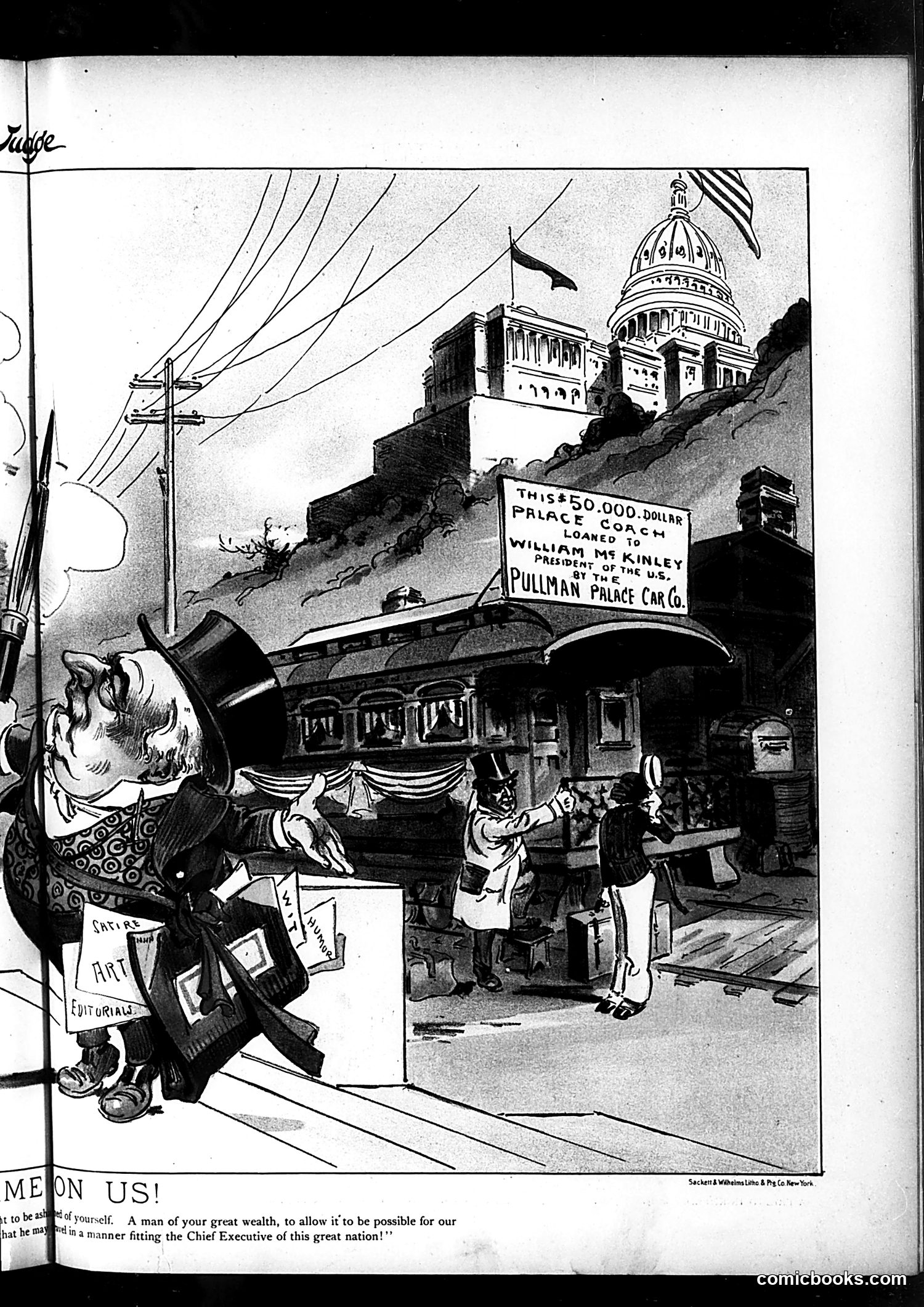
This political cartoon satirizes wealth inequality and presidential excess. It depicts President William McKinley (identified on the sign) receiving a luxurious $50,000 Pullman Palace Car as a gift. The Capitol building looms in the background, suggesting governmental involvement. The cartoon's left side shows a caricatured figure labeled with "SENATE" and "EDITORIALS," critiquing media and political complicity. The partial text at bottom argues that a wealthy man should donate such gifts "in a manner fitting the Chief Executive." The satire targets the apparent impropriety of the president accepting such an expensive gift while ordinary citizens struggle—a critique of elite excess and the cozy relationship between wealthy industrialists and government leadership during the Gilded Age.
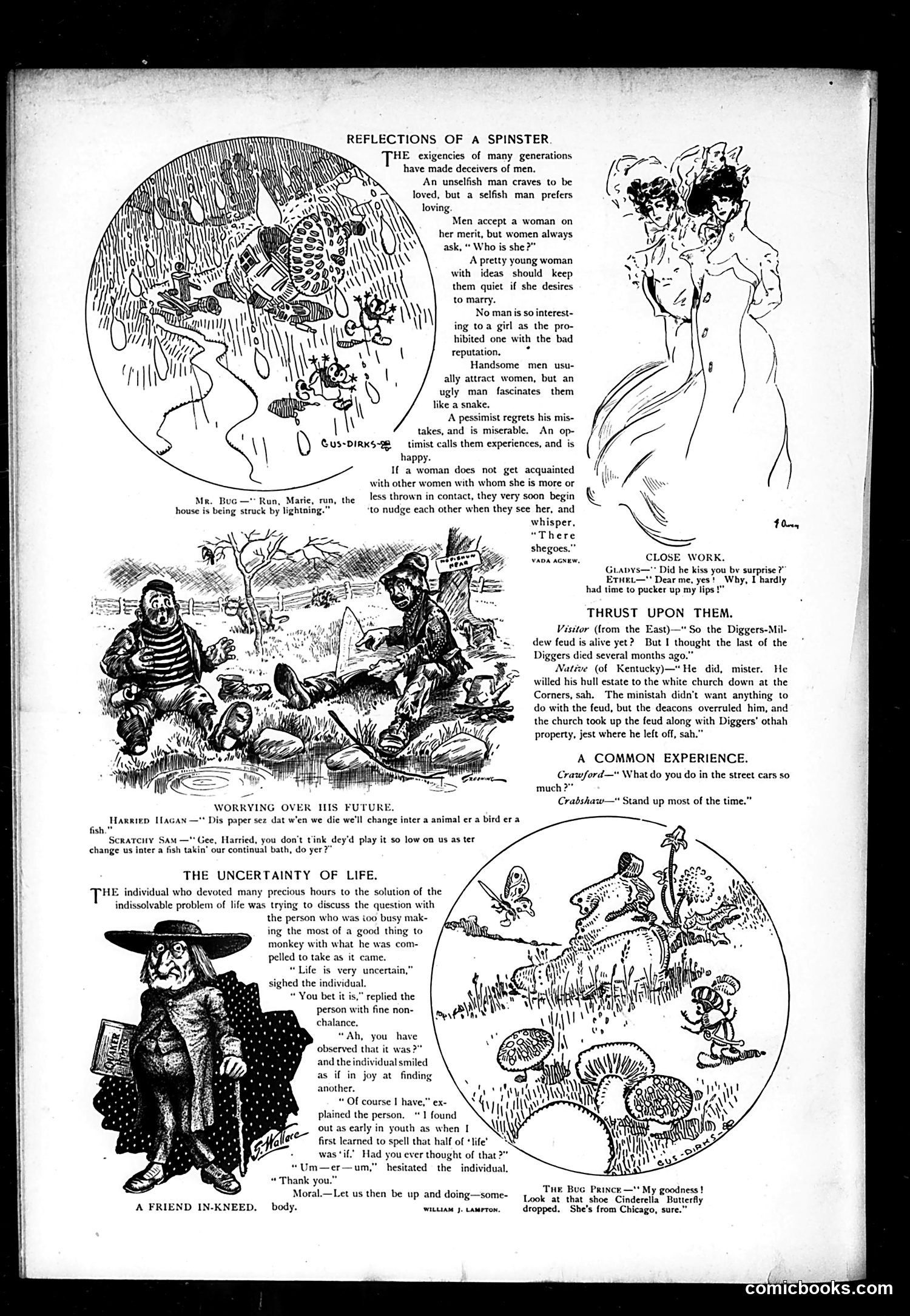
This page collects satirical observations about gender relations and social behavior, typical of early 20th-century American humor. **Main content:** A series of witty aphorisms about courtship and marriage, attributed to a spinster (unmarried woman). The jokes target both sexes—men's deceptiveness, women's preoccupation with status ("Who is she?"), and mutual contradictions in attraction. Notable: the barb that attractive young women should hide their intelligence to marry, and that women ostracize other women they don't know well. **Side cartoons** include vignettes about Kentucky mountain feuds (still-active family vendettas), overcrowded streetcars, and philosophical musings on life's uncertainty. The dialect humor and rural stereotypes reflect period attitudes. **Overall tone:** Urbane, cynical mockery of courtship conventions and human nature, aimed at Judge's educated readership. The "spinster" voice provides social commentary while maintaining plausible deniability about who holds these views.

I'm unable to provide a meaningful analysis of this page. The image is almost entirely black or extremely dark, making it impossible to discern any cartoon illustrations, caricatures, text, or visual details that would be necessary to identify the figures, political references, or satirical intent. The only clearly visible elements are the white margin on the left edge and the "comicbooks.com" watermark at the bottom right. Without being able to see the actual content of the Judge magazine page, I cannot explain what this cartoon or commentary means or what historical context it references. If you have a clearer or higher-contrast version of this image, I'd be happy to analyze it.