
A complete issue · 20 pages · 1901
Judge — April 13, 1901
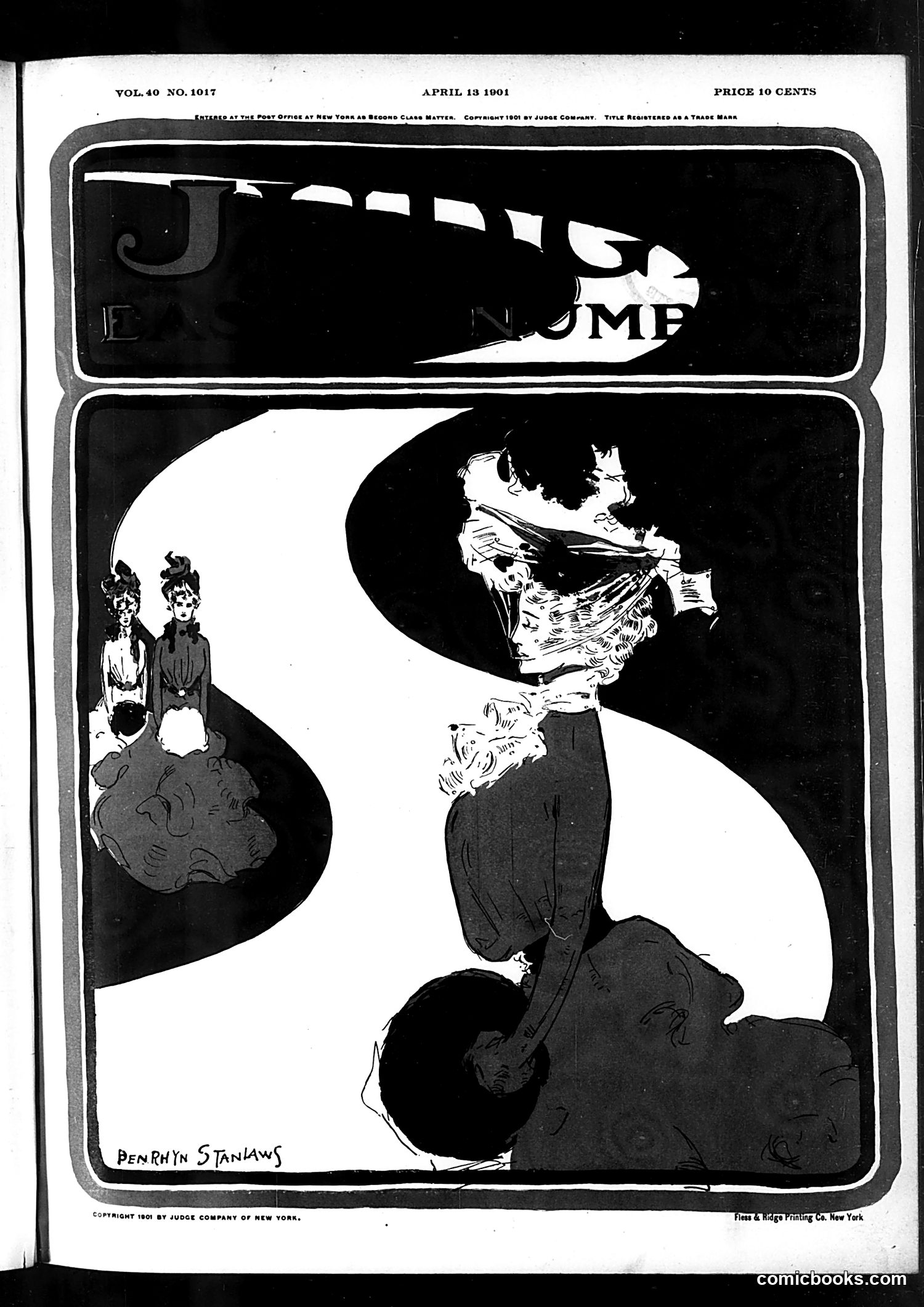
This cartoon by Ben Rhyn Staniaws depicts a wealthy woman in an elaborate hat and dress, shown in profile against a stark black and white composition. Two smaller figures appear within her large hat's silhouette on the left side. The satire likely targets the era's absurdly oversized women's hats—a common Judge subject. The exaggerated millinery was notorious for incorporating feathers, stuffed birds, and elaborate decorations, often criticized as wasteful and impractical. The tiny figures dwarfed by the hat suggest how ridiculously disproportionate these fashion statements had become. The artist emphasizes this excess through dramatic contrast and scale distortion, using the hat as commentary on Edwardian-era conspicuous consumption and women's fashion extremes. The precise social targets remain unclear without additional context.
This page is **primarily advertising** with minimal satirical content. The dominant features are commercial ads for: - Vartray Ginger Ale (top left) - A fashionable migration to California (center) - Three cigar brands: Brunita, Brunswick, and Bossy (right side) - Pullman train cars (center) - Hartford Tires (bottom left) The only potentially satirical element is the small quote at the top attributed to the *Boston Herald*, mocking Andrew Carnegie's death and wealth—a typical Progressive-era jab at robber barons. However, this is a minor editorial note rather than a developed cartoon. The page reflects **Judge magazine's business model**: mixing light political commentary with extensive paid advertising to reach middle and upper-class readers interested in luxury goods and travel.
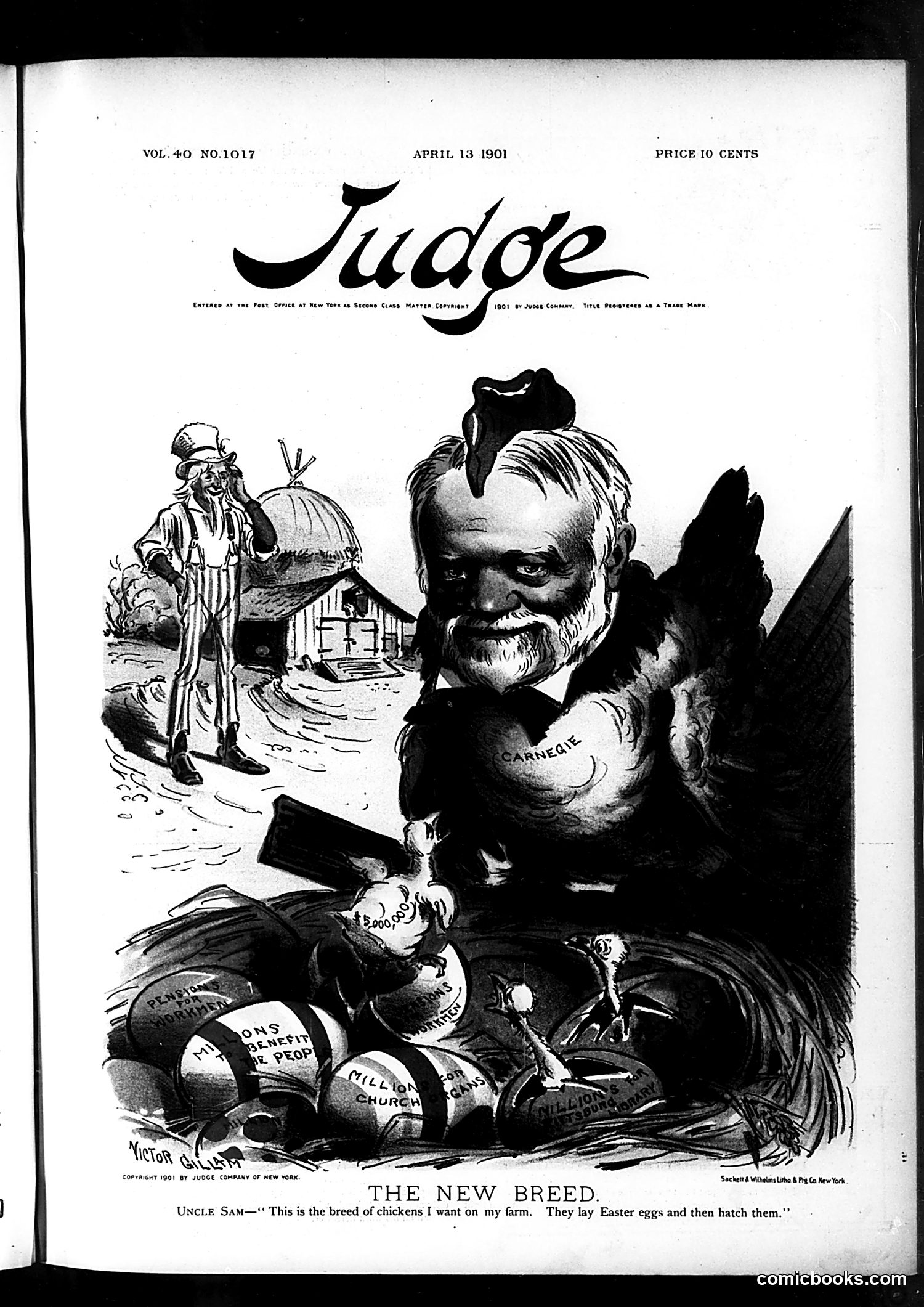
This political cartoon depicts **Uncle Sam** (representing the United States) presenting a grotesque figure labeled "Carnegie" (steel magnate Andrew Carnegie) as a desirable new "breed" of chickens. The caption reads: "This is the breed of chickens I want on my farm. They lay Easter eggs and then hatch them." The satire criticizes Carnegie's wealth accumulation and philanthropic practices. The "eggs" at the figure's feet are labeled with charitable institutions (visible text includes references to churches and benefits), suggesting Carnegie's donations are performative—he gives money away, then it somehow returns to him as profit or influence. The artwork mocks both Carnegie's outsized power and the contradiction between his vast wealth and his selective charity.
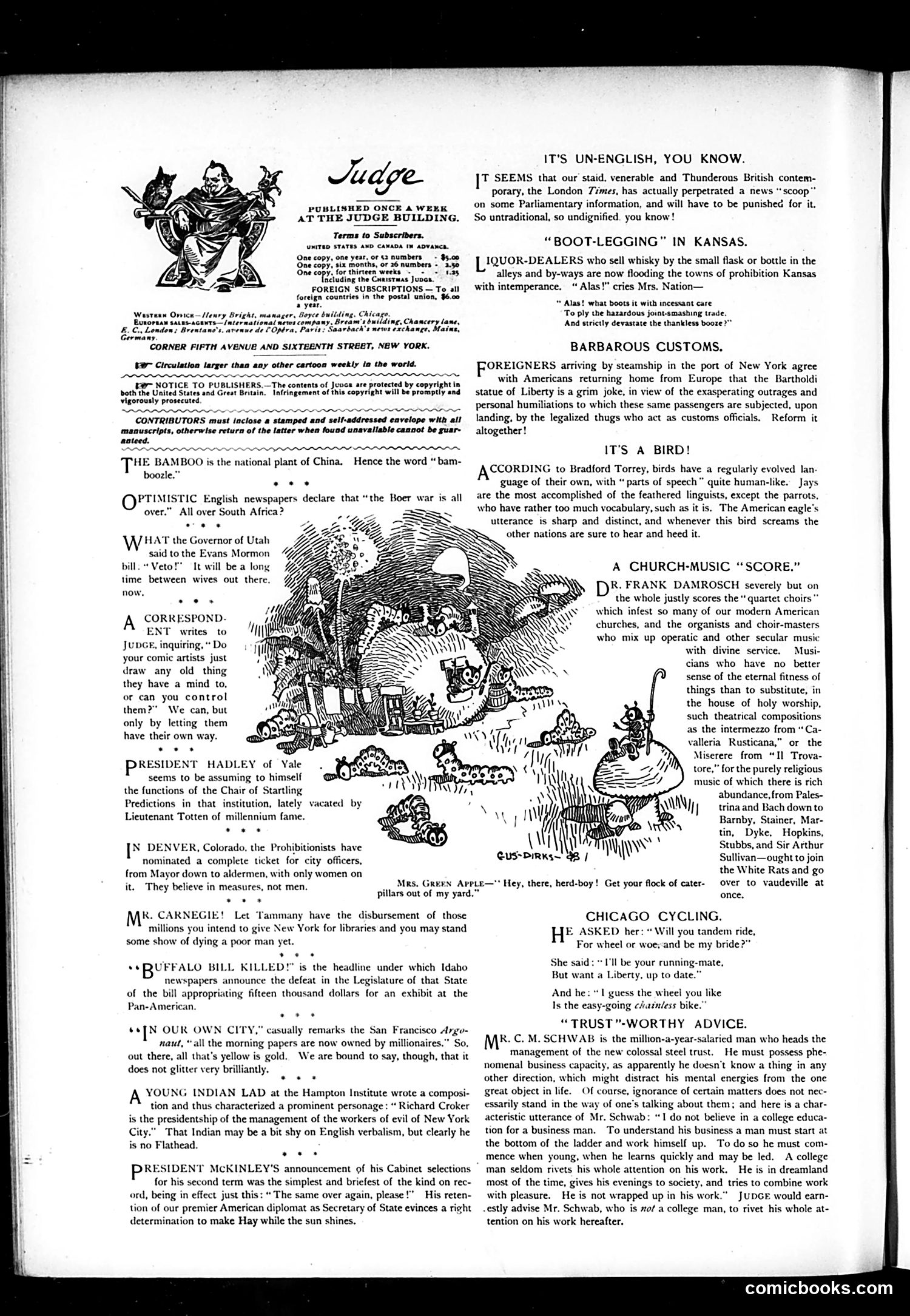
The main cartoon depicts what appears to be a rural or frontier scene with various animals and figures engaged in chaotic activity. The caption "Mrs. Green Apple—'Hey, there, herb-boy! Get your flock of caterpillars out of my yard'" suggests a humorous domestic dispute over garden pests. The page's text sections are satirical commentary on contemporary issues: prohibition enforcement in Kansas, foreigners' experiences at Ellis Island, bird intelligence, church music quality, and business advice. These short pieces mock various American social concerns of the era—including prohibition's ineffectiveness, immigration bureaucracy, and the pretensions of wealthy businessmen. Without clearer identification of specific figures or dates visible in the image, precise historical context remains uncertain, though the tone reflects typical early-20th-century American satirical critique.
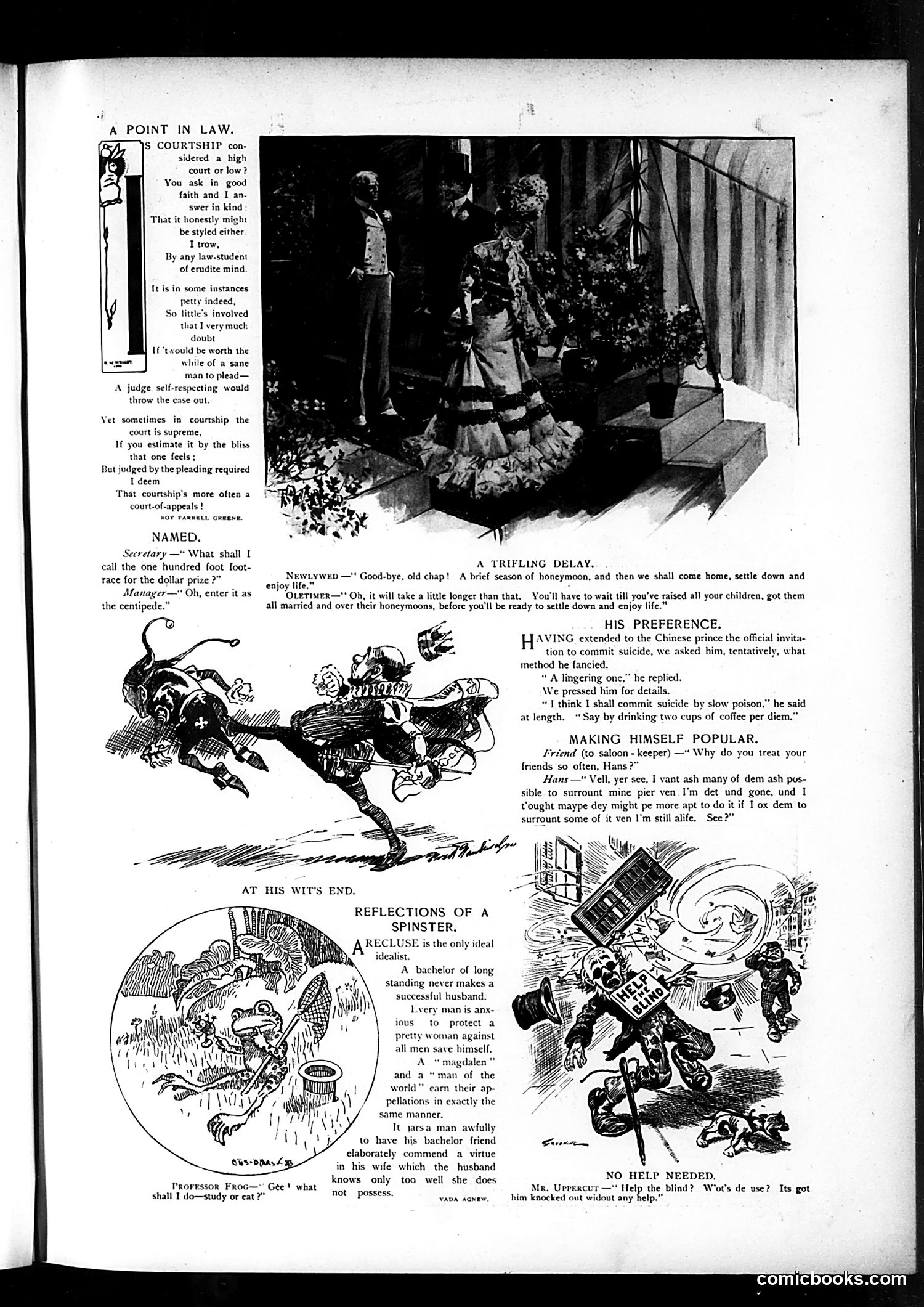
This page from the satirical magazine **Judge** collects several humor pieces and cartoons mocking courtship, marriage, and social conventions of the era (appears to be late 19th/early 20th century). **Key content includes:** - **"A Point in Law"**: A poem playing on legal terminology to joke that courtship resembles court proceedings—petty at times, but often requiring appeals (suggesting couples frequently reconsider their commitment). - **"Centipede" joke**: Wordplay on a 100-foot race called "the centipede"—the humor plays on the insect's many legs. - **Chinese prince suicide jest**: Dark satire suggesting coffee is slow poison (common contemporary complaint about coffee's effects). - **Hans the saloon-keeper**: Immigrant character (indicated by accent) who plies friends with drinks now so they'll attend his funeral later—gallows humor about building loyalty through alcohol. - **"Reflections of a Spinster"**: Cynical observations on bachelor life and marriage's double standards. The overall tone mocks marriage, courtship rituals, immigrant accents, and contemporary anxieties about modern life.
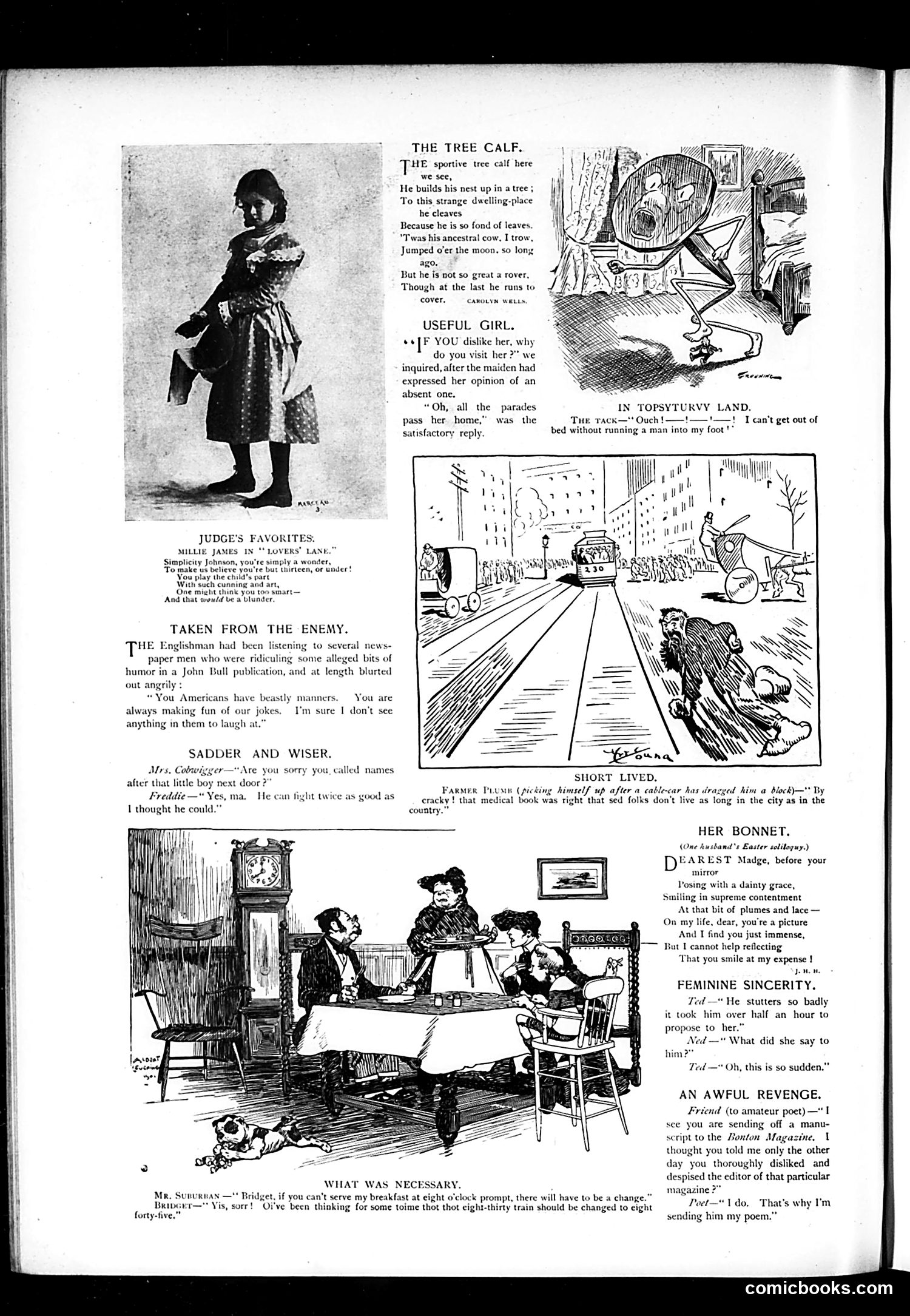
This page from Judge magazine contains several brief satirical sketches typical of the era. The humor relies on wordplay and social observation rather than political commentary. **"The Tree Calf"** is a whimsical fantasy piece playing on the nursery rhyme "Hey Diddle Diddle" (the cow jumping over the moon), imagining a descendant that builds nests in trees. **"Useful Girl"** mocks a young woman who complains about someone yet visits her regularly—the joke being her transparent excuse about parade-watching reveals insincerity. **"Taken from the Enemy"** satirizes Anglo-American cultural tensions, with an Englishman defensively objecting to Americans mocking British humor publications. **Other sketches** cover domestic life themes: a child learning regret, a farmer killed by urban transit (contrasting city dangers with rural safety), marital dynamics around Easter bonnets, and a poet's revenge—submitting work to a magazine editor he despises. The overall tone reflects genteel, middle-class Victorian humor focused on manners, relationships, and mild social absurdities rather than hard political satire.
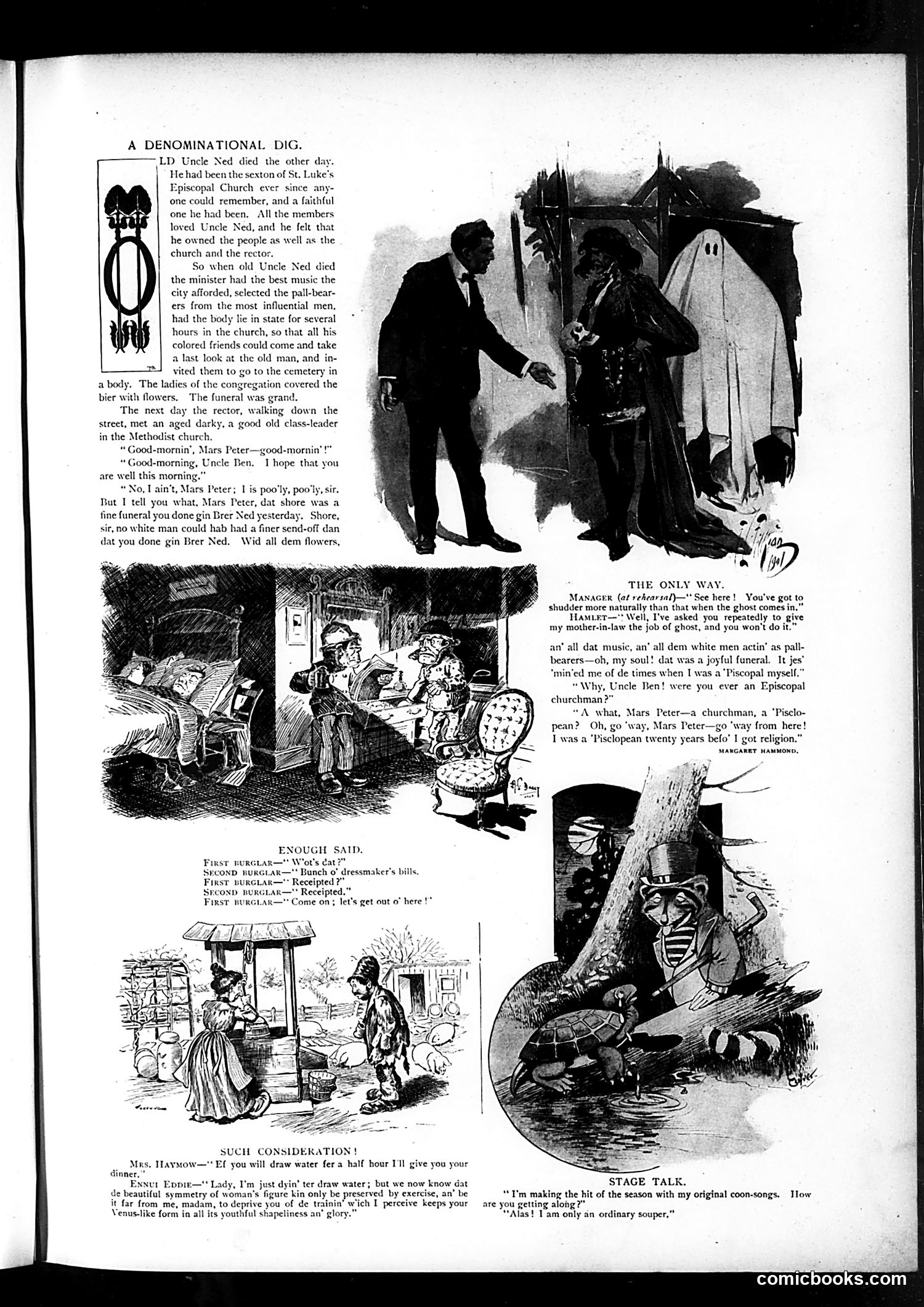
This page satirizes religious class distinctions in late 19th-century America. The main story mocks Episcopal pretension: Uncle Ned, a Black sexton (church custodian) at an Episcopal church, receives an elaborate funeral with music, influential pallbearers, and flowers. A Methodist Black man, Uncle Ben, encounters the Episcopal rector and praises the funeral effusively—then reveals he was himself "Episcopalian twenty years befo' I got religion," implying the Episcopal Church is less genuine or sincere than Methodism. The satire targets how Episcopal churches (historically more elite and formal) treated Black members versus how Methodism, seen as more democratic, engaged them. The joke suggests Episcopalianism is merely performative display rather than authentic faith. The page's other cartoons—about burglars, theatrical ghosts, and water-drawing—appear unrelated filler content typical of satirical magazines.
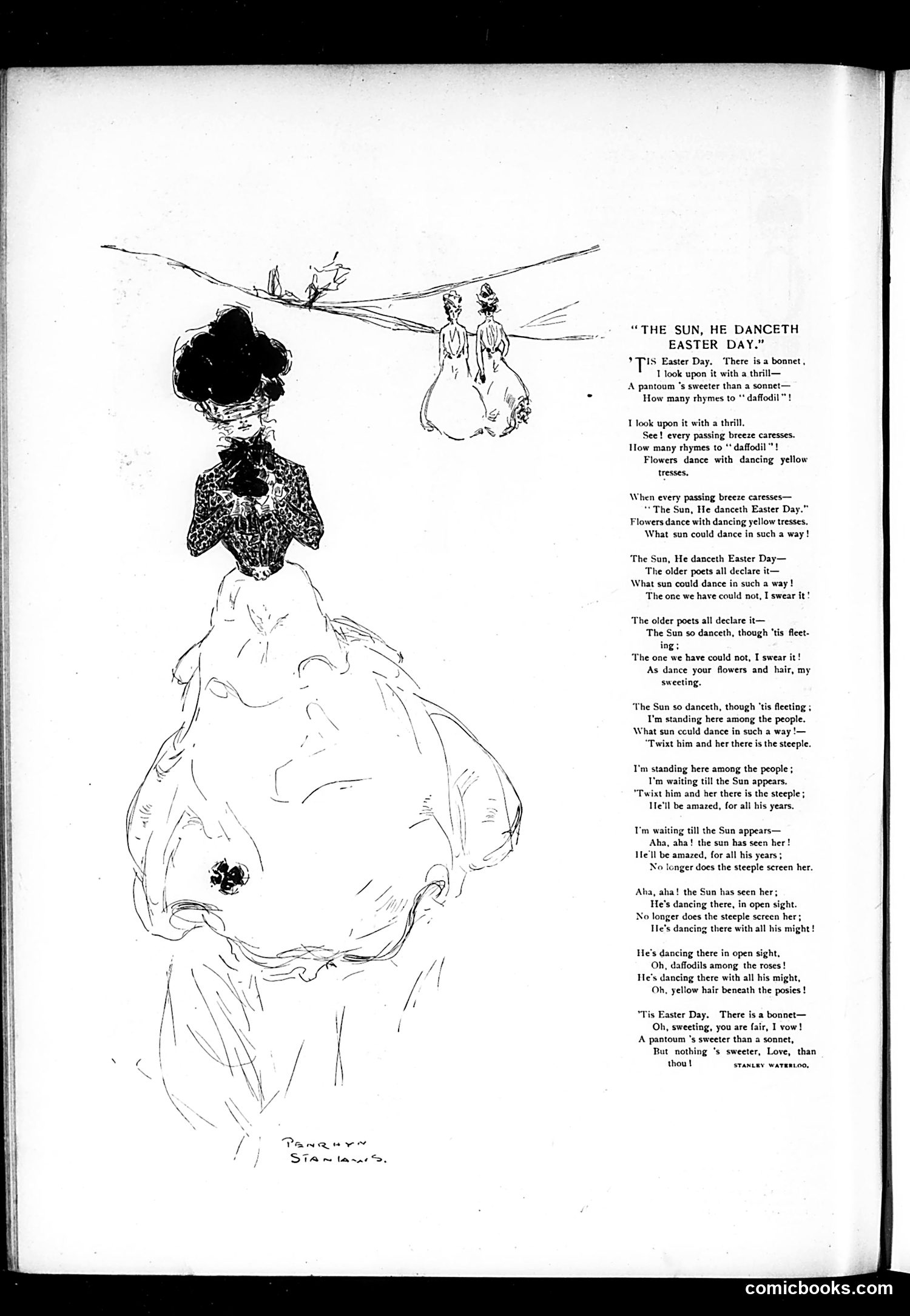
This page features a romantic Easter poem by Stanley Waterloo, illustrated with an elegant line drawing of a woman in Edwardian dress. The illustration shows a fashionably dressed figure wearing a large bonnet, with two smaller figures visible in the background. The poem is a pantoum (a repeating verse form) celebrating Easter and romantic love. It uses the metaphor of the sun "dancing" on Easter Day to describe a lover's joy at finally seeing their beloved, previously hidden behind a church steeple. The recurring imagery of daffodils, flowers, and yellow hair emphasizes spring renewal and youthful attraction. This appears to be *Judge* magazine's lighter, literary content rather than political satire—a sentimental romantic piece capturing early-20th-century courtship conventions and Easter celebration themes. The ornate dress and refined language reflect the magazine's educated, upper-class readership.
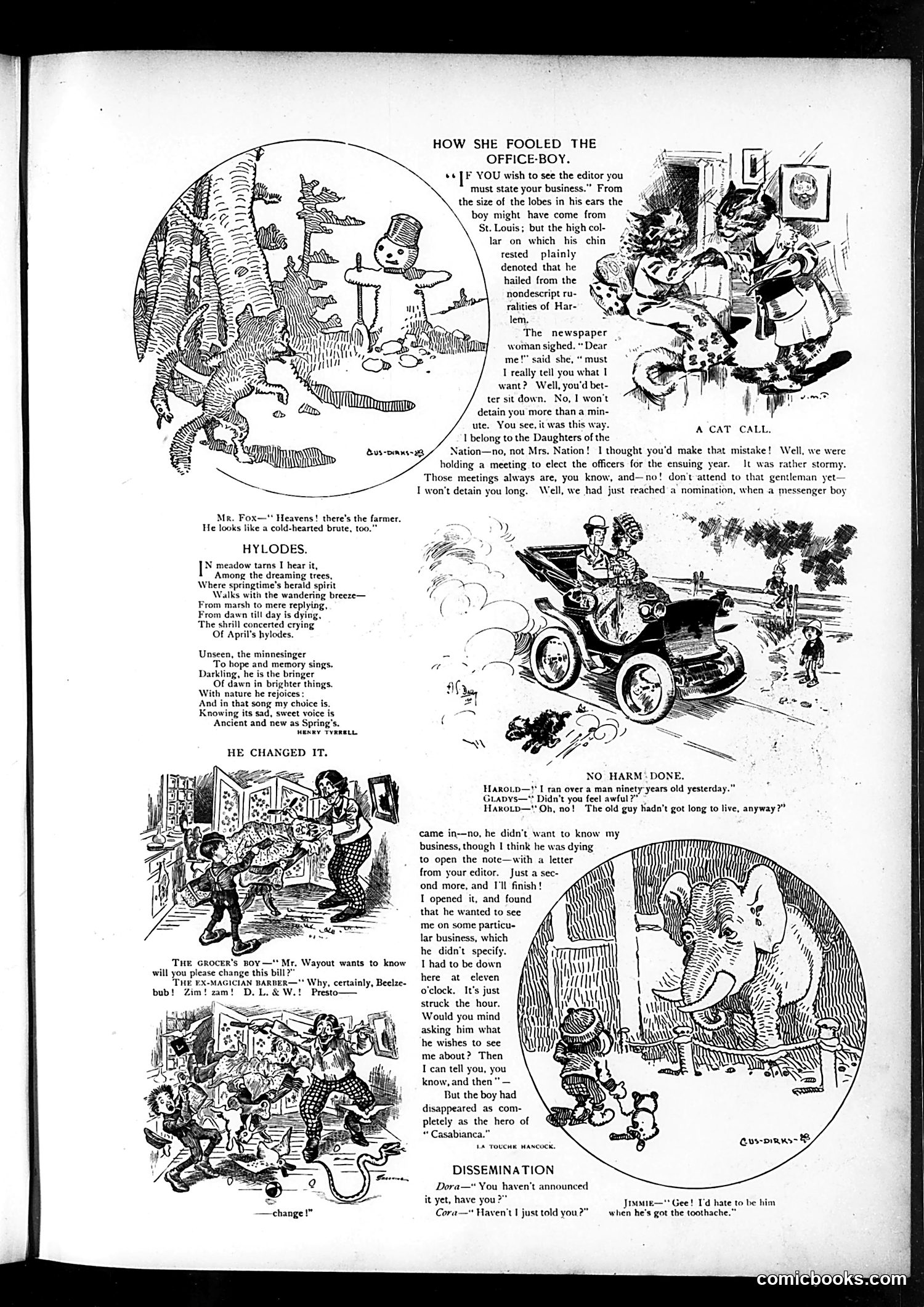
This page contains several satirical pieces typical of early 20th-century humor: **"How She Fooled the Office-Boy"**: A newspaper woman seeking the editor describes her involvement with "Daughters of the Nation" (likely a temperance or women's civic organization). She deliberately confuses the messenger boy—who appears to be a naive, poorly educated country youth—by talking at length about her organization, almost making him mistake it for the Women's Christian Temperance Union (Carrie Nation's anti-alcohol movement). The satire mocks both the boy's gullibility and the earnest activism of women's civic groups. **Other pieces** include a nature poem "Hylodes," light humor about accidentally hitting an elderly man, and brief comic exchanges about workplace mishaps and romantic complications. The cartoons are gentle, office-centered humor typical of Judge's appeal to urban middle-class readers. The satire assumes familiarity with contemporary civic organizations and social pretensions.
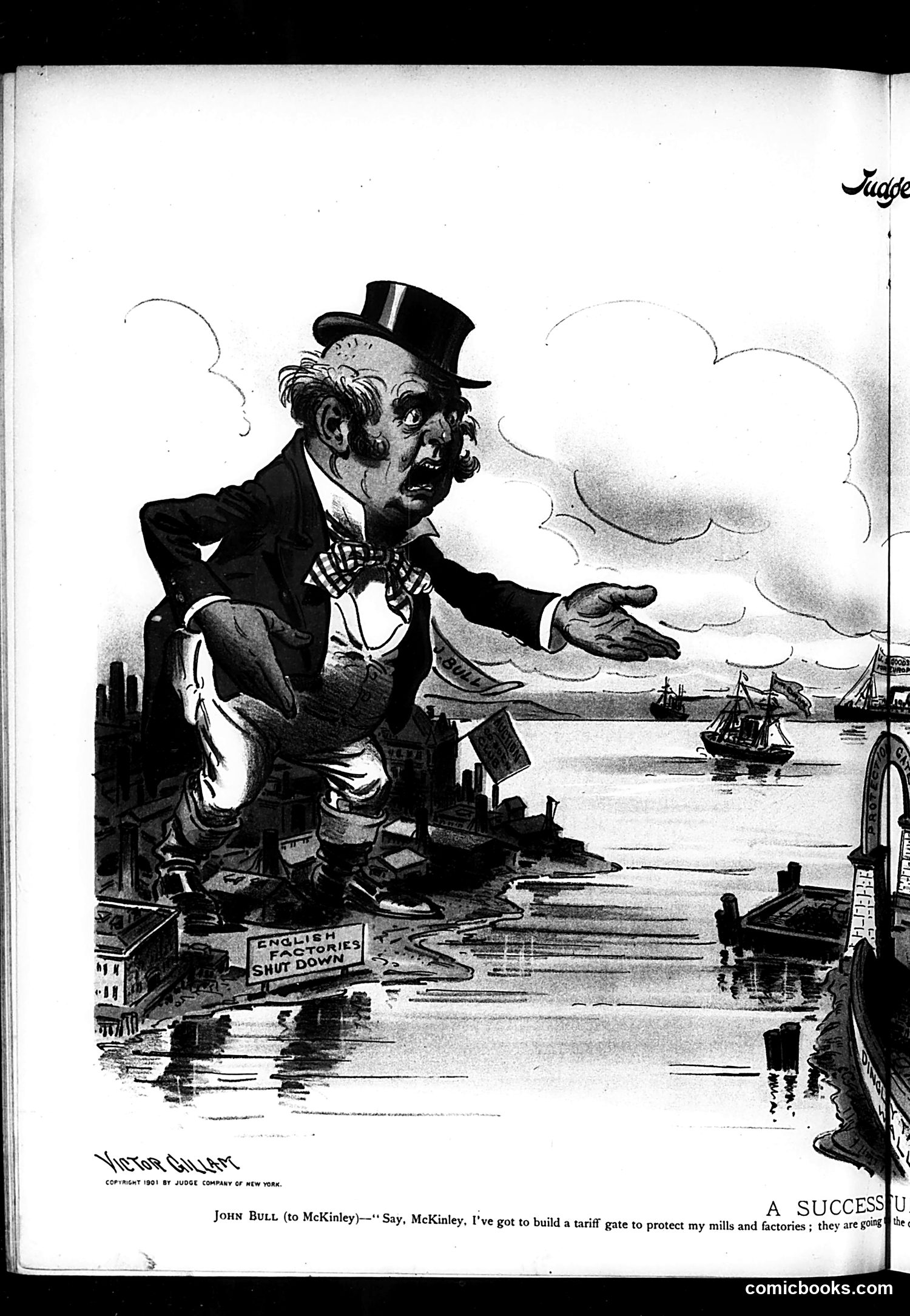
This 1901 Judge magazine cartoon satirizes **John Bull** (personification of Britain) appealing to **President McKinley** about protecting American industrial interests through tariffs. The cartoon depicts Bull as a caricatured figure in formal dress, gesturing toward a harbor scene with industrial mills and factories. Bull argues he needs a "tariff gate" to shield American manufacturing from foreign competition—ironically, since Britain historically championed free trade. The satire targets the **protectionist tariff debate** of the McKinley era. It mocks the contradiction: Britain, long associated with free-trade ideology, now appears desperate to adopt American protectionist policies to save struggling industries. The cartoon suggests this represents British economic decline and America's rising industrial power, presenting protectionism as necessary American policy while questioning Britain's traditional trade positions.
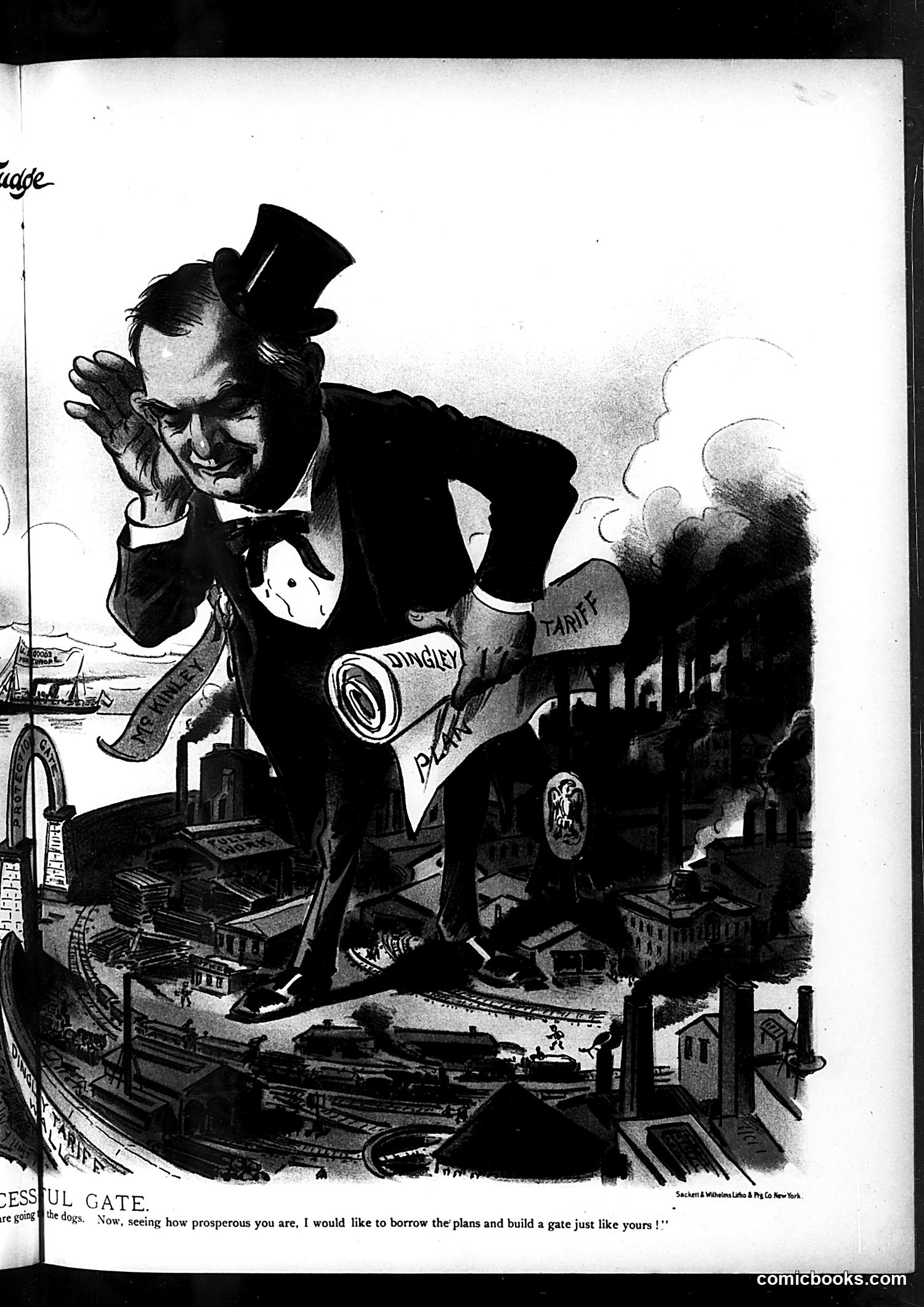
This cartoon depicts a wealthy industrialist or businessman (shown in formal dress with top hat) standing atop an elaborate gate structure, while a poorer figure below requests to borrow his plans. The gate appears to symbolize economic success and exclusivity—literally a barrier that separates the prosperous from those struggling below. The satire criticizes wealth inequality and the gap between rich and poor during what appears to be an economic downturn ("going to the dogs"). The poor man's request to "borrow the plans" is ironic: he cannot actually replicate the wealthy man's success because the system itself maintains barriers. The cartoon suggests the wealthy have constructed gates—both literal and figurative—that exclude others from prosperity, implying systemic inequality rather than equal opportunity for advancement.
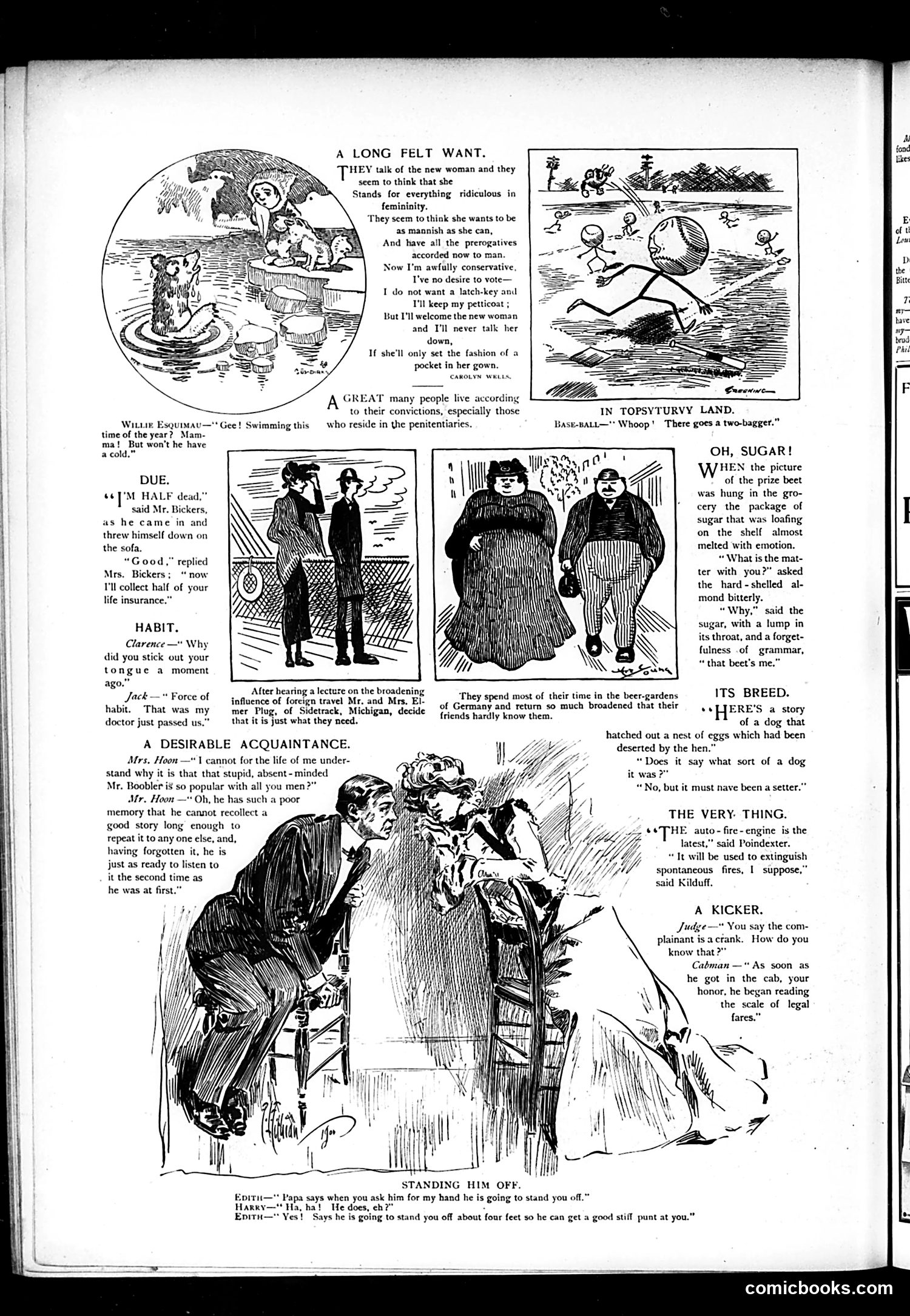
This page from the satirical magazine *Judge* contains several short humorous pieces reflecting early 20th-century attitudes: **"A Long Felt Want"** satirizes debates over "the New Woman"—a contemporary figure associated with feminism and women's rights. The poem humorously claims the author isn't demanding voting rights or independence, only requesting that women's clothing include pockets, suggesting even conservative women want practical improvements. **Other sketches** include domestic comedy ("Due," "Habit"), absurdist humor ("In Topsyturvy Land," "Oh, Sugar!"), and wordplay-based jokes ("Its Breed," "The Very Thing," "A Kicker," "Standing Him Off"). The visual style features typical pen-and-ink illustrations of the era. The humor relies on puns, exaggeration, and period-specific references (auto-fire engines, beer gardens, legal scales) rather than political messaging. Most jokes target everyday social situations—marriage negotiations, forgetfulness, courtship—with the casual sexism and class humor typical of early 1900s American humor magazines.
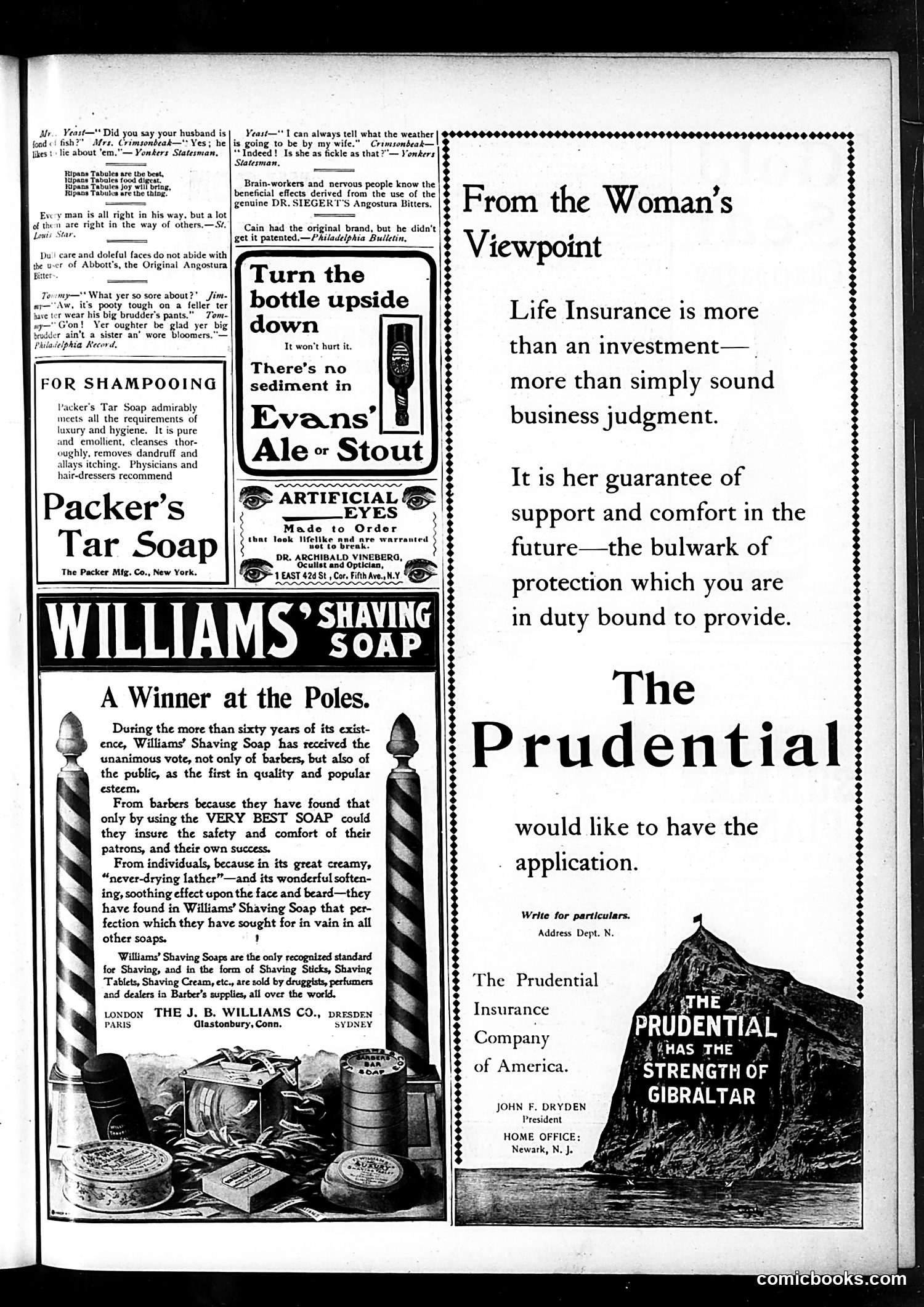
This page is primarily **advertising**, not satirical content. It features commercial advertisements for consumer products and financial services typical of early-20th-century periodicals. The advertisements include: - **Packer's Tar Soap** (shampoo) - **Evans' Ale or Stout** (beverage) - **Williams' Shaving Soap** (grooming product) - **Prudential Insurance** (financial services) At the top are brief joke snippets ("Yeast" exchanges), common filler material in magazines of this era. The **Prudential ad** is noteworthy: it frames life insurance for women as their "guarantee of support and comfort in the future"—reflecting the paternalistic view that women needed male financial protection. The image of Gibraltar reinforces stability and strength. The page demonstrates how early-20th-century publications monetized space through advertising while maintaining satirical editorial content elsewhere. No specific political satire or caricature appears on this particular page.
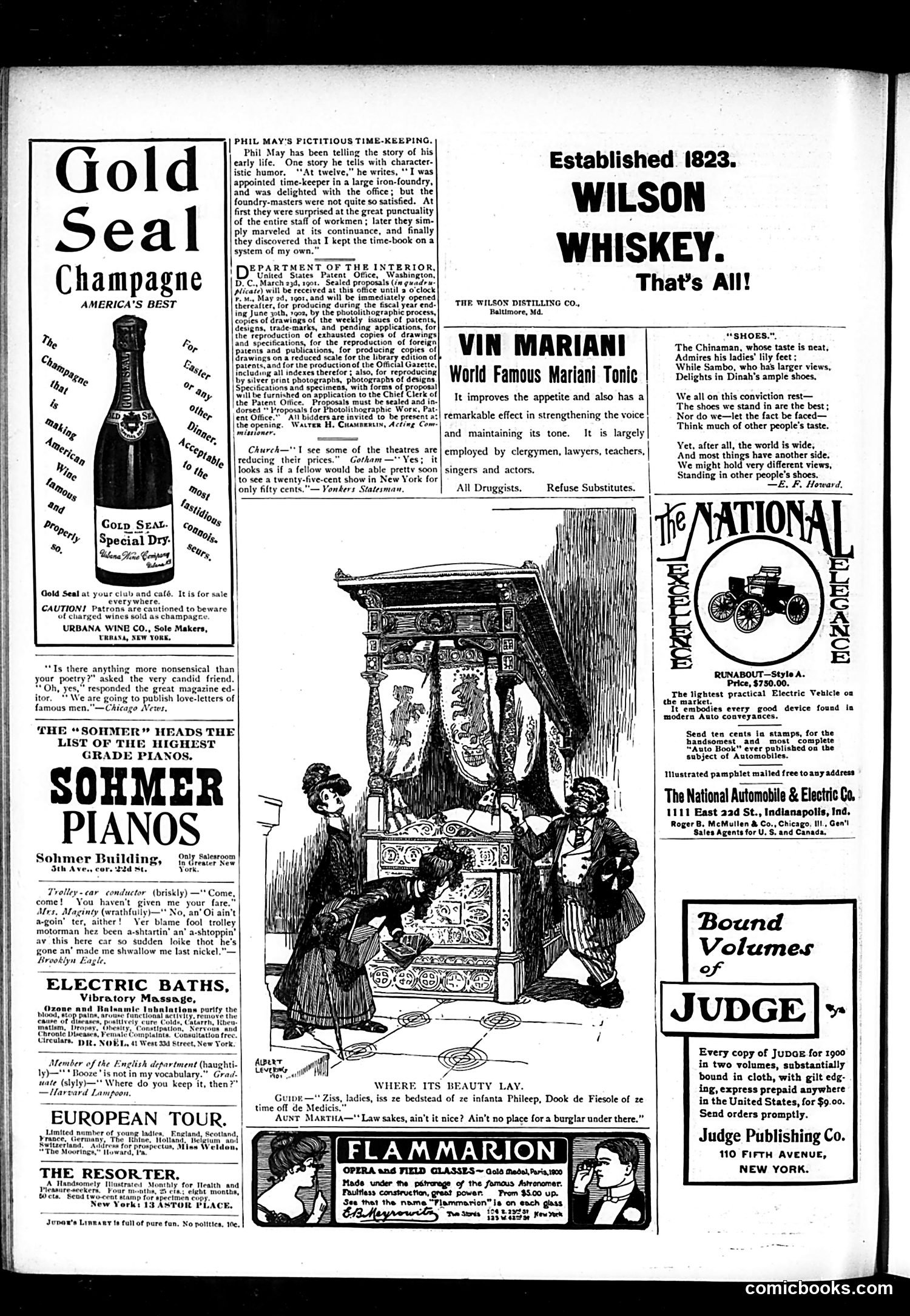
This page is primarily **advertising**, not political satire. It contains multiple product advertisements typical of early 1900s publications. The main illustrated cartoon ("Where Its Beauty Lay") depicts a domestic servant or maid being scolded by her employer at an ornate stove or appliance. The dialogue suggests she's been caught shirking work or making excuses—a common theme in period humor about class relations and household help. The page also includes several humor snippets and anecdotes: - Phil May's joke about keeping time dishonestly at a foundry - Theater price-reduction jokes - A poetry/love-letters editor exchange These represent typical *Judge* magazine filler content: light social commentary rather than sharp political satire. The advertisements (Wilson Whiskey, Mariani Tonic, Sohmer Pianos, National Automobile) reveal contemporary consumer culture and product claims—tonics promising voice strengthening, automobiles marketed as novelties. Overall: **This is a commercial publication page with light humor and period product advertising, not serious political commentary.**
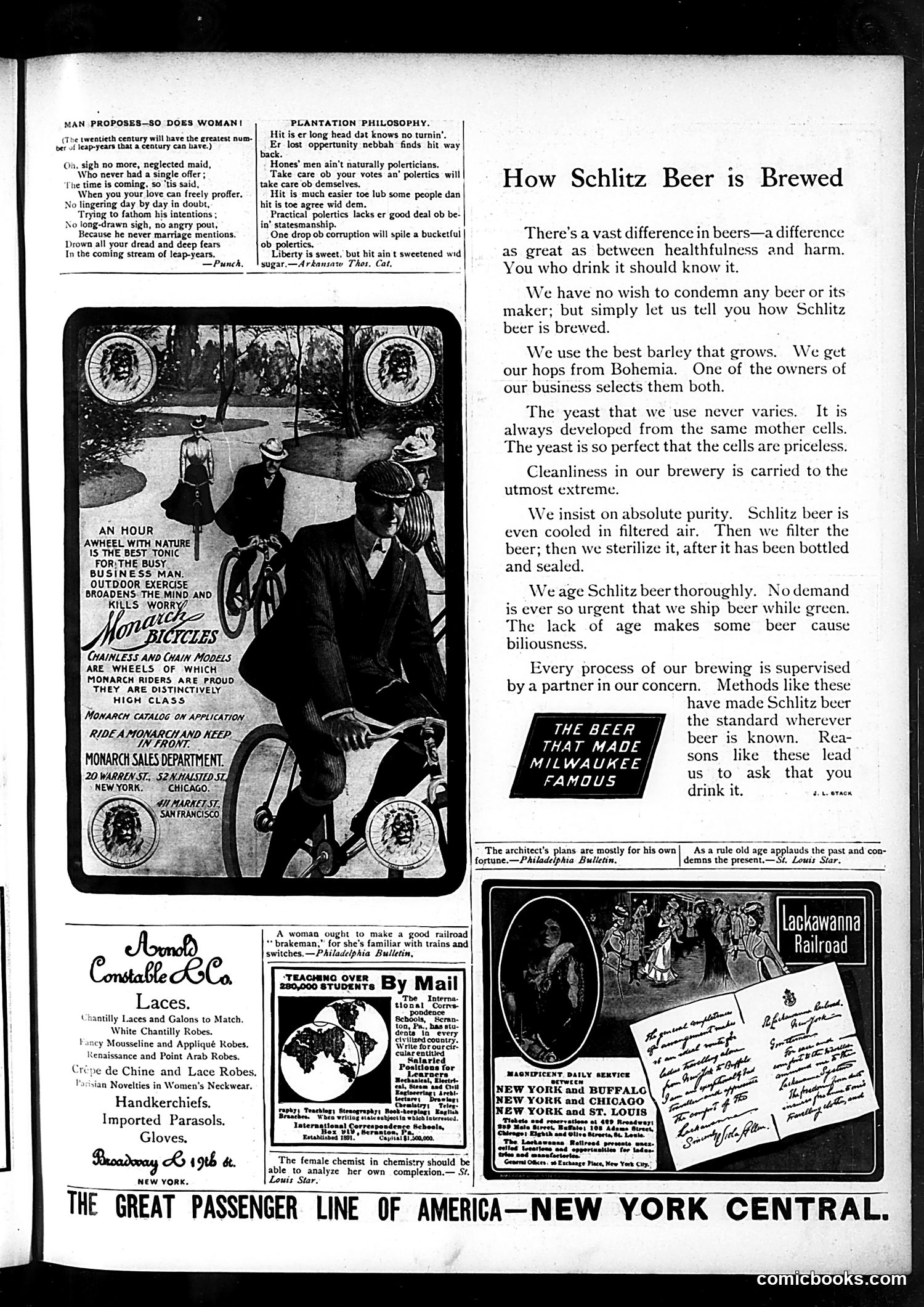
This page mixes satirical poetry with period advertisements. The main cartoon text, "Man Proposes—So Does Woman!," jokes about leap years (which occur more frequently in the 20th century). It satirizes traditional courtship by suggesting women will finally have socially acceptable opportunities to propose marriage to men during leap years—inverting the era's strict gender roles where only men could initiate proposals. The "Plantation Philosophy" section presents dialect humor stereotyping African American speech, discussing politics and morality in a condescending manner typical of early 1900s publications. The page includes advertisements for Monarch bicycles (positioning cycling as health-promoting), women's fashion items, and Schlitz beer, which emphasizes purity and careful brewing as selling points. The smaller jokes at bottom mock female railroad workers and female chemists—reflecting contemporary anxiety about women entering professional spaces.
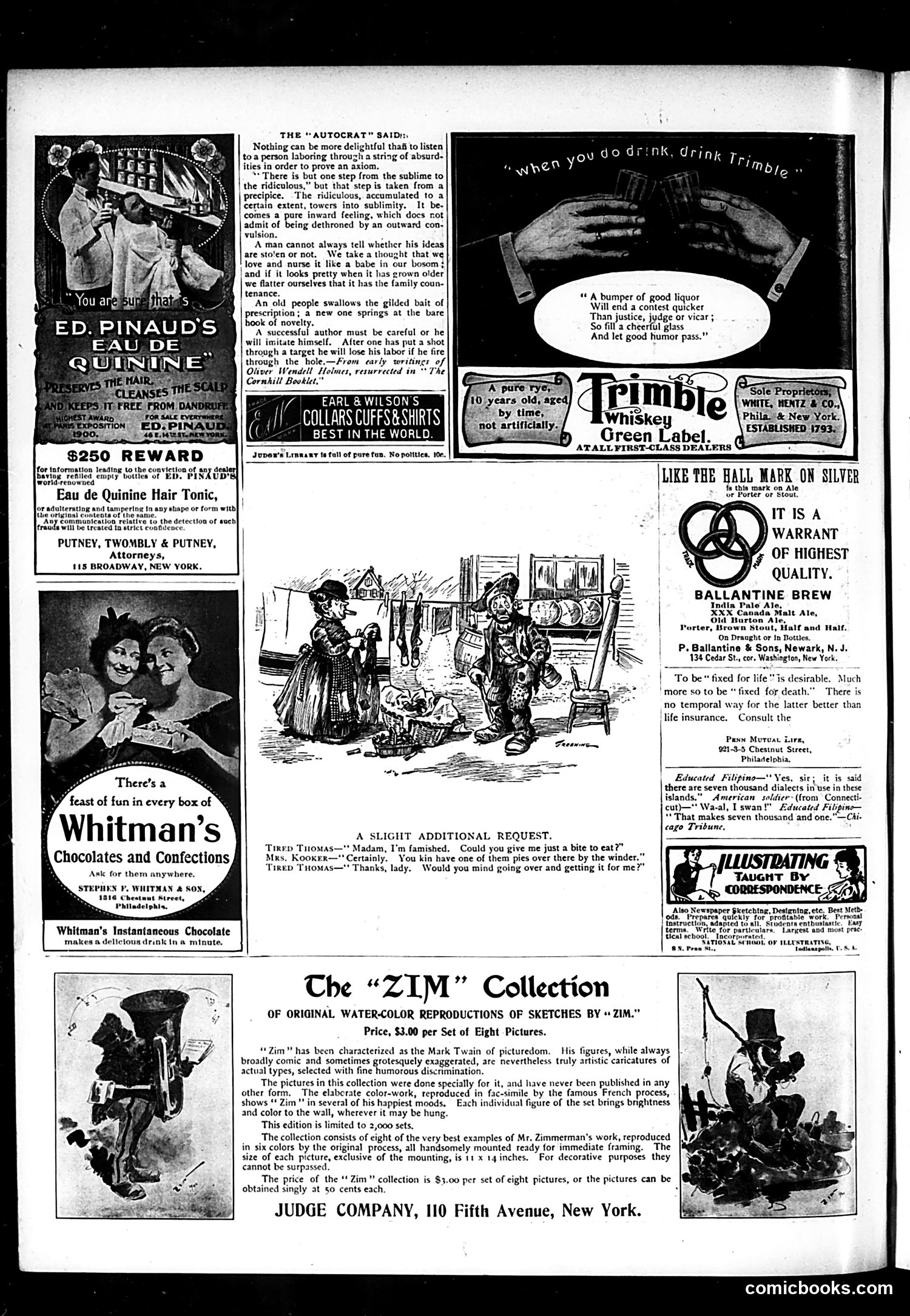
This page is primarily **advertising** with minimal political content. The main editorial piece is "The Autocrat Said"—philosophical quotes attributed to Oliver Wendell Holmes about absurdity, originality, and imitation. It's not satirical commentary but rather inspirational filler. The page's cartoons are brief humor sketches: one depicts a tired man asking for food, then requesting the homeowner retrieve it for him—a joke about shameless entitlement. Another shows an educated Filipino and American soldier discussing dialects, with the American's surprised reaction played for laughs at his expense. The rest is **commercial advertising**: Earl & Wilson collars, Whitman's chocolates, Trimble whiskey, Ballantine beer, hair tonic, life insurance, and notably, a "ZIM Collection" of water-color sketches compared to Mark Twain's humor style. The page reflects early 1900s Judge magazine's mix of genteel literary references and light domestic comedy, with advertising subsidizing publication.
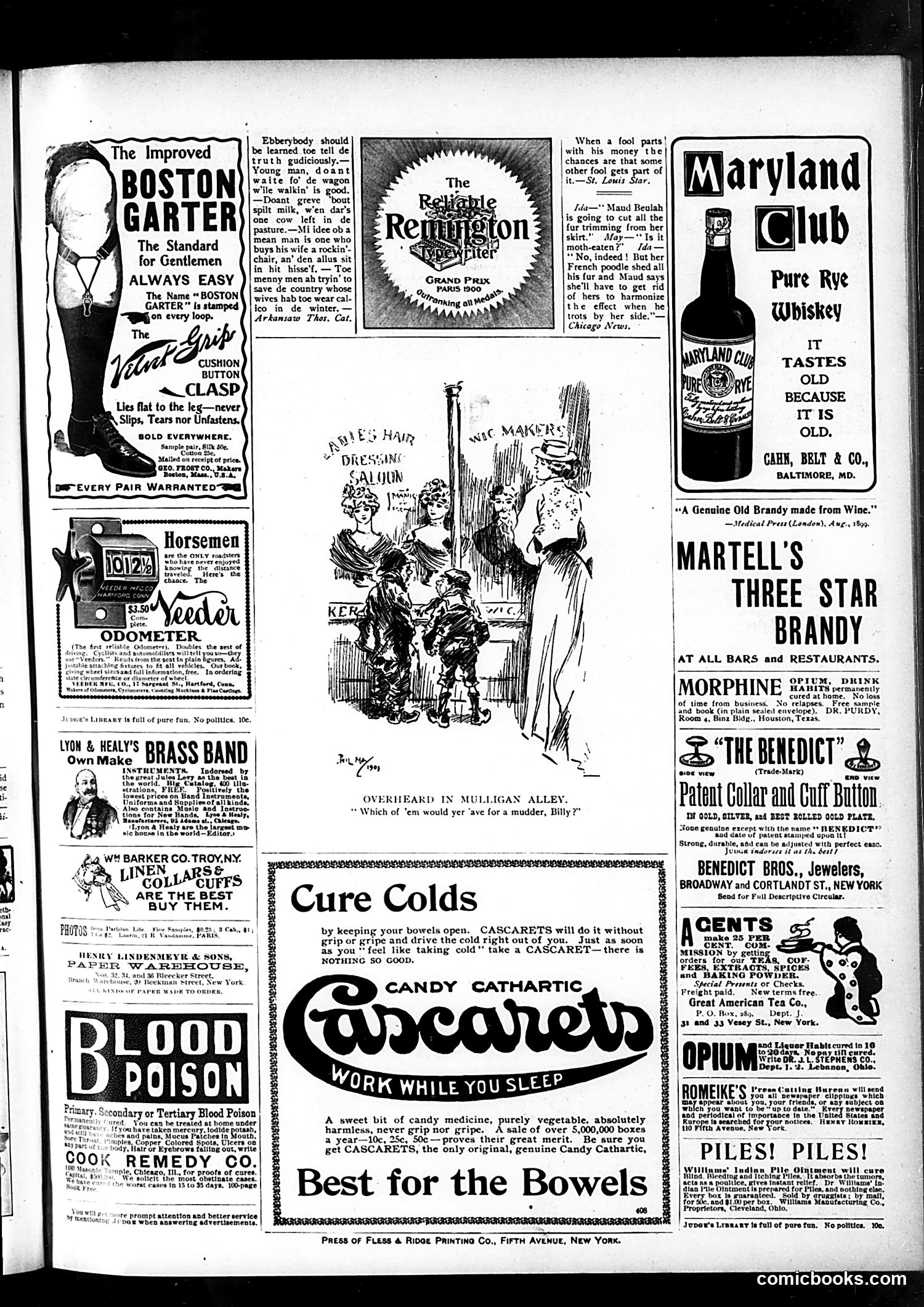
This page is **primarily advertisements** with minimal editorial cartoon content. The one notable cartoon is titled "OVERHEARD IN MULLIGAN ALLEY," depicting working-class Irish immigrants ("Mulligan Alley" being a stereotypical Irish neighborhood reference). The caption—"Which of 'em would yer 'ave for a mudder, Billy?"—uses exaggerated Irish dialect to present a crude joke about choosing a woman. The page is dominated by patent medicine ads typical of the era: Cascarets (laxatives), Blood Poison remedies, and Morphine treatments—reflecting early 1900s medical quackery. Other advertisements include garters, brass bands, and luxury goods (Martell brandy, whiskey). The Irish dialect humor and working-class caricatures represent period satire targeting immigrant communities. The abundance of dubious medical claims reflects an unregulated pharmaceutical market that Judge's readership apparently found both amusing and commercially viable.
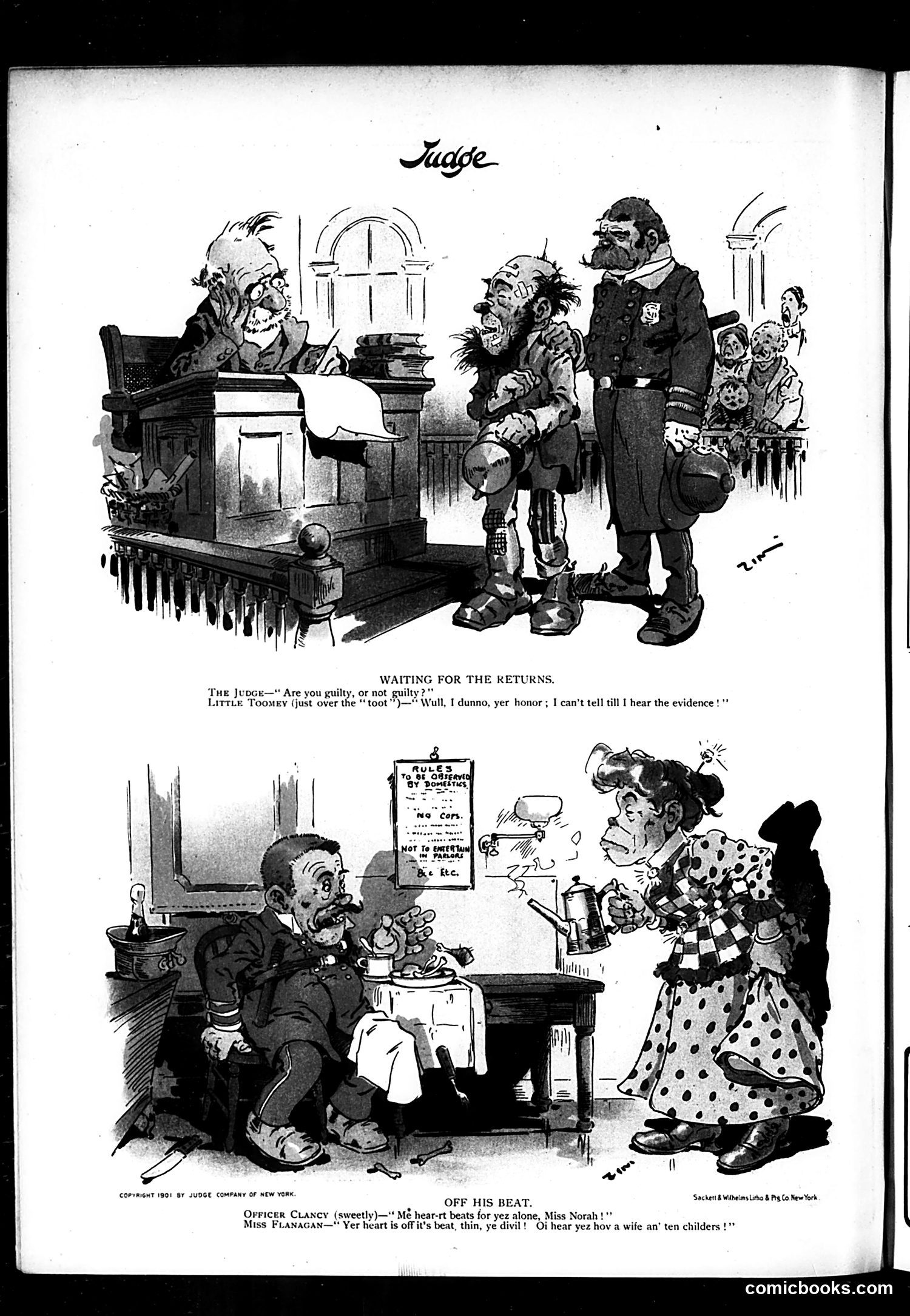
**"Waiting for the Returns"** (top): A courtroom scene satirizing political corruption. A grotesque defendant ("Little Toosey") stands before a judge, claiming he can't determine guilt or innocence until hearing "the evidence"—a joke about how election returns (votes being "counted") determine outcomes in rigged trials. The caricatured figures in the gallery suggest urban political machine involvement. The satire mocks how justice is corrupted by political manipulation rather than genuine legal proceedings. **"Off His Beat"** (bottom): A flirtation between Officer Clancy and Miss Norah/Flanagan, with Irish-dialect dialogue. Clancy claims his heart belongs only to her, but she reveals he has a wife and ten children—satirizing the hypocrisy of Irish-American policemen and urban infidelity. The humor relies on ethnic stereotyping typical of the era. Both cartoons target corruption and vice in early 1900s urban America.
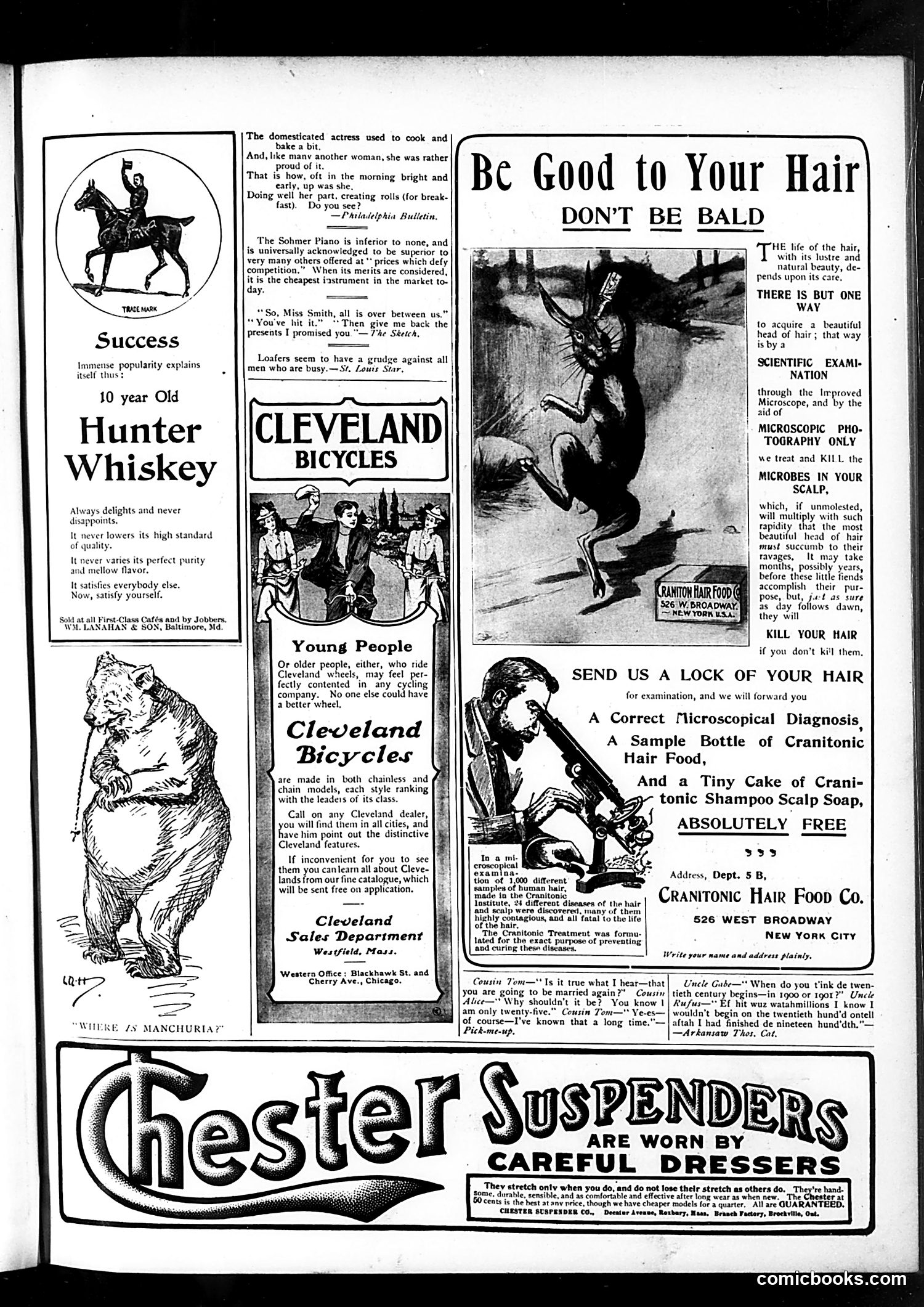
This page is primarily **advertising**, with several product promotions and one brief humorous anecdote. The main content includes ads for Hunter Whiskey, Sohmer Piano, Cleveland Bicycles, and Chester Suspenders. The most notable piece is a large advertisement for the **Cranitonic Hair Food Company**, which claims to treat baldness through "scientific examination" using microscopy and "microscopic photography" to identify and kill supposed hair-destroying microbes. This reflects early 20th-century pseudo-scientific medical claims—the company promises a free diagnosis, sample bottle, and shampoo cake if customers mail in a hair lock. There are also brief humorous quotations scattered throughout (from Philadelphia Bulletin, St. Louis Star, and Sketch magazine) playing on domestic life and courtship themes—typical light satirical fare for Judge's audience. The page reflects the era's willingness to market dubious scientific remedies and the magazine's reliance on advertising revenue rather than political satire.
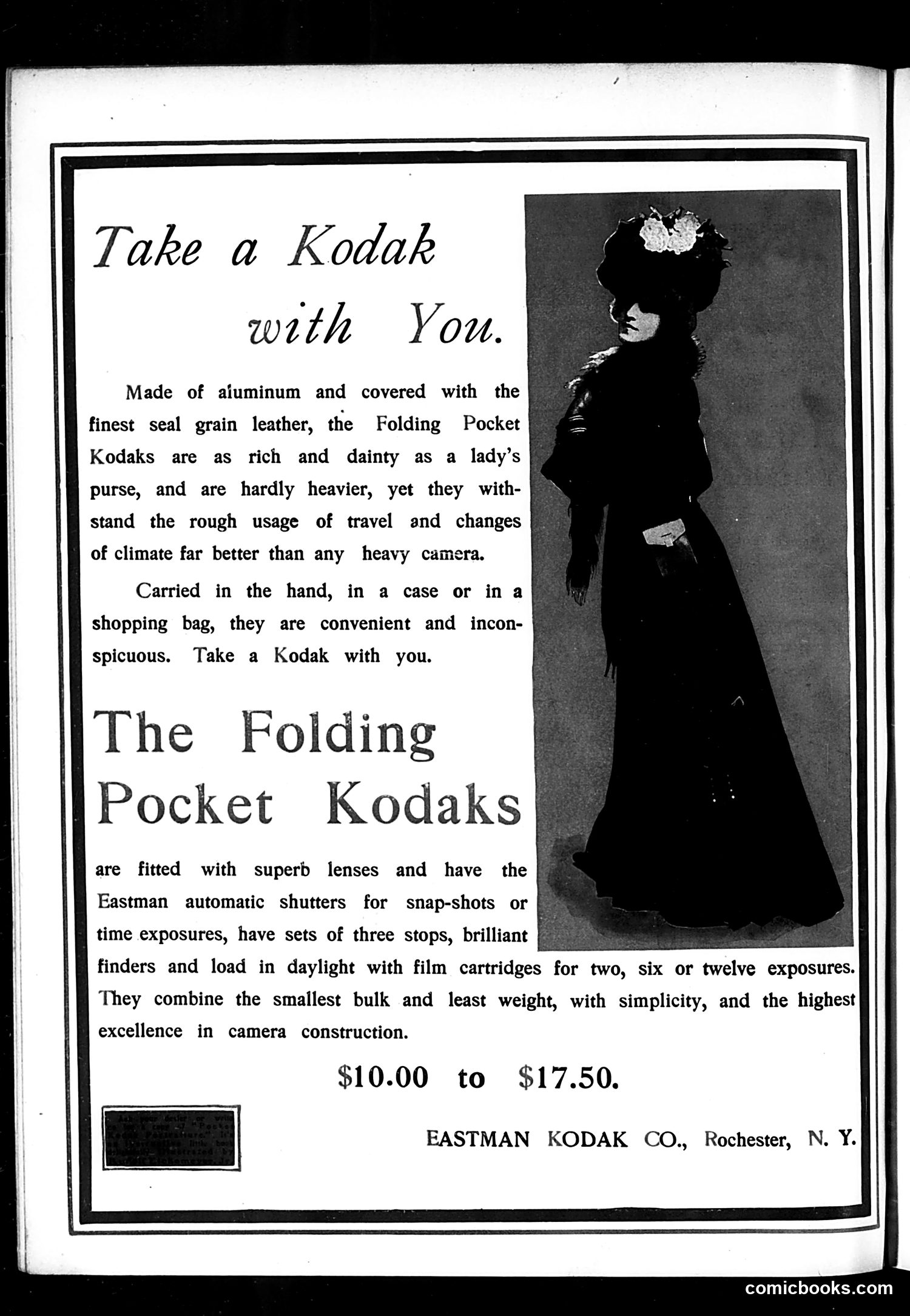
This page from *Judge* magazine is a straightforward **Kodak camera advertisement**, not political satire or editorial content. The image shows a fashionably dressed woman in early 1900s attire (long dark coat, elaborate hat) posed elegantly to demonstrate the camera's portability and appeal to female consumers. The ad emphasizes that Folding Pocket Kodaks are lightweight, durable, and as refined as "a lady's purse"—marketing photography technology to women as a practical yet fashionable accessory for travel. The price range ($10–$17.50) and technical details about lenses, shutters, and film cartridges are standard product information. This represents an era when photography was becoming accessible to amateur users rather than remaining a professional domain. There is no political commentary or satirical intent on this particular page.