
A complete issue · 16 pages · 1901
Judge — February 23, 1901
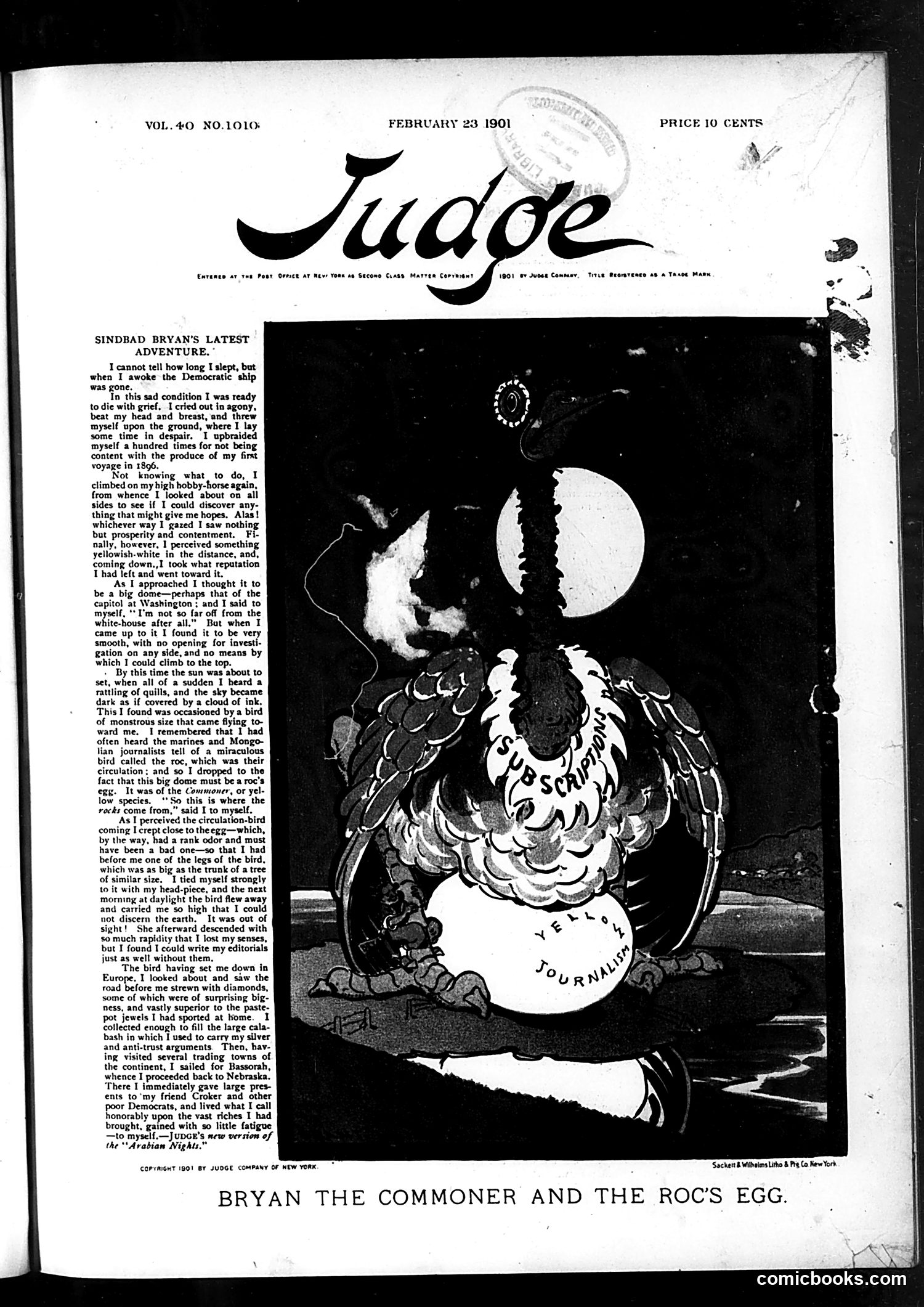
This cartoon satirizes William Jennings Bryan, the three-time Democratic presidential candidate. The illustration shows Bryan as a disheveled figure clutching an enormous egg labeled "Populism" and "Yellow Journalism," surrounded by dark, menacing creatures—likely representing threats or criticisms he faced. The accompanying article, titled "Sindbad Bryan's Latest Adventure," uses the Arabian Nights tale of Sindbad as an extended metaphor for Bryan's political struggles. The "Roc's egg" represents his populist ideology and media-driven campaigns, depicted as both valuable and dangerously burdensome—something he clings to despite it weighing him down and attracting hostile forces. Judge mocks Bryan's political persistence and reliance on sensationalism.
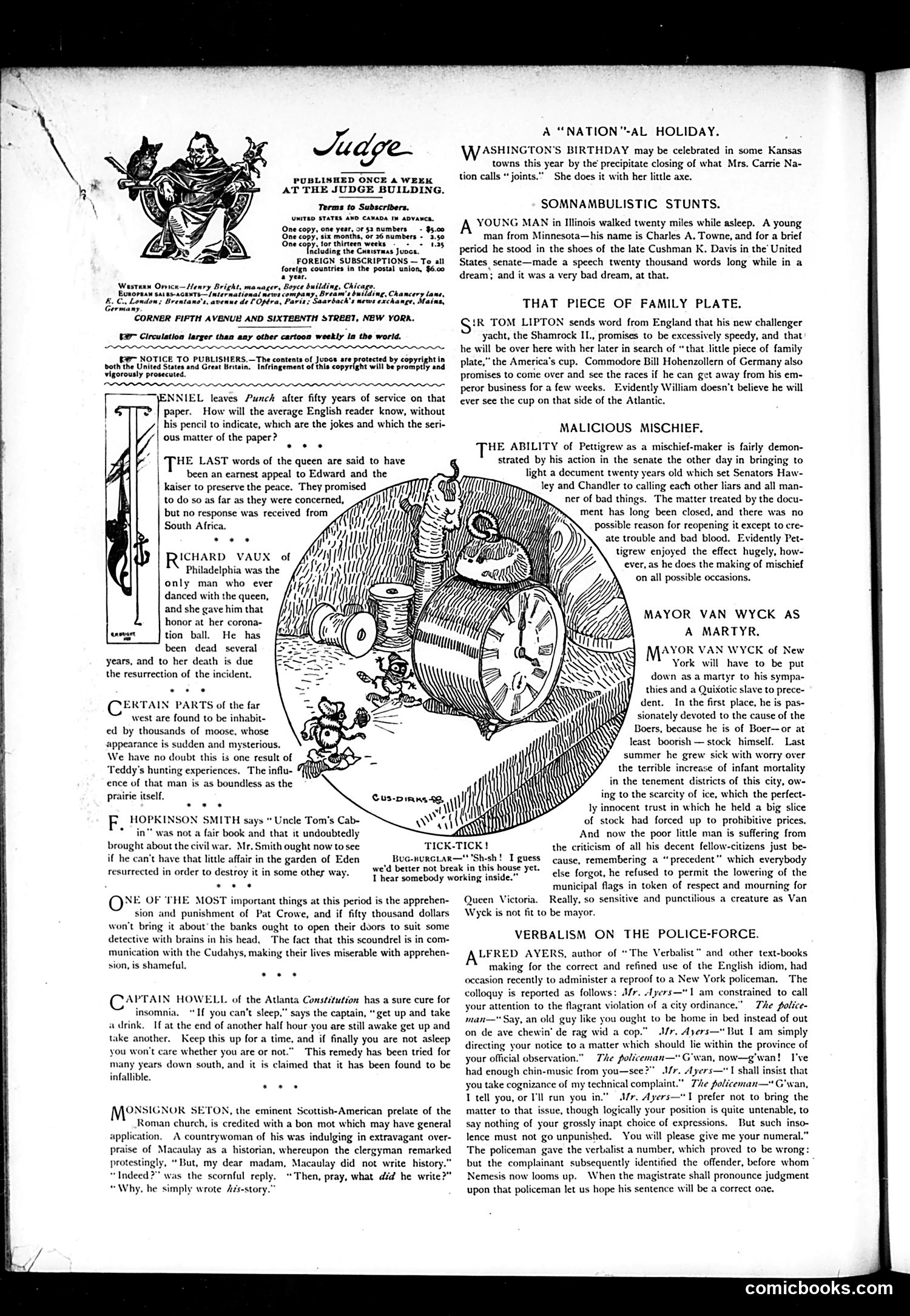
The main cartoon depicts a large, grotesque insect or bug-like creature emerging from or associated with a wheel or mechanical device, labeled "TICK-TICK!" Below it reads: "Bug-humbug—'Shh! I guess we'd better not break in this house yet. I hear somebody watching inside.'" This appears to be satirizing hidden social problems or corruption ("bugs" in the system) that operate undetected. The creature's cautious behavior suggests awareness of public scrutiny—likely commentary on scandals or misdeeds discovered when authorities pay attention. The surrounding text sections discuss various political and social topics, including Mayor Van Wyck of New York and verbalism in police conduct, suggesting the cartoon relates to civic corruption or government malfeasance of the period.
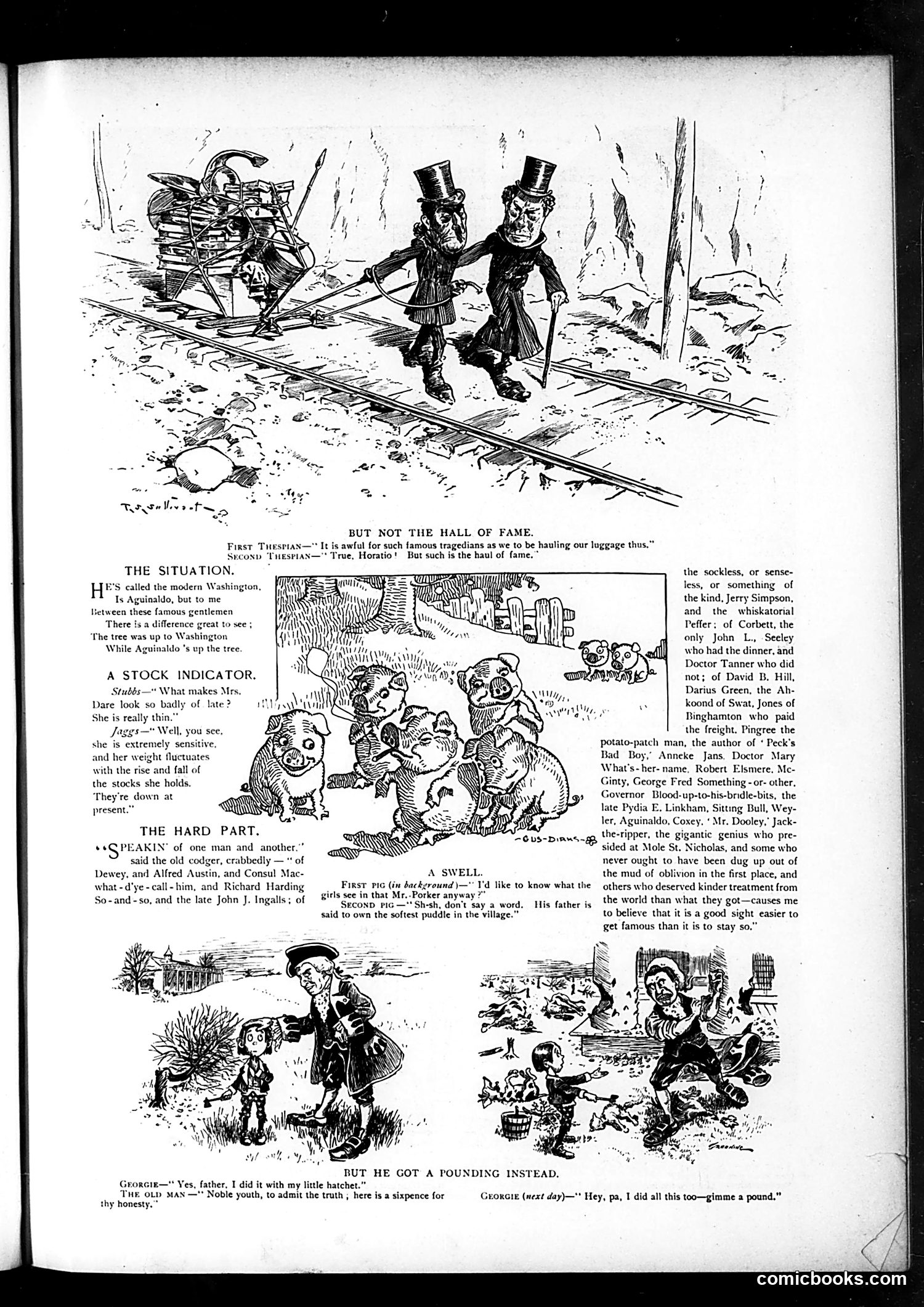
This page from *Judge* magazine satirizes American politics and society through multiple cartoons and jokes. The top cartoon, "But Not the Hall of Fame," mocks famous politicians debating whether to haul luggage, suggesting they're unworthy of historical recognition despite their prominence. "The Situation" and "A Stock Indicator" use anthropomorphized pigs to satirize financial markets and economic conditions—pigs' weight fluctuations mirror stock market volatility, a common metaphor for unstable investments. "The Hard Part" and "A Swell" mock working-class characters and parental discipline, with humor about poverty, manual labor, and children's misbehavior. The bottom cartoon, "But He Got a Pounding Instead," depicts a child's confrontation with an adult authority figure, satirizing social hierarchies and corporal punishment attitudes of the era. Overall, the page blends political criticism with broad social satire targeting wealth inequality, market instability, and class dynamics.
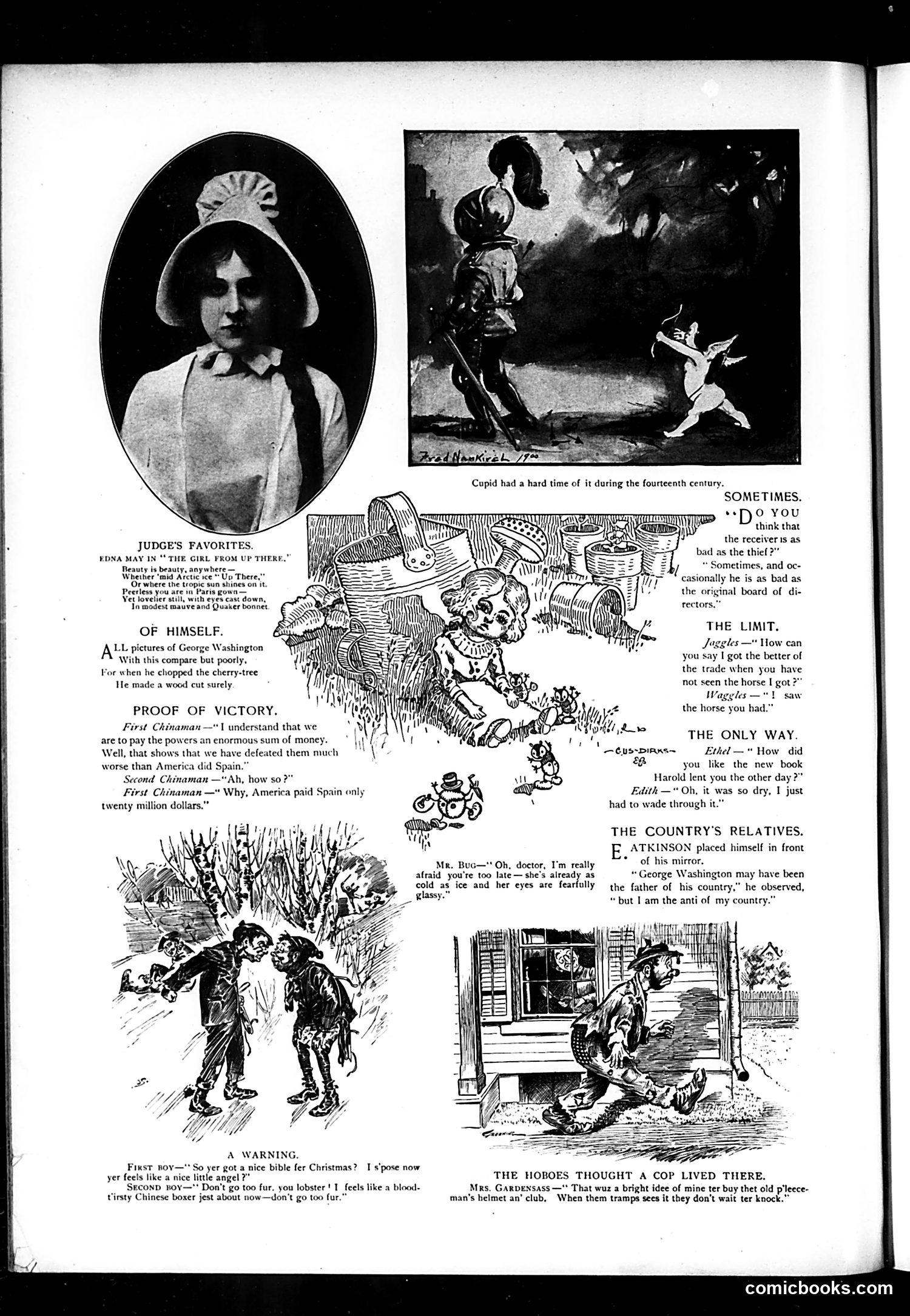
This page contains several satirical pieces mocking political and social figures of the early 20th century. The top includes a portrait labeled "Judge's Favorites" and references to George Washington comparisons. Multiple cartoon dialogues appear throughout: **"Proof of Victory"** mocks a Chinaman's claim about American monetary superiority over Spain, suggesting satirical commentary on colonial/imperial competitions. **"A Warning"** depicts two boys discussing Christmas gifts, with one calling the other a "dirty Chinese boxer"—likely referencing the Boxer Rebellion (1900), reflecting American xenophobia of that era. The remaining segments ("The Limit," "The Only Way," "The Country's Relatives," and "The Heroes") appear to be brief joke exchanges, though specific political figures referenced remain unclear from the visible text alone. The overall tone reflects Judge's characteristic irreverent commentary on contemporary politics and social attitudes.
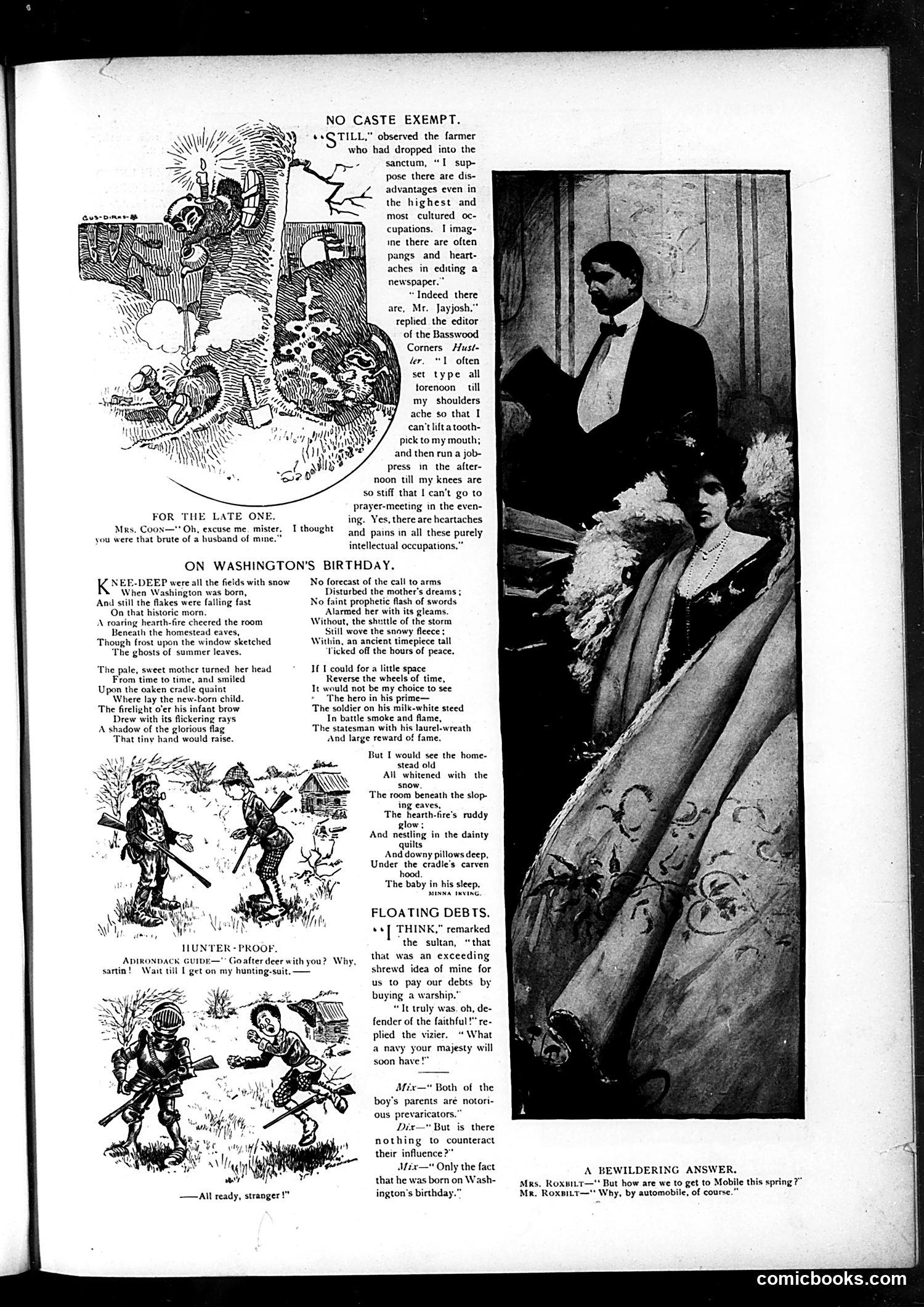
This page contains several satirical pieces typical of early 20th-century American humor: **"No Caste Exempt"** mocks a newspaper editor who complains of physical hardship—setting type, operating a job-press—while calling his work "purely intellectual occupations." The satire targets pretentious editors who claim their labor is dignified intellectual work while actually performing grueling manual tasks. **"On Washington's Birthday"** is a sentimental poem celebrating Washington's birth, contrasting his humble cradle with his later military glory. **"Hunter-Proof"** and related sketches are brief comedic dialogues with minimal political content—standard filler humor. **"Floating Debts"** satirizes an unnamed sultan's absurd fiscal policy: buying warships to pay debts. This likely references real international disputes or mockery of foreign governments' questionable financial decisions. **"A Bewildering Answer"** jokes about the newfangled automobile as a solution to travel plans—typical early-1900s humor about this emerging technology. Overall, the page reflects Judge's mix of political satire, social commentary, and light comedy.
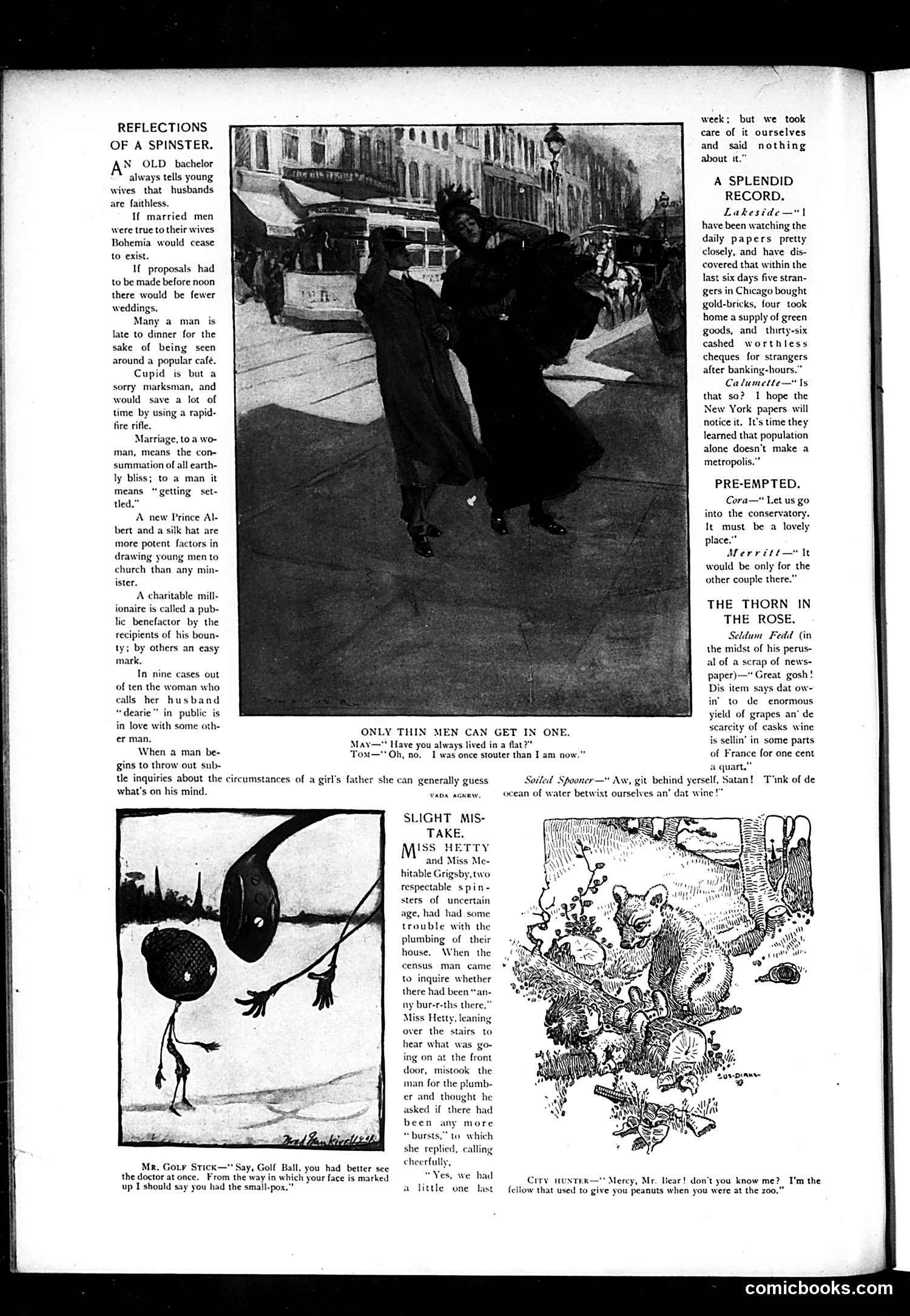
This page from Judge contains several unrelated satirical pieces typical of early 20th-century humor magazines: **"Reflections of a Spinster"** offers cynical observations on marriage and courtship—bachelors warn that married men are unfaithful, proposals should happen before noon to avoid fewer weddings, and marriage means different things to men versus women. **The cartoons illustrate specific jokes**: One shows a thin man beneath a large figure, captioned about living in a flat. Another depicts two spinsters (Miss Hetty and Miss Mehitable Grigsby) mishearing a census taker as a plumber asking about "bursts," replying cheerfully about plumbing problems. **"The Thorn in the Rose"** jokes about French wine scarcity and pricing. **"City Duster"** features a bear recognizing a former zoo visitor. The humor relies on wordplay, misunderstandings, and gentle social commentary about urban life, domestic situations, and courtship—typical Judge fare of the era.
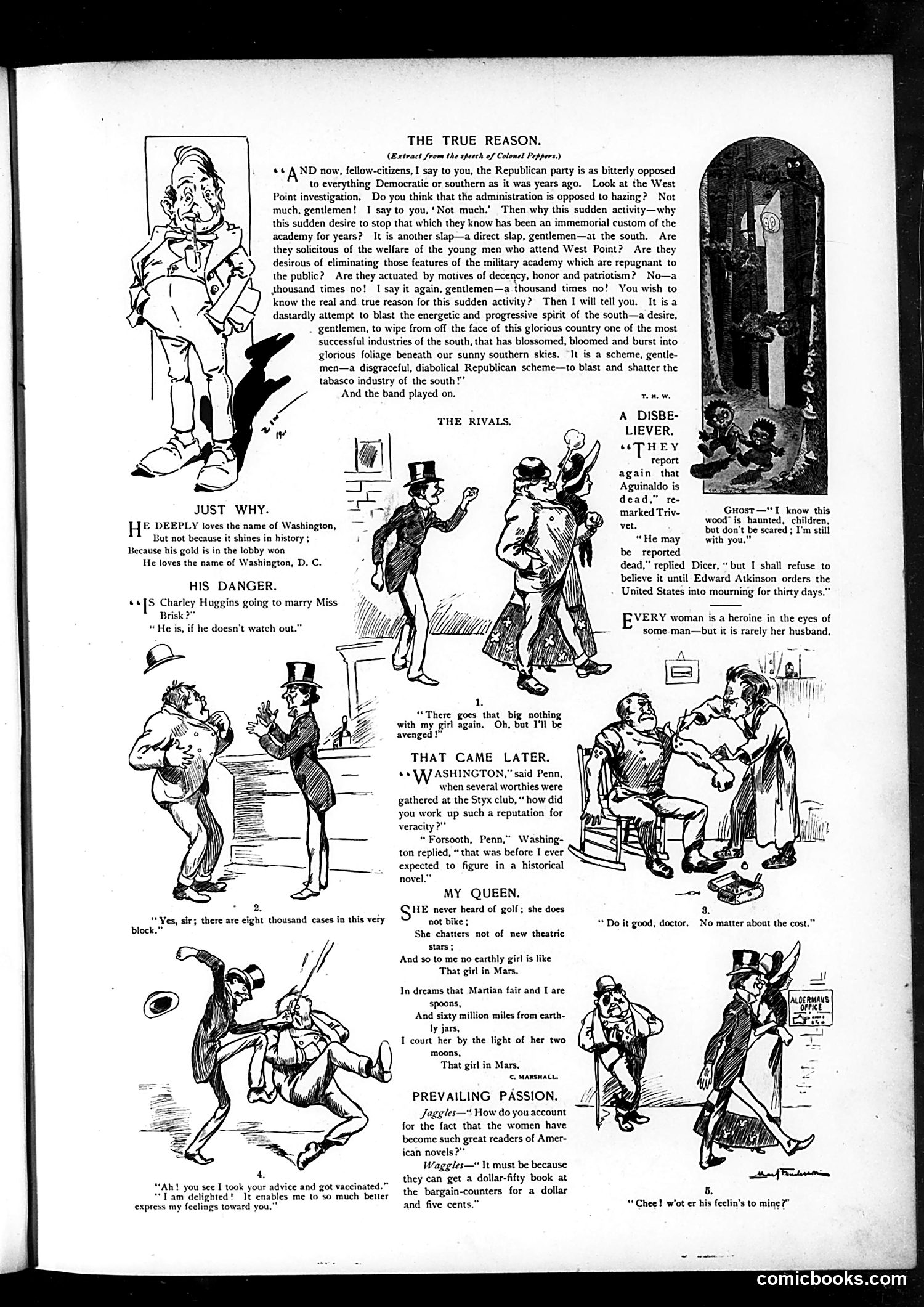
This page contains multiple satirical pieces mocking American politics and society circa early 1900s. **"The True Reason"** depicts Colonel Peppers delivering a bombastic speech claiming Republican hazing investigations at West Point are actually a scheme to destroy the South's "tabasco industry"—an absurd accusation exposing Southern politicians' paranoid victimhood narratives and their defensive justifications of military brutality as regional tradition. **"The Rivals"** mocks debates over Filipino insurgent leader Aguinaldo's death during the Philippine-American War. Edward Atkinson was a real anti-imperialist activist; the joke skewers both his activism and the military's credibility regarding casualty reports. **"His Danger"** jabs at politicians' attachment to Washington, D.C. specifically for lobbying opportunities rather than patriotic reverence. The remaining items are lighter humor about romance, golf, and women's reading habits—standard magazine filler. The page's core message critiques Southern defensiveness, imperial war propaganda, and political corruption through exaggerated character monologues and visual caricature.
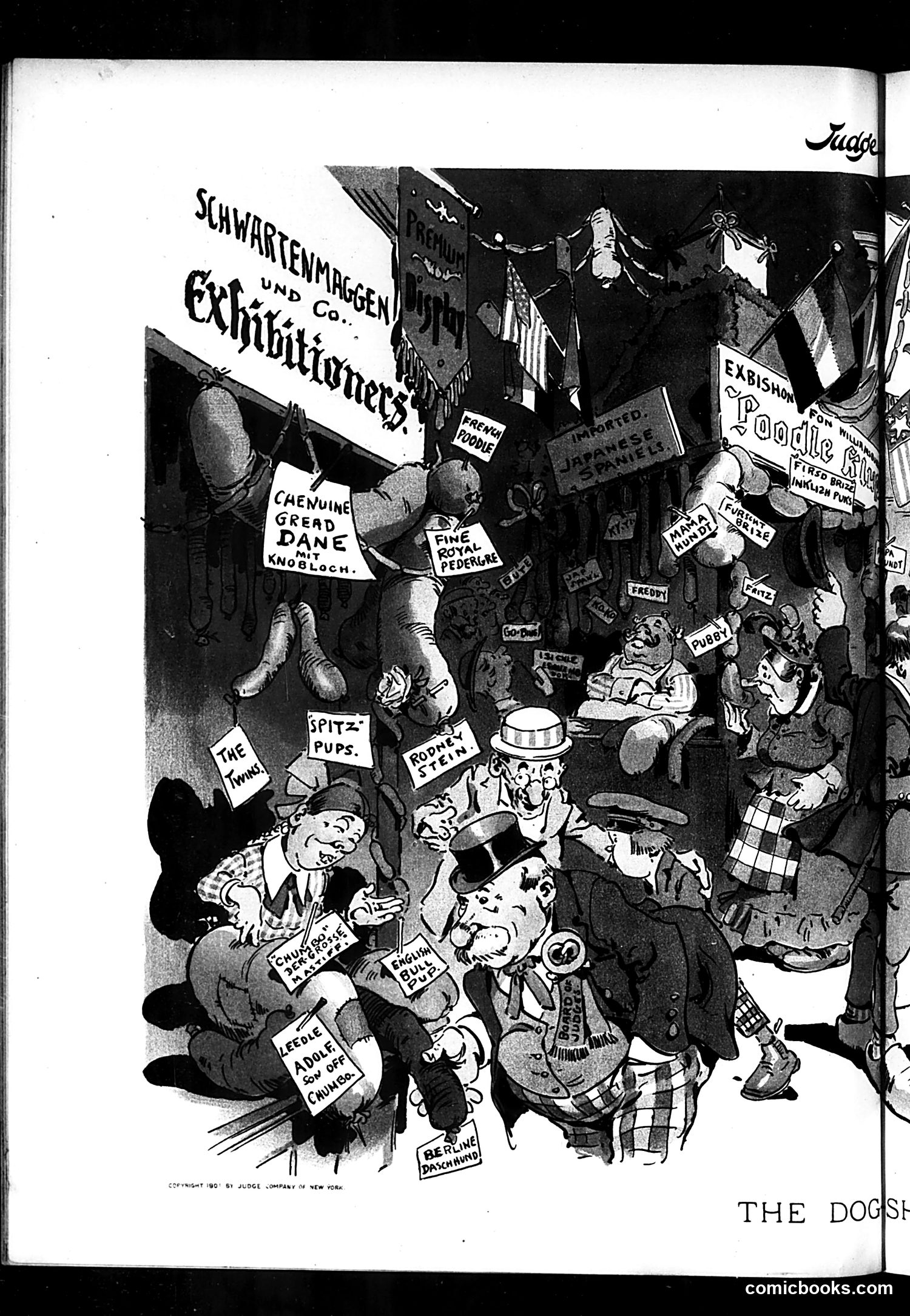
This satirical cartoon depicts a crowded dog show or exhibition, likely mocking the pretensions of dog breeding and showing culture around 1901. The cartoon is labeled "Schwartenmagen und Co., Exhibitors" at top, suggesting German or immigrant involvement in the dog fancy. Various dogs display labels identifying breeds and characteristics ("Genuine Great Dane," "Fine Roman Nose," "Pedigree," etc.), satirizing how breeders obsess over specific traits and pedigrees. The chaotic scene with multiple handlers suggests the competitive absurdity of dog shows. The figure in the center with a top hat appears to be a show judge or promoter overseeing this crowded, somewhat undignified spectacle. The overall message ridicules both the vanity of dog exhibitors and the arbitrariness of breed standards—treating animal husbandry as mere vanity.
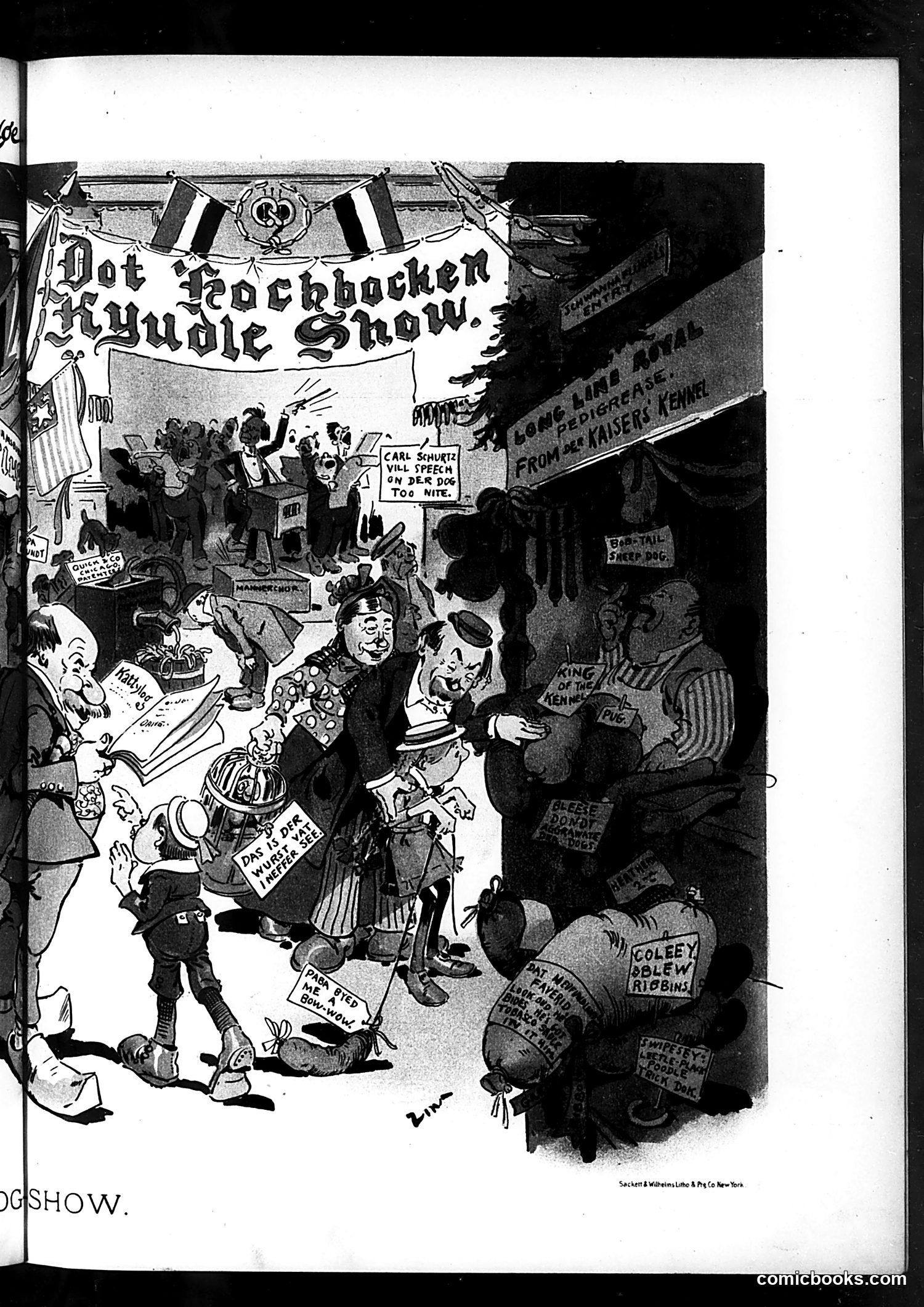
This political cartoon satirizes a carnival or "freak show" atmosphere, with the banner title suggesting a public spectacle (the exact referent is unclear from the OCR). The scene depicts exaggerated caricatures of what appear to be political or public figures, drawn in the grotesque style typical of Judge magazine's satirical approach. A sign references "Carl Schutz will speak on der dog too nite," suggesting a specific political figure or event being mocked. Various German phrases and references appear throughout, indicating this likely concerns German-American politics or figures, possibly from the early 20th century. The right side shows darker figures labeled with names like "Coley" and "Rippini," though their specific identities and relevance aren't clear from the visible text. The overall tone suggests ridicule of political personalities or movements through carnival imagery.
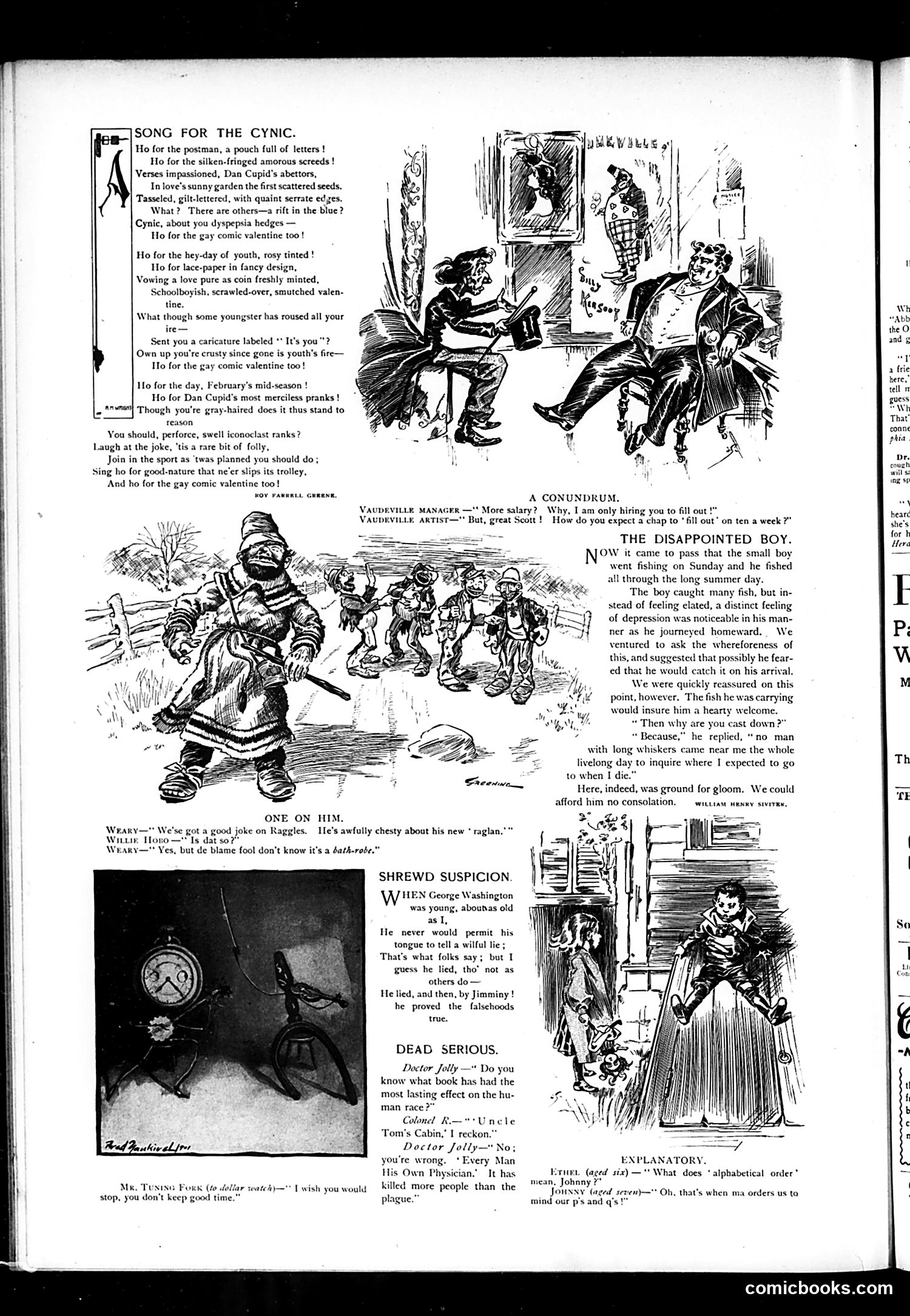
This page contains several satirical pieces typical of early 20th-century American humor: **"Song for the Cynic"** mocks cynical attitudes toward Valentine's Day, contrasting romantic sentiment with crude comic valentines—suggesting some readers find genuine love letters foolish compared to insulting caricature cards. **"A Conundrum"** satirizes exploitative vaudeville management: a theater manager claims he's only hiring a performer to "fill out" the show, yet expects the actor to survive on minimal wages—highlighting labor disputes in entertainment. **"The Disappointed Boy"** presents a small boy disappointed after fishing—not from lack of catch, but because no bearded man appeared to lecture him about the morality of Sunday fishing (a religious/moral concern of the era). Other brief pieces include workplace jokes and wordplay typical of the magazine's comic style. The overall tone is gentle satire aimed at contemporary social practices: romantic conventions, labor conditions, religious morality, and family dynamics.
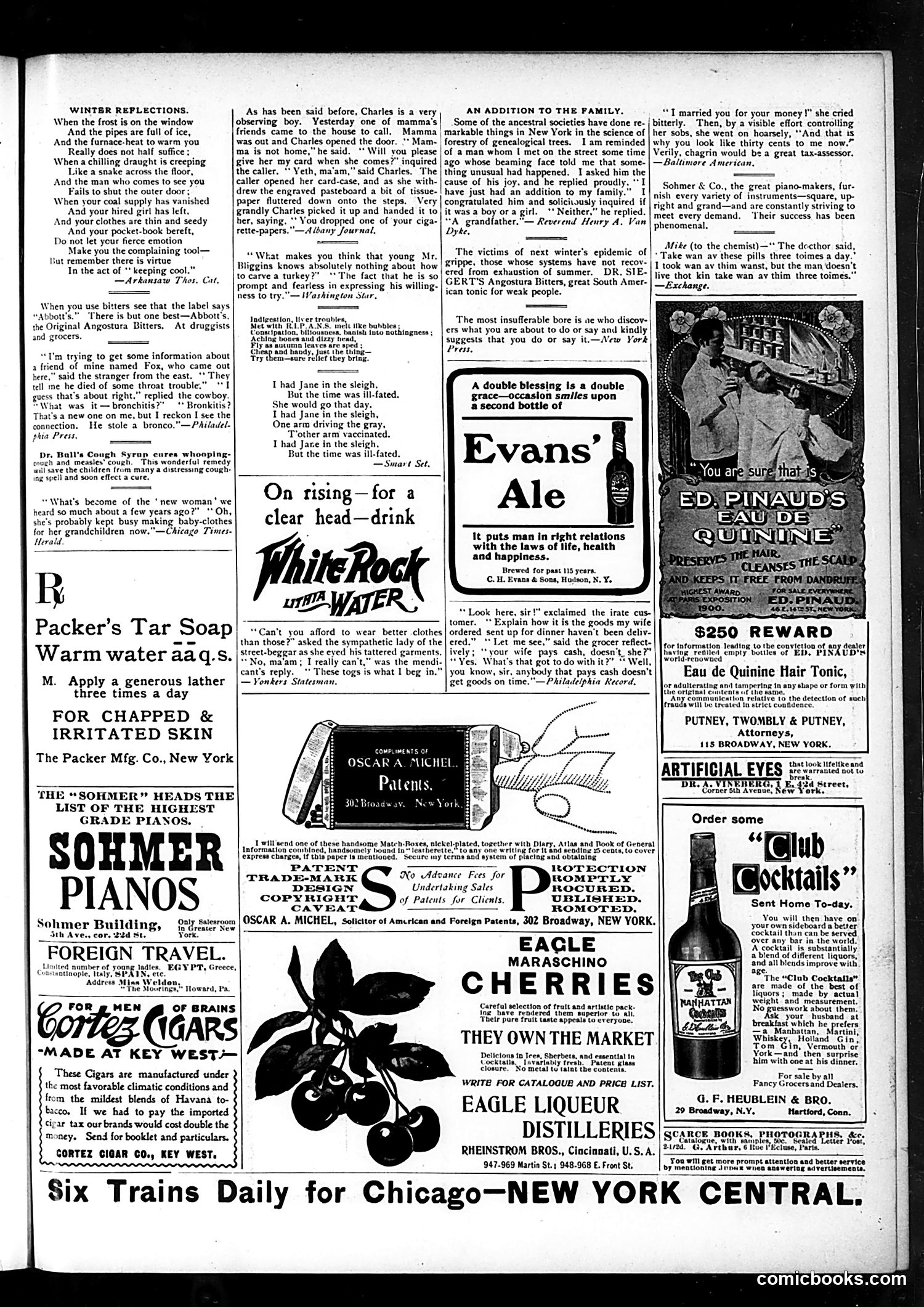
This page is **primarily advertising** with brief humorous anecdotes interspersed. The satirical content is minimal and consists of short jokes rather than political cartoons. **Key humorous items:** 1. **"Winter Reflections"** poem mocks complaints about cold weather and hardship, advising stoicism—typical genteel satire of the era. 2. **Fox/Bronc joke**: A play on words where a cowboy misunderstands "bronchitis" as theft of a bronco—simple frontier humor. 3. **"New Woman"** quip: Satire of early feminist discourse, suggesting progressive women have settled into traditional domesticity as grandmothers. 4. **Charles anecdote**: A precocious child mistakes tissue paper from a calling card for cigarette papers—gentle humor about class markers. 5. **Bliggins joke**: Mockery of social pretension regarding carving skills. The page is dominated by **period advertisements** for pianos, cigars, cough syrup, and travel services. There are **no recognizable political figures or significant satirical cartoons** visible on this page.
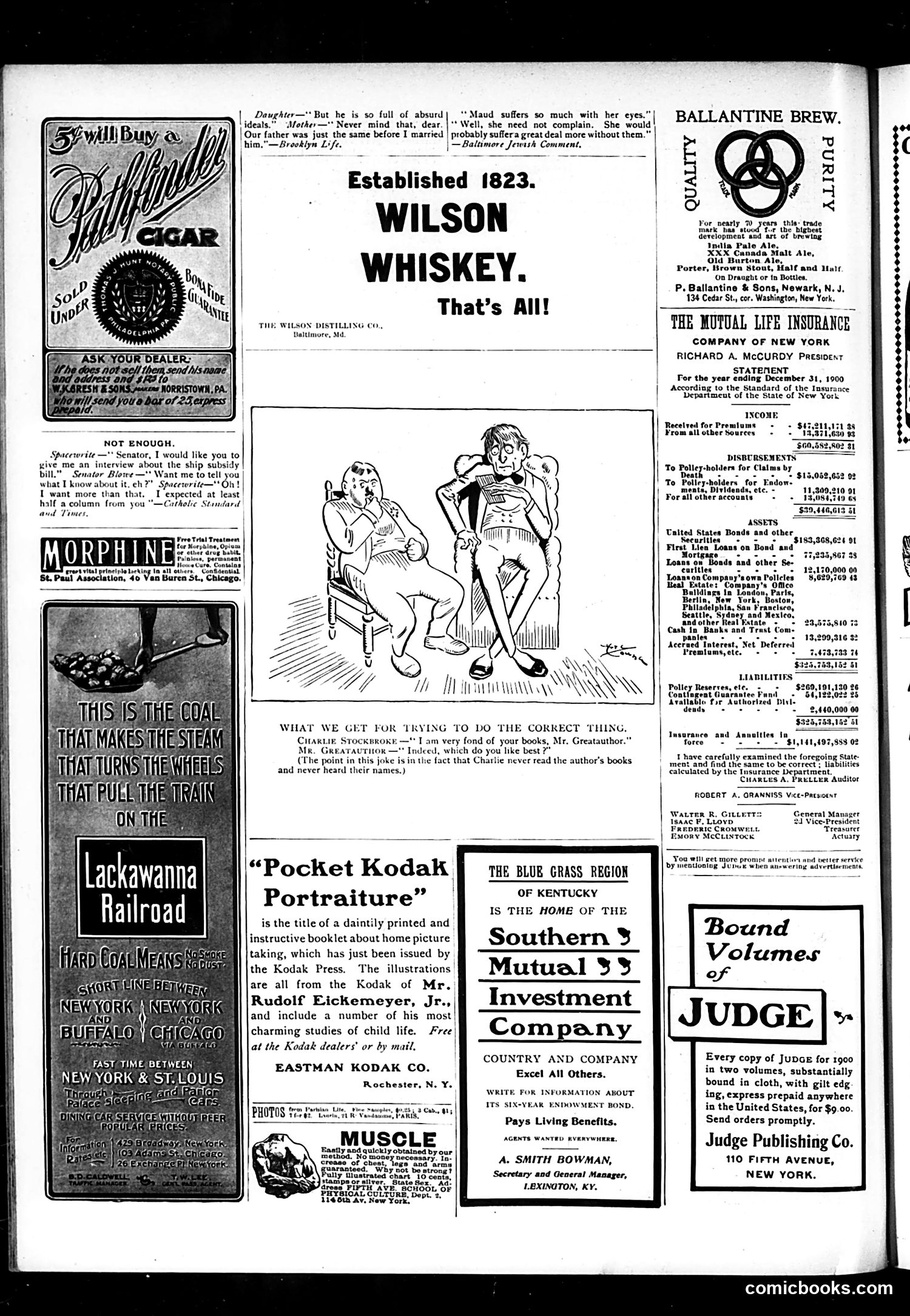
This page is primarily **advertising and financial statements**, not political satire. The main content includes: **Cartoons present:** Two brief jokes—one about a senator overstating his knowledge to a reporter seeking an interview, and another about a mother reassuring her daughter that an idealistic suitor is normal before marriage. These are mild domestic/political humor, not sharp satire. **Dominant content:** Corporate advertisements and a financial statement from The Mutual Life Insurance Company of New York (dated 1900), listing assets, liabilities, and officers including President Richard A. McCurdy. **Other ads:** Wilson Whiskey, Kodak cameras, Eastman Kodak, a muscle-building course, Ballantine beer, and various investment/insurance companies. The page reflects Judge's dual nature as both satirical magazine and advertising vehicle. The cartoons are gentle, topical humor rather than pointed political commentary. The financial statement's prominence suggests significant advertiser relationships.
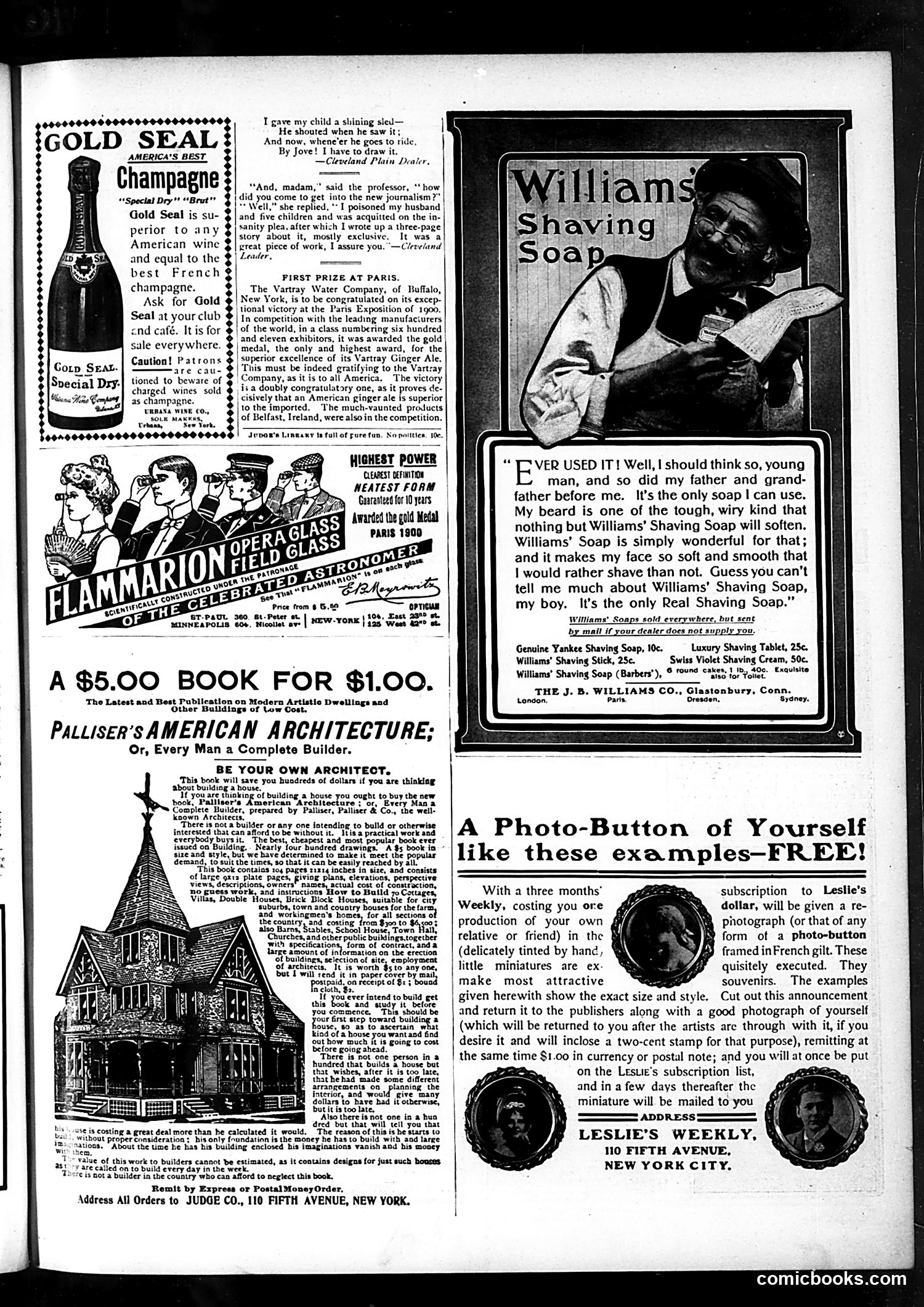
This page consists primarily of **advertisements** rather than political satire or cartoons. The main content includes: **Key Advertisements:** - Gold Seal Champagne (positioned as superior to French imports) - Williams' Shaving Soap (featuring a testimonial from a man praising its superiority for tough beards) - Flammation Opera Glasses (advertising optical clarity, awarded a gold medal at Paris 1900) - Palliser's American Architecture book (a $5 book sold for $1) - Leslie's Weekly photo-button offer (free miniature portraits for subscribers) **Historical Context:** The ads reflect turn-of-the-century American marketing emphasizing domestic products' superiority to European imports—a common nationalist theme of the era. The Paris Exposition of 1900 awards are cited multiple times to validate quality claims. **No significant political cartoon or satire** appears on this page. The brief poem at top about a child's sled is merely filler content, not political commentary.
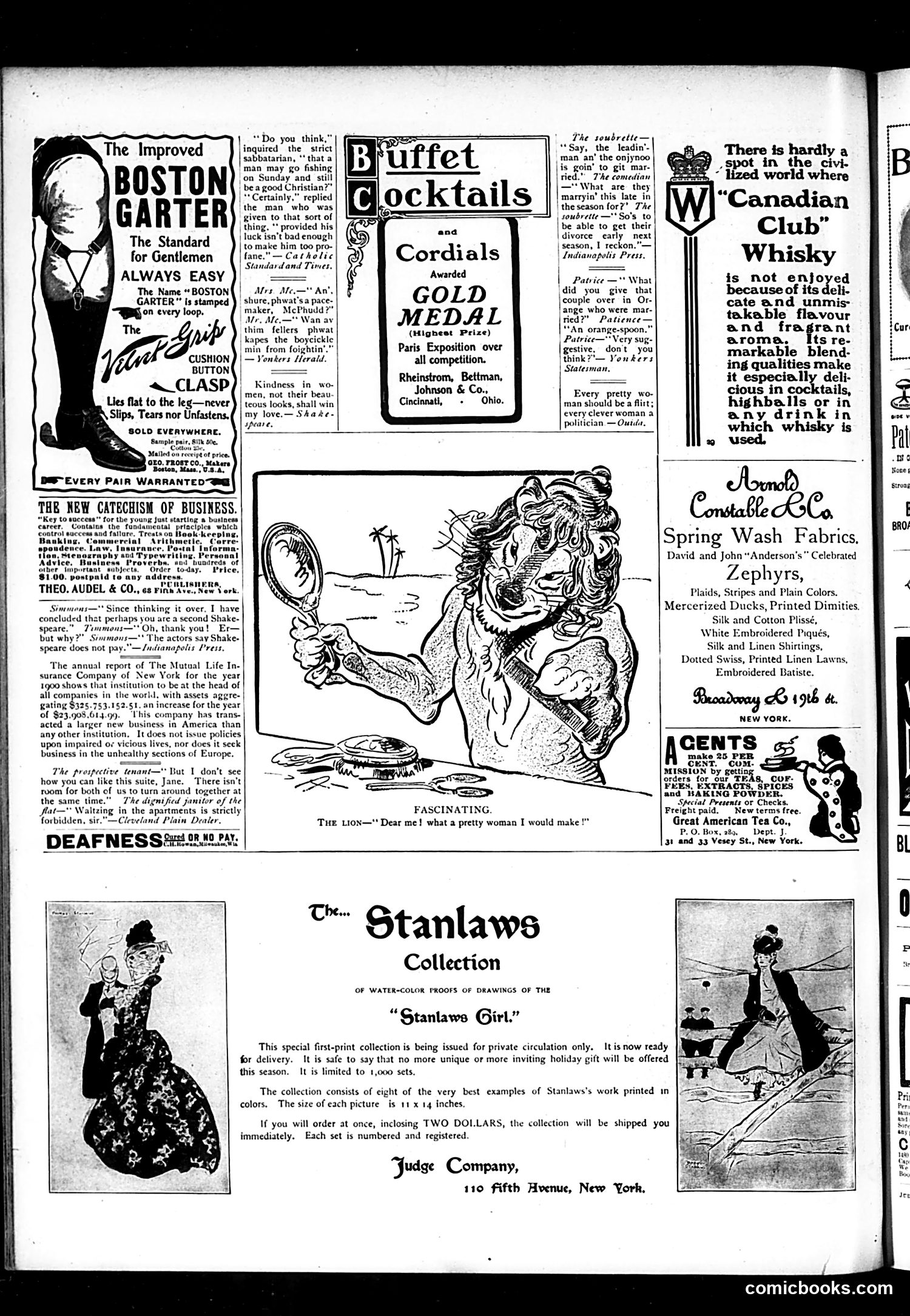
This page is primarily **advertising and announcements**, with minimal editorial cartoon content. The central cartoon titled "FASCINATING" depicts a lion admiring its reflection, captioned "Dear me! what a pretty woman I would make!" This is a simple anthropomorphic joke about vanity—the lion's self-admiration and imagined transformation plays on the conceit that appearance matters greatly. The page is dominated by product advertisements: Boston Garters (suspenders), Buffet Cocktails and Cordials, Canadian Club Whisky, and various fabric retailers. There are also announcements for Stanlaws Girl artwork prints and insurance company reports. The scattered dialogue snippets (about fishing on Sunday, theatrical marriages, bicycle maintenance) appear to be filler humor rather than political satire. They represent typical Judge magazine humor: gentle social observation rather than sharp political commentary. This layout—mixing ads with light domestic humor—was standard for turn-of-the-century American magazines that relied heavily on advertising revenue.
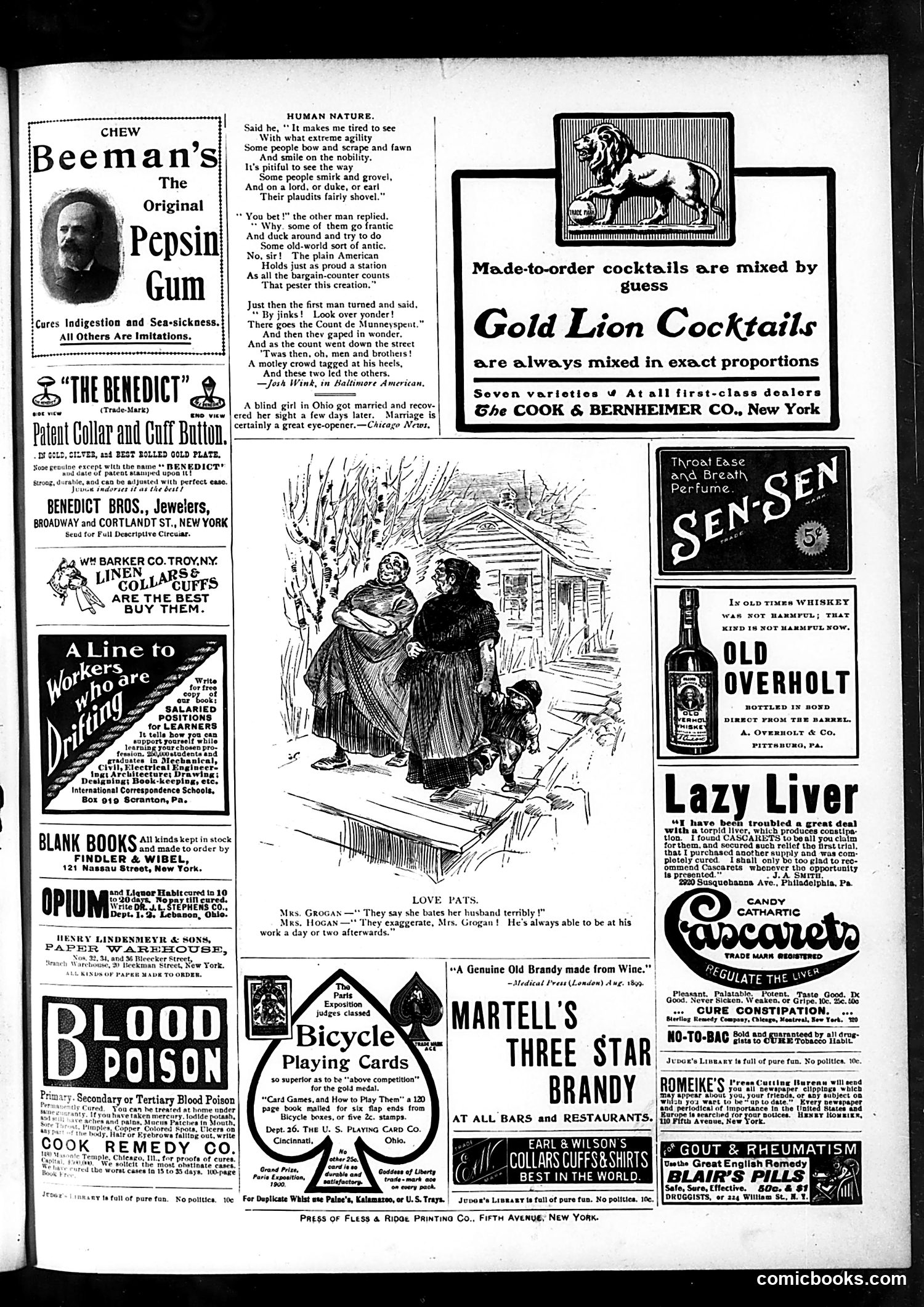
This page is primarily **advertising** with one satirical cartoon titled **"Human Nature"** by Josh Wink. The cartoon satirizes American hypocrisy regarding class. Two men boast about American democracy and reject European class-consciousness—claiming Americans don't bow to nobility like "bargain-counter counts." However, the moment they spot a wealthy aristocrat (the Count de Munneyspent) passing by, they abandon their principles entirely, leading a crowd of admirers chasing after him. The satire's point: despite Americans' proclaimed egalitarian ideals, they're actually just as eager to fawn over wealth and status as Europeans are over titles. The working-class men become the very thing they criticized—proving that snobbery transcends national boundaries and reflects universal human weakness rather than genuine democratic values. The irony is sharp: their self-righteous declarations about American superiority are immediately contradicted by their own behavior.
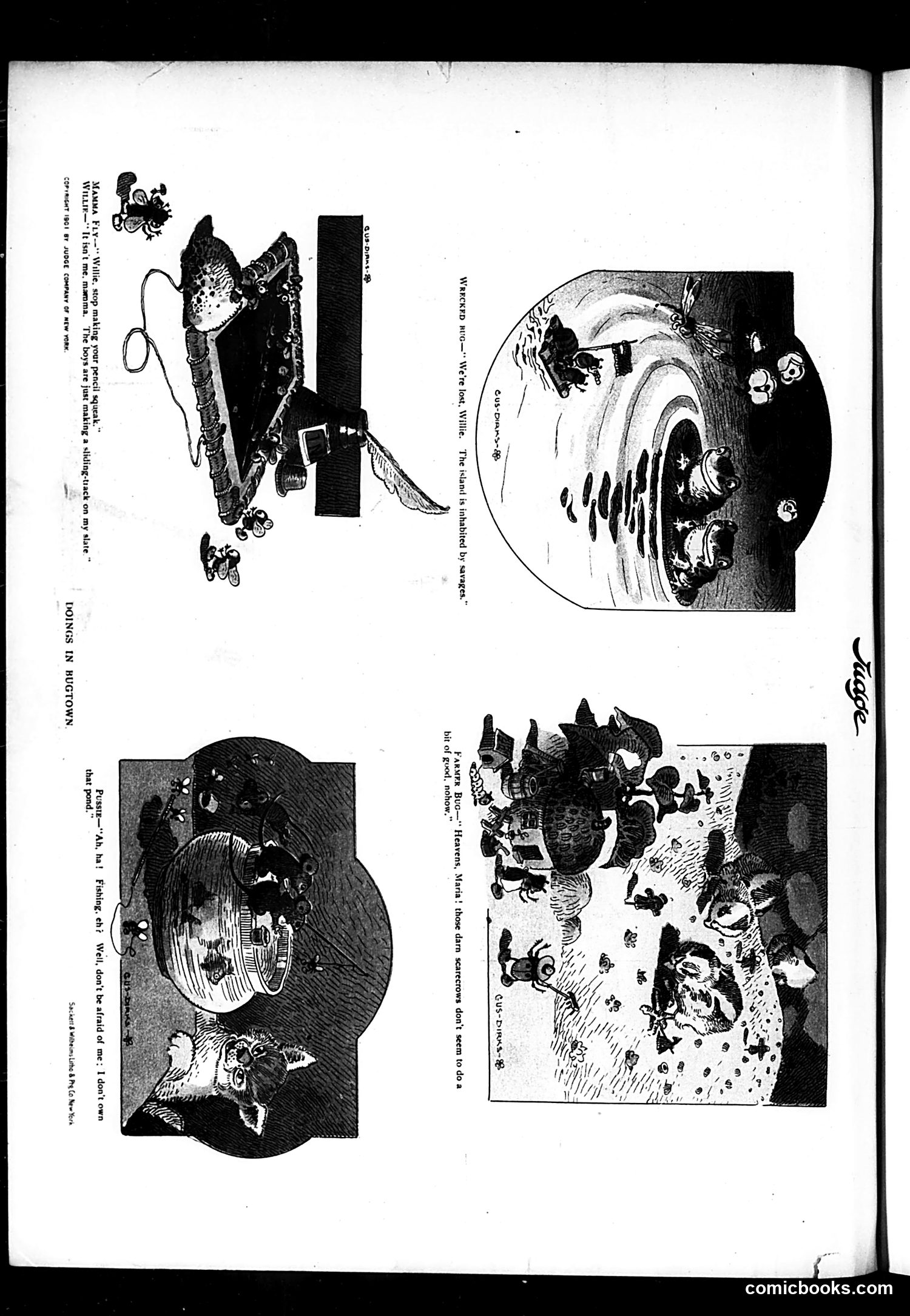
This is an anthropomorphic humor page depicting insects and bugs in human situations, a popular comic format of the era. The cartoons show: **Upper left**: A wrecked bug ship with caricatured passengers encountering "savages" on an island—a parody of colonial adventure narratives. **Upper right**: A farmer bug complaining that scarecrows don't work, inverting the scarecrow's purpose (they're useless against actual bugs). **Lower panels**: Domestic scenes with bug families—a mother scolding her son Willie for making his pencil squeak, and children making a "sliding-track" on slate (a writing surface), anthropomorphizing insect behavior as recognizable human family interactions. The satire mocks both contemporary adventure tales and ordinary domestic life by applying them to bugs, creating absurdist humor through the contrast between human social conventions and insect nature. This format was typical of Judge's lighthearted, visual comedy.