
A complete issue · 16 pages · 1901
Judge — February 2, 1901
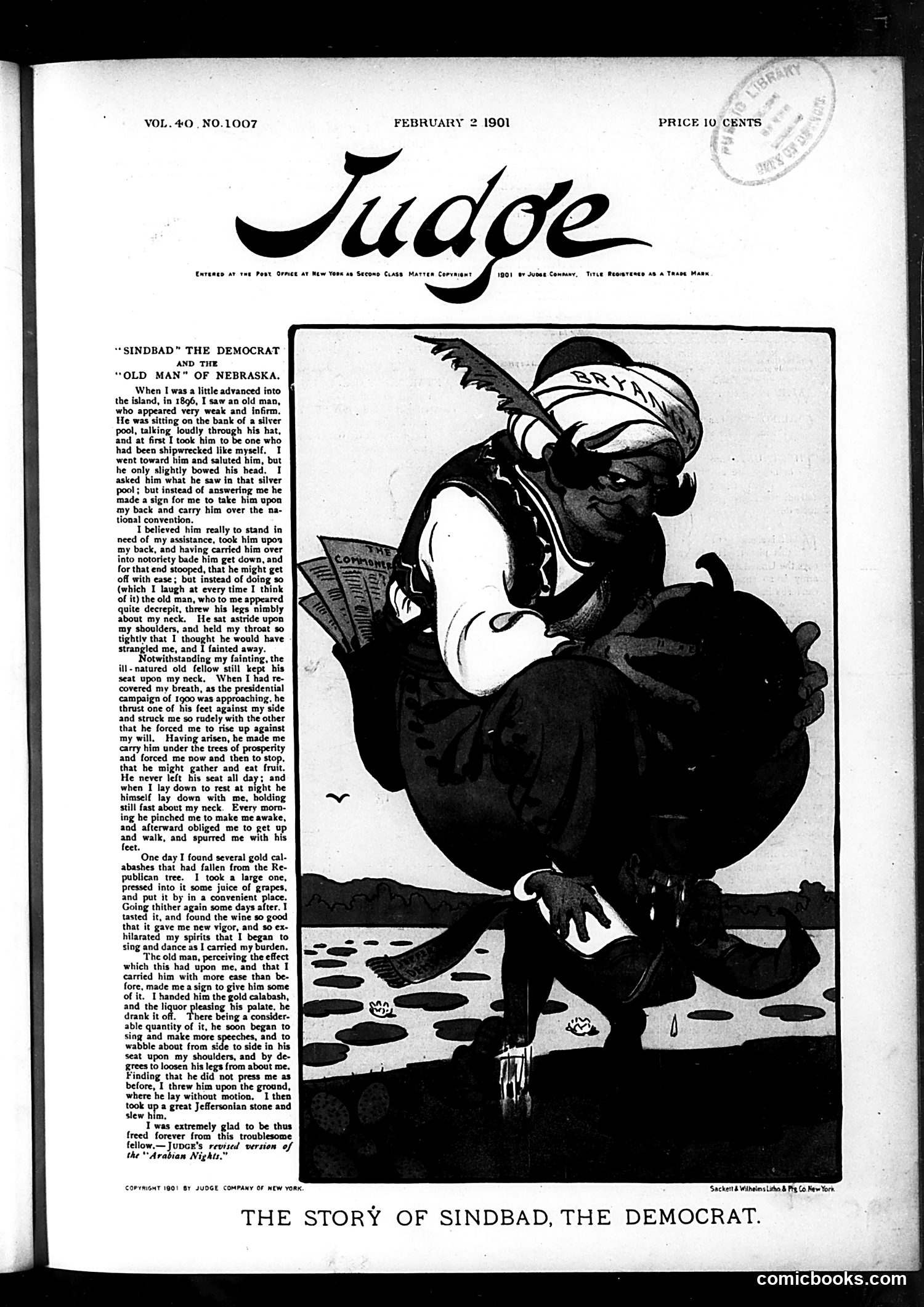
This satirical piece uses the famous Sindbad tale as political allegory. The illustration depicts a figure labeled "Bryan" (likely William Jennings Bryan, three-time Democratic presidential candidate) as the parasitic "Old Man of the Sea" who clings to and drains the Democratic Party. The text recounts how the narrator encountered this troublesome old man in a silver pool, who repeatedly demands to be carried and exploited the narrator's goodwill—a metaphor for Bryan's continued demands on the Democratic Party despite electoral defeats. The satire suggests Bryan was an albatross around the party's neck, exhausting resources and preventing progress. This reflects post-1900 frustration among some Republicans and moderate Democrats with Bryan's continued political prominence following his 1900 election loss.
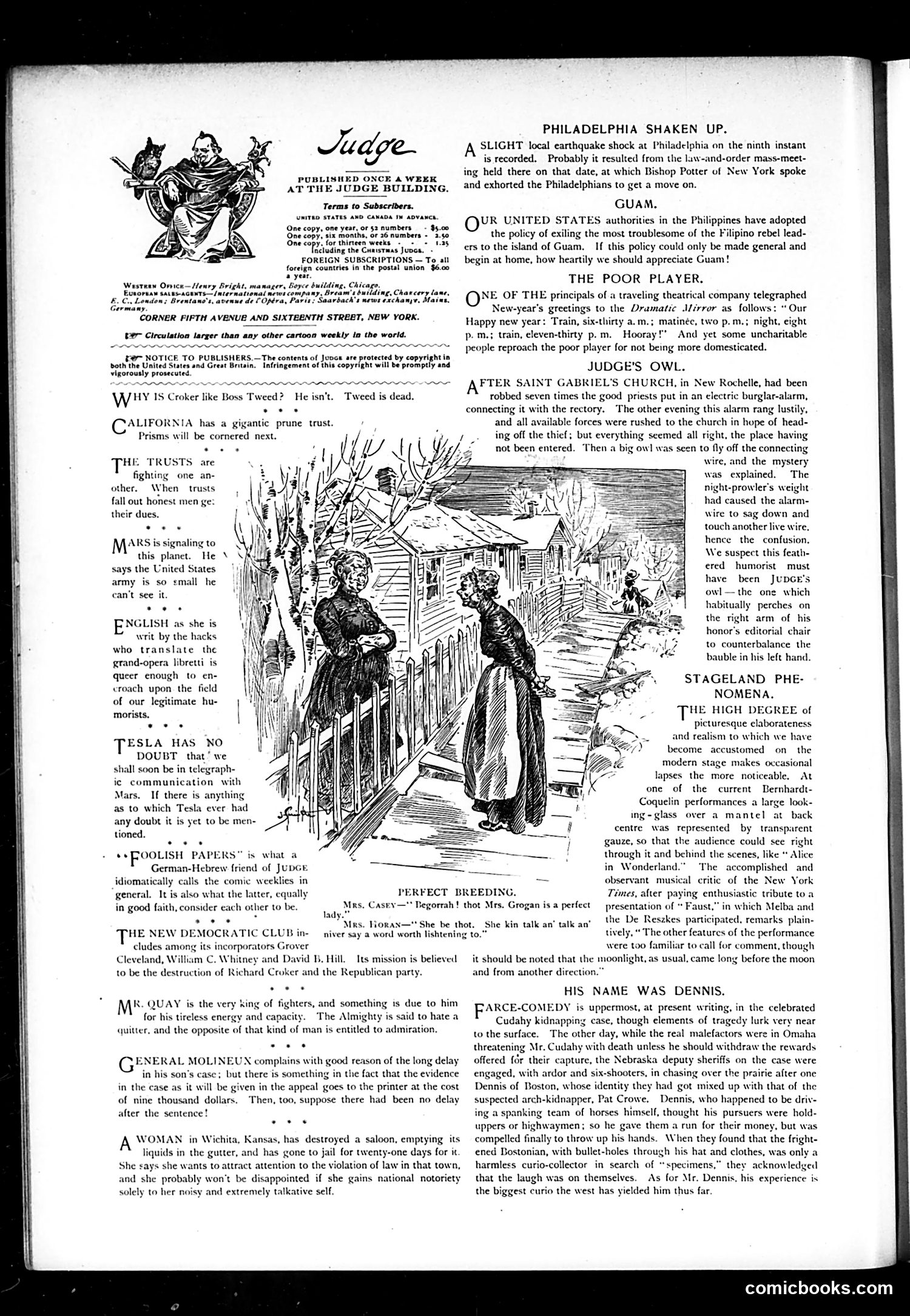
This cartoon illustrates a brief dialogue between two women about Mrs. Grogan's "perfect breeding." The humor relies on a pun: one woman interprets "perfect breeding" as refined manners and social status, while the other reveals Mrs. Grogan actually means it literally—she has many children ("She kin talk an' talk an' work an' listen to"). The joke satirizes class pretensions and the gap between upper-class aspirations and working-class realities. It mocks how women of modest means might claim gentility through endless talking and labor, while actually being defined by their fertility and domestic drudgery. The cartoon exposes the absurdity of applying aristocratic standards to ordinary people struggling with large families.
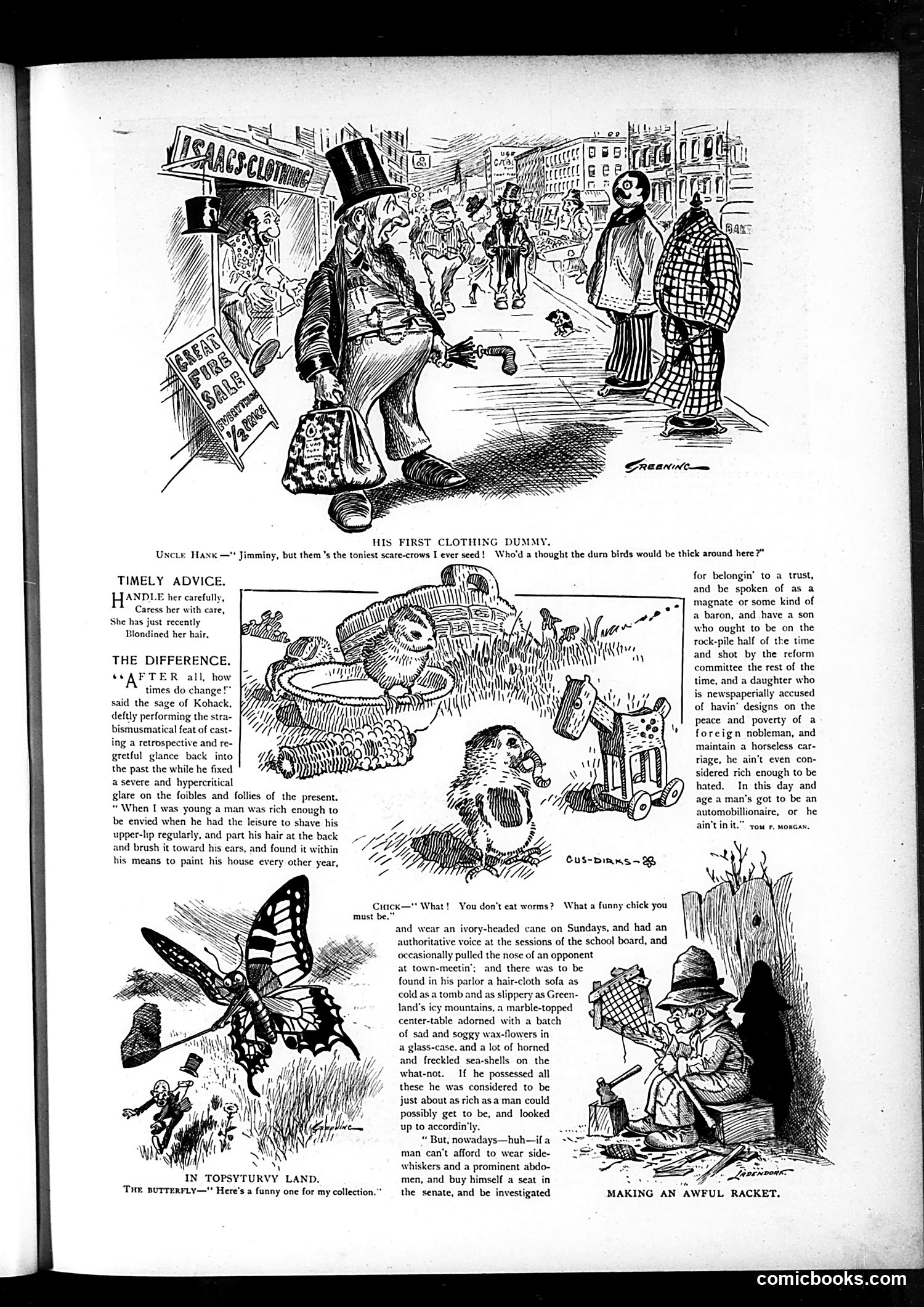
**Top Cartoon - "His First Clothing Dummy":** Uncle Hank, a rural character in top hat, displays a scarecrow on a city street. The joke plays on class and cultural differences: the scarecrow appears as refined as the city people around it, suggesting urban sophistication is equivalent to being an empty dummy. This satirizes urban pretension and fashion consciousness. **Middle and Lower Cartoons:** These appear to be separate humorous vignettes rather than political commentary. "Timely Advice" discusses marital care; "The Difference" reflects on past versus present manners; "In Topsyturvy Land" features nature illustrations; "Making an Awful Racket" depicts social behavior. The page emphasizes satirizing class distinctions and urban versus rural American attitudes—typical Judge magazine fare.
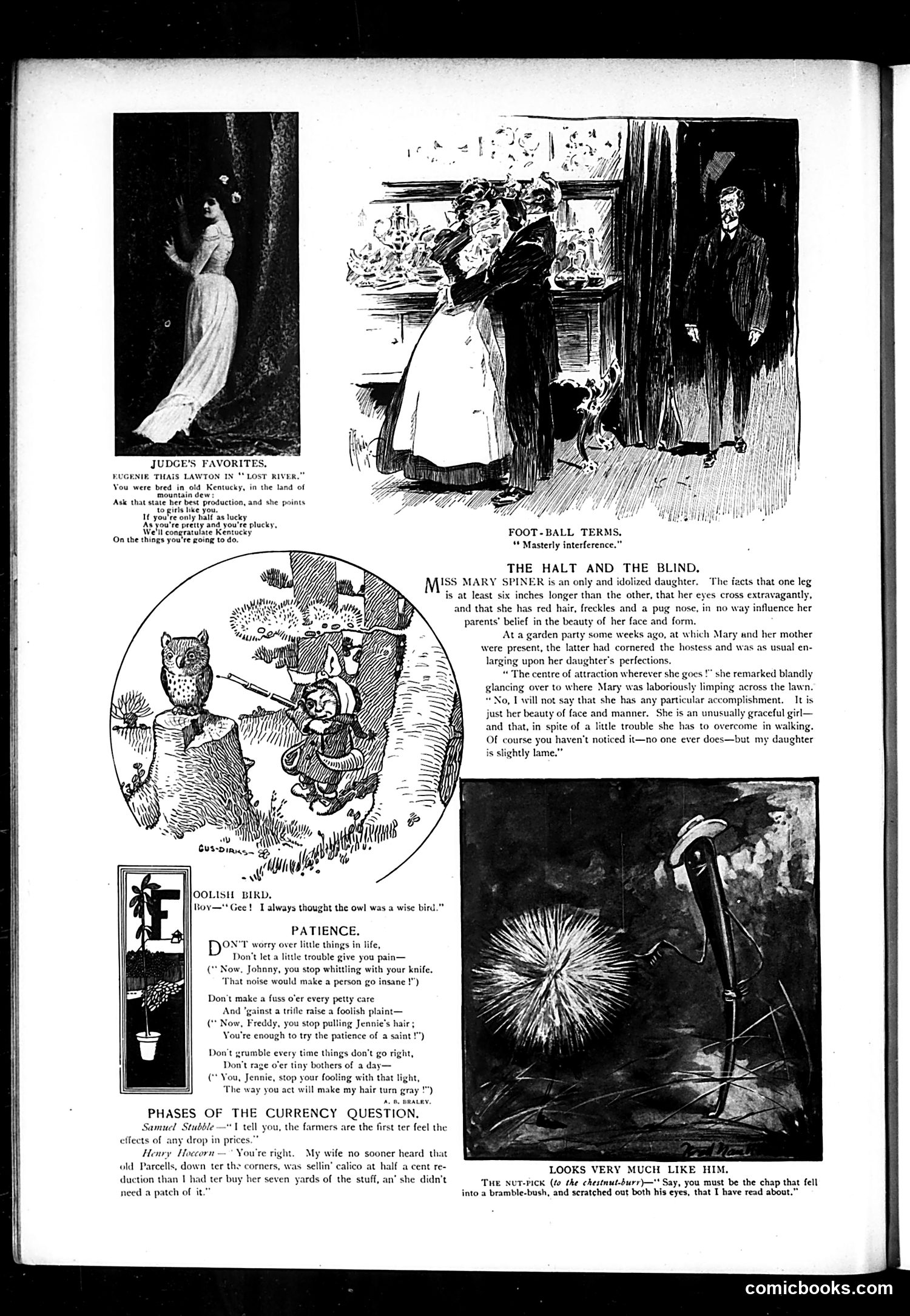
This page contains several satirical items rather than a unified political cartoon: **"Judge's Favorites"** references Eugenie Thais Lawton in "Lost River"—likely theatrical satire. **"Foot-Ball Terms"** depicts a domestic scene captioned "Masterly Interference," satirizing football terminology applied to marriage/household situations. **"The Halt and the Blind"** discusses Miss Mary Spinner, described as having one leg significantly longer than the other and crossed eyes. The satire critiques society's superficial judgments and parents who overlook their daughter's actual character flaws while fixating on physical appearance. **"Foolish Bird"** and **"Patience"** are humorous verse pieces about everyday life irritations. **"Phases of the Currency Question"** presents a dialogue between rural figures (Samuel Stubble and Henry Hayseed) discussing agricultural economics and crop prices—reflecting late-19th-century rural concerns about currency and farm prices.
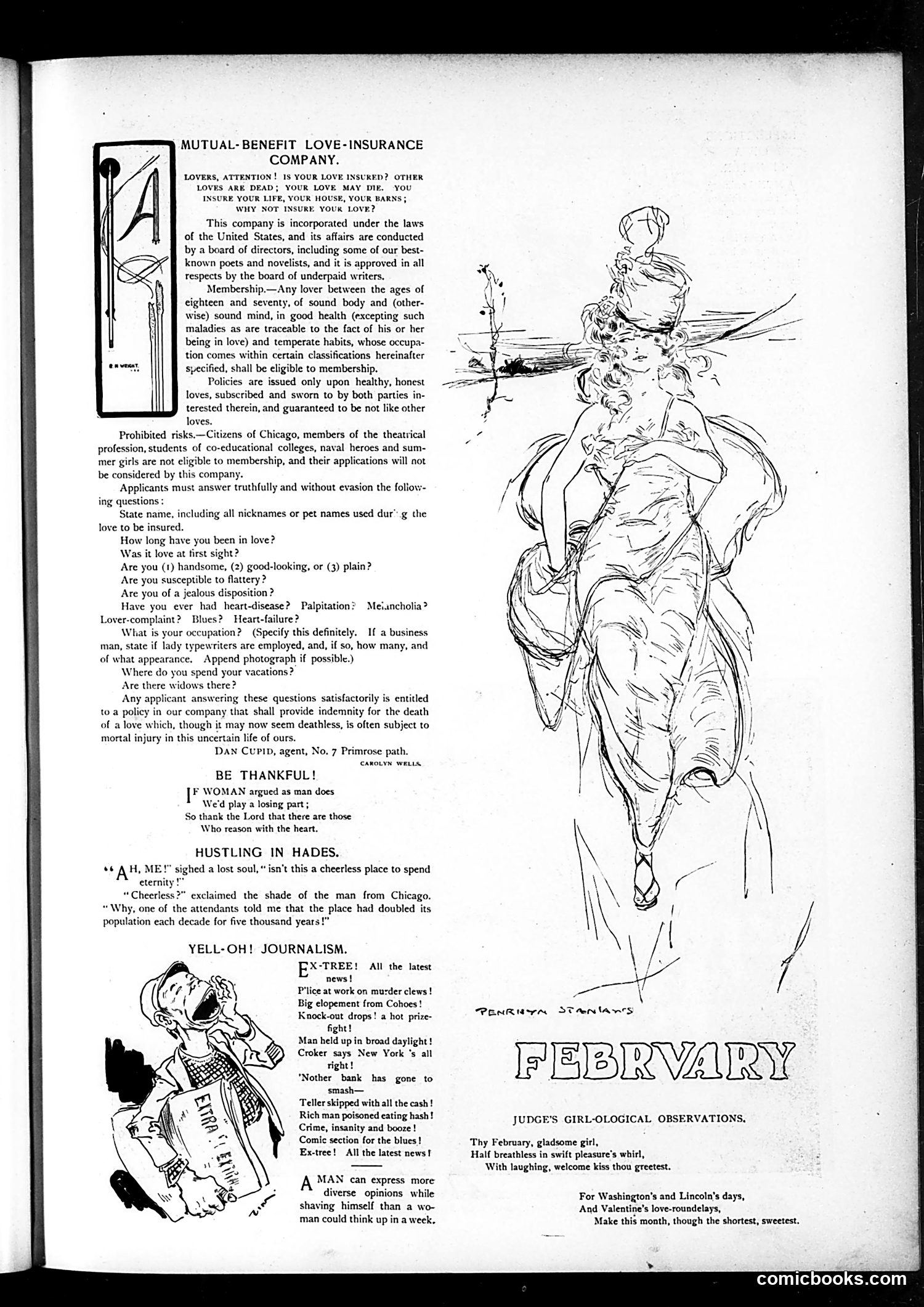
This page contains three separate satirical pieces: **"Mutual-Benefit Love-Insurance Company"** mocks the commercialization of romance by proposing an absurd insurance policy for love. The joke lists ridiculous exclusions (Chicago citizens, theater people, college students, "summer girls") and invasive questions about appearance, jealousy, and heart conditions—treating love like a health risk to be underwritten. It satirizes how American society commodifies even intimate emotions. **"Hustling in Hades"** jokes that Hell's population doubled every decade for 5,000 years—a dark comment on Chicago's rapid growth and moral corruption, with the implication that Chicago is hellish. **"Yell-Oh! Journalism"** caricatures sensationalist newspaper hawkers screaming lurid headlines (murders, elopements, poisonings, bank robberies)—criticizing how yellow journalism exploits crime and scandal for sales. The accompanying illustrations are satirical cartoons supporting these themes of commercial excess and journalistic irresponsibility.
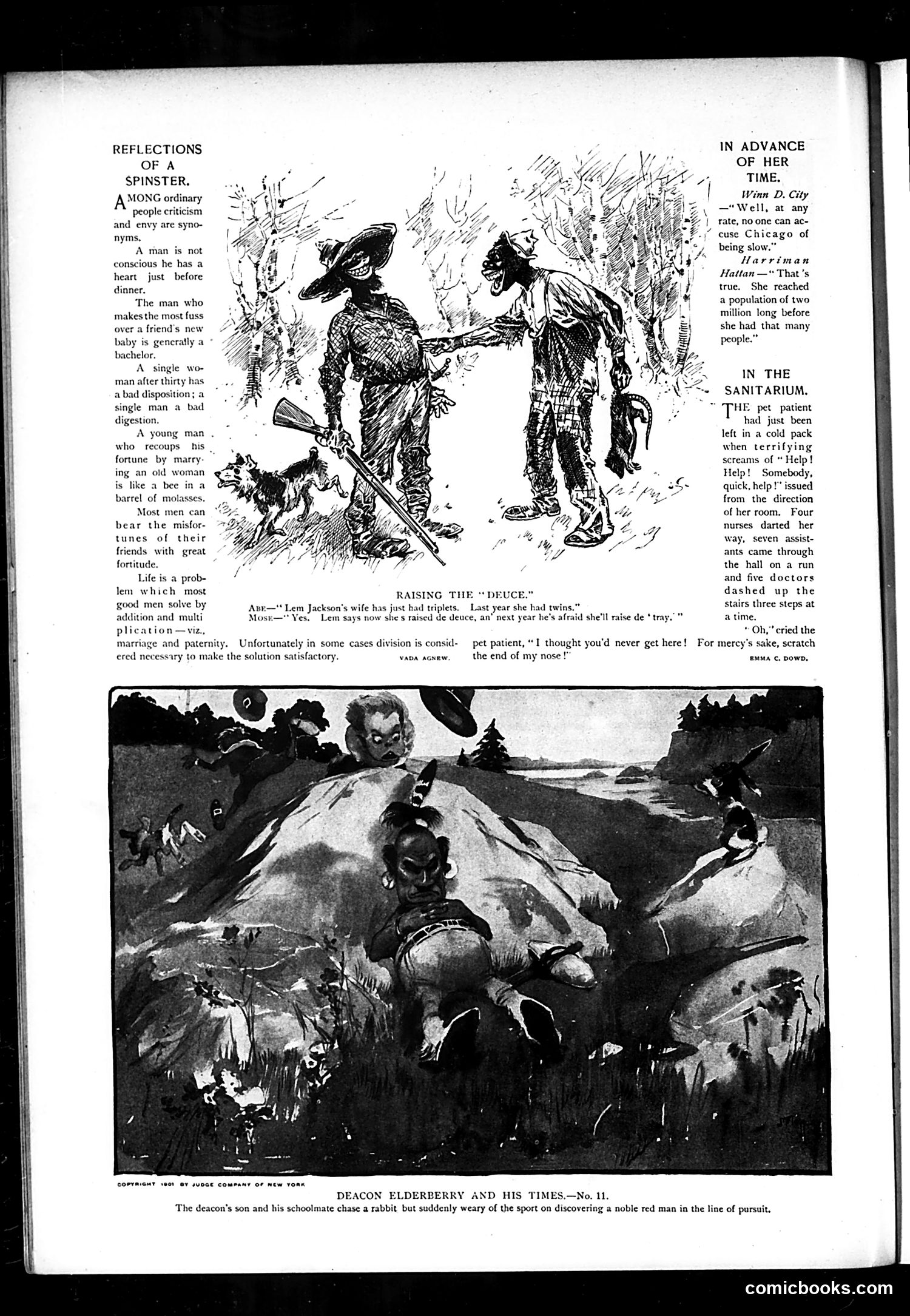
This page contains three separate satirical pieces typical of early 20th-century American humor: **"Reflections of a Spinster"** offers cynical observations about unmarried women and men, suggesting spinsters develop bad dispositions while bachelors develop digestive problems—reflecting period attitudes toward single life. **"Raising the Deuce"** jokes about a man named Lem Jackson whose wife has had triplets, punning on dice terminology ("deuce," "tray") to suggest he'll produce even more children—mocking rapid family growth. **"In the Sanitarium"** contrasts Chicago's rapid population growth with its slower cultural development, implying the city expanded faster than it matured as a civilization. **"Deacon Elderberry"** depicts children abandoning rabbit-hunting upon encountering a Native American, suggesting either respect or fear—the satirical point remains unclear from context alone. The humor throughout relies on period prejudices about gender, family size, regional development, and race relations.
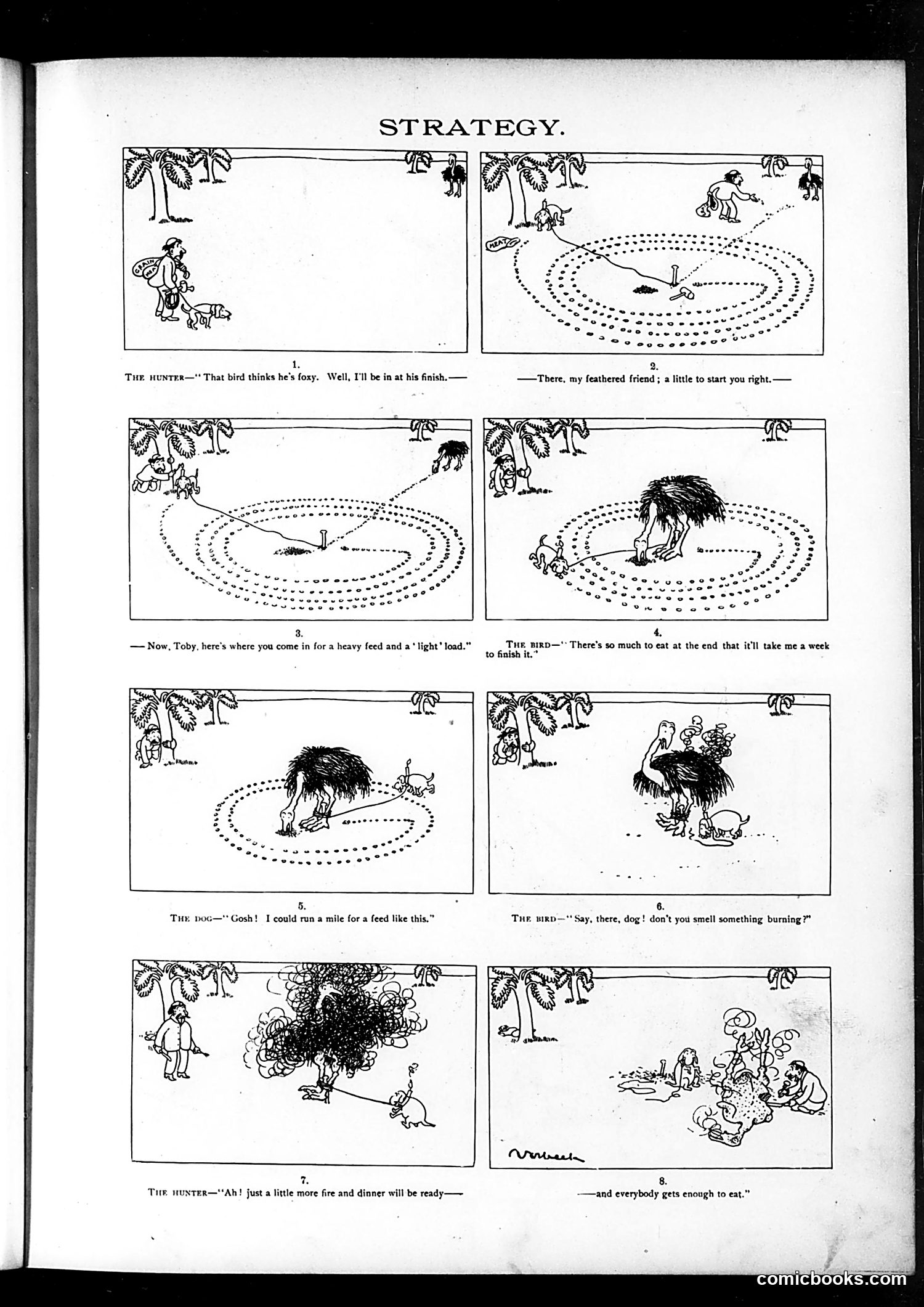
This is a six-panel comic strip titled "Strategy" depicting a hunting scenario. A hunter uses a dog and a bird to corner an ostrich in a spiral pattern (panels 1-4). The dog complains about the feed being insufficient (panel 5), while the bird warns the dog of danger (panel 6). In the final panels, the hunter builds a fire, apparently intending to cook the ostrich for dinner with enough for all participants. The satire appears to be about cooperation and exploitation: various parties (hunter, dog, bird) work together toward a common goal, but only the hunter benefits from the actual meal, while the others receive minimal compensation for their labor. It's a commentary on unequal reward distribution in collaborative efforts.
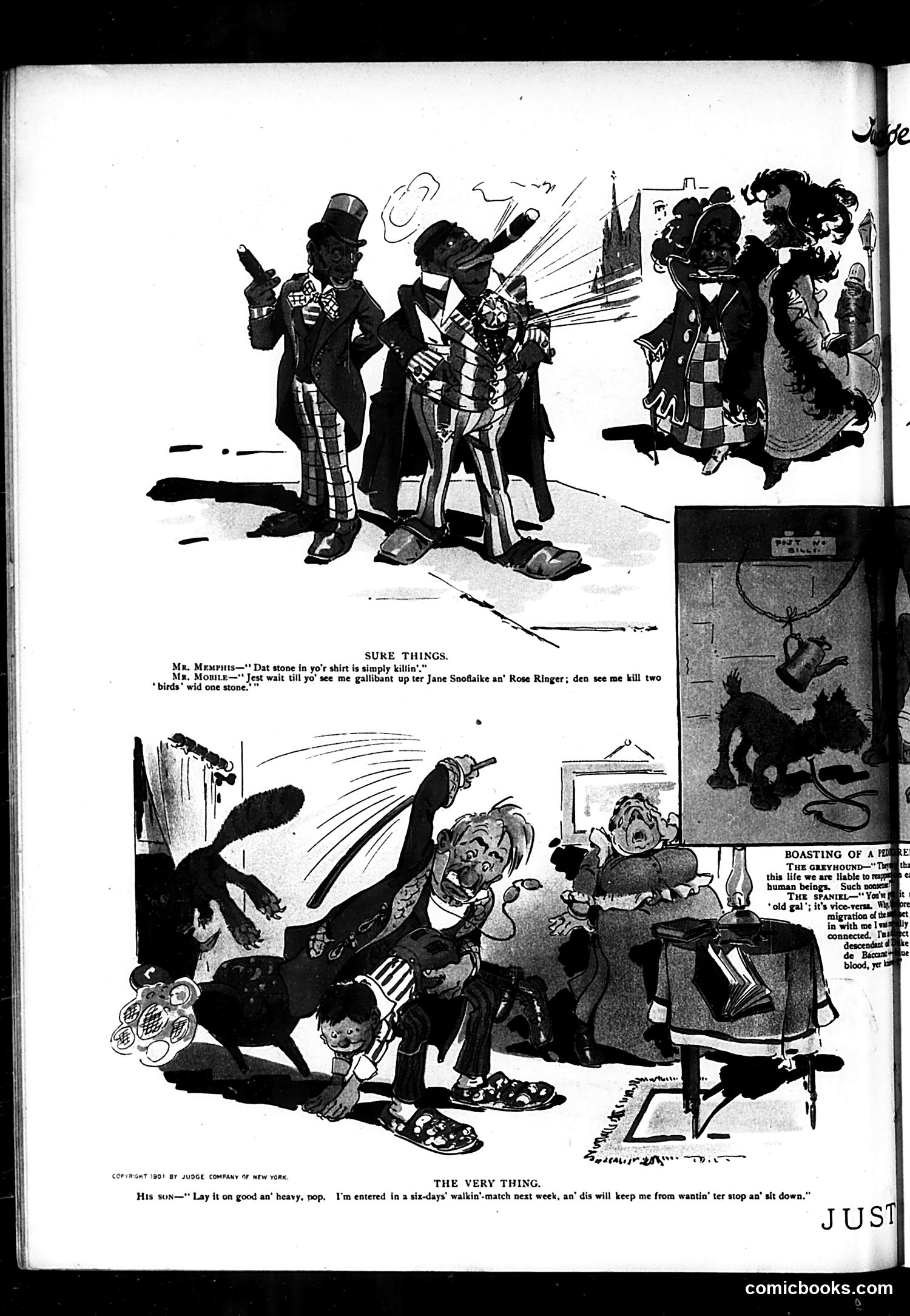
This page contains two separate satirical cartoons mocking lower-class characters through exaggerated dialect and physical comedy. **"Sure Things"** depicts two men in formal wear speaking in stereotypical African American vernacular, boasting about impressing women (Jane Snofflake and Rose Ringer) with a stone in their shirt—likely meaning a diamond or valuable object. **"The Very Thing"** shows a man entering a six-day walking match (a popular endurance competition of that era), with his socks advising him to "lay it on good and heavy" so he won't want to sit down and quit. Both cartoons rely on period stereotypes: exaggerated speech patterns, physical comedy, and working-class desperation. The humor targets lower-class ambition and bodily discomfort. The 1901 copyright confirms this reflects turn-of-century American attitudes toward class and race through Judge's satirical lens.
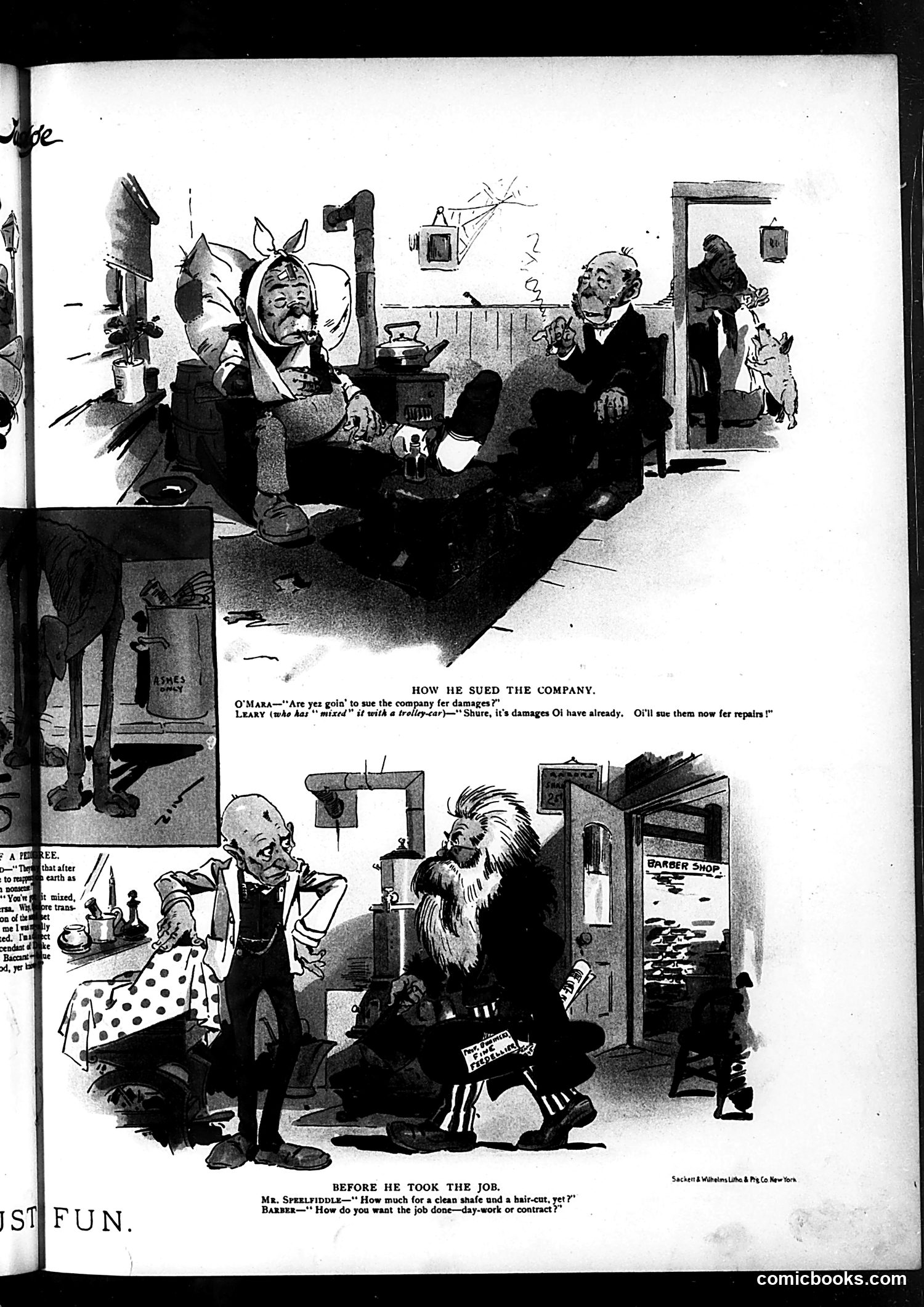
This two-panel Irish-immigrant satire lampoons a working-class man injured by a trolley car. In the upper panel, "Leary" has already suffered physical damages from being hit by the vehicle but cynically plans to sue the company not for his injuries—but for repair costs, suggesting he's badly broken and needs fixing like damaged property. The lower panel (titled "Before He Took the Job") shows a barber shop scene where a prospective employee negotiates wages with his boss, asking whether payment will be by daily wages or contract work—a common labor dispute of the era. The joke connects both panels: the working man is so accustomed to exploitation and meager compensation that he treats his own mangled body as merely another negotiation point, viewing himself as damaged goods requiring repair rather than a person deserving proper compensation for injury.
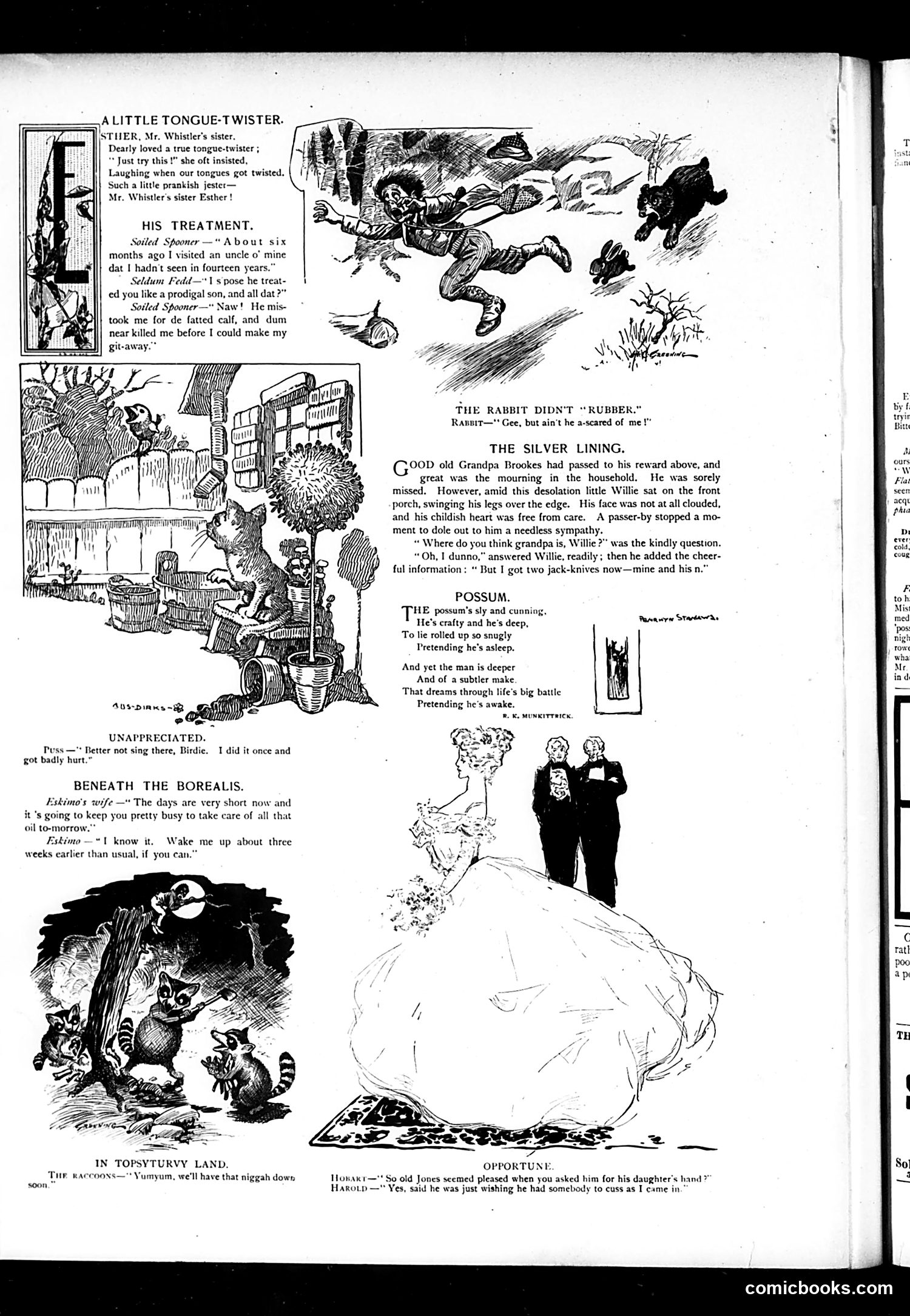
This page from the satirical magazine *Judge* contains multiple short humorous pieces typical of late 19th/early 20th-century American comedy: **"A Little Tongue-Twister"** references Mr. Whistler's sister Esther, likely alluding to James McNeill Whistler, the famous American painter known for sharp wit. **The remaining pieces are mostly generic comedic vignettes**: a joke about mistaken identity ("fatted calf"), puns on animal behavior, and observations on human nature. **Notable**: The page contains period language reflecting attitudes of the era—"In Topsyturvy Land" includes a racial slur, representing the casual racism endemic to publications of this period. **"The Silver Lining"** offers dark humor: a child profits materially from his grandfather's death (acquiring two jack-knives), satirizing childhood opportunism and materialism. Most content relies on simple wordplay and situational comedy rather than sharp political satire. The page demonstrates *Judge*'s mixed approach: some pieces targeted public figures, while others provided light domestic humor for general audiences.
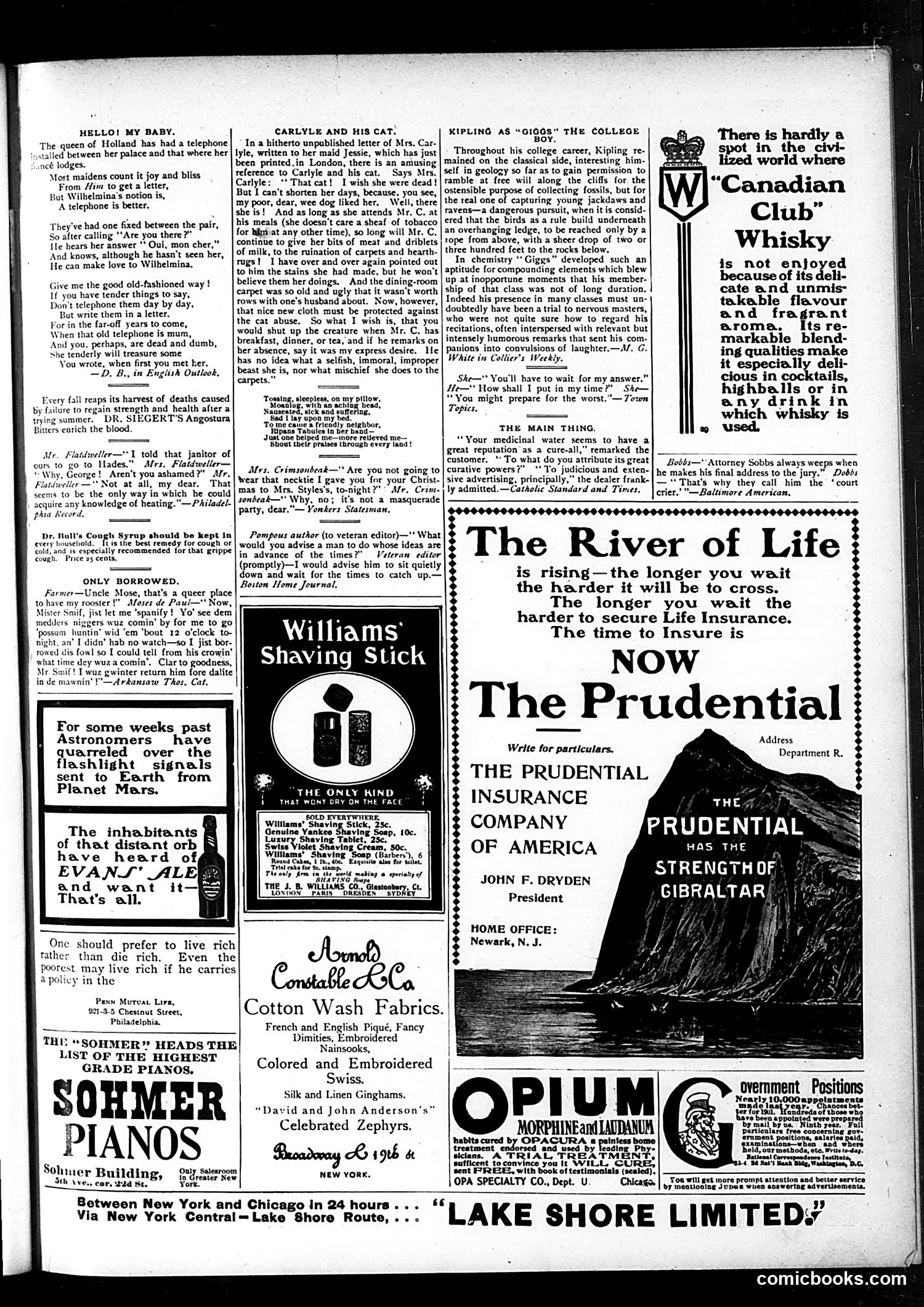
This page is primarily **advertising** with some light satirical content. The main pieces of social commentary are: **"Hello! My Baby"** — A gentle satire on Queen Wilhelmina of Holland's installation of a telephone between her palace and her lover's residence. The poem mocks modern technology replacing traditional romance, arguing that written letters are superior to telephone calls because they create lasting mementos. This reflects early-1900s anxieties about how new technology was changing courtship and intimacy. **"Carlyle and His Cat"** — A humorous anecdote from Mrs. Carlyle's unpublished letters, depicting the domestic friction between spouses over a pet's destructive behavior. The joke is Mrs. Carlyle's exasperation that her husband indulges the cat despite the damage it causes. **"Kipling as 'Giggs' the College Boy"** — References Rudyard Kipling's college years, suggesting he posed as a conventional student while secretly pursuing his own interests (collecting birds rather than fossils). The remaining content consists of advertisements for pianos, shaving products, insurance, and other goods typical of the era.
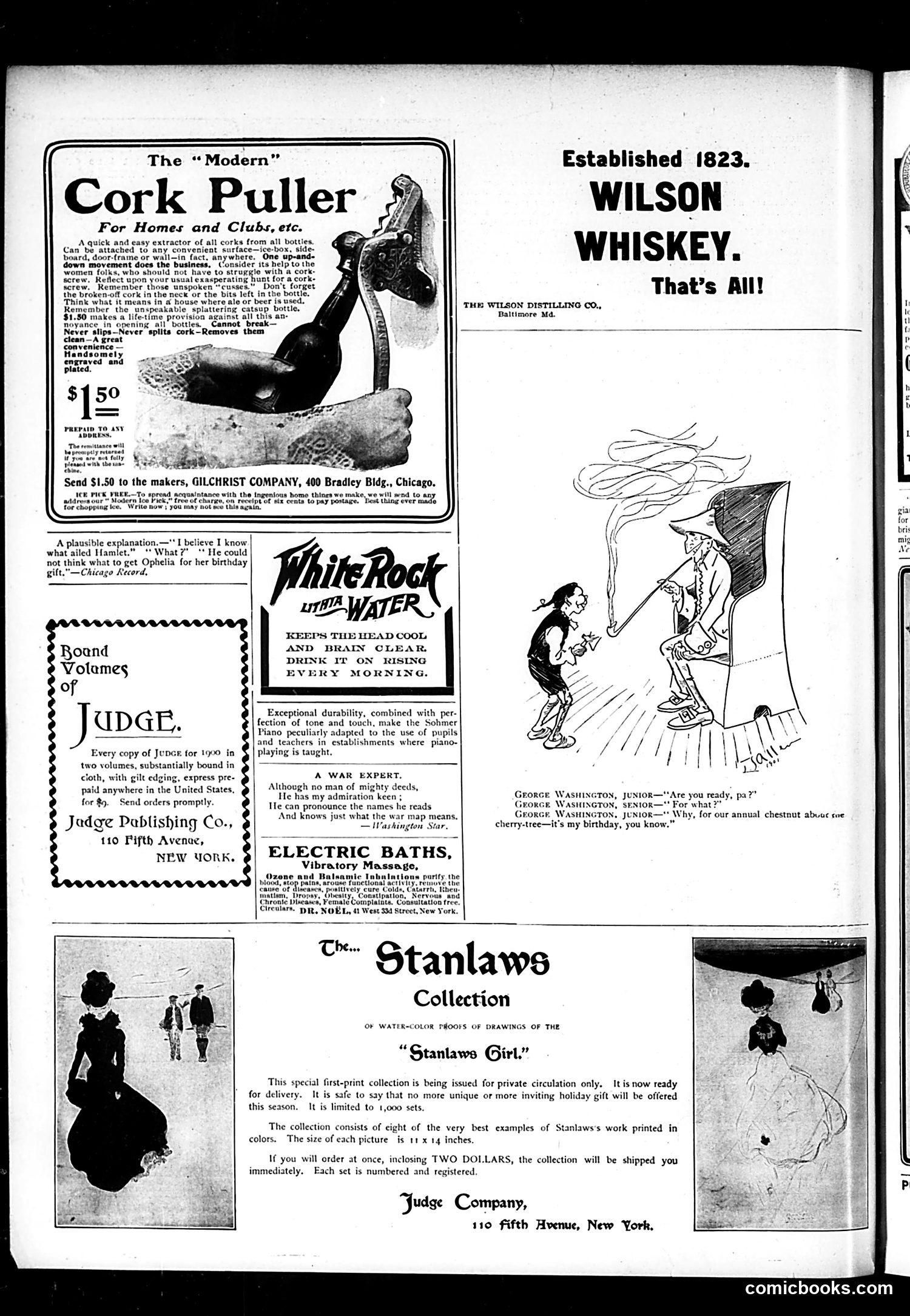
This page from Judge (circa 1900) is primarily **advertising and product promotion** rather than political satire. Key content includes: **Main Advertisements:** - A "Modern Cork Puller" ($1.50) marketed as labor-saving technology for home use - Wilson Whiskey establishment ad - White Rock Lithia Water promoting health benefits - Sohmer Piano advertisement - Electric Baths offering "vibratory massage" **Small Cartoon Elements:** A brief joke about *Hamlet* and Ophelia appears—a writer claims Hamlet's madness stemmed from inability to choose a birthday gift for Ophelia, playing on the literary classic. Another small cartoon shows young George Washington Jr. asking his father if he's ready, with a joke about the family's annual chestnut tree celebration. **Notable Content:** The "Stanlaws Collection" advertises water-color reproductions of drawings of the "Stanlaws Girl"—likely referewing popular illustrator Penrhyn Stanlaws's recognizable female figure type. The page reflects early 1900s consumer culture and advertising aesthetics rather than political commentary.
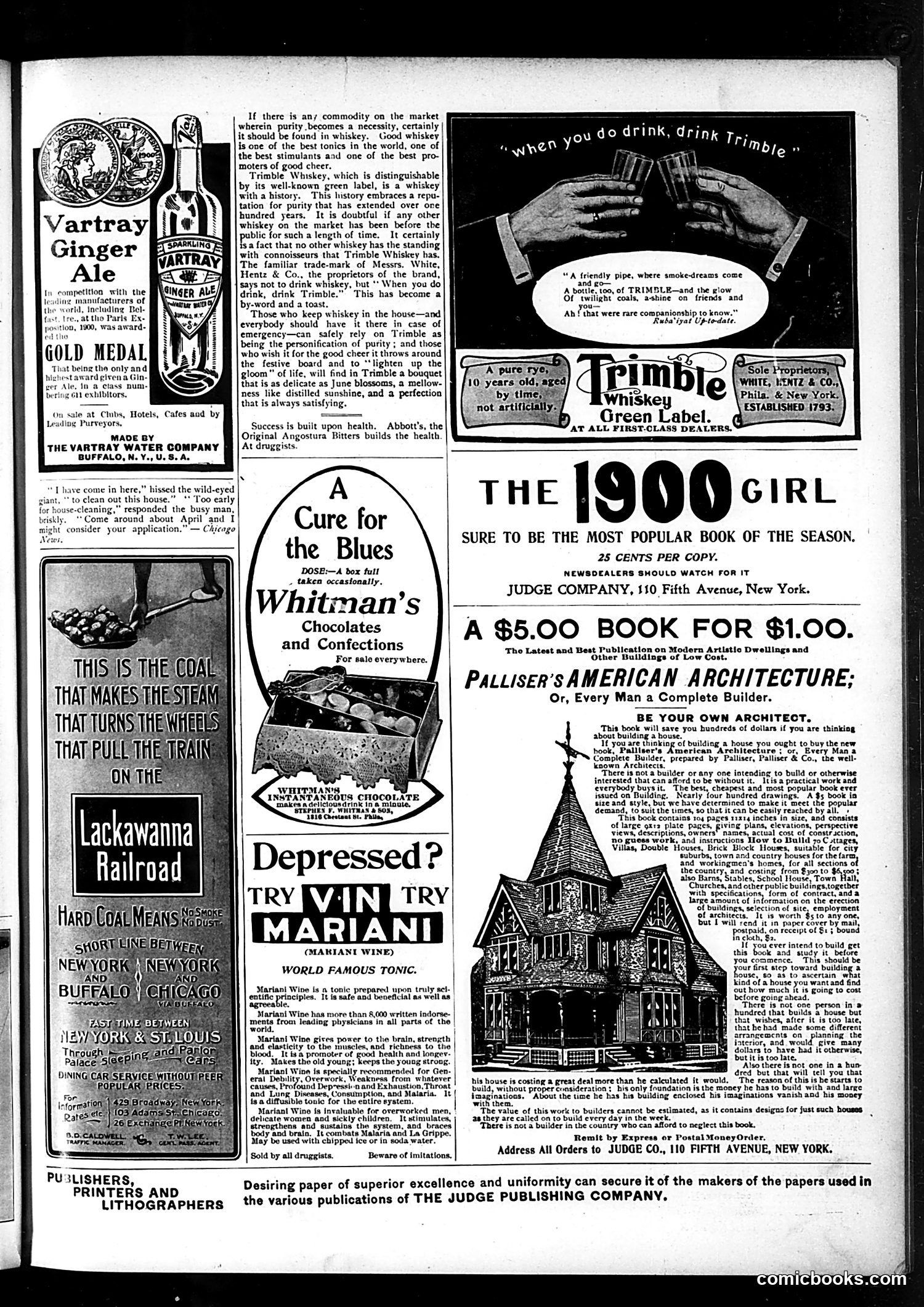
This is primarily an **advertising page** rather than a satirical cartoon section. The content consists of period product advertisements typical of early 1900s magazines. The ads promote various **tonics and medicinal products**: Vartray Ginger Ale (won a gold medal at the 1900 Paris Exposition), Trimble Whiskey (marketed as a health tonic with 100+ years of purity reputation), Whitman's Chocolates, Vin Mariani wine (advertised as treatment for depression, exhaustion, and malaria), and Abbott's Angostura Bitters. A small **joke** appears showing a man claiming to "clean out" a house for spring cleaning, being told to return in April—a mild commentary on domestic labor timing. The only significant content is a large advertisement for *The 1900 Girl* book ($5 reduced to $1) and Palliser's *American Architecture* guide for builders—positioned as practical resources for modern homeowners and builders of the era.
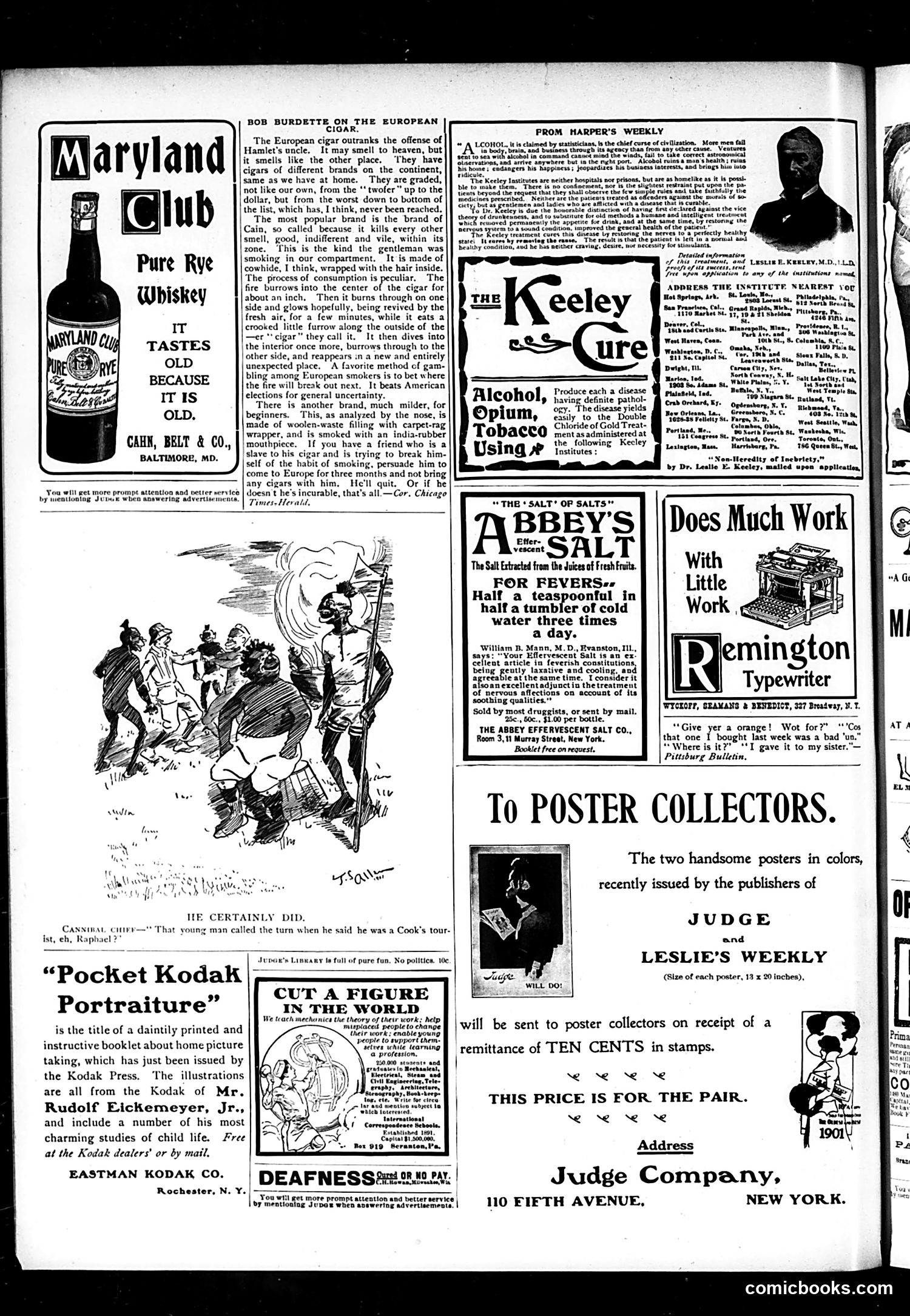
This page is primarily **advertising**, not political satire. The main content consists of product advertisements from the early 1900s, including: **Notable ads:** - Maryland Club Pure Rye Whiskey - The Keeley Cure (alcohol/opium addiction treatment) - Abbey's Salt (medicinal product for fevers) - Remington Typewriter - Pocket Kodak Portraiture booklet - Judge and Leslie's Weekly poster offer **The only cartoon** ("He Certainly Did") depicts a cannibal chief and a cook's tour guide—a generic ethnic joke typical of the era, with no specific political reference. **Context for modern readers:** This reflects how Judge monetized itself through patent medicine and consumer goods advertising. The Keeley Cure was genuinely marketed as addiction treatment; Abbey's Salt was homeopathic medicine. These ads reveal period attitudes toward health and consumption that seem dubious today. The page demonstrates Judge's dual nature: satirical magazine *and* commercial vehicle.
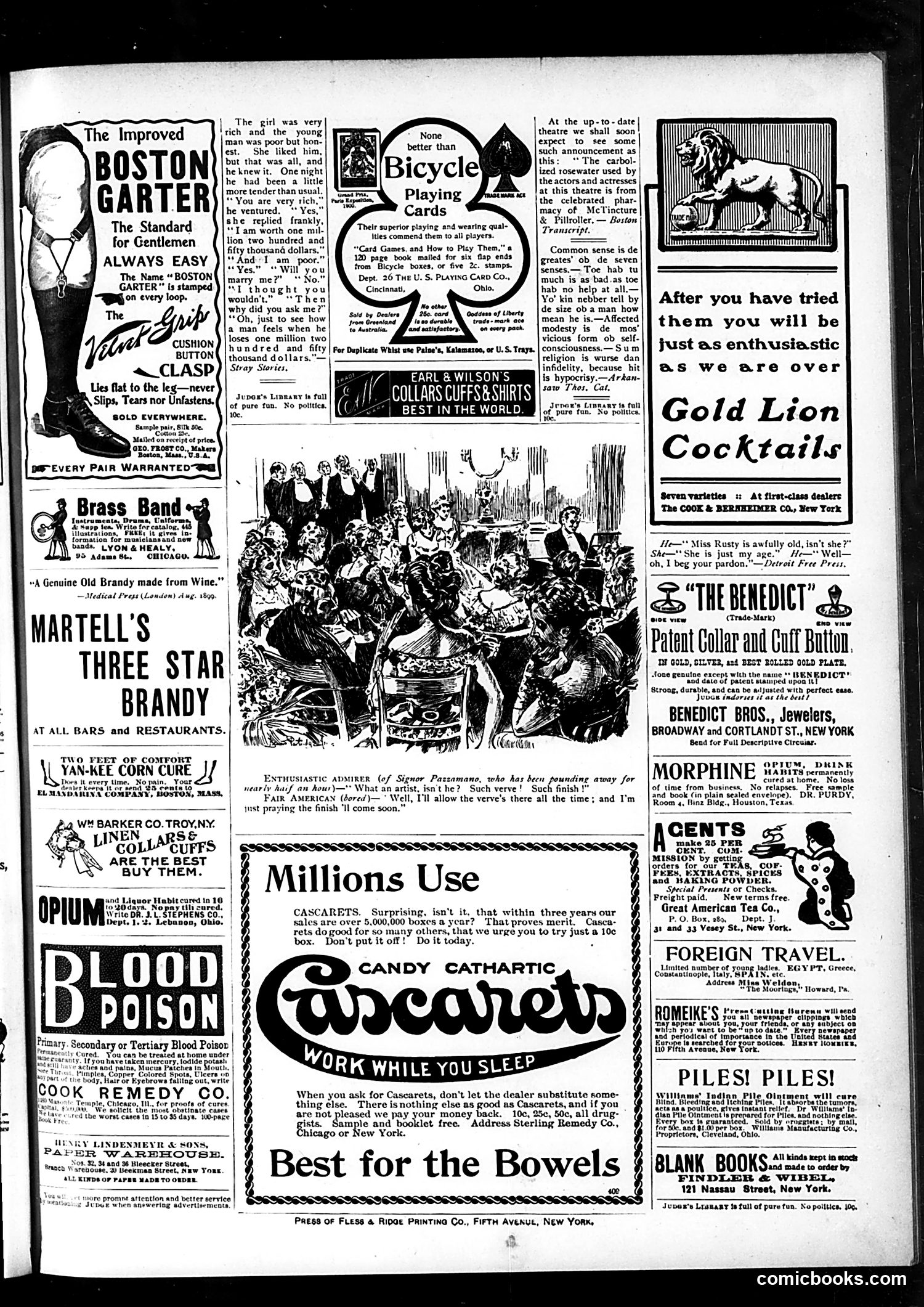
This is primarily an **advertising page** from Judge magazine, not a satirical article. The cartoons are minor—mostly supporting product ads rather than making political commentary. The main cartoon features a conversation about a wealthy woman rejecting a poor suitor, joking that he just lost "one million two hundred and fifty thousand dollars" of imaginary wealth through marriage refusal. This reflects **Gilded Age class tensions**—a common theme in early 1900s satire about marriages between poor-but-honest men and wealthy women. The page is dominated by ads for products typical of the era: Boston garters, brandy, playing cards, collars/cuffs, and notably medicinal products like "Cascarets" laxatives and cures for venereal disease (then openly advertised). The small repeated phrase "Jujor's Library is full of pure fun. No politics" appears to be Judge magazine's standard promotional line. Historically, this reflects how early mass-market magazines relied on patent medicines and dubious health products for revenue, before modern FDA regulations.
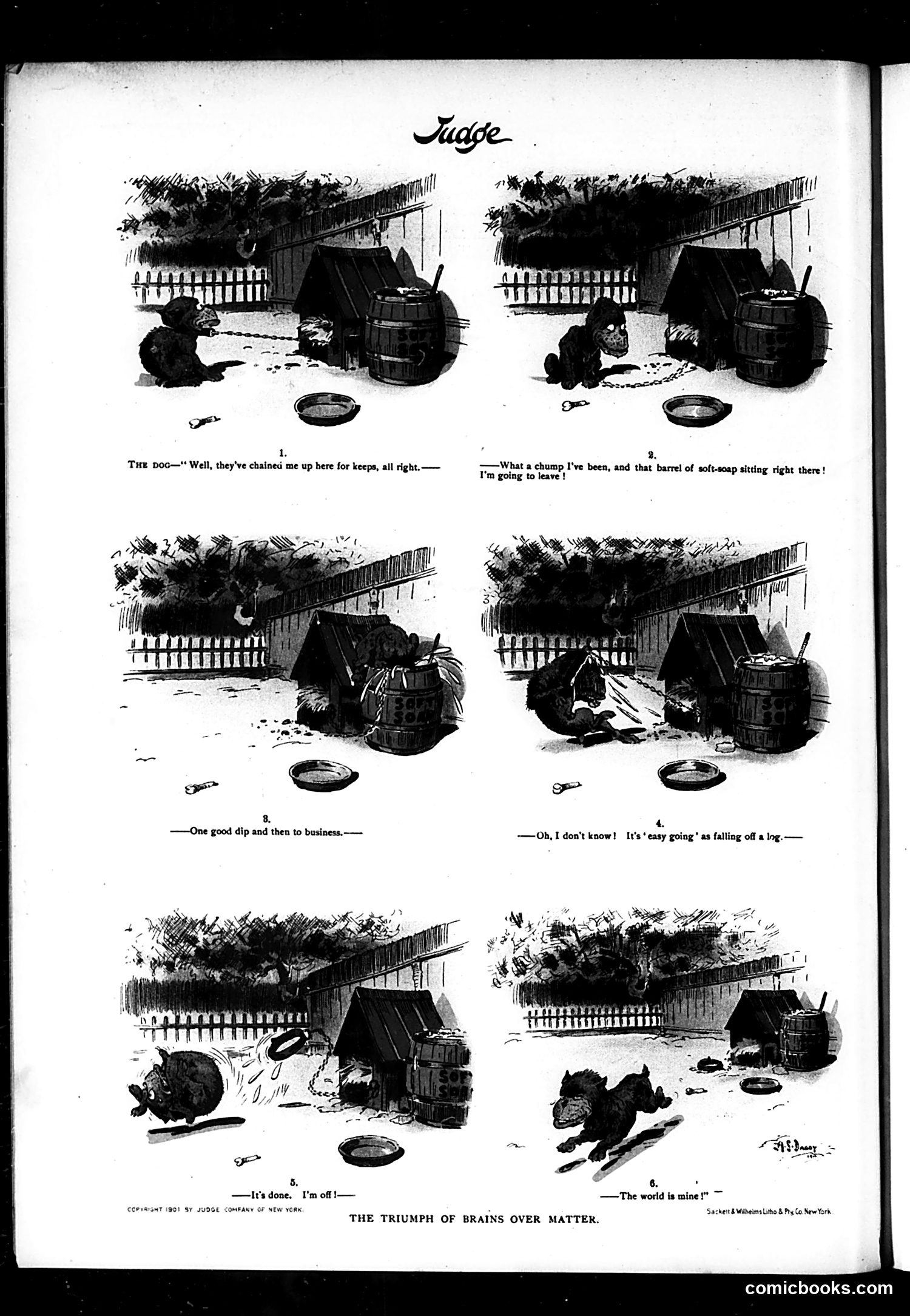
This six-panel comic strip shows a dog chained up near a barrel of soft soap and a doghouse. The dog initially resigns itself to captivity ("they've chained me up here for keeps"), but then realizes the soap barrel nearby offers escape. Over successive panels, the dog uses the slippery soap to slip free from its chains, exclaiming at its own foolishness for not noticing this solution earlier. Finally liberated, the dog declares "The world is mine!" The satire celebrates clever problem-solving and resourcefulness—"brains over matter." Rather than accepting physical constraint, the dog's intelligence allows it to overcome its circumstances. The cartoon likely appeals to readers' appreciation for wit and cunning, suggesting that mental ingenuity trumps brute force or passive acceptance of one's fate.