
A complete issue · 16 pages · 1900
Judge — November 24, 1900
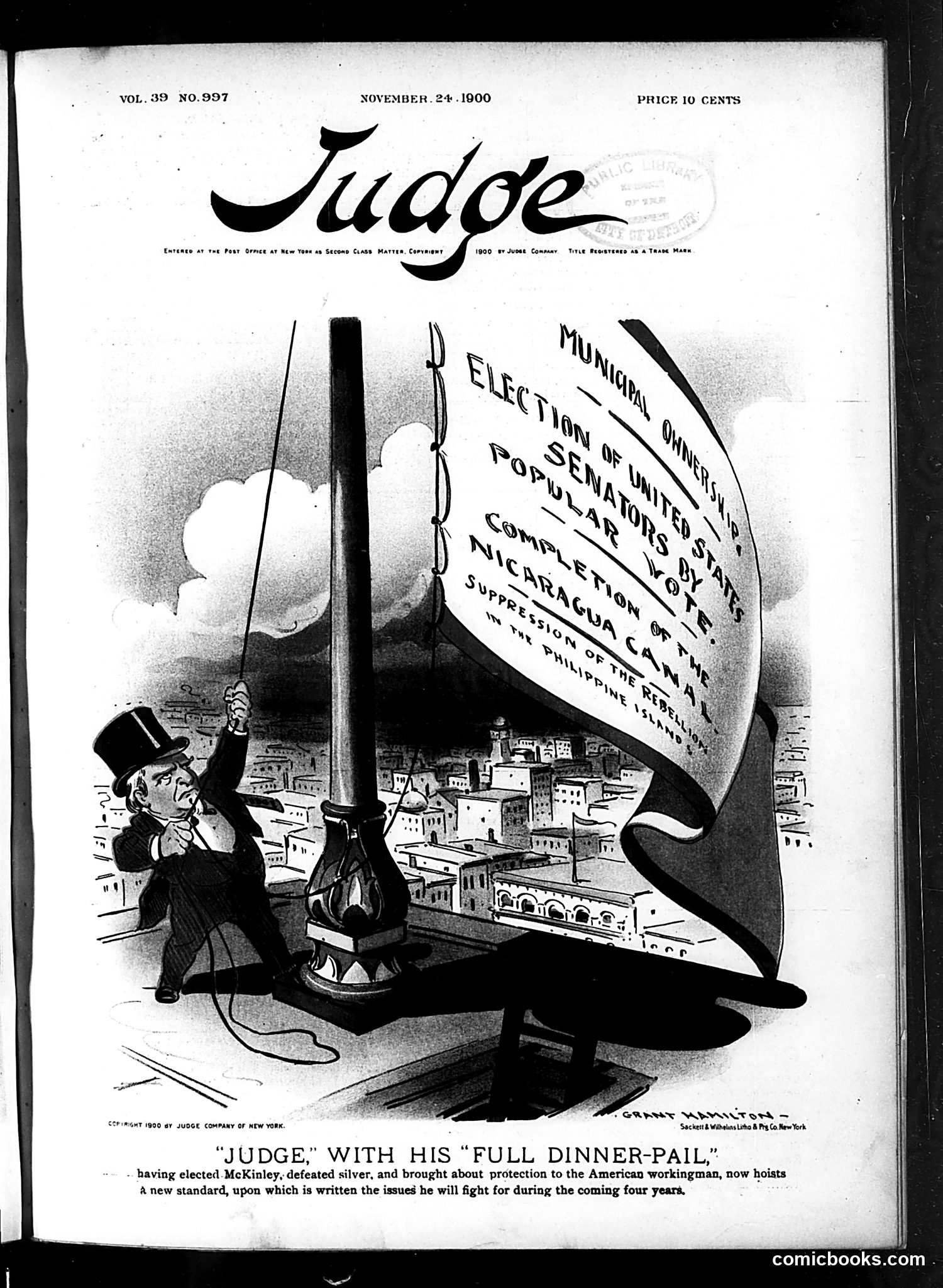
This November 24, 1900 *Judge* cover satirizes President William McKinley's recent election victory. The cartoon depicts "Judge" (the magazine's mascot character, in top hat) wielding a large dinner pail as a weapon or flag. The pail bears text referencing McKinley's election platform emphasizing "protection to the American workingman" and "a popular completion of Nicaragua Canal" with suppression of the Philippine insurgency. The satire suggests McKinley is using working-class economic promises (the "full dinner pail") as political cover for imperialist military ventures abroad—particularly in the Philippines and Central America. The figure appears cynical about whether rhetoric matching workers' interests actually aligns with his administration's true priorities.
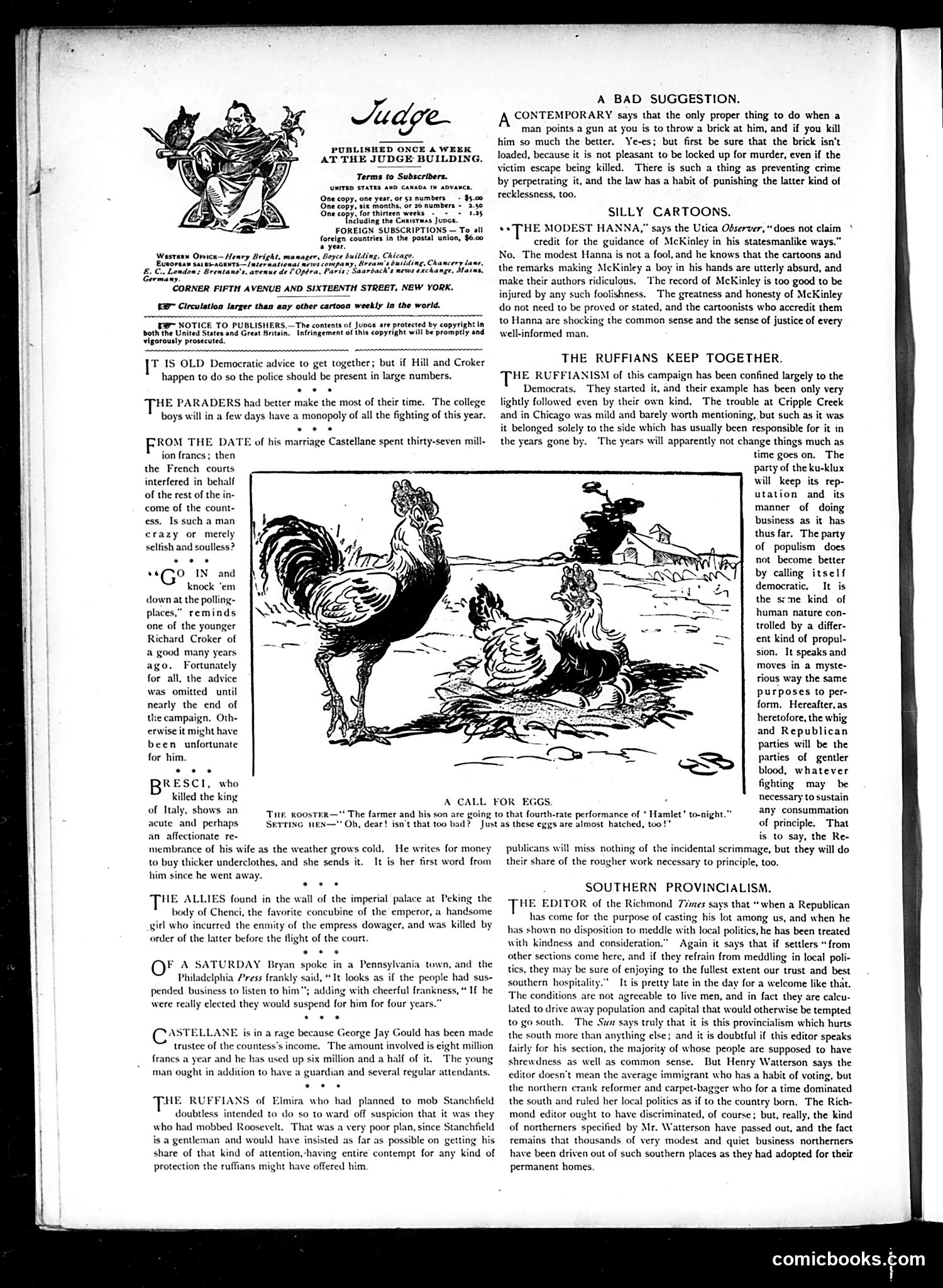
This cartoon depicts a rooster addressing hens, with the caption: "The farmer and his son are going to that fourth-rate performance of 'Hamlet' to-night. Now—oh, don't it just beat how? Just as these eggs are almost hatched, too!" The joke is a double entendre: the rooster urges the hens to produce eggs while the farmer is away, but the text simultaneously mocks a local theatrical production of *Hamlet* as "fourth-rate." The cartoon satirizes both rural life (farmers attending questionable theater) and the poultry industry's timing concerns. The humor relies on the incongruity of farm animals discussing Shakespeare while prioritizing egg production—a common Judge strategy combining lowbrow observation with literary reference for satirical effect.
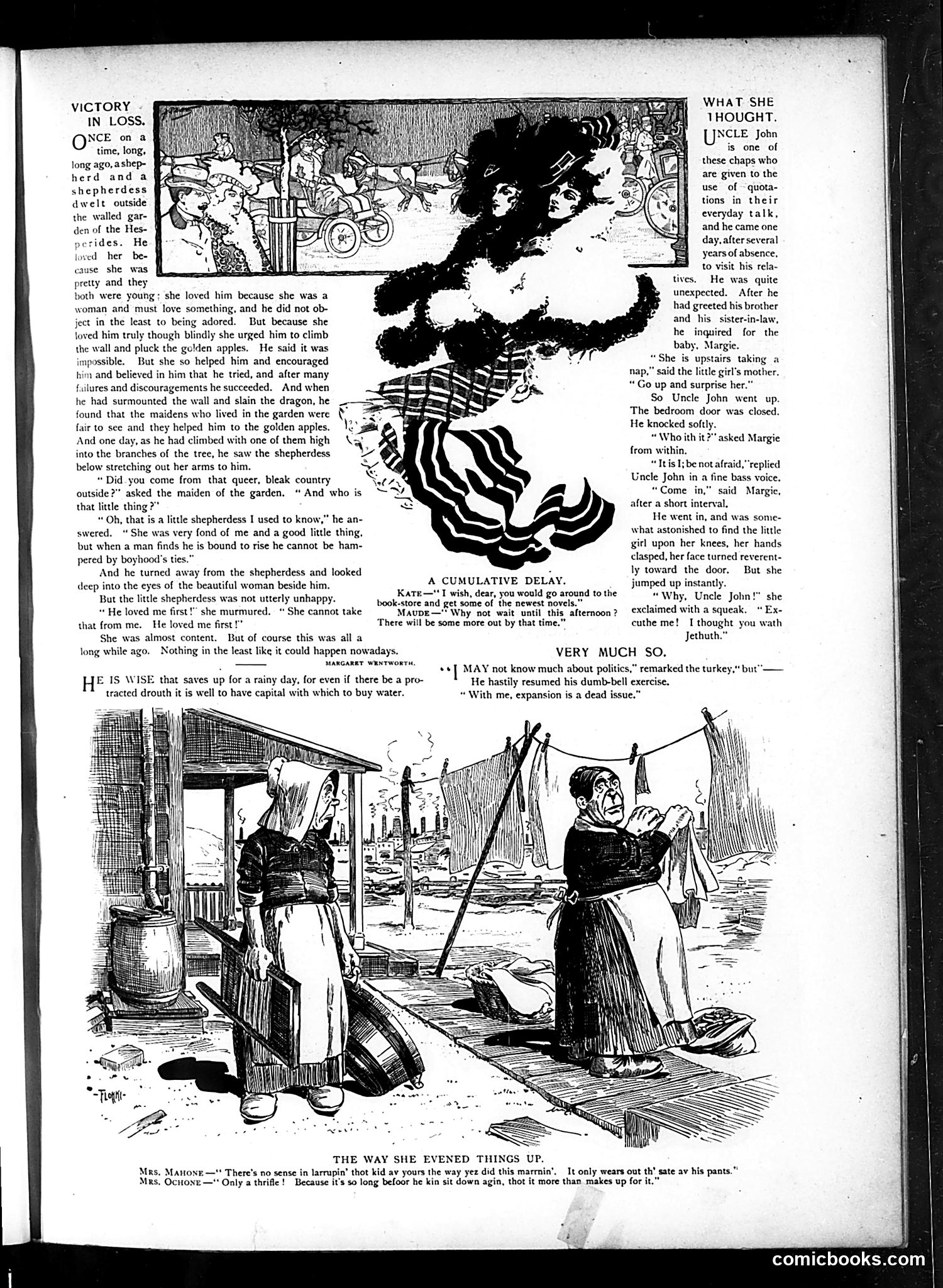
This page contains three separate humorous stories/cartoons typical of early 20th-century Judge magazine: 1. **"Victory in Loss"** (top left): A folk tale about a shepherd boy who defeats a dragon and wins a maiden's heart, illustrating that true love requires effort and courage. 2. **"A Cumulative Delay"** (center): Kate wishes her husband would visit bookstores for newer novels rather than always reading the same old book. The humor lies in domestic frustration with predictable routine. 3. **"The Way She Evened Things Up"** (bottom): Two working-class women discuss laundry wear. Mrs. Mahone notes her husband's pants wear out quickly; Mrs. Ochone jokes this is fair compensation since he's absent so long before returning home—satirizing male abandonment and slow financial recovery. The cartoons mock domestic life, gender relations, and working-class economics of the era.
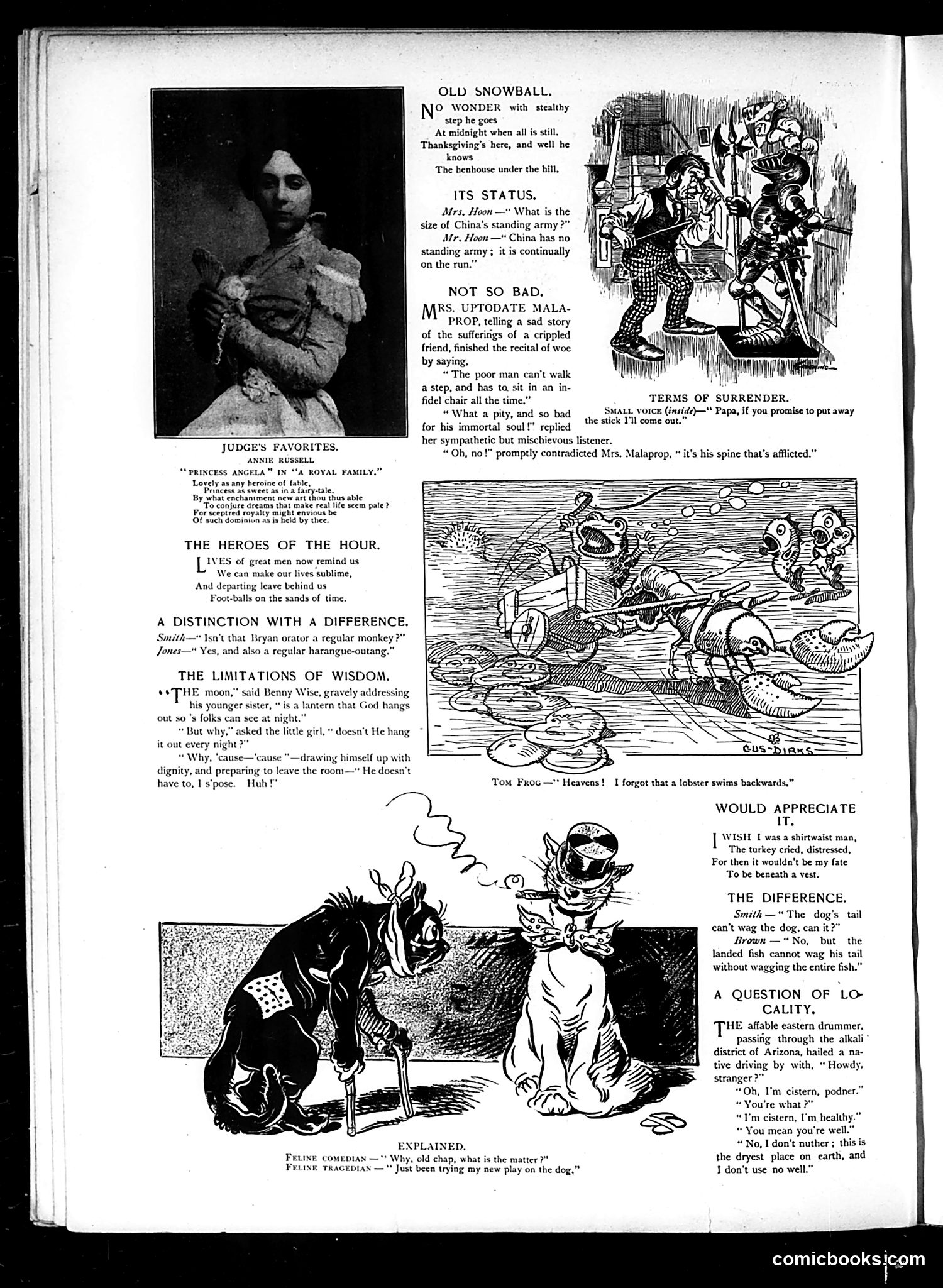
This Judge magazine page contains several short humorous pieces and illustrations rather than a unified political cartoon. The main items include: 1. **"Judge's Favorites"** – A poem praising an "Angel in a Royal Family," likely referencing a European royal woman of the era. 2. **Various comic vignettes** with animal characters (dogs, frogs, cats) exchanging witty dialogue—typical of period humor magazines. 3. **Miscellaneous jokes** on everyday topics: soldiers, the moon, a drummer in Arizona, and a drowning lobster. The page is primarily **light entertainment rather than political satire**. It reflects early 20th-century Judge magazine's style: mixing gentle social observation, animal-based humor, and puns. Without clearer identification of specific historical figures or events, the satirical targets (if any) remain unclear to a modern reader.
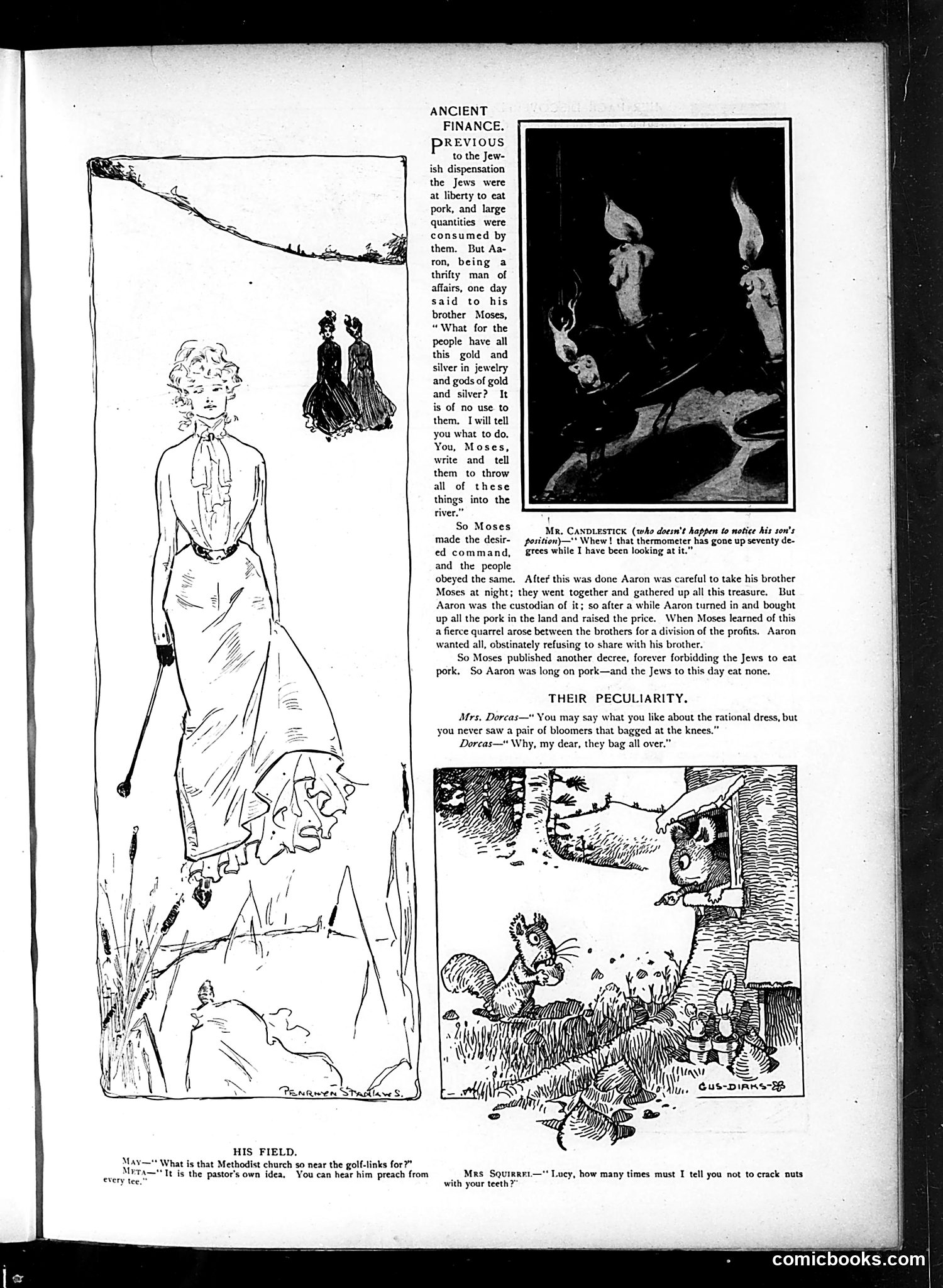
This Judge magazine page contains three satirical pieces: **"Ancient Finance"** mocks Jewish financial practices by presenting a false biblical origin story: Aaron supposedly convinced Moses to ban pork to monopolize the market and profit. The "joke" relies on antisemitic stereotypes portraying Jews as scheming moneygrubbers who invented dietary restrictions for financial gain. **"Their Peculiarity"** satirizes women's rational dress reform (bloomers) through a brief dialogue suggesting the garments fit poorly—a common anti-feminist criticism of the era. **"His Field"** and related vignettes are genteel social humor about churches near golf courses and etiquette violations (cracking nuts with teeth). The page primarily attacks Jewish people and women's dress reform. These stereotypes were mainstream in Judge's era, though they're now recognized as bigoted. The content reflects period prejudices rather than presenting legitimate satire.
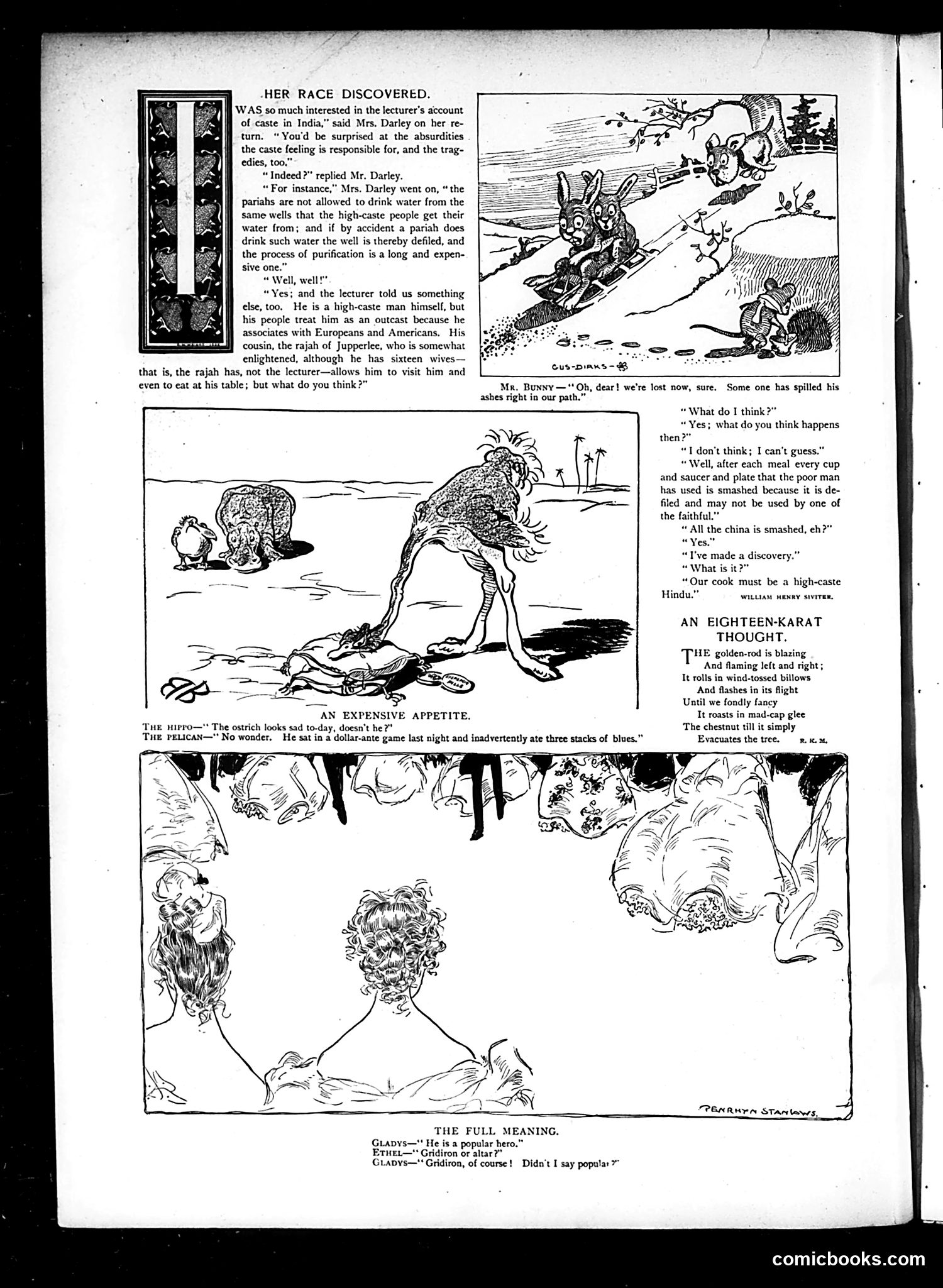
This page contains three separate satirical pieces: **"Her Race Discovered"** (top): Mrs. Darley lectures her husband about Indian caste system's rigid purity rules—how high-caste Hindus won't share wells with lower castes and destroy dishes touched by "defiled" people. The joke's punchline compares this to their cook, suggesting she must be high-caste Hindu because she breaks all the household dishes. The satire mocks both rigid caste hierarchies and domestic servants' carelessness. **"An Expensive Appetite"** (middle): A cartoon of an ostrich and pelican discussing why the ostrich looks sad—it lost money gambling the previous night. Light social humor about gaming losses. **"The Full Meaning"** (bottom): Three women's heads in conversation: one calls a man "a popular hero," another asks if he's famous for football ("gridiron") or religion ("altar"), and the first confirms "gridiron"—satirizing how American culture elevates football players to heroic status. The page reflects Judge's typical turn-of-century blend of domestic humor, ethnic stereotyping, and cultural commentary.
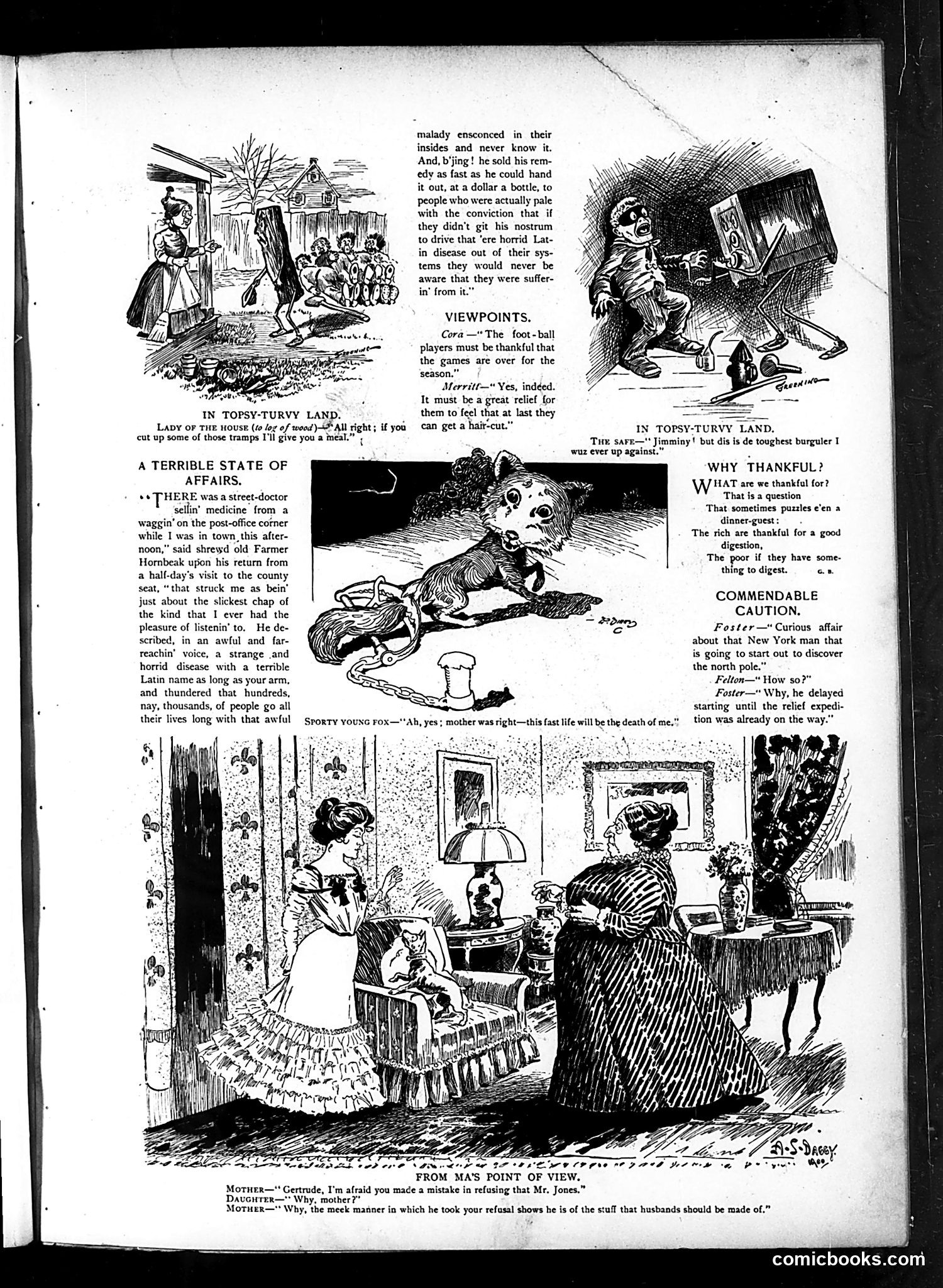
This page contains several satirical vignettes typical of late 19th-century American humor: **"A Terrible State of Affairs"** mocks medical quackery—a farmer recounts meeting a street-corner doctor hawking cure-all remedies for obscure "Latin" diseases. The satire targets both the charlatan's theatrical sales pitch and gullible patients' fears of unnamed ailments. **"In Topsy-Turvy Land"** presents absurdist humor: a lady offers tramps food for cutting them up; a burglar complains of tough resistance. The title suggests inverted logic for comedic effect. **Smaller dialogues** include football players relieved season's over, a New York explorer whose rescue expedition departs before he does (mocking poor planning), and domestic scenes about gratitude and refusing suitors. The recurring theme is satirizing American pretension, medical fraud, and social anxieties of the era. The cartoons use exaggerated situations and dialect to mock both the subjects depicted and broader societal follies Judge's audience would recognize.
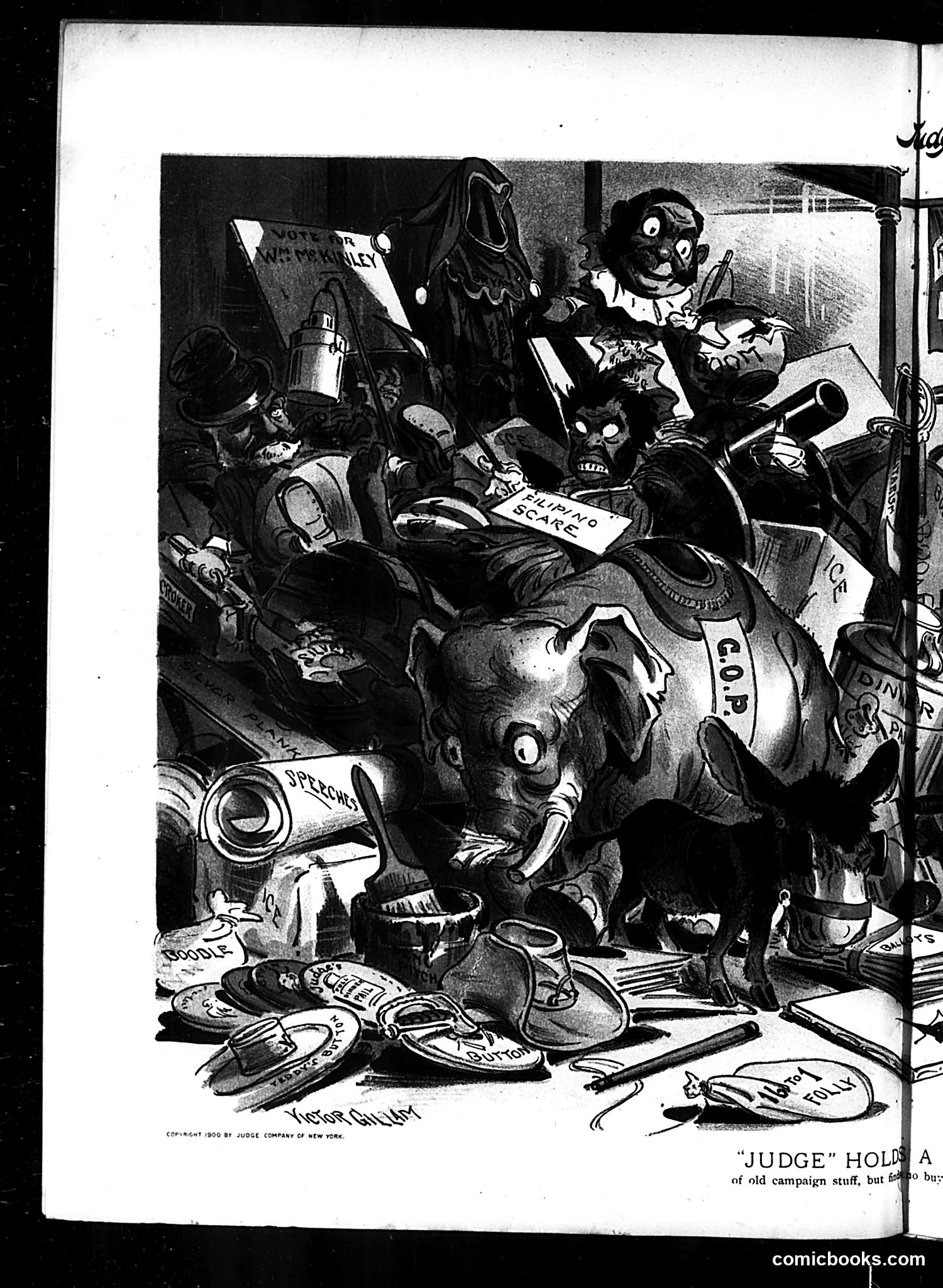
This 1900 Judge magazine cartoon satirizes political campaigns and their detritus. The central figure—labeled "JUDGE"—presides over a chaotic pile of "old campaign stuff": discarded materials, masks, caricatured figures, and debris. The imagery suggests the messy, disposable nature of electoral politics—costumes, props, and inflammatory rhetoric that are cast aside once campaigns end. The exaggerated, minstrel-show style caricatures and blackface imagery reflect the racist visual vocabulary of early 1900s American satire. The cartoon mocks both the superficiality of campaign culture and, likely, the manipulative use of inflammatory racial imagery in political discourse. The title indicates Judge magazine's self-positioning as an arbiter of taste, holding politicians accountable for their campaign excesses.
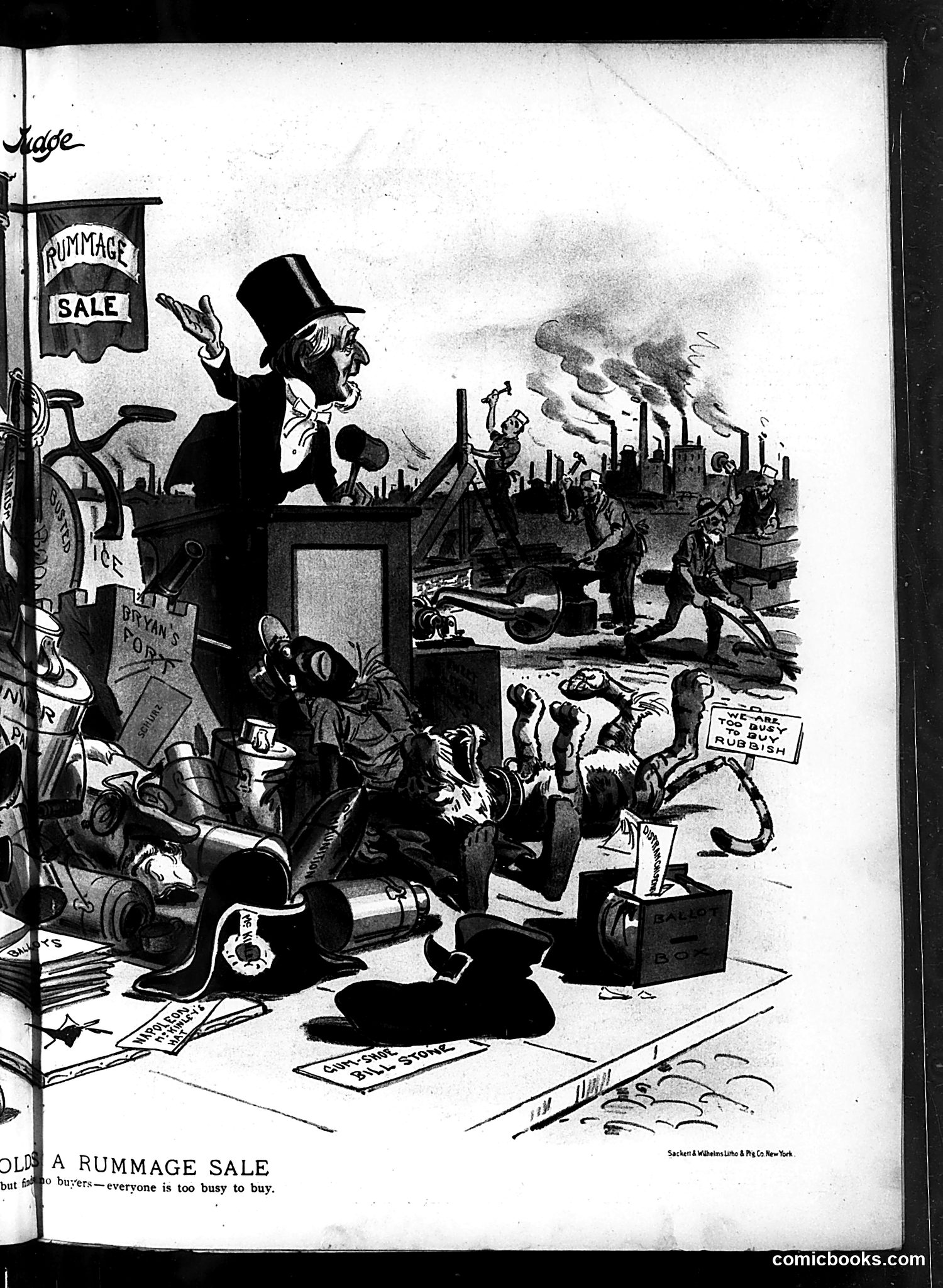
This is a political cartoon satirizing a "rummage sale" of discarded items and junk. A well-dressed auctioneer in a top hat stands at a podium advertising the sale, while industrial smokestacks belch smoke in the background. The foreground is cluttered with broken furniture, worn-out goods, and debris. The caption's joke—"no buyers—everyone is too busy to buy"—suggests commentary on economic conditions or consumer behavior, likely during a period of economic distress when people couldn't afford even cheap surplus goods. The industrial backdrop implies this rummage represents cast-off products of American manufacturing or commerce. The satire appears to critique either widespread poverty, market collapse, or the public's preoccupation with survival over consumption during what was likely an economic downturn (the cartoon's style suggests early-to-mid 20th century).
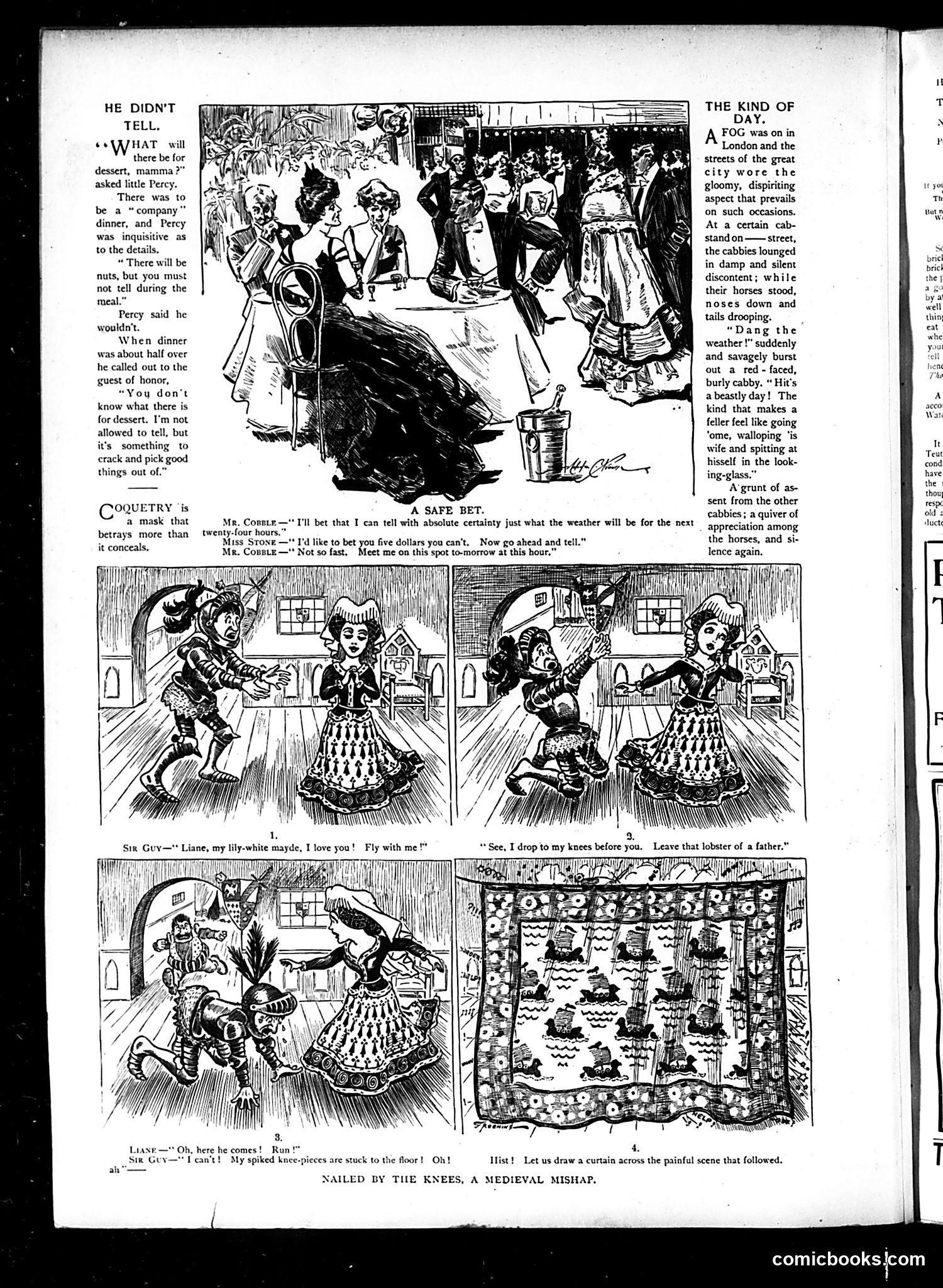
This page contains multiple unrelated satirical pieces typical of Judge's humor: **Top section ("The Kind of Day"):** A straightforward joke about London fog and cab drivers' misery. A grumpy cabby complains that bad weather makes him want to go home and mistreat his wife—dark Victorian humor about working-class frustrations. **Middle section ("A Safe Bet"):** Two women (identified as Mrs. Cobble and Miss Strove) make a wager about predicting tomorrow's weather. The joke plays on the impossibility of accurate weather prediction—a timeless source of humor. **Bottom section ("Nailed by the Knees"):** A medieval-themed comic strip showing a knight ("Sir Guy") and lady ("Liane") in a domestic scene. The punchline involves the knight's armor getting stuck to the floor, trapping him during an awkward moment—slapstick humor based on medieval costume absurdity. The page demonstrates Judge's mix of social observation, betting/wager humor, and physical comedy. No specific political figures or events appear identifiable.
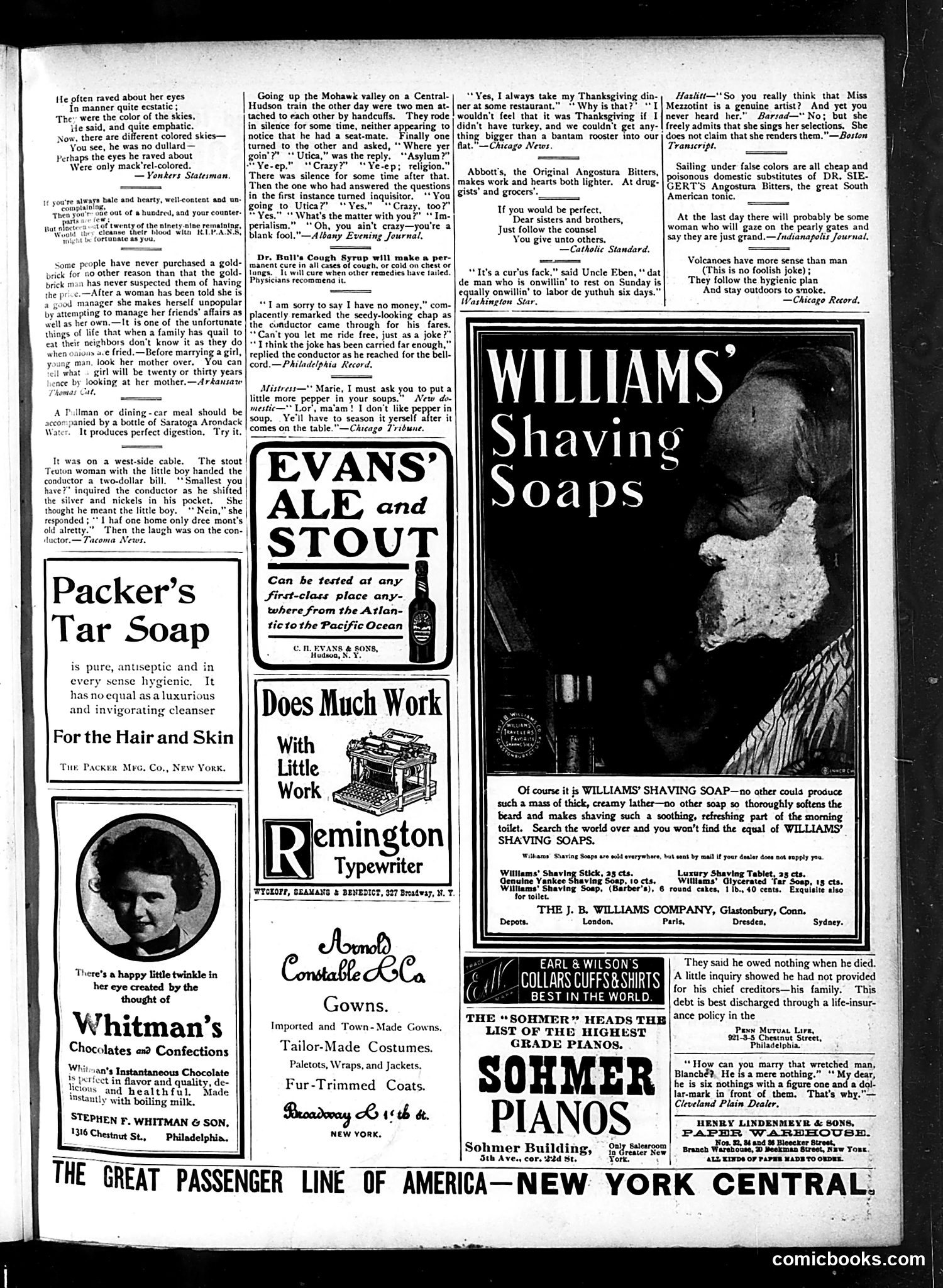
This page is primarily **advertisements with some brief humorous sketches** typical of Judge magazine's format. The main content consists of short, punchy jokes and anecdotes: - A **mock-serious poem** about a man who praised his sweetheart's eyes as "sky-colored"—the joke being that skies vary in color, so maybe he meant drab "mackerel-colored" eyes. - A **cable car anecdote** where a German woman with a toddler hands a conductor a two-dollar bill. When asked for smaller change, she says "Nein"—but the conductor thought she meant the child. The humor relies on the ethnic stereotype and the innocent misunderstanding. - A joke about two **handcuffed men on a train**, one bound for an asylum ("crazy") and one for Utica for being "impertinent"—essentially poking fun at institutional commitments and stubbornness. The remainder is **full-page advertisements** for shaving soaps, chocolates, typewriters, pianos, and beer—standard Judge revenue. These pages were typical of early 20th-century humor magazines: a mix of topical satire, domestic humor, and paying advertisements.
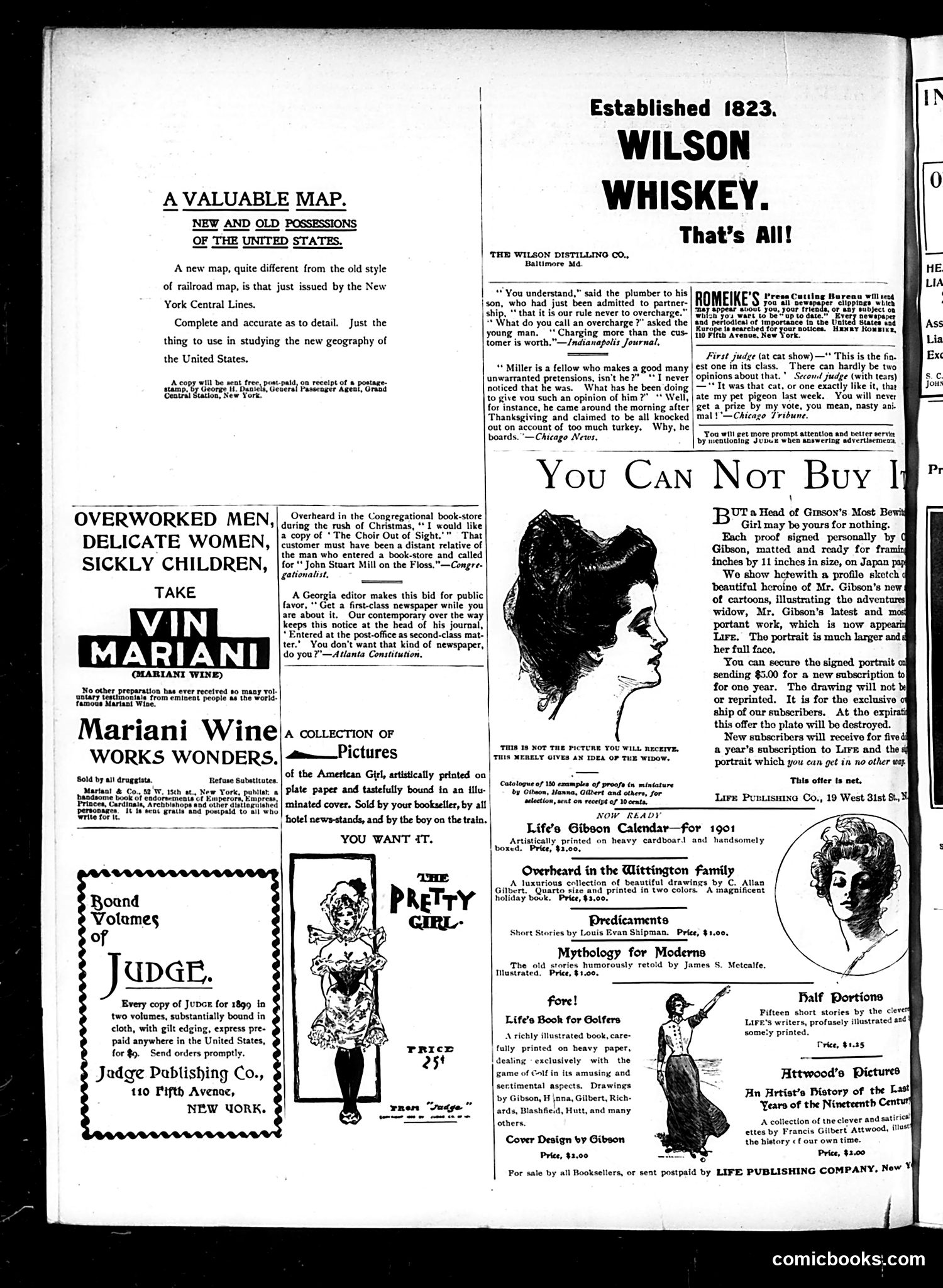
This is primarily an **advertising and miscellaneous content page** from Judge magazine, not a political cartoon page. The main elements include: 1. **"A Valuable Map"** advertisement for New York Central Lines railroad maps, presented as practical content rather than satire. 2. **Health/wellness ads**: "Vin Mariani" wine and other tonics marketed to "overworked men, delicate women, sickly children"—typical Victorian-era patent medicine advertising. 3. **Multiple short humorous items**: Brief anecdotes about an overcharging plumber, a man claiming overindulgence from Thanksgiving turkey, and a cat show judge with a personal grudge. These are light social humor rather than political satire. 4. **Book advertisements**: Including Gibson Girl portraits and various illustrated volumes. 5. **Judge Publishing Company advertisements**: Promoting their own publications. The page reflects Judge's era (turn-of-century) when magazines mixed serious content with advertising and light humor. There's no significant political commentary or social satire visible here—it's mainly commercial material and gentle domestic comedy.
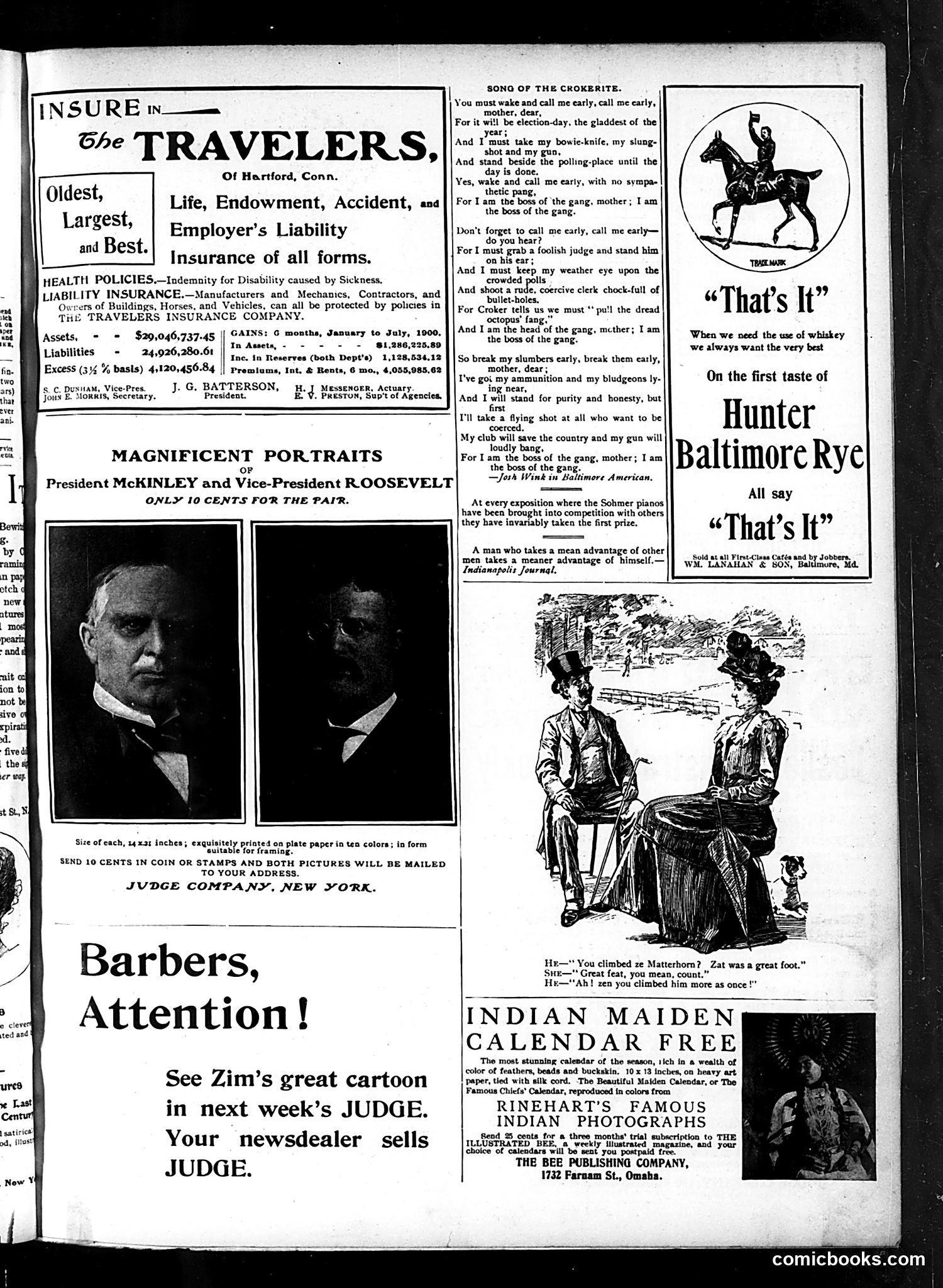
This page is primarily **advertising and promotional content** rather than editorial cartoons. Key elements: **Main Features:** - Insurance company ads (Travelers Insurance of Hartford) - Portraits of President McKinley and Vice-President Roosevelt available for 10 cents - Promotion for "Zim's great cartoon" appearing in next week's Judge **Political Content:** The "Song of the Crokerite" is a satirical poem mocking election-day violence associated with **Richard Croker**, the corrupt Tammany Hall political boss of New York. The song uses mock-heroic language to ridicule voter intimidation, ballot-box stuffing, and gang violence ("bowie-knife," "slung-shot," "coercive clerk chock-full of bullet-holes"). It's Judge magazine's criticism of Tammany Hall corruption during the election period. **Other Ads:** - Hunter Baltimore Rye whiskey - Sohmer pianos - Indian Maiden Calendar - Rinehardt's Indian Photographs The page reflects early 1900s concerns about urban political corruption and machine politics.
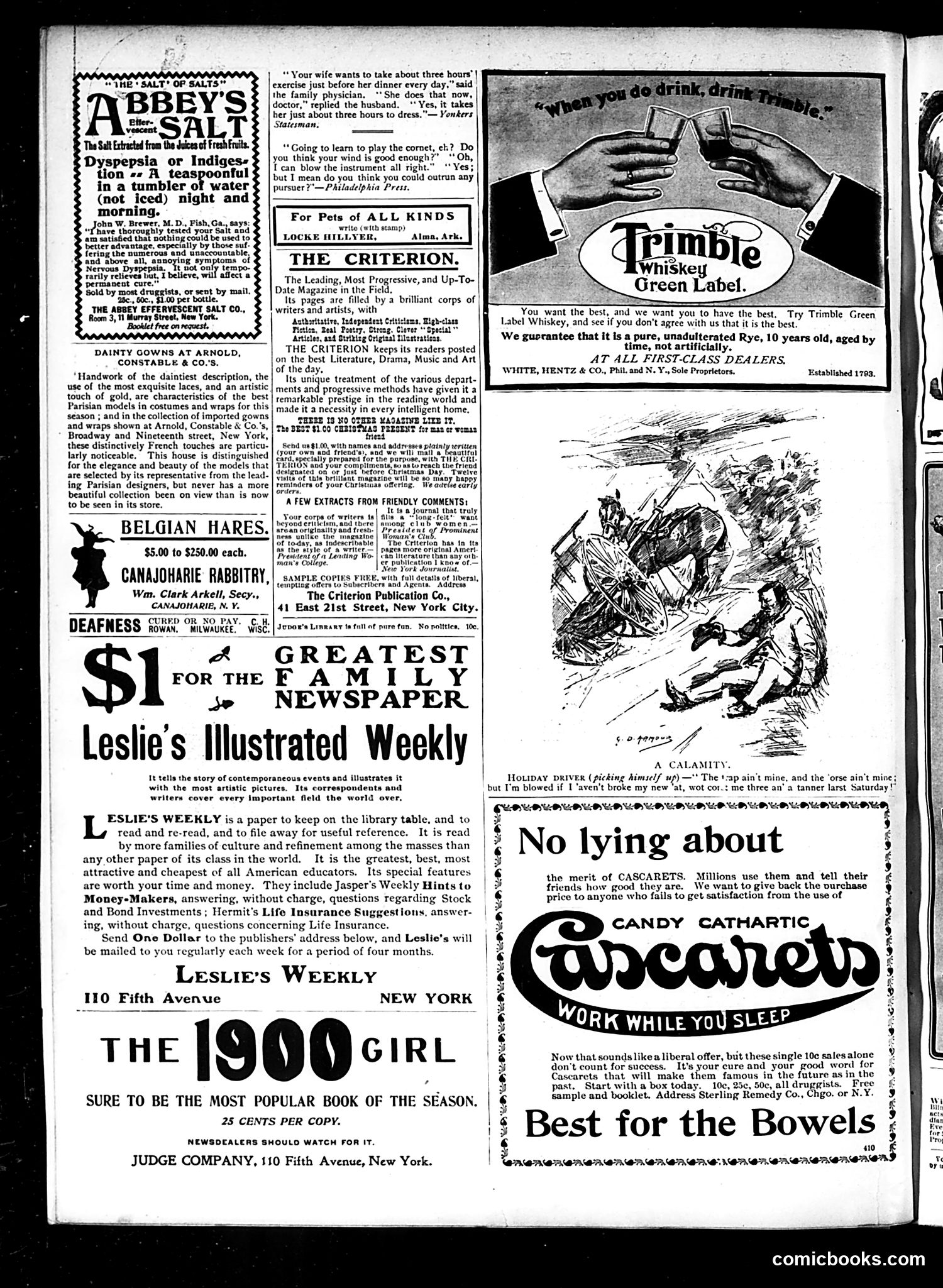
This page is primarily **advertising and promotional content** rather than political satire. The main cartoon visible—titled "A CALAMITY"—depicts a working-class London cab driver after an accident, lamenting that while his cart and horse aren't damaged, he's broken his new hat (costing three shillings sixpence). The humor is gentle class-based comedy: the laborer's priorities humorously reflect modest means—the hat's cost matters more than the vehicle damage. The page otherwise features ads for consumer products (Trimble Whiskey, Cascarets laxatives), Leslie's Illustrated Weekly magazine, and various commercial services. Two brief jokes in the text mock domestic situations: a husband's sarcasm about his wife's three-hour dressing routine, and wordplay about learning cornet versus outrunning pursuers. This reflects Judge's typical late 19th/early 20th-century character: a humor and advertising vehicle for middle-class readers, mixing light social observation with commercial promotion.
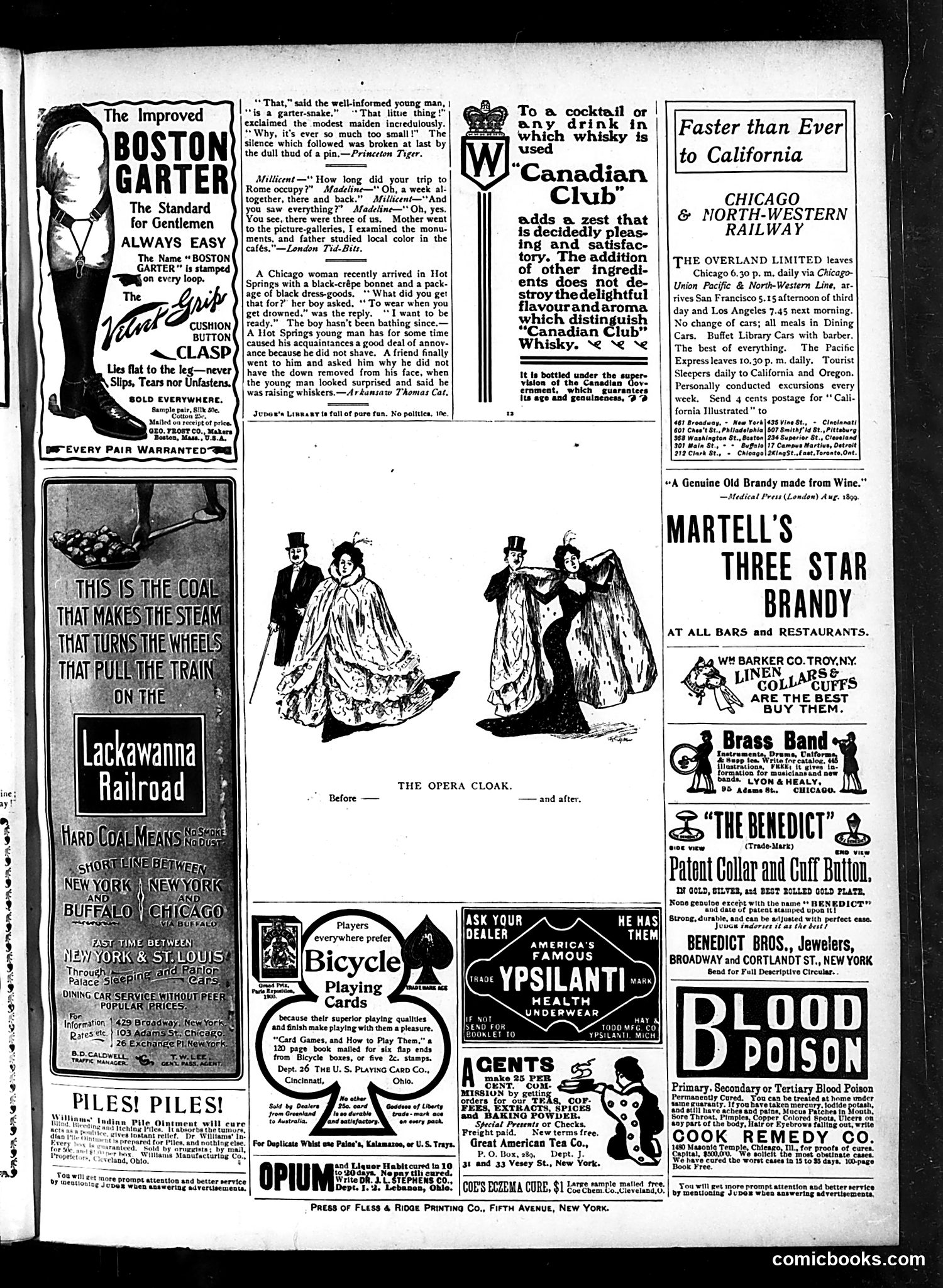
This page is primarily **advertising**, with several small humorous anecdotes in the margins. The cartoons are minimal. "The Opera Cloak" shows a woman before and after—likely depicting a social commentary on women's fashion or behavior at the opera, though the specific satire is unclear without additional context. The page features product advertisements for Boston Garters, the Lackawanna Railroad, Bicycle Playing Cards, Ypsilanti Health Underwear, Martell's Brandy, and various other goods typical of early 20th-century magazines. The short jokes involve: a young man's misidentification of a garter snake (playing on "garter" double meaning), a woman's rushed European tour, and a man growing whiskers. These are gentle, domestic humor pieces rather than political satire. Overall, this appears to be a standard Judge magazine page blending light humor with commercial advertising—representative of how magazines monetized content during this period.
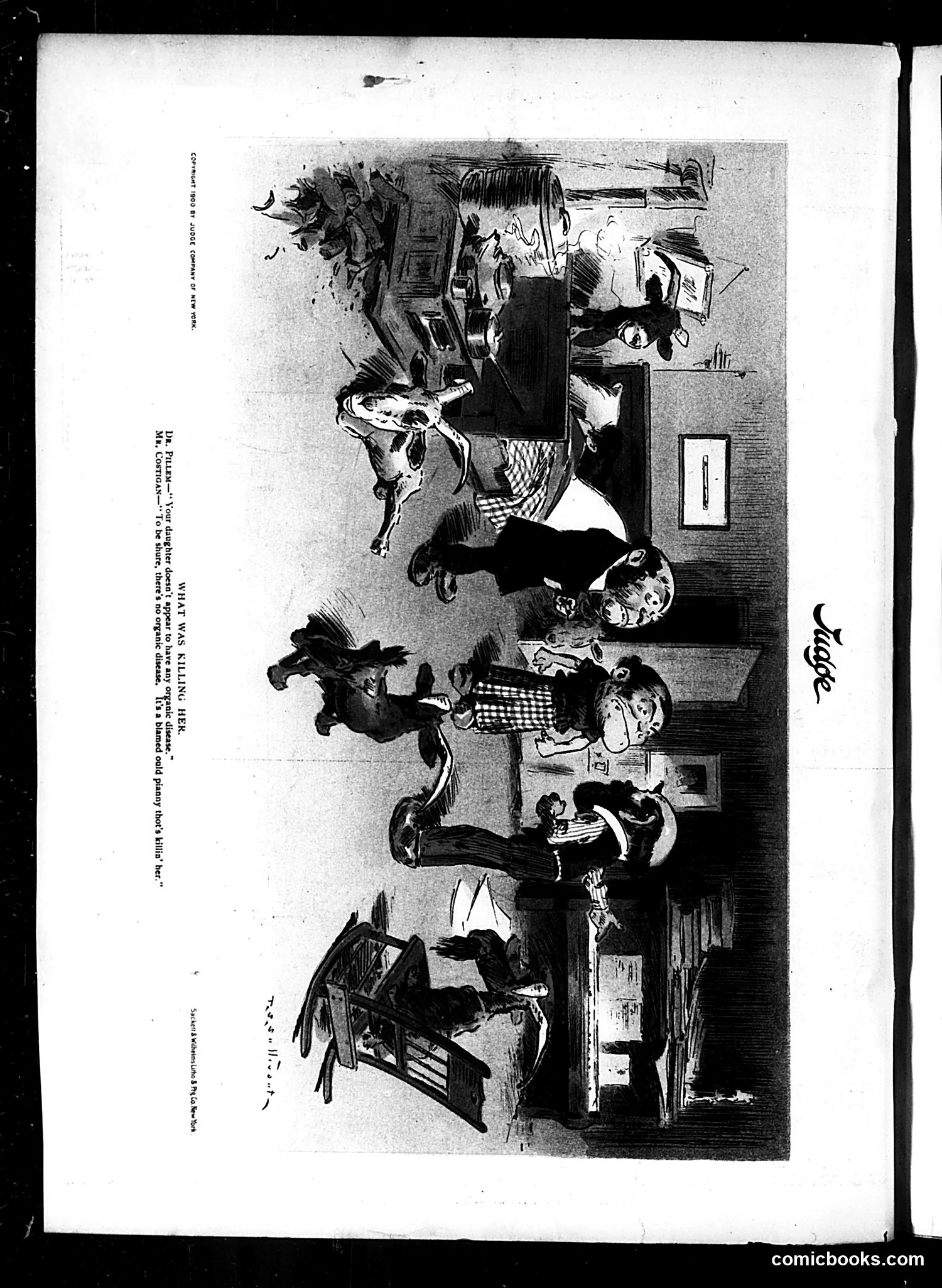
This appears to be a satirical comic from 1900 depicting Irish-American stereotypes. The scene shows a doctor (Dr. Pinkham) examining a young woman while her father (Mr. Costigan, identified by his Irish brogue in the dialogue) stands by. The joke plays on class anxieties of the period: the father blames the family piano—a symbol of genteel, middle-class aspirations—for his daughter's mysterious illness rather than accepting the doctor's medical diagnosis. The satire mocks Irish immigrants' supposed resistance to or misunderstanding of modern medicine and education, while also poking fun at the Victorian obsession with "nervous" ailments among young women. The piano represents the family's aspirational pretensions, which the cartoon suggests is ironically what's actually harming their daughter through stress or overexertion.