
A complete issue · 14 pages · 1900
Judge — November 3, 1900
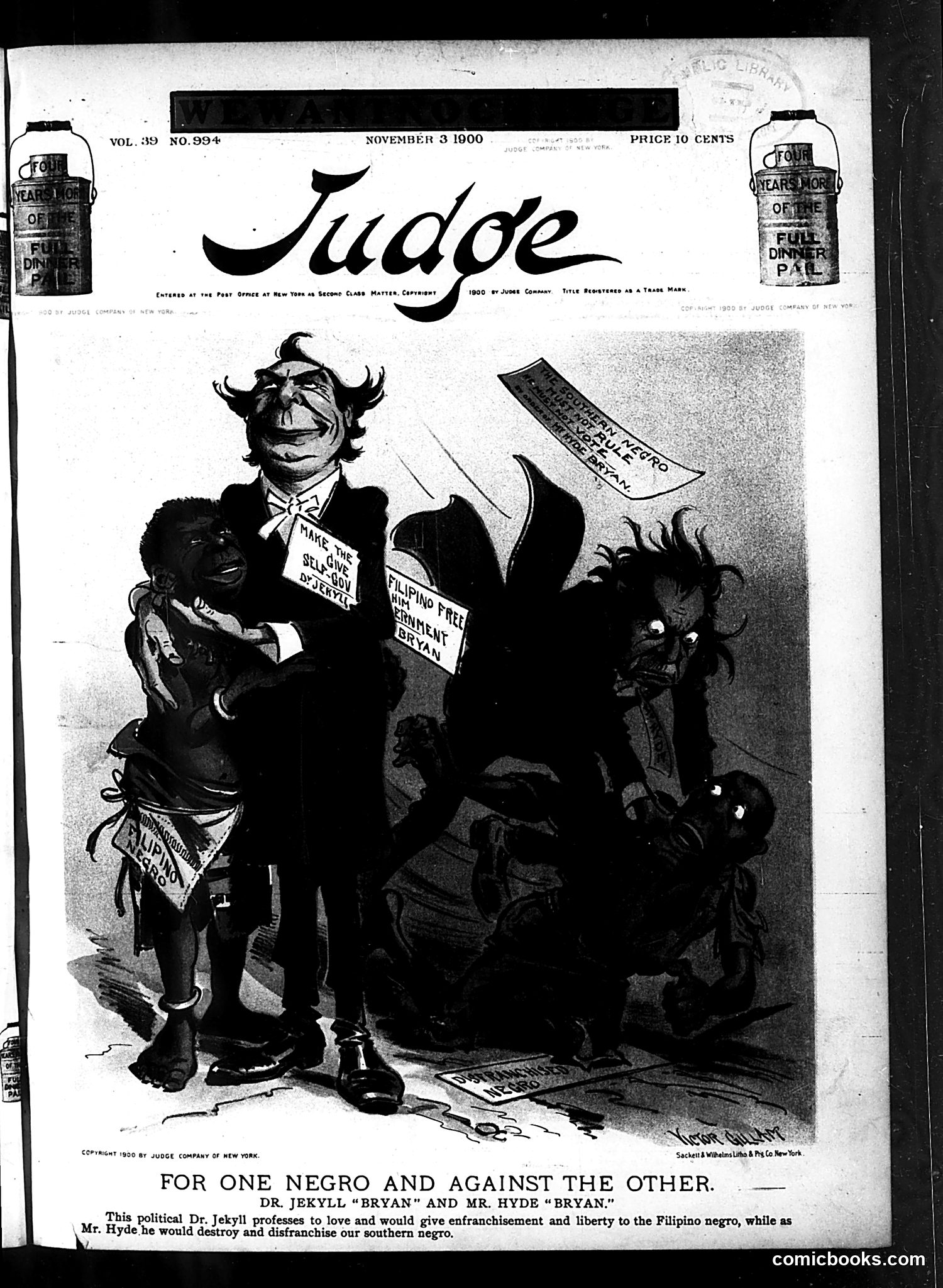
This political cartoon satirizes the 1900 presidential election, specifically contrasting two competing visions for African American policy. The central demonic figure represents "Dr. Jekyll and Mr. Hyde Bryan"—William Jennings Bryan, the Democratic candidate. The caption explains the satire: Bryan claims to offer Black voters enfranchisement and liberty (the "Dr. Jekyll" side), while simultaneously promising Southern white voters he would "destroy and disfranchise our southern negro" (the "Mr. Hyde" side). The surrounding caricatured figures represent different groups affected by this contradictory platform. This reflects genuine Republican arguments against Bryan during the 1900 campaign, portraying him as hypocritical on racial issues to appease both Northern and Southern constituencies.
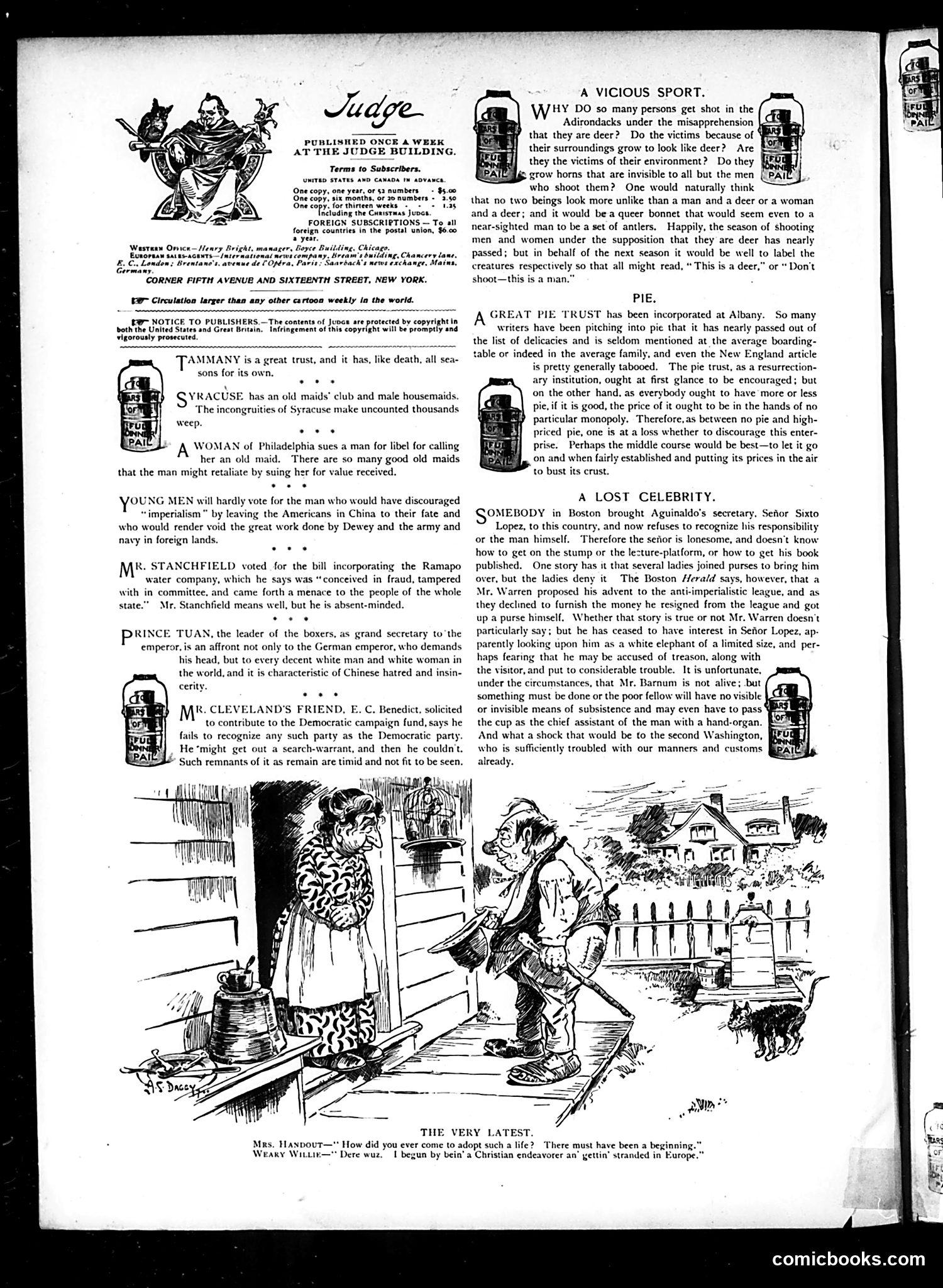
This page contains several brief political opinion pieces rather than cartoons. The "A Vicious Sport" section criticizes Adirondack hunters who mistake deer for humans, arguing the resemblance between man and deer should inspire restraint in shooting. "Pie" discusses a newly formed "Great Pie Trust" incorporating Albany bakeries, satirizing how monopolies control food industries and manipulate prices through artificial scarcity. "A Lost Celebrity" concerns Aguinaldo's secretary, Señor Sixto Lopez, brought to America by Warren. The piece mocks efforts to locate him for authentication of documents, suggesting he may have become a vagrant or invisible person in Boston—commentary on Filipino independence politics and American imperial entanglement following the Spanish-American War. The bottom cartoon depicts a domestic scene with unclear specific references.
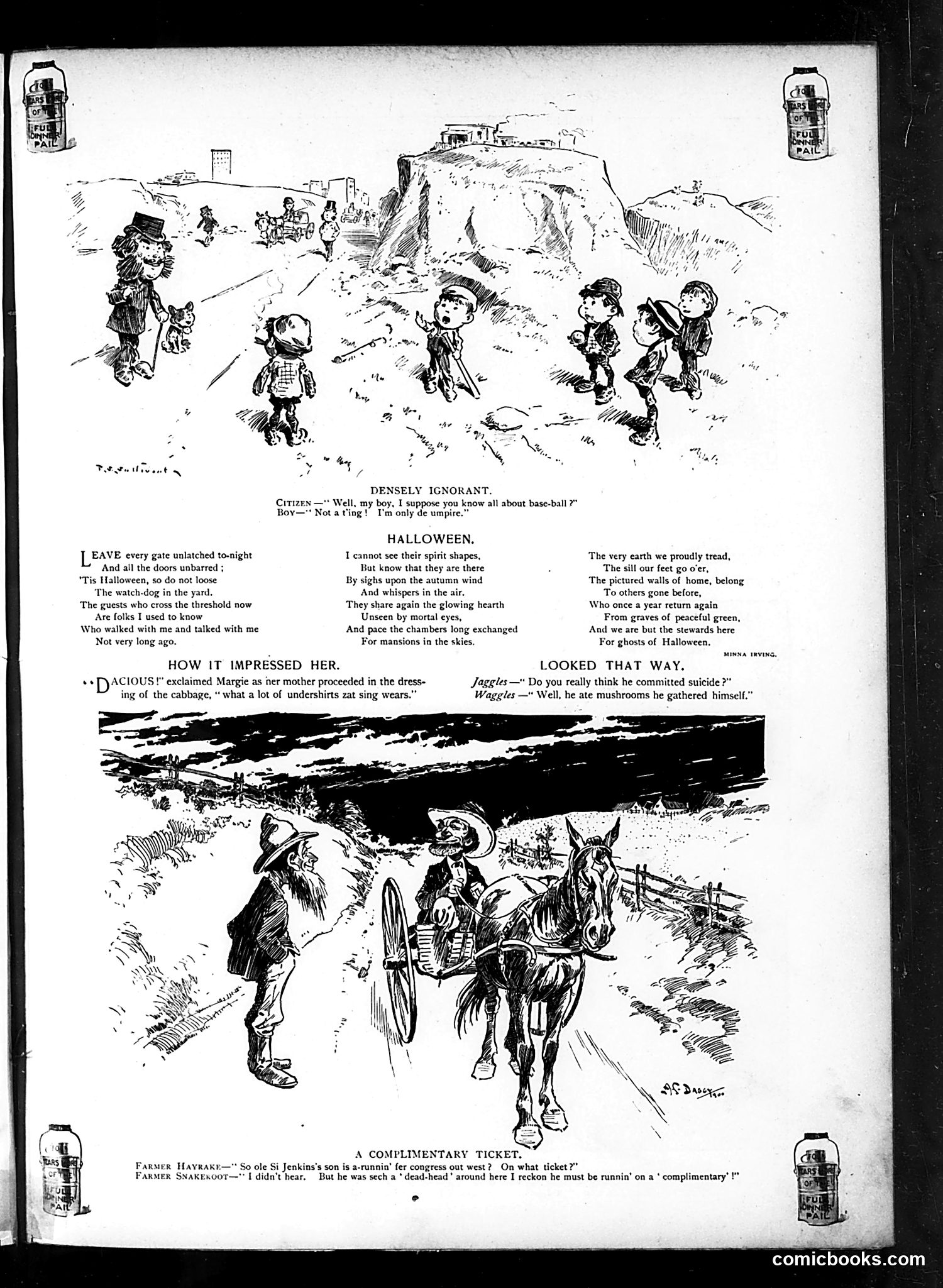
This page contains several satirical pieces typical of early 20th-century Judge magazine: **Top cartoon "Densely Ignorant"**: Mocks a city dweller's ignorance about baseball, claiming to know "all about base-ball" while admitting uncertainty about basic rules—satire on urban pretension. **"Halloween" poem**: A period-appropriate seasonal verse celebrating the holiday's supernatural themes, likely by Rhoda Irving (credited author). **Middle anecdote "How It Impressed Her"**: Satirizes women's perceived superficiality through Margie's fascination with undergarments during opera attendance. **Bottom cartoon "A Complimentary Ticket"**: Rural characters discuss someone running for Congress on a "complimentary ticket"—appearing to satirize American politics or campaign practices, though the specific reference is unclear. The page reflects Judge's recurring themes: urban/rural contrasts, gender stereotypes, and political mockery.
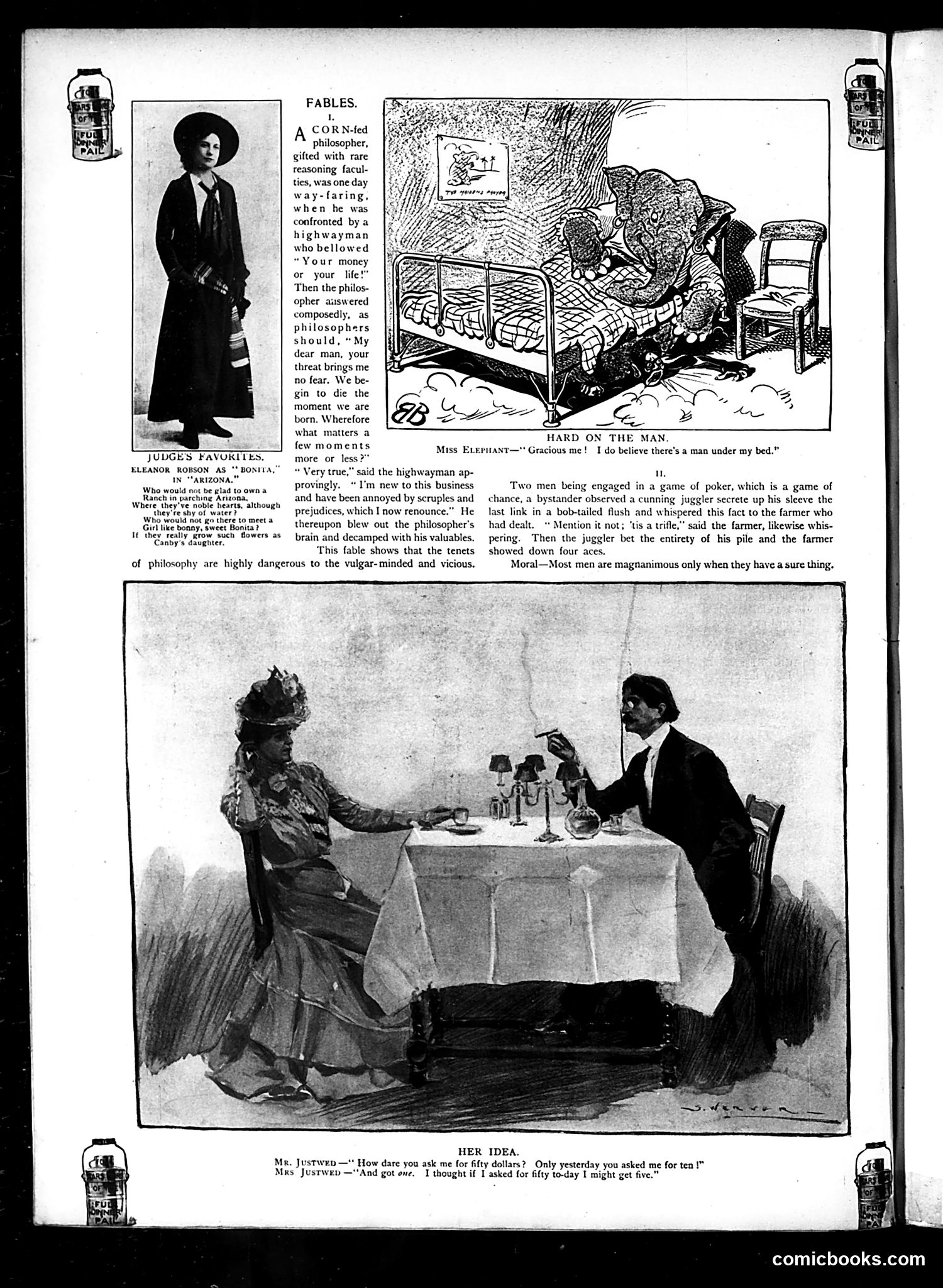
This page contains two satirical fables with moral lessons typical of Judge magazine's humor. **Top cartoon** ("Hard on the Man"): A Miss Elephant demands assurance from a man in bed that no one else is beneath it. The fable mocks female jealousy and paranoia in relationships, suggesting women are unreasonably suspicious. **Bottom cartoon** ("Her Idea"): A woman asks a man for fifty dollars, claiming she only asked for tea yesterday but now wants more money. The satire ridicules women's perceived greed and manipulation—the implied joke being that women exploit men financially through escalating requests. Both fables exemplify early-20th-century misogynistic humor common in Judge, presenting women as either irrationally jealous or mercenary. The morals reinforce stereotypical gender attitudes of that era.
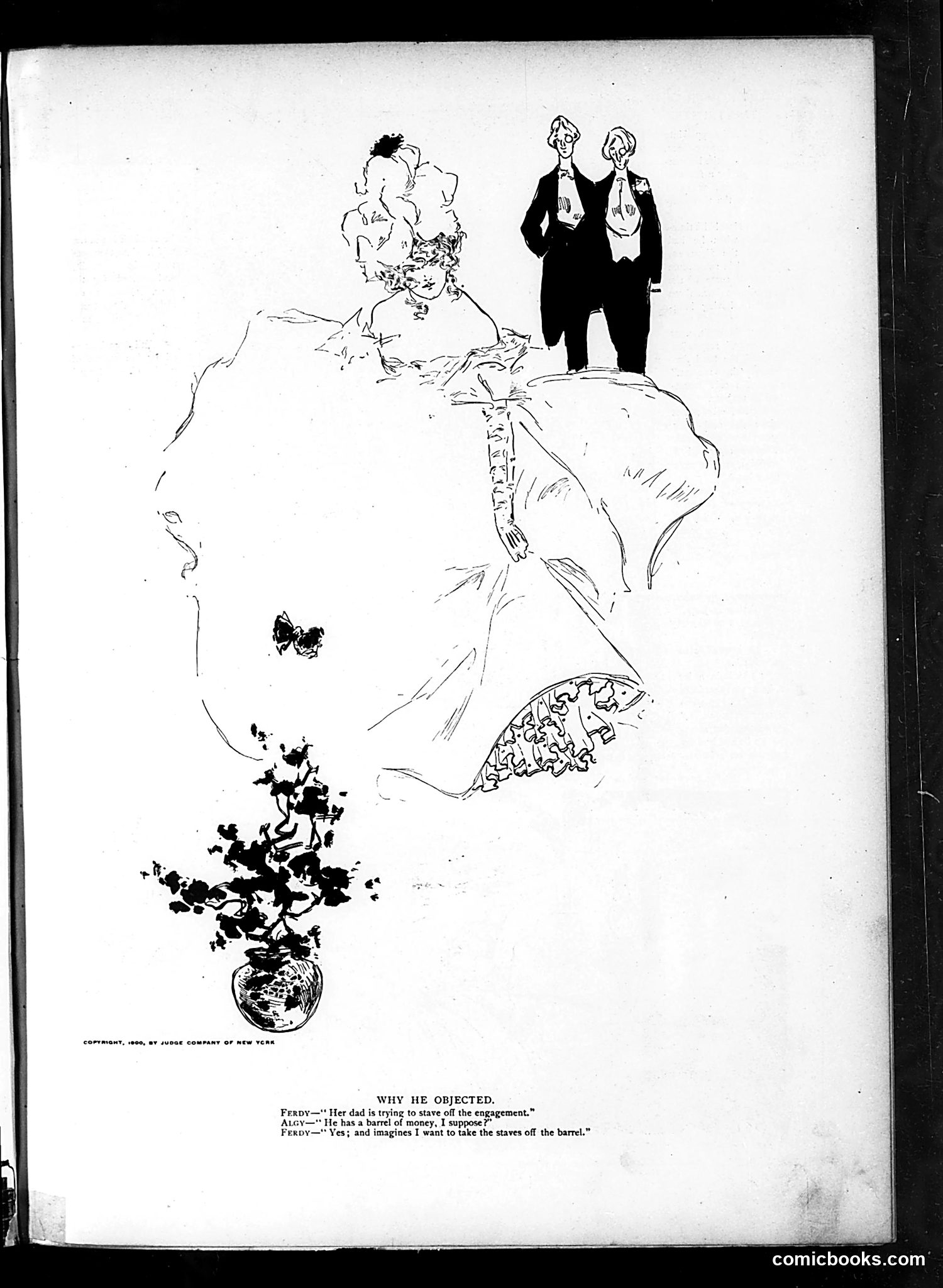
This is a social satire about courtship and money. Two men—Fenpy and Algy—discuss why a young woman's father objects to their engagement. The father is wealthy ("has a barrel of money") but wants to protect his fortune from a suitor he suspects is a fortune-hunter. Fenpy's witty response—that the father imagines he wants to "take the staves off the barrel"—is a double entendre: it suggests both literally dismantling the barrel and metaphorically extracting/stealing the money inside. The illustration shows a fashionable woman's face in profile with an elaborate hairstyle, positioned above a decorative vase with flowers—visually supporting the "barrel" metaphor. The satire targets both greedy suitors and wealthy fathers' anxieties about protecting their assets from gold-diggers.
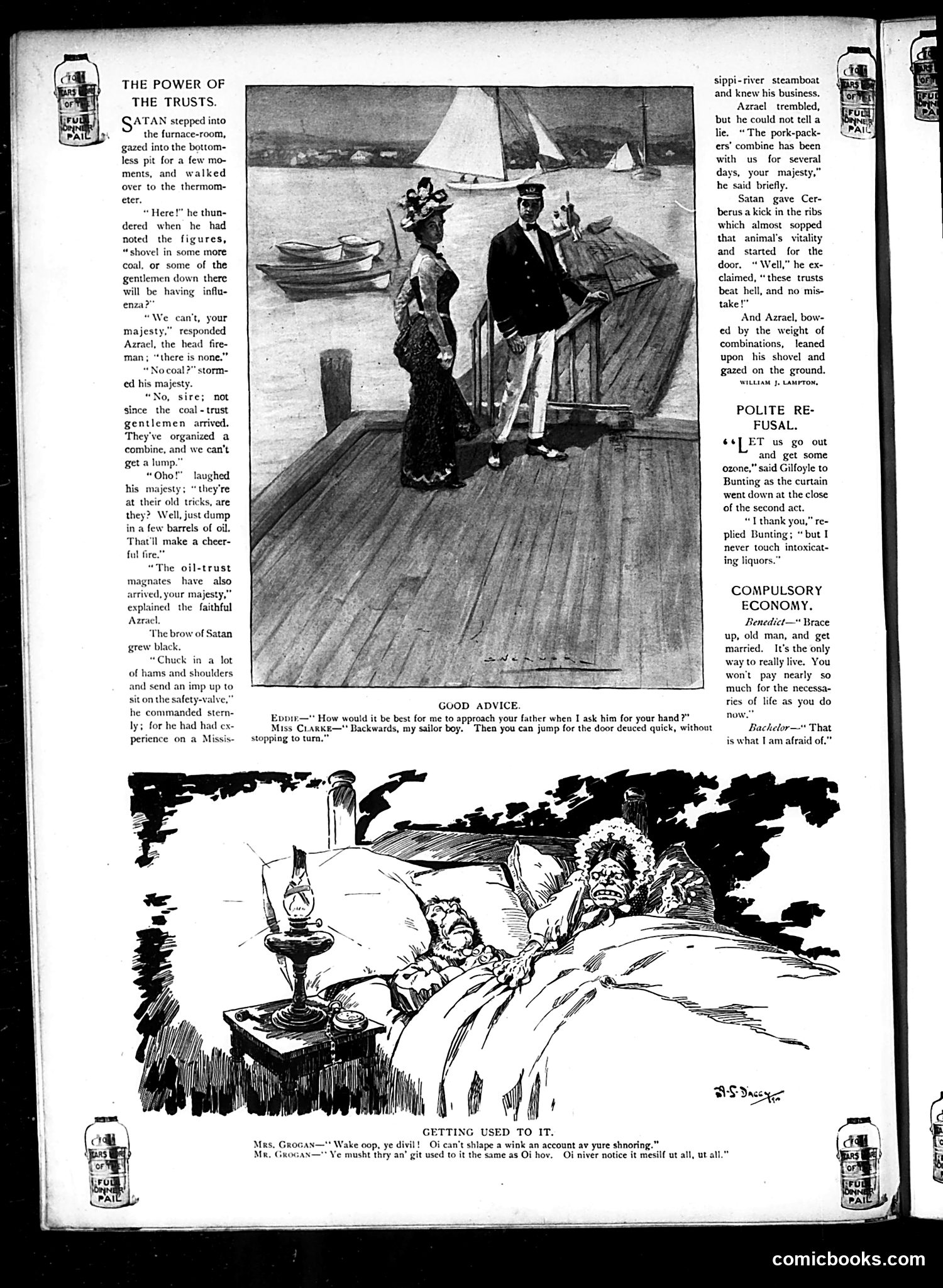
This page satirizes the growing power of **corporate trusts**—monopolistic business combinations that dominated early 20th-century American commerce. The main cartoon depicts Satan unable to heat Hell because the **coal trust, oil trust, and pork-packers' combine** have monopolized these resources, even in the underworld. The joke: trusts are so powerful and pervasive they've infiltrated everywhere, even Hell itself, rendering Satan helpless. The satire targets actual historical trusts that controlled coal, oil, and meat-packing industries—entities that dominated American business and faced political criticism for anti-competitive practices. By literalizing trusts as obstacles to Satan's operations, Judge magazine mocks their stranglehold on commerce and society. Secondary cartoons and jokes on the page employ unrelated humor about romance and Irish accents, typical of period magazines.
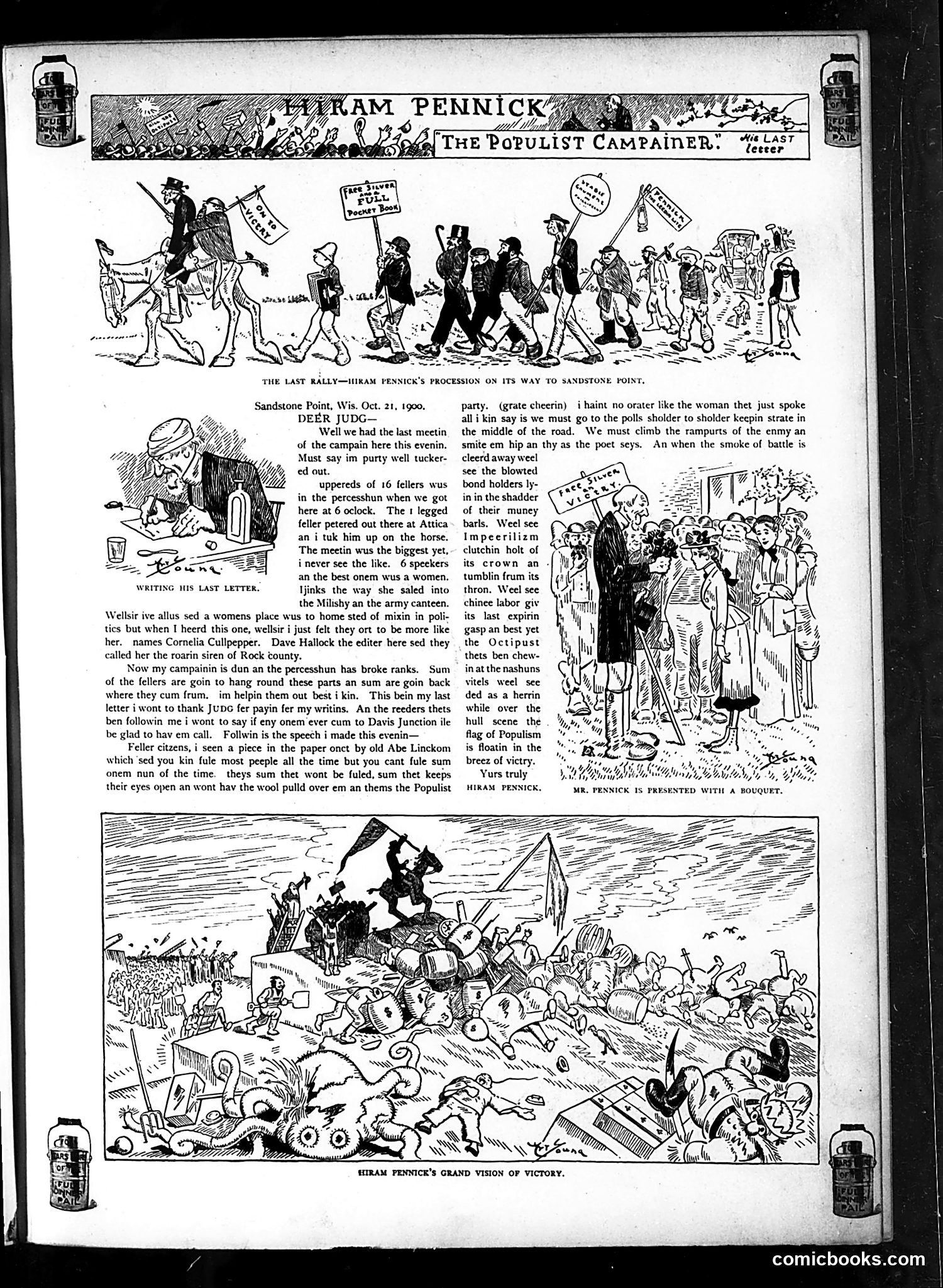
This 1900 satirical piece mocks the **Populist Party's** final campaign rally. Written as a folksy letter from "Hiram Pennick," a rural Populist campaigner, it ridicules the movement's rhetoric and supporters. The cartoons depict: 1. **Top panel**: Pennick's ragtag "procession" to Sandstone Point, Wisconsin—showing disheveled, poorly-organized supporters, contrasting with the grandiose language about "last rallies." 2. **Bottom panel**: Pennick's "grand vision of victory"—a chaotic fantasy of defeating enemies (depicted as bloated bond-holders, imperialism, Chinese labor, and the "Octopus" monopolies) while the Populist flag waves triumphantly. **The satire**: Through misspellings and malapropisms ("fuled" for fooled, "Octipust"), Judge mocks Populist idealism as naive and their apocalyptic rhetoric as disconnected from reality. The contrast between flowery campaign speeches and the movement's actual modest turnout emphasizes the Populists as ineffectual dreamers, not serious political force.
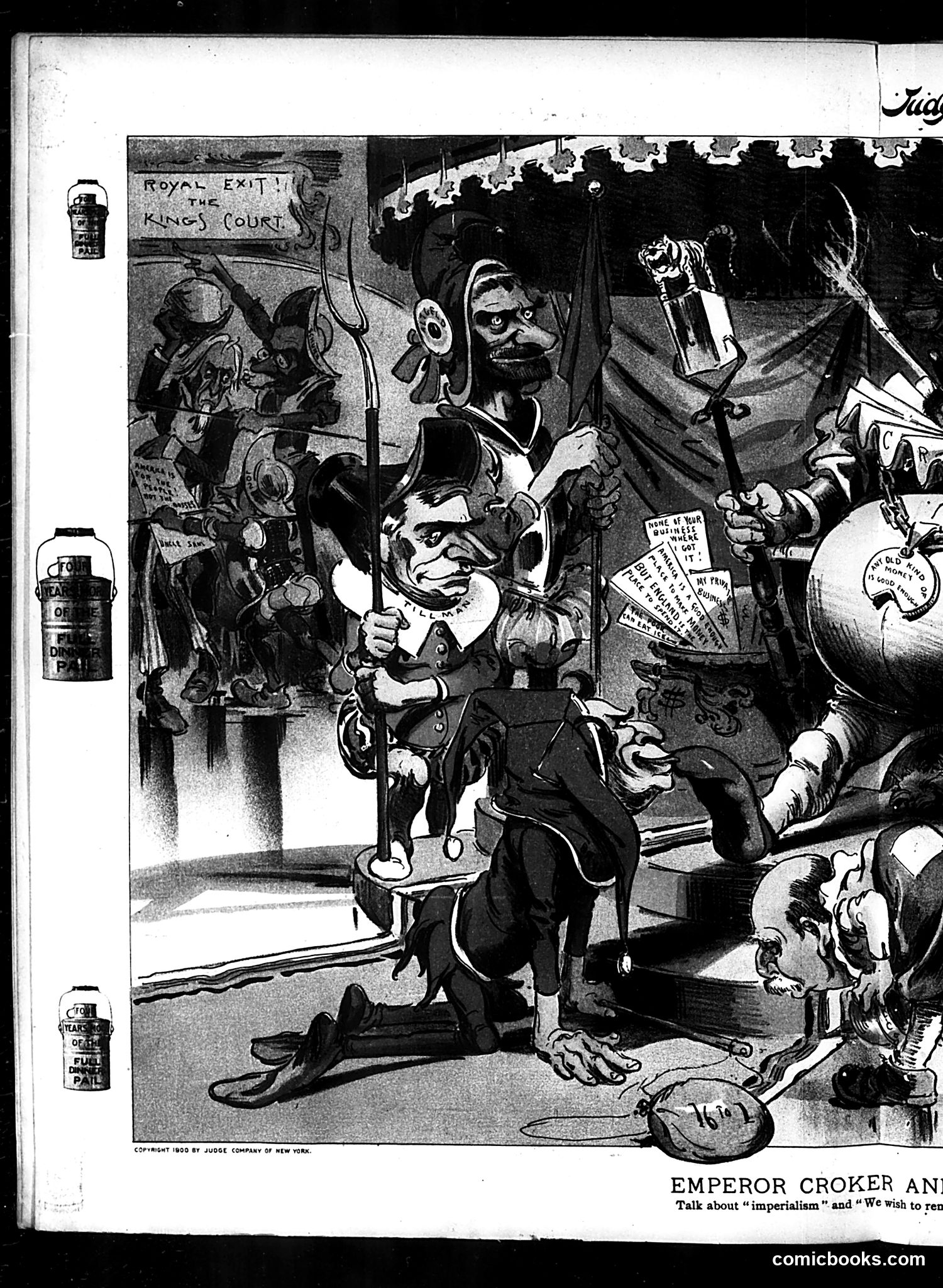
This Judge magazine cartoon satirizes **Richard Croker**, the powerful Democratic political boss of New York City's Tammany Hall machine in the late 19th/early 20th century. The image depicts Croker as an "Emperor" figure surrounded by subordinates and symbols of his political power, likely critiquing his autocratic control over Democratic politics and patronage networks. The caption references "imperialism," sarcastically comparing his domestic political dominance to imperial expansion—a timely jab given contemporary debates about American overseas imperialism. The cartoon suggests Croker wielded king-like authority over New York politics, treating the city's political apparatus as his personal empire rather than democratic governance. This was typical Judge satire targeting corrupt machine politics and concentrated power.
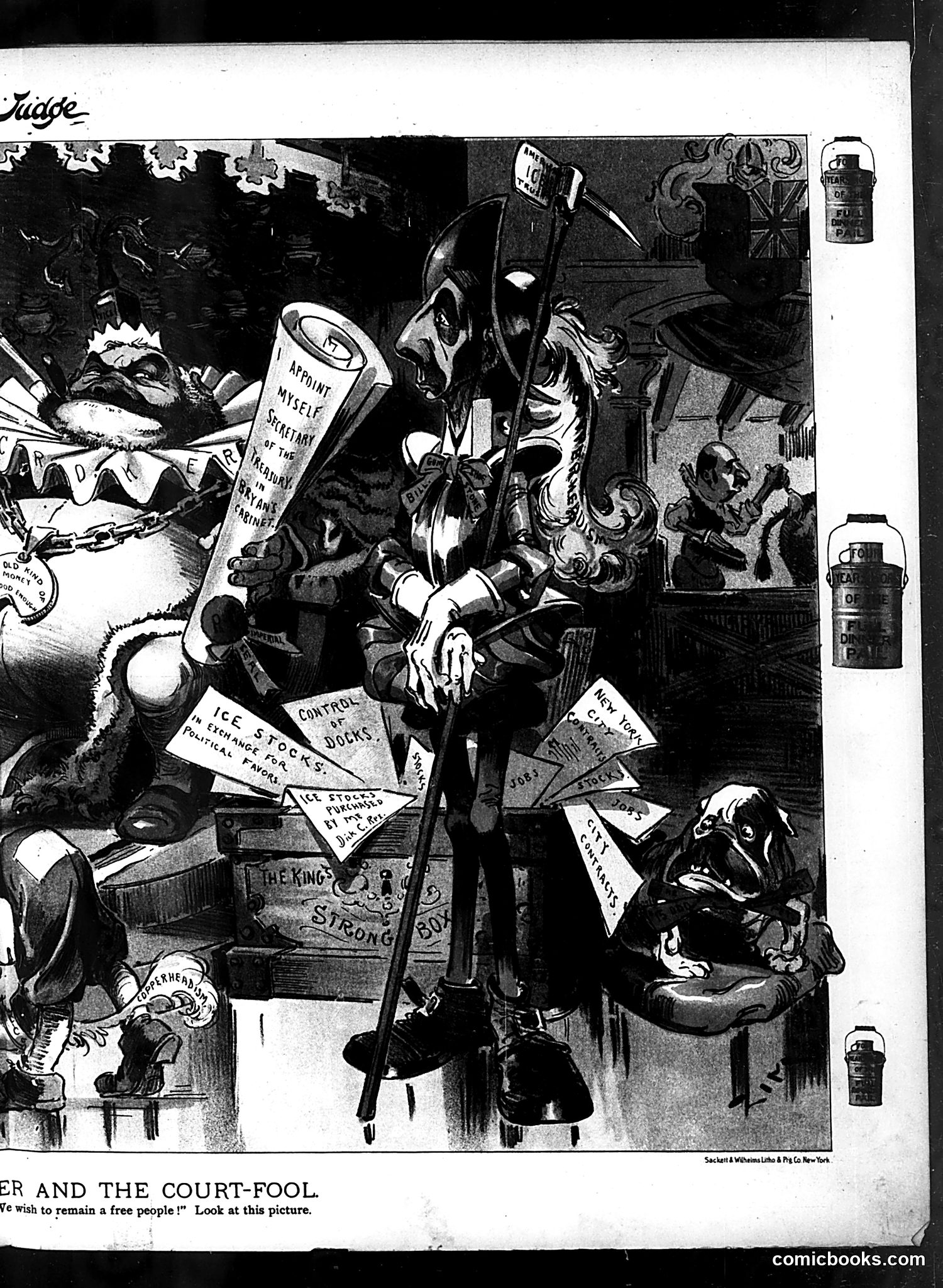
This appears to be a Judge magazine satirical cartoon titled "R and the Court-Fool," though the first figure's name is partially obscured. The cartoon depicts a well-dressed central figure (possibly a political leader or monarch) surrounded by various labeled documents and smaller caricatured figures, some appearing to be animals or fools in costume. The visible labels reference "Ice Stocks," "Control Docks," "New York," and other business/commercial terms, suggesting criticism of monopolistic control or corrupt management of public resources. The caption's reference to "remaining a free people" indicates this is political satire criticizing concentrated power or autocratic control. Without clearer identification of the main figure and date, the specific political target remains unclear, but the overall message warns against allowing such power concentration.
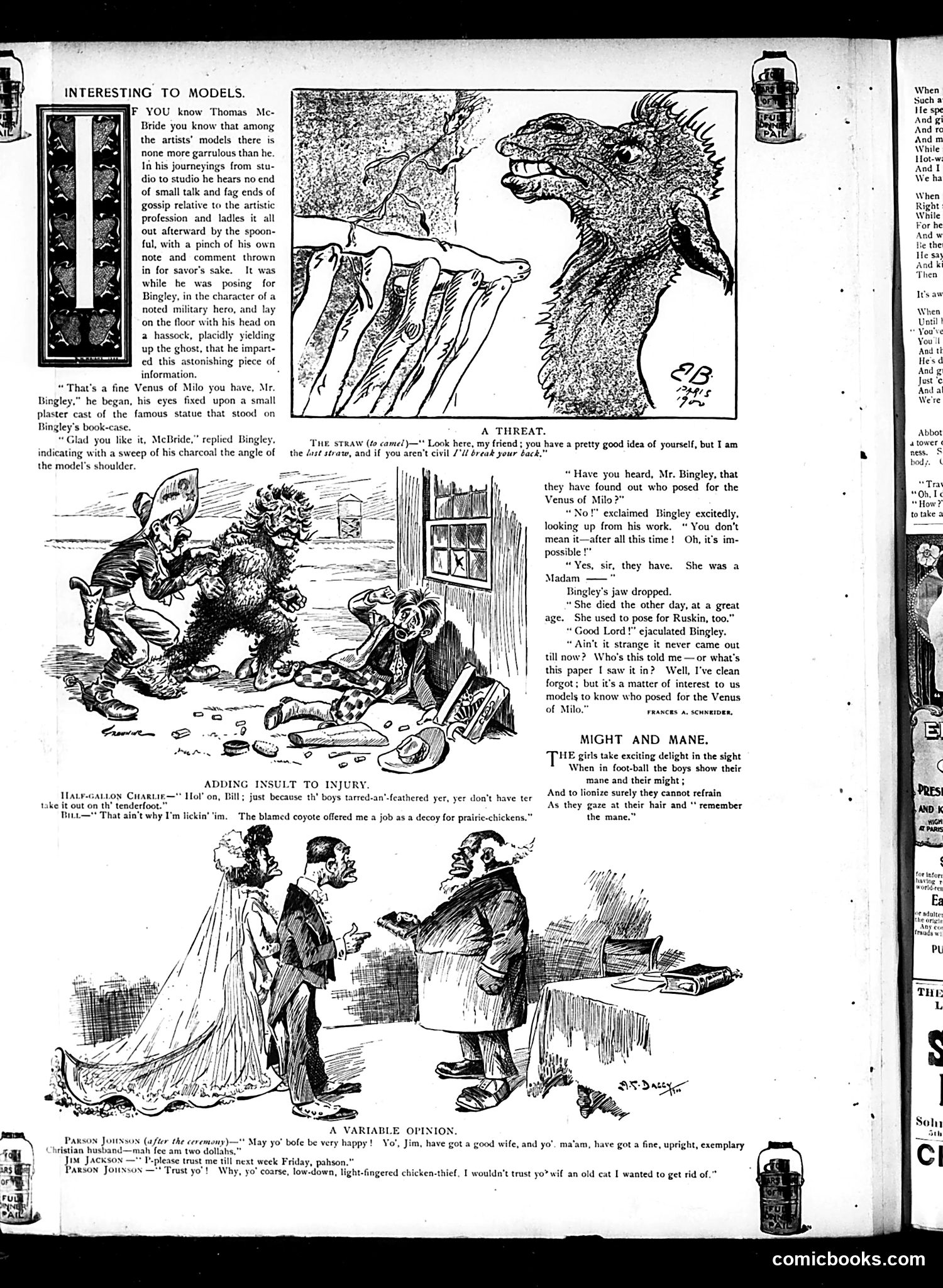
This page contains several satirical cartoons and humorous sketches typical of early Judge magazine: **"Interesting to Models"** presents a gossipy art model discussing the famous Venus of Milo sculpture with painter Bingley. The joke relies on the model's chatty nature—he claims to know who posed for the ancient statue, creating absurdist humor through the impossible premise that anyone could identify a model from antiquity. **"A Threat"** shows a camel and straw in a visual pun about "breaking a camel's back"—the final straw threatens the camel directly. **"Might and Mane"** is a light verse about football players and their hair, playing on the similar-sounding words "might" and "mane." **"Adding Insult to Injury"** depicts slapstick humor involving a disagreement over a job offer. **"A Variable Opinion"** presents Parson Johnson offering contradictory marriage advice—praising the groom to the bride while insulting him to Jim Jackson, suggesting hypocrisy or situational morality among clergy. The satire targets artistic pretension, gossip culture, and social hypocrisy rather than specific political figures.
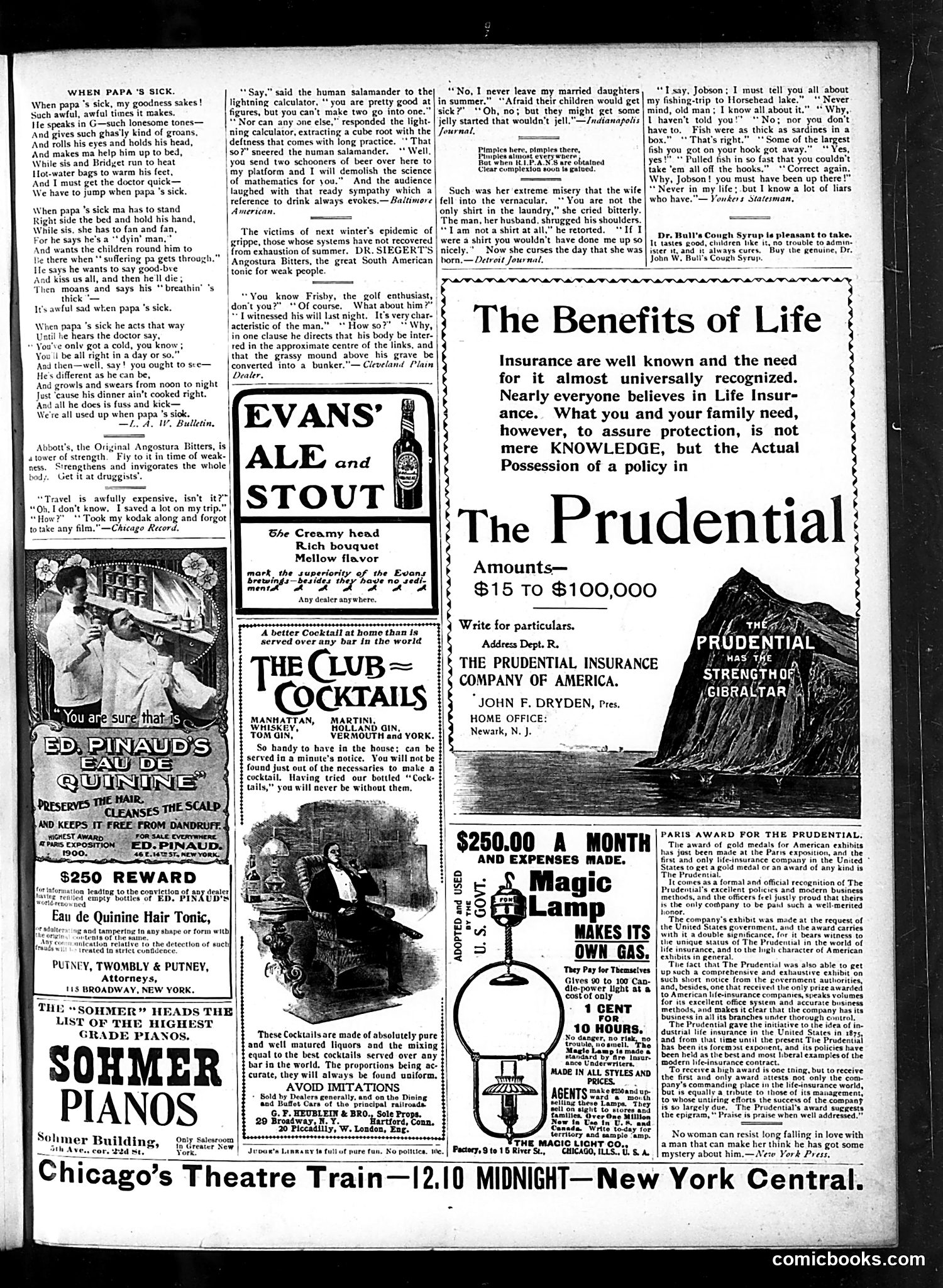
This humorous poem satirizes masculine hypochondria and domestic power dynamics. The joke depicts a father who dramatically exaggerates minor illness—moaning, demanding attention, claiming he's "dyin'"—to monopolize his wife and children's care. Once the doctor confirms it's merely a cold, he immediately recovers and becomes irritable and demanding about trivial matters like dinner preparation. The satire targets male self-centeredness: papa uses sickness as manipulation to receive sympathy and service, then reveals his theatrical illness was performative once medical reassurance arrives. The poem presents the family's exhaustion as the real consequence of his behavior. This reflects early 20th-century stereotypes about men's emotional dependency and domestic tyranny, portrayed here as comical rather than sympathetic. The piece mocks both masculine dramatics and the family dynamics enabling them.
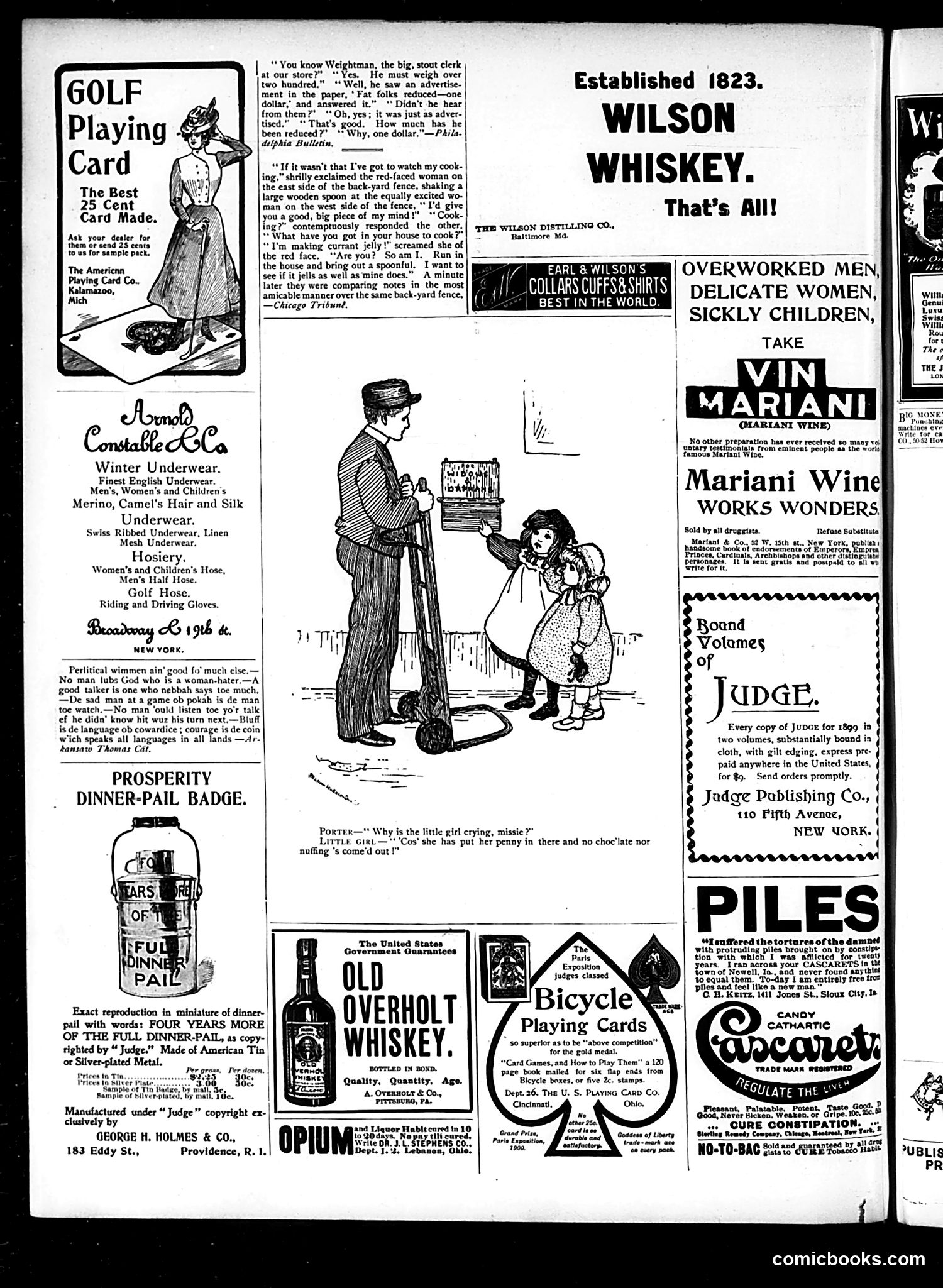
This page is primarily **advertising**, with two brief humorous anecdotes. The main cartoon depicts a porter or street vendor with a small child asking why she's crying—the joke being she put her penny in a slot expecting chocolate but nothing came out. The advertisements reflect late-19th/early-20th-century patent medicine culture: **Vin Mariani** (a cocaine-infused wine marketed as a tonic for "overworked men, delicate women, sickly children"), **Old Overholt Whiskey** (government-guaranteed), and various other products including golf cards and underwear. Notably, there's a "Prosperity Dinner-Pail Badge"—referencing McKinley's 1900 campaign slogan promising "a full dinner pail" under Republican policies. The two jokes mock working-class people: one ridicules a man who paid a dollar to a weight-loss scam; another shows two working-class women bonding over making currant jelly. These reflect *Judge*'s satirical posture toward ordinary people while promoting consumer products to its middle-class readership.
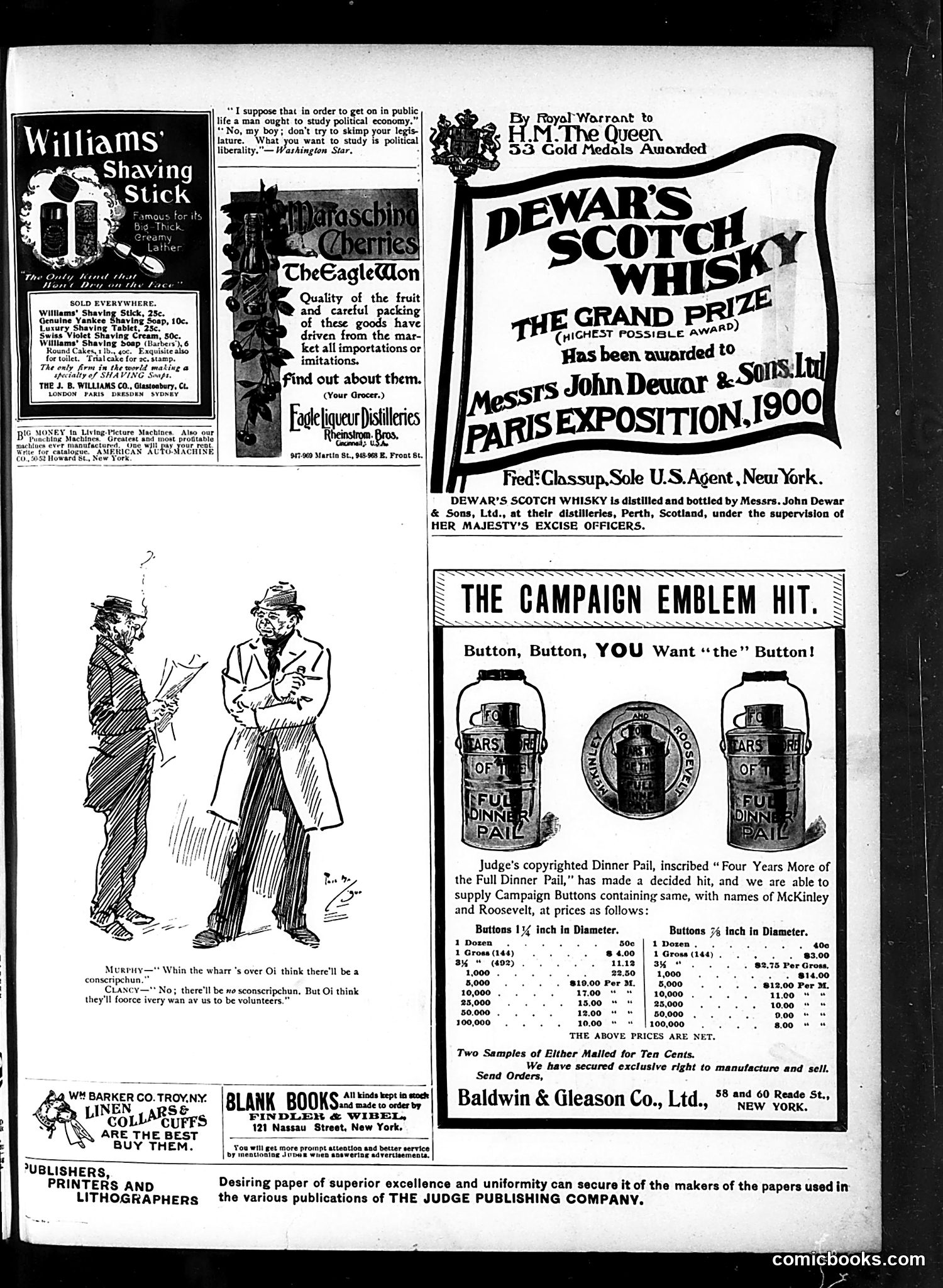
The main cartoon depicts two Irish immigrants (identifiable by dialect and caricature style typical of early 1900s American satire) discussing military conscription. "Murphy" expects conscription will follow after "the wharr's over" (the Spanish-American War), while "Clancy" corrects him—there won't be conscription, but rather forced volunteerism for all. The satire targets **American imperialism and militarism** following the 1898 Spanish-American War. The joke's irony: the government will pressure citizens into "volunteering" for military service, making "voluntary" enlistment effectively mandatory. This critiques how imperial expansion required constant troop commitments while maintaining democratic pretenses. The page is primarily **advertising** (Williams' Shaving Stick, Dewar's Whisky, campaign buttons for McKinley-Roosevelt featuring the "Full Dinner Pail" slogan). The cartoon's ethnic caricature reflects Judge's era—immigrant voices were standard for satirizing working-class political awareness.
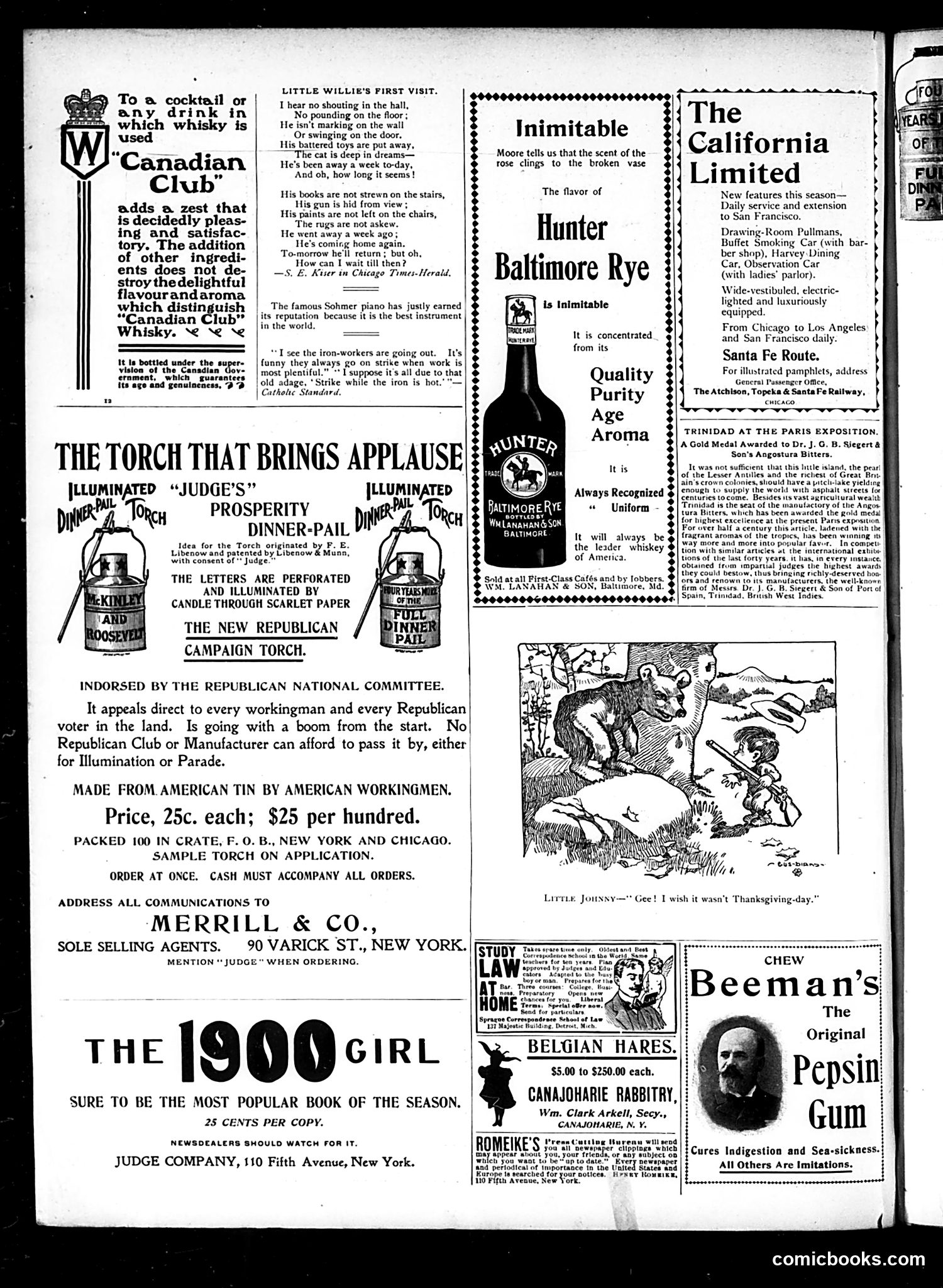
This page is primarily **advertising**, with one notable political cartoon. The main content is a campaign torch advertisement endorsed by the Republican National Committee, promoting an illuminated "Prosperity Dinner-Pail" torch made from American tin by American workers—clearly targeting working-class Republican voters before an election (likely 1900, given "The 1900 Girl" book advertisement below). The only political satire is a brief joke about labor strikes: "I see the iron-workers are going out...I suppose it's all due to that 'Strike while the iron is hot.'"—a pun playing on the common labor unrest of the era. The remainder consists of advertisements for whisky, a train service, bitters, Belgian hares, and digestive products. The "Little Willie" poem is sentimental domestic humor about a child's absence, unrelated to politics.