
A complete issue · 16 pages · 1900
Judge — October 6, 1900
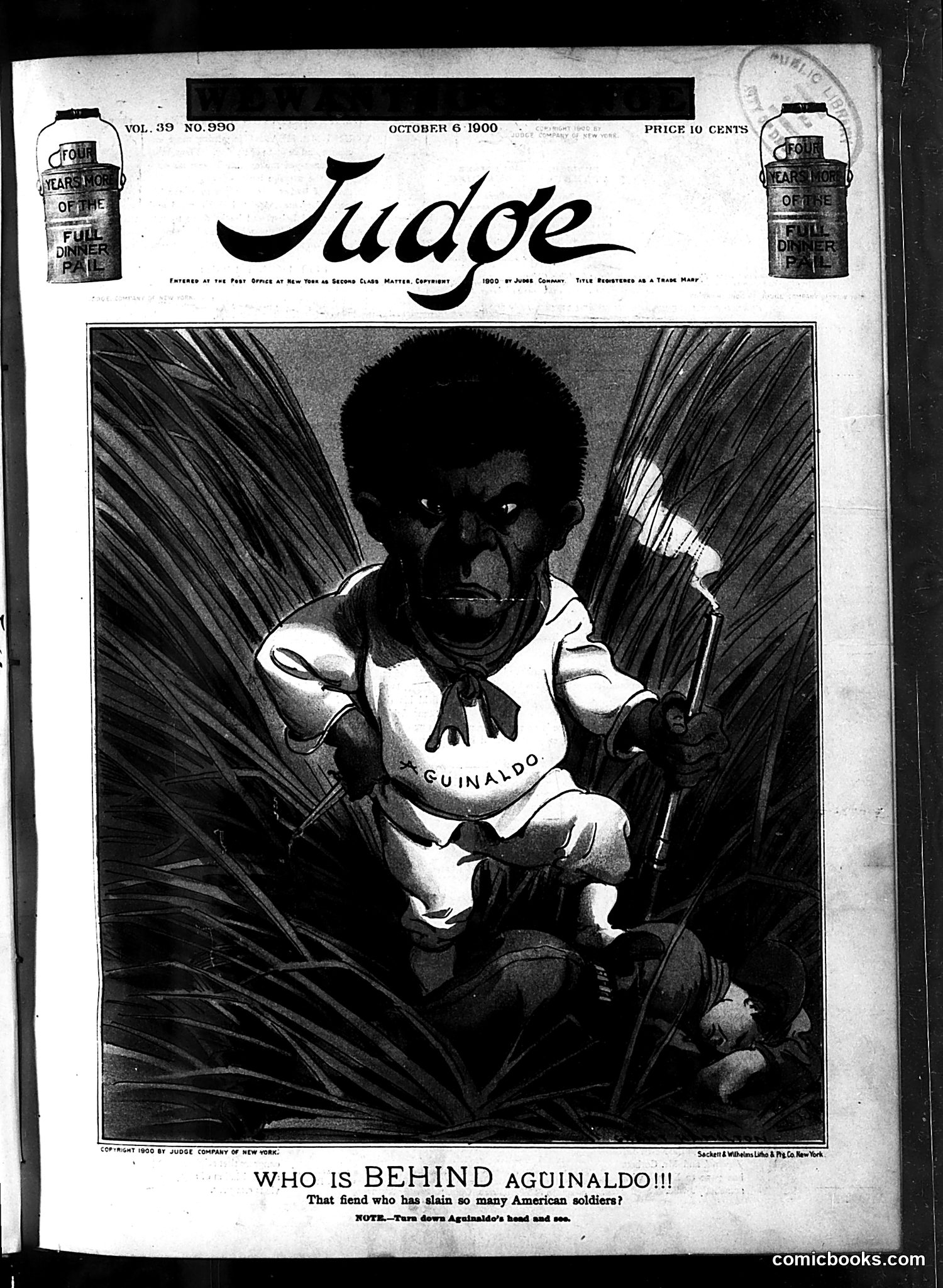
This cover satirizes **Aguinaldo**, the Filipino revolutionary leader fighting American forces during the Philippine-American War (1899-1902). The grotesque caricature—with exaggerated racial features—depicts him as a malevolent figure, depicted cradling what appears to be weapons or ammunition. The headline "WHO IS BEHIND AGUINALDO!!!" with the subtitle "That fiend who has slain so many American soldiers?" suggests conspiracy theories about foreign powers secretly supporting the Filipino insurgency against U.S. occupation. The imagery reflects American imperialist attitudes of the era: dehumanizing depictions of colonial resistance fighters were common in contemporary media. This represents how Judge magazine used racial caricature to justify American military intervention and frame Filipino independence fighters as barbaric enemies rather than legitimate resistance movements.
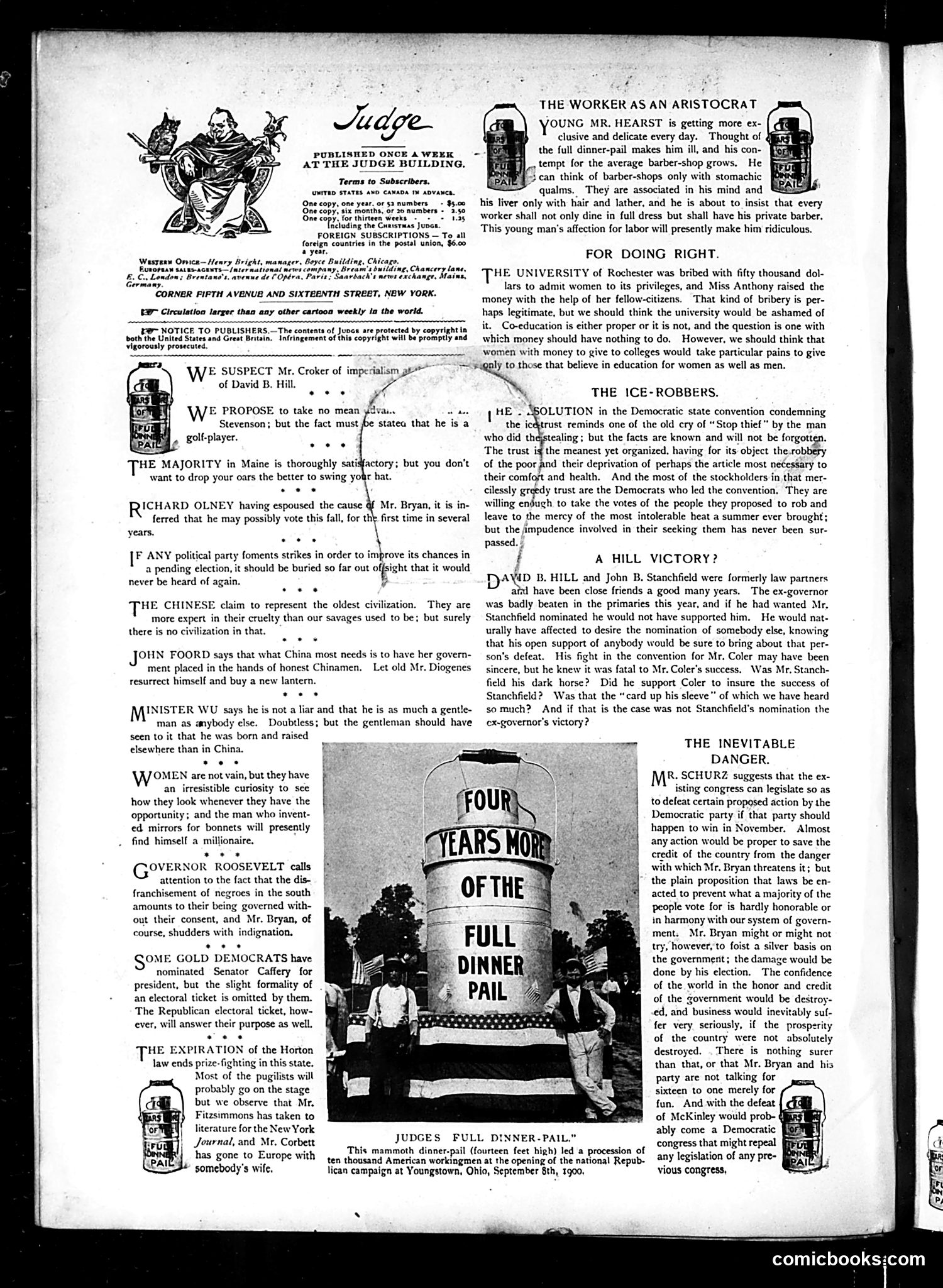
The central cartoon depicts a massive dinner pail labeled "FOUR YEARS MORE OF THE FULL DINNER PAIL," a Republican campaign slogan promising continued prosperity. Workers process toward it, referencing President McKinley's 1900 re-election campaign, which used "the full dinner pail" as shorthand for economic wellbeing under Republican rule. The surrounding editorial commentary attacks Democratic and reform positions: criticizing Bryan's potential presidency, mocking attempts to admit women to universities, and defending trusts as beneficial. One item sarcastically notes China needs imperialism rather than democracy. The overall message: Judge advocates Republican policies and prosperity while dismissing progressive social reforms and Democratic alternatives—typical conservative satire of the McKinley era (circa 1900).
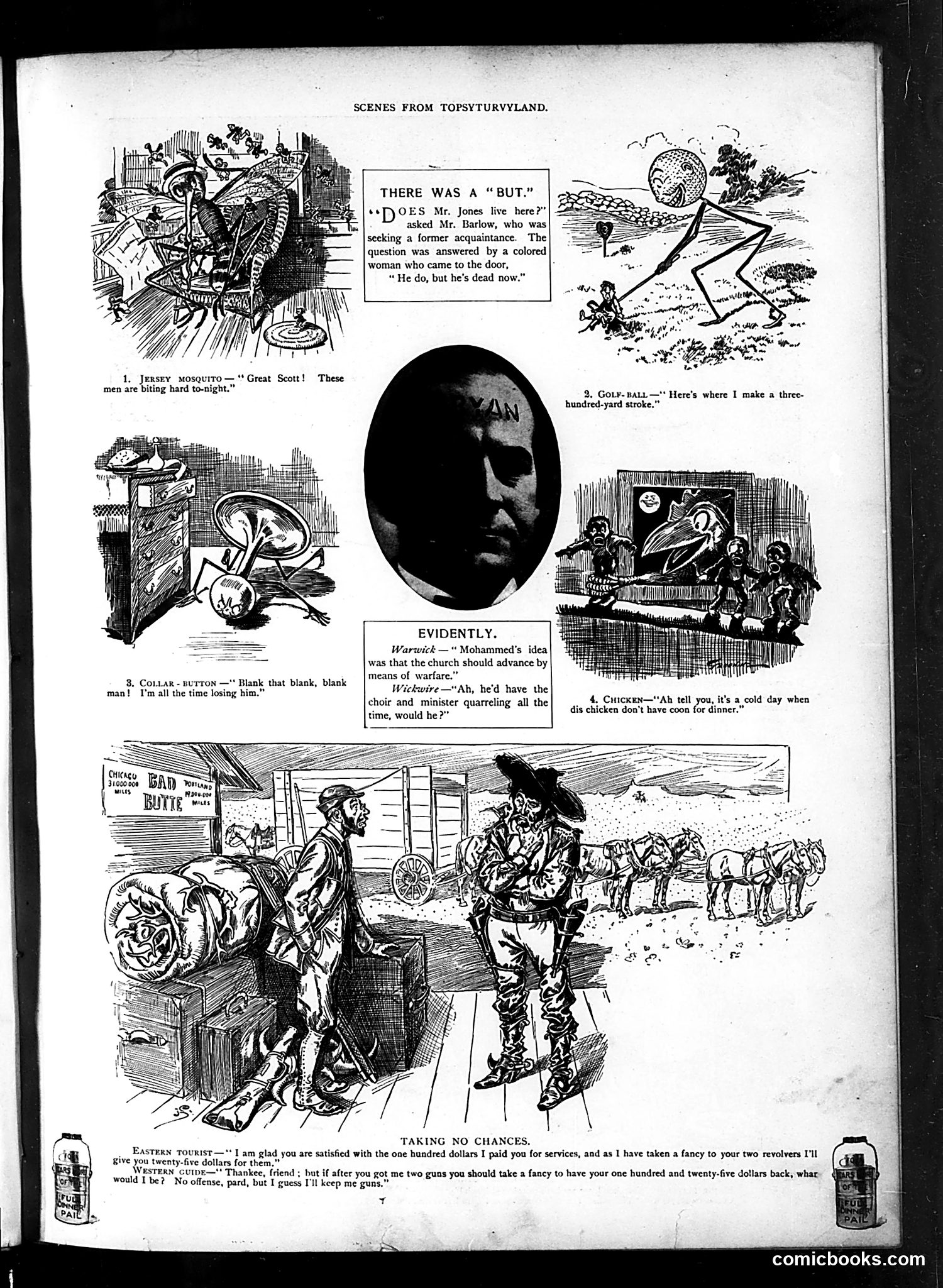
This page from Judge magazine presents satirical vignettes mocking everyday absurdities. The sketches include: 1. **Jersey Mosquito**: A man complaining about aggressive insects biting him at night—likely satirizing New Jersey's notorious mosquito problem. 2. **Collar-Button**: A domestic complaint about a lost button, a common household frustration. 3. **Golf-Ball**: A golfer's exaggerated claim about his shot distance. 4. **Chicken Dinner**: A complaint about missing poultry at mealtime. The central photograph appears to be a portrait, possibly of a public figure, though identification is unclear from the image alone. The large bottom cartoon, "Taking No Chances," depicts an "Eastern Tourist" negotiating with a Western figure over firearms and payment—satirizing Western frontier stereotypes and tourist anxieties about frontier violence and robbery.
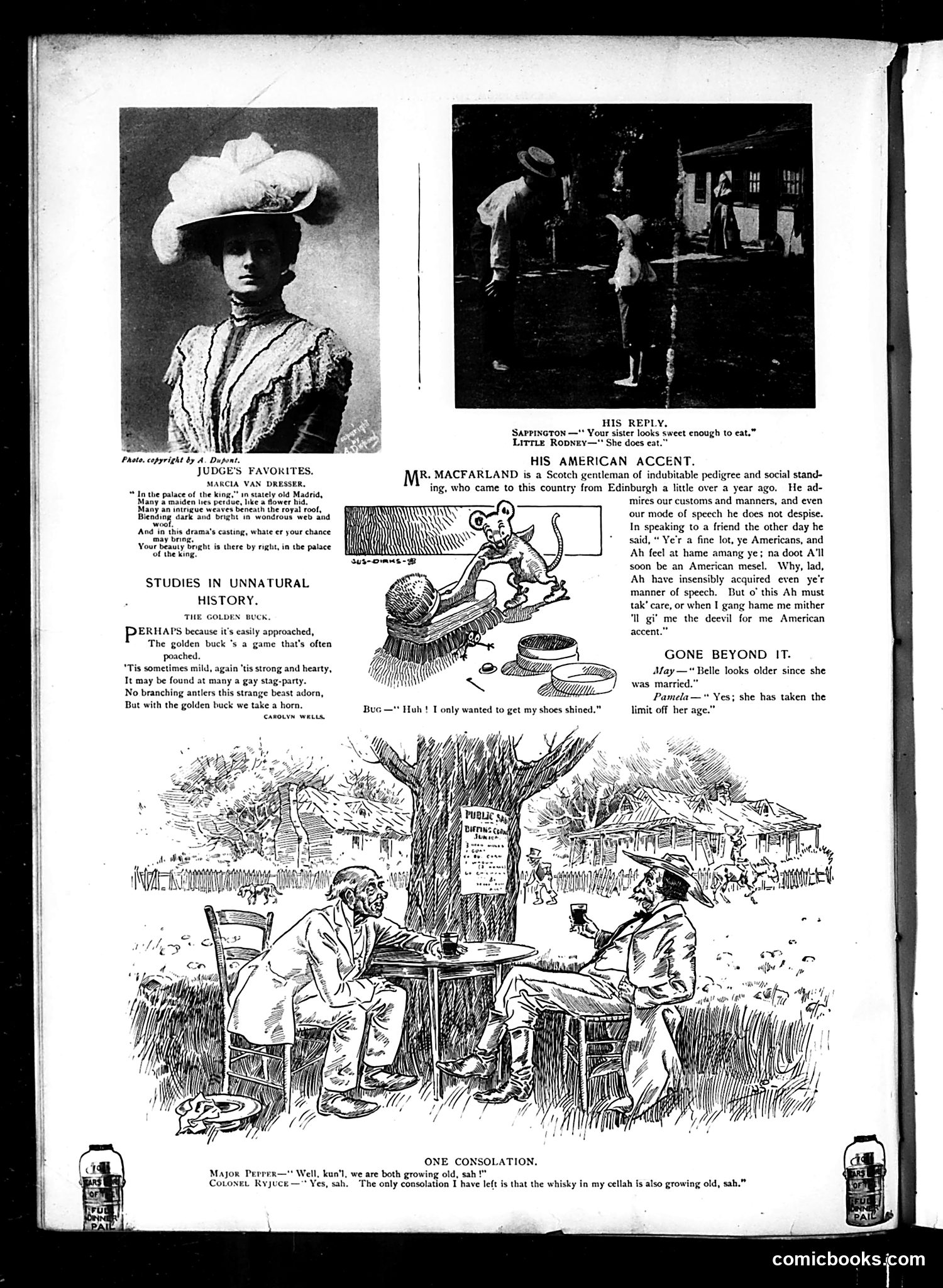
This page contains several satirical pieces from an early 20th-century American humor magazine: **"His American Accent"** mocks Mr. MacFarland, a Scottish gentleman who recently immigrated to America. The joke ridicules his affected attempt to adopt an American accent and manner of speech while maintaining Scottish mannerisms—a common subject of immigration-era humor. **"Gone Beyond It"** appears to be a brief quip about a woman's age relative to marriage. **"One Consolation"** depicts two men (identified as Major Petter and Colonel Kylice) commiserating under a tree about aging—one notes his whisky collection is also growing old alongside him. The page also includes fashion commentary ("Marcia Van Dressers") and a poem about golden bucks. These reflect Judge's typical blend of social commentary, fashion critique, and immigrant humor popular in American publications of this era.
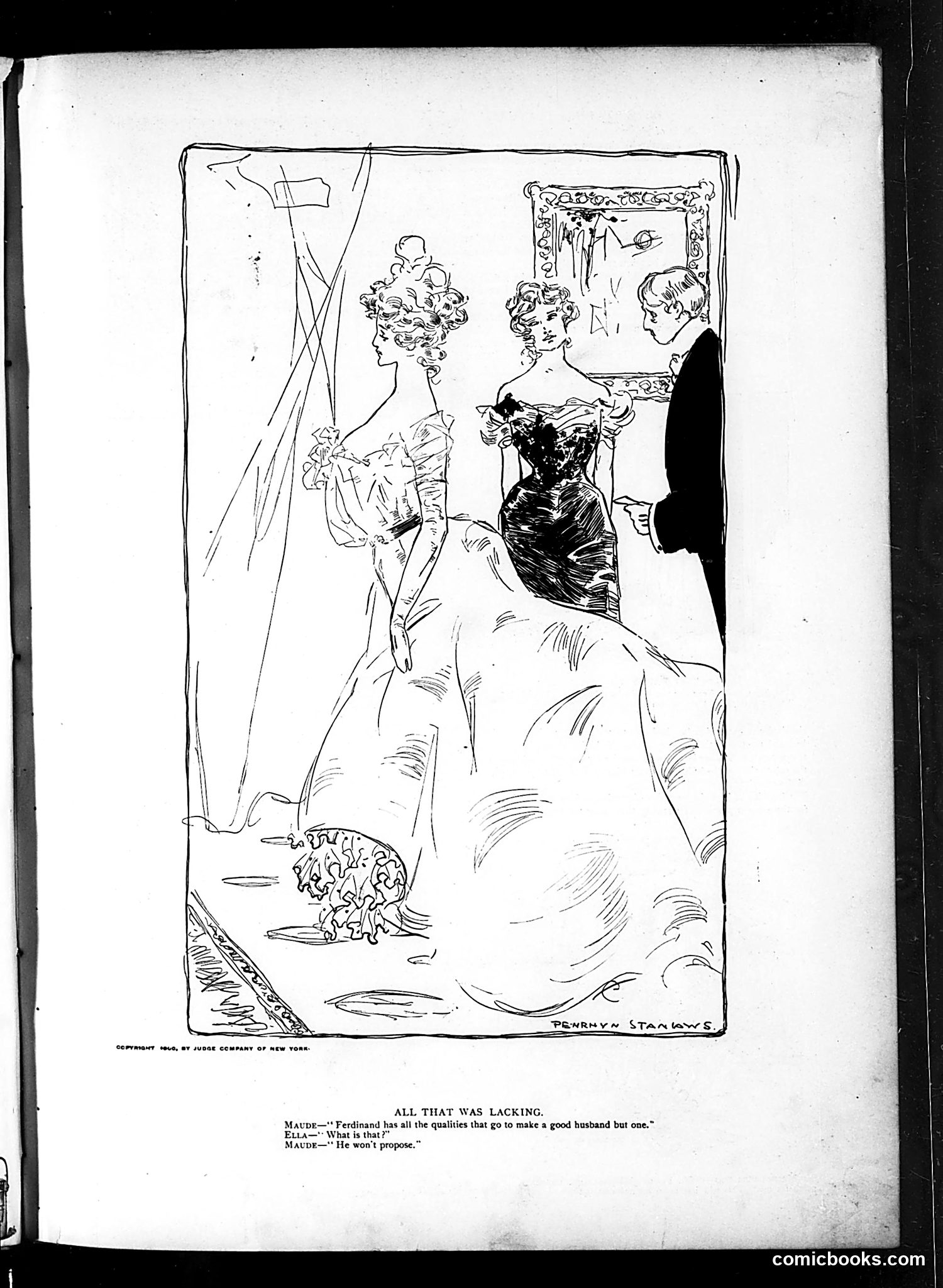
This Judge cartoon satirizes courtship conventions of the early 20th century. The dialogue reveals a social paradox: two women (Maude and Ella) discuss Ferdinand, who possesses all qualities needed for a good husband—except one crucial element: he won't propose. The satire targets the era's rigid gender expectations, where women could recognize a suitable match but were powerless to initiate marriage proposals. A man's willingness to propose was literally "all that was lacking," highlighting the absurdity of denying women agency in their own romantic futures. The woman in the black dress observing the scene suggests social scrutiny of unmarried women, reinforcing period anxieties about spinsterhood and the importance of securing a husband regardless of personal choice.
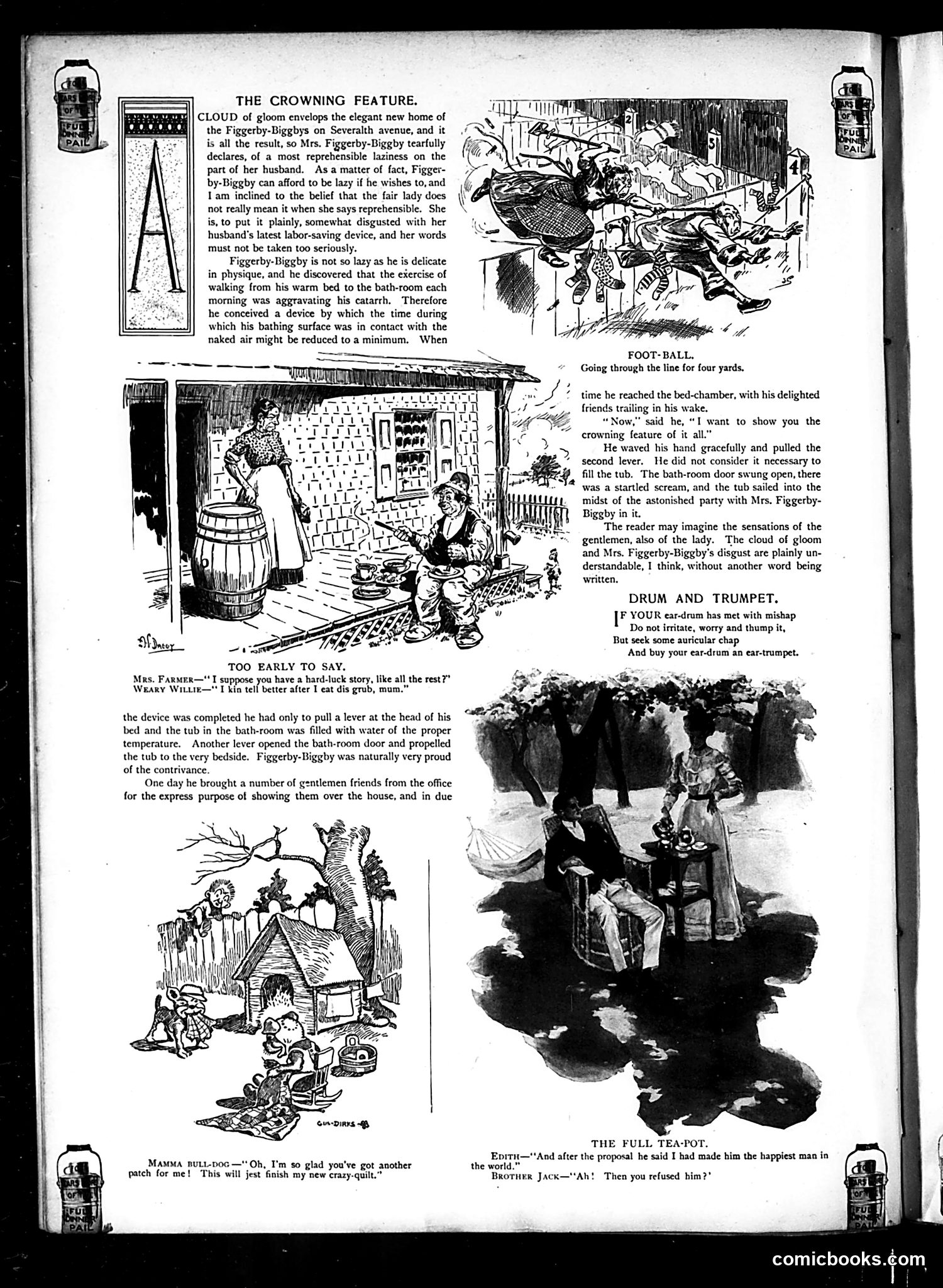
This page from *Judge* satirizes upper-class pretension through the mishap of Mr. Figgerby-Biggby, a wealthy but physically delicate man who invents an elaborate labor-saving contraption to avoid walking to his bathroom. His mechanical device—controlled by levers—was meant to deliver a filled bathtub to his bedside automatically. The joke: When he demonstrates his invention to office colleagues, he pulls the wrong lever. The tub launches into the room with Mrs. Figgerby-Biggby still inside it, causing chaos and scandal. The "crowning feature" refers both to his pride in the invention and the humiliating exposure. The satire targets Gilded Age excess: wealthy industrialists' obsession with labor-saving devices and comfort taken to absurd extremes, combined with the social embarrassment of public failure. The accompanying "Foot-Ball" cartoon and other vignettes are separate humorous pieces.
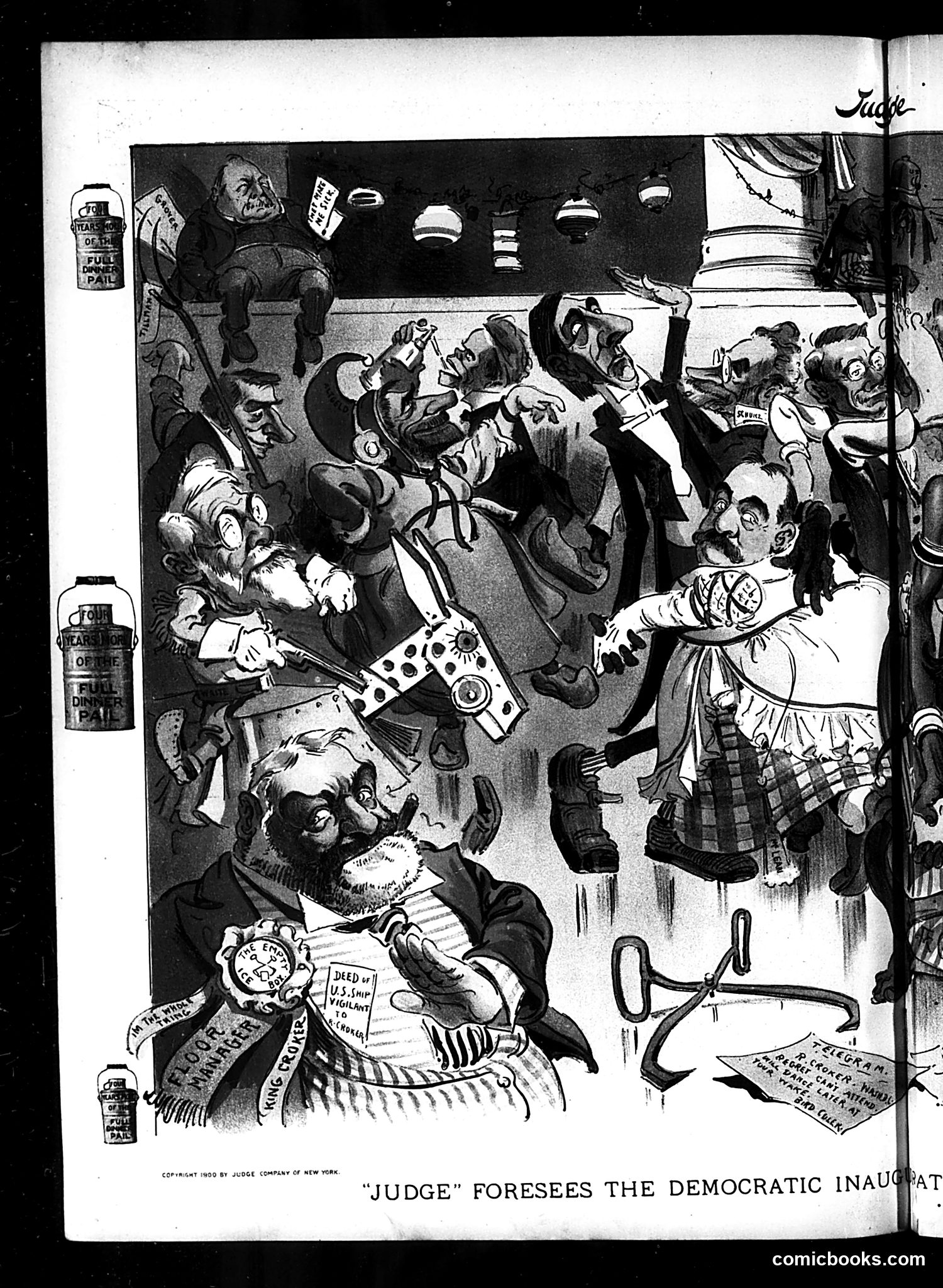
This satirical cartoon depicts a chaotic Democratic presidential inauguration scene. The caricatured figures appear to represent Democratic political figures or stereotypes of the era, rendered with exaggerated features typical of Judge magazine's style. The scene shows mayhem and disorder at what should be a formal state ceremony—suggesting the cartoonist's prediction that Democratic leadership would be incompetent or corrupt. Various figures engage in undignified behavior while formal inaugural elements (podium, ceremonial dress) surround them. The left margin displays bottles labeled "FULL DINNER PAIL," an American political slogan. The overall message appears to be a Republican critique forecasting Democratic mismanagement, though without a visible date or clearer text, the specific election year and targets remain uncertain.
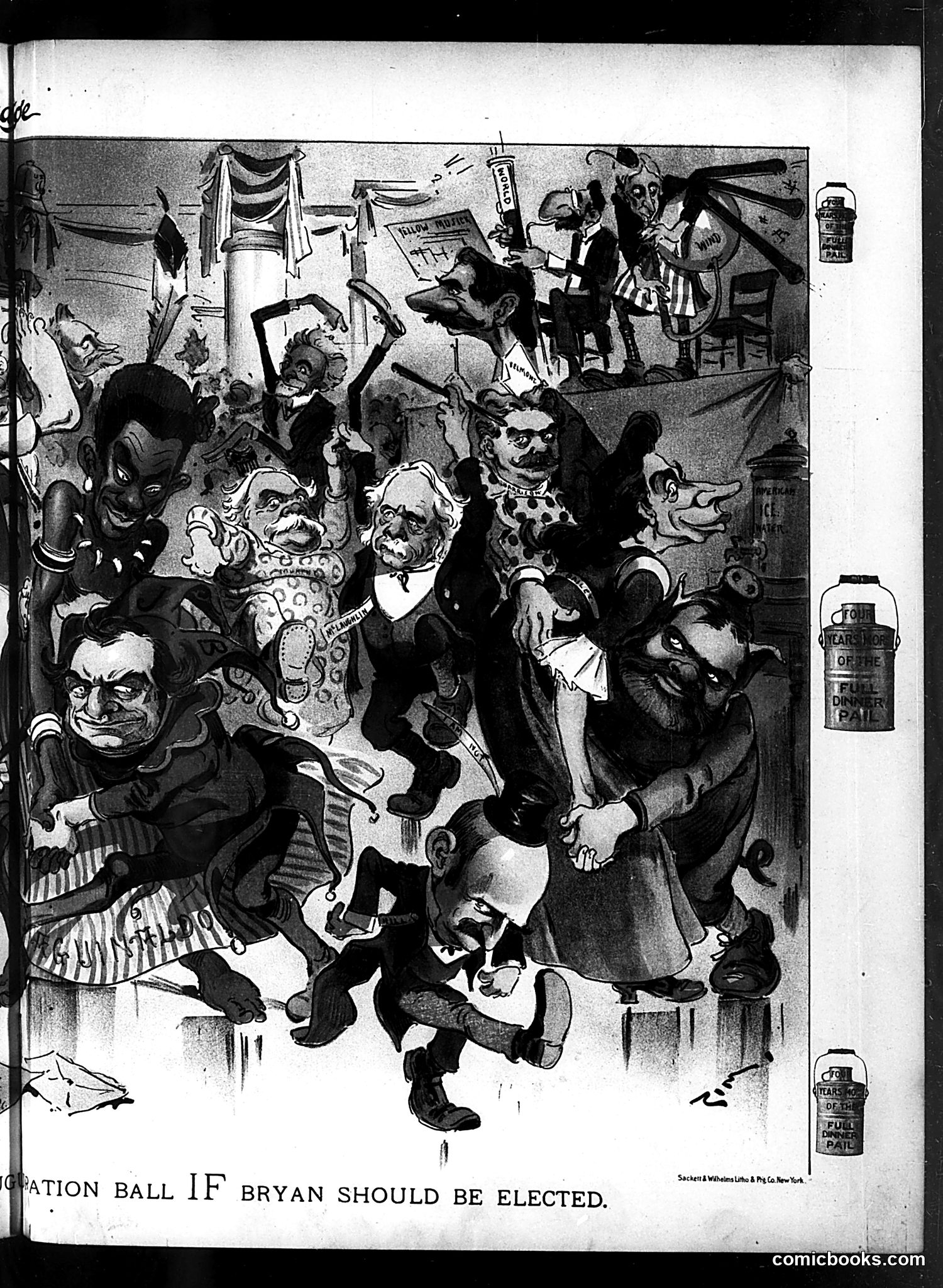
This is a satirical cartoon titled "Celebration Ball If Bryan Should Be Elected," depicting a chaotic, grotesque party scene. The image shows caricatured figures—appearing to be political opponents or those feared to benefit from William Jennings Bryan's election—in wild, drunken celebration. The exaggerated facial features and distorted body language suggest mockery of Bryan supporters. The cartoon functions as **opposition propaganda**, warning voters that Bryan's election would unleash chaos and unleash undesirable elements of society. The "celebration ball" metaphor presents his potential victory as catastrophic for the established order. Judge magazine, a Republican-leaning publication, used such imagery to discourage Bryan's presidential campaigns (he ran multiple times around 1896-1908), appealing to voters' fears about social disorder and radical change.
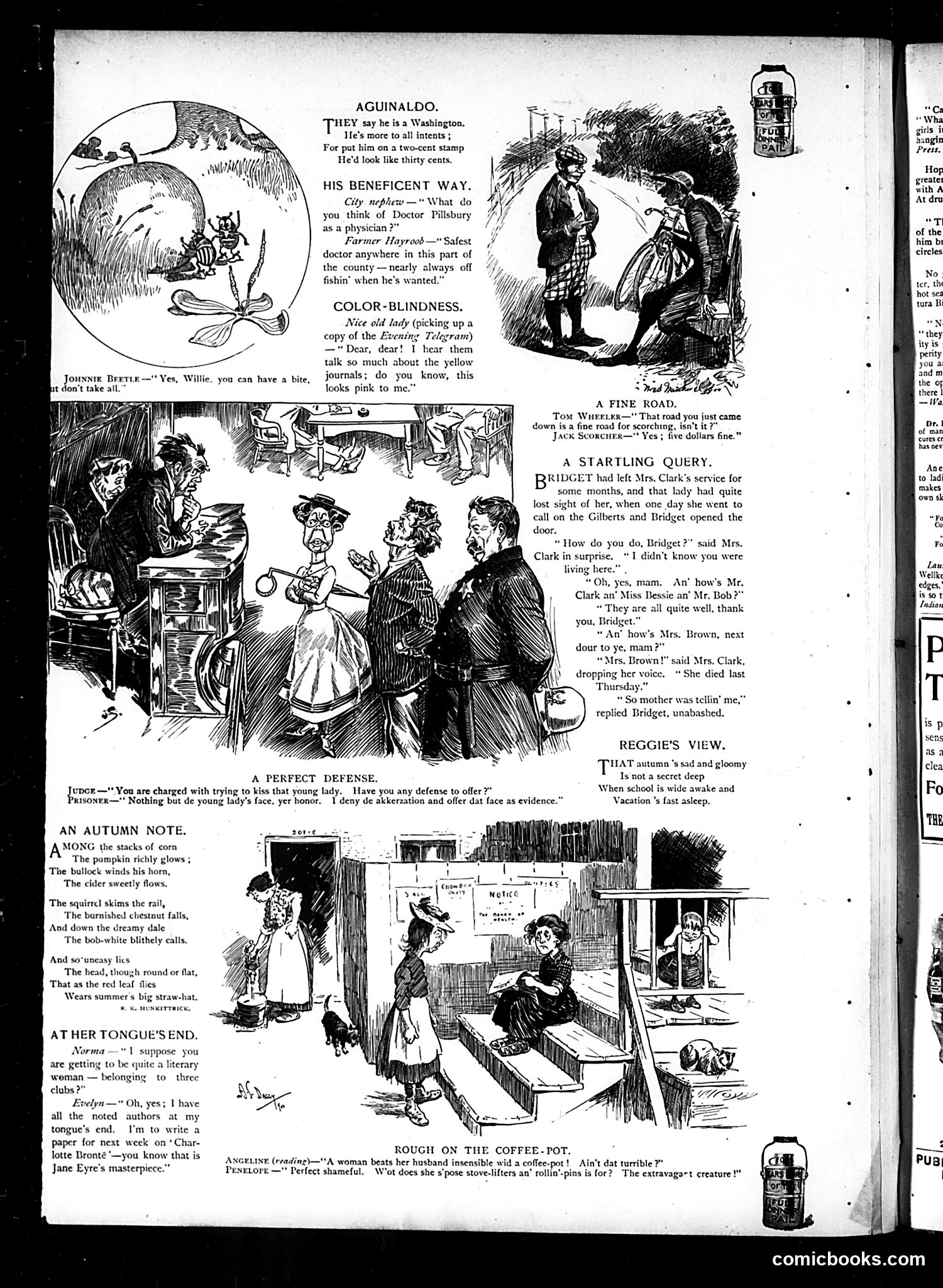
This page collects brief satirical jokes and humorous observations typical of Judge magazine's format. **Notable items:** The **Aguinaldo** verse mocks Filipino revolutionary leader Emilio Aguinaldo, likely referencing the ongoing Philippine-American War (1899-1902). The joke suggests he's overvalued—worthless on a postage stamp despite claims of importance. **"His Beneficent Way"** satirizes Dr. Pillsbury as an absent physician more interested in fishing than patients—a common Victorian trope about incompetent professionals. **"A Perfect Defense"** uses a crude racial stereotype in dialect, where a defendant claims an unattractive woman's face as legal defense against assault charges. **"A Fine Road"** plays on "scorching" (reckless driving) versus actual traffic fines. **"A Startling Query"** depicts Bridget, an Irish servant, blithely unaware of social niceties—unfazed learning of a neighbor's death. The remaining items are light verse, dating jokes, and domestic humor reflecting period attitudes toward gender, class, and ethnicity typical of early 1900s American satire.
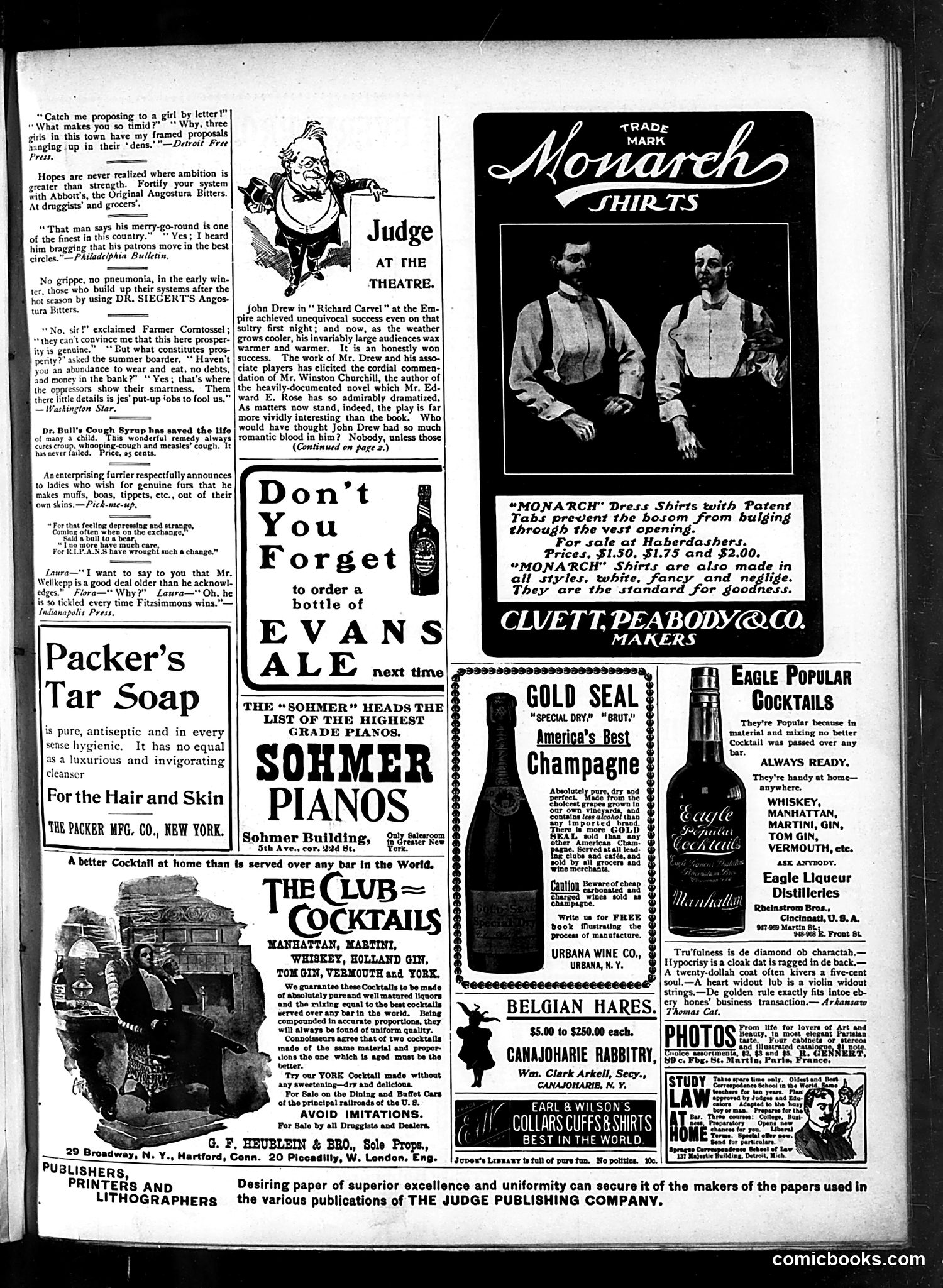
This is primarily an **advertising page** with brief satirical snippets interspersed. The main content consists of ads for products (soap, pianos, cocktails, champagne, shirts) and patent medicines typical of the era. The small satirical items mock: 1. **Male vanity**: A man keeps framed rejection letters from women in their homes—suggesting men are foolish enough to believe failed proposals are trophies. 2. **Class pretension**: A merry-go-round owner brags his patrons are "in the best circles"—absurd because carousel riders literally move in circles. 3. **Rural skepticism of prosperity**: Farmer Comtossel distrusts that having food, clothing, money, and no debt constitutes genuine prosperity—he sees it as a trick by "oppressors." 4. **Age vanity**: A woman notes her friend is older than he admits because he gets visibly excited when boxer Fitzsimmons wins—suggesting he's foolish and youthful in his enthusiasm. The review of John Drew's stage adaptation of "Richard Carvel" praises the actor's unexpected romantic depth in the role.
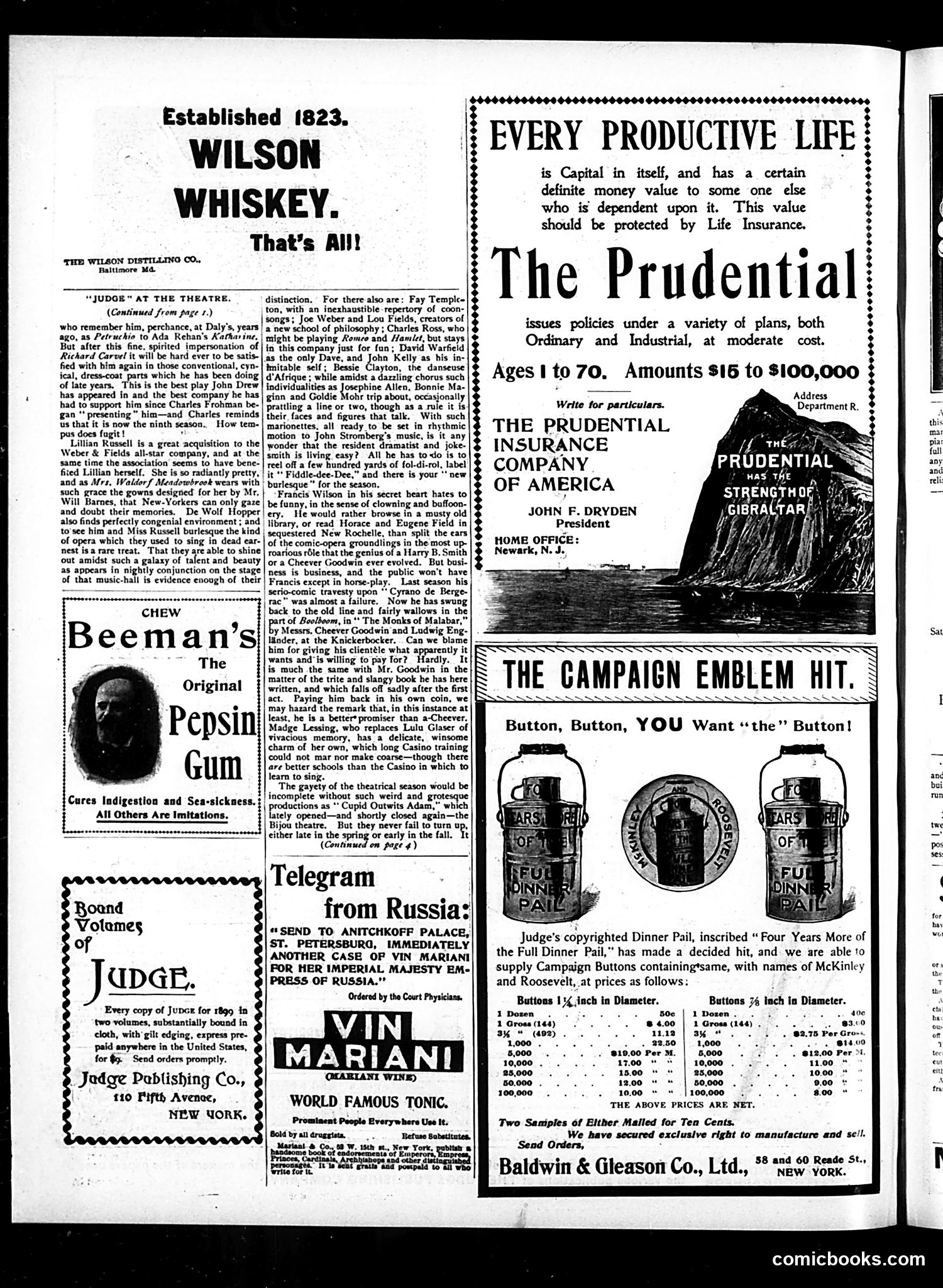
This page is primarily **advertising and theater criticism**, not political cartoons. The main content is a theater review ("Judge at the Theatre," continued from page 1) discussing recent Broadway productions, including performances by John Drew, Lillian Russell, and Francis Wilson at Weber & Fields. The review critiques theatrical trends: Francis Wilson apparently dislikes comedic buffoonery but performs it because audiences demand it—a commentary on commercial theater compromising artistic integrity. The advertisements include Wilson Whiskey ("established 1823"), Beeman's Pepsin Gum, Judge Publishing's bound volumes, Vin Mariani (a tonic wine), and insurance/dinner pail products. There's no evident political satire on this particular page—it reflects Judge magazine's mixed format of theater commentary and commercial advertisements typical of late 19th-century publications.
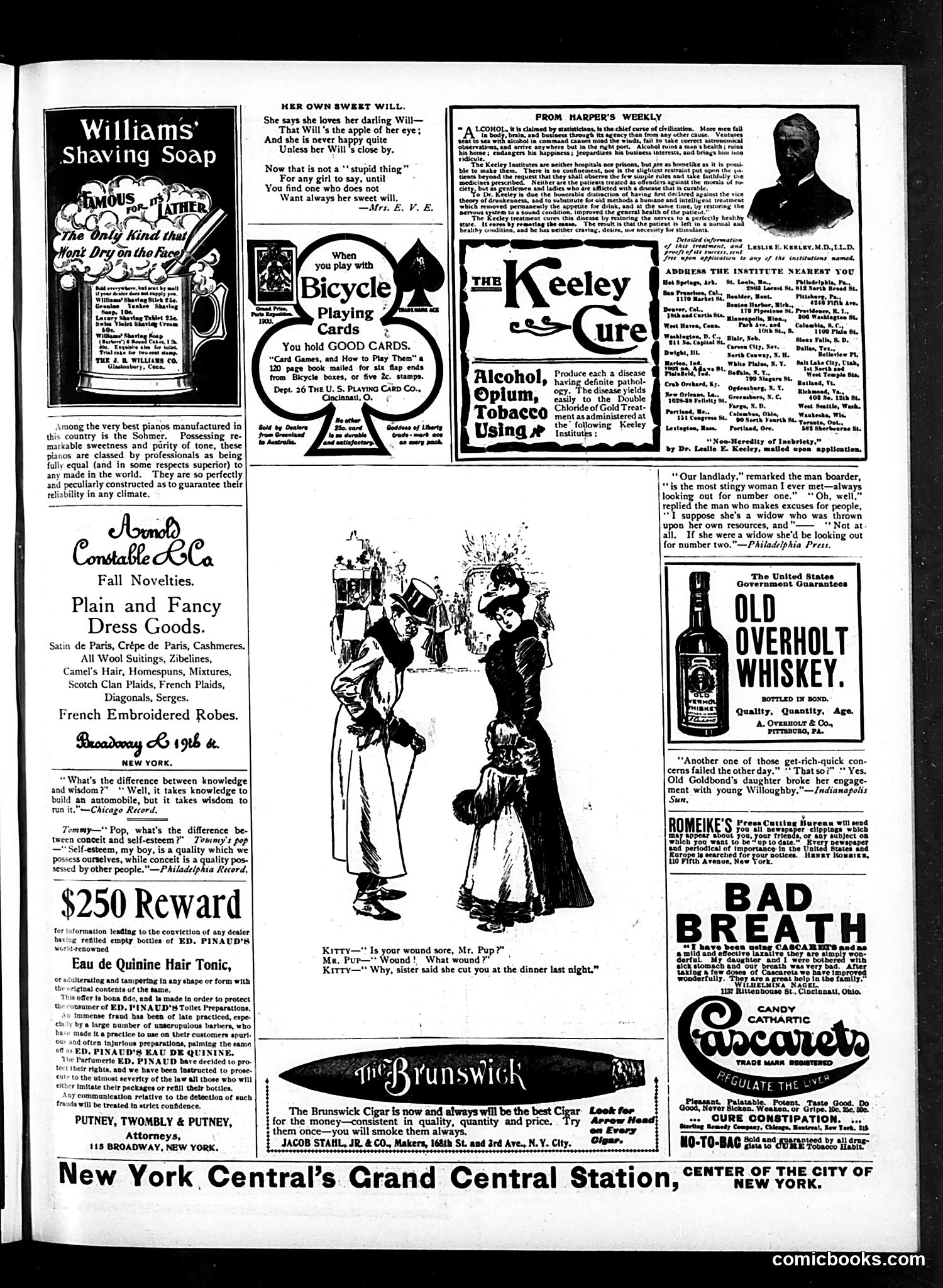
This page is primarily **advertising**, not political satire. The layout features commercial ads for consumer goods and services typical of early 20th-century America. The main illustrated cartoon (center) shows a domestic scene with a woman confronting a man about a "cut" at dinner—likely a social snub or insult. The accompanying text quotes suggest this depicts marital or relationship tension over social standing. The page's dominant content includes ads for: - **Williams' Shaving Soap** (upper left) - **Sohmer pianos** - **Bicycle Playing Cards** - **The Keeley Cure** (addiction treatment) - **Old Overholt Whiskey** - **Bad Breath remedies** - Various dress goods and remedies The humor pieces are mild domestic jokes about knowledge versus wisdom, and a woman's desire to have her "own sweet will"—reflecting contemporary gender dynamics where women's autonomy was limited. This represents Judge's mixed model: satirical content supporting serious advertising revenue.
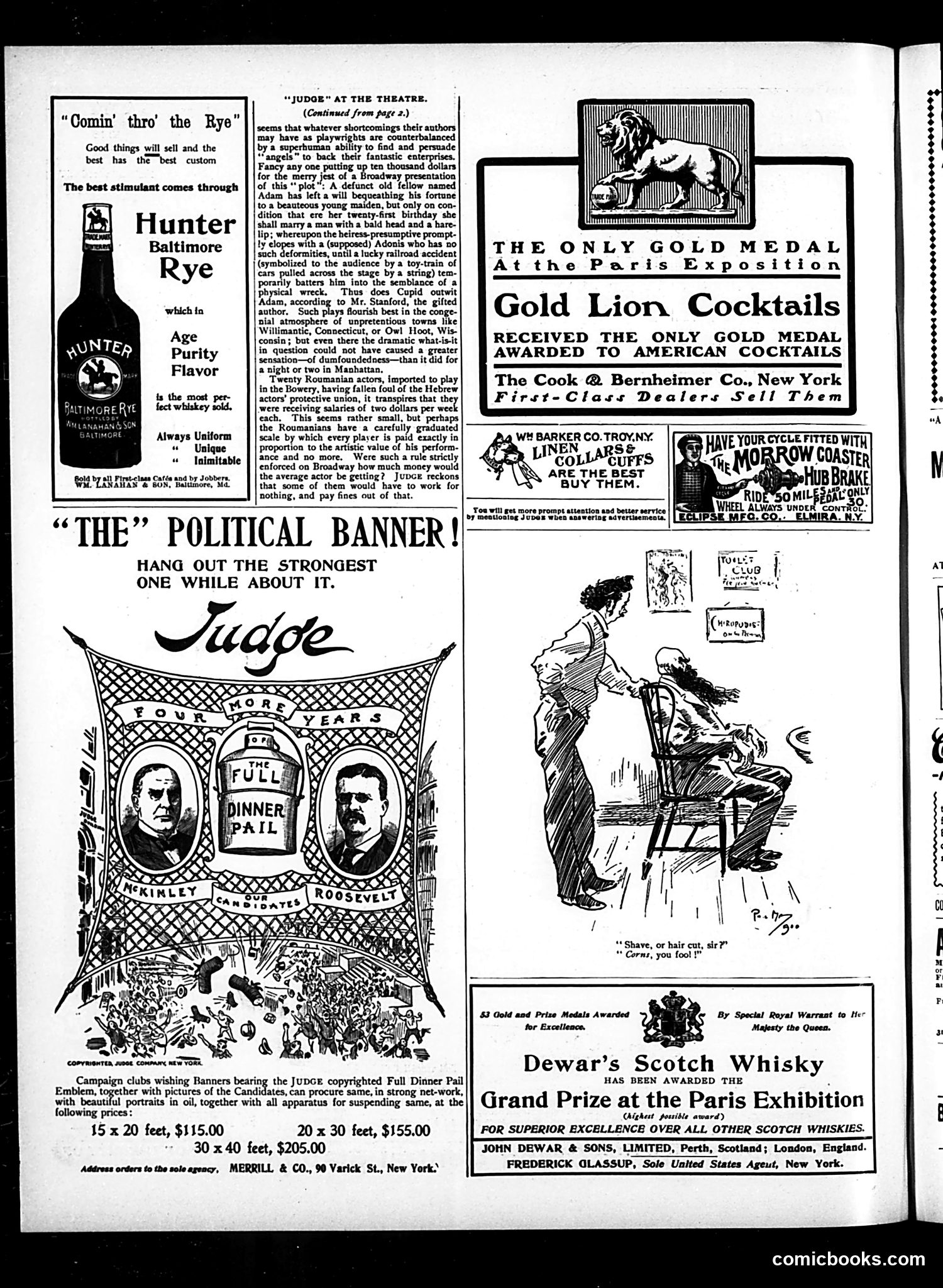
This page is primarily **advertisements and commercial content** interspersed with theater criticism and one political cartoon. The main political content is "THE POLITICAL BANNER" section featuring a **Judge campaign banner** for the 1904 election. The banner shows three portraits—likely candidates or political figures—with a "Full Dinner Pail" emblem (a Republican campaign slogan). The text invites campaign clubs to purchase banners, positioning Judge as supporting this political messaging. The **theater review** mocks a absurd Broadway play involving a man inheriting fortune only if he marries someone deformed—satirizing the low quality of theatrical plots that nonetheless attracted wealthy financial backers ("angels"). A secondary joke criticizes **Romanian actors** imported to the Bowery, paid only $2 weekly by a union, sarcastically suggesting Broadway actors might deserve similar treatment based on talent. The **cartoons** are minimal: one shows a barber/customer exchange about "corns," likely a mild joke about discomfort. The remainder consists of **whiskey, rye, and cocktail advertisements** emphasizing Paris Exposition awards—typical period advertising claiming superiority through international recognition.
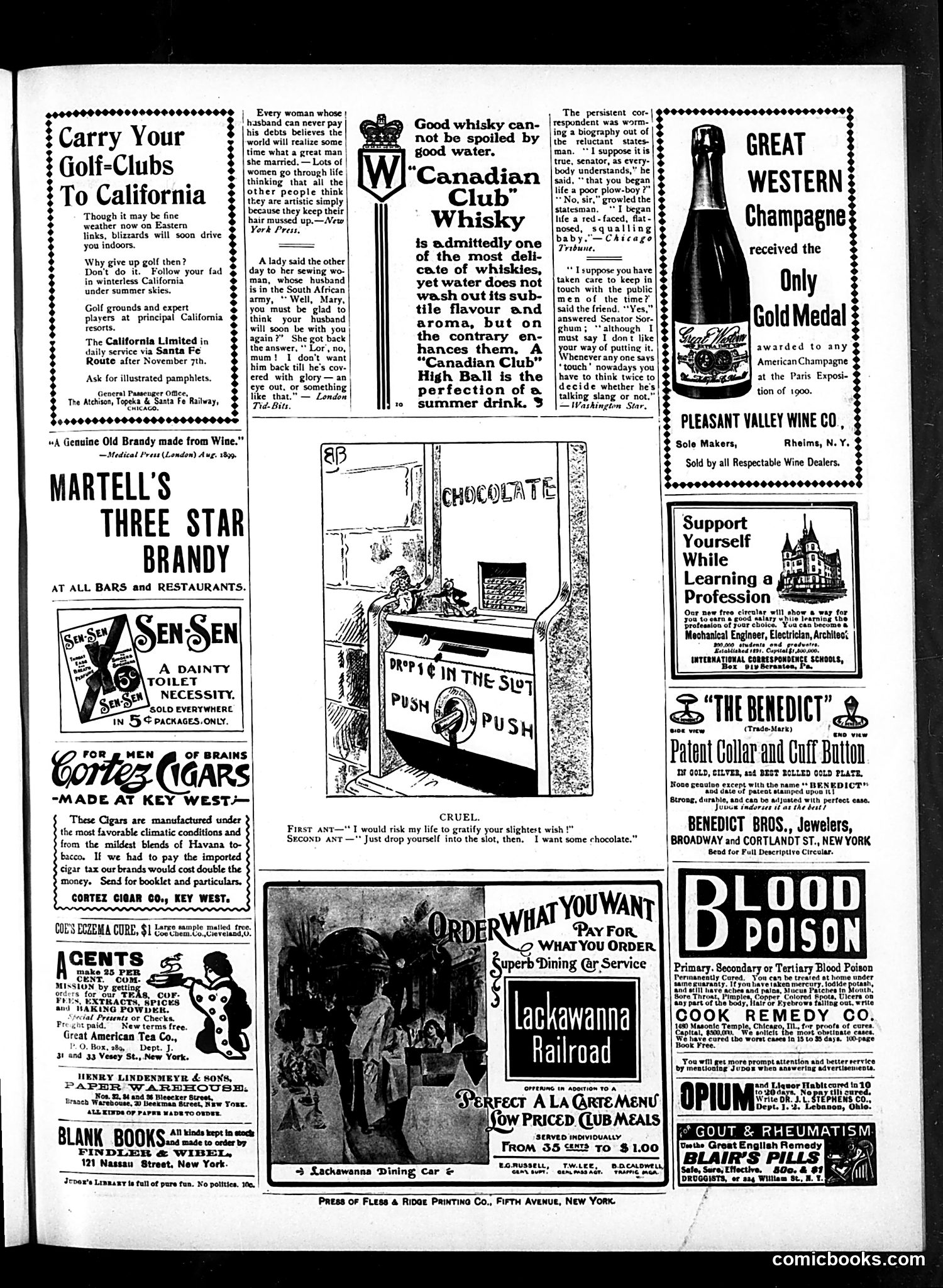
This page is primarily **advertisements and filler content** rather than editorial satire or political cartooning. The main cartoon depicts two ant-like figures at a chocolate vending machine, with dialogue establishing a crude joke: the first ant professes romantic devotion; the second responds by suggesting the first throw himself into the slot to retrieve chocolate. The satire targets the gap between romantic sentiment and selfish materialism—a common Judge theme mocking both flowery Victorian romance and mechanical modernity. The page's bulk consists of period advertisements for alcohol (Canadian Club whisky, champagne, brandy), cigars, patent medicines (including "Blood Poison" cure and opium remedies), and various commercial services. These ads reflect early 1900s consumer culture and, notably, the era's unregulated marketing of substances now recognized as dangerous (opium, mercury-based treatments). The "Carry Your Golf-Clubs to California" item promotes winter travel—suggesting leisured affluence. Overall, this page documents Judge's business model: satirical content subsidized by advertising to a prosperous readership.
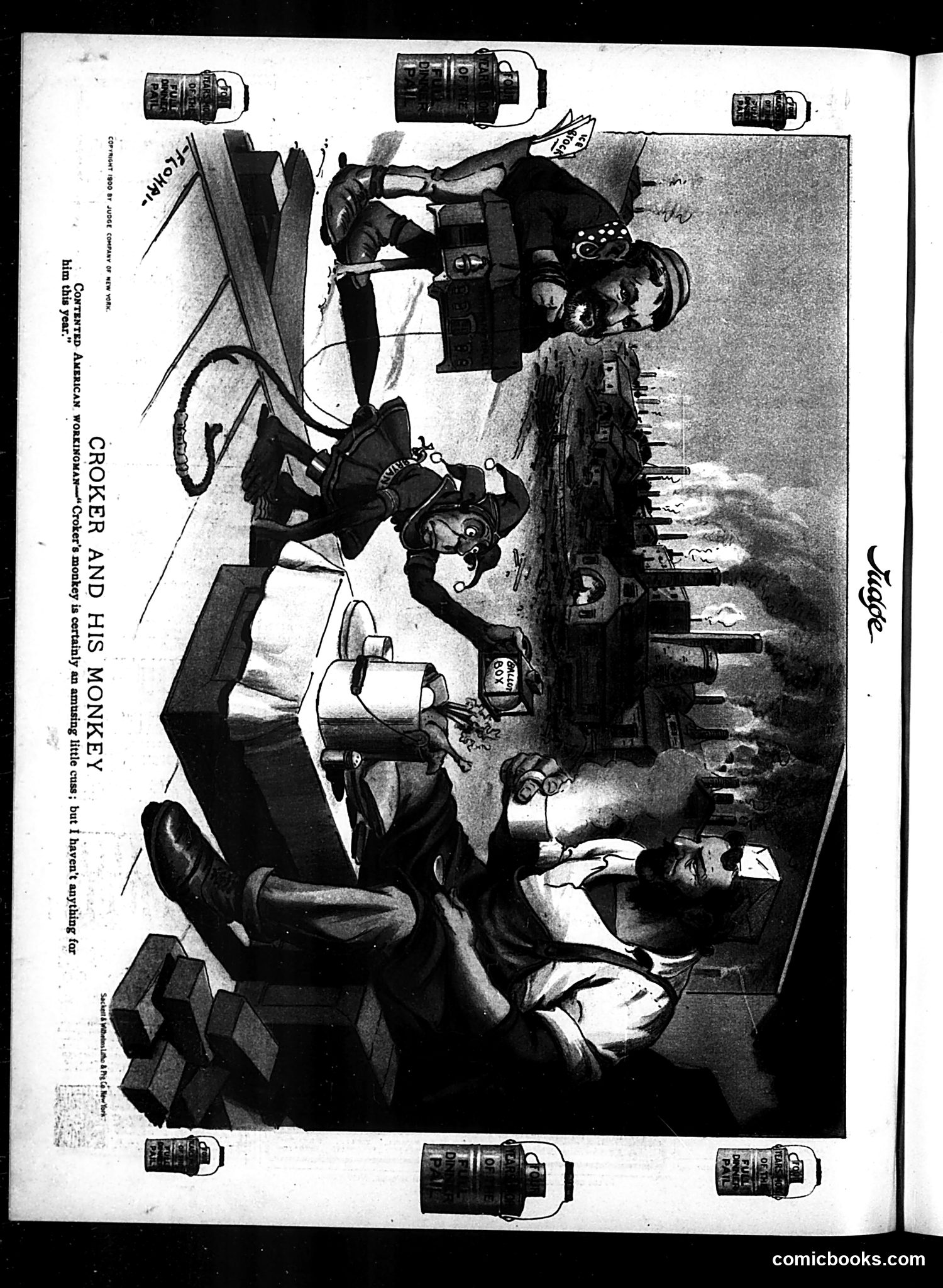
This 1900 Judge cartoon satirizes Richard Croker, the notorious boss of Tammany Hall (New York City's Democratic political machine). The "monkey" represents a political operative or favor-seeker dependent on Croker's patronage system. The caption shows a working American declaring he has "nothing for him this year"—meaning he won't support or benefit Croker's machine. The joke critiques the corrupt patronage network where Tammany Hall distributed jobs and favors to loyal voters in exchange for political support. By depicting the operative as a "monkey," the cartoonist ridicules both Croker's control over subordinates and the degrading nature of machine politics, where ordinary citizens were treated as performing animals rather than as independent citizens with genuine political choice.