
A complete issue · 16 pages · 1900
Judge — September 15, 1900
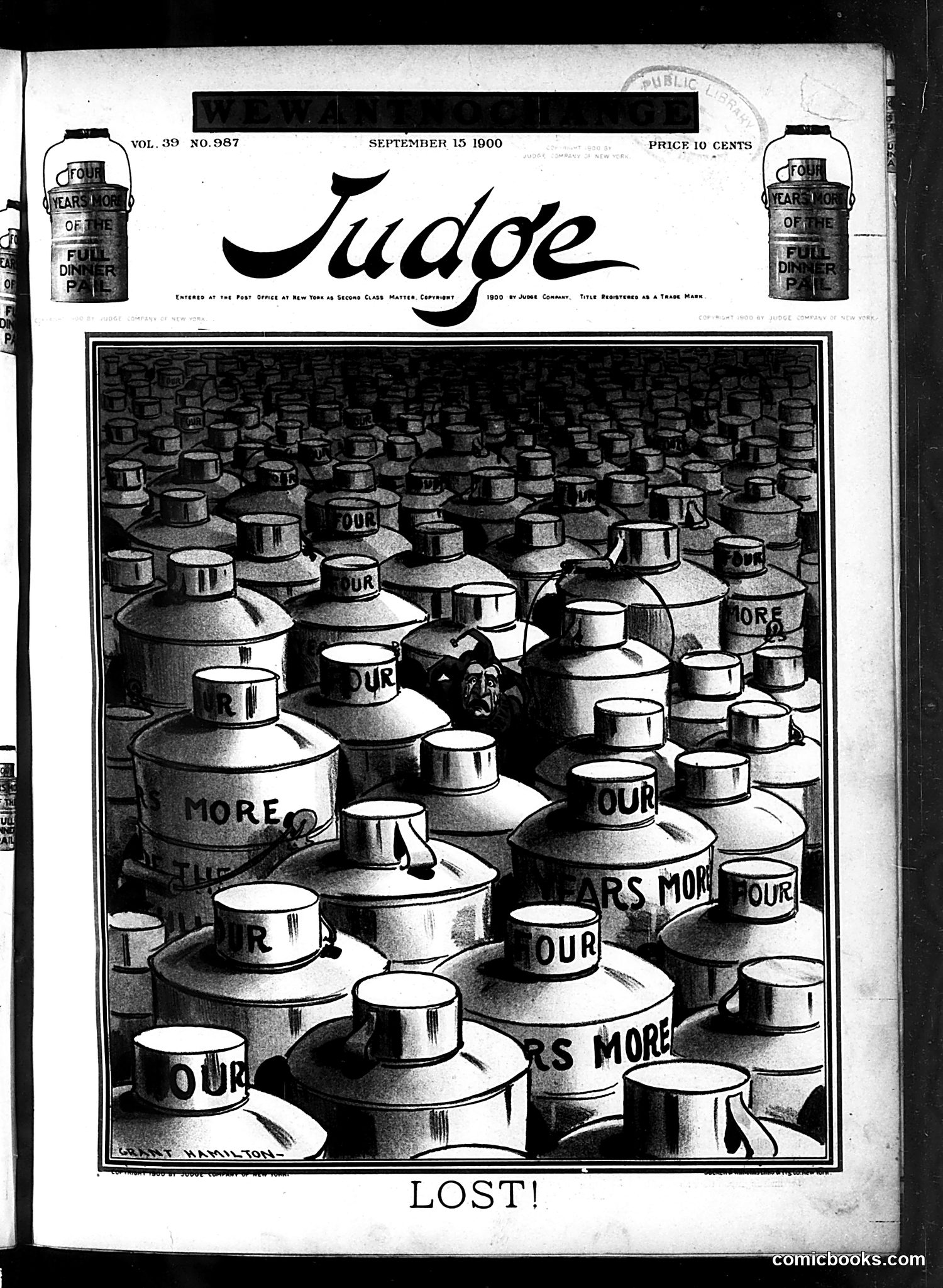
This page features a satirical illustration titled "LOST!" depicting numerous containers labeled "OUR" and "MORE" scattered across a landscape. A small human figure appears lost or overwhelmed among them. The cartoon likely critiques American expansionism or resource management during the 1900 period. The repeated "OUR" and "MORE" labels suggest commentary on American acquisition or consumption—possibly referencing debates over territorial expansion (the Philippines, Hawaii) or industrial/commercial growth during this era of American imperialism. The "lost" figure among proliferating containers implies satire about getting lost in abundance, excess, or the complications of managing newly acquired territories or markets. Without clearer context about contemporary 1900 events, the specific target remains somewhat unclear, though the theme appears to be imperial overreach or commercial excess.
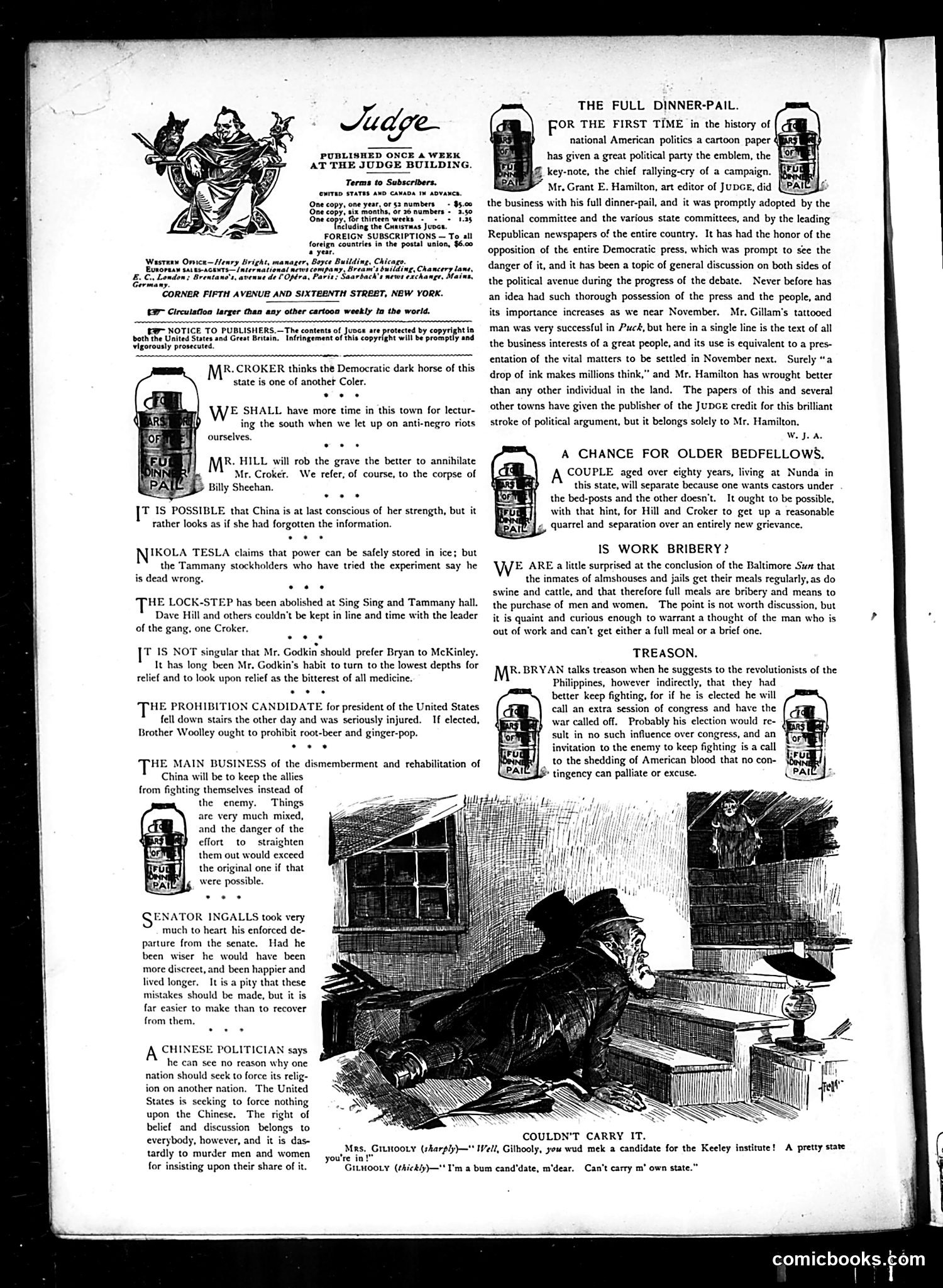
This cartoon depicts an elderly man (labeled "Mrs. Gilhooly") struggling to carry a large bundle labeled "candidate for the Keeley Institute" - a reference to the real Keeley Institute, which treated alcohol addiction. The satire targets a political candidate (identity unclear from this page alone) as unfit for office, using the implication of alcoholism as the disqualifying factor. The cartoon suggests he "couldn't carry" the burden of candidacy because of substance abuse issues. The dialogue jokes that while he might seek a position at the Keeley Institute (as a *patient*), he cannot manage his own affairs, much less public office. This represents typical turn-of-century political attack advertising through personal vice accusations rather than policy critique.
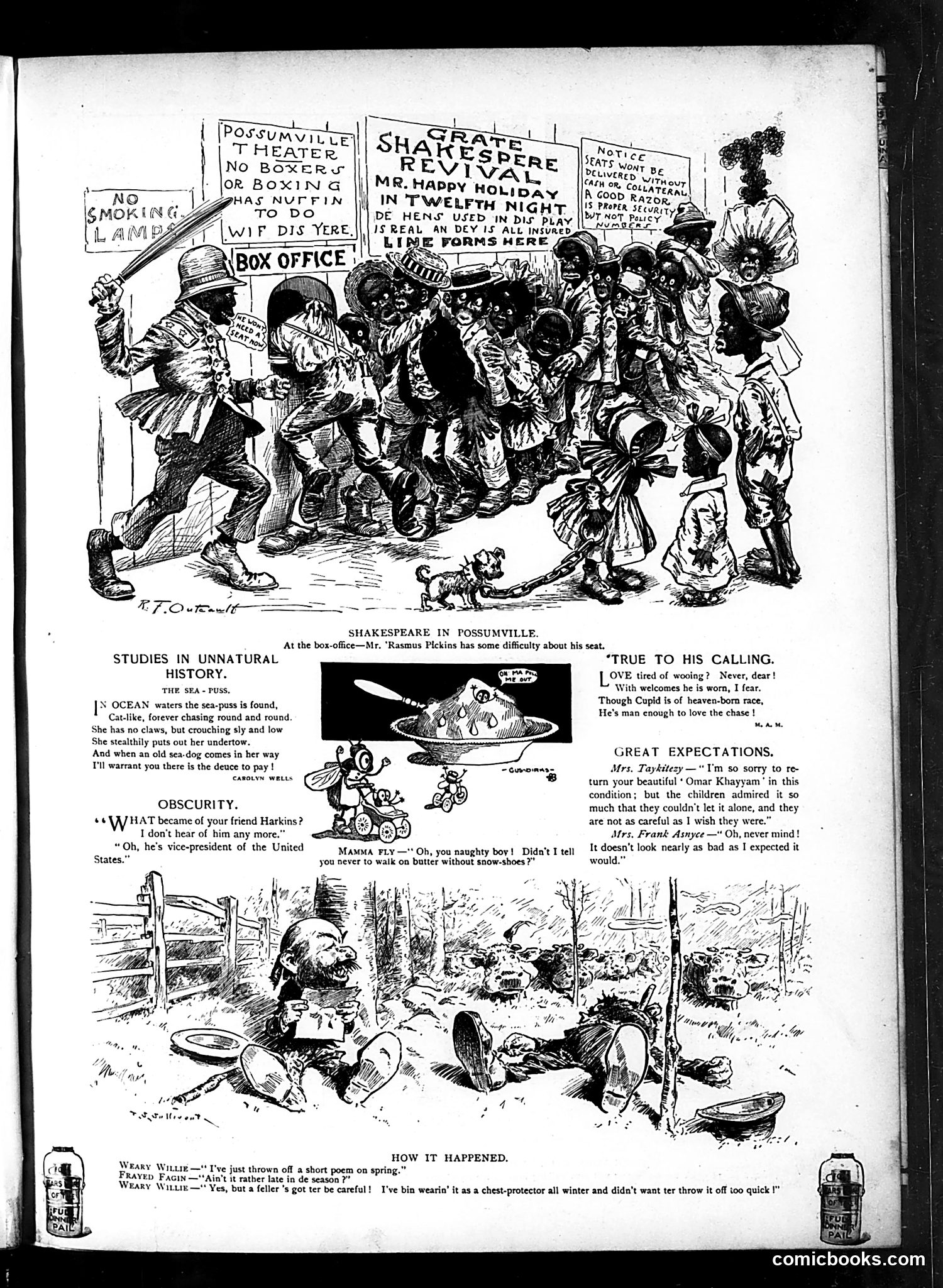
**Top Cartoon: "Shakespeare in Possusville"** This satirizes a Shakespeare theatrical revival at a box office in "Possusville" (a rural/working-class setting). The large crowd and signs about "No Boxers or Bowling" suggest Shakespeare's high culture is unexpectedly popular in humble circumstances. The cartoon mocks either the pretension of staging Shakespeare in such a place or the incongruity of rowdy audiences attending refined theater. The dog in the foreground adds comedic absurdity. **Lower Sections:** Include three joke pieces: "Studies in Unnatural History" (about sea creatures), "Obscurity" (a dialogue), and "How It Happened" (about someone throwing a poem). These are typical Judge humor features—puns and situational jokes common to early 20th-century satirical magazines. The content reflects period humor sensibilities rather than specific political commentary.
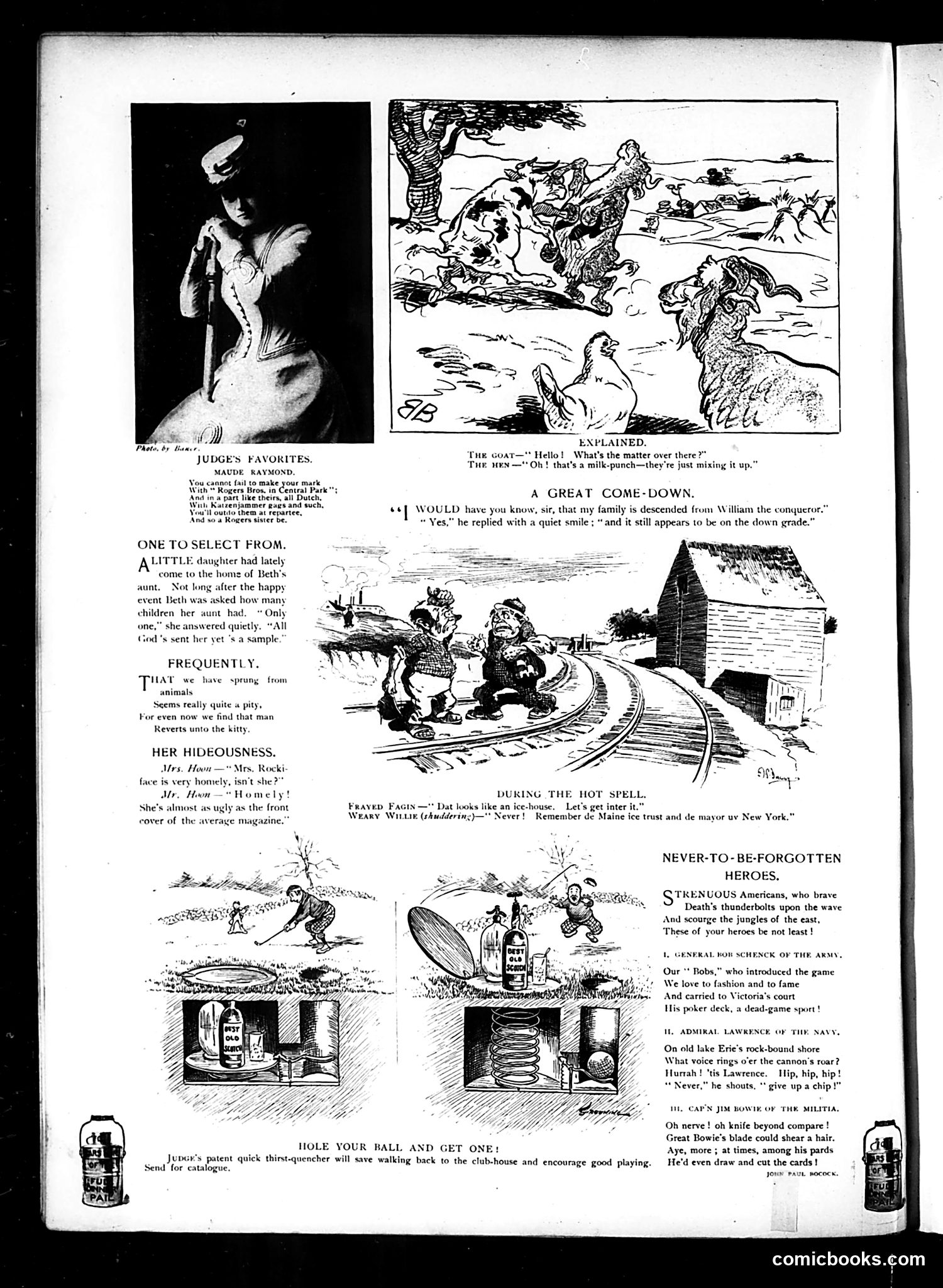
This page contains several satirical pieces and advertisements rather than a single coherent political cartoon. **"Judge's Favorites"** features a photograph of actress **Claude Raymond** with humorous verse about social pretension. **"Explained"** shows farmyard animals making crude jokes about a "milk-punch" — likely satirizing rural/working-class humor. **"A Great Come-Down"** depicts a snobbish character's deflation when learning about common ancestry, mocking aristocratic pretense. **"During the Hot Spell"** and **"Hole Your Ball and Get One"** appear to be humorous vignettes about summer leisure and sports. **"Never-to-be-Forgotten Heroes"** celebrates military figures (General Bob Schenck, Admiral Lawrence, Captain Jim Bowie) with patriotic verse — likely early 20th-century jingoism. The page primarily relies on visual humor and social satire rather than sharp political commentary.
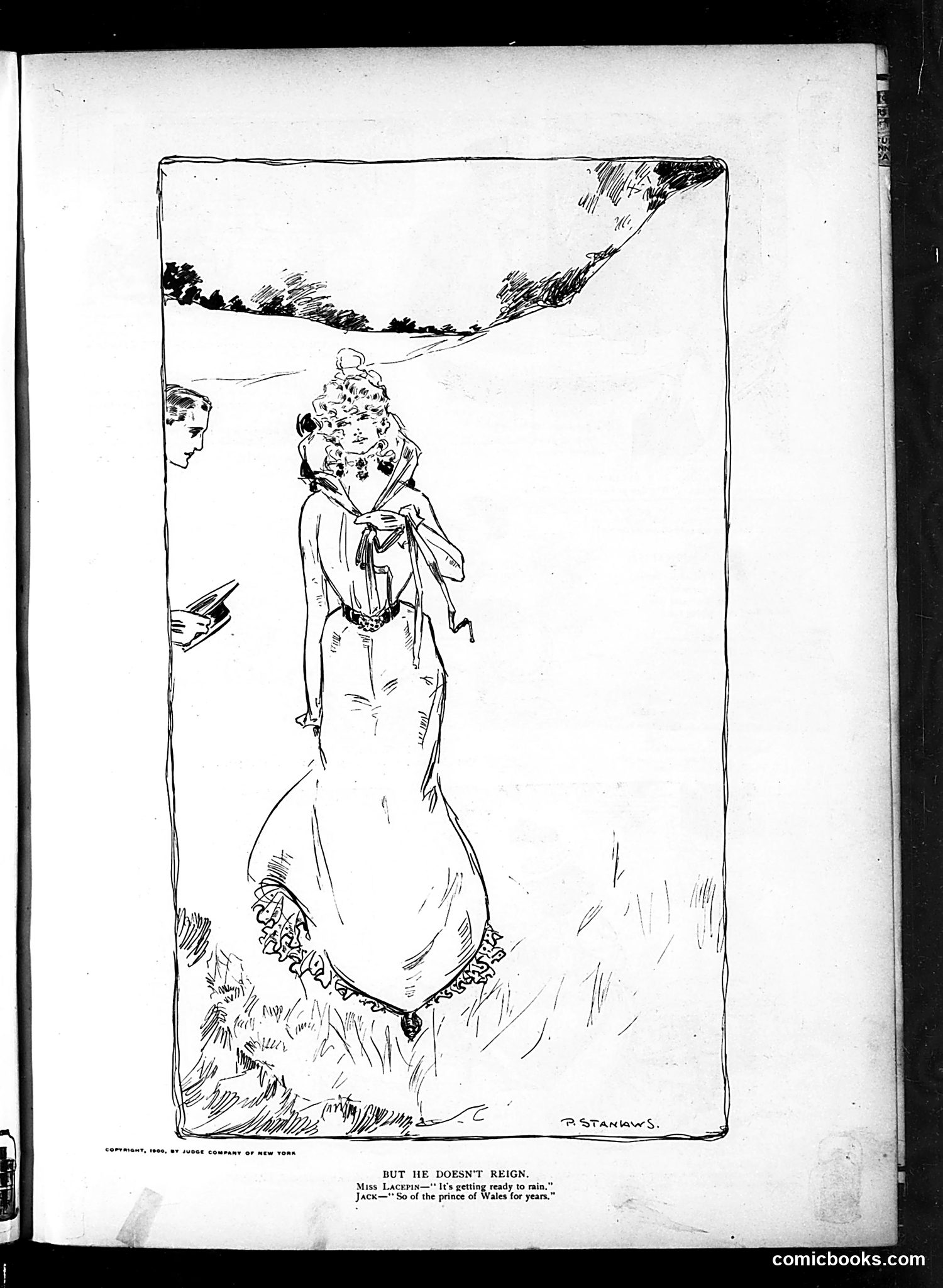
This cartoon presents a romantic scene with a woman (Miss Lacepin) and man (Jack) in a landscape. The humor relies on a pun about the Prince of Wales. The joke plays on homonyms: "reign" (royal rule) versus "rain" (precipitation). When Miss Lacepin comments on impending rain, Jack responds that the Prince of Wales hasn't been "reigning"—meaning he hasn't actively ruled—"for years." This likely references the Prince of Wales's limited political power during his father's reign. The cartoon mocks the Prince's ineffectual status by suggesting he has been absent from governance for an extended period. The rural setting and romantic framing contrast with this political commentary, making it a lighthearted jab at royal irrelevance rather than serious critique. The artist is P. Stanlaw, and this appears in Judge magazine, which frequently employed such wordplay-based satire.
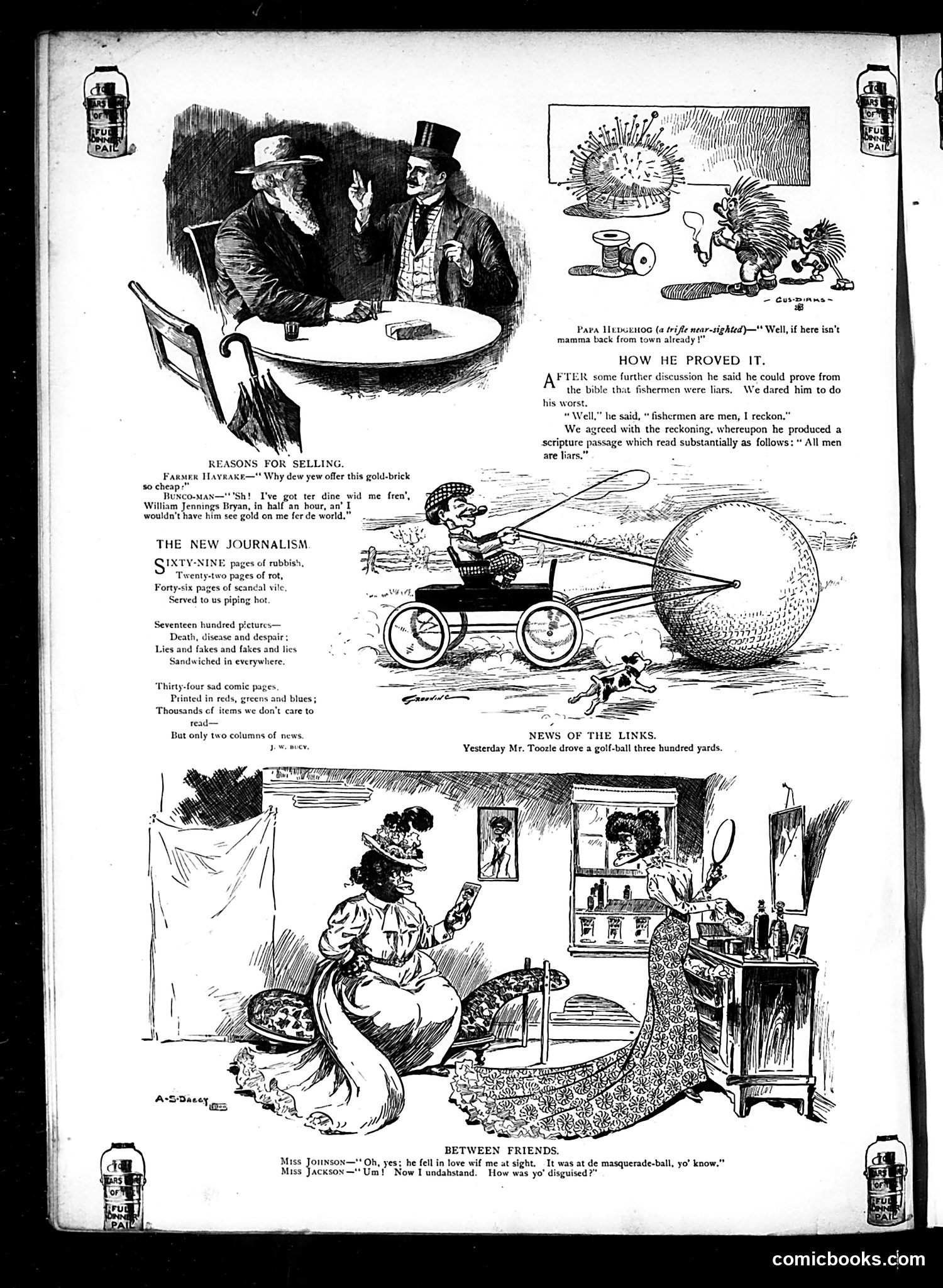
This page from the satirical magazine **Judge** contains multiple cartoons satirizing American society and politics: **"How He Proved It"** mocks biblical literalism by using scripture ("all men are liars") to "prove" fishermen are liars—a joke about circular logic and bad theological reasoning. **"Reasons for Selling"** references **William Jennings Bryan**, the populist politician and presidential candidate. A con artist selling a fraudulent "gold-brick" (scam) fears Bryan will see him with wealth, suggesting Bryan's anti-wealth politics and reputation for opposing the wealthy made him a cultural figure who'd scrutinize ill-gotten gains. **"The New Journalism"** criticizes sensationalist newspaper practices: excessive pictures, scandal, lies, and fear-mongering dominate while actual news occupies only two columns—commentary on the emerging "yellow journalism" era. **"Between Friends"** uses racial dialect humor (typical for the era) about a woman's disguise at a masquerade ball enabling romantic deception. The page reflects turn-of-century anxieties about journalism, populist politics, and social pretense.
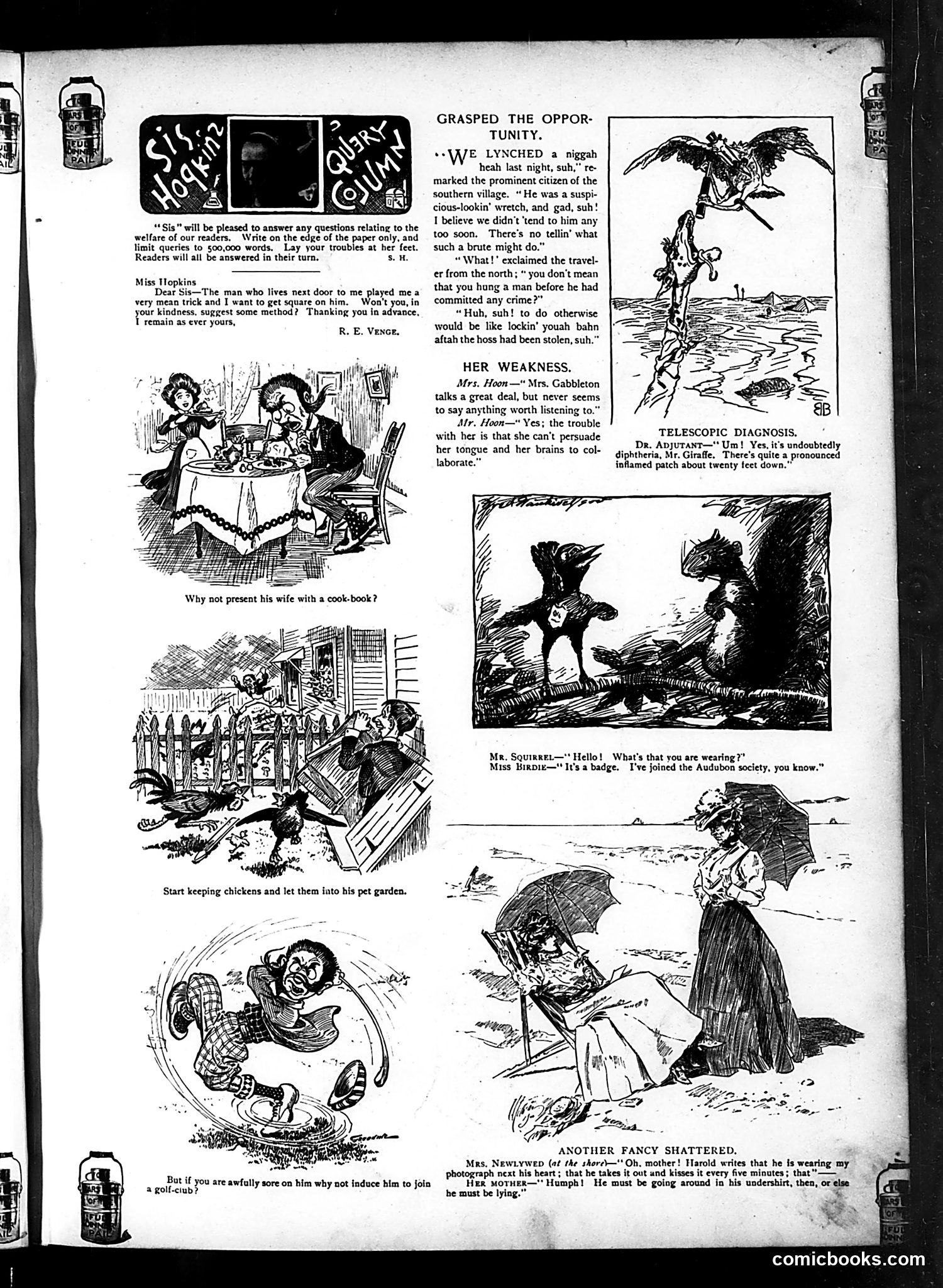
This page contains multiple unrelated satirical comics and advice column content typical of Judge magazine's format. **"Grasped the Opportunity"** depicts a racist dialogue where a Southern white man boasts of lynching a Black man without evidence of any crime. A Northern traveler expresses shock at this extrajudicial murder. The "joke" relies on the perpetrator's casual justification—comparing it to locking a barn after a horse is stolen. This satirizes Southern lynch culture and the absence of due process, presenting the practice as barbaric and indefensible, though the satire's effectiveness is severely undermined by its reliance on racist dialect and stereotypes. The other cartoons address domestic humor: a wife's talkative nature, a giraffe's extreme height requiring "telescopic diagnosis," and a young woman's Audubon Society badge mistaken for evidence of romantic devotion. The page reflects Judge's mix of biting social commentary alongside genteel domestic humor, all filtered through period racial attitudes that are now deeply offensive.
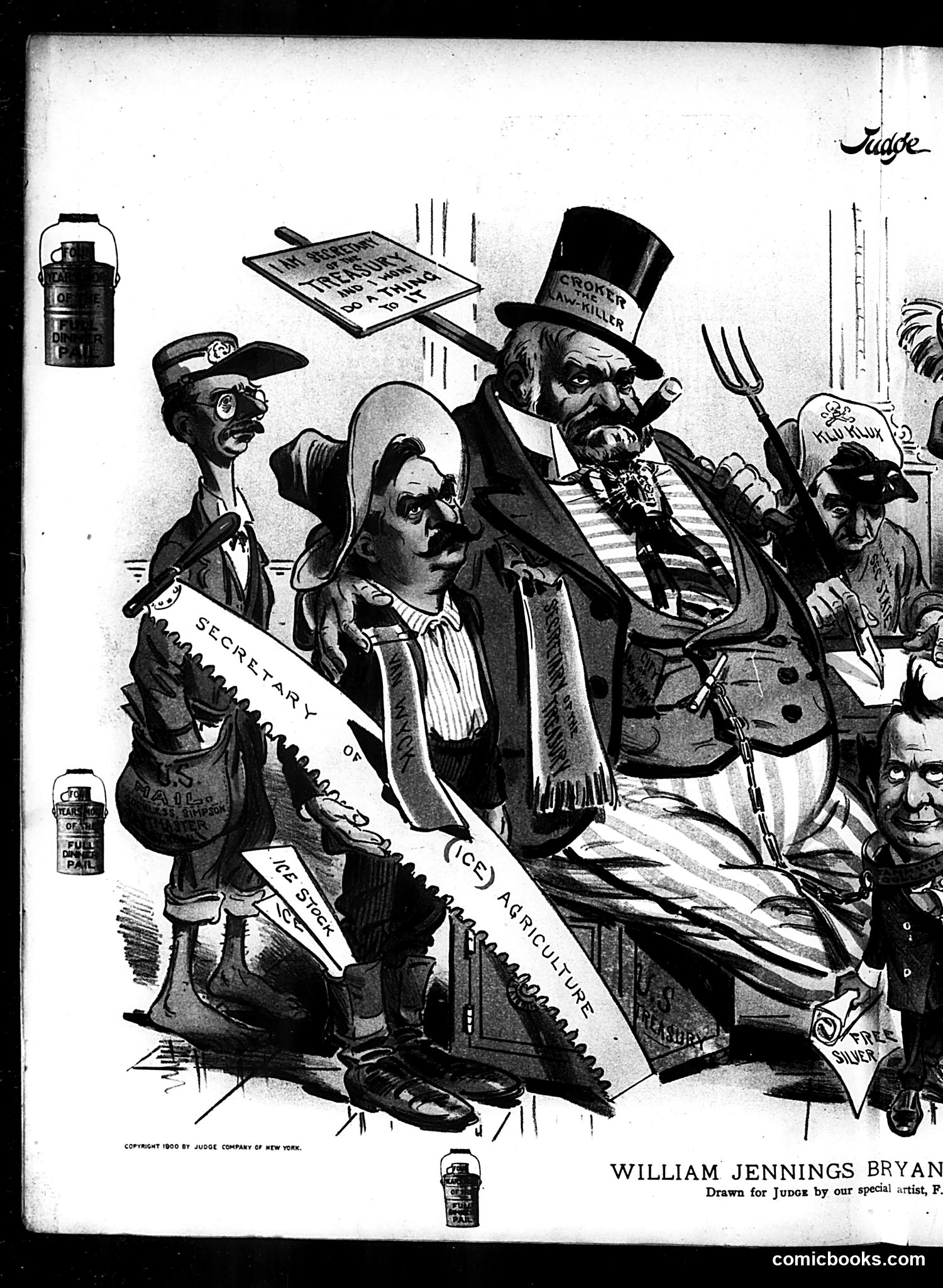
This Judge magazine cartoon satirizes William Jennings Bryan, the three-time presidential candidate and prominent politician known for his agrarian populism and anti-establishment rhetoric. The central caricature depicts Bryan as a devilish figure in a top hat labeled "Crowned Agitator-Killer," surrounded by menacing characters holding weapons and inflammatory signs referencing "Secretary of" and "Agriculture." The satire suggests Bryan and his supporters are dangerous radicals threatening established institutions—depicted through the violent imagery and demonic characterization. The "Judge" publication, representing establishment interests, presents Bryan's populist movement as a threat to social order, using grotesque caricature and apocalyptic visual language typical of anti-populist political attacks during the Gilded Age and Progressive Era.
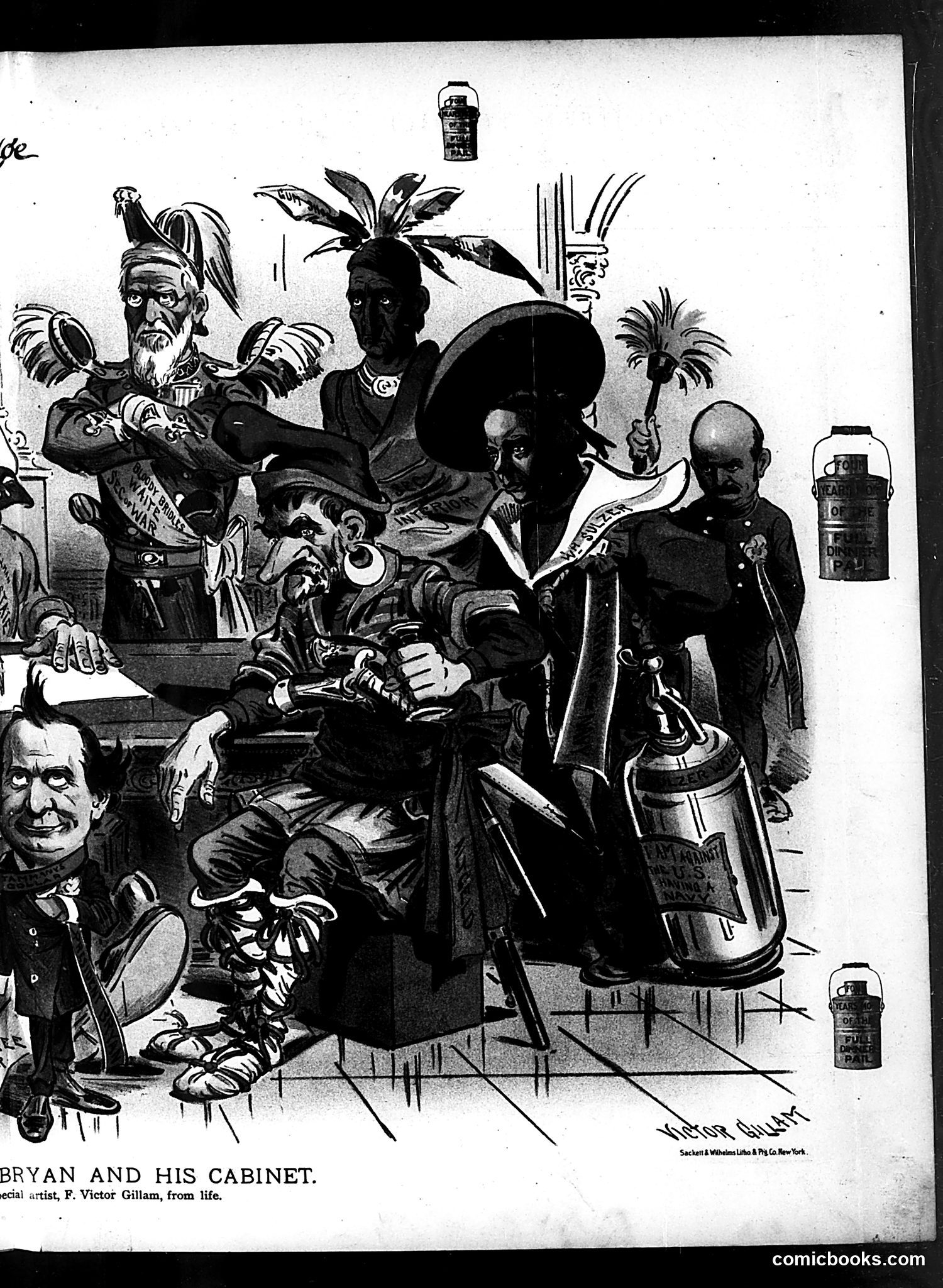
This political cartoon by F. Victor Gillam satirizes William Jennings Bryan's potential cabinet if elected president. Bryan, the Democratic presidential candidate known for his "Cross of Gold" speech and populist appeals, is depicted as a naive leader surrounded by exotic, caricatured figures—some appearing to represent foreign or non-Western peoples with exaggerated features. The satire suggests Bryan's cabinet would be composed of unqualified or unsuitable characters, mocking both his populist base and his diplomatic inexperience. The bizarre assemblage (including what appear to be figures in colonial/orientalist dress) implies his administration would be chaotic or dangerously influenced by outsiders. This reflects Republican opposition to Bryan's 1896 presidential campaigns, portraying him as an unfit, inexperienced radical.
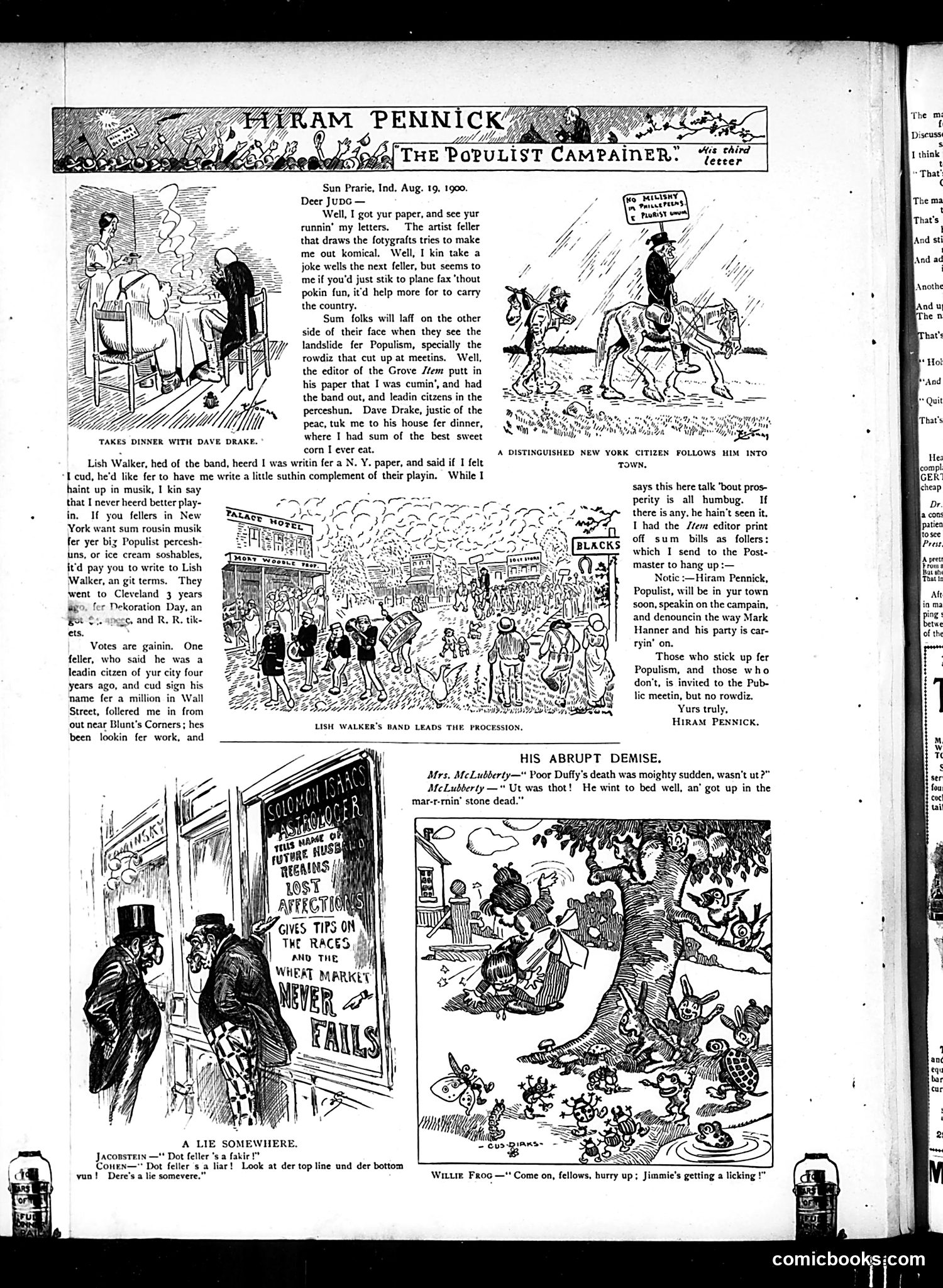
This 1900 *Judge* page satirizes American Populism through letters from "Hiram Pennick," a rural Populist campaigner. The main cartoon mocks Populist political organizing: Pennick claims votes are "gainin'" and promises to speak against Republican Mark Hanna's administration, yet the illustration shows a distinguished New York businessman following him into town—suggesting that even wealthy elites are abandoning the Republican Party for Populism. The smaller cartoons provide supporting jokes: "A Lie Somewhere" depicts two Jewish characters debating a poster's contradictions, implying Populist rhetoric is inherently dishonest. "His Abrupt Demise" makes an Irish joke about sudden death. The satire targets Populism's appeal across class lines and questions its credibility, while Pennick's rustically-spelled letters and boasts about band music and corn dinners use rural dialect to portray Populists as unsophisticated. The magazine clearly opposed Populism's challenge to Republican dominance in 1900.
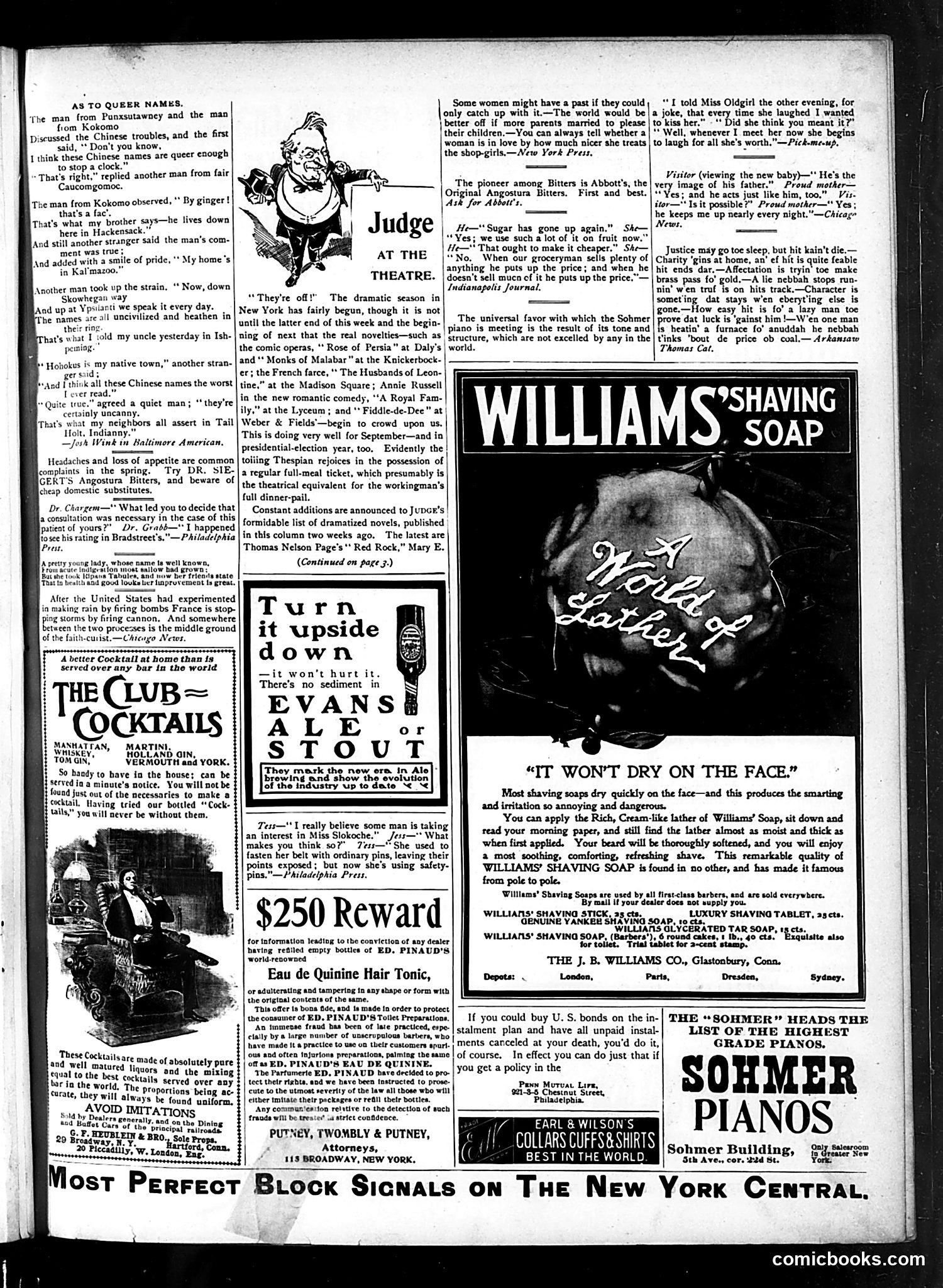
This page primarily consists of **humorous commentary** rather than political cartoons. The main feature, "As to Queer Names," is a joke about American parochialism: men from various towns with unusual names (Paxsutawney, Kokomo, Hackensack, Kalamazoo, Skowhegan, Ypsilanti) mock Chinese names as "queer," unaware of the irony that their own hometowns have equally peculiar names. The satire targets **American ignorance and hypocrisy**—specifically, the tendency to ridicule foreign cultures while being oblivious to one's own oddities. The page also includes a theatre column discussing Broadway openings, various aphorisms, and **period advertisements** (shaving soap, pianos, cocktails). The illustrated figure at top-left appears to be a caricatured man, likely meant to represent the self-important commentators in the main article.
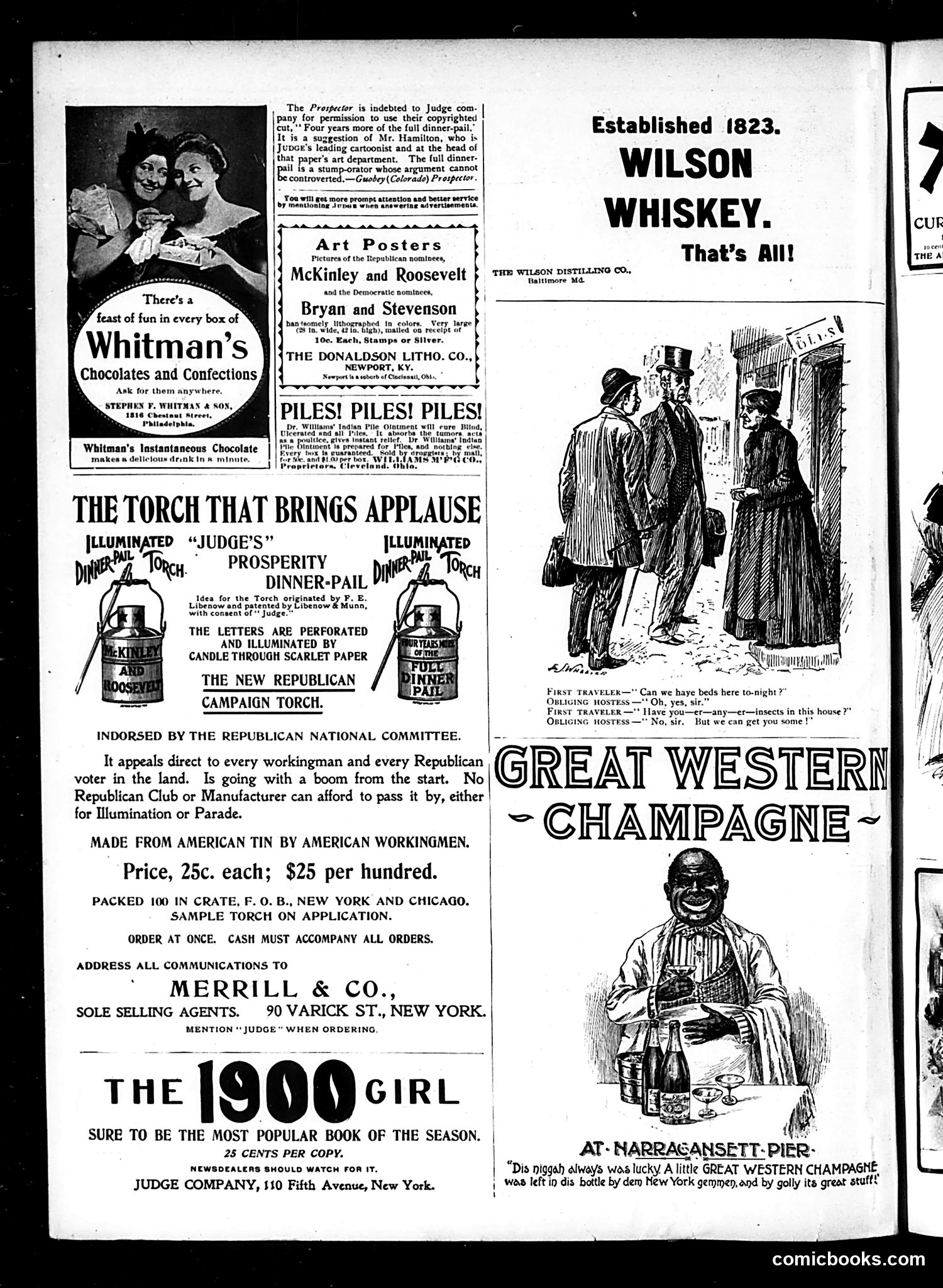
This page is primarily **advertising and promotional content** from Judge magazine, likely from the 1900 election cycle. The dominant feature is a campaign torch for **Republican candidates McKinley and Roosevelt**, endorsed by the Republican National Committee. The "full dinner-pail" referenced in the text was the Republicans' central 1900 campaign slogan, symbolizing American prosperity and workers' economic security under Republican leadership. The page also advertises art posters of the Republican nominees versus Democratic candidates Bryan and Stevenson, along with various commercial products (chocolates, whiskey, champagne, patent medicine for hemorrhoids). The cartoon at bottom right uses **offensive racial stereotyping** (common to the era) to advertise Great Western Champagne—depicting a Black man praising the product left behind by wealthy white New Yorkers. There's a brief comic dialogue about bedbugs in a boarding house, unrelated to politics. This reflects Judge's dual nature as **both satirical commentary and advertising vehicle** for commercial products and political campaigns.
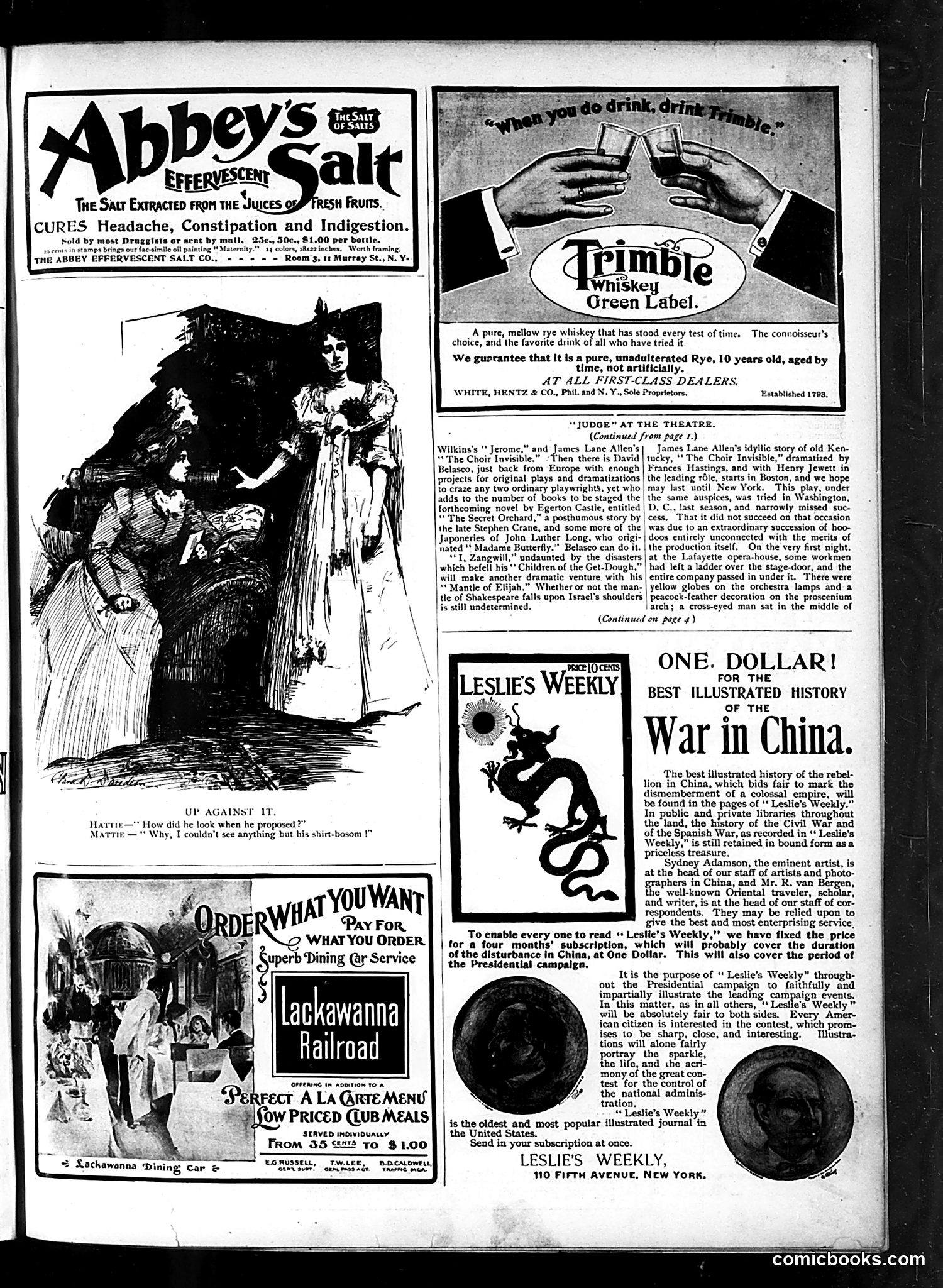
This page is primarily **advertising**, with minimal satirical content. The main cartoon, "UP AGAINST IT," depicts a couple's engagement moment: the woman (Mattie) says she couldn't see her fiancé's face during his proposal—only his starched shirt-bosom protruding. The joke satirizes the **formality and physical awkwardness of Victorian courtship rituals**, mocking how rigid dress codes and social conventions could literally obstruct intimacy between couples. The surrounding advertisements—for Abbey's Effervescent Salt (a digestive remedy), Trimble Whiskey, Lackawanna Railroad dining cars, and Leslie's Weekly—reflect turn-of-the-century consumer culture. The Leslie's ad notably promotes their war coverage of the **Boxer Rebellion in China**, suggesting this is from circa 1900, when American illustrated weeklies competed to document international conflicts through photography and commissioned artists.
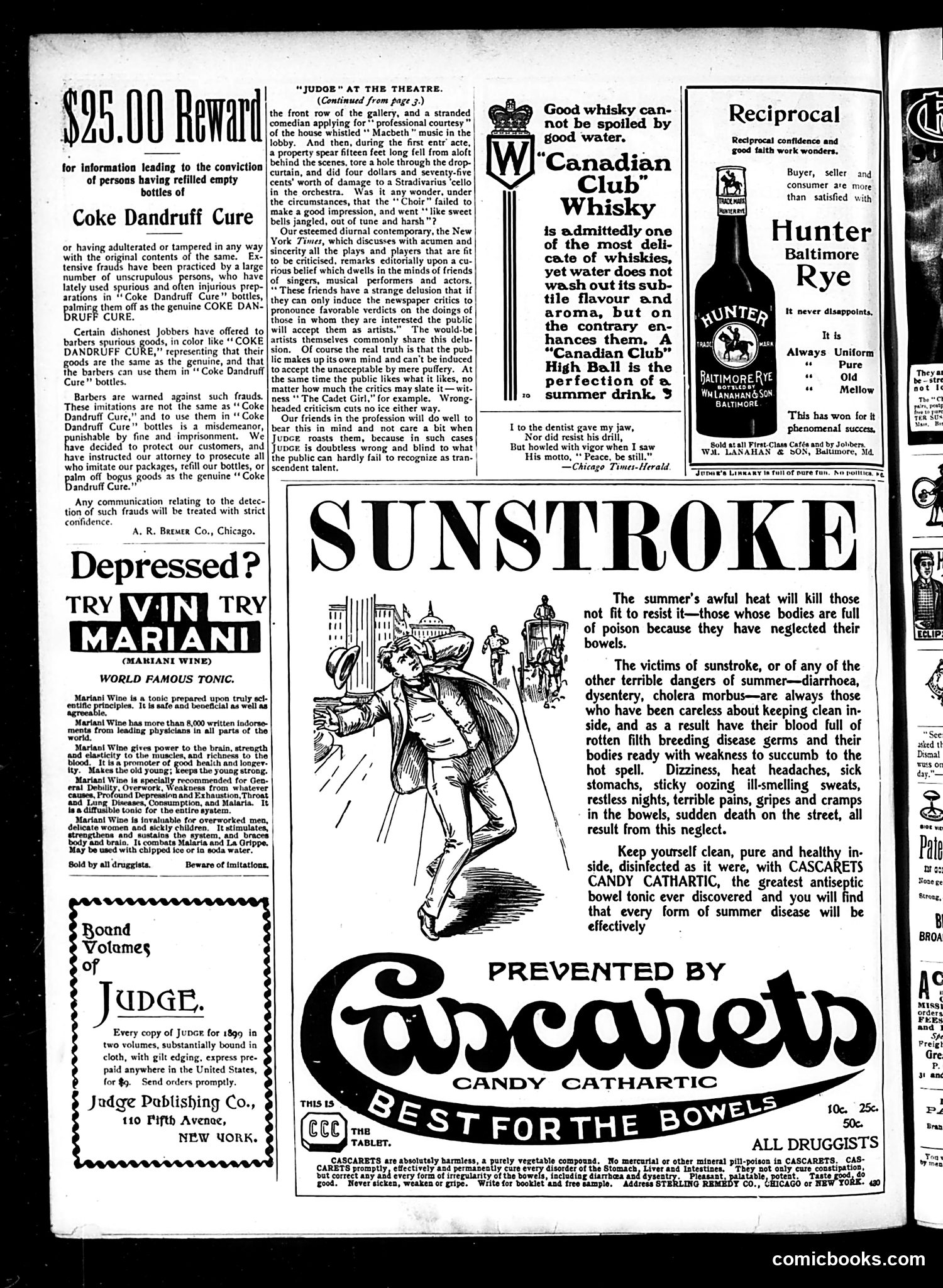
This page is primarily **advertising and notices** rather than political satire. The dominant content includes: **Main Advertisement:** A large "Sunstroke" warning advertisement for **Cascarets Candy Cathartic**, a laxative product. The illustrated figure shows a man collapsing from heat, promoting the product as prevention for summer ailments. **Other Notable Ads:** - Coke Dandruff Cure ($95 reward for counterfeit detection) - Mariani Wine (a "tonic" with claimed medicinal benefits, including endorsements from physicians) - Hunter Baltimore Rye whiskey - Canadian Club Whisky - Judge Publishing Company's book offer **Content:** A theater review criticizing a musical performance called "The Choir," noting various mishaps (fallen spears, damaged instruments). The page reflects **turn-of-century advertising practices**—promoting patent medicines and tonics with exaggerated health claims now considered fraudulent. The casual tone normalizes products (like wine as medicine) later regulated or banned.
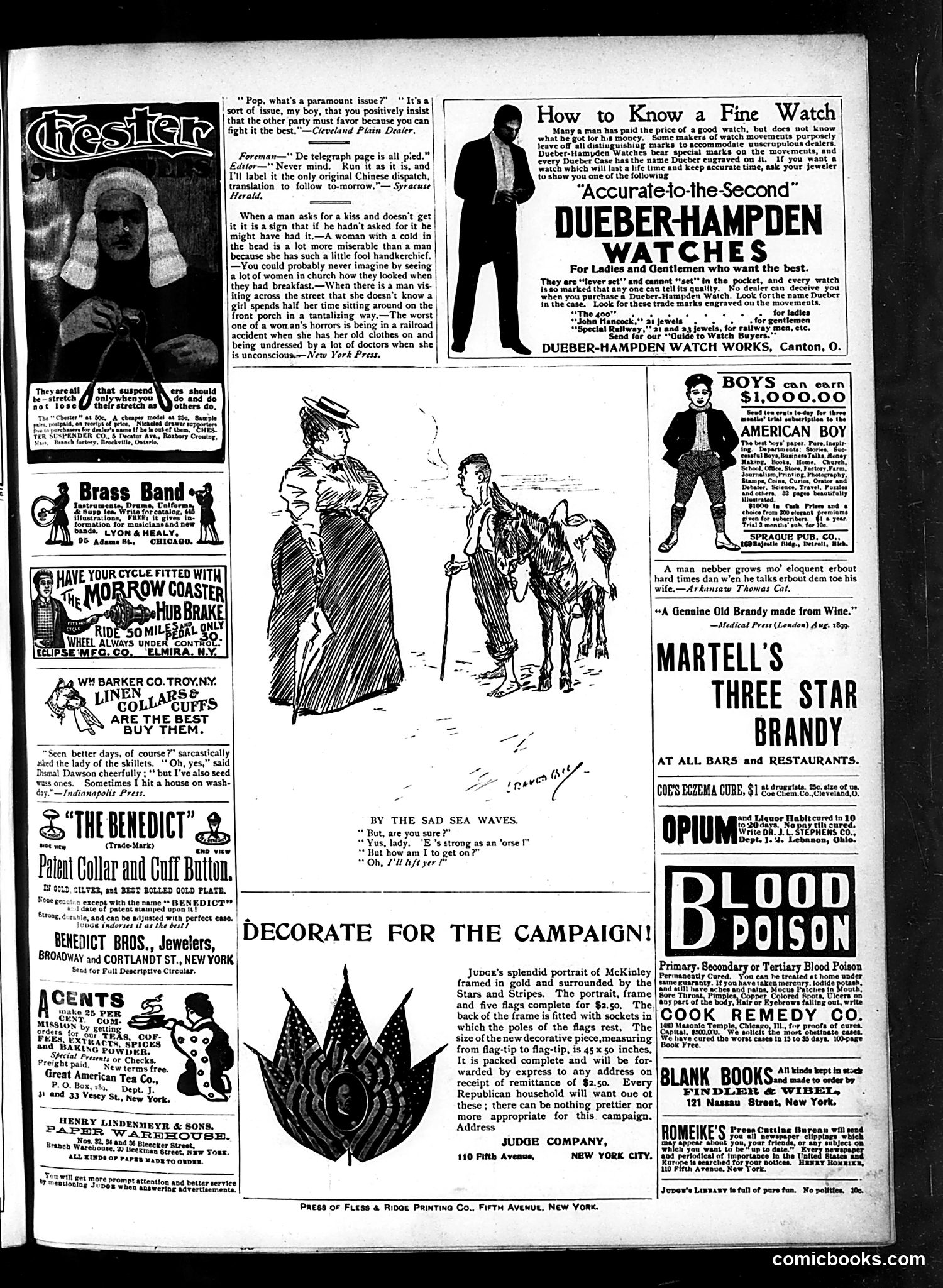
This page is primarily advertising with a few satirical jokes scattered throughout. The main cartoons appear to be brief textual humor pieces rather than visual ones. The political content references a **"paramount issue"** — a joke about politicians invoking major policy debates as rhetorical tools to attack opponents rather than genuinely support positions. This satirizes campaign strategy. A minor cartoon shows a domestic scene titled **"By the Sad Sea Waves,"** depicting a conversation between a woman and what appears to be a working-class man, likely poking fun at class or social interactions, though the exact satire is unclear from the limited context. The page's most prominent political element is an advertisement for **McKinley campaign decorations** — portraits framed in gold with American flags for $2.50. This dates the page to McKinley's presidency (1897-1901) and shows *Judge* actively promoting Republican imagery, indicating the magazine's partisan alignment during this era.
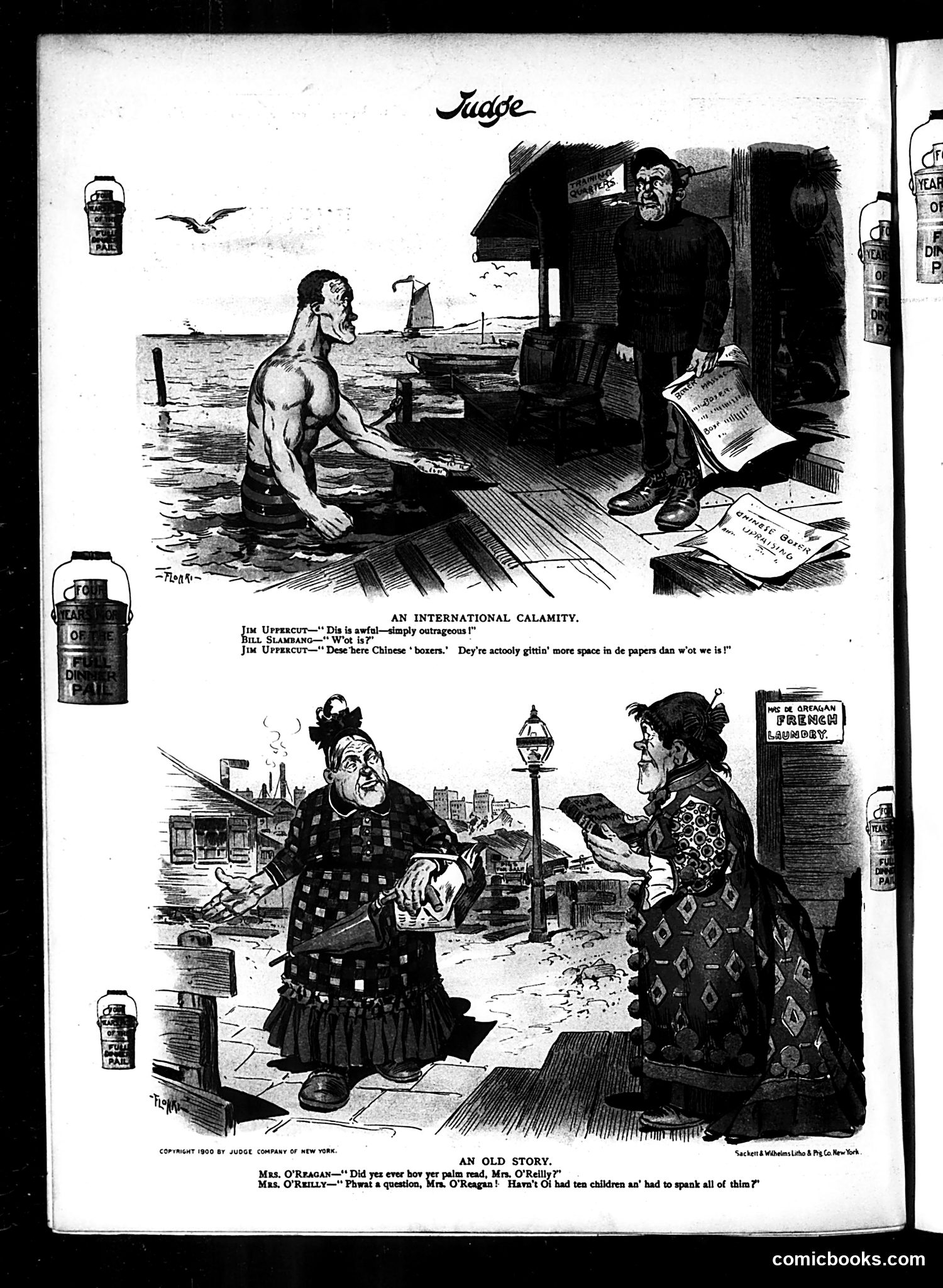
**Top Cartoon ("An International Calamity"):** Two working-class men—Jim Uppercut and Bill Slambang—complain that Chinese Boxers are getting more newspaper coverage than they are. This satirizes the 1900 Boxer Rebellion in China, suggesting American newspapers' fixation on foreign conflicts overshadows domestic news and working-class concerns. **Bottom Cartoon ("An Old Story"):** Two Irish-American women (Mrs. O'Reagan and Mrs. O'Reilly) discuss palm-reading. One sarcastically notes she's already had "ten children" and spanked them all—asking what a fortune-teller could possibly predict she doesn't already know. This jokes about large Irish families and the predictability of lower-class domestic life, using ethnic stereotypes common to the era. Both cartoons use exaggerated dialect and caricature typical of 1900s satirical magazines addressing working-class and immigrant communities.