
A complete issue · 16 pages · 1900
Judge — September 1, 1900
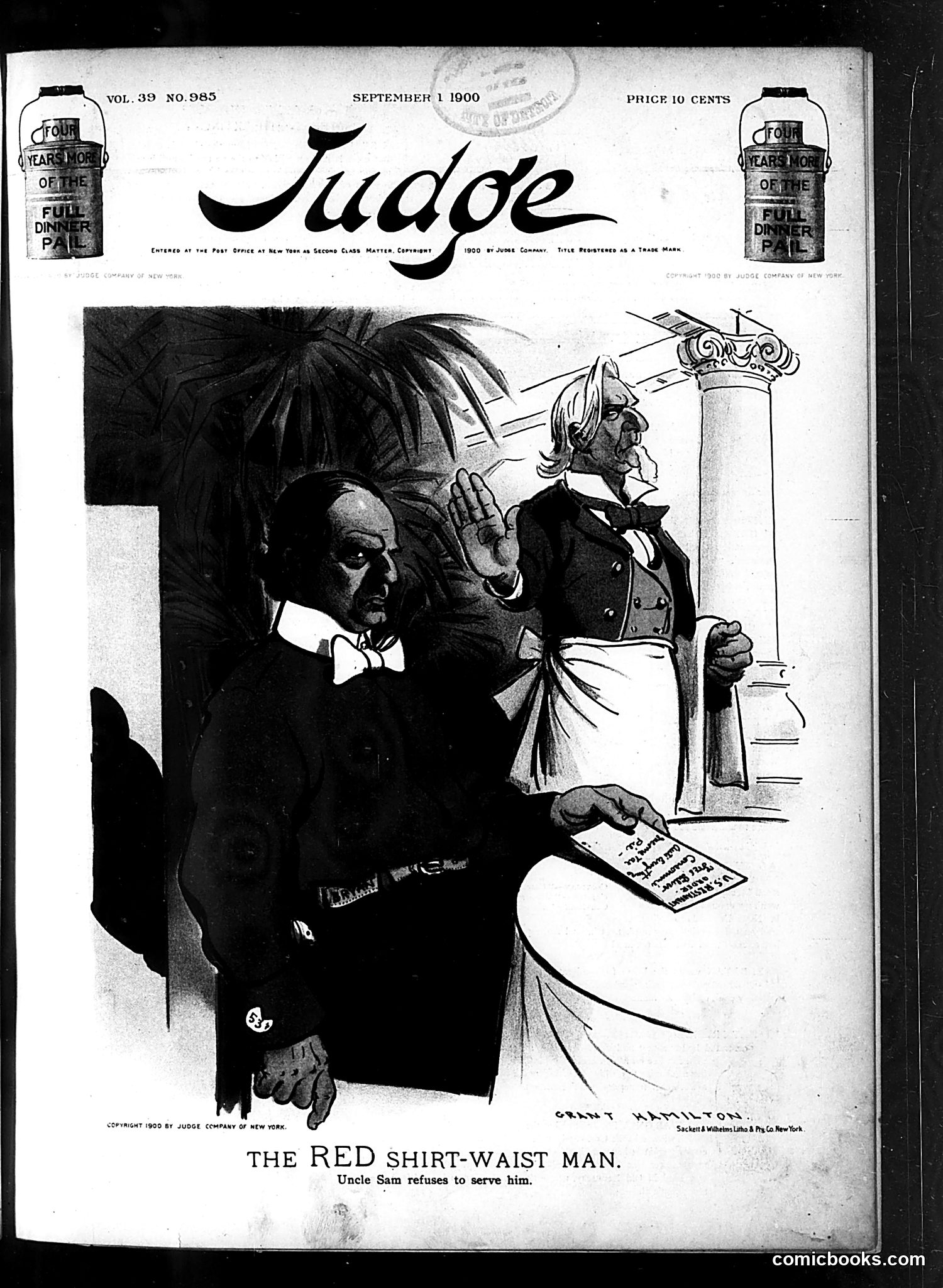
This cartoon satirizes American opposition to serving or doing business with radicals or socialists. The figure in the red shirt-waist (a red garment symbolizing socialism/radicalism) approaches "Uncle Sam" (representing America), who refuses service—depicted as rejecting him at what appears to be an official or commercial counter. The satire mocks xenophobic anxiety about radical immigrants and socialist ideology spreading in America around 1900. By showing Uncle Sam literally refusing to serve such a person, Judge ridicules both the fear of radical ideas and discriminatory impulses against those perceived as dangerous outsiders. The caption's bluntness emphasizes the cartoon's satirical point about American intolerance toward political dissent and foreign radical movements during this period of significant immigration and labor unrest.
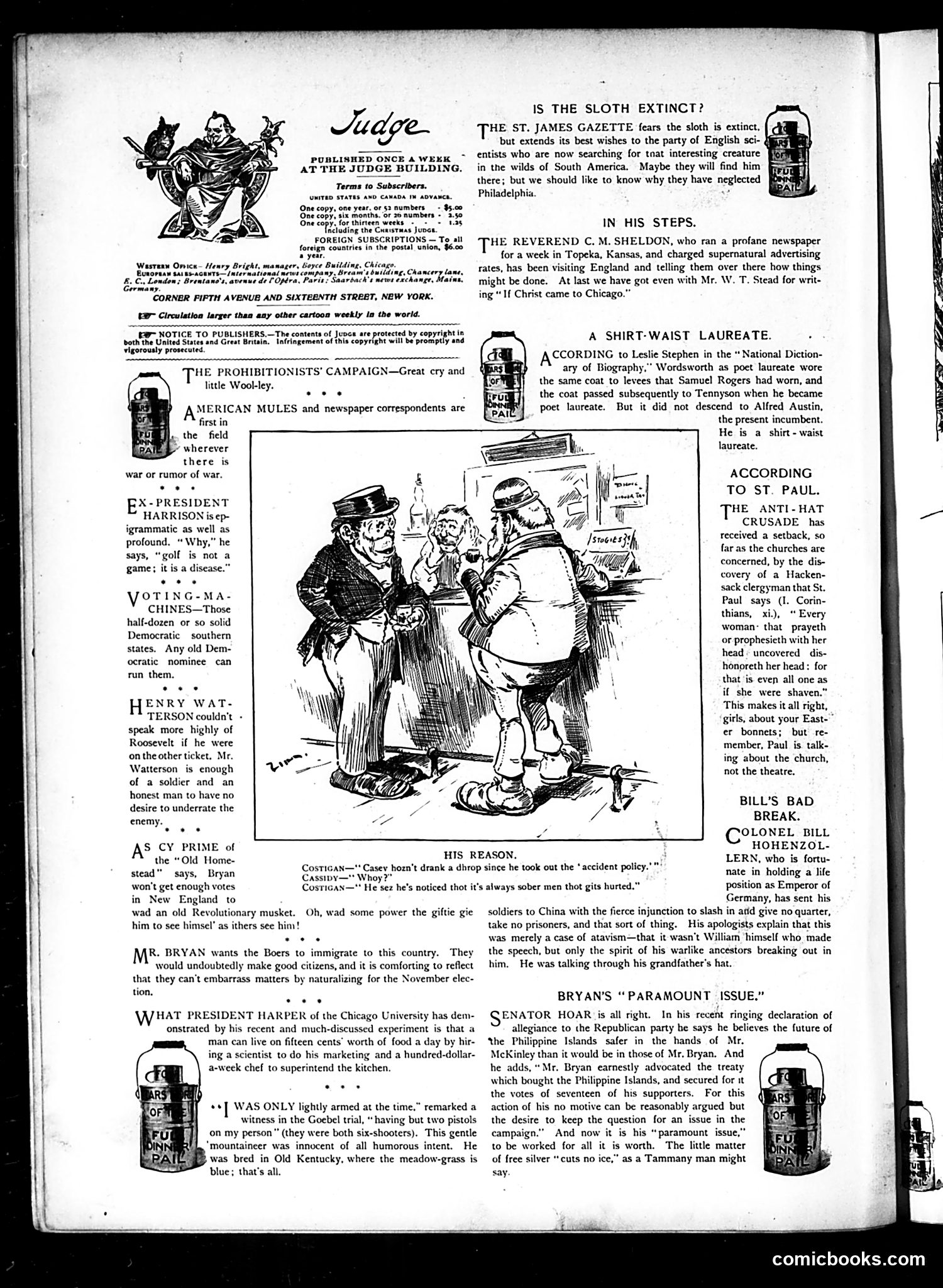
The central cartoon depicts three men in conversation, with one explaining why he stopped drinking. The caption reads: "Cassidy—'Why?' Corrigan—'He says he's noticed that it's always sober men that gets hired.'" This satirizes working-class attitudes toward sobriety and employment during what appears to be the early 1900s. The joke plays on the irony that despite a man discovering sobriety improves his job prospects, he's sharing this realization in what seems to be a bar setting with drinking companions—suggesting the message won't persuade them. The exaggerated facial features and ethnic names (Cassidy, Corrigan) suggest Irish immigrant stereotyping common in period American satire. The cartoon critiques both working-class drinking culture and satirizes contemporary attitudes about labor and personal discipline.
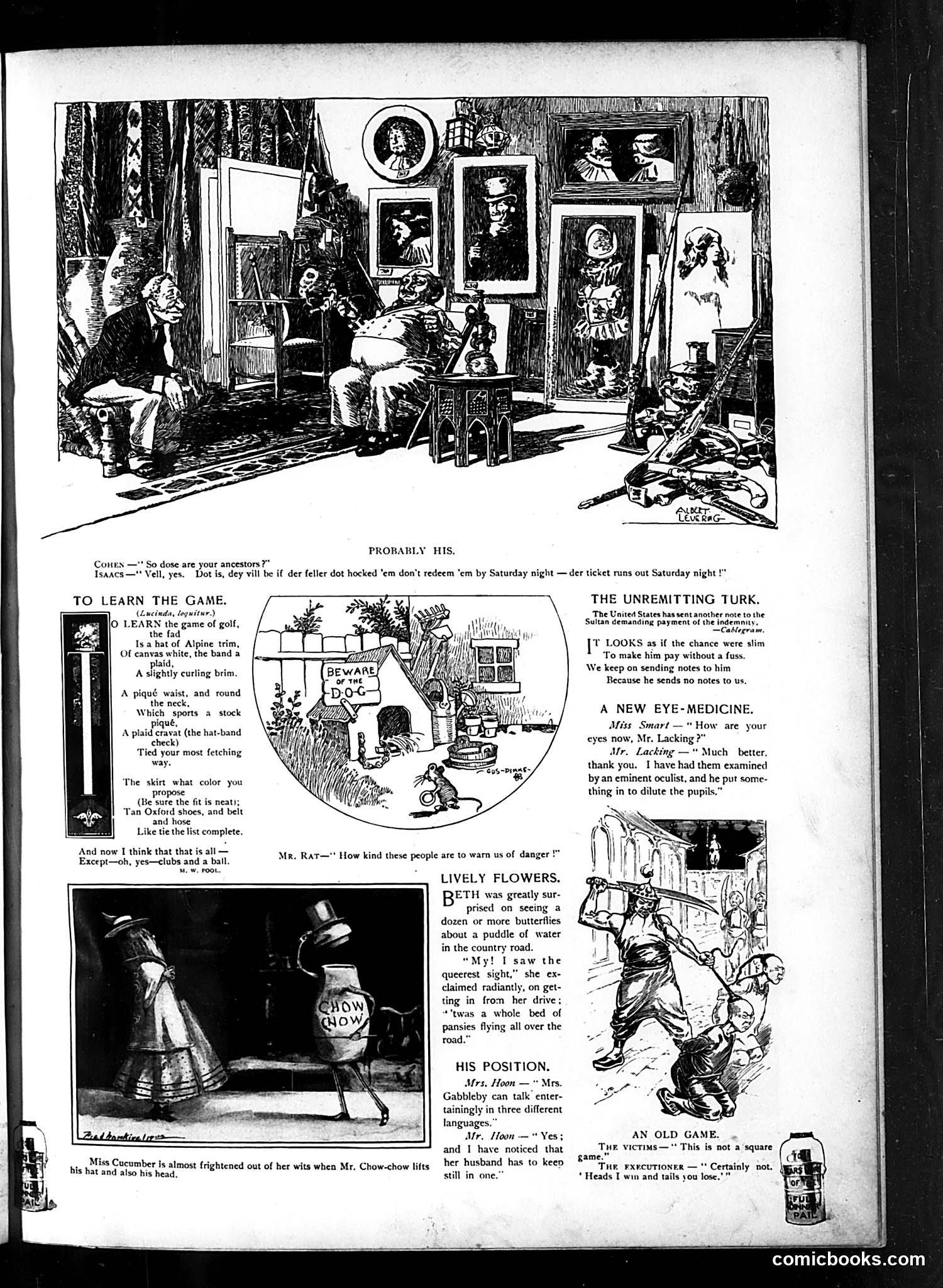
This page contains multiple humor pieces typical of Judge's format. The top cartoon "PROBABLY HIS" depicts an art studio scene where a character discusses ancestry with another, making a joke about social pretension—the punchline suggests ancestors who were criminals or undesirable. The remaining sections are brief humorous anecdotes rather than political cartoons: "TO LEARN THE GAME" mocks golf terminology, "THE UNREMITTING TURK" jokes about Ottoman demands, "A NEW EYE-MEDICINE" concerns eye exams, "LIVELY FLOWERS" describes wildflowers, "HIS POSITION" plays on language skills, and "AN OLD GAME" makes a pun about gambling. These represent Judge's typical mix of domestic humor and wordplay rather than serious political satire.
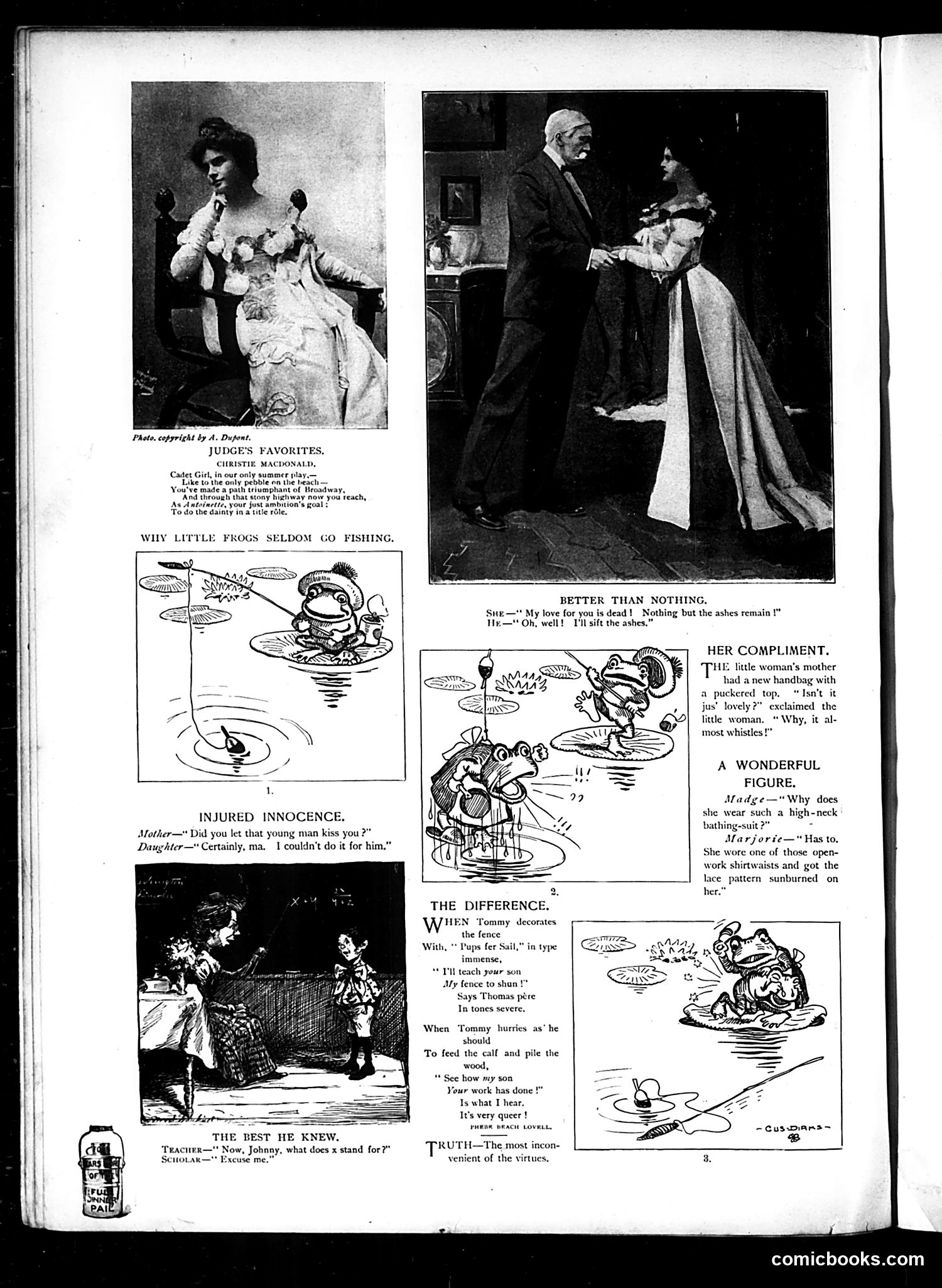
This page from *Judge* magazine contains primarily humorous illustrated jokes and verse rather than political satire. The content includes: **"Judge's Favorites"** - A theatrical photograph of actress Christie Macdonald with accompanying verse about romantic disappointment. **Comic illustrations** - Several small cartoons featuring frogs and children in domestic situations, with accompanying humorous captions and verse dialogue ("Why Little Frogs Seldom Go Fishing," "Injured Innocence," "The Best He Knew"). **Additional humor pieces** - Short comedic sketches titled "Better Than Nothing," "Her Compliment," "A Wonderful Figure," and "The Difference," mixing theatrical photographs with cartoon illustrations and witty dialogue. The page appears to be a general entertainment section mixing theater promotion, domestic humor, and light social comedy rather than direct political or satirical commentary on contemporary events.
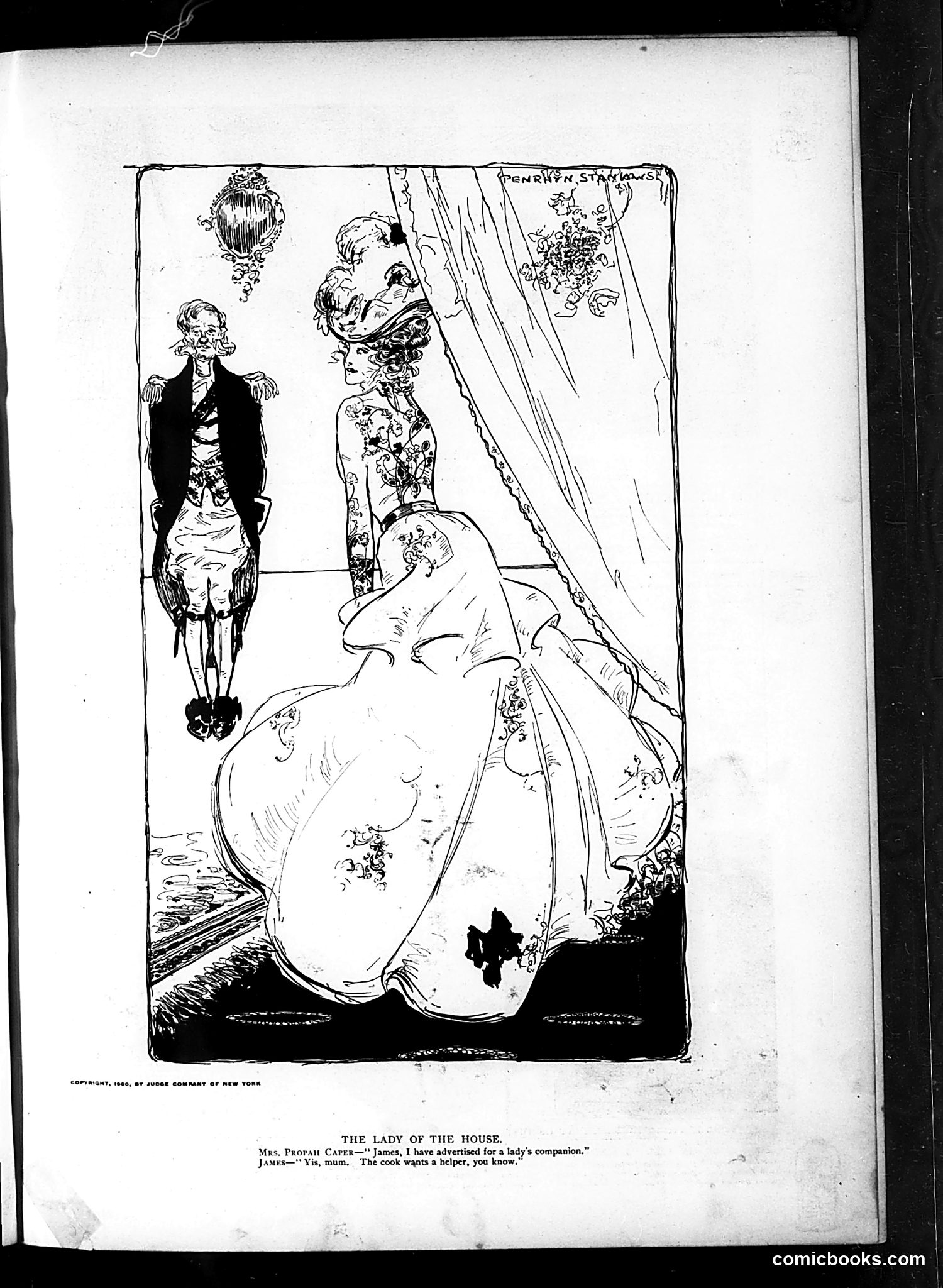
This cartoon satirizes the class pretensions and practical realities of household management among the genteel middle class. The elegantly dressed woman (labeled "Mrs. Propant Capen") has advertised for a refined "lady's companion"—a common Victorian/Edwardian position for genteel but poor women. Her husband James pragmatically counters that the cook actually needs a *helper*, not a companion. The joke targets the gap between social aspirations and domestic necessity: the wife wants to maintain appearances by employing someone of her own "class," while the husband recognizes the family's actual need is functional help in the kitchen. The servant shown in the background likely represents this clash between genteel pretense and working-class reality.
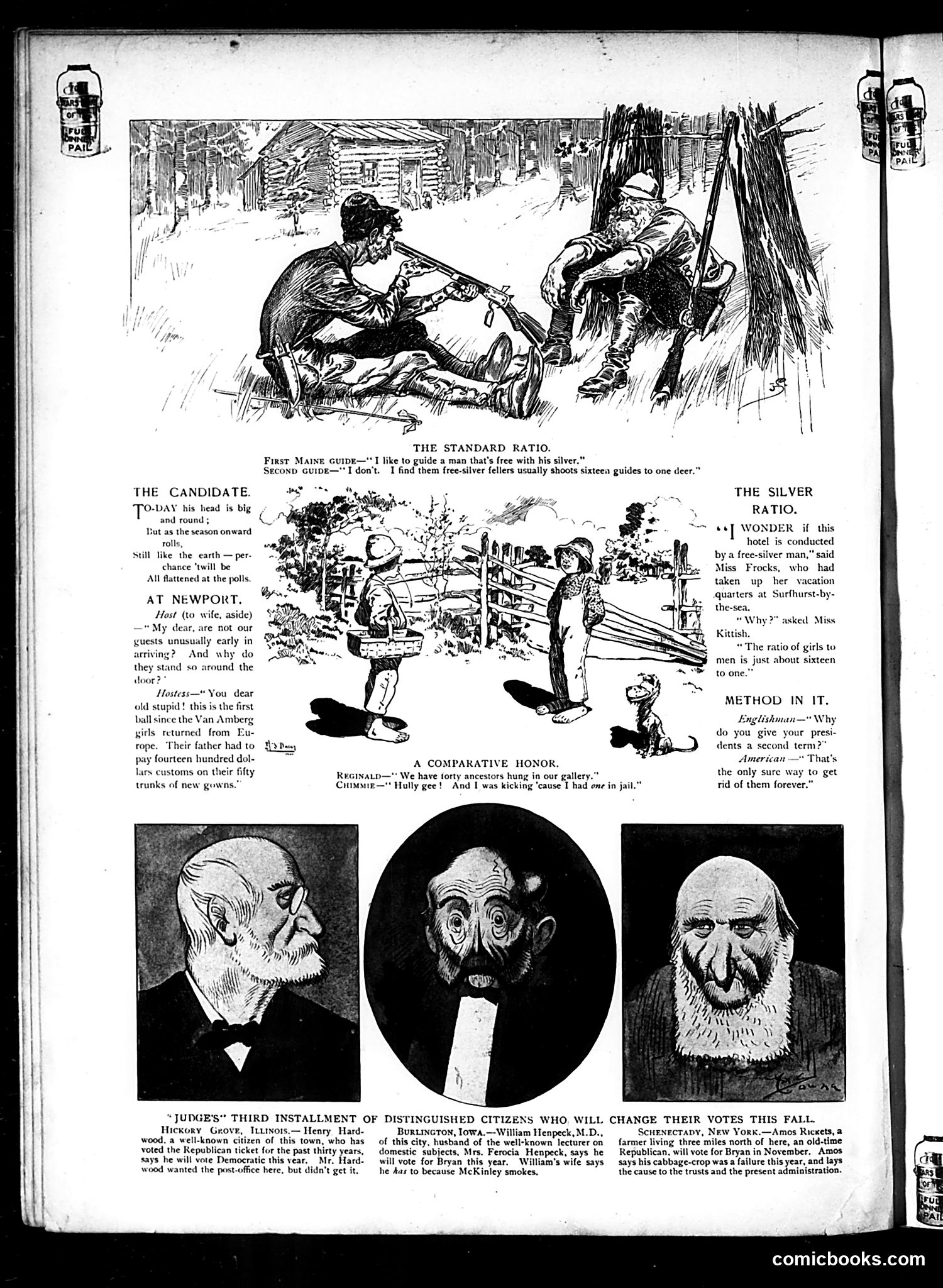
This page mocks the 1896 presidential election, likely between McKinley (Republican incumbent) and Bryan (Democratic challenger advocating free silver). **Top cartoon**: "The Standard Ratio" satirizes guides' mercenary nature—those favoring free silver are more generous tippers. **Middle cartoons**: "The Candidate" jokes that a politician's head shrinks after electoral defeat. "The Silver Ratio" and "Method in It" ridicule free-silver advocates through absurd comparisons (16 girls to 1 man; politicians serving two terms to exile them). **Bottom section**: The real satire. Judge presents three prominent citizens supposedly switching from Republican to Democratic votes—but reveals their petty, self-interested motives: one wanted a post office, another's wife forces him to oppose McKinley's smoking, a third blames crop failure on trusts. The joke: these aren't principled political conversions but transparent expressions of personal grievance, mocking both the free-silver movement and voters who abandon principles for narrow self-interest.
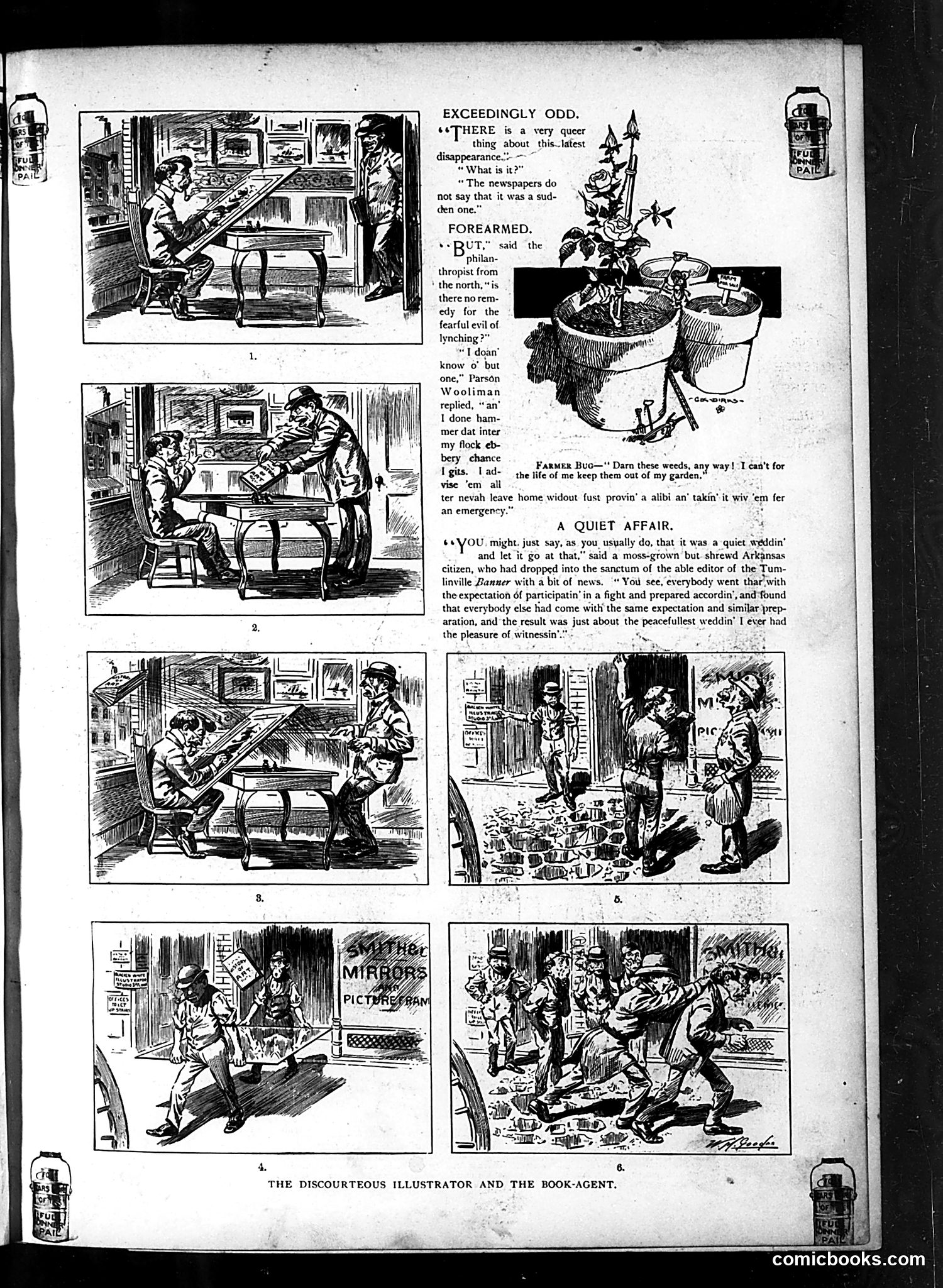
This page contains three separate satirical pieces: **"Exceedingly Odd"** mocks newspapers' inconsistent reporting—they fail to mention whether a disappearance was "sudden," suggesting editorial carelessness. **"Forearmed"** uses a Northern philanthropist and a Southern Black preacher (rendered in dialect) to satirize anti-lynching rhetoric. The preacher's "remedy"—advising his flock to carry alibis—absurdly suggests victims should prove their innocence beforehand, skewering the inadequacy of proposed solutions to racial violence. **"A Quiet Affair"** presents an Arkansas editor's anecdote: a wedding where all guests *expected* a fight and came armed, yet everyone's mutual readiness for violence paradoxically prevented any. It satirizes frontier violence culture by showing how normalized combat expectations were—so thoroughly embedded that preparedness ironically ensured peace. The comic strips below ("The Discourteous Illustrator and the Book-Agent") depict unrelated domestic comedy.
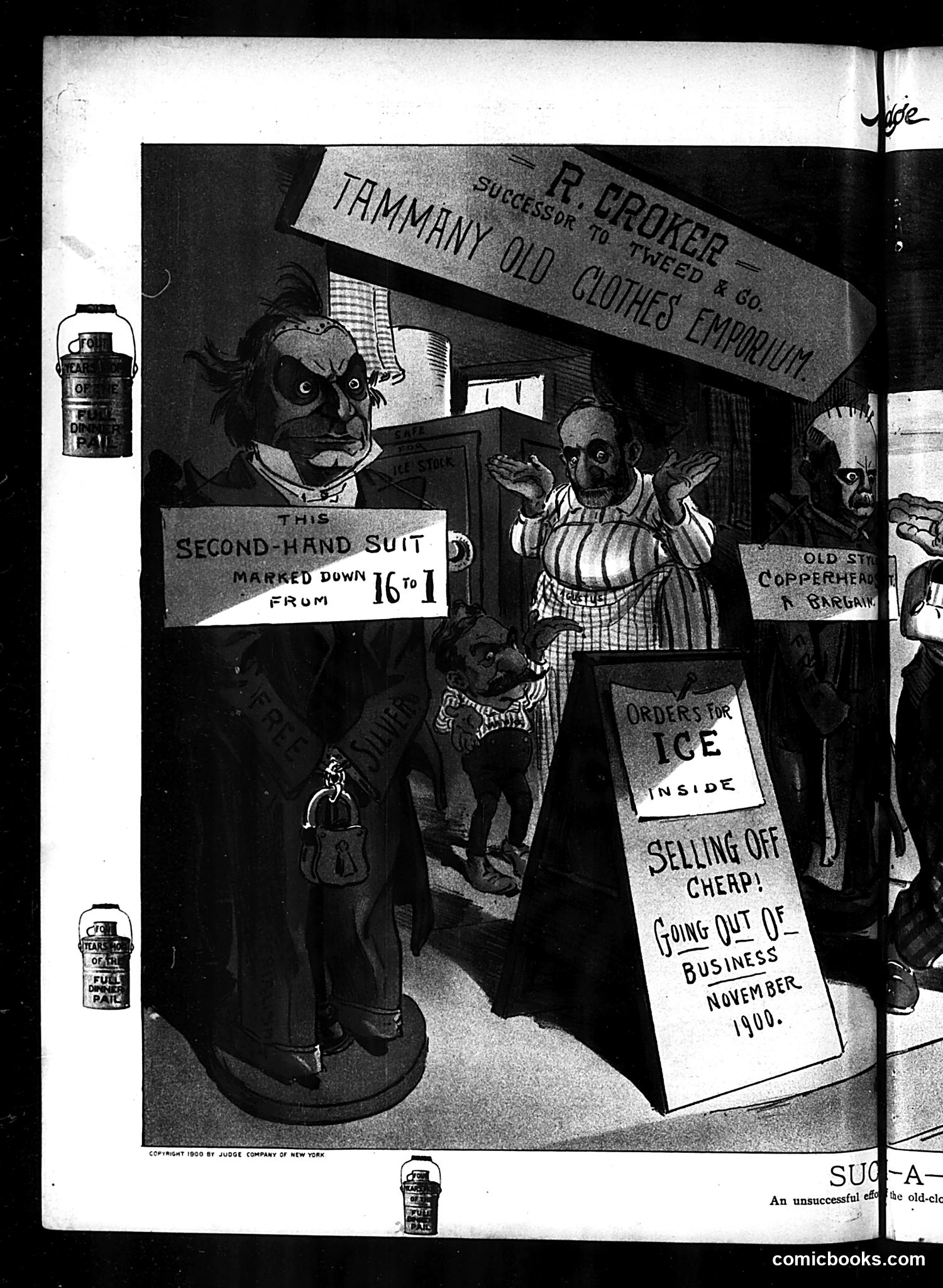
This appears to be a satirical display window or storefront scene from Judge magazine (copyright 1899, Judge Company of New York). The caricatured figures—with exaggerated grotesque features typical of period satire—are shopkeepers or merchants advertising a going-out-of-business sale in November 1900. The signs mock various retail schemes: "Second-Hand Suit Marked Down 16 to 1," "Tammany Old Clothes Emporium" (referencing NYC's corrupt Tammany Hall political machine), "Orders for Ice Inside," and "Selling Off Cheap! Going Out of Business." The satire targets dishonest merchants and possibly Tammany Hall corruption, suggesting these businesses succeed through deception rather than legitimate commerce. The grotesque caricatures emphasize the cartoon's contempt for such operators. The specific historical context—the 1900 election period—likely adds political dimensions now unclear without further research.
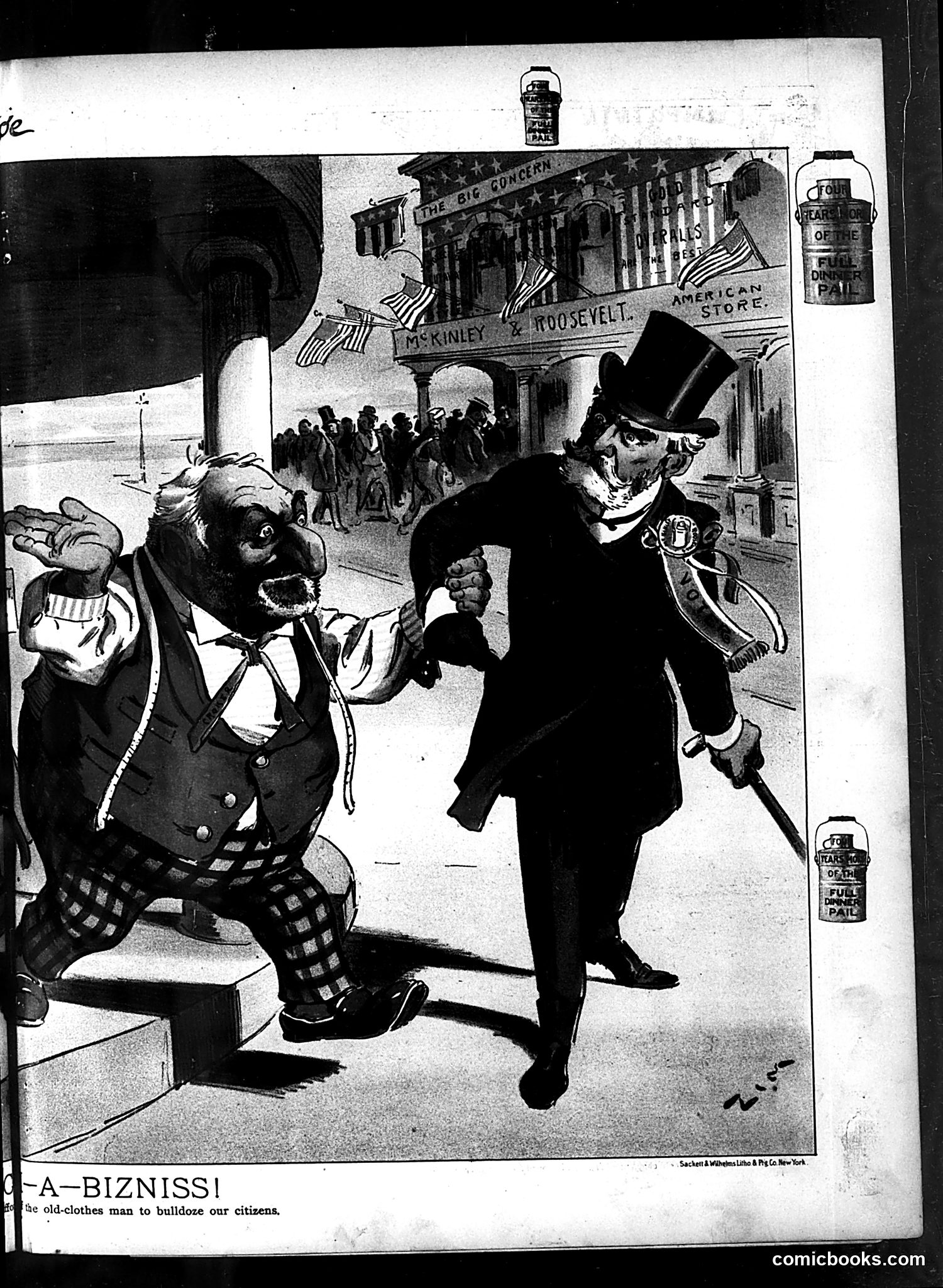
This Judge magazine cartoon satirizes immigrant "old-clothes men"—a common occupation among Jewish and Italian immigrants in early 20th-century America. The caricature depicts a figure with exaggerated features in formal dress "bulldozing" citizens near what appears to be an American store (marked "McKinley," "Roosevelt," "American Store"). The satire suggests these immigrant merchants were aggressive or coercive in their business dealings with American citizens. The cartoon uses dehumanizing visual caricature common to this era's anti-immigrant sentiment, particularly targeting Jewish immigrants who dominated the secondhand clothing trade in urban America. This reflects the xenophobic attitudes prevalent in American publications of the 1890s-1910s period.
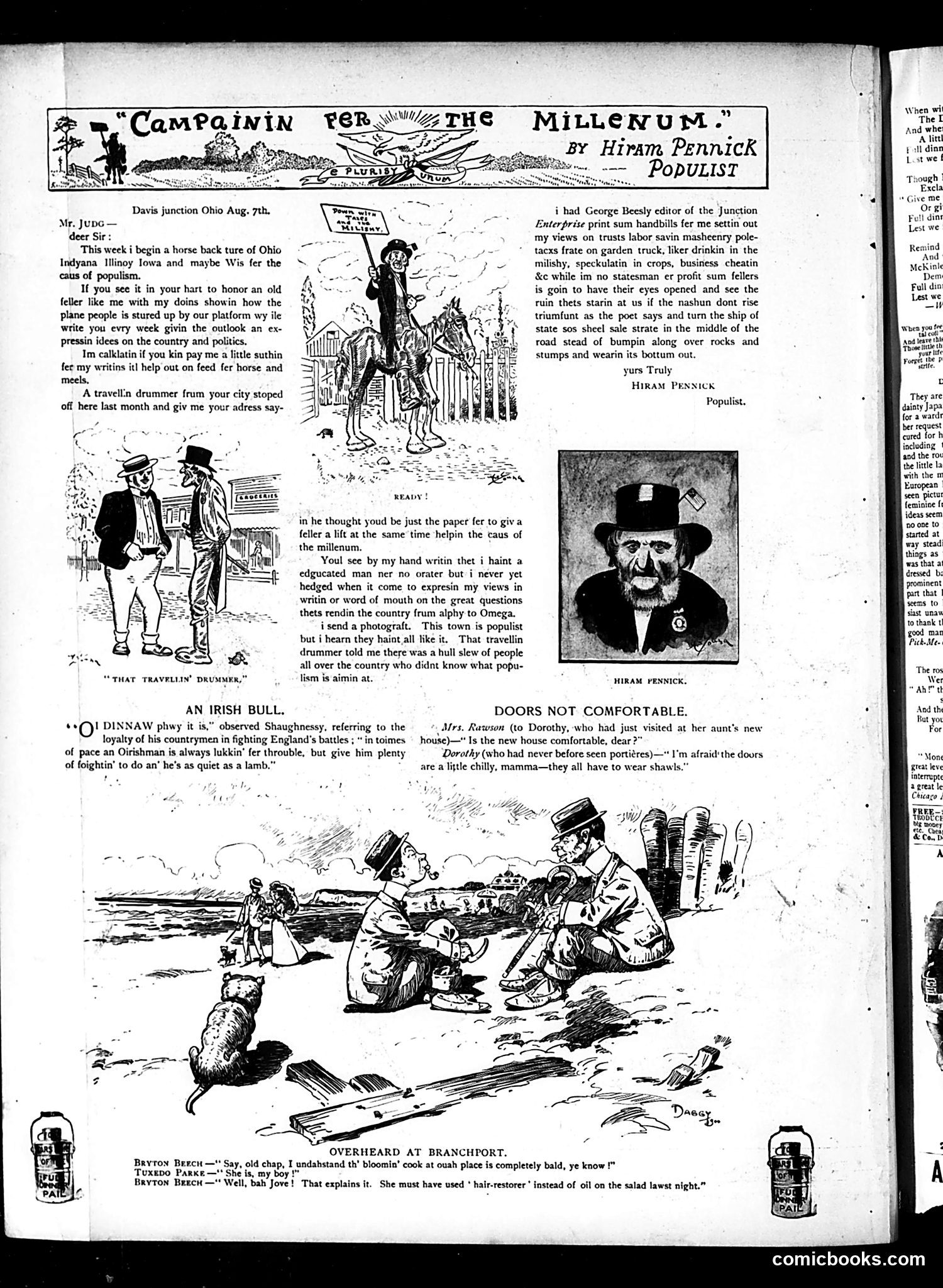
This page satirizes the **Populist movement** of the 1890s through a letter from "Hiram Pennick," a self-described populist traveling Ohio on horseback to campaign. The satire targets populists' lack of education and sophistication: Pennick writes in deliberate misspellings and poor grammar ("edgucated man ner no orater"), undermining the movement's credibility. The cartoon mocks populist complaints about trusts, labor-saving machinery, taxes, and business corruption—genuine grievances presented through an ignorant, buffoonish speaker. Judge (a Republican publication) uses this device to delegitimize populist reform ideas by associating them with rural simplicity and illiteracy. The page also includes unrelated humorous items: "An Irish Bull" (ethnic humor), "Doors Not Comfortable" (a domestic joke), and "Overheard at Branchport" (wordplay about hair-restorer).
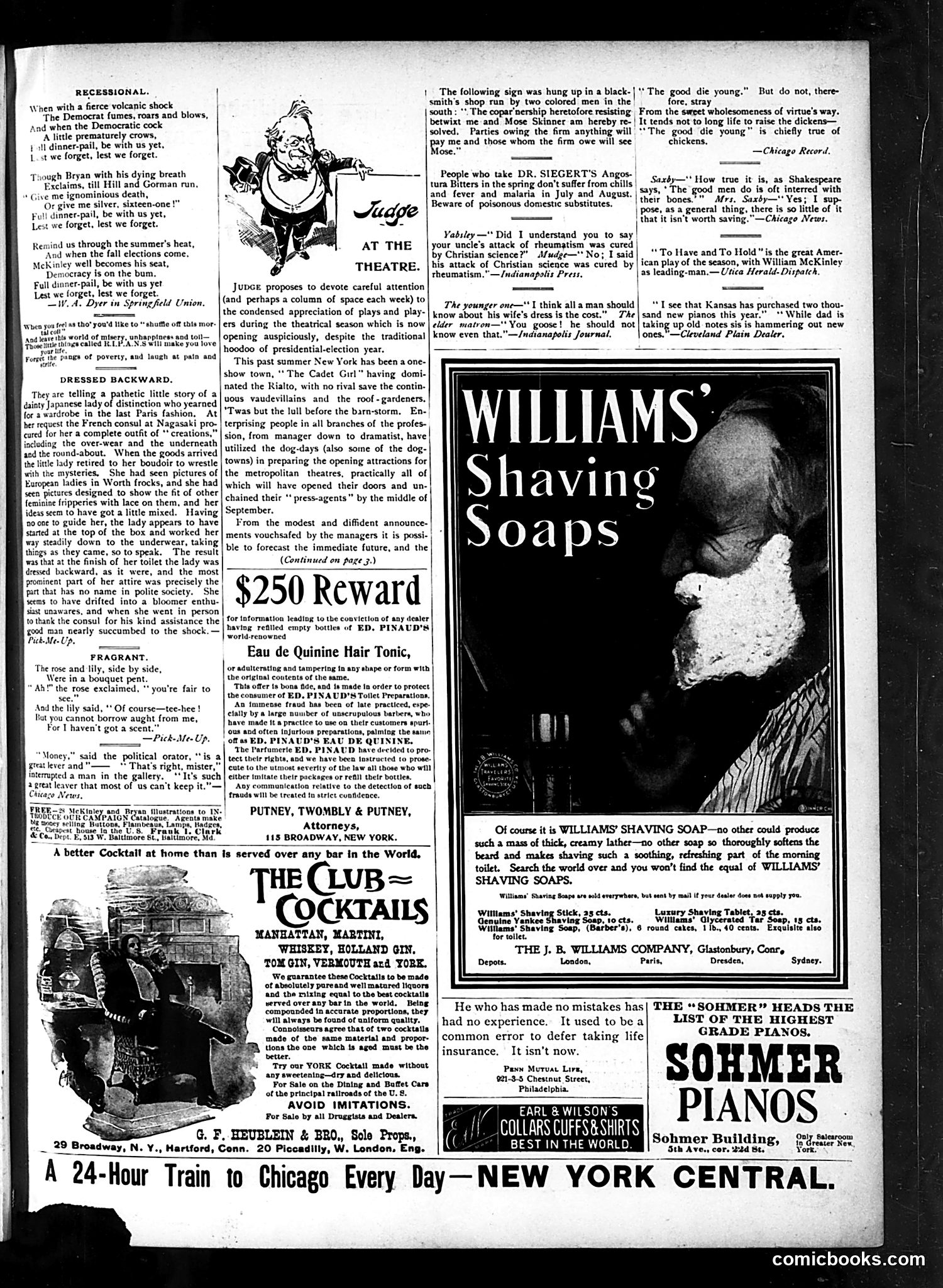
This page contains primarily **advertising and theatrical commentary**, with one significant political poem. ## The Political Content The "RECESSIONAL" poem mocks the Democratic Party, referencing **William Jennings Bryan's failed 1896 presidential campaign** (which championed "free silver" at the "16-to-1" ratio). The poem sarcastically invokes the "full dinner-pail"—a Republican campaign slogan suggesting prosperity under GOP rule—while suggesting Democrats have lost power and credibility. References to Bryan's dying breath, Hill, and Gorman indicate intra-party Democratic conflict. The satire argues voters should remember Republican economic success during elections. ## Other Content The "DRESSED BACKWARD" anecdote humorously describes a Japanese woman who dressed in reverse order after receiving Paris fashions, creating an embarrassing wardrobe mishap—satirizing cross-cultural confusion and unfamiliarity with Western clothing conventions. The page is otherwise dominated by period advertisements (Williams' Shaving Soaps, The Club Cocktails, Sohmer Pianos, etc.) and theatrical notices, typical of Judge's mixed editorial-advertising format.
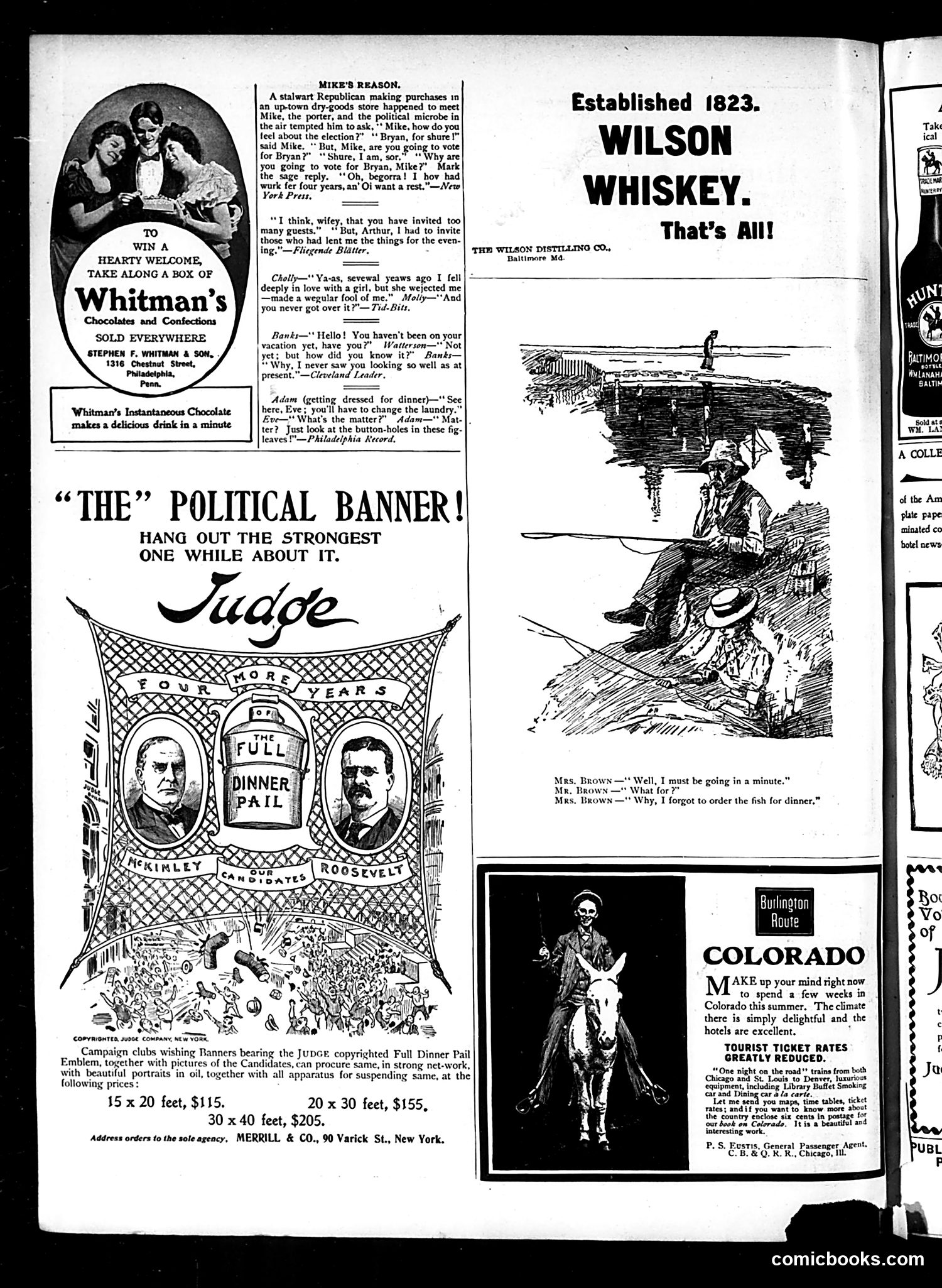
This page contains **political advertising** rather than traditional satirical cartoons. The dominant image is "The Political Banner"—a campaign poster featuring the "Full Dinner Pail," the Republican Party's 1900 election slogan under President McKinley. The banner displays portraits of **William McKinley** (left) and **Theodore Roosevelt** (right, as vice-presidential candidate), with a dinner pail symbolizing Republican prosperity and economic success for working Americans. The phrase "Four More Years" references McKinley's re-election campaign against William Jennings Bryan. The accompanying text fragment, "Mike's Reason," uses an Irish-immigrant character dialect to satirize working-class Democratic voters. Mike supports Bryan because McKinley's policies gave him steady employment—implying he ironically wants to vote against the party providing his job, wanting "rest" instead. The page is primarily **commercial**—selling campaign banners and promoting Wilson Whiskey and Colorado tourism—rather than offering sharp political commentary.
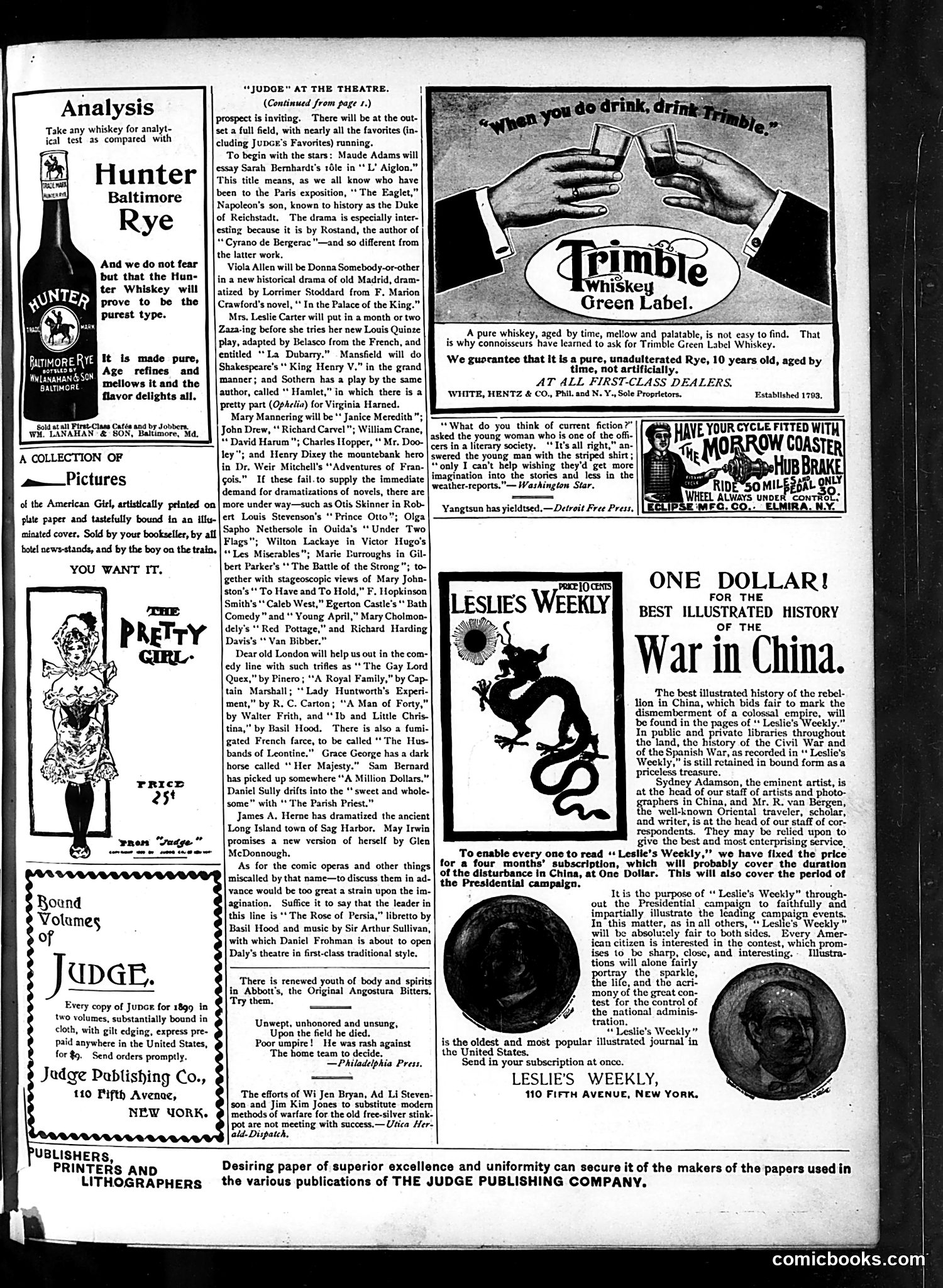
This page is primarily **advertising and editorial content** rather than political satire. The main elements are: **Advertisements:** - Hunter Baltimore Rye whiskey (top left) - Trimble Green Label Whiskey (center, with hand holding glass) - "The Pretty Girl" picture collection (left side) - Judge Publishing Company's bound volumes (bottom left) - Leslie's Weekly and War in China book (right side) **Editorial Content:** The "Judge at the Theatre" column (top right, continued from previous page) discusses upcoming 1899 theatrical season productions, listing major actors and plays—mostly adaptations of novels like *L'Aiglon*, *In the Palace of the King*, and *Cyrano de Bergerac*. There is **no visible political cartoon or satire** on this page. It functions as a typical late-19th-century magazine layout combining entertainment criticism with commercial advertisements.
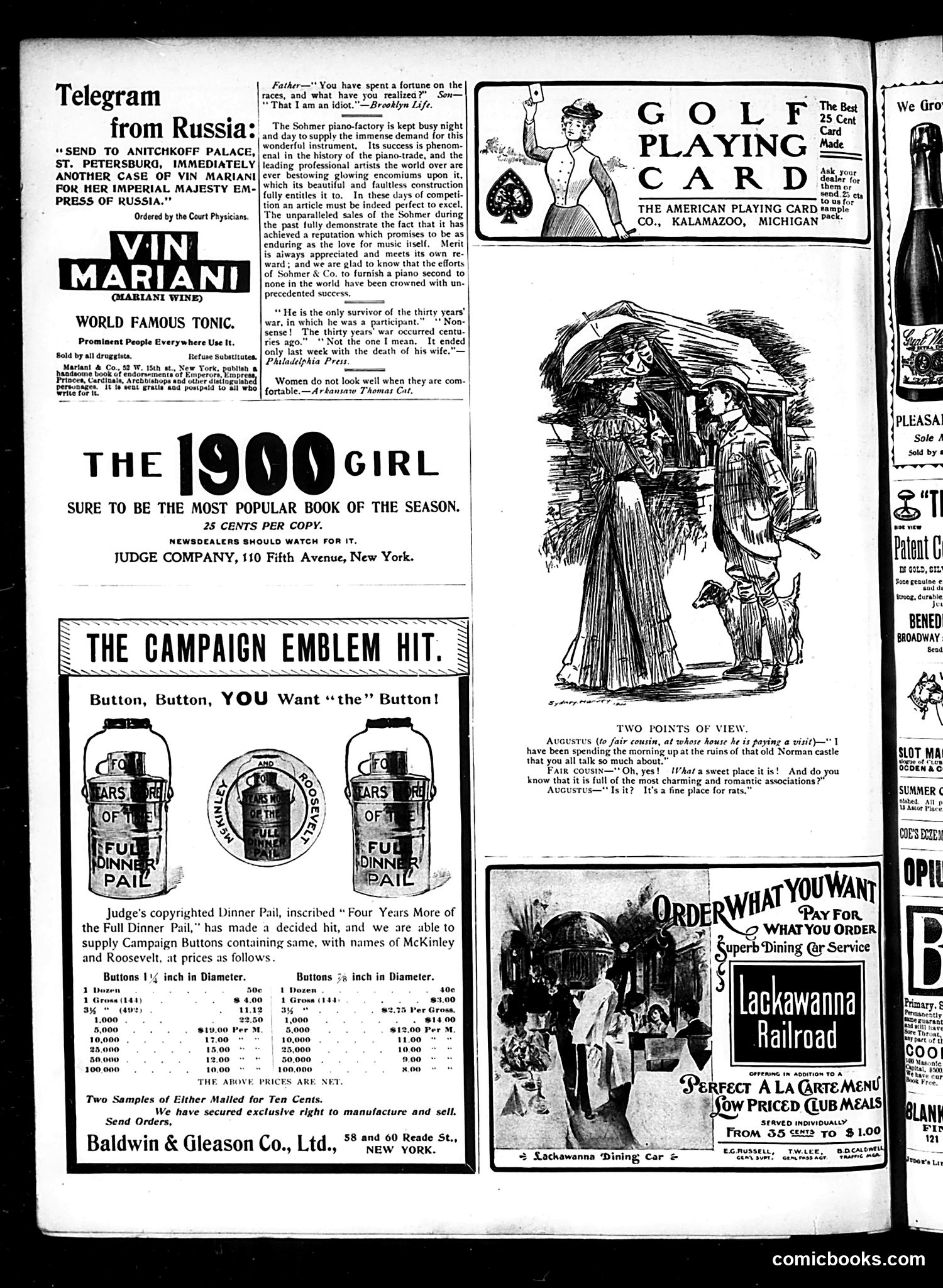
This page from *Judge* magazine features several satirical elements targeting early 1900s American politics and society: **The Russian Telegram**: A joke about the Russian imperial court's supposed dependency on "Vin Mariani" (a wine tonic), mocking both Russian excess and dubious patent medicines marketed to the wealthy and famous. **"The 1900 Girl" Book Advertisement**: Promoting a seasonal bestseller—typical publishing promotion for the era. **The Campaign Emblem**: The centerpiece satirizes McKinley and Roosevelt's 1904 campaign slogan "Four Years More of the Full Dinner Pail"—a promise of prosperity. Judge's mockery suggests skepticism about this claim, offering campaign buttons for sale. **Other Jokes**: Include domestic humor (a woman complaining about her husband's 30-year "war"), social commentary on women's appearance, and upper-class leisure activities (Norman castle tourism). The page reflects *Judge*'s role as satirical commentary on politics, advertising, and society, with advertising interspersed throughout.
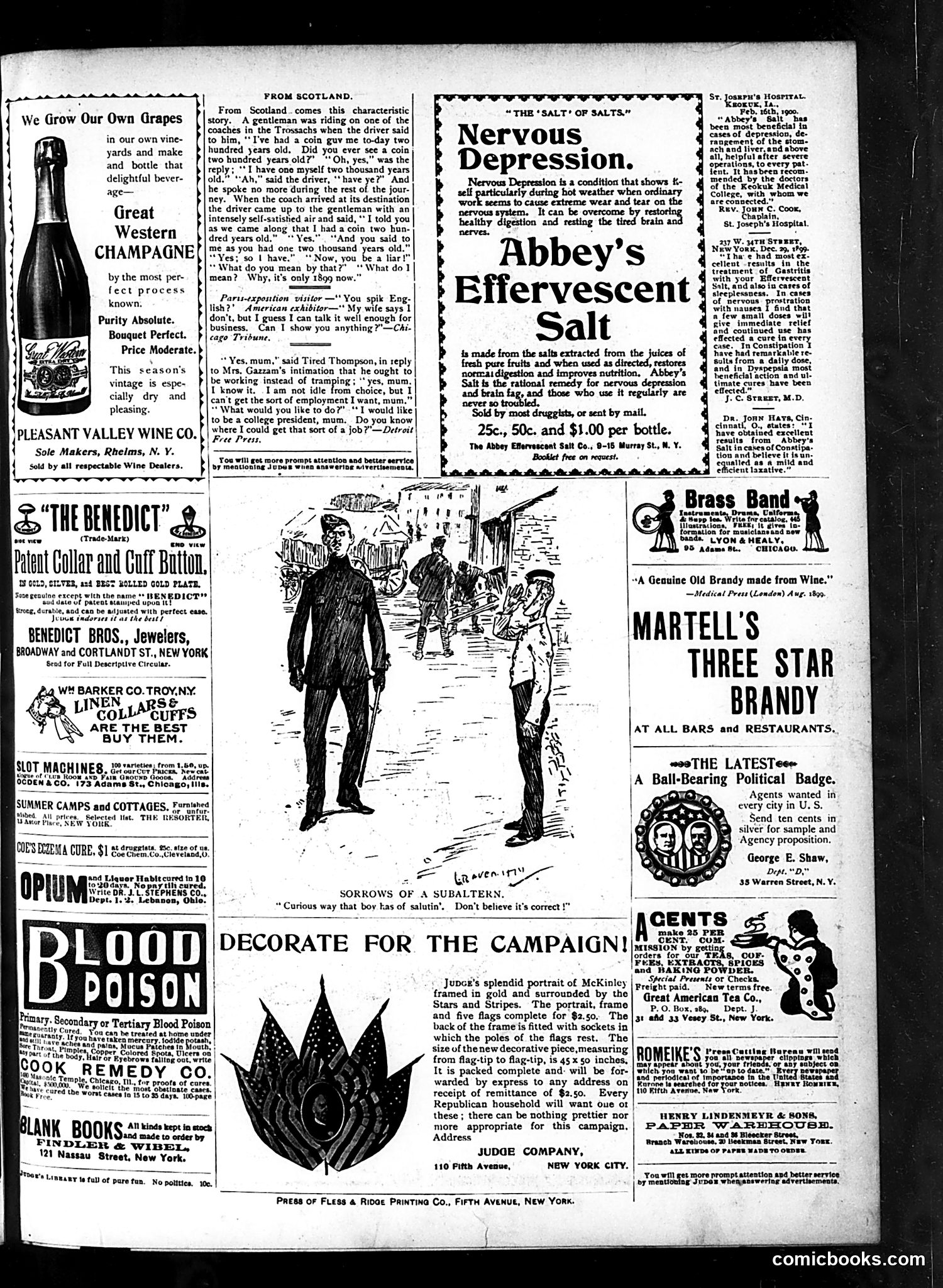
The central cartoon depicts two military officers in conversation on a street. The caption reads: "Curious way that box of salts'. Don't believe it's correct!" This appears to be satirizing the widespread advertising of patent medicines and health tonics (like Abbey's Effervescent Salt, prominently featured on this page) during the late 19th century. The joke suggests that a junior officer ("subaltern") has been given or recommended a box of medicinal salts to address some ailment, and the other officer skeptically questions whether this remedy will actually work. The humor targets the era's credulity about commercial health products—doctors and testimonials endorsed these products extensively (as shown in the adjacent advertisements), yet educated men remained doubtful of their efficacy. The cartoon mocks both the prevalence of these dubious remedies and the gap between popular belief and rational skepticism about their effectiveness.
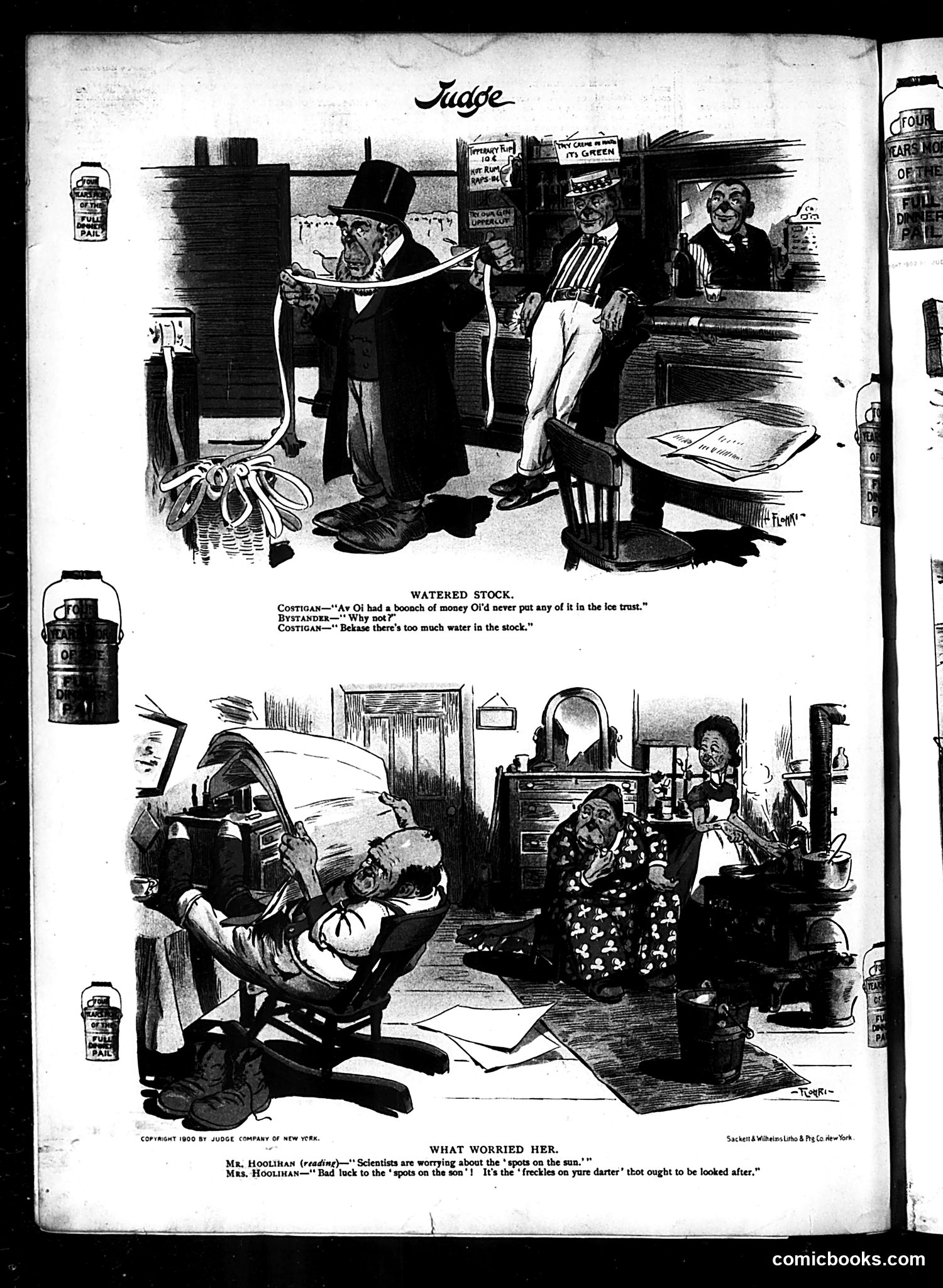
**"Watered Stock"** (top): This cartoon satirizes financial fraud. Two men discuss investing in "the ice trust" (a monopoly controlling ice distribution). Costigan warns against it because the stock is "watered"—a common practice where companies inflated share value with worthless securities. The joke plays on the literal meaning: ice mixed with water. This reflects Progressive-Era anxieties about corporate deception and monopolistic trusts that dominated American business. **"What Worried Her"** (bottom): Mrs. Hoolihan reads about scientists studying sunspots while dismissing the concern. She's more worried about her daughter's freckles—a beauty flaw considered serious in this era. The satire mocks superficial Victorian concerns about female appearance versus scientific advancement. Both cartoons use Irish-dialect characters (Costigan, Hoolihan names and speech patterns), reflecting how ethnic humor was standard in early-1900s American comics.