
A complete issue · 16 pages · 1900
Judge — July 28, 1900
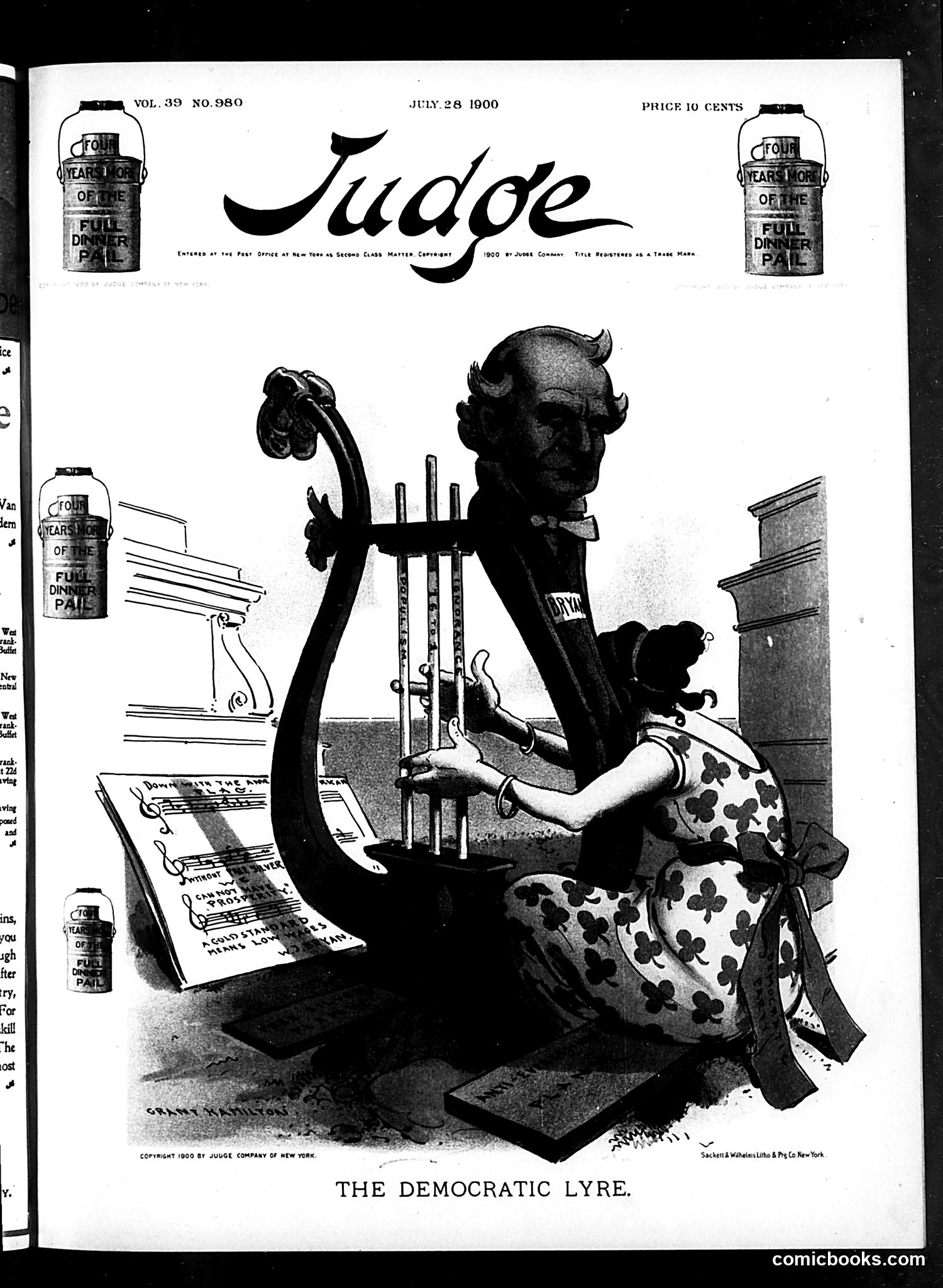
This political cartoon satirizes the Democratic Party's campaign messaging ahead of the 1900 presidential election. A woman (representing Democracy or the Democratic Party) plays a large harp-like instrument while consulting sheet music labeled with Democratic campaign themes. The figure has exaggerated, caricatured facial features typical of period political satire. The "lyre" pun suggests the Democrats are "lying"—their campaign promises are mere musical noise rather than substantive policy. The sheet music and careful consultation imply they're following a scripted, artificial message rather than genuine conviction. The adjacent "Four Years of One Full Dinner Pail" advertisements (visible on the margins) reference Republican William McKinley's successful 1896 slogan, suggesting Judge's Republican editorial stance and mockery of Democratic alternatives.
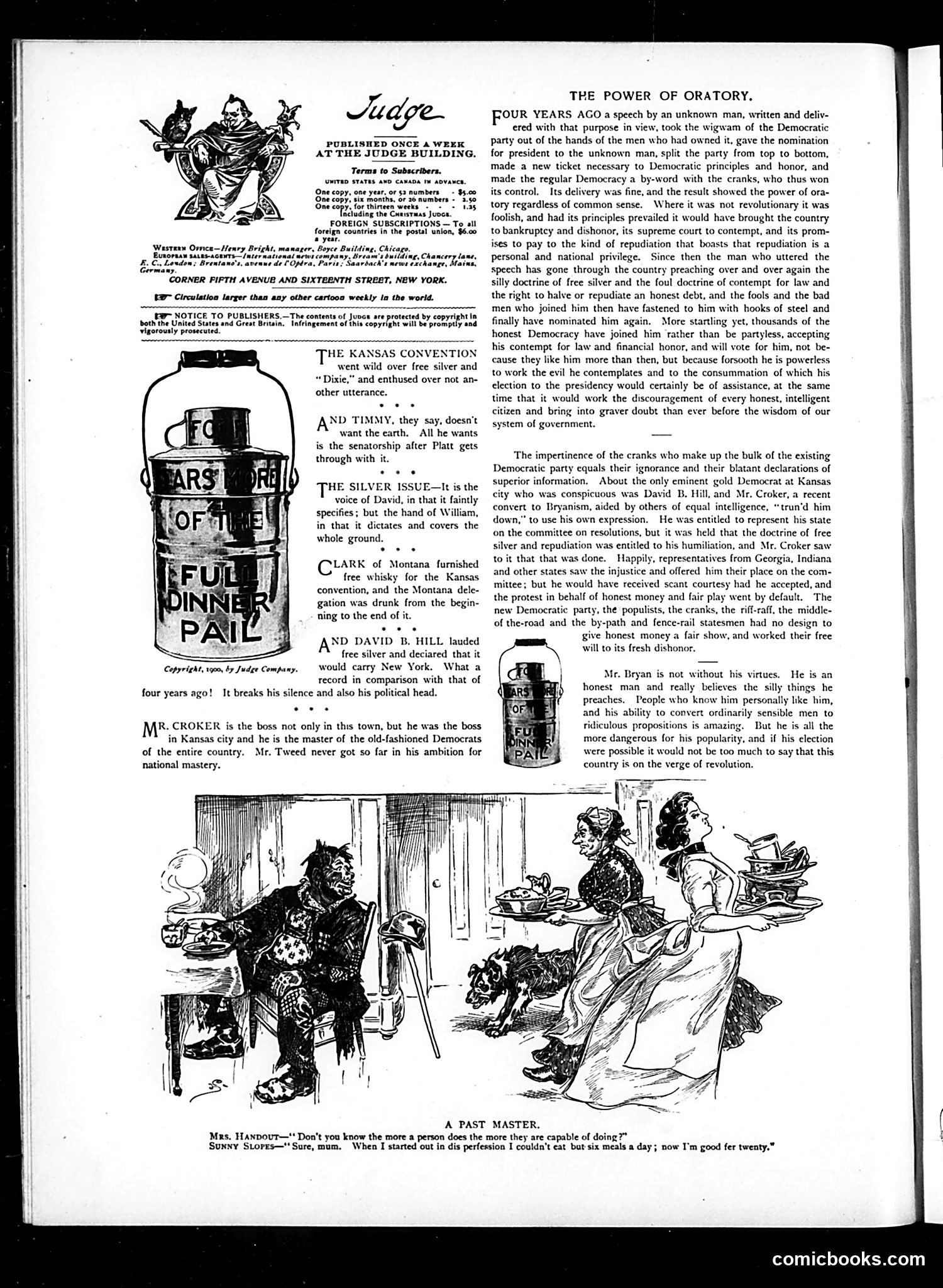
This page satirizes William Jennings Bryan's 1896 "Cross of Gold" speech and its political aftermath. The main article criticizes Bryan's oratory as dangerously persuasive yet intellectually hollow—his silver-standard advocacy won Democratic support through rhetoric rather than sound economic policy. The cartoon "A Past Master" depicts a homeless man ("Sunny Slopes") crediting Bryan's persuasive powers for his improved circumstances: he now earns enough for meals, having previously starved. The satire suggests Bryan's eloquence fooled voters into supporting policies that helped no one materially. The accompanying images of tinware labeled "Ears of Corn" mock Bryan supporters as gullible listeners captivated by empty speeches rather than substantive governance.
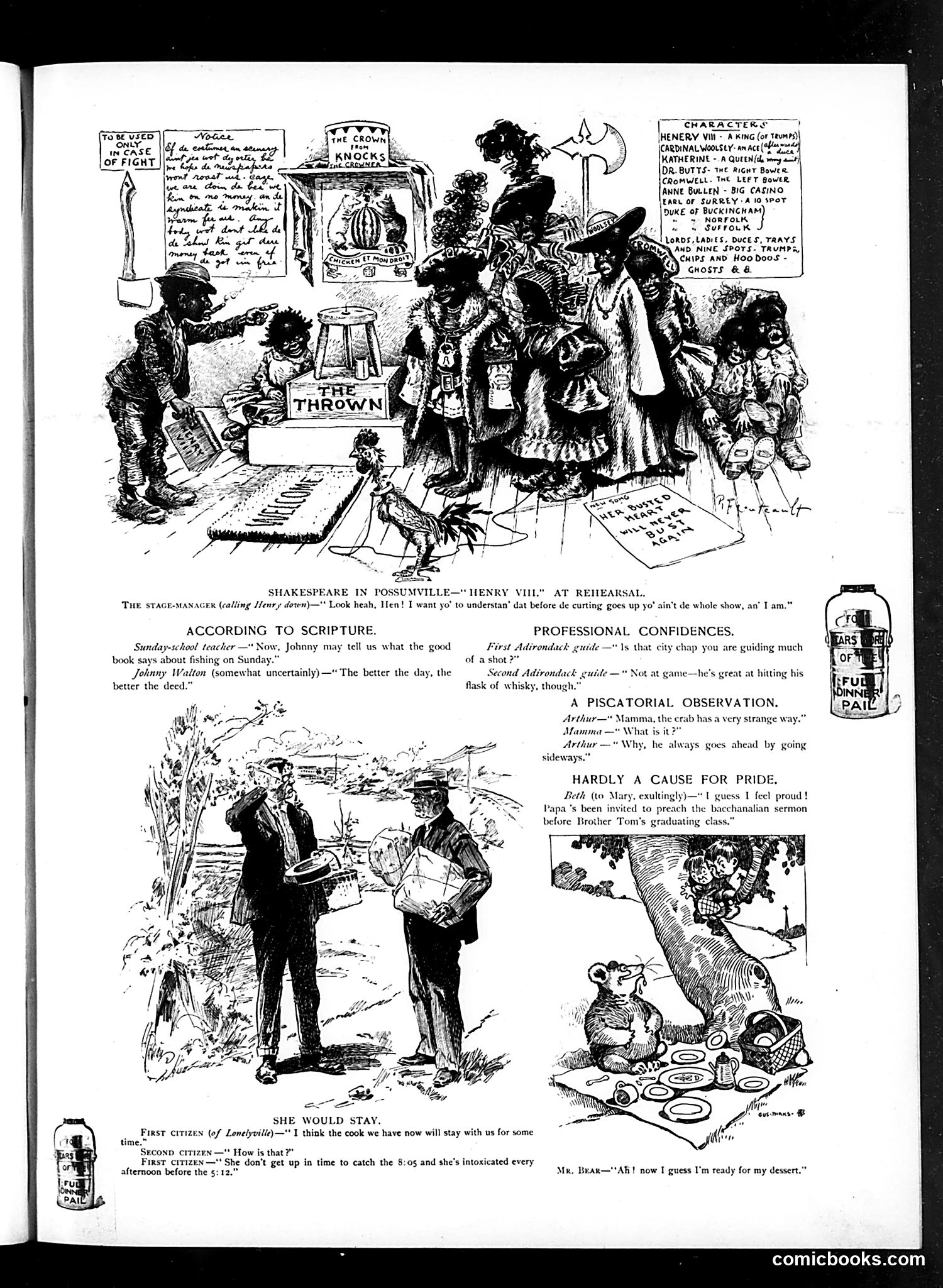
This page contains several humorous sketches satirizing everyday social situations rather than specific political figures. **Top cartoon** depicts a theatrical rehearsal of "Henry VIII," mocking amateur dramatics and pretentious amateur actors attempting Shakespeare. **Middle sections** include brief comic exchanges: - "According to Scripture" jokes about Sunday school lessons - "Professional Confidences" pokes fun at city guides - "A Piscatorial Observation" plays on miscommunication between characters - "Hardly a Cause for Pride" satirizes social climbing through religious affiliation **Bottom sketches** feature domestic humor about cooking ("She Would Stay") and dining etiquette ("Ms. Bear"). The page relies on gentle social satire about class aspirations, amateur theatrics, and household management—typical Judge magazine fare targeting middle-class readers' foibles rather than political commentary. The advertisements for what appears to be a beverage frame the content.
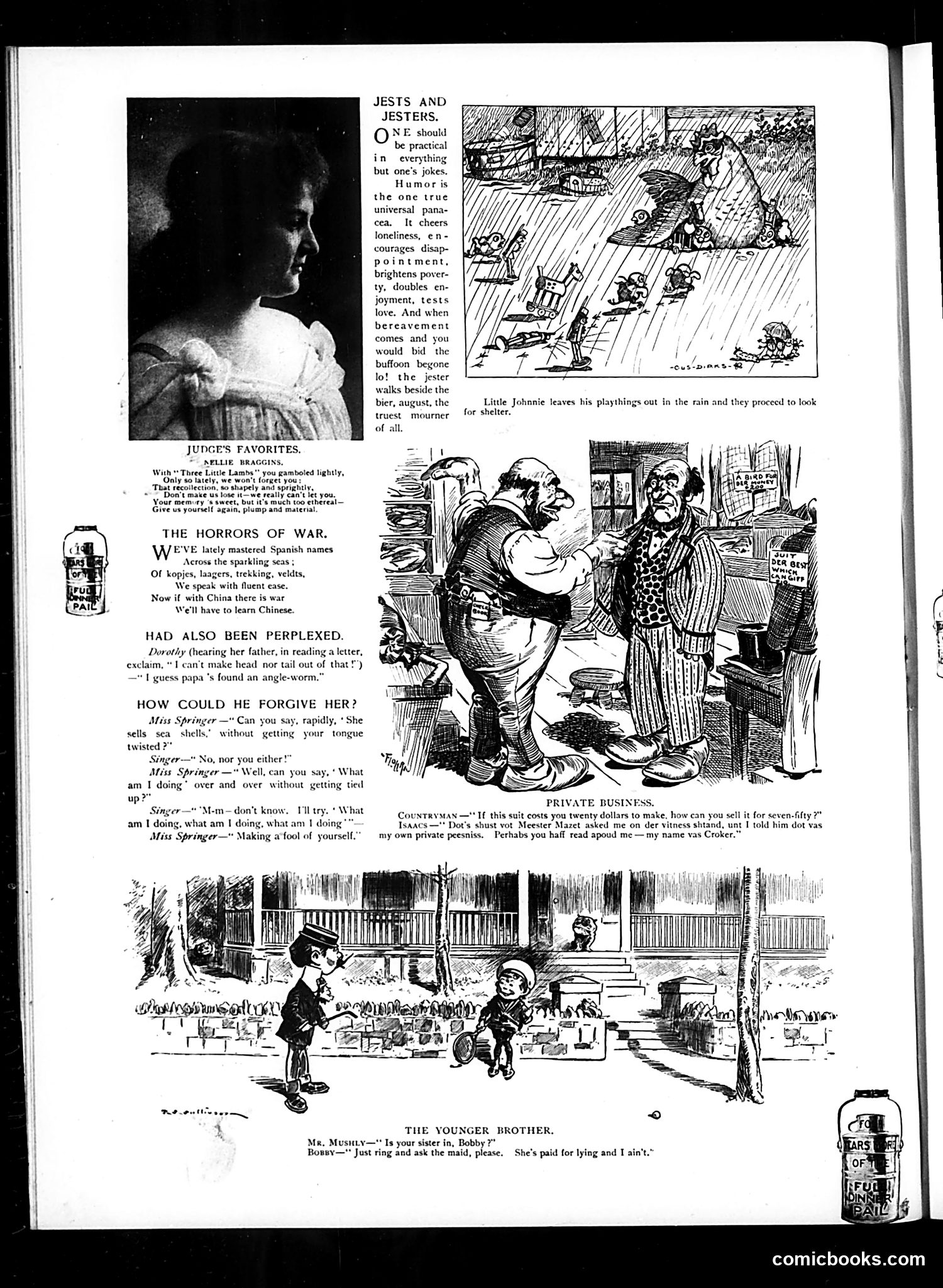
This page contains multiple cartoons and humorous pieces typical of early 20th-century satirical journalism: **"The Horrors of War"** references conflict with China, likely the Boxer Rebellion era, using darkly comedic verse. **"Private Business"** satirizes commerce—a countryman tries selling a suit for seventy-five dollars while a character (possibly a Jewish merchant, given stereotypical caricature style) negotiates aggressively about profit margins. **"The Younger Brother"** shows two boys, one asking the maid to summon his sister, with the punchline mocking the sister's dishonesty ("paid for lying"). The page reflects Judge's signature approach: combining social commentary on war, commerce, and domestic life with period-typical ethnic stereotyping. The humor relies on wordplay, visual exaggeration, and class-based observations.
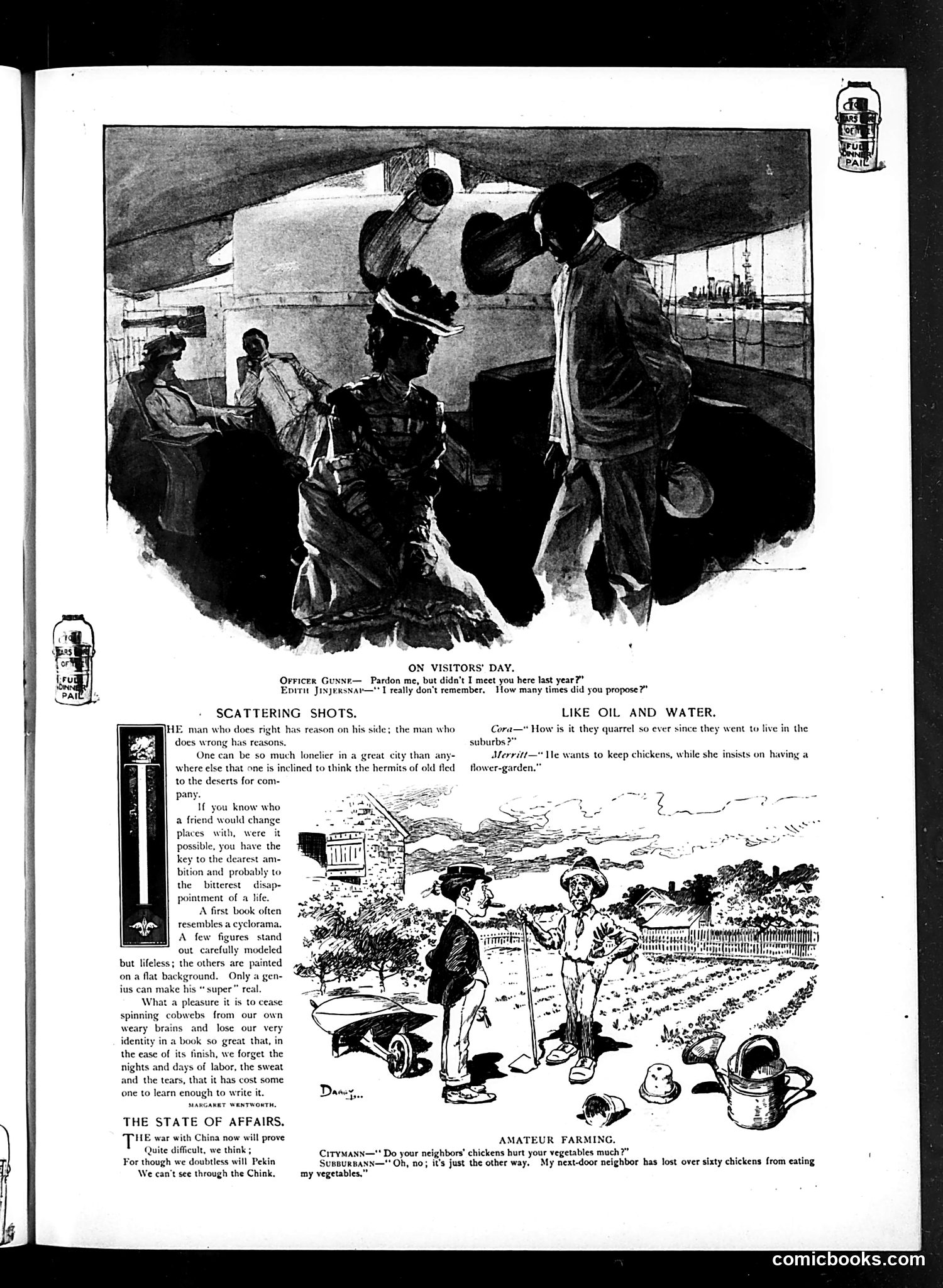
This page contains several brief satirical pieces typical of the era: **"On Visitors' Day"** (top): A joke about a prison visit. An officer asks if he's met a female visitor before; she replies by asking how many times he proposed to her—implying she's a repeat visitor, likely due to romantic entanglements rather than legitimate prison business. The humor relies on suggesting loose morals. **"Scattering Shots"**: A collection of philosophical one-liners about human nature, friendship, and writing—standard filler content with no specific political reference. **"The State of Affairs"**: A pun-based joke about the Boxer Rebellion or similar China conflict, using "Chink" as a racial slur while making a play on words about seeing through Chinese people/matters. **"Like Oil and Water" and "Amateur Farming"**: Domestic humor about suburban couples arguing over gardens versus chickens, and neighbors' livestock eating vegetables—gentle satire of amateur rural life among city transplants. The page mixes social commentary with crude stereotyping typical of early 20th-century American humor magazines.
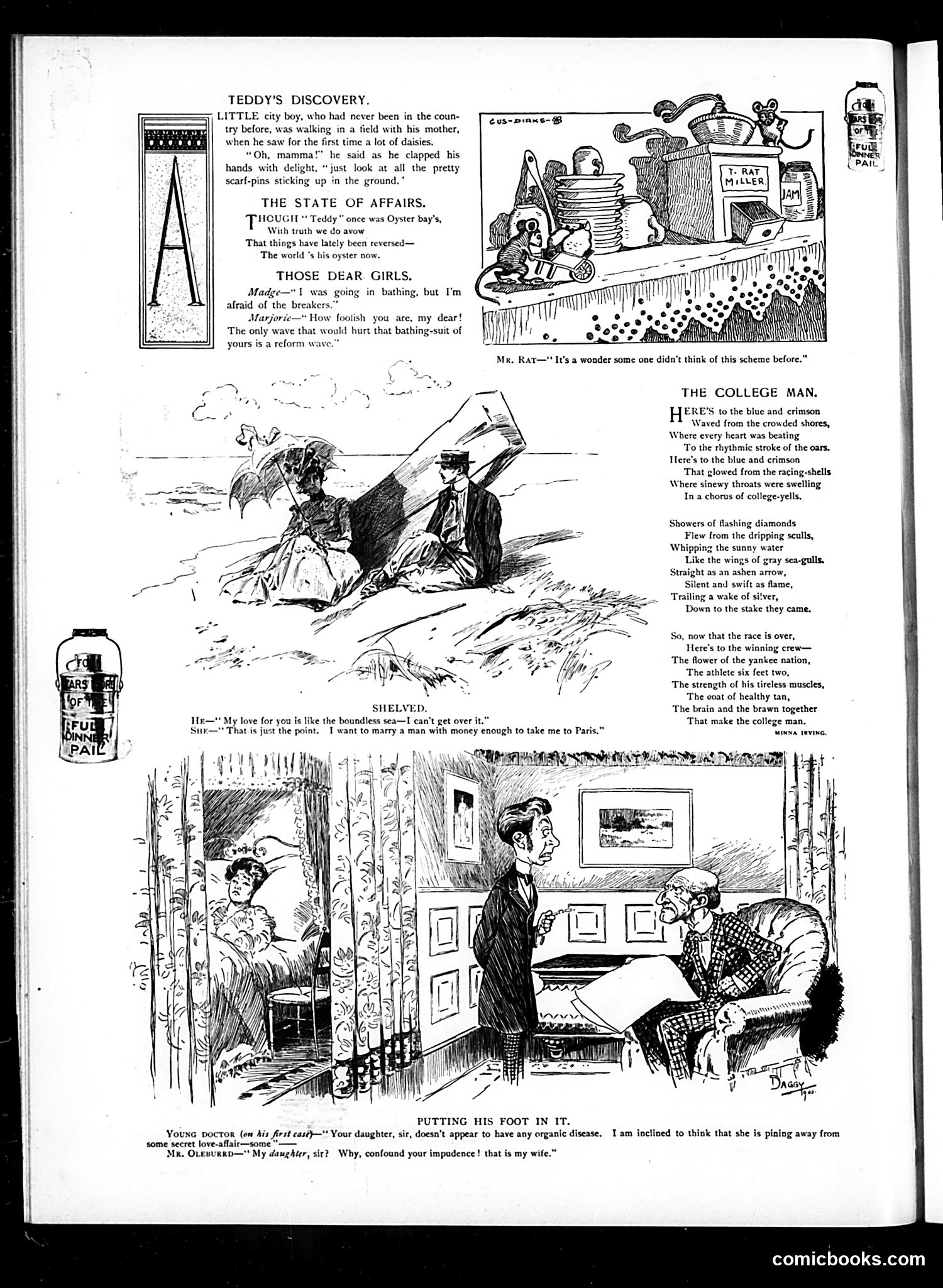
This page contains several satirical pieces from Judge magazine: **"Teddy's Discovery"** jokes about a city boy mistaking daisies for "scarf-pins"—a lighthearted children's humor piece. **"The State of Affairs"** references Theodore Roosevelt ("Teddy"), likely alluding to his rise to prominence or presidency. The "oyster bay" reference indicates his estate; the satire suggests his fortunes have reversed or elevated globally. **"Those Dear Girls"** satirizes women's fashion and reform movements, with one woman dismissive of "reform waves"—mocking both bathing suit concerns and women's suffrage/reform activism. **"The College Man"** is celebratory verse about collegiate athletics and rowing, glorifying the idealized American college athlete. **"Shelved"** presents a romance joke where a woman rejects romantic declarations, preferring a wealthy husband who can take her to Paris—satirizing materialistic marriage motivations. **"Putting His Foot in It"** shows a young doctor mistakenly suggesting a patient (actually the doctor's client's *wife*) has a secret love affair, creating comedic embarrassment through misidentification.
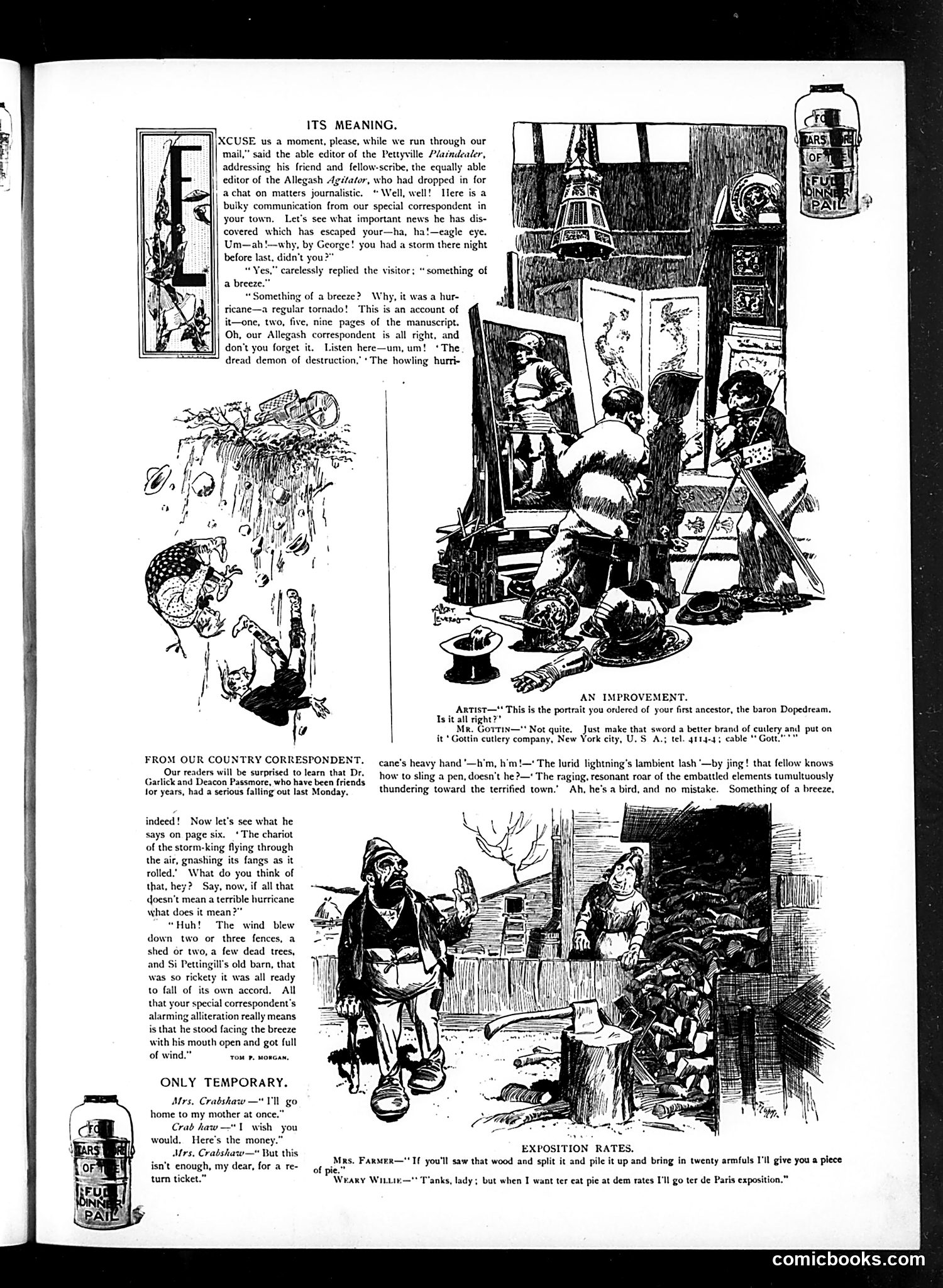
This page contains three separate satirical pieces mocking contemporary society: **"Its Meaning"**: Two small-town newspaper editors discuss an overly dramatic storm report. The satire targets flowery journalistic excess—a correspondent uses grandiose language ("dread demon of destruction," "lurid lightning's lambent lash") to describe what was merely strong wind that knocked over a few fences and a rickety barn. The joke: purple prose doesn't equal substance. **"An Improvement"**: An artist painting a nobleman's portrait is asked to add a sword and brand it with "Gottin Cutlery Company." This mocks commercialism and vanity—even ancestral portraits are now advertising vehicles. **"Only Temporary"** and **"Exposition Rates"**: Brief domestic comedy sketches. The first shows a wife threatening to leave; the second depicts a farmer refusing extra work for inadequate pay, sardonically suggesting he'll eat at the Paris Exposition instead (implying better conditions elsewhere). The page collectively satirizes provincial journalism, commercial exploitation, and labor disputes—typical turn-of-century Judge targets.
This appears to be a vintage Judge magazine page, though the OCR text provides only a website reference without article content visible in the image itself. The black and white cartoon shows a scene rotated 90 degrees: a person lying down operating a large camera on a stand, with what appears to be a witch or grotesque figure beside them, and various props or equipment scattered about. A caricatured face or mask is prominently featured below. Without clear text identifying the specific political figures, events, or satirical targets, I cannot definitively explain the cartoon's meaning. The grotesque imagery and theatrical setup suggest commentary on entertainment, theater, or media production of the early 20th century, but the exact subject remains unclear from the image alone. The "Judge" magazine's typical focus was American politics and social satire.
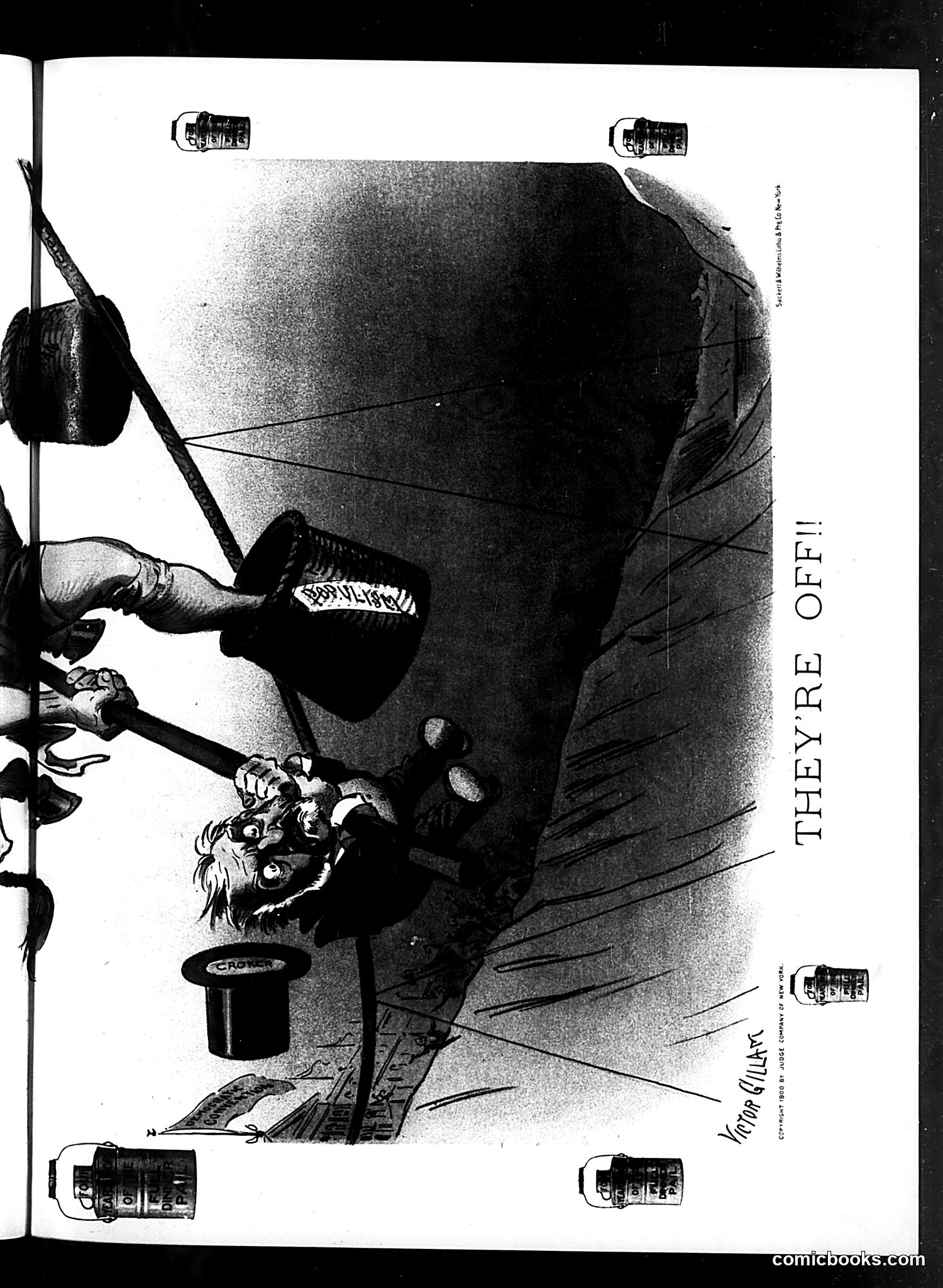
This political cartoon depicts a magician or illusionist pulling a rabbit from a hat labeled "CROWN," with the text "THEY'RE OFF!" The imagery suggests a magic trick or sleight-of-hand deception involving royalty or state power. The cartoon appears to satirize political deception or manipulation—likely referencing a government official or leader using misdirection (the "magic trick") to distract the public from actual events. The rabbit emerging from the crown suggests something unexpected or absurd being produced through governmental sleight-of-hand. Without clearer dating or additional context visible in the OCR text, the specific political event referenced remains unclear, though the general critique targets political dishonesty and public manipulation through spectacle or illusion.
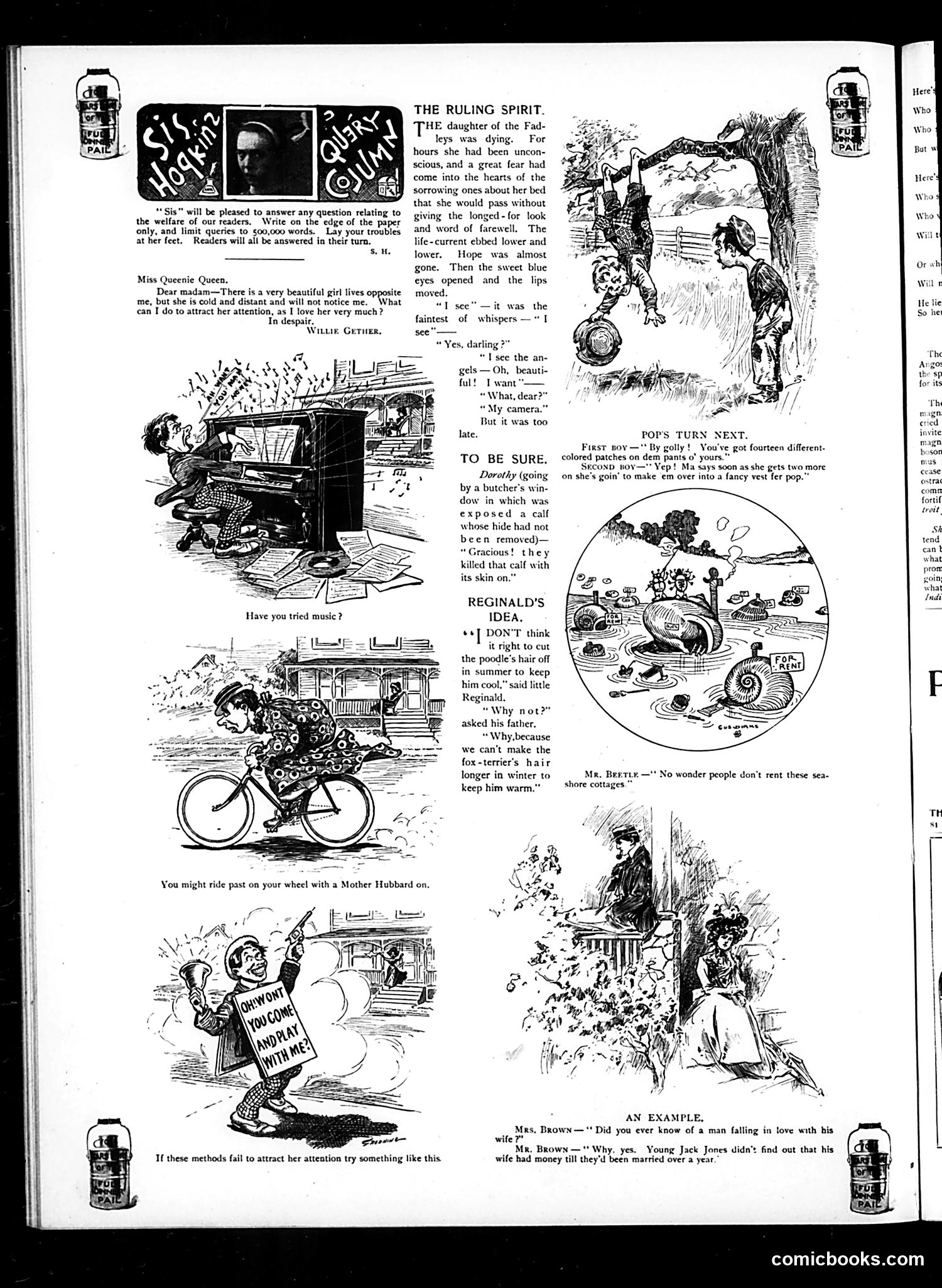
This page contains humorous advice columns and short comic pieces typical of early 20th-century American satire magazines. **"The Ruling Spirit"** is a sentimental story mocking deathbed sentimentality: a dying young woman's final words reveal she wants her camera—skewering both Victorian melodrama and the era's new obsession with photography. **"To Be Sure"** jokes about Dorothy's literal-mindedness, finding it absurd that a butcher killed a calf "with its skin on"—satirizing simple-minded observations. **"Reginald's Idea"** presents a child's illogical argument about grooming pets differently in seasons, mocking naive reasoning. The remaining pieces address dating/marriage advice and domestic humor: attracting women's attention, pet grooming logic, and marital economics (wives discovering husbands' financial situations post-marriage). **"Pop's Turn Next"** depicts working-class patching of worn trousers—a wife collecting patches to make her husband a vest—gentle satire on poverty and thrift. All pieces employ gentle, family-friendly humor typical of Judge's approach to social observation.
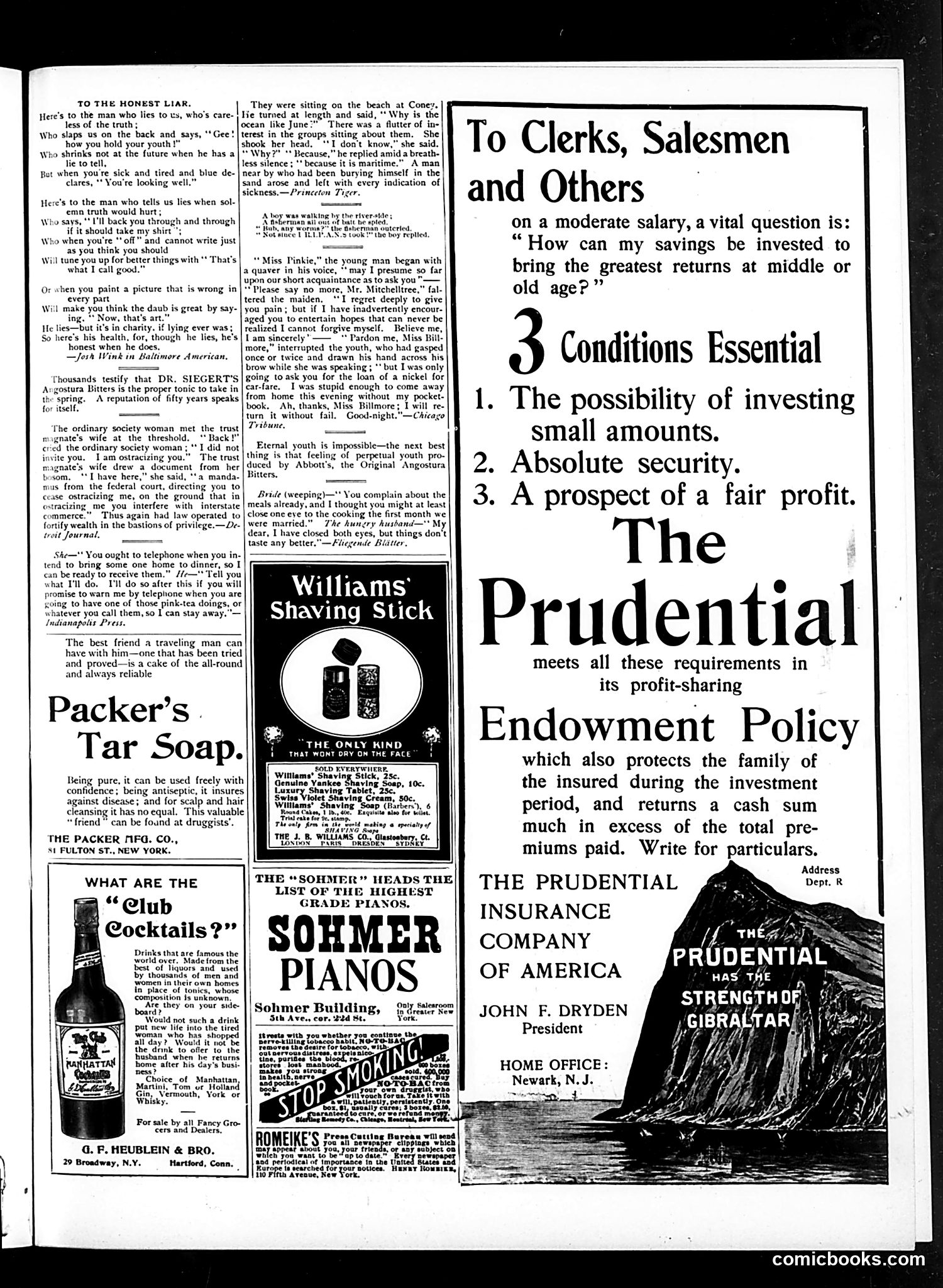
This page is primarily **advertisements and filler content** rather than political satire or cartooning. The editorial content consists of short humorous anecdotes: 1. **"To the Honest Liar"** — celebrates the person who lies charitably, to spare others' feelings or boost morale, contrasting with malicious falsehoods. 2. **Brief society/relationship jokes** — including a satirical piece about a trust magnate's wife using federal court mandamus to force her way into high society, mocking how wealth exploits legal power. 3. **Romantic comedy snippets** — including a terrible beach pun ("maritime" joke) and a melodramatic rejection scene. The advertisements promote patent medicines (Angostura Bitters), soap, pianos, and cocktails — typical period advertising. No prominent caricatures or named political figures appear. The satire is mild, domestic, and social rather than political.
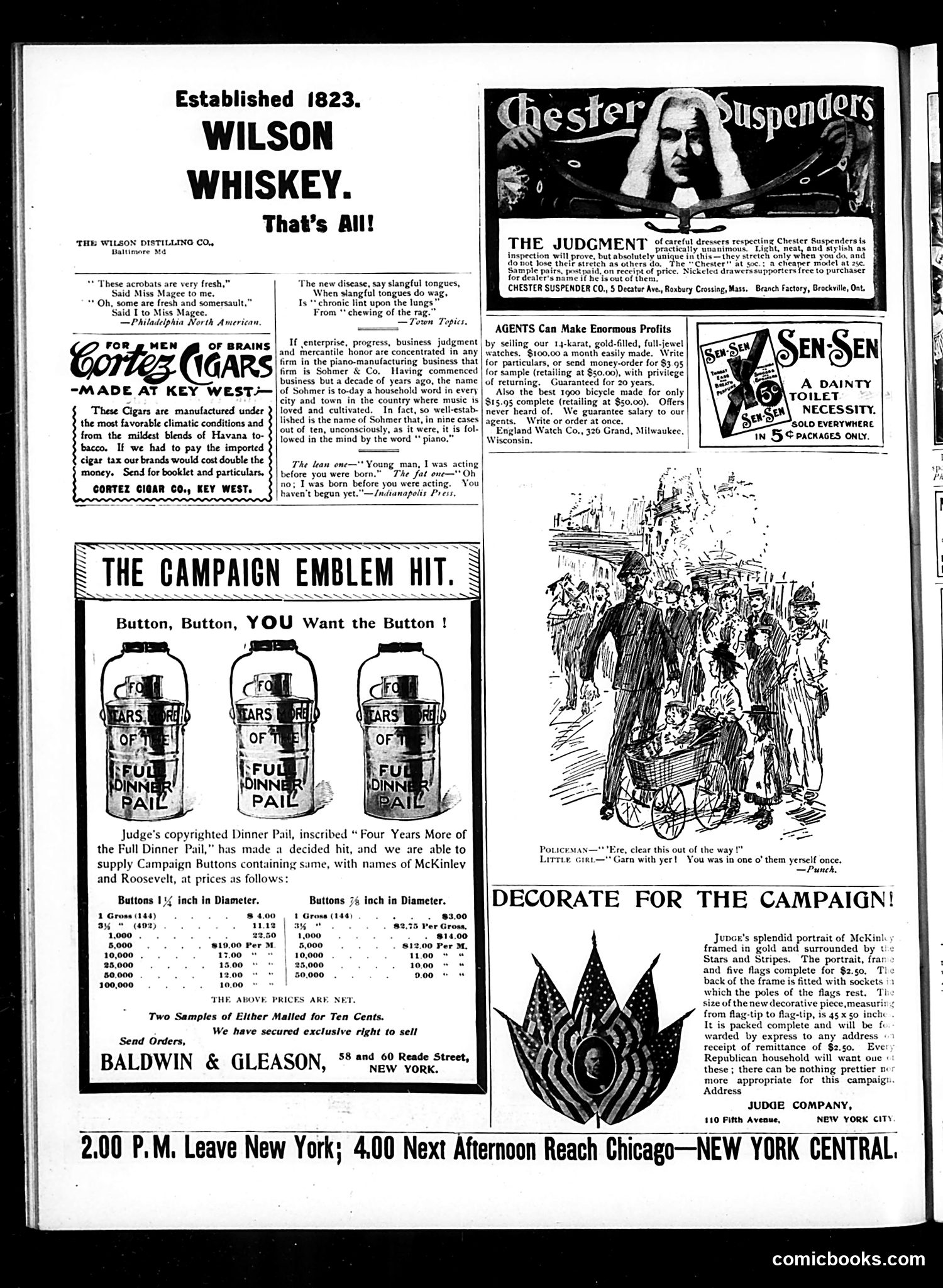
This page is primarily **advertising**, not political satire. The bulk consists of commercial ads for whiskey, cigars, suspenders, watches, and campaign materials. The one notable political content is "The Campaign Emblem Hit" section, which advertises **campaign buttons for McKinley and Roosevelt**—clearly referencing the 1904 U.S. presidential election. The buttons feature Judge's portrait of McKinley surrounded by stars and stripes. This represents standard campaign merchandise of the era. The scattered jokes and cartoons (the "acrobats," the "lean one" and "fat one" exchange, the policeman and girl vignette) appear to be generic humor filler typical of Judge's format—not pointed political commentary. The page reflects Judge's dual nature as both satirical magazine and advertising vehicle, with the campaign materials representing timely merchandise tied to contemporary electoral politics rather than editorial satire.
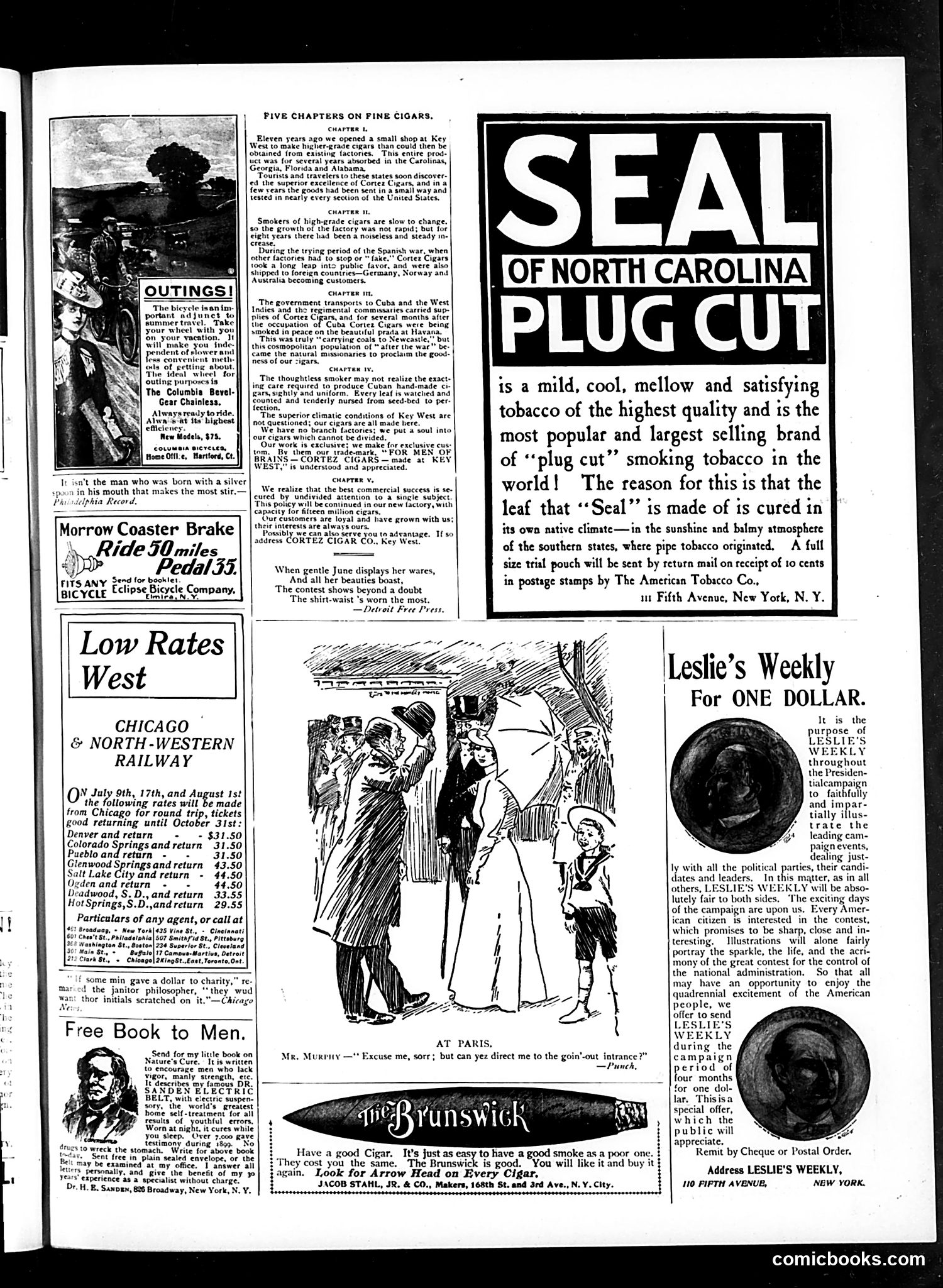
This page is primarily **advertising** with one cartoon. The main visual humor appears in the middle: a sketch labeled "AT PARIS" showing well-dressed figures with an umbrella, captioned "Excuse me, sir; but can ye direct me to the goin'-out entrance?"—attributed to Puncch. The joke plays on the confusion of formal Parisian etiquette, suggesting an American visitor mistakes ordinary exits for special "going out" entrances, satirizing American tourists' unfamiliarity with European customs. The remainder is commercial advertisements: Cortez Cigars (promoting their Key West manufacture and Spanish-American War popularity), bicycle and railway promotions, and patent medicine ads typical of the era (Dr. Sanden's Electric Belt for male vigor). The "Seal of North Carolina Plug Cut" tobacco advertisement occupies significant space. These ads reveal period consumer goods and nostrum marketing practices.
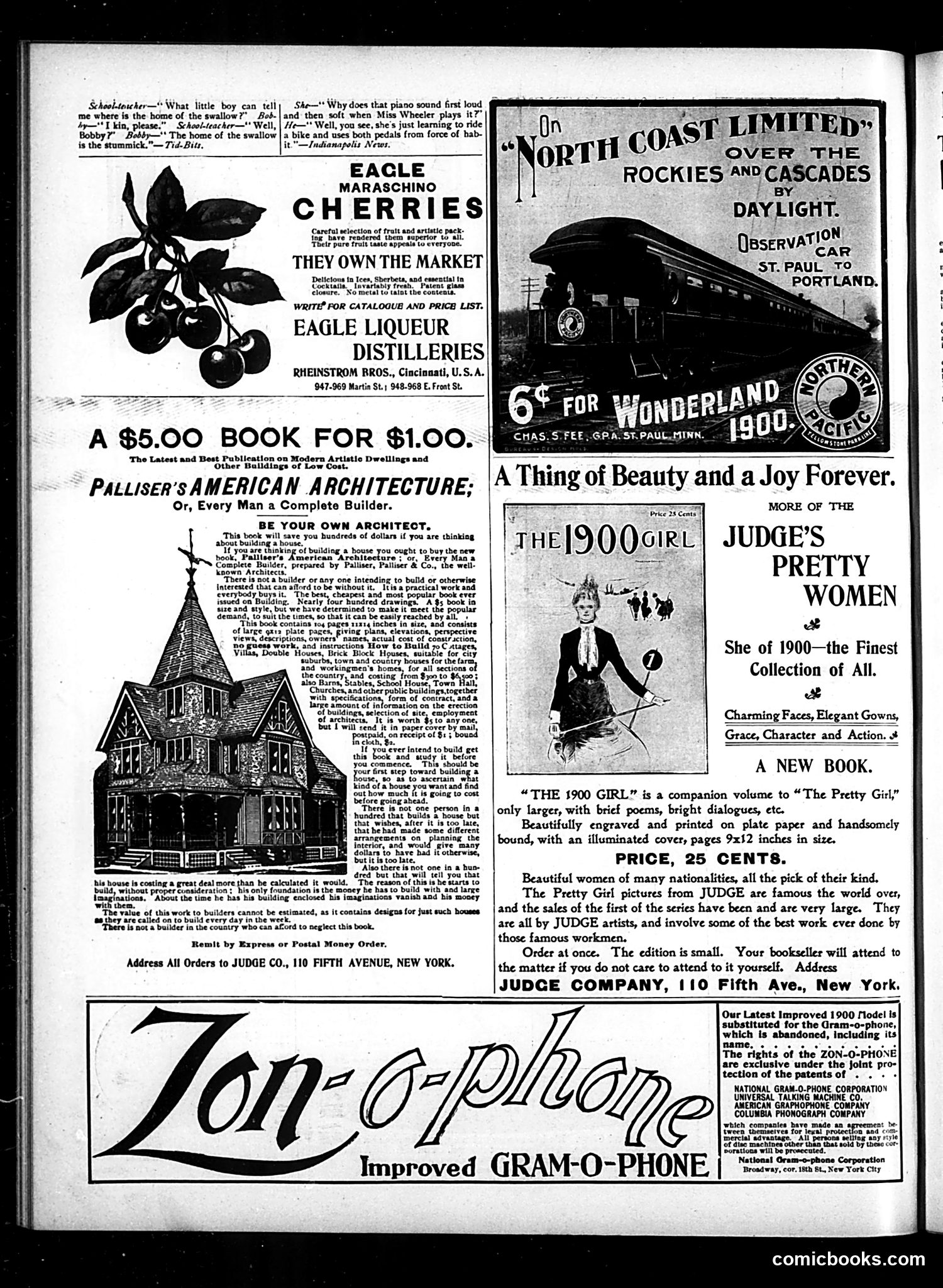
This is primarily an **advertising page** from Judge magazine, circa 1900. Rather than political cartoons, it features commercial advertisements interspersed with small humor items at the top. The page includes ads for: - **Eagle Maraschino Cherries** and liqueur - **Palliser's American Architecture** book (a practical guide for building homes affordably) - **"The 1900 Girl"** and **"Judge's Pretty Women"** books—illustrated volumes featuring photographs of attractive women, marketed as collectible publications The humor snippets are mild jokes: one about a schoolboy confusing a swallow's home, another about piano pedals. **Historical context**: This reflects turn-of-the-century consumer culture—mail-order books, mail-order architecture guides, and illustrated beauty collections were popular products. The emphasis on "The 1900 Girl" as a desirable collectible reflects period attitudes toward women as aesthetic objects. The page is essentially a **commercial document** rather than satirical commentary.
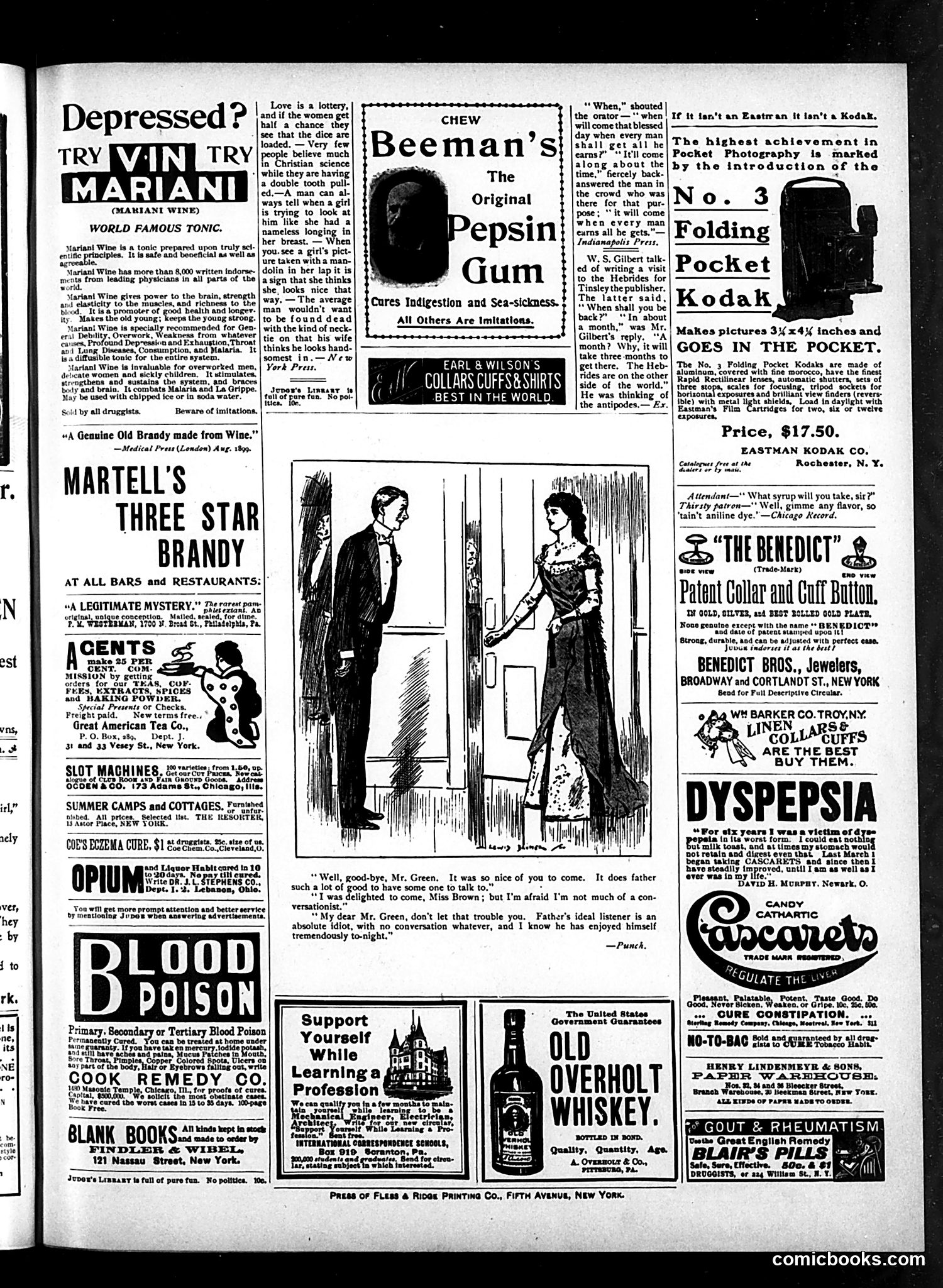
This is primarily an **advertising page** from Judge magazine, with one small cartoon/joke illustration. The central image shows a brief comedic exchange between two figures—a man and woman in what appears to be a parlor setting. The caption reveals the joke: a socially awkward visitor (Mr. Green) apologizes for not being a good conversationalist, while the woman politely demurs. The humor lies in the man's self-deprecating admission about lacking social skills—a common topic in period humor about Victorian-era social anxieties. The page is otherwise dominated by **patent medicine and consumer product advertisements** typical of early 20th-century magazines: tonics (Mariani Wine), digestive aids (Beeman's Pepsin Gum), whiskey, brandy, and various dubious "cures" for conditions like blood poison and eczema. These ads reflect the era's largely unregulated patent medicine industry. The scattered quotes and aphorisms about love and human nature are filler content, not part of a coherent political or social commentary. This is a commercial page designed to generate revenue through advertising rather than editorial satire.
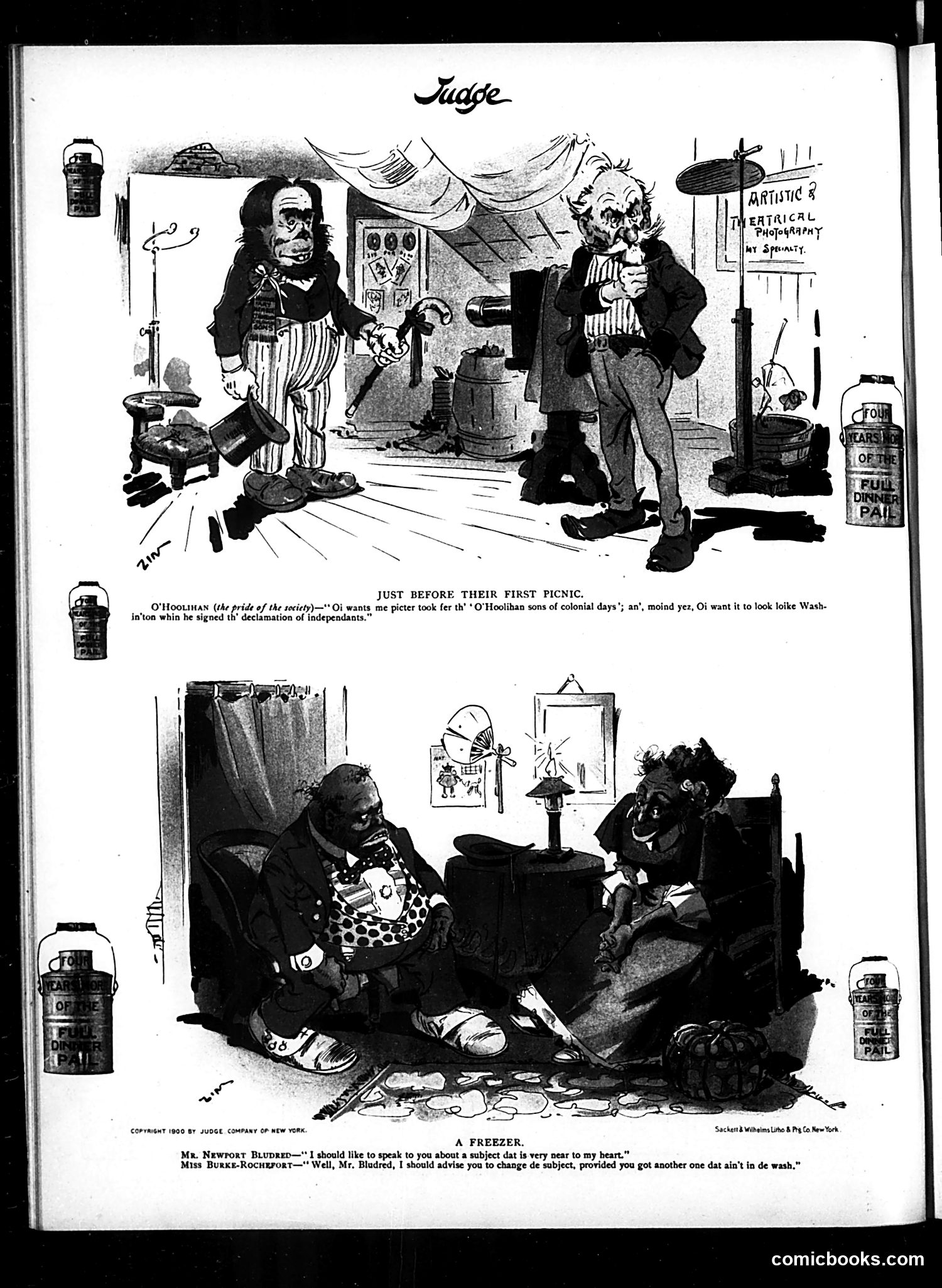
This page contains two satirical cartoons mocking Irish and wealthy American social pretensions circa 1900. **Top cartoon ("Just Before Their First Picnic"):** An Irish character named O'Hoolihan, described as "the pride of the society," wants his portrait taken to look like George Washington signing the Declaration of Independence. The satire targets Irish-American social climbing—the character's malapropism ("declamation of independants") and immigrant accent underscore the mockery of aspiring to founding-father status. **Bottom cartoon ("A Freezer"):** A wealthy man (Mr. Blodred) attempts romantic conversation with a woman (Miss Burke-Rochefort), but she dismisses his sentiment, suggesting he find another topic "that ain't in de wash"—implying his romantic declarations are as worn-out as dirty laundry. The humor lies in her brusque rejection of his pretentious emotional appeal. Both cartoons ridicule social aspirations through exaggerated dialect and character types—Irish immigrants and nouveau-riche wealthy Americans trying to perform sophistication.