
A complete issue · 17 pages · 1900
Judge — June 30, 1900
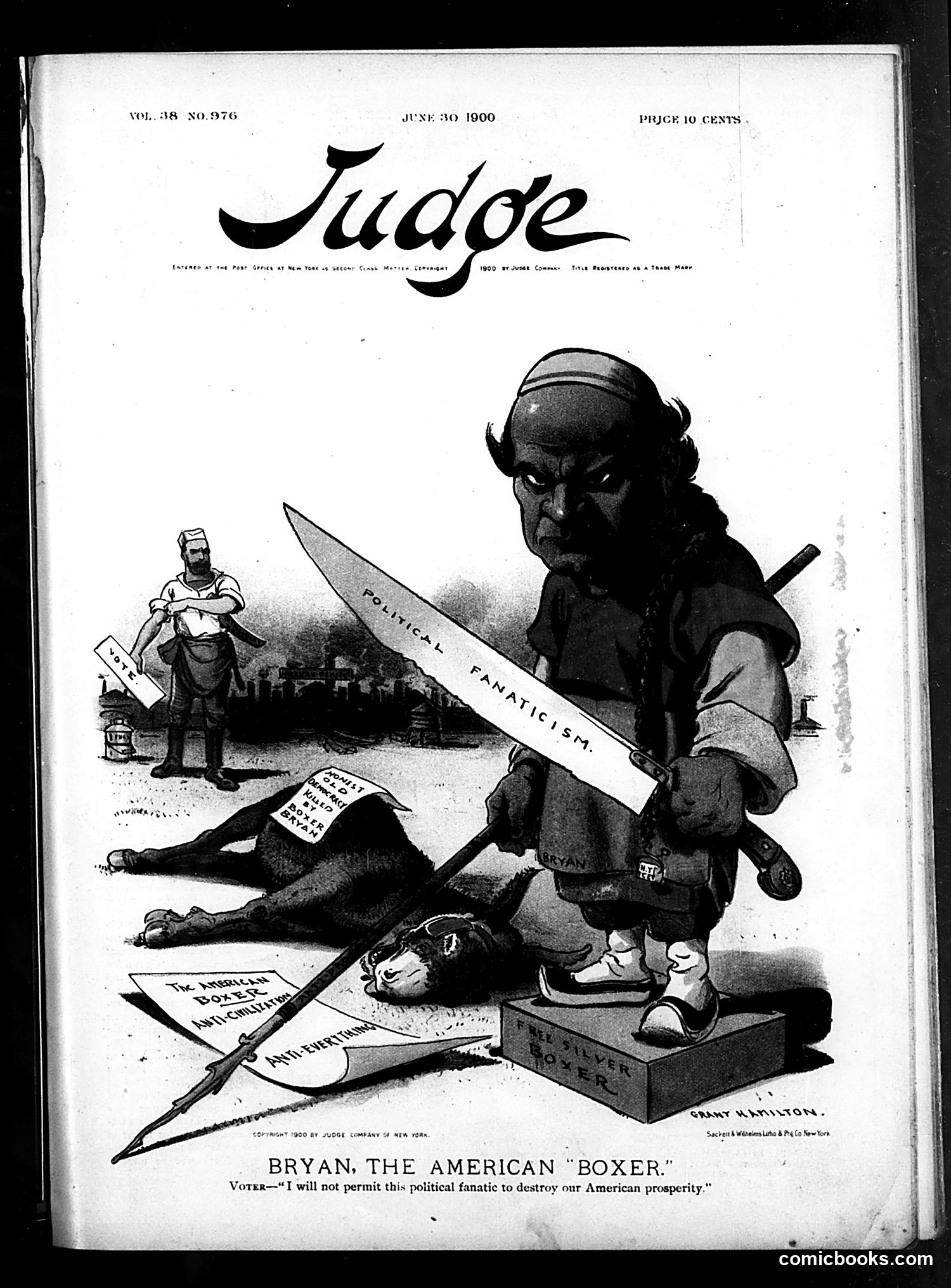
This 1900 Judge magazine cover depicts **William Jennings Bryan**, the Democratic presidential candidate, as a demonic "boxer" wielding a sword labeled "Political Fanaticism." The cartoon satirizes Bryan as a dangerous radical threatening American prosperity. The figure at left appears to represent a concerned voter or America itself, protecting documents labeled "The American Policy" and "Anti-Chinese" legislation. Below, fallen figures labeled with economic concerns lie defeated. The satire argues that Bryan's political extremism—likely referring to his populist policies and anti-establishment positions—poses an existential threat to American economic stability and established policies. The "boxer" metaphor suggests aggressive, reckless combat rather than reasoned governance.
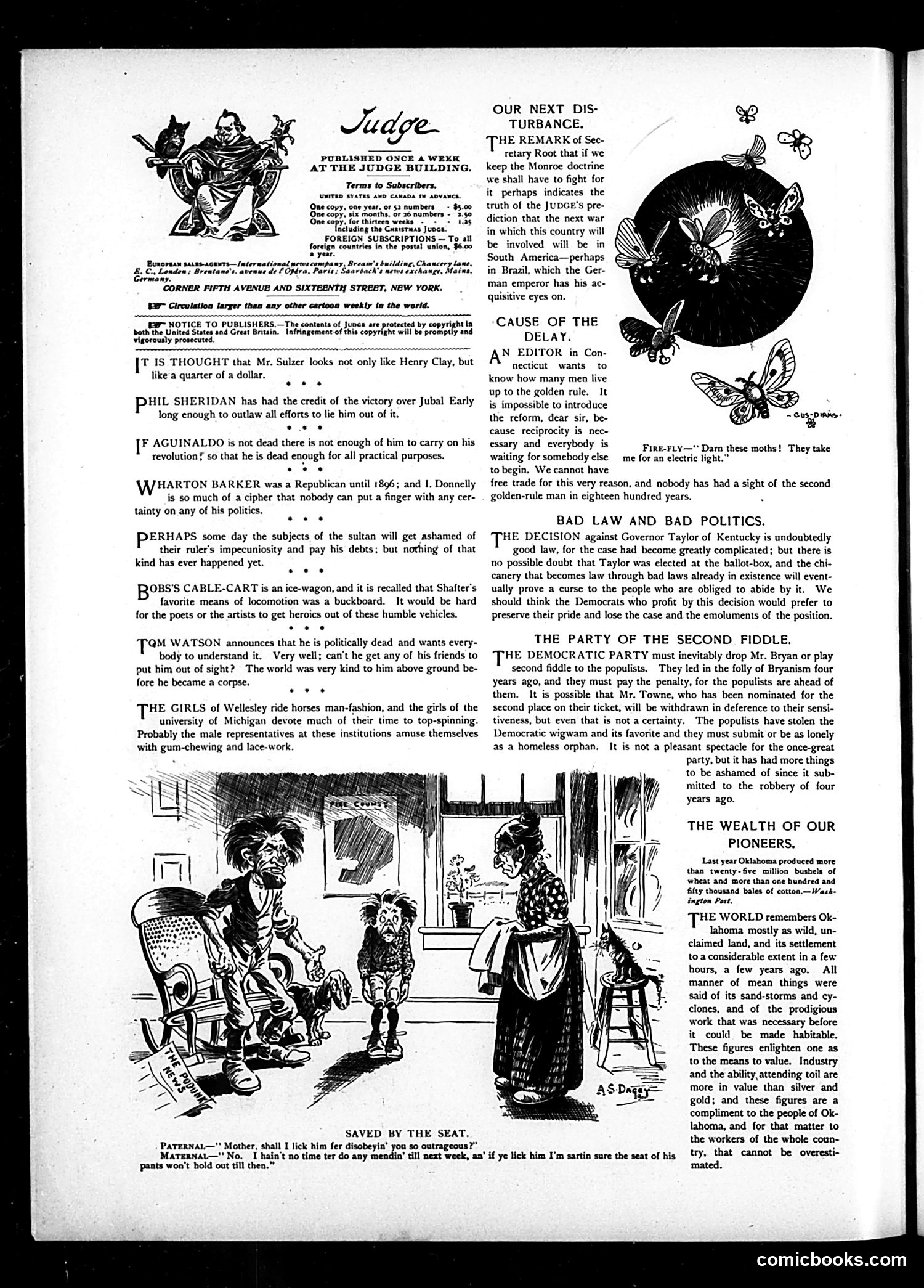
The main cartoon titled "SAVED BY THE SEAT" depicts a domestic scene where a mother warns her child about proper behavior, using crude humor about pants splitting as enforcement. This is a straightforward parenting joke rather than political satire. The text articles address contemporary issues: discussions of Henry Clay, Jubal Early, and Aguinaldo (likely Emilio Aguinaldo, Filipino resistance leader), suggesting post-Spanish American War politics. Articles critique Republican politics, Democratic Party leadership prospects, and Kentucky Governor Taylor's defeat. "The Wealth of Our Pioneers" celebrates Oklahoma's settlement and agricultural productivity, reflecting contemporary expansion optimism. The decorative botanical illustrations are period design elements typical of Judge's aesthetic. Overall, this page mixes domestic humor with political commentary on late 19th/early 20th century American governance and expansion.
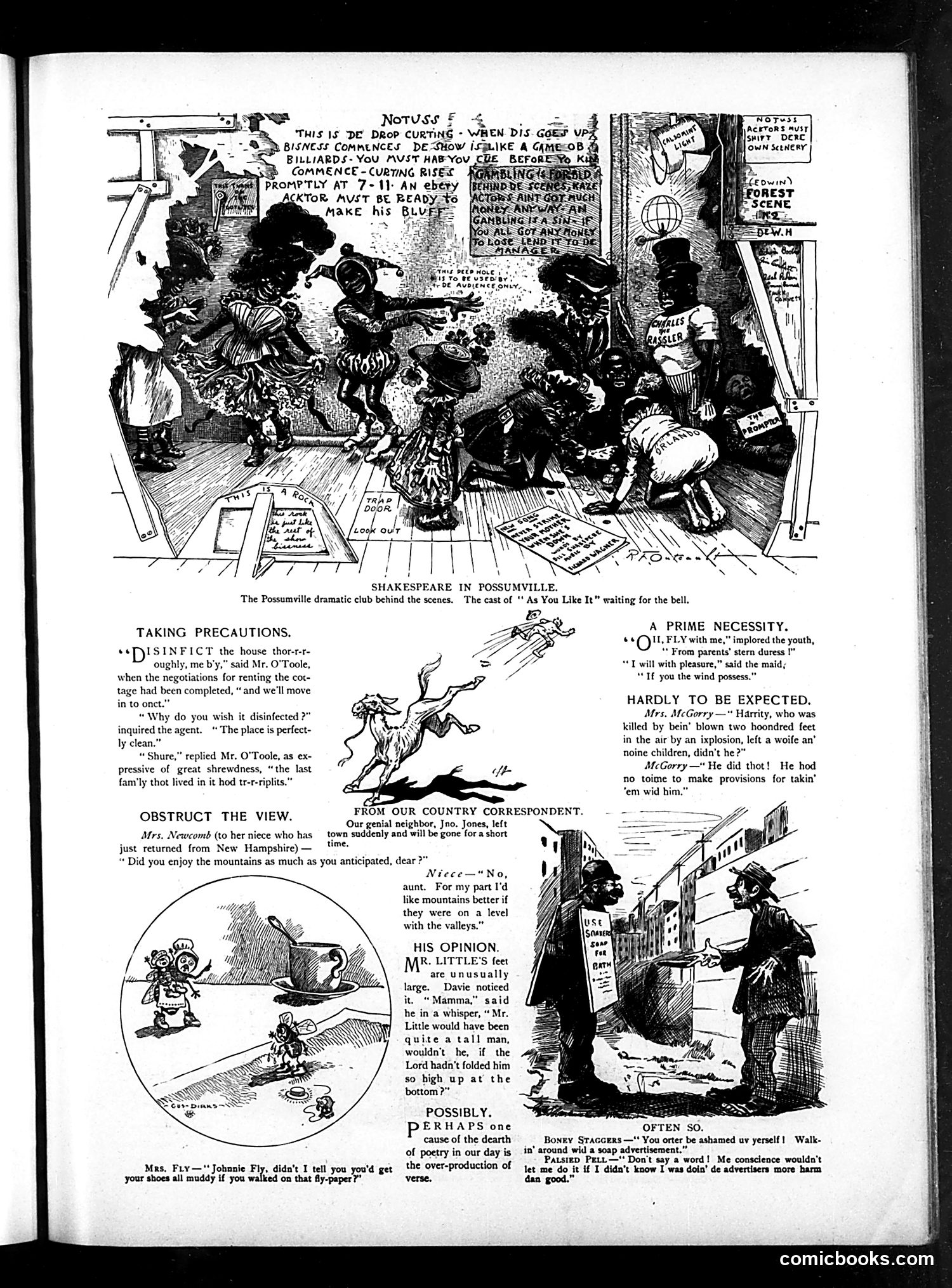
The top illustration satirizes theatrical productions, specifically showing "Shakespeare in Possum ville" — a burlesque stage production of "As You Like It." The satire mocks amateur or low-quality dramatic adaptations, showing chaos backstage with performers in crude costumes. This reflects period concerns about theater quality and the commercialization of Shakespeare. The remaining sections contain brief comic anecdotes rather than political cartoons: - **"Taking Precautions"**: A landlord insists on disinfecting before renting - **"Obstruct the View"**: A woman complains about mountain scenery - **"His Opinion"**: Mr. Little's unusual height - **"A Prime Necessity"**: A maid seeks employment These are domestic humor pieces typical of Judge's satirical commentary on ordinary American life and social pretensions, rather than political satire.
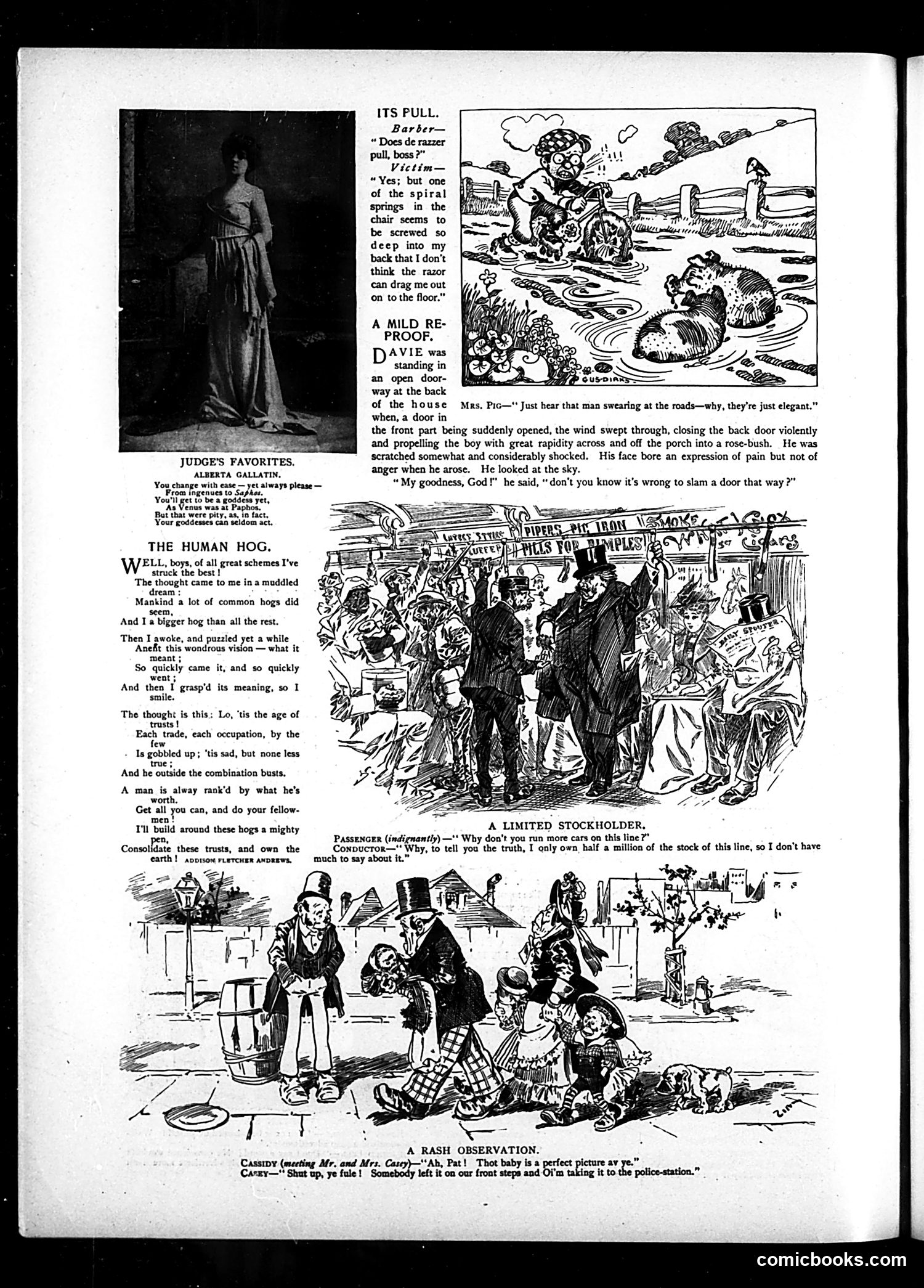
This page contains several satirical pieces typical of Judge magazine's social commentary: **"Its Pull"** (top right): A barber-customer dialogue mocking someone's influence or connections. The cartoon shows figures in water, suggesting someone is "in over their head" despite claimed pull. **"Judge's Favorites"** (left): A poem praising someone who "changes with ease" and "goes off to bed," likely satirizing fickle public opinion or inconsistent politicians. **"The Human Hog"** (center): A poem criticizing monopolistic business practices and class inequality—a common Progressive-era Judge theme attacking robber barons and industrial consolidation. **"A Limited Stockholder"** (center-right) and **"A Rash Observation"** (bottom): Satirize working-class hardship and social pretension during what appears to be an economic downturn. The page reflects Judge's consistent focus on class conflict and economic injustice.
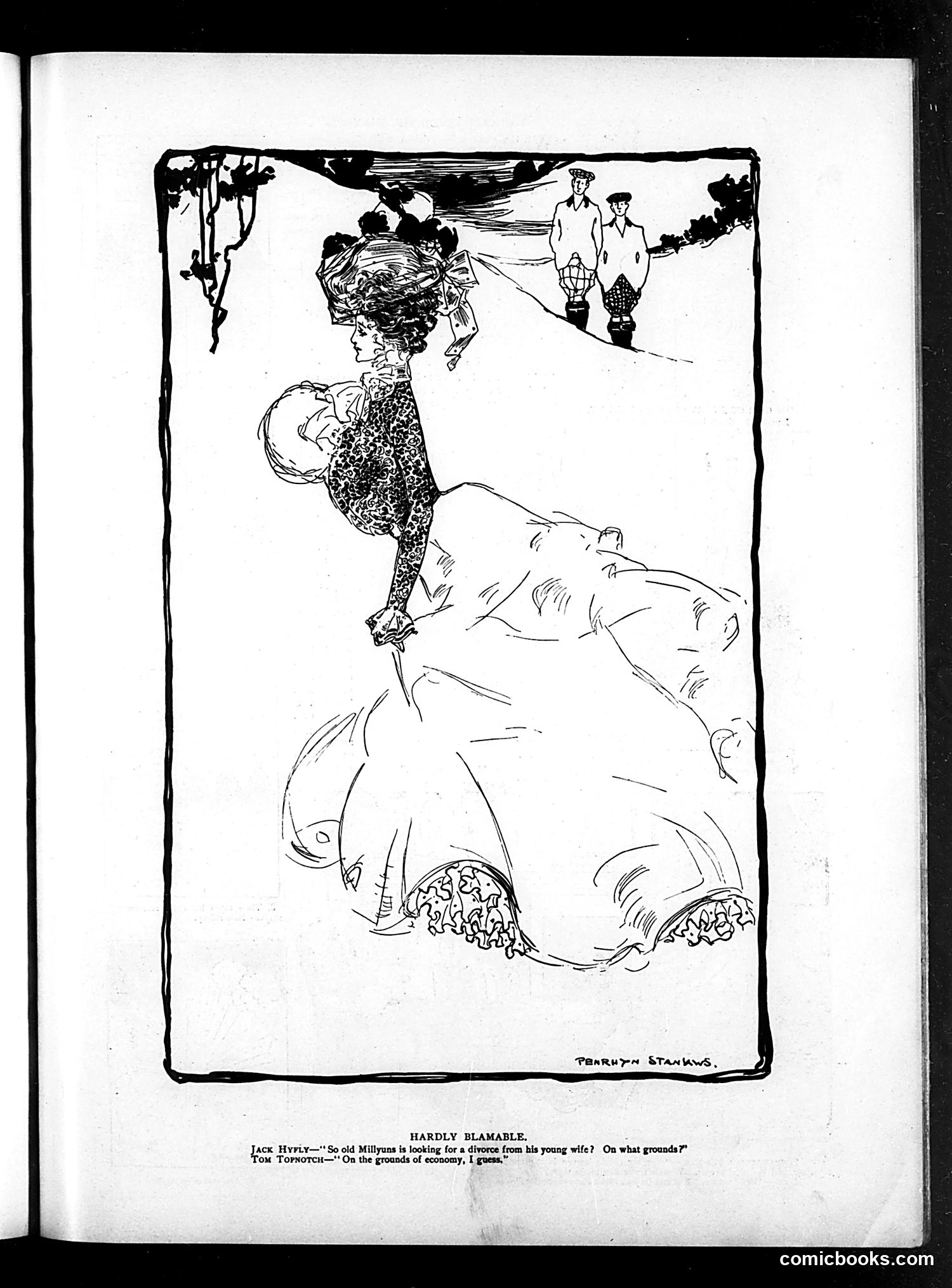
This is a single-panel cartoon satirizing wealth disparity and marital economics. The dialogue references "old Millyuns" (a wealthy man) seeking divorce from his young wife on grounds of "economy"—a darkly comic contradiction, since divorce from a young spouse would typically be expensive due to alimony and settlements. The joke targets wealthy men who marry young women for companionship or status, then seek to escape the financial obligations. The elegant illustration shows a fashionably dressed woman, emphasizing her role as a costly accessory. The satire mocks both the absurdity of claiming "economy" motivates the divorce and society's acceptance of May-December marriages among the rich. The cartoon reflects early 20th-century concerns about marriage as a financial transaction.
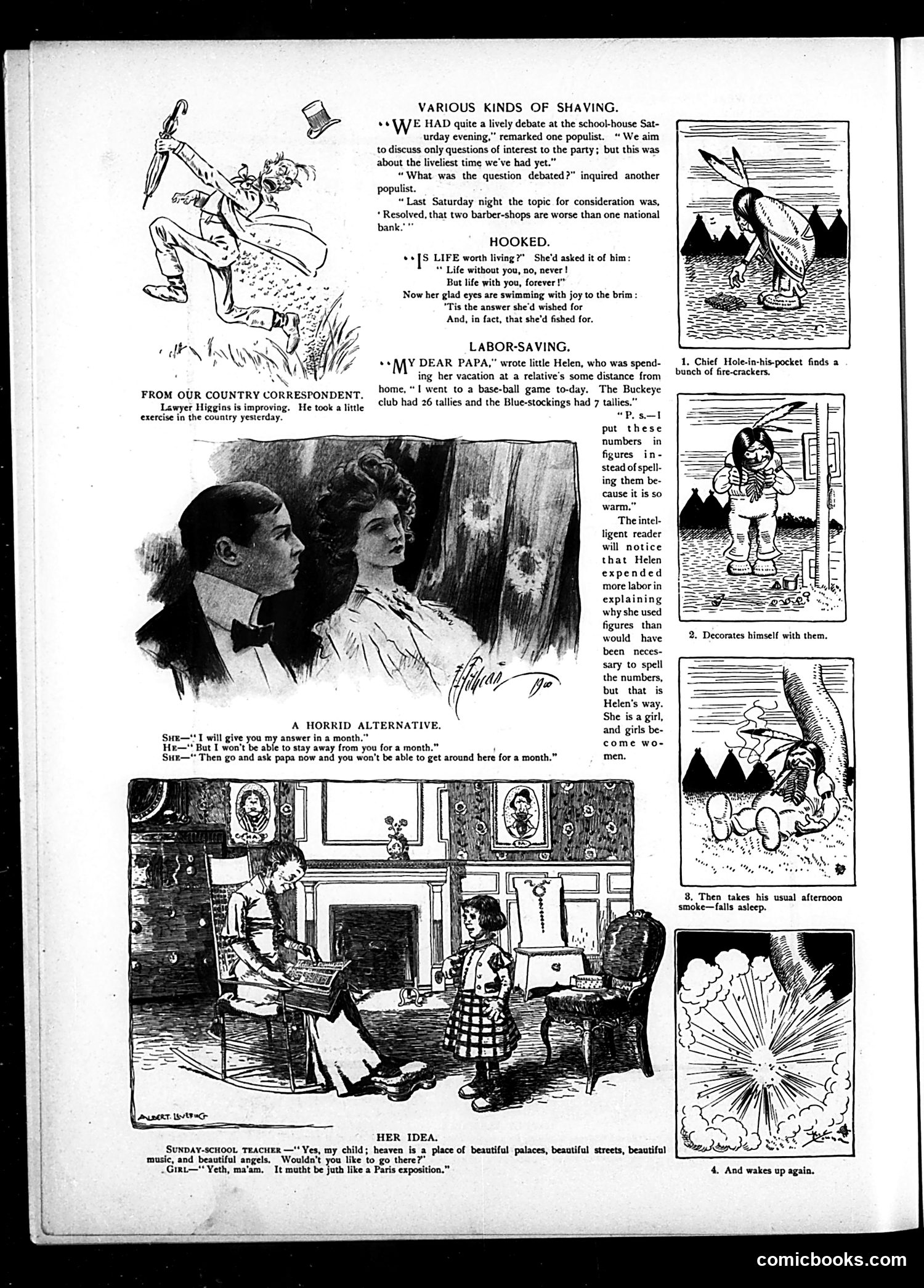
This page from *Judge* contains several satirical sketches mocking contemporary American life: **"Various Kinds of Shaving"** mocks Populist Party debates—comparing two barber-shops versus a national bank as equally trivial, satirizing their tendency toward petty disputes. **"Hooked"** is a romance joke: a woman asks if life is worth living, gets the romantic answer she wanted, and the humor lies in recognizing she deliberately "fished for" the compliment. **"Labor-Saving"** satirizes a girl named Helen who uses numerals in a letter claiming it's less work—then wastes effort explaining why, exemplifying female illogic (a period stereotype). **"A Horrid Alternative"** jokes about courtship: a suitor can't wait a month for an answer, so the woman advises asking her father instead—implying he'll be so angry the suitor won't be allowed to visit. **"Her Idea"** has a Sunday-school girl equate heaven with the Paris Exposition, mocking materialistic values and poor grammar ("juth" for "just"). The humor relies on period gender stereotypes and social conventions now considered offensive.
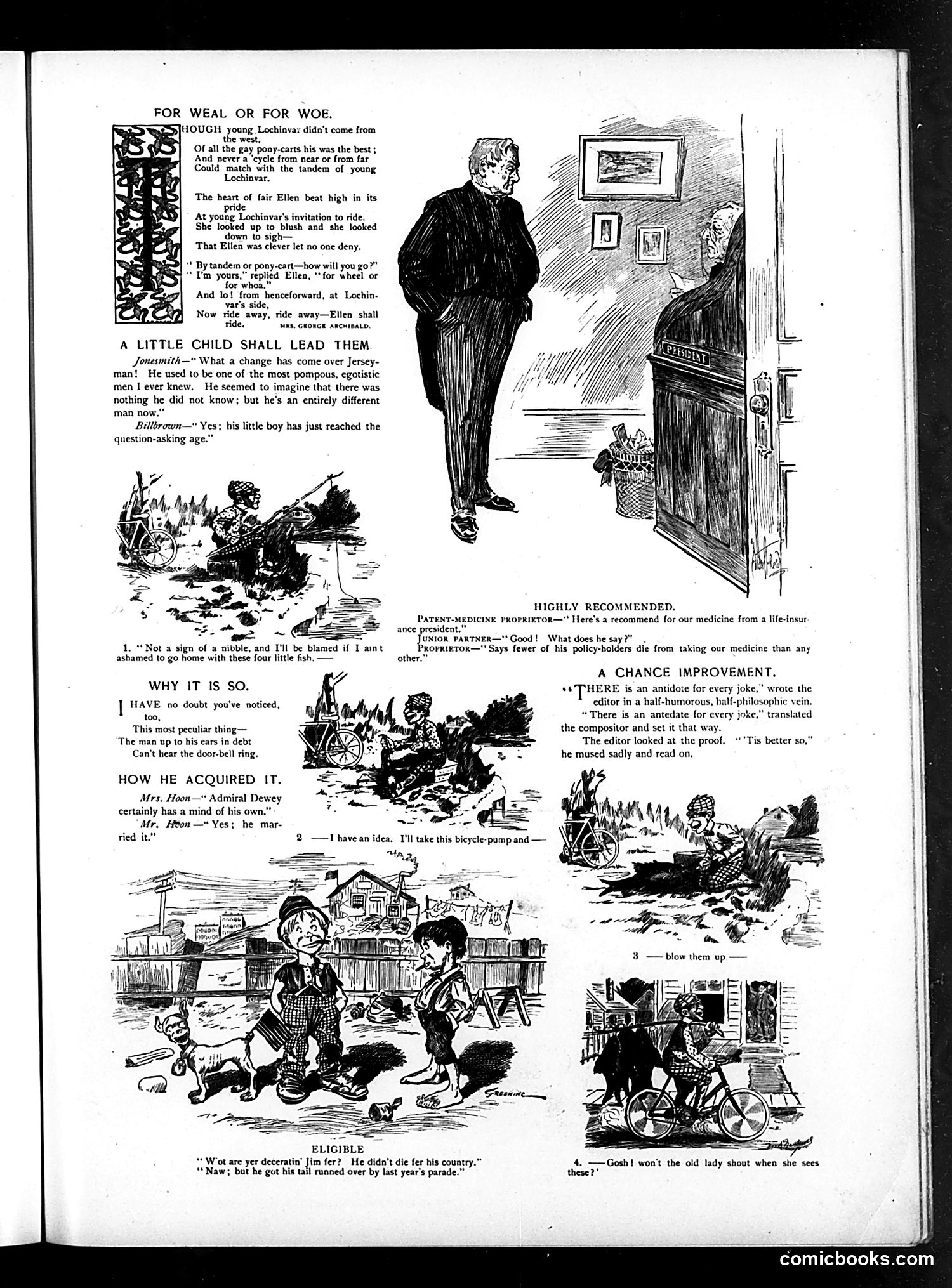
This page from *Judge* (a satirical American weekly) contains several unrelated humorous pieces typical of the era: **"For Weal or For Woe"** is a romantic poem about young Lochinvar courting Ellen via tandem bicycle—a commentary on the bicycle craze as a courtship vehicle. **"A Little Child Shall Lead Them"** jokes that a pompous man became humble after his son reached the "question-asking age"—satirizing how inquisitive children expose adult pretension. **"Why It Is So"** is a one-liner gag: a debtor can't hear the doorbell because he's avoiding creditors. **"How He Acquired It"** references Admiral Dewey (Spanish-American War hero), joking that he acquired his independent mind by marrying it—a dig at wives' influence. **"Eligible"** shows children decorating a dog's tail, misunderstanding patriotic parade decorations as funeral honors. The remaining sections are brief jokes about patent medicine, editorial mishaps, and children with a bicycle—typical *Judge* humor mixing topical references with everyday domestic situations.
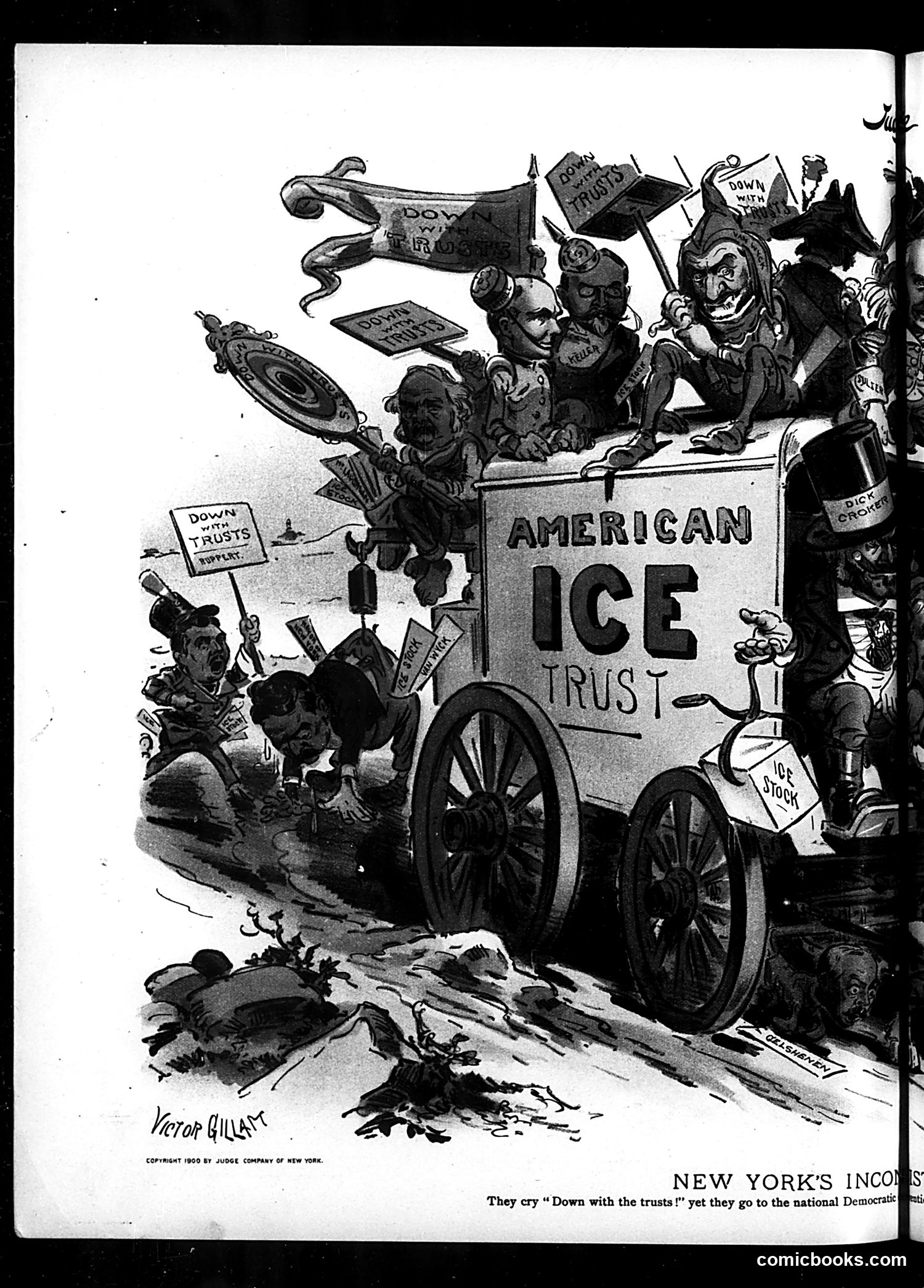
This 1900 Judge magazine cartoon satirizes hypocrisy regarding monopolies ("trusts"). The central image shows an "American Ice Trust" wagon—likely referencing the actual ice monopoly that controlled New York's ice supply—loaded with caricatured political figures and corporate interests. The satire's point, indicated by the caption and visible signs reading "Down with the Trusts," is that Democratic politicians publicly denounce trusts while simultaneously supporting or benefiting from them. The figures climbing onto and riding the trust wagon represent politicians who campaign against monopolies but participate in them anyway. The decomposed body beneath the wagon suggests victims harmed by these monopolistic practices. This reflects genuine Progressive Era anger at trusts, which controlled prices and exploited consumers. Victor Gillam is the credited cartoonist.
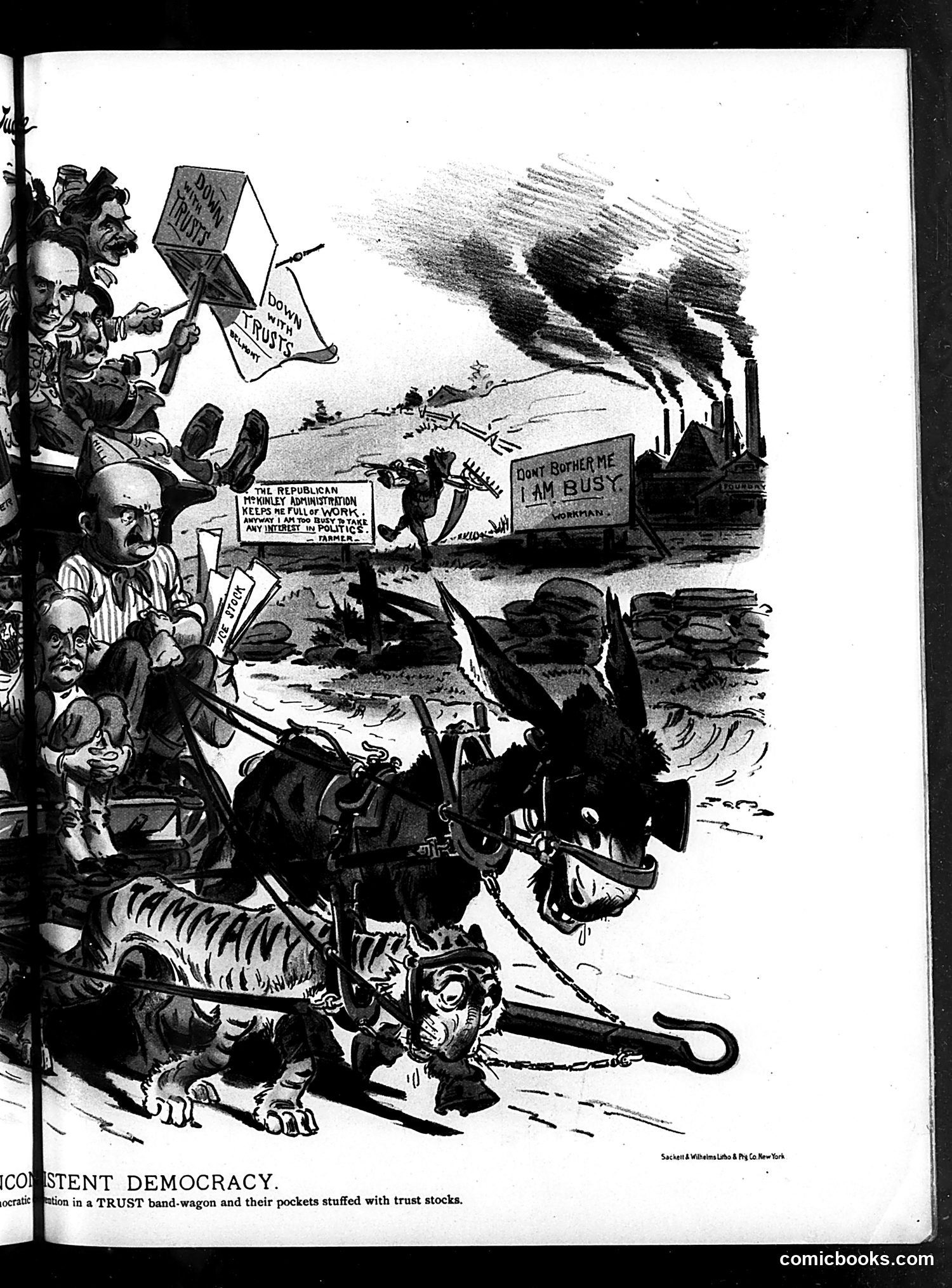
This Judge magazine cartoon satirizes Republican hypocrisy regarding trusts (monopolistic corporations). On the left, Republican politicians and McKinley administration figures ride in a "TRUST band-wagon" with pockets stuffed with trust stocks, while pulling a kite labeled "REFORM" and "TRUST" to appear virtuous. On the right, a farmer—referenced in the visible text about being "too busy to take any interest in politics"—is depicted as willfully blind or indifferent to this corruption. The cartoon's central critique: Republicans claim to oppose trusts while profiting from them, while ordinary citizens remain too preoccupied to notice the contradiction. The "inconsistent democracy" title underscores the gap between democratic ideals and oligarchic reality where corporate interests control politics.
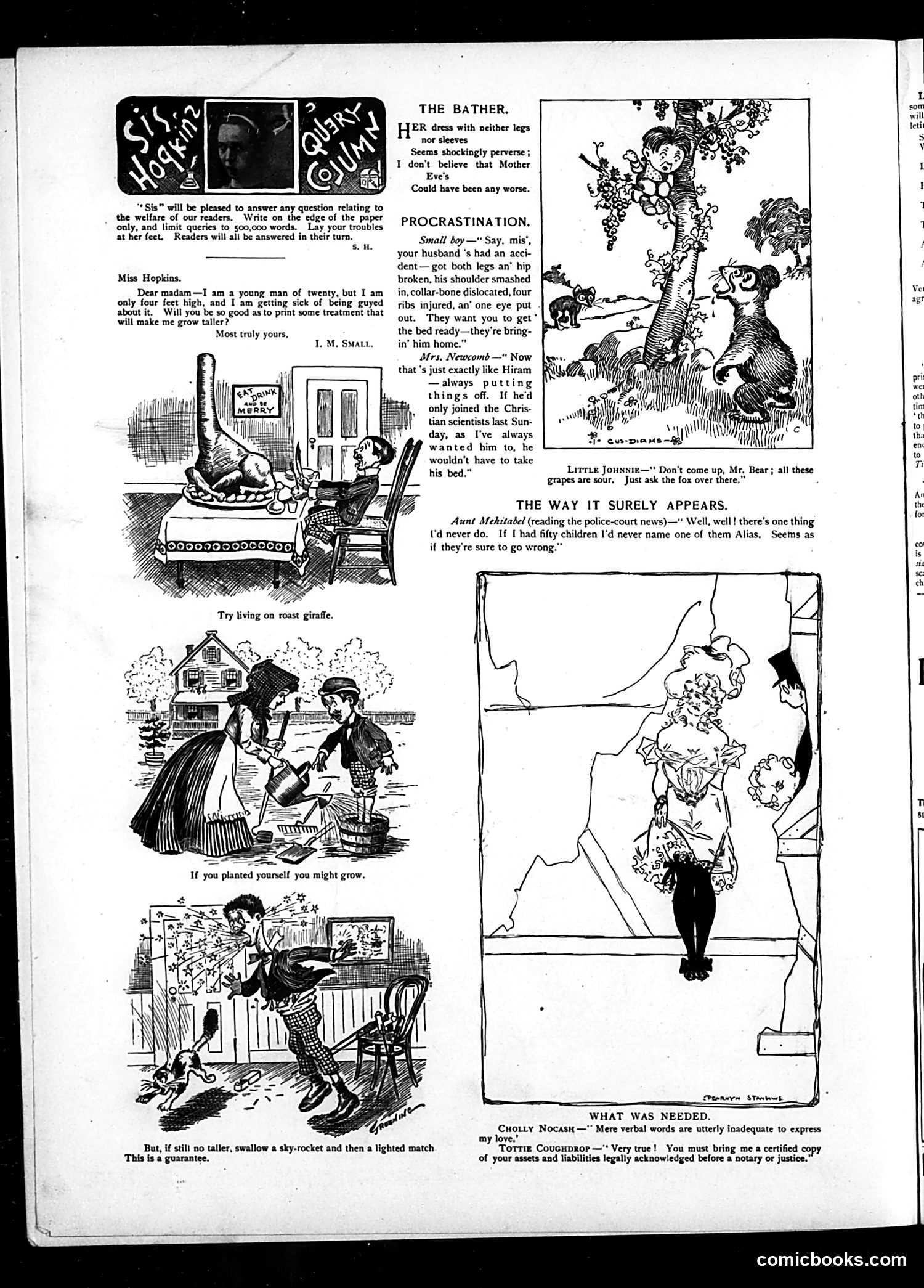
This page contains several humor pieces satirizing early 1900s American social attitudes: **"The Bather"** mocks Victorian prudishness about women's swimming attire. The complaint that a woman's sleeveless, legless bathing dress is "shockingly perverse" ridicules the era's extreme modesty standards. **"Procrastination"** jokes about a wife's Christian Science faith—a contemporary religion emphasizing faith healing. She delays preparing for her injured husband's homecoming, assuming Christian Science would have prevented the accident if he'd only joined. **"The Way It Surely Appears"** satirizes how people name children "Alias"—a humorous comment on criminal records, suggesting children with that name inevitably become criminals. **"What Was Needed"** mocks romantic excess and materialism: a man's passionate declarations are deemed insufficient; he must prove his love with certified financial documentation. The cartoons collectively target contemporary anxieties about women's fashion, religious movements, crime, and changing courtship customs.
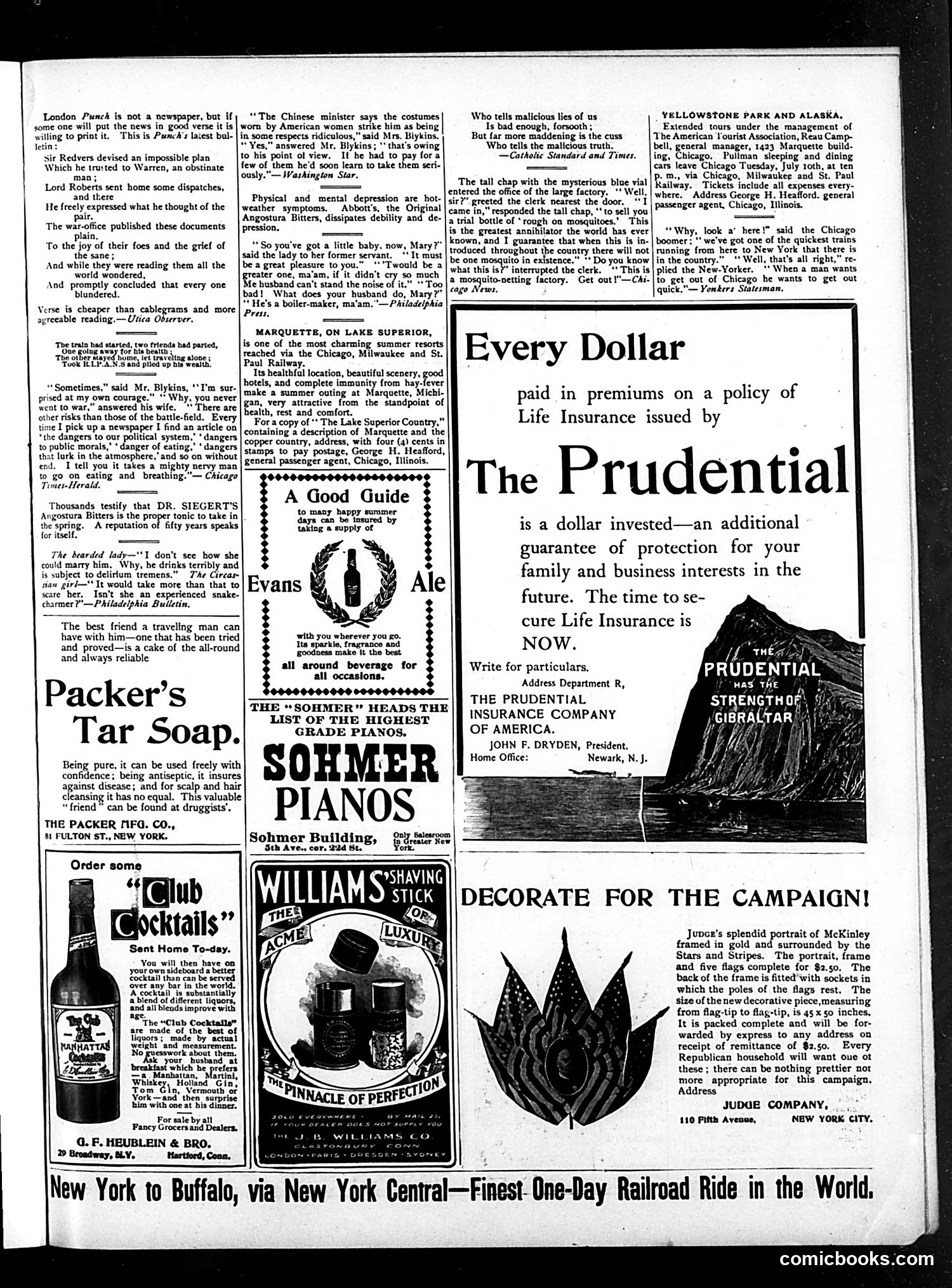
This page is primarily **advertisements and light humor**, not political satire. The content includes: **Humorous anecdotes** (not cartoons): - Jabs at the Boer War's military leadership (Redvers, Warren, Roberts) - Domestic jokes about wives, servants, and childbirth - A traveling salesman trying to sell mosquito repellent to a mosquito-netting factory owner - Banter between Chicago and New York about train speeds **Major advertisements** for: - Packer's Tar Soap - Evans Ale - Sohmer Pianos - Williams Shaving Stick - Club Cocktails - The Prudential Insurance Company (large display ad) - Yellowstone Park tours - Judge Company's McKinley campaign portrait frame **The satirical point** (modest): Light mockery of American vanity and pretension—Chinese diplomats finding American women's fashions ridiculous, boasting about fast trains, etc. This appears to be from the **early 1900s** (McKinley era), when Judge mixed political commentary with general consumer advertising and genteel humor for middle-class readers.
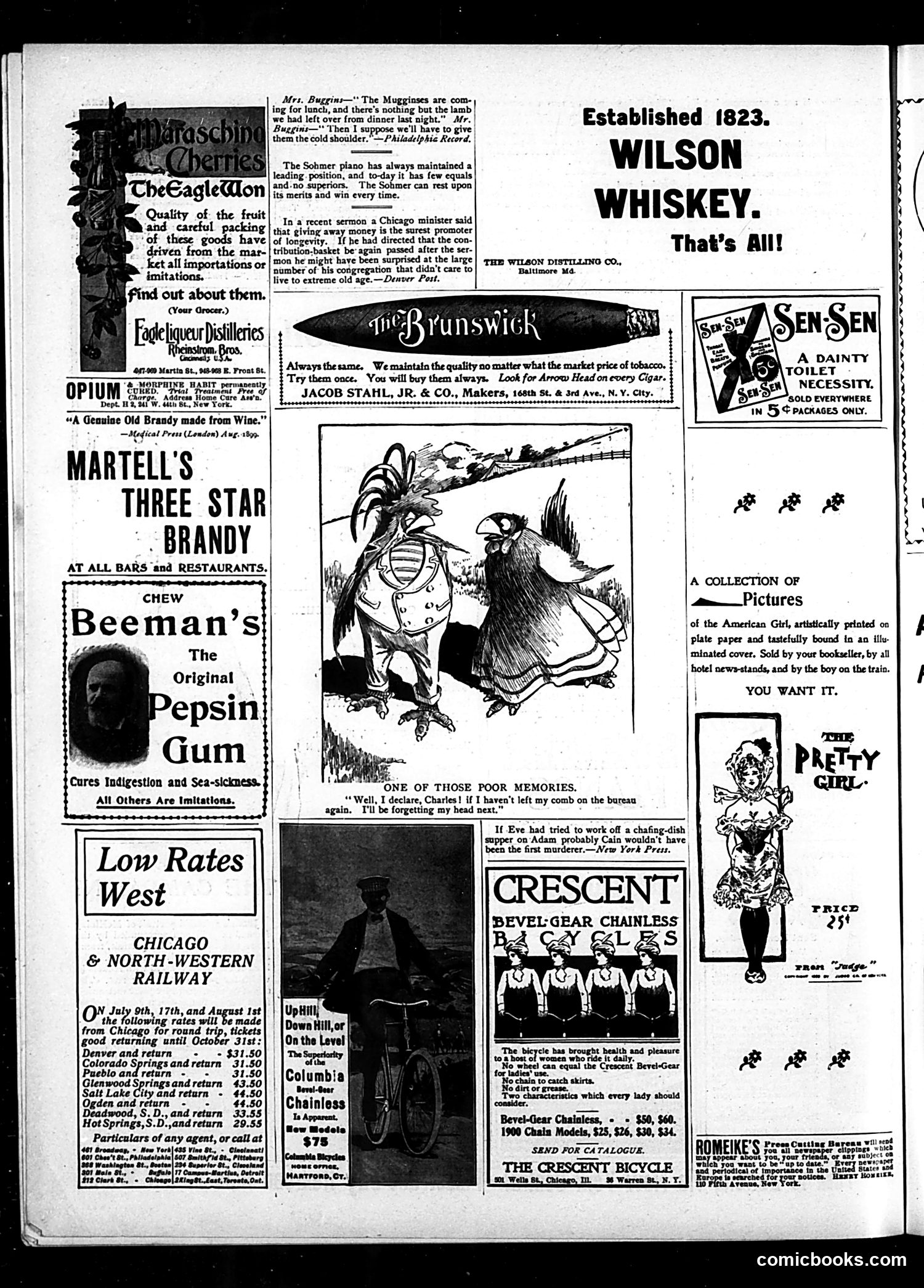
This page is primarily **advertisements with minimal editorial cartoon content**. The main visual humor appears in the small captioned sketch labeled "ONE OF THOSE POOR MEMORIES," depicting a couple where the wife has forgotten her comb—a domestic joke about forgetfulness. The page's satirical commentary consists of brief **one-liner jokes** interspersed among ads: - A joke about serving "cold shoulder" (rejection) alongside leftover lamb - A minister's sermon about money-giving promoting longevity—satirizing both organized religion and hypocrisy when the collection plate is re-passed - A quip suggesting Eve's failure to "work off" a chafing-dish supper (poor cooking) might have prevented Cain's murder of Abel—dark humor about domestic inadequacy causing violence The bulk of the page features period advertisements for whiskey, brandy, bicycles, gum, railway travel, and other goods—standard Judge magazine revenue model. The cartoons serve mainly as filler between commercial notices rather than sustained political or social satire.
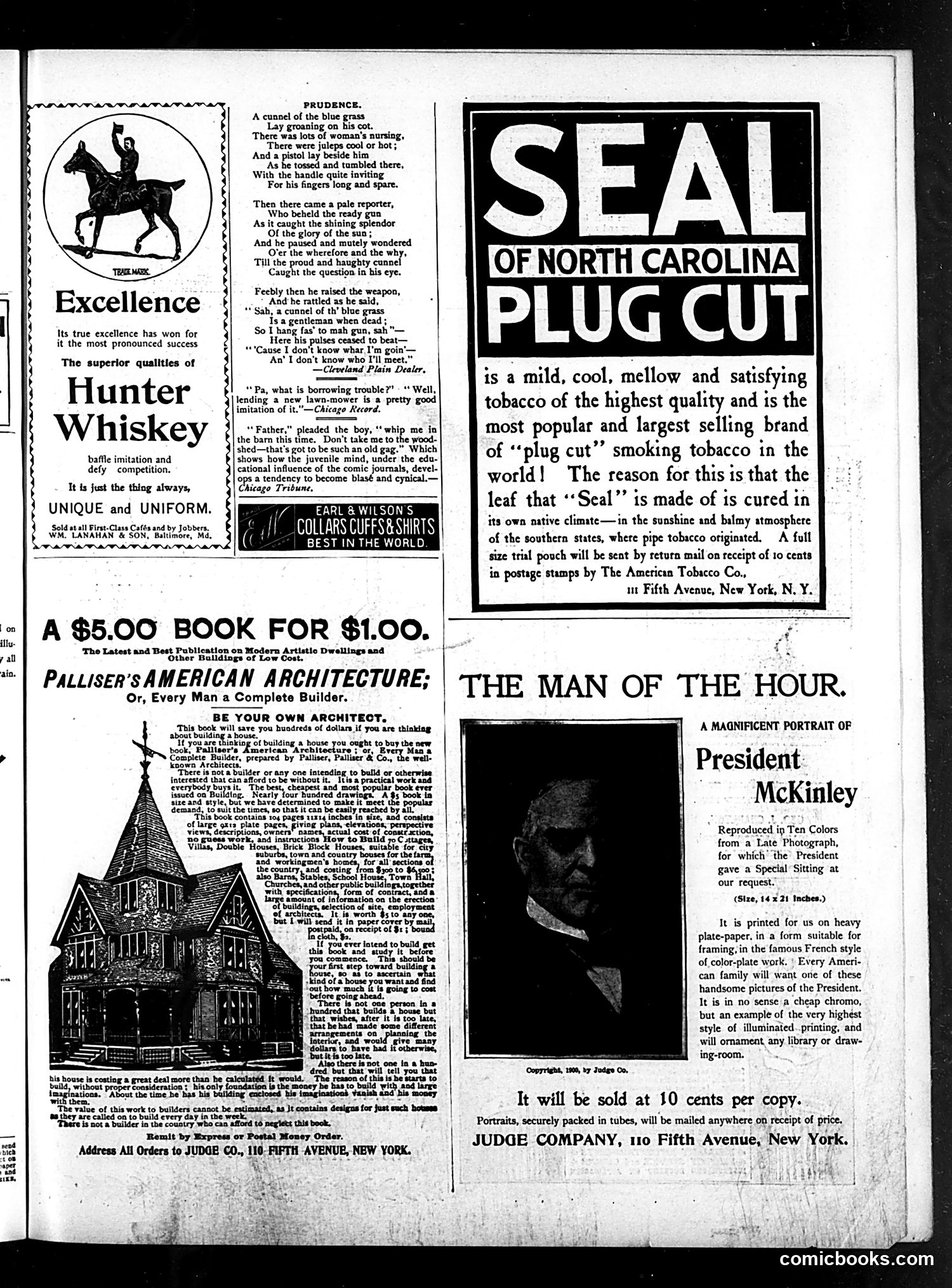
The poem "Prudence" satirizes the romanticized mythology of the antebellum South through the story of a dying Confederate colonel. The narrative—a pale reporter witnessing a Southern gentleman holding a pistol—invokes the "Lost Cause" narrative while subverting it. The colonel's final speech reveals the satire's target: he clings to his gun and the identity of "a cunnel of th' blue grass" because he faces existential uncertainty about death and the afterlife. This undercuts the noble suffering typically associated with Southern aristocratic mythology. The dialect and self-aware desperation suggest the real motivation behind Southern dignity wasn't honor but anxiety—fear of the unknown future, both literal and metaphorical regarding the South's post-war condition. Judge magazine uses this to mock both Southern pretension and the broader American sentimentality surrounding it.
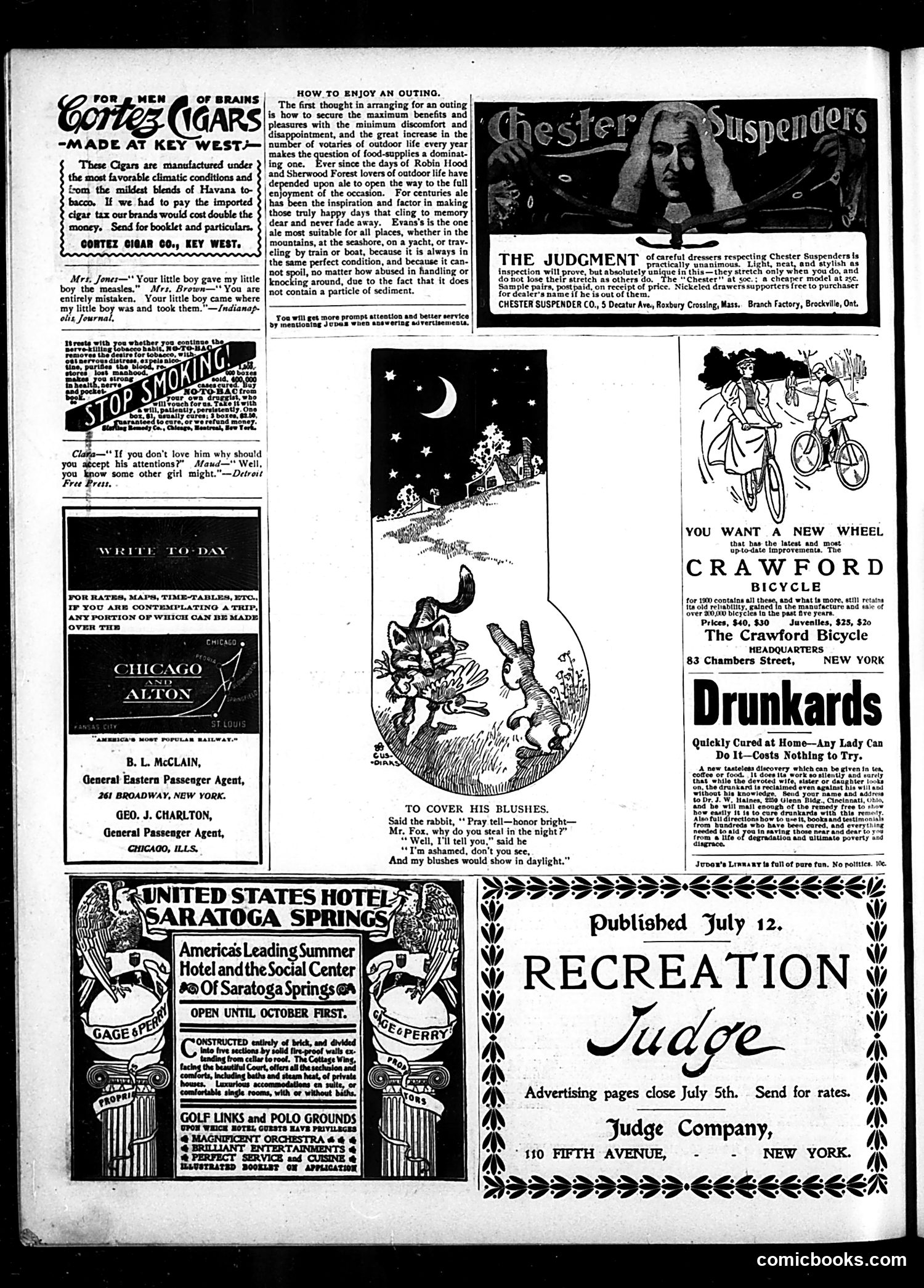
This page is primarily **advertising**, typical of Judge magazine's revenue model. Most content consists of product ads (cigars, bicycles, hotel, suspenders, ale) with small comic elements interspersed. The notable satirical content includes: **"To Cover His Blushes"** (center): A anthropomorphic fox justifies stealing at night because daylight would expose his blushing shame. This is light social satire—mocking the absurdity of a thief's embarrassment overriding his criminal behavior. **Brief joke exchanges** (left side): Humorous domestic disputes, like a mother defending her child's contagious disease transmission, or a woman accepting unwanted romantic attention because "some other girl might" want him. These reflect period attitudes toward courtship and parental defensiveness. The **Chester Suspenders ad** makes a pun on "judgment," suggesting unanimous approval. Overall, this represents Judge's blend of advertising revenue and gentle, domestic humor rather than hard political satire. The tone is lighthearted rather than biting social commentary.
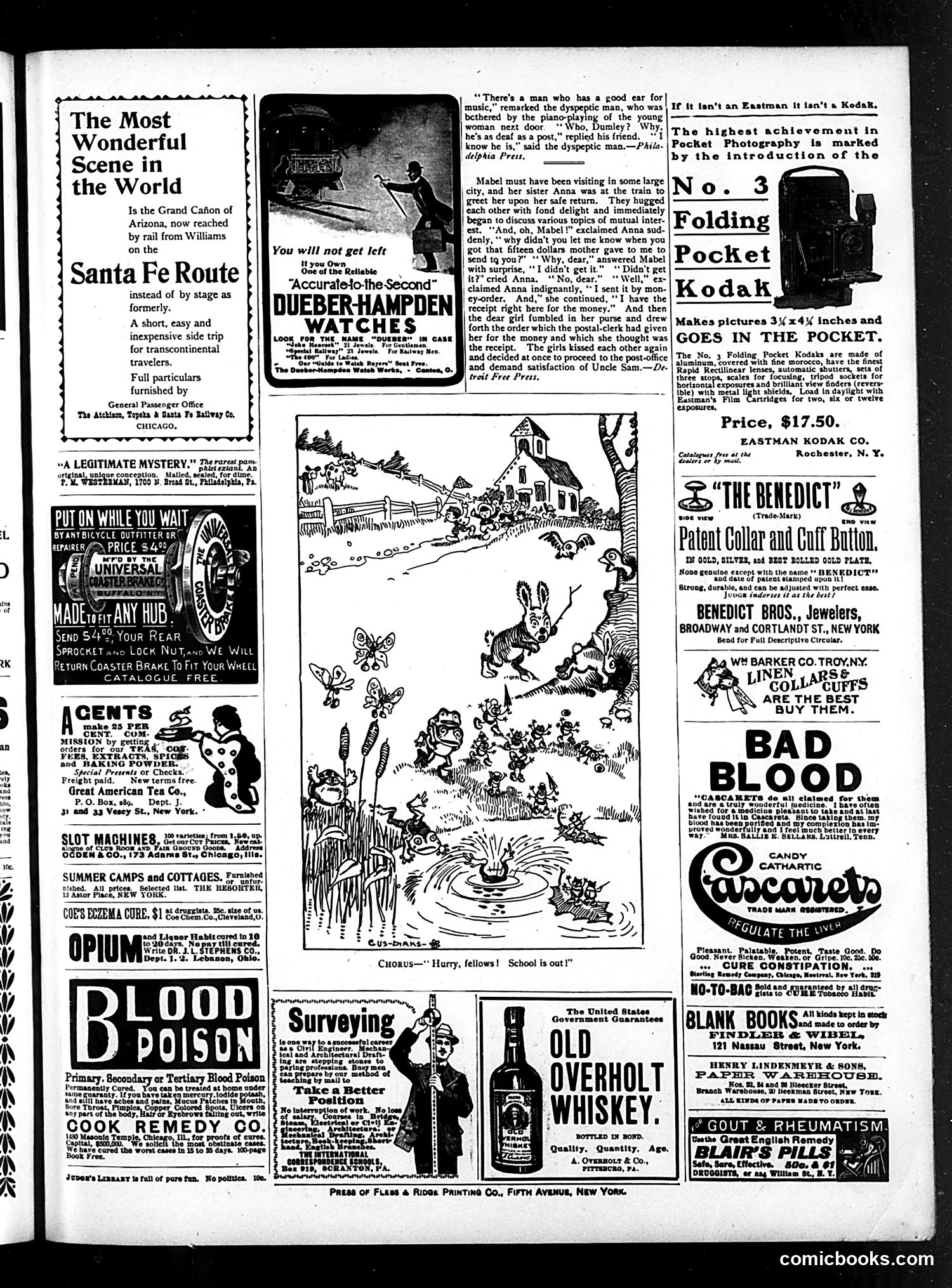
This page is primarily **advertising**, with minimal editorial content. The main cartoon appears in the center—a whimsical illustration labeled "Chorus—'Hurry, fellows! School is out!'" showing animals (rabbits, frogs) in a pastoral scene, likely humorous filler. Two brief joke items appear: 1. A deaf man with a "good ear for music"—a simple contradiction joke playing on misheard words. 2. A story about sisters Anna and Mabel, where a postal money order is mistaken for a receipt, requiring them to visit the post office to "demand satisfaction of Uncle Sam"—a gentle joke about bureaucratic confusion. The remainder consists of advertisements for era-typical products: railway travel, bicycle parts, watches, cameras (Kodak), patent collars, whiskey, and medicinal remedies (blood poison treatments, eczema cures). These ads reveal period consumer concerns and patent medicine prevalence. The page lacks significant political or social satire—it's primarily commercial content with light humor.
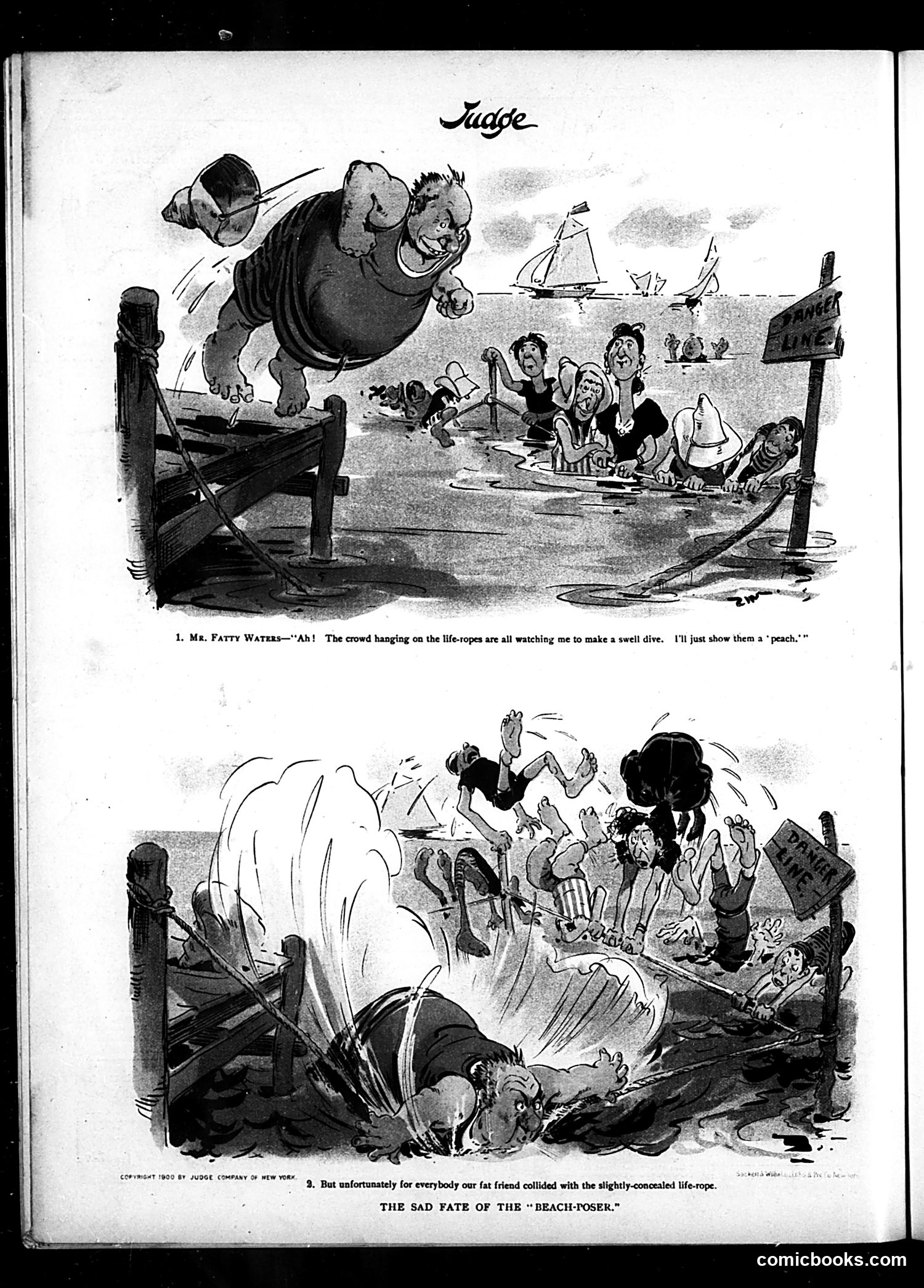
This two-panel satirical cartoon from Judge (1900) mocks a vain, overweight man attempting to impress beachgoers with his diving prowess. In panel one, labeled "Mrs. Patty Waters," he announces a dramatic dive to the crowd watching from the water. Panel two depicts his humiliating collision with a life-rope, sending him sprawling into the water amid chaotic splashing and spectators' reactions. The satire targets vanity and physical pretension—the "beach-poser" tries to show off athletically despite his evident unfitness, resulting in public embarrassment. The joke exploits period humor about corpulent men attempting undignified feats, and reflects early 1900s beachgoer culture where such displays were apparently common enough to warrant satirical commentary.

I can see this is a mostly blank page from Judge magazine with only "comicbooks.com" visible at the bottom right. The page appears to be either blank/empty content, a divider page, or the back of another page. Without visible cartoon imagery, caricatures, text content, or satirical material, I cannot identify any political or social references, specific figures, or explain any jokes or satire. This appears to be a page without substantive editorial or illustrative content to analyze.