
A complete issue · 25 pages · 1900
Judge — June 23, 1900
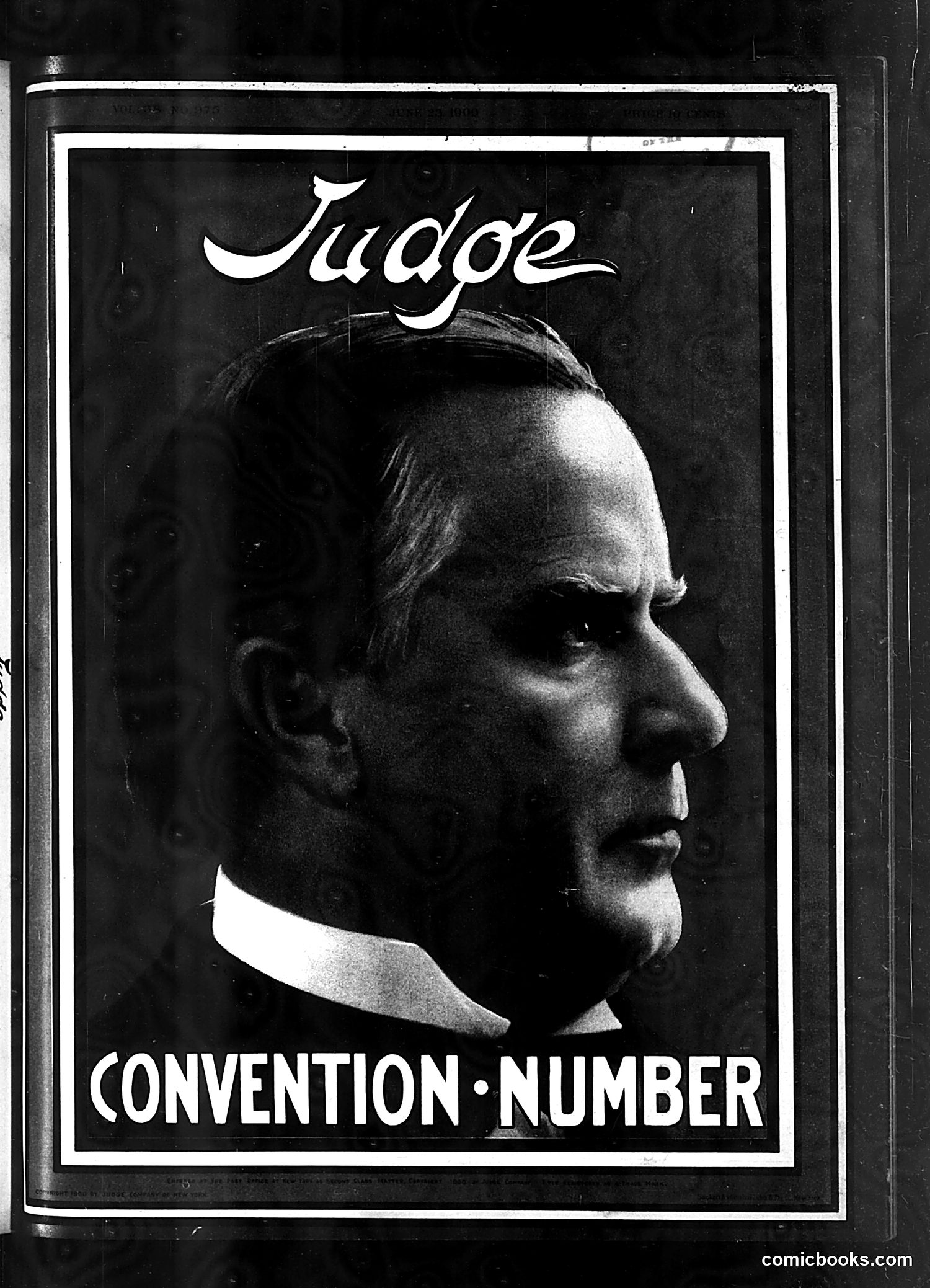
This appears to be a cover from *Judge* magazine featuring a portrait labeled "CONVENTION NUMBER." The image shows a distinguished man in profile wearing formal attire with a white collar, photographed in a serious, statesmanlike manner. The "Convention Number" designation suggests this issue was published around a major political convention—likely a presidential nominating convention. The formal presentation and prominent placement indicate the subject was a significant political figure of his era. However, **without additional context or visible text identifying the specific individual, convention year, or political party**, I cannot definitively state who this depicts or what satirical point the magazine intended. The styling and photography technique suggest early-to-mid 20th century publication, but the exact reference remains unclear from the image alone.
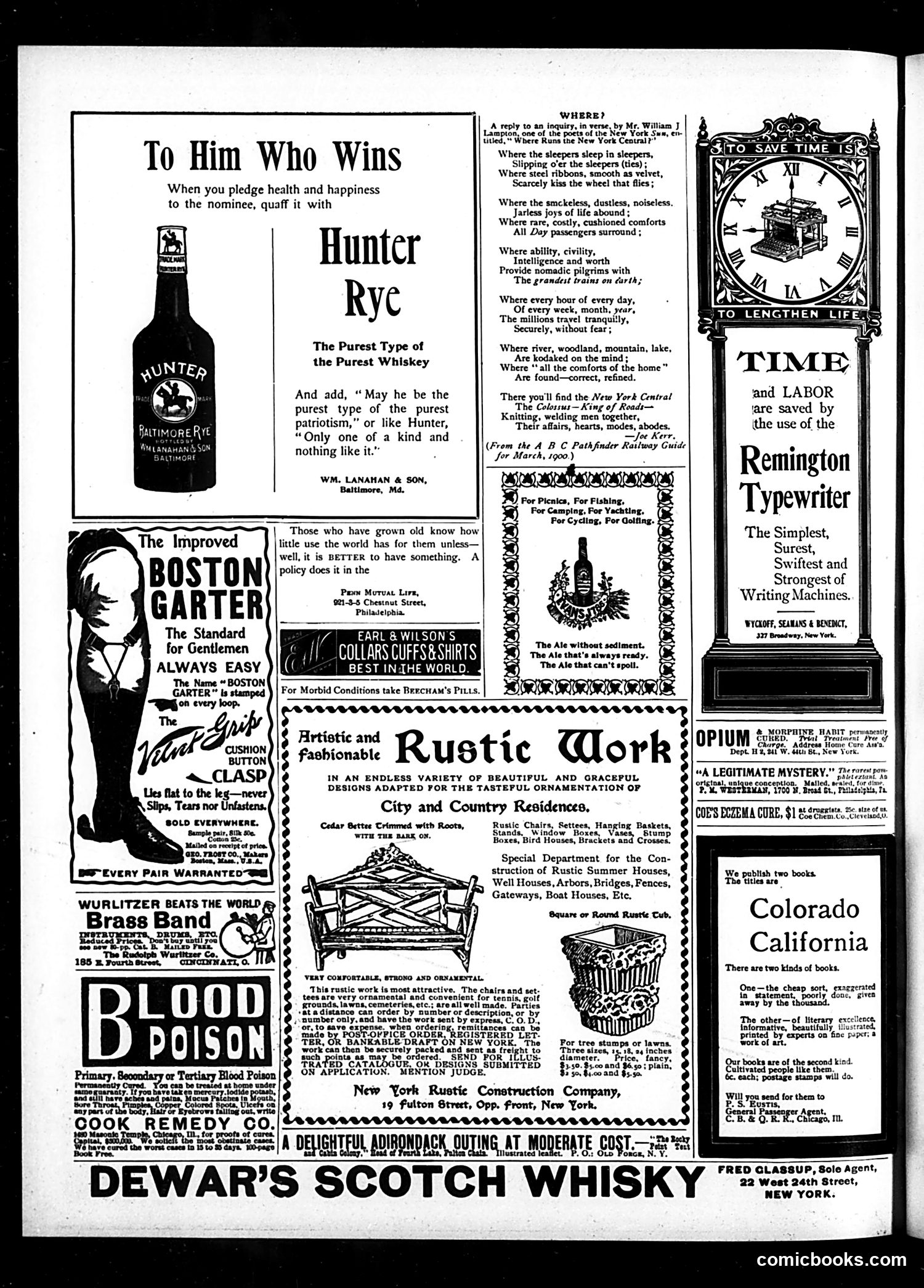
This page is primarily **advertising**, not political satire. It contains multiple product advertisements from the early 1900s, including: - Hunter Rye whiskey ("The Purest Type of the Purest Whiskey") - Boston Garter (men's suspenders, "The Standard for Gentlemen") - Earl & Wilson collars and shirts - Remington Typewriter - Rustic Work furniture and construction - Dewar's Scotch Whisky The only satirical element is a small poem titled "Where?" (top right), which appears to be a lighthearted verse about the New York Central Railroad's comforts. Otherwise, the page reflects typical early-20th-century Judge magazine content: advertisements targeting gentlemen's fashion, household goods, and luxury items, interspersed with occasional editorial commentary.
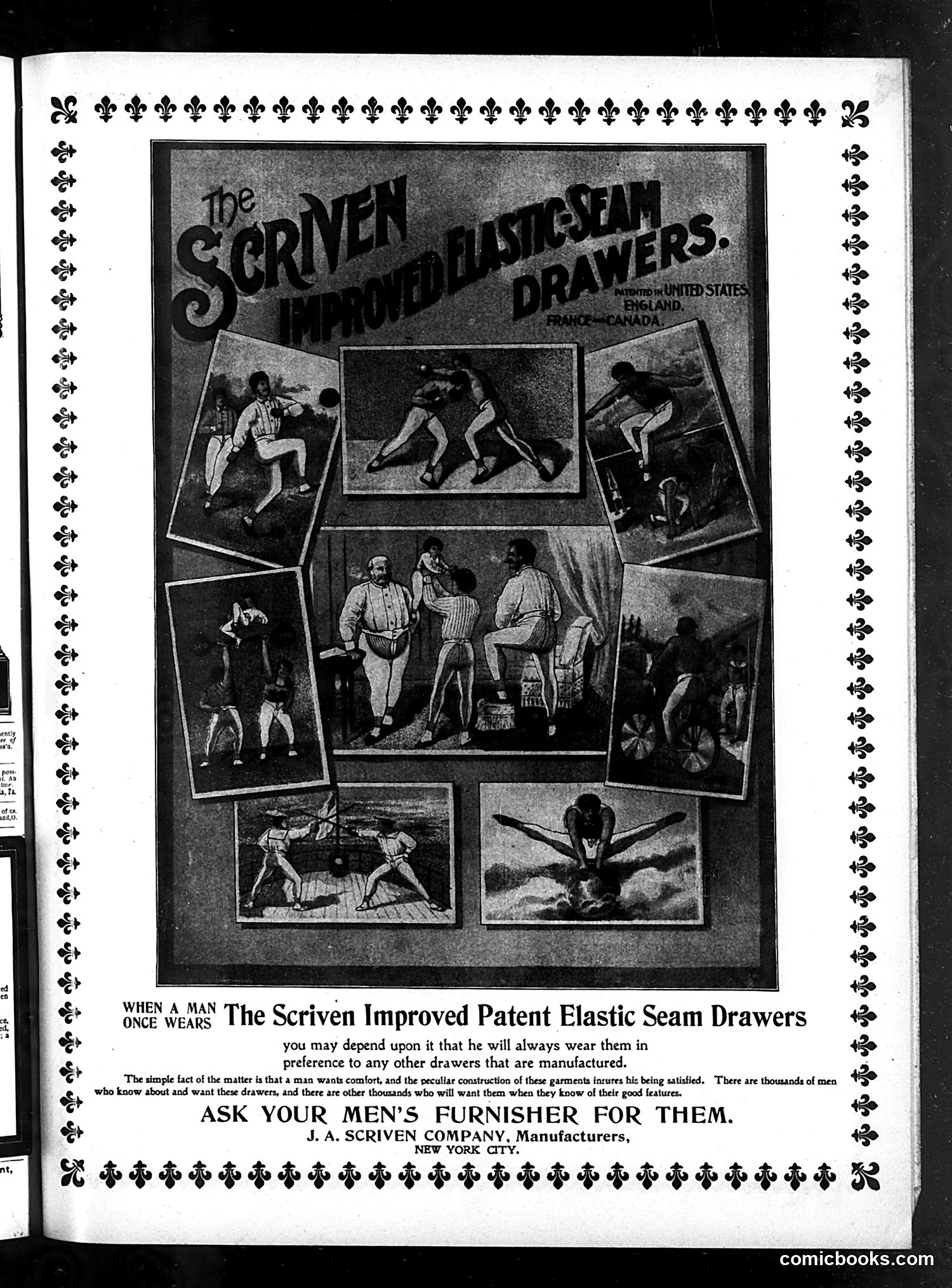
This page is primarily **advertising, not satire or editorial content**. It advertises "The Scriven Improved Patent Elastic Seam Drawers" — men's underwear manufactured by J.A. Scriven Company in New York City. The multiple photographs arranged around the title show men engaged in various physical activities (athletics, acrobatics, wrestling, cycling, and flying) to demonstrate that the product's elastic seams provide comfort and durability during strenuous movement. The tagline "WHEN A MAN ONCE WEARS" emphasizes customer loyalty through product quality. This represents early 20th-century advertising strategy: using action imagery and testimonial claims to market intimate apparel to male consumers. No political satire is present — this is straightforward commercial promotion.
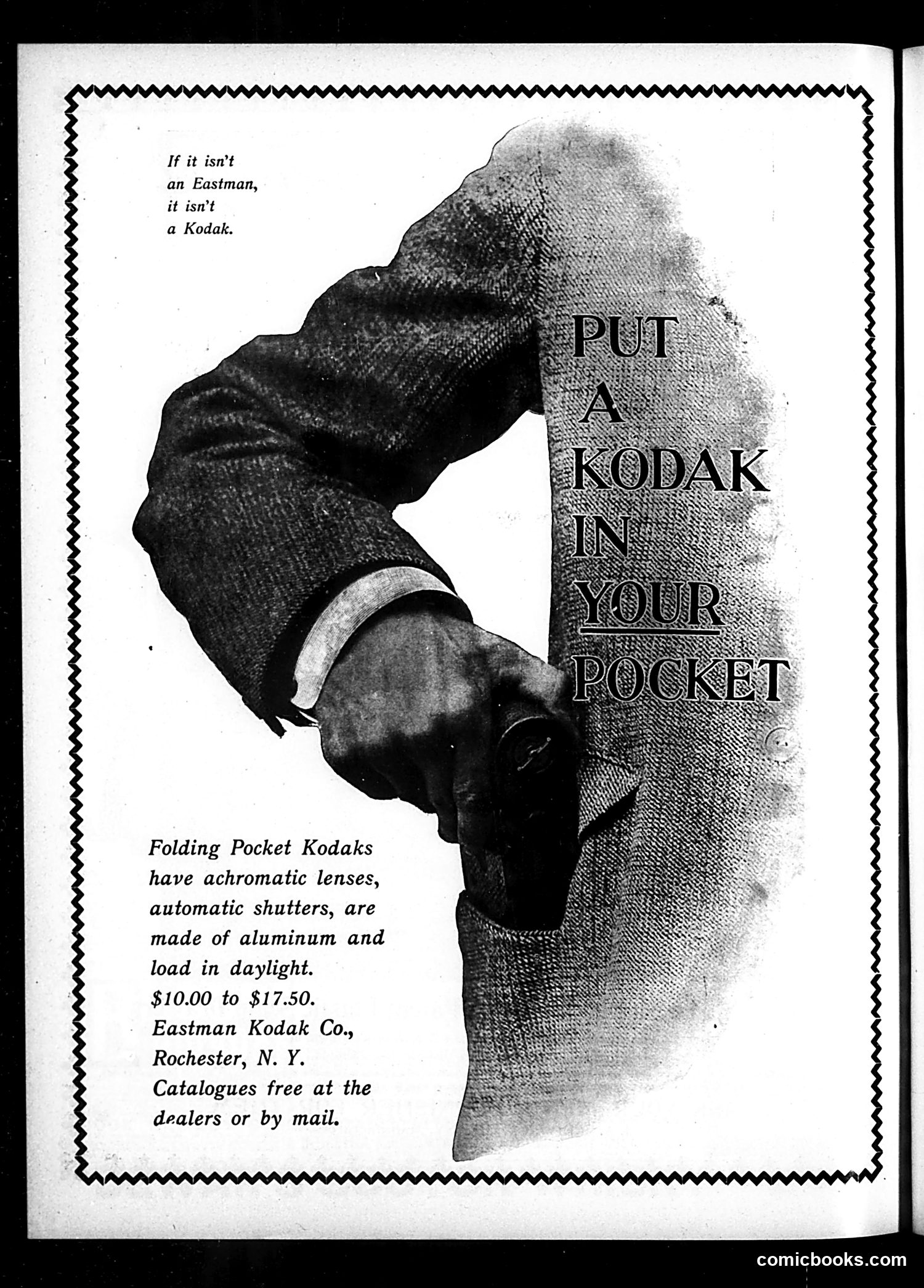
This page is primarily an **advertisement**, not satire or political commentary. It's a Kodak camera ad from *Judge* magazine promoting "Folding Pocket Kodaks." The headline plays on Eastman Kodak's brand dominance: "If it isn't an Eastman, it isn't a Kodak"—essentially claiming their cameras *define* what "Kodak" means in the marketplace. The visual shows a hand placing a compact camera into a jacket pocket, emphasizing portability. The ad highlights technical features (achromatic lenses, automatic shutters, aluminum construction, daylight-loading) and price range ($10-$17.50), with contact information for Eastman Kodak Co. in Rochester, New York. The "satirical magazine" context is incidental—this is straightforward commercial advertising using a confident brand-positioning message typical of early-20th-century promotions.
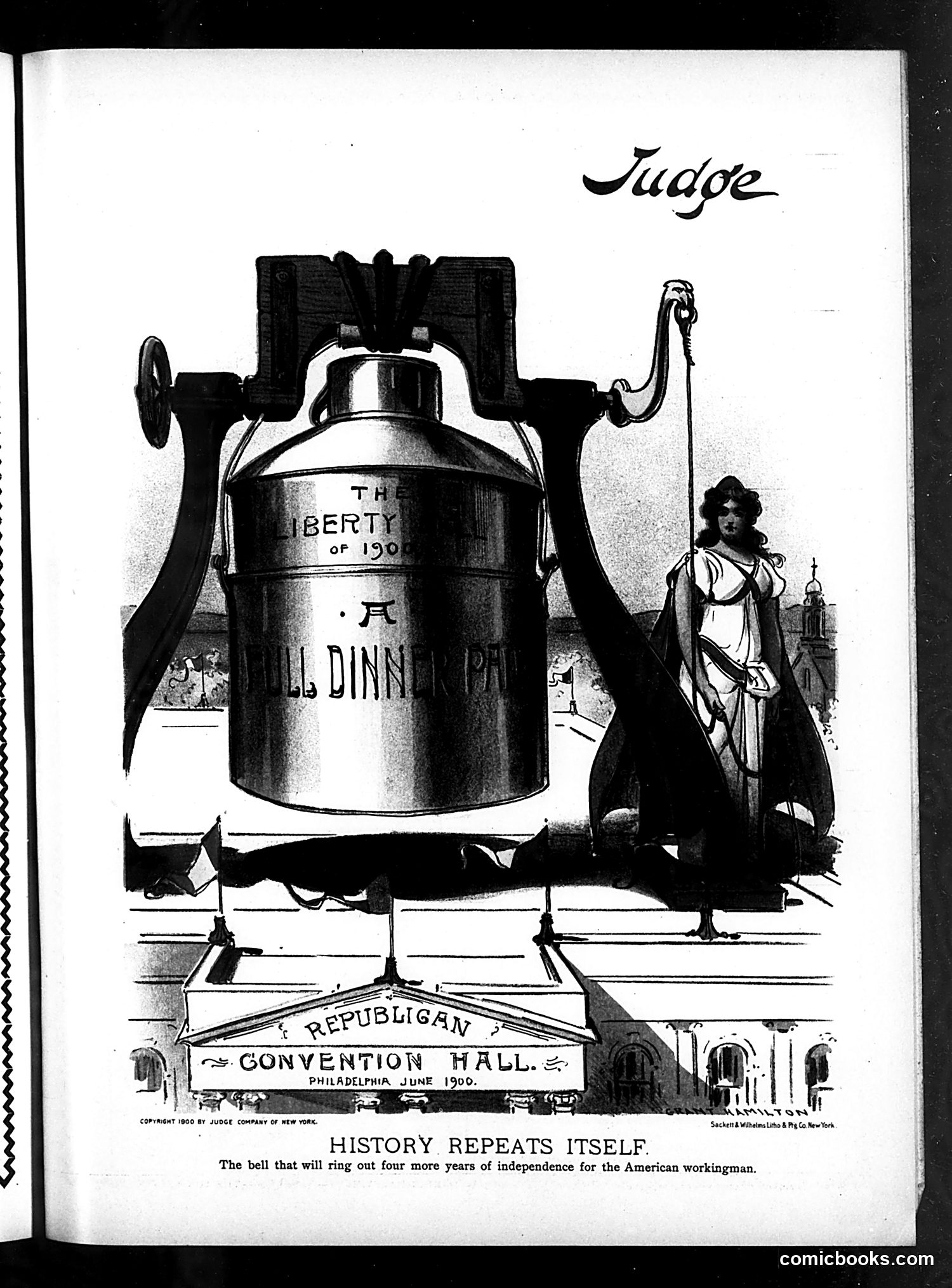
This Judge magazine cartoon from June 1900 depicts the **Liberty Bell** prominently displayed at Philadelphia's Convention Hall during the Republican National Convention. The allegorical female figure (likely representing Liberty or America) stands beside it. The caption "History Repeats Itself" with text about "four more years of independence for the American workingman" suggests this is **Republican campaign imagery supporting William McKinley's reelection**. The Liberty Bell symbolizes American independence and freedom—the Republicans are claiming their policies will extend economic independence to working Americans. The 1900 context matters: McKinley's first term included the Spanish-American War and industrial prosperity. Republicans framed his reelection as preserving American workers' economic freedom and independence, positioning themselves as defenders of both national liberty and labor prosperity.
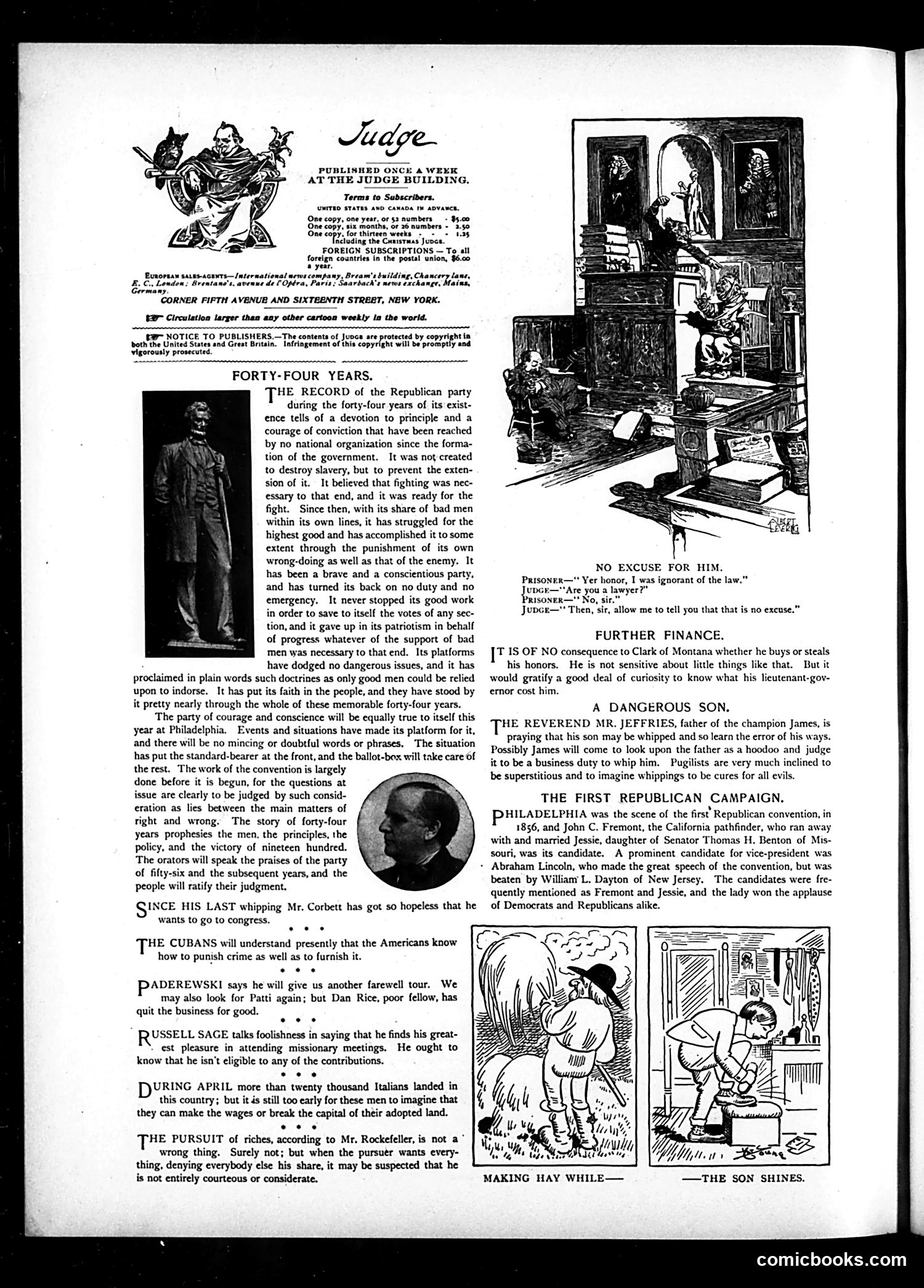
This page from Judge magazine contains a lengthy editorial praising the Republican party's 44-year record (dating the piece to around 1900), followed by brief satirical commentary on contemporary figures. The main editorial defends Republicans' principles on slavery prevention and party discipline, likely written during the 1900 presidential campaign ("Philadelphia" convention reference). The cartoons below use visual humor about labor and childhood. "No Excuse for Him" depicts a legal proceeding—likely satirizing someone claiming ignorance as a defense. The bottom illustrations labeled "Making Hay While—The Son Shines" show a child working while parents rest, a visual pun playing on the proverb "make hay while the sun shines." The brief satires mock contemporary figures: boxer Corbett seeking Congress, Russell Sage's hypocrisy about charity, Italian immigration concerns, and John D. Rockefeller's wealth accumulation. These represent typical Judge targets—politicians, wealthy industrialists, and social issues of the 1900 era.
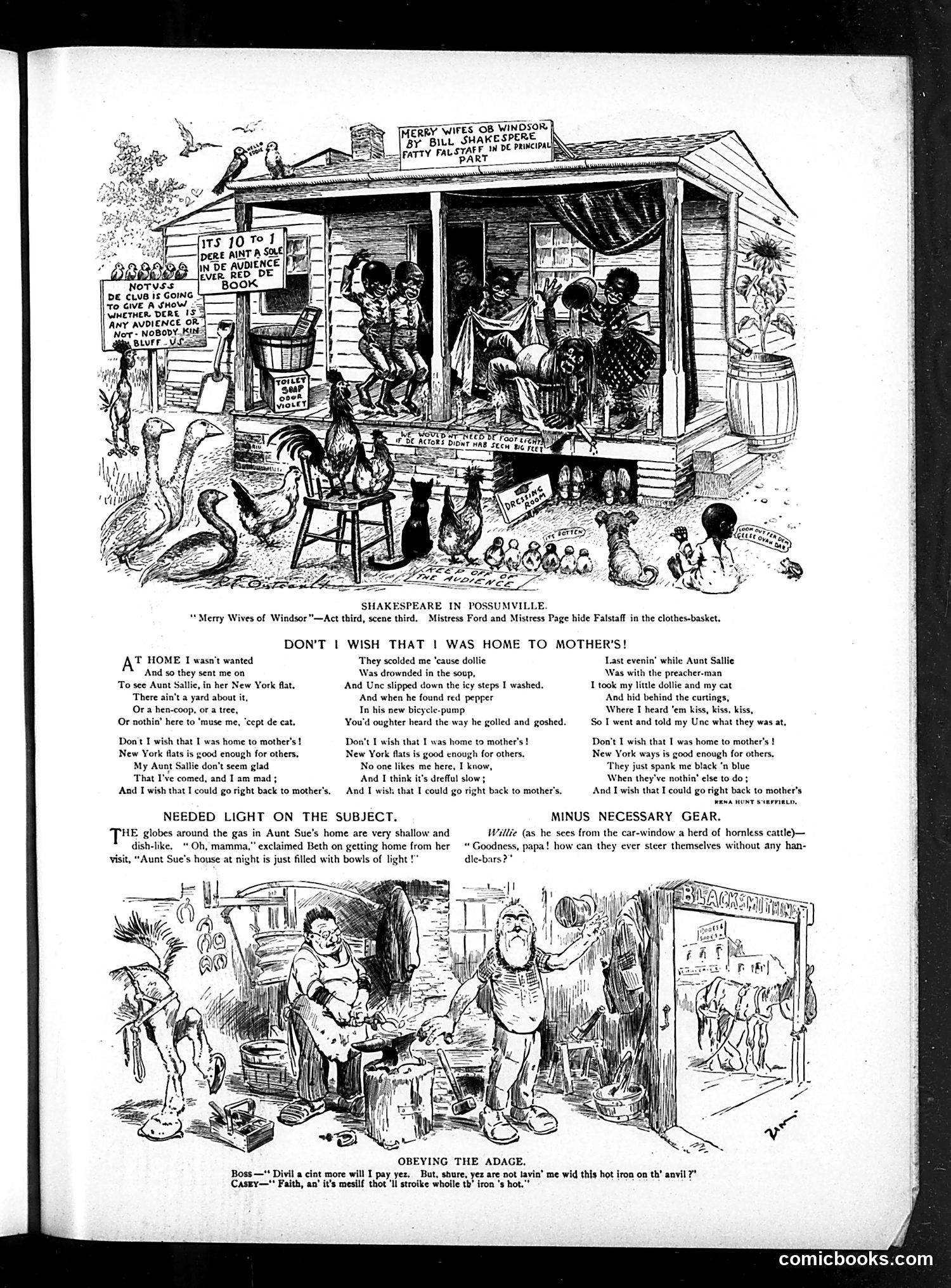
This Judge magazine page satirizes early 20th-century urban life through multiple sketches: **"Shakespeare in Possumville"** parodies a rural staging of Shakespeare's "Merry Wives of Windsor," showing African American performers in a makeshift theater—mocking both amateur theatricals and racial stereotypes common to the era. **"Don't I Wish That I Was Home to Mother's"** is a sentimental song-poem about a homesick child visiting an aunt in a cramped New York City apartment. The humor stems from the child's complaints: no yard, no animals except a cat, and Aunt Sallie's coldness—capturing period anxieties about urban versus rural life and city apartment living. **"Needed Light on the Subject"** makes a simple visual pun: shallow gas-lamp globes at the aunt's home create many reflections, making the rooms appear flooded with "bowls of light." **"Obeying the Adage"** and **"Minus Necessary Gear"** are brief joke sketches with ethnic humor and wordplay typical of Judge's comedic style. The page emphasizes nostalgic rural values versus impersonal city life.
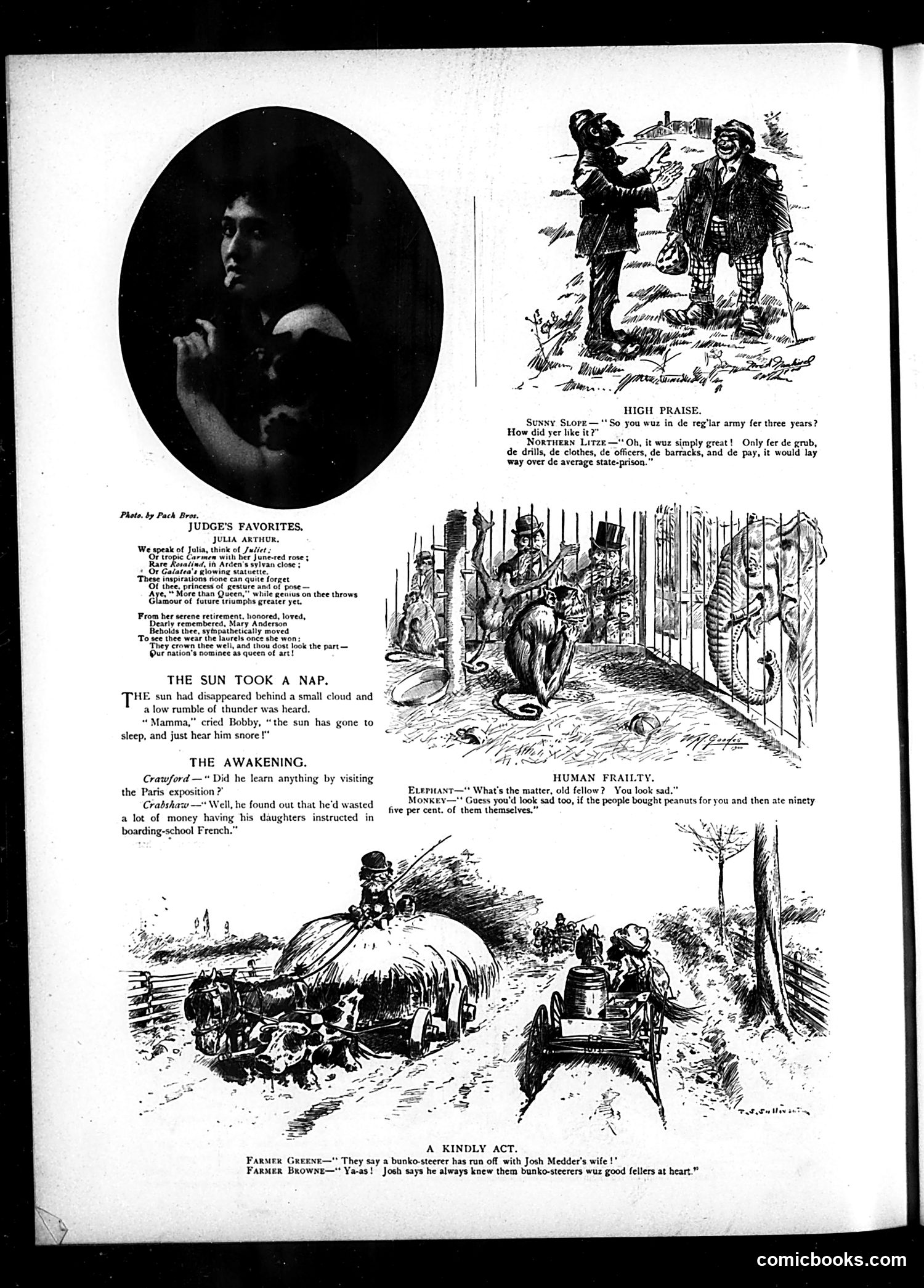
This page contains multiple short humorous pieces typical of late-19th/early-20th-century Judge magazine: **"High Praise"** satirizes military service through dialect humor. A soldier claims the army is superior to prison—except for food, drills, uniforms, officers, barracks, and pay. The joke relies on the irony that he's excluded everything actually *constituting* military life, making the comparison absurd. **"Judge's Favorites"** praises actress Julia Arthur, comparing her to celebrated predecessors like Mary Anderson. This appears to be straightforward theatrical appreciation rather than satire. **Remaining pieces** use simple, gentle humor: a child mishearing thunder as the sun snoring; a man wasting money on his daughters' French education; an elephant and monkey exchanging sad observations about audience behavior; a farmer finding silver linings in moral failings. The page also includes a portrait photograph credited to Pach Bros. Overall, the humor is sentimental and relies on wordplay, dialect, and gentle observations about human nature—typical of Judge's lighter satirical content.
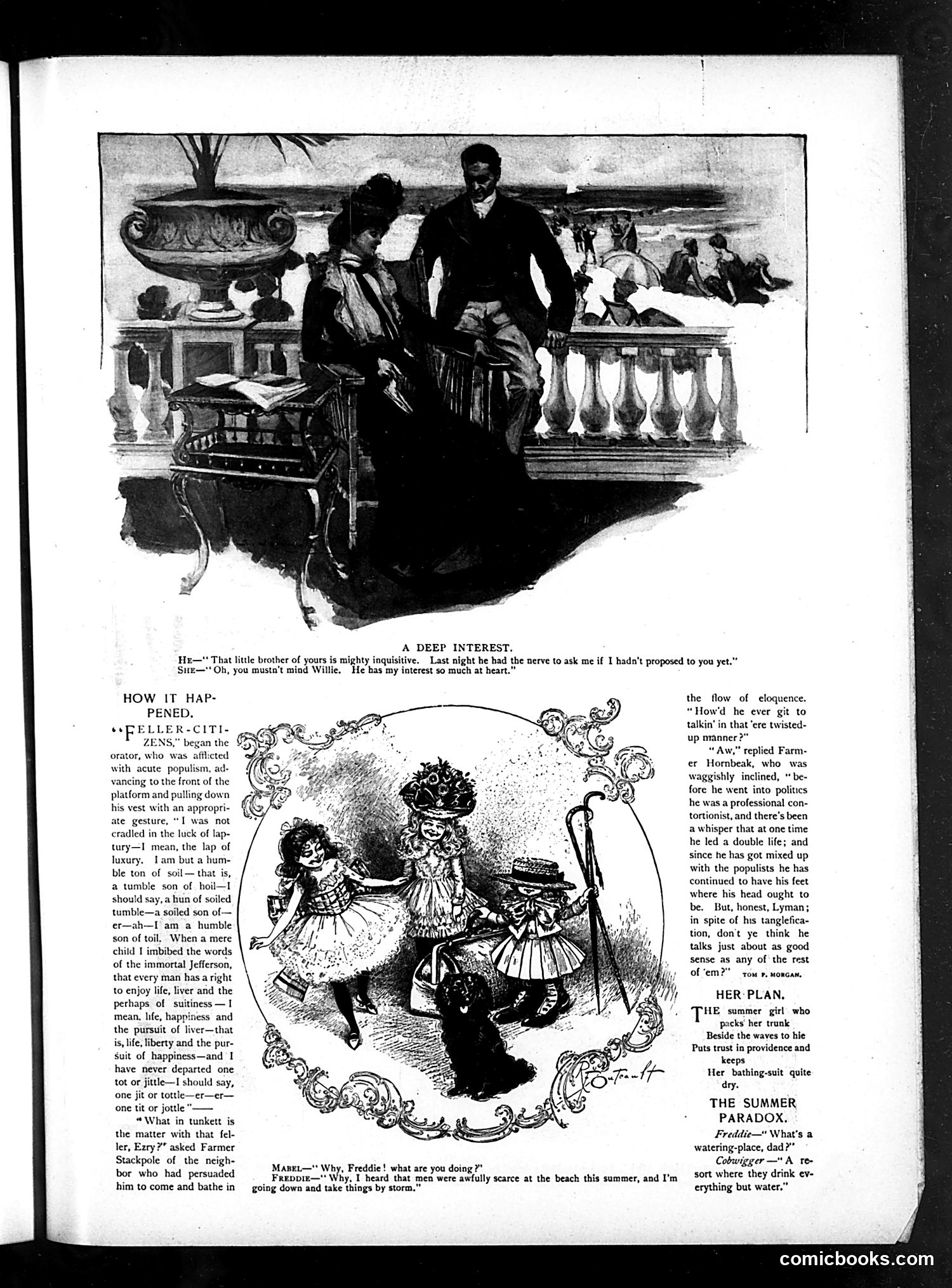
This page contains three distinct satirical pieces mocking contemporary American figures and social types circa the 1890s. **"How It Happened"** ridicules a Populist politician whose speech devolves into absurd verbal tangles ("tumble son of hoil," "tit or jottle"). The accompanying dialogue reveals he was formerly a contortionist, suggesting Populist politicians are literally and figuratively twisted. Two rural farmers discuss him, with one defending his "good sense" despite the nonsense—satirizing Populist appeal to working-class voters. **"A Deep Interest"** shows a young boy asking an adult about marriage proposals, with the adult deflecting by claiming the child's interest in the matter is heartwarming—a gentle joke about romantic intrigue. **"The Summer Paradox"** jokes that a "watering-place" (beach resort) is where people drink everything *except* water, mocking the leisure habits of wealthy vacationers. The illustrations employ exaggeration and wordplay typical of Judge's satirical style, targeting political incompetence and upper-class absurdity.
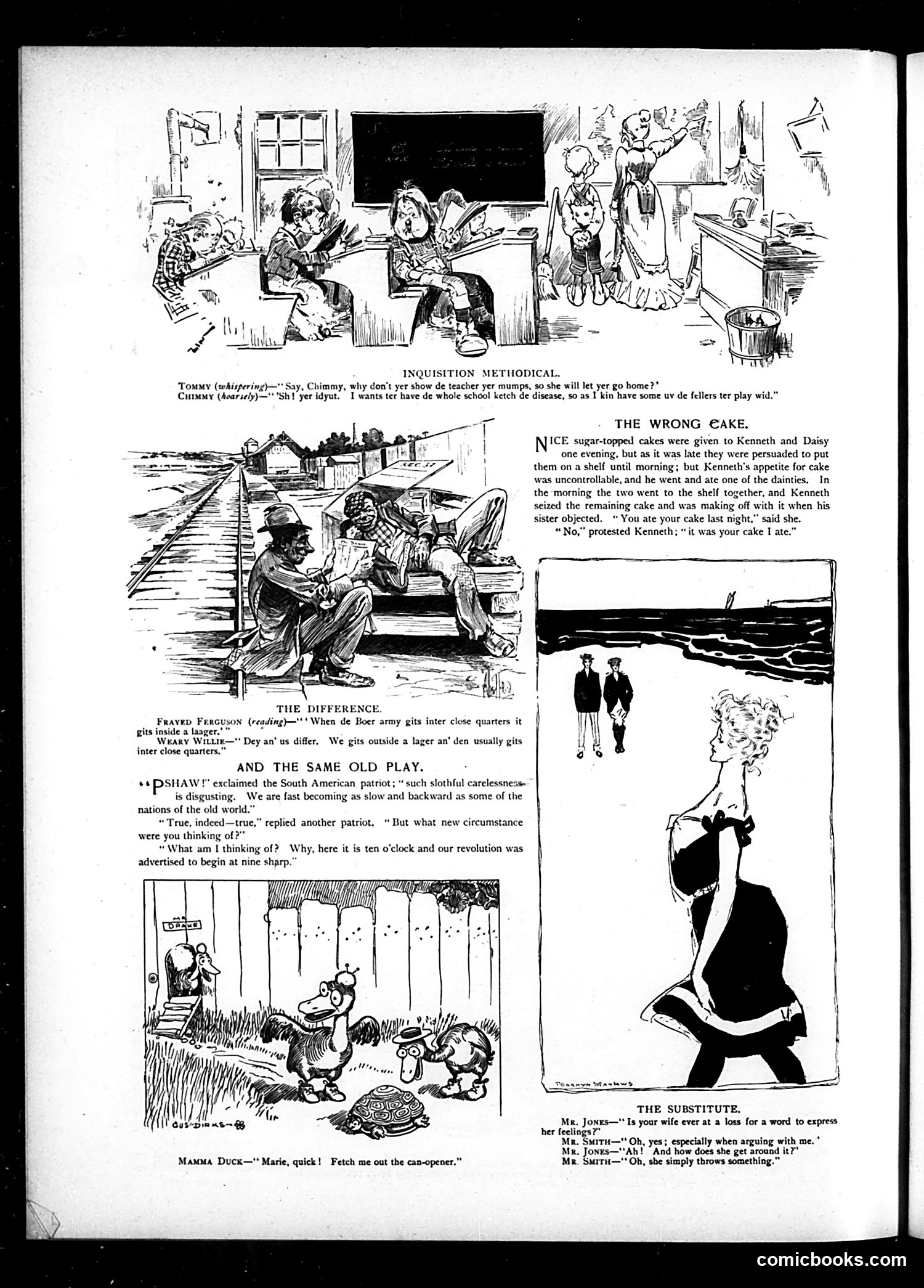
This page contains five separate humorous vignettes typical of Judge's satirical style: **"Inquisition Methodical"** depicts schoolchildren in dialect, with one suggesting deliberately spreading mumps so classmates can play together—satirizing both childhood logic and period concerns about disease. **"The Difference"** jokes about the Boer War (South African conflict), contrasting military tactics: Boers use "lagers" (fortified camps); the homeless character "Weary Willie" exits bars before being arrested—dark humor about poverty. **"Same Old Play"** mocks South American political instability, with patriots embarrassed that their revolution started late, suggesting chronic disorganization. **"The Wrong Cake"** is a gentle children's story about sibling deception. **"The Substitute"** presents a domestic joke: a husband claims his argumentative wife avoids words by throwing things instead—period humor about marital conflict. The page mixes social commentary, ethnic dialect humor (common but offensive by modern standards), and gentle family comedy. All reflect Judge's mix of political satire and light domestic entertainment.
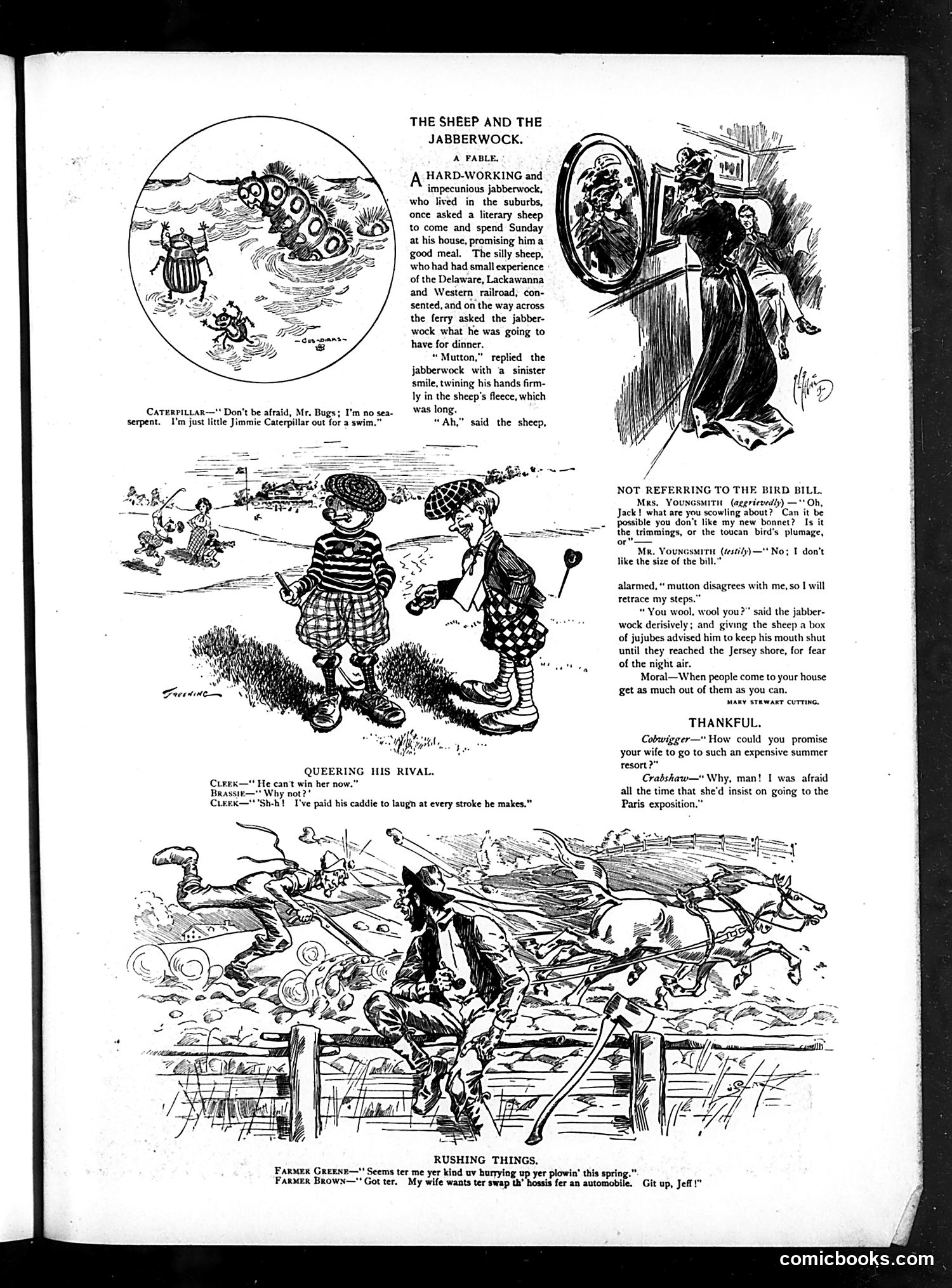
This fable satirizes gullible people (the "silly sheep") exploited by unscrupulous hosts. A poor "jabberwock" invites a literary sheep to dinner, threatening to serve "mutton" (the sheep itself). The sheep escapes by claiming mutton disagrees with him—a dark joke about self-preservation through absurdity. The accompanying jokes mock contemporary social anxieties: a wife obsessing over a fashionable bonnet's cost; husbands bribing caddies to boost their golf egos; and rural farmers desperate to trade horses for automobiles to satisfy materialistic wives. The "Caterpillar" vignette appears unrelated—likely referencing Lewis Carroll's *Alice in Wonderland*. The overall theme: American society's preoccupation with status, consumption, and vanity, presented through satirical humor targeting both the gullible and the greedy.
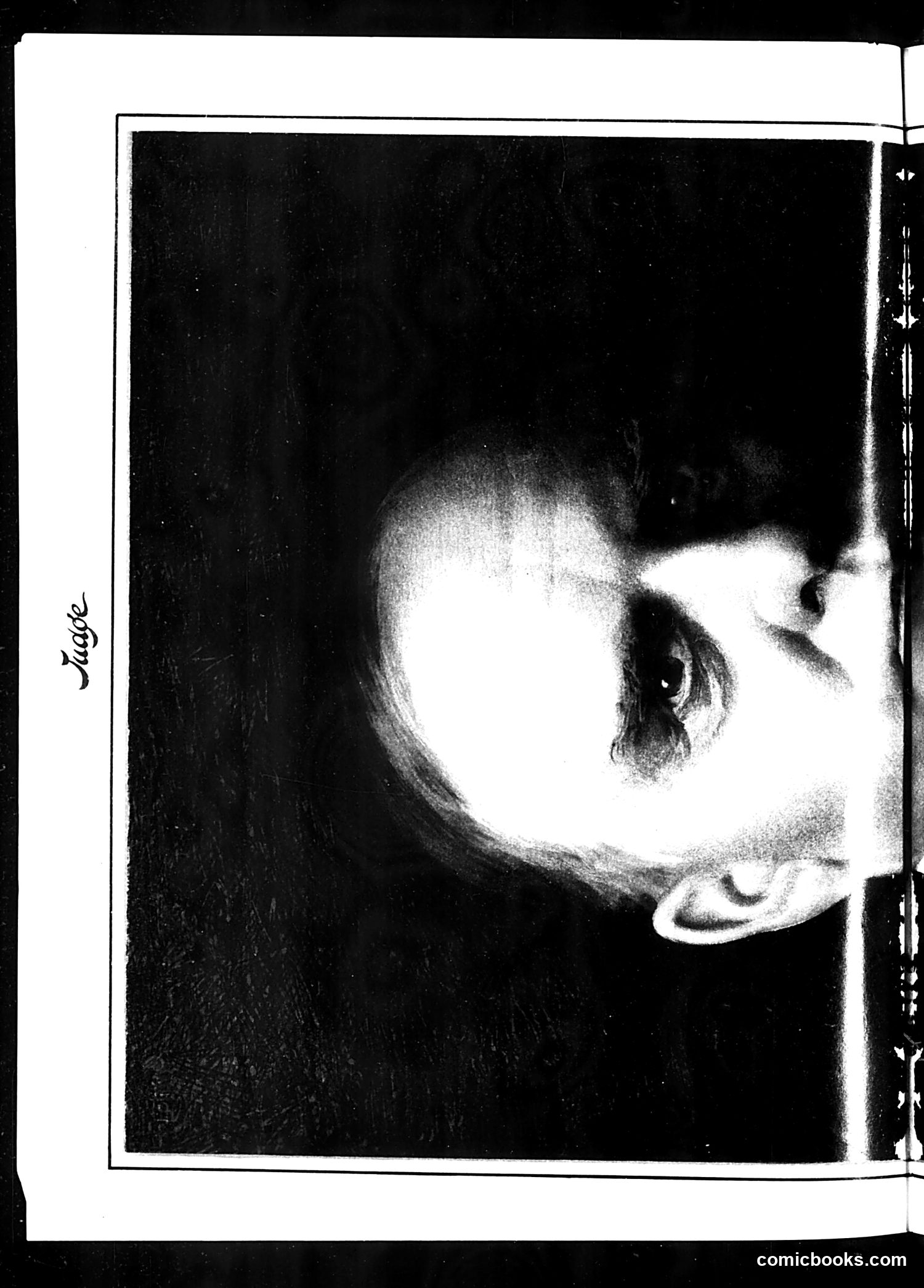
I can see this is a black and white photograph or portrait from Judge magazine showing a person in profile against a dark background. However, the image quality and contrast make it difficult to identify specific details with certainty. There appears to be a signature or text on the left side of the page, but it's not clearly legible in this reproduction. Without being able to read any accompanying caption or article text that would explain the context, I cannot reliably identify who is pictured, what political or social commentary this represents, or what the satirical point might be. The OCR text provided only shows "comicbooks.com," which appears to be a website attribution rather than period content. To accurately explain this cartoon's meaning to a modern reader, I would need clearer text identifying the subject and context.
I can see this is a page from *Judge* magazine showing what appears to be a black and white photograph or illustration of abstract curved shapes against a dark background. The image has handwritten text on the right margin that reads "Lovely." However, I cannot confidently identify specific political figures, caricatures, or satirical references from this image alone. The abstract nature of the forms—appearing to be curved, light-colored shapes—makes it difficult to determine what or whom is being depicted or what social/political commentary is intended. Without clearer visual detail or additional contextual text from the page, I cannot reliably explain the cartoon's meaning to a modern reader. The quality and abstraction level prevent certain identification of the satire's target.
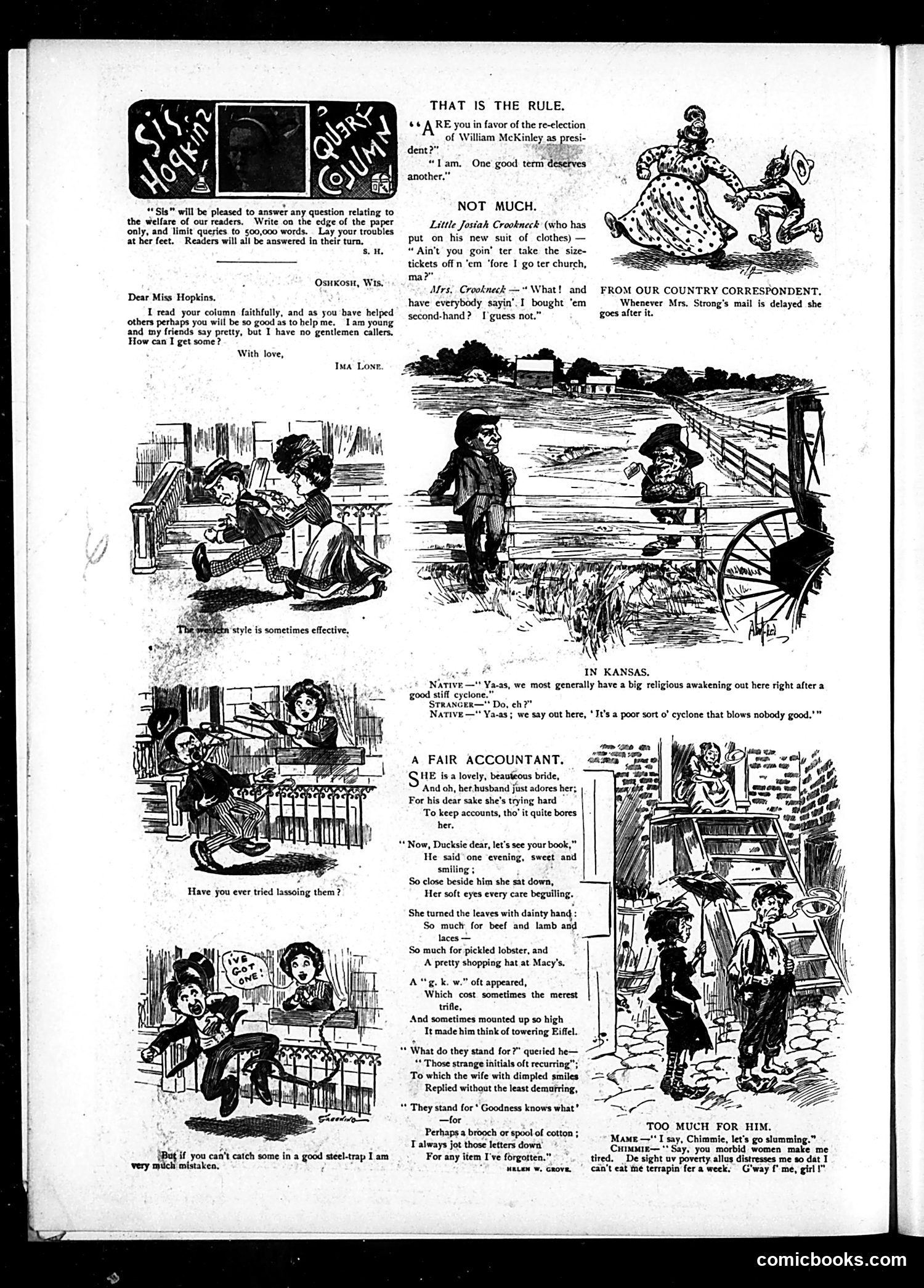
This page from *Judge* contains several satirical pieces satirizing American domestic and political life, circa the McKinley era (early 1900s): **"That Is the Rule"** mocks President William McKinley's re-election campaign through a simple political exchange—a voter supports McKinley's second term using the cliché "one good term deserves another." **"Not Much"** ridicules working-class pretension: a man in new clothes refuses to remove price tags before church, with his wife insisting she bought them new (second-hand purchases were socially shameful). **"A Fair Accountant"** satirizes newlywed finances. A bride's account book repeatedly shows mysterious "g.k.w." entries (apparently meaning "goodness knows what"), suggesting wives concealed shopping expenditures from husbands—a commentary on female consumer spending and marital financial secrecy. **"Too Much for Him"** uses stereotypical immigrant dialect ("Chimmie," "De sight") to mock upper-class "slumming" tourism. The working-class character refuses poverty-watching because witnessing deprivation spoils his appetite—inverting expected sympathy roles.
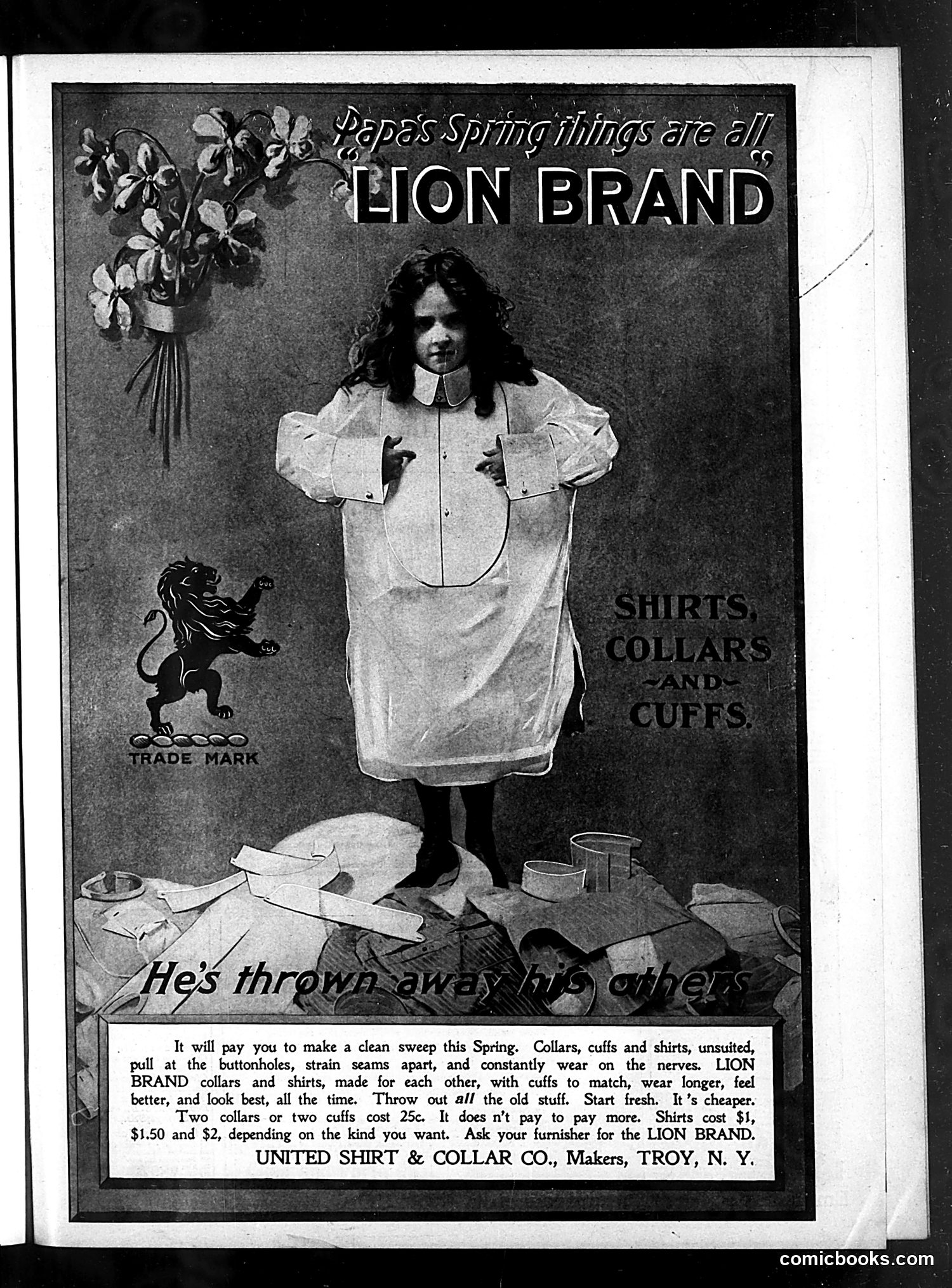
This is primarily a **product advertisement**, not political satire. It promotes Lion Brand shirts, collars, and cuffs made by United Shirt & Collar Co. of Troy, New York. The image shows a child in spring clothing surrounded by discarded old garments, illustrating the advertising slogan "He's thrown away his others." The lion trademark appears at bottom left. The advertisement's pitch is practical rather than satirical: Lion Brand items are durable, affordable (25¢ for collars/cuffs), and worth replacing worn clothing. The "clean sweep this Spring" messaging encourages consumers to discard inferior garments and purchase new Lion Brand products instead. The text emphasizes durability ("wear longer"), comfort ("feel better"), and economy—typical early 20th-century advertising appeals. There is no apparent political commentary or social satire present on this page.
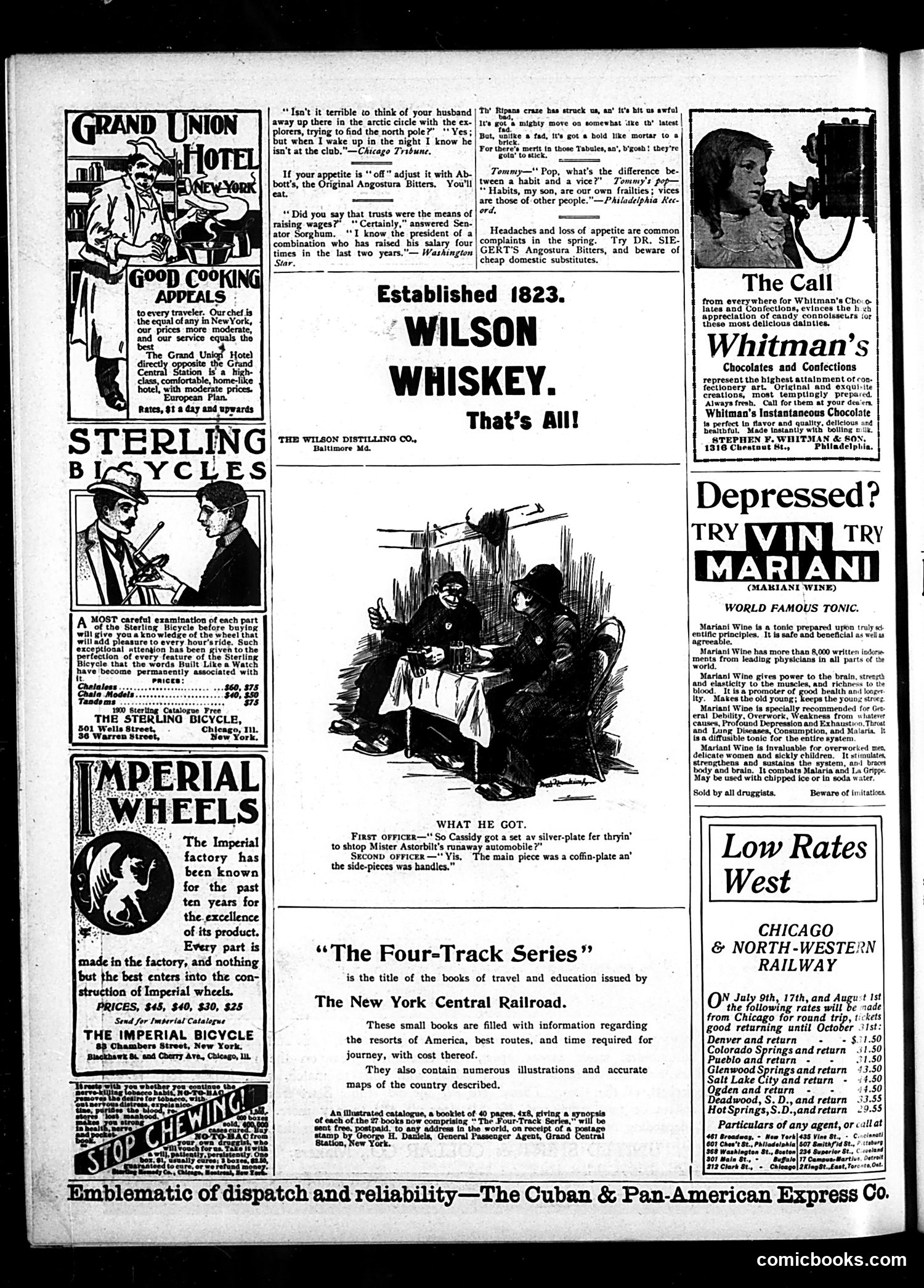
This page is primarily **advertisements and filler jokes** rather than political satire. The main content includes: **Notable joke:** A brief domestic humor piece contrasts a wife's relief that her husband exploring the Arctic isn't at his club—suggesting marital infidelity concerns were common anxieties. Another joke mocks Senator Sorghum's claim that trusts raise wages, revealing he merely raised his own salary repeatedly—satirizing the hypocrisy of robber-baron era politicians. **Central cartoon:** "What He Got" depicts an officer discussing Cassidy receiving a "silver-plate" reward for stopping an Astor automobile—but the "main piece was a coffin-plate." This dark humor references the wealthy Astorbilt family (likely Astor caricature) and implies stopping their vehicle was deadly. The page is dominated by period **patent medicines** (Mariani Wine, Ripans Tabules, bitters) and **product advertisements** (bicycles, chocolates, railroads), typical of early-1900s magazine revenue.
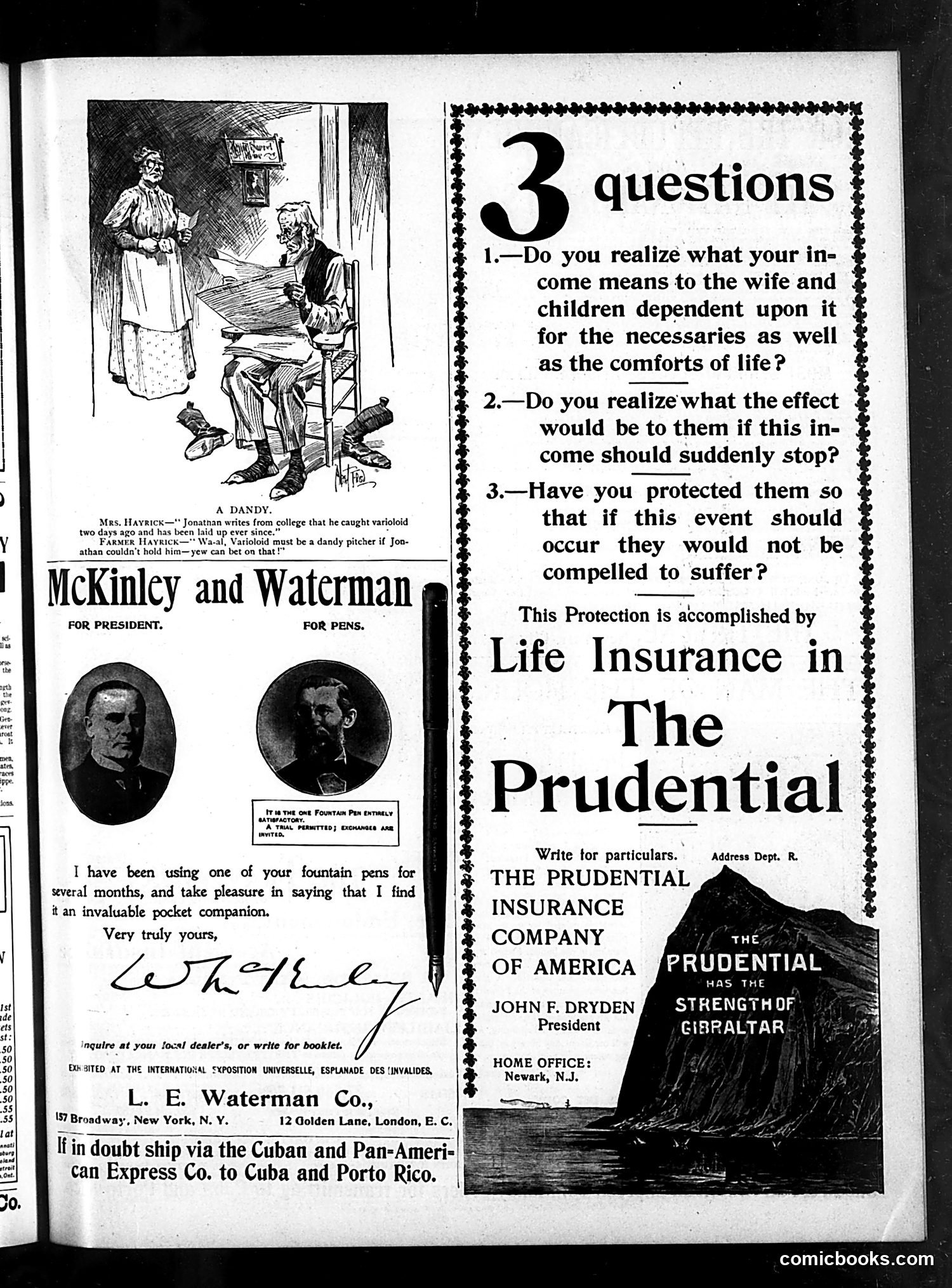
This Judge magazine page contains a political cartoon and advertisements from the early 1900s. **The Cartoon ("A Dandy"):** The sketch depicts a domestic scene where Mrs. Hayrick tells her husband that their son Jonathan caught "varioloid" (a mild form of smallpox) at college. Mr. Hayrick jokes that varioloid must be an excellent baseball pitcher if Jonathan "couldn't hold" him—a pun playing on the double meaning of "caught." The humor relies on wordplay misunderstanding a disease name as a person's name, typical of period comedy. **The Advertisements:** The page features two major ads: - **McKinley and Waterman for President/Pens**: A presidential endorsement ad for William McKinley paired with promotional copy for L.E. Waterman fountain pens, featuring a testimonial signature - **The Prudential Insurance**: A life insurance advertisement using three rhetorical questions to convince readers of insurance necessity, emphasizing family financial protection The page reflects turn-of-the-century American concerns: public health (smallpox), politics, consumer products, and the emerging insurance industry.
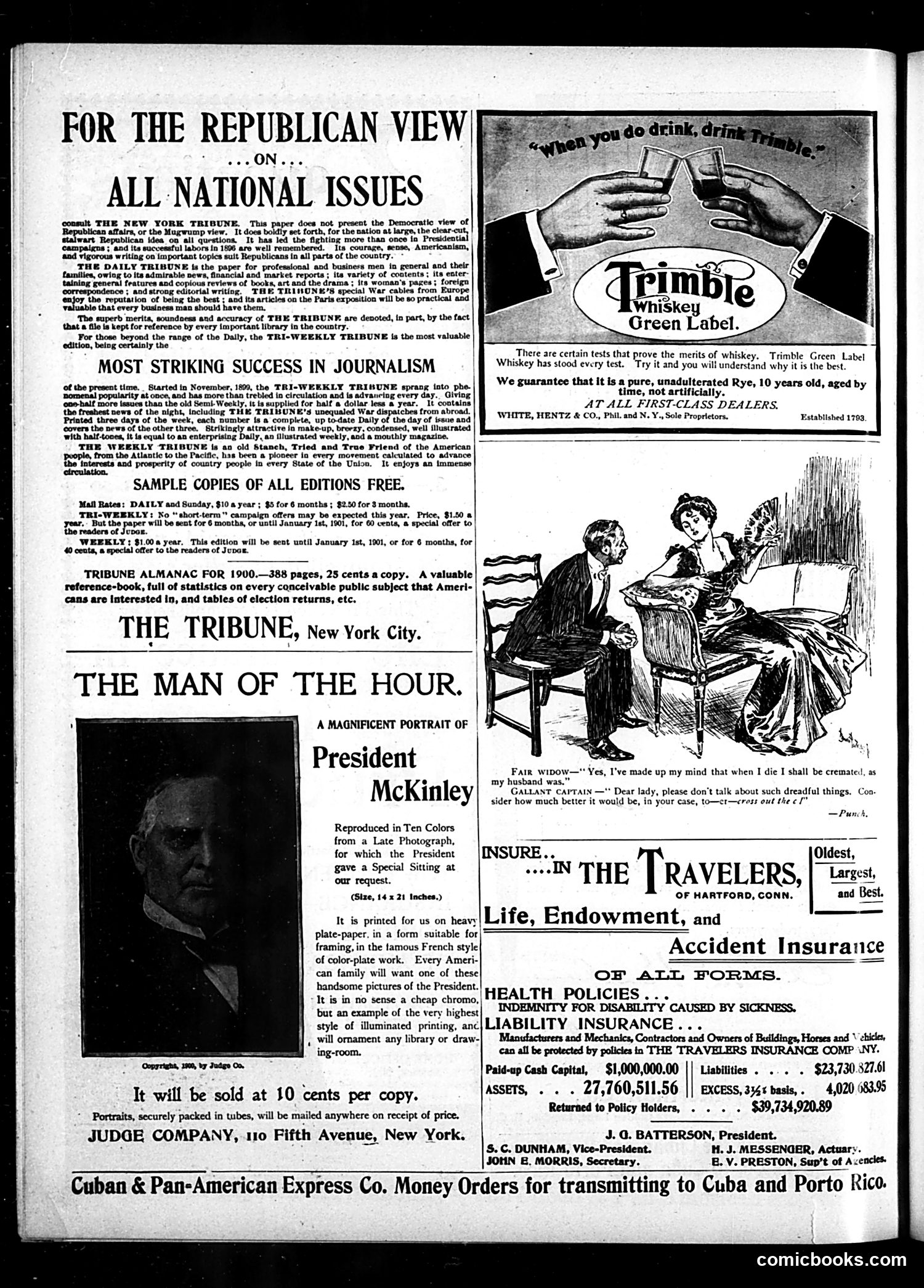
This page is primarily **advertising and promotion** for *The Tribune*, a Republican newspaper, rather than editorial content or satire. The layout includes: 1. **"Man of the Hour" portrait**: A ten-color reproduction of President McKinley—positioned as heroic imagery to appeal to Republican readers. The timing (circa 1900, based on the 1901 subscription dates mentioned) suggests this celebrates McKinley's presidency or recent electoral success. 2. **Promotional text**: Extensive advertisements for *The Tribune's* various editions (Daily, Tri-Weekly, Weekly) and the *Tribune Almanac*, emphasizing Republican viewpoint and journalistic quality. 3. **Commercial ads**: Including Trimble Whiskey and Travelers Insurance, typical period advertising. 4. **Cartoon**: A small sketch showing a domestic scene with a widow and "Gallant Captain" discussing morbid topics—likely comic relief rather than political satire. The page functions as **partisan promotion**: positioning *The Tribune* as the authoritative Republican voice for the "Man of the Hour" (McKinley), appealing to both business interests and general readers.
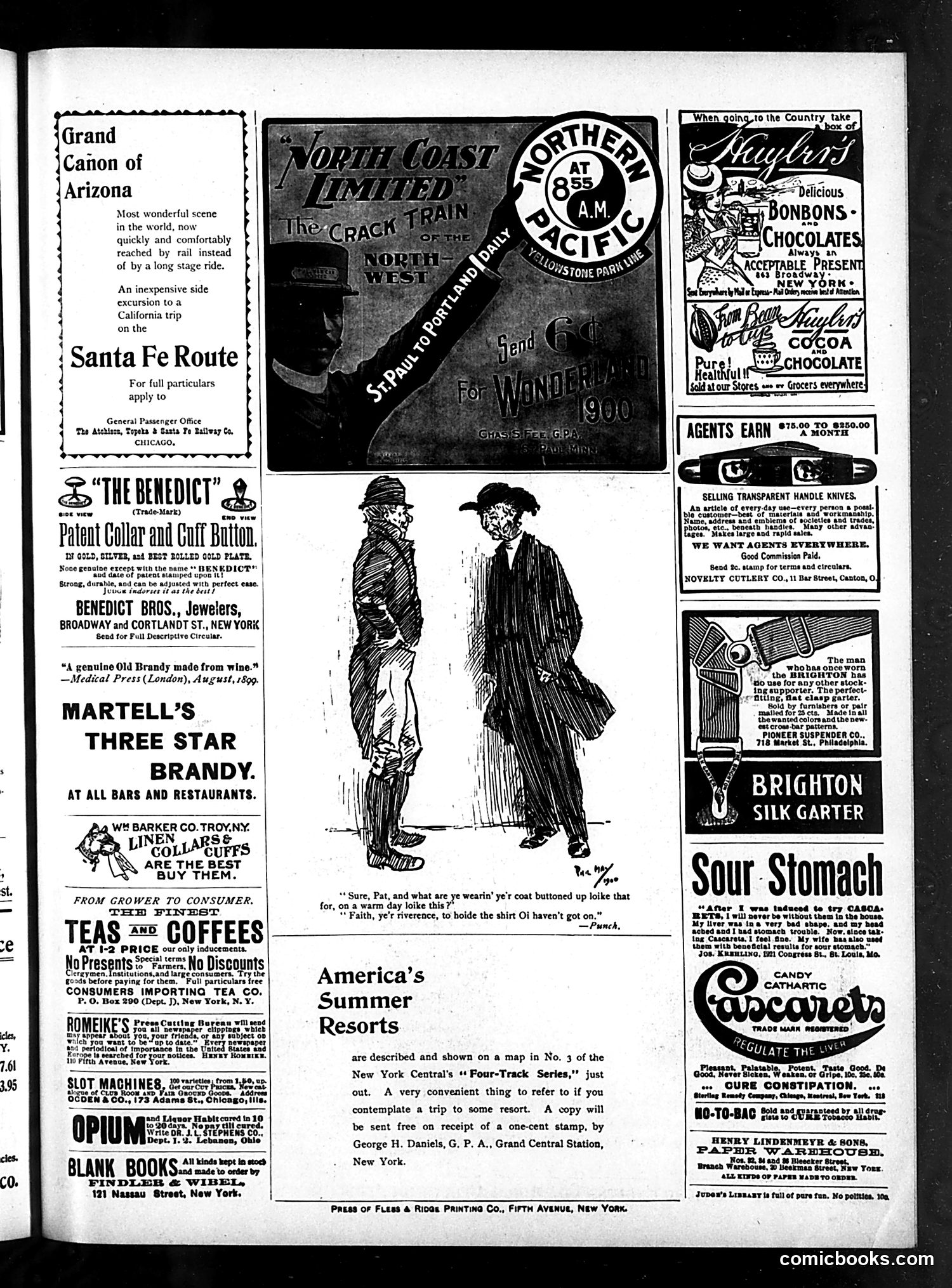
This page is primarily **advertising**, typical of Judge magazine's revenue model. The central content is a single cartoon captioned with Irish dialogue. ## The Cartoon The illustration shows two working-class Irish men in conversation. One asks why the other buttons his coat on a warm day. The reply: to hide the shirt he doesn't have. **The satire:** This is a gentle joke about Irish poverty and resourcefulness—a common stereotype in late-19th-century American humor. The humor relies on the absurdity of the solution (buttoning an empty shirt space) and the character's matter-of-fact acceptance of his condition. The thick Irish dialect ("ye'r," "loike," "Oi") reinforces ethnic stereotyping typical of the era. The cartoon's point reflects attitudes toward working-class Irish immigrants, portraying them as comically impoverished yet dignified. By modern standards, this would be considered ethnic stereotyping, but it was mainstream humor in Judge's audience. The rest of the page contains period advertisements for brandy, tea, railroads, and novelty products—contextual material rather than editorial content.
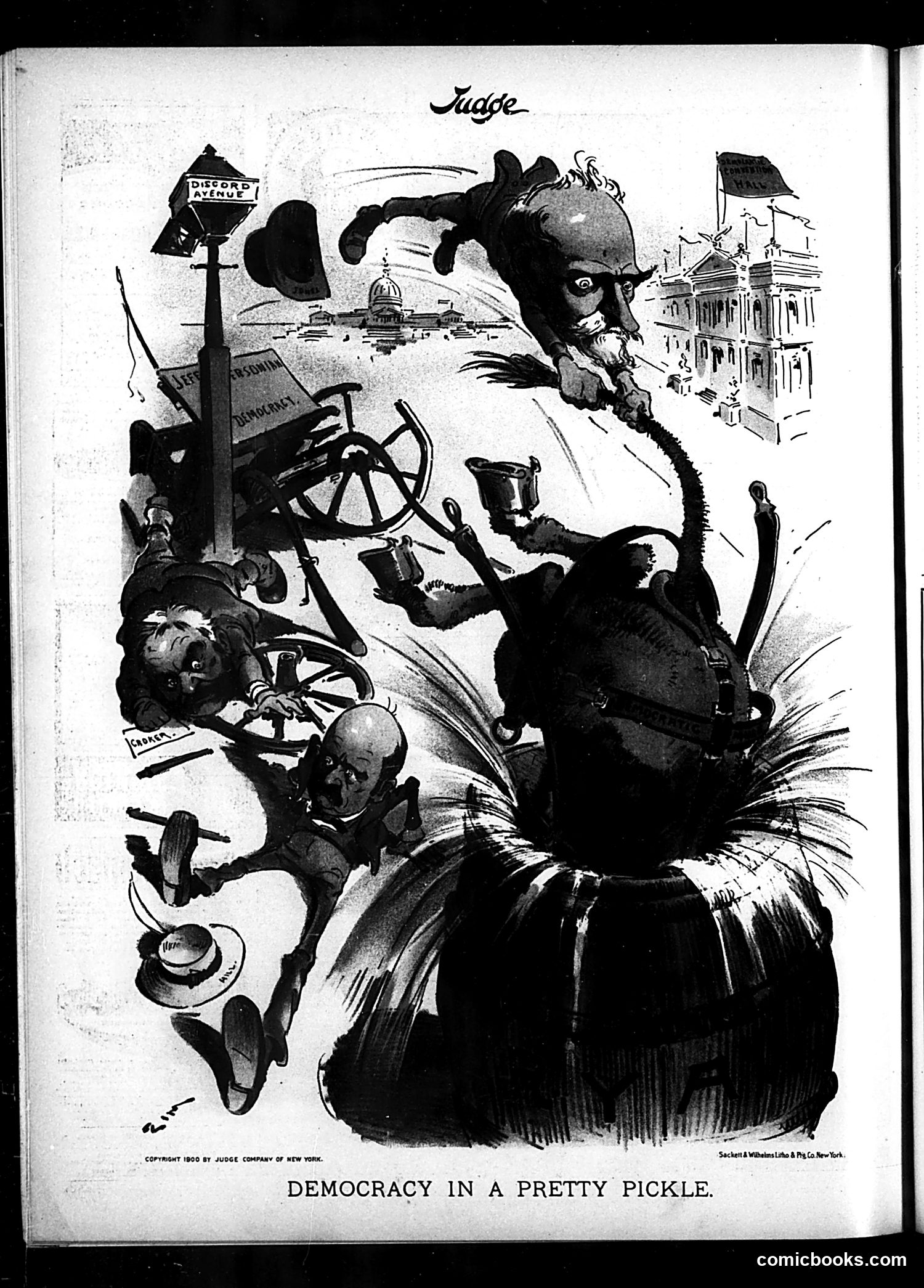
This 1900 Judge magazine cartoon satirizes American democracy as chaotic and threatened. The central figure appears to be Uncle Sam or Lady Liberty (the large face on the right), surrounded by turbulent imagery: a ship of state in distress, a donkey (likely representing the Democratic Party), various political figures in disarray, and symbols of governmental institutions (the Capitol building visible in background). The "pickle" metaphor suggests democracy is in serious trouble—trapped, constrained, or in dire circumstances. The tangled composition of competing forces, animals, and politicians conveys political turmoil and confusion. The cartoon likely comments on turn-of-the-century political instability, perhaps relating to the 1900 presidential election or broader anxieties about American governance during this transitional period.
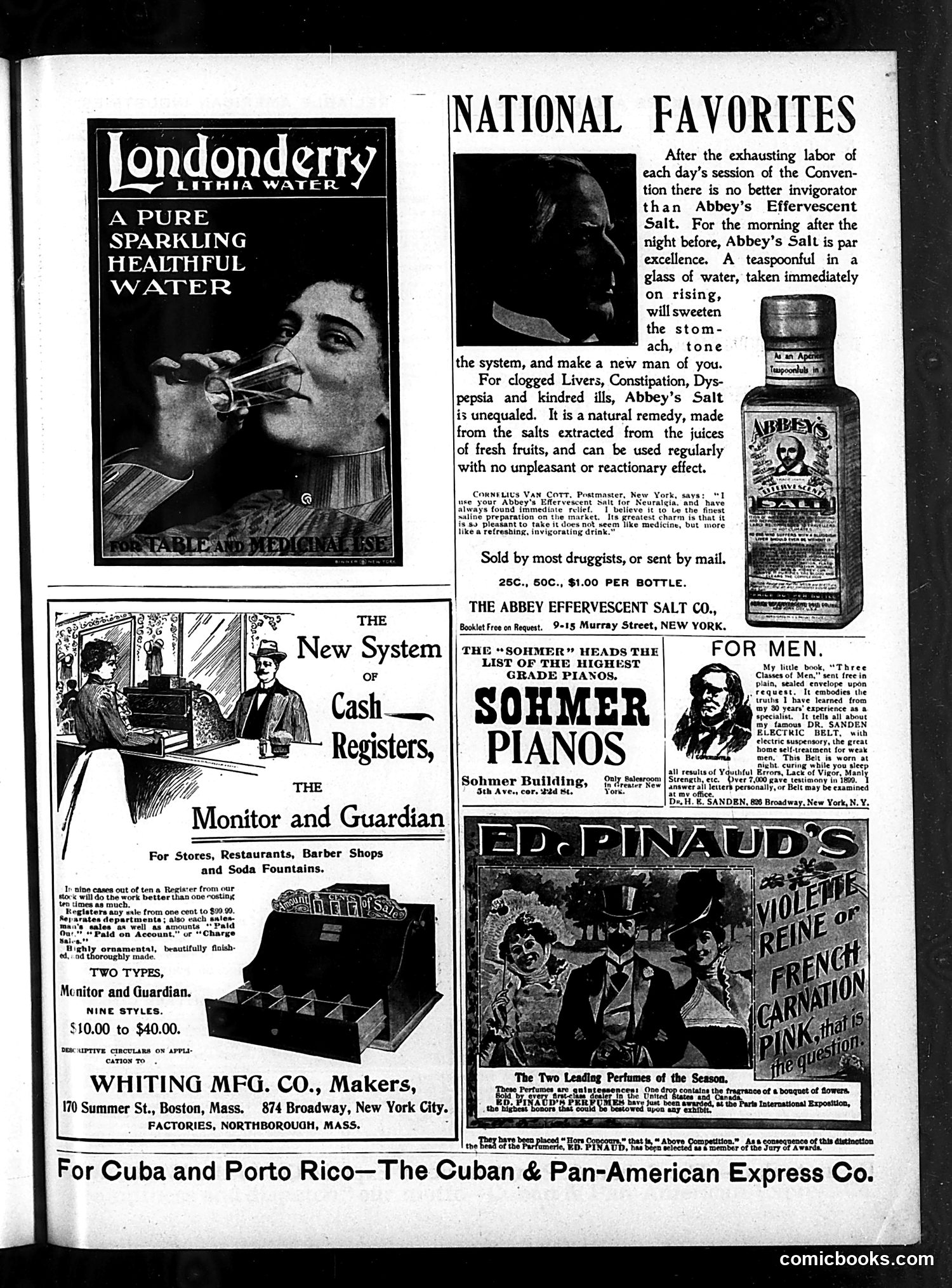
This page is primarily **advertising**, not political satire. It showcases "National Favorites"—commercial products marketed to early 1900s consumers. The ads include: - **Londonderry Lithia Water**: a sparkling mineral water promoted for health - **Abbey's Effervescent Salt**: a digestive remedy (laxative) endorsed with a testimonial from a New York postmaster, marketed for hangovers and constipation - **Cash Registers**: the "Monitor and Guardian" system for retail businesses - **Sohmer Pianos**: high-grade instruments - **Dr. Sanden's Electric Belt**: a quack medical device claiming to cure male sexual dysfunction and vigor loss through electricity—a common fraudulent product of the era The page reflects the era's patent medicine culture and the prevalence of dubious health claims. The reference to "Convention" (likely a political gathering) in the Abbey's Salt ad suggests Judge's readership attended such events and needed hangover relief. No political figures or satire are present—this is straightforward period advertising.
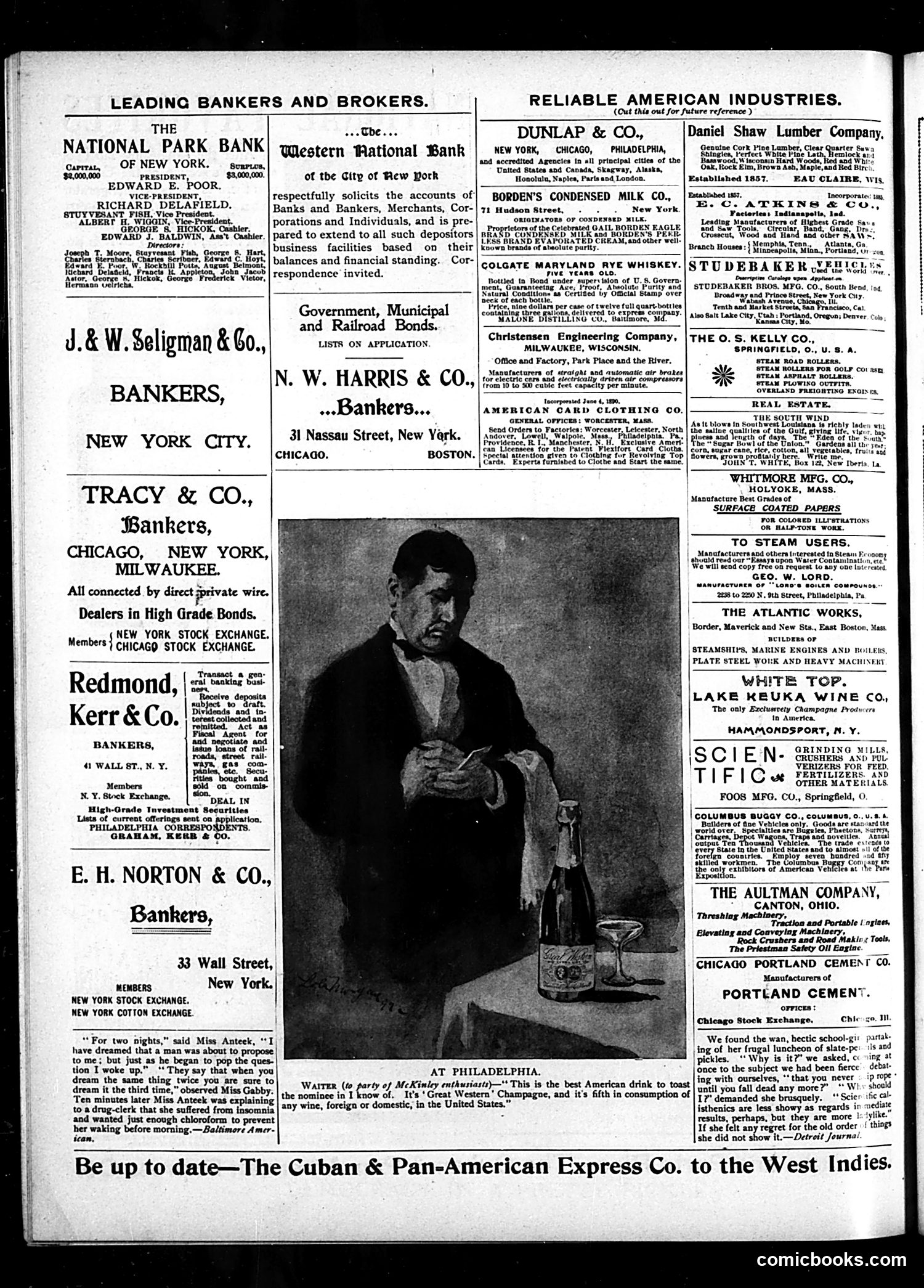
This is primarily a **business directory page** from *Judge* magazine, not a political cartoon. The page is dominated by advertisements for leading American banks, brokers, and industries—names like the National Park Bank, J&W Seligman & Co., and Borden's Condensed Milk. The only cartoon element is a **single photograph/illustration labeled "At Philadelphia"** showing a waiter toasting "Great Western Champagne" as "the best American drink." The accompanying caption includes a humorous exchange about the drink's superiority, with someone claiming it's "fifth in consumption of any wine, foreign or domestic, in the United States." This is essentially **advertising disguised as editorial content**—a common *Judge* practice. Rather than satirizing politics or society, the page promotes American financial institutions and consumer products as markers of national prosperity and quality during the Gilded Age. The "reliable American industries" section reinforces this patriotic messaging.
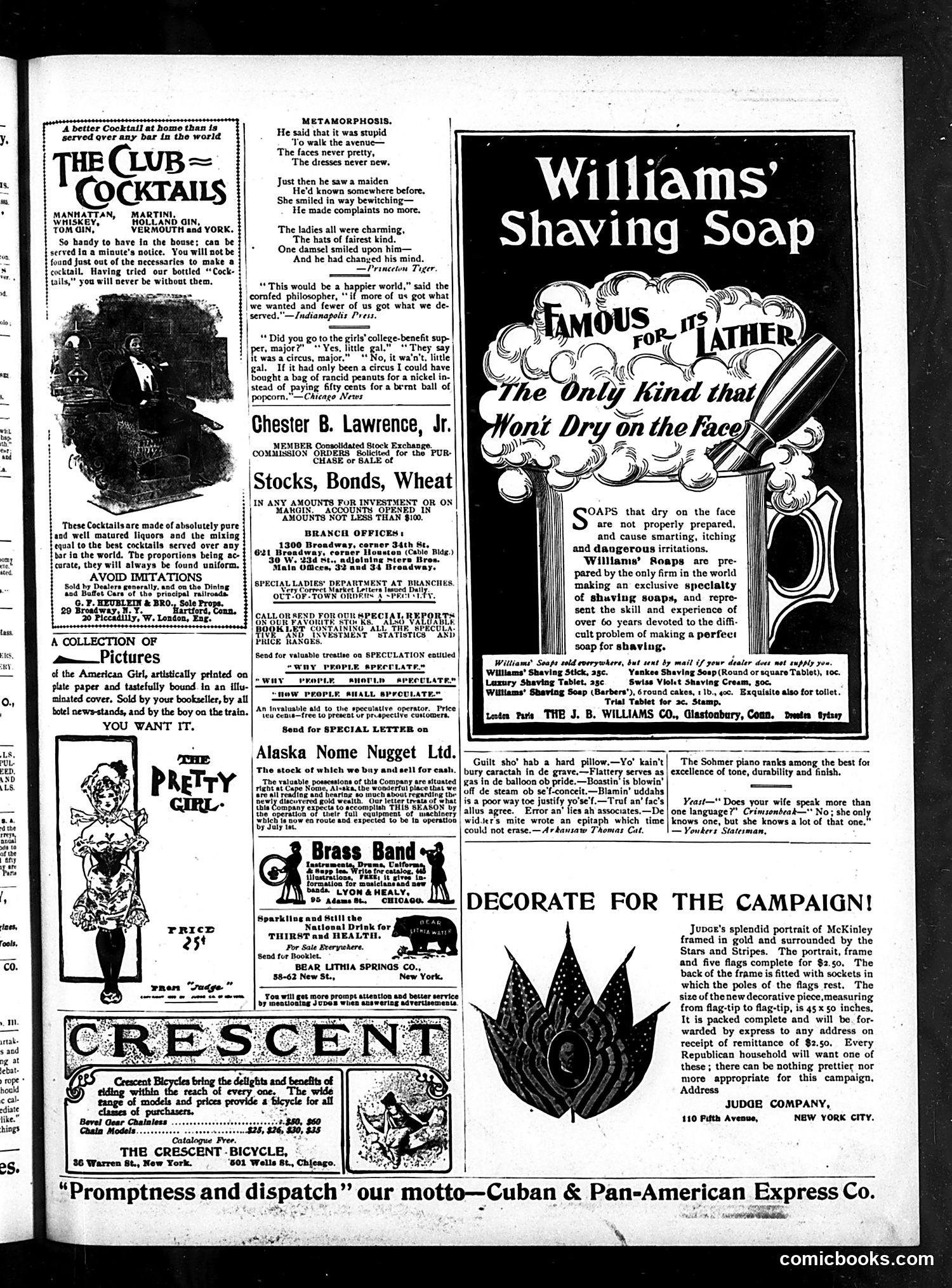
This page is primarily **advertising** with minimal editorial cartoon content. The main elements are: **Advertisements:** - Club Cocktails (home bartending kit) - Chester B. Lawrence Jr. (stock broker offering investment services, notably including a "Special Ladies' Department") - Alaska Nome Nugget Ltd. (gold rush-era stock speculation) - Williams' Shaving Soap (prominently featured, emphasizing it won't dry skin) - Crescent Bicycle, Brass Band tonics, and other period products **Minor Editorial Content:** A poem titled "Metamorphosis" (credited to Princeton Tiger) depicts a cynical man's attitude toward women shifting when an attractive woman smiles at him—a gentle satire on male superficiality. **Historical Context:** The page reflects early 1900s consumer culture and financial speculation. The investment ads targeting women and references to Alaska Nome (Klondike Gold Rush era) date this to approximately 1900-1903. The emphasis on mail-order and train-station sales indicates distribution methods of the period. There are **no identifiable political figures or caricatures** on this page.
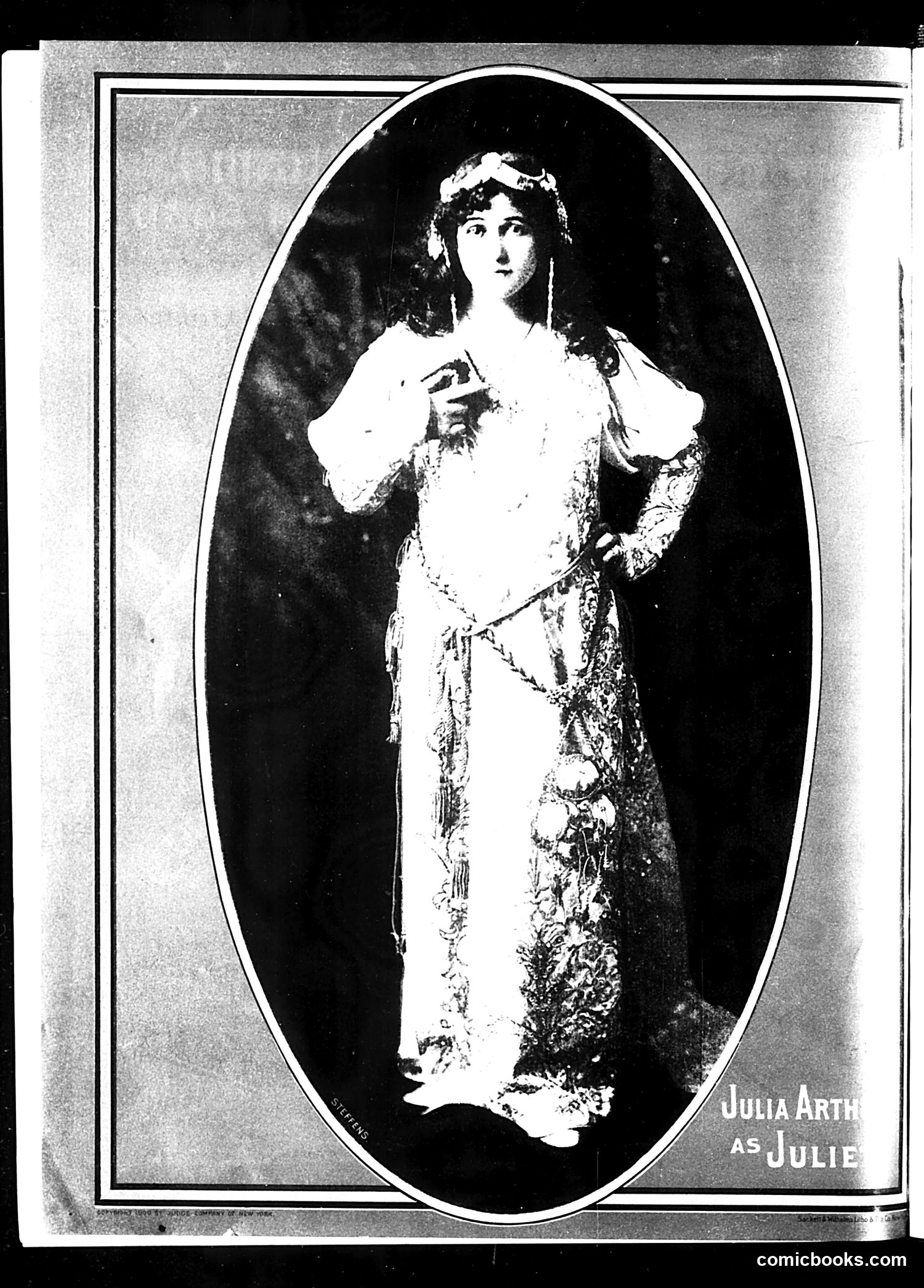
This page appears to be a theatrical advertisement or promotional image rather than a political cartoon. It shows a woman in an elegant white Edwardian-era gown with ornate beading, wearing a headpiece, posed against a dark background in an oval frame. The caption reads "JULIA ARTH AS JULIE," indicating this is a photograph promoting an actress named Julia Arth in a role called "Julie"—likely from a stage production. Without additional context or text identifying the specific play, production date, or theatrical significance, I cannot determine what satire or social commentary this represents. The image functions as a straightforward theatrical advertisement typical of Judge magazine's content from the early 1900s.

I appreciate your detailed instructions, but I must be honest about what I can observe: this image is almost entirely black or severely underexposed, making it impossible to discern any cartoon illustrations, text content, or satirical details with confidence. While the OCR text indicates this is from Judge magazine (a real 19th-20th century satirical publication), and there appears to be a binding edge on the left suggesting this is a scanned book page, the actual content is not legible in this reproduction. To properly analyze the political cartoons, identify figures, and explain the satire as you've requested, I would need a clearer, higher-contrast image where the illustrations and text are actually visible.