
A complete issue · 16 pages · 1900
Judge — June 9, 1900
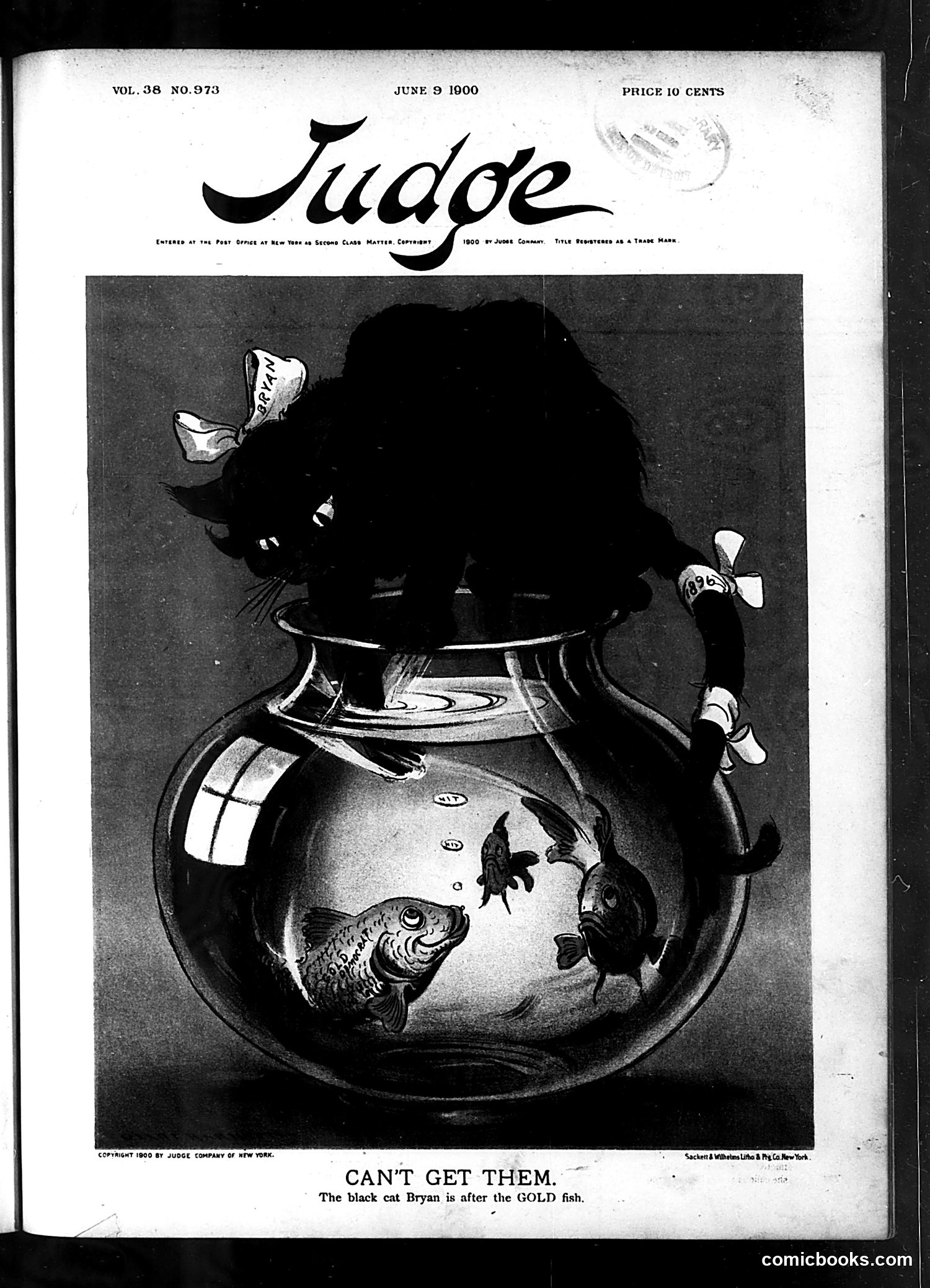
This political cartoon depicts a black cat perched atop a fishbowl containing goldfish, with the caption "The black cat Bryan is after the GOLD fish." The image satirizes William Jennings Bryan, the Democratic presidential candidate who championed "free silver" (unlimited coinage of silver). His opponents associated him with monetary instability. Here, Bryan is represented as a predatory black cat trying to reach the "gold fish"—a metaphor for the gold standard that Republicans defended. The cat cannot access the fish inside the protective glass bowl, suggesting Bryan's free-silver agenda would ultimately fail to overturn the gold standard. This was a central issue of the 1900 election, reflecting intense debate over monetary policy during the era.
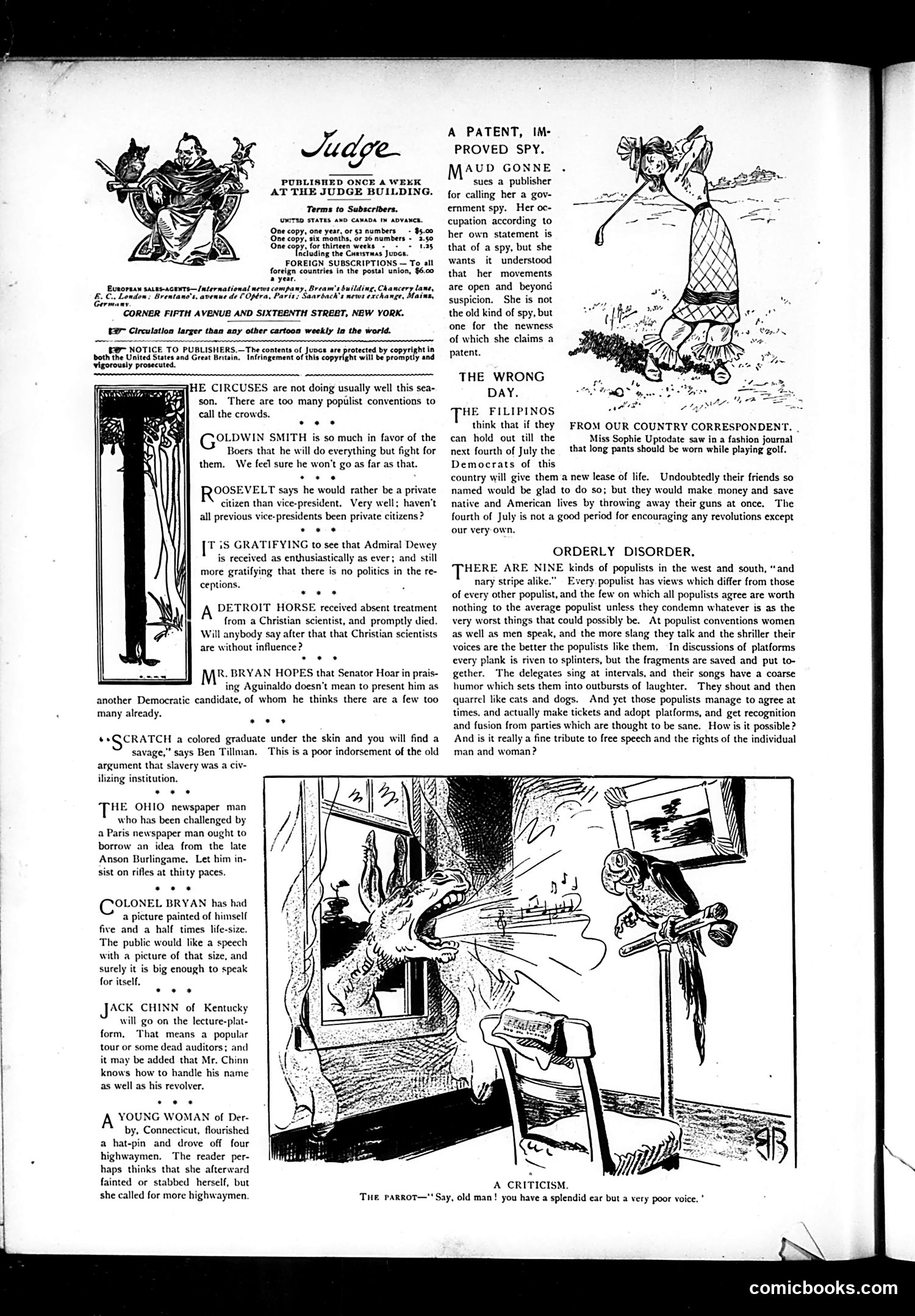
This page contains several brief political commentary sections rather than a single cartoon. The main items critique: 1. **Maud Gonne** - A publisher claiming to be a "patent improved spy," asserting her espionage activities are legitimate and transparent rather than secretive. 2. **Political figures and events** - References to Goldwin Smith, Roosevelt, Admiral Dewey, Senator Hoan, and Colonel Bryan appear as commentary on contemporary political debates about populism, vice-presidency, and Democratic politics. 3. **"Orderly Disorder"** - Satirizes populist conventions in the American West and South, mocking their chaotic nature while defending free speech rights. 4. **Bottom cartoon** - Shows a parrot criticized for having "a splendid ear but a very poor voice," likely political allegory. The page reflects early 20th-century American political satire focused on Populism, Democratic Party dynamics, and public figures of the era.
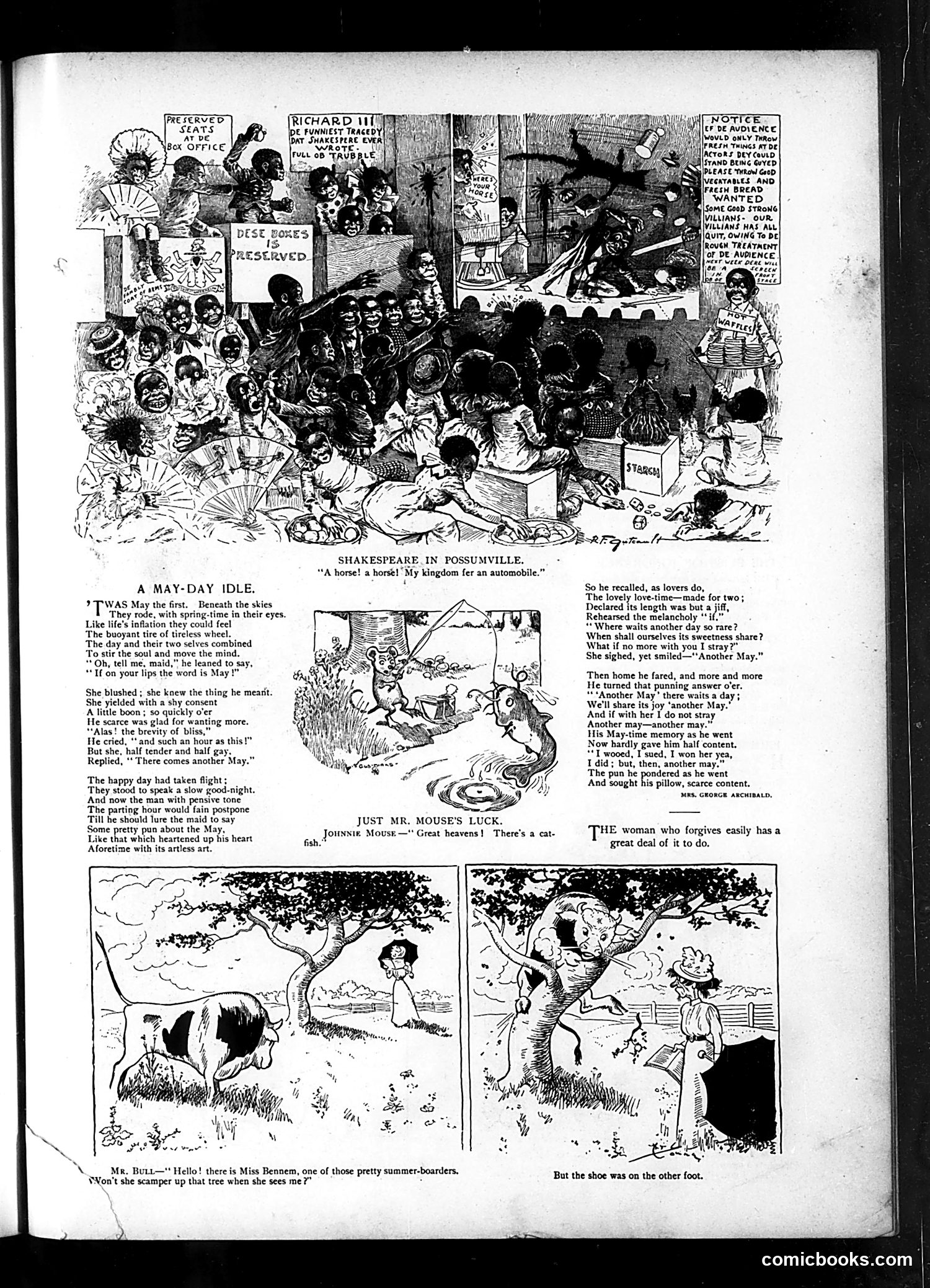
The top cartoon, "Shakespeare in Possumville," satirizes a theatrical performance of Shakespeare in what appears to be a rural or working-class American setting, contrasting high culture with lowbrow entertainment. The scene depicts a crowded, chaotic audience watching a performance, likely mocking the democratization of classical theater or absurdity of staging Shakespeare in inappropriate venues. Below, "A May-Day Idle" is a poem, followed by "Just Mr. Mouse's Luck"—a brief humorous anecdote about a mouse and fish. The two bottom panels show a romantic comedy scenario involving "Miss Benson" and a shoe, playing on the conventional "lost shoe" trope from fairy tales, suggesting romantic mishaps and confusion. The overall page mixes literary satire, light verse, and domestic humor typical of Judge's editorial approach.
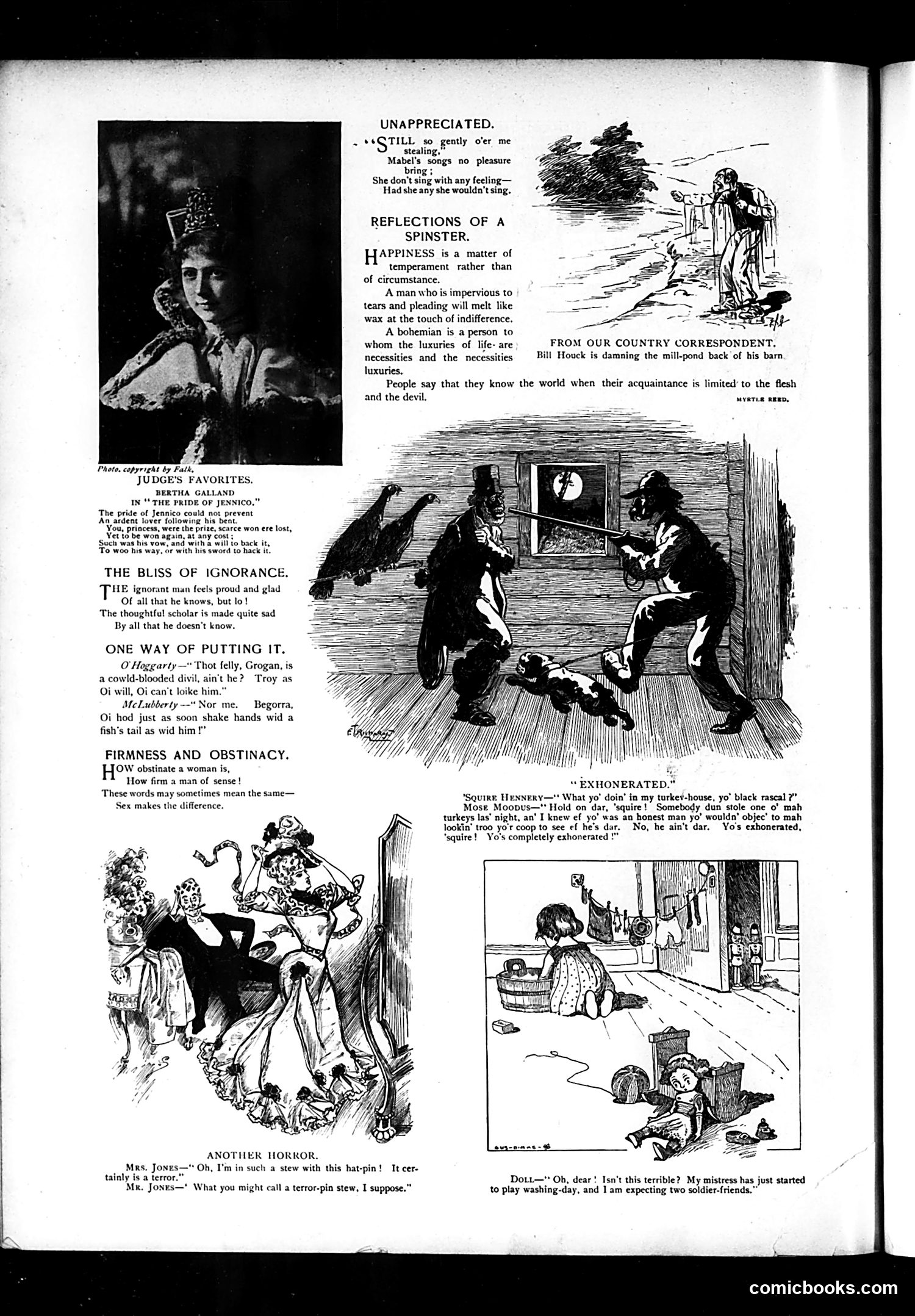
This page contains literary and humorous commentary rather than political cartoons. The content includes: **"Unappreciated"** — A poem about an ungrateful woman who shows no appreciation despite being supported. **"Reflections of a Spinster"** — A philosophical piece contrasting happiness with circumstances, suggesting bohemians view luxuries as necessities. **"Judge's Favorites"** and other short humorous pieces satirizing everyday social situations—marital indifference, pretension, stubbornness. The illustrations are genre scenes: people in domestic situations, a doll abandoned during a mistress's washing day. These are gentle social satire targeting middle-class manners and relationships rather than political figures or events. The humor relies on recognizable Victorian/Edwardian social awkwardness and hypocrisy rather than topical references a modern reader would need explained.
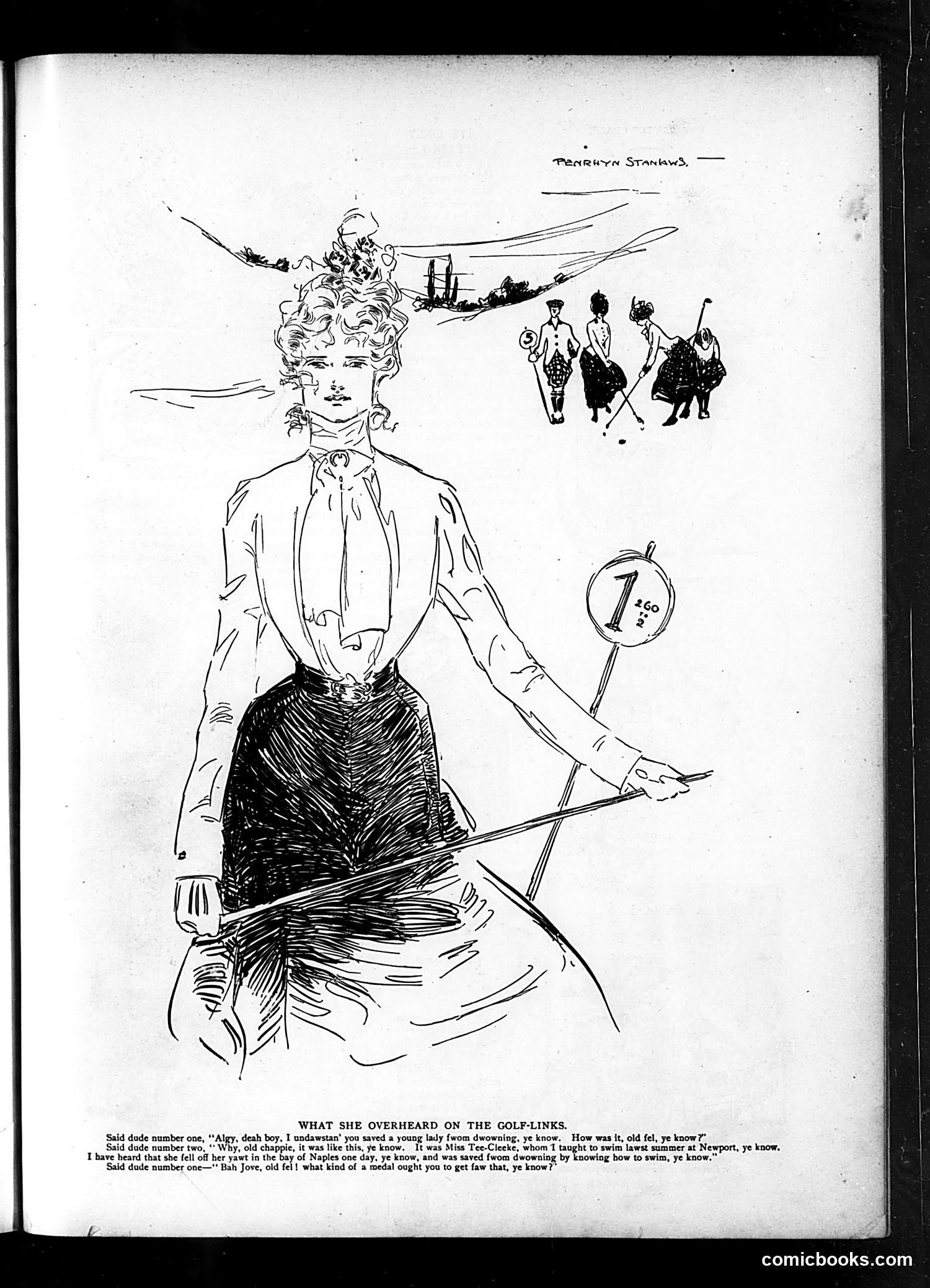
This satirical cartoon mocks the affected speech and vanity of wealthy American upper-class men. Two dandies on a golf course discuss one man's supposed heroism—teaching a woman to swim at Newport (an exclusive resort)—who later survived drowning because of his instruction. The satire targets their pretentious affectations: exaggerated speech patterns ("deah," "faw," "ye know"), self-congratulation over minor contributions, and obsession with medals and recognition for trivial acts. The woman depicted appears to be the subject of their boastful gossip. The title suggests we're viewing this scene from her perspective—overhearing men inflate their importance. Judge ridicules Gilded Age elitism and masculine self-importance dressed in affected mannerisms.
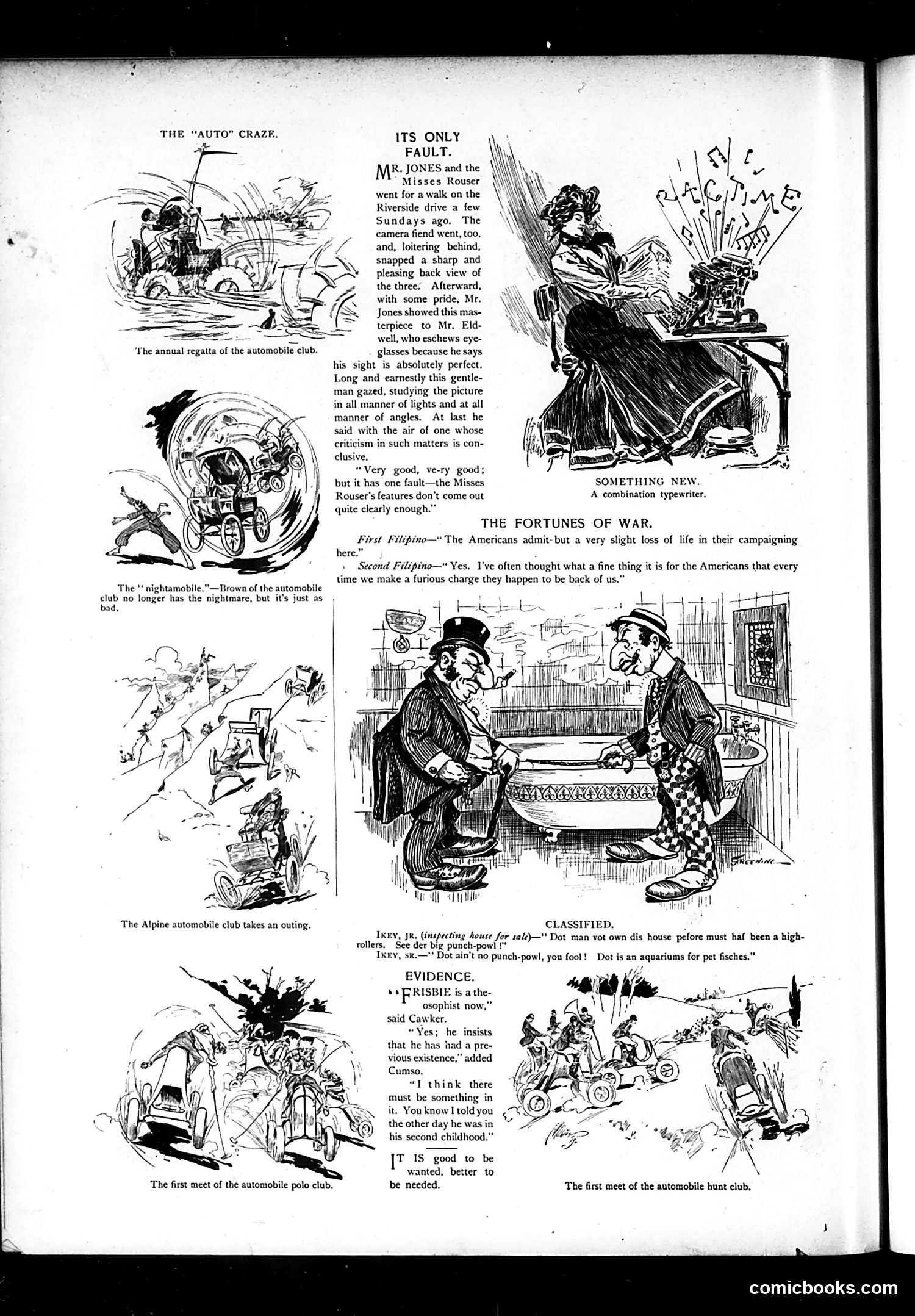
This page satirizes the early 1900s American "automobile craze" through multiple cartoons mocking car culture's pretensions and dangers. **"The Auto Craze" section** ridicules enthusiasts taking themselves too seriously—Mr. Jones photographs companions on a car outing, then shows the resulting image to a critic who nitpicks the composition, embodying the fussy, obsessive nature of early motorists. **"The Fortunes of War"** and **"Classified"** sections contain immigrant characters (indicated by dialect spelling like "dot" for "that") making crude jokes about warfare and home inspections—typical period humor using ethnic caricature. **The automobile club cartoons** (polo club, hunt club, etc.) mock wealthy enthusiasts inventing frivolous car-based activities mimicking established sports, suggesting the automobile craze was more about status and novelty than genuine sporting achievement. The overall satire targets how automobiles had become fashionable status symbols attracting vapid imitators and pretentious behavior among the wealthy classes.
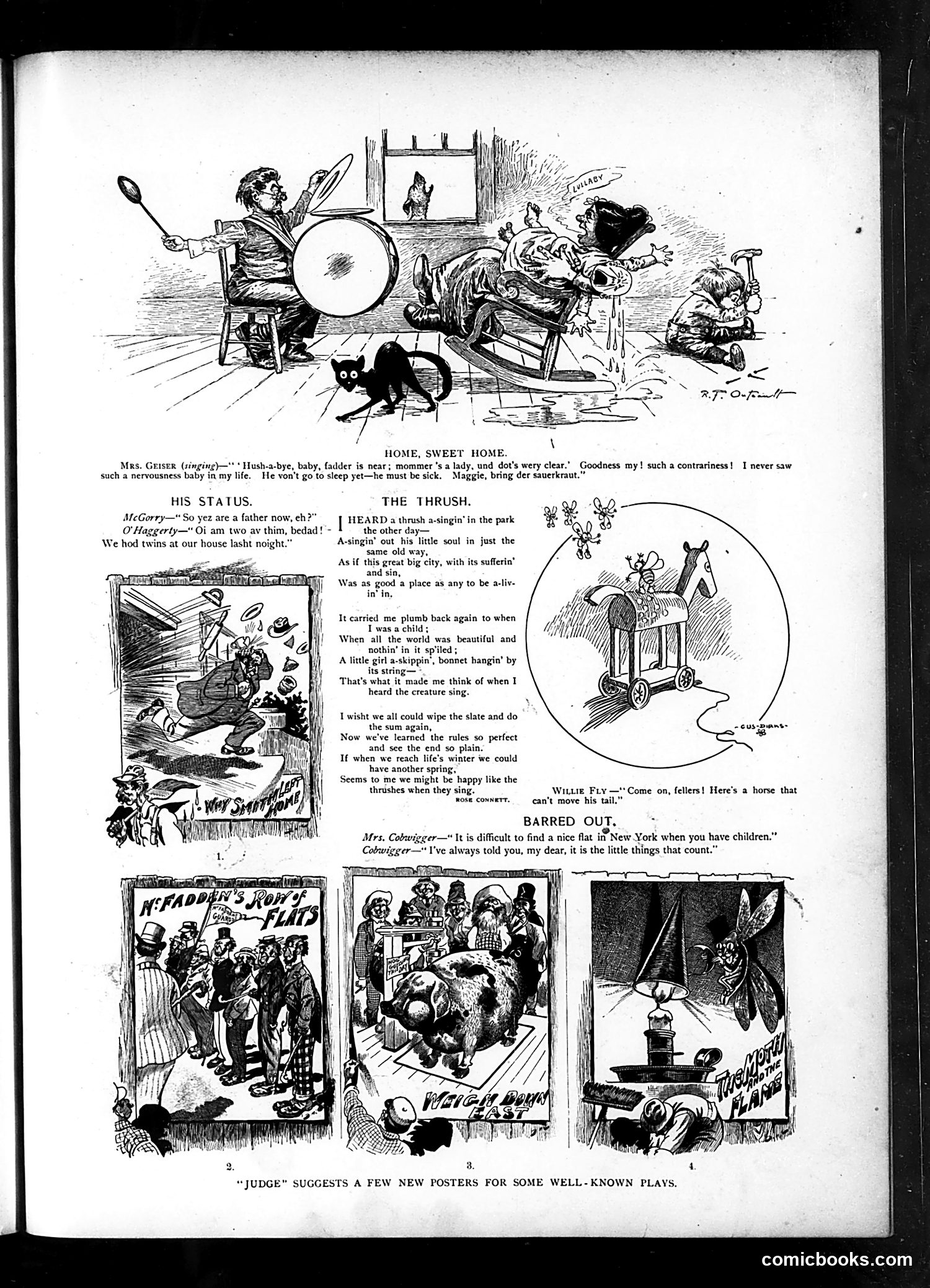
This page contains several satirical sketches on domestic and social themes: **"Home, Sweet Home"** mocks immigrant parenting, depicting Mrs. Geiser (German-accented) singing a lullaby to a fussy baby while considering sauerkraut as medicine—stereotyping German-American culture and folk remedies. **"His Status"** jokes about Irish immigrants (McGorry and O'Haggerty, indicated by accents and "bedad") celebrating becoming fathers of twins, playing on period stereotypes about Irish families and working-class reproduction. **"The Thrush"** is sentimental poetry about a bird's song evoking childhood innocence, contrasting nature's simplicity with urban corruption. **"Barred Out"** presents a pun: landlords refuse to rent to families with children ("little things"), exploiting housing discrimination. The bottom section advertises theatrical posters for popular plays, with illustrations numbered 1-4 (partially legible). Overall, the page reflects turn-of-century American attitudes toward immigrants, domestic life, and urban social problems, mixing sentiment with casual ethnic stereotyping typical of Judge's humor.
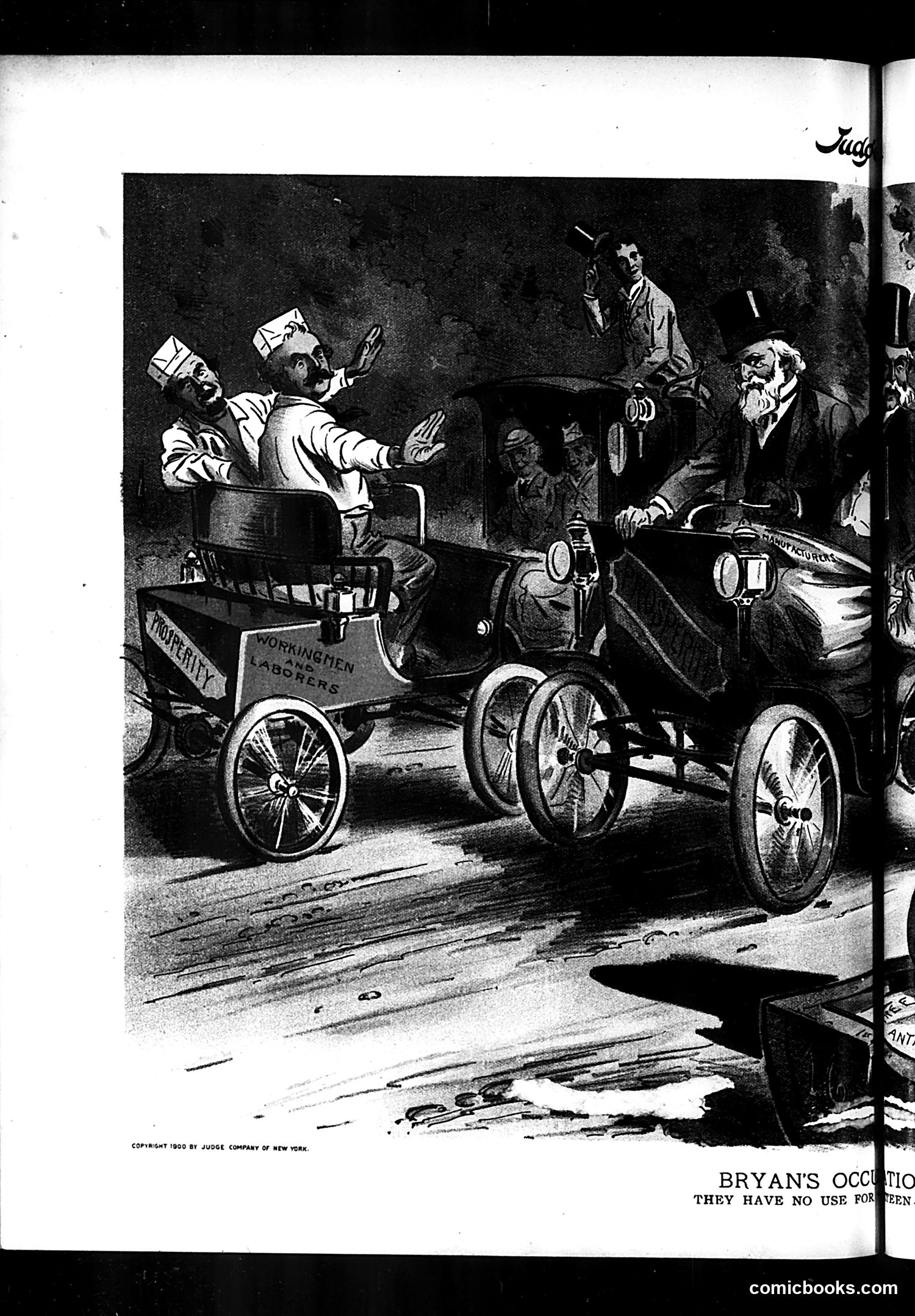
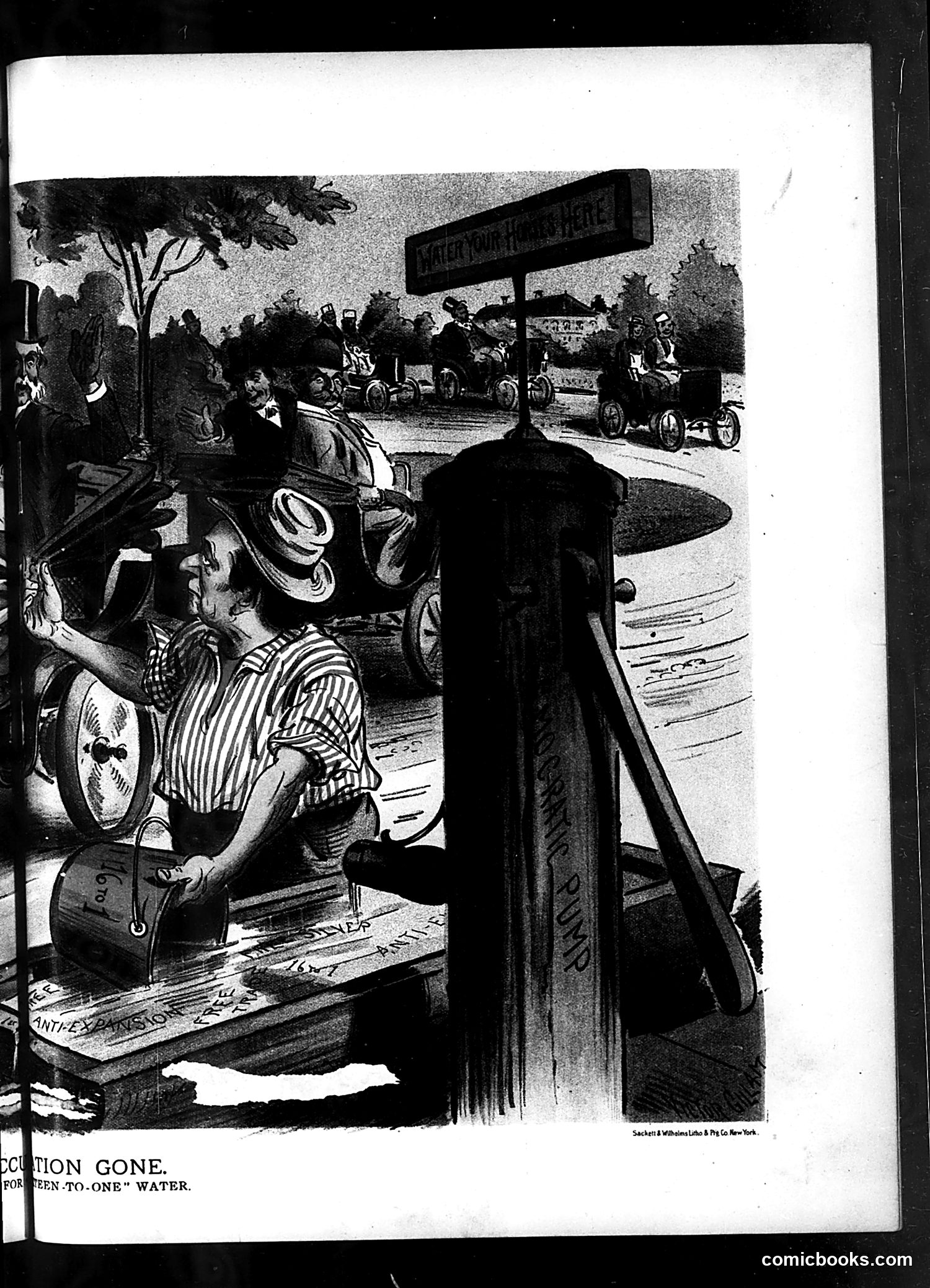
This political cartoon, titled "Bryan's Occupation — They Have No Use For Him," depicts William Jennings Bryan in a vehicle labeled "Workingmen Somers" alongside other figures. The satire appears to target Bryan's political relevance or employment prospects, suggesting he has become obsolete or unwanted. The cartoon likely dates to the early 1900s, following one of Bryan's unsuccessful presidential campaigns (he ran in 1896, 1900, and 1908). The "workingmen" reference suggests criticism of Bryan's populist appeal to labor voters, while the title's claim that "they have no use for him" mocks his diminished political standing or effectiveness among his supposed base of support.
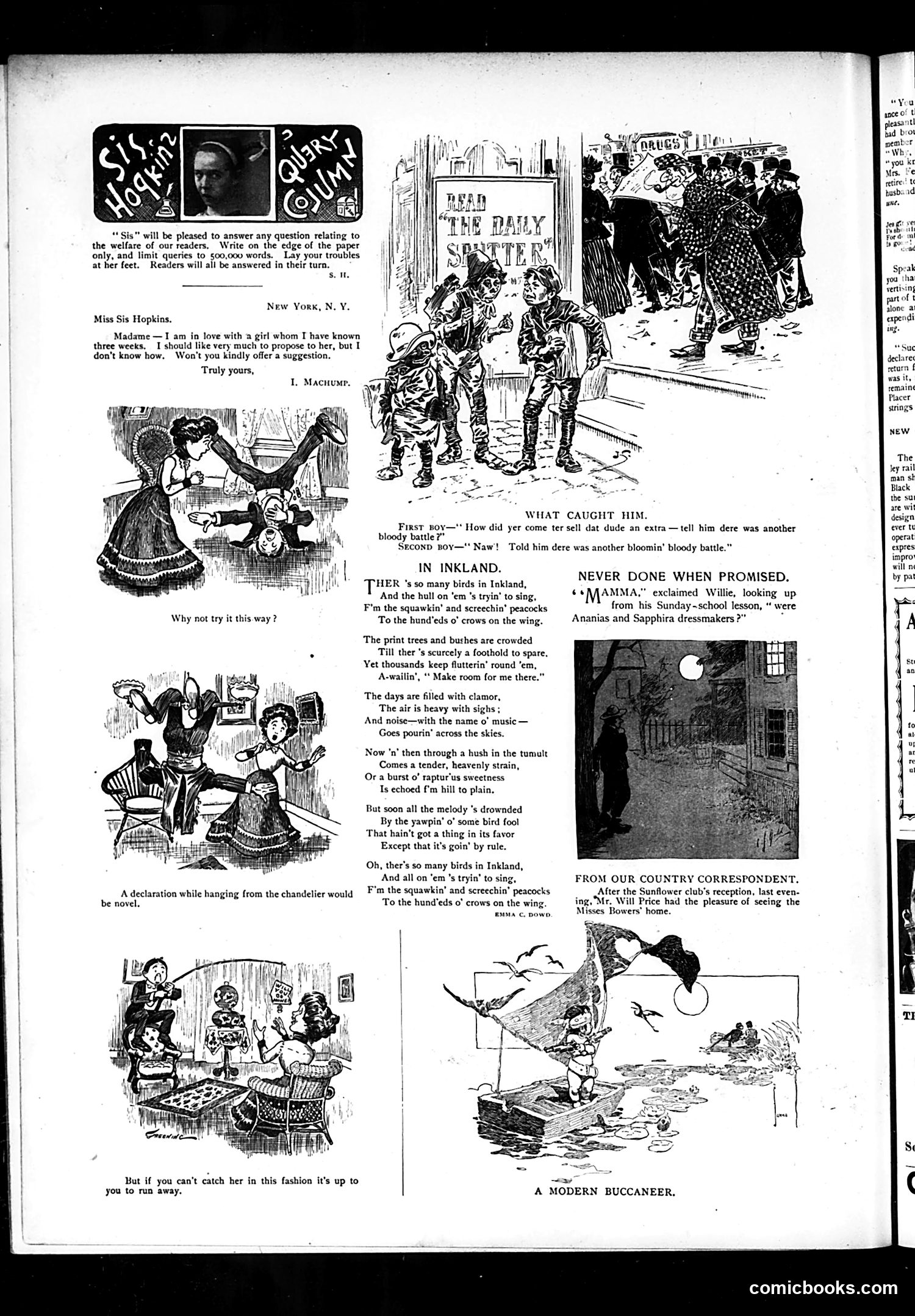
This page contains several satirical pieces typical of the era: **"In Inkland"** is an allegorical poem critiquing the overcrowded literary/publishing world. "Inkland" represents the publishing industry where countless writers ("birds") compete noisily, with mediocre work drowning out genuine talent. The "peacocks" and "crows" likely reference different classes of writers, while the complaint that bad work succeeds merely "by rule" suggests satire of formulaic, commercially-driven publishing over merit. **"What Caught Him"** mocks yellow journalism—newspaper boys sell papers by sensationalizing violence ("another bloomin' bloody battle"), implying readers crave exaggerated conflict over substantive news. **"Never Done When Promised"** shows a child asking whether "Ananias and Sapphira dressmakers" exist, sardonically suggesting dressmakers never complete promised work on time, linking biblical deceivers to modern service failures. The page mostly contains light humor and social observation rather than direct political commentary.
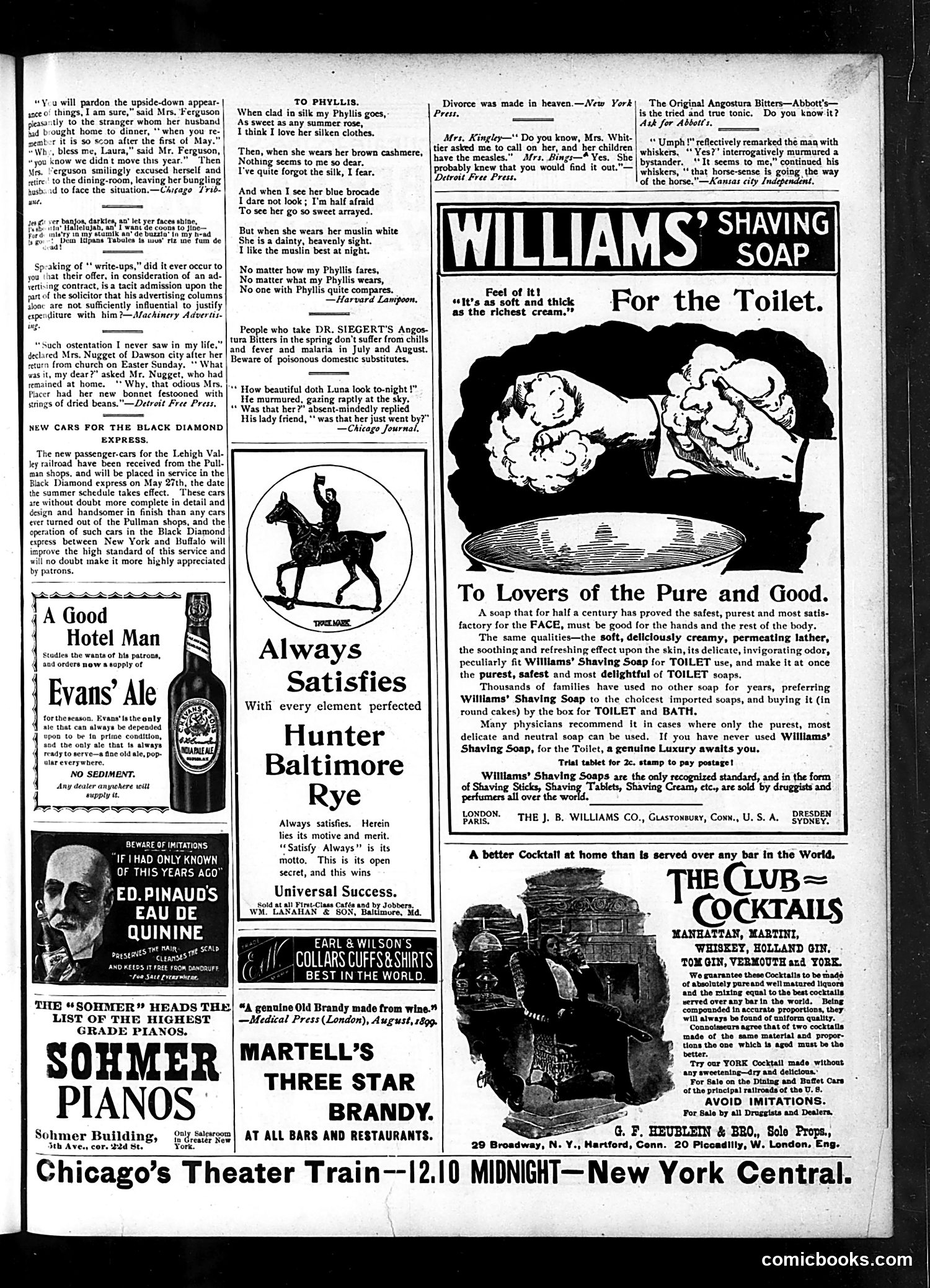
This page is primarily **advertising with light humor pieces** rather than political satire. The cartoons are gentle domestic jokes: **Main content:** A humorous anecdote about Mrs. Ferguson, who pretends their home is in disarray because they've just moved (a common May 1st tradition when leases renewed), but her husband reveals they didn't actually move—embarrassing her in front of a dinner guest. The joke relies on early 20th-century moving customs. **Other items:** Brief satirical quips about advertising solicitation, Easter bonnets decorated with dried beans (mocking nouveau-riche ostentation), and a romantic poem about a man's changing preferences for his beloved depending on her clothing. **Advertisements dominate:** Evans' Ale, Sohmer Pianos, Ed. Pinaud's Eau de Quinine, Williams' Shaving Soap, Hunter Baltimore Rye, and Martell's Brandy—typical period luxury goods marketed to affluent readers. The page reflects Judge magazine's mix of light social satire targeting middle and upper-class pretension, combined with revenue-generating advertisements for consumer products.
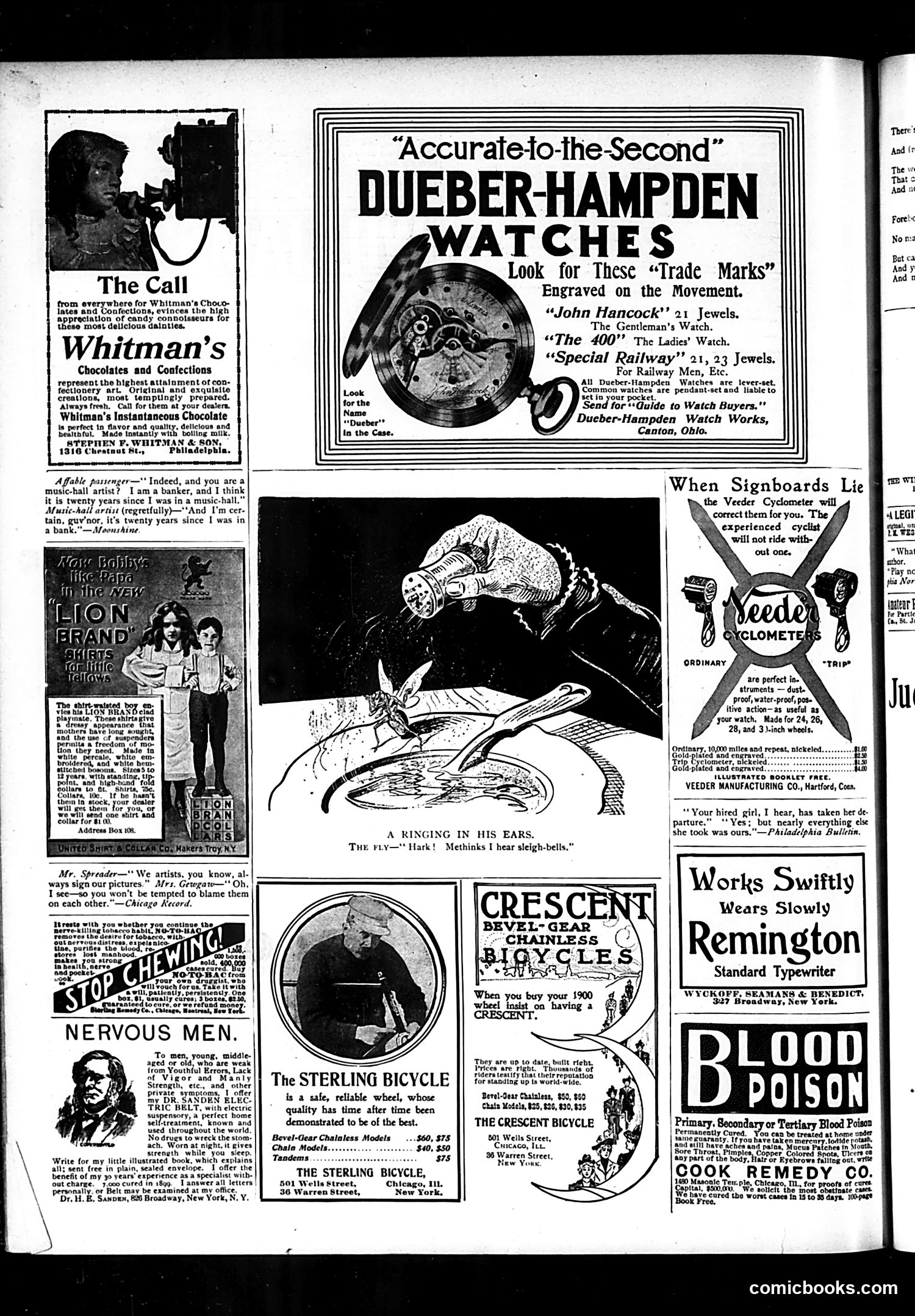
This is primarily an **advertising page** from Judge magazine, with minimal editorial content. The few comic elements are brief quips: **The comics:** - "Affable passenger" dialogue: A banker encounters a music-hall artist who hasn't worked in twenty years—a mild joke about the performer's decline. - "A Ringing in His Ears": A fly buzzes near someone who hears it as sleigh-bells—absurdist humor. - "Mr. Spreader": Artists sign paintings so they won't blame each other for them—light satirical jab at artistic vanity. **The advertisements** dominate: Whitman's chocolates, Dueber-Hampden watches, Sterling and Crescent bicycles, Veeder cyclometers, Remington typewriters, and notably, **Dr. Sanden's Electric Belt**—a quack medical device marketed to "nervous men" suffering from "youthful errors" (sexual dysfunction), promising restored vigor without drugs. The Dr. Sanden ad reflects early-1900s medical fraud; such belts were pseudoscientific cure-alls. The page otherwise reflects period consumer goods targeting middle-class readers.
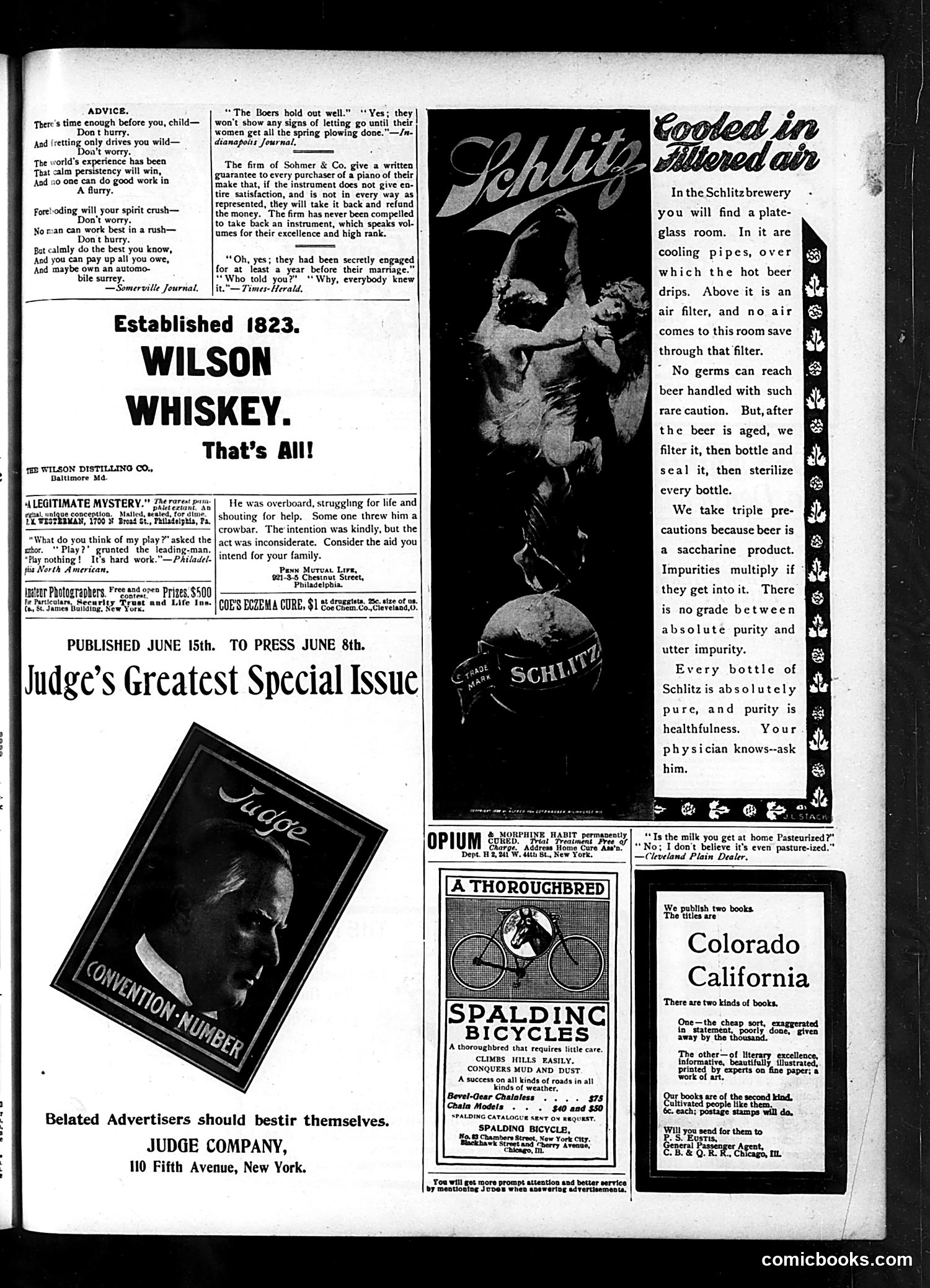
This is primarily an **advertising page** from Judge magazine (June 1902 issue), with minimal political/satirical content. The few jokes present are mild social commentary: 1. **"The Boers" quip**: References the ongoing Boer War (1899-1902), jesting that Boer resistance persists because their women are occupied with spring plowing—a light swipe at rural life priorities. 2. **"Legitimate Mystery"** anecdote: A theater patron says the playwright's play is "hard work"—gentle theater criticism. 3. **"Crowbar" parable**: Warns against unhelpful aid; appears designed as moral instruction rather than satire. The page is dominated by period advertisements: Wilson Whiskey, Schlitz Beer (emphasizing purity and sterile bottling), Spalding Bicycles, and travel guides to Colorado and California. The Schlitz ad is notably lengthy, marketing beer as a health product requiring pharmaceutical-level cleanliness—reflecting early-1900s advertising claims before modern FDA regulations. No identifiable political figures or caricatures appear on this page.
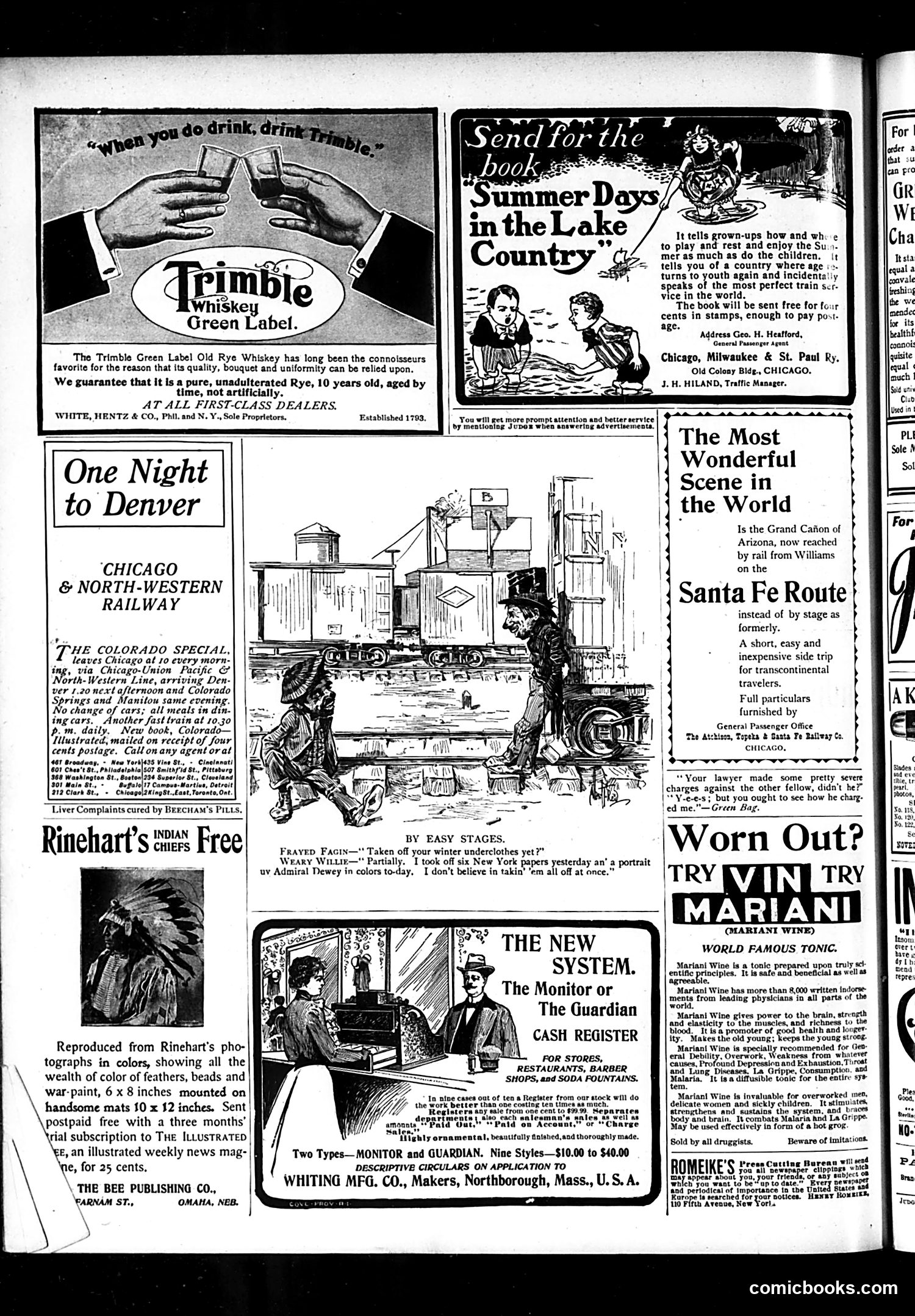
This page is primarily **advertising**, not political satire. It contains multiple commercial advertisements from the late 19th/early 20th century targeting middle and upper-class readers. Notable ads include: - **Trimble Whiskey**: Appeals to connoisseurship, guaranteeing "pure, unadulterated Rye, 10 years old" - **Railroad advertisements**: Chicago & North-Western Railway and Santa Fe Route promote scenic travel to Denver and the Grand Canyon - **Mariani Wine**: A dubious "tonic" claiming 8,000 endorsements from physicians, marketed for exhaustion, malaria, and general weakness—typical snake-oil medicine advertising of the era - **Cash registers**: "Monitor" and "Guardian" models for businesses The only apparent humor is a small cartoon captioned "Frayed Fabric," showing someone reluctant to remove winter clothing, joking about removing newspapers and an Admiral Dewey portrait instead. This is mild, observational humor rather than political satire. The page reflects consumer culture and unregulated patent medicine claims of the period.
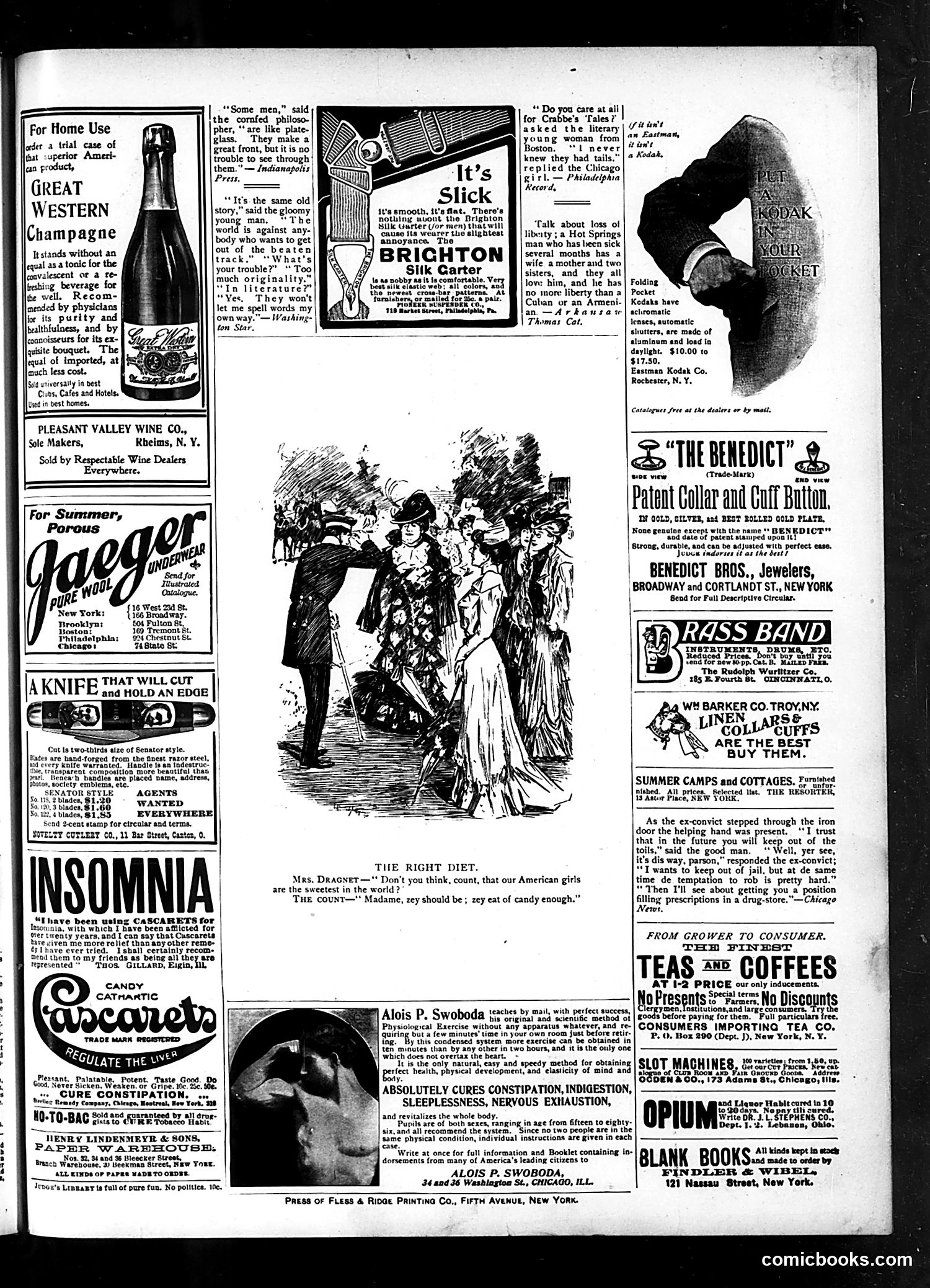
This is primarily an **advertising page** from Judge magazine, with one small cartoon and several joke items scattered among product ads. The main cartoon depicts an "ex-convict" being greeted by charitable helpers as he's released from prison—a reference to the Progressive Era's interest in prisoner rehabilitation and charitable "helping hand" organizations that assisted released convicts reintegrate into society. The scattered jokes mock social pretensions and gender dynamics typical of the era: - A cornfed philosopher compares people to "plate-glass" (superficial) - A young man complains about originality being rejected (literary gatekeeping) - A Chicago girl admits ignorance about literature - A joke about a sick man losing "liberty" to hovering female relatives (domestic entrapment) The advertisements reflect turn-of-the-century consumer goods: champagne, garters, candy laxatives, Kodak cameras, and patent collar buttons—typical Judge content mixing satire with commercial promotion.
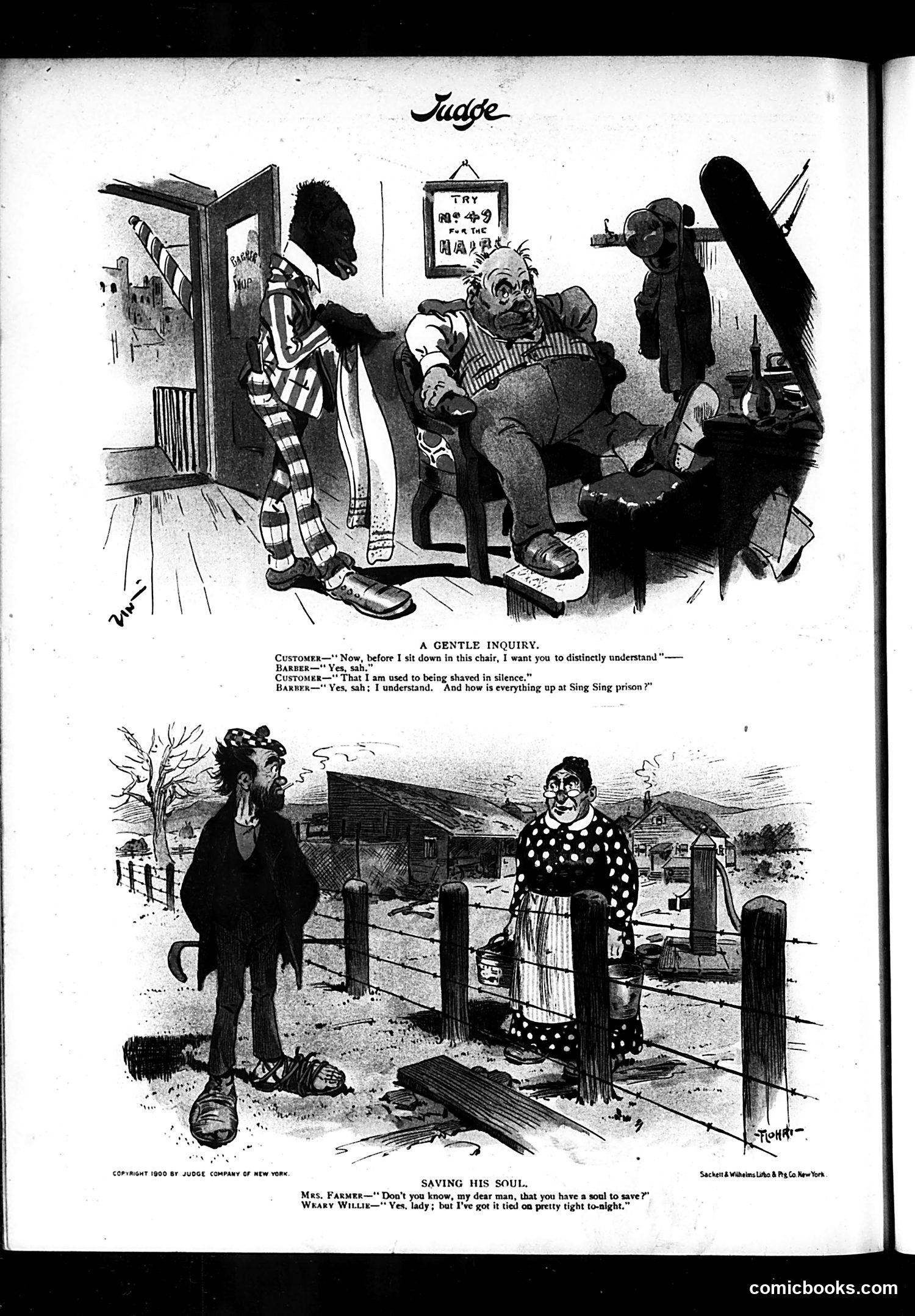
This 1900 page contains two satirical cartoons with racial caricatures typical of the era. **"A Gentle Inquiry"** depicts a white customer at a Black barber shop requesting silence during his shave. The barber immediately violates this by asking about conditions at Sing Sing prison—a jab at the customer's apparent criminality or moral failing. The humor relies on ironic contrast: the customer demands quiet, yet the barber immediately intrudes with an insulting question. **"Saving His Soul"** shows a well-dressed woman confronting a vagrant ("Weary Willie," a stock character of the period) about his spiritual salvation. His response—that his soul is "tied on pretty tight"—is a crude joke suggesting drunkenness or moral depravity so complete he can barely keep his soul attached. The satire mocks both the woman's sanctimonious charity efforts and the vagrant's hopeless condition. Both cartoons use exaggerated racial and class-based imagery to mock their subjects, reflecting Judge's satirical approach to social hierarchies of that era.