
A complete issue · 16 pages · 1900
Judge — May 12, 1900
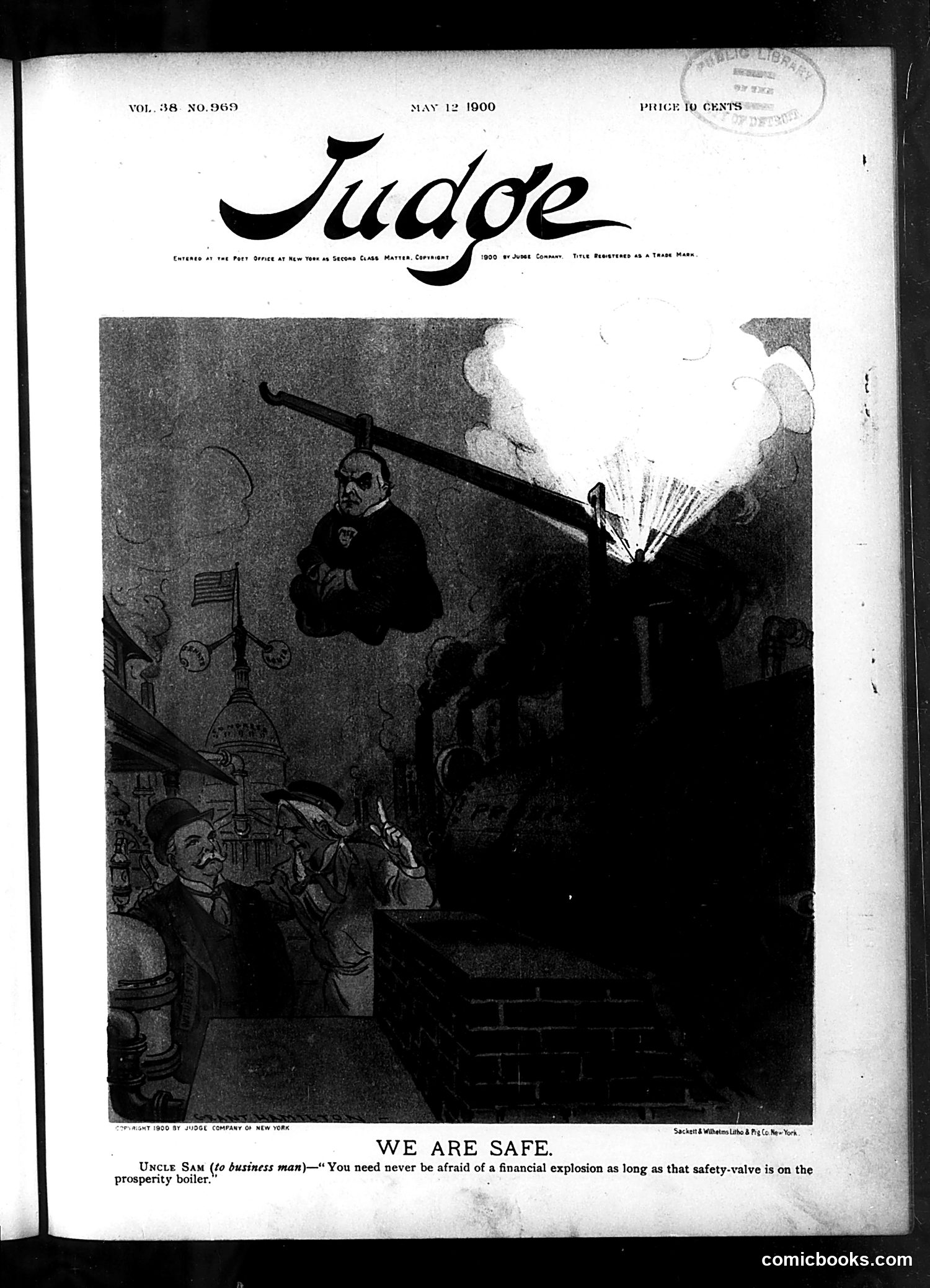
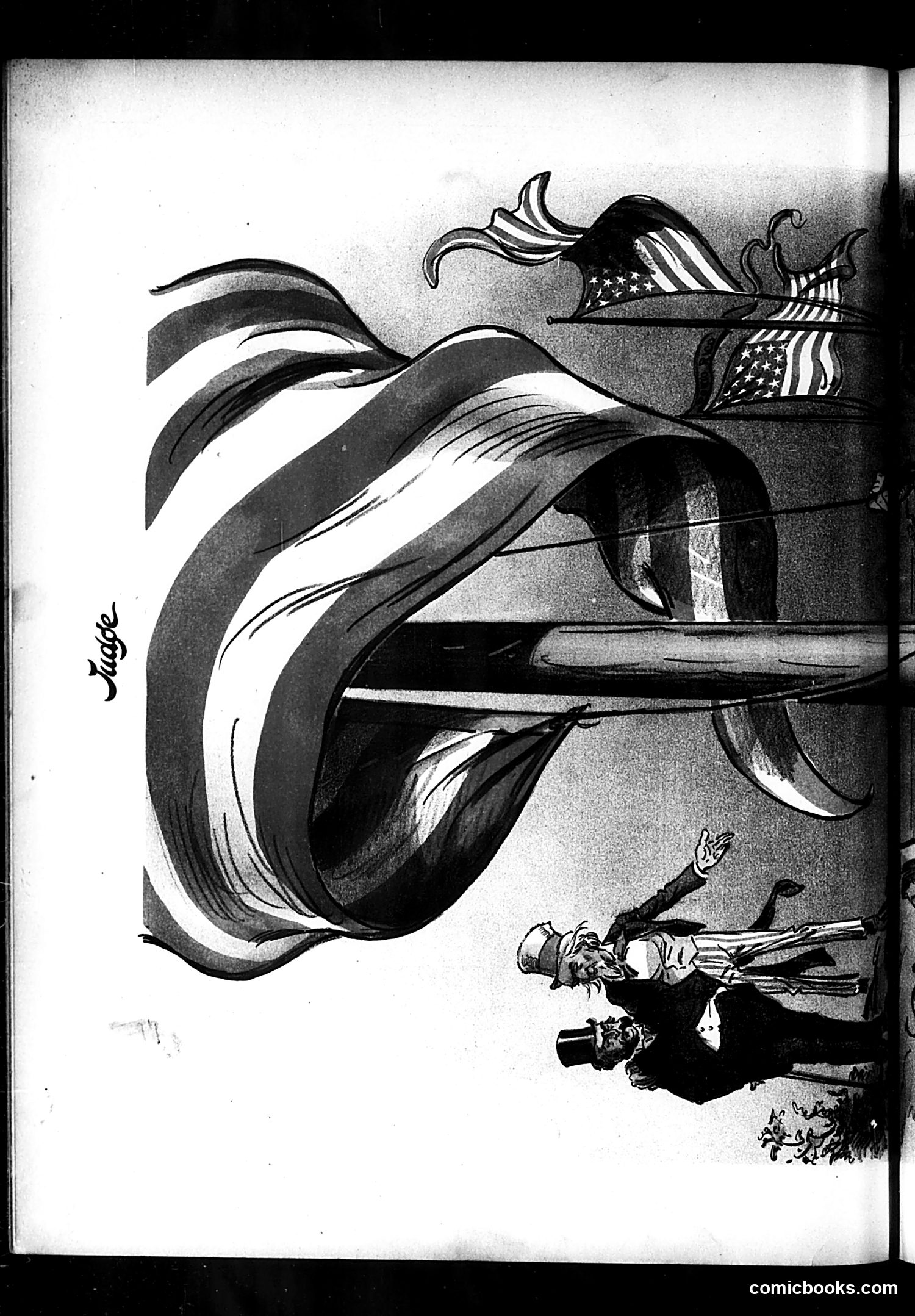
This political cartoon satirizes American financial security through a dramatic metaphor. Uncle Sam (representing the U.S. government) stands confidently atop the Capitol building, operating a massive safety valve on what appears to be a boiler—representing the economy or financial system. The caption's joke is darkly ironic: Uncle Sam assures a businessman below that there's no need to fear "a financial explosion as long as that safety-valve is on the prosperity boiler." The cartoon suggests that American economic stability depends entirely on this single regulatory mechanism. The massive, threatening shadow looming over the scene implies impending financial danger lurks despite the safety valve's presence—undercutting the stated reassurance and questioning whether such safeguards are truly adequate.
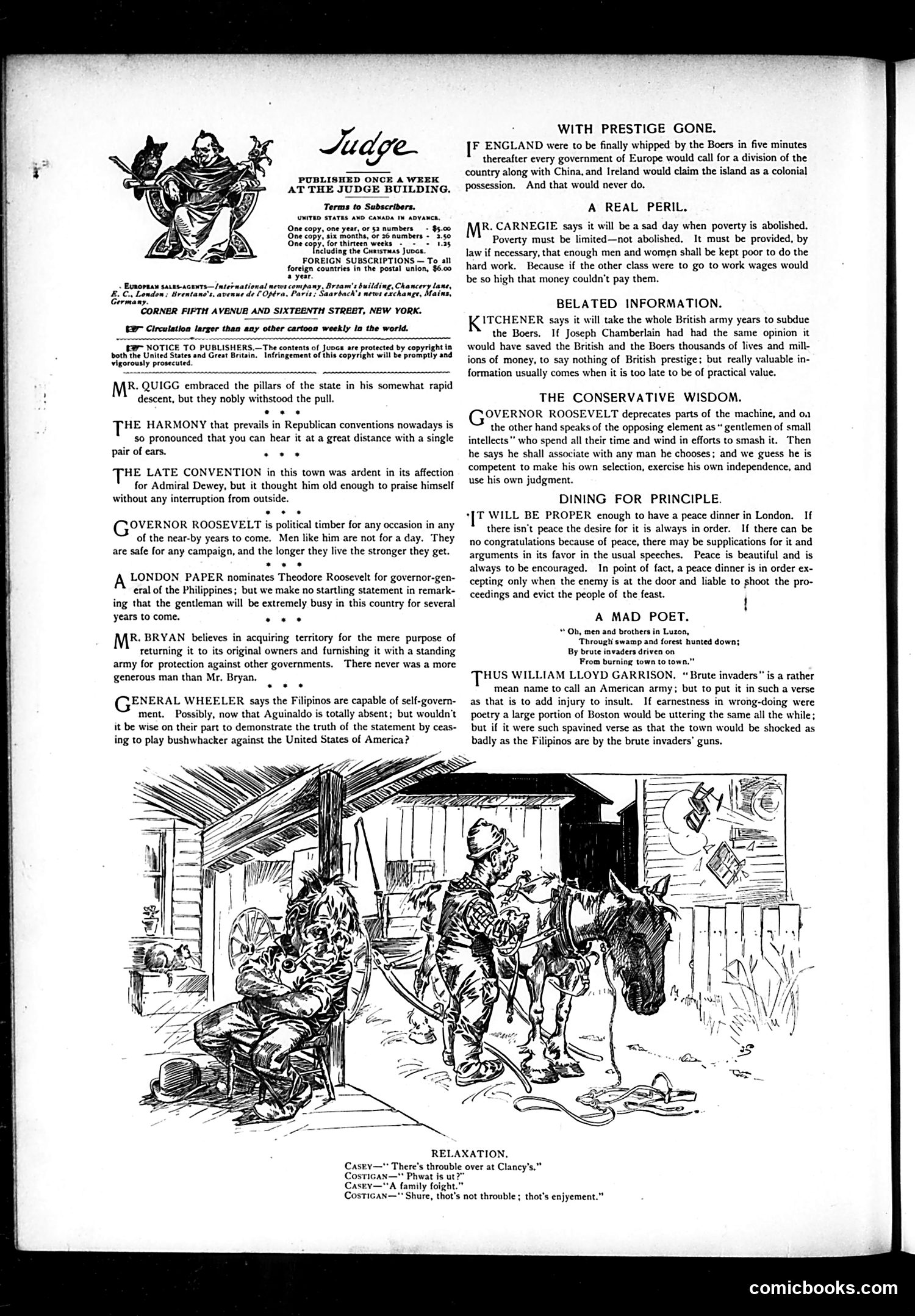
This page contains political commentary and editorial cartoons from an early 20th-century American satirical magazine. The main cartoon titled "Relaxation" depicts what appears to be Irish immigrants or working-class figures at leisure, with dialogue suggesting family disputes over minor matters—a stereotype-laden portrayal common to the era. The text sections critique various political figures and events: discussions of Roosevelt's policies, commentary on British colonial matters, and criticism of William Lloyd Garrison's characterization of certain groups as "brute invaders." The satire employs period ethnic stereotyping while addressing contemporary political debates about empire, poverty, and military matters. Without clearer date markers visible, the specific historical moment remains somewhat unclear, though the references suggest early 1900s American politics and international colonial issues.
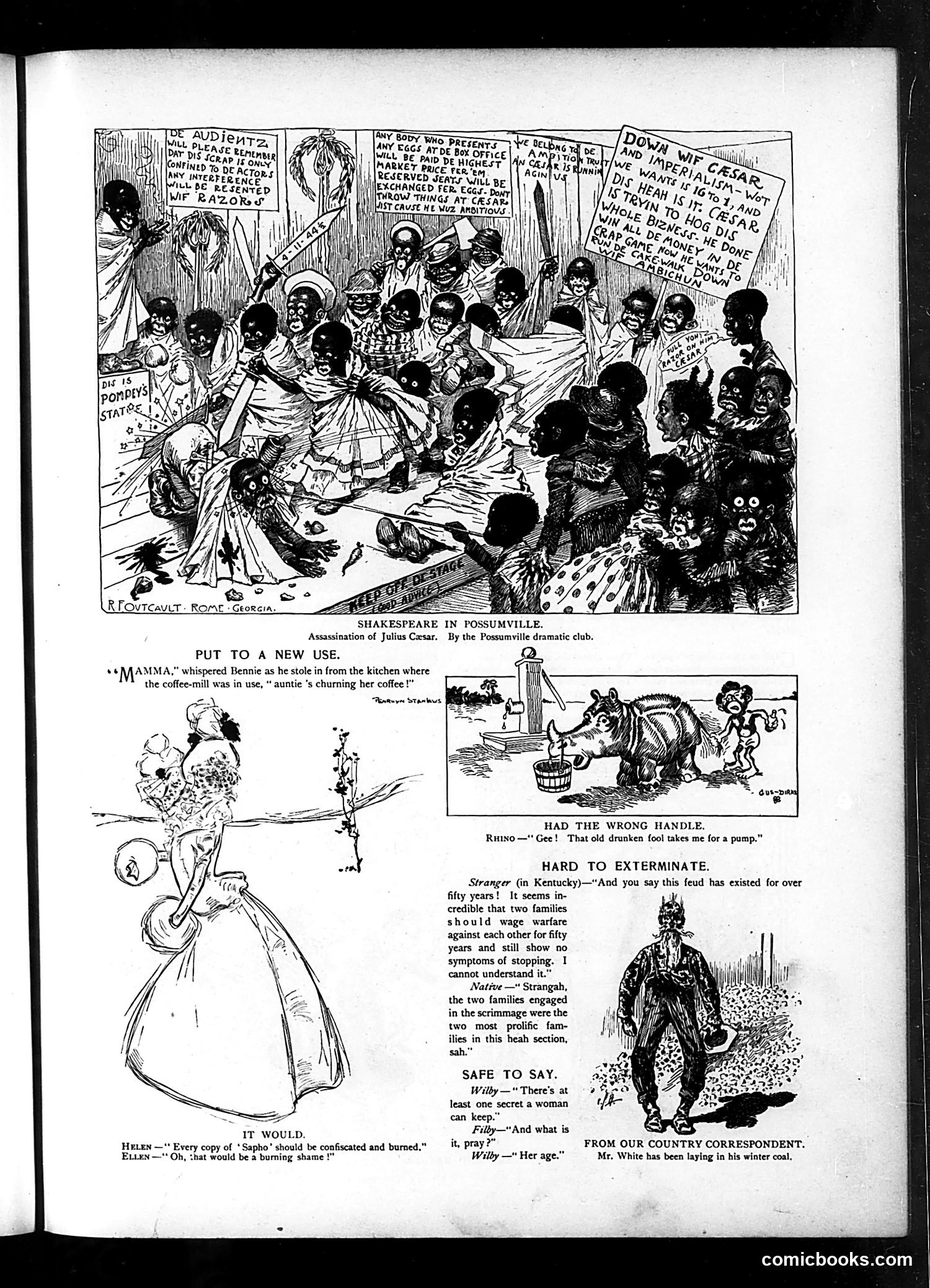
The top cartoon, "Shakespeare in Possum ville," depicts a minstrel show parody of Julius Caesar's assassination. The figures appear to use exaggerated blackface caricatures performing a dramatic theatrical scene. This reflects Judge magazine's satirical commentary on popular entertainment of the era—specifically minstrel shows and theatrical adaptations in the American South. The remaining vignettes ("Put to a New Use," "Had the Wrong Handle," "Hard to Exterminate," "Safe to Say," "It Would," "From Our Country Correspondent") are brief humorous sketches with punchlines about everyday situations—a woman's domestic role, animal behavior, regional feuds, secrets, and winter. The overall page demonstrates Judge's mix of racial caricature humor (now deeply offensive) alongside genteel domestic comedy typical of early 20th-century American satirical magazines.
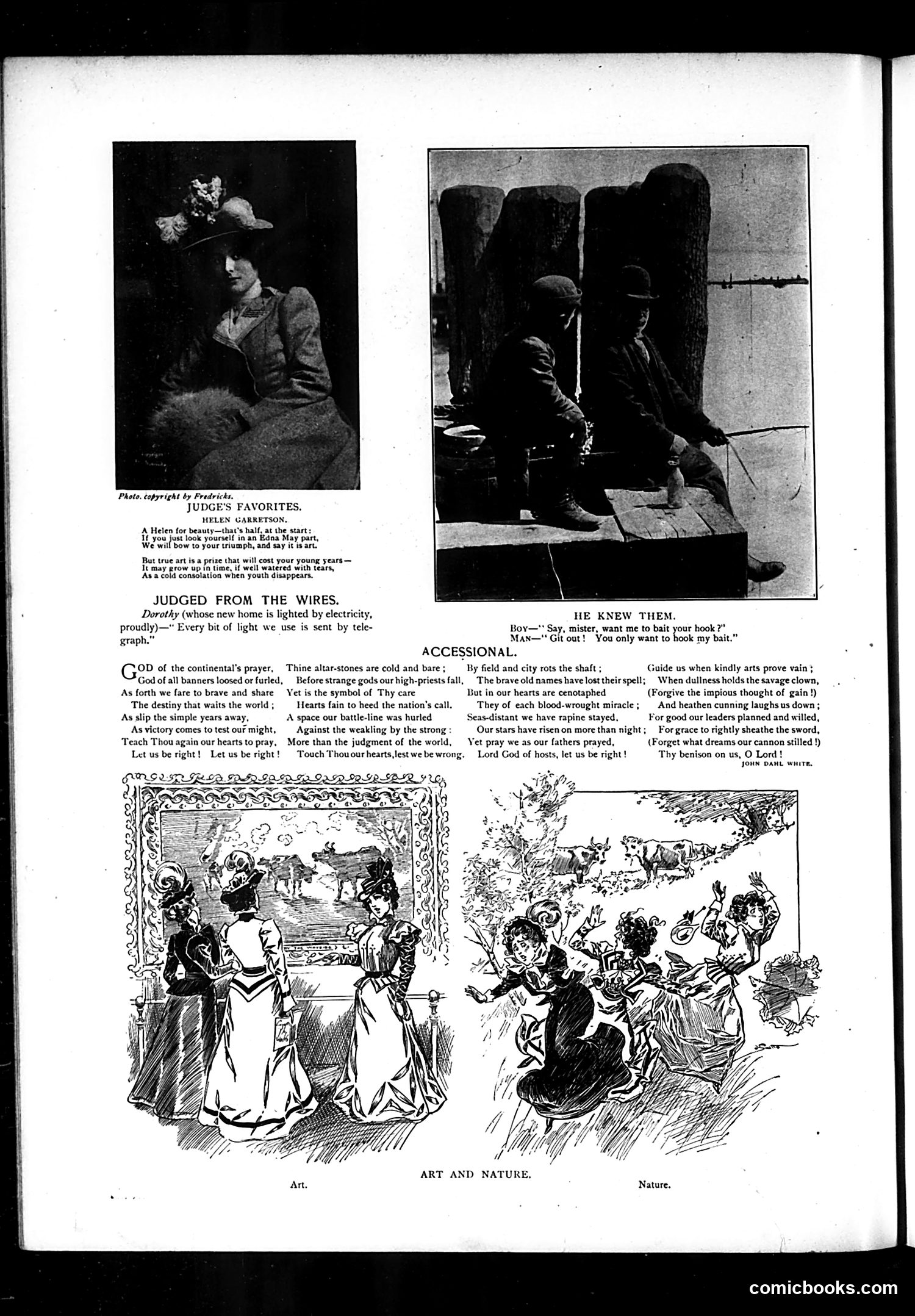
This page contains theatrical/entertainment content rather than political satire. The top section features "Judge's Favorites" with a photograph of actress Helen Garretson, accompanied by promotional verses. Below are two illustrated pieces: "Art and Nature" contrasts refined indoor society (left) with rustic outdoor life (right). The cartoons employ the period's common visual trope of comparing civilized versus natural human behavior—a stock satirical comparison of the era. The poems scattered throughout appear to be sentimental verses about patriotism and faith rather than sharp political commentary. Overall, this page prioritizes entertainment and lifestyle content over the hard-hitting political satire Judge magazine was known for, suggesting this particular issue balanced serious commentary with lighter cultural material.
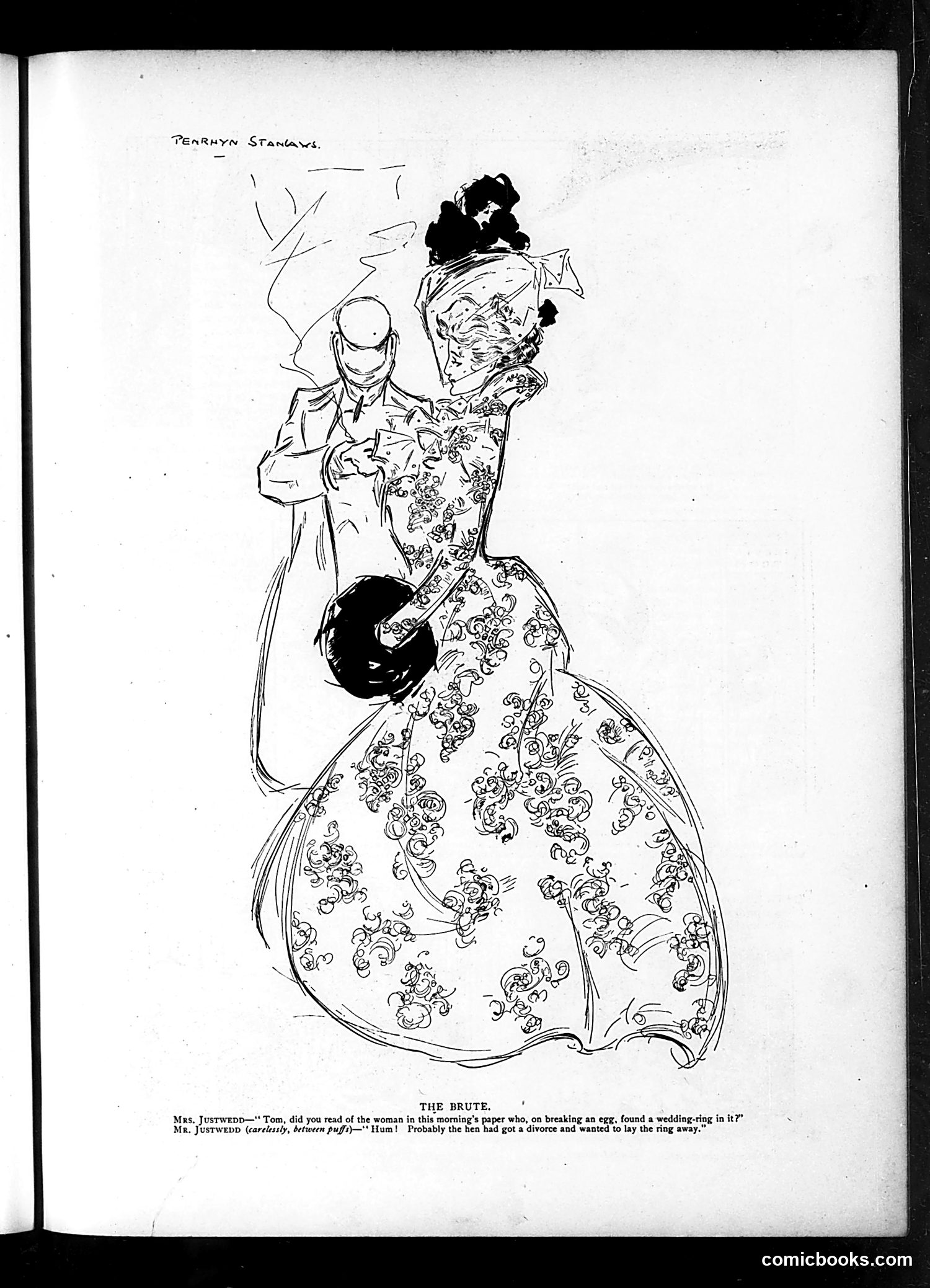
This satirical cartoon depicts a married couple, with the wife (Mrs. Justwepp) reading aloud about a woman who found a wedding ring inside an egg. The husband (Tom), shown as an indifferent, slouching figure labeled "The Brute," dismissively responds with a crude joke suggesting the hen underwent divorce. The satire targets husbandly callousness and marital discord. The wife's eager attempt at conversation contrasts sharply with the husband's crude, dismissive attitude—he won't even engage seriously with her story. His flippant quip about divorce weaponizes the serious topic, suggesting emotional distance and lack of care for his wife's interests. The cartoon mocks the "brute" husband archetype: emotionally unavailable, crude, and indifferent to his wife's attempts at connection. It's social commentary on unhappy marriages and masculine insensitivity.
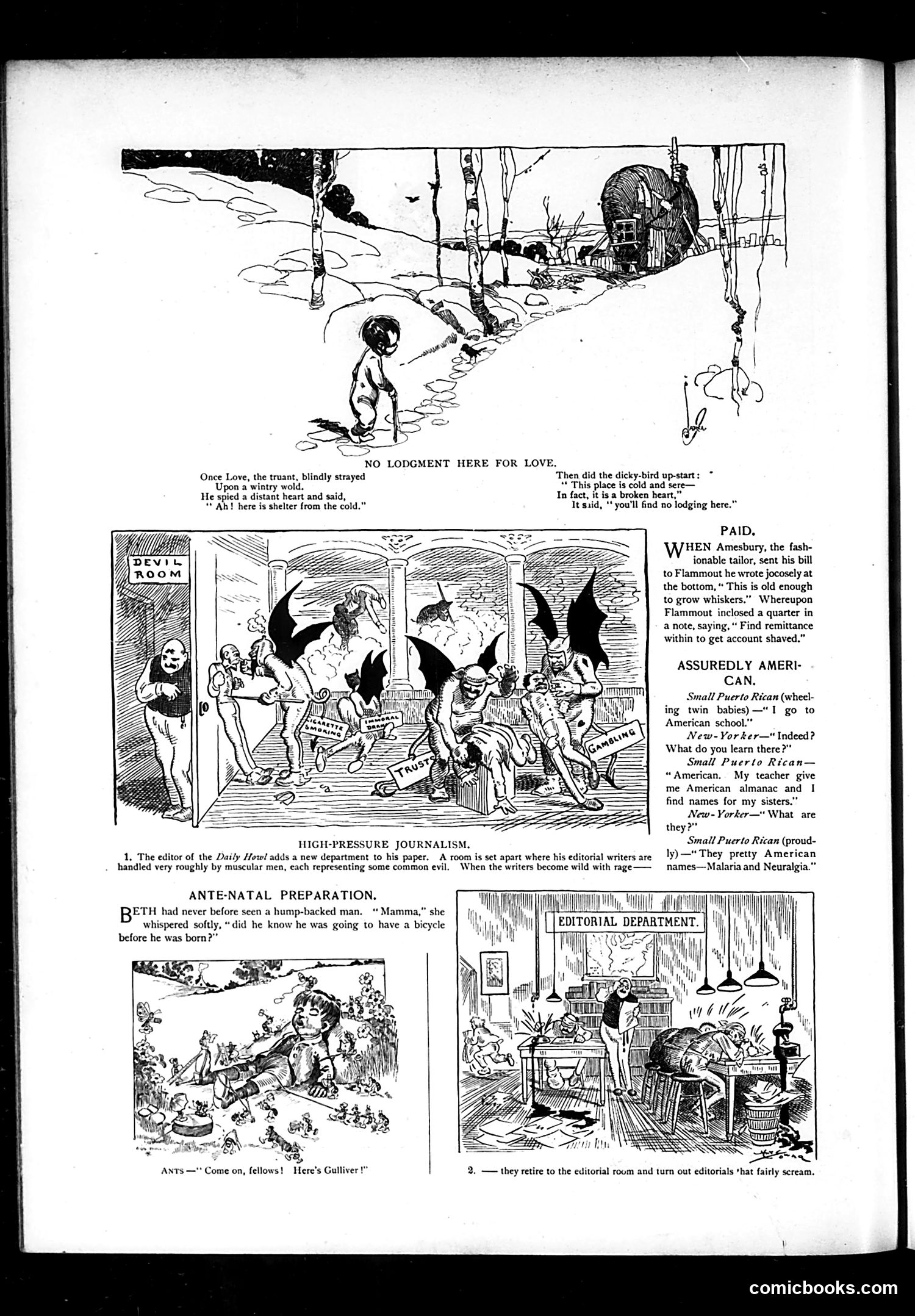
This page from *Judge* contains several satirical pieces: **"No Lodgment Here for Love"** is a poetic cartoon showing Love personified rejected by a "broken heart"—likely satirizing emotional coldness or misanthropy in society. **"High-Pressure Journalism"** mocks sensationalist newspaper practices, depicting the *Daily Howl* (a fictional yellow-journalism parody) where editorial writers are physically roughed up by muscular men representing "common evils" to inspire inflammatory writing. This critiques how newspapers manufactured outrage for circulation. **"Ante-Natal Preparation"** is a brief joke about a child asking if a hunchbacked man knew his deformity "before he was born"—gentle mockery of childhood logic. **"Assuredly American"** satirizes Puerto Rican immigrants naming their children after diseases ("Malaria and Neuralgia") they learned from American almanacs—mocking both American insularity and the period's casual xenophobia. These pieces reflect *Judge's* focus on social criticism and contemporary American life during the turn-of-the-century era.
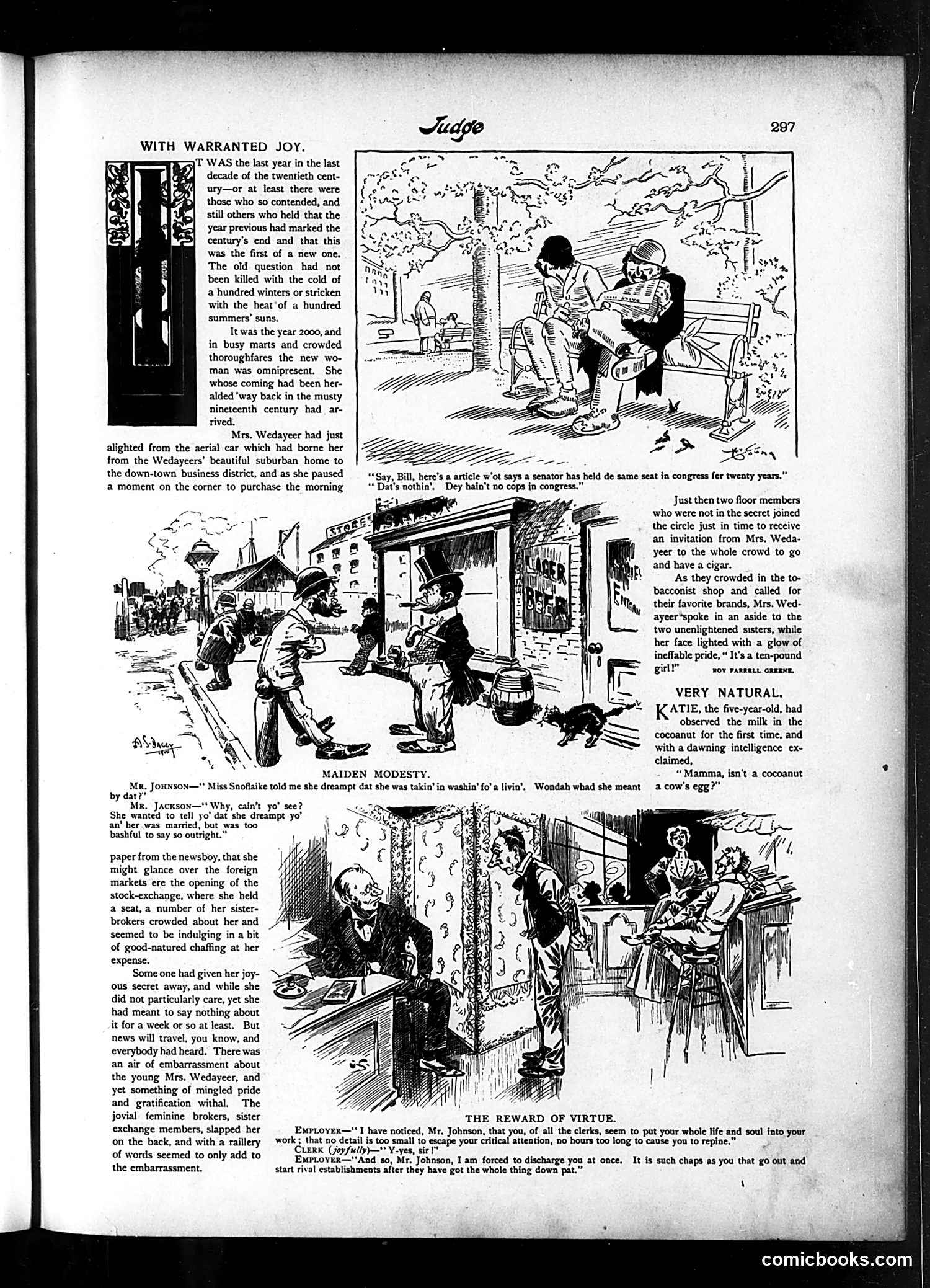
This 1900 satirical page offers four separate humorous sketches about modern life and social change: **"With Warranted Joy"** imagines the year 2000, where the "New Woman" has arrived—Mrs. Wedayeer is a businesswoman who trades stocks and has just given birth. The joke mocks outdated social anxieties: colleagues congratulate her on her baby while casually discussing Congress lacking police oversight, treating both as equally remarkable. **"Maiden Modesty"** satirizes excessive prudishness through a conversation where a woman dreams of taking in laundry but is too bashful to state her romantic intentions directly. **"Very Natural"** presents innocent child-logic: five-year-old Katie, seeing milk in coconut, asks if a coconut is "a cow's egg?" **"The Reward of Virtue"** offers dark workplace satire: an employer fires his most dedicated clerk specifically *because* his work ethic and attention to detail make him a threat—he'll steal the business's methods. The page reflects turn-of-century concerns about women entering business, changing social mores, and industrial anxieties about labor competition.
This appears to be a political cartoon from *Judge* magazine, though the OCR text provides minimal content. The image shows: **Visual Elements:** - A large, billowing ribbon or banner in the center (rendered in stark black and white) - An American eagle with shield at the top right - Two human figures at the bottom right — one appears to be a uniformed official or soldier, the other a civilian - An artist's signature on the left side **Interpretation:** Without clearer text or context, the exact political message is unclear. The flowing ribbon likely represents something being swept up or dispersed — possibly depicting a political movement, policy, or social force. The eagle and figures suggest American governmental or patriotic themes. The composition implies commentary on power dynamics or the influence of some force on American institutions, but the specific satirical target remains uncertain without additional context or legible OCR text.
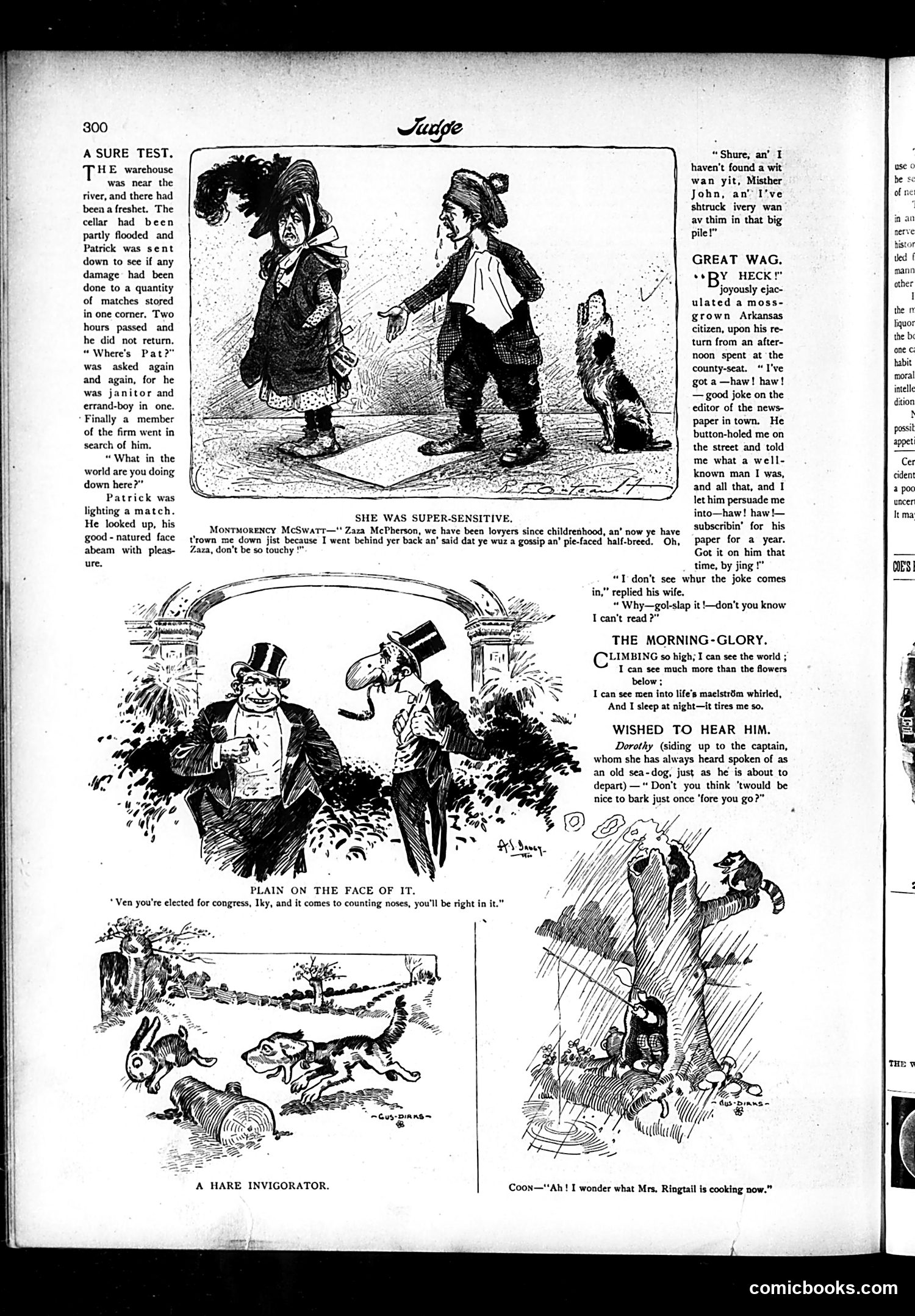
This page contains multiple satirical cartoons and jokes typical of early 20th-century American humor: **"A Sure Test"** jokes about an Irish janitor named Patrick who goes missing in a flooded warehouse—the humor relies on Irish immigrant stereotypes and dialect comedy. **"She Was Super-Sensitive"** depicts a man complaining that his girlfriend is offended after he called her a "gossip" and "pie-faced half-breed" behind her back. The satire mocks both his casual cruelty and her sensitivity as unreasonable. **"Plain on the Face of It"** uses Yiddish-inflected dialect ("Iky," "Ven") in a joke about political nose-counting during elections—playing on stereotypes of Jewish immigrants and corrupt voting practices. **"Coon" cartoon** uses a racial caricature (the title itself) as dark comedy about animal behavior. The page reflects Judge's reliance on ethnic/racial stereotypes and dialect humor as primary comedic devices—material that would be considered offensive today. The sophistication lies in political and social observation, but delivered through dehumanizing caricature.
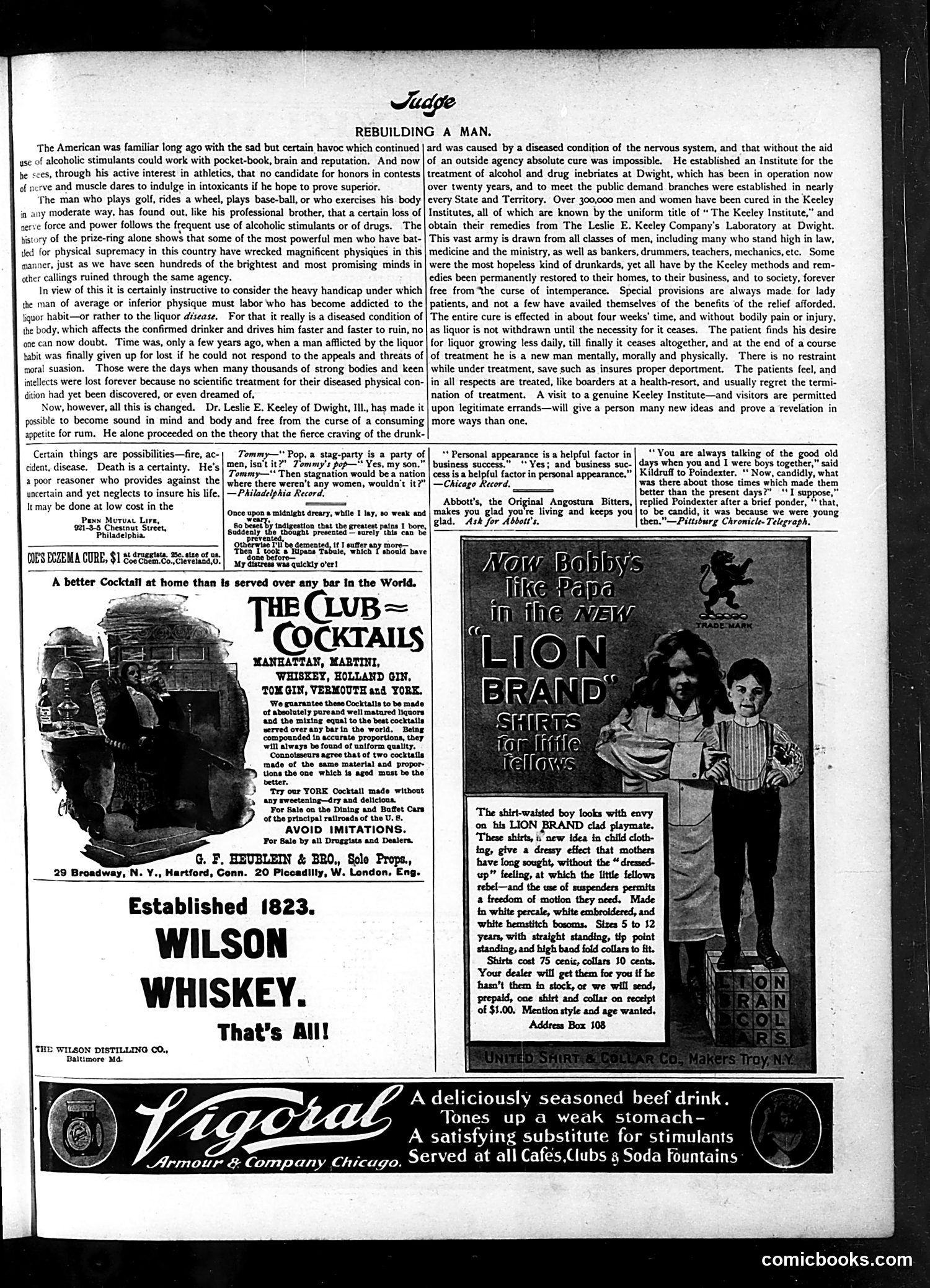
This page is primarily **advertising and advocacy** rather than political satire. The main content is a lengthy article promoting Dr. Leslie Keeley's alcohol treatment institute in Dwight, Illinois—a real, historically significant facility that operated from 1879 onward. **The Article's Message:** The piece argues that alcoholism is a *disease* (not moral failing), treatable through Keeley's scientific methods rather than "moral suasion." It claims 300,000+ patients across many states have been cured in four weeks without physical pain, drawing patients from all social classes—lawyers, clergy, bankers, mechanics. **Historical Context:** This represents Progressive Era optimism about medical solutions to social problems. The Keeley Institute was genuinely influential in late-19th-century America. **Supporting Advertisements:** The page includes ads for Wilson Whiskey, Club Cocktails, Lion Brand children's shirts, and Vigorol (a beef drink tonic)—creating ironic juxtaposition between promoting alcoholic products and alcohol treatment. The page contains **no political cartoons or satire**—it functions as advertorial content for a medical enterprise.
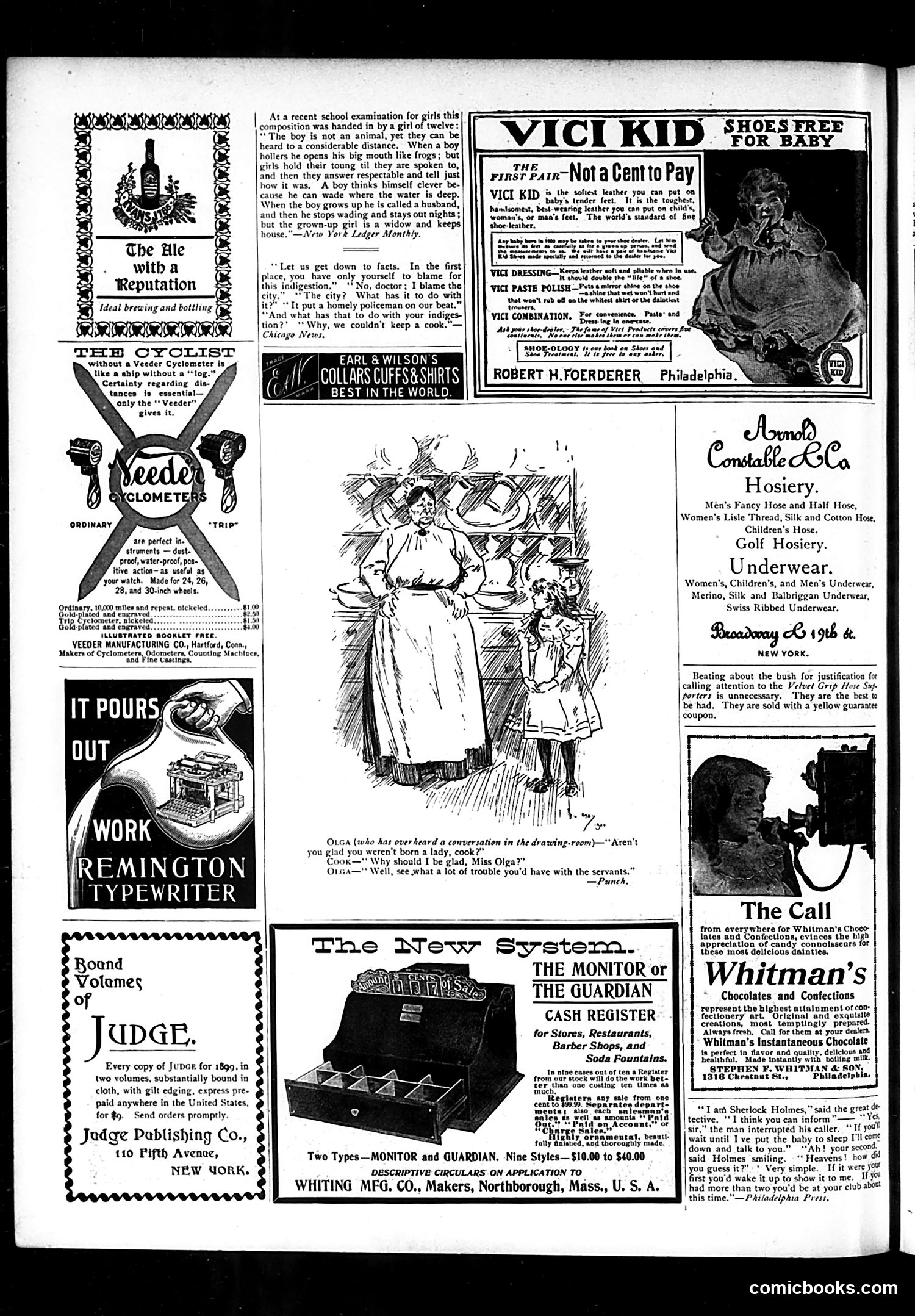
This page is primarily **advertisements and filler content** rather than political satire. The main cartoon appears in the center: a domestic scene titled "Olga" depicting a cook and a young girl (Olga) in conversation in a drawing-room. **The Joke**: Olga comments that the cook should be glad she wasn't born a lady, reasoning that ladies have "trouble with the servants." The cook's response (partially visible) suggests ironic perspective on class and domestic labor. **Context for Modern Readers**: This reflects Victorian-era class consciousness and the common domestic arrangement where wealthy households employed live-in servants. The humor derives from the servant's perspective on the burdens of managing household staff—inverting typical class hierarchies by suggesting servitude has advantages over the "trouble" of being mistress of a house. The page surrounding this cartoon consists entirely of product advertisements (typewriters, hosiery, shoe polish, chocolates, etc.), characteristic of Judge's business model in the 1890s-1900s.
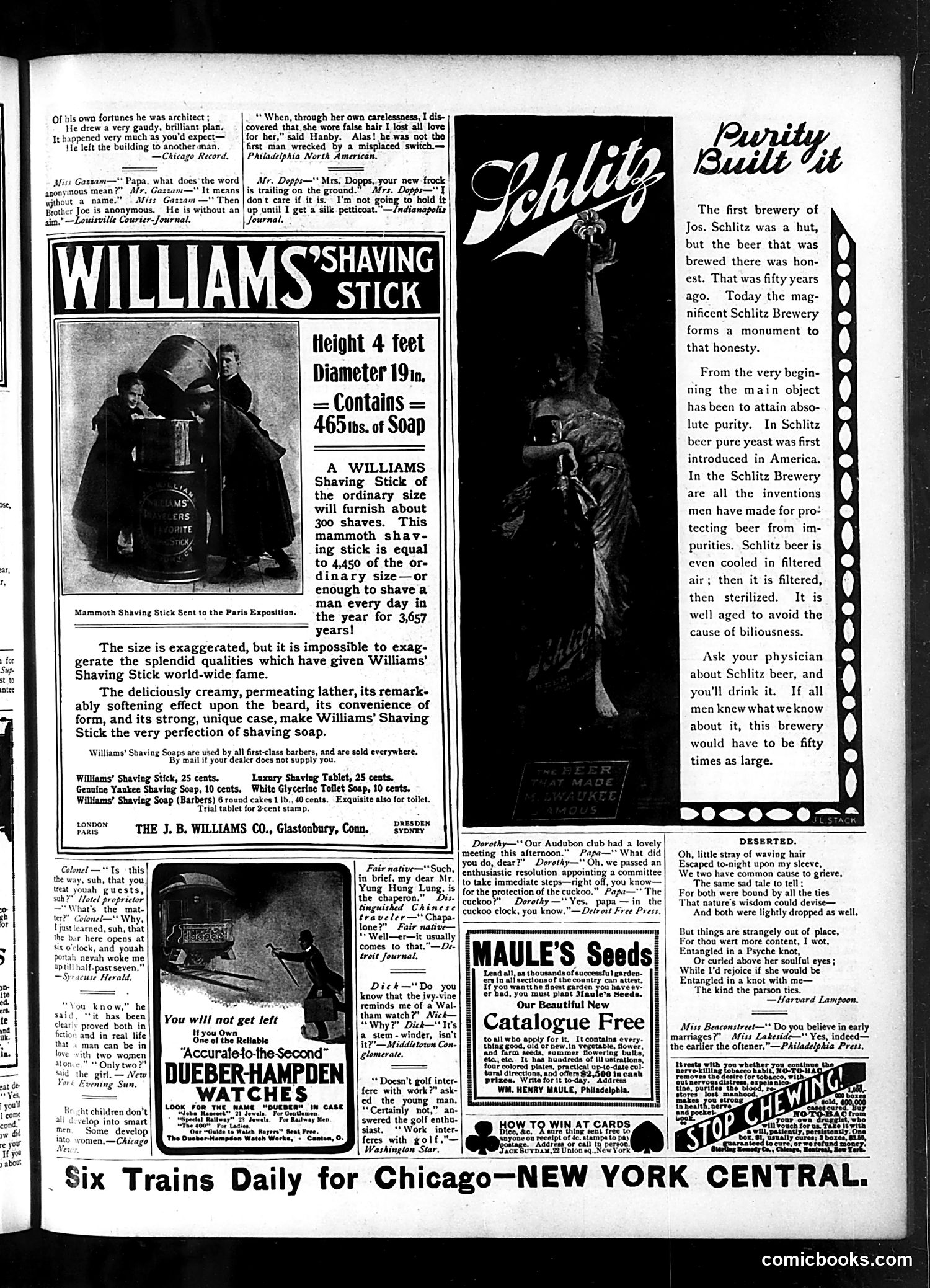
This page is primarily **advertising** interspersed with brief humorous quips rather than political cartoons. The main featured advertisement is **Williams' Shaving Stick**, showcasing an exaggerated "mammoth" version (4 feet tall, 19 inches diameter) supposedly sent to the Paris Exposition. The hyperbole is intentional—the ad admits "the size is exaggerated, but it is impossible to exaggerate the splendid qualities." Scattered throughout are short jokes typical of Judge's humor: wordplay about anonymous identity, marital mishaps, hotel service complaints, and romantic misunderstandings. These reflect genteel turn-of-the-century American domestic life and social conventions. A **Schlitz Beer advertisement** emphasizes purity and scientific brewing processes—appealing to Progressive Era concerns about food/beverage safety and modern industrial standards. Other ads include **Dueberhamden Watches** (reliable timekeeping), **Maule's Seeds** (gardening), and transportation notices. The page reflects early 1900s consumer culture and advertising evolution.
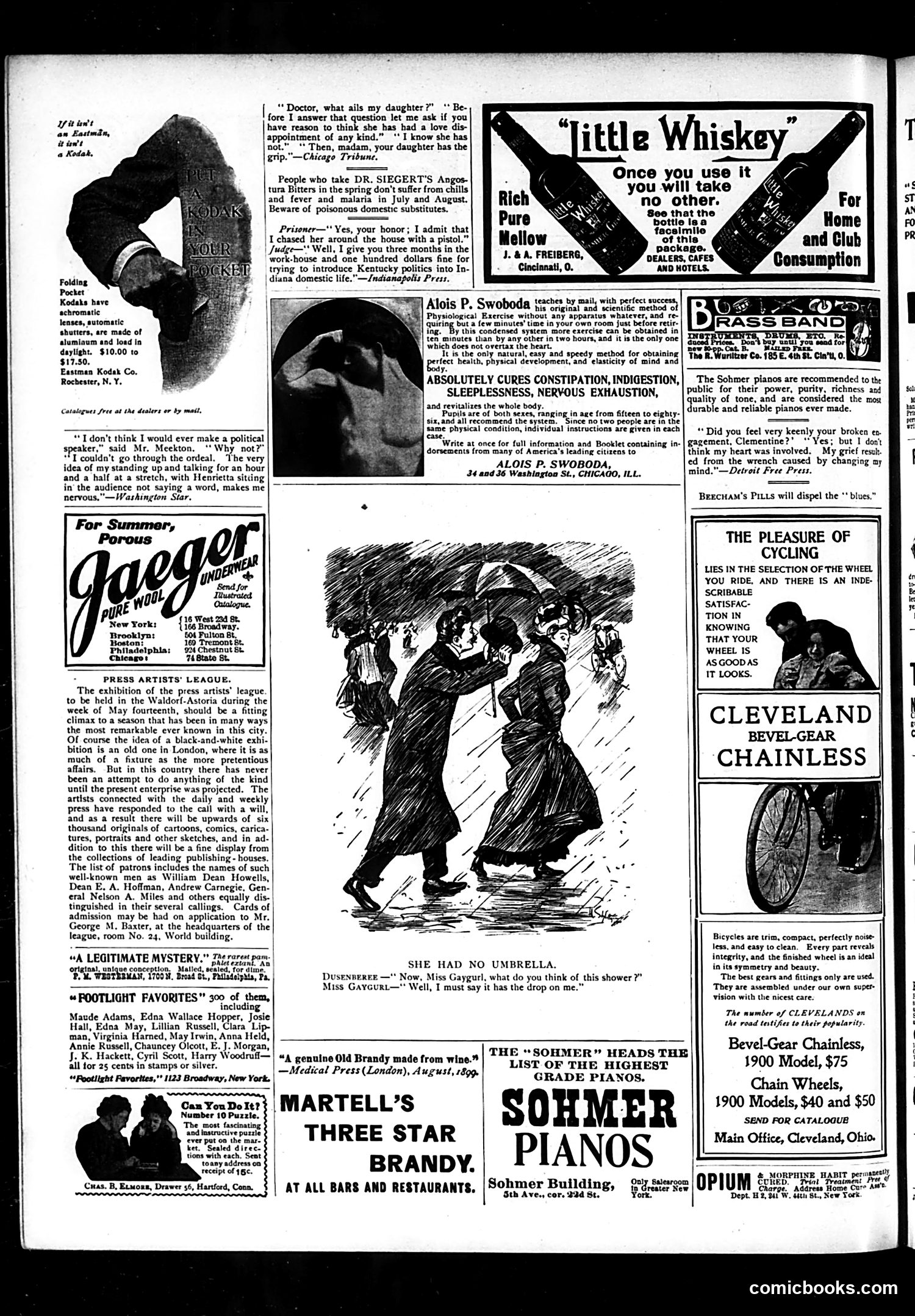
This page from Judge contains multiple satirical cartoons and advertisements typical of early 1900s American humor: **Main Cartoons:** 1. **"Love and Grip" joke**: A doctor diagnoses a young woman's illness as "the grip" (influenza) after her father mentions she suffered a love disappointment—satirizing the period's attribution of women's ailments to romantic disappointment rather than actual medical causes. 2. **"Kentucky Politics" cartoon**: A prisoner admits chasing his wife with a pistol; the judge sentences him, calling it an attempt to introduce "Kentucky politics into Indiana domestic life"—satirizing Kentucky's reputation for violent feuds and frontier lawlessness. 3. **The cyclist illustration**: Features a couple on a bicycle in rain, with the caption "She had no umbrella"—a double entendre about sexual impropriety cloaked in innocent language, typical of Judge's suggestive humor. The page is primarily **advertisements** for products like Kodak cameras, Martell's brandy, Sohmer pianos, and bicycles, interspersed with brief jokes and social commentary reflecting contemporary attitudes.
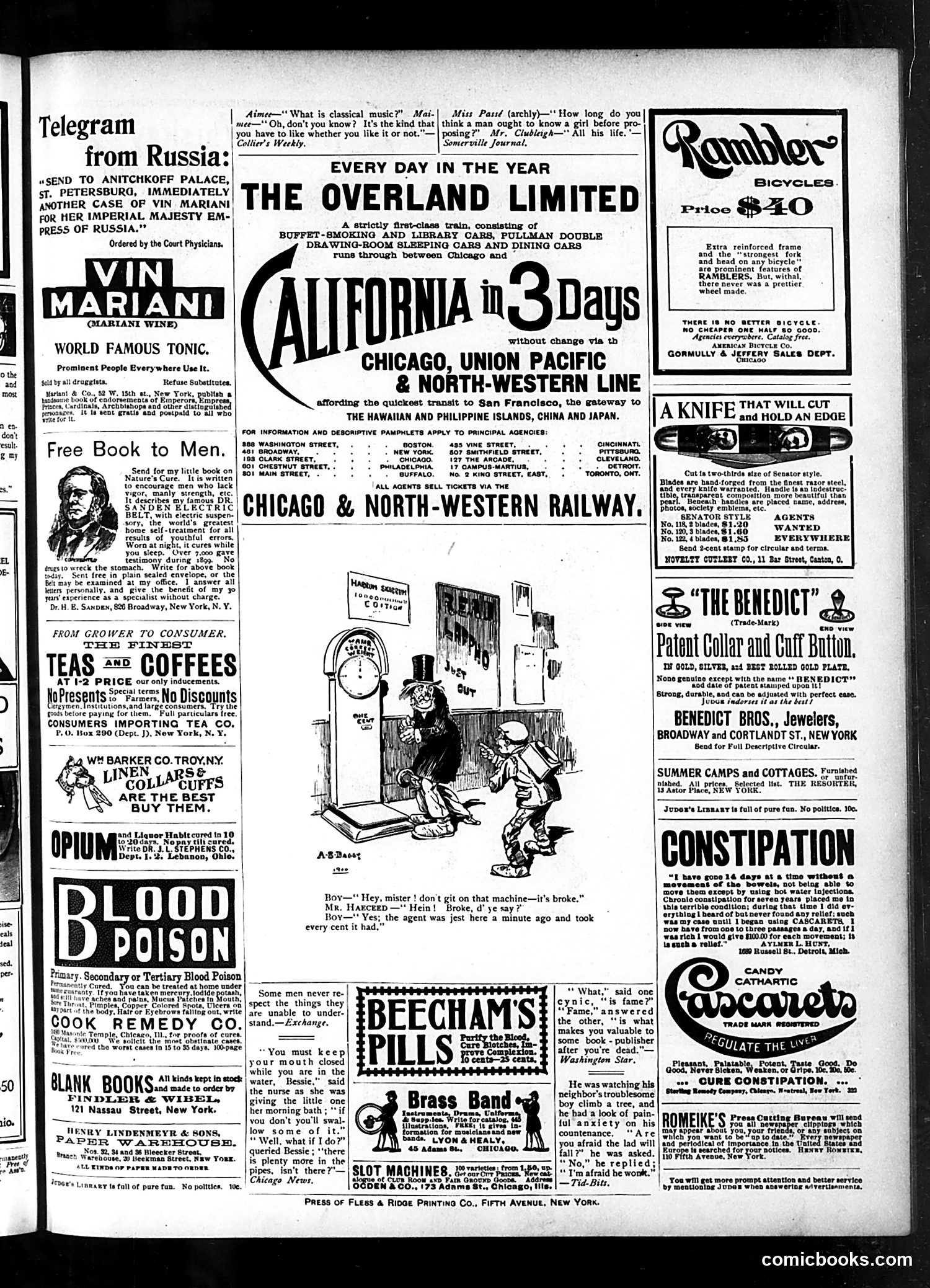
This page is primarily **advertisements and light humor**, not political satire. The main cartoon depicts a boy breaking a mechanical fortune-telling or gambling machine ("A Bent," likely a nickelodeon-style device). The gag is simple: the boy warns a man not to use it because it's broken, yet moments earlier the operator "took every cent it had"—implying the machine was working fine for extracting money, just not for whatever function it promised users. The cartoons and jokes scattered throughout (about classical music, courtship) are gentle, non-political humor typical of Judge magazine's miscellaneous content pages. The bulk of the page consists of **patent medicine and consumer product advertisements** (Vin Mariani tonic, blood poison cure, Dr. Belt electrotherapy device, Beecham's Pills) and travel/rail advertisements (The Overland Limited train to California, Rambler bicycles). These reflect early-20th-century advertising norms, many promoting dubious or now-illegal health products. No identifiable political figures or satire are present on this page.
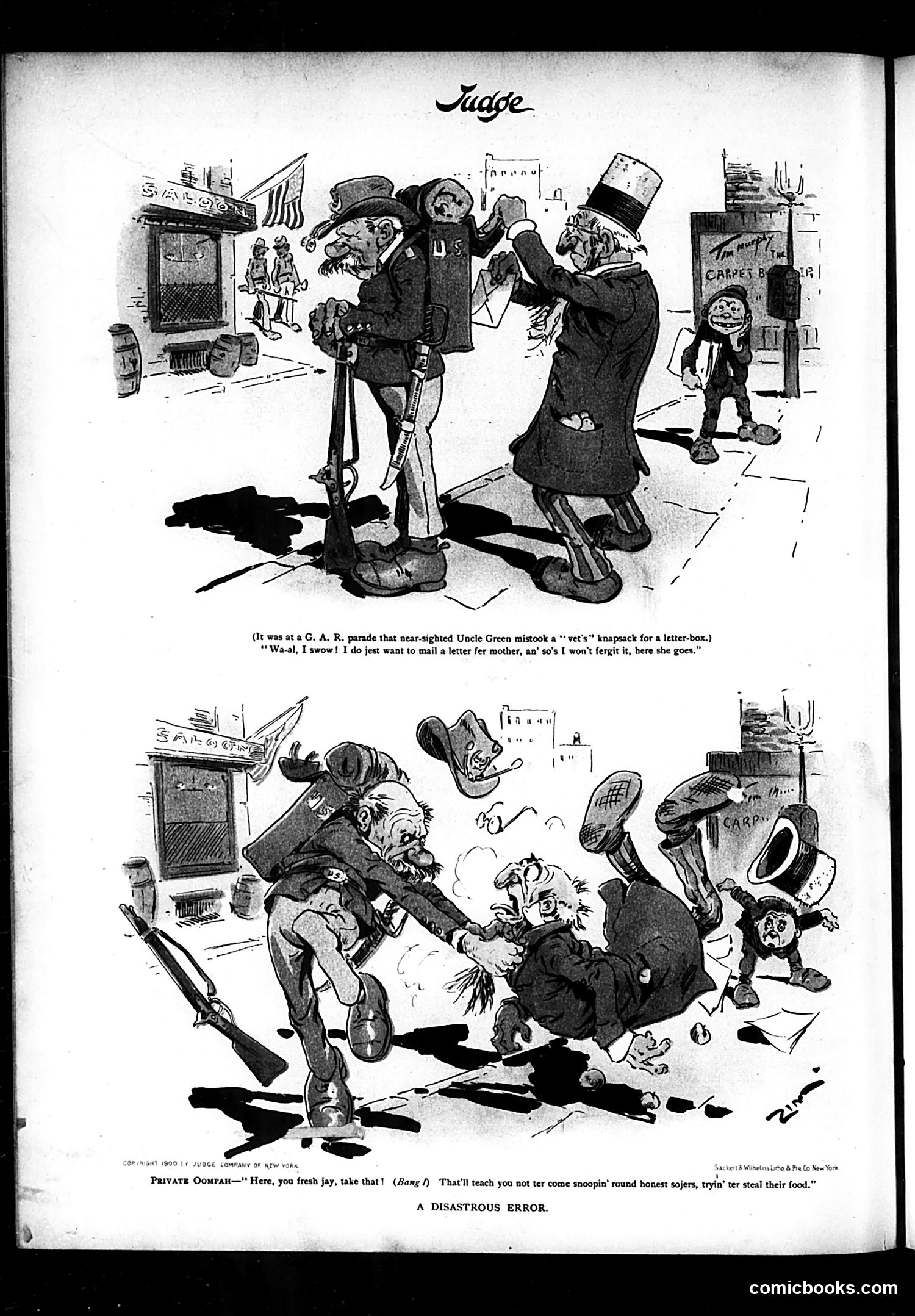
This two-panel cartoon satirizes a near-sighted elderly man ("Uncle Green") at a G.A.R. (Grand Army of the Republic—Civil War veterans' organization) parade. In the top panel, he mistakes a soldier's knapsack for a mailbox and attempts to mail a letter to his mother. The bottom panel shows the "disastrous error's" consequence: the soldier, thinking the old man is a thief trying to steal food rations, violently attacks him. The humor targets both the man's poor eyesight and the soldiers' violent overreaction. The G.A.R. parade context suggests this pokes fun at Civil War veterans' parades as chaotic public events. The joke ultimately ridicules the absurdity of the misunderstanding and the soldier's excessive response to an innocent mistake.