
A complete issue · 16 pages · 1900
Judge — May 5, 1900
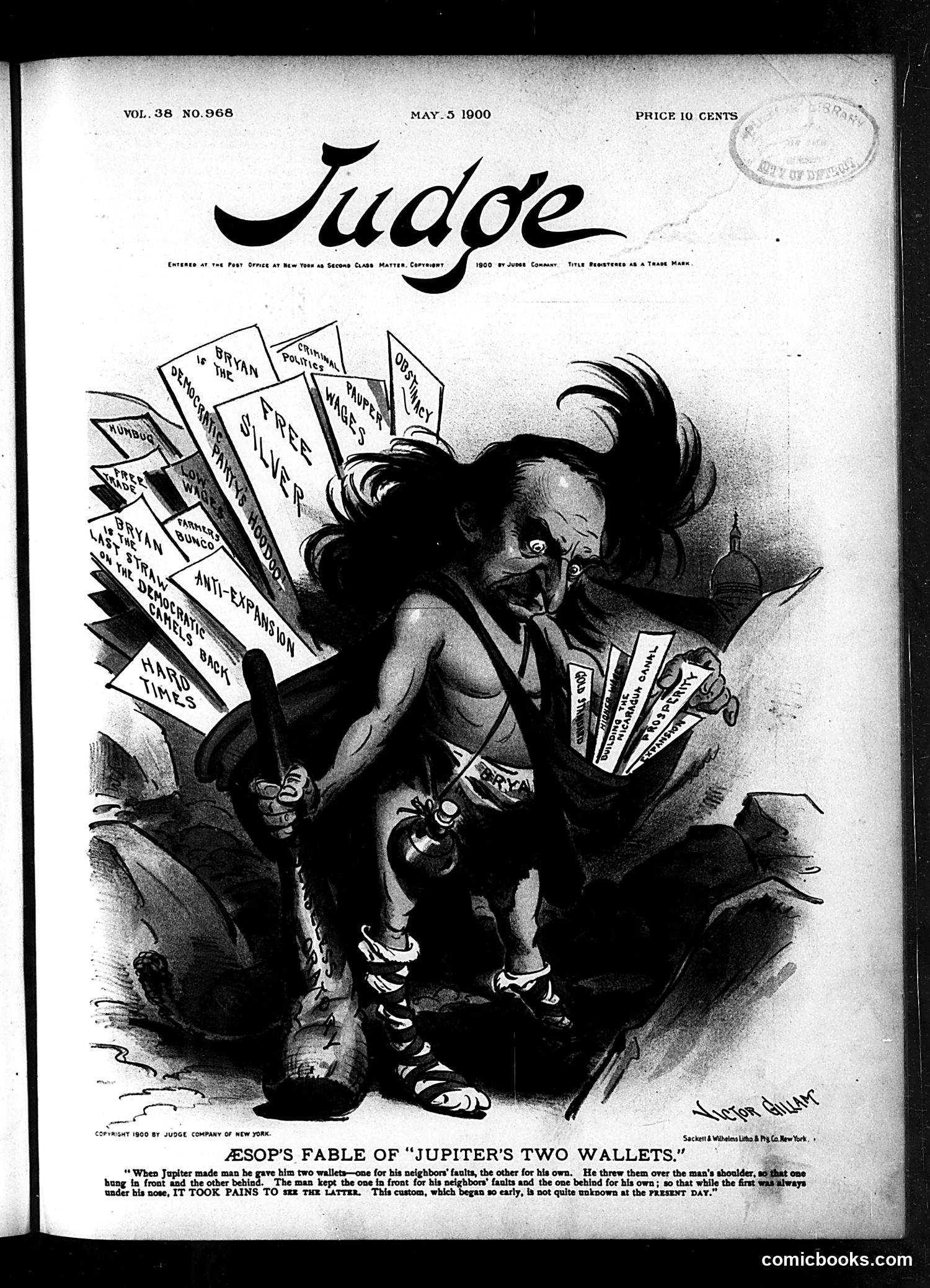
This satirical cartoon adapts Aesop's Fable of "Jupiter's Two Wallets." The central figure is a demon or devil-like character juggling multiple papers labeled with various political positions and policies (text reads "BRYAN," "CURRENCY," "EXPANSION," "ANTI-EXPANSION," and others). The satire targets William Jennings Bryan, the Democratic presidential candidate, suggesting his political inconsistency and contradictory positions on major issues of 1900—particularly regarding currency policy, imperialism, and territorial expansion. The overloaded wallet metaphor implies Bryan is dishonestly carrying incompatible political stances simultaneously. The fable's moral warned against keeping one's faults hidden while displaying virtues; here Judge accuses Bryan of the opposite: concealing inconsistency behind multiple contradictory public positions.
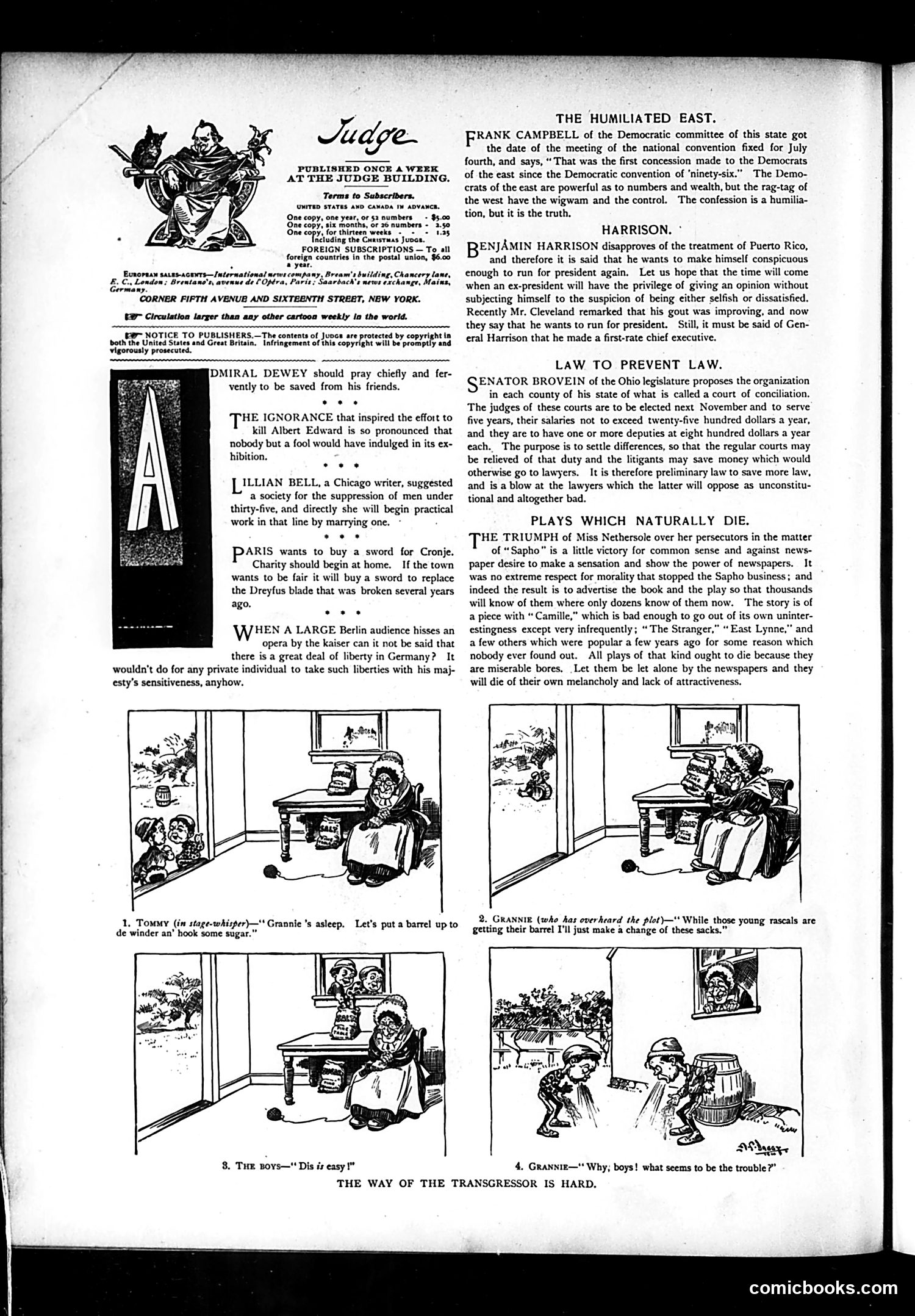
This page contains three distinct sections: **Top Articles:** Political commentary on Democratic convention timing, Puerto Rico policy under Benjamin Harrison, and Senator Brovein's proposed "court of conciliation" to reduce litigation costs. These represent typical turn-of-the-century political debate. **Bottom Comic Strip:** "The Way of the Transgressor is Hard" depicts a domestic scene where Tommy and boys apparently steal sugar or supplies, then attempt to hide barrel-related evidence from their grandmother (Grannie). The humor derives from the children's failed deception and escalating consequences—a morality tale about transgressions being discovered. The strip's title references biblical moralizing common to the era. The satire targets both political hypocrisy (top) and domestic discipline (bottom), reflecting Judge's mixed agenda of political criticism and family-humor content.
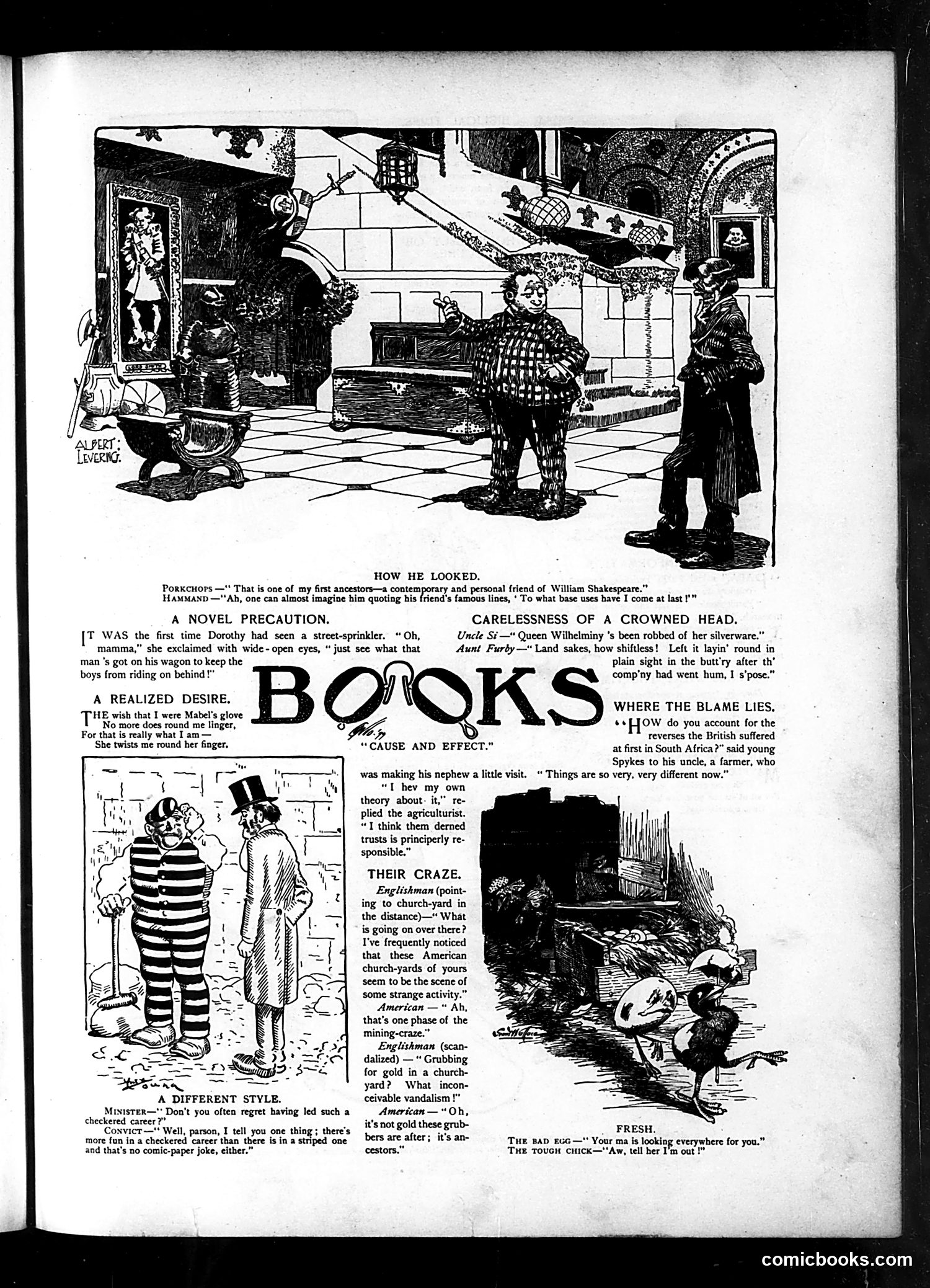
This page contains multiple satirical "Books" sections with brief jokes and illustrations rather than a single coherent cartoon. The top illustration shows what appears to be a period interior scene with figures in formal dress, labeled "HOW HE LOOKED," referencing Shakespeare and a contemporary person. The middle section includes a cartoon of a rotund man in striped clothing conversing with a tall figure, apparently satirizing social pretension or class differences. Lower sections titled "WHERE THE BLAME LIES" and "THEIR CRAZE" appear to mock American agricultural practices and churchyard behavior through dialogue between British and American characters, suggesting transatlantic cultural criticism. The page employs typical Judge-style social commentary through caricature and dialogue, though specific political targets aren't clearly identifiable from available context.
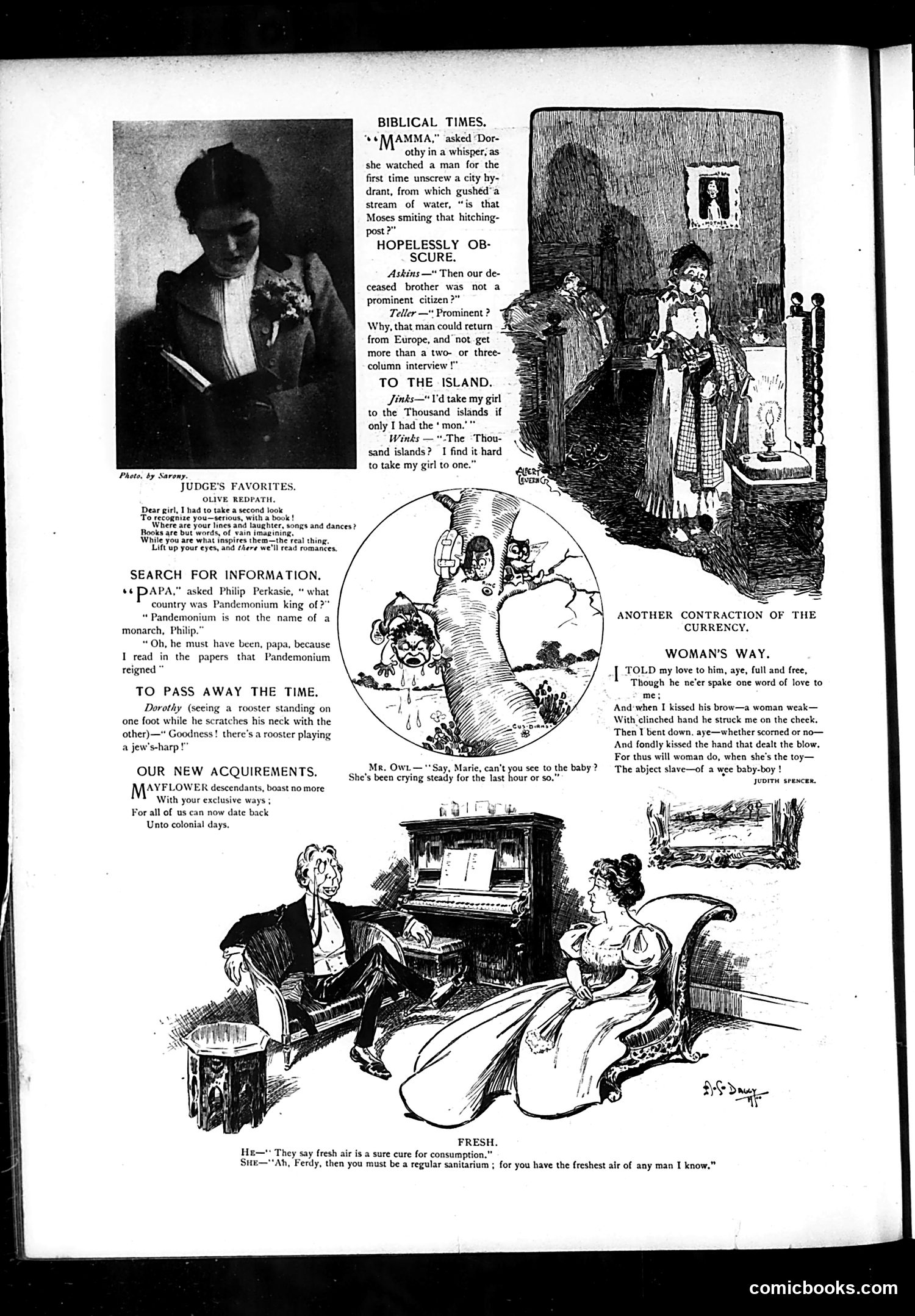
This page contains multiple satirical humor pieces typical of early 20th-century Judge magazine: **"Biblical Times"** mocks naive questions about historical accuracy, with a character asking if Moses invented the hitchingpost. **"Judge's Favorites"** presents Olive Burnett's poetry about taking a "second love" to theaters and dances—satirizing romantic sentimentality. **"To the Island"** jokes about matrimonial desperation, with a woman claiming she'd relocate for a man if she had "the 'mon.'" **"Fresh"** depicts a man and woman at a piano, with dialogue about "fresh air" as a tuberculosis cure, likely mocking both health fads and flirtation. The cartoons employ period-typical caricature styles and target upper-class social pretensions, romantic conventions, and pseudoscientific health claims. Most references are generic social satire rather than commentary on specific political events.
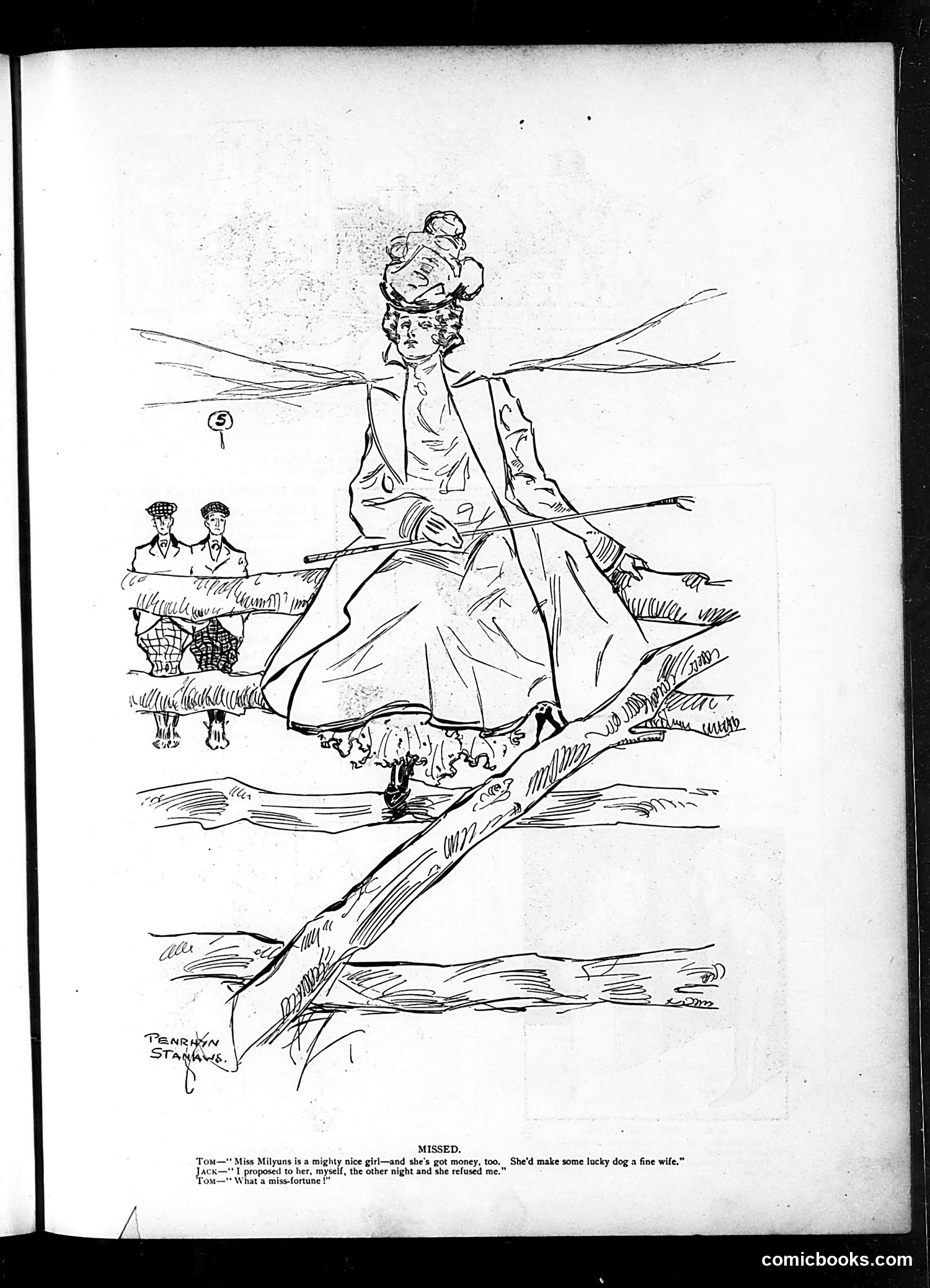
This page from *Judge* magazine features a satirical illustration signed by Penrhyn Stanlaws. The cartoon depicts a woman balanced precariously on a log, with two men observing her in the background. The humor centers on a dialogue between Tom and Jack about Miss Milyuns (a play on "millions," suggesting wealth). Tom praises her as "a mighty nice girl" with money who'd make "some lucky dog a fine wife." Jack reveals he proposed to her and was rejected. Tom's response—"What a misfortune!"—is the punchline, suggesting his regret is not about her personal rejection of Jack, but about her refusal to marry *him* instead, motivated by her money rather than her character. The precarious log-balancing pose appears to visualize the unstable, mercenary nature of the romantic/marital dynamics being mocked.
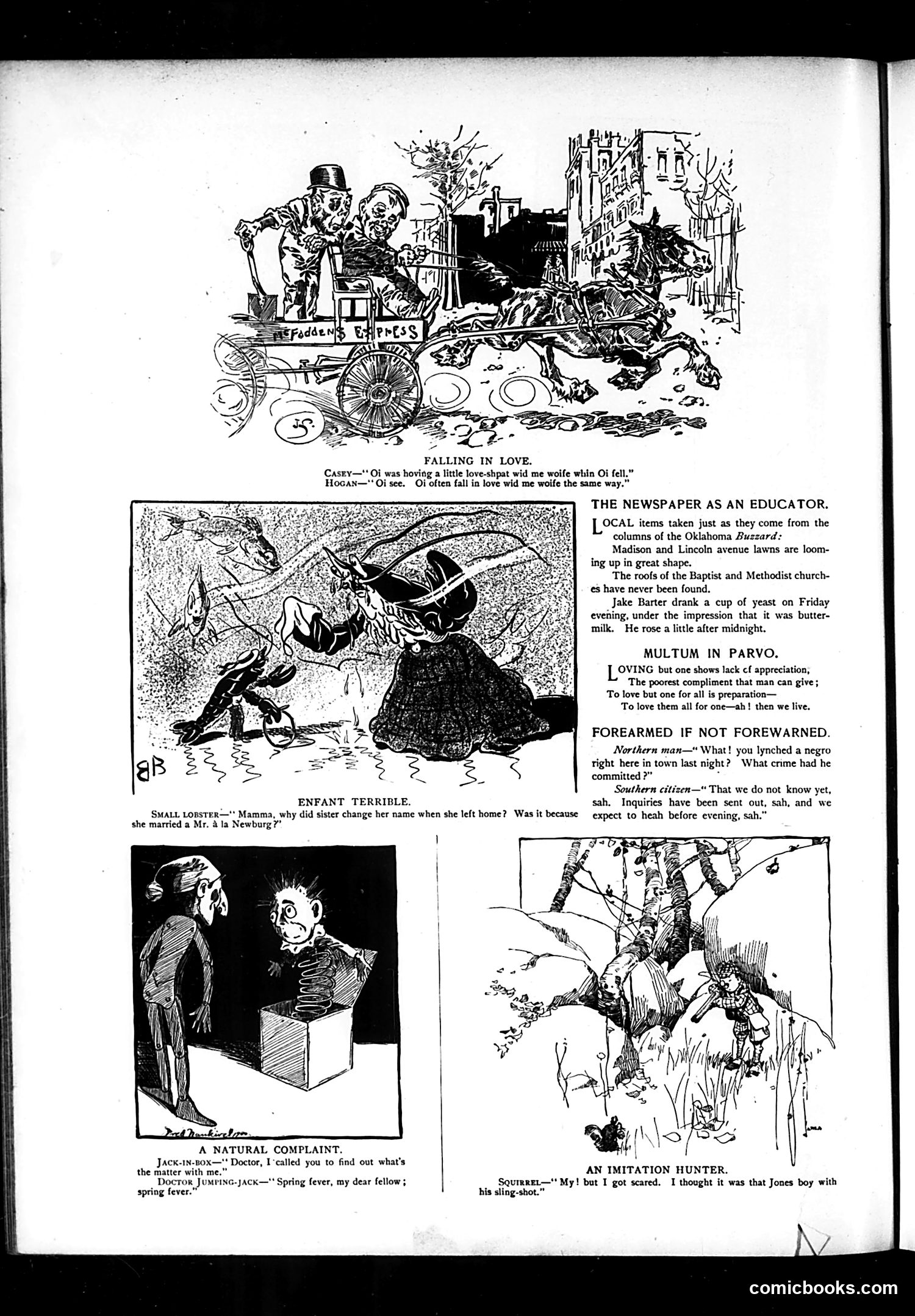
This page contains multiple satirical cartoons and humorous snippets typical of the 1890s-era Judge magazine: **"Falling in Love"** features working-class Irish characters (indicated by dialect) making a joke about domestic quarrels being mistaken for romantic passion—commenting on rough relationships among laborers. **"The Newspaper as an Educator"** mocks small-town Oklahoma journalism, satirizing absurd local news items (churches with missing roofs, a man rising after consuming yeast) as evidence of poor reporting or gullible readers. **"Forewarned If Not Forewarned"** contains a dark political joke about Southern lynching, with a Northern visitor shocked that a Black man was lynched without known cause. The Southern response ("inquiries have been sent out") satirizes the casual, unpunished nature of racial violence in the post-Reconstruction South. Other cartoons joke about doctor visits, mistaken identity, and childhood pranks. The page reflects Judge's mix of working-class humor, regional satire, and commentary on contemporary social problems, particularly racial violence.
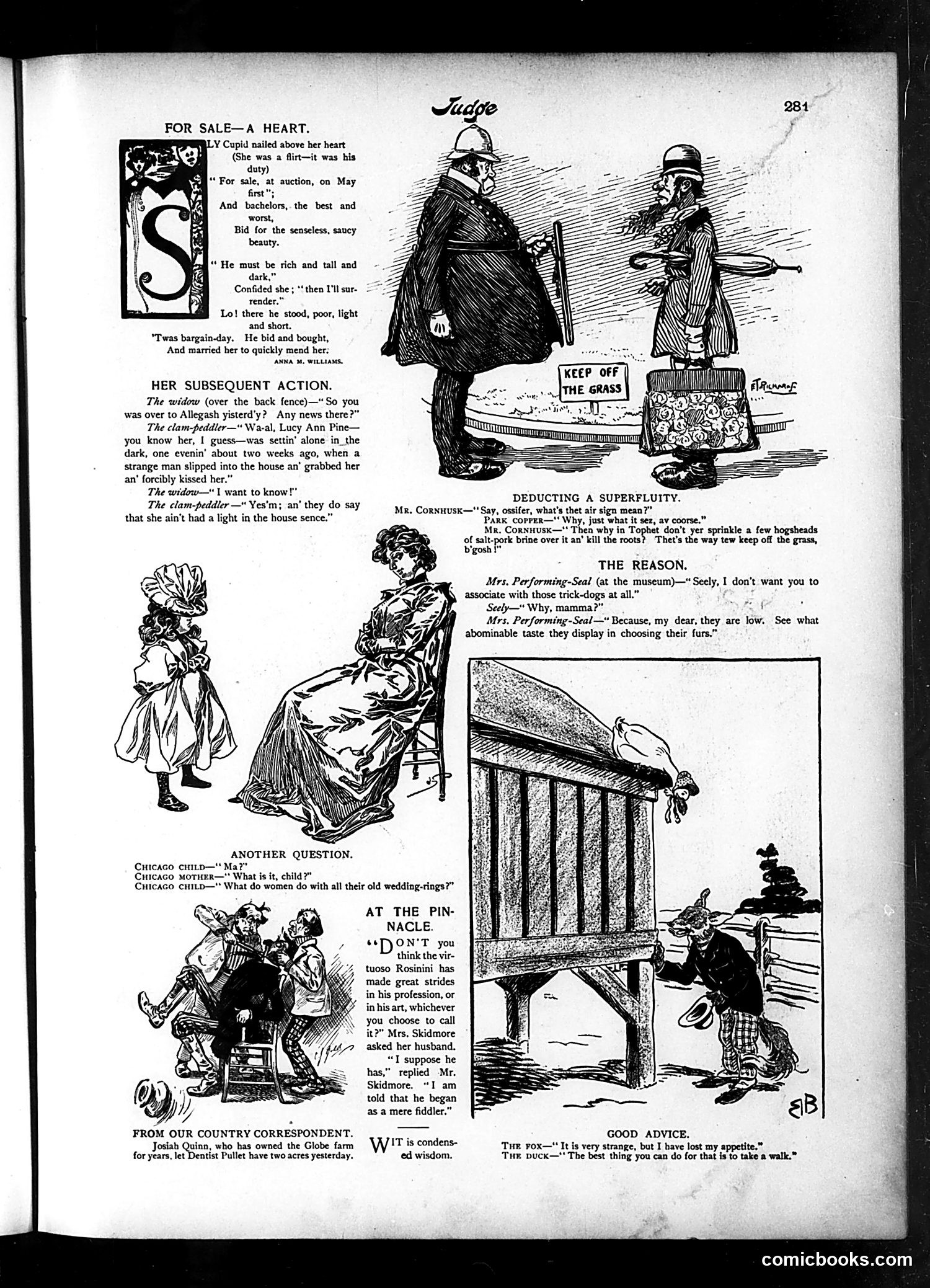
This page contains multiple brief satirical sketches typical of Judge's humor circa early 1900s: **"For Sale—A Heart"** mocks a flirtatious woman who auctions her affections to the highest bidder, only to marry a poor man when he's the only buyer. The satire targets superficial women and marriage as commercial transaction. **"Deducting a Superfluity"** jokes about a park official trying to keep dogs off grass by pouring pork brine on it—absurd logic presented as bureaucratic reasoning. **"The Reason"** satirizes class consciousness: a performing seal mother forbids her offspring from associating with "low" trick-dogs due to their poor taste in fur. **"Another Question"** implies women secretly dispose of old wedding rings—a jab at disposable attitudes toward marriage. **"At the Pinnacle"** plays on a musician's rise from "mere fiddler" to virtuoso as the height of achievement. The remaining items are brief jokes about rural life and animal behavior. The overall tone is lighthearted social commentary on marriage, class pretension, and human foolishness.
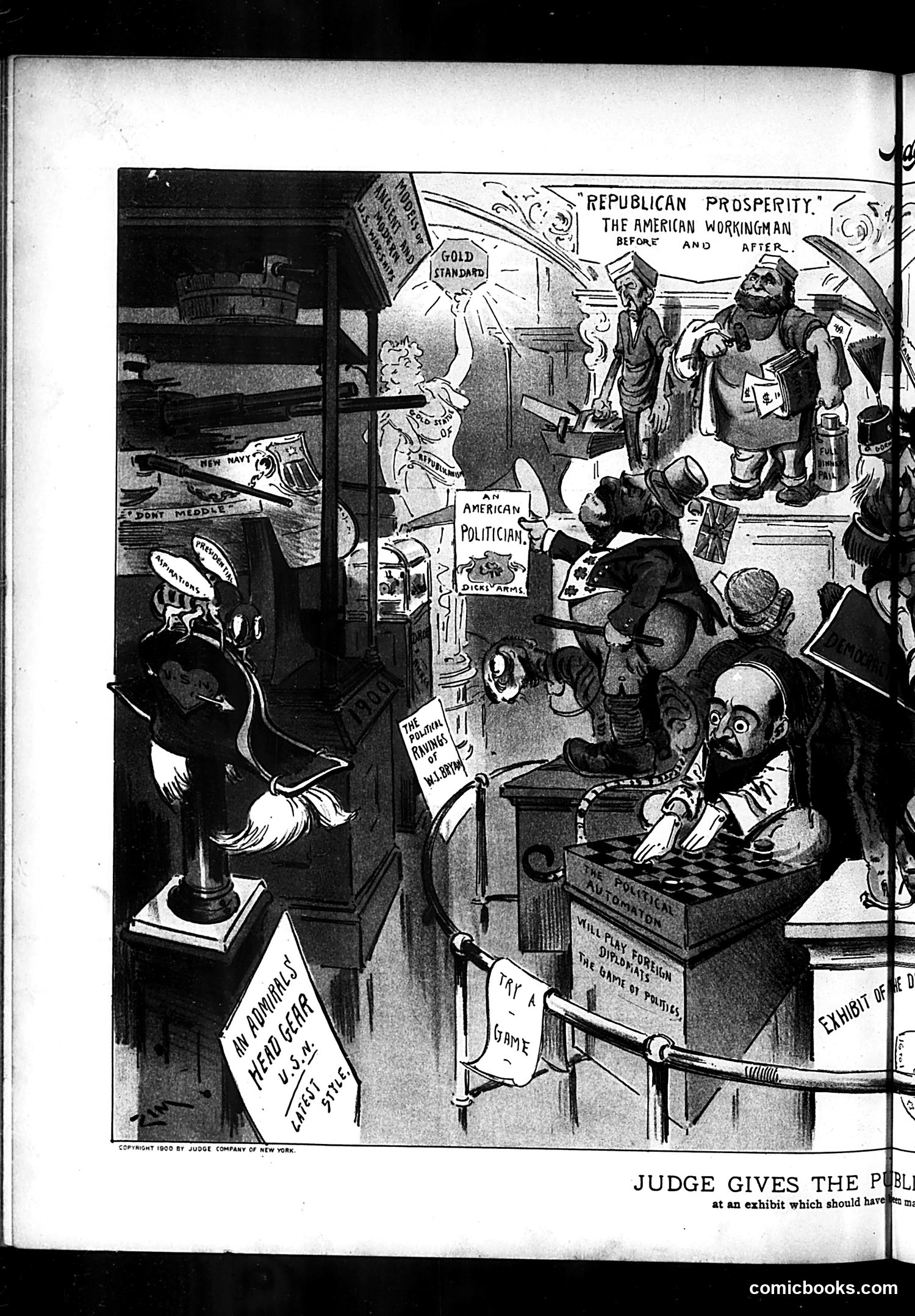
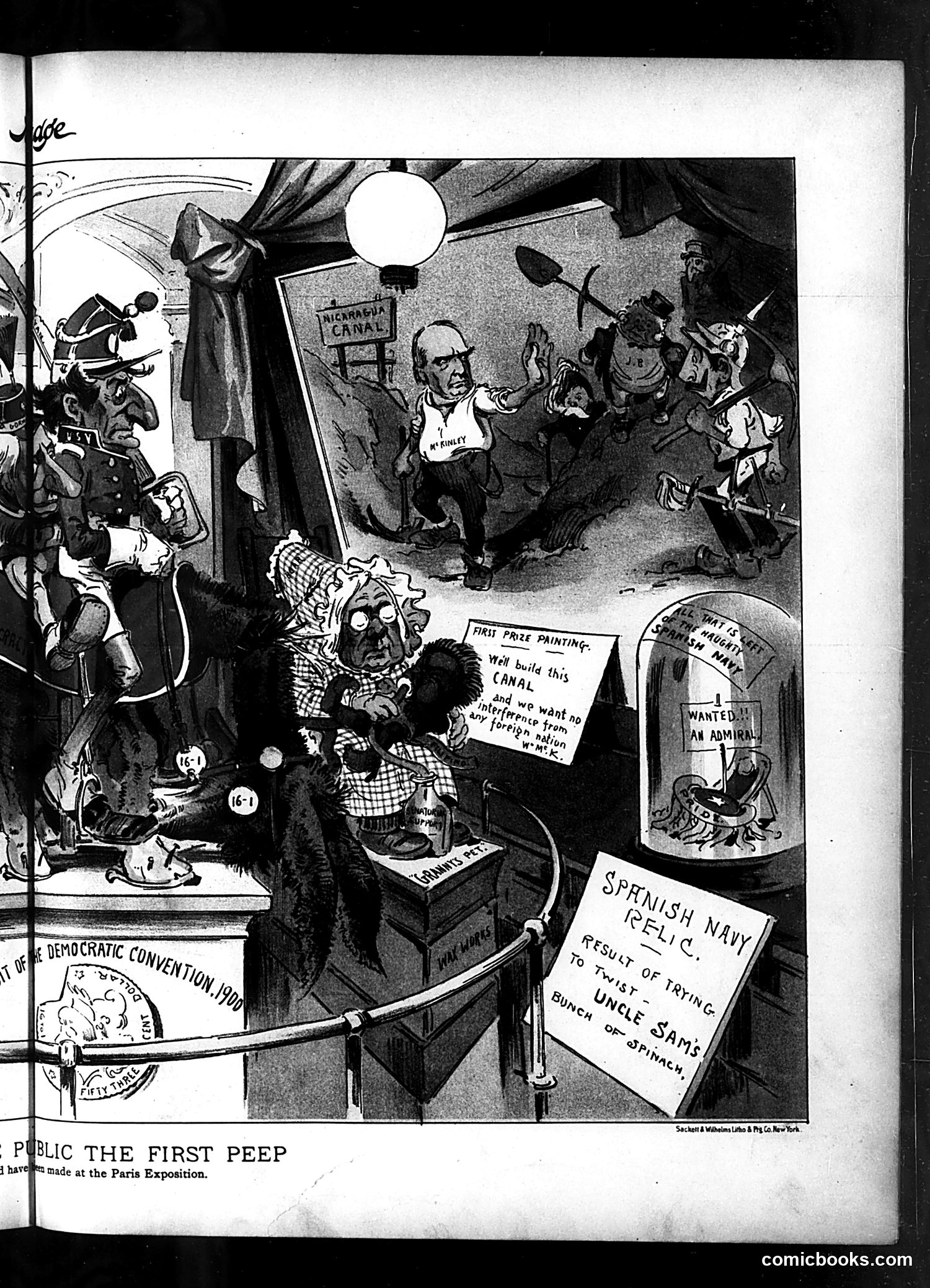
This Judge magazine cartoon satirizes the Panama Canal construction project. The scene depicts a chaotic exhibition or display labeled "First Prize Painting" showing the canal's development. Key visible elements include: - Political/military figures on the left (appearing to represent American leadership) - A central figure labeled "Hamlet" gesturing uncertainly - A sign reading "Well built this CANAL" with text about wanting "no interference from any foreign nation" - References to a "Spanish Navy Relic" and wanting "an Admiral" - The title indicates this concerns "The First Peep" at the Paris Exposition The cartoon mocks American ambitions regarding the canal while satirizing international tensions, particularly with Spain. The chaotic composition and exaggerated figures suggest editorial skepticism about the project's execution or diplomatic implications, though specific historical context would clarify the exact timeframe and all references intended.
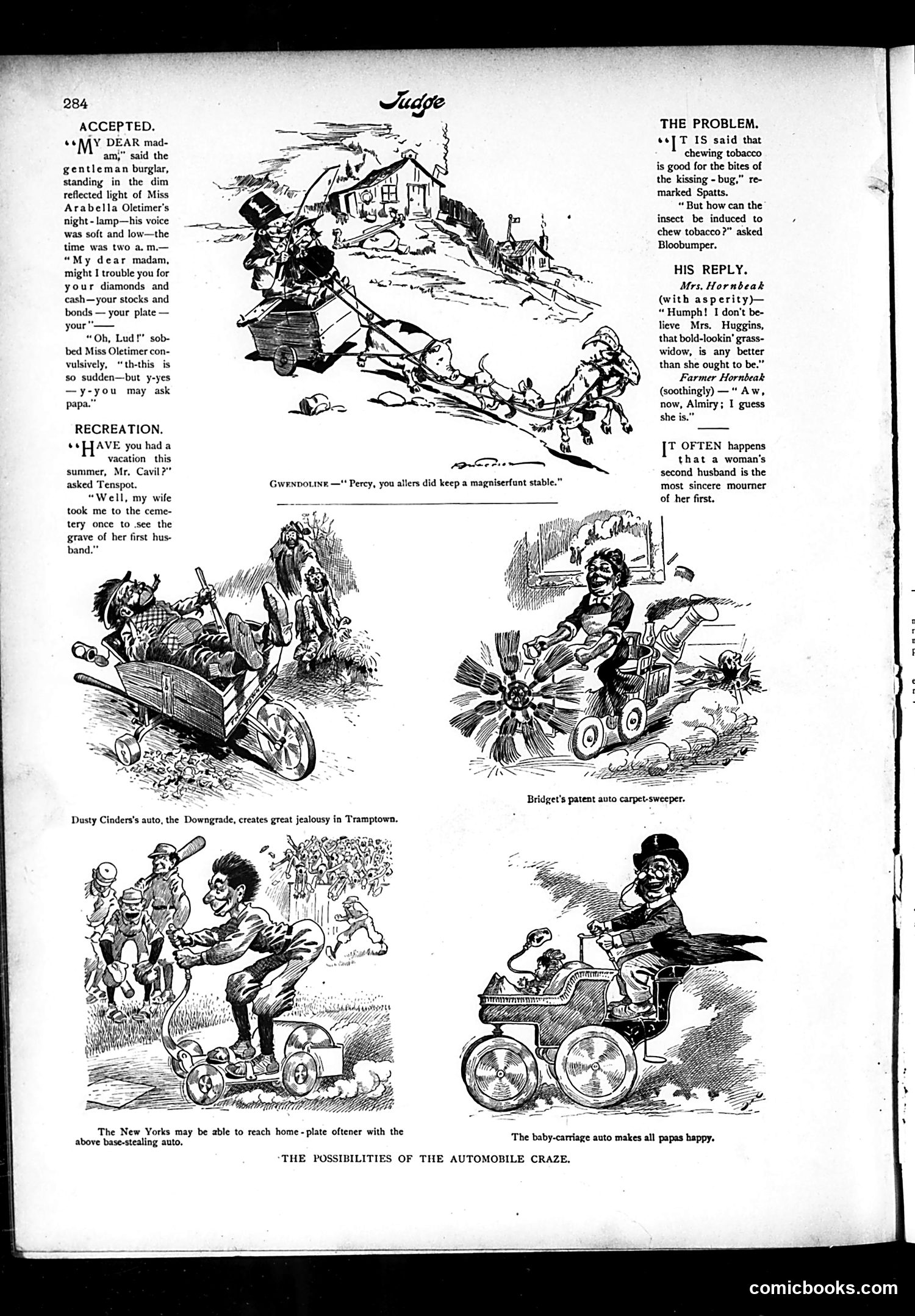
This page satirizes the early automobile craze through humorous vignettes. The central feature, "The Possibilities of the Automobile Craze," depicts absurd applications of motorized vehicles: a man using an auto-powered cart as a base-stealing device in baseball, a woman's motorized carpet-sweeper, and most comically, a motorized baby carriage piloted by a man with exaggerated features. The surrounding brief jokes employ typical Judge humor: a burglar's politeness to a spinster, a husband's darkly comic remark about his wife taking him to her first husband's grave, and gossip about a widow's propriety. The satire mocks both the automobile industry's overenthusiasm and Victorian society's anxieties about rapid technological change. By imagining ridiculous domestic and recreational applications—turning ordinary activities into motorized spectacles—the cartoonist suggests the era's obsession with mechanization was impractical and somewhat foolish.
This page is primarily **advertising**, with some poetry and light humor pieces interspersed. The main content includes: **Poetry**: "Annie Laurie" variations—romantic verses referencing the Scottish ballad, with themes of memory and nostalgia. **Humor snippets**: Brief jokes including one about a **Boer dialect story** (referencing the ongoing Boer War, contemporary to publication), a pun about Noah's sons, and McKinley's political fence-sitting on the Puerto Rican question compared to British General Buller's unclear positioning in the Boer War. **Advertisements**: Dominate the page—Prudential Life Insurance, Sohmer Pianos, Mariani Wine (marketed as medicinal), Wilson Whiskey, and various tonics and soaps. These ads reflect period health claims now considered dubious (wine and alcohol as cure-alls). The page reflects **early 1900s sensibilities**: romantic nostalgia, contemporary political references most readers would recognize, and patent medicines presented as legitimate remedies.
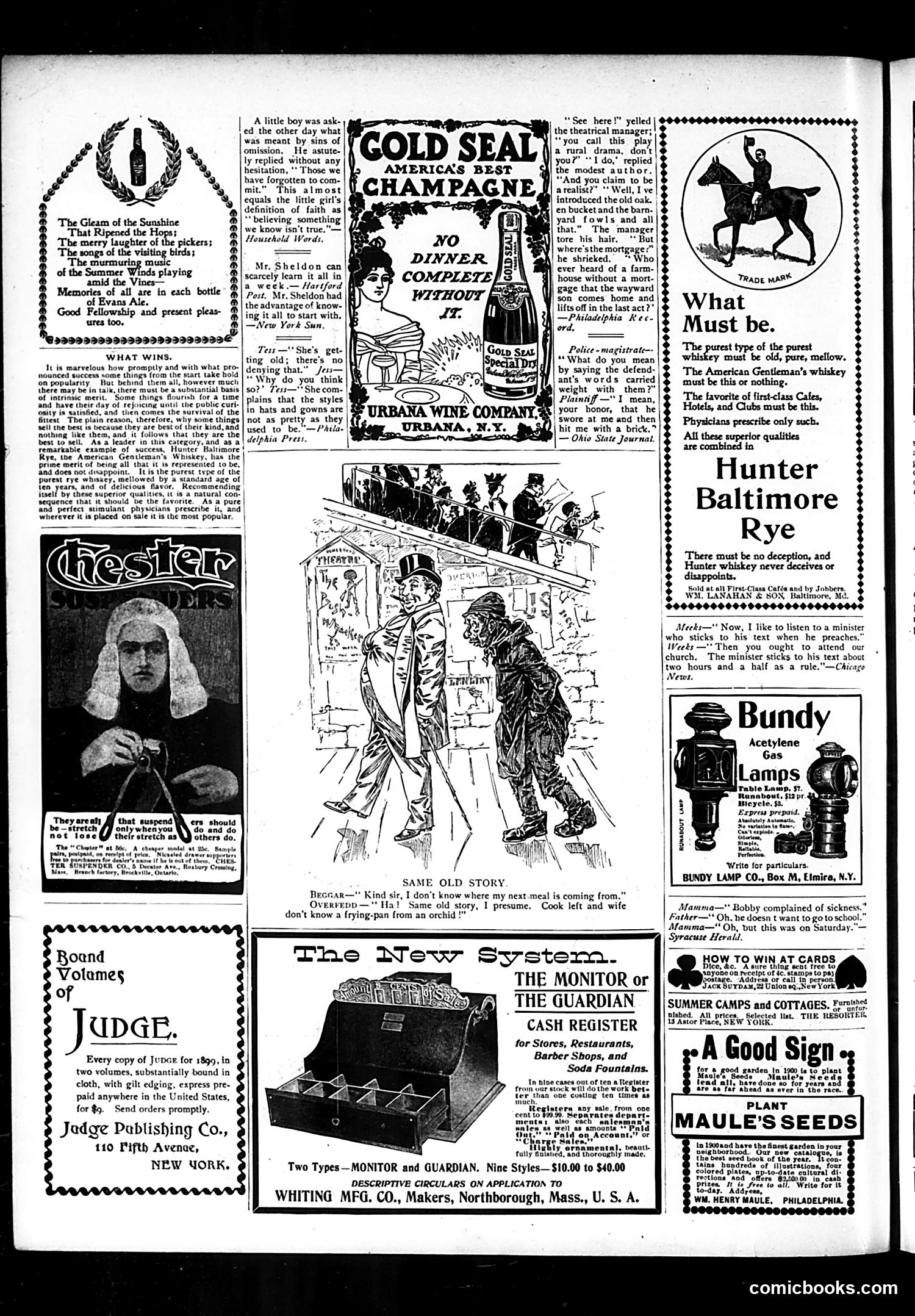
This page from *Judge* is primarily **advertising with comic interludes**—typical of early 20th-century satirical magazines that subsidized editorial content through paid ads. The two main cartoons mock **rural/farm-themed theater**. One ridicules a theatrical manager demanding "realism" in a play set on a farm—the author includes picturesque details (sunshine, singing birds, laughter) but forgets the essential mortgage that would make it authentic. The joke: rural life's defining feature is financial hardship, not sentimentality. The second cartoon depicts a beggar asking for food; the responder quips the beggar's problem is domestic—his cook quit and his wife can't cook. The dated humor assumes wealthy households depend entirely on servants. The page otherwise features advertisements for **whiskey, lamp oil, seeds, and a cash register**—all with period advertising language emphasizing purity and reliability. The "Chester" cigarette ad and various product endorsements are typical commercial content of the era. No specific political figures are caricatured; the satire targets **generic social pretension and domestic absurdity** rather than current events.
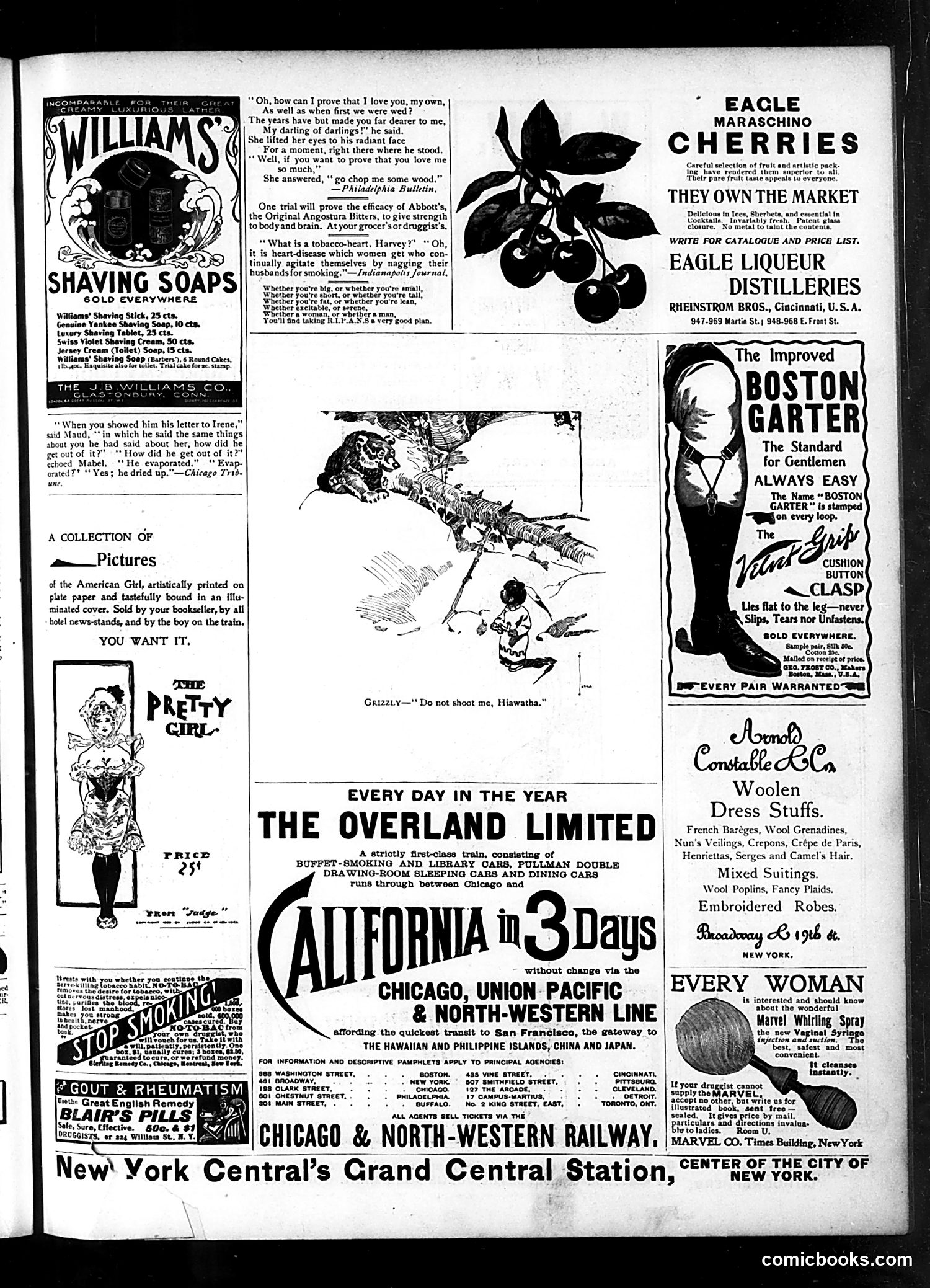
This page is primarily **advertisements and light humor**, typical of Judge magazine's format. The main elements: **Central Cartoon**: A grizzly bear confronting a Native American (labeled "Hiawatha"), with the caption "Do not shoot me, Hiawatha." This references Longfellow's famous 1855 poem *The Song of Hiawatha*, playing on the incongruity of the legendary hunter pleading with an animal. **Comic Snippets**: Brief jokes about relationships and health—a woman asking her devoted husband to chop wood as proof of love; a joke about "tobacco-heart" (heart disease from nagging wives upset about smoking); a man caught in infidelity who simply "evaporated." **Advertisements**: Numerous period products (Williams' shaving soap, Boston garters, maraschino cherries, the Overland Limited train to California, patent medicines). The "Marvel Whirling Spray" ad at bottom right appears to be for contraception/feminine hygiene, euphemistically marketed. The page reflects early-1900s consumer culture and gender dynamics—husbands smoking, nagging wives, courtship anxieties—presented as humor for Judge's affluent male readership.
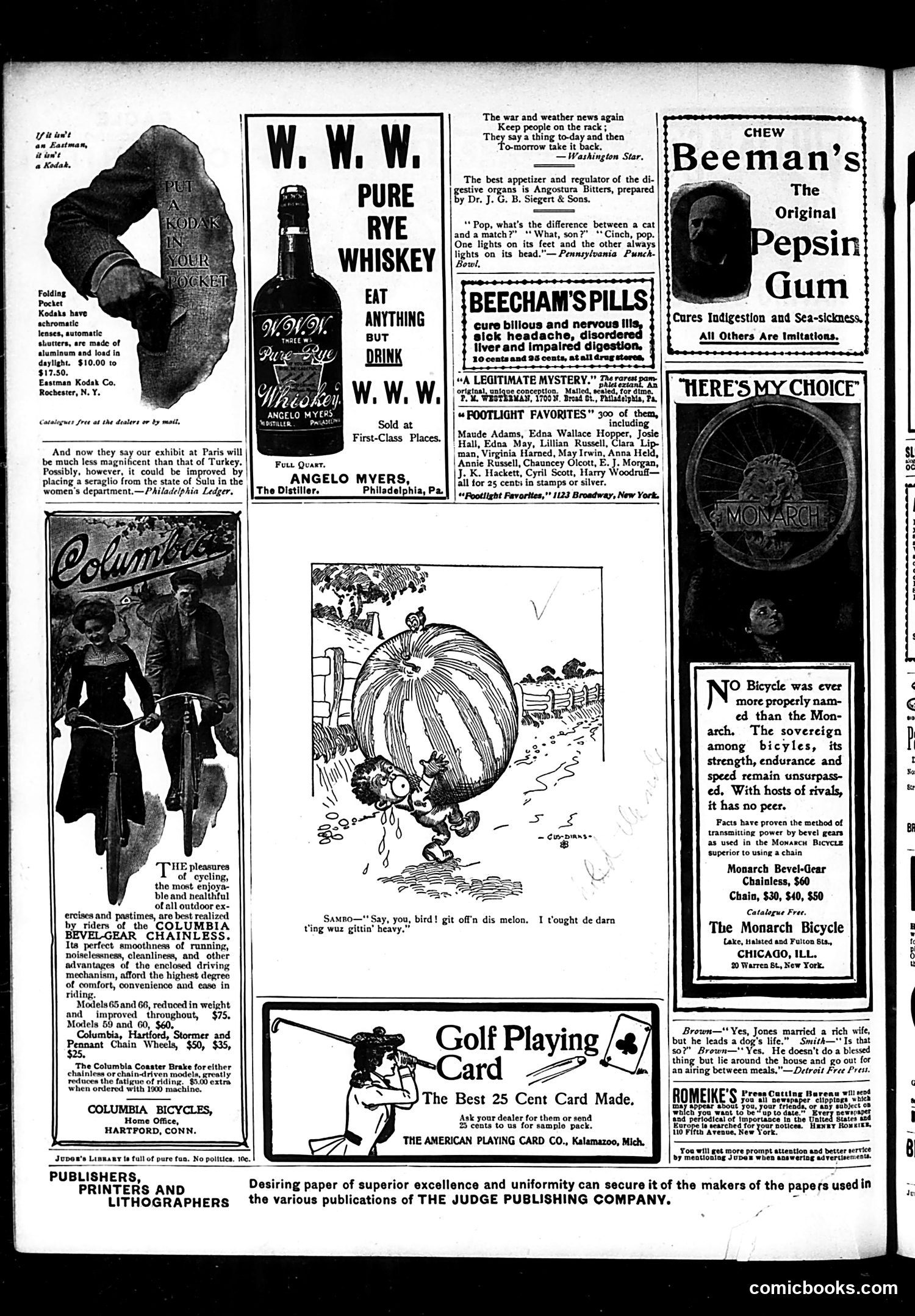
This page is primarily **advertising**, typical of late 19th/early 20th-century magazines. The notable content includes: **The Main Cartoon** (center): A small child named Sambo struggles to push a large melon off a road, saying "Say, you bird! git off'n dis melon. I fought de darn ting wuz gittin' heavy." This employs racist dialect humor common to the era, depicting a Black child in a struggle with an oversized object—the "joke" relying on stereotypical speech patterns and physical comedy. **Advertisements** dominate the page: W.W.W. Rye Whiskey, Columbia bicycles, Beeman's Pensin Gum, Monarch bicycles, playing cards, and various patent medicines (Angostura Bitters, Bregcham's Pills). **Minor jokes** scattered throughout use period-appropriate puns and wordplay unrelated to politics or social commentary. The page reflects advertising-heavy magazine economics of the era and casual acceptance of racial caricature in mainstream publications.
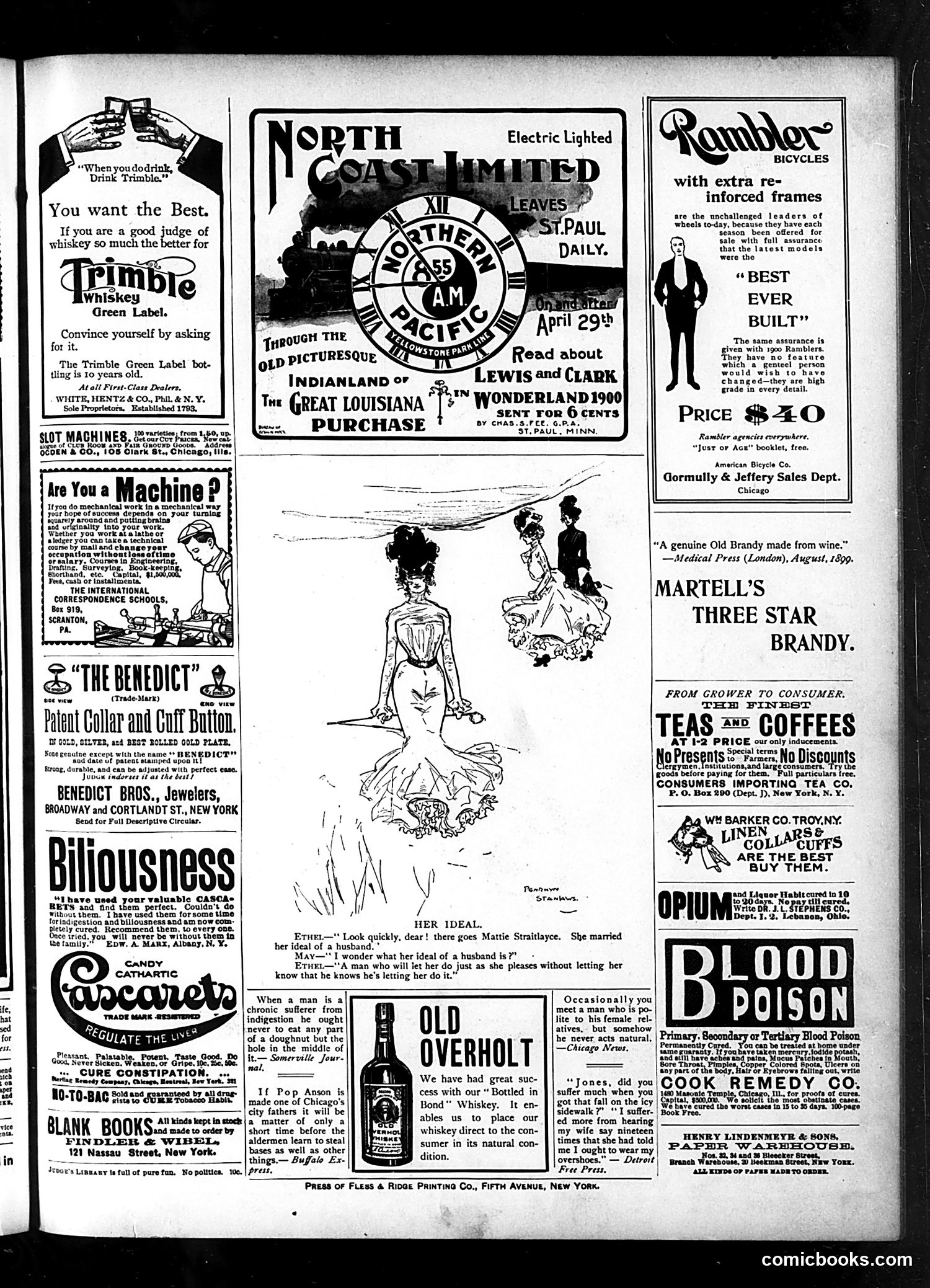
This page is primarily **advertisements and humor fillers**, not political satire. The main cartoon—titled "Her Ideal"—is a social comedy about marriage expectations. A woman remarks that her friend married "her ideal of a husband," which she defines as "a man who will let her do just as she pleases without letting her know that he knows he's letting her do it." This satirizes marital dynamics and female independence, suggesting wives desired autonomy while husbands maintained plausible deniability about permitting it. The rest of the page consists of period advertisements (whiskey, bicycles, brandy, tea, constipation remedies) and brief humorous squibs about local Chicago figures like baseball manager Pop Anson and various satirical observations about men's behavior. The North Coast Limited train advertisement references the 1900 Lewis and Clark Exposition, a real historical event celebrating westward expansion.
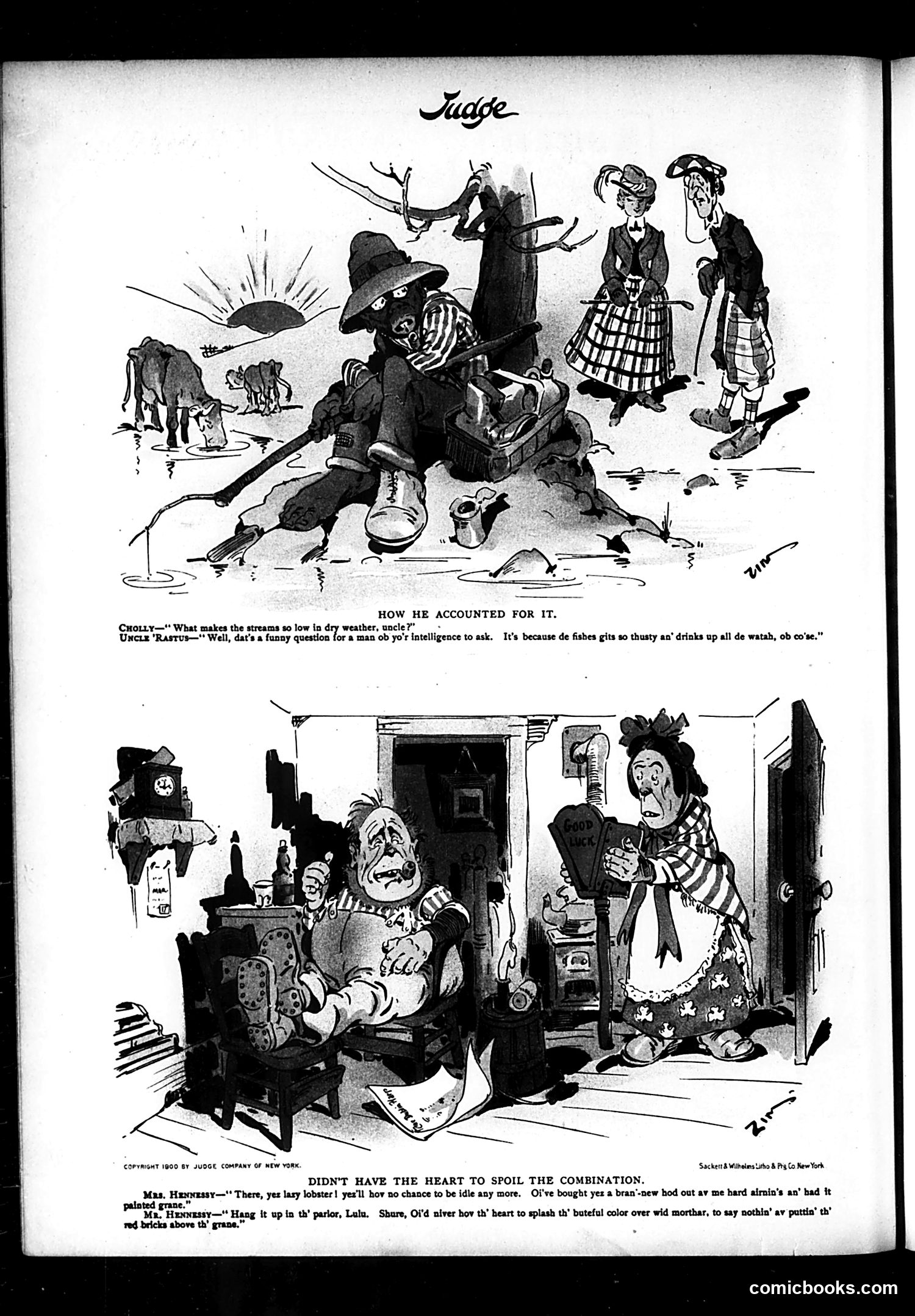
This 1900 Judge page contains two ethnic stereotype cartoons typical of the era's casual racism. **Top cartoon**: Features "Uncle Rastus," a Black character with exaggerated features. The joke relies on a racist "dialect" and portrayal of Black people as intellectually inferior—the humor hinges on the absurd explanation that fish drink all the water during dry weather. **Bottom cartoon**: Depicts Irish immigrant characters (the Hennessys) with heavy Irish accents rendered phonetically ("Oi've," "Shure"). Mr. Hennessy buys his wife a new coal hod (a bucket for carrying coal) with his hard-earned money. The joke is that she refuses to use it because the decorative paint is too pretty to ruin with actual coal—valuing appearance over function. Both cartoons mock marginalized immigrant and Black communities through exaggerated dialect, physical caricature, and supposed cultural or intellectual deficiencies. This represents standard Judge editorial content of the period, using stereotypes as the primary source of humor for contemporary readers.