
A complete issue · 16 pages · 1899
Judge — December 16, 1899
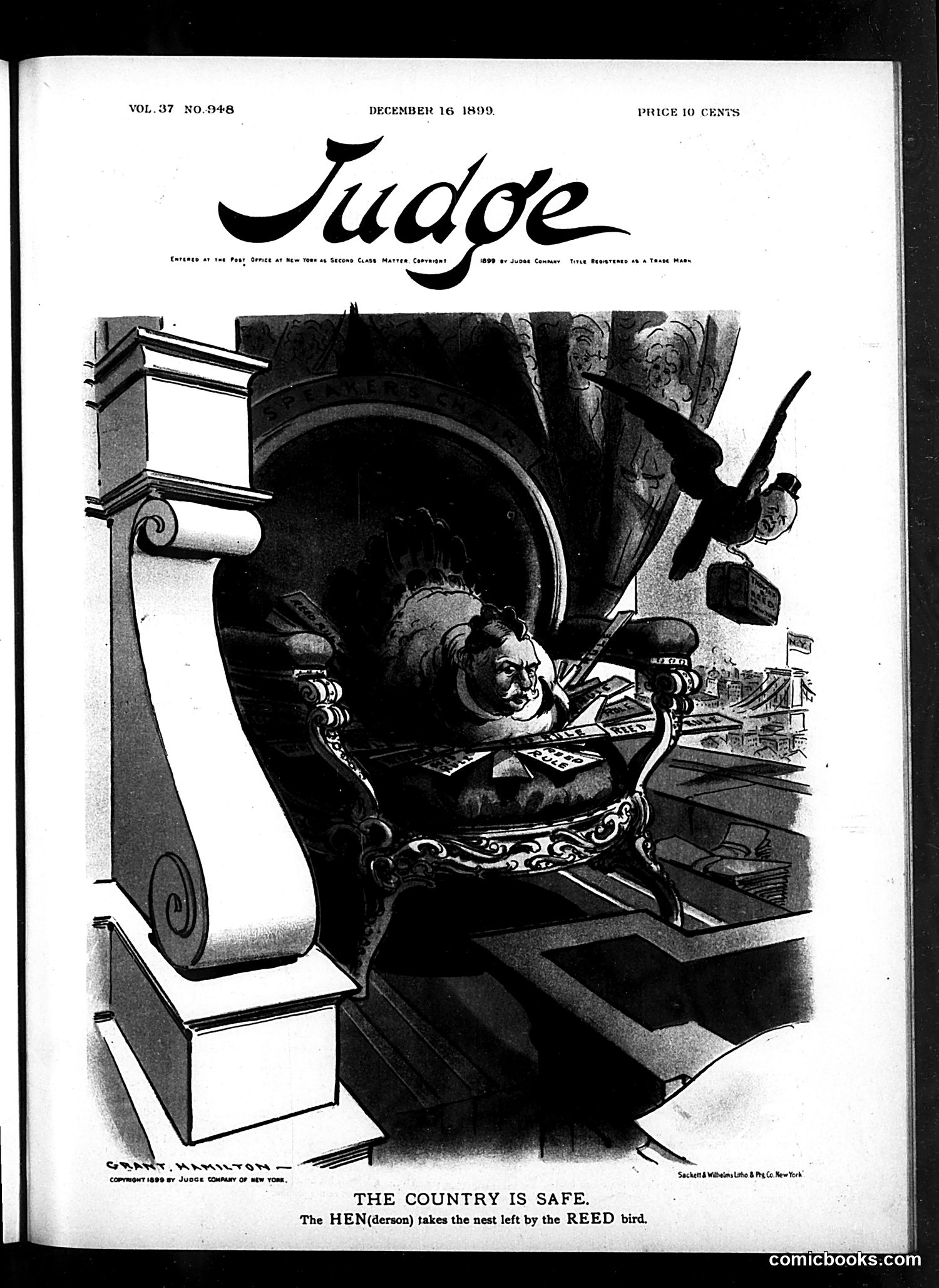
This political cartoon titled "The Country Is Safe" depicts a caricatured figure (labeled as representing "the HEN/derson") sitting in an ornate chair within what appears to be the U.S. Capitol building. The caption states "The HEN(derson) takes the nest left by the REED bird." This appears to reference a transition in House Speaker leadership in late 1899. The cartoon uses bird wordplay—"REED" (likely Speaker Thomas Brackett Reed) and "HEN/derson" (likely David B. Henderson, his successor)—to satirize the changing of the guard in Congressional leadership. The ornate chair represents the Speaker's position. The artist's satirical point seems to be commentary on this political transition, though the specific implications of the "country is safe" assertion are unclear without additional historical context.
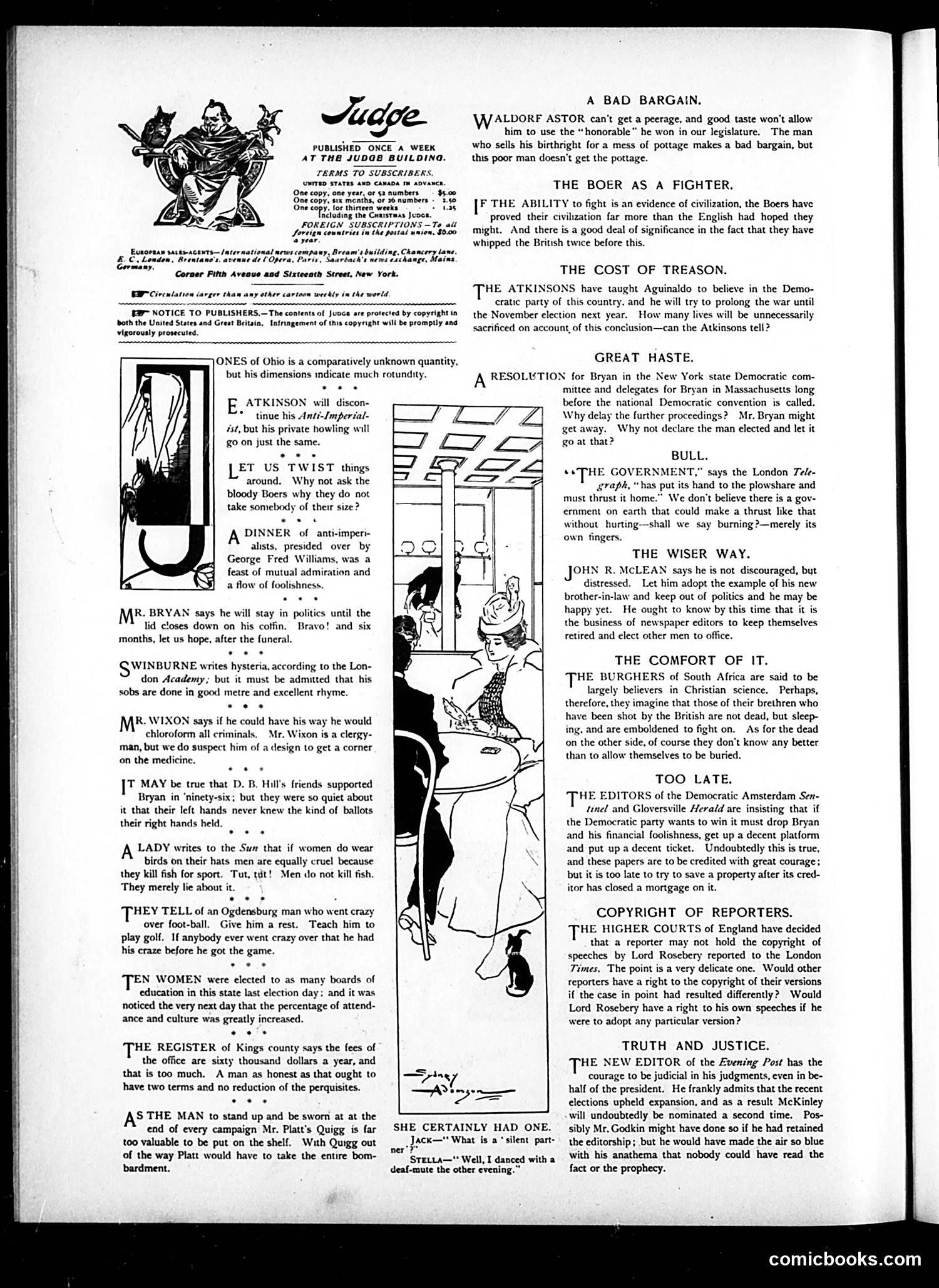
This page contains several political commentary sections rather than illustrated cartoons. The pieces critique political figures and events, likely from the early 1900s based on style and references. **Key content:** - "A Bad Bargain" mocks Waldorf Astor for selling his birthright - "The Boer as a Fighter" references the Boer War, praising Boer combat abilities - "The Cost of Treason" discusses Aguinaldo (Philippine independence leader) and Democratic party politics regarding an upcoming November election - "Great Haste" criticizes Bryan (William Jennings Bryan, Democratic candidate) for premature convention declarations - Other sections satirize Wilson, Swinburne, and various social observations The page reflects Judge's Republican-leaning editorial stance, targeting Democratic figures and positions on imperialism and domestic politics.
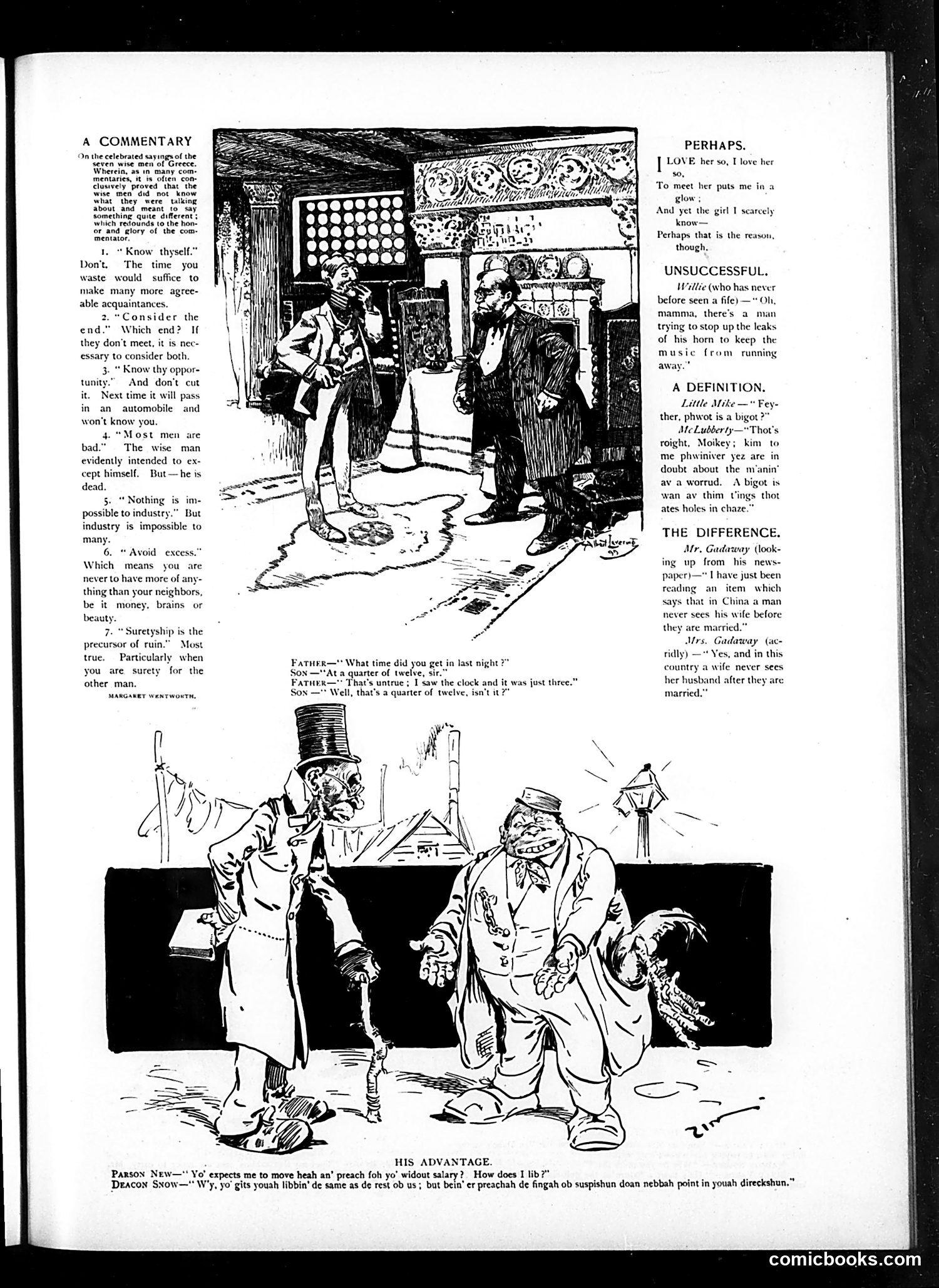
This page contains two separate cartoons and a "Commentary" section with humorous definitions. **Top cartoon**: Shows two men in what appears to be a music studio or practice room with sheet music and musical instruments. The caption indicates a discussion about musical practice or performance, though the specific reference is unclear without additional context. **Bottom cartoon ("His Advantage")**: Depicts a confrontation between two men—one in formal dress with a top hat, the other portly and roughly dressed. The caption suggests a dialogue about preaching and salary negotiations, with ethnic dialect used for comedic effect. This likely satirizes class differences and labor disputes common in early 20th-century America. The "Commentary" section offers brief satirical definitions of terms like "Know Thyself," "Consider the Girl," and "Suretyship," typical of Judge's humorous social commentary.
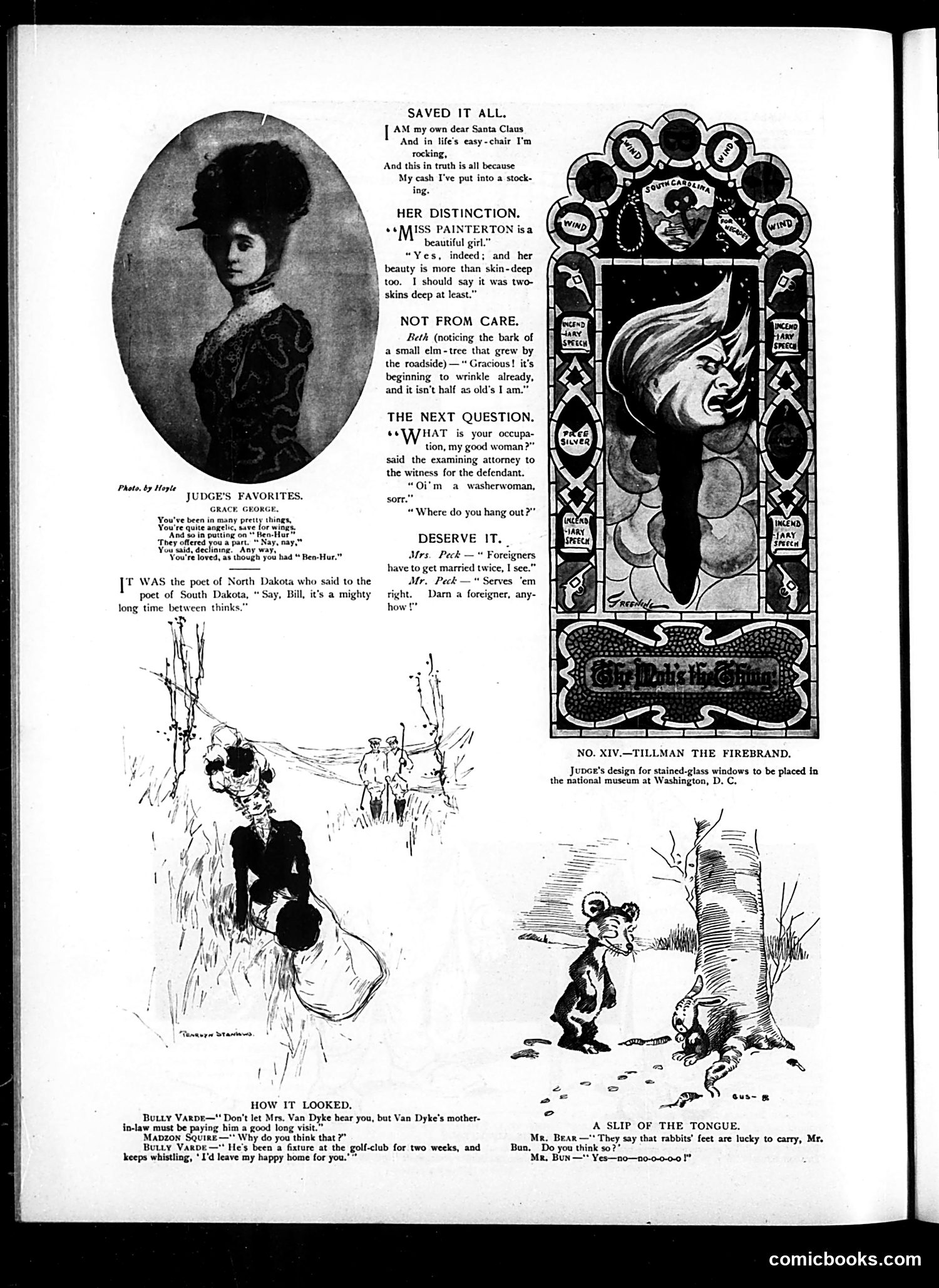
This page from *Judge* magazine combines several distinct items: **Upper left:** A portrait of "Miss Painterton" with commentary on her beauty, paired with a poem titled "Saved It All" about financial prudence through stock investments. **Center-right:** An ornate Art Nouveau illustration labeled "No. XIV—The Man in the Fireband," apparently part of a series. **Bottom section:** Humorous anecdotes labeled "Judge's Favorites" and "How It Looked," featuring dialogue about marital misunderstandings and comic situations. The final cartoon, "A Slip of the Tongue," shows what appears to be a bear and rabbit discussing the luck of "rabbits' feet." The page primarily showcases satirical humor through brief jokes and witty observations about contemporary social situations—particularly marriage, class anxieties, and financial matters—rather than direct political commentary.
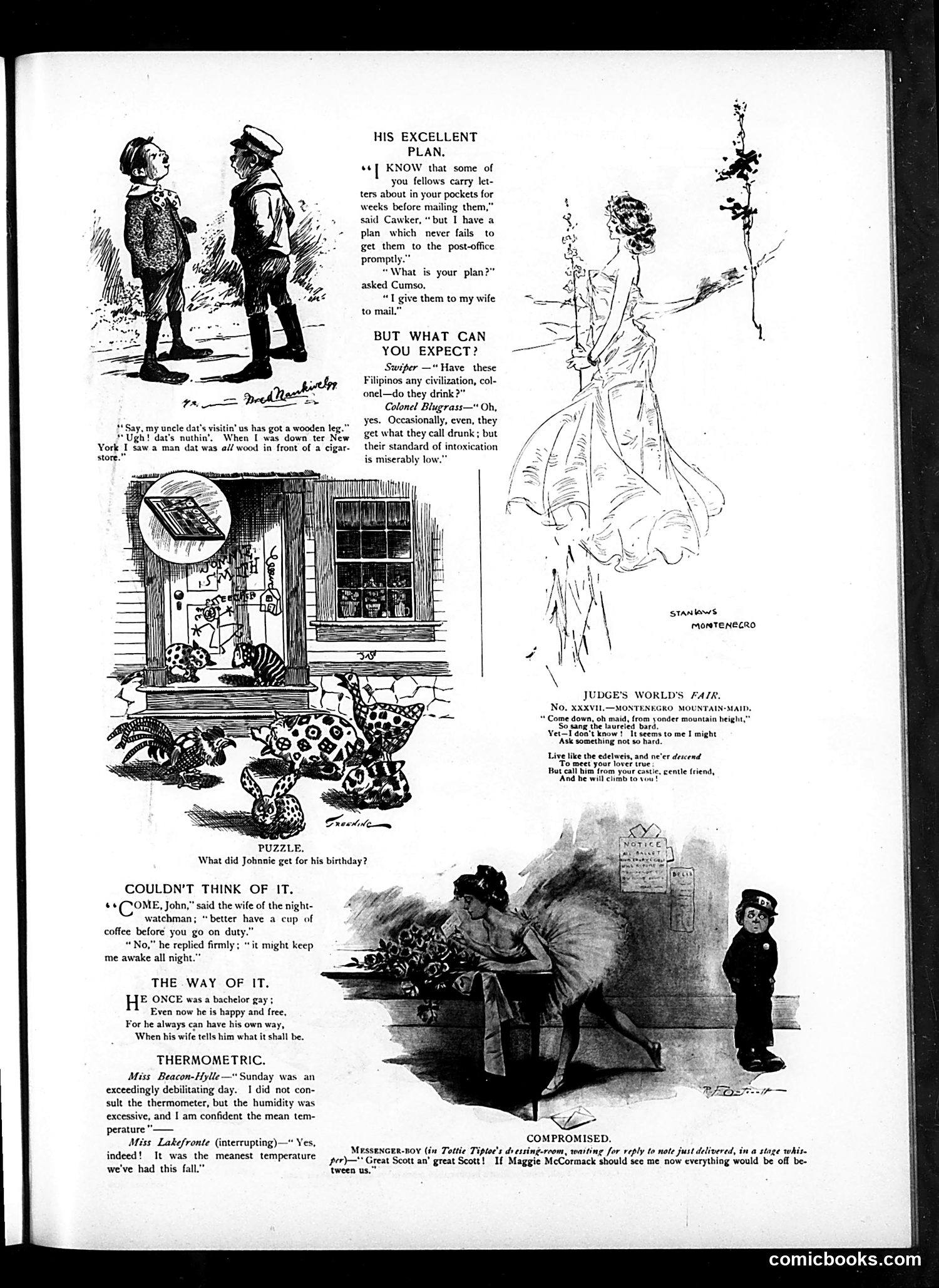
This page from Judge contains several brief humorous pieces typical of late 19th-century American satirical magazines: **"His Excellent Plan"** mocks the common excuse for delayed mail—a husband admits his wife's method of mailing letters (giving them to her directly) ensures they go out promptly, implying wives are more reliable than men's good intentions. **"The Way of It"** and **"Thermometric"** are gentle domestic humor about marriage dynamics and affected speech patterns. **"Judge's World's Fair"** references the 1893 World's Columbian Exposition in Chicago, offering a romantic poem about a "Montenegro Mountain-Maid." **"Compromised"** appears to be theatrical gossip about a messenger boy in actress Tottie Tiptoe's dressing room, with concern about a rival (Maggie McCormack) discovering a romantic note. The page also includes racist ethnic humor in the opening dialogue with stereotyped dialect. The illustrations and shorter jokes reflect Judge's typical mix of social satire, marital comedy, and theatrical celebrity gossip aimed at educated, urban readers.
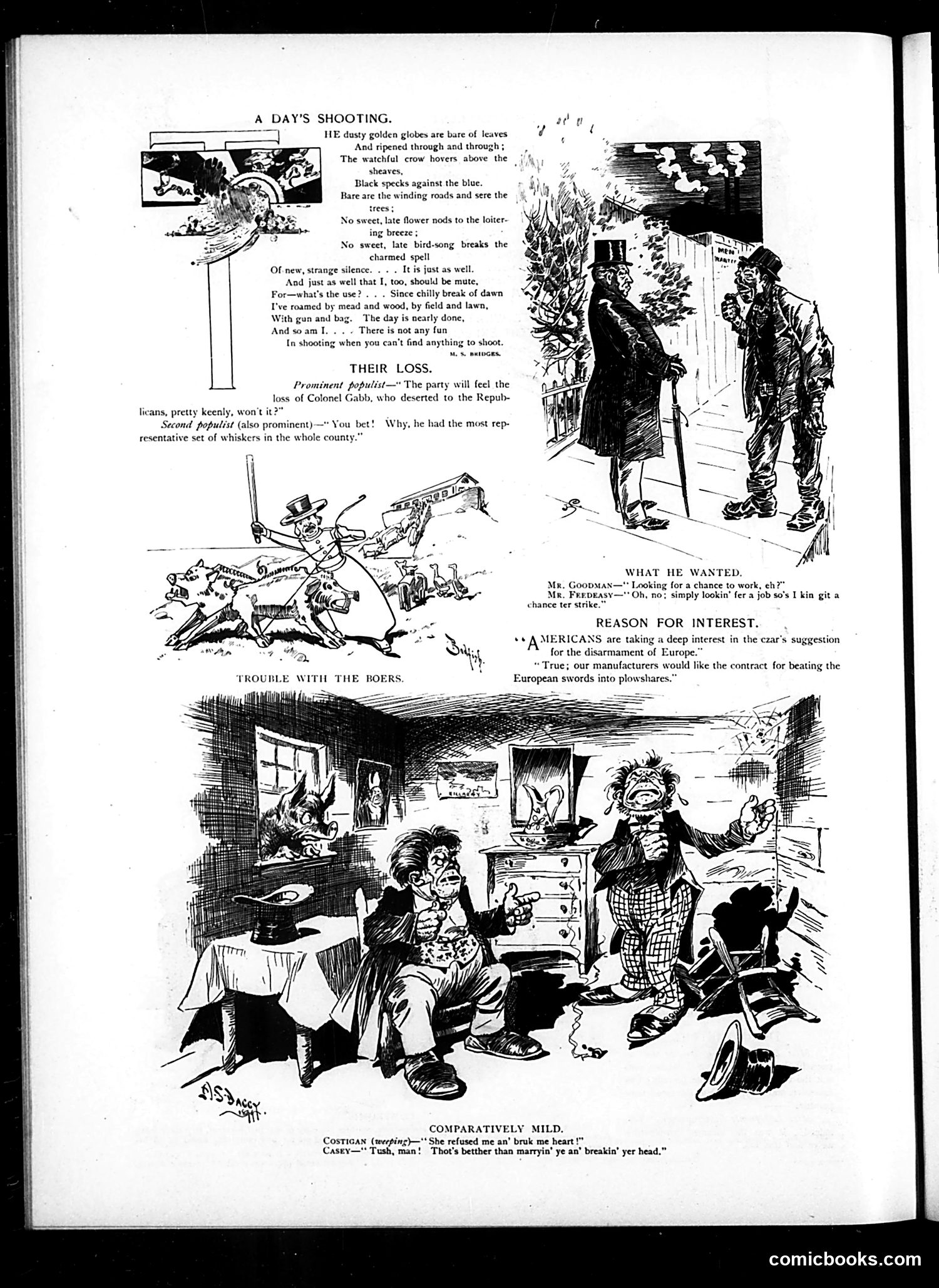
This page contains multiple satirical pieces typical of Judge magazine's style: **"A Day's Shooting"** is a poem about hunting frustration—finding no game to shoot, likely a metaphor for political impotence or futility. **"Their Loss"** mocks Populist Party politicians, suggesting their primary concern is Colonel Gabb's distinctive facial hair rather than his actual political defection to Republicans—satirizing the party's superficiality. **"What He Wanted"** depicts a jobseeker admitting he wants work only to gain leverage for striking, critiquing labor activism. **"Reason for Interest"** comments on American manufacturers' enthusiasm for the Czar's European disarmament proposal—they'd profit from converting weapons into plowshares, highlighting capitalist hypocrisy regarding peace. **"Comparatively Mild"** uses Irish-dialect humor to joke that refusing marriage is better than accepting it and suffering abuse—a dark domestic satire. The page reflects late 19th/early 20th-century American political cynicism, labor tensions, and satirical contempt for both Populists and industrial capitalism.
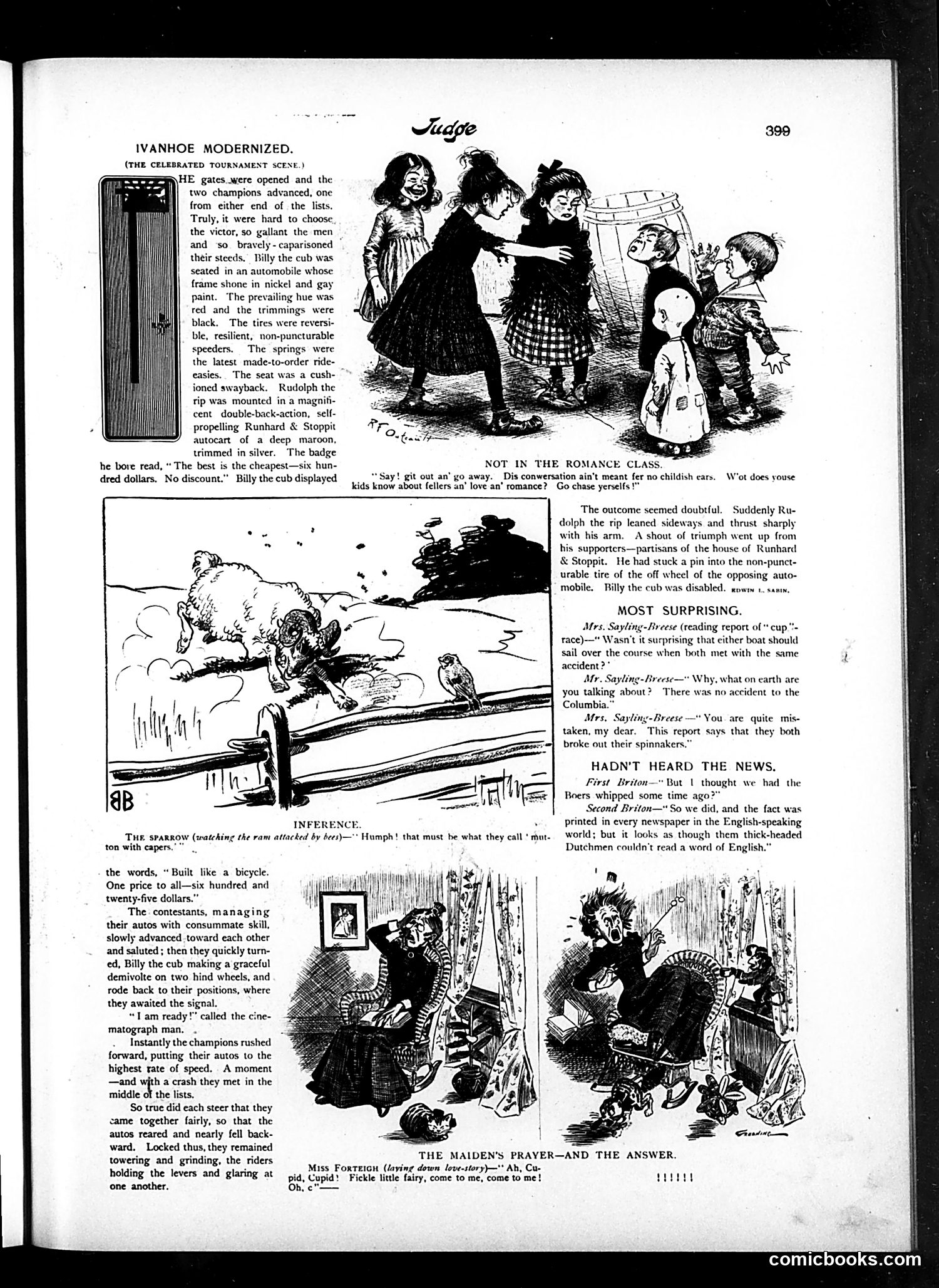
This page satirizes the modernization of Sir Walter Scott's *Ivanhoe* by replacing the medieval tournament with an **automobile race** — a contemporary early-1900s reference. "Billy the cub" and "Rudolph the rip" are champion racers whose vehicles are described with exaggerated detail (nickel frames, resilient tires, etc.), mimicking the novel's florid descriptions of knights and steeds. The satire mocks both the overwrought literary style and society's obsession with new automobile technology. The sidebar jokes reference contemporary events: the **Boer War** (Britain's recent conflict in South Africa), where the British claim victory but Boers allegedly remain unaware; and what appears to be an **America's Cup sailing race**, likely the 1901 competition between American and British yachts, poking fun at misunderstandings about nautical terminology ("spinnakers"). The cartoons use humor to comment on technological change displacing traditional romanticism and military valor.
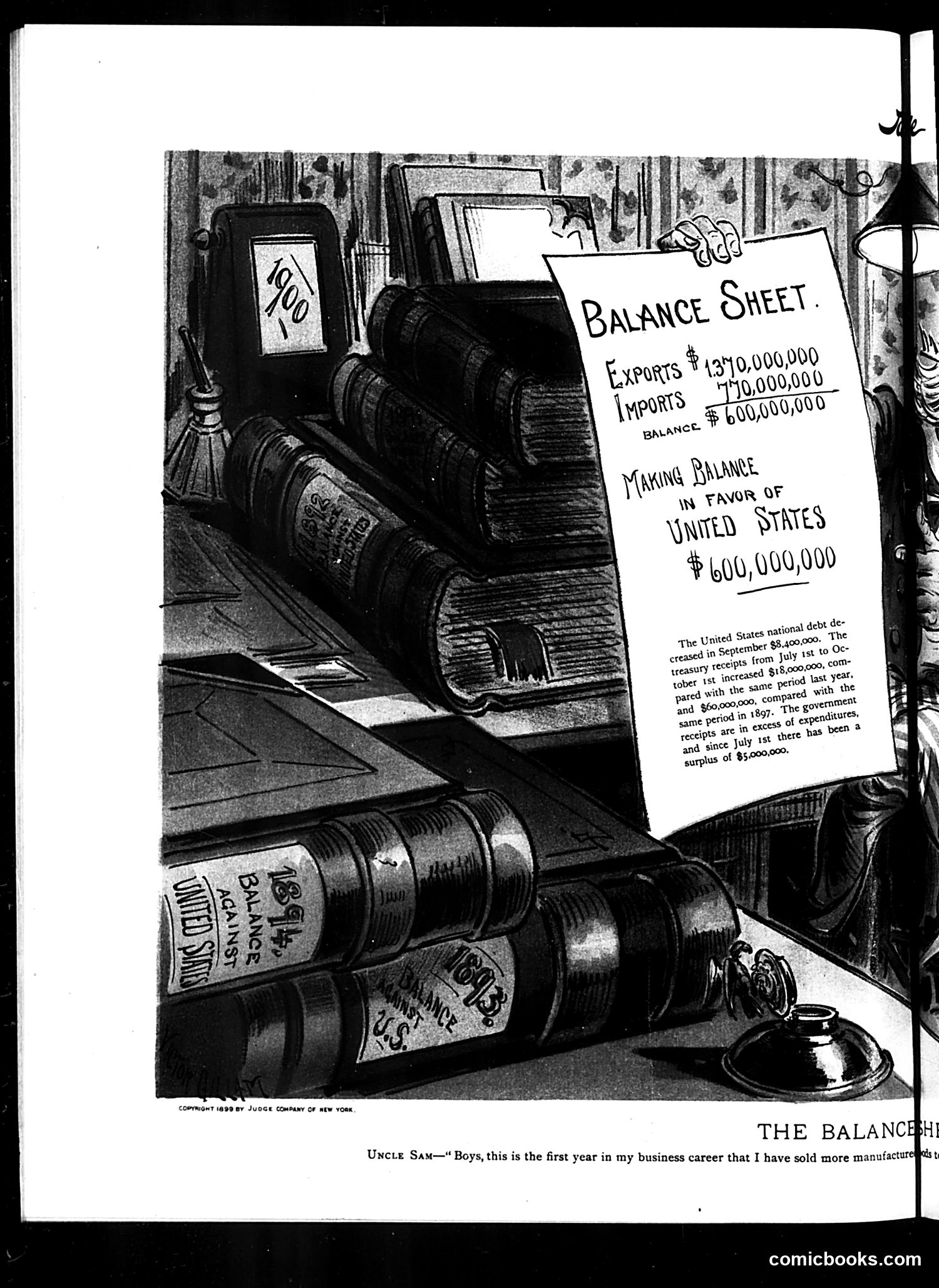
This political cartoon depicts Uncle Sam (personified as America) examining barrels labeled with trade goods, holding a "Balance Sheet" that shows: - Exports: $1,370,000,000 - Imports: $770,000,000 - Balance: $600,000,000 (in favor of the United States) The accompanying text notes the U.S. national debt decreased in September and treasury receipts exceeded expenditures, creating a budget surplus. **The satire**: Uncle Sam celebrates achieving a trade surplus and balanced budget—seemingly good news for American business. The visual metaphor of industrial barrels suggests this prosperity comes from manufactured goods exports, which the caption indicates is unusually successful for his "business career." The cartoon likely appears in a publication promoting American economic achievement during a specific fiscal period, though the exact date isn't visible here.
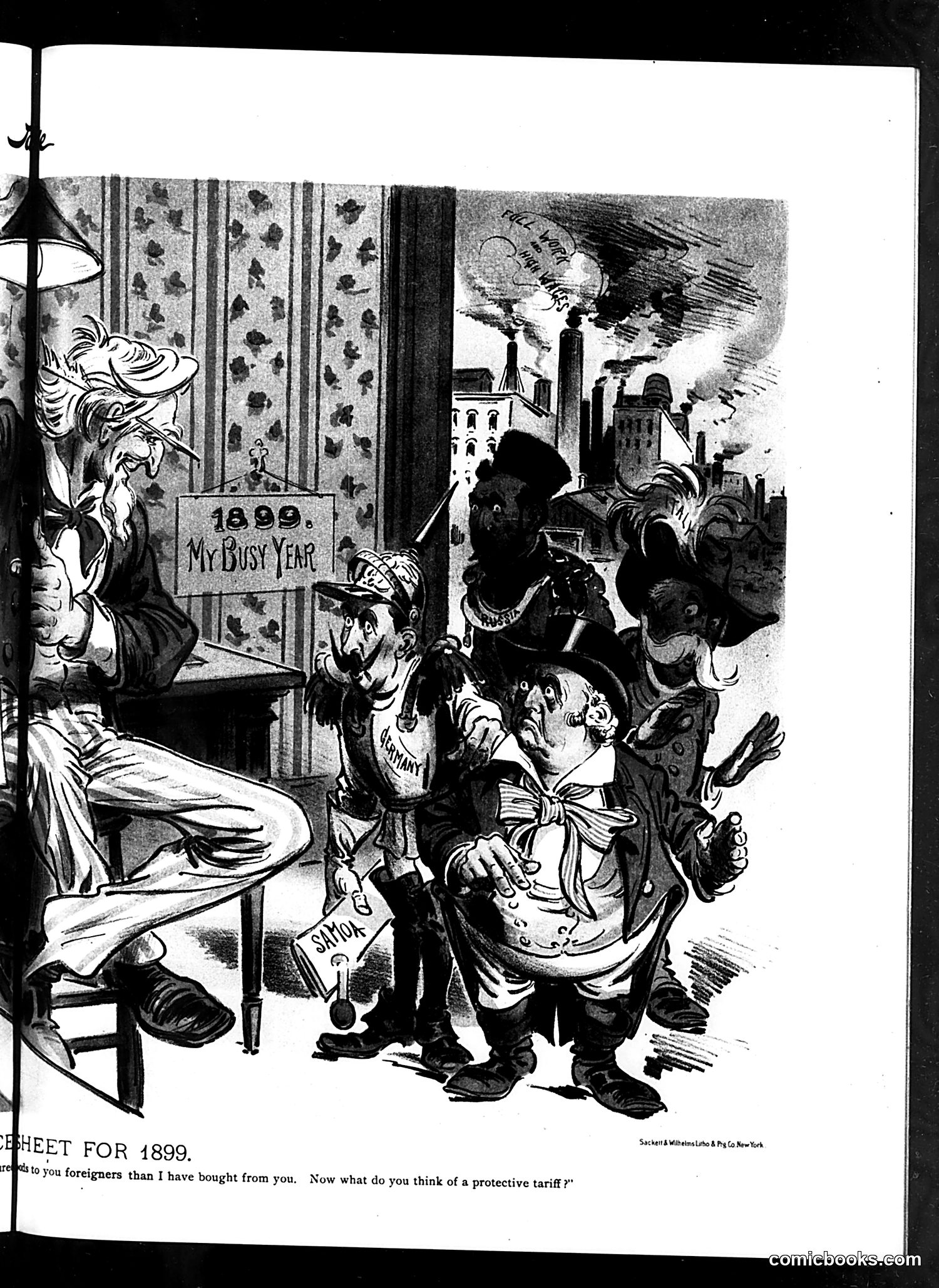
This Judge magazine cartoon satirizes the year 1899 through a chaotic scene featuring caricatured figures representing different nations or political interests. A bearded man (likely Uncle Sam or a Western power) sits observing a crowd of smaller figures engaged in frenzied activity, with industrial smokestacks visible in the background—suggesting commercial/industrial competition. The visible text fragment asks about a "protective tariff," indicating the cartoon critiques trade policy debates of that era. The crowded, bustling composition suggests 1899 was tumultuous for American commerce and international relations. The caricatured figures appear to represent foreign competitors or different economic interests vying for advantage. The satire likely mocks either protectionist trade policies or their opponents, depending on Judge's editorial position.
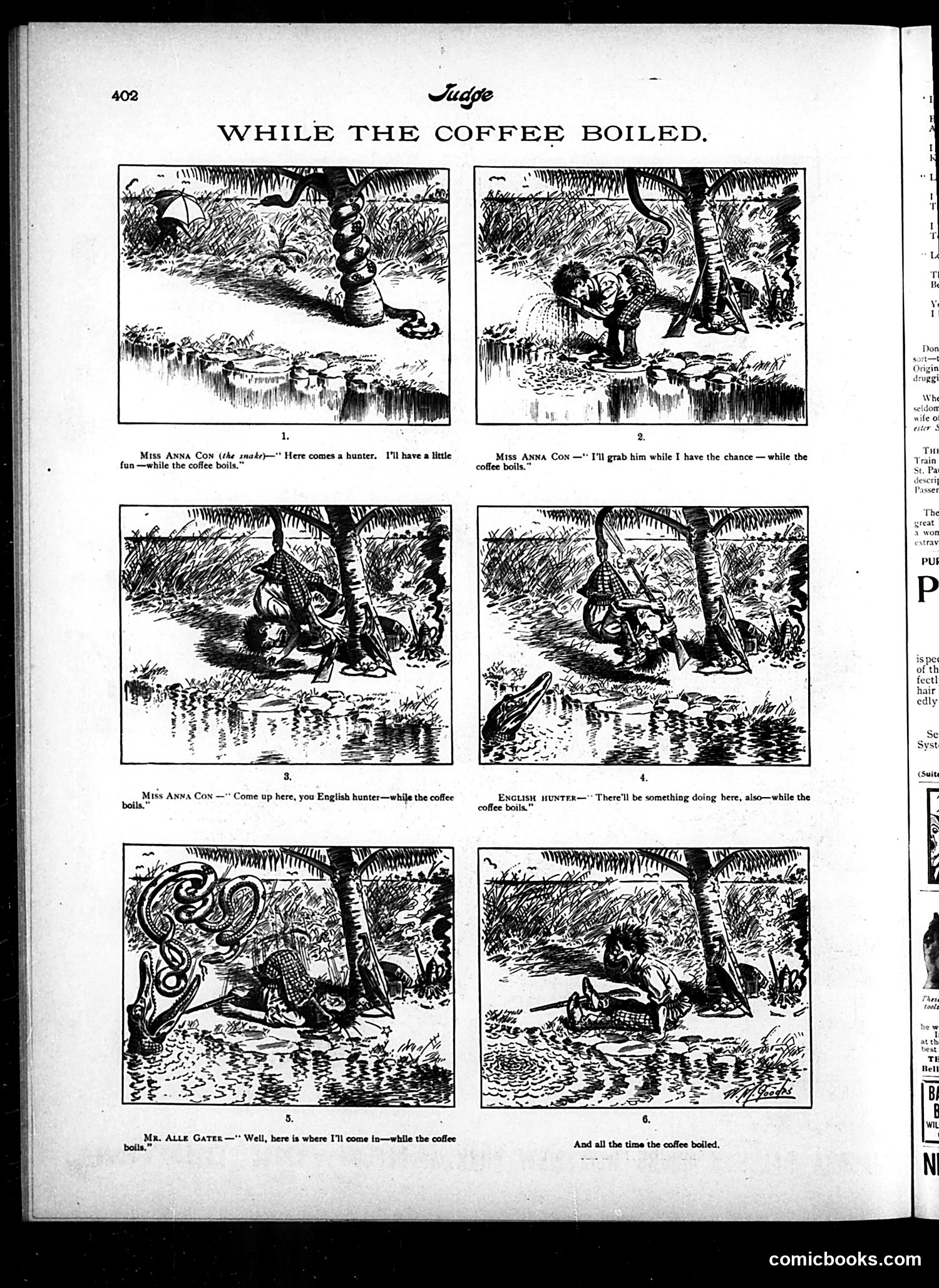
This six-panel comic satirizes colonial-era encounters in what appears to be India or similar British colonial territory. The recurring phrase "while the coffee boils" frames a series of humorous misunderstandings. The narrative features Miss Anna Con (depicted as a snake—a pun on "anaconda"), an English hunter, and Mr. Alle Gates, each planning to capture or seduce the others during a brief moment. The joke operates on dramatic irony: while each character schemes in isolation, they remain unaware of the others' simultaneous plans. The satire appears to mock the colonial attitude of casual conquest—treating encounters with both wildlife and local inhabitants as opportunities for sport or romance during leisure time. The repetitive "while the coffee boils" emphasizes how trivial these dramatic confrontations are framed as being—mere amusement to pass the time.
This appears to be primarily **an advertising page** rather than a political cartoon page. Judge magazine here functions as a vehicle for commercial advertisements, with only incidental satirical content. The page contains a short romantic poem ("The Sweet Command") and scattered witticisms typical of Judge's humor sections—brief, cynical observations about marriage, drinking, and social foibles (e.g., "When a man buys a drink for a friend he seldom stops to think that he has deprived his wife of one happy day at the big store"). The bulk of the page advertises consumer goods: **Packer's Tar Soap**, **Dunlop Tires**, **Sohmer Pianos**, **Chester Suspenders**, **Evans Ale and Stout**, **Wilson Whiskey**, and men's furnishings. One ad includes a brief anecdote about a freshman and a Scottish plaid suit—a mild joke about clever deception. There are **no identifiable political figures or substantive political satire** visible here. The page is characteristic of early 20th-century magazine advertising mixed with light humor.
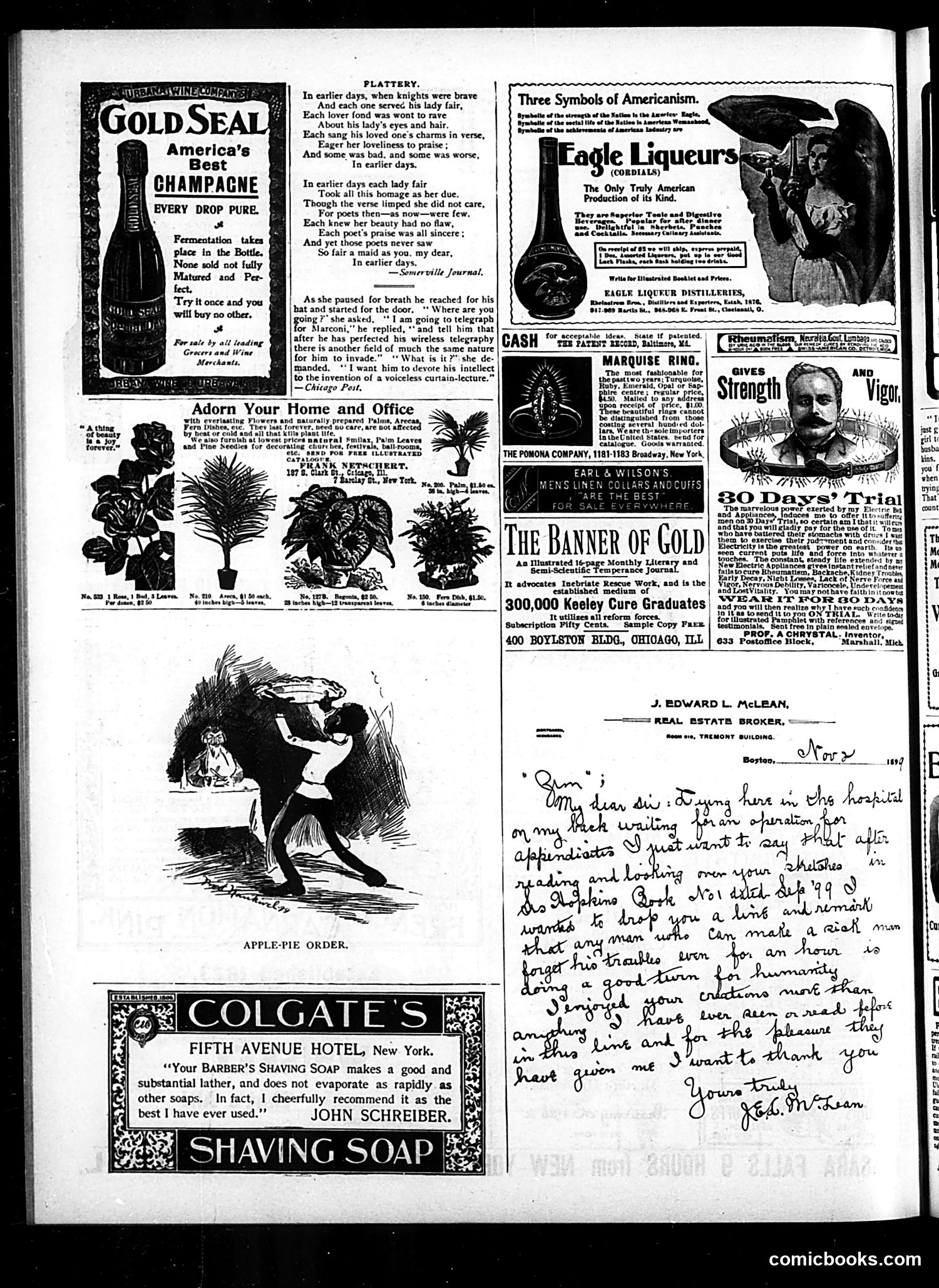
This page primarily consists of **advertisements and a handwritten letter**, with minimal satirical cartoon content. The most substantial editorial piece is the poem **"Flattery,"** which compares courtly love poetry of medieval times to contemporary flirtation. The satire is gentle: it nostalgically contrasts sincere (if clumsy) medieval verse with modern superficiality. The accompanying anecdote mocks a woman's endless talking—the man jokes about inventing a "voiceless curtain-lecture" (a reference to nagging wives), suggesting frustration with female verbosity, a common period trope. Below this is a small illustration labeled **"Apple-Pie Order"**—depicting what appears to be domestic chaos or confusion—though its exact satirical point is unclear from the visible image. The remainder of the page contains **commercial advertisements** for champagne, liqueurs, plants, real estate, shaving soap, and other goods typical of early 20th-century magazines. A handwritten testimonial letter from a real estate broker adds authenticity to the advertising. The page reflects Judge's mixed format: light social satire paired with substantial commercial content.
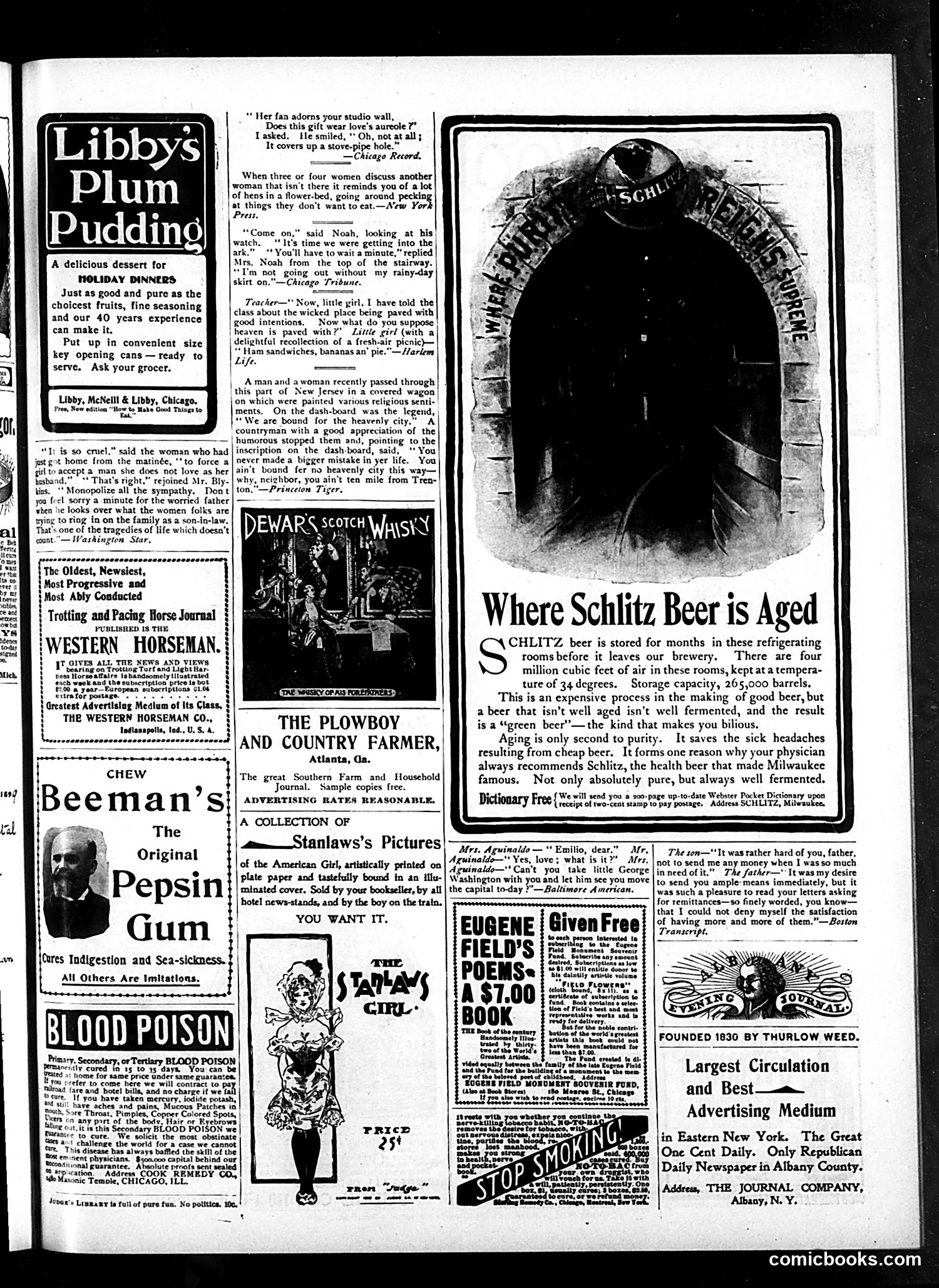
This page is primarily **advertising and light humor**, not political satire. The bulk consists of commercial ads for products like Libby's Plum Pudding, Beeman's Pepsin Gum, Schlitz Beer, and dubious patent medicines (a "Blood Poison" cure). The scattered jokes are social commentary rather than political: - A woman forced into marriage (theater melodrama trope) — the humor inverts sympathy to the "worried father" - Noah's wife delaying departure for her "rainy-day skirt" — domestic gender humor - A schoolgirl imagining heaven as "ham sandwiches, bananas an' pie" — innocent child humor - A covered wagon's "heavenly city" sign misidentified as heading toward Trenton, New Jersey — geographic/place-name humor The **Stanlaws's Pictures** advertisement references popular illustrated collections of "the American Girl" — a common commercial art genre of the era. No identifiable political figures or events appear. This is a typical early-20th-century magazine page mixing consumer advertising with gentle, family-appropriate humor.
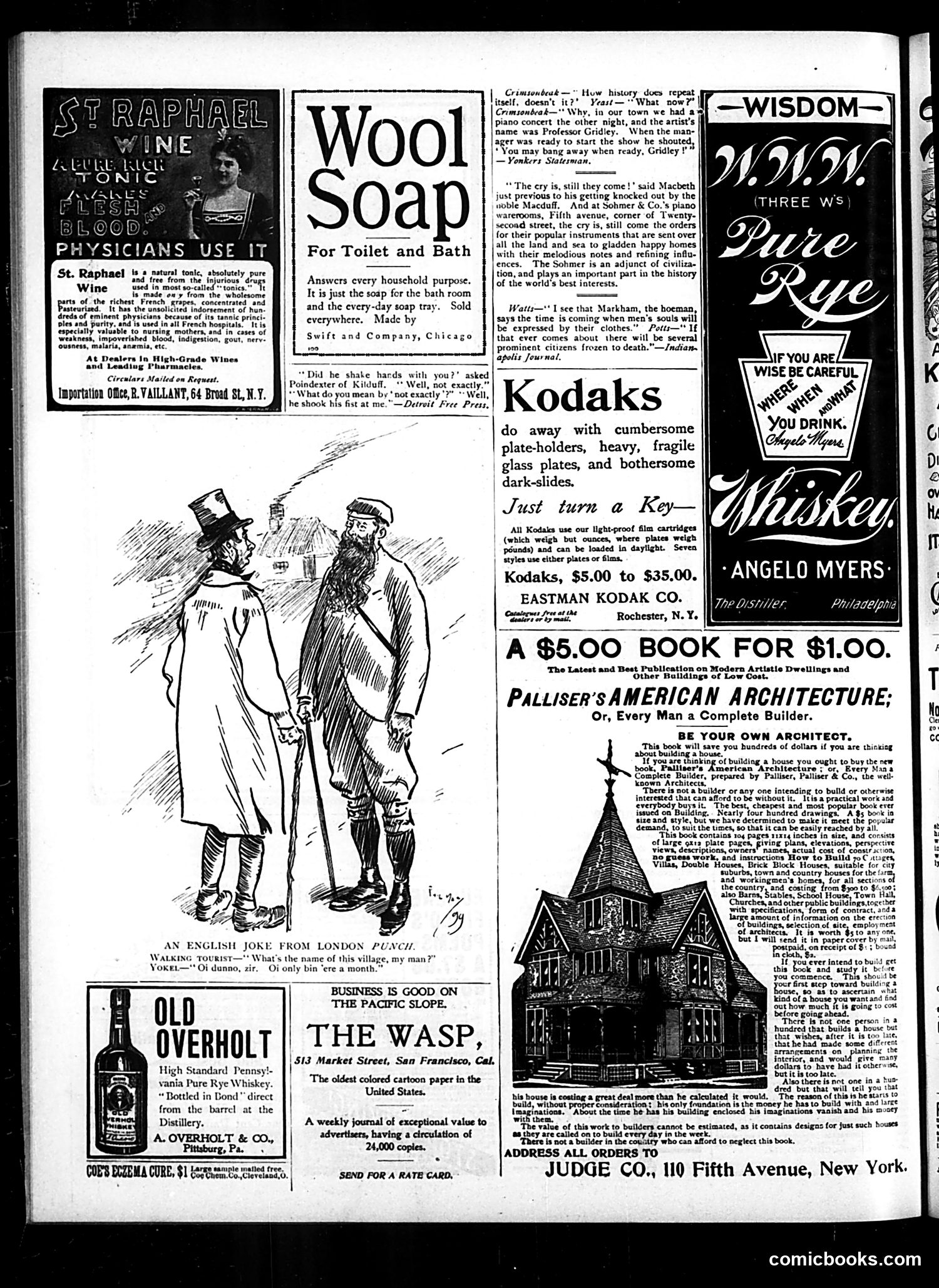
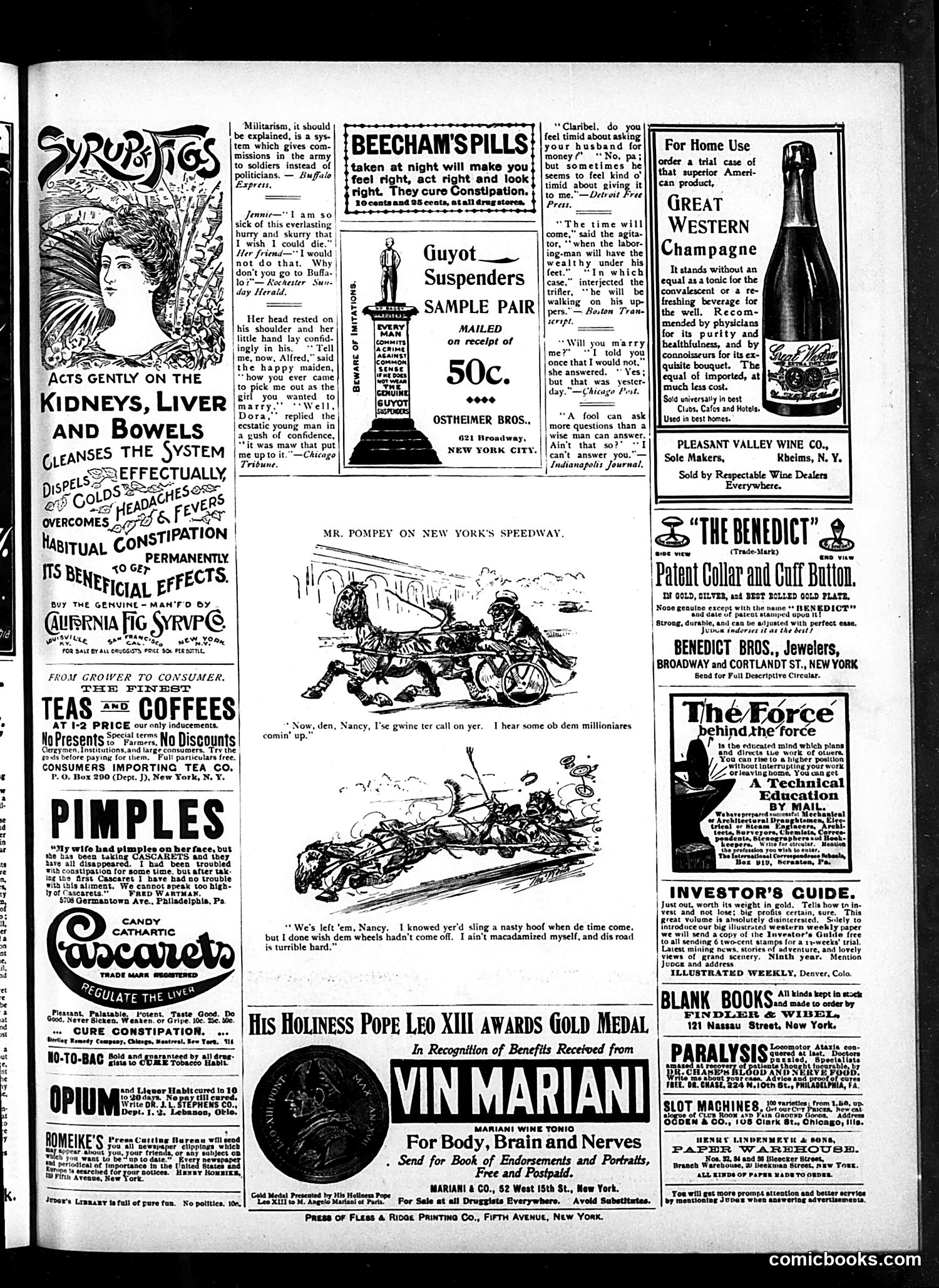
This page is primarily **advertisements** interspersed with brief comedic vignettes typical of Judge magazine's format. The main cartoon titled "MR. POMPEY ON NEW YORK'S SPEEDWAY" depicts an African American character named Pompey driving a vehicle, speaking in heavy dialect ("Ise gwine ter call on yer"). The joke concerns wealthy millionaires approaching on the speedway—Pompey claims he's already passed them, though his wheels have fallen off on the hard road. This reflects early-1900s attitudes toward automobiles, speed, and uses racial caricature common to the era's "humor." Other brief jokes scattered throughout address relationships (marriage proposals, marital finances) and bodily functions—typical Judge content. The advertisements promote patent medicines (Beecham's Pills for constipation, California Fig Syrup), wines, and various products targeting common complaints (pimples, opium addiction, constipation). These ads reveal what contemporaries considered marketable health concerns, now often viewed as quackery or inappropriate. The page lacks obvious political satire beyond one small quote criticizing "militarism" as giving army commissions to soldiers rather than politicians.
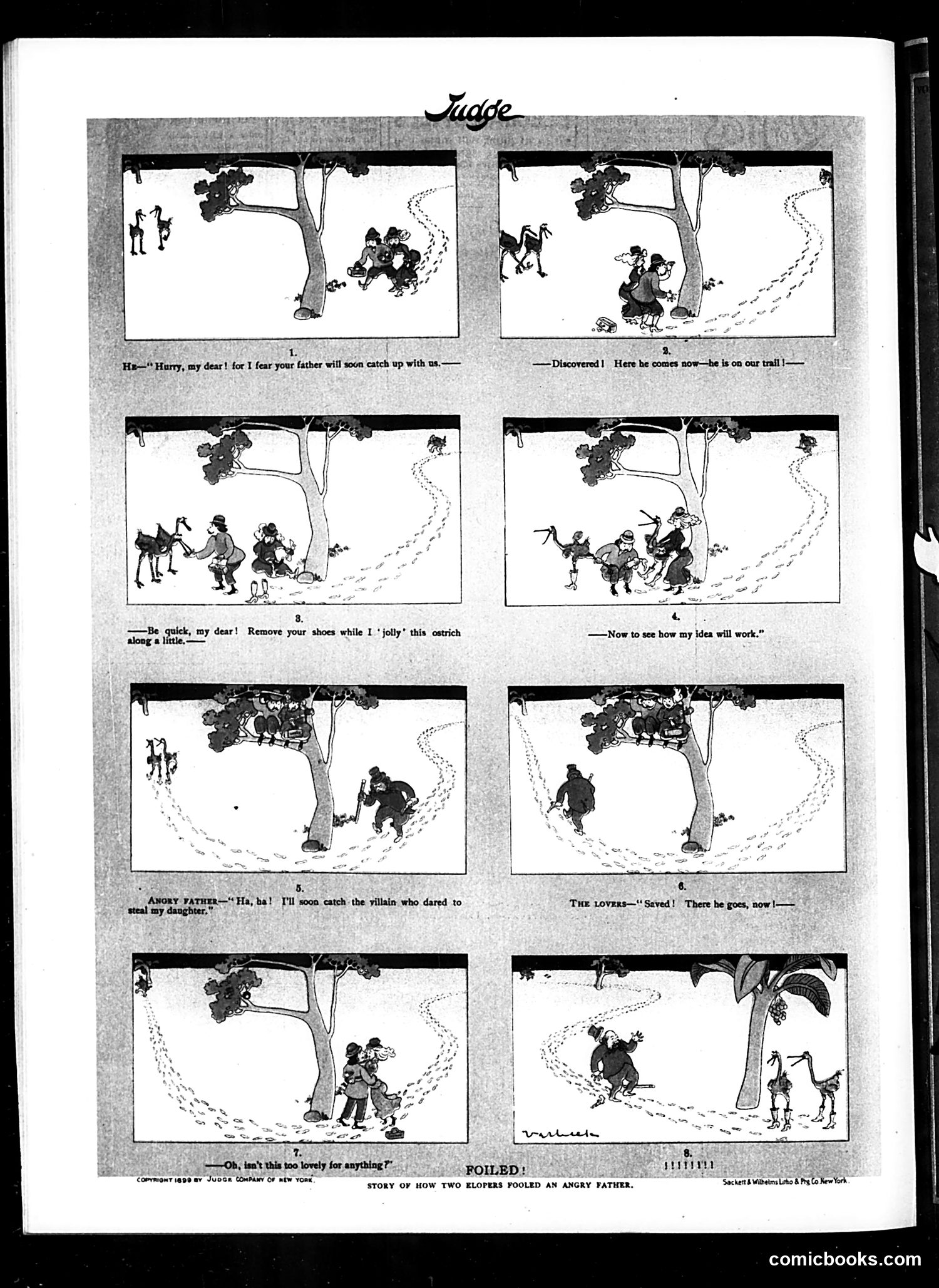
This is a humorous eight-panel comic strip about two young lovers eloping and outwitting an angry father pursuing them. The narrative follows a classic Victorian melodrama setup: a couple flees (Panel 1-2), the father discovers the elopement and gives chase (Panel 5), and the lovers devise a scheme involving an ostrich to distract him (Panel 3-4). The father becomes so focused on "jollying" the ostrich that he loses track of the fugitives. By the final panels, the lovers escape while the father remains absurdly occupied with the bird, leading to the punchline: "Oh, isn't this too lovely for anything?" The joke satirizes both romantic convention—the dramatic father-forbids-love scenario—and the absurdity of using a comical animal as a distraction device. It's lighthearted domestic comedy typical of Judge magazine's family-oriented humor.