
A complete issue · 16 pages · 1899
Judge — December 9, 1899
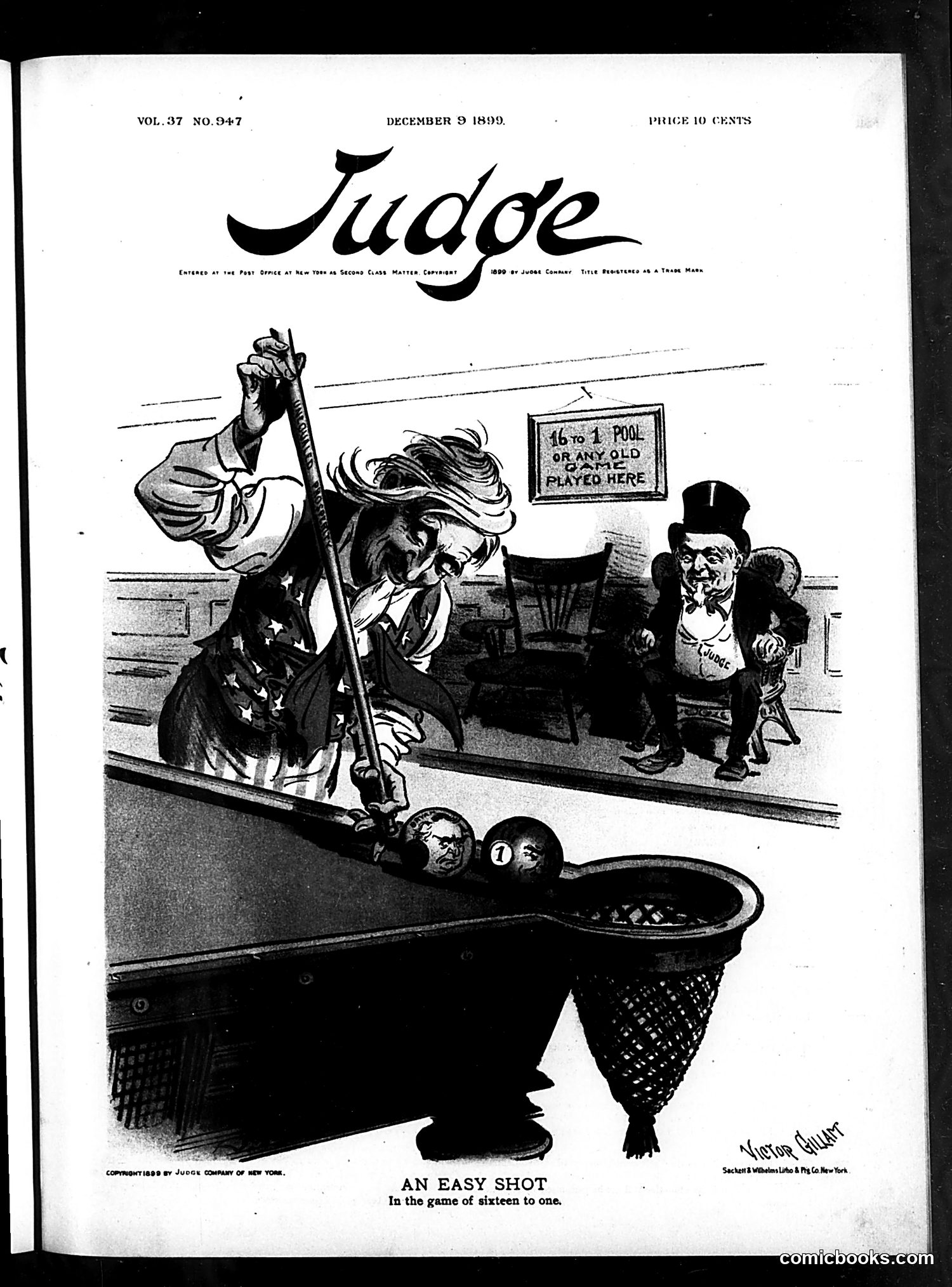
This political cartoon satirizes gambling culture, specifically pool/billiards. Lady Justice (blindfolded figure with sword) is depicted as a pool player, about to make a shot labeled "16 to 1 POOL OR ANY OLD GAME PLAYED HERE." Two well-dressed men observe from a bench—likely representing political or judicial figures complicit in gaming operations. The joke is that Justice herself has become compromised by gambling. Rather than administering impartial law, she's playing pool at odds suggesting rigged games ("16 to 1"). The caption "AN EASY SHOT: In the game of sixteen to one" implies that the fix is predetermined. This reflects 1890s American concerns about corruption in legal/political systems and the prevalence of illegal gambling establishments.
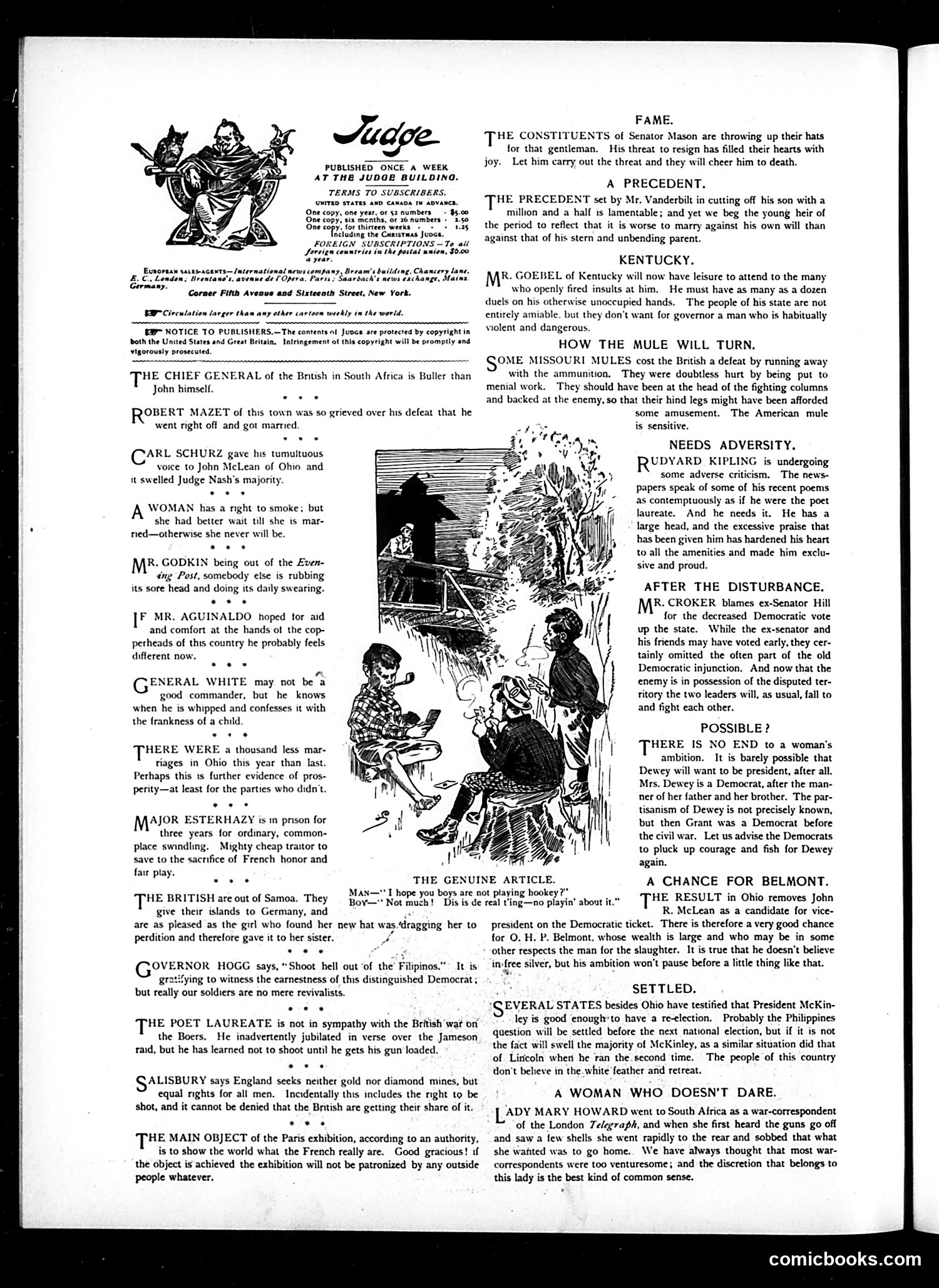
This page contains short political commentary pieces rather than a single cartoon. The central illustration depicts what appears to be a domestic or social scene with multiple figures in period dress. The satirical items mock various political figures and events of the era (likely early 1900s based on style). References include Senator Mason, Mr. Goebel of Kentucky, Rudyard Kipling, and discussions of Democratic politics, the Philippines, and British involvement in the Boer War. The humor relies on contemporary political knowledge—critiquing figures' statements, ambitions, and policy positions. Without precise dates or clearer context for each reference, exact meanings remain partially obscure to modern readers. The tone is consistently sardonic about political hypocrisy and public figures' contradictions.
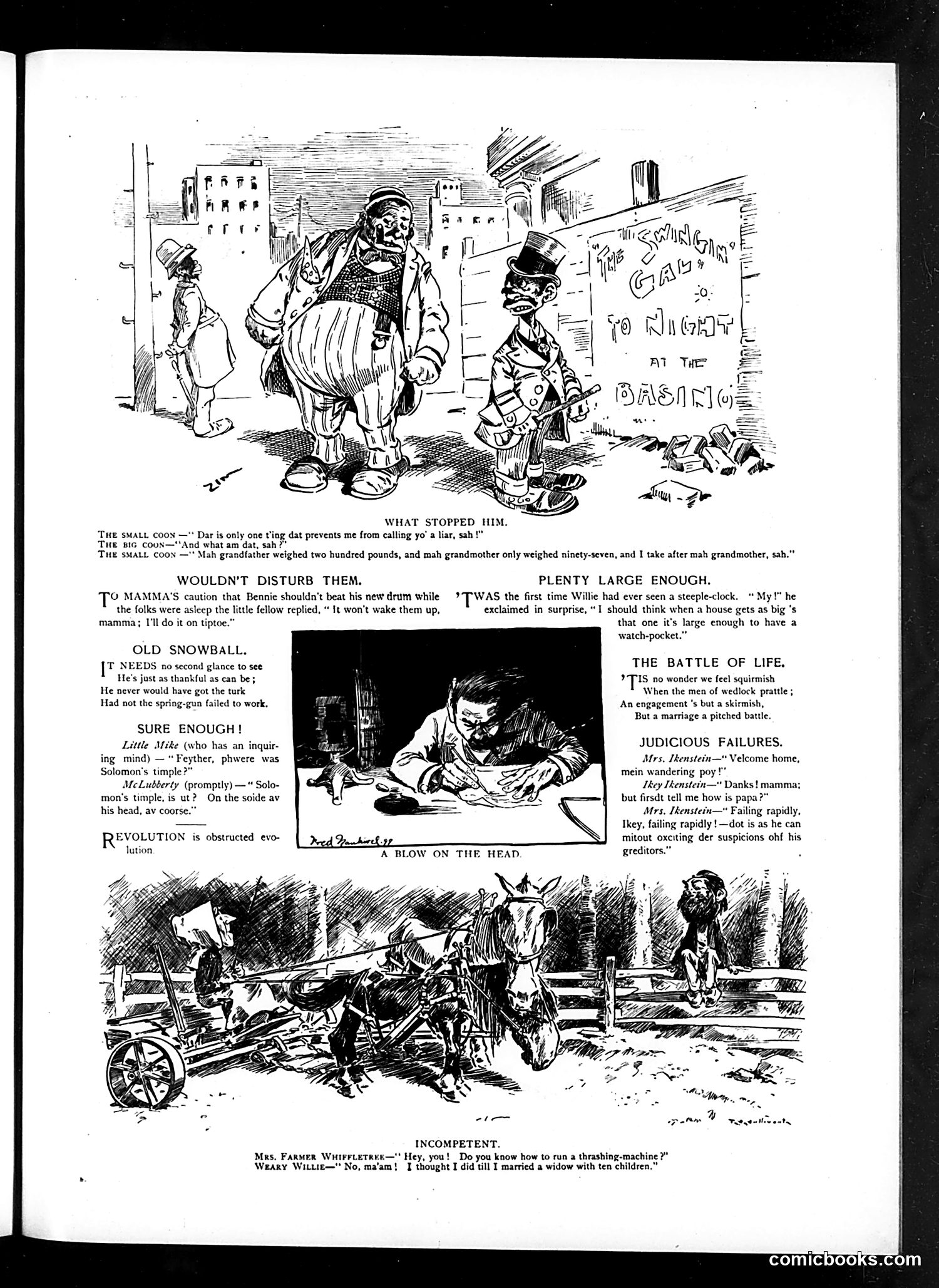
This page contains several humor sketches satirizing domestic life and social situations circa early 20th century. **Top cartoon** ("What Stopped Him"): A large man discusses his grandmother's weight (ninety-seven pounds) and warns against waking the house—satirizing domestic tensions and complaints about in-laws. **Middle sections** include brief humorous anecdotes about everyday life: an old clock that won't work, a man encountering a steeplejack, and marital discord during childbirth. **"A Blow on the Head"** sketch depicts someone being struck, likely illustrating comic physical humor. **Bottom cartoon** ("Incompetent"): A farmer's wife questions a hired hand about operating a threshing machine, suggesting incompetence among rural laborers—a common turn-of-century stereotype about farm workers' limited skills. The page emphasizes domestic comedy and working-class humor typical of Judge's satirical approach.
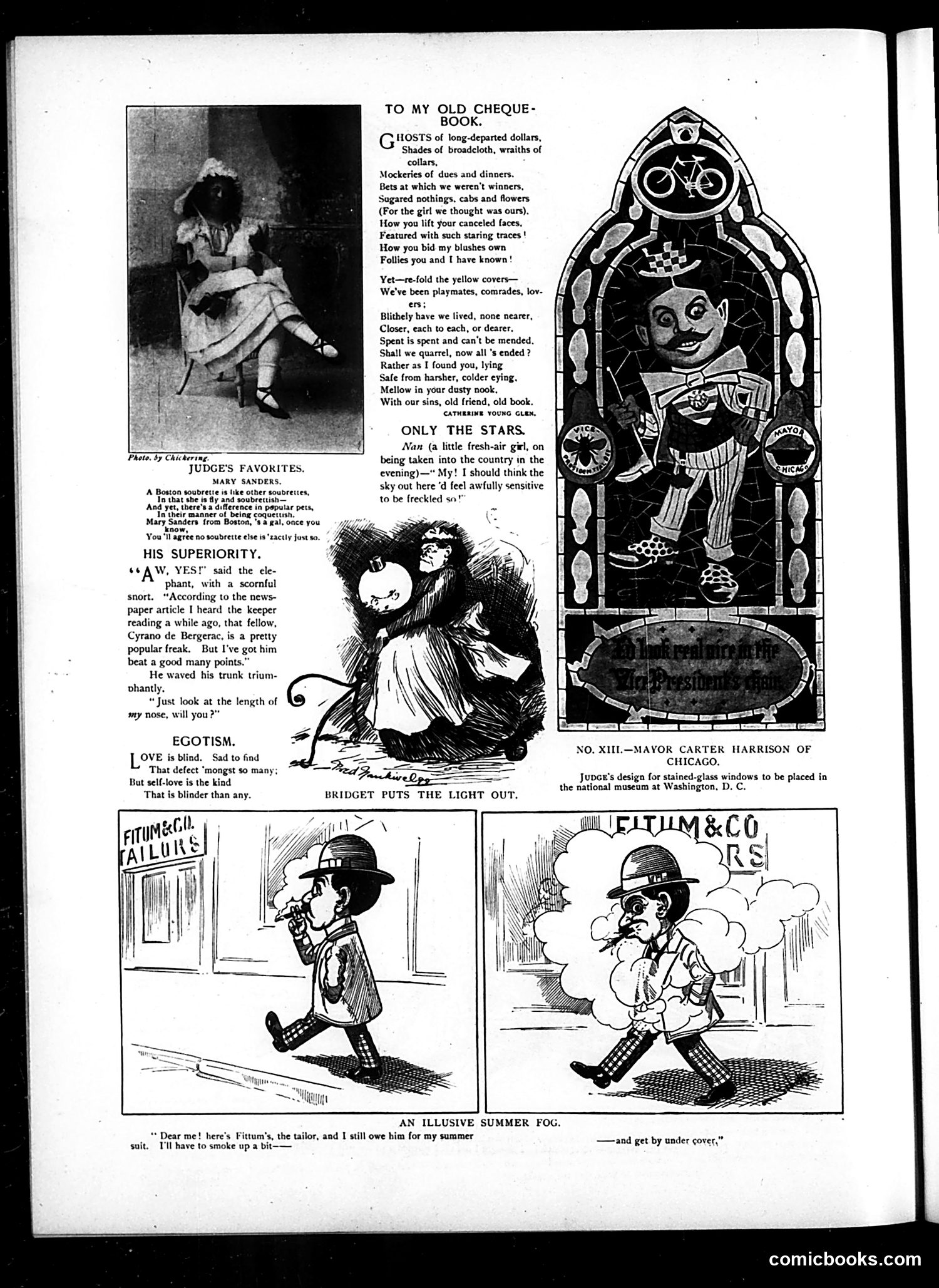
This page contains miscellaneous satirical content rather than a unified political cartoon. **"To My Old Chequebook"** is sentimental verse by Catherine Vour Clark about a well-used checkbook, personifying it as a friend through shared experiences. **"Chiddes Favorites"** features Mary Sanders, a Boston society figure, with commentary on her pet preferences. **"His Superiority"** presents a brief joke about someone named Cyrano de Bergerac being a "popular freak," mocking pretension through nose-related humor. **"Bridget Puts the Light Out"** appears a domestic servant humor cartoon. The **stained-glass window design** depicts Mayor Carter Harrison of Chicago—notable enough for the national museum at Washington, D.C. **"An Illusive Summer Fog"** shows Fittum & Co., apparently a tailor facing business failure, using smoke as cover—a visual pun on business deception.
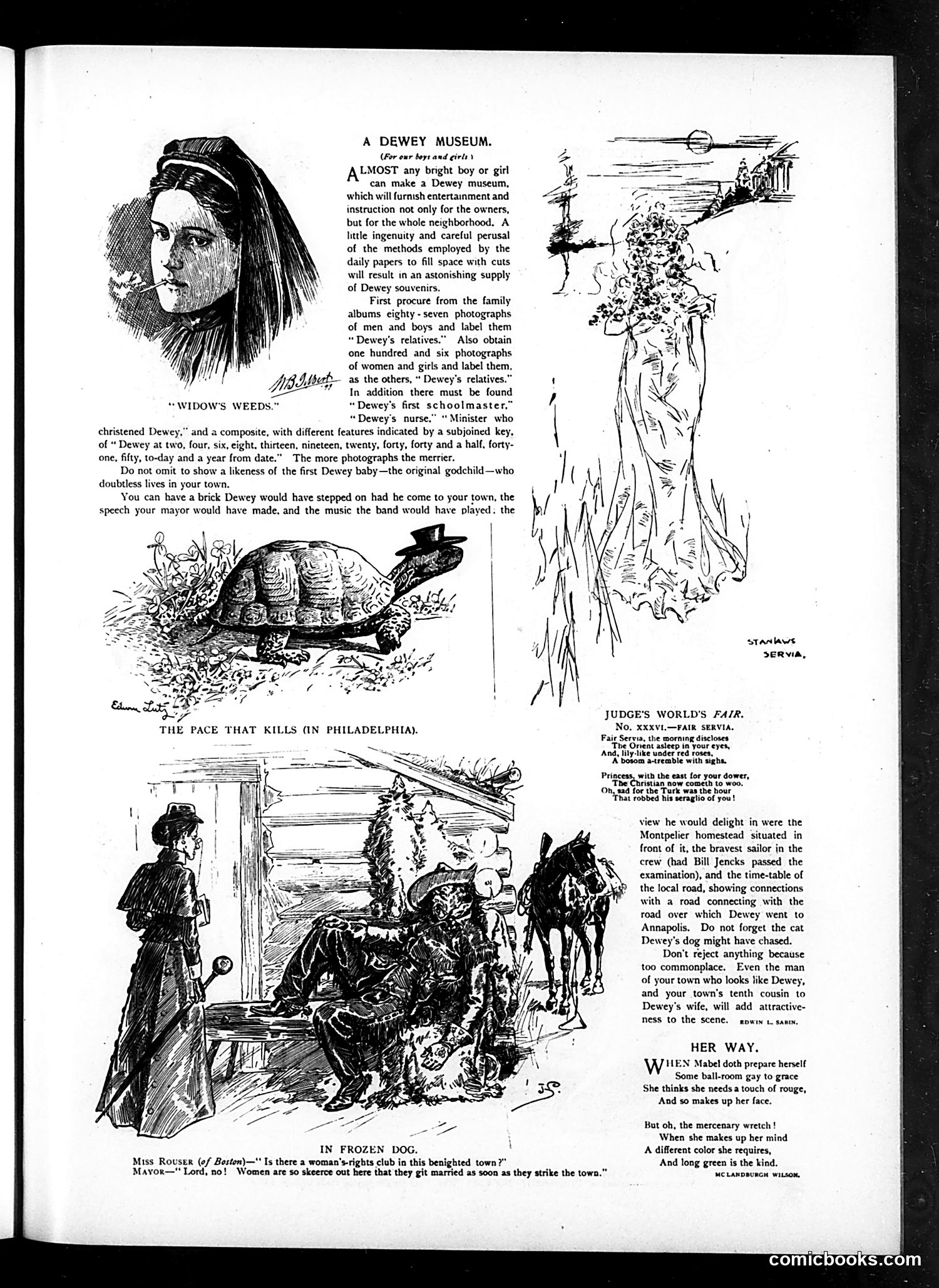
This page satirizes the American public's obsession with Admiral George Dewey following his naval victory in the Spanish-American War (likely 1898). Judge mocks how newspapers and the public manufacture celebrity memorabilia by suggesting readers create absurd "Dewey museums" from ordinary objects—family photos relabeled as "Dewey's relatives," composite images showing Dewey at every age, even bricks he "might have stepped on." The satire targets both the media's sensationalism (filling papers with celebrity content) and public gullibility in consuming mass-produced nostalgia. By suggesting people collect items like the mayor's speech or the band's music "he would have played," the cartoon exposes how manufactured celebrity worship inflates trivial objects into "souvenirs." The other cartoons on the page ("Judge's World's Fair," "Her Way," "In Frozen Dog") appear unrelated satirical pieces on romance, gender relations, and regional life.
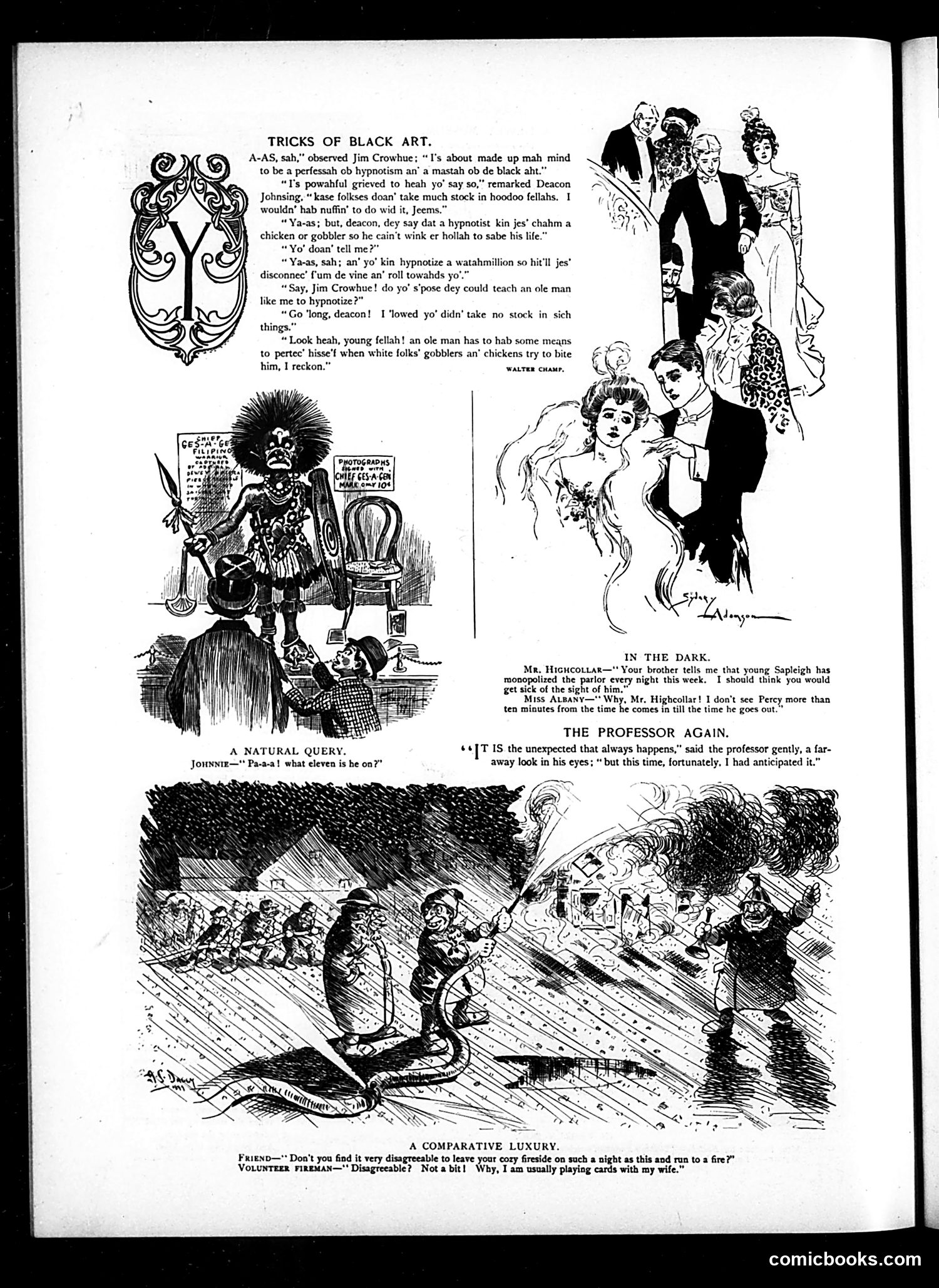
This page contains three separate humorous sketches typical of early Judge magazine: **"Tricks of Black Art"** (top): A dialect-heavy joke featuring Jim Crowhue and Deacon Johnsing (characters using racist minstrel-show speech patterns common to the era). Jim proposes becoming a hypnotist, claiming he could charm chickens or make watermelons detach from vines. The deacon, initially skeptical of "hoodoo," becomes interested when Jim suggests it could protect him from white people's livestock—a subtle commentary on theft anxieties and racial dynamics of the period. **"In the Dark"** (middle): A brief romantic comedy where Miss Albany claims barely seeing her suitor Percy, though he monopolizes her parlor nightly—a conventional joke about courtship deception. **"A Comparative Luxury"** (bottom): A volunteer fireman jokes that leaving his fireside to fight fires is actually preferable because it escapes playing cards with his wife—a domestic complaint joke. The page reflects Judge's mix of racial stereotypes, romantic humor, and domestic comedy typical of early-20th-century American satirical publications.
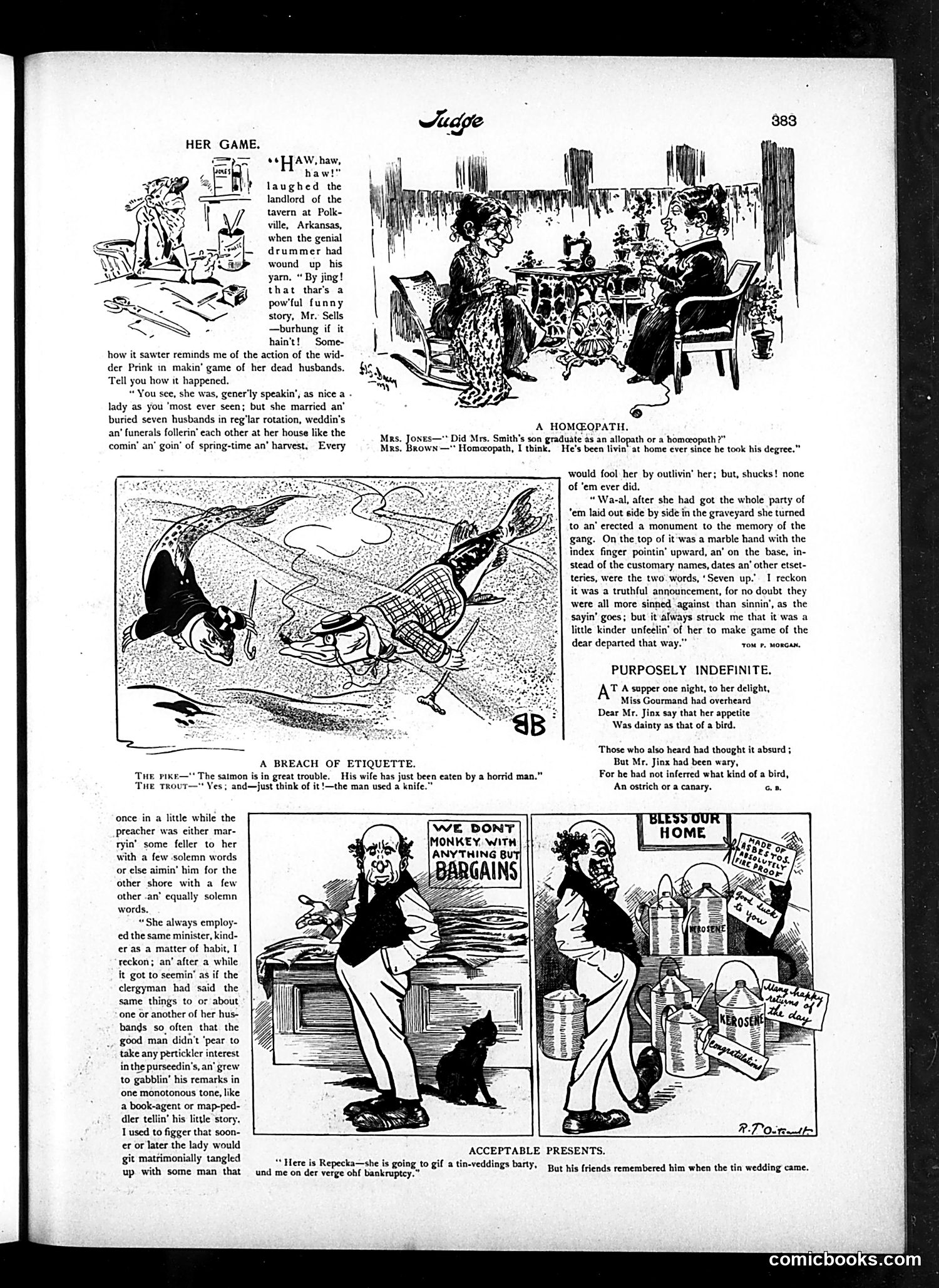
This page contains several satirical pieces typical of early 20th-century American humor: **"Her Game"** mocks a widow who married and buried seven husbands in succession, then erected a monument reading "Seven up"—a cruel pun on both card games and her marital history. The joke satirizes both her serial marriages and her tasteless mockery of the deceased. **"A Homeopath"** jokes about a young man graduating in homeopathy (an alternative medicine popular then) who simply lives at home—a pun suggesting he's been "living at home" rather than practicing medicine. **"A Breach of Etiquette"** presents fish-based wordplay: a salmon's wife was eaten by a man using a knife—violating etiquette by not using proper cutlery. **"Purposely Indefinite"** plays on Mr. Jinx's vague compliment about a woman's "dainty" appetite "like a bird"—leaving ambiguous whether he meant a delicate songbird or a gluttonous ostrich. **"Acceptable Presents"** depicts someone gifting tin goods to a tin-wedding celebration, with comic Yiddish-accented dialogue. These are light, pun-based humor pieces rather than political satire.
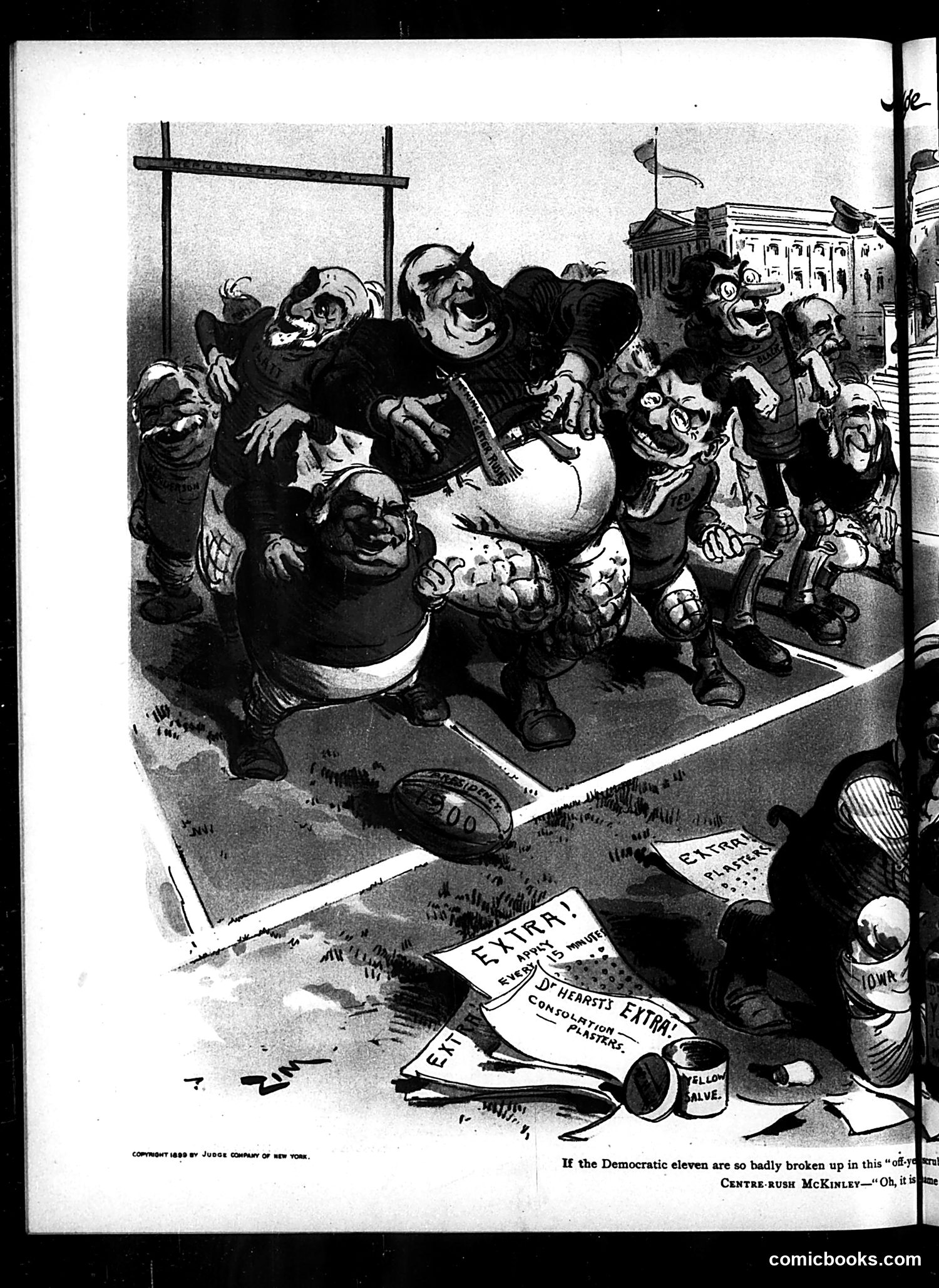
This 1890 Judge magazine cartoon satirizes the Democratic Party as a damaged sports team. The central figure appears to be a rotund politician (likely representing Democratic leadership) surrounded by caricatured figures labeled as the "Democratic eleven"—referring to Democratic politicians or party members. The gallows visible in the background and scattered papers labeled "EXTRA" suggest political chaos and scandal. The caption's reference to "Centre-rush McKinley" alludes to William McKinley and Republican power struggles. The cartoon mocks the Democratic Party as internally fractured and disorganized, using sports metaphors to make the political dysfunction appear comical. The exaggerated physical caricatures and chaotic scene emphasize the satire of Democratic disunity during the 1890 political period.
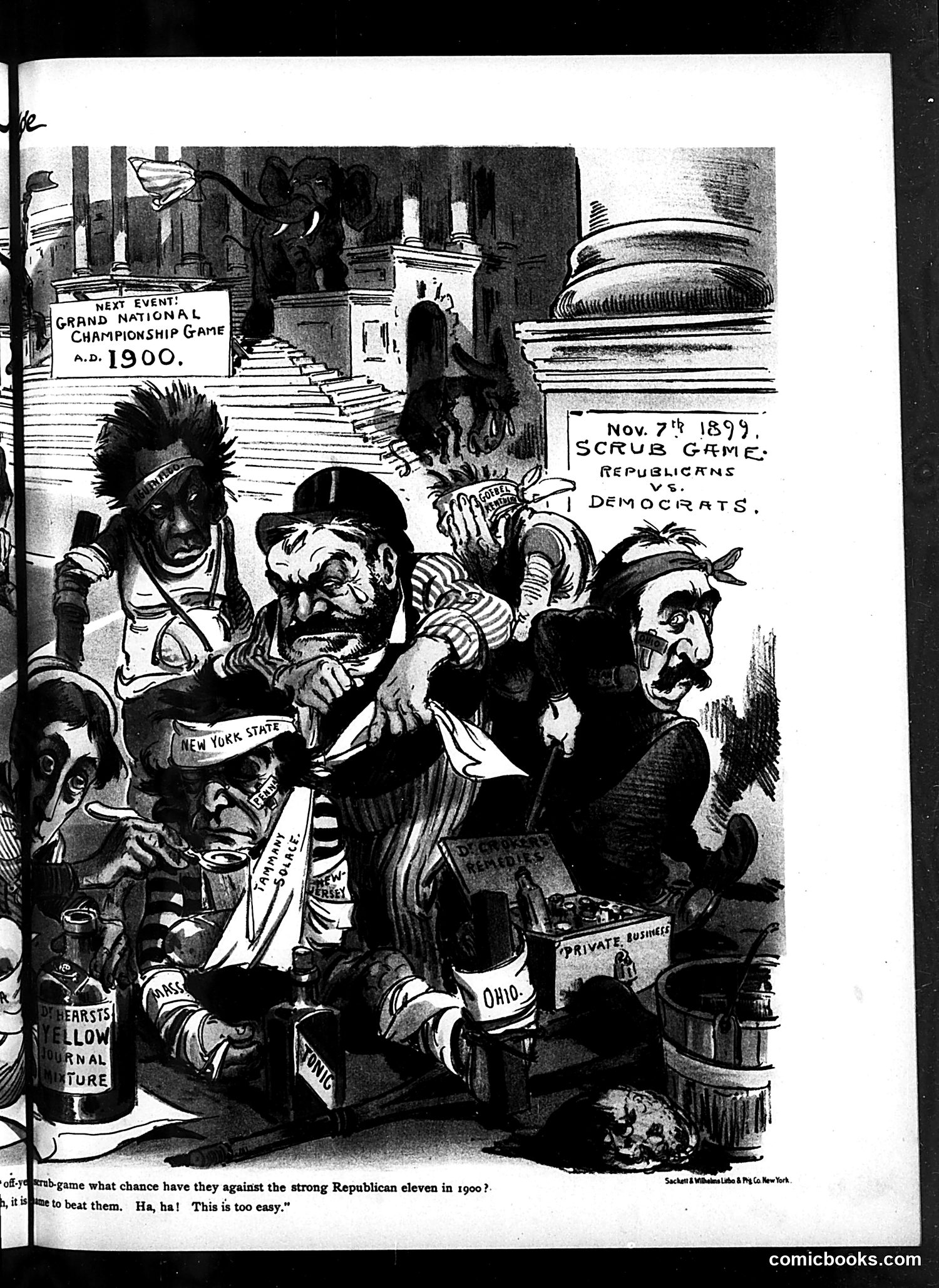
This 1899 Judge magazine cartoon satirizes the upcoming 1900 U.S. election as a football game between Republicans and Democrats. The caricatured Democratic figures—labeled with states like "New York State" and "Ohio"—are depicted as a disorganized "scrub" (inferior) team, while Republicans are portrayed as strong and dominant. The cartoon mocks Democratic prospects, with text suggesting Republicans will easily defeat them. The grotesque character portrayals reflect common period caricature conventions. The Capitol building and formal setting underscore the stakes as a national championship event. The satire expresses Republican confidence before the 1900 election (which McKinley won decisively), presenting Democratic opposition as bumbling and outmatched.
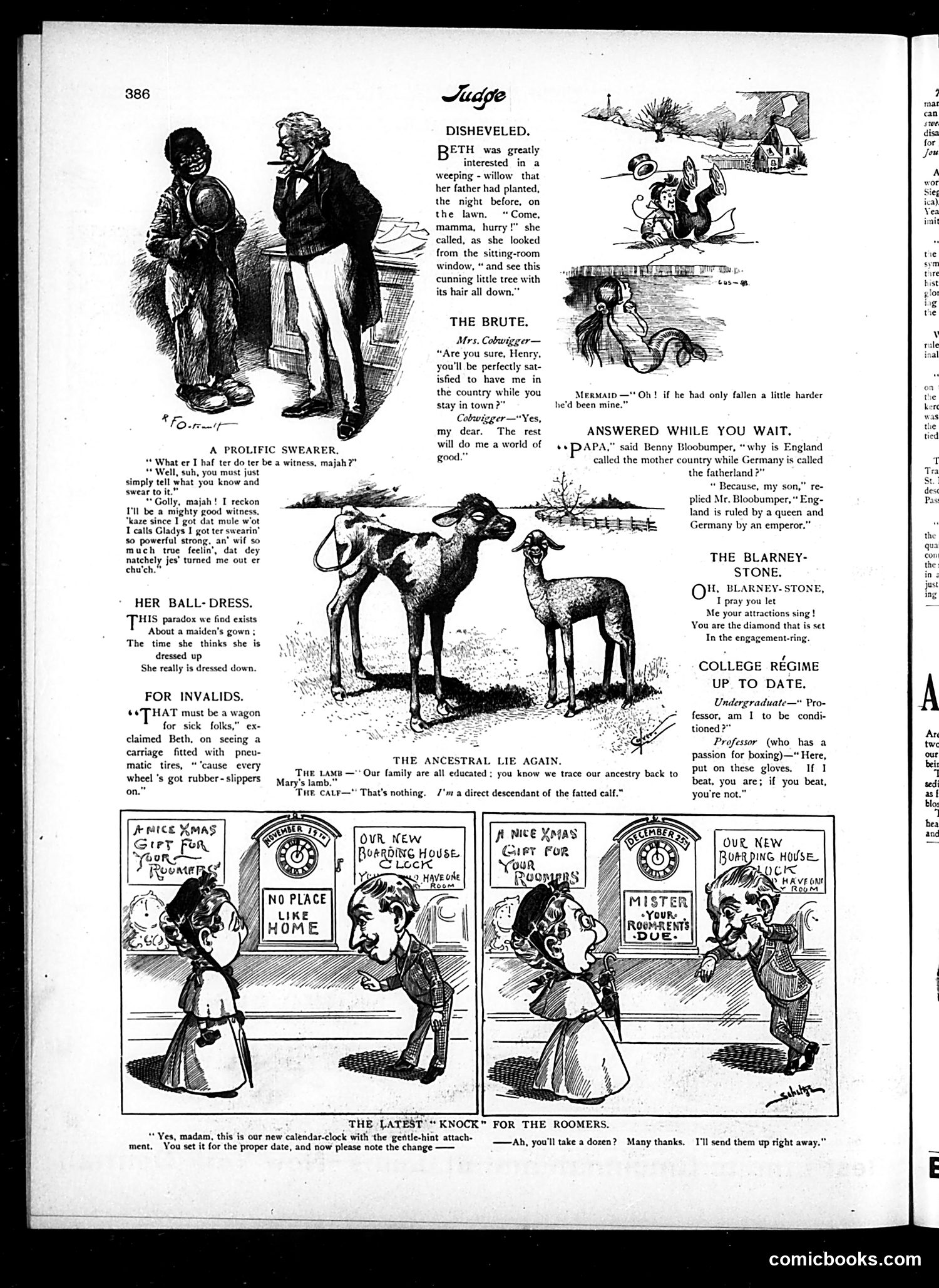
This page contains six unrelated humorous sketches typical of early 20th-century American satirical magazines: **"A Prolific Swearer"** mocks a Black man (depicted in period stereotypes) who claims he'll be a good witness because his mule has made him accustomed to swearing. **"Her Ball-Dress"** offers wordplay about women's fashion—the paradox that formal dresses expose more skin than everyday wear. **"The Ancestral Lie Again"** satirizes social pretension: a lamb and calf boast about noble ancestry, mocking those who exaggerate lineage claims. **"Answered While You Wait"** plays on contemporary geopolitics, with a child asking why England is "mother country" while Germany is "fatherland"—answered by noting England has a queen, Germany an emperor. **"The Latest Knock for the Roomers"** (bottom comics) shows landlords advertising boarding houses; the joke involves switching calendar dates to confuse tenants about payment due dates. The page reflects period humor conventions: ethnic caricature, domestic comedy, and gentle social satire about class anxieties and gender roles.
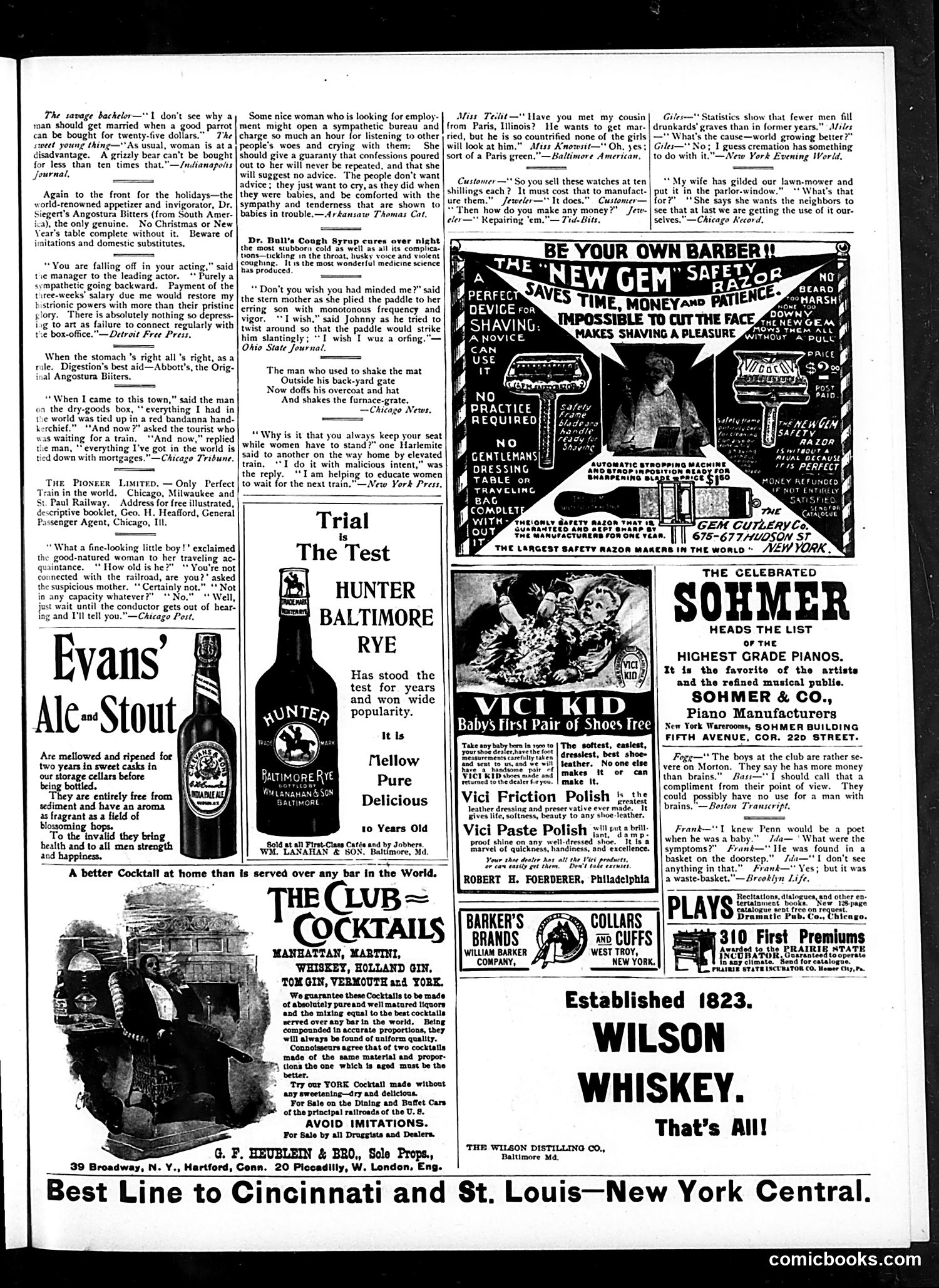
This page is primarily **advertisements and short humorous anecdotes** rather than political cartoons. The content reflects early 20th-century American humor and consumer culture. The jokes mock contemporary social conventions: a bachelor's comparison of women to parrots (with the woman's witty rejoinder about bears), an actor blaming his poor performance on unpaid wages, a migrant's economic decline from minimal possessions to debt-ridden property ownership, and a mother's suspicion of railroad employees near her child. The advertisements promote patent medicines (Dr. Jaeger's Bitters, Dr. Bell's Cough Syrup), spirits (Evans' Ale and Stout, Hunter Baltimore Rye, Wilson Whiskey), and consumer products (barber devices, pianos). One notable ad promotes the "Gem" safety razor—a relatively new technology claiming to eliminate the need for professional barbers. The humor is genteel and domestic rather than overtly political. The page captures Gilded Age American attitudes toward gender relations, labor, commerce, and technological progress, with gentle satire of bourgeois anxieties and aspirations.
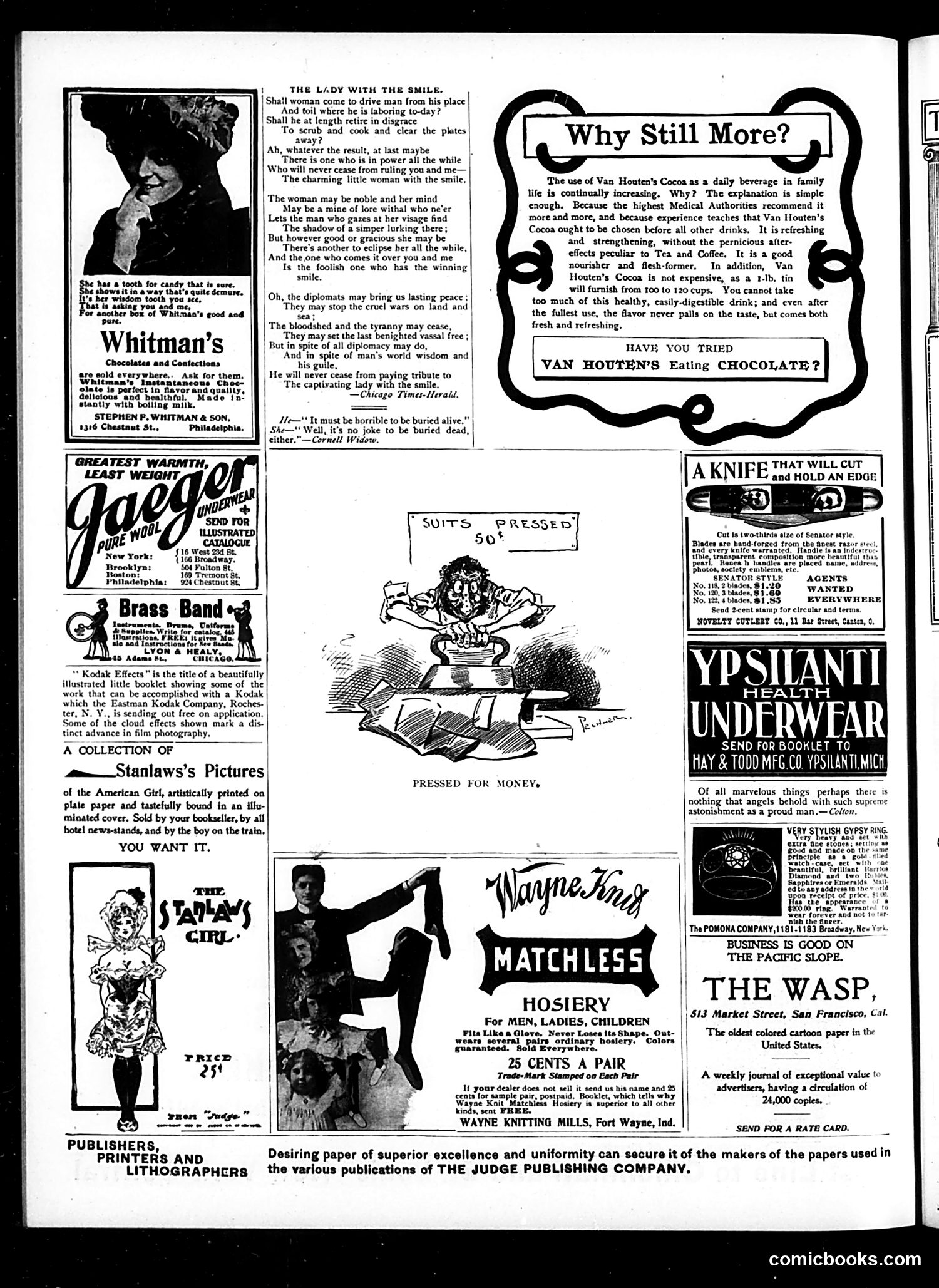
This page features a satirical poem-cartoon about gender politics and female power, likely from the early 1900s when women's workplace entry was debated. **The Main Satire:** The poem argues that despite women potentially entering traditionally male spheres of work and influence—diplomacy, politics, and industry—their true power lies in something allegedly more fundamental: feminine charm and "the smile." The speaker claims that regardless of male achievement in ending wars, tyranny, or poverty, men will always "pay tribute" to attractive women. **The Point:** This is anti-feminist satire. Rather than celebrating or fearing female political/economic advancement, it dismisses women's potential authority by reducing their actual influence to mere superficial attractiveness. It's a backhanded insult disguised as flattery—women's "real" power isn't intellect or capability but rather romantic appeal. **Context:** This reflects early-20th-century anxieties about changing gender roles, using humor to trivialize female ambition by suggesting biological/social determinism would prevail regardless. The page is otherwise filled with period advertisements (chocolates, clothing, hosiery).
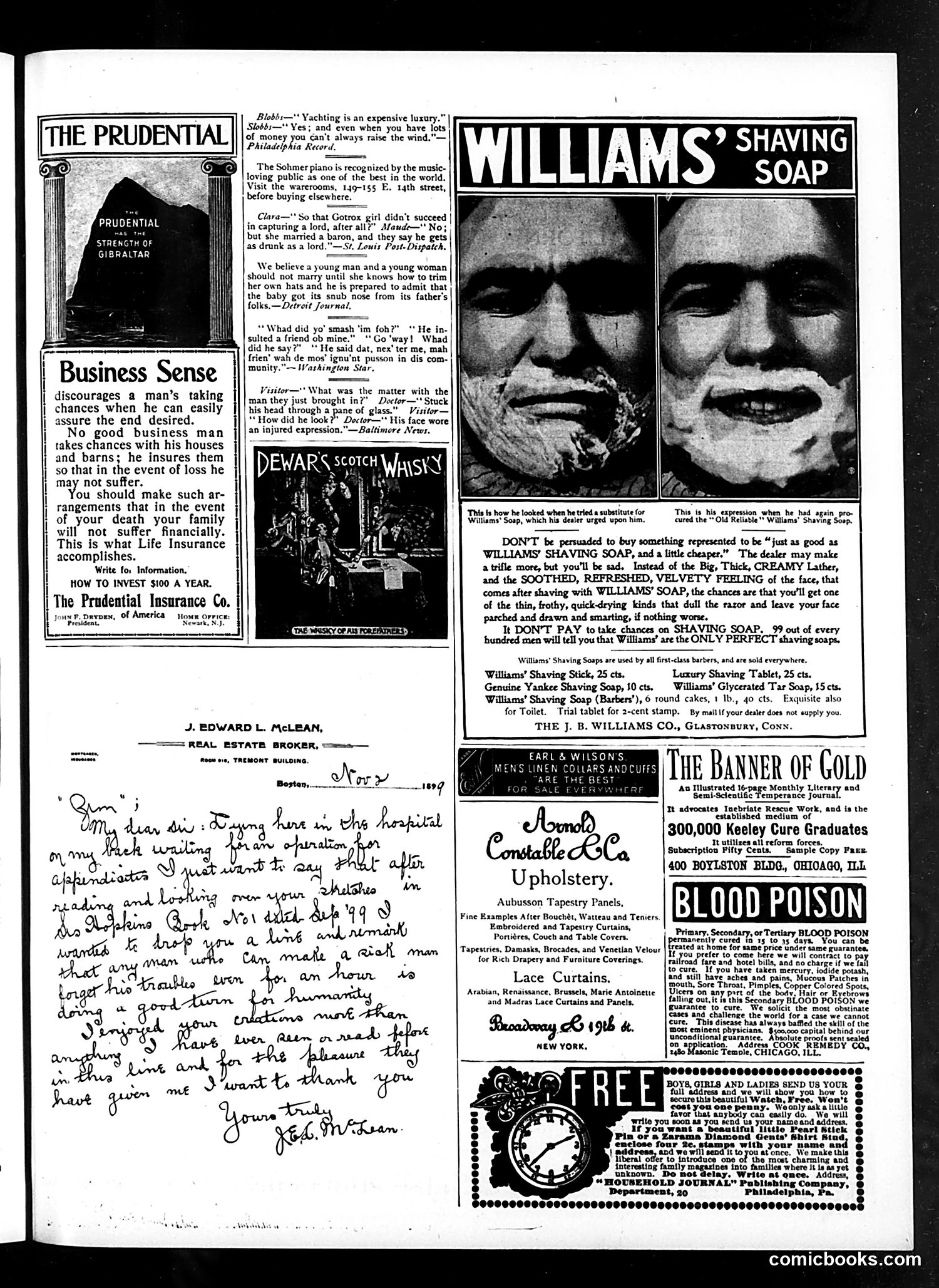
This page is primarily **advertising** rather than editorial content or political cartoons. The dominant features are product advertisements interspersed with short humorous quips typical of the era. The main visual content includes: 1. **The Prudential Insurance ad** (left) — promoting life insurance with the tagline "Strength of Gibraltar," using conventional business arguments about protecting one's family. 2. **Williams' Shaving Soap ad** (right, largest) — the centerpiece, featuring before/after images of a man's face showing him unsatisfied with a substitute soap, then satisfied after using Williams' brand. This is a straightforward product comparison advertisement. 3. Various other ads for pianos, upholstery, books, and patent medicines fill the remaining space. The small jokes scattered throughout are generic period humor about marriage, yachting expenses, and social situations—typical filler content for magazines of this era. There is **no identifiable political satire or social commentary** on this particular page.
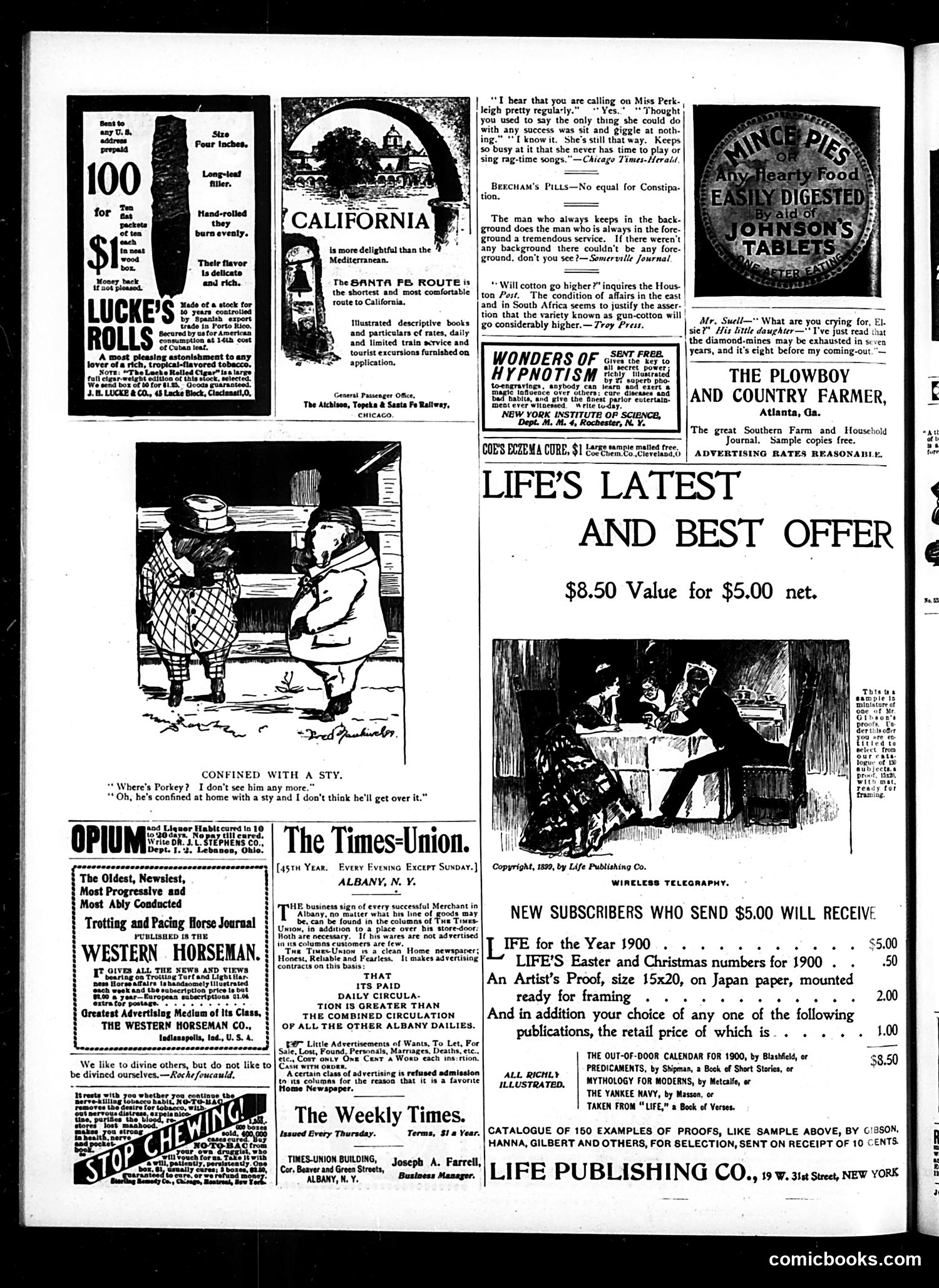
This page is primarily **advertising and promotional material** rather than satirical political cartoons. The one actual cartoon—titled "Confined With a Sty"—depicts two people discussing a pig named Porkey who has contracted a sty (an eye infection). One character jokes that the pig is confined at home and "won't get over it," a mild pun playing on the double meaning of "sty" (both the pig's enclosure and the disease). The page's dominant content consists of advertisements for various publications (*The Western Horseman*, *The Times-Union*, *The Weekly Times*), patent medicines (Beecham's Pills, Coe's Eczema Cure), and subscription offers. The satirical snippets scattered throughout—jokes about a woman who only giggles, wordplay about "gun-cotton" prices, and diamond mine exhaustion—are filler material typical of magazine layouts from this 1899-1900 period. None carries significant political or social commentary.
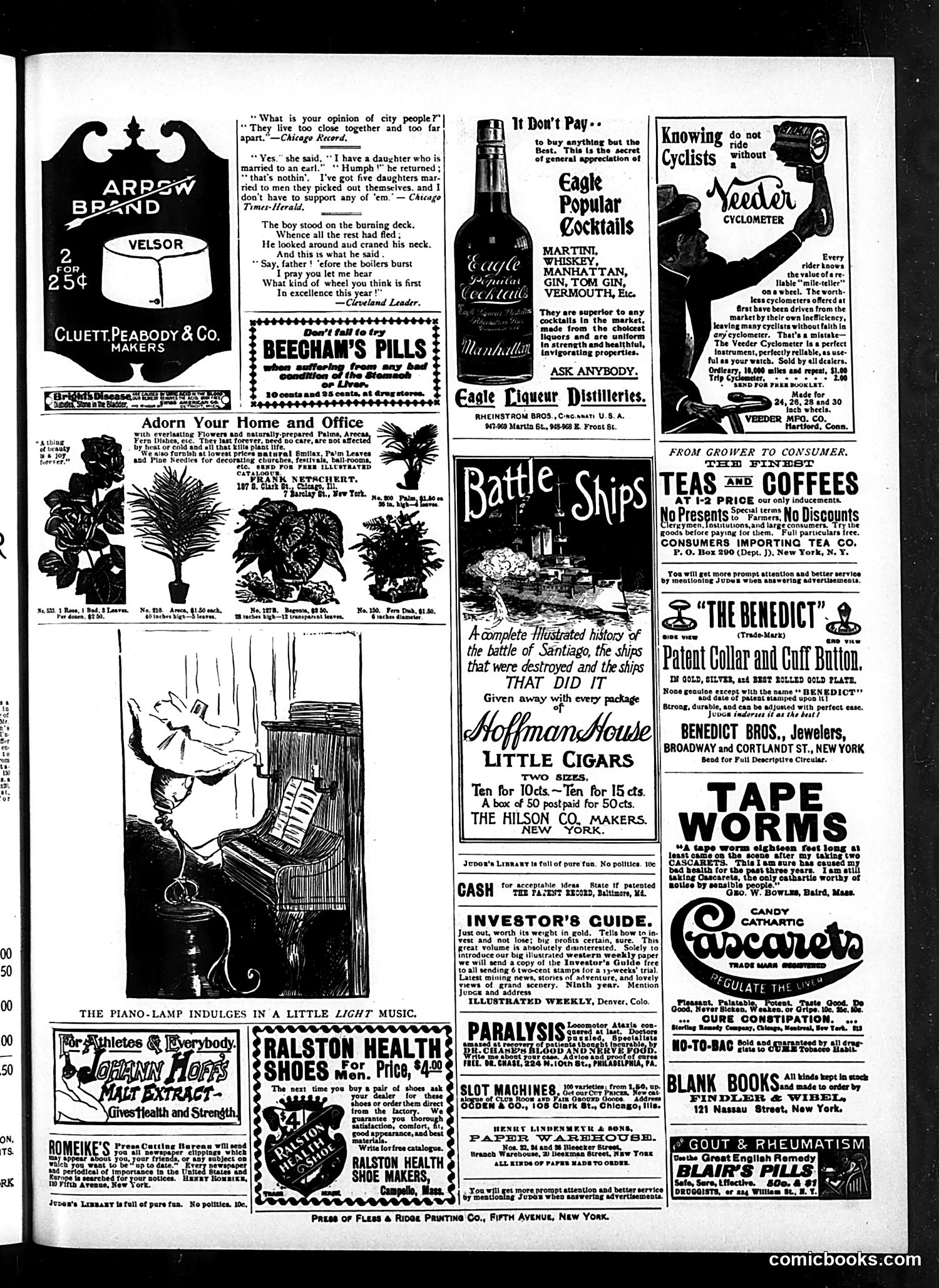
This page consists primarily of **advertisements and comic snippets** rather than a coherent political cartoon. The small comic fragments mock contemporary attitudes: - One joke satirizes **class pretension**: a woman boasts her daughter married an earl; a man counters that his daughters married men of their own choosing—suggesting superiority of American independence over European aristocratic hierarchy. - Another depicts a boy on a burning ship asking about "what wheel" is "first in excellence"—likely mocking excessive American commercialism and consumerism, even in disaster. The page is dominated by **product advertisements**: patent medicines (Beecham's Pills for liver ailments), cigars, shoes, cocktails, and various remedies typical of early 1900s marketing. Many ads make dubious health claims ("paralysis cure," "nerve food"). **Overall meaning for modern readers**: This reflects an era of aggressive, often fraudulent advertising mixed with gentle social satire about American materialism and class consciousness. The humor is mild and the editorial commentary is minimal—the page functions primarily as a revenue generator through ads rather than serious political commentary.
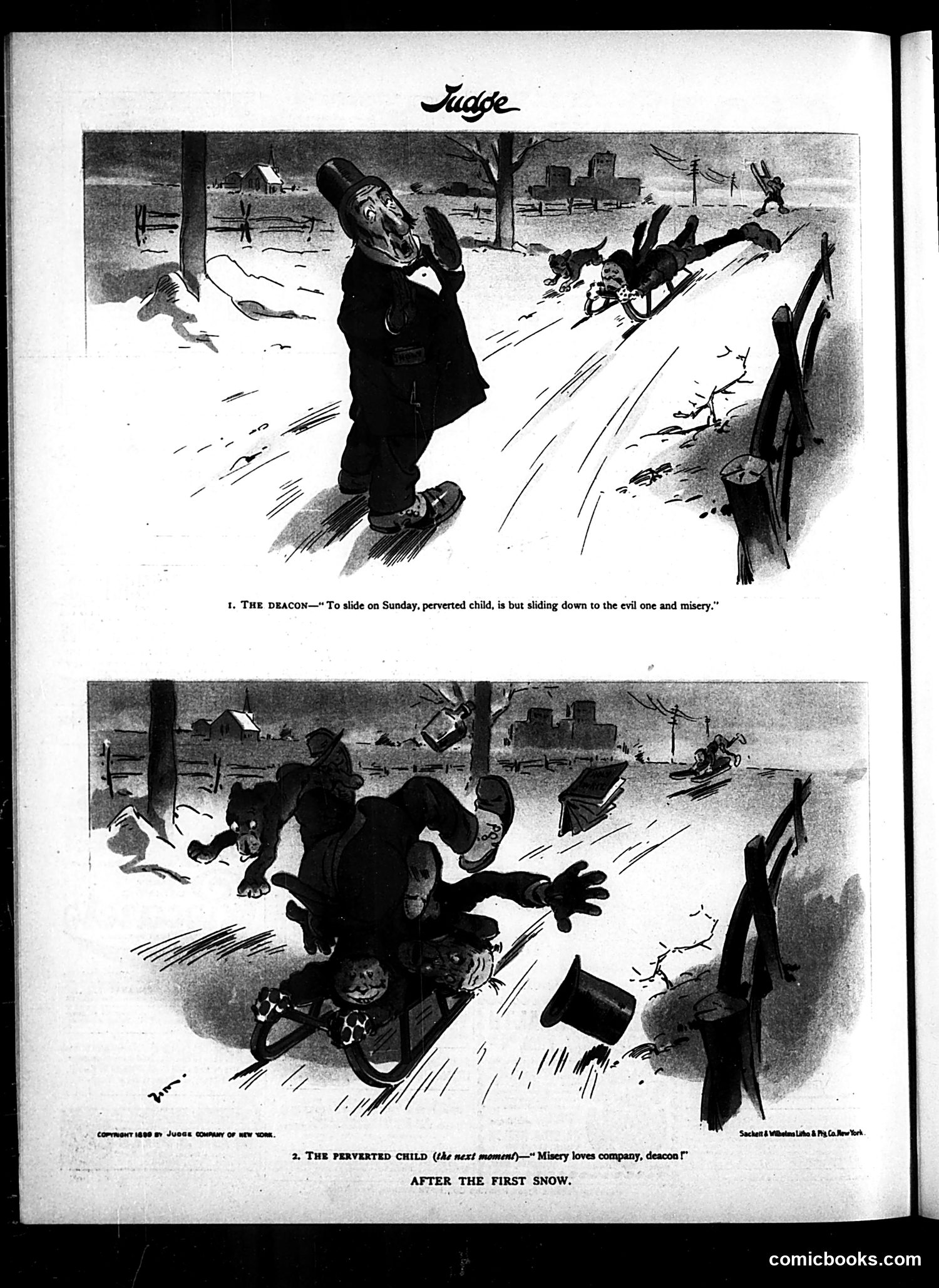
This is a two-panel moral satire from 1899 titled "After the First Snow." **Panel 1** depicts a stern-faced deacon (a church official) warning a child against Sunday sledding, claiming it leads to "evil one and misery." **Panel 2** shows the child gleefully sledding down a snowy hill moments later, declaring "Misery loves company, deacon!"—implying the child has dragged the disapproving deacon along into the "sinful" activity. **The satire**: The cartoon mocks rigid religious authority and Sunday observance laws (still enforced in many American communities during this era). The joke critiques adults who impose joyless moral restrictions on children while hypocritically joining in the fun anyway. It suggests the deacon's stern piety is performative and easily abandoned when actual enjoyment is at hand.