
A complete issue · 16 pages · 1899
Judge — November 11, 1899
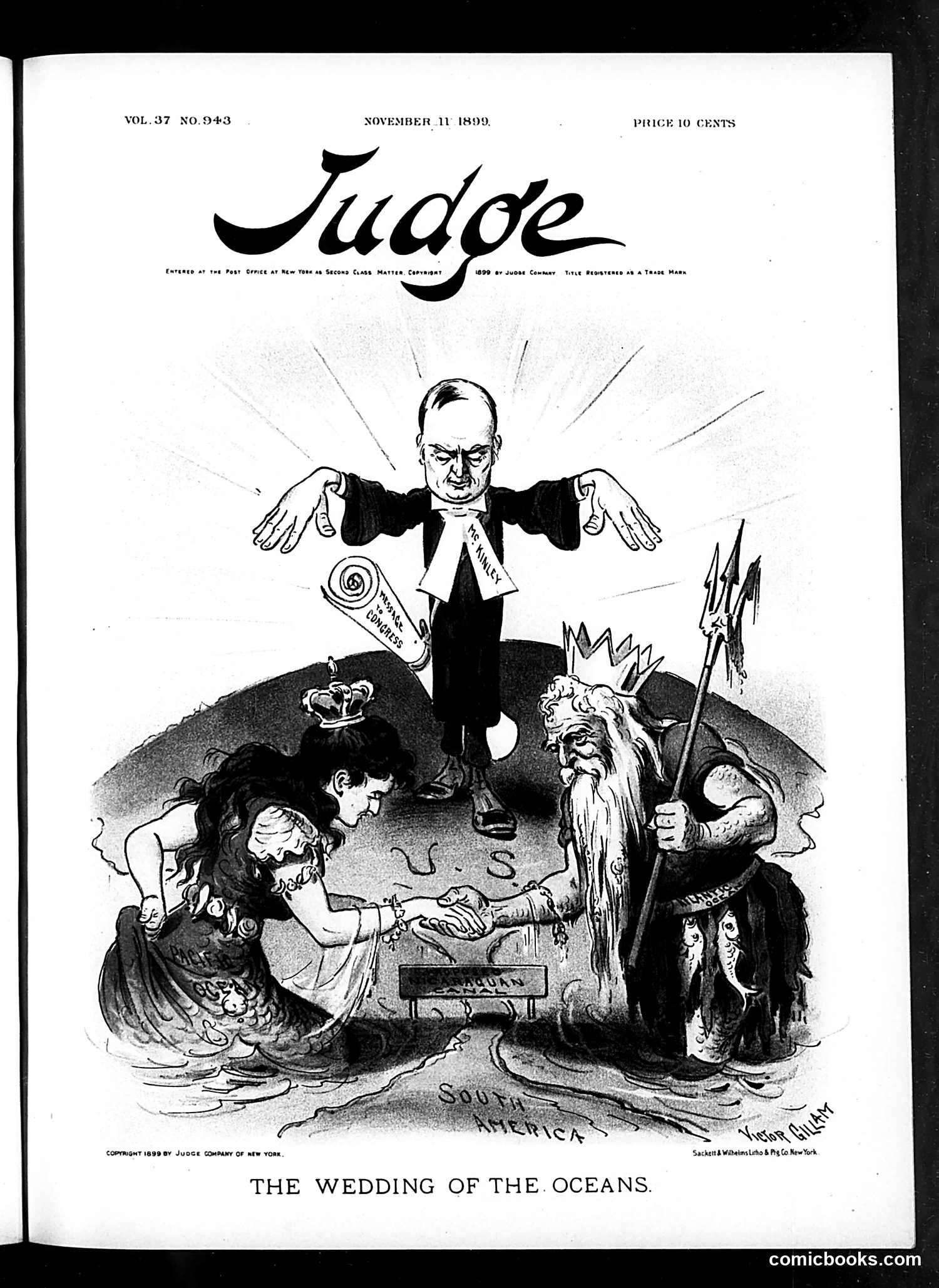
This November 1899 Judge cartoon satirizes the completion of the **Nicaraguan Canal** (or a similar isthmian canal project under discussion). The central figure appears to be a U.S. politician or administrator presiding over the "wedding" of the Atlantic and Pacific Oceans. The allegorical figures represent the two oceans as a bride and groom. A bearded character on the right (likely representing a foreign power, possibly European colonial interests) objects to or challenges the union. The radiating lines around the officiant suggest divine approval or power. The satire critiques American imperial ambitions in Central America—the canal represented U.S. commercial and strategic dominance. The cartoon suggests the U.S. was "marrying" the oceans for profit while other nations watched with concern or hostility.
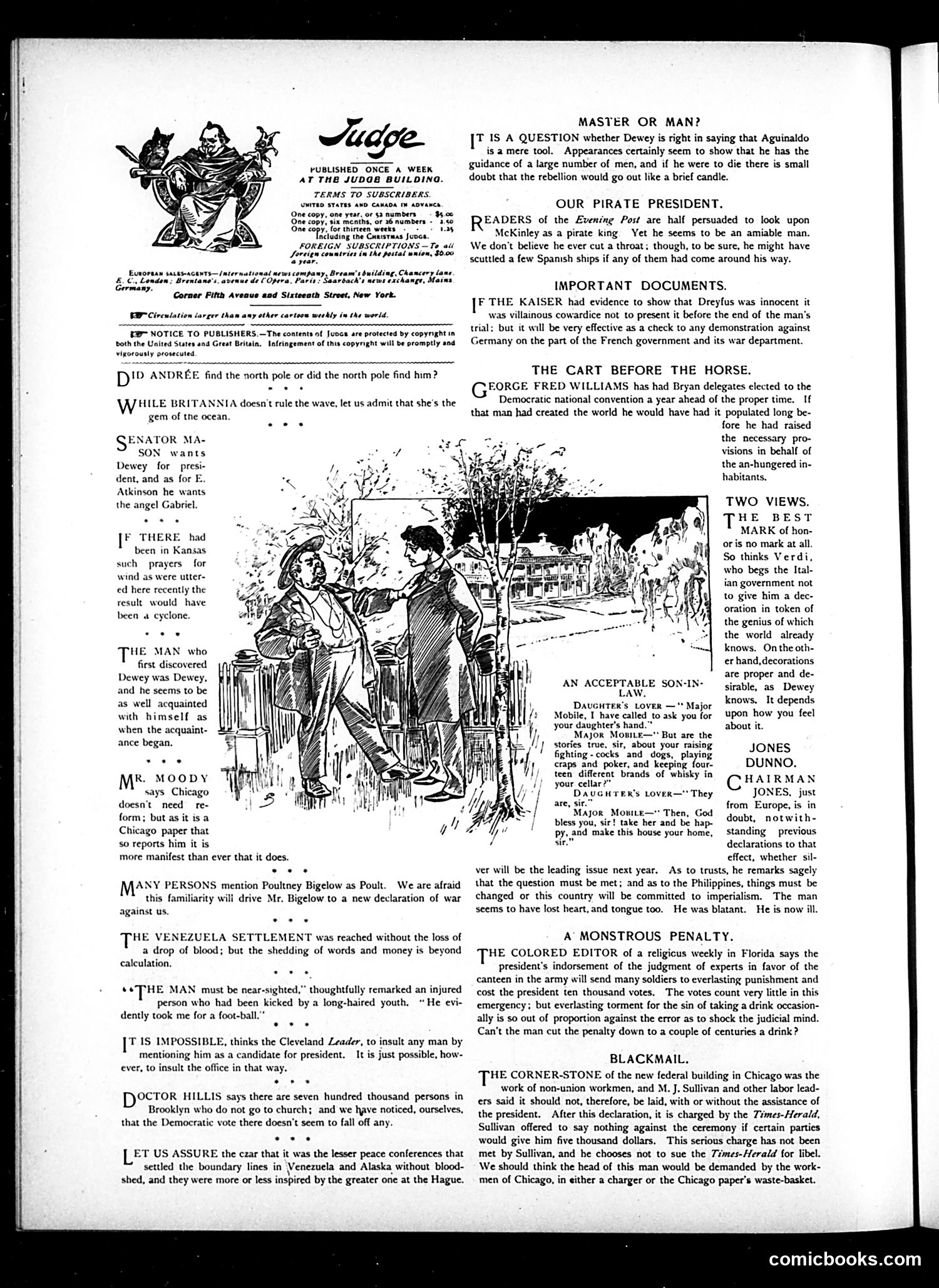
The main illustration depicts two men in what appears to be a romantic or domestic negotiation scene. Based on the surrounding text column titled "AN ACCEPTABLE SON-IN-LAW," the cartoon satirizes a daughter's romantic choices versus her father's expectations. The dialogue references "Major Mobile" and discusses a suitor's character—contrasting his stories about "craps and poker" against the daughter's hopes he'll be "happy" in marriage. The satire mocks the tension between parental approval and young women's romantic autonomy in early 20th-century America. The page contains multiple political commentary sections below, but the main cartoon focuses on domestic/social humor rather than explicit political figures, making it representative of Judge's mixed content approach.
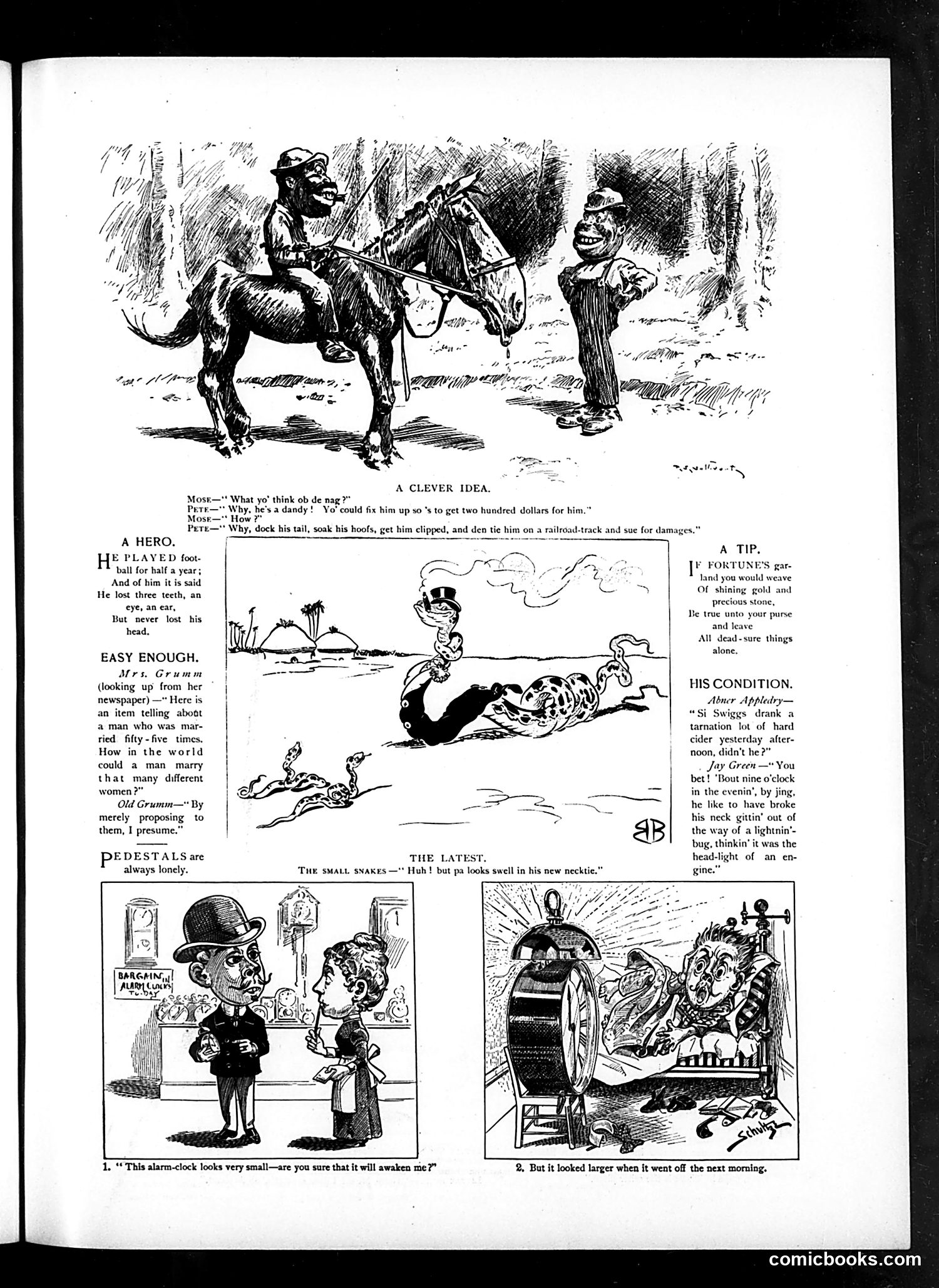
This page contains several unrelated humorous sketches typical of Judge's format. **"A Clever Idea"** depicts a conversation about a mule, with the punchline suggesting someone could profit by having the animal clipped and placed on railroad tracks to sue for damages—satirizing the era's litigation culture. **Other sketches** include: - "A Hero" and "Easy Enough"—brief joke-poems about marriage and proposing - "Pedestals are Always Lonely"—a visual gag about a man at a bargain alarm clock sale - "The Latest"—a joke about a small snake's new necktie - "His Condition"—dialogue about someone drinking cider and suffering headaches These appear to be generic humor pieces without specific political commentary. The style and sensibility are typical of early 20th-century American comic magazines aimed at middle-class readers.
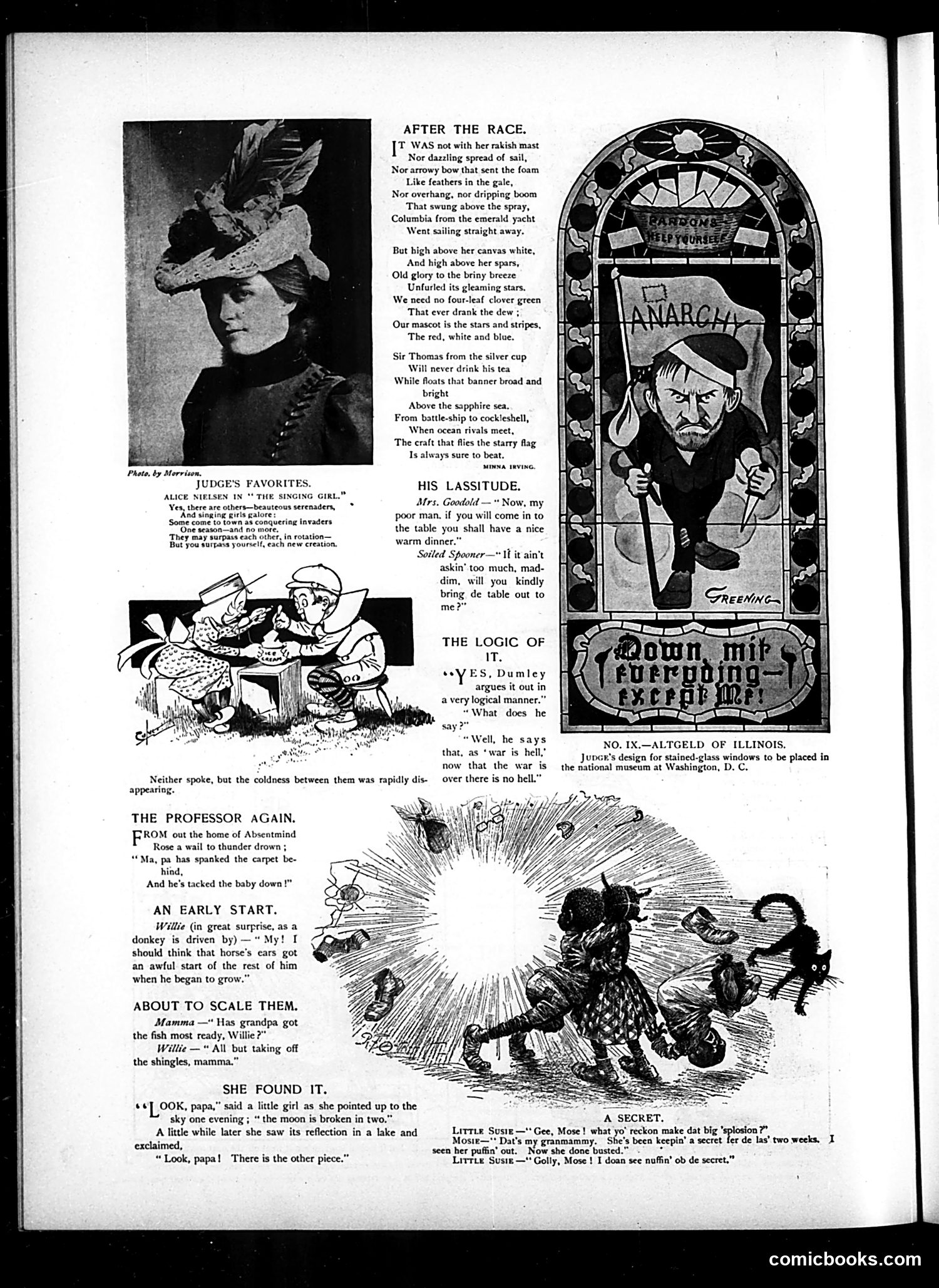
This page contains primarily **humorous anecdotes and illustrations rather than political cartoons**. The content includes: - "Judge's Favorites": A poem about Alice in "The Boding Girl" with decorative photography - "After the Race": A patriotic poem about American naval superiority, mentioning Columbia and maritime glory - Multiple brief comedic sketches ("His Lassitude," "The Logic of It," "The Professor Again," etc.) featuring domestic situations and wordplay - A stained-glass window design labeled "No. IX—Altgeld of Illinois," apparently mocking Governor John Peter Altgeld - A cartoon showing children and animals in chaotic action **The satire is primarily social rather than overtly political**—poking fun at everyday family situations, relationships, and minor absurdities rather than major political events or figures. The Altgeld reference suggests contemporary Illinois politics, but most content prioritizes light entertainment over social commentary.
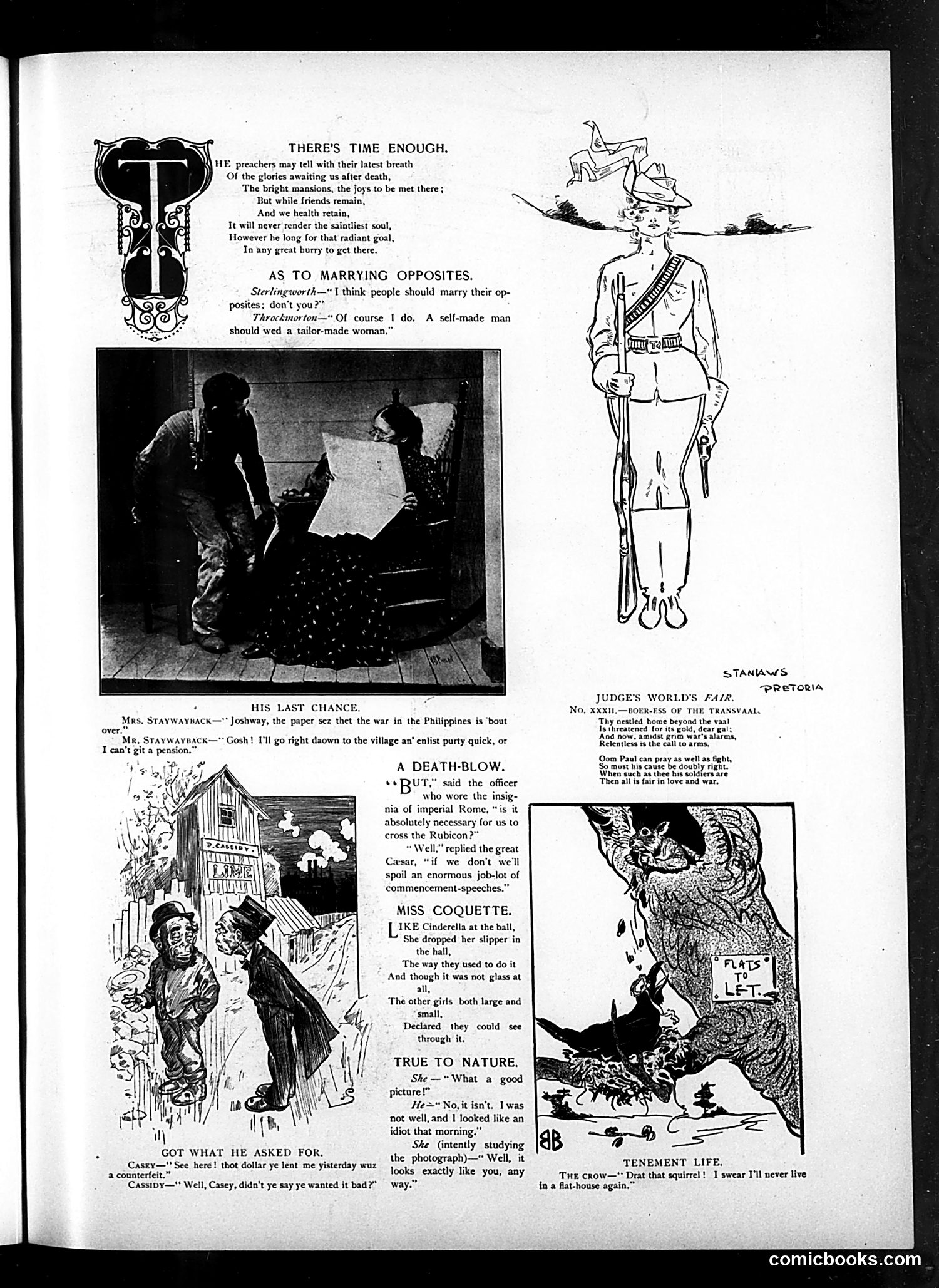
This page contains several unrelated humorous pieces typical of early 1900s Judge magazine: **"There's Time Enough"** is a moral poem arguing people shouldn't rush toward death despite religious promises of heavenly rewards. **"As to Marrying Opposites"** presents a brief joke where one character advocates marrying opposites, and another agrees—a "self-made man" should marry a "tailor-made woman" (one who dresses fashionably). **"Judge's World's Fair"** features a sketch labeled "Boer-ess of the Transvaal," likely referencing the Second Boer War (1899-1902), depicting a woman from South Africa's Transvaal region. **"His Last Chance"** shows rural Americans discussing the Philippines War (Philippine-American War, 1899-1902), with one character eager to enlist for a pension. The remaining pieces—"A Death-Blow," "Miss Coquette," "True to Nature," "Got What He Asked For," and "Tenement Life"—are brief, disconnected jokes about social situations and romantic mishaps. The page is primarily humor and satire rather than focused political commentary.
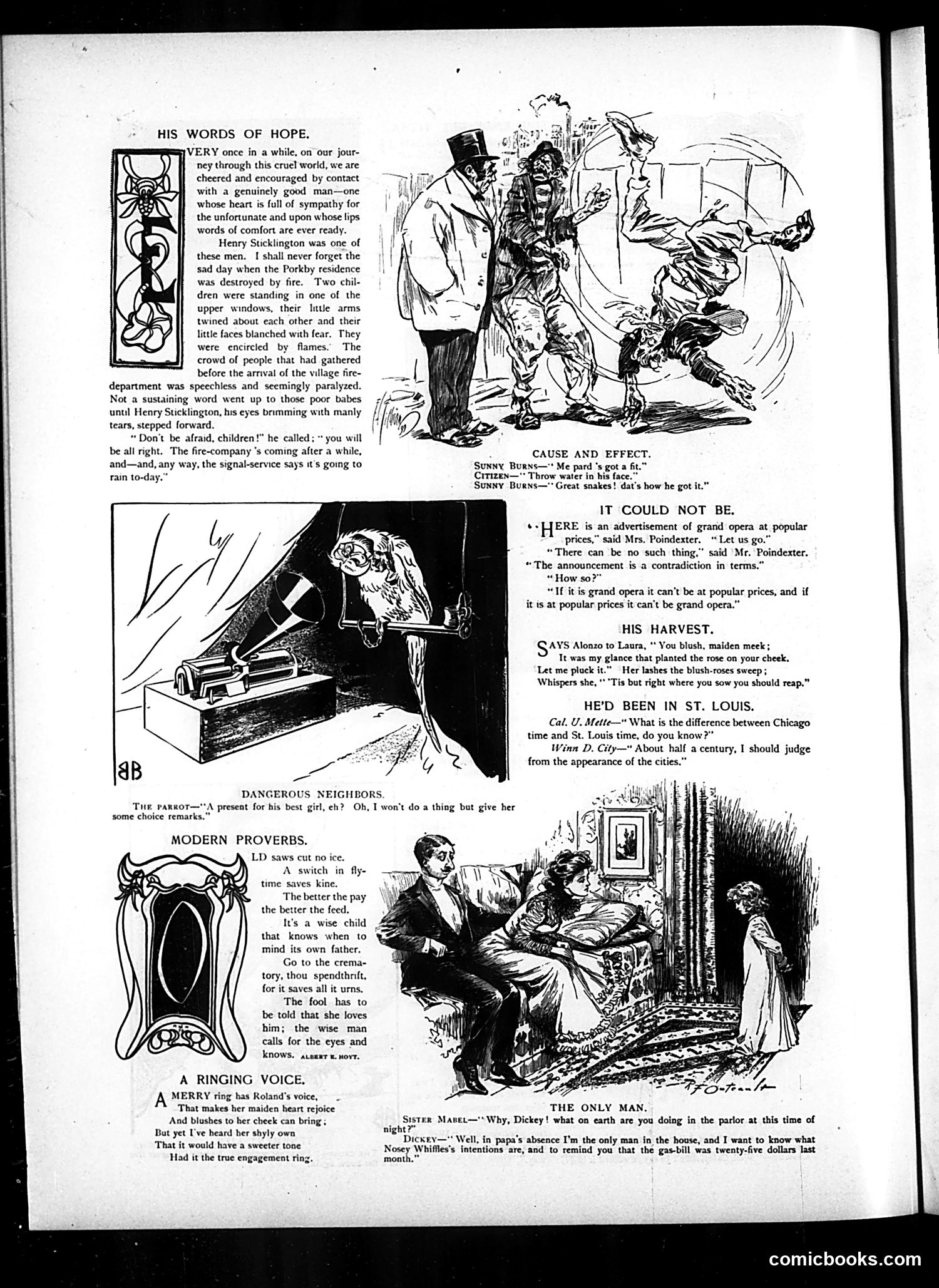
This page contains several short humorous pieces typical of Judge's satirical format: **"His Words of Hope"** mocks sentimentality—a man offers hollow reassurance to children trapped in a burning building, his only comfort being that rain is forecast. The satire targets performative sympathy and useless platitudes in crisis. **"It Could Not Be"** jokes about the contradiction between "grand opera" and "popular prices," satirizing either inflated artistic pretension or false advertising. **"The Only Man"** presents domestic comedy: a boy mimics adult authority in his father's absence, demanding to know a suitor's intentions and complaining about utility bills—inverting typical gender roles for laughs. Other brief items include romantic verses, regional rivalry (Chicago vs. St. Louis), and "Modern Proverbs" parodying folk wisdom. The cartoons feature stock characters like a parrot and various domestic scenarios. Overall, this is light satirical humor targeting social conventions, gender expectations, and everyday absurdities rather than serious political commentary.
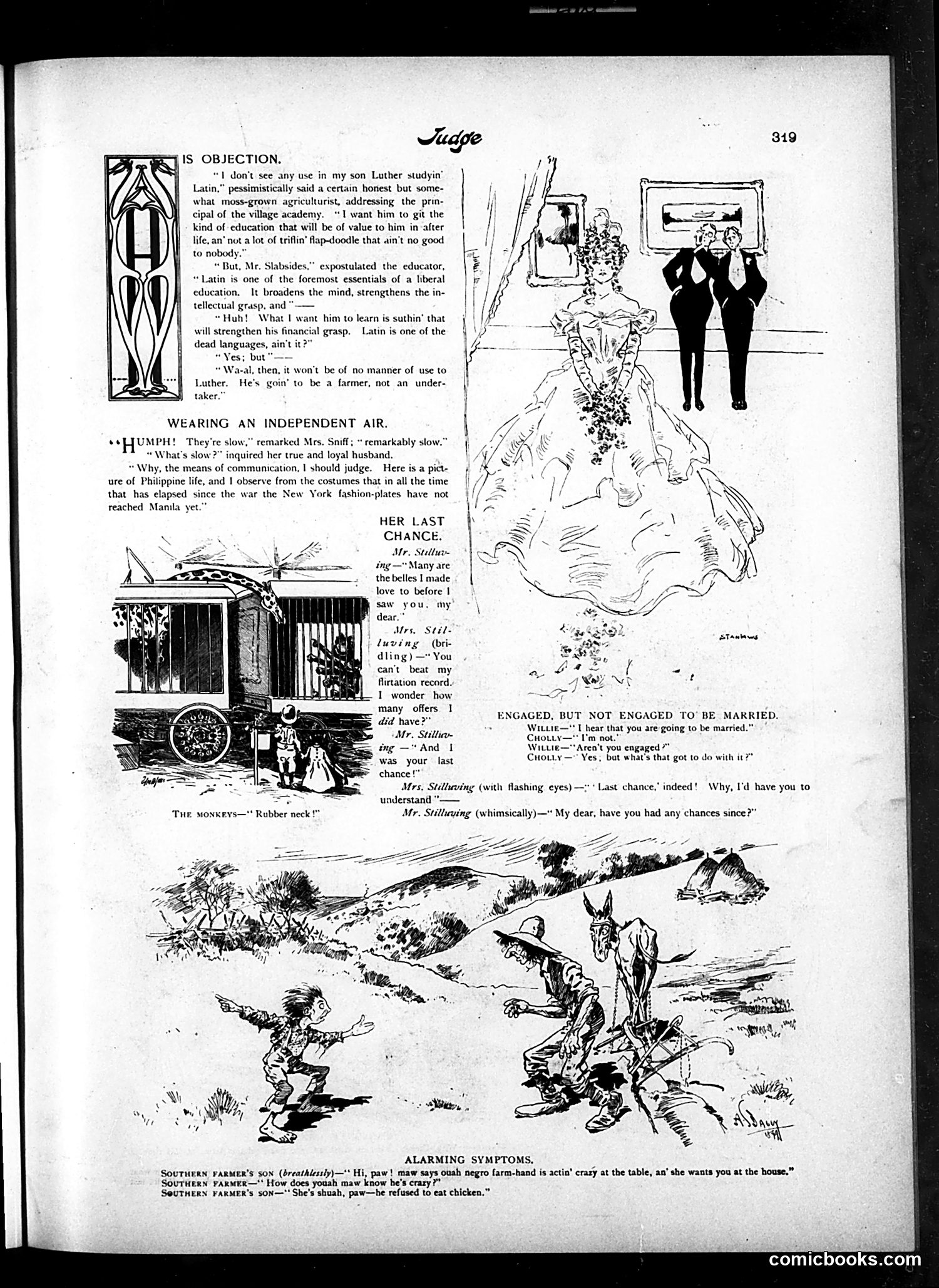
This page contains several satirical vignettes typical of early 20th-century American humor: **"Is Objection"**: A rural farmer opposes his son Luther studying Latin, arguing it's useless for a farmer. The satire mocks anti-intellectual attitudes and narrow practicality—the farmer values only direct financial benefit, dismissing humanistic education as "flap-doodle." **"Wearing an Independent Air"**: Mrs. Sniff criticizes slow communication with the Philippines post-Spanish-American War, noting New York fashion hasn't reached Manila yet. This satirizes Americans' expectation of rapid cultural assimilation in newly acquired territories. **"Engaged, But Not Engaged to Be Married"**: A couple discussion where the woman has had many past flirtations; the man jokes she's had no chances since. Light satire on courtship conventions. **"Alarming Symptoms"**: A Southern farmer's son reports their enslaved farm worker is "acting crazy"—he refused chicken. The "joke" relies on racist stereotypes about Black people and food preferences, typical of the era's offensive humor.
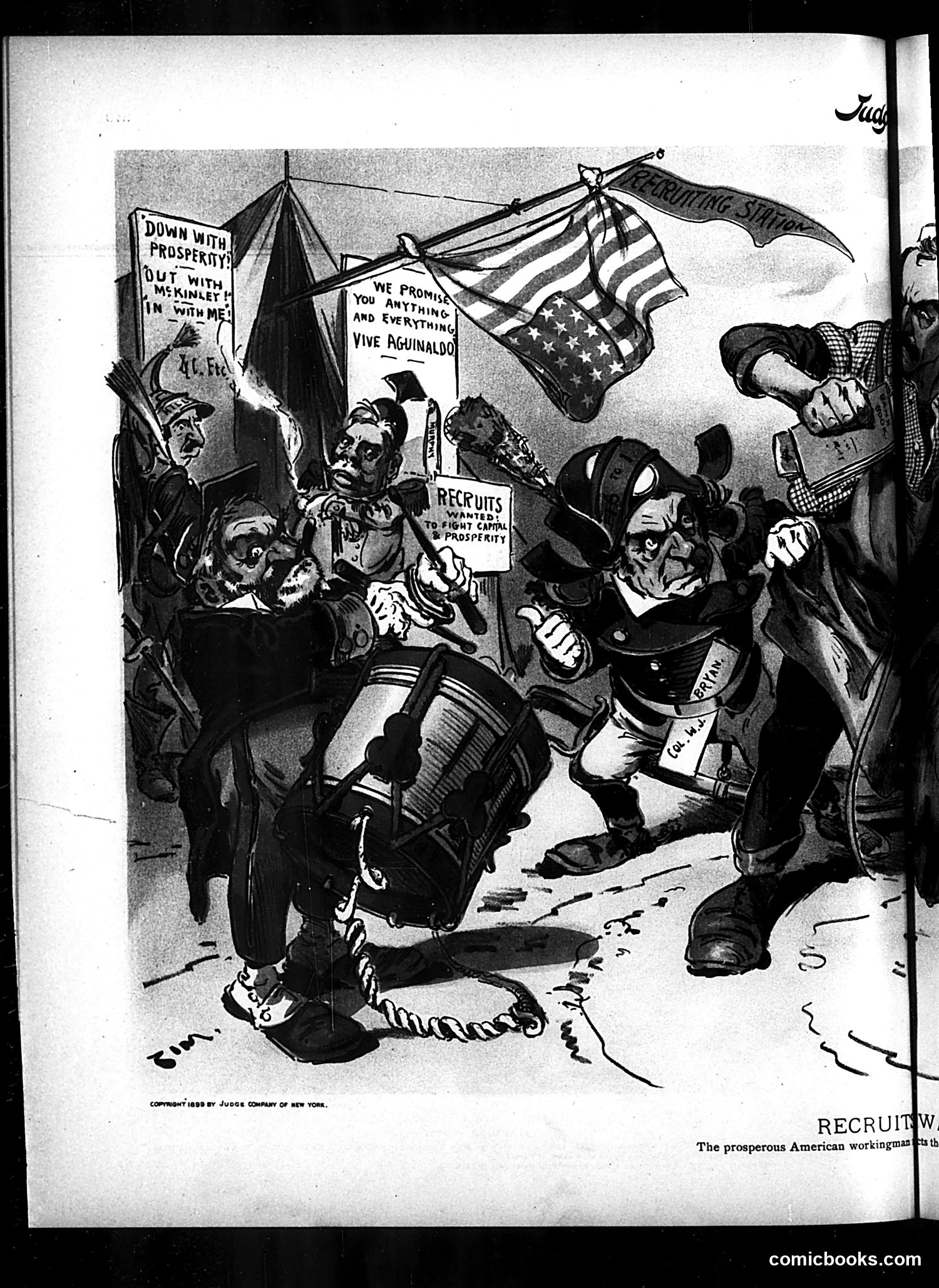
This cartoon satirizes American military recruitment efforts, likely during the Philippine-American War (1899-1902). The central figure labeled "VIVE AGUINALDO" references Emilio Aguinaldo, leader of Filipino independence forces opposing U.S. occupation. The recruitment tent displays contradictory promises—"Down with Prosperity," "We Promise You Anything and Everything"—mocking recruiters' false assurances to working-class men. Caricatured figures (appearing to represent Irish and other immigrant workers) are being lured toward military service under false pretenses. The "Recruiting" title and caption about "the prosperous American workingman" suggests Judge's criticism: that the U.S. military deceives ordinary workers into fighting colonial wars while promising domestic prosperity. The torn American flag and threatening figure overhead reinforce the cartoon's warning against this deception.
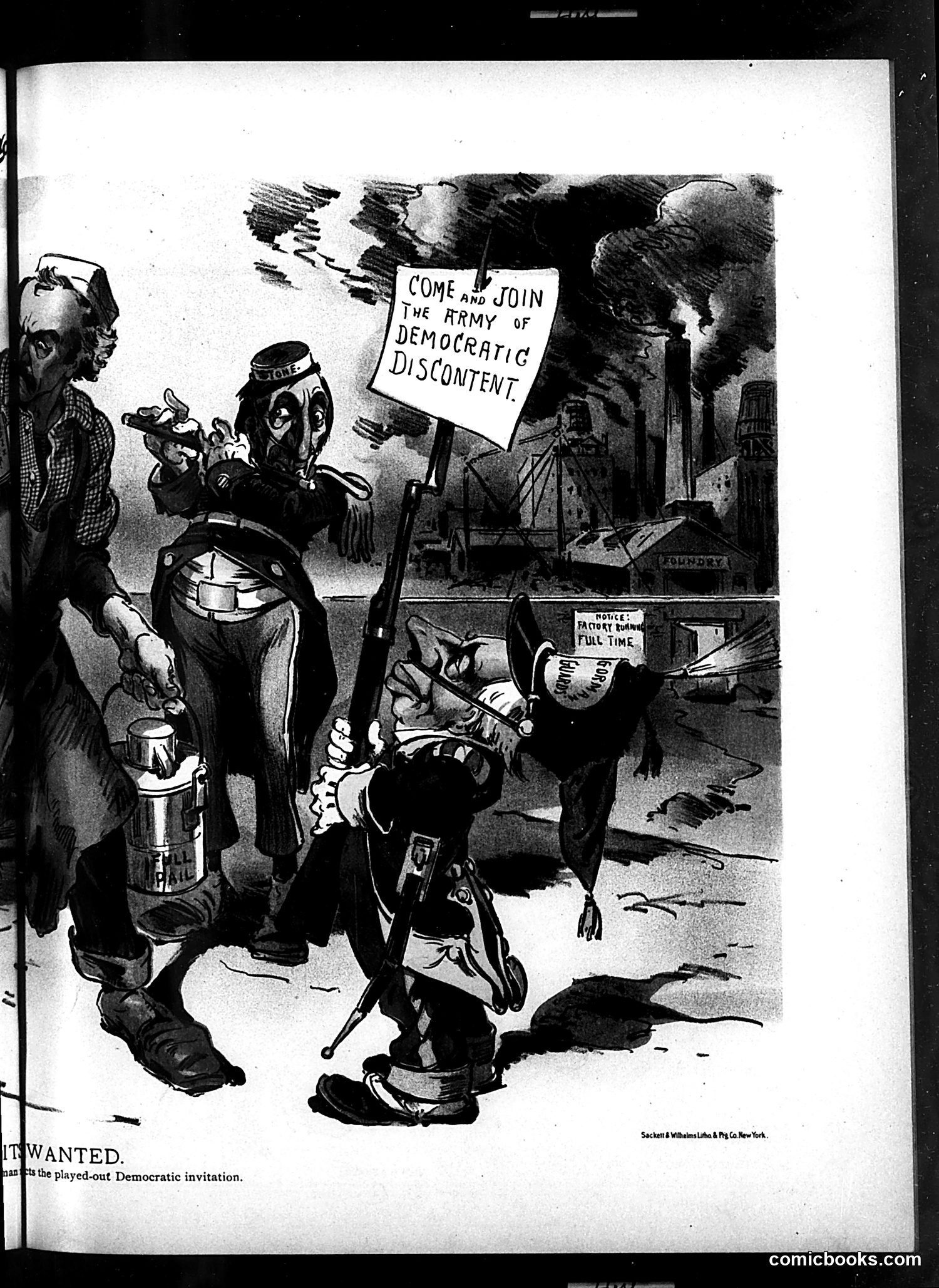
This political cartoon critiques the Democratic Party's weakened position. A militaristic figure holding a sign reading "COME AND JOIN THE ARMY OF DEMOCRATIC DISCONTENT" recruits from industrial ruins and urban decay. The central figure wears a gas mask and military gear, suggesting desperation and toxic conditions. The cartoon's message: the Democratic Party is reduced to recruiting from desperate circumstances—portrayed as a struggling "army" built on discontent rather than positive vision. The industrial wasteland backdrop implies economic hardship. The visible text "WANTED: the played-out Democratic invitation" indicates the cartoon mocks the Democrats' appeal as exhausted and ineffectual. This likely reflects early 20th-century criticism of Democratic Party weakness or internal division during a specific political crisis, though the exact historical moment requires additional context.
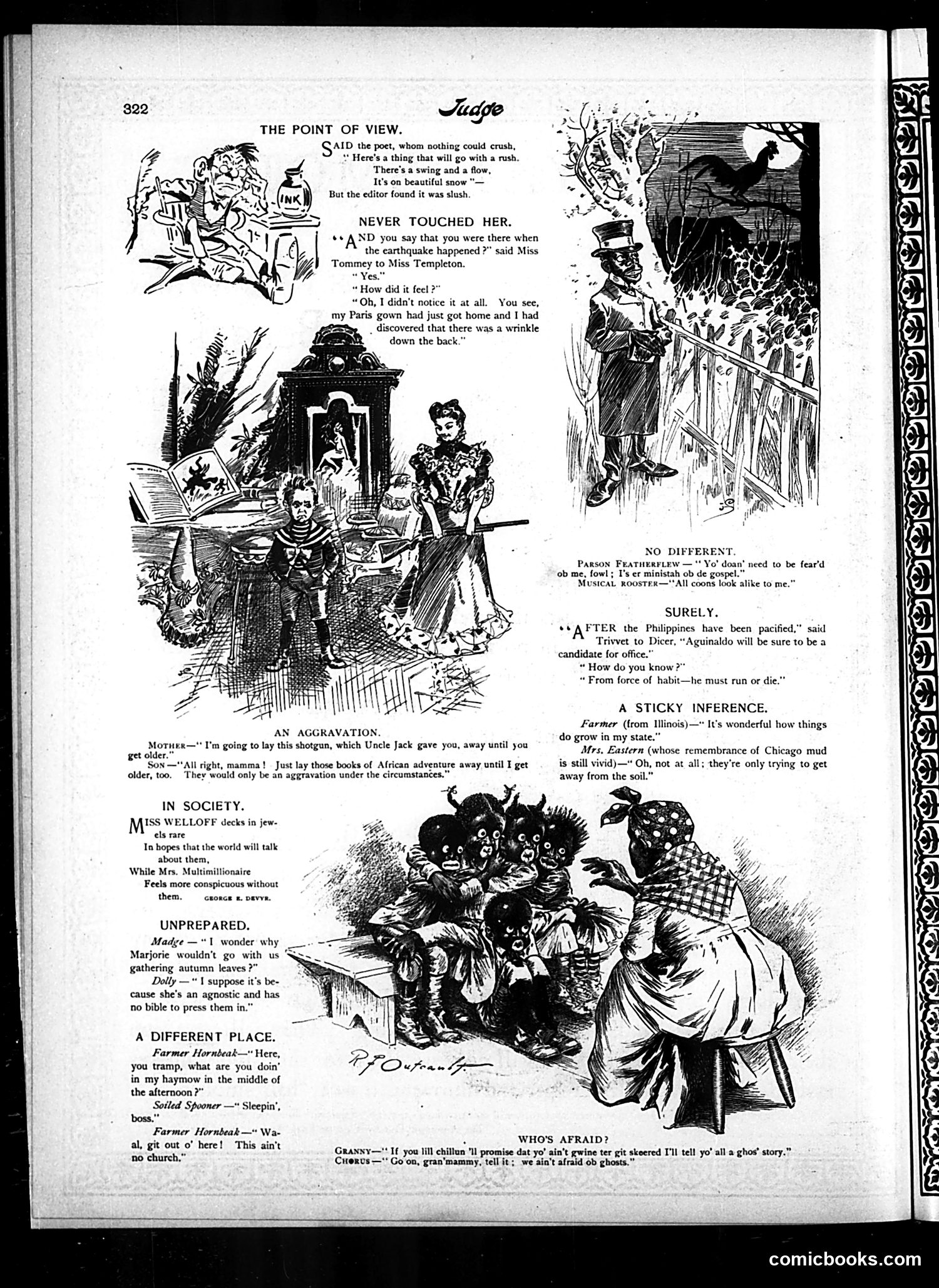
This page contains multiple satirical cartoons and jokes typical of early-1900s American humor: **"Never Touched Her"** mocks women's vanity—a woman experiences an earthquake but notices only a wrinkle in her Paris dress, satirizing shallow priorities. **"Surely"** references the Philippine-American War (post-1898). The joke suggests Filipino leader Aguinaldo will become a political candidate because "he must run or die"—a dark pun on his actual military situation. **"A Sticky Inference"** plays on regional stereotypes: a farmer boasts about Illinois soil fertility, while a Chicago woman cynically suggests things only grow there by escaping the notorious mud. **"In Society"** contrasts a wealthy woman adorning herself with jewels for attention against a multimillionaire woman who avoids such displays—satirizing different approaches to conspicuous wealth. The remaining jokes target agnosticism, tramps, and rural life with period-typical condescension. Overall, the page reflects early-1900s American preoccupations with imperialism, class anxiety, and gender stereotypes.
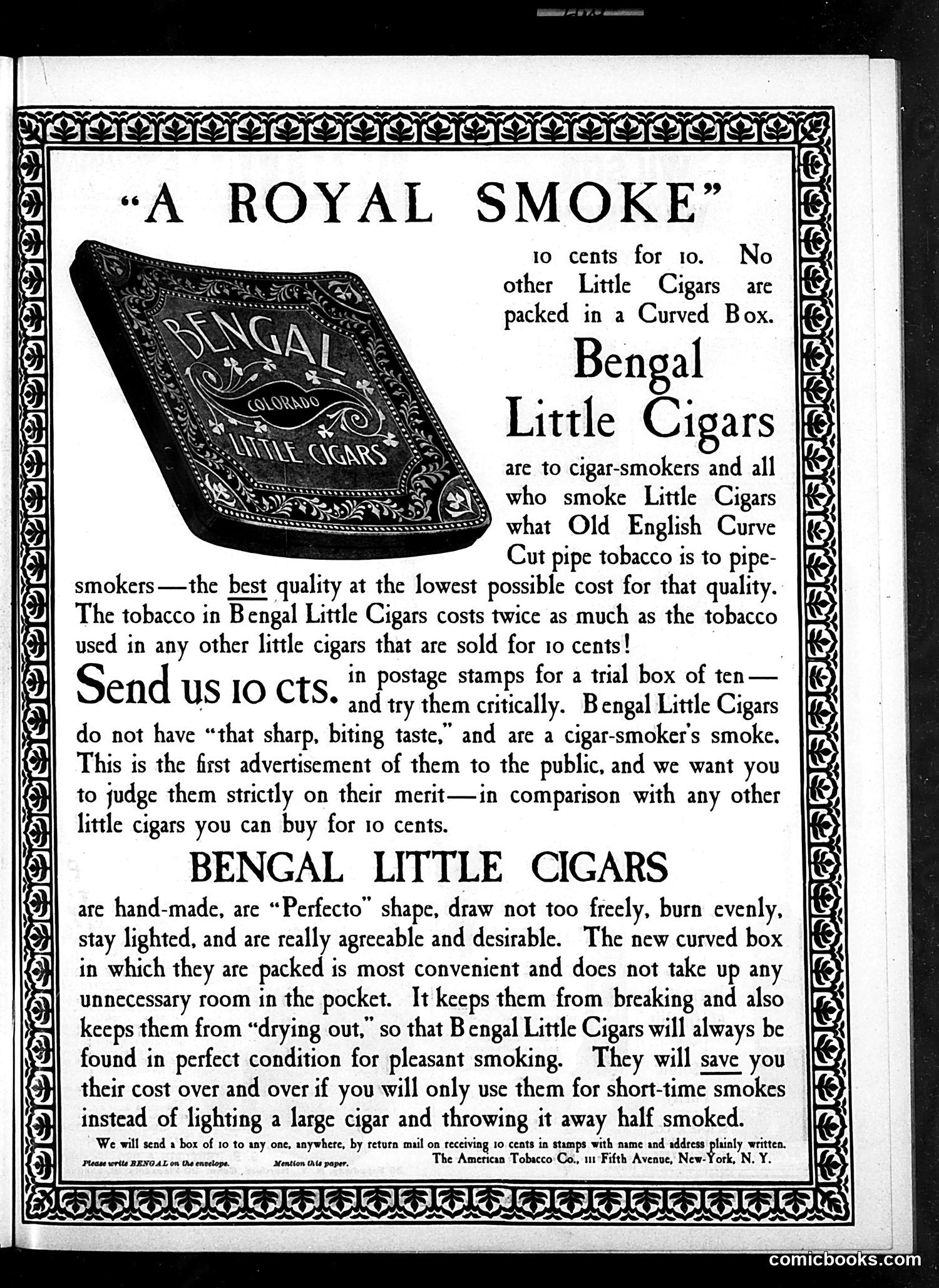
This page is **not a cartoon or satire** — it's a straightforward advertisement for Bengal Little Cigars by the American Tobacco Company, placed in *Judge* magazine (likely early 1900s). The ad promotes small cigars packaged in a curved box, emphasizing quality tobacco at a competitive 10-cent price point. Key selling points include: - Hand-made construction and "Perfecto" shape - Superior tobacco (claimed to cost twice as much as competitors) - Novel curved packaging that prevents breakage and drying - Practical value for short smoking sessions The "Royal Smoke" headline suggests premium positioning despite the modest price. The ad includes a trial offer: 10 cents in postage stamps for a sample box of ten cigars. This represents typical early-20th-century tobacco marketing—emphasizing craftsmanship, quality ingredients, and convenience to appeal to regular smokers. There is no political satire or social commentary present on this page.
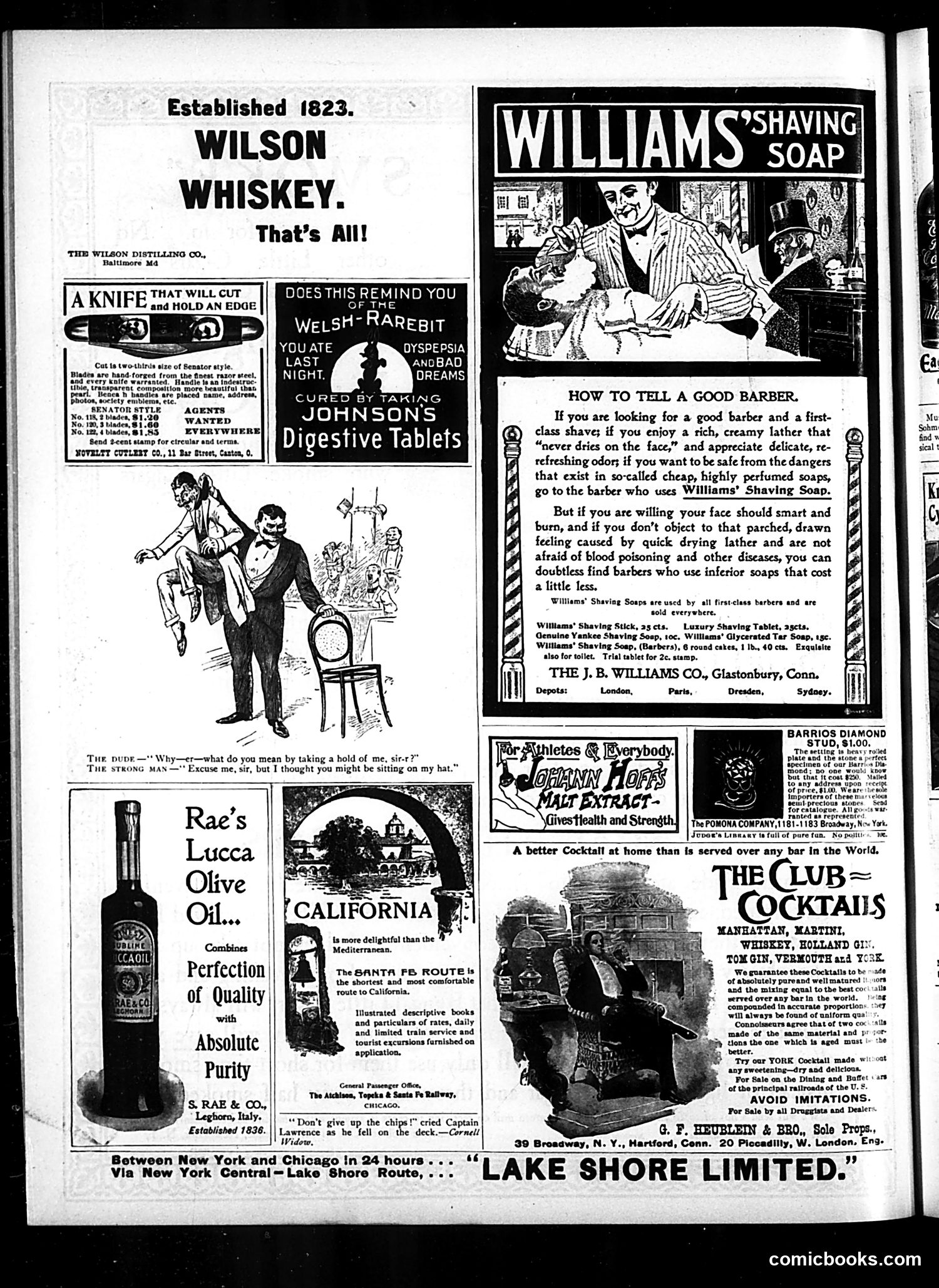
This is primarily an **advertising page** from Judge magazine, with one small cartoon joke. The main visual humor appears in the cartoon captioned with dialogue between "the dude" and "the strong man"—a vaudeville-style gag where a robust man grabs a well-dressed gentleman, apologizing because he thought the dude was sitting on his hat. The humor relies on physical comedy and class contrast typical of early 1900s entertainment. The page is otherwise dominated by product advertisements: Wilson Whiskey, novelty cutlery, Johnson's Digestive Tablets (for hangovers/dyspepsia), Rae's olive oil, California tourism, Williams' Shaving Soap, Glenn Hops Malt Extract, and various cocktail and railroad services. The **Welsh Rarebit reference** in one ad is a joke—Welsh rarebit (a cheese dish) was blamed for indigestion and bad dreams, humorously "cured" by the advertised tablets. The page reflects early 1900s consumer culture and the magazine's reliance on advertisements to fund publication.
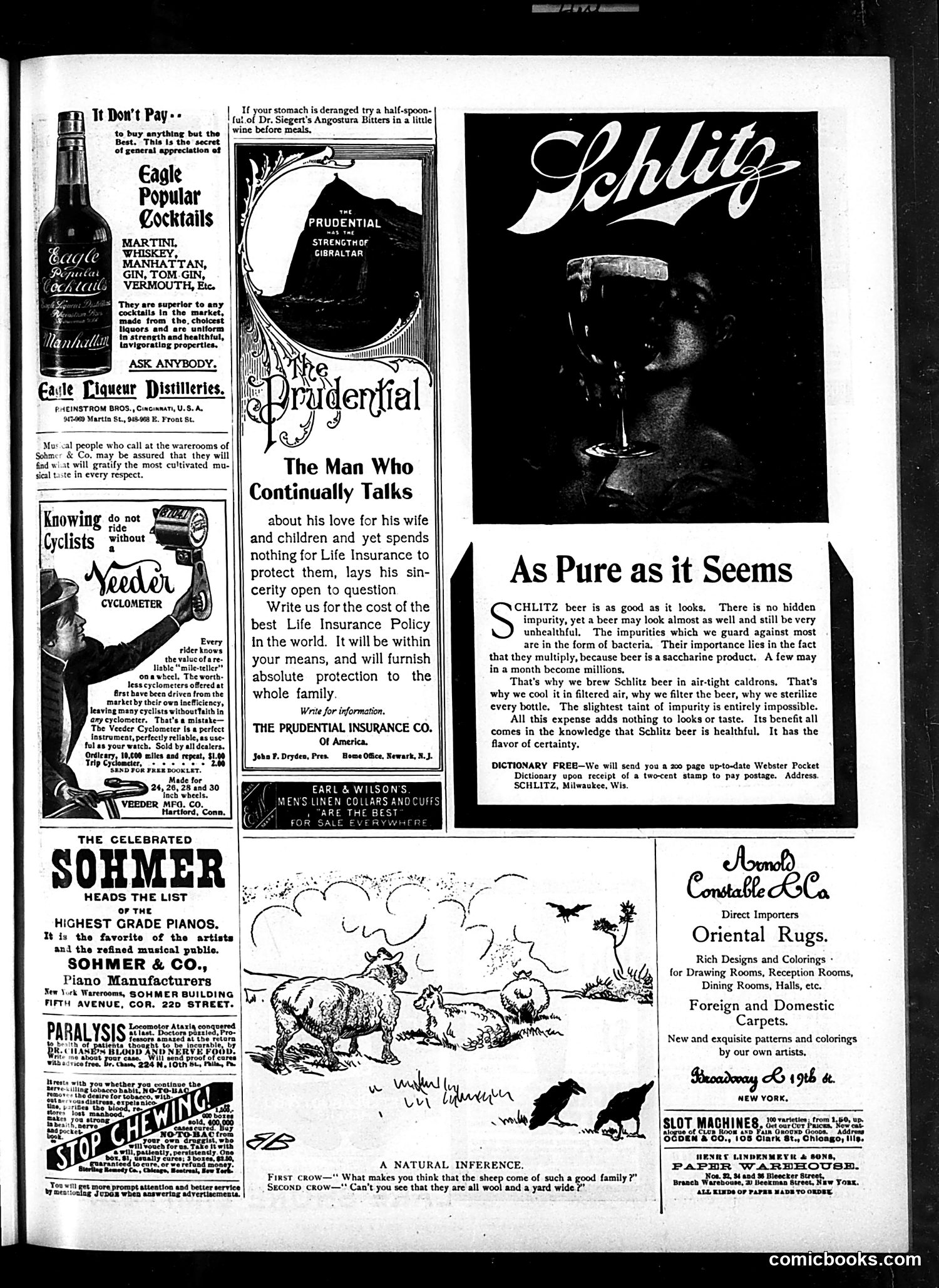
This page is primarily **advertising**, typical of Judge magazine's revenue model. However, it contains one small cartoon worth noting: **"A Natural Inference"** (bottom center) shows two crows observing sheep. The joke plays on visual appearance: one crow assumes the sheep must be of "good family" because they're "all wool and a yard wide"—a sarcastic reference to the phrase "all wool and a yard wide," meaning genuine or of quality. The satire mocks people who judge character or worth based solely on superficial appearance or material presentation, rather than actual substance. The surrounding ads promote Life Insurance (Prudential), beer (Schlitz), pianos (Sohmer), cocktails, and luxury goods—all marketing to affluent readers. The Prudential ad specifically targets men who claim to love their families but won't invest in life insurance, implying hypocrisy about financial responsibility.
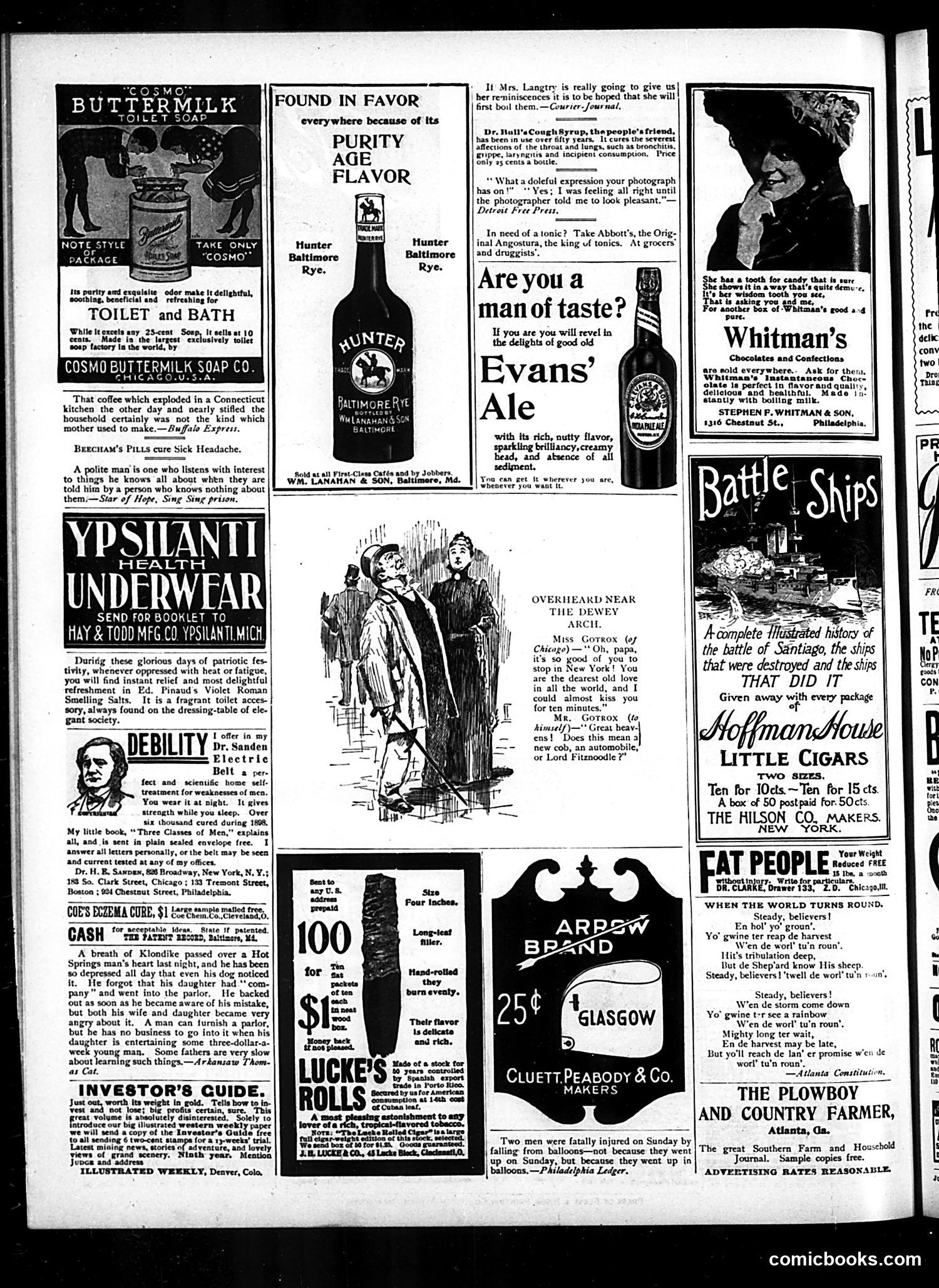
This page is primarily **advertisements with minimal editorial cartoon content**. The visible cartoon appears in the middle section: two men in formal dress conversing, with the caption "Overheard Near the Dewey Arch" in Chicago. The cartoon likely references the **Dewey Arch**—a temporary triumphal structure built in New York (not Chicago, suggesting OCR error or editorial joke) to celebrate Admiral Dewey's 1899 Spanish-American War naval victories. The humor derives from the social commentary: a wealthy Chicago woman ("Miss Gorrox") effusively flatters her father, while he cynically wonders what expensive gift she wants—suggesting either a new carriage ("cob"), an automobile, or marriage to "Lord Fitznoodle" (a satirical aristocrat name). The satire critiques **nouveau riche materialism** and the Gilded Age tendency of wealthy Americans to pursue European titles and status symbols. The remainder of the page contains period patent medicines, health products, and consumer goods typical of 1890s advertising—including dubious treatments like Dr. Sanden's electric belt for male "debility."
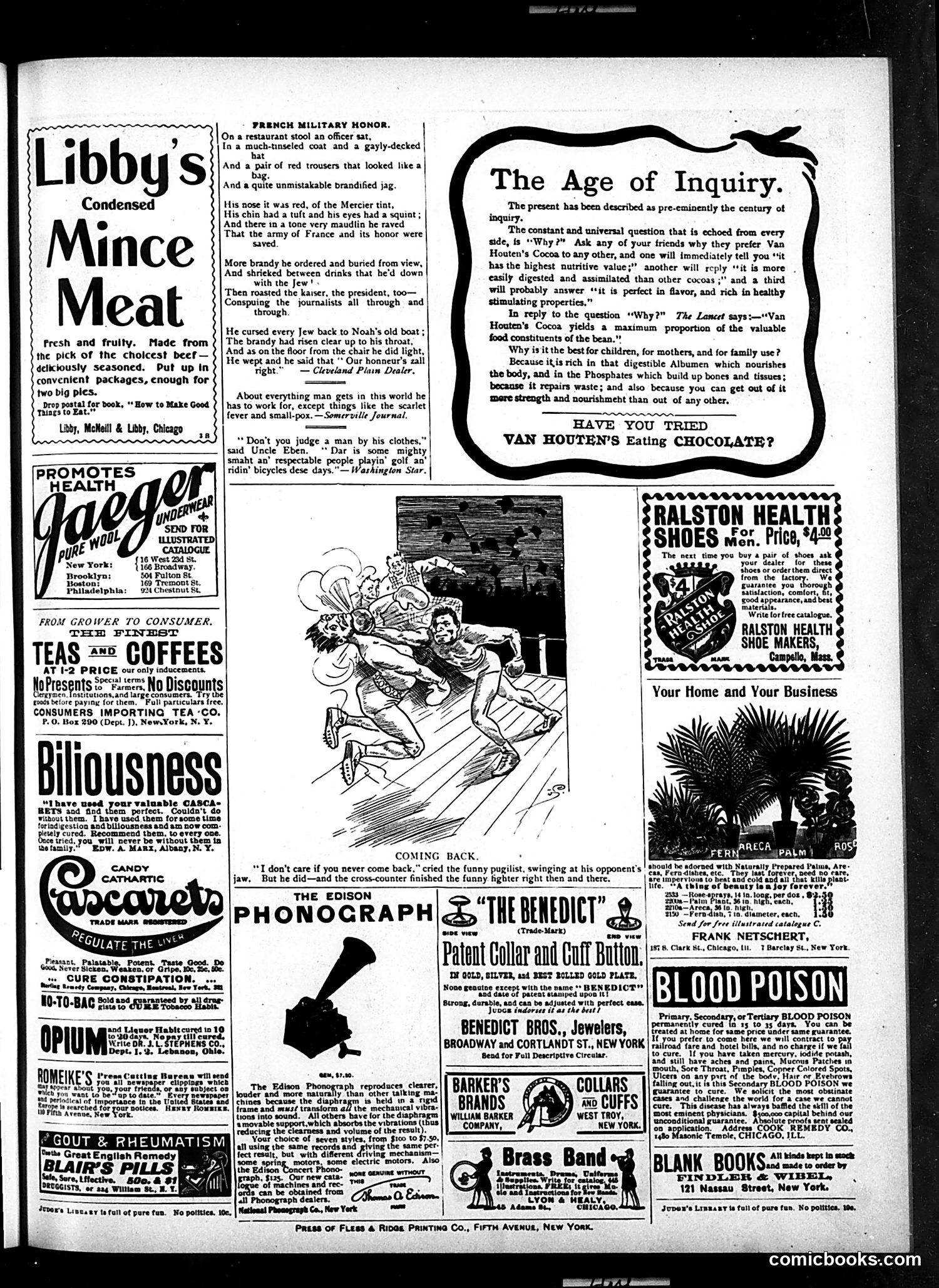
This page from the satirical magazine *Judge* contains several distinct elements: **Main Cartoon ("Coming Back"):** A comedic boxing scene where a pugilist claims he doesn't want his opponent to return, but the opponent does—and lands a decisive counter-punch. The joke plays on the phrase "coming back," treating it literally as a boxing match rather than a romantic scenario. **"French Military Honor" Poem:** A satirical jab at French military culture, depicting a drunken officer in a fancy uniform ranting about honor while getting progressively inebriated. It mocks the contradiction between ornate military pageantry and actual dignity. **"Age of Inquiry":** An advertisement disguised as commentary, humorously noting that everyone asks "why?" about consumer products, then pivoting to promote Van Houten's chocolate as the obvious answer. The page is primarily **advertisements** (Libby's meat, Ralston shoes, various tonics and remedies) interspersed with light satirical content typical of early 20th-century humor magazines—punching at pretension, drunkenness, and consumer culture.
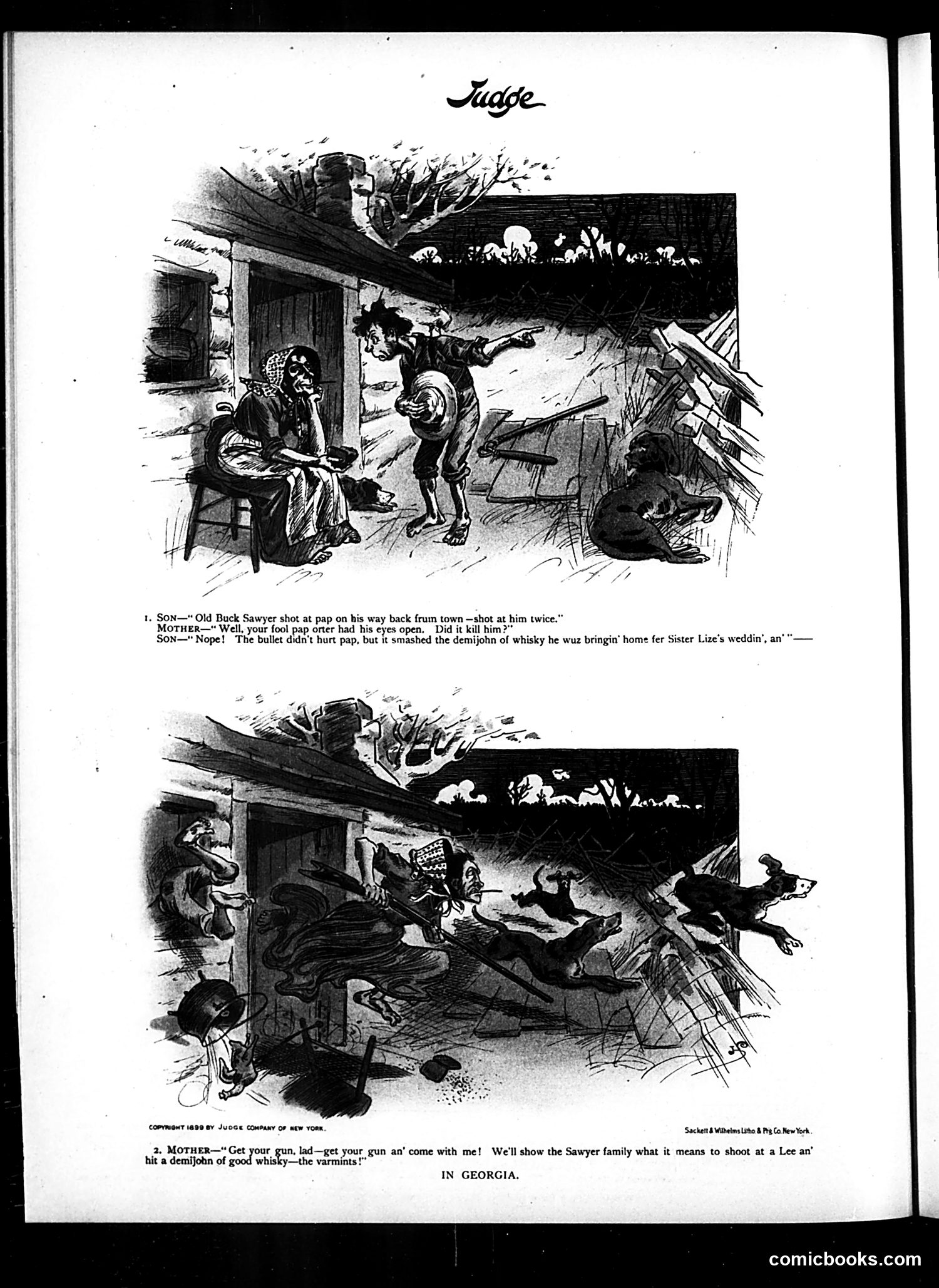
This two-panel cartoon satirizes rural Southern feuding culture, specifically depicting a backwoods family dispute in Georgia. The humor centers on misplaced priorities during a violent conflict. In panel one, a boy reports that "Old Buck Sawyer" shot at his father twice—but the boy's mother cares less about the attempted murder than about the destroyed demijohn (large jug) of whisky intended for his sister's wedding. Panel two escalates the absurdity: the mother mobilizes for revenge, but again frames the offense not as an assassination attempt, but as damage to "good whisky." The implication is that the family's honor has been wounded by property destruction rather than lethal violence. The satire mocks both the casual acceptance of gunplay among poor rural Georgians and their skewed value system—treating alcohol as more precious than human life. This reflects late-19th-century Northern stereotypes about Southern backwardness and lawlessness.