
A complete issue · 16 pages · 1899
Judge — October 21, 1899
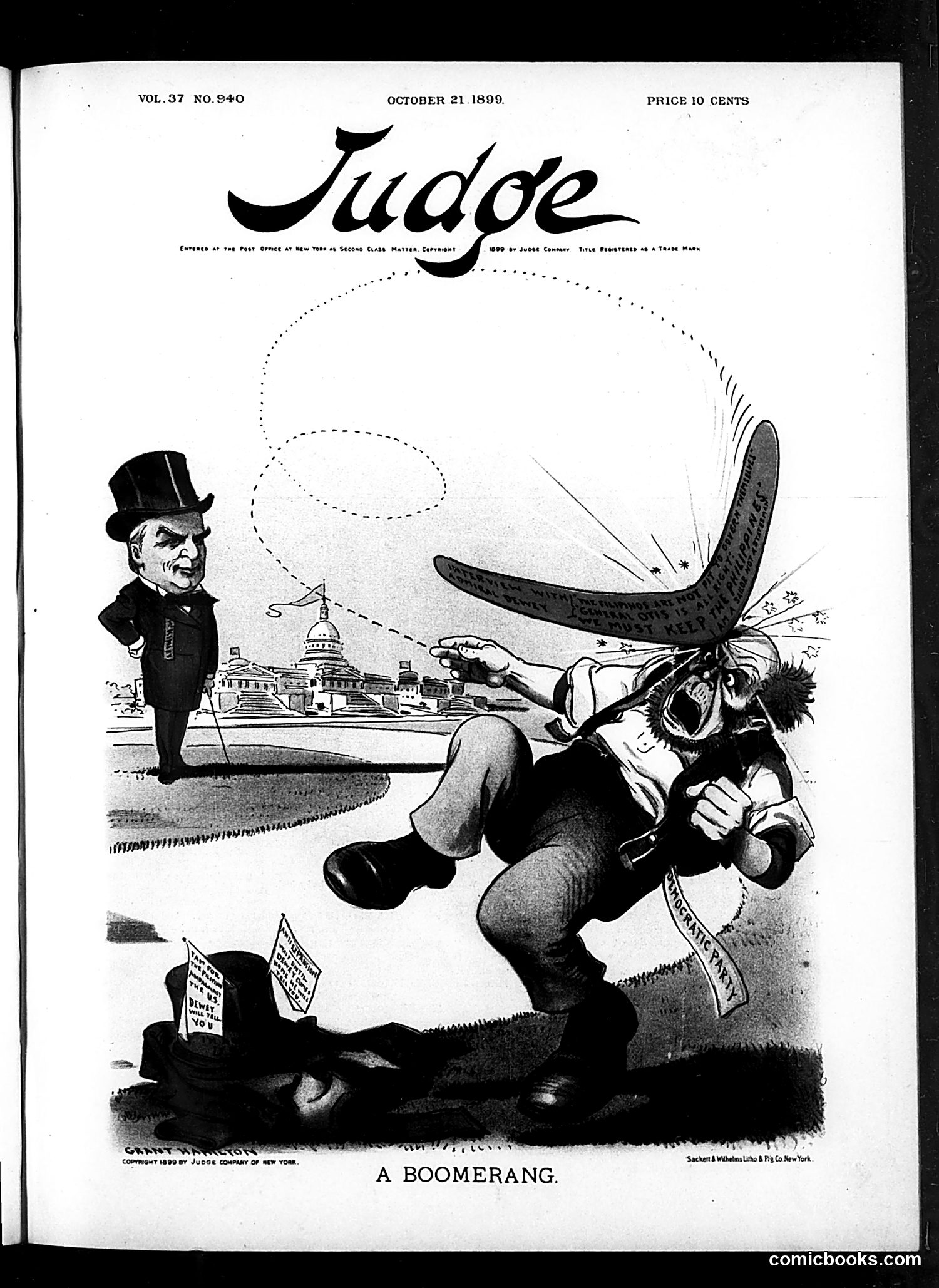
This political cartoon depicts a figure being struck by a returning boomerang labeled "EXPANSIONISM" while a well-dressed man in a top hat (likely representing political leadership or imperialism) controls the trajectory from the Capitol building in background. The satire criticizes American imperial expansion policies of the 1890s-early 1900s. The boomerang metaphor suggests that aggressive expansionist policies will return to harm their architects. The figure being knocked down appears to represent the working class or common American suffering the consequences of imperialist ambitions. The cartoon suggests Judge's editorial stance that imperial ventures abroad would produce negative "blowback" effects domestically—a prescient critique of expansionism's costs.
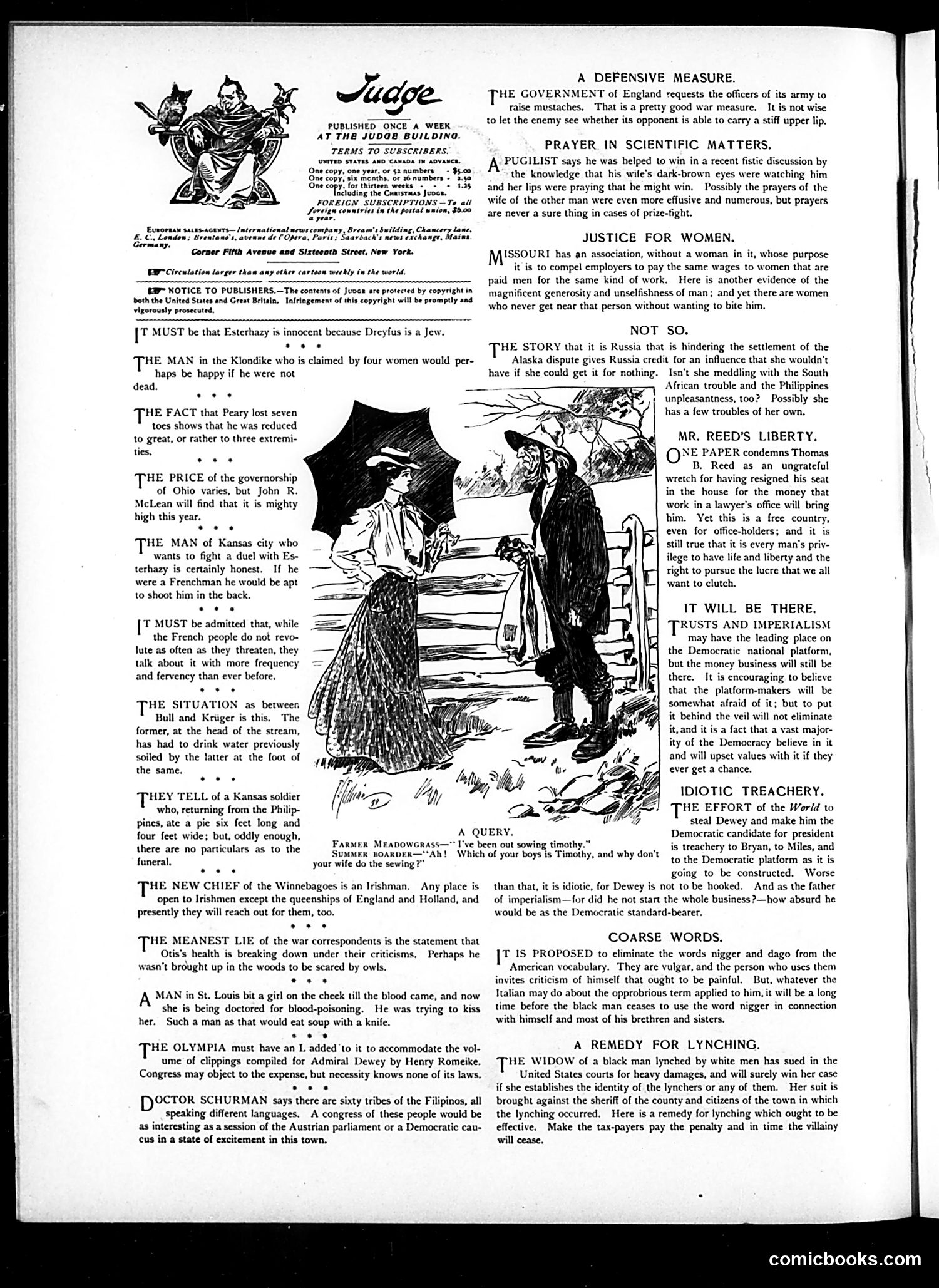
The main cartoon "A Query" depicts a farmer and woman in conversation, likely satirizing rural perspectives on current events. The accompanying text section discusses various political topics of the era. Key content includes: - **"A Defensive Measure"**: Mocks the British army's request that officers raise mustaches - **"Justice for Women"**: Criticizes Missouri's lack of women in employment-related organizations, noting unequal pay - **"Not So"**: References Russia and the Alaska dispute, suggesting political complications - **"Mr. Reed's Liberty"**: Defends Thomas B. Reed's resignation from Congress, asserting individual freedom - **"Coarse Words"**: Debates eliminating racial slurs from American vocabulary - **"A Remedy for Lynching"**: Proposes legal action against sheriffs and town officials complicit in lynchings The satire targets government inefficiency, gender discrimination, international disputes, and racial violence.
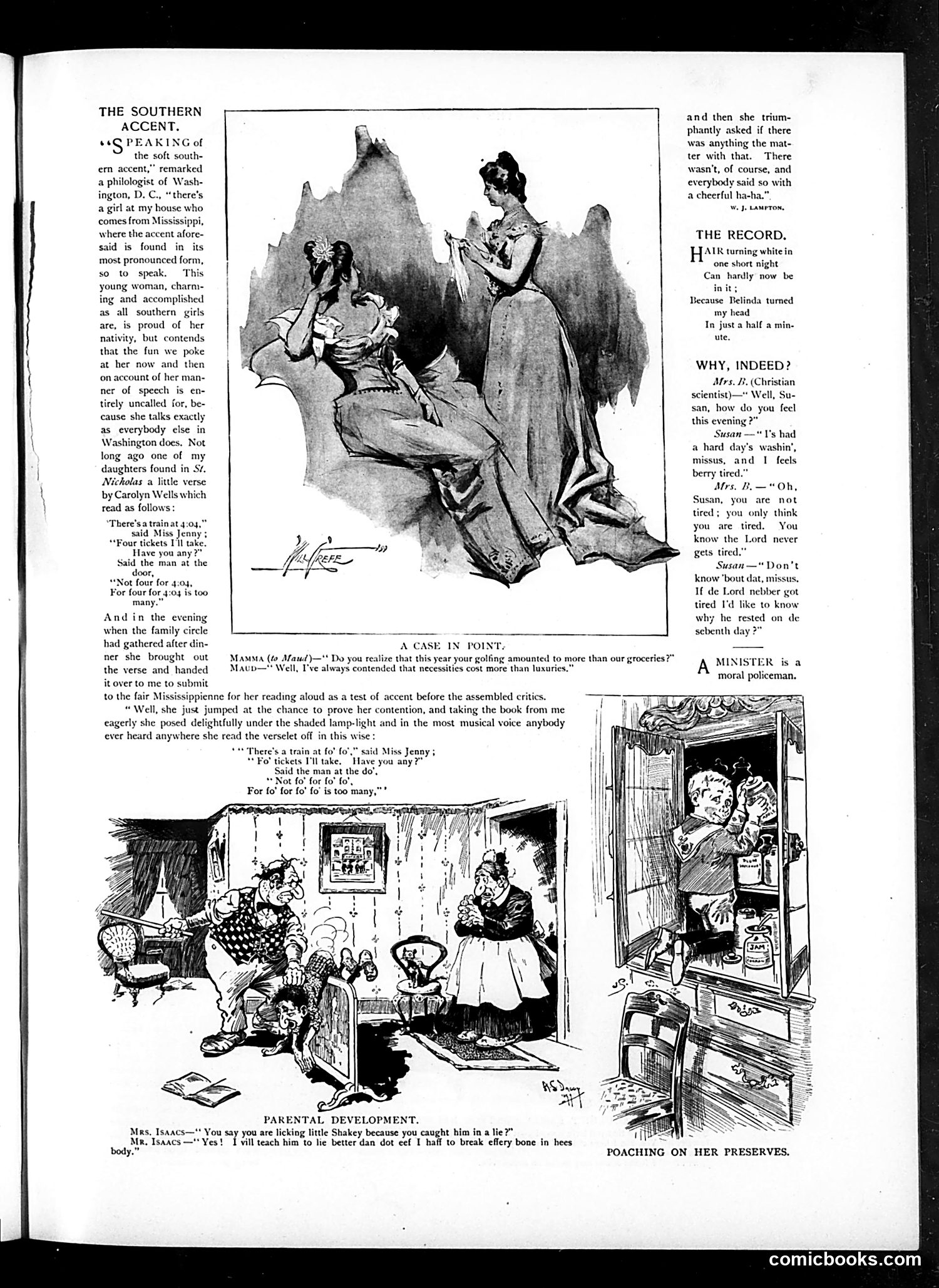
This page contains three separate satirical pieces: 1. **"The Southern Accent"** (top left): A humorous essay mocking a Washington woman's exaggerated Southern dialect and affected mannerisms, suggesting she affects a regional accent for pretense. 2. **"A Case in Point"** (center): An illustration depicting a mother and daughter conversation about fatigue and religious faith—the mother counsels that "the Lord never gets tired," mocking the daughter's complaint of exhaustion. 3. **"Parental Development"** (bottom): Shows a mother catching her son in a lie about breaking something, satirizing childhood dishonesty and parental discipline. 4. **"Poaching on Her Preserves"** (right): Depicts a woman finding someone raiding her pantry, likely commenting on domestic theft or boundary violations. The page is primarily humor-focused rather than overtly political, targeting social behavior and domestic life.
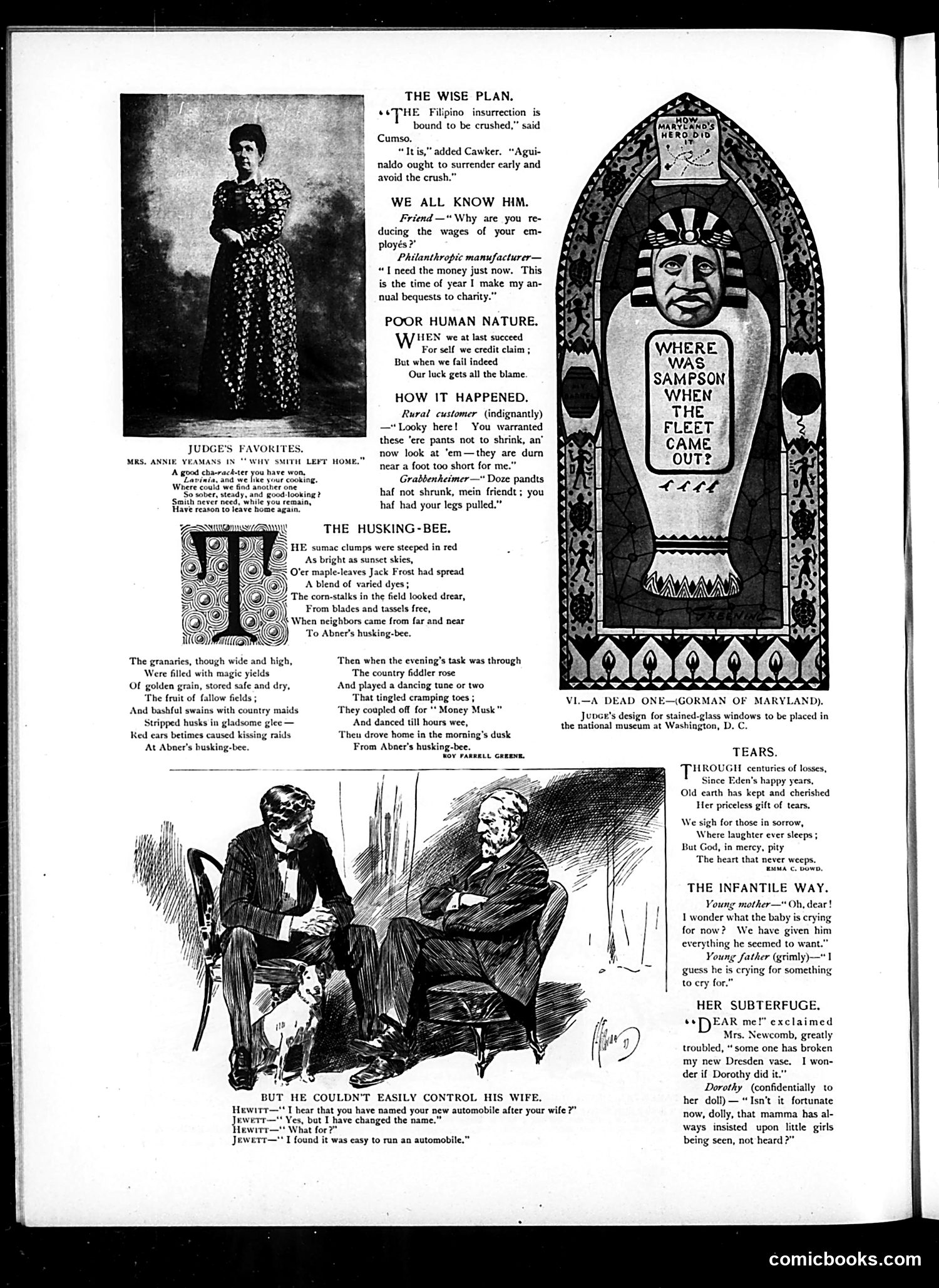
This page contains multiple satirical pieces targeting early 20th-century social issues: **"The Wise Plan"** mocks Filipino insurgents and American imperialist strategy, with characters debating whether to crush or negotiate with the Philippines rebellion. **"We All Know Him"** satirizes a wealthy philanthropist who reduces workers' wages while making charitable donations—exposing hypocrisy in wealthy "benevolence." **"The Husking-Bee"** is a nostalgic rural poem contrasting innocent country life with urban corruption. **"But He Couldn't Easily Control His Wife"** jokes about a man who renamed his automobile after his wife, suggesting wives are difficult to manage. The right column contains sentimental verses ("Tears," "The Infantile Way," "Her Subterfuge") depicting domestic family scenarios with gentle humor. The overall tone reflects turn-of-the-century concerns: imperialism, labor exploitation, and gender relations in marriage.
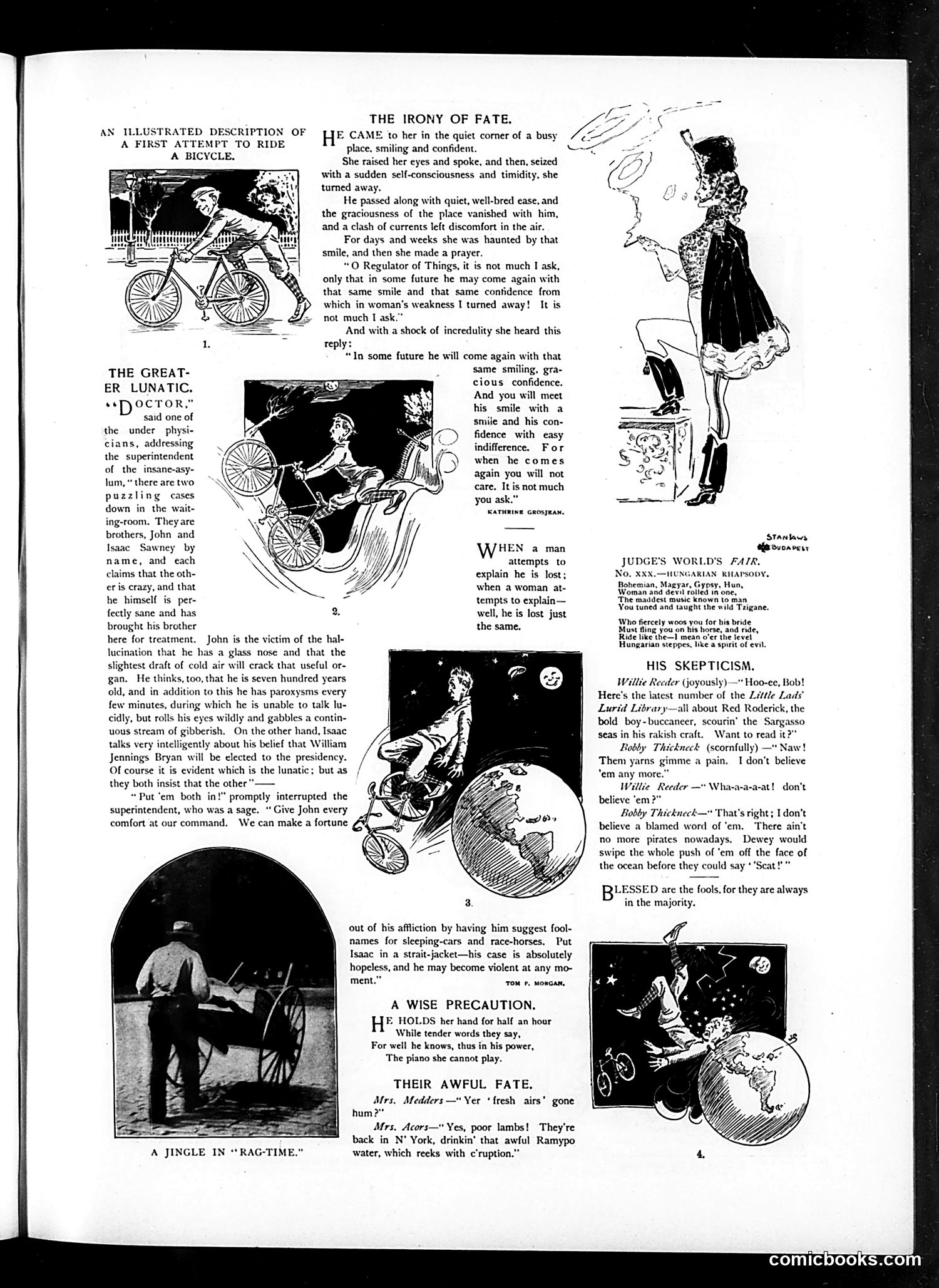
This page contains several satirical pieces mocking contemporary concerns: **"The Great-er Lunatic"** compares two asylum patients: one with absurd delusions (a glass nose, being 700 years old) versus another who rationally believes William Jennings Bryan will become president. The superintendent's joke suggests that Bryan's likely election makes the rational believer the true lunatic—a jab at Bryan's 1896 presidential campaign and his supporters' perceived foolishness. **"The Irony of Fate"** is a sentimental story about a woman's prayer being answered in unexpected ways—a romantic narrative unrelated to satire. **Bicycle cartoons** (illustrations 1-4) humorously depict the dangers and difficulties of early bicycle-riding, a relatively new phenomenon in the 1890s. The "Doctor" section satirizes bicycle accidents as medical emergencies. **"His Skepticism"** mocks children's dime novels (cheap adventure stories), with a boy dismissing pirate tales as unbelievable—commentary on popular juvenile literature. The page reflects 1890s concerns: political opposition to Bryan, the bicycle craze, and popular entertainment for children.
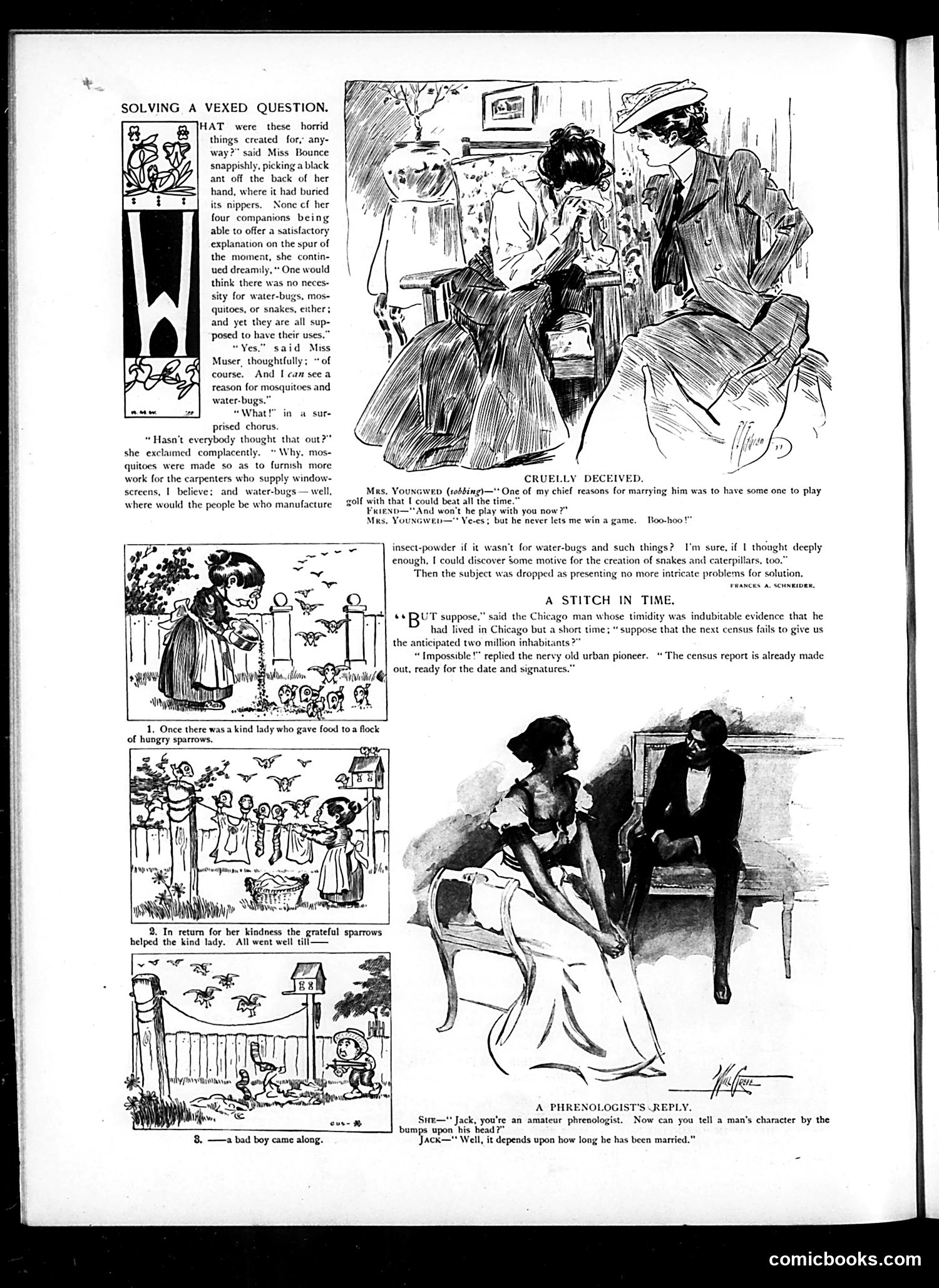
This page contains multiple satirical pieces typical of early 20th-century humor: **"Solving a Vexed Question"** mocks women's pseudo-intellectual conversation. Miss Bounce and friends discuss why God created annoying insects. Miss Muser offers absurd "explanations"—mosquitoes exist to create work for window-screen manufacturers; water-bugs justify insect-powder sales. The satire targets women's tendency toward frivolous logic and self-satisfied reasoning. **"Cruelly Deceived"** shows a newlywed wife complaining her husband won't let her beat him at games, suggesting marriage has disappointed her romantic expectations. **"A Stitch in Time"** satirizes bureaucratic dishonesty: a Chicago pioneer admits census reports are pre-filled before actual counting occurs—commentary on government corruption or carelessness. **"A Phrenologist's Reply"** offers dark marital humor: a man's head bumps reveal character based on "how long he's been married"—implying marriage damages men's character. The overall tone reflects period attitudes toward women's intellect, marital discord, and government incompetence.
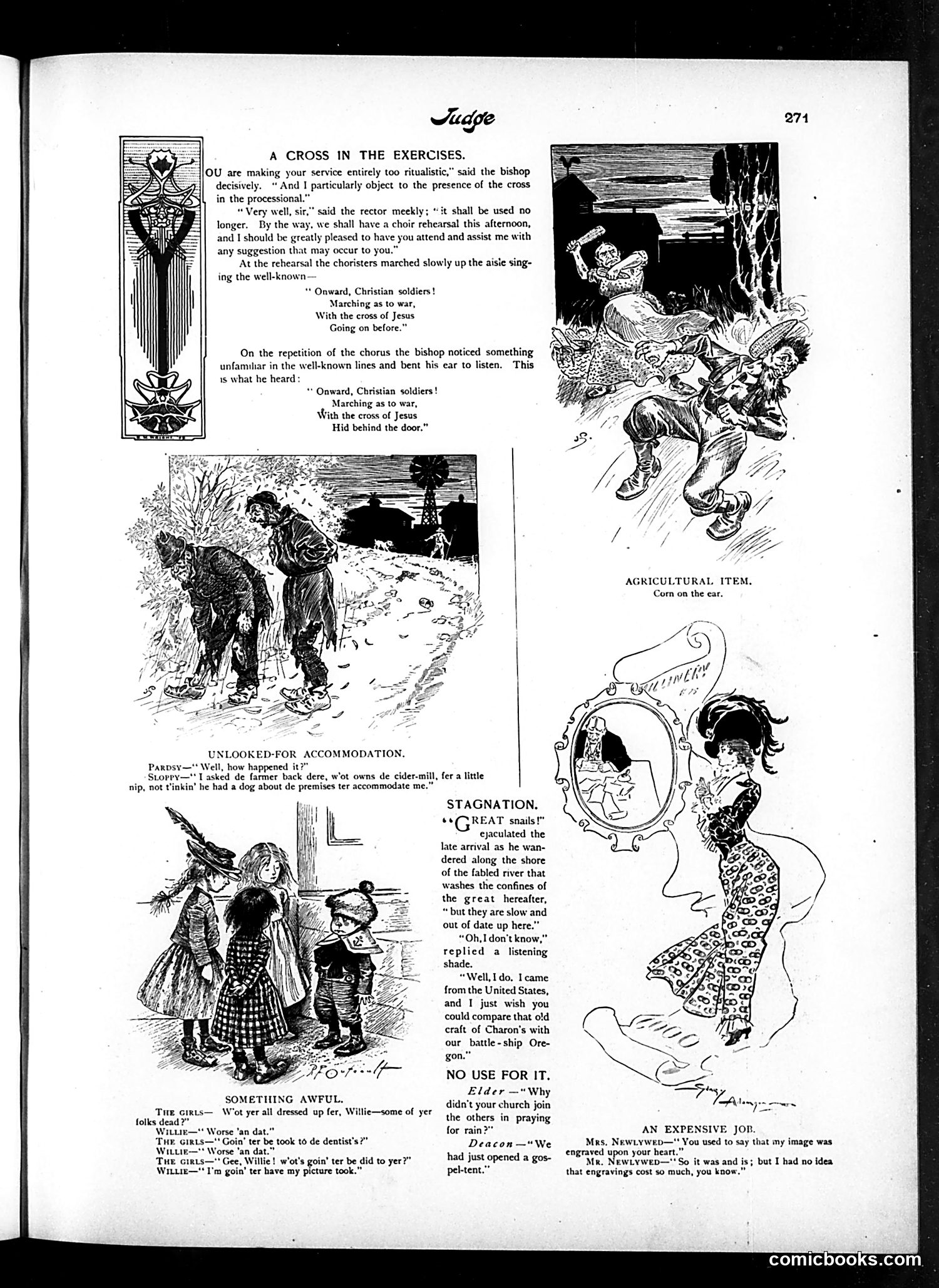
This page contains several satirical cartoons mocking religious hypocrisy and social pretension: **"A Cross in the Exercises"**: A bishop objects to ritual crosses in church services as "too ritualistic," then insists on attending choir practice. The choir deliberately sings altered lyrics—"With the cross of Jesus / Hid behind the door"—exposing the bishop's contradiction. The satire criticizes clergy who denounce ritualism while enforcing their own rules. **"Unlooked-for Accommodation"**: A man asks a farmer for cider but gets bitten by a dog instead—a pun on "accommodation." **"Stagnation"**: A newly arrived soul complains about slow ferries in the afterlife compared to American warships, satirizing American technological boasting. **"Something Awful"** and **"No Use for It"**: Humorous exchanges about children's fears of dentists and church fundraising. **"An Expensive Job"**: A woman complains an engraver charged too much for her portrait, unaware her husband had it removed from his heart. The dominant theme: exposing contradictions between stated principles and actual behavior.
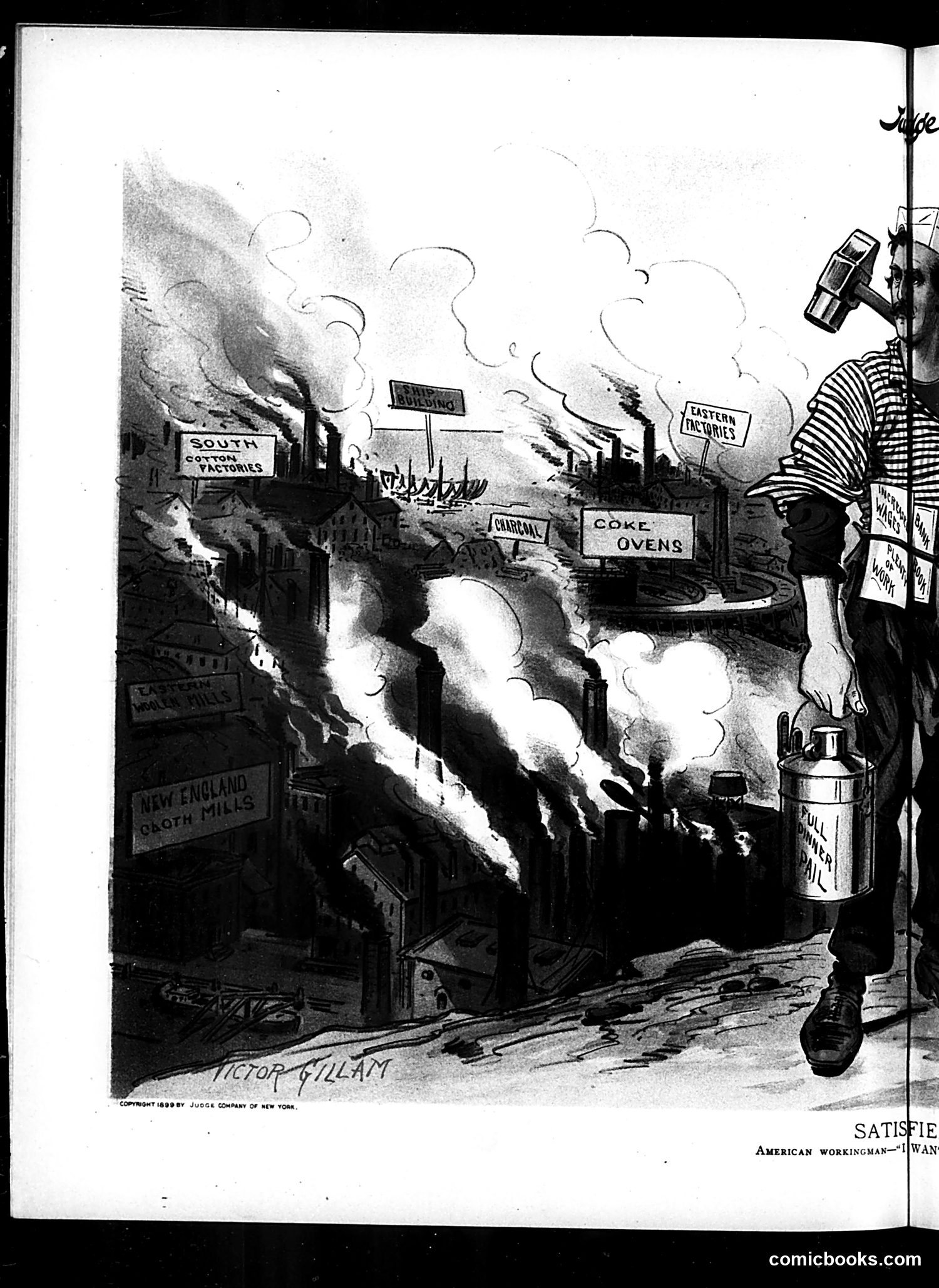
This is a satirical cartoon by Victor Gillam depicting industrial pollution and labor concerns. The image shows massive factories belching thick smoke, with signs identifying various industries: cotton mills, coke ovens, and Eastern factories. On the right stands a figure labeled "American Workingman" holding what appears to be a bottle or container, facing this polluted industrial landscape. The satire critiques industrial working conditions and environmental degradation in America. The workingman's presence suggests commentary on labor's relationship to these polluting industries—likely questioning whether industrial growth benefited workers or merely exploited them while poisoning their environment. The cartoon appears to be from Judge magazine's social commentary tradition, addressing early 20th-century anxieties about industrialization's human and environmental costs.
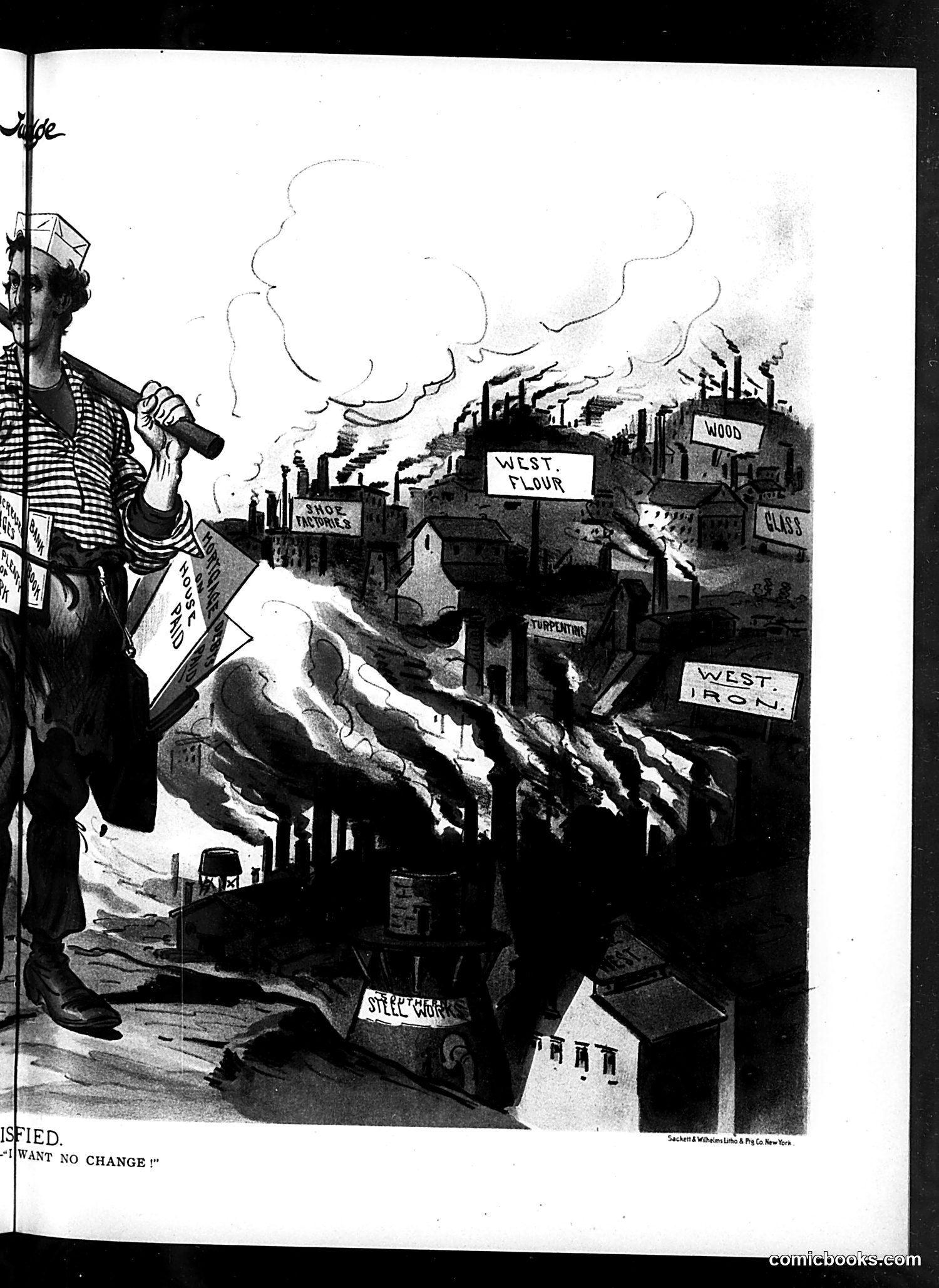
This political cartoon depicts a figure on the left (appearing to be a wealthy industrialist or politician, indicated by his fine clothing) surveying an industrial landscape with smoking factories labeled "West Flour," "West Wood," "West Iron," and "Slag Works." The figure holds a telescope and declares "I want no change!" The satire critiques resistance to industrial reform or regulation. The factories are belching smoke, suggesting environmental and labor concerns of the era. The caption's ironic assertion of wanting "no change" mocks those opposing progressive reforms—the figure is satisfied with the status quo despite obvious pollution and industrial problems visible in the scene. This reflects late 19th/early 20th-century tensions between industrialists resisting regulation and reformers demanding change.
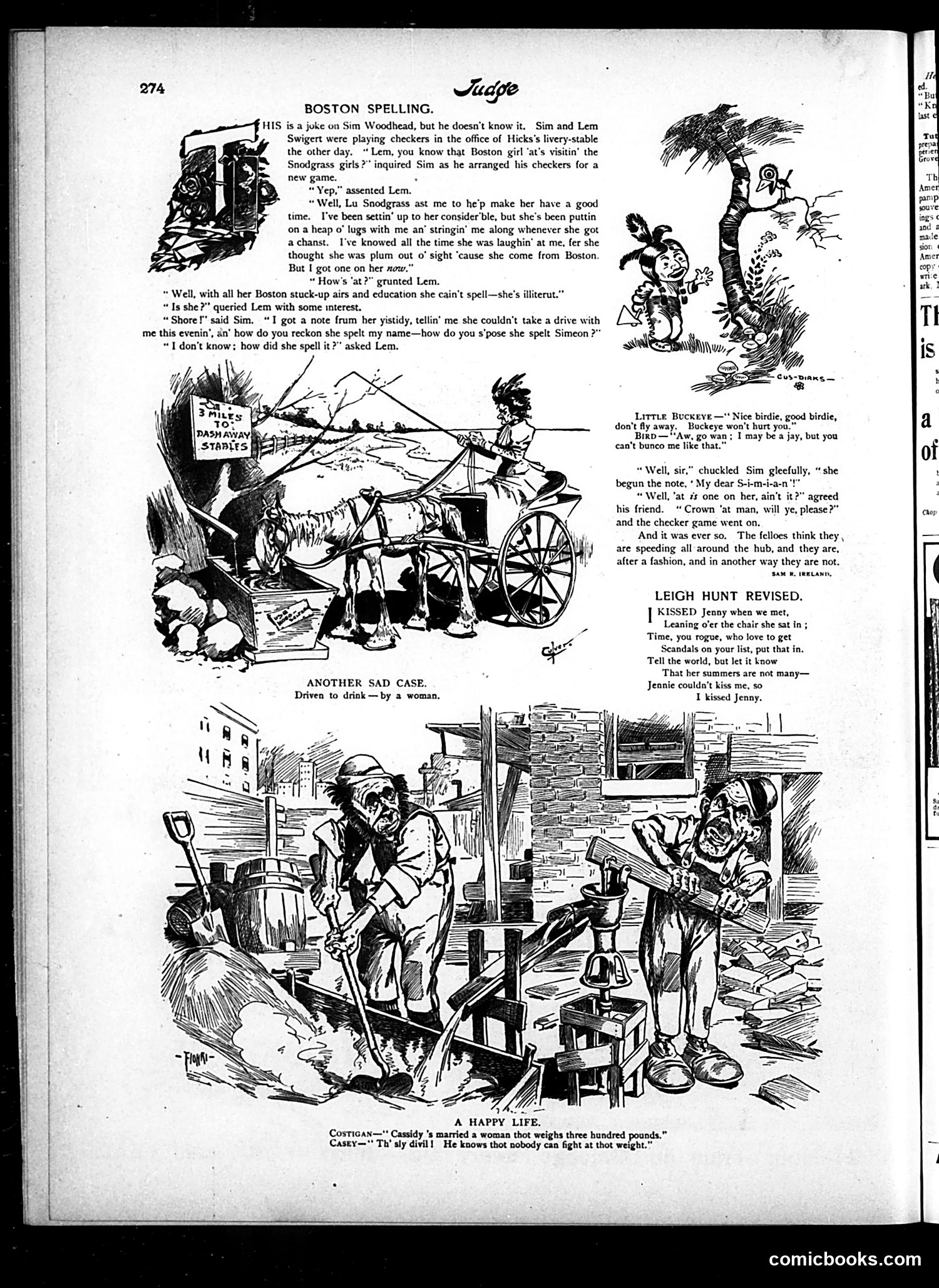
This page contains rural American humor from an era when Judge satirized regional dialects and social pretensions. **"Boston Spelling"** mocks a visiting Boston girl's perceived superiority. Rural men Sim and Lem play checkers while Sim brags he's outsmarted her—she misspelled his name "Simeon" as "S-iem-i-a-n" in a note. The joke assumes Boston education is fraudulent; the girl's fancy airs mask illiteracy. The humor relies on dialect comedy (rural "ain't" vs. urban pretension) and class mockery typical of the era. **Lower cartoons** are unrelated: "Another Sad Case" depicts working-class Irish figures; "A Happy Life" is a brief comic exchange about a boxer named Cassidy marrying a 300-pound woman—the joke being no one will fight someone that heavy. **"Leigh Hunt Revised"** is a sentimental poem about kissing Jenny. The page reflects early-20th-century American humor that punched down at regional accents, immigrants, and those perceived as socially inferior.
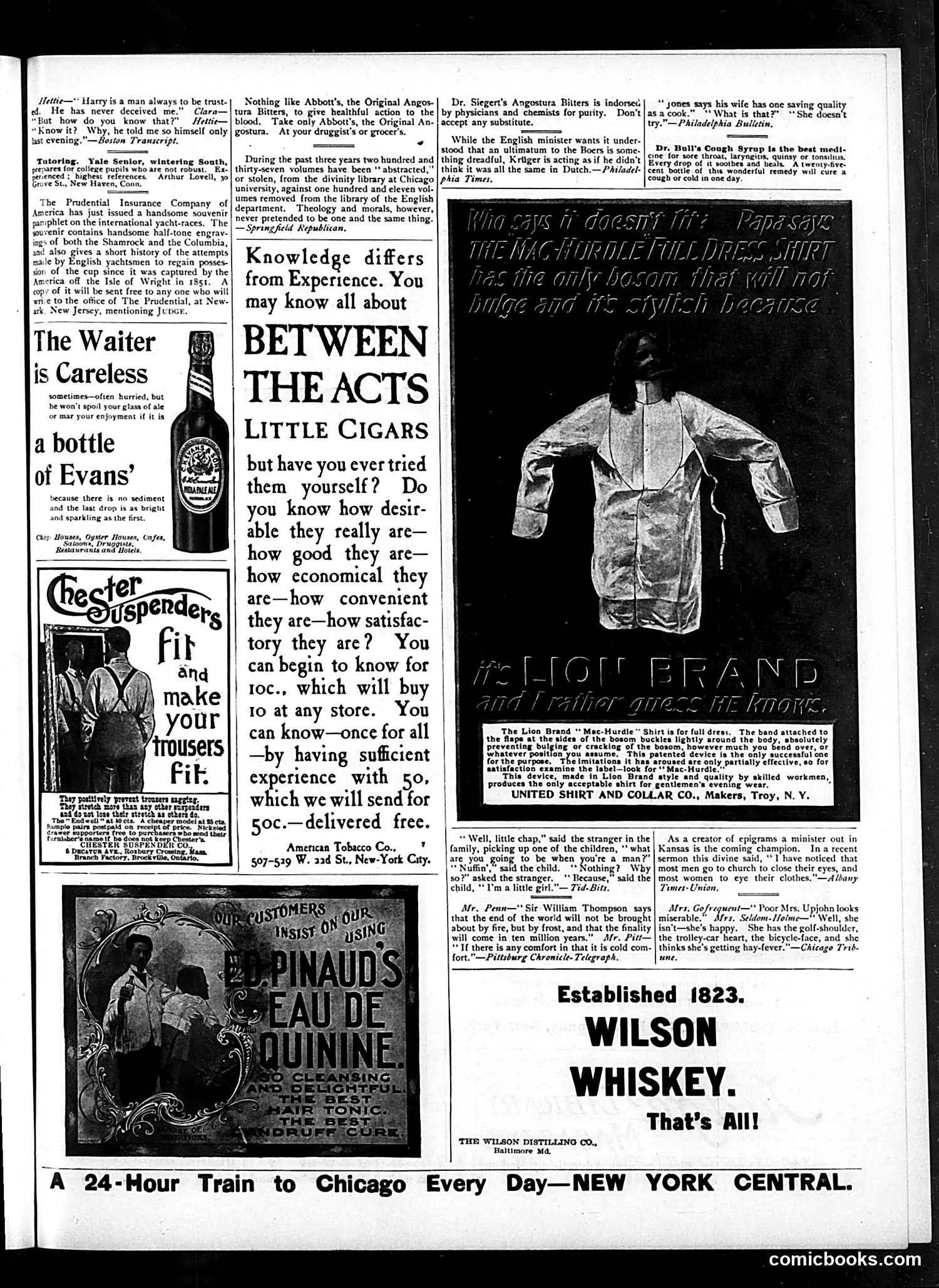
This page from *Judge* magazine consists primarily of **advertisements and short humorous anecdotes** rather than political cartoons. The main content includes: **Advertisements** for products like Evans' ale, Between the Acts cigars, Angostura Bitters, Chester suspenders, Pinaud's eau de cologne, and Wilson whiskey—typical of early 1900s magazine marketing. **Brief jokes** scattered throughout, such as a wife trusting her husband because "he told me so himself," and a child responding to being asked what she'll be when grown: "Nothing? Why so? Because I'm a little girl"—gentle humor about gender expectations. **A notable editorial quip**: theft from a university divinity library exceeded theft from other departments, prompting the observation that "Theology and morals...never pretended to be one and the same thing"—light social satire about hypocrisy. **A reference to the Boer War** (Britain's conflict in South Africa, 1899-1902), mocking British diplomatic posturing. The page reflects *Judge*'s mixed approach of satirical commentary interspersed with period advertising.
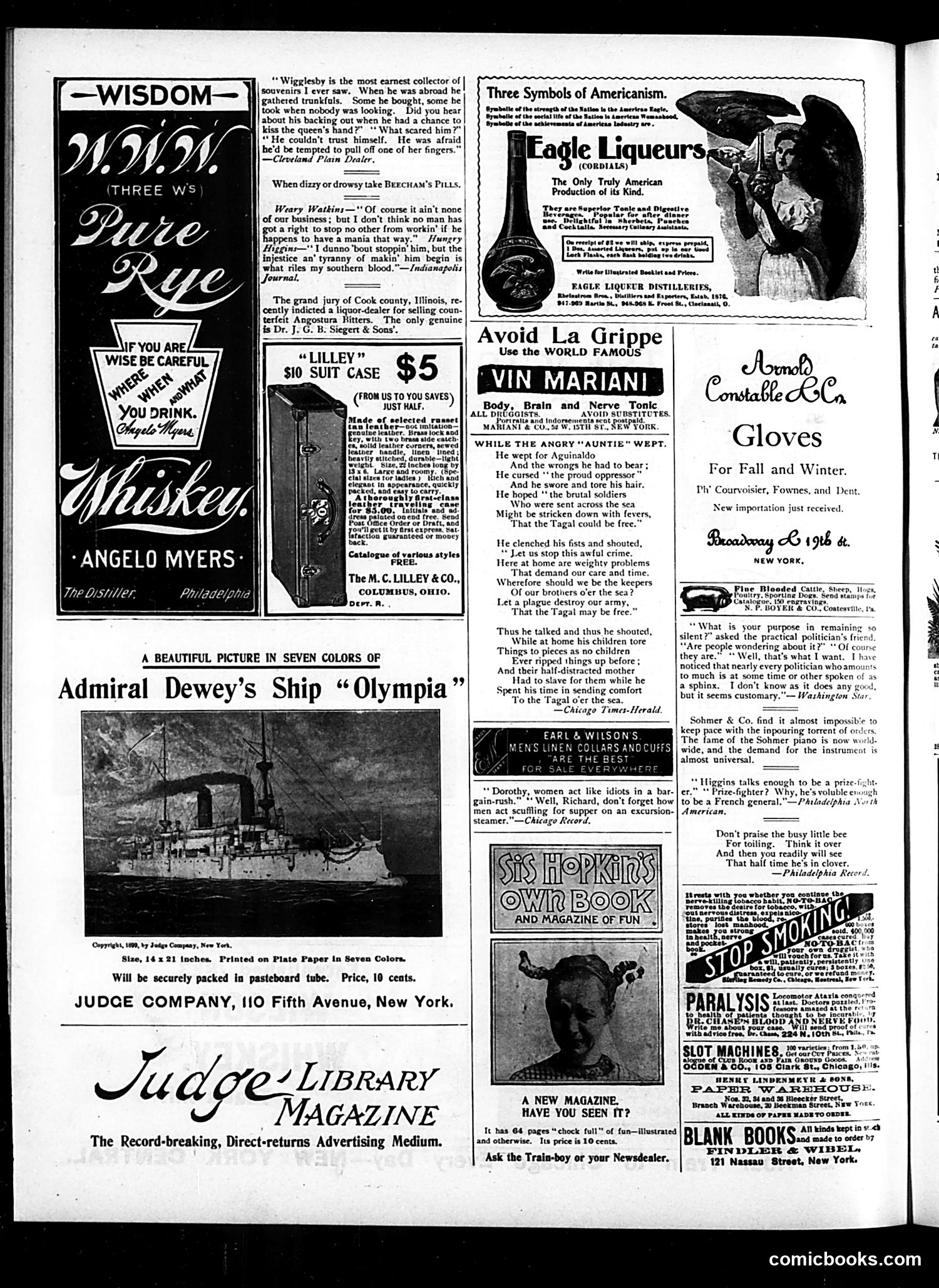
This page is primarily **advertisements** interspersed with brief humorous anecdotes in the "Wisdom" section, rather than political cartoons. The main satirical content appears in a poem titled "While the Angry 'Auntie' Wept," which criticizes American military intervention in the Philippines during the Filipino-American War (circa 1898-1902). The "auntie" character represents an anti-imperialist activist who emotionally demands withdrawal from the Philippines and rails against "brutal soldiers," while his own children at home cause chaos unattended. The satire suggests that vocal war critics are hypocritical—more concerned with distant colonial issues than domestic responsibilities. The page also includes brief jokes mocking a souvenir collector's dishonesty and labor disputes, typical period humor. Most space, however, is devoted to product advertisements (whiskey, liqueurs, suits, gloves) that dominated Judge's revenue model.
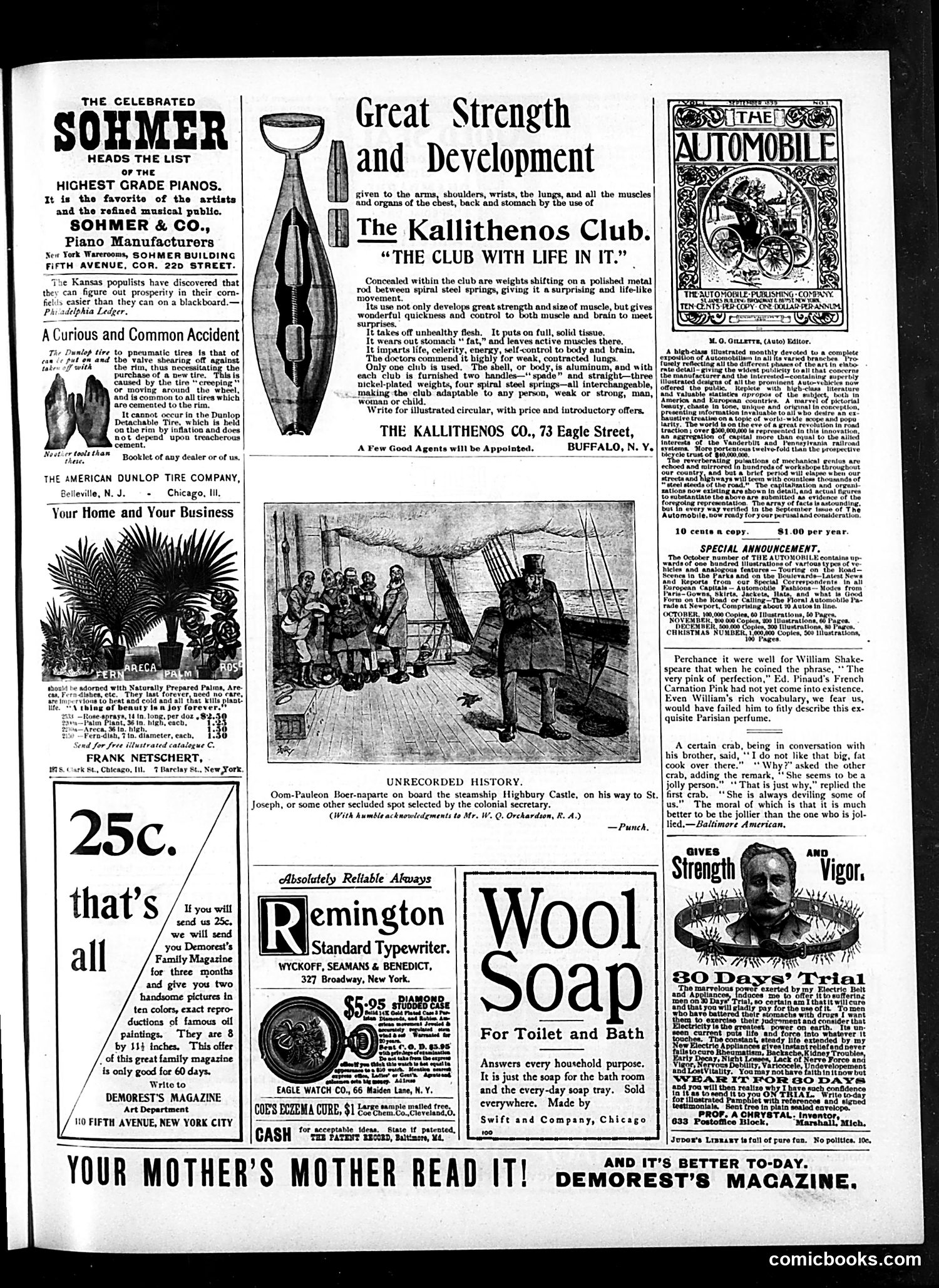
This is primarily an **advertising page** with minimal editorial content. The notable satirical item is the small section titled "UNRECORDED HISTORY," which presents a single-panel cartoon about **Oom-Paulcon Boer-aparte** traveling aboard a steamship to St. Joseph. This is a **political reference to the Boer War era** (late 1890s-early 1900s). The figure's name combines "Oom Paul" (a nickname for Boer leader Paul Kruger) with "Bonaparte," humorously comparing him to Napoleon. The caption suggests this is an invented historical anecdote—perhaps satirizing either Kruger's exile or making a joke about the Boers' military ambitions being as grandiose but ultimately futile as Napoleon's. The rest of the page consists of **product advertisements**: pianos, tires, exercise equipment (the "Kallithenos Club"), typewriters, soap, and magazines. There is also a brief quip about Kansas populists misunderstanding economics. The page reflects turn-of-the-century commercial culture rather than sustained political satire.
This is primarily an **advertising page** from an early 1900s Judge magazine, with minimal political satire. The page contains commercial advertisements interspersed with brief humorous anecdotes. **Notable Content:** The **Syrup ad** (top right) is a vintage patent medicine advertisement claiming to cure kidneys, liver, bowels, headaches, fevers, and constipation—typical exaggerated health claims common before FDA regulation. The **Beeman's Pepsin Gum ad** (right) similarly promises to cure indigestion and sea-sickness, with claims that "all others are imitations." The **Palliser's American Architecture book advertisement** (center-left) offers a substantial $5 book for $1, targeting home builders and architects. The brief anecdotes scattered throughout contain mild social humor about marriage, wealth, and contemporary life, but lack sharp political commentary. References to "Newport," "Transvaal," and leisure activities reflect upper-class preoccupations of the era. The **Hunter Baltimore Rye whiskey ad** (left) represents alcohol advertising before Prohibition. This page reflects Judge's commercial orientation rather than satirical focus.
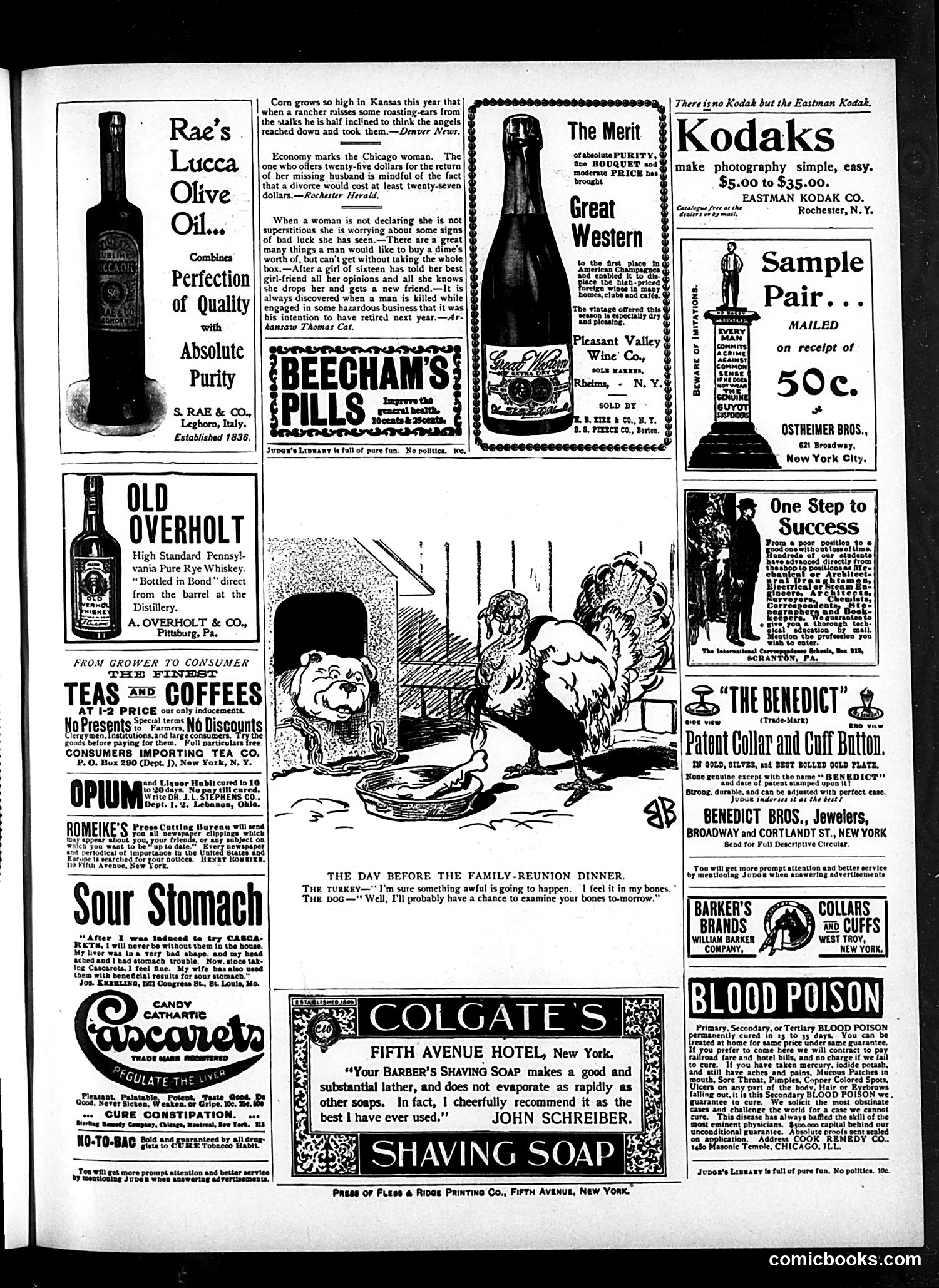
This is primarily an **advertising page** from Judge magazine, with one small cartoon joke. ## The Cartoon The main cartoon ("The Day Before the Family-Reunion Dinner") shows a turkey and dog conversing. The turkey worries "something awful is going to happen," while the dog replies he'll "probably have a chance to examine your bones to-morrow." **The joke**: Dark humor about the turkey's impending fate—it will be killed and eaten at tomorrow's dinner, leaving only bones for the dog to gnaw. This plays on the turkey's anxious premonition. ## The Advertisements The page is filled with period patent medicines and consumer products (Beecham's Pills, Old Overholt Whiskey, Cascaret laxative, Colgate's Shaving Soap, etc.)—typical of Judge's revenue model. One ad quotes a barber praising shaving soap, representing the era's common practice of endorsements by named individuals claiming product superiority. **Context**: Early 1900s American consumer culture relied heavily on such magazines for advertising revenue and product promotion.
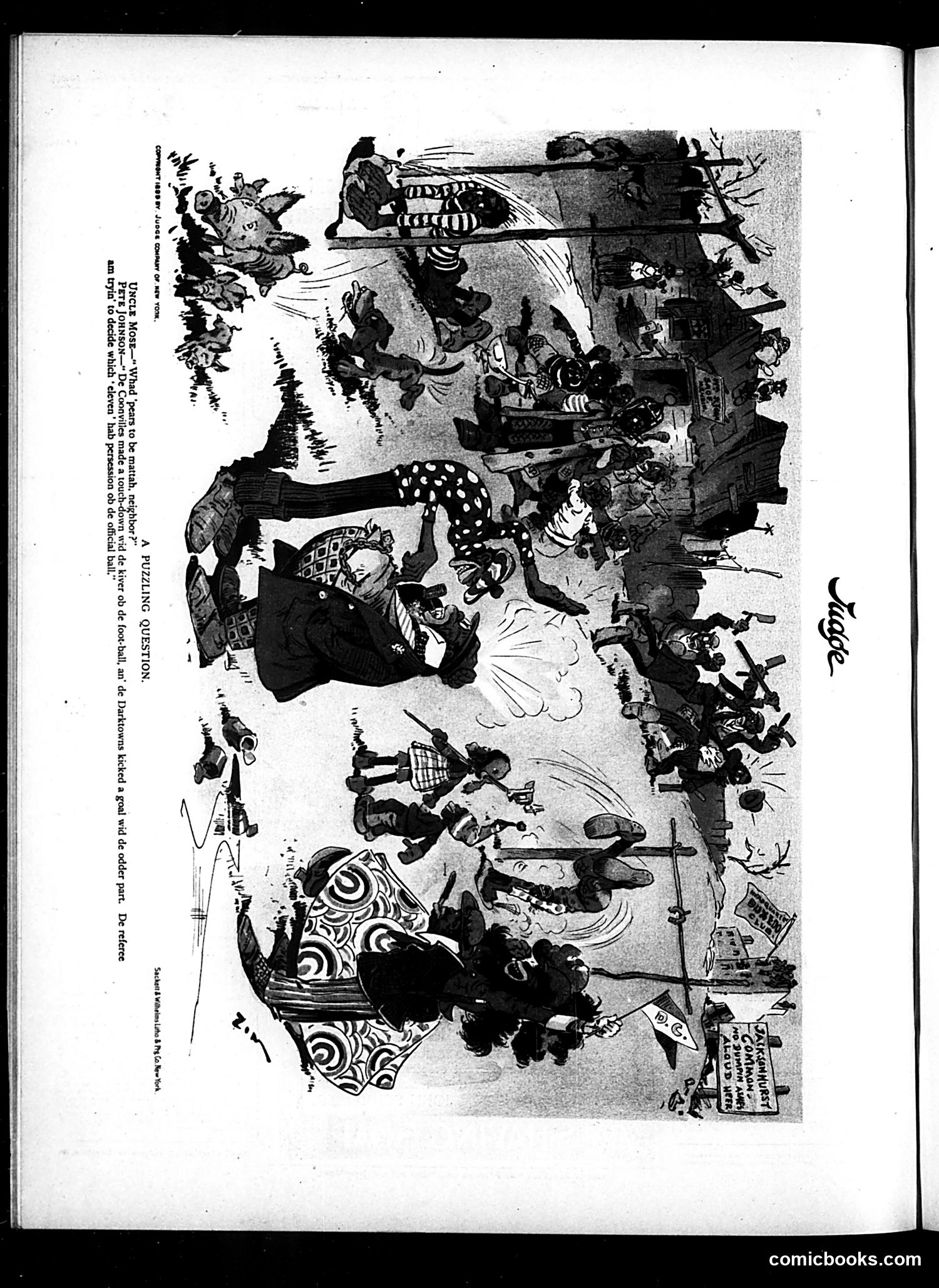
This cartoon satirizes racial stereotypes through a football game between two teams with racially coded names: "Coonvilles" and "Darktowns." The humor relies on period racist nomenclature and dialect caricature. The joke depicts a referee unable to decide which team possesses the ball after conflicting plays—a "puzzling question" that appears to be a metaphor for broader confusion or dispute, though the specific political reference remains unclear from the visible text alone. The dialogue uses exaggerated African American dialect ("Whad 'pears," "De," "hab"), standard for Judge's satirical approach. The copyright date (1899) places this in the Jim Crow era. Without additional context, the cartoon's specific target—whether it comments on actual sports, Black political representation, or social confusion of the period—cannot be determined with certainty from the image and OCR text alone.