
Judge, 1899-10-21 · page 5 of 16
Judge — October 21, 1899 — page 5: what you’re looking at
What you’re looking at
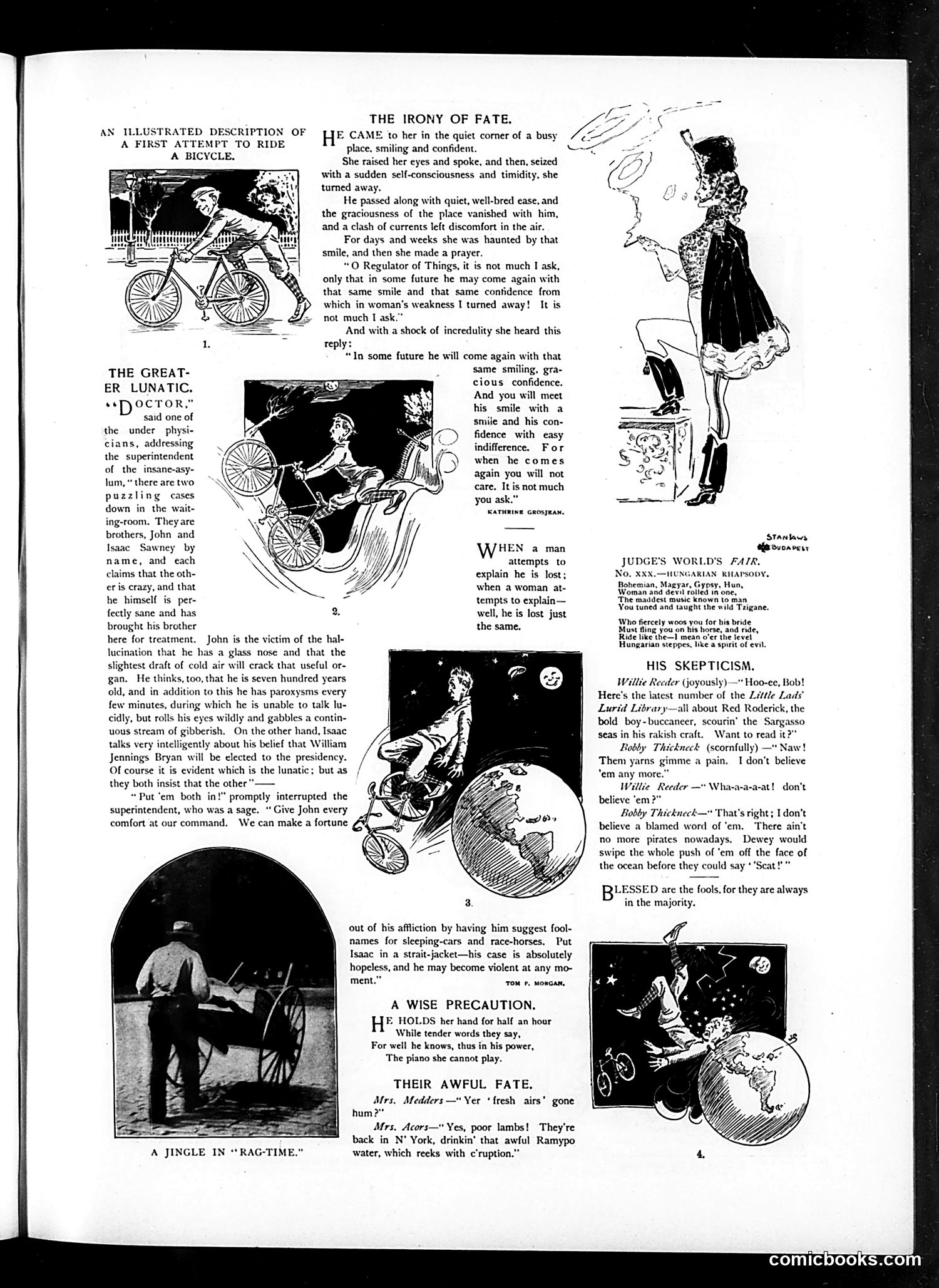
This page contains several satirical pieces mocking contemporary concerns: **"The Great-er Lunatic"** compares two asylum patients: one with absurd delusions (a glass nose, being 700 years old) versus another who rationally believes William Jennings Bryan will become president. The superintendent's joke suggests that Bryan's likely election makes the rational believer the true lunatic—a jab at Bryan's 1896 presidential campaign and his supporters' perceived foolishness. **"The Irony of Fate"** is a sentimental story about a woman's prayer being answered in unexpected ways—a romantic narrative unrelated to satire. **Bicycle cartoons** (illustrations 1-4) humorously depict the dangers and difficulties of early bicycle-riding, a relatively new phenomenon in the 1890s. The "Doctor" section satirizes bicycle accidents as medical emergencies. **"His Skepticism"** mocks children's dime novels (cheap adventure stories), with a boy dismissing pirate tales as unbelievable—commentary on popular juvenile literature. The page reflects 1890s concerns: political opposition to Bryan, the bicycle craze, and popular entertainment for children.
📄 Transcribed text from this page (OCR, searchable)
Machine-transcribed from the original scan — historical spelling and the odd misread are preserved.
AN ILLUSTRATED DESCRIPTION OF A FIRST ATTEMPT TO RIDE A BICYCLE, THE GREAT- ER LUNATIC, sePjocTor,” D said one of the under physi- cians, addressing the superintendent of the insane-asy- * there are two puzzling cases down in the wait- ing-room. They are name, and each claims that the oth- er is crazy, and that he himself is per- brought his brother here for treatment. THE IRONY OF FATE. E CAME to her in the quiet comer of a busy place. smiling and confident. She raised her eyes and spoke, and then, seized with a sudden self-consciousness and timidity, she turned away. He passed along with quiet, well-bred ease, and the graciousness of the place vanished with him, and a clash of currents left discomfort in the air. For days and weeks she was haunted by that smile, and then she made a prayer. O Regulator of Things, it is not much I ask, only that in some future he may come again with that same smile and that same confidence from which in woman's weakness I turned away! It is not much I ask.” And with a shock of incredulity she heard this. reply: “In some future he will come again with that same smiling, gra- cious confidence. And you will meet his smile with a smile and his con- fidence with easy indifference. For when he comes again you will not care. It is not much you ask.” KATHRIN GROSIEAN. HEN a man attempts to explain he is lost; when a woman at- tempts to explain— well, he is lost just the same, John is the victim of the hal- lucination that he has a glass nose and that the slightest draft of cold air will crack that useful or- gan. He thinks, too, that he is seven hundred years old, and in addition to this he has paroxysms every few minutes, during which he is unable to talk lu- cidly, but rolls his eyes wildly and gables a contin uous stream of gibberish. On the other hand, Isaac talks very intelligently about his belief that William Jennings Bryan will be elected to the p Of course it is evident which is the luna they both insist that the other" — “Put ‘em both in!” promptly interrupted the superintendent, who was a sage. “ Give John every comfort at our command. We can make a fortune out of his affliction by having him suggest fool- names for sleeping-cars and race-horses. Put Isaac in a strait-jacket—his case is absolutely hopeless, and he may become violent at any mo- Tom F, MORGAN, A WISE PRECAUTION. HE HOLDS her hand for half an hour While tender words they say, For well he knows, thus in his power, ‘The piano she cannot play. THEIR AWFUL FATE, Mrs. Medders —"Ner ‘fresh airs’ gone hum?” A JINGLE IN *RAG-TIME.” Mrs, Acors—"Yes, poor lambs! They're back in N’ York, drinkin’ that awful Ramypo water, which reeks with c'ruption.” Stans Buoavesr junc WORLD'S FAIR, NO, XXX. HUNGARIAN RHAPSODY, Bohemian, Magyar, Gypsy, Hun, Woman and devil rolled in one, ‘The maddest music known to man You tuned and taught the wild Tzigane. Who fiercely woos you for his bride Must fling you on his horse, and ride, Ride like the—1 mean o'er ihe level Hungarian steppes, like a spirit of evil. HIS SKEPTICISM. Willie Reeder (joyously) —" Hoo-ce, Bob! Here's the latest number of the Little Lads’ Lurid Library—all about Red Roderick, the bold boy-buccaneer, scourin’ the Sargasso seas in his rakish craft. Want to read it? Bobby Thickneck (scorntully) —" Naw! Them yarns gimme a pain, I don't believe “em any more.” Willie Reeder —* Whaca-a-a-at! don’t believe ‘em 2” Bobby Thicknech— That's right; Idon't believe a blamed word of ‘em. There ain't no more pirates nowadays. Dewey would swipe the whole push of ‘em off the face of the ocean before they could say *’Scat!"" BLESSED are the fools, for they are always in the majority.