
A complete issue · 16 pages · 1899
Judge — October 7, 1899
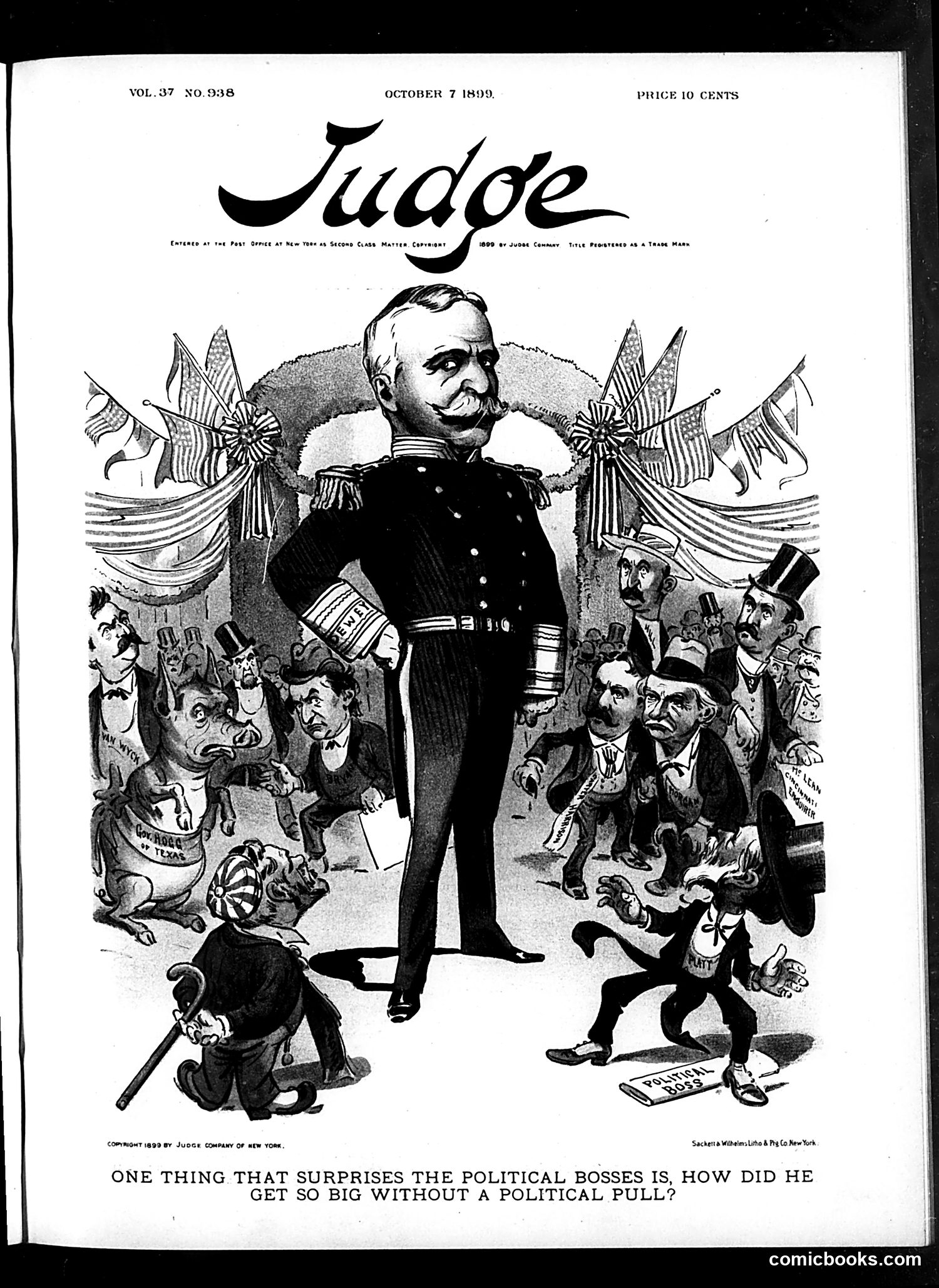
This political cartoon satirizes a powerful political figure—likely a party boss or machine politician—depicted as an enormously tall military officer towering over a crowd of smaller political operatives and hangers-on. The caption reads: "One thing that surprises the political bosses is, how did he get so big without a political pull?" The satire mocks the irony of someone achieving such dominance and stature despite supposedly lacking "political pull" (connections or influence). The surrounding caricatured figures—wearing top hats and formal dress, some appearing corrupt or scheming—represent the traditional political establishment. The cartoon likely critiques either an outsider who rose to power unexpectedly or, conversely, questions claims that success came without patronage networks. The flags and military regalia suggest national or imperial ambitions.
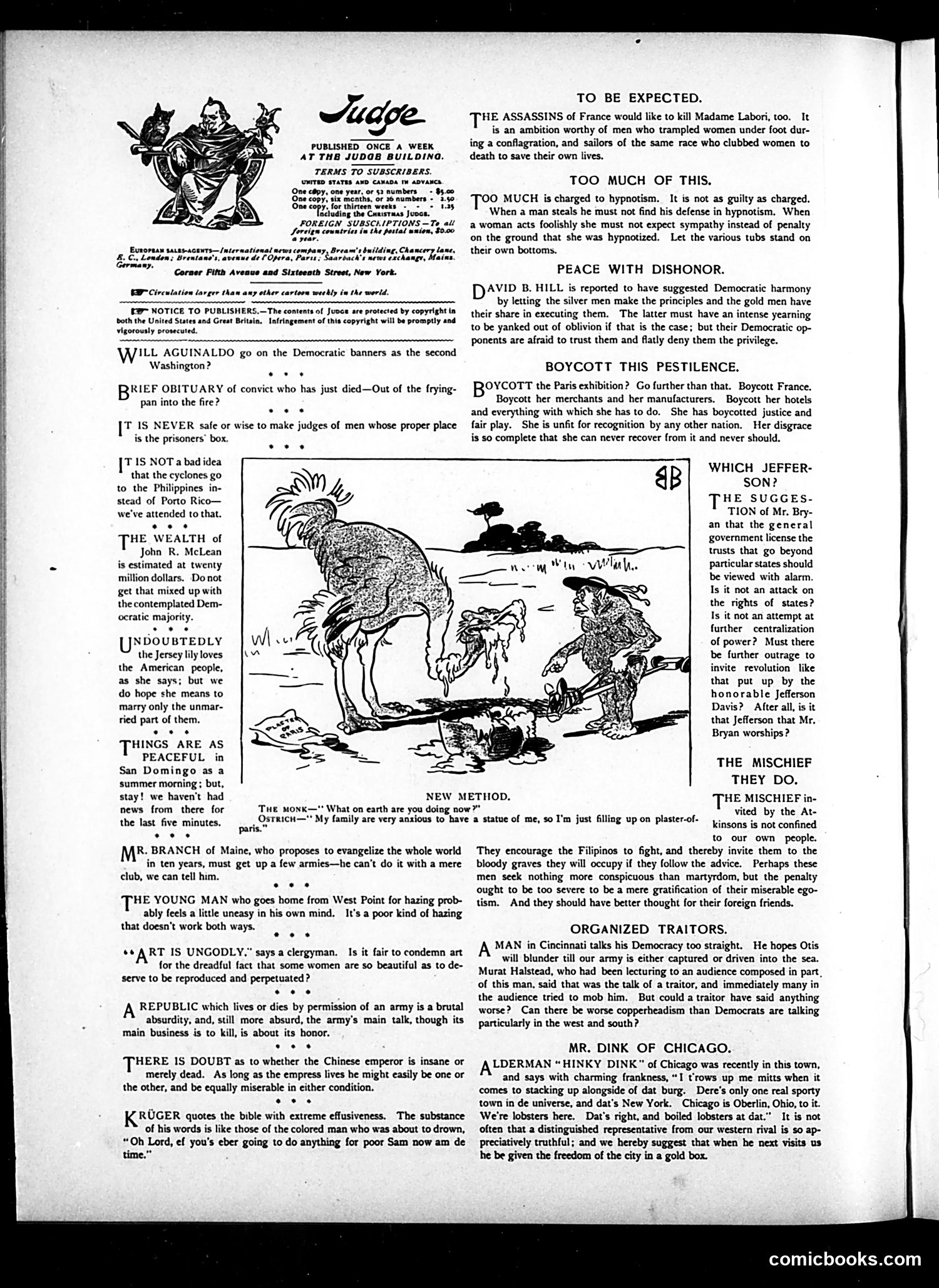
The main cartoon titled "NEW METHOD" depicts an ostrich burying its head in sand while being attacked or bothered by smaller figures—a visual metaphor for willful ignorance or avoidance of problems. The accompanying dialogue joke suggests someone is literally filling an ostrich with plaster, humorously literalizing the phrase about ostriches ignoring reality. The surrounding text columns contain political commentary on various contemporary issues: Democratic Party divisions, French commerce boycotts, government trust regulation, and Democratic traitors. References to "Jefferson Davis" and Bryan suggest this dates to the late 1800s/early 1900s era. The satirical point appears to be that American political leadership—particularly Democrats—are like ostriches: avoiding serious problems through denial rather than facing them directly.
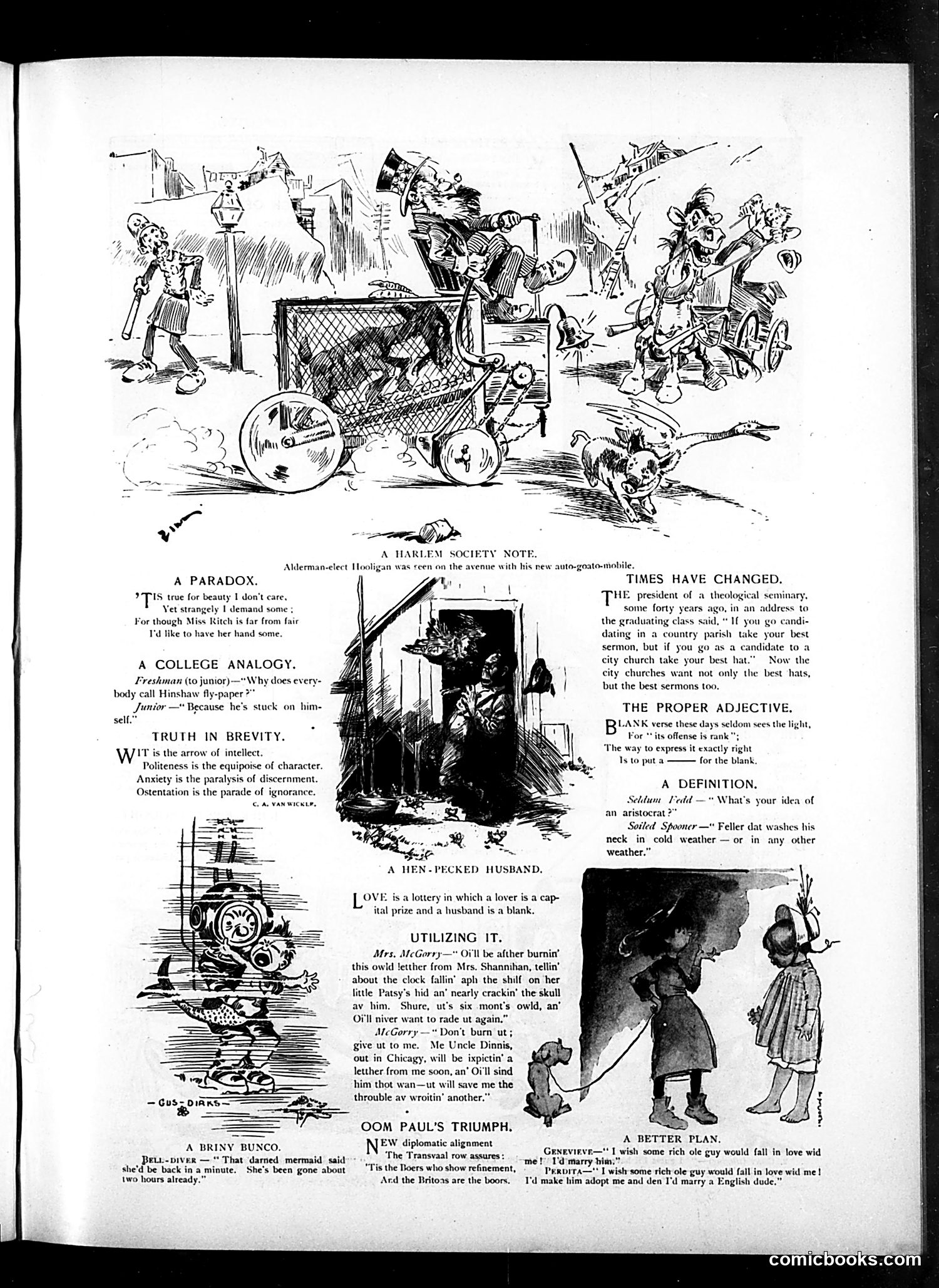
The top cartoon depicts a chaotic "Harlem Society Note" featuring Alderman-elect Hooligan in an absurdly overloaded auto-gasto-mobile, surrounded by rowdy figures and mayhem. This satirizes Tammany Hall–associated politicians and New York's Irish-immigrant political machine, portraying them as crude and reckless. The remaining content consists of brief humorous quips and witticisms rather than coherent political cartoons—jokes about beauty, college students, brevity, and domestic life. A "Hen-Pecked Husband" joke and dialogue about an aristocrat appear typical of Judge's miscellaneous humor format. The illustrations throughout are generic satirical sketches without identifiable specific political figures, suggesting this page emphasizes social satire over topical political commentary. The overall tone mocks working-class Irish-American urban politics and common domestic scenarios.
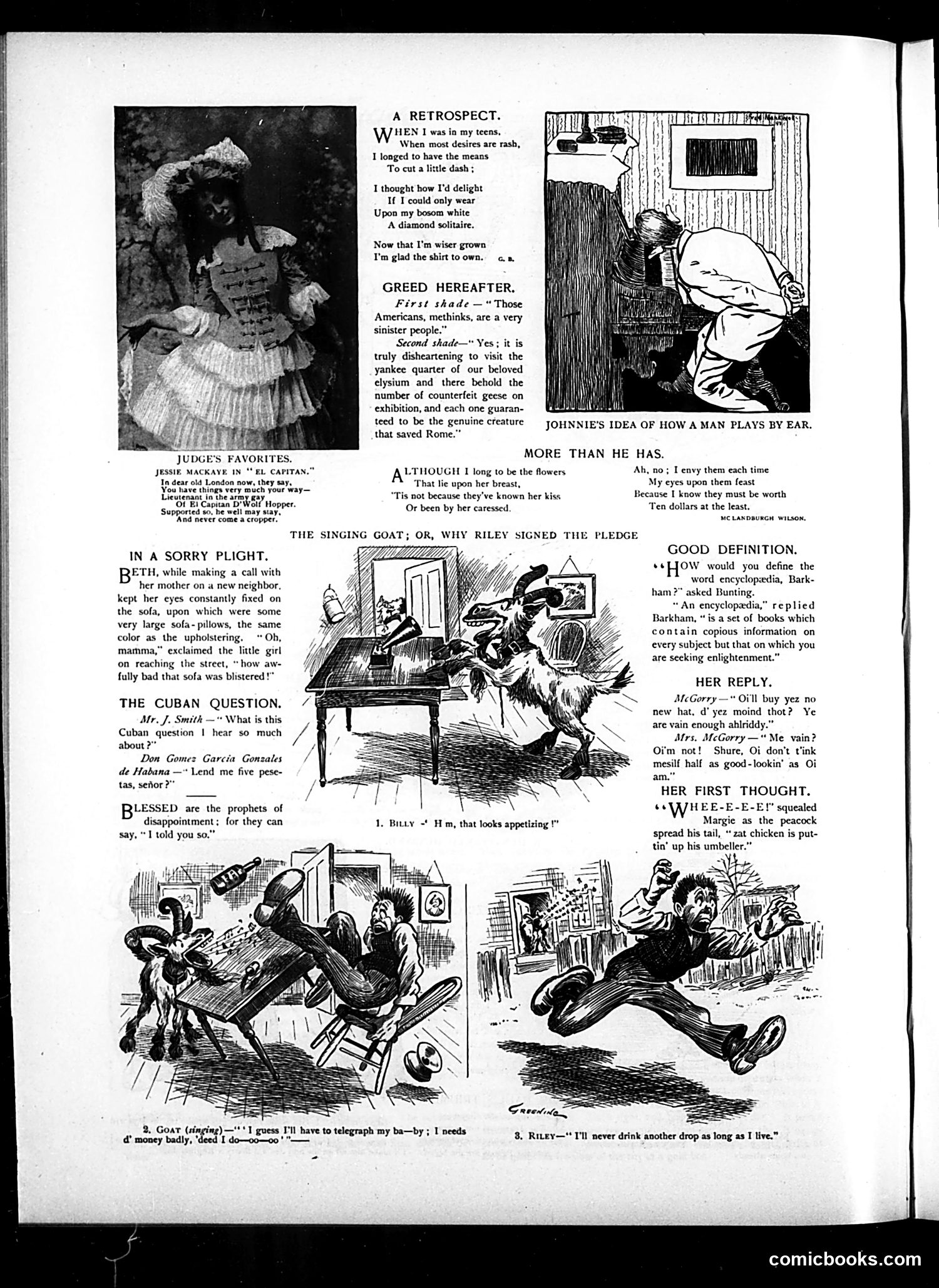
This page contains several satirical pieces and illustrations typical of Judge's humor: **"A Retrospect"** mocks vanity and changing fashion tastes among the wealthy. **"Greed Hereafter"** critiques American materialism and counterfeiting, suggesting moral corruption. **"The Singing Goat; or, Why Riley Signed the Pledge"** appears to be a humorous narrative about someone named Riley, likely playing on contemporary temperance movement debates. **"The Cuban Question"** references Cuba (unclear which specific period), suggesting political commentary on U.S.-Cuba relations. The remaining pieces—"In a Sorry Plight," "Good Definition," and others—are brief comic anecdotes and wordplay typical of Judge's satirical format, mocking social pretension, domestic life, and misunderstandings. The page reflects late 19th or early 20th-century American concerns: class anxiety, immigration and counterfeiting, temperance debates, and imperial politics.
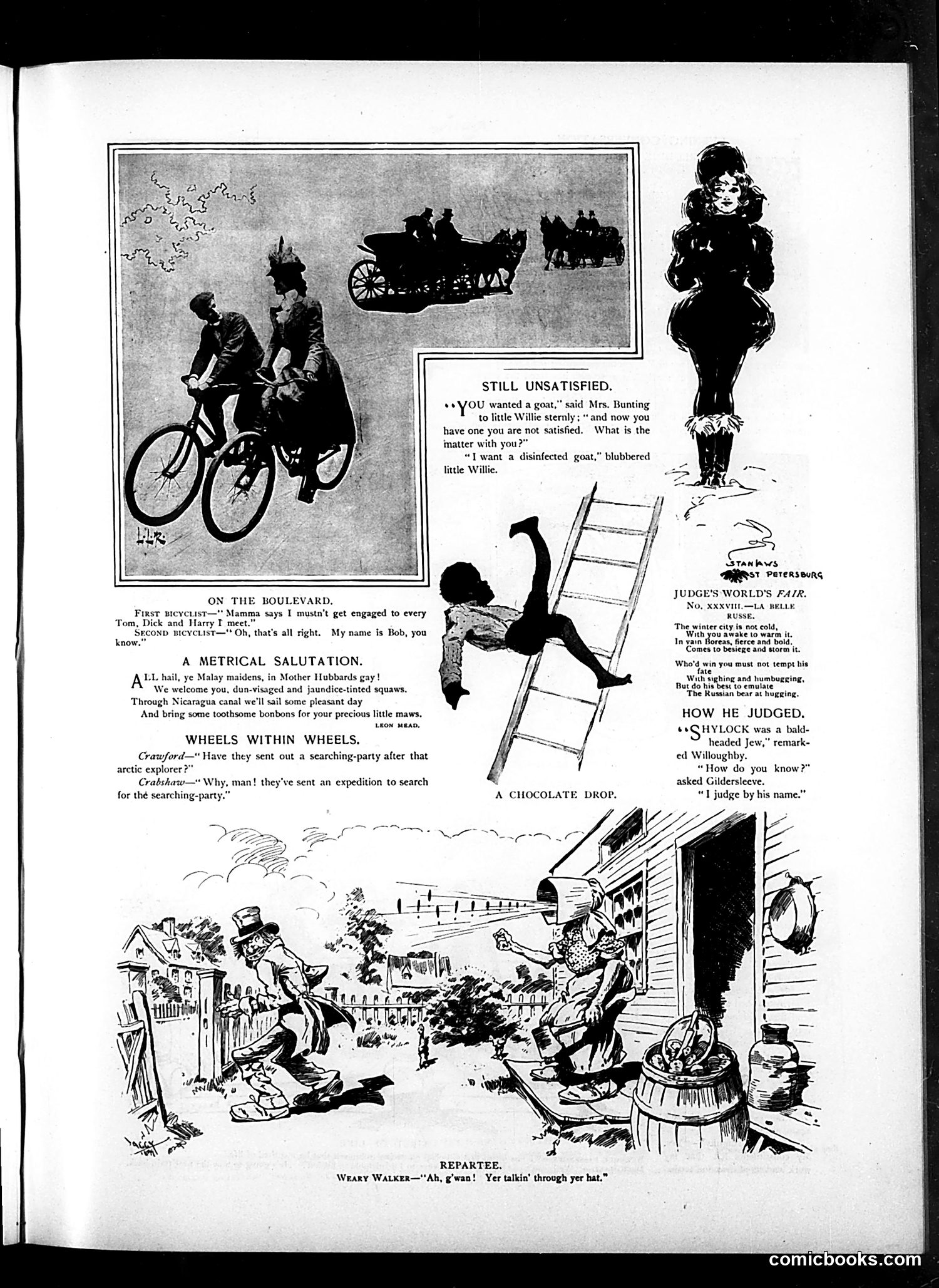
This page contains multiple short satirical pieces typical of Judge's humor: **"On the Boulevard"** mocks young cyclists' romantic entanglements through a simple wordplay joke about names. **"A Metrical Salutation"** appears to satirize American imperial expansion, likely referencing the Nicaragua Canal project and patronizing attitudes toward non-white peoples ("Malay maidens," "jaundice-tinted squaws"), treating them as conquests to be "civilized" with Western goods. **"Wheels Within Wheels"** makes a recursive joke about an Arctic explorer search becoming so complicated that they must search for the search party itself—mocking bureaucratic absurdity. **"Still Unsatisfied"** depicts a bratty child's impossible demands, showing generational entitlement humor. **"How He Judged"** contains an antisemitic joke assuming someone named "Shylock" must be Jewish and bald—referencing Shakespeare's character while relying on ethnic stereotyping. The remaining pieces are brief jokes or verse. The overall tone reflects early 20th-century satirical magazine conventions: sometimes clever wordplay, sometimes crude ethnic humor considered acceptable at the time.
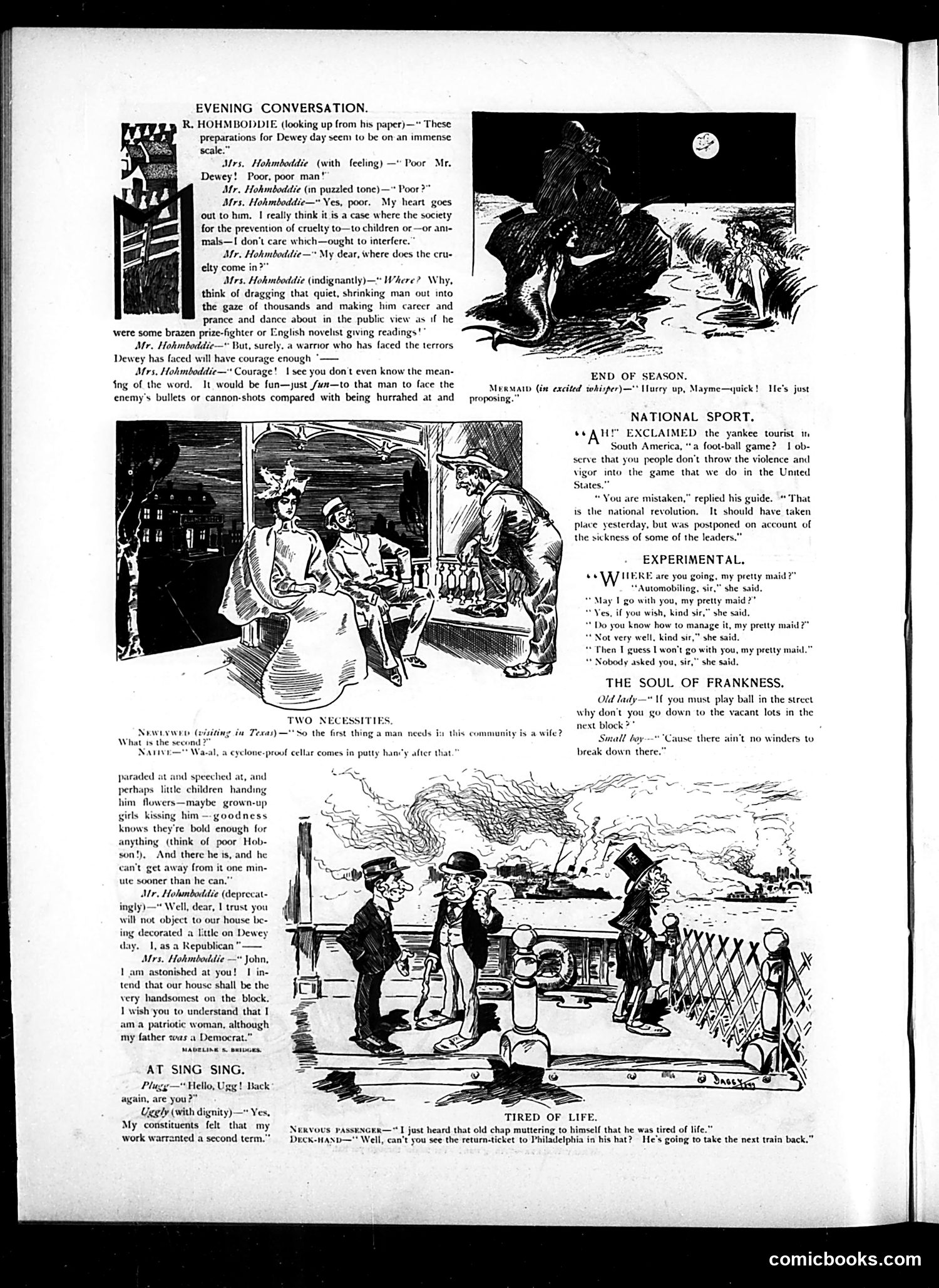
This page contains multiple satirical sketches typical of early 1900s American humor: **"Evening Conversation"** mocks excessive civic celebration. Mrs. Hohmboddie expresses sympathy for Admiral Dewey (likely referencing preparations for a public celebration following his 1898 Spanish-American War victory), comparing the ordeal of public adulation to cruel torture—worse than facing enemy gunfire. The satire targets both Americans' obsessive hero-worship and the discomfort such attention inflicts. **"Two Necessities"** jokes about Texas requiring both cyclone-proof cellars and cyclone-proof wives—implying wives must be as durable as buildings. Other sketches mock automobile safety ("Experimental"), political corruption ("At Sing Sing"), and social pretension. One piece satirizes Latin American instability by calling a revolution their "national sport." The humor is gentle domestic comedy mixed with light political commentary typical of Judge's approach.
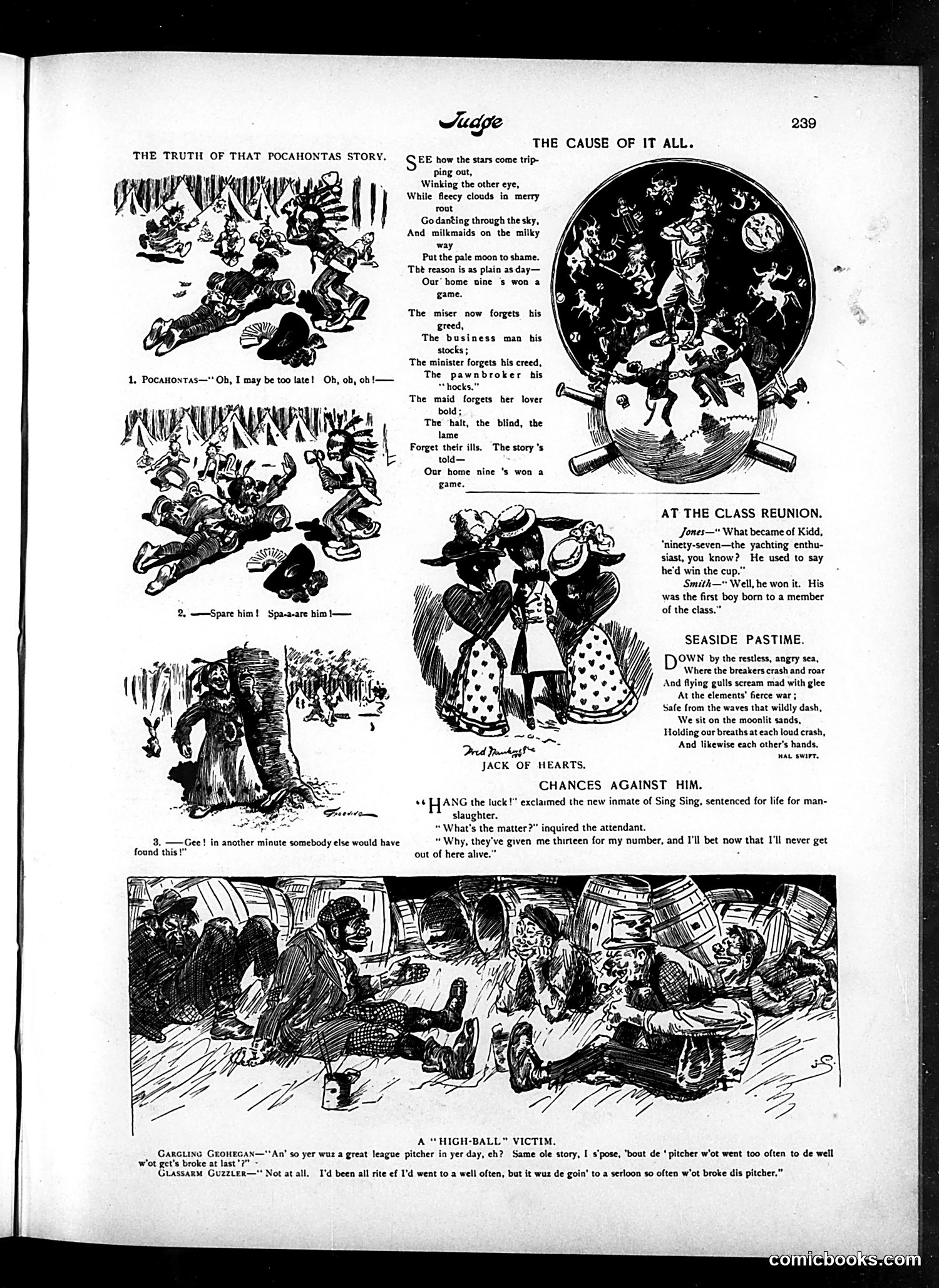
This page from *Judge* contains multiple unrelated satirical pieces typical of the magazine's format. **"The Cause of It All"**: A poem celebrating a local baseball team's victory, humorously suggesting their win has magically improved everyone's mood and made people forget their troubles—the "home nine" (baseball team) winning causes universal joy. **"Pocahontas Story"**: The title references a famous historical narrative, but the cartoon appears to use it ironically as a heading for the baseball celebration piece, likely a playful non-sequitur. **"At the Class Reunion"**: A joke about a wealthy Yale alumnus (Kidd) who bragged about winning a yachting cup; the punchline reveals he won it through having the class's first son, a satirical jab at upper-class privilege. **"High-Ball Victim"**: A dialect humor piece where an elderly former pitcher attributes his decline not to overuse (the "well" worn out) but to frequenting saloons too often—satirizing alcohol abuse's effects. The page emphasizes baseball enthusiasm, class commentary, and period-typical ethnic/dialect humor.
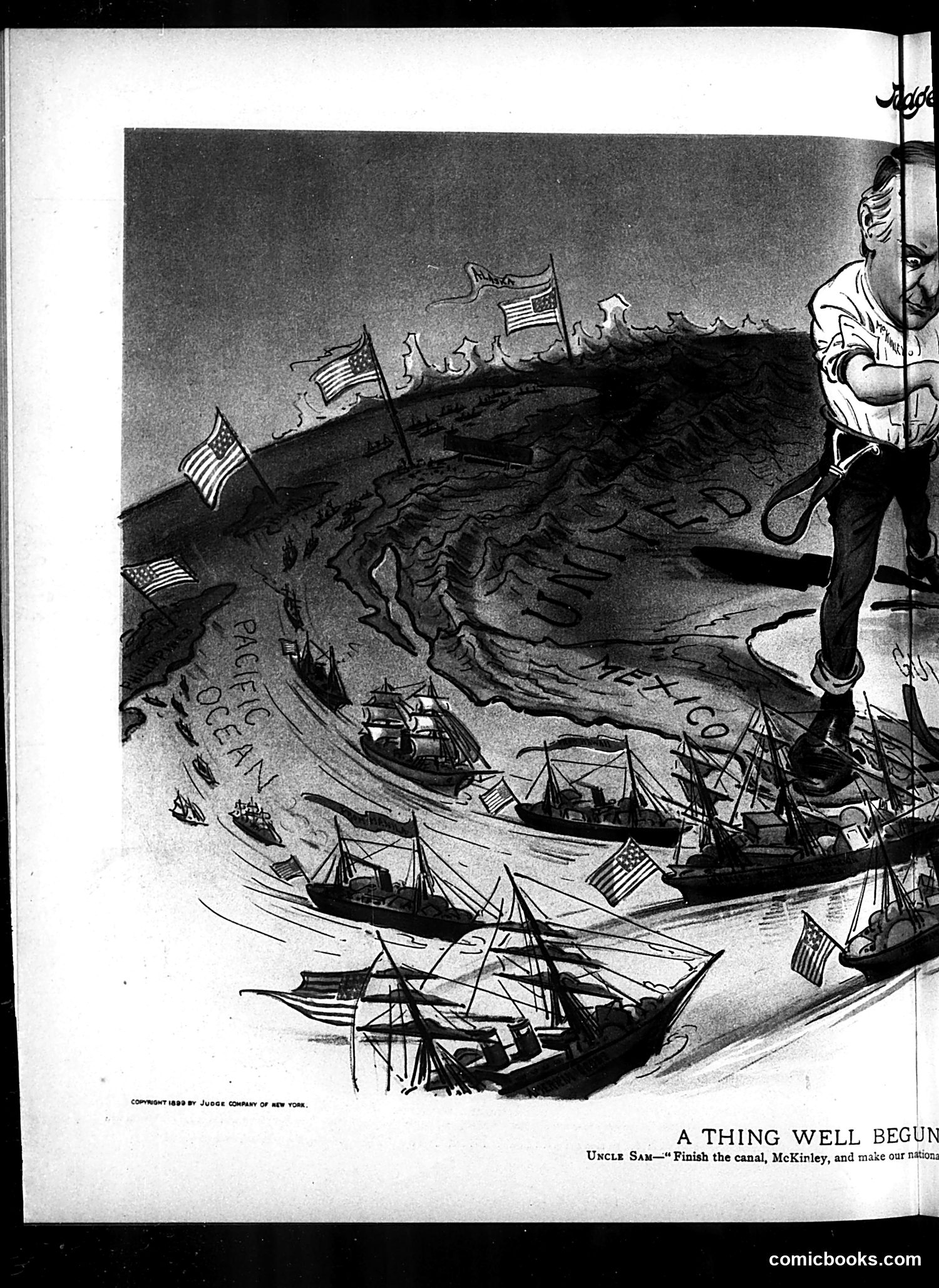
This 1899 Judge cartoon depicts Uncle Sam directing President William McKinley to "finish the canal" and strengthen the nation. The image shows American naval vessels and flags positioned along what appears to be a canal route, with ships clustered in the waterway. This references the **Panama Canal project**—a major American infrastructure ambition of the era. The cartoon advocates for completing this canal to enhance American naval power and national greatness. The military ships symbolize how canal completion would benefit U.S. maritime strength and global influence. McKinley (president 1897-1901) is portrayed as Uncle Sam's agent, responsible for executing this patriotic vision. The cartoon represents the expansionist, imperialist sentiment popular among American political elites during this period of American imperial growth.
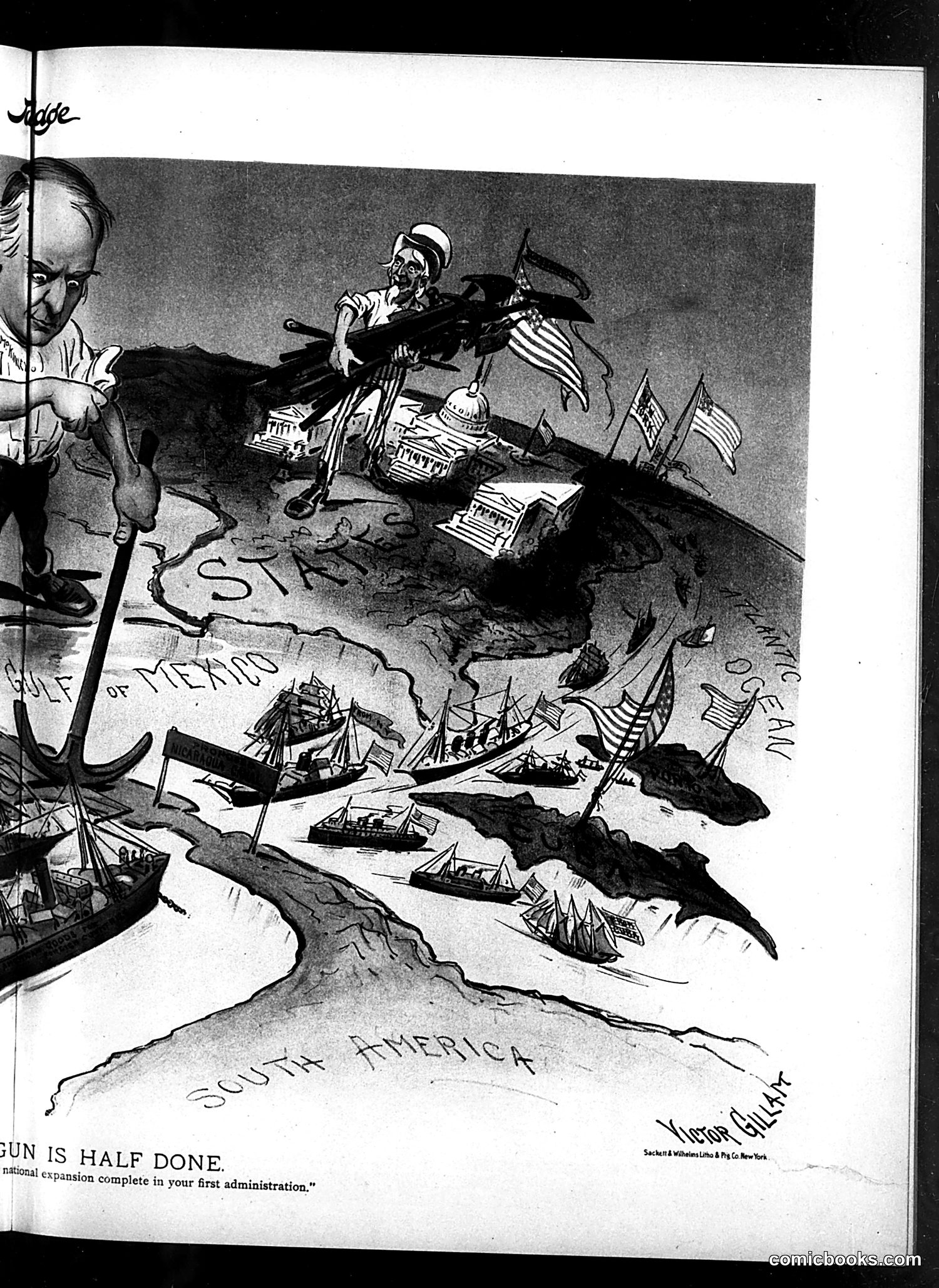
This Judge magazine cartoon by Victor Galarza depicts **American imperial expansion**, likely from the early 1900s. An Uncle Sam figure rides a bucking horse labeled "South America," wielding an American flag while the horse bucks wildly. Naval ships dot the waters below, representing military force. The visible text references completing "national expansion" in "your first administration," suggesting this critiques a president's aggressive foreign policy in Latin America. The bucking horse symbolizes resistance from South American nations to U.S. intervention and expansion. The scattered warships underscore military coercion. The phrase "The gun is half done" (partially visible) likely comments on ongoing military campaigns. This satirizes American interventionism and imperialism in the Western Hemisphere during the era of "gunboat diplomacy."
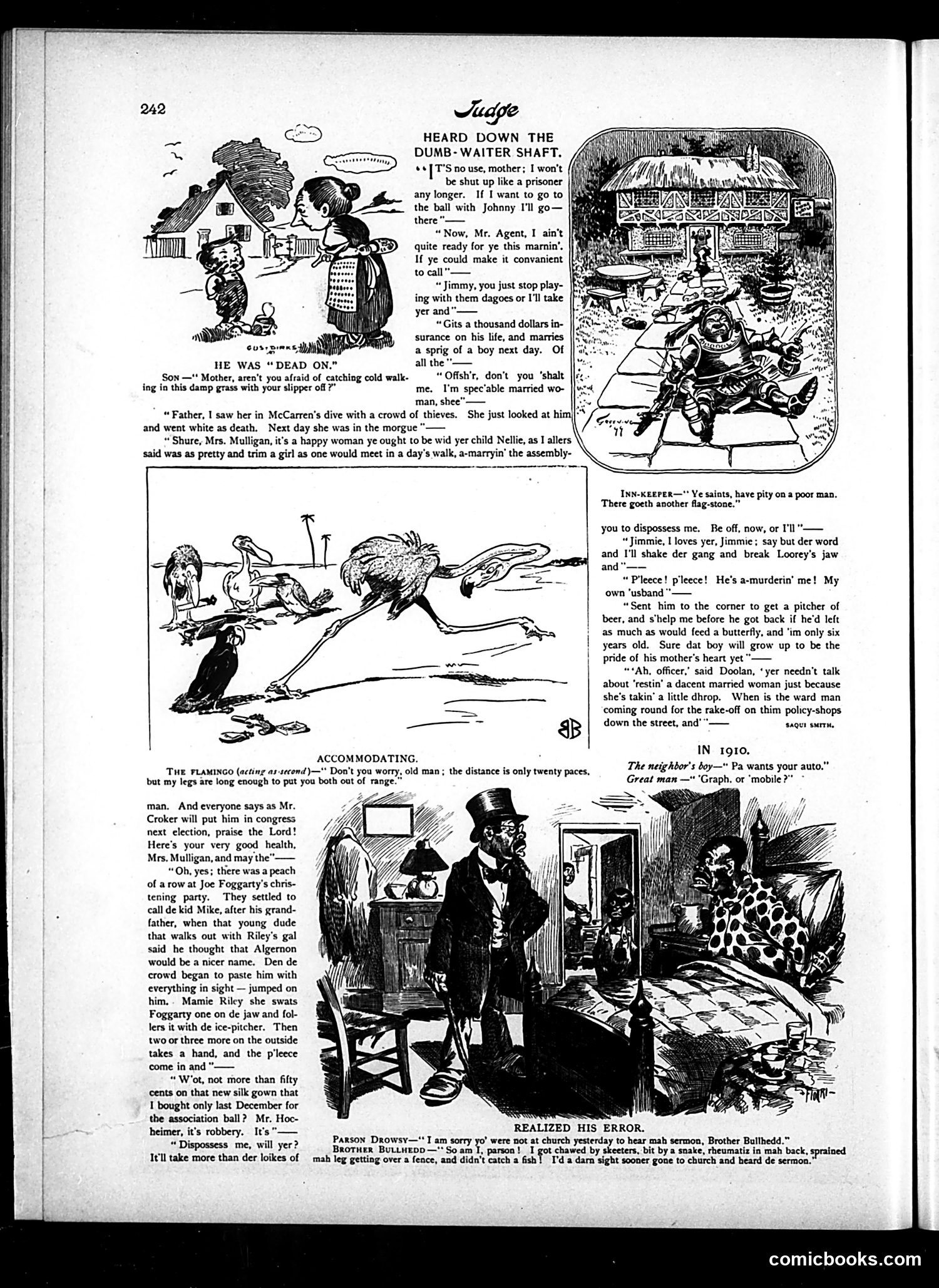
This page from Judge (c. 1910) collects multiple satirical vignettes capturing working-class and immigrant life in early 20th-century America. The main feature, "Heard Down the Dumb-Waiter Shaft," presents overheard conversations revealing domestic dysfunction, poverty, and moral compromise among tenement dwellers—depicting violence, alcoholism, and casual corruption ("rake-off on thim policy-shops"). The cartoons mock urban immigrant communities (Irish, Italian stereotypes evident in dialect) while satirizing societal hypocrisy. Referenced figures include **Richard Croker** (Tammany Hall political boss), suggesting commentary on machine politics and graft. Secondary cartoons include "Accommodating" (a duel joke) and "Realized His Error" (a rural/Black dialect joke about church-skipping). The humor relies heavily on ethnic caricature and dialect humor typical of the era's class-conscious satire—simultaneously mocking both the poor and the corrupt systems exploiting them.
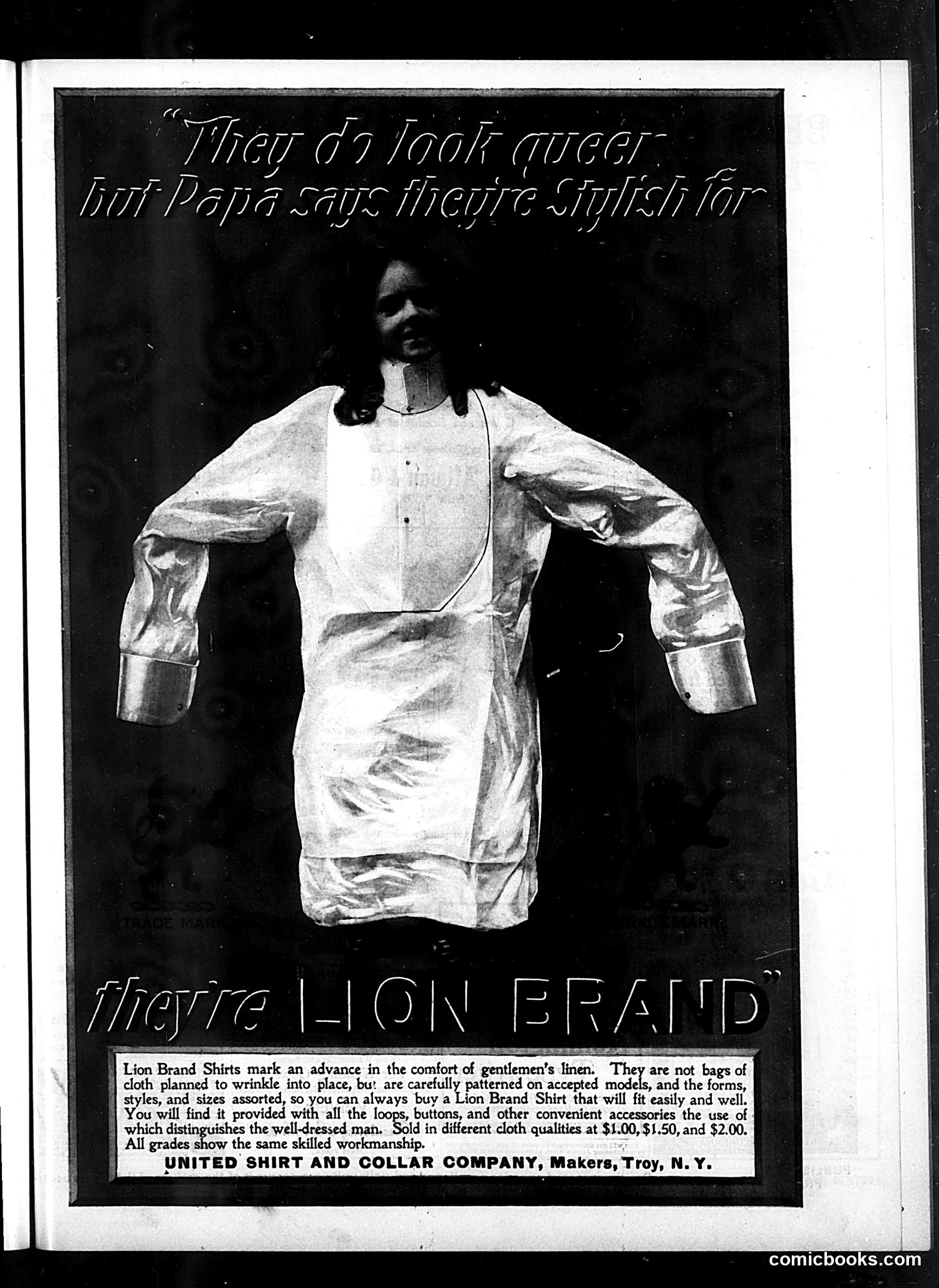
This page is primarily an **advertisement**, not political satire. It promotes Lion Brand shirts by the United Shirt and Collar Company of Troy, New York. The ad features a photograph of a man modeling a dress shirt with distinctive puffy sleeves and formal front placket. The headline plays on fashion consciousness: "They'd look queer; but Papa says they're stylish for"—suggesting that while the garment's design might seem unusual, paternal approval validates it as fashionable. The copy emphasizes that Lion Brand shirts are carefully constructed (not "bags of cloth") with proper tailoring, buttons, and loops, available in multiple sizes and cloth qualities ($1–$2). This targets gentlemen concerned with appearing well-dressed. The satirical element is minimal—mainly the mild joke that fathers endorse fashion trends. The "queer" reference simply means "odd-looking," without modern connotations. This is straightforward period advertising using light humor to sell quality menswear.
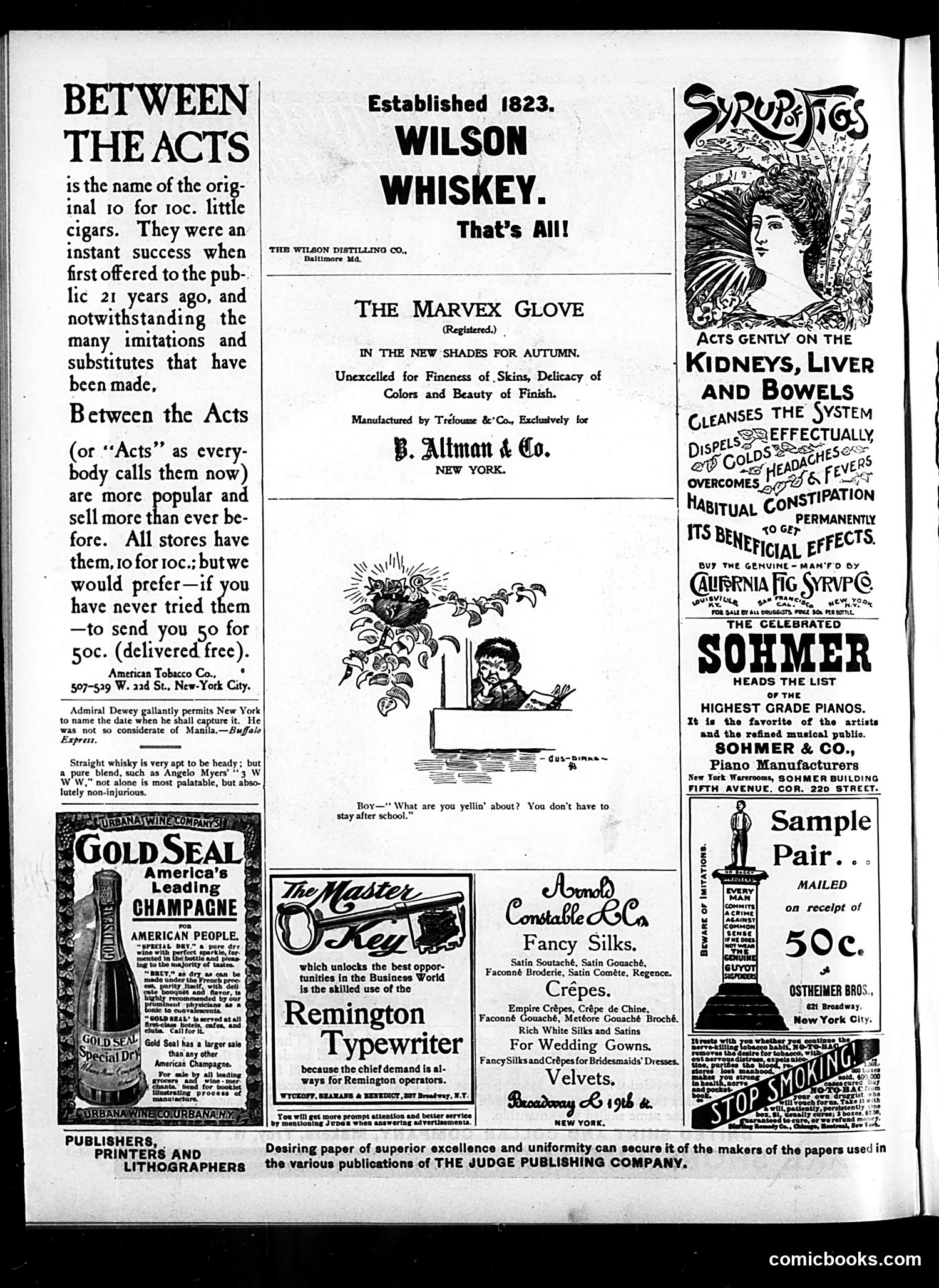
This page is primarily **advertising**, not political satire. The dominant content comprises commercial advertisements for consumer products and services typical of early 20th-century America. The single cartoon—a small illustration of a boy and girl by a sunflower—accompanies a mild joke about school detention, not political commentary. The advertisements showcase period consumer goods: cigars, whiskey, champagne, typewriters, gloves, silk fabrics, pianos, and a laxative (California Fig Syrup). One text snippet references Admiral Dewey and Manila, alluding to the recent Spanish-American War, but this is brief editorial commentary rather than satire. The page reflects Judge's dual nature as both satirical magazine and advertising vehicle, with commercial content dominating this particular spread. The Dewey reference is the only substantial political reference visible.
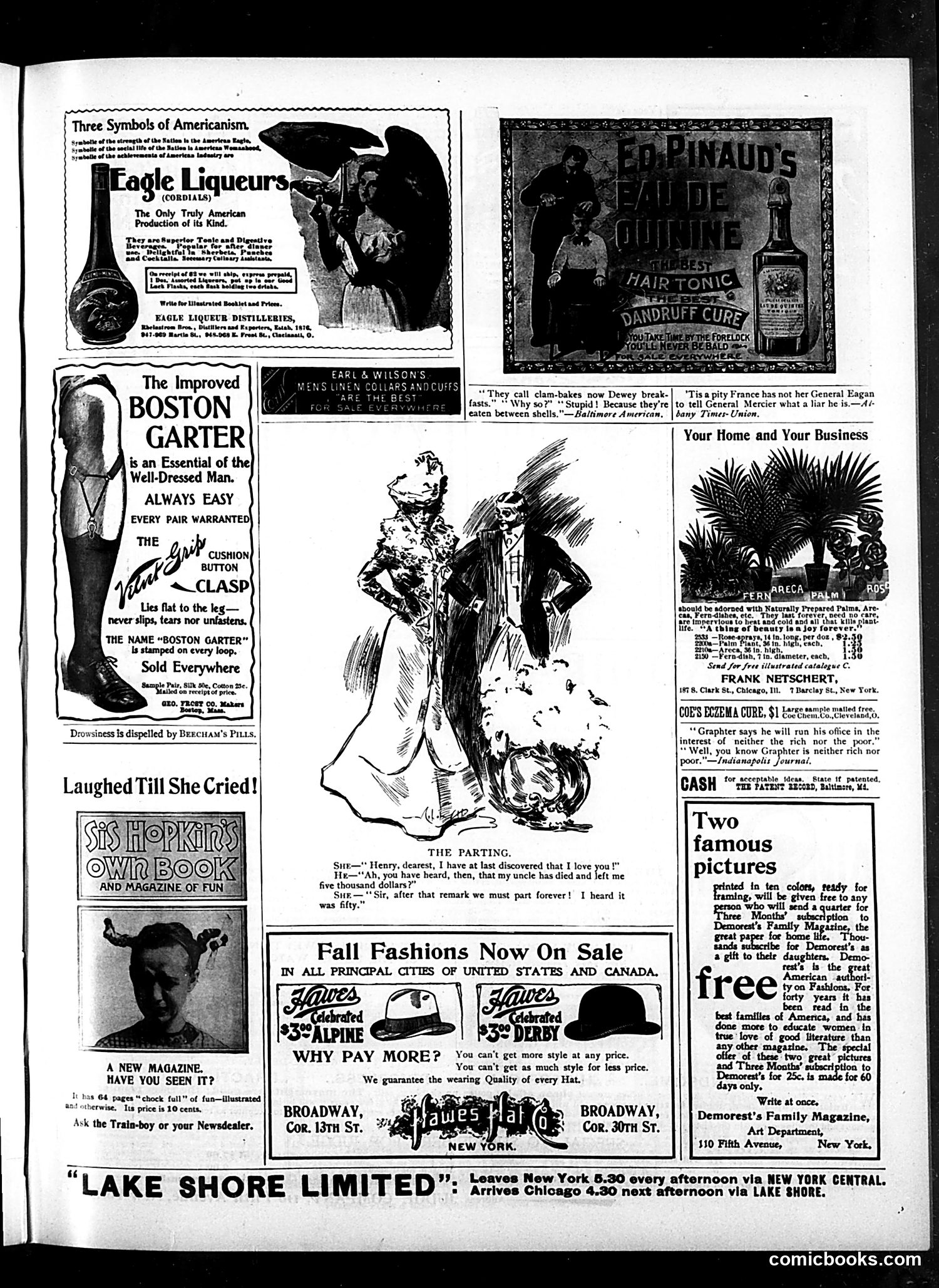
This is primarily an **advertising page** with minimal satirical content. The main cartoon, "The Parting," uses a common Victorian joke structure: a couple discusses their love, but she withdraws her affection upon learning his uncle died and left him money—implying she only loved him when he was poor and couldn't afford to marry her. The humor relies on exposing female mercenary hypocrisy. Two brief text jokes reference contemporary figures: one about Admiral Dewey (Spanish-American War hero) and "clam-bakes," and another about French General Mercier during the Dreyfus Affair, mocking his credibility. The page is otherwise dominated by product advertisements—Eagle Liqueurs (branded as "American"), Boston Garters, Beecham's Pills, Sis Hopkins' comic magazine, and Alwes hats—reflecting Judge's primary revenue model.
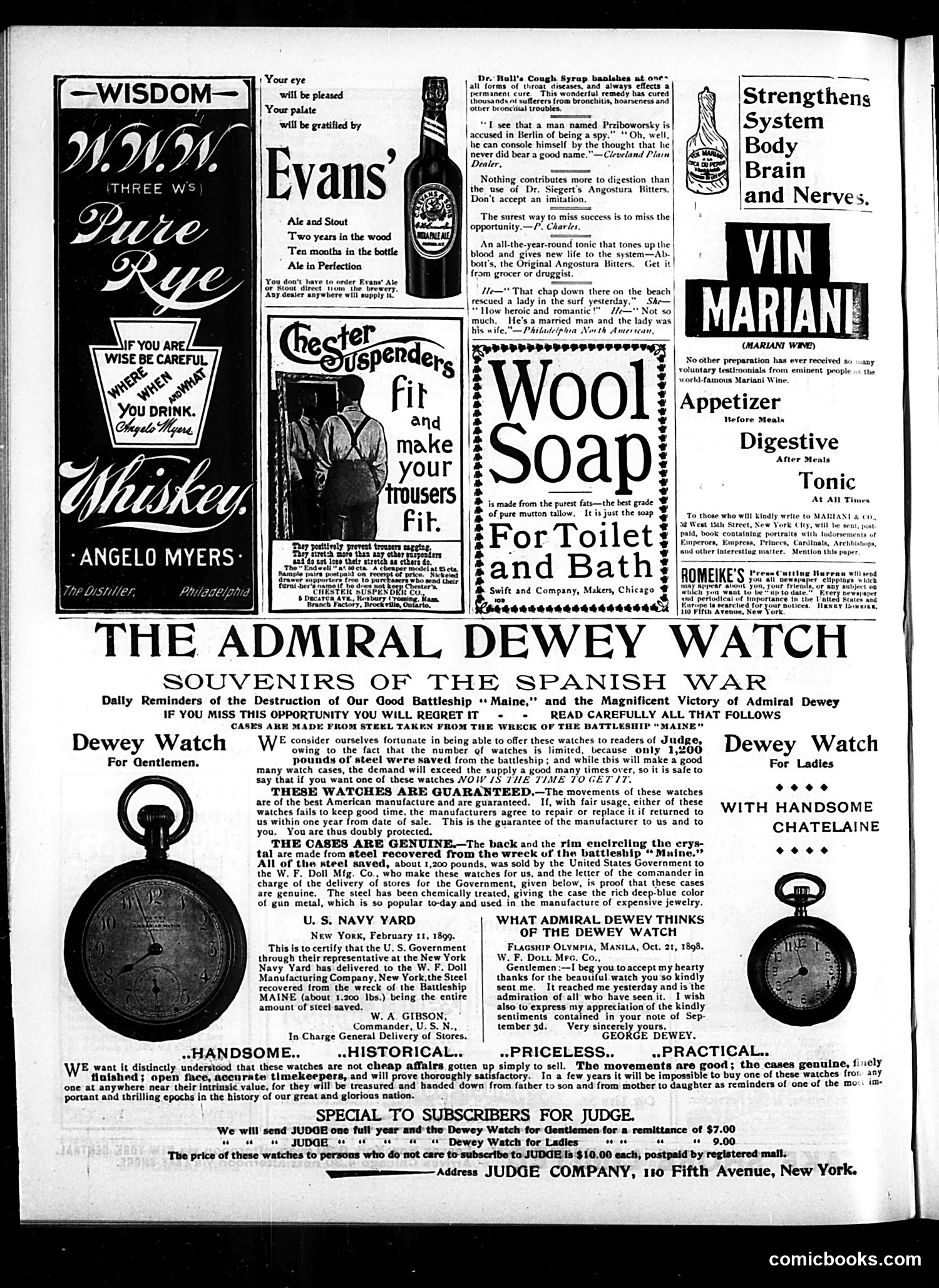
This page is primarily a large advertisement for commemorative watches marketed as patriotic souvenirs of the Spanish-American War. The watches' cases were allegedly made from steel salvaged from the USS *Maine*, the battleship whose explosion in Havana harbor in 1898 triggered American entry into the war ("Remember the Maine!"). The ad capitalizes on recent American triumphalism, particularly Admiral Dewey's naval victory at Manila. It promises authenticity through government documentation and manufacturing guarantees, emphasizing scarcity (only 1,200 pounds of steel recovered) to create urgency. The surrounding advertisements for whiskey, ale, bitters, and patent medicines are typical period content. For modern readers: this represents how commercial enterprises exploited contemporary military events for profit, wrapping patriotism around product sales—a practice that remains familiar today.
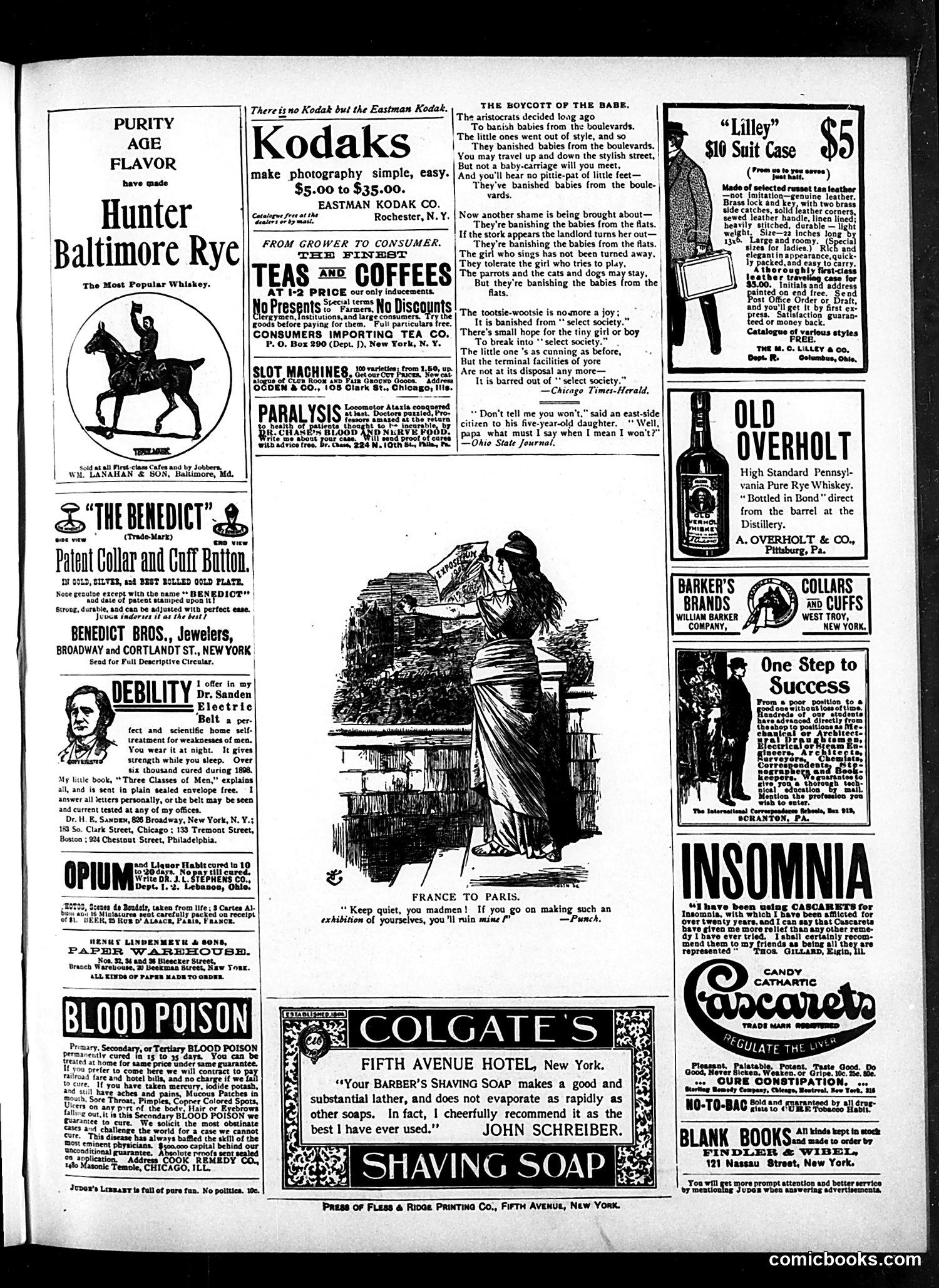
This satirical poem mocks upper-class exclusionary attitudes toward children and babies in turn-of-the-century urban life. The piece observes that wealthy "aristocrats" on fashionable boulevards and in "select society" have banned babies from their neighborhoods and apartment buildings—landlords evict tenants with infants, while paradoxically tolerating pets and entertainers. The satire targets class hypocrisy: the wealthy tolerate singers, parrots, and cats but exclude children, treating them as social nuisances. The poem emphasizes the absurdity by noting babies are "cunning" and harmless, yet face systematic exclusion from respectable neighborhoods due to snobbish attitudes about propriety and status. The "east-side citizen" reference suggests working-class resentment of this discrimination, positioning the poem as social critique of elitist urban culture. This likely reflects contemporary tensions over rapid urbanization and residential segregation by class.
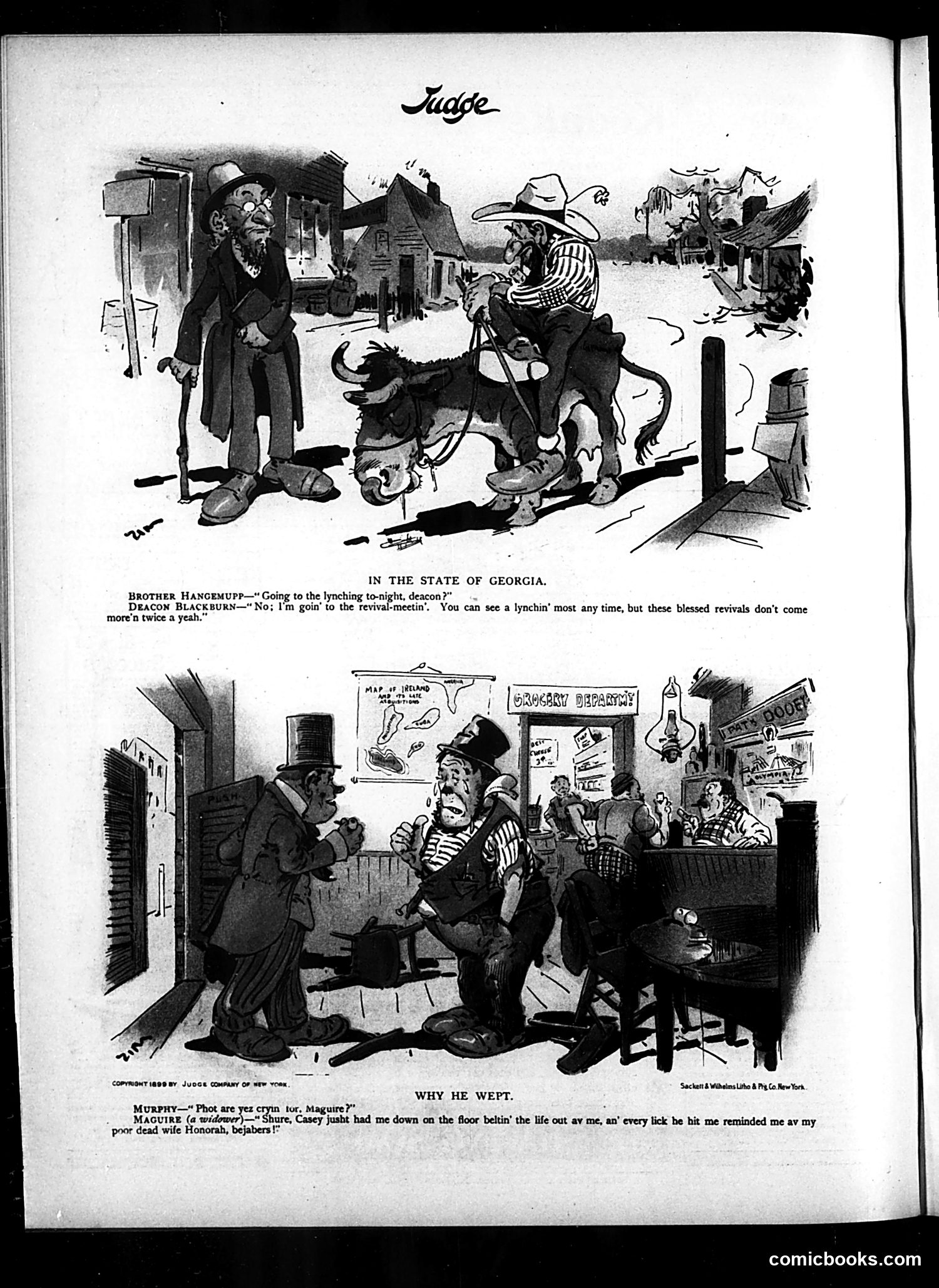
## Top Cartoon: "In the State of Georgia" This depicts two Black men in rural Georgia discussing their evening plans. The satire exposes the casual normalization of lynching in the post-Reconstruction South—so routine that one character treats it as mundane entertainment ("you can see a lynchin' most any time"), prioritizing a revival meeting instead. The cartoon uses grotesque racial caricature typical of the era to satirize the horrifying indifference to racial violence among Southern communities. ## Bottom Cartoon: "Why He Wept" An Irish immigrant (Maguire) weeps to a policeman (Murphy) after being arrested. His explanation—that each police blow reminds him of his dead wife—is absurdist humor playing on Irish stereotypes and sentiment. The cartoon mocks both Irish emotional expressiveness and the casual police brutality of the period. Both cartoons reflect Judge's satirical approach to American social conditions, though with deeply offensive racial imagery by modern standards.