
A complete issue · 16 pages · 1899
Judge — September 16, 1899
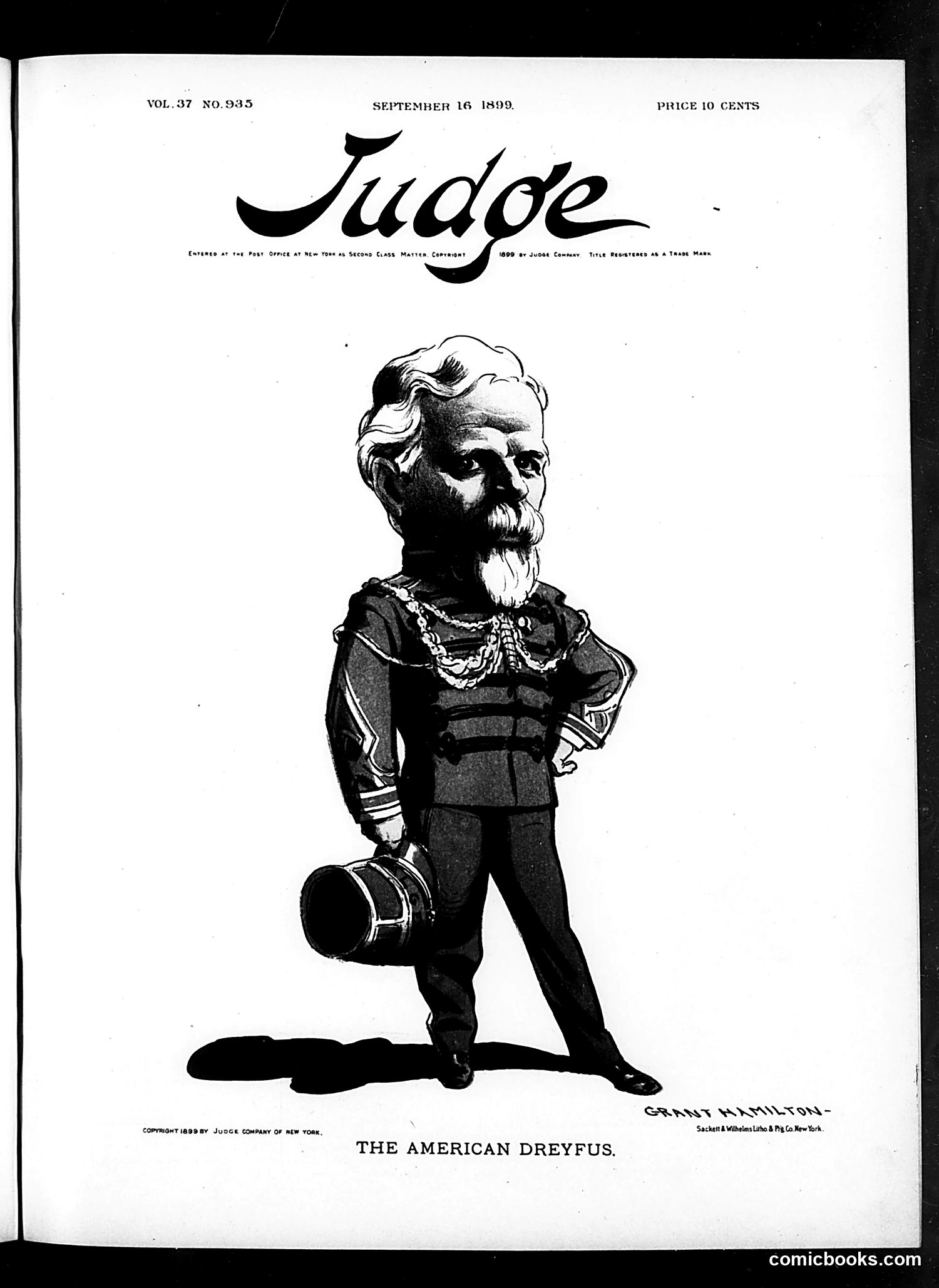
This caricature references the Dreyfus Affair, the massive French scandal where Jewish military officer Alfred Dreyfus was falsely convicted of treason in 1894. The figure depicted appears to be a bearded man in military uniform, labeled "The American Dreyfus," suggesting an American parallel to Dreyfus's wrongful persecution. The cartoon likely critiques either a specific American case of injustice or anti-Semitic persecution occurring around 1899. The barrel he holds and exaggerated facial features are typical of period satirical caricature. By invoking the Dreyfus case—then still dominating international news—the cartoonist positions this American situation as similarly unjust and scandalous, implying institutional corruption and prejudicial treatment. The specific American case referenced remains unclear without additional context.
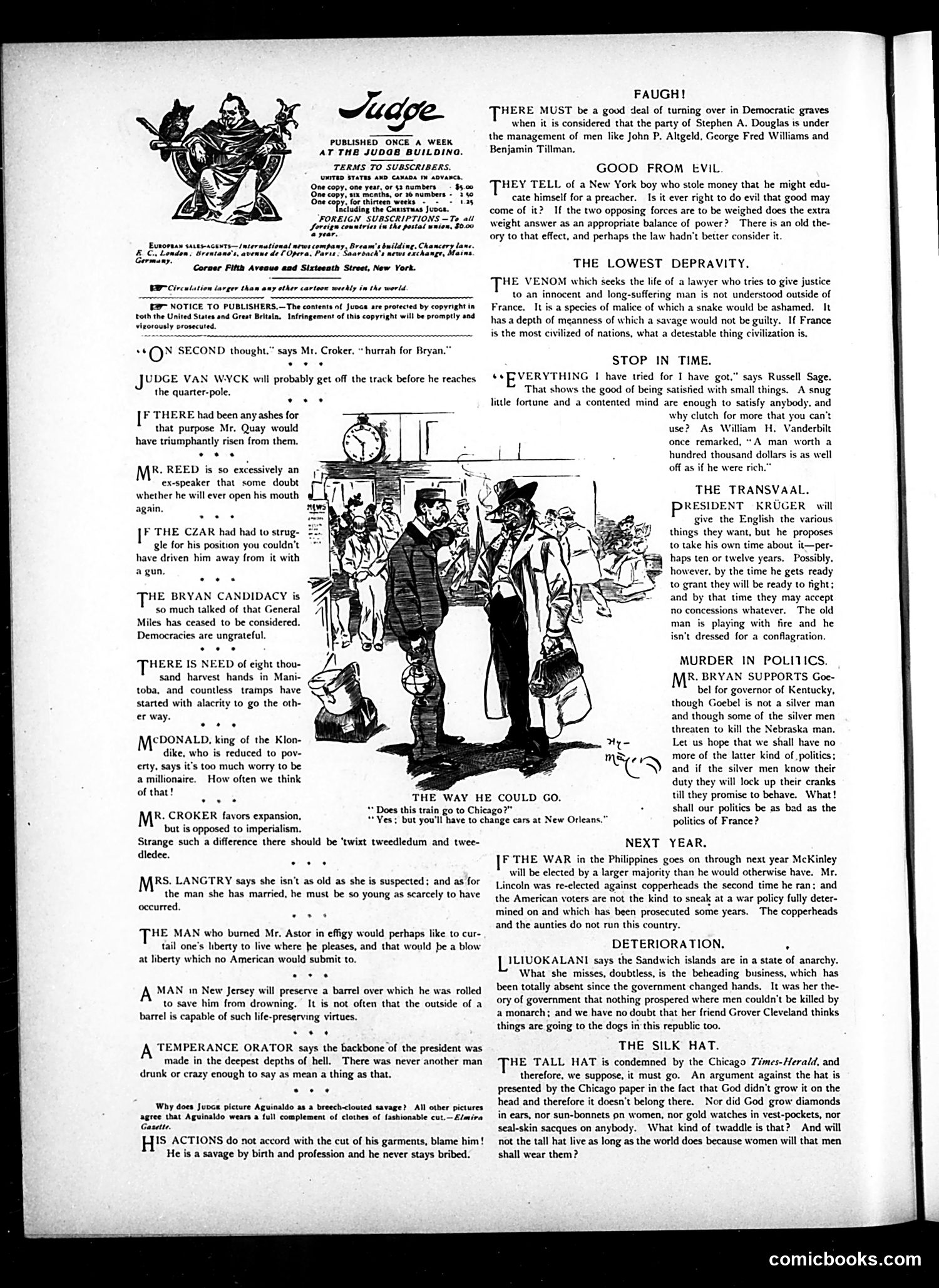
This cartoon satirizes **William Jennings Bryan's** presidential ambitions. The caption reads: "Dang it! I want to go to Chicago!" "Yes; but you'll have to change cars at New Orleans." The joke is political: Bryan, the three-time Democratic presidential candidate (1896, 1900, 1908), is depicted as a train passenger who must make an inconvenient transfer. The cartoon suggests that Bryan's path to the presidency requires negotiating through the South (New Orleans), implying Southern Democratic Party support is necessary but comes with complications or compromises. The surrounding text discusses Bryan's ongoing political relevance and the 1912 presidential race, positioning this as commentary on his continued influence despite previous electoral failures.
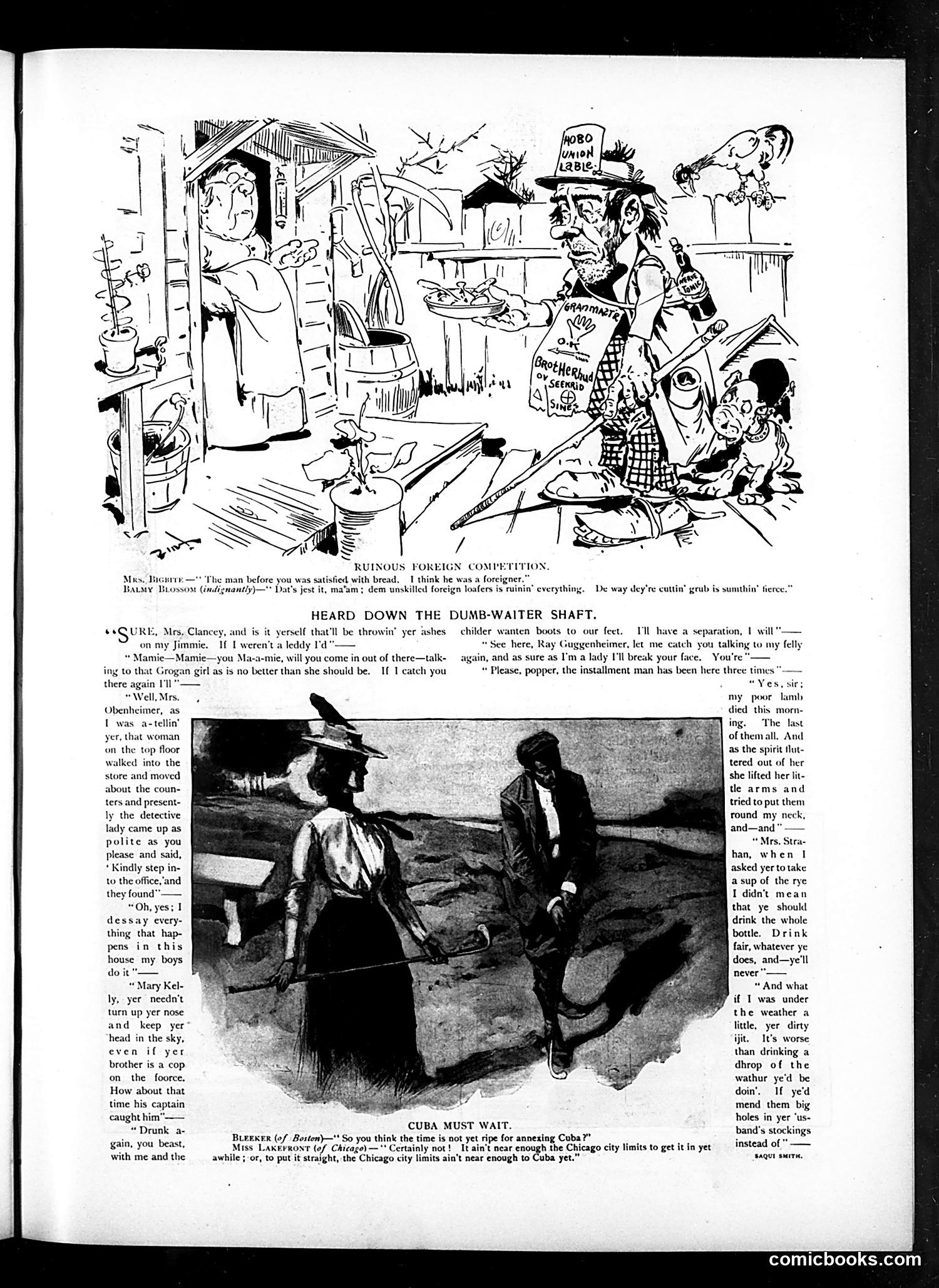
This page contains two cartoons mocking immigrant and working-class life in early 20th-century America. **"Riotous Foreign Competition"** (top) depicts an immigrant family's chaotic kitchen, satirizing foreign workers as incompetent and uncouth compared to native-born Americans. The caricatures employ ethnic stereotypes common to the era's nativist sentiment. **"Heard Down the Dumb-Waiter Shaft"** and **"Cuba Must Wait"** (bottom) feature dialogue mocking Irish and other immigrant servants and laborers. The cartoons perpetuate stereotypes about immigrant speech patterns, cleanliness, and intelligence while expressing anxiety about foreign competition for American jobs and markets. These pieces reflect Judge magazine's consistent editorial stance against immigration and labor organizing—positioning immigrants as threats to American prosperity and social order during a period of intense xenophobia and labor unrest.
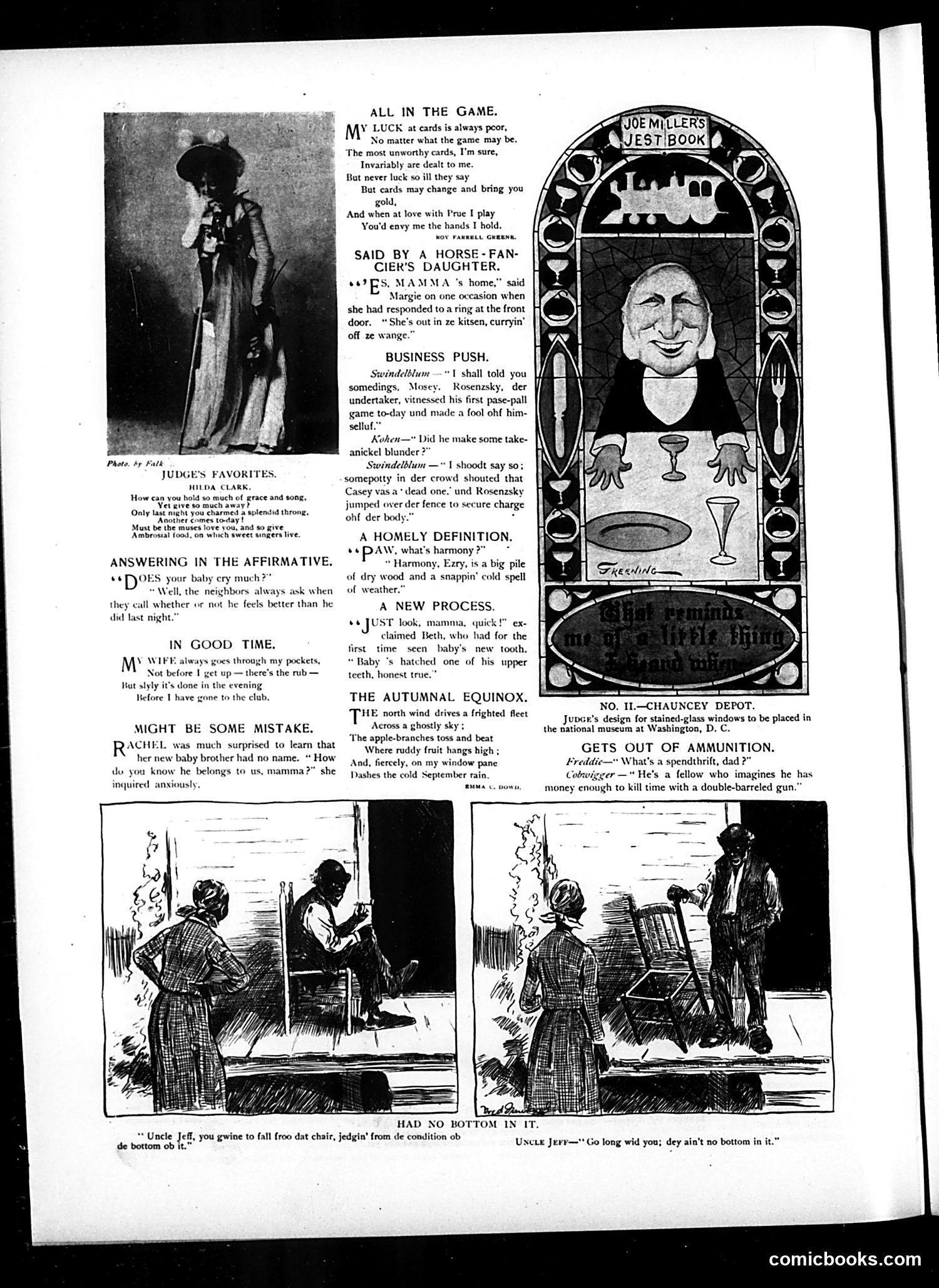
This page contains miscellaneous humor pieces and a two-panel comic strip titled "HAD NO BOTTOM IN IT." The strip shows a domestic scene where a woman (appearing to be a wife) confronts a man (Uncle Jeff) about a chair. In the first panel, Uncle Jeff sits in a chair that breaks beneath him. In the second panel, the woman tells him to "go long wild; you; dey ain't no bottom in it"—a dialect joke playing on the chair's broken state and the man's fall. The surrounding text pieces are brief comic anecdotes on various topics (cards, horses, babies, etc.). This is typical filler content from early-20th-century humor magazines. The "Joe Miller's Jestbook" reference in the decorative frame suggests these are traditional jokes rather than commentary on contemporary political events.
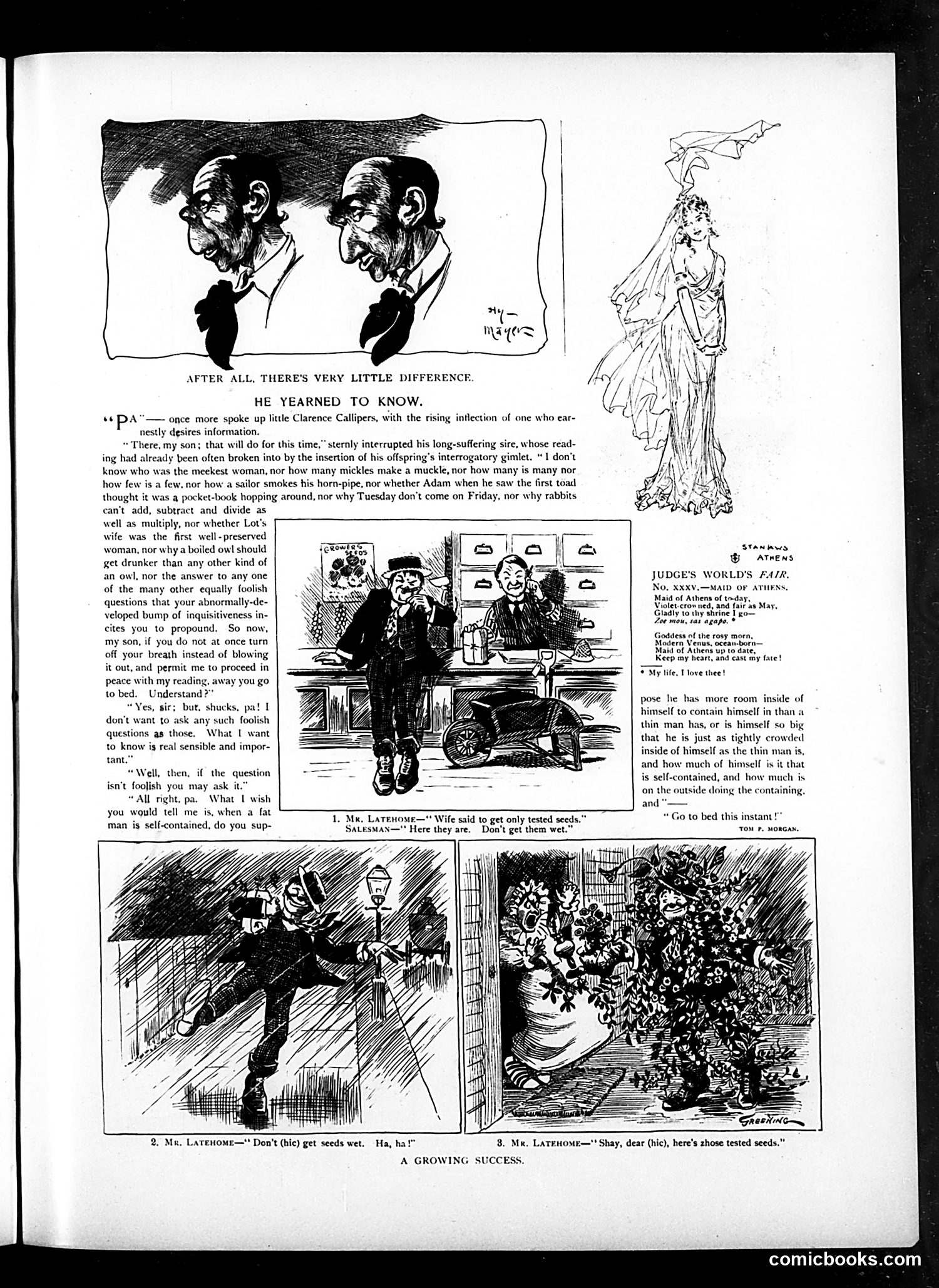
This page contains multiple satirical pieces. The top caricatures appear to contrast two political figures with minimal differences—a common Judge magazine trope mocking politicians as interchangeable. The main narrative mocks a pedantic father repeatedly interrupted by his inquisitive son Clarence Callipers with absurd questions. The father finally answers what he considers a "real sensible" question about whether fat men have more internal space when "self-contained"—a crude pun playing on physical volume versus emotional composure. The three-panel "Growing Success" cartoon below depicts a husband obtaining "tested seeds" from a salesman, then getting progressively drunk while tending the plants (indicated by "hic"—hiccup sounds). The final panel shows the seeds have grown into beer/alcohol bottles rather than vegetables—satirizing either spoiled agriculture or a drunk man's deteriorating perception. The satire targets either incompetent farming or alcohol abuse among working-class men.
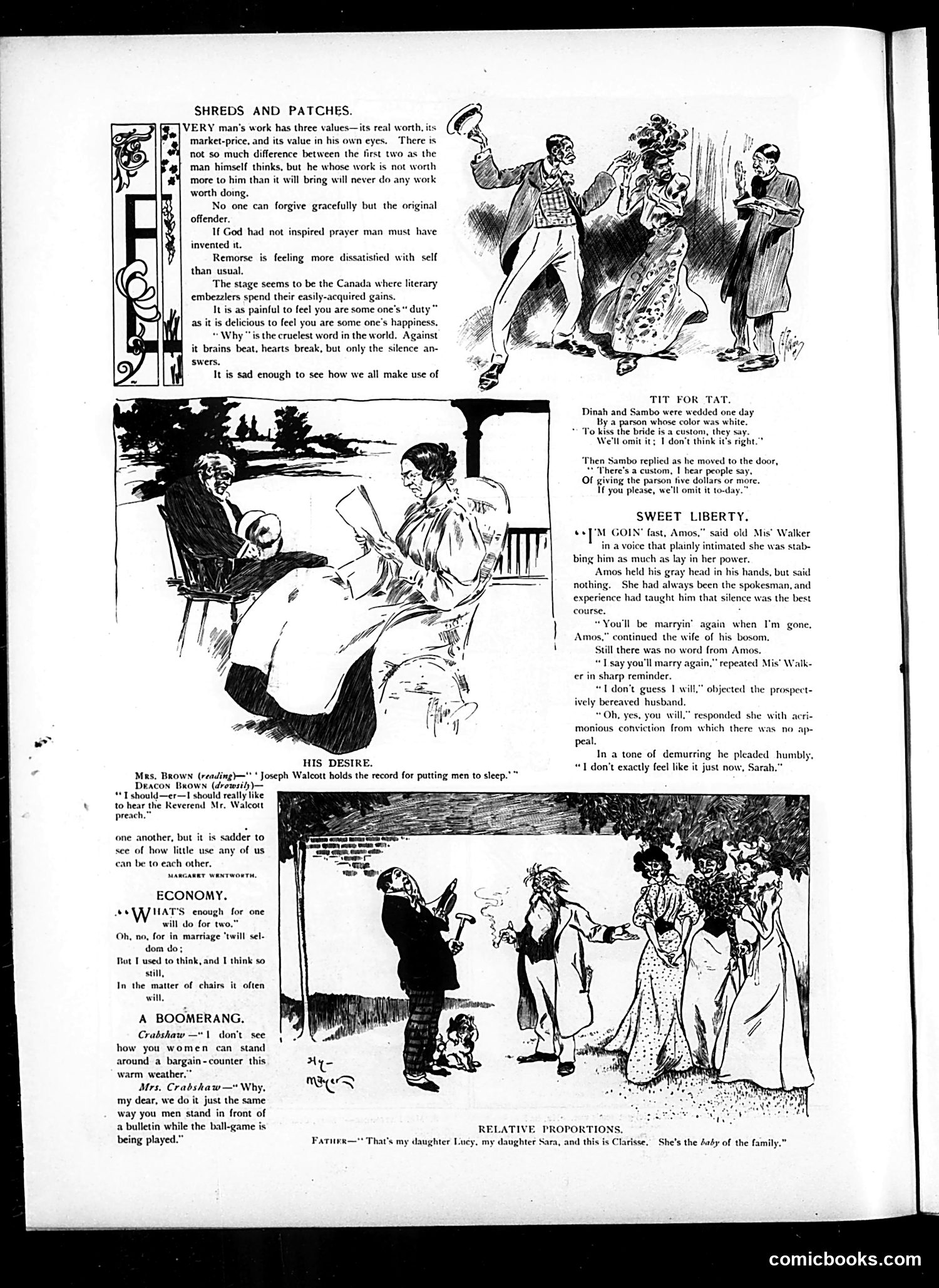
This page from *Judge* magazine contains satirical commentary on gender relations and social customs of the era (likely early 1900s). The "Tit for Tat" cartoon mocks racial attitudes by depicting a Black couple's wedding where the groom refuses to pay the customary parson's fee, mirroring the bride's refusal to follow kissing custom—crude satire reflecting period prejudices. "Sweet Liberty" depicts a nagging wife threatening her husband with remarriage after her death; his silent resignation suggests marital unhappiness presented as comedic inevitability. The brief humor pieces mock domestic life generally: a man eager to hear a boring preacher, women's shopping obsession compared to men's sports obsession, and the irony of calling the smallest daughter "the baby of the family." Overall, the page presents women as domineering nags and men as resigned sufferers, with racial caricature used for crude jokes—reflecting the magazine's satirical approach to contemporary social dynamics through now-offensive stereotypes.
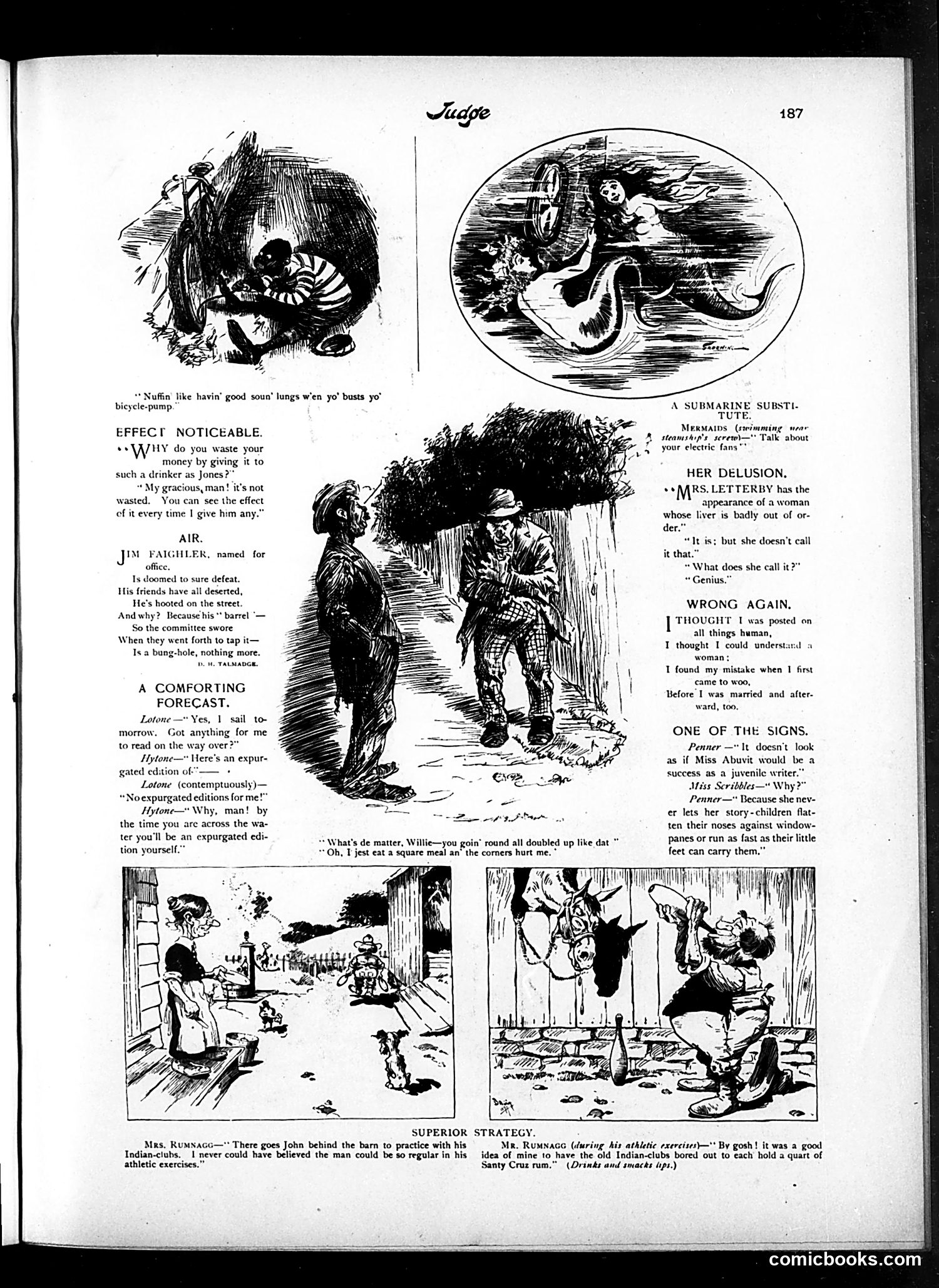
This page from *Judge* contains multiple brief satirical sketches typical of early 20th-century American humor magazines. The cartoons use exaggeration and wordplay to mock everyday social situations. **Key sketches:** - "Effect Noticeable" ridicules a man who gives money to a drunk friend Jones, joking the "effect" is visible in the friend's appearance - "Air" satirizes a political candidate named Jim Faighler whose campaign lacks support, with a crude pun comparing his empty support to a barrel's "bung-hole" - "A Comforting Forecast" uses mild innuendo about ocean travel's effects - "Her Delusion" mocks a woman's vanity regarding her health - "Superior Strategy" shows a man secretly filling hollowed-out Indian clubs with rum for exercise—a joke about disguising alcohol consumption The humor relies on ethnic dialect ("Nuffin'"), puns, and observations about drinking, infidelity, and bodily functions—typical of the era's satirical approach. The cartoons target middle-class pretension and hypocrisy.
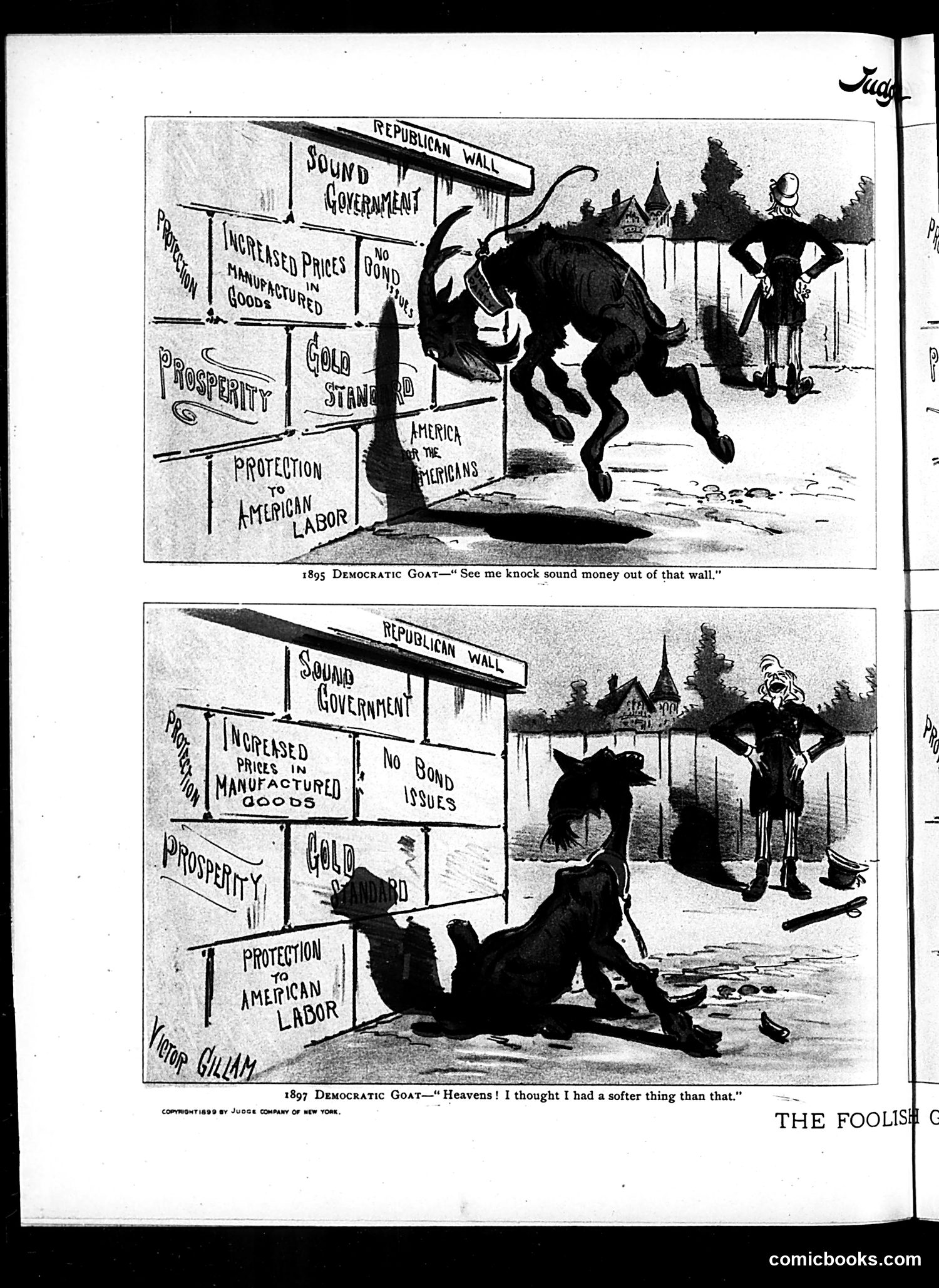
These two cartoons, titled "Democratic Goat" (1895 and 1897), use a goat as metaphor for the Democratic Party. The goat attempts to butt through a wall labeled "Republican Wall" constructed from policy planks: "Sound Government," "Increased Prices in Manufactured Goods," "Prosperity," "Gold Standard," "Protection to American Labor," and "No Bond Issues." In 1895, the goat confidently charges the wall. By 1897, it's knocked flat, exclaiming it expected an easier target. The satire mocks Democratic weakness against Republican political dominance during this period. The figure watching on the right appears to represent Republican leadership, observing the Democrats' futile efforts. This reflects the mid-1890s political climate when Republicans controlled policy following McKinley's 1896 election victory over Democrat William Jennings Bryan.
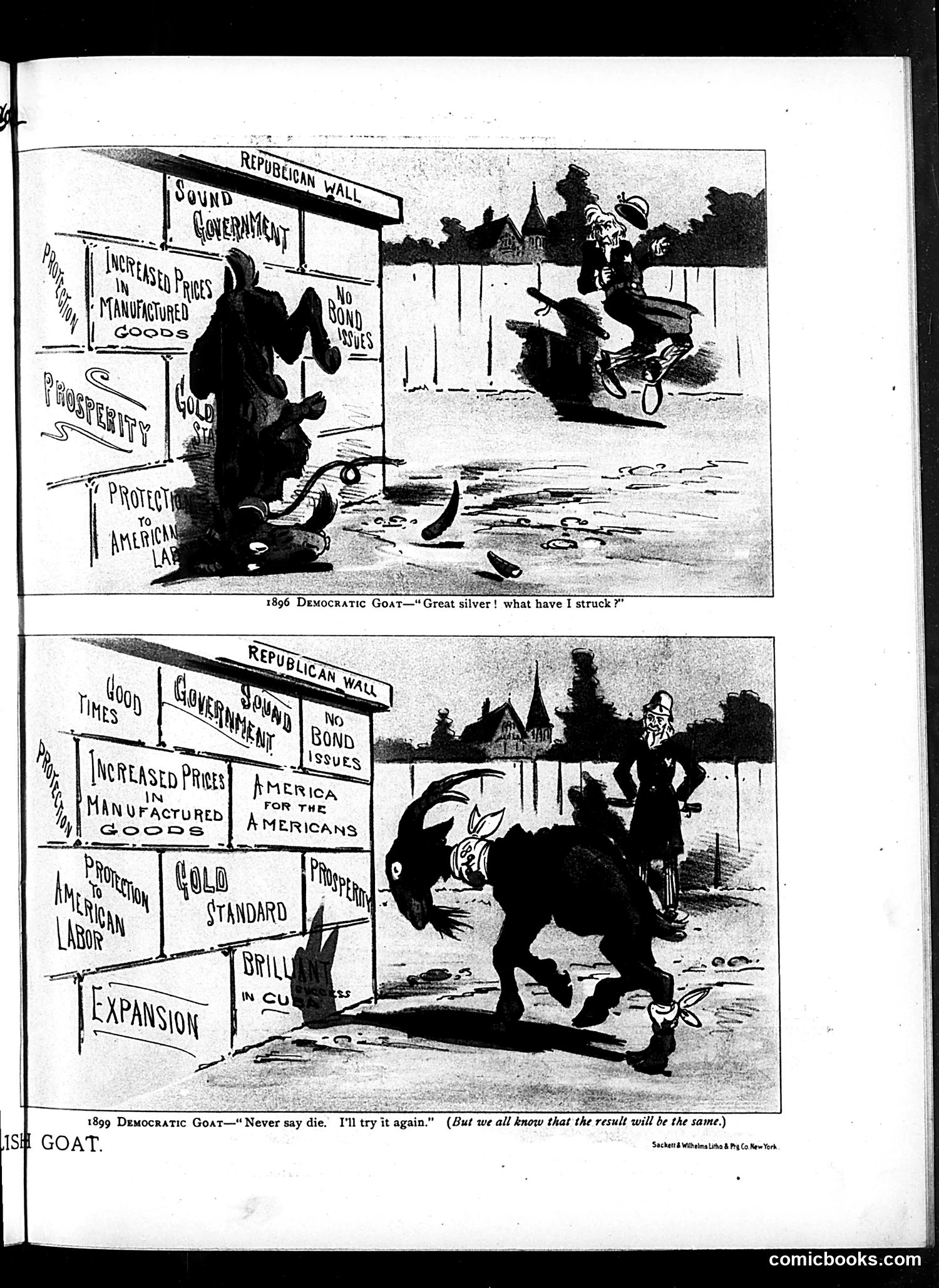
This 1896-1899 comparative cartoon depicts the **Democratic Party as a stubborn goat** repeatedly charging at the Republican Wall—a barrier covered with Republican policy achievements: sound government, no bond issues, increased prices, prosperity, protection for American labor, and gold standard expansion. The top panel (1896) shows the Democratic goat striking the wall and asking "Great silver! what have I struck?" The bottom panel (1899) shows the same goat attempting again, with the caption "Never say die. I'll try it again"—but the parenthetical note adds: "(But we all know that the result will be the same.)" The satire mocks Democratic persistence in opposing Republican policies despite repeated electoral failures. The goat symbolizes both stubbornness and futility, suggesting Democrats cannot overcome Republican economic success, particularly regarding monetary policy (the silver versus gold standard debate was central to 1890s politics).
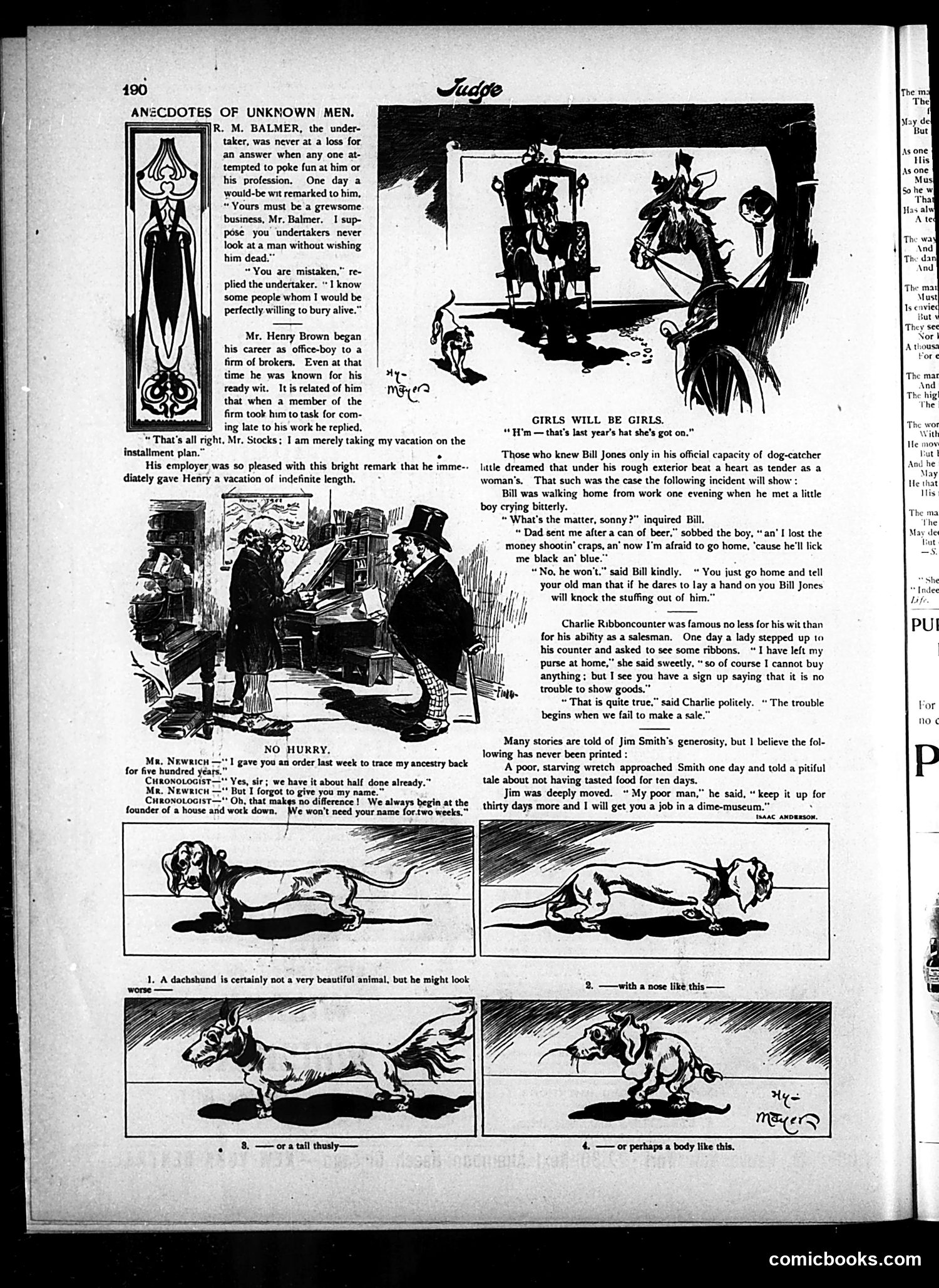
This page contains several "anecdotes of unknown men"—humorous short stories typical of Judge's satirical format. The humor relies on unexpected wit and cynical reversals: **"The Undertaker"**: A undertaker outwits a would-be mocker by claiming he'd willingly bury *living* people he dislikes—dark humor about human nature. **"Office Boy"**: A young employee's quip about taking vacation "on the installment plan" (paying gradually) gets him fired—satire of workplace absurdity and poor employee-employer relations. **"Genealogy"**: A genealogist needs no client name, as he'll trace ancestry "from the founder" taking weeks—mocking the pretension of ancestry research and suggesting all families descend from humble origins. **Bottom section** includes unrelated anecdotes about a kind dog-catcher, a witty ribbon salesman, and Jim Smith's "generous" offer to employ a starving man only after 30 more days of starvation (cruel satire of wealthy indifference). The dachshund cartoon bottom-left appears to be a visual joke about dogs' physical appearance, though the exact reference is unclear.
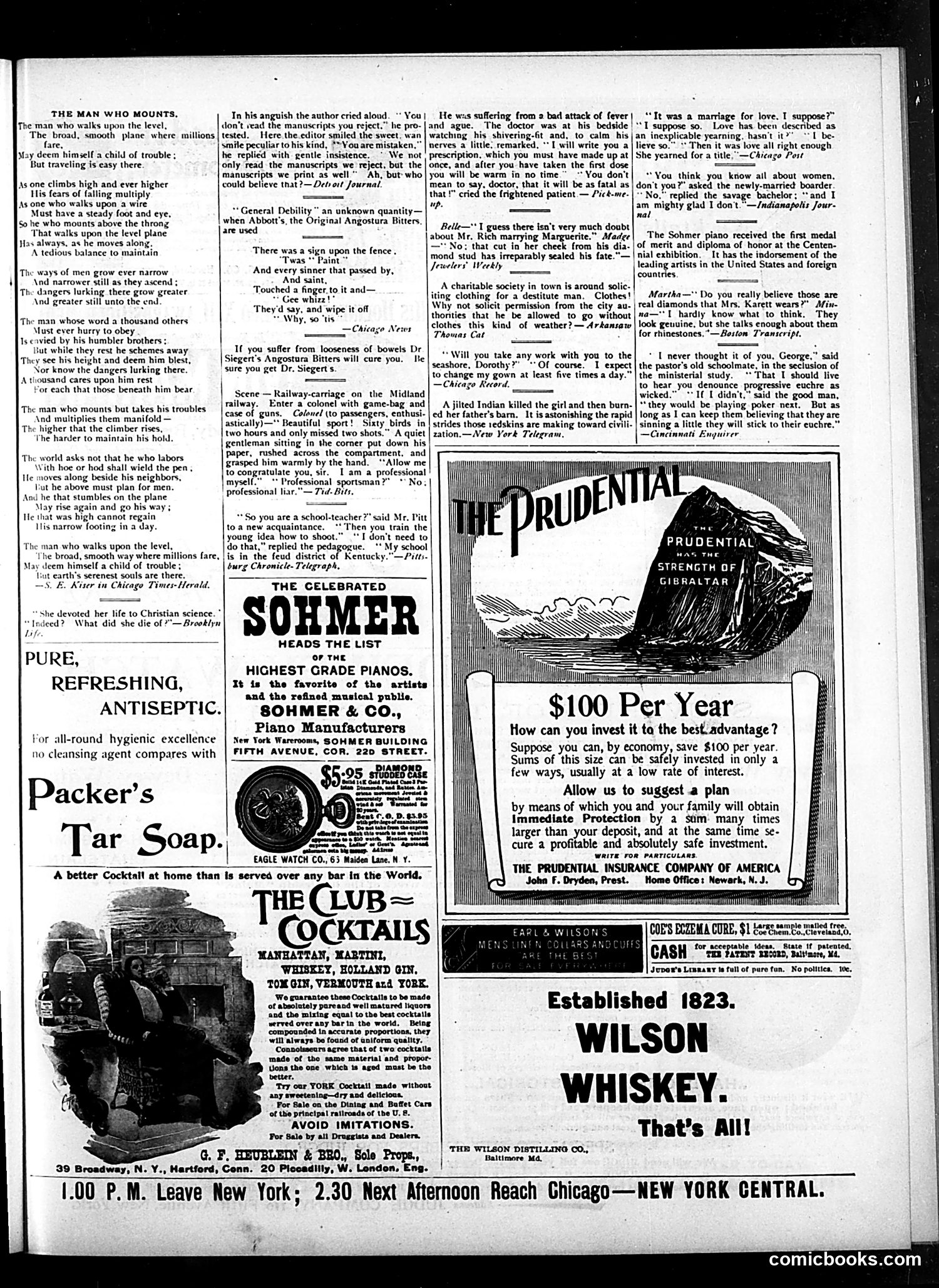
This page is primarily **advertisements and filler content** from Judge magazine, not political satire. The main elements are: **"The Man Who Mounts"** — A lengthy poem (by S.E. Kiser) using the metaphor of climbing to discuss social responsibility. It argues that those who rise to positions of power face greater burdens and risks than ordinary people ("walks upon the level"). The poem warns that prominent figures cannot afford to stumble as easily as common folk. This reflects late 19th/early 20th-century conservative ideas about leadership as inherently burdensome. **Short humorous anecdotes** scattered throughout—brief jokes about doctors, schoolteachers, and sporting mishaps. These appear to be generic humor filler rather than topical satire. The page is dominated by **product advertisements**: Packer's Tar Soap, Sohmer pianos, Wilson Whiskey, insurance, and cocktail recipes. The Prudential Insurance ad emphasizes safe investment strategies for middle-class readers. There is **no identifiable political cartoon or clear satirical target** on this page. It represents typical Judge magazine content: moralistic verse mixed with period advertising.
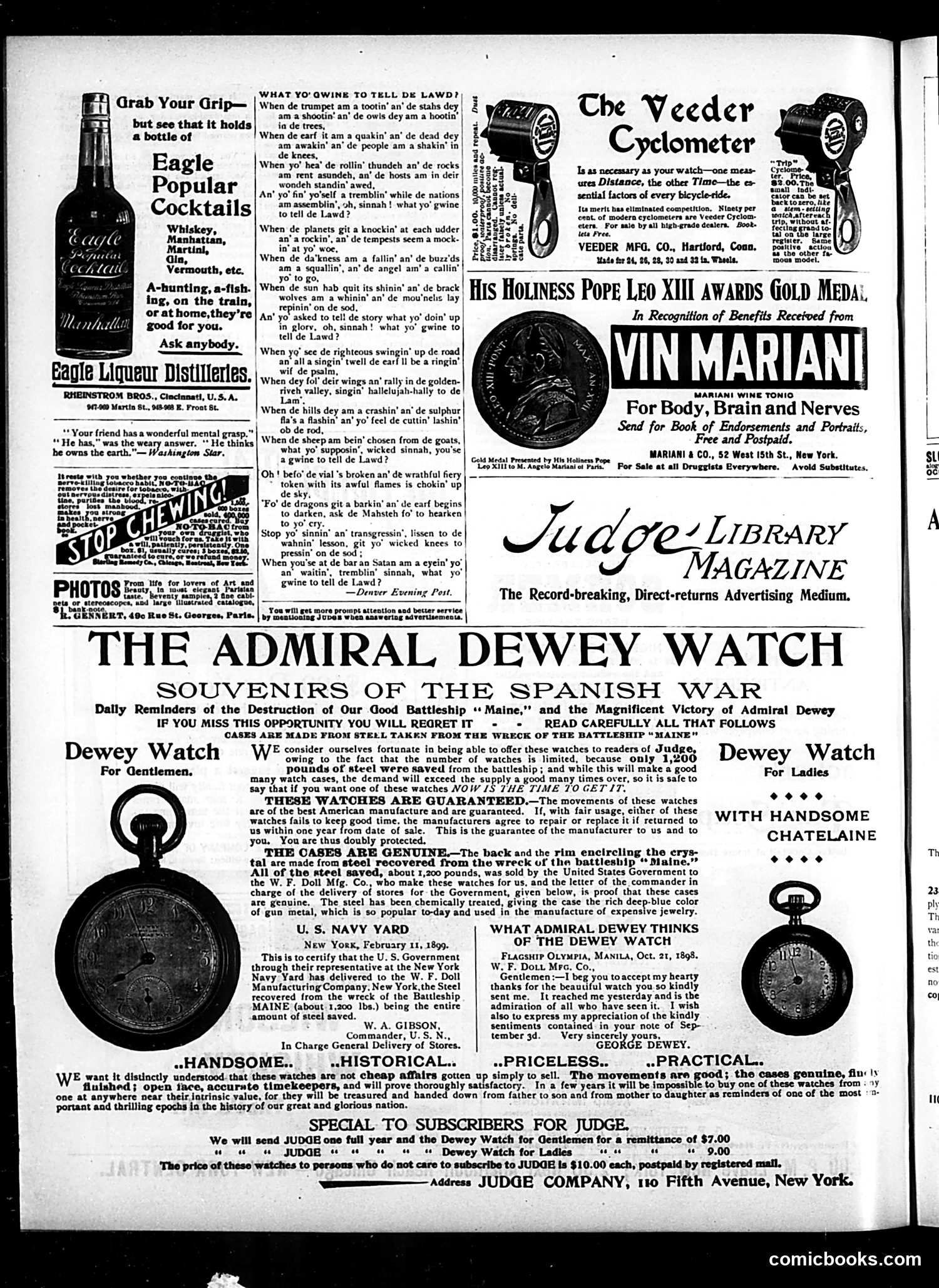
This is primarily an **advertising page** from Judge magazine, with one notable satirical poem. ## The Main Content: The large poem "What Yo' Gwine to Tell de Lawd?" uses **racist dialect** (written phonetically in exaggerated African American vernacular) to present a fire-and-brimstone religious warning. This reflects the period's entertainment conventions, though such depictions are now recognized as offensive stereotypes. ## Key Advertisements: - **Admiral Dewey Watch**: Marketed as souvenirs commemorating the 1898 Spanish-American War and the USS Maine battleship (which exploded in 1898, sparking the war) - **Vin Mariani**: Wine tonic endorsed by Pope Leo XIII, marketed as medicinal for body and nerves - **Eagle Popular Cocktails**: Portable liquor bottles for hunting/travel - **Veeder Cyclometer**: Bicycle odometer device The page reflects turn-of-the-century American culture: patriotic fervor over recent military victory, patent medicine promotion, and emerging consumer products for leisure activities.
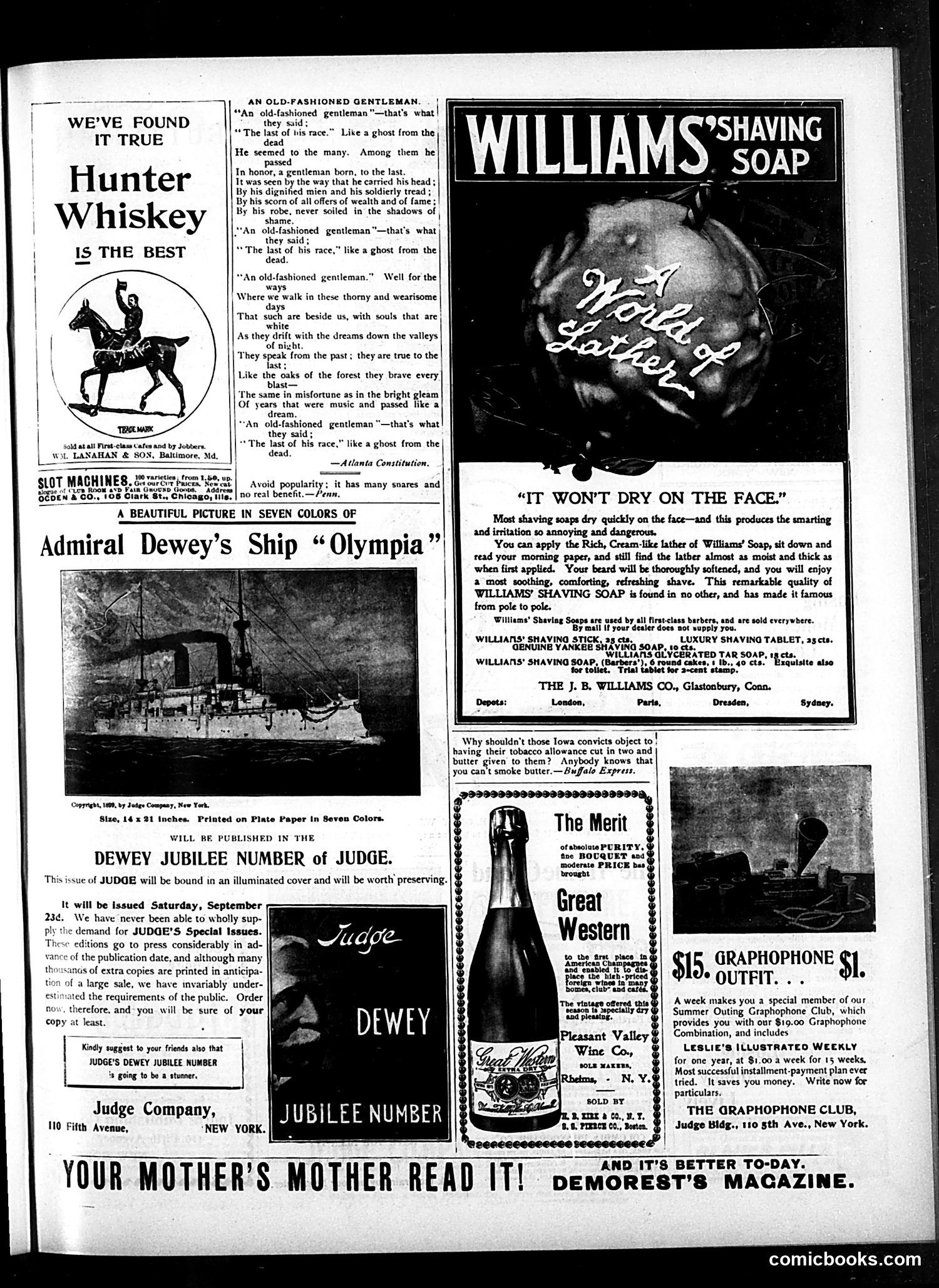
This page is primarily **advertisements and promotional content** rather than political satire or editorial cartoons. The main features include: 1. **Poetry ("An Old-Fashioned Gentleman")**: A sentimental verse from the *Atlanta Constitution* lamenting the disappearance of traditional gentlemen—men of honor, dignity, and moral integrity unswayed by wealth or fame. This reflects turn-of-century nostalgia for "old-fashioned" values. 2. **Advertisements**: The page features ads for Williams' Shaving Soap, Hunter Whiskey, and various other products typical of the era. 3. **Editorial announcement**: Judge Company promotes its upcoming "Dewey Jubilee Number" (celebrating Admiral Dewey, likely referring to George Dewey's Spanish-American War fame circa 1898). The sentiment about disappearing gentlemen reflects broader late-Victorian anxiety about modernization and social change, but this page contains no identifiable political cartoons or satirical commentary requiring historical context beyond general nostalgia for pre-modern values.
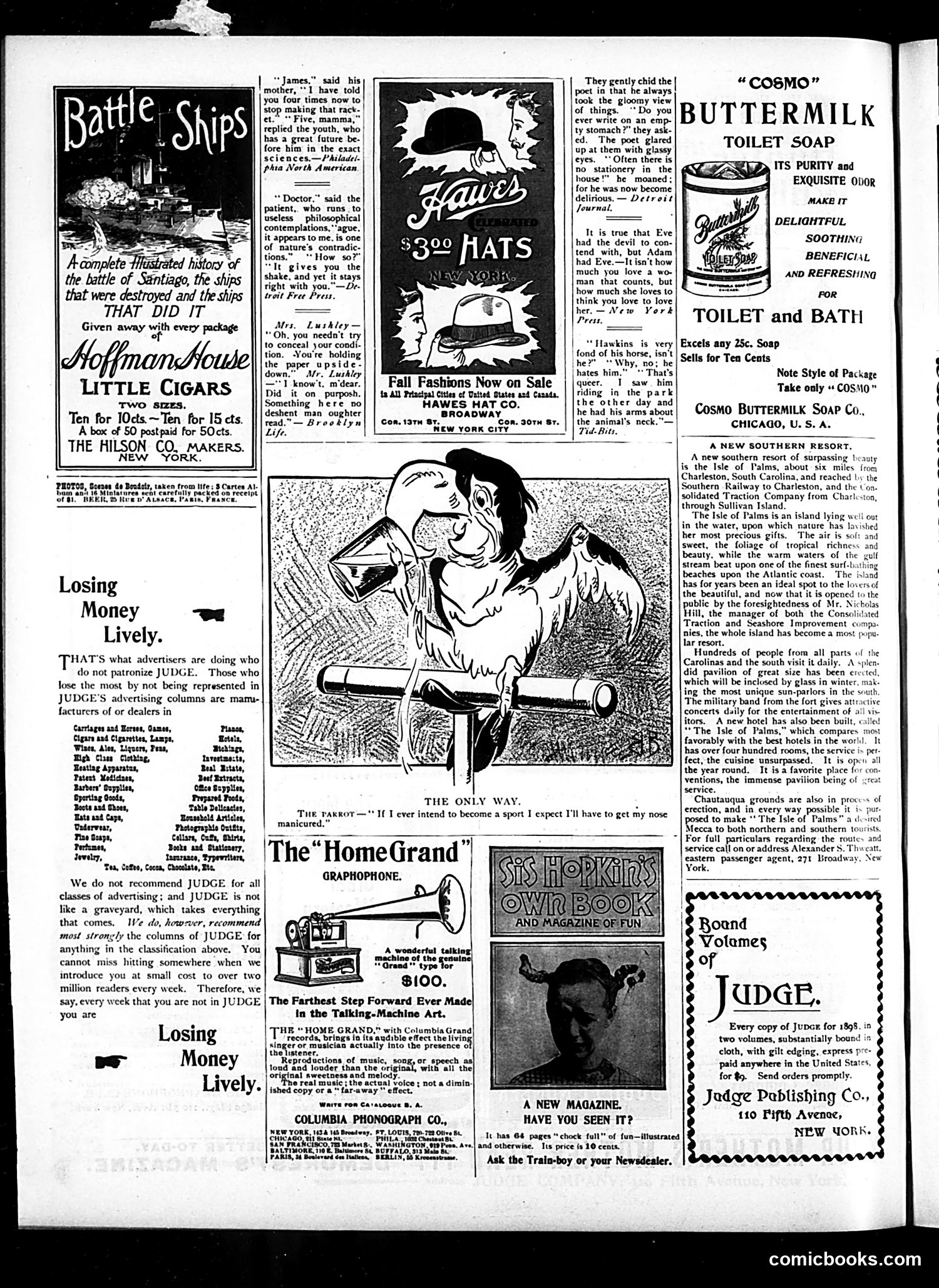
This page is primarily **advertisements and short humorous anecdotes** rather than political cartoons. The content includes: **Main Features:** - Multiple brief jokes playing on wordplay and domestic situations (a boy correcting his mother's count, a drunk man reading upside-down, marital quips about Eve and Adam) - A cartoon of a parrot saying it needs its nose "manicured" to become a "sport" (gentleman) - Product advertisements for cigars, hats, soap, gramophones, and a phonograph device **Historical Context:** The "Judge" advertisements emphasize the magazine's two-million-reader reach, suggesting advertisers should buy space. The products advertised (cigars, phonographs, gramophones) reflect early 1900s consumer goods. There's no identifiable political satire on this page—instead, it showcases the magazine's mix of light humor and commercial content targeting affluent readers.
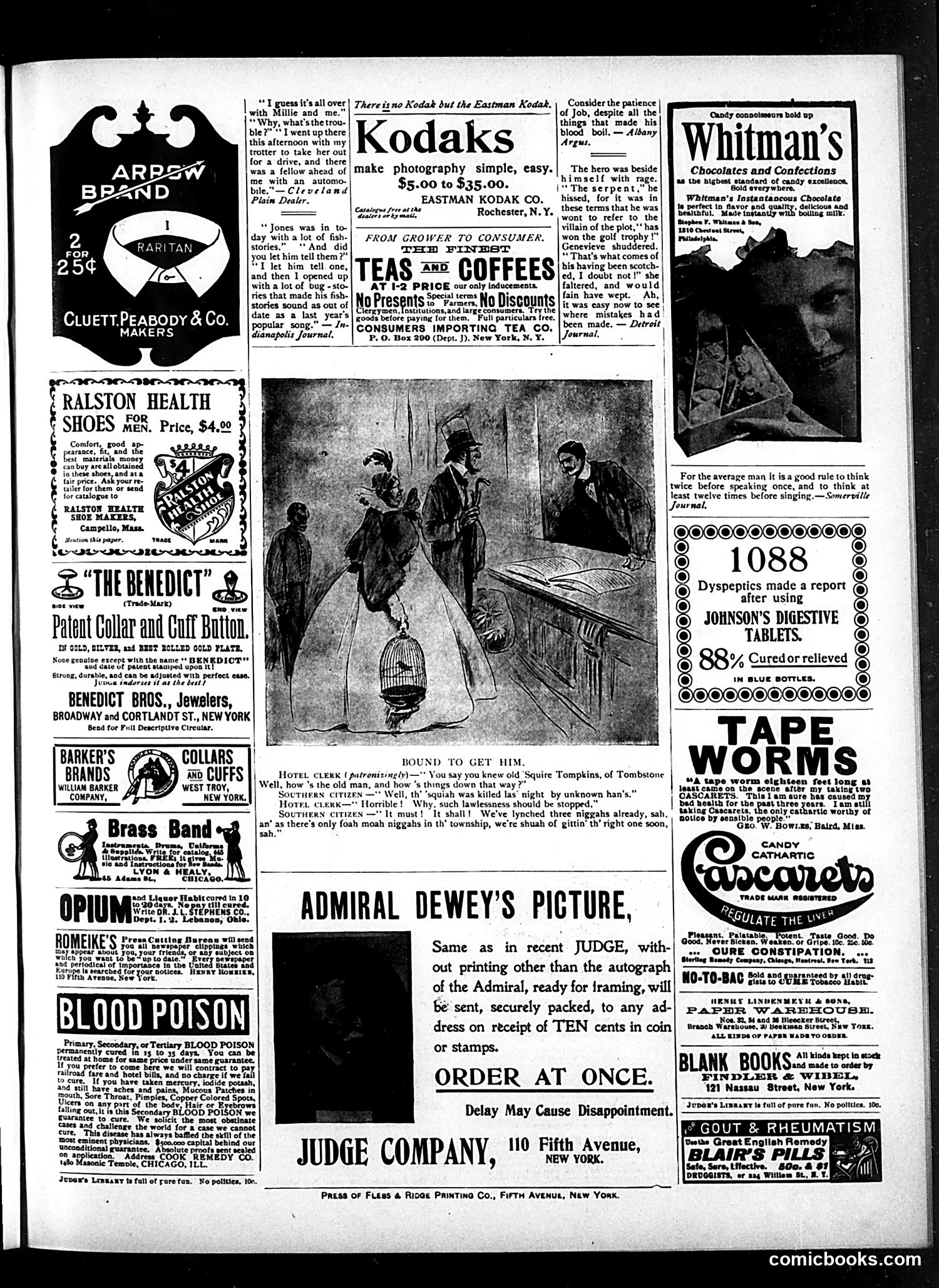
This page is primarily advertising, with one significant political cartoon embedded in the middle. **The Main Cartoon: "Bound to Get Him"** The cartoon satirizes Southern racial violence and mob justice in the post-Reconstruction era. A hotel clerk patronizingly asks a Southern citizen about an old acquaintance, "Squire Tompkins." The citizen reveals Tompkins was killed "by unknown han's" the previous night. When the clerk expresses shock that "such lawlessness should be stopped," the citizen casually responds they've already lynched three Black people and are confident they'll "git'n th' right one soon" among the remaining four. The satire is biting: it exposes how Southern whites conducted mob lynchings under the pretense of justice, targeting Black citizens indiscriminately while claiming certainty of guilt. The grotesque casualness of the dialogue highlights the absurdity and moral bankruptcy of lynch mob logic. This reflects Judge magazine's satirical criticism of racial violence that was epidemic during this period.
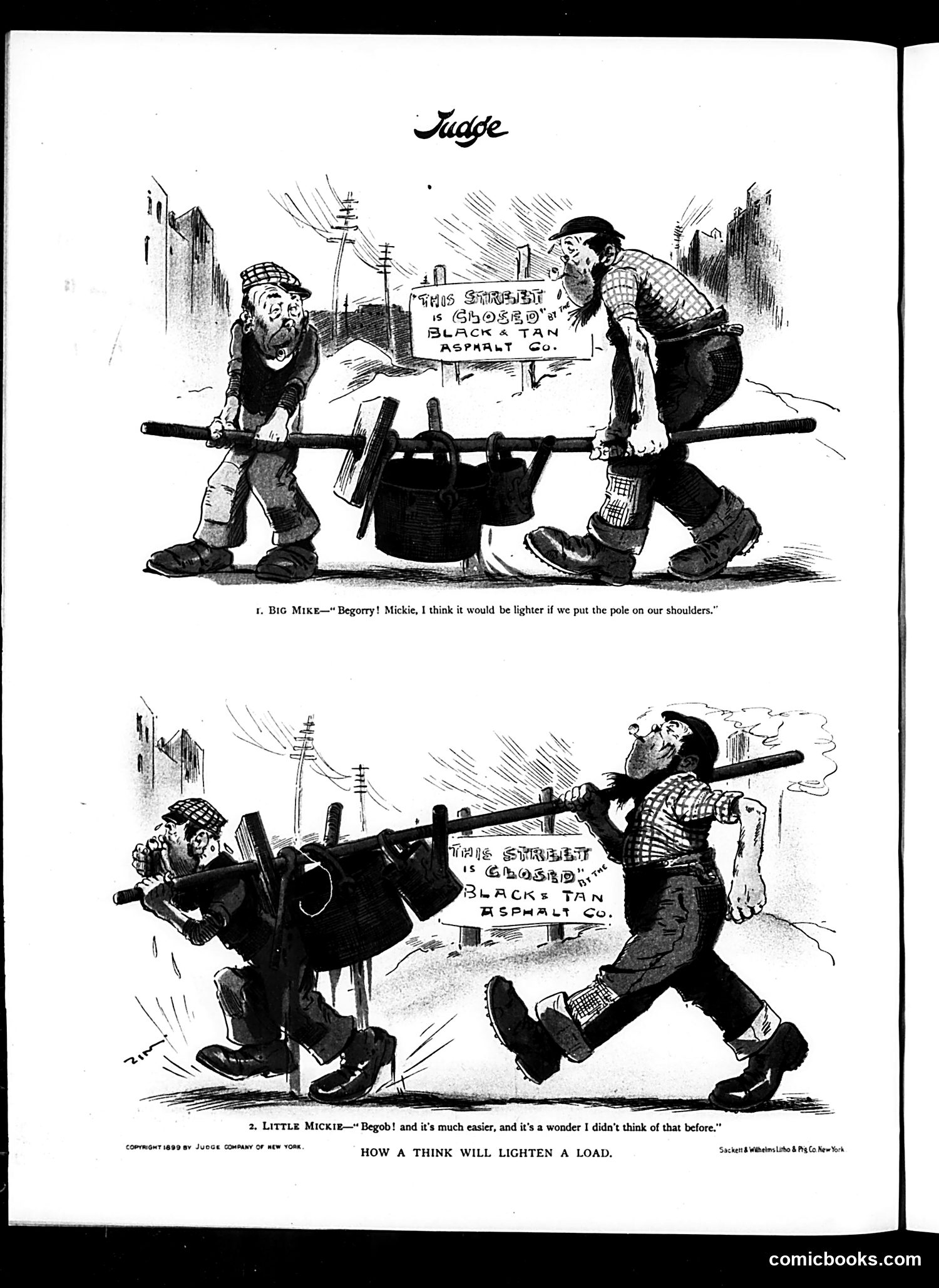
This two-panel cartoon uses Irish working-class characters ("Big Mike" and "Little Mickie," identified by their dialect and names) to illustrate a practical problem-solving lesson. Both men carry a heavy pole supporting a sign for "Black Tan Asphalt Co." **The joke**: In panel one, Big Mike suggests shifting the pole to their shoulders rather than carrying it by hand. In panel two, Little Mickie agrees it's "much easier," crediting the insight as a clever discovery. **The satire's point**: The cartoon mocks how people often overlook simple solutions to everyday problems. By using working-class Irish laborers as the characters, *Judge* (a satirical magazine) creates gentle humor about practical intelligence versus overthinking. The "think" in the title refers to using one's mind—suggesting that thoughtful consideration can reduce physical burden, a message likely aimed at the magazine's educated, middle-class readership.