
A complete issue · 16 pages · 1899
Judge — August 26, 1899
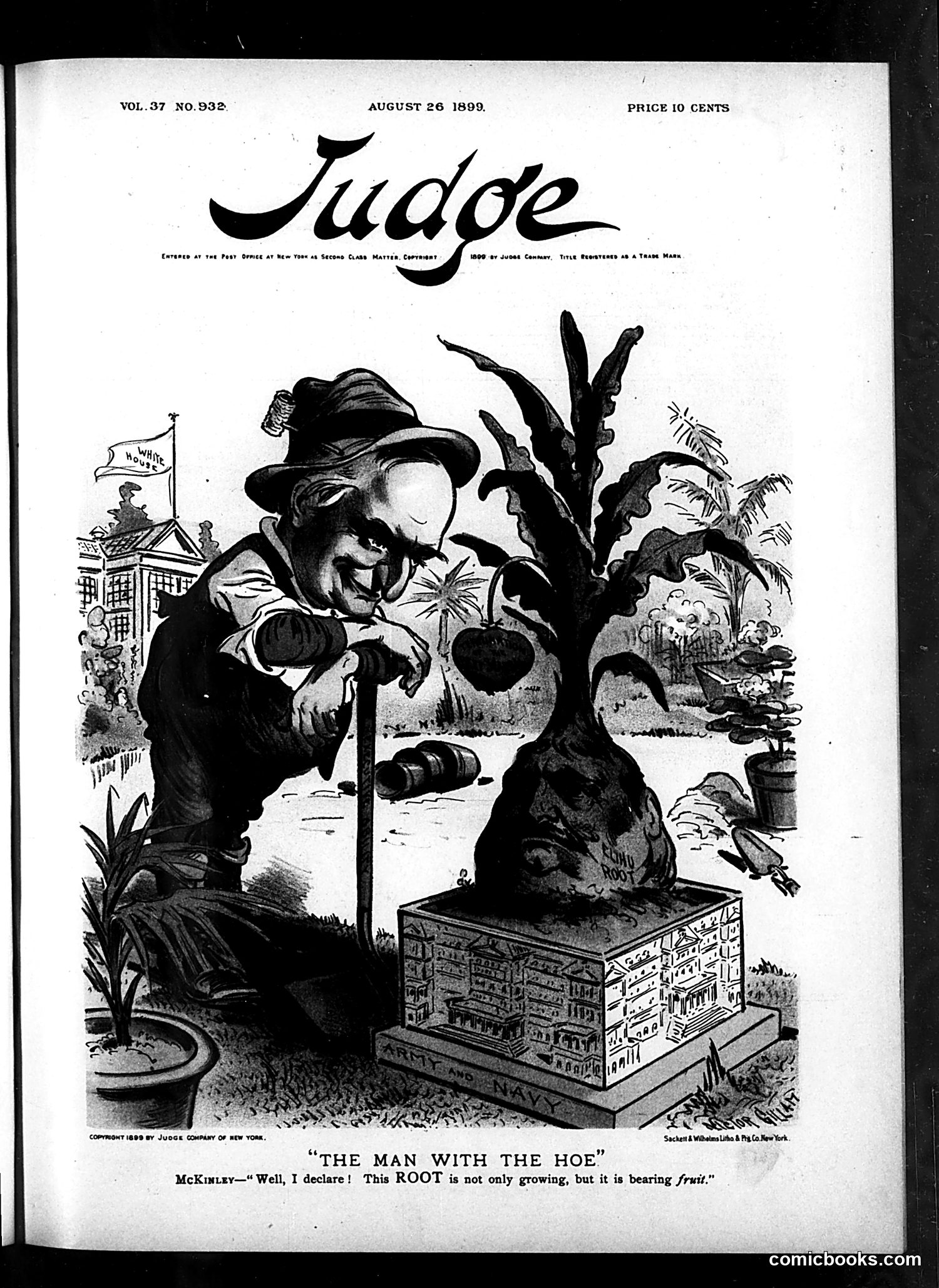
This cartoon satirizes President **McKinley** through a visual pun on Edwin Markham's famous 1899 poem "The Man with the Hoe," which depicted agricultural labor as exploitative and dehumanizing. The caricature shows McKinley as a grotesque figure tending a twisted, barren tree growing from a pedestal labeled "ARMY AND NAVY." The "fruit" emerging are spheres (likely representing territories or colonial possessions). A colonial building and palm trees suggest overseas expansion. The joke: McKinley, like Markham's laborer, is cultivating something, but instead of crops, he's harvesting imperial fruits from American military might. The satire critiques McKinley's expansionist foreign policy and the Spanish-American War aftermath, suggesting his administration was reaping problematic colonial consequences.
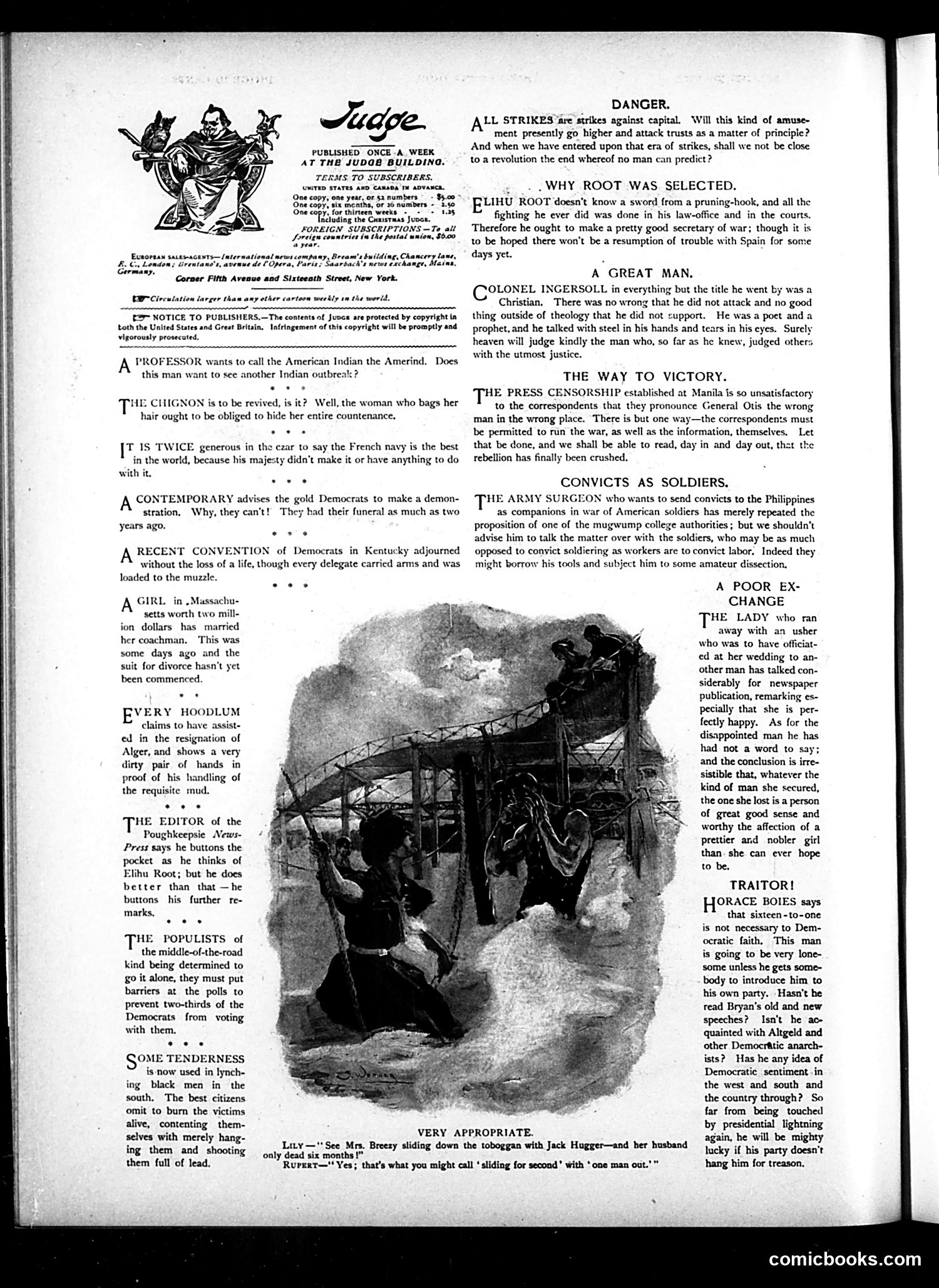
The central cartoon, captioned "VERY APPROPRIATE," depicts a woman (labeled "Lucy") riding in a toboggan with a man identified as "Jack Hagger," who is described as "only dead six months." The joke's dark humor relies on the phrase "sliding for second," a baseball term for advancing bases—here applied morbidly to a widow with a recently deceased husband. The surrounding editorial snippets offer political commentary on contemporary issues: Democratic conventions, press censorship in Manila (Philippines colonial context), treatment of convicts as soldiers, and accusations of Democratic disloyalty. The page reflects early 20th-century American satirical style, blending crude humor with partisan political criticism typical of Judge magazine's Republican-leaning editorial stance.
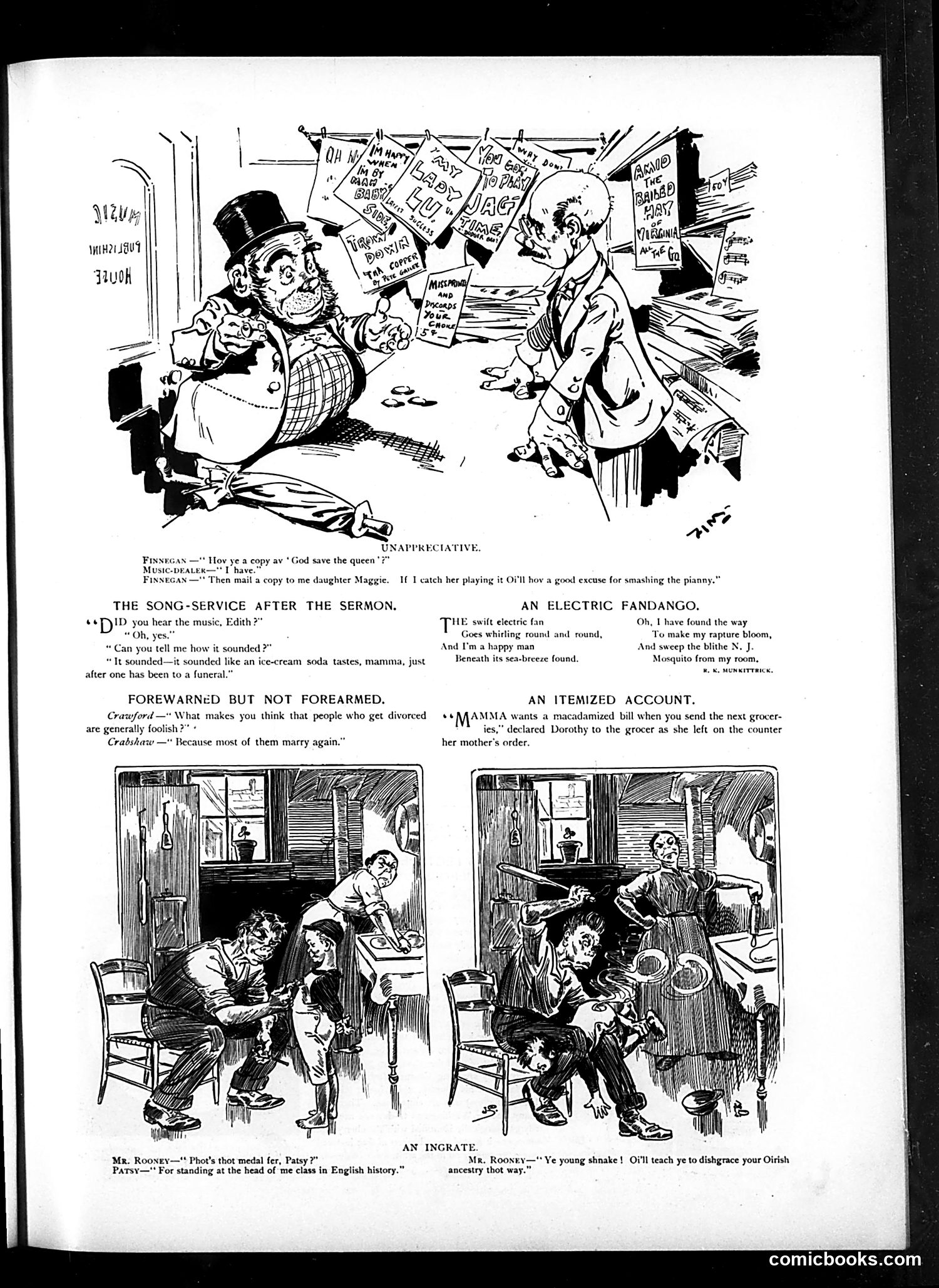
This page contains several unrelated humorous sketches and brief comedic anecdotes typical of Judge magazine's format. The top cartoon shows two men amid scattered papers, apparently discussing music or performance—one wearing a top hat. The surrounding sketches include domestic scenes with captions like "THE SONG-SERVICE AFTER THE SERMON" and "AN ELECTRIC FANDANGO," focusing on everyday middle-class life and social pretensions. The lower panels titled "FOREWARNED BUT NOT FOREWARNED" and "AN INGRATE" depict parent-child interactions, with humor derived from generational misunderstandings and children's irreverence toward authority figures. These are primarily social satire rather than political commentary, mocking Victorian-era manners, domestic relationships, and cultural affectations rather than specific political figures or events. The overall tone is lighthearted domestic humor targeting middle-class concerns.
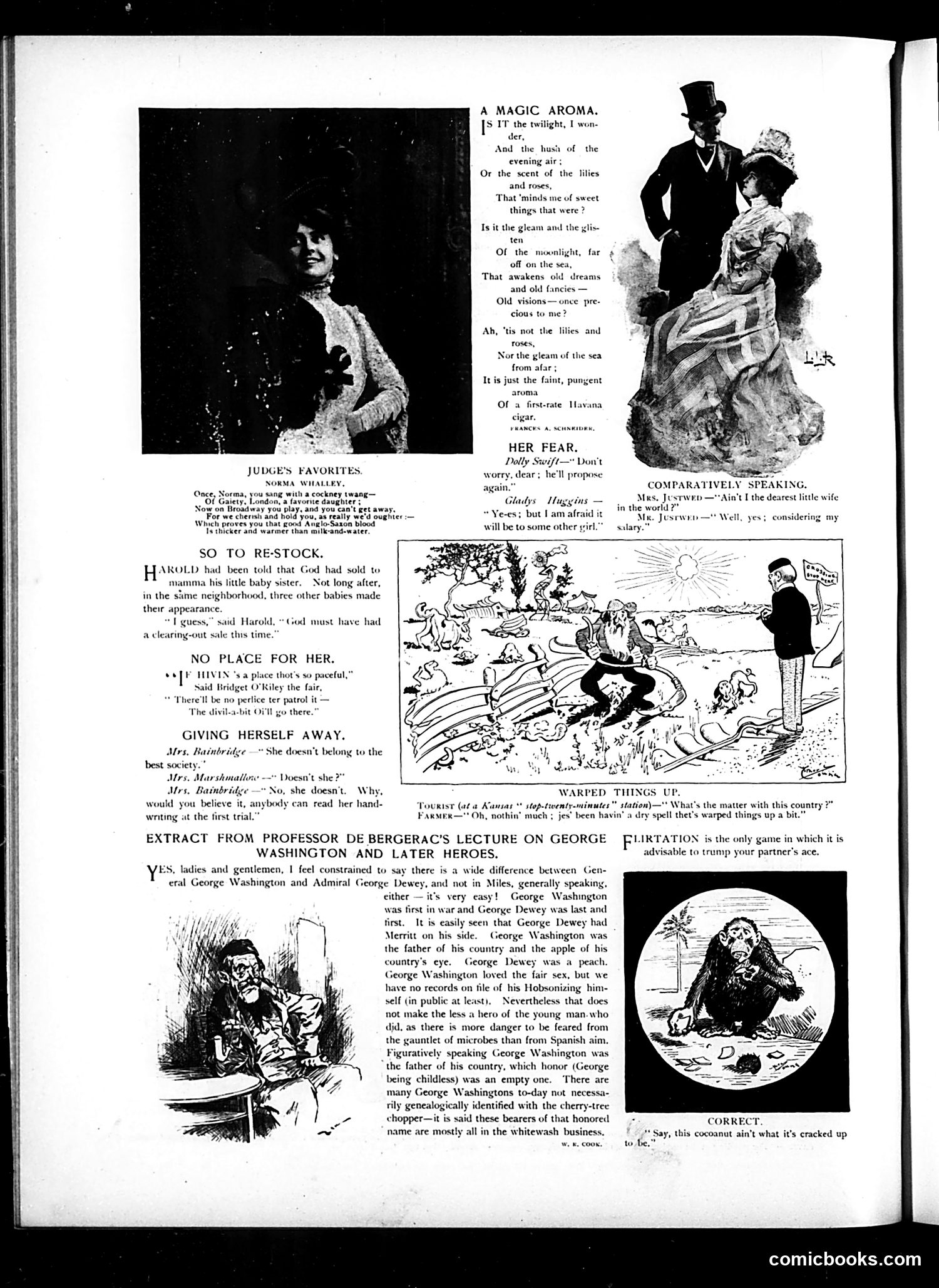
This page contains several humor pieces and illustrations typical of Judge's satirical content. The main features include: **"A Magic Aroma"** - A poem about pleasant evening scents, accompanied by a sketch of well-dressed figures. **"Judge's Favorites"** - Features Norma Whalley, apparently a popular actress or performer of the era. **"So to Restock," "Her Fear," and other titled pieces** - Short humorous anecdotes and dialogues about everyday social situations. **The bottom section** includes Professor De Bergerac's lecture comparing George Washington and Admiral George Dewey—likely referencing Dewey's recent prominence (possibly the Spanish-American War era, early 1900s). The satire contrasts Washington's mythologized heroism with Dewey's more questionable public character. The cartoons employ typical Judge-style illustrations to mock social pretensions and contemporary figures.
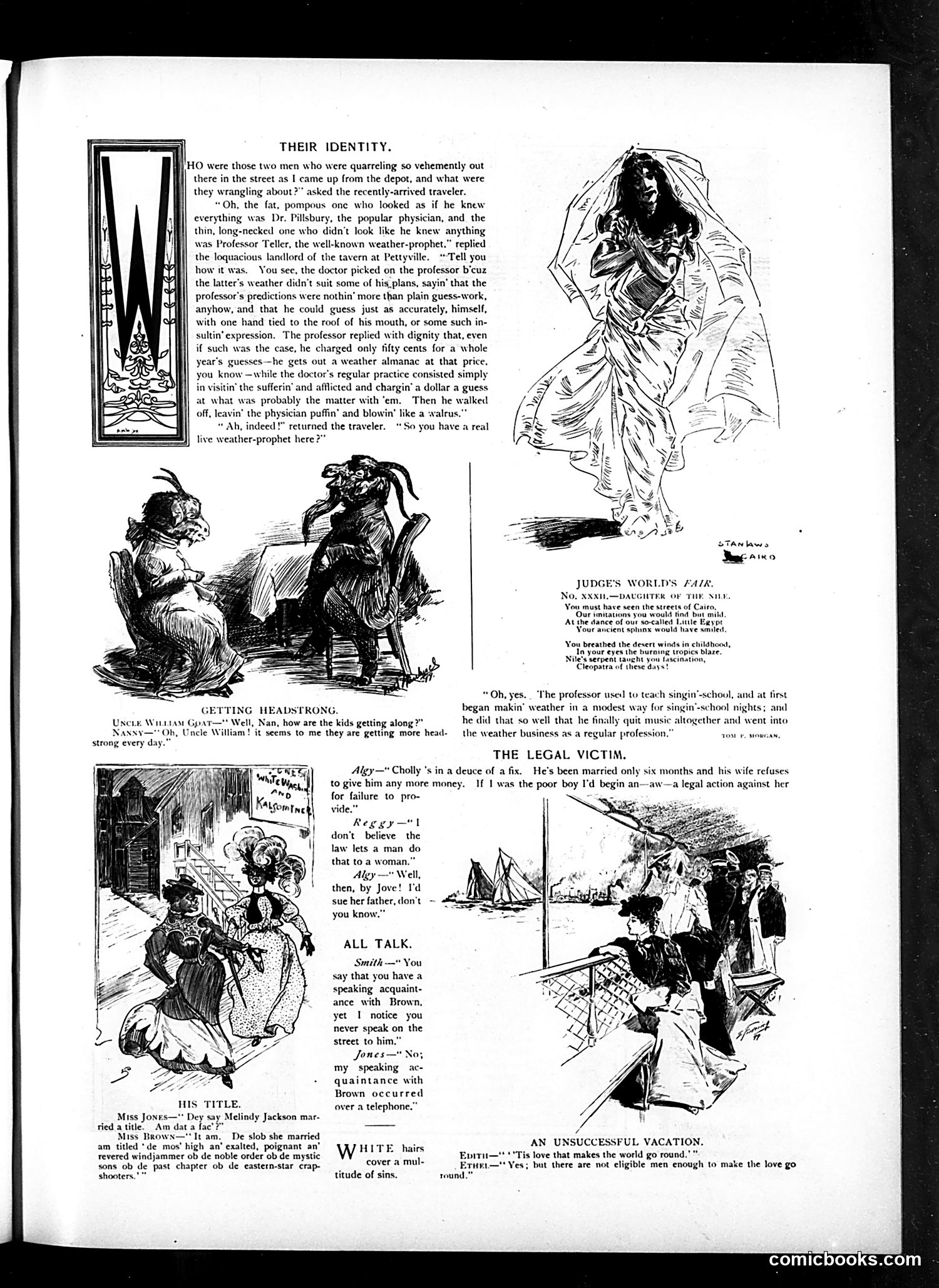
This page contains several satirical sketches mocking small-town life and social pretension in late 19th/early 20th-century America. **"Their Identity"** ridicules a dispute between a doctor and weather-prophet in a small town ("Pettyville"), satirizing professional charlatanism—both men claim expertise while the doctor charges inflated fees for diagnostic guessing. **Other sketches** mock various social absurdities: a couple's marital discord over money ("The Legal Victim"), pretentious speech patterns among the upper class ("All Talk"), and a woman's false claims to Egyptian descent ("Judge's World's Fair"). The humor relies on ethnic stereotypes, class mockery, and satirizing American optimism about progress and professionalism. The cartoons suggest that doctors, weather-predictors, and society folk all trade in deception or empty talk—nobody is genuinely competent or honest. The overall tone is cynical about American institutions and aspirations, typical of Judge's satirical mission.
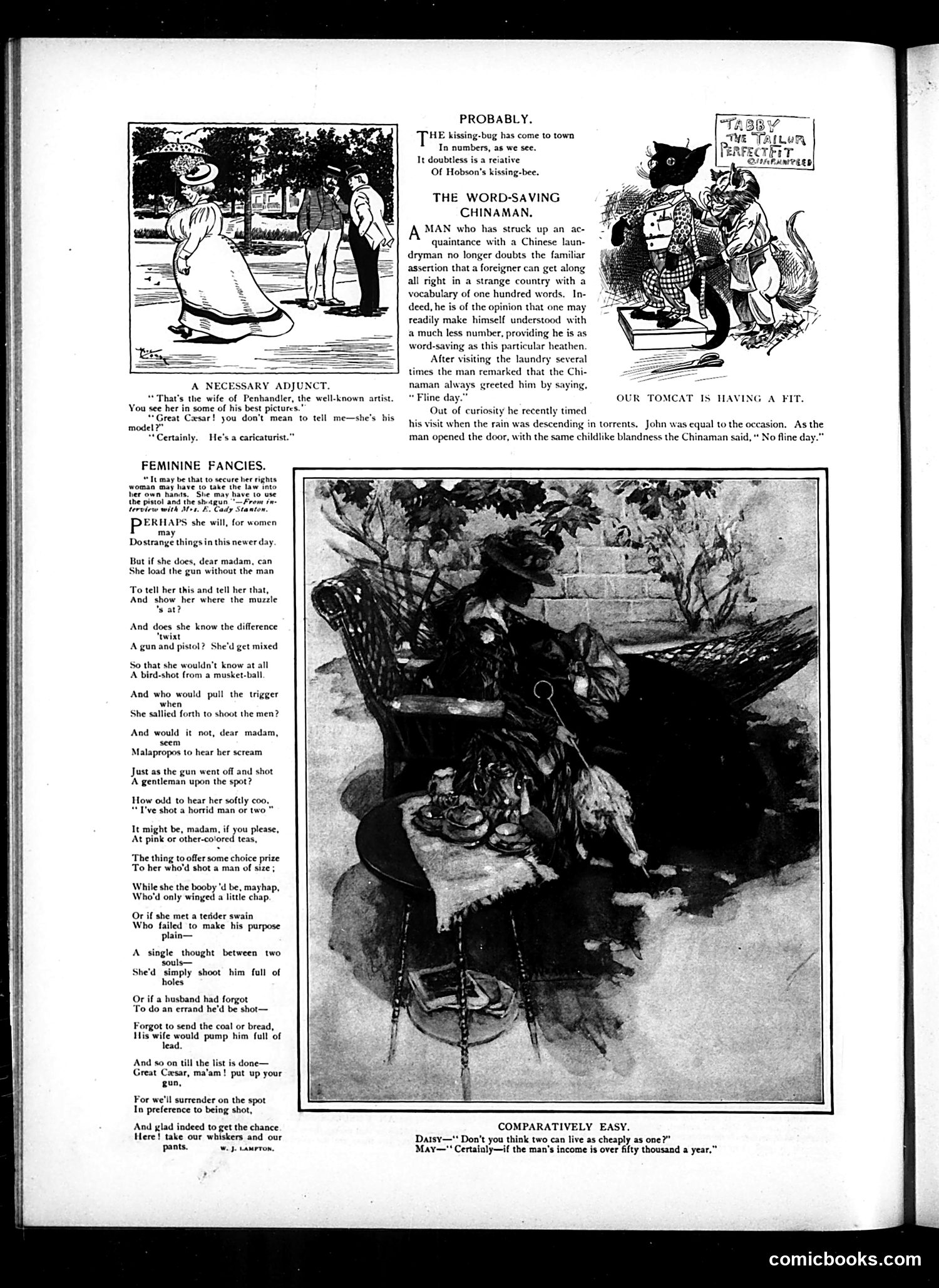
This page contains three distinct pieces of early 20th-century American satire: **"The Word-Saving Chinaman"** mocks the notion that foreigners need only minimal vocabulary in foreign lands. A Chinese laundryman greets a customer with only "Fine day" and "No fine day" depending on weather—satirizing both the stereotype of Chinese brevity and American assumptions about communicating across language barriers. **"Feminine Fancies"** is a lengthy poem ridiculing women's suffrage activism. It sarcastically questions whether women could safely handle firearms for self-defense, imagining absurd scenarios of women accidentally shooting bystanders or using guns to punish husbands for minor domestic failures. The satire defends male authority through exaggerated "concerns" about female competence. **"Comparatively Easy"** is a brief joke about marriage economics: a couple discusses living cheaply together, with the punchline that it's only feasible if the husband earns over fifty thousand dollars annually—mocking the assumption that marriage saves money while reflecting class anxieties about wealth requirements for respectable life.
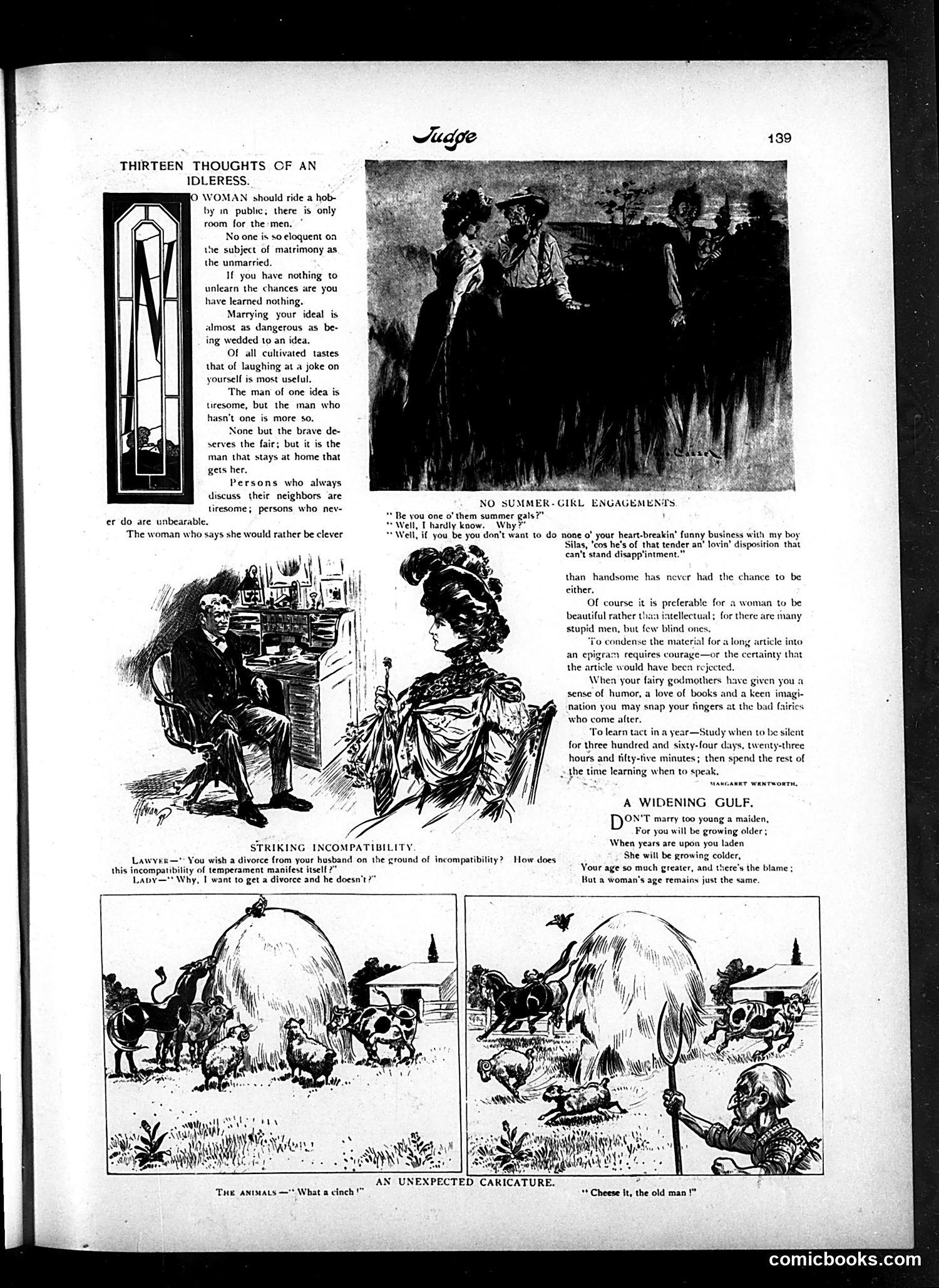
This page contains several satirical pieces typical of Judge's social commentary: **"Thirteen Thoughts of an Idleress"** offers witty aphorisms mocking women's idleness and romantic notions—satirizing both unmarried women's views on marriage and the era's assumptions about women's intellectual limitations versus beauty. **"Summer Girl Engagements"** cartoon depicts a rural father warning a young man away from a "summer girl," suggesting these were frivolous visitors known for breaking hearts and causing emotional damage to local boys. **"Striking Incompatibility"** is a legal joke: a husband and wife seek divorce because they disagree on getting one—he refuses while she wants it, making them fundamentally incompatible. **"A Widening Gulf"** poem warns against marrying young women, noting that men age faster, creating an increasing gap as husbands grow older while wives remain youthful—a commentary on the marriage age disparity common in the era. **"An Unexpected Caricature"** shows animals observing a large shape, with an old man revealing it's "cheese"—likely a visual pun or absurdist humor. All pieces reflect early-20th-century attitudes toward courtship, marriage, and gender roles.
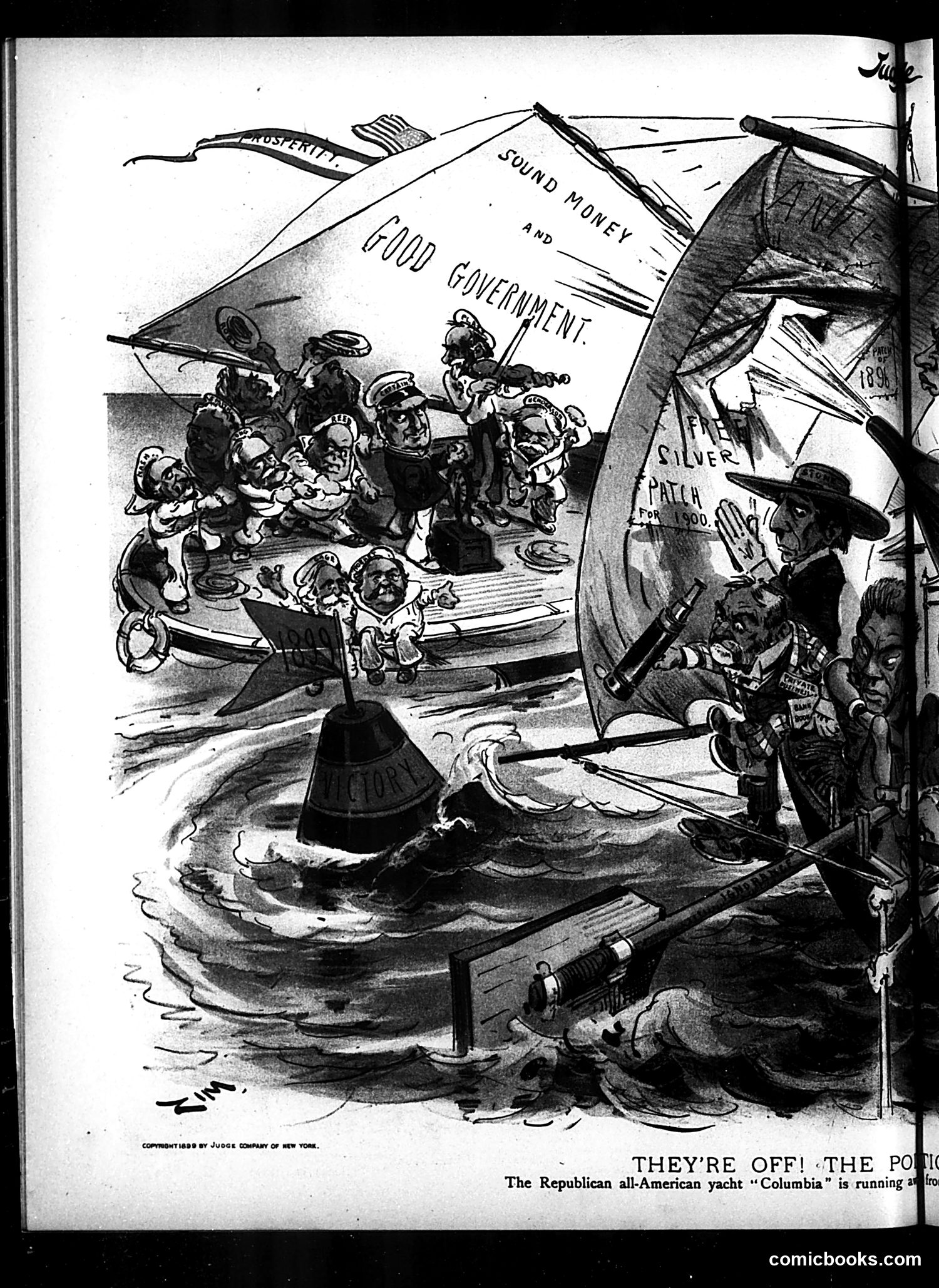
This appears to be a political cartoon satirizing Republican economic policy, likely from the 1890s-1900s based on Judge magazine's publication era. The central image shows a yacht labeled "Columbia" (a symbol of America) with figures labeled "Sound Money and Good Government" aboard, seemingly racing or competing. The satire appears to critique Republican claims about sound fiscal policy and governance. The caricatured figures aboard suggest mockery of Republican politicians or their stated principles. The surrounding imagery—including what appears to be struggling figures below—likely contrasts Republican rhetoric about prosperity with actual hardship experienced by ordinary Americans. The incomplete caption "They're Off! The Politics" suggests commentary on political competition or campaign activity, though the full meaning remains partially obscured by the page's cut-off text.
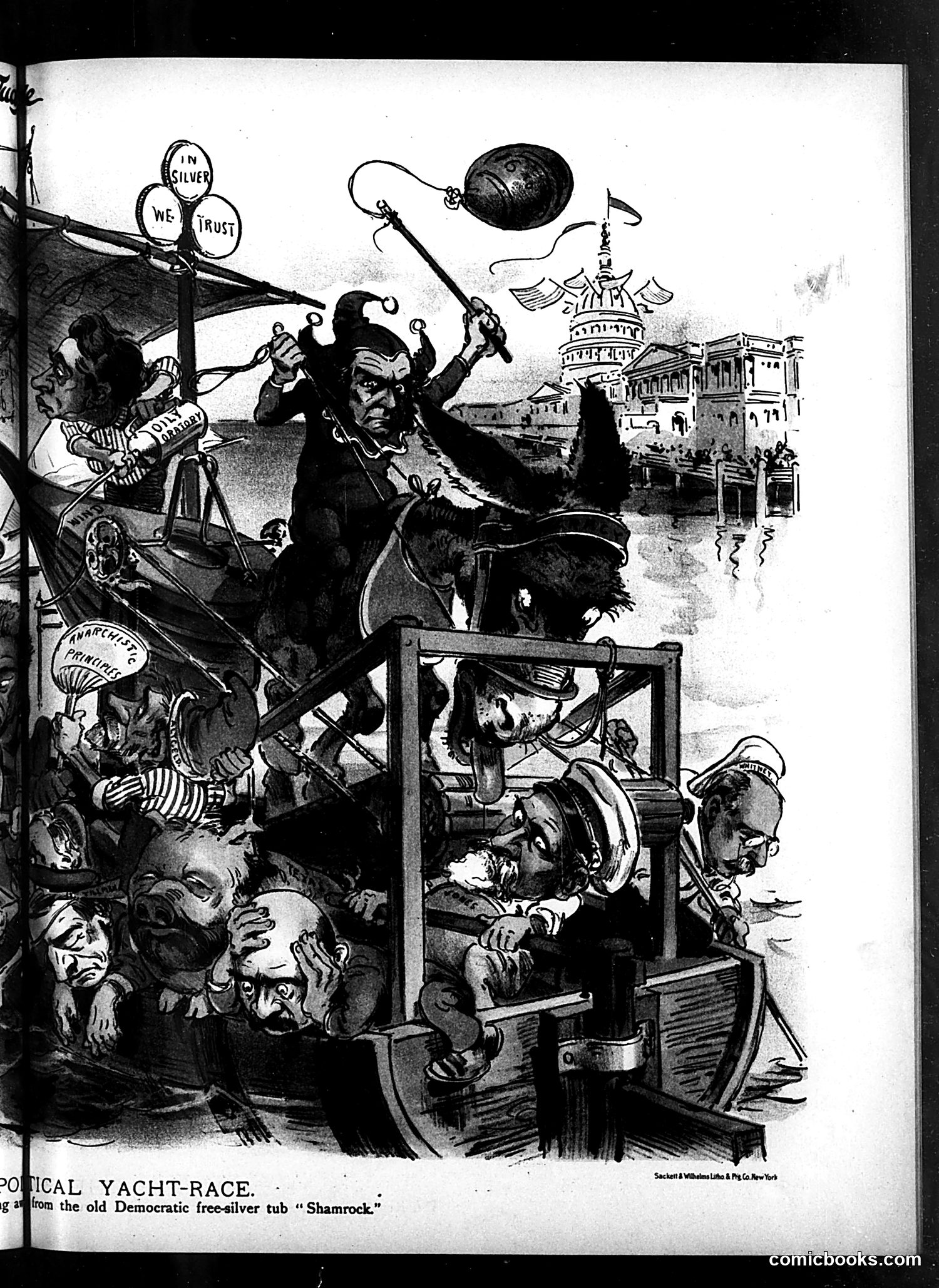
This political cartoon satirizes the 1896 presidential race between Republican William McKinley and Democrat William Jennings Bryan over the free-silver issue. The cartoon depicts a chaotic "yacht-race" where Bryan (the demon-like figure with horns) commandeers a vessel labeled "Shamrock"—the old Democratic free-silver platform. He swings a wrecking ball toward the Capitol, representing his threat to established government. The three balloons reading "IN SILVER WE TRUST" mock Bryan's monetary policy, contrasting it with the official motto "In God We Trust." The overcrowded boat below contains Democratic supporters being dragged along recklessly. McKinley Republicans appear on the left observing this chaos, positioning themselves as the stable, rational alternative to Bryan's dangerous radicalism. The cartoon reflects upper-class anxieties about populist monetary reform threatening economic order.
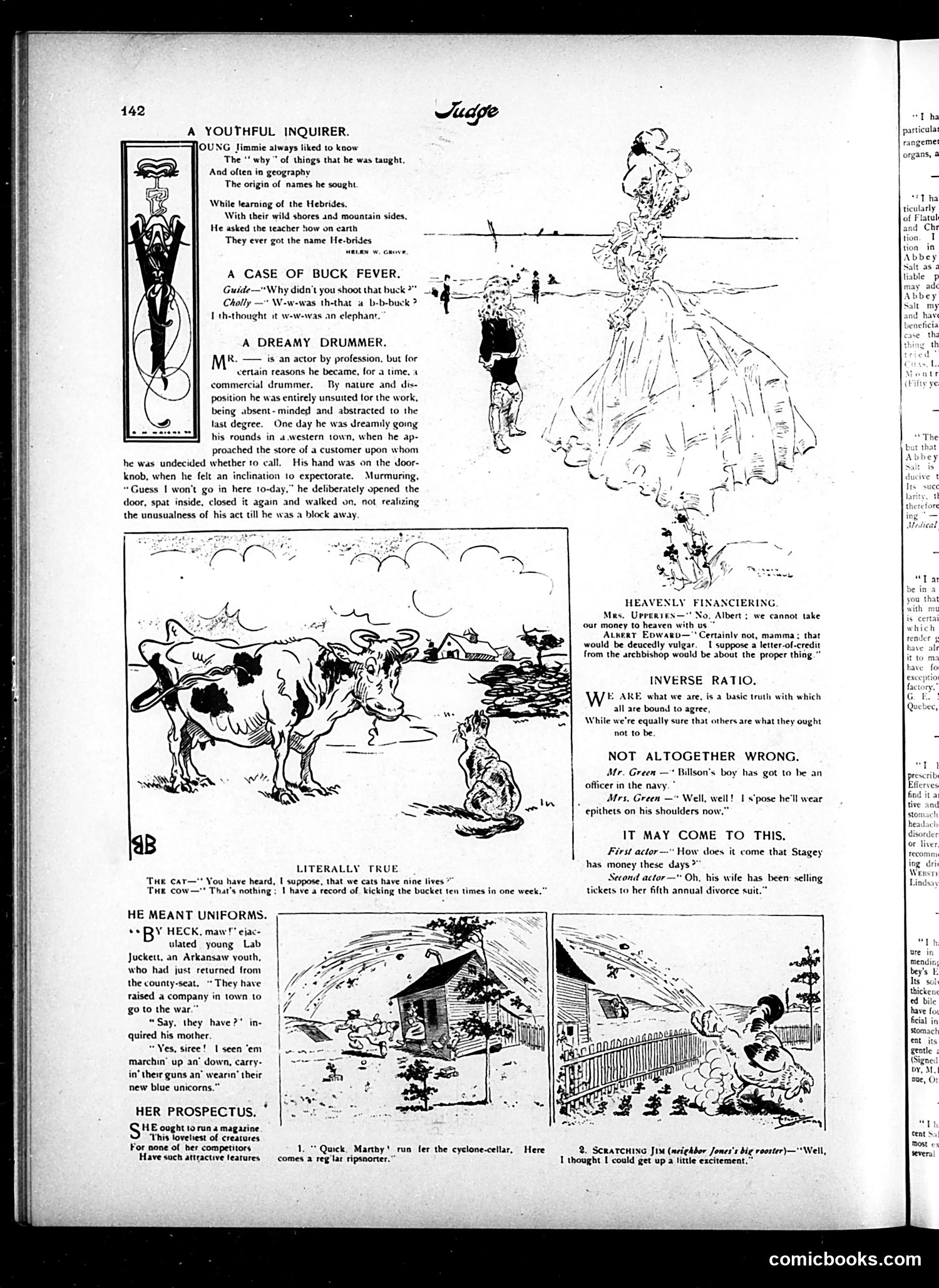
This page contains several short humor pieces typical of early 20th-century Judge magazine: **"A Youthful Inquirer"** jokes about a child mishearing "Hebrides" as "He-brides" — a simple pun on the Scottish islands' name. **"A Case of Buck Fever"** mocks a nervous hunter who mistakes a deer for an elephant, satirizing inexperienced sportsmen. **"A Dreamy Drummer"** depicts an absent-minded traveling salesman who spits inside a customer's door, then walks away unaware of his rudeness — humor from character foolishness. **The remaining sketches** include jokes about: wealthy people discussing taking money to heaven; observations about human nature; a naval officer's pretensions; an actor's wife profiting from repeated divorce suits; an Arkansas youth mispronouncing "uniforms" as "unicorns"; and rural people seeking storm shelter. The humor is genteel, class-conscious satire targeting absent-mindedness, social pretension, and rural/working-class speech patterns — typical of the era's satirical magazine style.
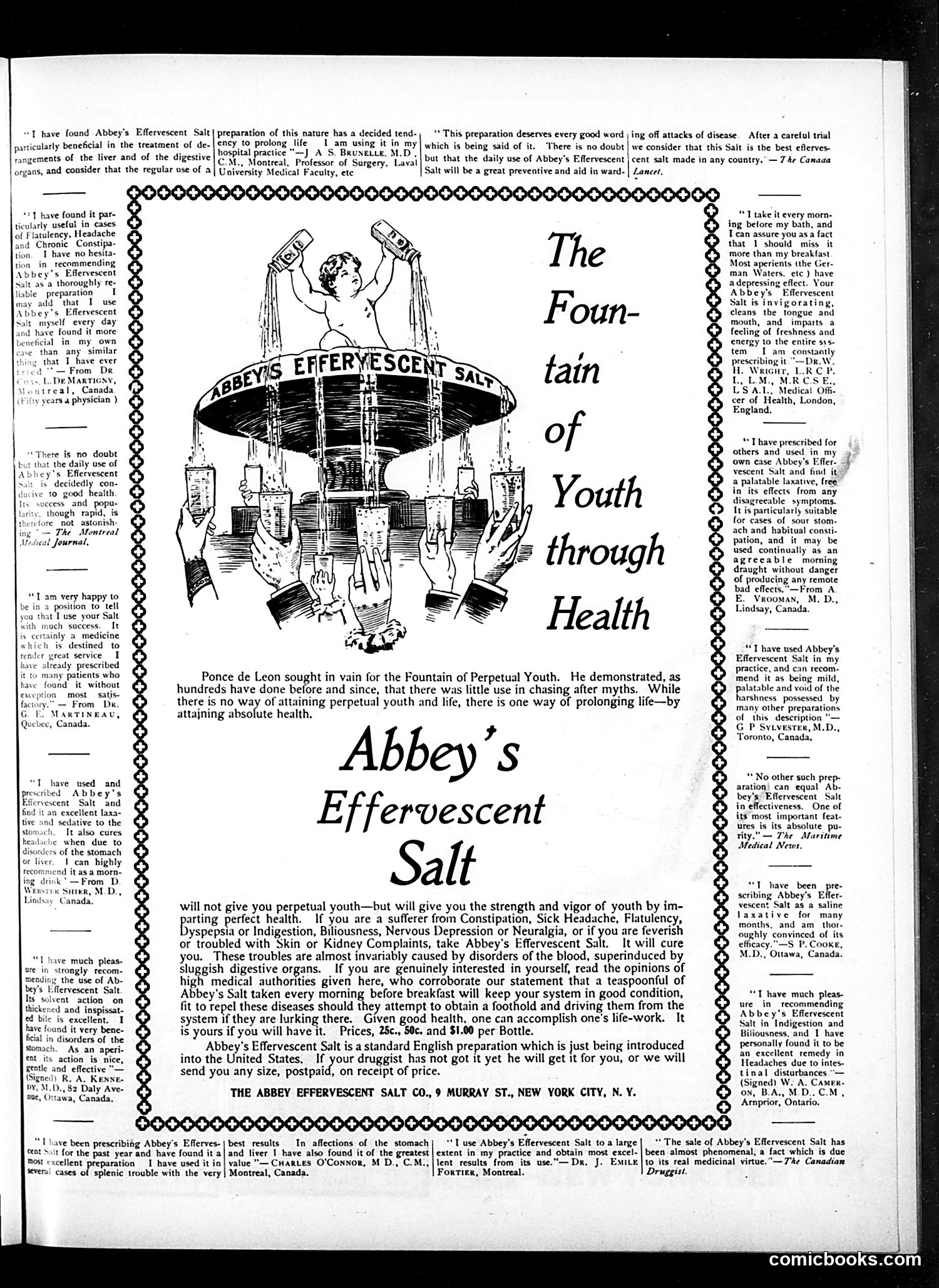
This is a **patent medicine advertisement**, not political satire. It promotes Abbey's Effervescent Salt, a digestive remedy marketed as a cure-all for constipation, headaches, indigestion, and various ailments. The central illustration depicts a cherub or baby figure above a fountain labeled "Abbey's Effervescent Salt," with hands reaching upward—a visual reference to Ponce de Leon's legendary search for the Fountain of Youth. The ad's text explicitly makes this comparison: while perpetual youth is impossible, the product promises renewed "strength and vigor of youth" through improved digestion and health. The surrounding testimonials from Canadian physicians lend false medical credibility. This represents the era's unregulated patent medicine marketing, where any dubious health claims could be published with invented or real (but paid) endorsements. Modern readers would recognize this as misleading advertising for what was likely an ineffective laxative.
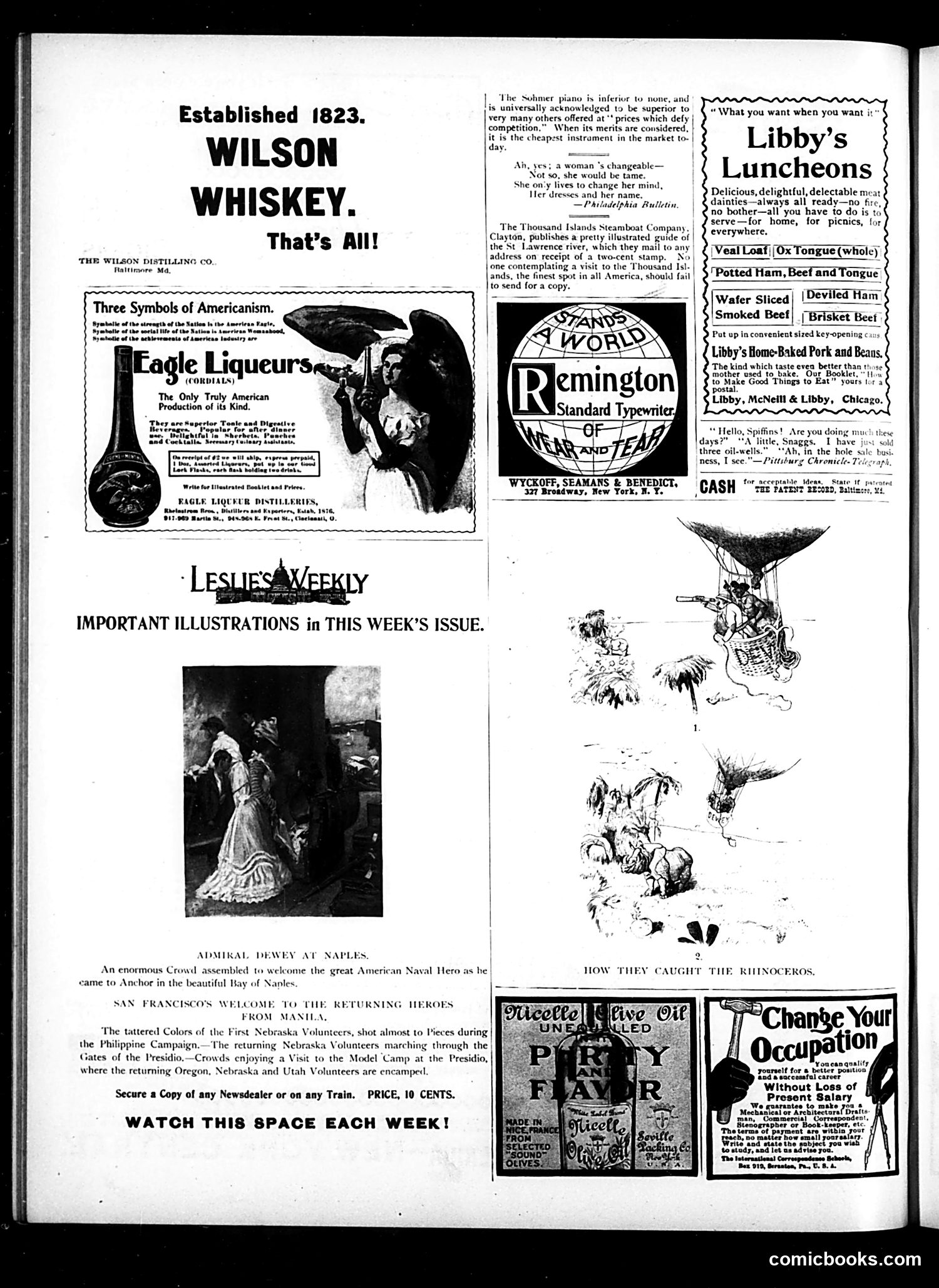
This is primarily an **advertising and announcements page** from Judge magazine, with minimal satirical content. The page features several period advertisements (Wilson Whiskey, Eagle Liqueurs, Libby's Luncheons, Remington Typewriters) and promotional material for upcoming illustrations, including: - **Admiral Dewey at Naples** — referencing Admiral George Dewey's return from the Spanish-American War (Philippine Campaign), celebrating American naval victory - **San Francisco's Welcome to Returning Heroes** — depicting the homecoming of Nebraska, Oregon, and Utah volunteer soldiers from Manila These illustrations celebrate American military triumph in the 1898 Spanish-American War, which was a major patriotic moment. The references to "returning heroes" and "great American Naval Hero" reflect the jingoistic enthusiasm of the period. A small comic vignette about a woman's changeability appears mid-page, but the bulk of content is commercial rather than satirical. The page represents Judge's role as both humor magazine and mainstream advertising vehicle.
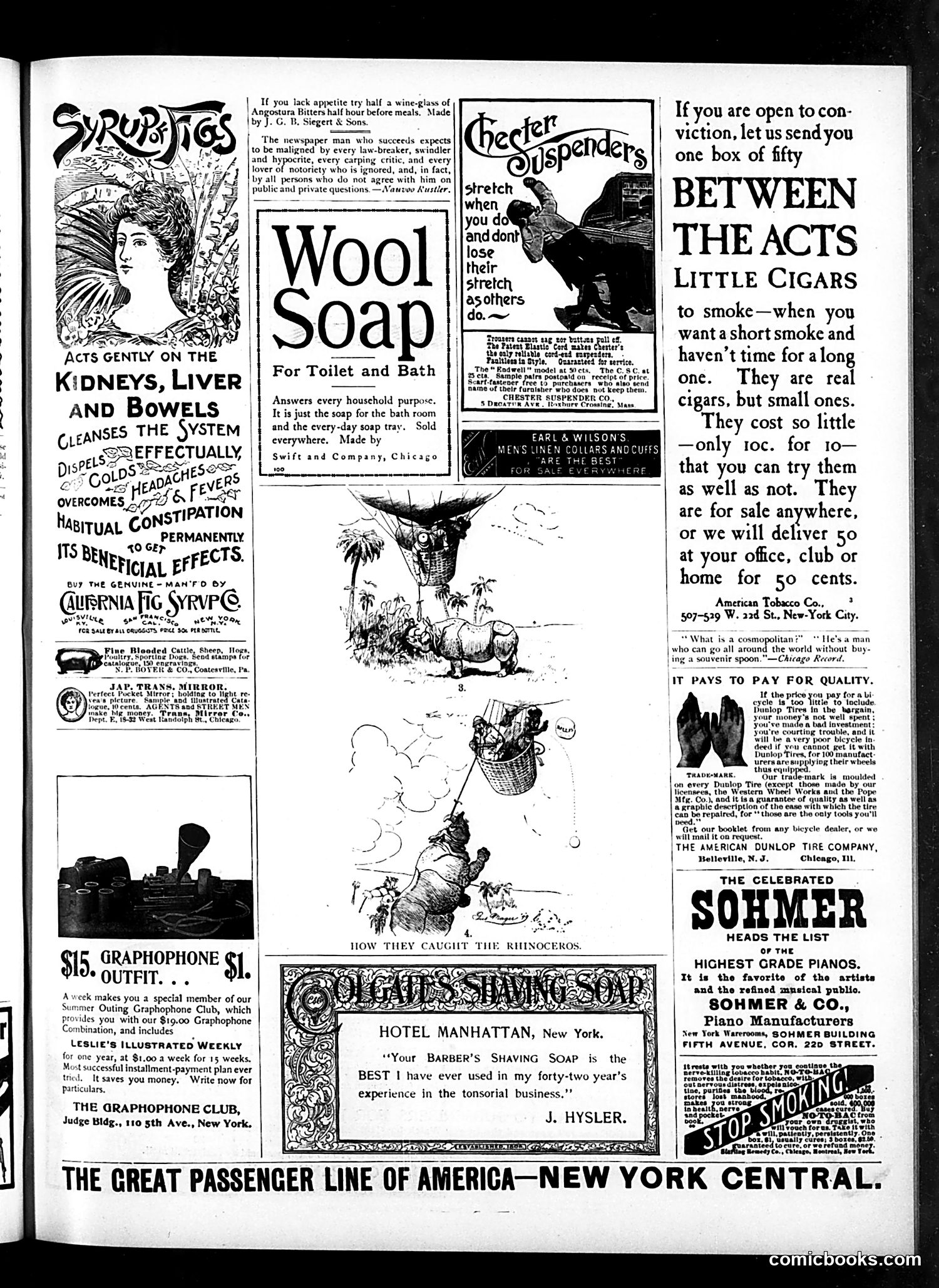
This is primarily an **advertising page** from Judge magazine, with minimal editorial content. The page features various product advertisements typical of early 20th-century American magazines: patent medicines (California Fig Syrup for digestive health), soaps, musical equipment (graphophone), cigars, tires, and pianos. The only clearly visible satirical content is a small cartoon titled **"How They Caught the Rhinoceros"** (center), which appears to use animal imagery for unstated social commentary—though the specific reference is unclear from this reproduction. A single editorial quote attributes a statement about newspaper editors facing criticism from "law-breakers," "swindlers," and "carping critics" to "Vauvooo Kustler"—likely a misspelled reference, but the intended target is unclear. The page primarily serves as a revenue vehicle through advertising rather than as satirical commentary.
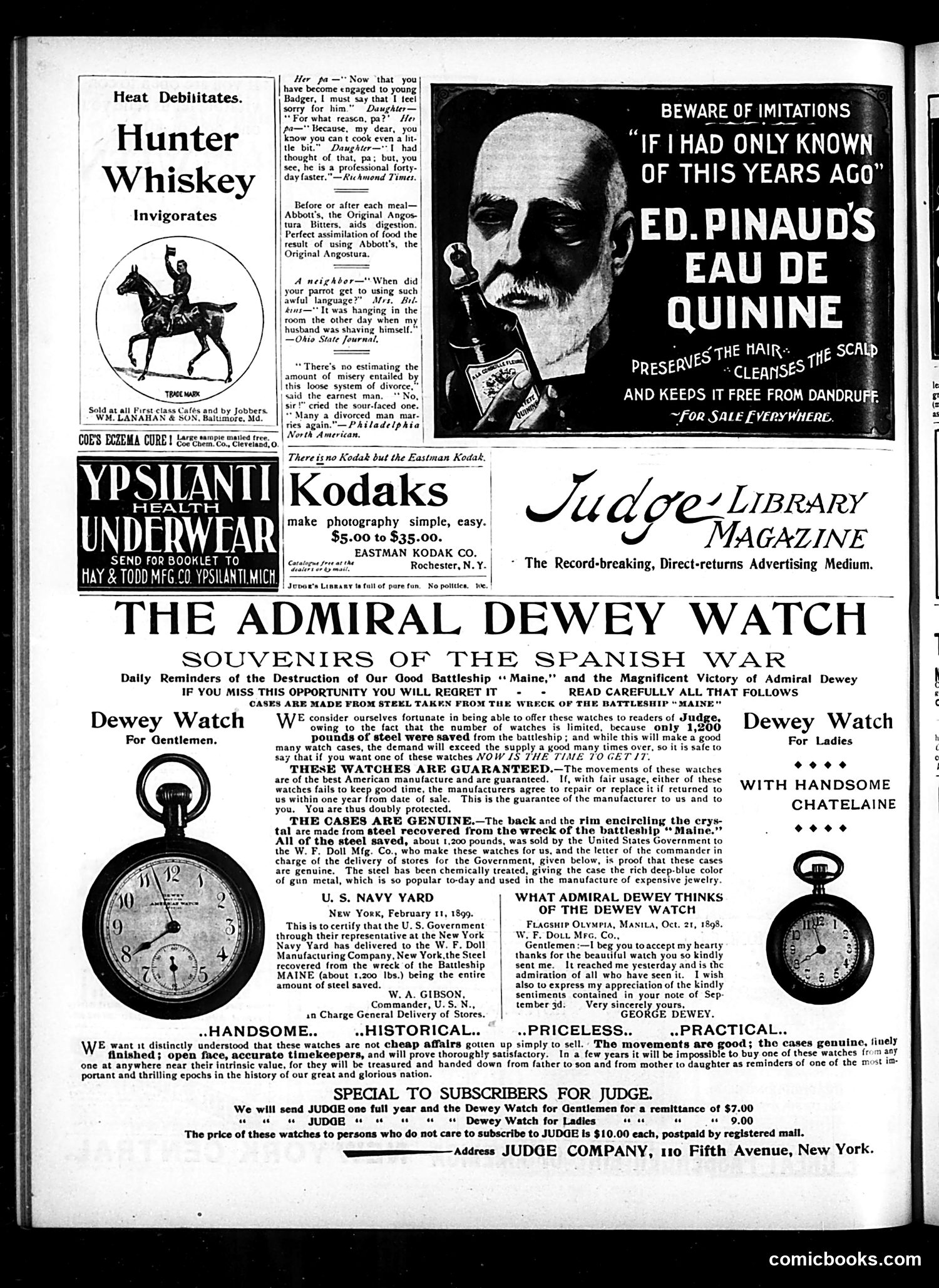
This page is primarily **advertising**, not political satire. It features: **Main Content:** The "Admiral Dewey Watch"—a commercial product marketed as souvenirs of the Spanish-American War (1898). The watches supposedly contain steel salvaged from the USS *Maine*, the battleship whose explosion sparked the war. This appeals to patriotic sentiment around Admiral Dewey's naval victory at Manila. **Historical Context:** The Spanish-American War was recent and hugely popular in America. Dewey was a celebrated national hero. Marketing products as "Maine relics" exploited genuine public emotion over the ship's destruction. **Other Advertisements:** The page includes typical period ads for whiskey, health underwear, kodak cameras, and hair tonic—standard Judge magazine content. **The Joke Content:** Brief humorous anecdotes about engagement, parrots, and divorce—light social comedy unrelated to the watches. The page reveals how commercial interests capitalized on wartime patriotism through memorabilia marketing.
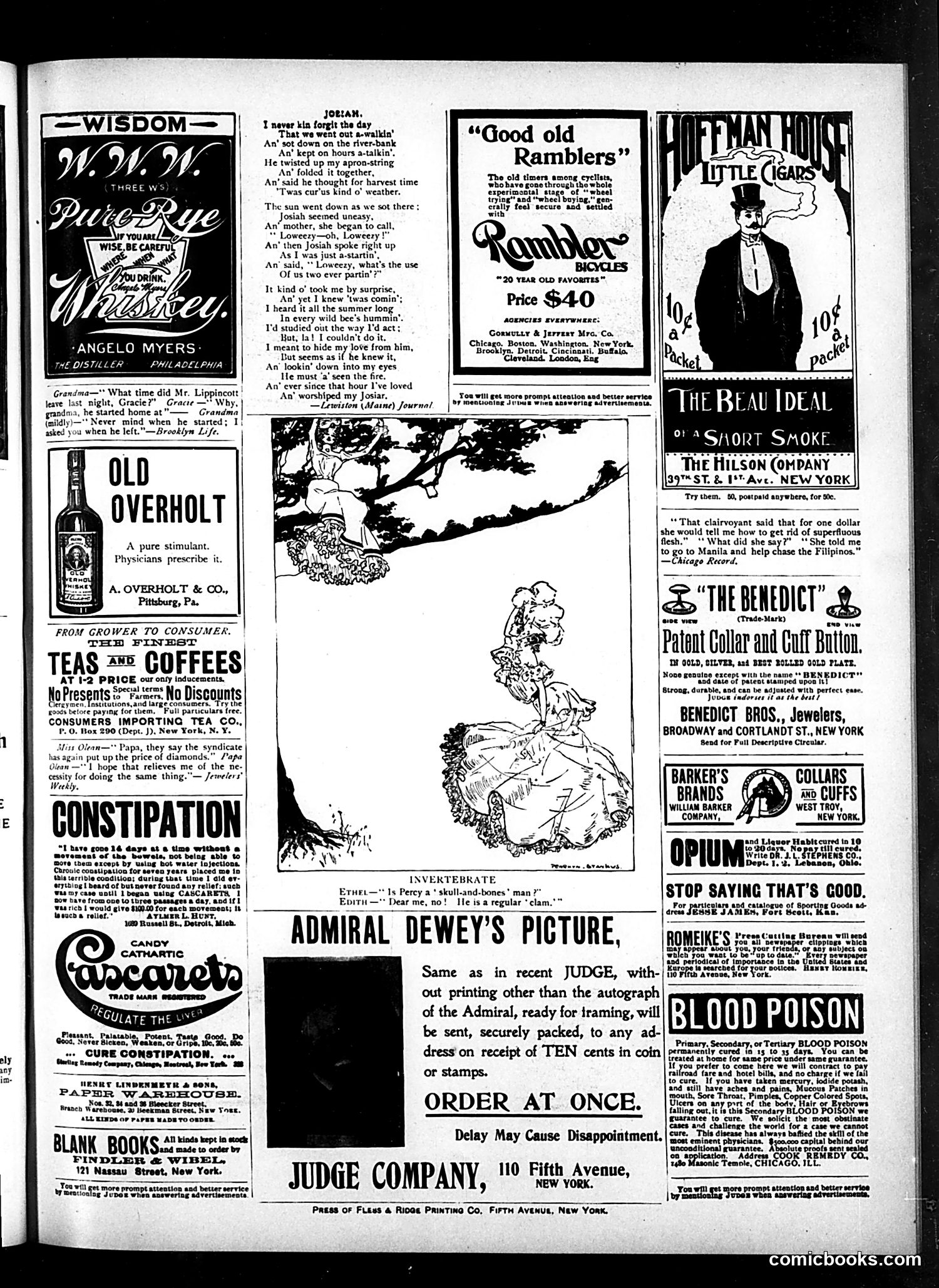
This small cartoon depicts two figures discussing a third person named Percy. One asks if Percy is a "skull-and-bones man" (slang for a serious, intellectual type—possibly referencing Yale's secret society). The response: "Dear me, no! He is a regular 'clam.'" The joke equates Percy with a clam—an invertebrate creature with no backbone. This is a pun: "clam" as slang means someone taciturn or uncommunicative, but the visual setup plays on "invertebrate" (literally, lacking a spine/backbone) to mock Percy as spineless or weak-willed rather than intellectually rigorous. The humor relies on mid-19th century slang and wordplay typical of *Judge* magazine's satirical style, mocking social pretension and character types.
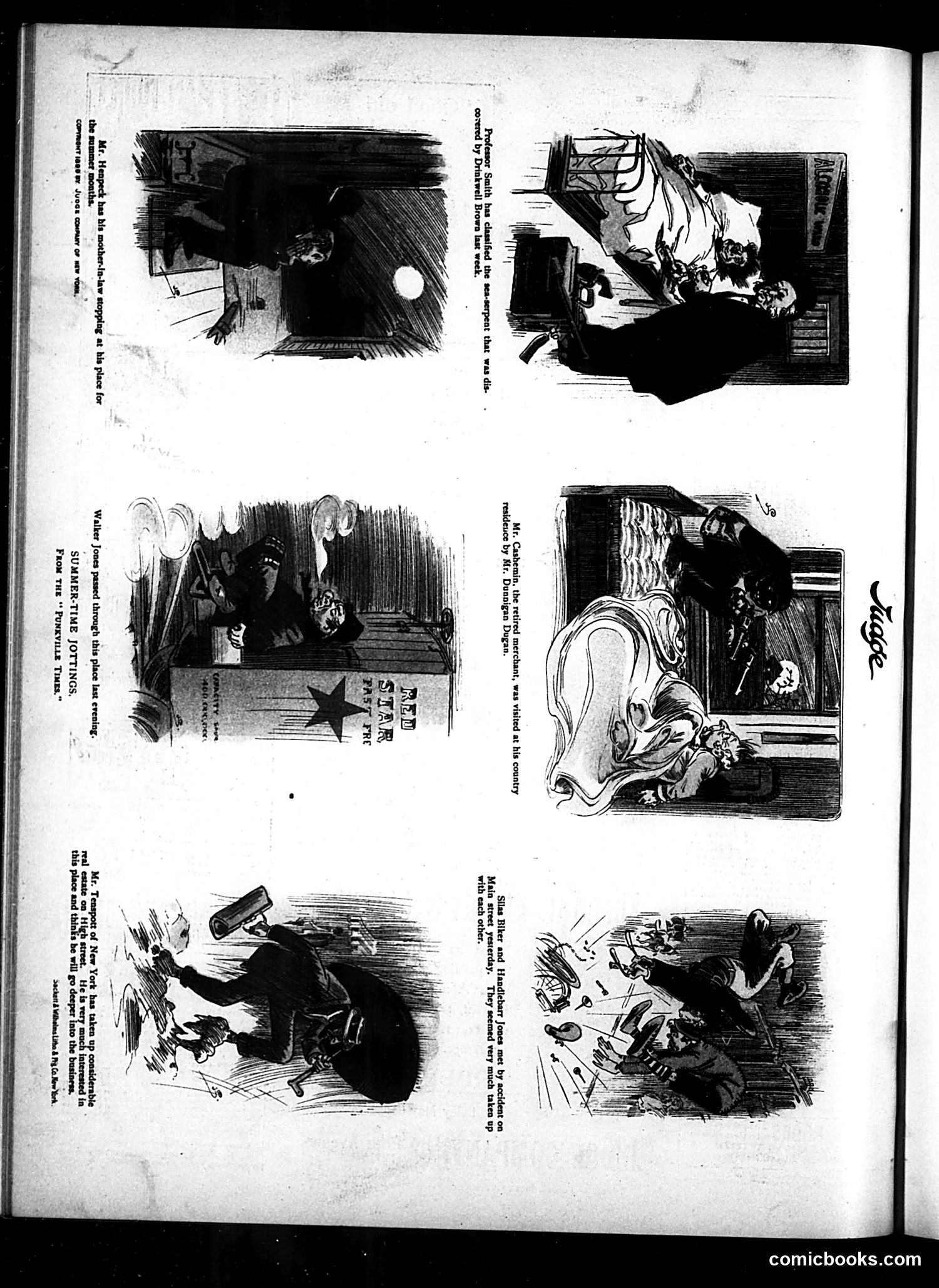
This page appears to be a humorous illustrated feature satirizing small-town gossip columns and rural life. The six sketches accompany mock "news items" from the fictional "Punkville Times"—a parody of local newspaper society pages. The satire targets the banality and absurdity of small-town reportage: trivial announcements about visiting relatives, chance street encounters, and mundane business activities are presented as newsworthy. The illustrations exaggerate the dramatic or comedic potential of these non-events—depicting ordinary moments (visits, meetings, domestic situations) with overwrought theatrical styling. The joke is that rural or small-town publications treat utterly unremarkable occurrences as significant news. By pairing crude, expressive woodcut illustrations with deliberately dull text, the cartoonist mocks both provincial newspapers' editorial judgment and readers' appetite for such trivia. This reflects urban magazine readers' condescension toward rural American life during the Gilded Age.