
A complete issue · 16 pages · 1899
Judge — June 3, 1899
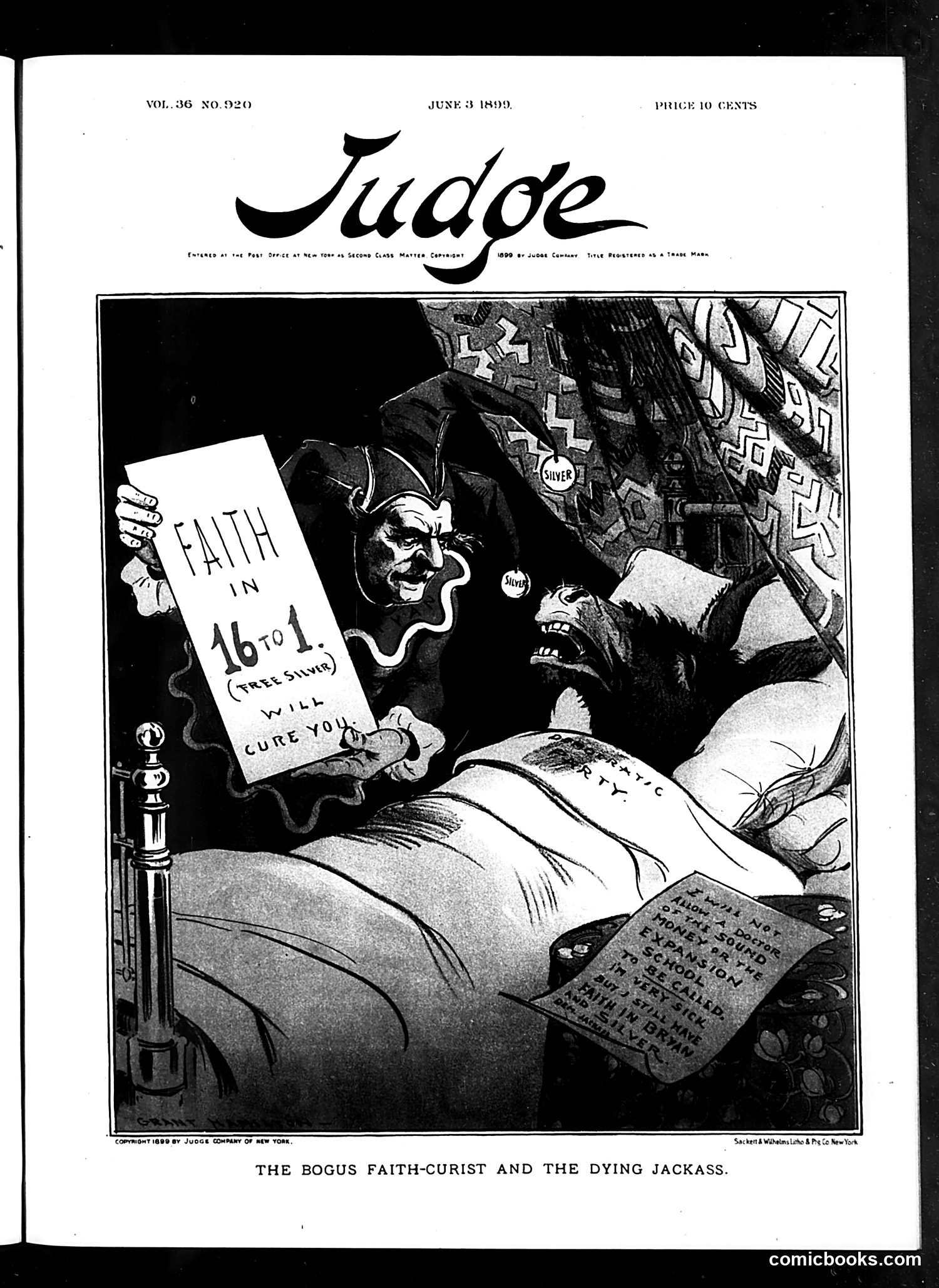
This 1899 *Judge* cartoon satirizes fraudulent faith-healing practices. A jester-like charlatan peddles a sign reading "FAITH IN 16 TO 1 (FREE SILVER) WILL CURE YOU" to a dying donkey. The "16 to 1" ratio references the heated monetary debate of the era—whether silver should be valued at 16 times the price of gold. The cartoon equates faith-based silver currency advocacy with snake-oil medicine: both are presented as worthless remedies promising miraculous cures. The dying jackass (donkey) likely represents the American economy or public, portrayed as terminally ill from free-silver policies. The satire mocks both faith healers and the Populist/Democratic push for unlimited silver coinage as dangerous delusions.
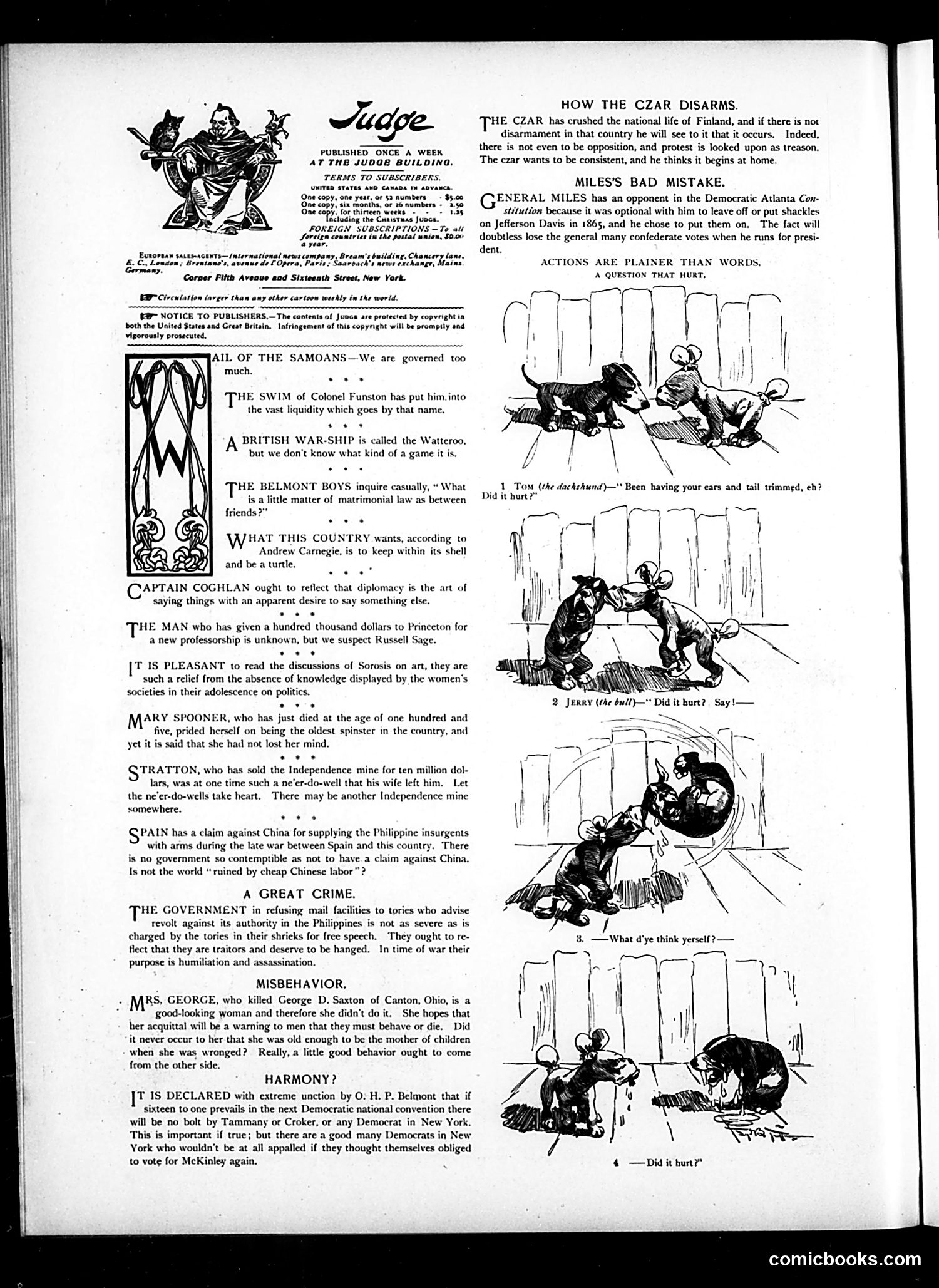
This page contains editorial commentary and a four-panel cartoon titled "Actions Are Plainer Than Words: A Question That Hurts." The cartoon depicts two figures (likely political opponents) in a physical altercation, with dialogue asking "Been having your ears and tail trimmed, eh?" and "Did it hurt?" The satirical point appears to concern political violence or aggressive rhetoric—the cartoon uses animals with trimmed ears and tails as metaphor, suggesting one political figure has been figuratively "cut down" by another. The surrounding editorial snippets mock various public figures and policies, including references to General Miles, the Czar's actions in Finland, and Democratic politics. The overall tone suggests Judge magazine is critiquing political aggression and questionable tactics among leaders during this period. Without clearer dates or specific historical markers visible, the exact political figures remain unclear.
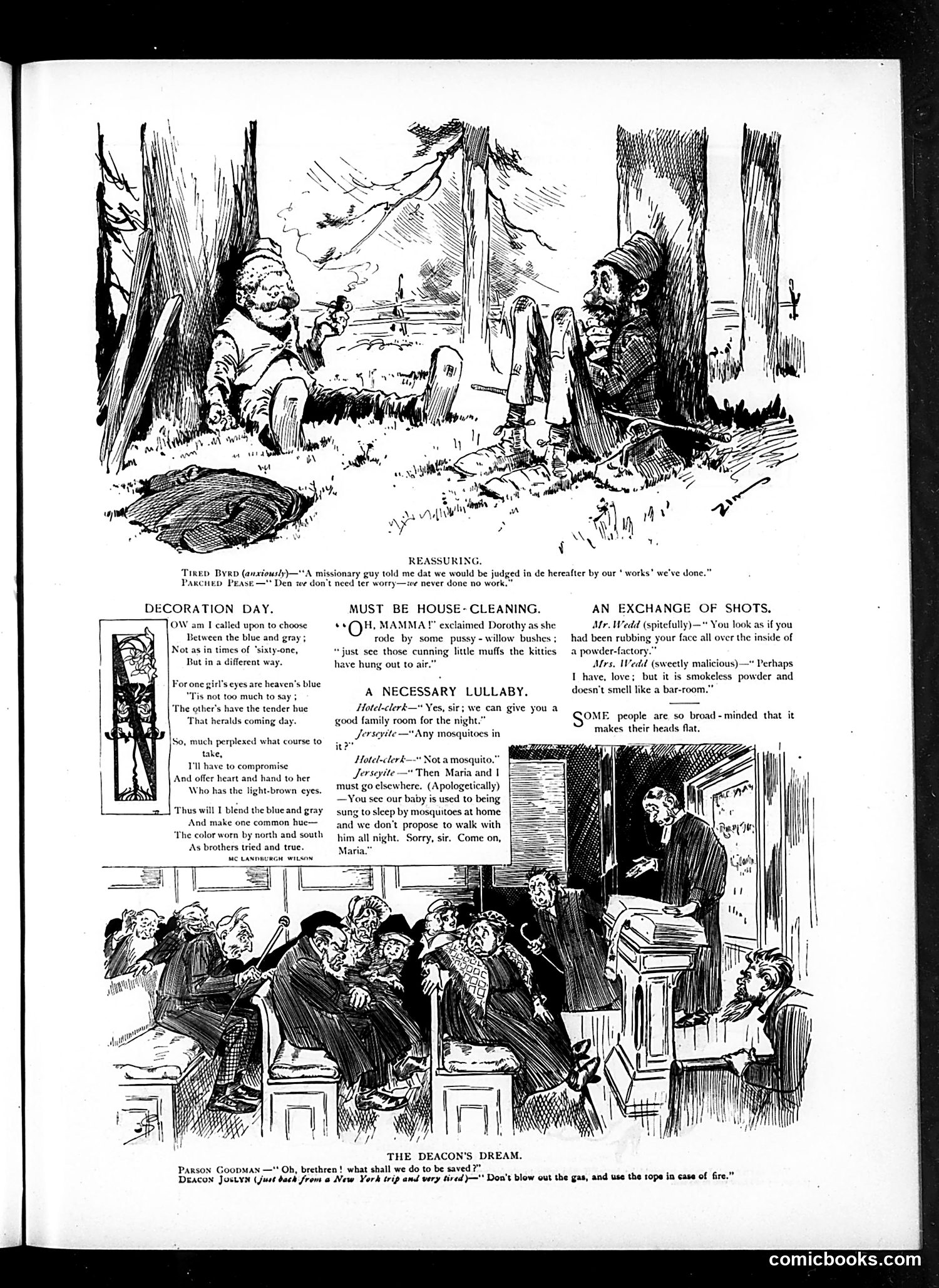
This page contains several satirical sketches mocking American life. "Reassuring" depicts two figures discussing missionary work—likely satirizing self-righteous or hypocritical religious claims. "Decoration Day" jokes about choosing between decorating graves and doing housework, parodying the holiday's observance. "Must Be House-Cleaning" shows a woman blaming cats for household odors, satirizing domestic excuses. "A Necessary Lullaby" mocks a couple debating mosquitoes versus sleeping arrangements—absurdist domestic humor. "An Exchange of Shots" appears to joke about powder and "bar-room" behavior, likely referencing dueling or quarrels. "The Deacon's Dream" depicts what appears to be a church gathering with exaggerated figures, with dialogue about saving souls and using ropes in case of fire—satirizing both religious zeal and practical concerns. The overall tone is lighthearted social commentary on everyday American behaviors.
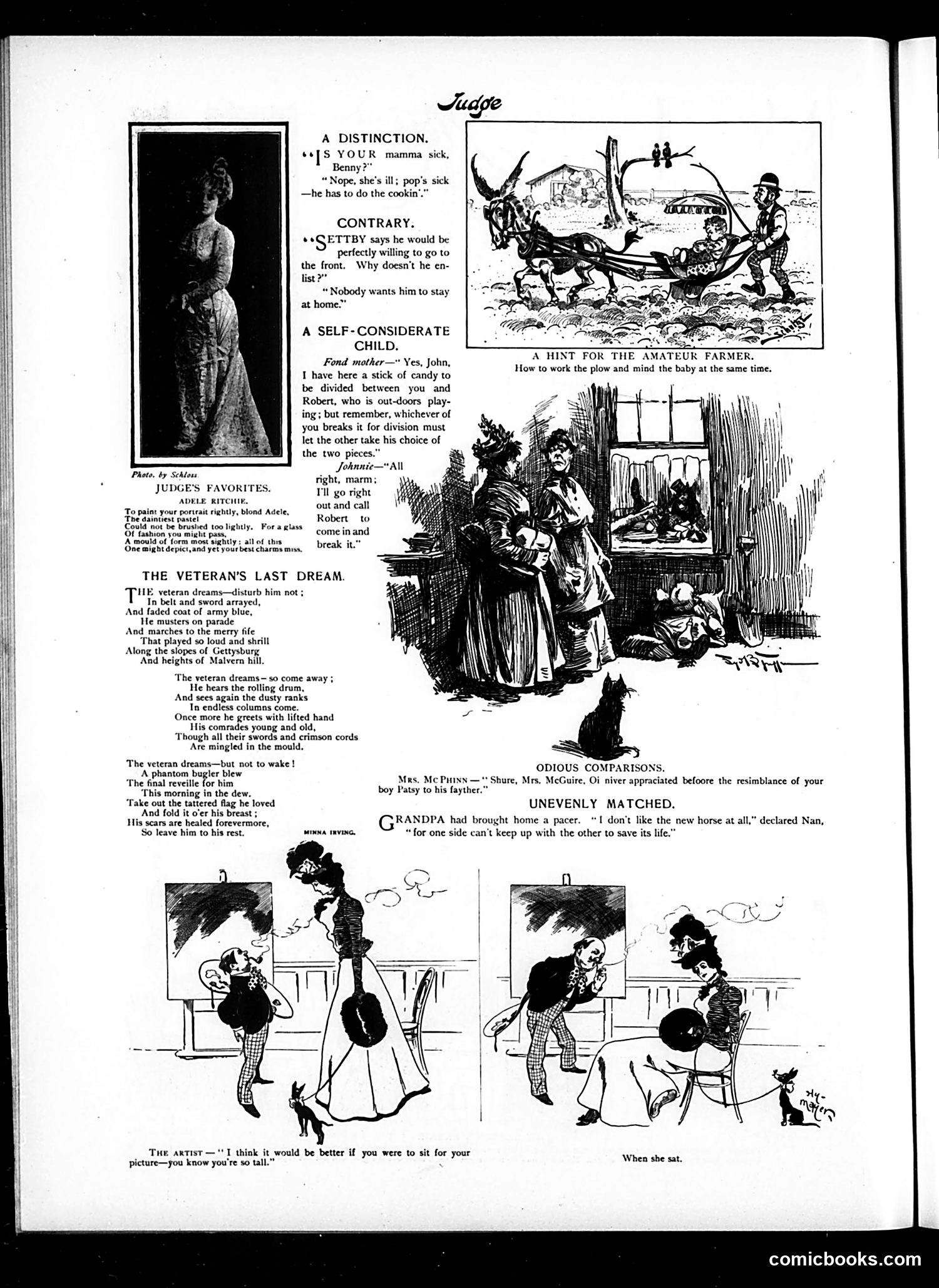
This page contains several unrelated satirical pieces typical of Judge magazine's format: **"A Distinction"** and **"Contrary"** are brief social humor items about parenting and children's behavior—standard domestic comedy with no apparent political content. **"The Veteran's Last Dream"** is a sentimental poem about an aging Civil War veteran, reflecting on memories of battle and lost comrades. This references America's ongoing relationship with Civil War memory in the early 20th century. **"A Hint for the Amateur Farmer"** and **"Odious Comparisons"** are visual gags about rural life and family situations respectively. The lower cartoons titled **"Unevenly Matched"** depict a domestic scene where a woman appears taller/larger than a man, playing on period humor about gender dynamics and physical mismatch in relationships. These are primarily social satire rather than political commentary.
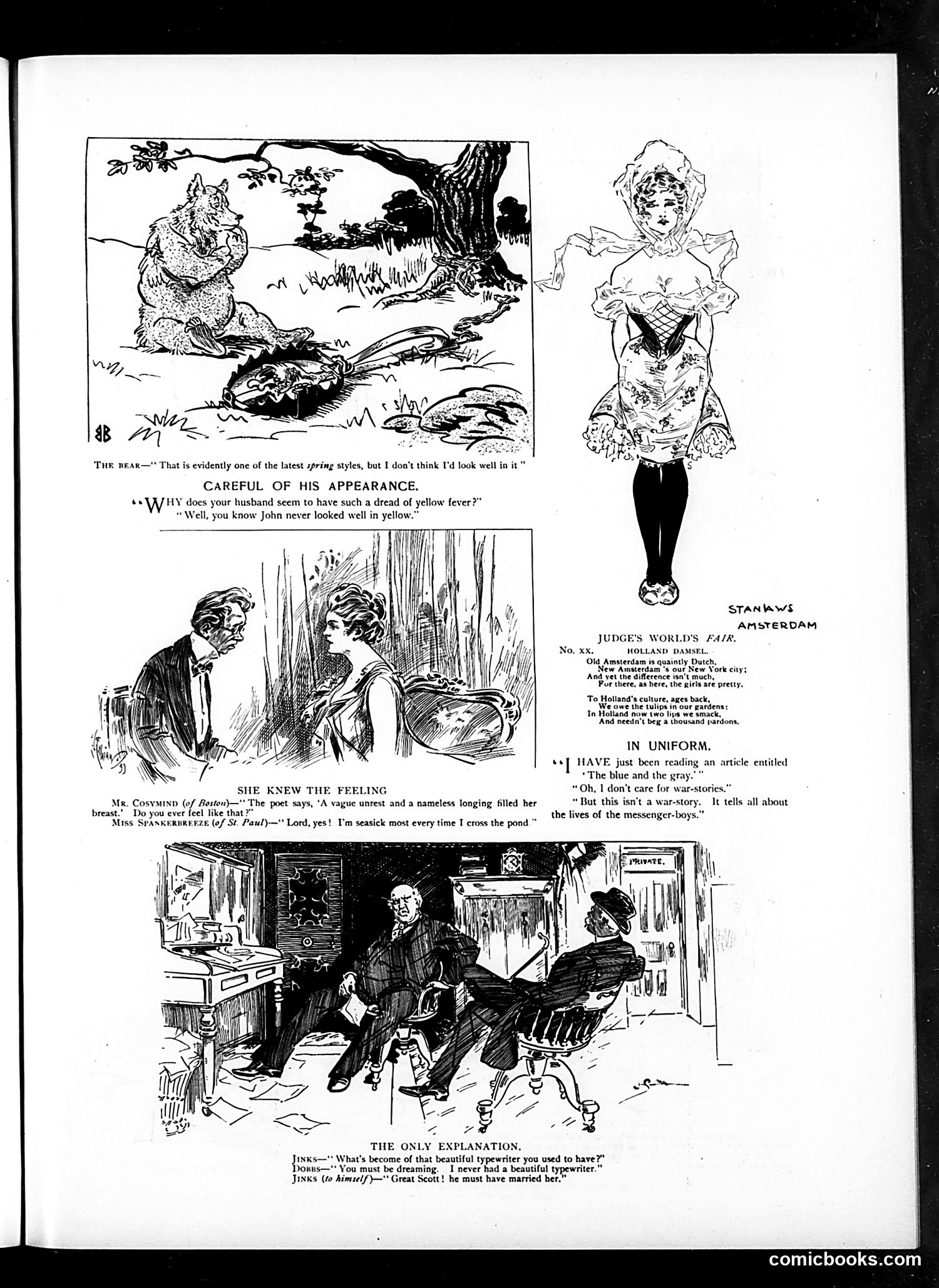
This Judge magazine page contains several satirical cartoons on turn-of-the-century social topics: **"Careful of His Appearance"** jokes about a husband's vanity—he fears yellow fever not for health reasons, but because the yellowing of his skin would be unflattering. **"Holland Damsel"** celebrates the World's Fair (likely the 1893 Chicago Columbian Exposition), making light comparisons between Amsterdam and New York while making flirtatious observations about Dutch women. **"She Knew the Feeling"** satirizes romantic poetry's clichés; a Boston man quotes flowery verse about "vague unrest" to a St. Paul woman, who relates it to seasickness—mundane reality deflating literary pretension. **"The Only Explanation"** suggests a man's beautiful typewriter disappeared after marriage, implying the wife is responsible—a jab at marriage as a transformative (negative) force. The humor relies on period anxieties about appearance, courtship, poetry, and matrimony.
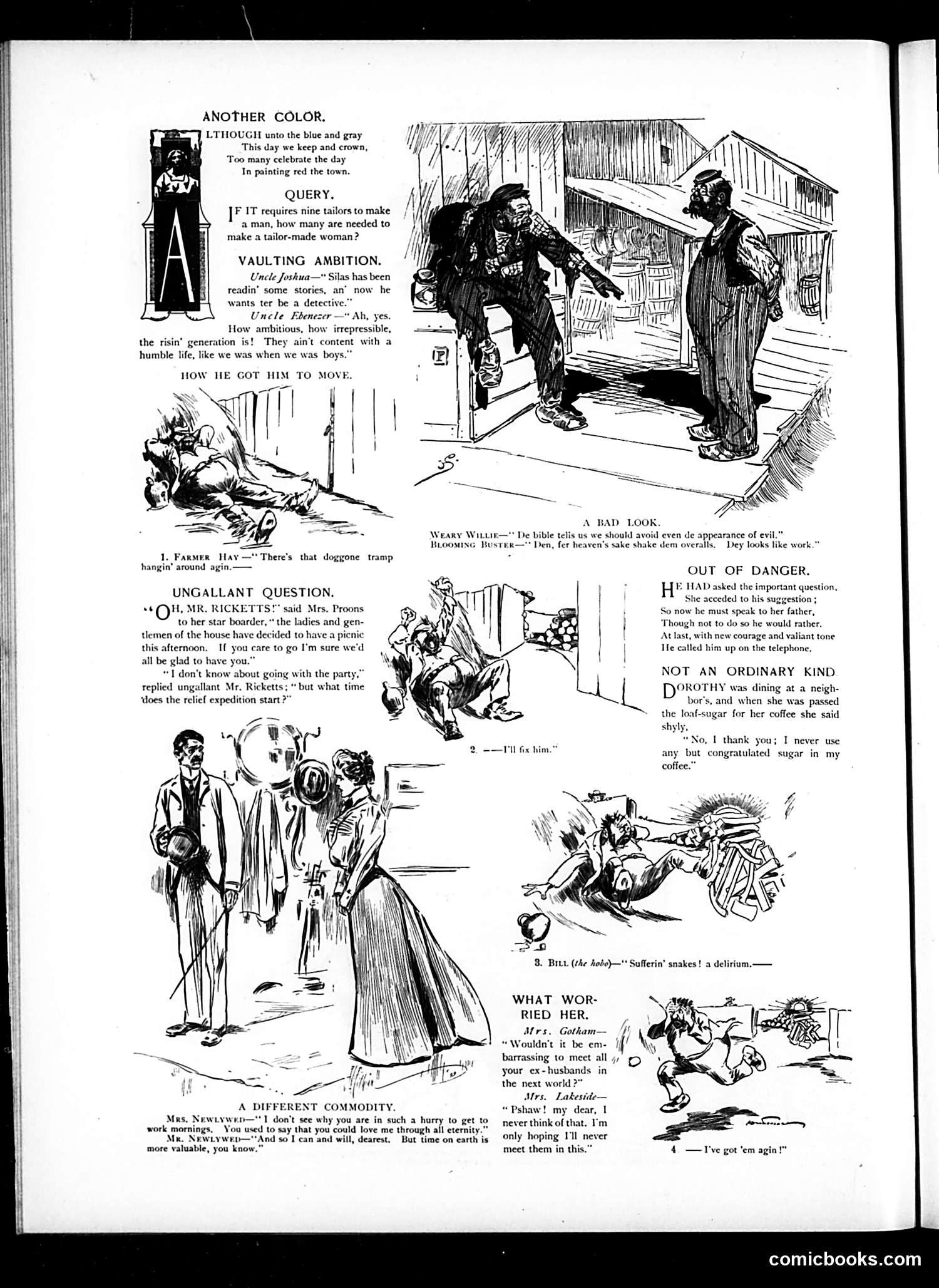
This page from the satirical magazine *Judge* contains multiple short humor pieces typical of early 20th-century American comedy. **Main themes:** The cartoons mock social pretension and gender relations. "A Different Commodity" satirizes newlywed husbands who claim eternal love but prioritize work—mocking romantic excess. "Not an Ordinary Kind" jokes about affected upper-class affectation (using only "congratulated sugar"). "What Worried Her" satirizes divorce culture among wealthy women, suggesting remarriage is so common that meeting ex-husbands casually is the real concern, not divine judgment. **Supporting humor** includes absurdist premises ("nine tailors make a woman"), commentary on vagrant homelessness ("Weary Willie"), and class commentary on ambitious working-class aspirations (boys wanting detective careers). The opening poem references Memorial Day observances being overshadowed by rowdy civilian behavior ("painting red the town"—likely drunkenness). Overall, the page targets affluent pretension, marital discord, and social climbing through quick, cynical jokes typical of Judge's satirical voice.
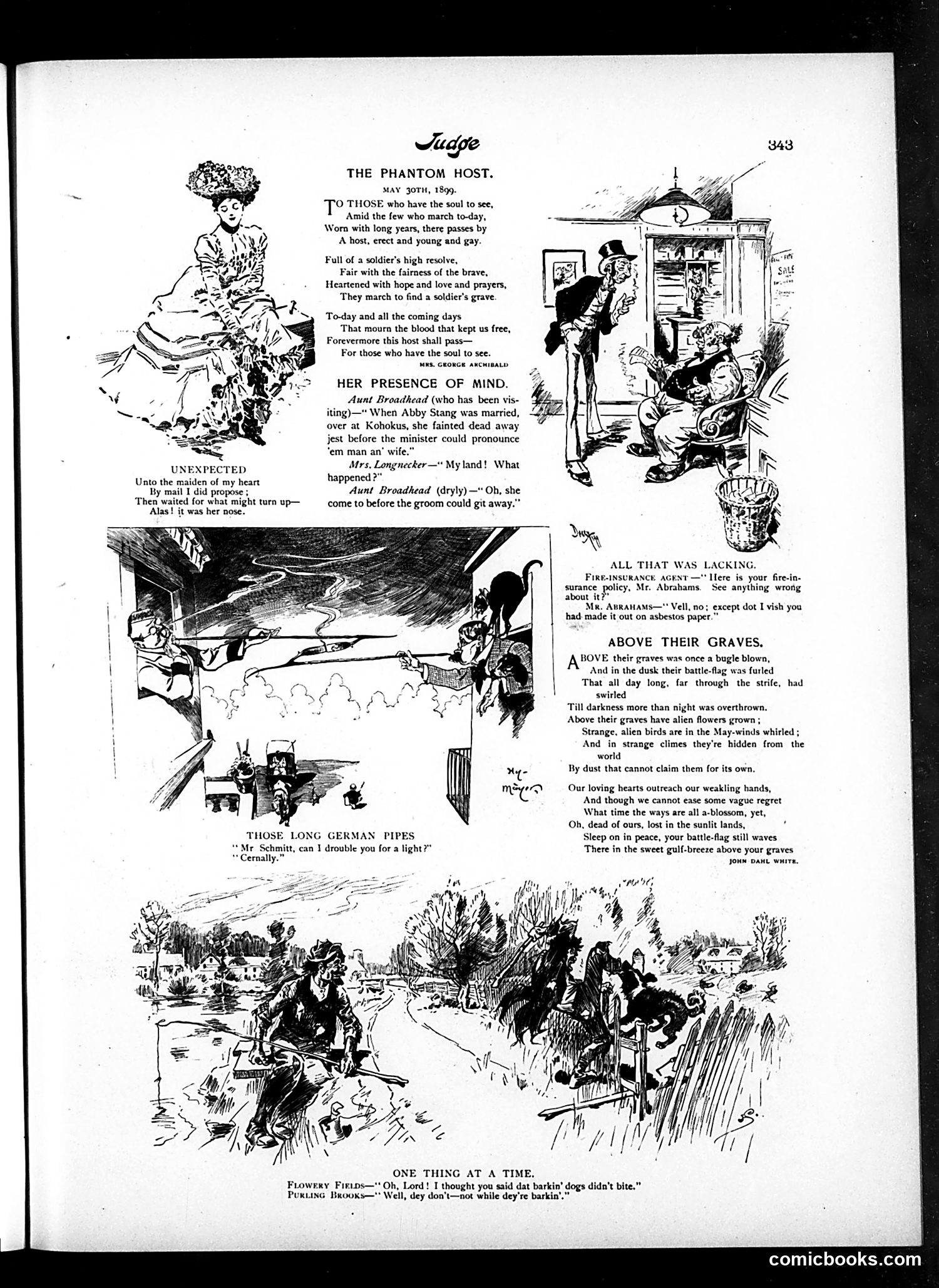
This page commemorates Memorial Day (Decoration Day), observed May 30th. The dominant piece, "The Phantom Host," is a solemn poem about fallen soldiers—described as an invisible procession of the war dead marching alongside living veterans. The accompanying illustrations show Civil War soldiers and graves, honoring those who died "that all day long...had swirled" in battle. The page balances this patriotic tribute with lighter humor: anecdotes about a bride fainting at her wedding, a Jewish immigrant (Mr. Abrahams) joking about fire insurance on asbestos, and rural characters (Flowery Fields and Purling Brooks) discussing barking dogs. The juxtaposition—solemn war commemoration alongside everyday comedy—reflects how American magazines of this era mixed patriotic sentiment with humor. The Jewish character's dialect humor was typical (if offensive by modern standards) of 1890s American publishing.
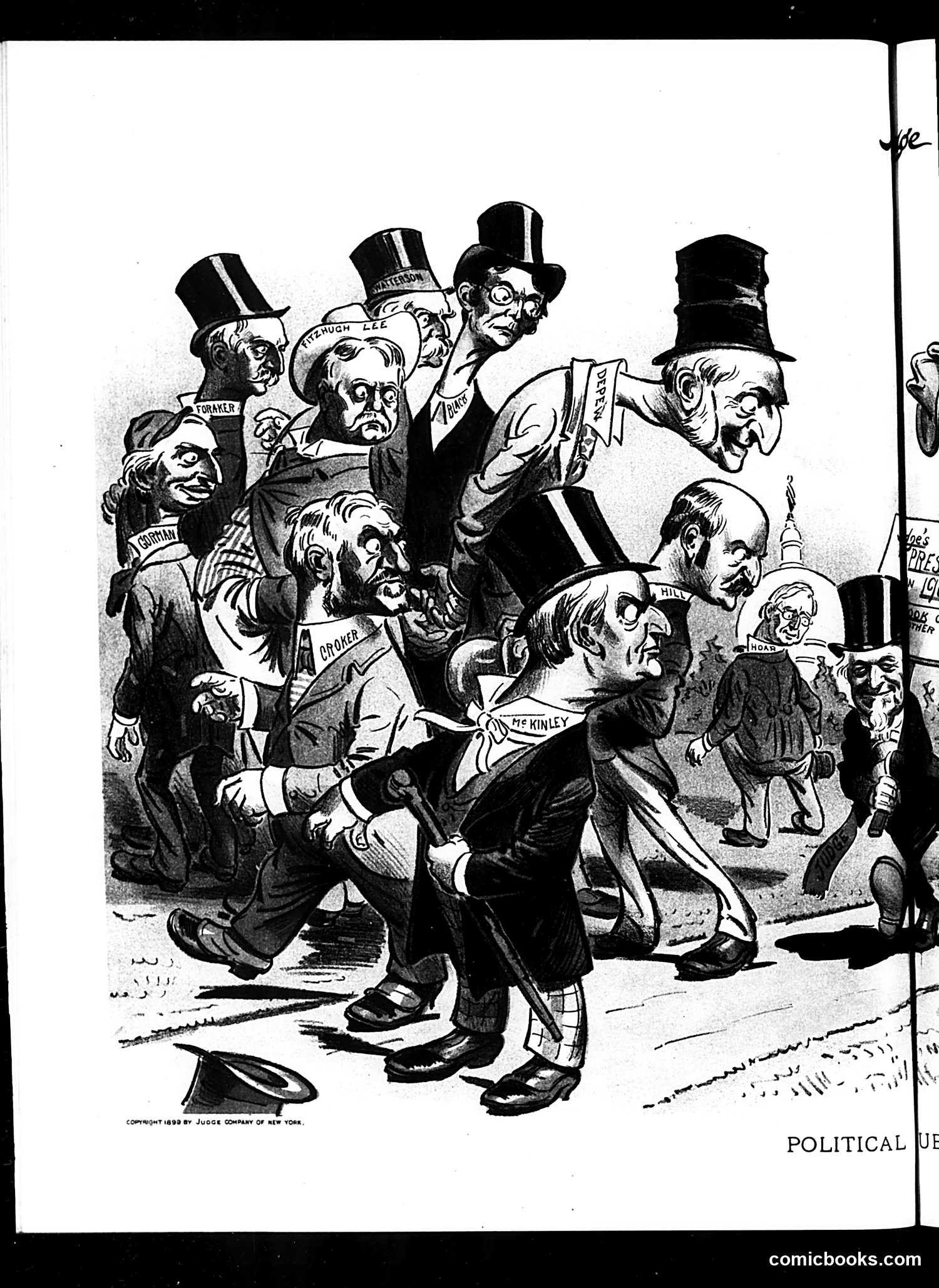
This is a satirical cartoon from *Judge* magazine (copyright 1899) depicting a group of formally-dressed men in top hats labeled with various names including what appears to be "Choker," "McKinley," and others. The figures are caricatured with exaggerated facial features in the style typical of late 19th-century political satire. The cartoon appears to criticize a political establishment or party machine, showing these labeled figures as a coordinated group. Without clearer text labels visible in the image, the specific identities and exact political event remain unclear, though the 1899 date suggests it relates to McKinley's presidency or Republican politics of that era. The formal dress and grouping suggest commentary on political elites or power structures, though the precise satirical target requires additional context.
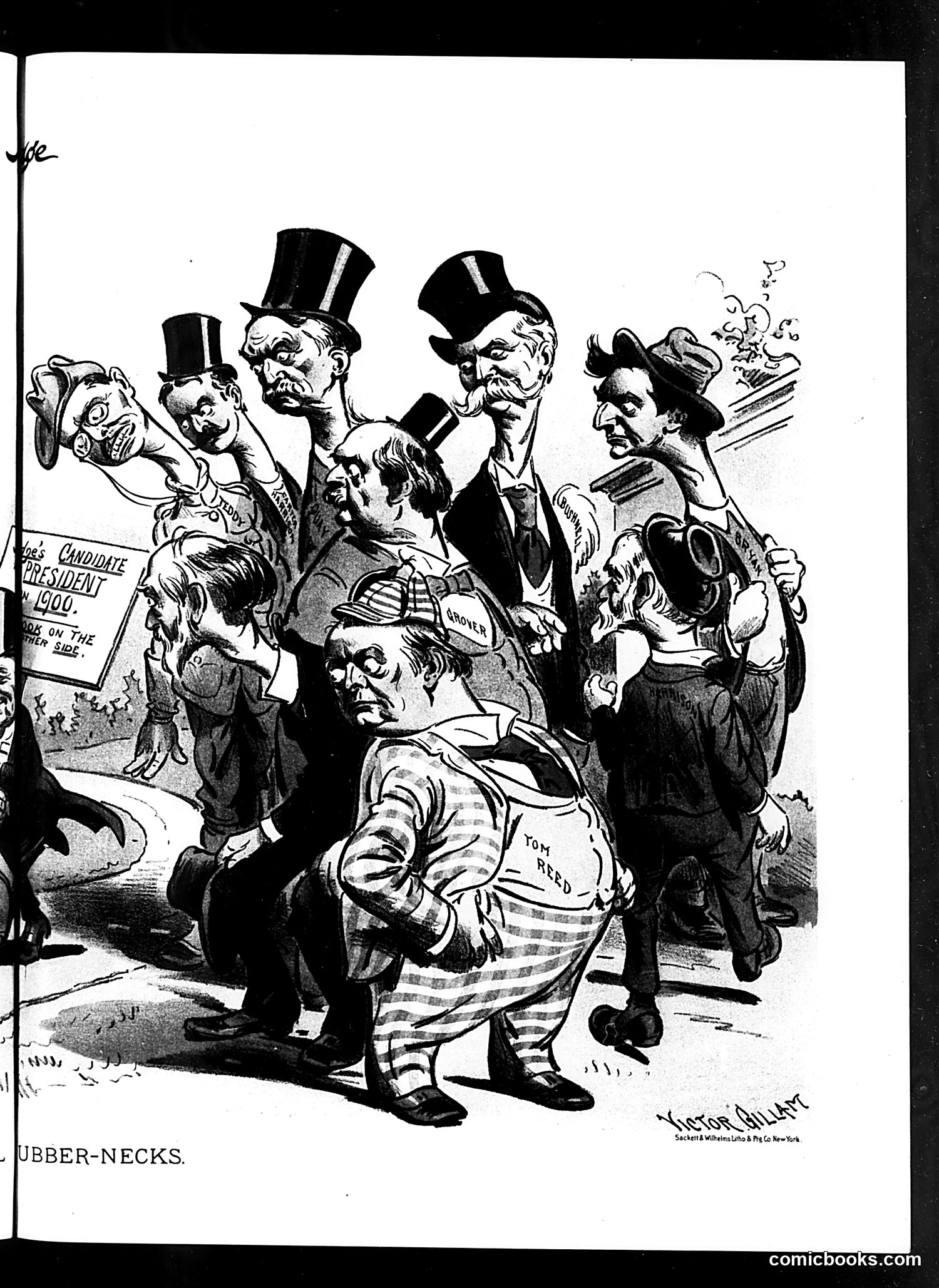
This political cartoon depicts several well-dressed men in top hats with exaggerated facial features—a common caricature style of the era. The title "Rubber-Necks" refers to people who gawk or crane their necks to see something, suggesting these figures are onlookers or rubberneckers at some event. One figure wears a vest labeled "Tom Reed," likely referring to Thomas Brackett Reed, a prominent Republican politician around 1900. A sign visible on the left mentions "Candidate for Presidency 1900," indicating this satirizes the presidential race and its various contenders. The cartoon mocks political figures as gawking spectators—a commentary on their public behavior or the circus-like nature of political campaigning during the 1900 election cycle.
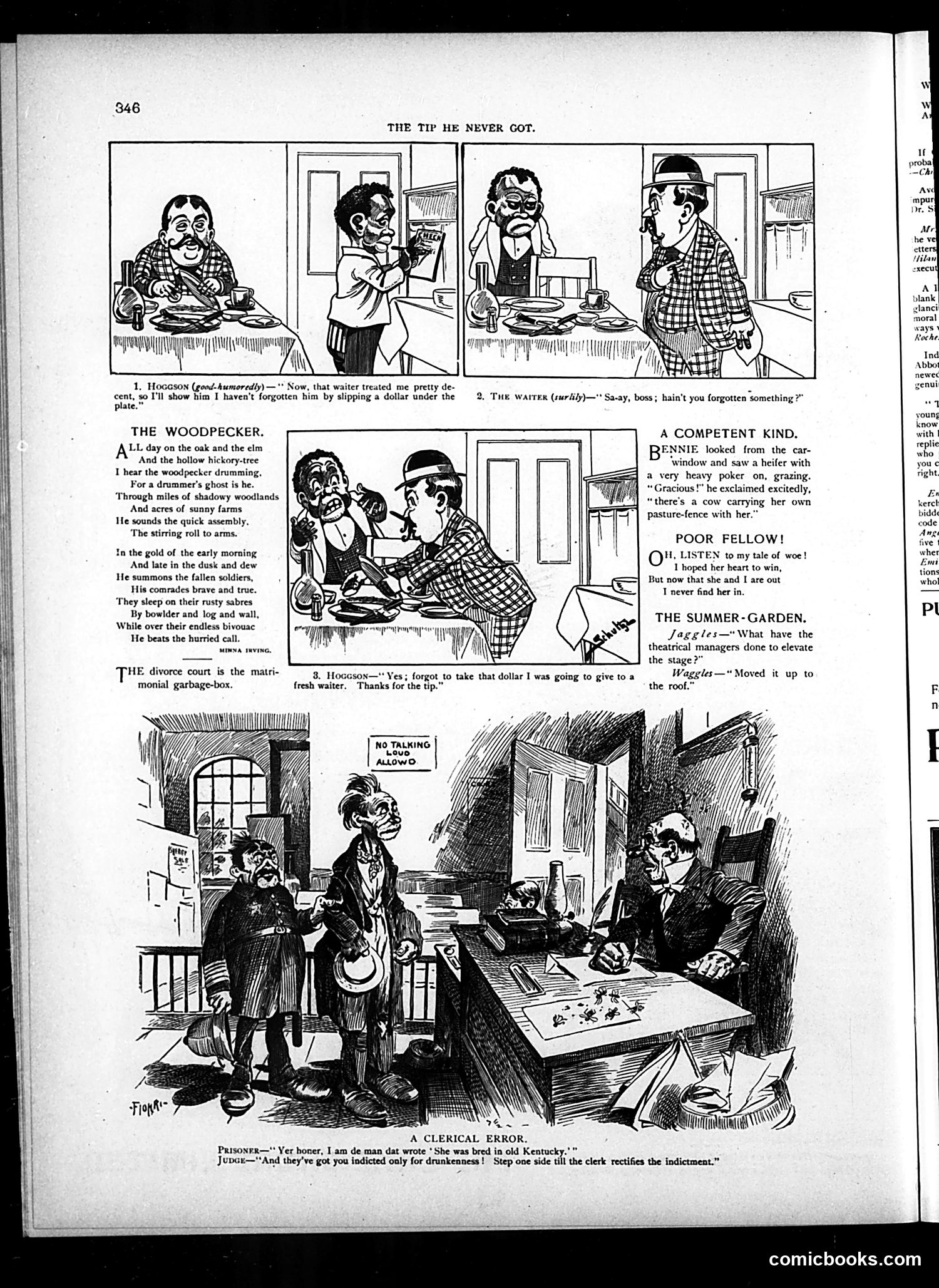
This page contains multiple unrelated humorous cartoons and verses typical of Judge magazine's satirical format. **Main cartoon strip (top)**: Shows a comedy about tipping etiquette. A diner (Hobson) leaves a dollar tip for courteous service, but the waiter, finding no tip under the plate, pursues him complaining he's forgotten something—creating ironic confusion about gratitude and compensation. **Other content includes**: - "The Woodpecker" - a sentimental poem using the bird's drumming as metaphor for summoning fallen Civil War soldiers - "A Clerical Error" - courtroom satire where a prisoner convicted under the wrong charge (drunkenness instead of songwriting) gets his indictment corrected - Various short jokes about divorce, theater management, and bovine humor The satirical targets are modest: social conventions (tipping), bureaucratic incompetence, and theatrical pretension. No specific political figures are identifiable. The page reflects Judge's typical blend of sentimental verse, domestic comedy, and light social commentary.
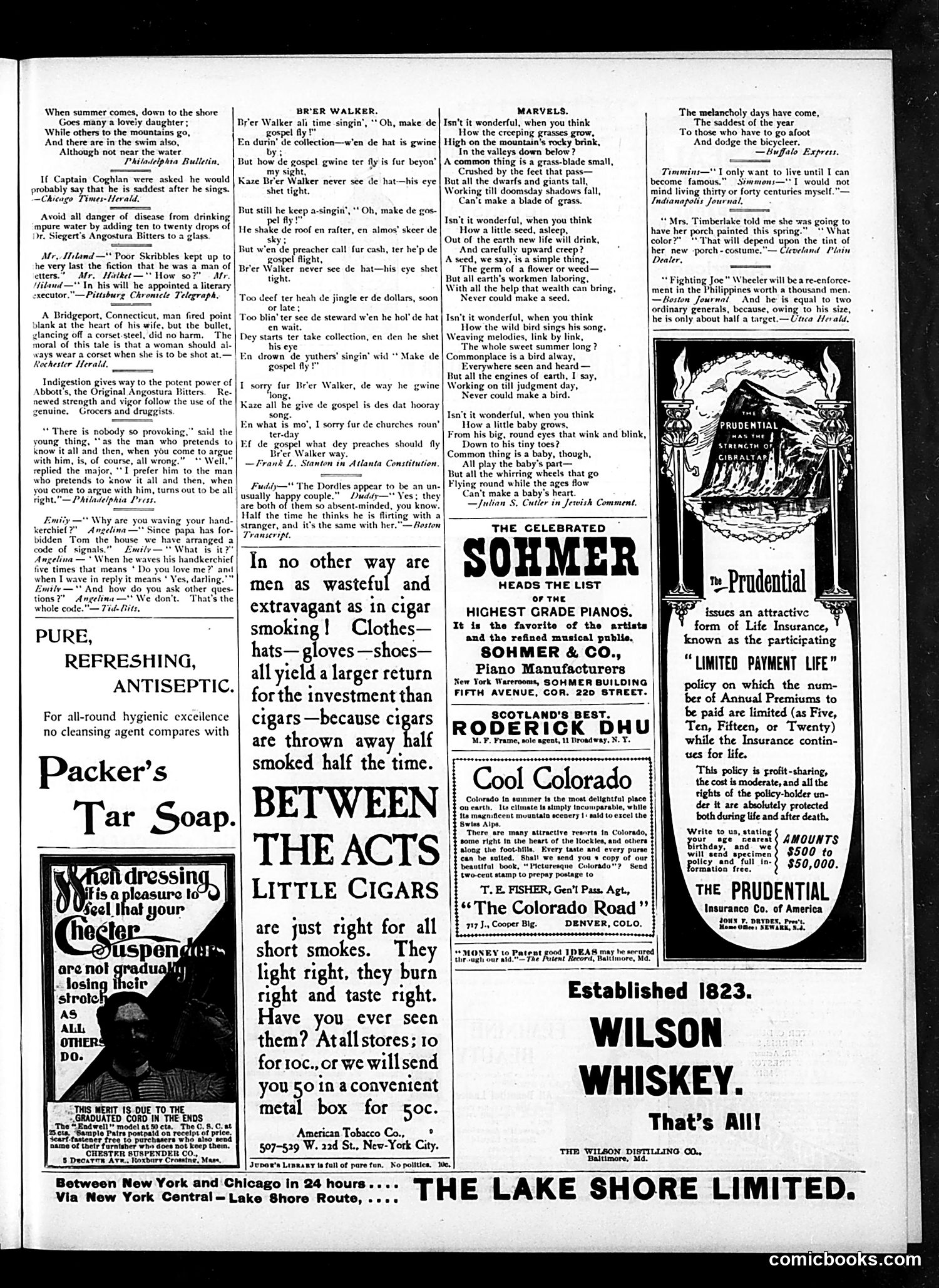
This page is primarily **advertising with humorous filler content**, typical of Judge magazine's format. The main cartoon, "Br'er Walker," uses **dialect humor** (common in early 20th-century American publications) to satirize religious hypocrisy. The character Br'er Walker sings loudly during church services about "making the gospel fly," but strategically closes his eyes and stops singing when the collection plate passes—suggesting he enthusiastically supports religion only when it costs him nothing. The joke critiques selective piety and financial stinginess in churchgoers. The page is otherwise dominated by **product advertisements** for cigars, whiskey, soap, and insurance, interspersed with brief jokes on social topics (courtship, marriage, women's fashion). These short jokes reflect period preoccupations: corsets, flirtation, and conjugal relations. The offensive racial dialect and stereotyping reflect attitudes normalized in that era but would be considered deeply inappropriate today.
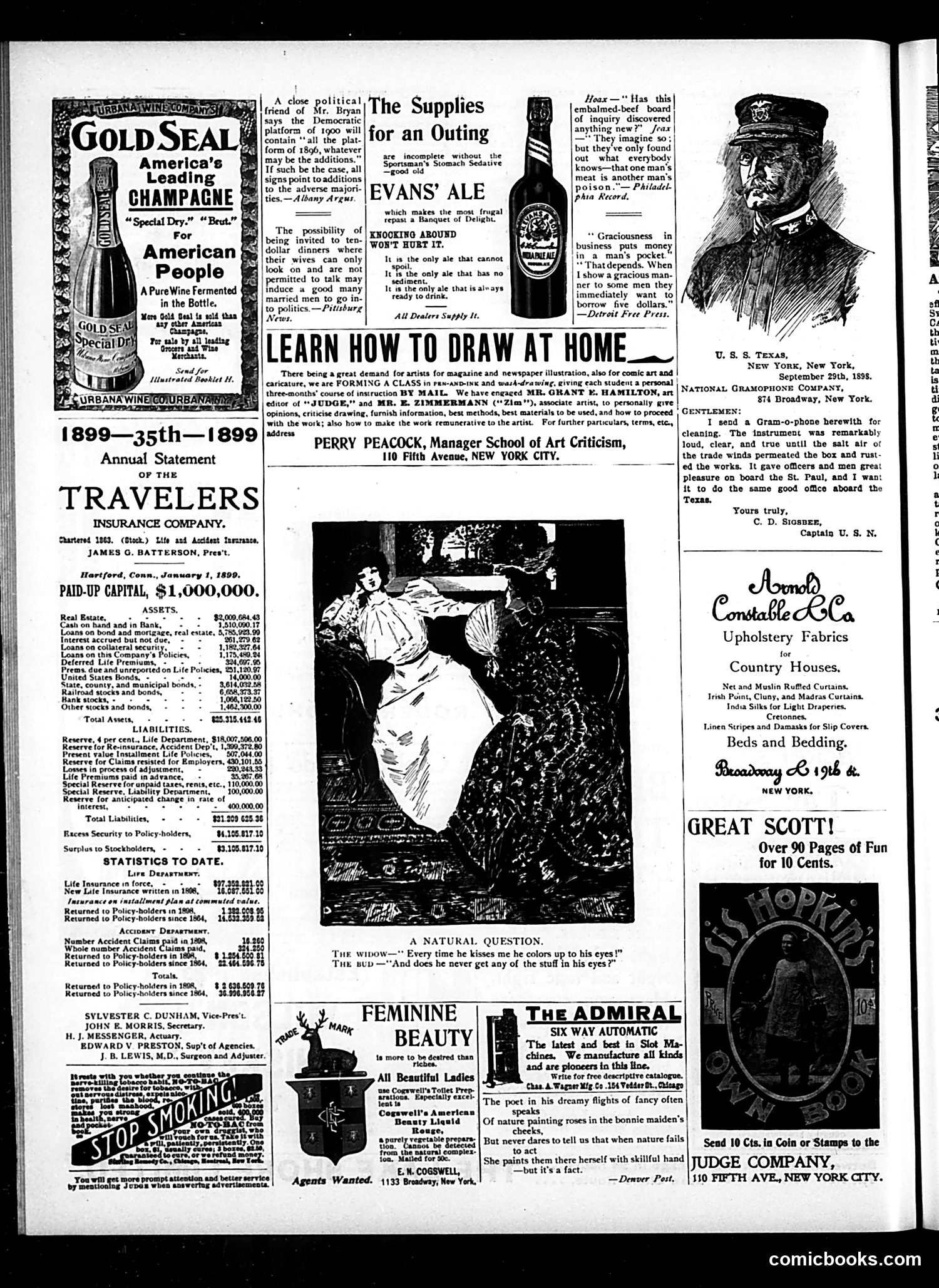
This page is primarily a financial statement and advertisements, not political content. The only political element is a small cartoon captioned "A CLOSE POLITICAL HEAX" (hoax). The widow jokes: "Has this embalmed-beef board of inquiry discovered anything new?" The bed replies negatively. This references the 1898 Spanish-American War scandal where the U.S. Army's "embalmed beef" (chemically preserved rations) made soldiers sick. Congressional investigations followed. By 1899, when this appears, the investigation was seen as finding nothing substantive—hence "political hoax." The cartoon mocks continued inquiries into what was already known as a failure of military provisioning. The skeleton imagery suggests the controversy was "dead" but investigators kept rehashing it.
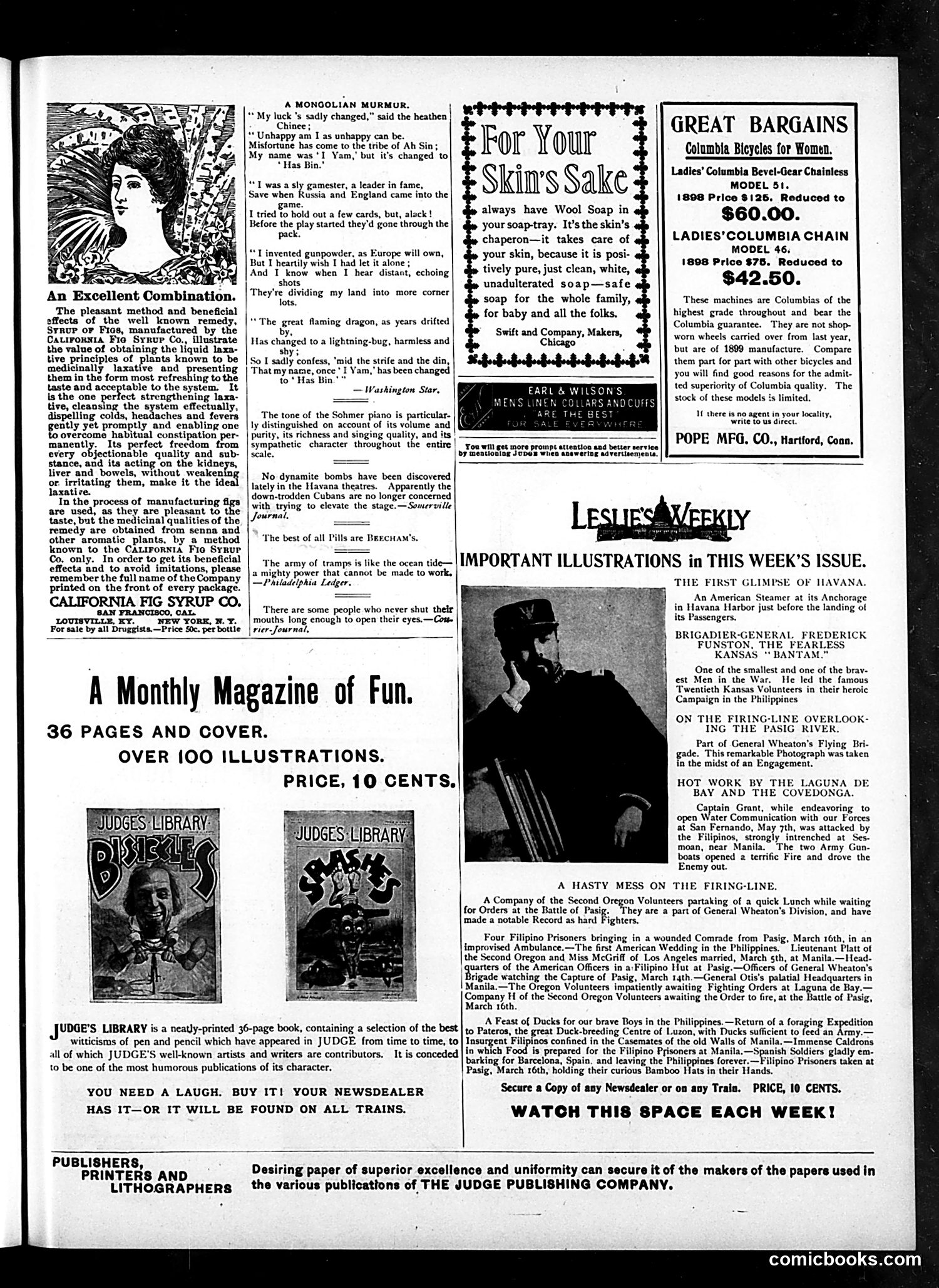
This page is primarily **advertisements and humorous filler content** rather than political satire. The main cartoon, "A Mongolian Murmur," presents a Chinese figure ("the heathen Chinee"—a stock character from Bret Harte's 1870 poem) lamenting his nation's misfortunes. The humor relies on wordplay: his name changed from "I Yam" to "Has Bin" due to bad luck. The complaints reference actual imperial anxieties of the period—**European and Russian colonialism dividing Chinese territory** into "corner lots," and China's lost technological superiority (gunpowder becoming mere "lightning-bugs"). This reflects late-19th-century American attitudes toward the "Sick Man of Asia," treating Chinese decline as comedy while obliquely acknowledging Western imperial aggression. The racist caricature and dialect humor were standard Judge fare. The page otherwise contains patent-medicine ads (Fig Syrup, Brecham's Pills) and bicycle advertisements—typical period advertising that subsidized magazines.
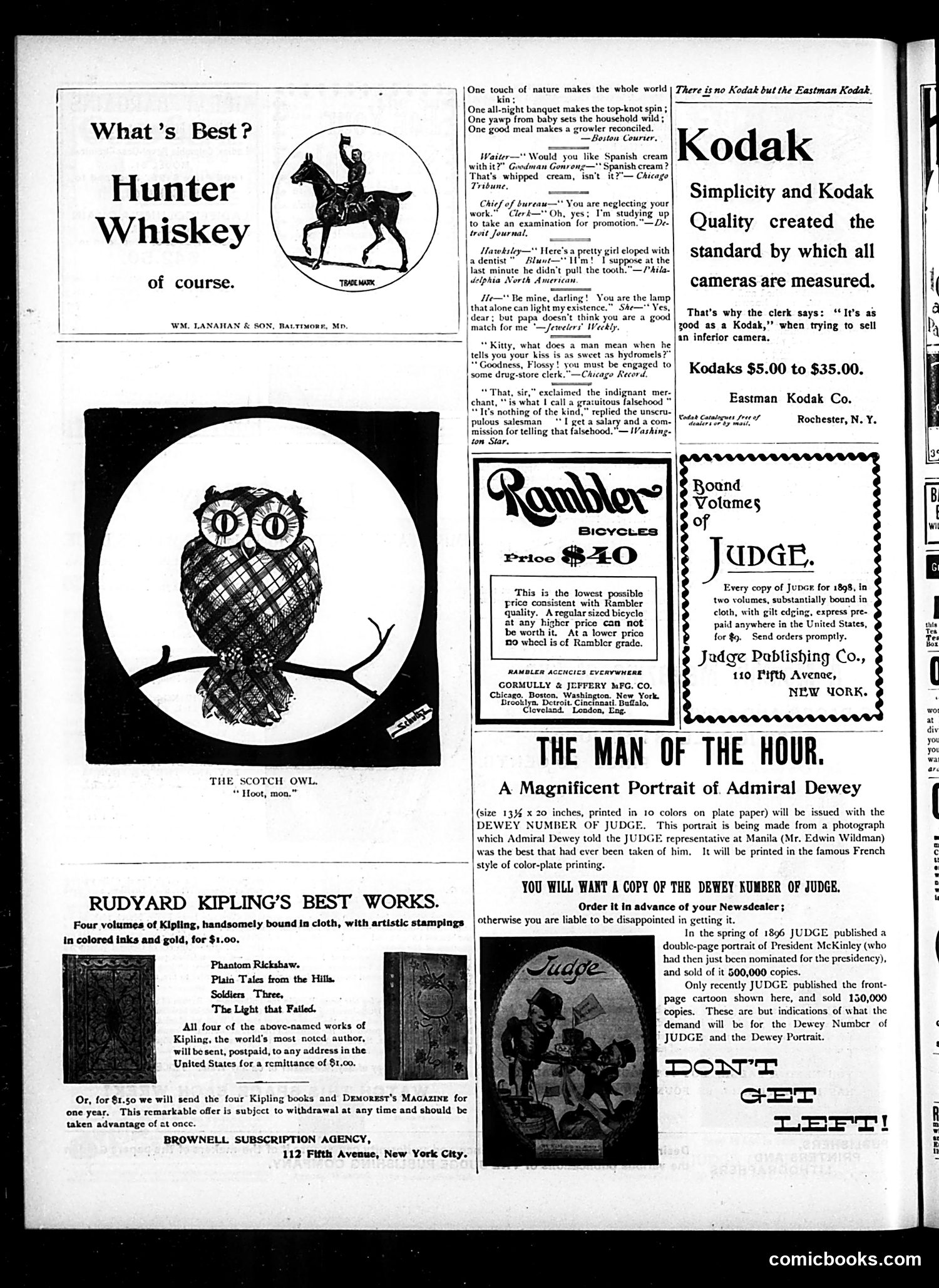
This is primarily an **advertising page** from Judge magazine, circa 1898, interspersed with short humorous jokes. The main visual content includes: 1. **Hunter Whiskey advertisement** with a horseman illustration 2. **"The Scotch Owl"** — a decorative illustration with Scottish dialect ("Hoot, mon"), likely playing on stereotypes about Scottish identity 3. **Rudyard Kipling book offer** — promoting four volumes of his works for $1.00 4. **Kodak camera advertisements** emphasizing quality and affordability ($5-$35) 5. **Admiral Dewey portrait announcement** — promoting an upcoming special "Dewey Number" of Judge featuring a color portrait of Admiral George Dewey, the Spanish-American War hero The scattered jokes are typical period humor about romance, misunderstandings, and workplace situations. The Dewey advertisement references Judge's previous success selling 500,000 copies of a McKinley portrait in 1896, suggesting Dewey's popularity as an American military figure merited similar treatment.
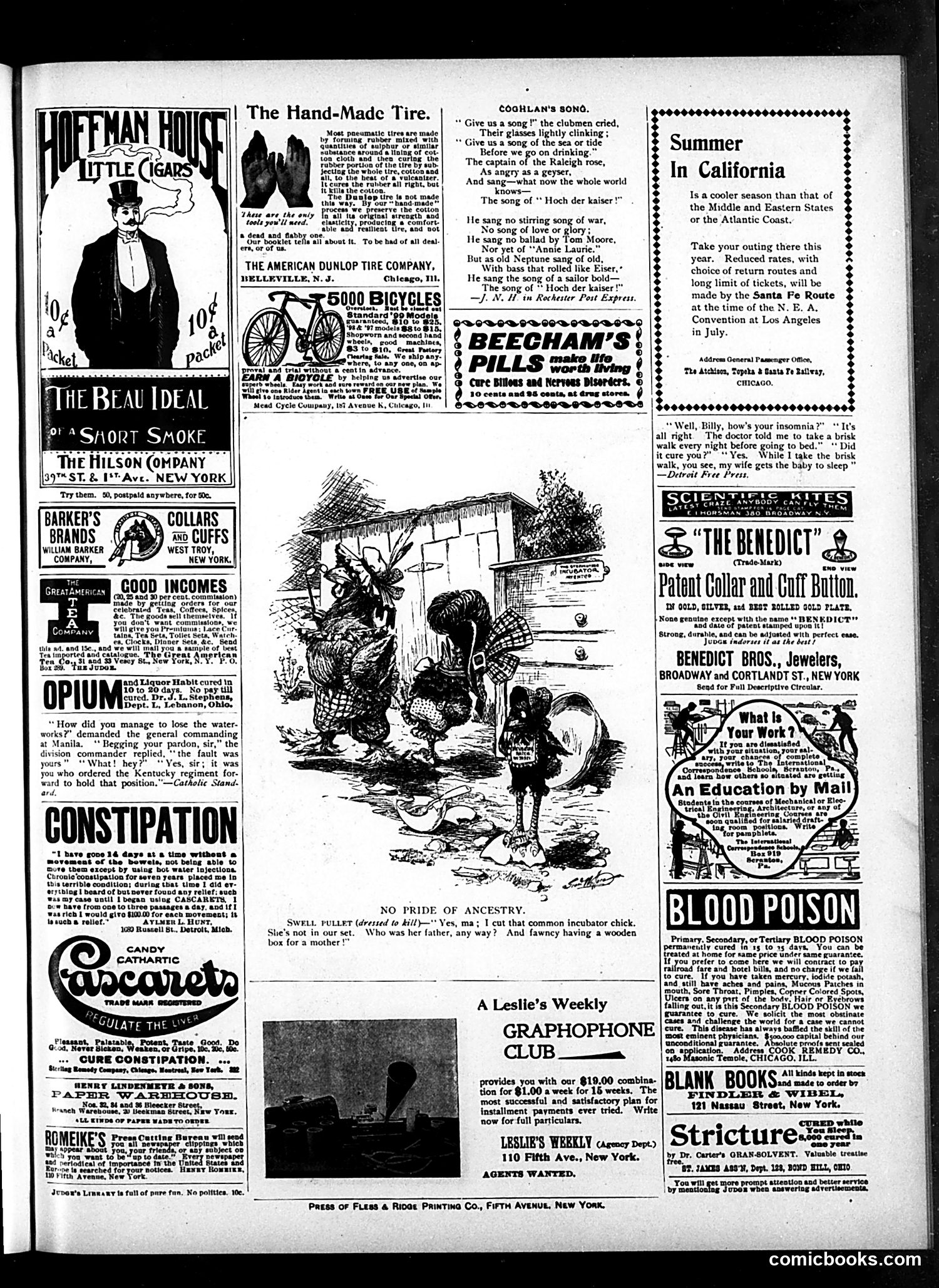
This single-panel cartoon satirizes social pretension among poultry. A dressed-up hen (labeled "Pullet") boasts to another bird that a third hen "isn't in our set," despite being "cut from that common incubator chick." The other hen responds by questioning the pullet's own ancestry: "Who was her father, any way?" The satire mocks humans who claim social superiority based on family lineage. By placing this snobbery in a barnyard setting where all chickens have similarly humble origins, Judge ridicules the idea of aristocratic pride. The humor lies in the absurdity of hens claiming refined breeding when they all come from equally common stock—a pointed commentary on American social climbers who pretended to distinguished ancestry despite ordinary backgrounds. The cartoon's timing suggests this reflected Gilded Age anxieties about newly wealthy industrialists lacking "proper" pedigree.
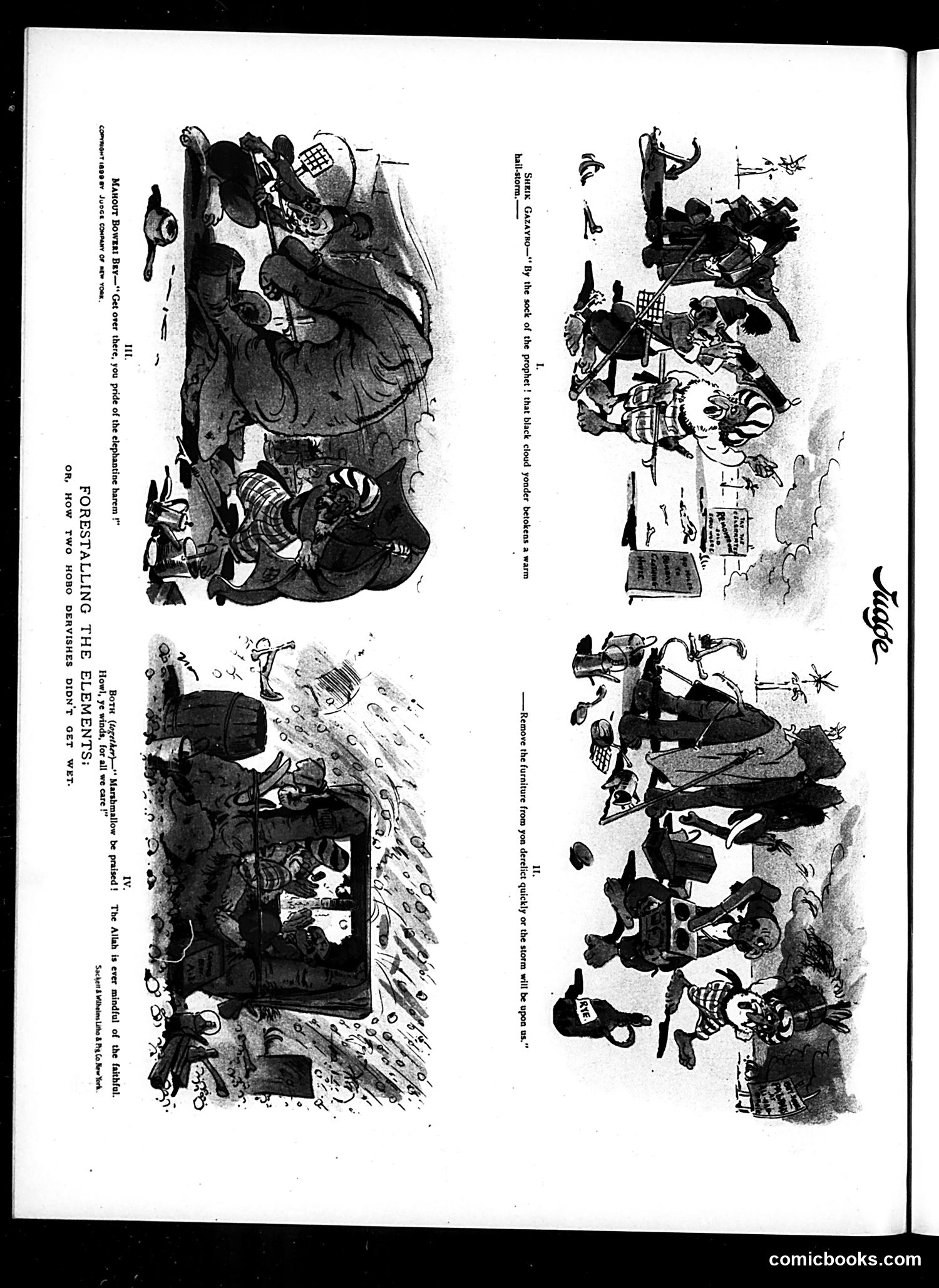
This satirical cartoon depicts two homeless men ("hobo dervishes") using Islamic religious language and poses to comically avoid a rainstorm. The joke relies on ethnic stereotyping common to the era: the characters mock Muslim prayers and customs while claiming divine protection from weather. The humor (by modern standards, offensive) hinges on suggesting that religious devotion—particularly Islamic practice—is absurd superstition. The "dervishes" invoke "the Prophet" and "Allah" while relocating furniture, implying their faith provides no actual protection; they must take practical action anyway. The title's wordplay ("Forestalling the Elements") suggests they're outwitting nature through either luck or the ineffectiveness of their mock-religious posturing. This reflects period attitudes dismissing non-Western religions as mere theatrical performance rather than legitimate belief systems.